Bound to be Visible

For https://www.autostraddle.com/ 

Do you ever see an ad and just think. . . an effort was made. Was it successful? Absolutely not. But the company tried. Is that always enough though? How close to a good amount of effort is close enough to accomplish the purpose? How far off does a company need to be to be ineffective? These are all questions I’ve been asking myself and my friends in regards to the “High Neck Longline Bra” from Girlfriend Collective that swept the media (well, swept my targeted ads on social media) a bit ago. This product is marketed as a supportive and compressive sports bra, but the caption on their Instagram ad, pictured below, is “Full coverage plus a layer of power mesh for extra support. *Wink*”. Yes, they wrote out the word wink in asterisks. No, I’m not sure why they didn’t just use a semicolon-parenthesis combo. 

Girlfriend Collective [@girlfriend]. Picture of Instagram ad for Girlfriend Collective’s High Neck Longline Bra. Instagram.

If you’re in a pretty intense sport, you might look at this bra and see a good supportive bra. If you’re somewhere in the genderqueer category, you can squint a little bit and see a potential binder alternative. Not only is it possible, but this realization already happened very visibly in the comment section. This realization has both positive and negative side effects, as I’ll explain later. Below are some of the comments on this ad, with names and profile pictures marked out for privacy. My personal favorites are “Binder 💞light💞” and “besties this is a binder”. 

Screenshot of comments on Girlfriend Collective’s Instagram ad. Girlfriend Collective [@girlfriend]. Picture of various comments on the ad above. Instagram.

These sorts of comments are harmless, or at least seem to be. Using sports bras as binders is not a new concept to people with breasts that do not identify as cisgender women. Buying actual binders can sometimes be inaccessible to people who might not be out to the people they live with. Many times, young people will bind unsafely with Ace bandages or sports tape instead of a binder to either avoid outing themselves or accommodate their financial situation. At times like these, it’s easier for someone to convince their parents to buy a sports bra over something marketed as a binder.

Does it actually work as a binder though? According to two of the TikToks I found, yes!! Isn’t that exciting? Accounts @salemnight (he/they) and @cowboinary (they/them) on TikTok both did reviews on the High Neck Longline Bra from Girlfriend Collective. Salem gave a holistic and visual review of how the bra looked in comparison to his other binders and bras as well as answering some common questions, while @cowboinary focused more on how the bra felt and compressed in comparison to their other binders. These TikToks I found after simply searching “girlfriend collective binder” can serve as an incredibly useful resource to young people or closeted people looking for binders that are accessible to them, as well as assuring people that it does actually work as a binder. 

Screenshot of comments on Girlfriend Collective’s Instagram ad. Girlfriend Collective [@girlfriend]. Picture of an exchange in the comments of ad pictured above. Instagram.

However, the visibility and accessibility of this product might also serve as a detriment to its usefulness in some ways. Above, with names and profile pictures yet again blocked out for privacy, you can see an exchange between two users in the comments section of this Girlfriend Collective ad on Instagram. One person asks “WHY would you want a HIGH neck bra??” Another user responds explaining that it’s a binder, marketed as a sports bra “so those who are in the closet or in an unsafe environment to come out in can get one to help with dysphoria without outing themselves and risking harm”. The first user responds positively in a reply. However, imagine for a second that you’re a young trans man, looking for a way to convince your transphobic parents to buy you a binder or allow you to get one without coming out. They think it’s an odd request, to get a high neck bra, go onto Instagram, ask this question, and get a response that could potentially force you into an uncomfortable situation. This may or may not happen, but it’s not ideal, right?

The rise of social media and marketing on these platforms has resulted in a multitude of both problems and benefits. Benefit: people are funny in the comments of what, to them, is an obvious secret binder. Problem: the discrete nature of the marketing can be ruined by people thinking it’s funny. Benefit: TikTok provides a platform where multiple people can assure you in different ways that a product is going to work how it says it will. Problem: TikTok provides a platform that brings so much attention to a certain product that even a month later, most sizes are sold out (including my own, sadly). These pros and cons don’t necessarily cancel themselves out, but it’s an interesting and complex issue that companies who aim to produce these discrete products should consider.

So. With this High Neck Longline Bra ad, I just think. . . an effort was made. Was it successful? In my mind, partially. It’s rather expensive for an improper binder at $42, where there are other less expensive options. However, the brand is incredible with size-inclusivity and sustainability. The company tried. Is that always enough though? How close to discrete is close enough to accomplish this subtlety? How far off from discrete does the company need to be to have people aware that this is a secret binder? Is the *Wink* enough, or should they have just put a semicolon and a parenthesis? Many of these questions are unanswerable, as we don’t yet have enough experience with these hurdles (I really do think they should’ve just used a little 😉 though). These questions and conversations are important, regardless of our lack of answers, as our goal as consumers and producers of media should always be to learn more and adapt to the times. While we have these conversations around discrete marketing, I’ll be watching my email carefully for an update on when the bra/binders come back into stock. For, uh, research.

Book Review *Everyday Sexism: The Project That Inspired a Worldwide Movement*

The overwhelming truth of our world today is the ignorance or dismissal of still- rampant misogyny is as harmful as ever. In some cases, it feels as if the most effective way for the public to understand and agree there is a problem to actively work against, the accounts must be clearly laid out in front of our eyes. Laura Bates, journalist and feminist who details her own reports of assault, takes this to heart as she transforms what began as a catalog for women to share personal experiences of sexism, into a full-forged book of facts and real life stories of how misogyny is woven into everyday life. After her own experience of being harassed on London transport in 2012, Bates becomes passionate about the reality that if she went through this act, other women most definitely have their own stories to share as well.

The beginning of this movement was founded on the idea that the day to day instances of harassment and under representation of any degree deserve to be reported and known, so the argument that this does not occur in current day society can be rebutted. The Everyday Sexism Project, which began in London but became a worldwide phenomenon, is still running as a website, and anyone can report cases of misogynistic actions. After the online platform gained momentum, Bates formatted the stories told into one of the boldest works on the fight against sexism. The power of this collection comes from it being exclusively compiled of real life and relevant circumstances of misogyny being alive today, from women who have lived to tell the tale. 

Laura Bates has certainly already left her mark on the gender and sexualities field, from her numerous publications to her awards won in the craft. An English feminist writer who graduated from the University of Cambridge, Bates has published five works of literature, including Misogynation: The True Scale of Sexism (2018), The Burning (2019), and Men Who Hate Women (2020) as her most recent works. She is also working with the Women Under Siege Project, which is based in New York and has a mission of chronicling how gender violence has been utilized in warfare. Articles she has contributed to this platform include “The Impact of Nurturing Male Violence,” “Shutting us down: How online misogyny prevents women from fully participating in misogyny,” and “A crime upon a crime: rape, victim-blaming, and stigma.” Bates is strong in her assertion of important conversations into her work as she tackles women’s issues. Her relentless dedication to both breaking down injustice and empowering women, which go hand in hand, has led her to earn many honors, including the British Empire Medal in 2015 for services to gender equality and Cosmopolitan’s Ultimate New Feminist Award in 2013. More recently, she has been elected as a Fellow of the Royal Society of Literature as a result of all of the new and upcoming works she has provided. Bates’s publication of Everyday Sexism, in particular, began her trajectory as a feminist writer and opened more doors for how the misogyny women face can be addressed in future literary works. 

The approach Laura Bates takes covers how sexist behavior exists in all places, but it is easy for those who do not experience it’s harm to become oblivious to its effect when it goes unreported. Through the one hundred thousand entries posted, it can no longer be waved off as an invalid, already resolved issue. This myth is debunked further with every inclusion of personal stories from cat-calling, unfairness in the workforce, to violent rapes. Laura Bates declares these crimes against women need to be addressed on a wide, global platform. 

Bates presents both qualitative and quantitative research as the methods of which to layer this argument. The qualitative accounts are derived from the inclusion of women’s personal stories and experiences. While the Everyday Sexism itself website gained over 100,000 submissions before this book was published, the book includes around 15 short excerpts of what these posts had to say. This strengthened the work tremendously, since it backed up Bates’s argument of how misogyny is interwoven into the trials of daily life through following up a point with an undeniable example that proves it. Quantitatively, each chapter begins with a list of vital statistics regarding the topic. This is equally as advantageous to the case at hand, since it sets in place a series of irrefutable numbers and percentages that cannot be overlooked. Both methods, when imputed together, are effective in conveying the serious message of what women have faced both historically and, now, face currently. 

The first four chapters, after the introduction, focus primarily on “Silenced Women: The Invisible Problem”, “Women in Politics,” “Girls,” and “Young Women Learning.” Bates sets up her argument in a way that naturally flows and substantiates as it goes along. To start, she pinpoints three elements that lead silencing to occur: “these three powerful silencing factors- the invisibility of the problem, the social acceptance of it, and the blaming of victims- are corroborated loud and clear by the reports we received, particularly from young women who are learning such lessons hard and early” (29). Later on, in the chapter of women in politics, Bates offers striking statistics, including how at the current rate of progress, it will be 2121 before gender parity is achieved in Congress, according to the Institute for Women’s Policy Research. Bates follows this up with stating how women are enormously underrepresented in politics around the entire globe, and how “one frustrating consequence of women being underrepresented in politics is that often any woman is seen first and foremost to represent all women, as if she speaks and advocates for them, and can be judges as if all womankind stands or falls by her actions” (66). This is especially problematic when taking into account women who are also marginalized by their disabilities, sexuality, or skin color, “none of whom are miraculously included in the debate simply by the introduction of a white, middle-class voice” (66). Bates starts her book with powerful sentiments that cannot be overseen. 

The next following chapters include “Women in Public Spaces,” “Women in the Media,” “Women in the Workplace,” and “Motherhood.” These four sections are incredibly telling as they combine all of the different areas where women may face the most discrimination. One particular area this is amplified is street harassment. Bates includes stories of women who “describe the emotional and psychological ways street harassment affects them to an extent that those who do not experience it might struggle to imagine” (173) including the self-hatred and shame that can result from it. Bates also adds how “women of color, trans women, and women of the wider LGBT community experience disproportionate levels of street harassment (the Stop Street Harassment study found that 45 percent of all LGBT people surveyed experienced physically aggressive harassment or assault compared to 38 percent of all heterosexual people) (178). The implications of mistreatment in these key areas is extremely harmful, as Bate expresses, since it devalues the way women view their presence in their fields of study, and how much more difficult it becomes to advance. Also, it is detrimental for institutions to refuse to evaluate how they may be playing a complicit role in this issue. 

The final four chapters of this book incorporate “Double Discrimination,” “What About the Men?” “Women Under Threat,” and “People Standing Up.” The final excerpts of Bates’s work are arguably the most dire to address today. This is where Bates highlights intersectionality as a key term. She explains how “since the Everyday Sexism Project started, many of the stories we have catalogued have described not only sexism but sexism intermingled with other forms of prejudice- racism, homophobia, transphobia, classism, ageism, disablism, stigma around mental health problems, and more” (291). It is indisputable that transgressions are commonly made against multiple identities at once, and Bates’s inclusion of double discrimination as an entire chapter gives this book an added layer of depth. She states how anyone different from the dominant norms including heterosexuality, white, cisgendered, and nondisabled are met with serious threats. From a feminist perspective “if we are to tackle the fact that women have historically been oppressed because of characteristics that are seen to be different from the male norm, how can we protest such treatment while simultaneously excluding from our own movement the needs and agendas of those with other significant characteristics?” (293). Bates seeks for intersectionality to be synonymous, or rightfully included in every action of the feminist movement, which is crucial for her case to not be met with protest of it being catered exclusively towards white women, which is a route taken time and time again with feminist works that do not account for all women. 

One particular area where Bates’s strengths as a feminist writer come to fruition is her thoroughness when it comes to detail. Each chapter is filled to the brim with resources, research, and insight into the topic at hand. Her word choice is poignant and powerful, and causes readers to be introspective and process what is on the page, and how it is ever present in the world around them. Her inclusion of intersectionality and how incredibly important it is to understand how the issues white, middle class women experience cannot be the loudest voice in the room, since they cannot speak for everyone, sets her tone and supports her argument as one that is inclusive. 

One identifiable weakness is how, although there was a chapter dedicated to the presence of double discriminatory factors, this was not brought up until the very end. Bates did an exceptional job of spotlighting it as she wrote, but it could have been included throughout more of the book. If it were touched upon inside more of the work, readers might gain a greater sense of how pressing and real it truly is. Also, Bates does not elaborate much on what the word “women” covers for her, so this either means it is an umbrella not necessary to exclusively define for the book to still carry the same message, or it is a binary approach. After reading, I believe Bates refers to this term more closely to the first option. 

Critics rave of Everyday Sexism as a pioneering work, and after analyzing it, this remains true. The layout is concise, and the material is nothing short of compelling and raw. Bates has most definitely succeeded in bringing forth a book that is both personal and provocative in how it addresses the issues that need to be dissected. Every skeptic of misogyny and gender discrimination as a real deterrent of women’s empowerment and equality should read this book. College-age students specifically may gain the most from diving into this work, as it is important to pinpoint how these misogynistic mentalities penetrate our world as we are learning individuals, so we can dismantle them together. Overall, this work from Laura Bates is a must-read for all. 

Book Review: “Sex/Gender Biology in a Social World”

by Chase Waldner

One of the most perplexing and scientifically mystifying areas of study is neuroscience. The study of the brain, memory, identity and neural networks is interconnected and infinitely complex due to the multitude of factors seen and unseen that contribute to what makes you, you. A specific application of this is in the biological study of sex, gender, and sexuality. We have no idea what truly creates gender in humans or any animal for that matter, but we have some fairly decent guesses. There is a potential prenatal hormonal factor that could contribute to gender; a genetic factor, epigenetic factor, a parental and sibling factor, a societal factor. There are too many “answers” as to why we experience gender the way we do to seemingly ever find the true cause, although I suspect it’s a combination of all of those aforementioned aspects in combination with some we have not even discovered yet. Over the years, biologists, psychologists, anthropologists, and sociologists have all performed many different types of studies to try and get closer to the big gender questions: Why do we experience it? Why are there so many different expressions of it? How can we better understand it? And we have made a lot of progress in this field. Anne Fausto Sterling brilliantly summarizes a lot of the major work done on gender exploration and does so from a lot of these unique scientific perspectives. 

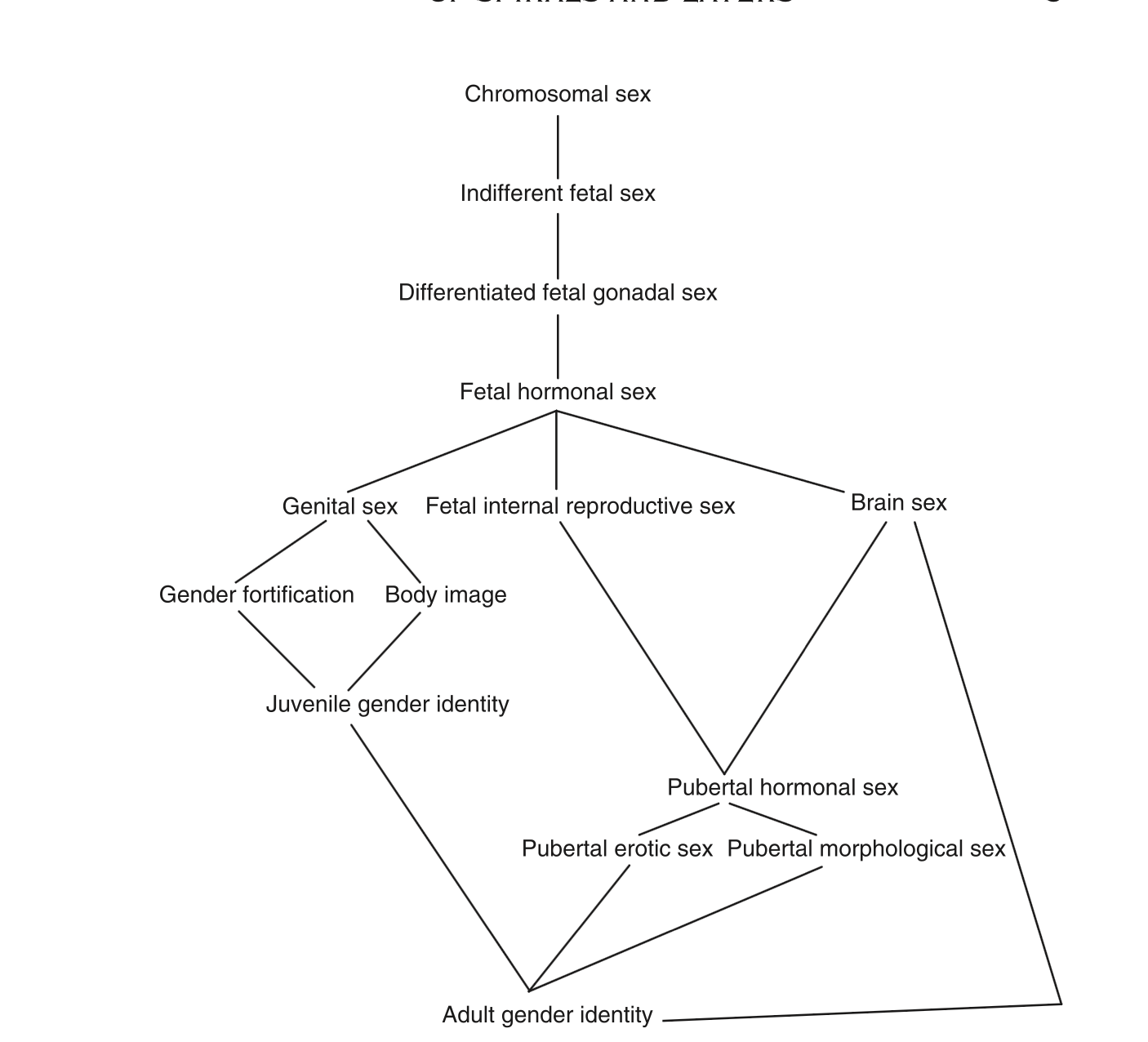
In, Sex/Gender Biology in a Social World, Sterling deep dives into the scientific pursuit of gender within the context of social pressures we experience within our culture. She describes both the biological and cultural contributions to our multifaceted gender identity and expression starting from conception and ending with adulthood. She identifies the many different sex and gender identities we cycle through throughout our development and how they each play a role in our final, “adult gender identity.” Sterling uses Money’s “sex layer model” to show this. You start with chromosomal sex (ie. XX, XY, or, rarely, some other combination of sex chromosomes), then “indifferent fetal sex,” and as you develop go through 11 other “layers” of sex until you end up at your adult gender identity. These layers aren’t linear as some layers form as a function of several that come before it. For example, brain sex and fetal internal reproductive sex both contribute to the pubertal hormonal sex of an individual, and gender fortification and body image both create your juvenile gender identity. Sterling uses this book to break down all of these different categories and talk about the different aspects of each one and how they play off of each other in order to come to some sort of definition or conclusion on what makes up our gender.

these are the “layers of sex” from Money

NY native, Anne Fausto Sterling was born in Queens, New York, in 1944. She graduated from The University of Washington with a degree in zoology in 1965 and later earned her Ph.D. in developmental genetics from Brown University in 1970. Currently, Sterling is the Nacy Duke Professor of Biology and Gender Studies at Brown and works within the molecular and cell biology department as well as the biochemistry department. During her time in academia, Sterling has written several books about gender intended for a general audience and has made over 60 scientific articles on similar subjects. She also is a Fellow of the American Association for the Advancement of Science where she has received many grants for both the sciences and humanities. Clearly, Sterling is known for her astounding scientific achievements and has made many contributions to modern-day feminist movements with her work on the intersection of gender and biology. Sex/Gender Biology in a Social World was written in 2012 and is just one of the written works Sterling has produced on gender. Her listed main areas of interest are, “rethinking the nature/nurture divide, women in science/gender, intersectionality, homosexuality and its construction, and the role of race in gender and sexuality.” Her Ph.D. and mountain of scientific excellence make her uniquely qualified for explaining and exploring gender through a variety of scientific methods. 

For this book, Sterling references many researchers across several disciplines and creates a holistic view of gender through that lens. As said before, she uses Money’s “layers of sex” model to explain how our own gender changes as we grow up. At the beginning of the book, Sterling uses several stories and metaphors to explain how we have been and probably will always be a gendered society. Although our societal expressions of gender have changed throughout time and across different cultures, it will always be a part of the human experience. Starting from birth, your parents dress you and socialize you based on your sex or genitalia, and with this interpretation of your sex, your social gender identity is created. In modern-day America, we have pink for girls, blue for boys, and all childrens’ toys have a gender that they are intended for. Our society has determined what you are supposed to like and how you should act based on your perceived “boyness,” or “girlness.” This in combination with the infant starting to learn their anatomy by discovering their genitals, and the genitals of those around them creates their sense of body image.

Sterling also makes a point of how some different species have more than two sexes, and how some creatures have more than one type of male or female. For example, some insects have three distinct sexes, and there is a species of lizard that does not use males at all for reproduction. There are a variety of factors that determine what sex an animal will be too. Some frogs use temperature for sex determination, and there are so many other seemingly arbitrary environmental features that different species use to determine the sex of their offspring. Some species can even change their sex (ie. develop the opposite genitals and reproductive organs to their natal body) based on a lack of males or females in their vicinity. All of this boils down to Sterling making a point of how up in the air and fluid both sex and gender are. We can not truly understand them if we keep thinking of them as rigid and unchanging when in reality they keep growing and developing just as we do.

As the book continues Sterling circles back to explain the process of human child development in more detail and highlights the stage or “layer(s)” of sex one has reached based on their stage of life. When embryos are first beginning to develop they go into a stage of “equipotential development” where male and female fetuses are indistinguishable. At this point in time, the fetus is said to have reached the “indifferent fetal sex” layer, and soon the XX and XY babies will begin to develop in separate, yet similar, processes. Sterling also makes a note of intersex children and how sometimes sex can get a little more complicated than just male or female. Intersex babies may present as one gender while having the genetics of another, or even have a mix of male and female parts. She then goes into the different aspects of “brain sex.” In some species, like canary birds, the presence of a sex hormone will change the size/development of specific parts of the brain. For example, the injection of testosterone into a female canary’s brain will cause the “song” part to grow and that female will begin to sing male-specific songs. Environmental complexity also affects brain sex. In an experiment with rats, there were separate groups of male and female rats. Some were placed in a cage with no enrichment, while others were given toys and housed together to provide an enriched environment. Female rats in the enriched environment had significantly higher neural branching (think of more neural branching equating to more/better/faster communication within the brain) than males. And in the caged environment, males had higher levels of neural branching. This goes to show how complex brain sex is and how, in some ways, male and female brains develop differently. This, in turn, creates a big part of our adult gender identity.

Throughout the entire book, Sterling does an excellent job at providing enough scientific detail to provide context and clarity to her exploration of gender, while at the same time not jumping off into the deep end and making the book inaccessible to people with less biological knowledge. At some points in the book she lets herself dive a little deeper into genetic and biological factors of sex and gender and provides mind-gripping science and discovery to keep her readers invested in the book. Some chapters even come across more like scientific articles minus the chemical jargon. This is a wonderful way to expose people to the science behind our brains without losing them with an excess of detail. At the same time, Sterling also uses more anthropological and historical perspectives to analyze gender which only furthers her reach of audience.

While Sterling does a phenomenal job explaining all of these different perspectives, she also sometimes gets lost in story and metaphor. Part of her writing style is to use anecdotes to explain complex topics, but she sometimes spends too much time fleshing out those stories and loses focus on the point of her book. In chapter five, for example, she spends the first half recounting two conflicting scientists’ histories with each other in an attempt to explain gender identity and, more specifically, fetal sex. Although there is validity in bringing up these two scientists, the length of time she spent on their lives rather than their work concerning gender in the context of this book seemed excessive. This is not the only time she does this either. There are a few longer chapters in this book that could be shortened and clarified with some editing down of irrelevant information.

Anne Fausto Sterling’s Sex/Gender Biology in a Social World was well written and provided a wonderful intersection of science and humanities to explore what sex and gender are. Her in-depth recount of the neuroscience and biology behind gender was especially gripping while reading through this book. It truly is meant for people from all walks of life. You don’t have to know a lot about science or biology to understand what Sterling is saying, although having some prior knowledge is imperative to understanding the full picture. At the same time, you do not have to be an anthropological expert to follow along either. Sterling successfully made this a book for all people regardless of their background and education, as there are so many different yet connected perspectives on gender that she cycles through.

Work Cited:

Fausto-Sterling, Anne. Sex/Gender: Biology in a Social World. Routledge, 2012.

Sterling, Anne. “Home – Dr. Anne Fausto.” Anne Fausto Sterling, http://www.annefaustosterling.com/.

Book Review: *Ableist Rhetoric: How We Know, Value, and See Disability*

As a society, our interpretation of disability should be no different than our interpretation of race, gender, class, or any other aspects of our identities. But, as a society, our interpretations of our different identities face constant backlash and oppression that plagues the idea of what is considered to be “normal.” In the monograph, Ableist Rhetoric by James L. Cherney, it is emphasized that ableism studies are different from disability studies, but in studying ableism, contributions are made to the field of studying disabilities. To put it simply, studying oppressive factors enhances knowledge on the situation of oppression. The same can be said for racism and ethnic studies and sexism for women’s studies (Cherney 11). Additionally, Cherney argues that viewing ableism in a rhetorical light allows for us to see the role it plays in everyday life and our commonly perceived norms.

James L. Cherney, Ph.D. is currently an associate professor in the Department of Communication Studies at the University of Nevada, Reno. In addition to Ableist Rhetoric, Cherney has published multiple journal articles, book chapters, media reviews, and more, most of which with a focus on disability studies and ableist culture.

In Ableist Rhetoric, Cherney argues that the main relationships that support the genre of ableist rhetoric are that (1) deviance is evil, (2) normal is natural, and (3) the body is able (Cherney 24). He discusses that while some media may not fall neatly into one of these three categories of analysis, ableist themes can nonetheless be present. The argument for deviance is evil is that in the media, people and concepts that are “unnatural” or deviate from the accepted norms exhibit sin and are reason for punishment. This relationship is exhibited when Cherney discusses The Exorcist and how the little girl’s deviant behavior is demonic and needs to be expelled. Before it’s accepted as demonic possession, doctors pass it off as a mental disorder or some form of neurodivergence that is not inherently bad. However, once they find that the root of the problem is demonic possession, it is unanimously decided that the girl must be cured. While one may question how this example is an idea that enables an ableist rhetoric (since it rules out a neurodivergence), it still assumes that deviation from normal behavior is evil and needs to be dealt with in a proper, holy way.

The argument for normal is natural is that natural law and biological reason are used to define what we consider as “normal” (25). The relationship is demonstrated by explaining the Cochlear Implant Debate (CID) and the conflict it creates within ableist culture, but more specifically, Deaf culture. According to Cherney, “the CID pits Deaf activists who see the implant as a threat to their cultural identity against medical specialists and implant designers who typically view deafness as an illness that can and should be cured” (64). Activists take the stance that this view assumes that Hearing culture and spoken language is the only valid approach to communication, while there is an entire culture of Deaf people who communicate through gesture and sign language. The issue is that while they are alienated from the general majority in a space that is not originally theirs, who is to say what can be considered normal in a place where that minority is the majority. A hearing person who is learning sign language can be considered a minority in the Deaf community in a similar way in which cultural immigrants are technically the minority in a foreign country or setting. 

The argument for body is able equivocates the capacity of one’s body with ability, enforcing the idea that the confines of body measures determine one’s ability. In the chapter where Cherney builds on the idea, he uses the example that the rhetoric of body is able supports that with the accessibility of stairways, “people who cannot use stairs are disabled by their bodies instead of by a set of ableist ideas and the structures that entrench these in contemporary culture” (85). This relationship is examined further in the context of disability and sport. Cherney discusses the idea that sports rely on “privileging those whose bodies are different enough to give them an advantage in the specified activity,” essentially saying that sport is ableist in its nature to encourage only those who have the specific abilities to participate (94). This not only excludes disabled people, but further excludes “normal” able-bodied people who just don’t have the general skill set to excel at sports. However, the prevalence of disability sports like the Paralympics, wheelchair basketball, quadriplegic rugby, and many more suggest that everyone can benefit from the perks of participating in sports and physical activity. In carrying out the notion that sports are available to all and that to be athletic is to be able-bodied and extremely physical implies the blatant ableism present within the realm of physical activity and the exclusion principle based on biological strength and fitness.

Cherney’s research for the book tends to focus mainly on social and media analyses, drawing information and examples from popular media (like The Exorcist) and current social commentaries (like the CID and the debate about disability and sport). Additionally, Cherney draws information from historical points of view and various ethnographic accounts of ableist culture. By combining the various sources of information, his research contributes an objective as well as a subjective telling of each example.

A main strength of Ableist Rhetoric is that the book highlights the differences between disability studies and ableist studies, giving more clarification in the argument of how we interpret media, society, and otherwise harmless constructs. In the past, we have not questioned the concept of normal and how we define normal in the added context of abnormal. However, with Cherney’s defined relationships that make up ableism, it is easier to understand how we continue to exacerbate the conditions of disability. Additionally, the book manages to tell a subjective view of disability studies and how its rhetoric impacts our daily lives in a much broader context than just simple activism for disability.

A weakness of Ableist Rhetoric is that it fails to provide an explanation for exactly what rhetoric is. While it goes very in-depth on the rhetoric of ableism and other rhetorical structures and models, the text does not give a straight definition of rhetoric. It would be beneficial to include this definition in order to give a basic understanding to the backbone of his argument. Additionally, including a more thought-out definition of rhetoric could help to expand the audience that the book targets, since many people may not know what it is off the top of their heads.

I thoroughly enjoyed reading Ableist Rhetoric because not only did it help me gain a better understanding of a more rhetorical view of disability studies, but it helped me to realize that my lens on the world is more clouded than I originally thought. I found it really interesting to learn more about the debate of how we define normalcy, mainly because I have been learning more information on what “normal” is, but in many different contexts (my classes, other books, etc.). I believe that everyone should be able to read this book in some shape or form, even if they just hear Cherney’s view on the main three flaws in our understanding of ableism. A major audience for the book should be healthcare providers, people who have a voice in media and society, and even just people who interact with disabled people on a day-to-day basis. Ableism is a real problem in our society, but due to our view on what “normal” is, we overlook its simplest manifestations, whether that be sports, popular culture, or even just daily functioning.

Works Cited:

Cherney, J. L. (2019). Ableist rhetoric: How we know, value, and see disability. The Pennsylvania State University Press.

James Cherney: University of Nevada, Reno. Academia.edu. (n.d.). Retrieved October 31, 2021, from https://nevada-reno.academia.edu/JamesCherney/CurriculumVitae.

University of Nevada, Reno. (n.d.). James Cherney: Communication studies. Department of Communication Studies. Retrieved October 31, 2021, from https://www.unr.edu/communication-studies/faculty-and-staff/james-cherney.

Book Review: *Her Stories: Daytime Soap Opera and US Television History*

Soap operas have been a major part of television history, anyone who owns a TV has at some point in their lives watched a soap opera show. These programs have highly influenced popular culture. The monograph Her Stories by Elana Levine highlights the impacts soap operas have had on the US broadcasting industry as well as on “cultural constructions of gender and social identity”. Similar to the popular girls in high school, soap operas can be the trendsetters for what is and is not acceptable in our society. Soap operas often set the standard and definitions for gender and sexuality, many teens grow up watching these shows that can ultimately determine and impact each generation’s cultural beliefs. 

In Levine’s own words, Her Stories “is American television history, a lens through which to see the economic, creative, technological, social, and experiential path of television across seventy years that exposes its gendered structure” (6). This age was the start of the “cultural construction of femininity” as well. In the 1940s these serials were mainly viewed by American housewives and highlighted the differences between men’s and women’s lives that could push some to envision cultural changes. This book tells the history of soap operas and more specifically the shifts in culture and identities. Levine lays out this history, from the 1940s to 2010s, to support her claim that soap operas have shaped US culture on gender and identities. 

Elana Levine is a Professor at the University of Wisconsin-Milwaukee, she teaches Media, Cinema, and Digital Studies. Not only was she an avid soap opera watcher but it was her main focus in graduate school. She dedicated many of her papers and academic research to soap operas. This book was written over a span of twelve years, focusing on how the past, present, and future have been shaped by soaps. Levine got her undergraduate degree in English and Telecommunications from Indiana University and graduate degrees in Media and Cultural Studies from the University of Wisconsin-Madison where she currently teaches. Just from her degrees, it is obvious that soap operas and television’s effects on culture are the main focus of her studies. This topic could be researched for years, each generation tends to be impacted slightly differently. It could also go into depth on how this has affected teens mentally as they figure out who they are and how they fit into society. 

Levine’s research is mainly from archives, she combines her own personal experiences and research analysis with books, manuscripts from soap creators/networks, episodes, blogs, and websites. She is able to take into consideration the facts and opinions of that current time period and connect it to what occurs in the soap opera. She watches the soap opera shows or reads the scripts and she then analyzes them and makes connections on how they differ depending on the era.  

As stated above Levine goes through the history of soap operas and the cultural impacts they had on each decade. Focusing on two main changes, the first being “Change in US broadcast network television as an economic and social institution” (page 5). The second is “change in cultural and constructions of gender and intersecting aspects of social identity including race, class, and sexuality”(page 5). The first change is more on how TV changes and gets influenced/ influences society, whereas the second is how these changes affect cultural ideas and beliefs on intersectionality. These changes are constantly occurring in society but TV and soap operas specifically had and have a major impact on culture. 

This book is split into three parts each focusing on a different time period. “Part 1: The New TV Soap” is from the late 1940s to early 1960s focusing on the transition from radios to television and post-war soap operas. “Part 2: The Classic Network Era” is from the mid-1960s to the late 1980s and discusses the evolution of television businesses and content. “Part 3: A Post Network Age” from the late 1980s to 2010s is on issues of the post-network era.

The first chapter is called “Serials in Transition (From Radio to Television)”, as the name implies this chapter is describing the transition from radio to TV. Early television was trying to find ways to get people to watch more television, by appealing to current social expectations they can convince viewers to watch more television. Chapter Two: “Daytime Therapy (Help and Healing in the Postwar Soap)” discusses the postwar mentality on gender identities and family roles. Dissecting the soap opera, As the World Turns, helps show how this “eras investment in emotional realism” created characters that questioned traditional roles. This was the first era in television where characters started questioning and expressing current traditions and identities. 

In part two, Chapter three: “Building Network Power (The Broadcasting Business and the Craft of Soap Opera),” Levine examines the economic growth and development of television-influenced soaps. These “developments in the ownership and control of soaps were crucial shifts in the business, enabling network dominance”(83). Soaps were one of the most profitable forms of entertainment so they became very popular on many networks. At this time soap operas were still created with young housewives as the main audience. Chapter four: “Turning to Relevance (Social Issue Storytelling)” explains the new social issues emerging in soap operas in the 60s. General Hospital, a popular soap opera, was created in the early 19060s during a transitional period for soaps. The social issues being questioned changed, this show particularly “combined a focus on gender-specific ‘disorders’ of the psyche with a sense that gendered roles and the problems associated with them were changing, no longer confined to the sphere of home and family” (107). This chapter focuses on normalizing and expressing family and marital issues. This leads into Chapter five: “Love in the Afternoon (The Fracturing Fantasies of the Soap Boom)” introduces the soap romances that grew in popularity throughout the 1980s.  These fantasies often lacked an “explicit connection to the issues of the day” (154), which created a reprieve from societal issues. Though 1980s soaps were popular they were short-lived. 

The last section focuses on the late 1980s to 2010s starting with Chapter six: “Struggles for Survival (Stagnation and Innovation)”. This section focuses on the convergence era when networks began struggling to make a profit. The decline was due to many reasons but mainly structural instabilities in the dramas and the network, although despite many challenges the companies adapted to current audiences and technologies. Chapter seven: “Reckoning with the Past (Reimagining Characters and Stories)” focuses on the “Stories and Characters of the soaps”(12) across this same period of time. Many shows brought back soaps challenging family and couple dynamics but in this new era they then had to decide on how to incorporate race, sexuality and gender. Chapter eight: “Can Her Stories Go On? (Soap Opera in Digital Age)” discusses this era from the 2000s to 2010s. This chapter “details the major business, production, and storytelling changes that the soaps have experienced in the 2010s” (281), these changes ultimately led to a decline of daytime soap operas. Although it has declined, soap operas are still a major and important part of American media culture and influence current social standards and traditions. 

In Her Stories, Levine does a great job of connecting the economic/technological side of broadcasting with the decade and current social standards. This is clear in part three, Chapter six analyzes the economic decline of daytime soap operas and the reasons behind that decline. Chapter seven explains how the industry tried to save these shows by bringing back and incorporating social issues, thus adapting to the current societal wants and needs. And finally, chapter eight how despite these changes current modernizations in technology have hindered and continued the decline in soap operas. These three chapters, in the same time period, help to build on each other while giving different perspectives for the current state of the broadcasting networks. Levine’s main strength in her work is her organization, her entire book is structured to give the reader the best possible understanding of the history of daytime soap operas. She is able to take a complicated history and describe all the different factors that affected and determined the current shows being broadcast. 

Although her organization is strong her topic is so broad and her summary is misleading, in the introduction she summarizes each chapter and at the beginning of each chapter, she summarizes what is about to be said. This can be helpful so the reader can follow along easier, but it also makes it difficult to connect back to the main focus in her work. The author’s introduction gave the impression that most of this monograph would explain how soap operas have impacted social and cultural standards but a lot of the book seemed to be focused on the economic growth of broadcasting networks. Yes, the author still analyzed how many of the show’s characters and plots were based on social norms in that time period, but the overall book was the entire history of Broadcasting. 

Overall I enjoyed this book, the topic and history were interesting. It makes you consider how not only are we impacted by social constructs that we watch but what and how soaps create is also dependent on how we respond and what we enjoy in that time period. Although there was less focus on social and cultural impact than I was expecting I would still recommend reading this book especially if you enjoy the economic and historical perspectives of broadcasting. 

Levine, Elana. Her Stories: Daytime Soap Opera and US Television History. Duke University Press Books, (2020). Print.

Book Review: *Visibility Interrupted: Rural Queer Life and the Politics of Unbecoming*

Would you consider a tomato a fruit or a vegetable? You are most likely thinking that a tomato is obviously a vegetable because they have more of a savory taste rather than a sweet one when comparing it to other fruits like a banana. You are also probably thinking it is a vegetable because when would someone ever use tomatoes when baking or eating desserts? Although these are all logical thoughts, that is a prime and simple example of stereotyping. Now it is not as severe as stereotyping an individual per say, however, it is stereotyping and assuming things nonetheless. More severe cases of stereotyping are applied when doing it to an individual based on their race, gender, class, or any other forms of social categorizations and identity. Now, I mention stereotyping because in the monograph Visibility Interrupted by Carly Thomsen, she focuses her studies on one specific term that applies labeling to its meaning: metronormativity. Understanding the term ‘metronormativity’ is something that readers should suggest prior to diving in on Carly Thomsen’s monograph. When breaking the word up, it can become easier to grasp the concept. ‘Metro’ or a ‘metropolitan area’ is generally a region that consists of a large urban population. “Normativity’ is a term that refers to behavior based on a standard or norm and it carries the notions of social pressure. When looking at the word ‘metronormativity,’ it can be comparable to the word ‘heteronormativity’ which is when the sexual orientation of an individual is preferred and normalized to be heterosexual. These two terms are comparable because ‘metronormativity’ is derived from a similar context. It exerts the idea that queer life and identity are inseparable from urban areas, therefore saying that the norm or standard is that queer identity thrives, flourishes, and remains in the urban core opposed to in rural life. Metronormativity is an idea that can be referred to as stereotyping. Believing and saying that queer life belongs and is more prominent and important in urban areas and not in rural areas is the same thing as believing and saying that a tomato belongs in the vegetable category and not the fruit category. Thomsen establishes the idea of metronormativity from the beginning of her monograph and branches her study off the opposite idea: rural queer life. 

Carly Thomsen is the author of the scholarly monograph Visibility Interrupted: Rural Queer Life and the Politics of Unbecoming that was published in this year: 2021. She resides in Vermont where she is an assistant professor of gender, sexuality, and feminist studies at Middlebury College. In her monograph, she wants to examine “the experiences, desires, and politics of LGBTQ women in the rural upper Midwestern United States in relation to broader ideas about rural place and LGBTQ sexuality” (Introduction ix). Her focus on specifically women coincides with her profession at Middlebury College regarding feminist studies and her outlook on their visibility inspires authenticity and freedom. 

Beginning her monograph, Carly Thomsen introduces a problem within the LGBTQ community: There is a visibility problem and a rurality problem. The sense of metronormativity dominance is constantly circulated throughout different communities and this fact leads to Thomsen’s main argument in this monograph. She states “It is my position that rural LGBTQ women are illegible not to rural people but to urban people; self-identified liberals, progressives, and leftists; and gay rights groups, and, further, that rural LGBTQ women become illegible through visibility discourses” (Introduction x). Following the introduction of her main position, Thomsen then establishes two important court cases in the first chapter of her monograph involving two members of the LGBTQ community. The first case infers a hate crime (murder crime to be specific) committed towards a gay man, Matthew Shepard, who resided in the Midwest. The second case regards a lesbian woman, Jene Newsome, who was discharged from the military under the policy Don’t Ask, Don’t Tell due to her hometown police department in the Midwest outing her. Although both cases differ in their own terms of context, each make their contribution to the assumptions made that visibility is desirable and politically valuable across geographic locales which illuminates the centrality of visibility politics to metronormativity. These assumptions inspire Thomsen’s curiosity in rural queer life regarding women which she further explores in the following chapters. 

 In chapter 2, Thomsen addresses the topic of coming out. She analyzes how many gay rights activists worship this understanding and process of “coming out of the closet” and LGBTQ scholars often criticize it. She believes that LGBTQ studies scholars have complicated the process of coming out. For example, she mentions how Mignon Moore, an LGBTQ scholar, “critiques those who represent ‘coming out’ as a linear process’” (41). Her study in this chapter analyzes her interviewees’ articulations of their relationships to visibility, specifically focusing on their disinterest in visibility, lack of identification with their sexuality, and overall, the role of rurality in shaping their positions. Thomsen concludes that “LGBTQ women in the rural Midwest can feel out and visible without speaking about their sexuality, identifying strongly with it, or politicizing it” as many gay rights activists who reside in urban areas do (57). Moving on to chapter 3, Thomsen intertwines LGBTQ and disability visibility in order to emphasize the hardships faced when struggling for visibility. Thomsen considers “moments in which disability and queerness come into contact and illustrate that visibility discourses can compel the erasure of material bodies, and in the process, render certain (spatialized and racialized) experiences obsolete” (64). Chapter 4 shifts to something different from disability as discussed in chapter 3, and now discusses queer labors. Thomsen focuses on the argument that coming out in one’s own workplace is work itself because it is a process of becoming visible. The constant demand from gay rights supporters to come out at work stresses the prevalence of metronormativity in not only urban areas but also rural areas. Thomsen concludes chapter 4 with the idea that “activists’ beliefs that all LGBTQ workers desire to be out at work and their related stitching of authenticity to visibility… are misguided at best and, at worst, write out of LGBTQ subjectively those for whom sum assumptions do not work” (116). Lastly, in chapter 5, Thomsen reflects on what we might learn about the relationship between metronormativity and visibility politics by observing the changes and similarities between rural queerness over the course of the last decade. She comes to find that long ago when Flickr was a popular source of social media, the LGBTQ side of it was dominated by men and this did not change much when Instagram came rolling around. The difference found was that although mostly displaying gay men, Flickr did not have much opportunity or accounts with LGBTQ members while when Instagram came out, there were more accounts with LGBTQ visibility. However, these accounts were still more dominated by men and more specifically, they were men in urban areas, not rural. In this monograph, Thomsen intentionally criticizes those who feel the need to politicize their queerness. Those who identify as LGBTQ in rural areas have developed more practices of freedom because they manage their queerness in the sense of how they feel most authentic to themselves.  

Carly Thomsen’s most prominent methodology used within her monograph is the use of interviews and having a core focus group; that focus group being women in the rural upper Midwestern United States. Throughout each of her different chapters, she focuses on different branches regarding visibility politics, however, she gathers different interviewees for each chapter. She allows for her interviewees to tell her their stories with no limits, rarely asking many specific questions and just letting them come to their own conclusions with their queerness in regards to where they live and how they identify themselves. With this being said, the data that Thomsen is collecting from these women is much more qualitative than quantitative. For example, in chapter 2 as I mentioned before, Thomsen interviews women to see how they view their relationship to visibility. These interviews helped Thomsen conclude that “demands to be visible actually interfere with [rural women’s] ability to be themselves, live their sexualities and engage politics in way that feel authentic to them” (44). Exemplified in chapter 3 is Thomsen interviewing women in the rural Midwest who are not only queer but also impaired with a disability. She does this in order to “consider the existence of post-racial and post-spatial epistemologies” in her interviewees’ narratives in regards to visibility politics (73). Thomsen concludes in this chapter with the help of the interviews that post-racial and post-spatial ideologies are reproduced as connections between sexuality and disability through discourses of visibility is articulated by each of the women interviewed. In chapter 4, Thomsen interviews women in the workforce and allows them to explain their perception on their visibility and outness in their place of work. One interviewee says, “I could be fired for being gay. So that’s a little bit scary” (114). Interviews with honesty like this helps Thomsen validate her concerns on employment discrimination and further her argument that gay rights activists demand visibility, however, it is not always the favored option in regards to rural queers. Drawing from these examples of how Thomsen uses interviews in order to construct her research and validate her claim, it is evident that the qualitative data she has obtained assists her argument that visibility politics do flow with the idea that metronormativity grants. Rural queer live is there, and it may not be prominent, however, it resides how those want it to. 

Something I would consider a strength of this monograph, disregarding the content within it, is the year that it was published. Visibility Interrupted was published in the year 2021, which means that the research was conducted in close proximity to the year it was published. Now transferring to the content in the monograph, the year it was published and the time in which the research was conducted gives accurate information in relation to the interviewee’s experiences in life and scholarly views on LGBTQ politics. The methodology of using interviews to gather research information also helps this scholarly monograph excel in its relatability towards readers as well as in its qualitative content which assists the author in validating her argument. The specificity of the women interviewed help Thomsen keep consistent research that readers will find accurate and reliable. The fact that Thomsen chose to focus on rural areas in the Midwest also helps contribute into finding interests in the monograph because it is not a super prominent topic that is researched amongst LGBTQ scholars. 

In contrast, something that holds this monograph back is its inability to have a consistent idea or argument flowing throughout the whole book. For instance, in the beginning, the term ‘metronormativity’ is introduced and described. Thomsen gave this term much importance and significance and set up the foundation for a monograph that would incorporate it often. Despite the few mentions of metronormativity throughout the monograph as each chapter moved to different topics, the term could have been more elaborated on in regards to the topics in each chapter. For instance, in chapter 4, queer labors are discussed. Thomsen concluded that women do not have to feel obligated to come out at their place of work if they feel it interferes with their authenticity and freedom and expression of choice. However, Thomsen could have included the idea of metronormativity in this chapter more than she did. The idea that women in rural areas do not feel the need to provoke their visibility in their place of work as much as women in urban areas do centers around the ideas that metronormativity generates. This idea is that queer life thrives more in urban areas and visibility politics are more prominent there. Overall, Thomsen could have included some slight elaborations and connections more in her monograph. 

Carly Thomsen’s Visibility Interrupted: Rural Queer Life and the Politics of Unbecoming sets to deconstruct the stereotypes of rural life in general. She intends to set rural life apart from the homogenous repetitive assumptions of the area and tries to reinforce when rurality and queerness encounter each other. Despite her lack of elaboration on what seemed like a key idea in her argument, Thomsen achieves finding the different perspectives on queer visibility in the rural upper Midwest of the United States as well as the politics that lie within it. Carly Thomsen calls that “taking on the cult of visibility will require that we examine its many iterations and mutations” which will allow for growth within the LGBTQ community overall.  

Works Cited

Thomsen, Carly Ann. Visibility Interrupted Rural Queer Life and the Politics of Unbecoming. University of Minnesota Press, 2021.

Book Review: *Medical Bondage*

Sex, rape, injustice, medicine, slavery. These words spark an interconnected web of issues relating to sexism and racism in the antebellum era. Owens’ begins with ways in which the perpetuation of slavery and the expansion of the field of gynecology were directly proportional. When Congress prohibited the importation of slaves from Africa, slave owners feared that there would no longer be enough slaves to sustain the growing economy, so slave owners turned their focus to the reproductive health of female slaves in order to maintain and improve slave procreation. Slave owners and white, male physicians alike continued to expand the field of gynecology; however, their motives were unethical. The motive for the development of the field of gynecology was to maintain a growing economy built upon slave labor by experimenting on marginalized populations like black women and Irish immigrants. These experiments planted the seeds for racism and sexism in medicine that still plague society today, illustrating the power of science and a persuasion. 

As one of only two Black women in the US leading a program rooted in the medical humanities at a university, Dierdre Cooper Owens is an award-winning public speaker and activist. Time magazine claimed Owens are one of the most successful and “acclaimed experts in U.S. history”. Owens graduated with a Ph.D. in history form the University of California-Los Angeles. Currently, Owens is the Director of the Humanities in Medicine program at the University of Nebraska-Lincoln. With a doctoral degree in history, Owens’ is versed in the history of gender and racial discrimination; furthermore, her position as Director of the Humanities in Medicine program indicates her knowledge for the intersectionality of race, sex, and medicine which allows her to speak with intelligence and poise on the topics discussed in Medical Bondage. Medical Bondage, Owens’ first book, won The Darlene Clark Hine Award for the best book in African American women’s and gender history in 2018. As a black woman, Owens can write with an accurate, first-hand point of view because she herself may have been victim to racism and sexism, either in medicine or the workplace. 

In the first chapter, Owens discusses the “Birth of American Gynecology” in the hands of Dr. James Marion Sims and other antebellum-era white physicians. Dr. Sims invented the silk suture method through countless experiments on female slaves. The sorrowful reality of this process is that once the experiments were complete, and the female slave was proved “infertile”, they were sold back to their slave owner because they were no longer useful for research. In other words, female slaves were pawns for white males, the economy, and for the development of modern-day science and medicine. White supremacy, male dominance, and the slave holder mentality prevailed in that no credit was given to the female slaves for the brutality that they endured; in other words, the white males were apathetic to the fact that a population was suffering at the expense of their ingenuity, success, and scientific fame. To be specific, by experimenting on innocent women, white males asserted their dominance and searched for biological ways to justify differences between white women and black women, further perpetuating the idea of black inferiority and oppression. The physicians used science as a means of justifying racism and oppression, stating that black women are biologically inferior to white women. 

In the second chapter, Owens further describes the cruelties that black women face in the hands of white slave owners and white physicians. Black women were seen as pawns and merely “breeders” for producing more and more slaves to benefit white men. White men viewed black women and Irish immigrants (another marginalized and discriminated population) as “impervious to physical pain and unafraid of surgeries” (Owens 20), illustrating the dehumanization and alienation of blacks and minorities. This mindset of using black women and immigrants as pawns for research is explained in Thomas Wright’s and other southern physicians’ experimentations in that “they needed their black patients, as a means to learn about curing disease, much more than their black patients needed them” (Owens 27). In other words, the blatant disrespect of dragging a black woman’s body across the floor, disrobing her in front of other servants, and performing an invasive surgery without consent illustrates the selfish and egocentric nature of white physicians in the Antebellum era, as well at outlining one of the motives for their gynecological research: perpetuating systemic racism and sexism. One specific example of the brutality that black women faced was the Supreme Court case State of Missouri vs. Celia, a slave, which was the trial for Celia who murdered the slave master who repeatedly beat, raped, and impregnated her on several occasions. The jury decided that Celia be sentenced to death, but at the time of the murder, she was pregnant, so the State of Missouri decided to wait until the child was born before executing her. This cruel and unjust criminal justice system illustrates the slave master’s desperation for the slave procreation and the perpetuation of forced labor. 

The final three chapters parallel each other in that Owens explains reasons as to how physicians used scientific authority to justify their sexist and racist claims, as well as the various ways in which rape and mistreatment of black women went under the radar. The term “superbodies”, which is brought up in chapter five, suggests that rape does not even harm a black woman because they are physically dominant and capable of hard work which minimizes the pain and suffering of rape stories. For example, black women’s rapes were “private occurrences” and many of them went under the radar because it was considered normal and moral in the eyes of white supremacists. In short, gynecological medicine in the antebellum era was a field that allowed white physicians to stake inherently racist and sexist statements about women by using their title as doctors to bolster their claims. 

One of Owens’ strengths lies in her ability to synthesize information and find the intersections of medicine, race, and sex. The sexual discrimination and racial discrimination that arise in Medical Bondage relates to Audre Lorde’s “There is no Hierarchy of Oppression” In Audre Lorde’s “There is No Hierarchy of Oppressions”, the theme of oppression as a omnipresent challenge, not just individualistic, is revealed when Lorde states that “any attack against Black people is a lesbian and gay issue, because I and thousands of other Black women are part of the lesbian community” […] “I cannot afford the luxury of fighting one form of oppression only” (Lorde). In other words, oppression is bad in any of its forms: racism, sexism, heterosexism etc. One cannot classify one oppression to be less significant than another. In relation to Medical Bondage the brutality endured by women in bondage and the sexist claims created by male physicians is just as significant and oppressive as the racist classifications of white versus black female bodies. Black women were found to have “steatopygia (enlarged buttocks), elongated labia, low-hanging breasts, and lasciviousness” (19). These discriminatory and racist stereotypes perpetuated the racial binary of white versus black, which provided evidence for white supremacists to harass black women. These derogatory stereotypes relate to an article that I read in my writing class titled “Venus in Two Acts” written by Saidiya Hartman. Hartman brings up the term “Hottentot” which relates to Hottentot Venus, a stereotypical image of the black female physique, and further details the cruel language that is used to describe black women: “A sulky bitch. A dead negress. A syphilitic whore” (6, Venus in Two Acts). In short, Owens’ ability to create subtle connections with other texts, feminists, and activists illustrates the implicit strength of her argument. 

            A weak point in Owens’ book is when the term “superbodies” is brought up in Chapter 5 regarding black women seeming capable of harder work in the eyes of white men as a result of their “hypersexuality”, and their “physical strength” which was supposedly superior to that of white women. “Superbodies” is ironic in that it assumes black women are superior to white women because of their strength; however, women are supposed to be known for the weakness, fragility, tenderness, and submissiveness. Does the relationship drawn between “superbodies” and black women suggest that female slaves are not even human? “Superbodies” means “superhumans” or “superheros” which are all superior to humanity. Do female slaves not experience feelings, emotions, and physical suffering of normal humans? Black women were subject to racism and sexism and suffered the “ugly stereotypes that many American men, regardless of race, held about them as wanton seductresses,” (Owens 75) meaning that on top of racism coming from white men, black women experienced oppression from both white and black men who saw them solely for selfish sexual pleasure. However, I find the term “superbodies” to be hypocritical and illusionary by blurring the lines between white and black femininity. To strengthen the vagueness of this new term, Owens should have given an example for black women not showing emotion or pain or suffering and contrasting this with an example of white women’s fragility and emotion. 

In my opinion, the book Medical Bondage is an accurate representation of the intersectionality between sex, medicine, and race. While there are some weaknesses in the delivery of certain terms, Owens successfully describes the birth of American gynecology and draws connections between medicine and societal issues such as sexism and racism. Anyone seeking to learn more about the history of developing women’s health and the roots of prejudice in medicine that were planted during the antebellum era should read this book because the reading is accessible to the broader public and anyone who reads the book will benefit from its message about the ongoing quest for equity in medicine. 

Works Cited:

Owens, Deirdre Cooper. Medical Bondage Race, Gender, and the Origins of American Gynecology. University of Georgia Press, 2017. 

Lorde, Audre. “There is No Hierarchy of Oppressions”. Leaning into Lorde. Council on Interracial Books for Children, 1983.

Hartman, Saidiya. “Venus in Two Acts.” Small Axe, vol. 12 no. 2, 2008, p. 1-14. Project MUSE muse.jhu.edu/article/241115.

Walsh-Little, Maya. “Bio”. Dr. Deirdre Cooper Owens, https://www.deirdrecooperowens.com/bio

Dierdre Cooper Owens. “Charles and Linda Wilson Professor in the History of Medicine; Director, Humanities in Medicine”, University of Nebraska-Lincoln, 2019. 

Book Review: *The Gender Effect: Capitalism, Feminism, and the Corporate Politics of Development*

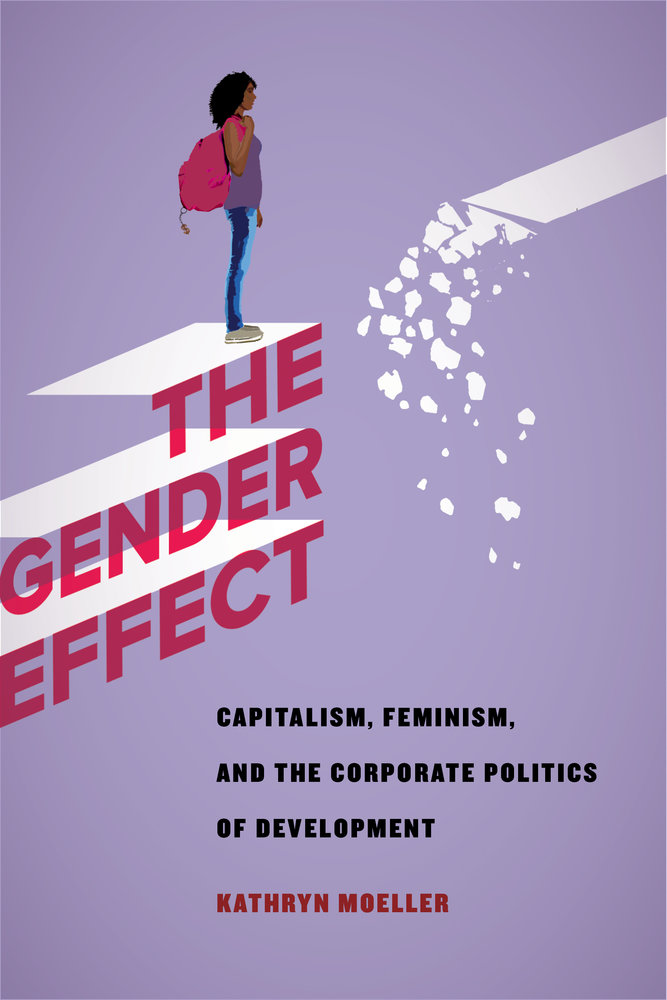
Book cover

In the 1990s, the idea of “investing in women” started circulating around large corporations and foundations. In developing countries, it was thought that this idea could help women, their families and their countries out of poverty. In return, it was then thought that women would pay specific attention to children’s nutrition, education and healthcare when considering where to spend their money and thus raise the country’s human capital. Educating women and girls was the most effective way to fight  poverty and encourage development in the Global South. This approach has since been adopted by powerful corporations and institutions, such as the United Nations, the World Bank, and the United Kingdom’s Department for International Development. Using her ethnographic case study of the Nike Foundation’s Girl Effect initiative as an example, the author Kathryn Moeller argues that these corporate led campaigns end up benefiting corporations but at the expense of women and equality in The Gender Effect: Capitalism, Feminism, and the Corporate Politics of Development. 

Continue reading “Book Review: *The Gender Effect: Capitalism, Feminism, and the Corporate Politics of Development*” →

Book Review: *Latinas in the Criminal Justice System*

Criminal justice systems are the systems in our government that enforce the law, protect the public, prevent crimes, and arrect people accused of crimes. However, criminal justice systems pick and choose who to protect; Latinas often suffer from the criminal justice systems rather than receiving help and support. In Vera Lopez and Lisa Pasko’s Latinas in the Criminal Justice System: Victims, Targets, and Offenders, readers are shown countless testimonies and interviews about system-impacted Latinas and their negative experiences with criminal justice systems. Lopez and Pasko use data and information from academic scholars and practitioners that work closely with system-impacted Latinas. Latinas in the Criminal Justice System explores Latinas’ negative involvement in the criminal justice systems through four distinct parts: the victimization of Latinas, how Latinas become ‘offenders’ and are forced into the systems, immigration and discrimination, and community programming for system-impacted Latinas (Lopez and Pasko).

Overall, Lopez and Pasko’s main argument focuses on the system-impacted Latinas and how the criminal justice systems have negatively affected their lives, especially the police. Lopez and Pasko explain how Latina women’s involvement in the systems is due to several factors: an increase in women immigrating to the United States than in previous decades, an increase in women advocating about domestic violence, and so on. This negative impact occurs because Latinas struggle fighting for their freedom since the systems do not support or help them. Latinas in the Criminal Justice System focuses specifically on Latinas because, according to Lopez and Pasko, there is not enough literature that explains and details the experiences of Latinas when facing the criminal justice systems. Whenever Latinas face the criminal justice systems, there are many of her aspects that are judged: her documentation status, her sexuality, her race makeup, and her ability to speak English (Lopez and Pasko). Lopez and Pasko go in-depth in the subject of system-impacted Latinas and describe the hardships and obstacles Latinas face when they are confronted with problems that require the involvement of the criminal justice systems.  

The authors bring substantial knowledge about feminist criminology in Latinas in the Criminal Justice System. Firstly, Vera Lopez, Ph.D. is a Professor of Justice and Social Inquiry in the School of Social Transformation at Arizona State University (NYU Press). She has studied feminist criminology and has researched girls’ and women’s involvement in the criminal justice systems. Her most famous book is titled Complicated Lives: Girls, Parents, Drugs, and Juvenile Justice.

Secondly, Lisa Pasko, Ph. D. is currently an Associate Professor of Sociology and Criminology at the University of Denver (NYU Press). She is also affiliated faculty in the Gender and Women’s Studies Program. Pasko is co-author of The Female Offender: Girls, Women, and Crime and Girls, Women, and Crime: Selected Readings. Pasko has primarily studied female offenders, violence in youths, adolescent behavior, delinquency, and the juvenile justice systems as well as sexualities for more than fifteen years.

As previously mentioned, in Latinas in the Criminal Justice System, Lopez and Pasko discuss system-impacted Latinas and how they are negatively impacted by criminal justice systems. In the introduction, the reader is introduced to the four parts that make up the book. Each part delves into a distinct aspect of Latinas’ involvement with criminal justice systems. Lopez and Pasko’s methodology consist of surveys, questionnaires, interviews, and information gathered from government offices.

In the first part, Lopez and Pasko describe the victimization of Latinas and how intersectionality plays a crucial role when it comes to the bullying of Latina girls. Many Latinas experience domestic violence; Lopez and Pasko discuss the tactics abusers use to control their victims, specifically isolation and fear. Abusers separate their victims from family members and friends to instill fear into them and prevent them from finding resources to receive help and support. Latinas who suffer from domestic violence struggle with escaping because of the lack of resources available to them. Regardless of their documentation status, Latinas who are isolated do not have connections that support them and aid them in searching for resources, leading to depression and feeling stuck in an abusive situation (Lopez and Pasko 30). Lopez and Pasko also discuss how Latine culture induces fear in Latinas. Latinas do not want to become the family ‘chisme’, so they fear reporting domestic violence to avoid facing judgment from their families. Also, undocumented Latinas feel like they do not have a choice but to endure their abusive situations because of fear towards the police and their immigration status. They know that the authorities will judge them rather than support them, worsening their situation. Through interviews, surveys, and testimonies, Lopez and Pasko gathered these details and factors that made Latinas afraid of criminal justice systems during their abusive situations. However, Latina women are not the only ones who are victims of violence; Latina girls, especially LGBTQ+ Latinas, face bullying in school settings. According to surveys given to high-school aged students, LGBTQ+ Latinas are more likely to face bullying than heterosexual Latinas. This study and results show the importance of taking intersectionality into consideration; Latinas face many obstacles and struggles, but those obstacles and struggles increase when identities intersect (i.e., being LGBTQ+ and Latina).

In the second part, Lopez and Pasko describe how Latinas become ‘offenders’ and how distinct settings induce Latinas to become ‘offenders’. Lopez and Pasko report research that shows that Latinas who have been in trouble with the law have experienced a variety of difficulties in their lives, such as childhood trauma, abuse, and self-image struggles, and Lopez and Pasko also mention that there has been in increase in girls who are juvenile offenders. After collecting some information from a juvenile diversion program, Lopez and Pasko found that Latinas were more likely to be charged with misdemeanor charges, disorderly conducts, and person offenses than their white counterparts. Moreover, Lopez and Pasko addressed how certain settings and situations cause Latinas to become ‘offenders’. The results from surveys and interviews showed that Latina girls witnessed violence in their homes or communities, a family member involved in a gang, a parent with substance abuse problems, and an important figure in their life jailed more than white girls reported. Lopez and Pasko also address how school settings and authorities promote violence in Latinas by not aiding them when needed; they just wait until Latinas show any sign of violence so that they can expulse them from school and detain them. Latinas are viewed by authorities, judges, and administrators as lazy and untrustworthy, preventing Latinas from willingly reaching for help and support. In this part of the monograph, the authors discuss how Latina girls move in and out of the system and are forced to be on the run. Several girls battle substance abuse, gang affiliation, and homelessness. Latina girls who have a warrant against them must stay with friends and/or partners to have a place to live in, but there are problems that can arise with that: some friends and/or partners could introduce Latina girls to drugs or abuse, forcing Latina girls to leave or feel stuck to avoid further issues with authorities (Lopez and Pasko 112). Rehabilitation is hard for Latina girls, especially if they are connected to gangs; they cannot leave gangs easily, which can lead to further rehabilitation and trauma for Latinas.

In the third part, Lopez and Pasko talk about immigration and discrimination. The opening chapter mentions the several reasons many Latinas immigrate from their home countries to the United States. Most Latinas immigrate from Central America, Mexico, and the Caribbean, and their reasons include poverty, inequality, and state repression. However, Latinas also immigrate for gendered reasons, such as domestic violence and sexual abuse. Lopez and Pasko discuss how the ‘border’ between the United States and Latin America is not only physical; there are language and culture barriers that become obstacles in immigrants’ lives, and systems take advantage of these barriers to criminalize Latines, especially Latinas due to their intersectionality of being a woman and a Latina. Lopez and Pasko explore the case of Adriana and Esther, two Latinas who were sentenced to prison and later deported to Mexico. Language was a huge barrier that affected them in different settings: during their sentencing, in prison, and when receiving medical attention. Language also impacted Adriana and Esther’s reintegration into Mexican society. Esther talks about how she was discriminated during her deportation; she received looks filled with judgment. Esther also mentions how she had to conform to gender norms in Mexico to not be perceived as a criminal and have the ability to start anew. The authors also discuss how immigration separates families (Lopez and Pasko 201). Mothers and children are split from each other, causing emotional trauma and distress in both the mother and the child.

In the fourth part, Lopez and Pasko discuss about the limited resources available to undocumented Latina girls, how Latinas cope with discrimination, and intervention programs installed for system-impacted Latinas. In one case study, Lopez and Pasko discuss Lupe’s experiences growing up as a Latina who was affiliated with a gang (Lopez and Pasko 264). Lupe mentions growing up being a star student and excelling in class. However, when she entered a private middle school, she lost confidence, and her grades reflected her feelings of unworthiness, leading her to join a gang through her cousins. After leaving the gang due to a cousin getting killed during gang violence, Lupe reflected on her past actions, decided to change, and pursued higher education after high school. Due to her undocumented status, she had a lot of hurdles to overcome, especially financial problems. However, the Colorado ASSET law helped Lupe cut her tuition in half. The ASSET law allows undocumented students to receive in-state tuition, making college more affordable for Lupe. Lopez and Pasko also mention how Latina girls react to discrimination based on their mother’s teachings. The results from questionnaires showed that Latina girls exhibit proud feelings of their culture, especially when motivated by their mothers. Latina girls who received positive teachings about their culture from their parents were more likely to dismiss discrimination and feel less impacted by others’ views. Finally, the fourth part is wrapped up with intervention programs and how they should be customized to fit Latinas’ perspectives, cultures, and intersectionality. According to surveys, Latinas believed that intervention programs should focus on how culture is impactful to their behaviors and how respect should be a mutual feeling between patients and staff. An example of a great intervention program is Xinachtli. This intervention program focuses on both gender and culture when it comes to Latinas’ perspectives and experiences. Xinachtli focuses on removing existing stereotypes on identities so that patients can define their own identities.

Overall, the strongest aspect of Lopez and Pasko’s book is the combination of perspectives of system-impacted Latinas. The variety of views and studies shows a collaborative input from academic scholars and practitioners that work closely with system-impacted Latinas. This combination also allows a conversation to occur regarding system-impacted Latinas and bring this topic to the forefront of criminology, more specifically feminist criminology. Many perspectives are brought together to discuss the issue of system-impacted Latinas, and it sets literature focused on Latinas, allowing further research to develop on this topic.

Alternatively, a weakness in Latinas in the Criminal Justice System is that some studies used surveys and questionnaires to gather their data, and self-reported data can have bias and could affect the accuracy of studies. Also, certain questionnaires that require rating an event could be rated differently depending on the individual. For example, some situations may be rated as stressful for one person while another could rate it as calm. Self-reported data can affect the accuracy of results due to how individuals answer questions.

In conclusion, Latinas in the Criminal Justice System discussed the issue and lack of literature around system-impacted Latinas. Vera Lopez and Lisa Pasko united distinct perspectives and brought up different aspects that Latinas face while facing criminal justice systems. This monograph also brings intersectionality into the book, allowing Latinas to think about their identities and see how they impact each other. Furthermore, this allows for more research to be addressed towards system-impacted Latinas, and it could lead to the creation of better, more effective intervention programs to support system-impacted Latinas. Ultimately, Latinas in the Criminal Justice System adds important information towards feminist criminology, and it combines distinct aspects of criminal justice systems that Latinas face.

Works Cited

Lopez, Vera and Pasko, Lisa. Latinas in the Criminal Justice System: Victims, Targets, and Offenders, New

York, USA: New York University Press, 2021. https://doi.org/10.18574/nyu/9781479804641

NYU Press. “Vera Lopez.” NYU Press, NYU Press, 21 Feb. 2019. https://nyupress.org/author/vera-lopez/.

NYU Press. “Lisa Pasko.” NYU Press, NYU Press, 21 Feb. 2019. https://nyupress.org/author/lisa-pasko/.

West Virginia University. “Lisa Pasko, Ph.D..” Research Center on Violence, West Virginia University,

https://violenceresearch.wvu.edu/executive-board/research-associates/lisa-pasko

*Fearing the Black Body: The Racial Origins of Fat Phobia* Review

Unlike existing historical scholarship, Fearing the Black Body: The Racial Origins of Fat Phobia by Sabrina Strings is one of the first historical studies that emphasizes the interconnectedness of race, gender, and morality in the development of thin fetishism and fat phobia. Strings argues that anti-fat bias is not recent discourse, instead claiming that fat phobia has been circulating since the Renaissance. The transatlantic slave trade and spread of Protestantism were key historical events that contributed to the bias toward slenderness and fear of fatness. Another important point Strings makes is that fat phobia did not originate from  health issues but was instead implemented  to justify the race and class hierarchy. 

Continue reading “*Fearing the Black Body: The Racial Origins of Fat Phobia* Review” →

Book Review: *The Tragedy of Heterosexuality* by Jane Ward

For the dominant form of sexual orientation, heterosexuality sure looks disappointing. Consider the oft-referenced statistic that fifty percent of marriages end in divorce. Another statistic, that one in six women in the U.S. experience rape, shows a troubling rate of violence within heterosexuality. Such troubling information indicates that received ideas that queerness is harder than straightness may be quite misguided (4). In The Tragedy of Heterosexuality, Jane Ward describes the contradictions inherent in straight culture, and provides a lesbian feminist perspective on how heterosexuality might become less problematic and more fulfilling for both women and men (4). Her book is a salient and strong argument for a reformation of straight culture to be more feminist.

Continue reading “Book Review: *The Tragedy of Heterosexuality* by Jane Ward” →

Book Review: *Rape Culture on Campus*

Meredith Minister’s Rape Culture on Campus Book Cover

Within college campuses, rape culture is a prominent issue that is often addressed on a surface level, leading to little or no change in the occurrence of sexual assualt and sexual violence. Meredith Minister breaks down how rape culture is continually perpetuated on college campuses and offers solutions to reducing the prominence of sexual assualt on campus in her book, Rape Culture on Campus. Minister emphasizes that not only is rape culture an issue that requires a change in ideolgies and how we approach sexual assault prevention, but also that rape culture is partially a result of binaries that often exclude gender, sexual, racial, and ethnic minorities. 

Minster begins her book by introducing how she defines rape culture, specifically saying that rape culture is “a socially accepted pattern that legitimates violence to police socially nonconforming activities, including expressions of sexuality and gender” (1). She equates the issue of rape culture existing in the first place to the way we view society and the people within that society. Colonial ways of thinking about gender and sexuality exacerbate the occurence of rape culture in society. She expands on her definition of rape culture by breaking the causes and continuation of rape culture down into pieces. Minister’s writing provides an up close look at how rape culture has defined college campuses and how colleges can do better to break the cycle of continuing the voilent pattern. Mininter draws on her educational expertise to include how purity culture, religion, and autonomy, in addition to policing and trigger warnings, do not assist in interrupting the rape culture pattern on college campuses. 

Book review on Daring to Be Bad: Radical Feminism in America 1967-1975

Daring to Be Bad: Radical Feminism in America 1967-1975 is an academic monograph by Alice Echols, published in 1989. As the title suggests, the book offers a detailed account of the rise and fall of radical feminism in America from late ‘60s to ‘70s. Echols vividly depicts the achievements, struggles and conflicts within radical feminism, identifies and categorizes different theories and activists’ groups emerged from the movement, and attempts to explain how radical feminism eventually came to its doom. The book organizes a complex half-decade of political history into an easily comprehensible timeline, while summarizing many scholar ideologies towards radical feminism. It serves as an accessible scholarly introduction to readers who lack significant knowledges about this topic.

Echols contends that radical feminism, several years after its establishment, was eclipsed by cultural feminism, which was a “tendency that grew out of radical feminism” (5) Whereas radical feminists called for a political confrontation with the government and a subversion of the male supremacy society, cultural feminists were keen on creating an alternate counter-culture with only women. These are not the only two tendencies shared by women of the radical movements. Echols also introduces other categories of feminist ideologies, such as politicos, liberal feminists, new left women, socialist-feminists. She focuses on how, in the movement, radical feminism gradually dissipated, along with fatal flaws within the movement that prefigure its end. In her opinion, if one successfully articulates the reason for the popularity of radical feminist movements in ‘60s as well as their lethal flaws, it might be possible for she and her contemporaries to revitalize the movements.

As Echols concludes herself, her work is “not simply an intellectual history, a social history, or a collective biography” but “the combination of three”. (19) Her academic approach in this book is primarily historiographical. Employing a large number of direct quotes from speeches, interviews and writings, Echols presents a wide range of narratives from scholar’s and activists’ views from 1967-1975. Her sources of evidence consist of multiple types of texts, since her emphasis is not solely on the feminism theories, but also their practice, the interpersonal relationships between feminists, the engagement with other ongoing movements black movements, as well as media response. As the radical feminist movement was, in her own words, “factious”, she often introduces each sub-group and its theories in separate sections of a chapter, accompanied by a micro biography of their founders and leaders. However, her work is not uncritical. Though the historical narratives are kept objective and impartial, she presents her analysis on the feminists’ theories and approaches as conclusions.

The book is divided into 6 chapters, ordered chronologically. Each chapter marks a certain time period with distinct features attributed to it, such as 1973-1975 and the flourishment of cultural feminism. Generally, the radical feminism history in the book can be divided into three parts: the early days radical feminism as an affiliate to other radical movements, the rise of many radical feminism theories and organizations, and radical feminism’s decline that started the development of lesbian feminism and cultural feminism.

Beginning from 1965, the prototype of the actual radical feminism that appeared after 1967 emerged. As early as 1965, women activists still worked inside male-dominating movements, such as the new left and civil rights movement. Women’s issues were not taken seriously, as ““Male chauvinism” was a phrase that one did not utter unless one was ready to be laughed at.” (26) At the same time, the growing gender tensions on sex roles forced (SDS) to start holding workshops on women’s roles. Later on, women activists like Jo Freeman and Shulamith Firestone from the Chicago’s group embarked on the earliest women liberation movements by forming small independent women groups and issuing a manifesto about “defining their own struggles” (49) Echols argues that the black power before 1967 ultimately inspired the statement that “it was only valid form women the organize their own oppression and to define the terms of their struggle.” The radical feminists’ struggle begins with a fundamental “politico-feminist schism.” (52) “Politicos” and “Feminists” occupied opposing theoretical positions inside the women liberation groups by 1969. Politicos viewed capitalism as the main enemy of women’s liberation and claimed women’s movements as an important sector of the leftist movements at the time. By contrast, feminists believed male supremacy to be the biggest problem faced by women and refused to be in only a subordinate position under male-dominating movements. The earliest women liberation groups included D.C. Women Liberation, The Westside Group of Chicago, and New York Radical Women. Together, they articulated the early radical feminist theories and organized events and protests, such as consciousness-raising meetings. In chapter two, Echols demonstrates in detail how problems arose within women liberation groups. Besides the clashes between politicos and feminists, the theories divided on questions like whether men should be challenged or rejected, and whether consciousness-raising groups should demand for actions. In addition, Echols argues that the premise of consciousness-raising, as well as the largely embraced theories at the time, was dismissive of class and sexuality differences, as they contended that “differences still had the same root.” As the white upper- and middle-class women of liberation groups based their theories on assumptions that all women shared universal experiences which united them, bringing up differences was discouraged. The inner conflicts, the unorganized groups, as well as the growing sizes, all contributed to the early failures of radical feminism such as the dissolution of a large group like NYRW.

However, the tendency of the whole movement became much less politico and much more feminist towards 1969, when feminists faced increasing hostility from the larger movements. The sexism within the leftist movements at the time forced women to organize their movements outside of the left. Starting from 1969, radical feminism grew continuously into even more strains and more radical of theoretical positions. Echols contends that “In the early ‘70s radical feminism seemed to be flourishing” as “there was an explosion of radical feminism literature.” (197) Moreover, she also illustrates several flaws within these groups. For example, Redstockings continued on the previous generalized assumptions of all women by upper class, white women. It failed again, to see the need of specifying class and race differences in consciousness-raising. The in-movement schism still existed, and was expressed in opposition between pro-woman line and gender conditioning theory. The former, represented by Redstockings, believed women were forced by the material reality of the male-dominating society to take oppressed roles, while the latter, represented by Cell 16, maintained that women were “brainwashed.” (161) Accusations of elitism, especially against the most educated member, who were also main theorists and writers, were growing. Organizations like The Feminists and New York Radical Feminists were so obsessed with an egalitarian approach to achieve leader-less structure and a true sisterhood that they became greatly unorganized. In addition, prefiguration of cultural feminism started to appear when arguments from Cell 16 transformed into a more gender essentialism theory. Besides, they also proposed that “women withdraw from men personally as well as politically.” (164) It was also true that in 1970, “the newcomers often lacked the founders’ radical perspective” as they “seemed more interested in self-improvement than in the radical restructuring of society.” Radical feminism, in reality, started to decline.

The start of chapter five, titled “the Eruption of Differences,” marks the turning point of radical feminism. In the winter of 1970, Barbara Mehrhof and Pam Kearon organized the Class Workshop for women activists to discuss class. However, Echols maintains that class workshops were “response to the media’s growing fascination with the women’s liberation movement.” Class and elitism were assessed as a result of the resentment created when only few people(leaders) had attention of the press. The discussion about class equality did not have noticeable positive results; instead, it “had become a tyranny of personal conformity. Imagination, inspiration, and efficient political organization are suspected and throttled.” (210)

Meanwhile, Lesbianism emerged as more and more lesbian-feminists entered the movement and demanded for more inclusiveness within radical feminism. Lesbians faced mostly hostility among the heterosexual women liberationists, for lesbian sexuality was regarded as sexual rather than political. As evidenced by quotes from Roxanne Dunbar, “feminism…to get women out of bed rather than change the gender of their partners,” Most radical feminists were anti-sex. To convince the heterosexual women in the movement, lesbian-feminists like Rita Mae Brown promoted lesbianism with the term “women-identified women.” They legitimized lesbian as a political term and contradicted the stigmatization that lesbians were “male-identified bogeywomen.” (216) To them, their sexuality “involved sensuality rather than sexuality, communication rather than conquest.” Echols comments on the de-sexualization of lesbianism that “the movement’s acceptance of lesbianism was always conditional – contingent upon lesbians’ wiliness to de-emphasize sexuality…Lesbianism was never really legitimated on sexual grounds.” While the eruption of differences was not directly correlated to cultural feminism, she contends that “cultural feminism’s ascendence is in large measure attributable to the turmoil created by lesbianism and class.” From 1969, cultural feminists proposed arguments in “The Fourth World Manifesto” and “Mother Right.” The manifesto declared that the female culture formed a fourth world, since women were essentially a colonized group. In addition, Jane Alpert articulated in “Mother Right” that women exhibited a super power due to female biology, as she explained, “biology is hence the source and not the enemy of feminist revolution.” (250) A vision of women united by their shared “motherhood” (251) was described, and Echols concludes that the reason why cultural feminism was constructed and embraced was a “desire to put an end to the painful and often immobilizing discussions about women’s differences.” Cultural feminism was, inevitably, a logical solution which feminists sought for after a long time of turmoil and an intensifying tendency to essentialism.

Over 30 years after its first publication, Echols’ book is still not outdated and serves as a valuable text for those who are curious about radical feminist movements in 60s and 70s. While the book is relatively accessible so that people without fundamental knowledge in social movements or feminism can understand Echols’ ideas, the ways she structures her material are sometimes misleading. For example, the contradicting theories of pro-woman line and gender conditioning are firstly mentioned in conclusion of chapter 2. Without further explanation in chapter 2, this material is revisited in chapter 4 and finally addressed in detail. As the chapters describe mostly simultaneous events, similar situation happens multiple times and render one particular piece of content quite confusing. Other than that, the book is based on a cis-gender assumption. Mostly limited by ‘80s gender concepts(it was written in 1987), the book fails to address struggle of non-cis-gender women, as well as other non-binary communities. Though Echols provides ample insights into the race and class perspective of radical feminism, gender minorities other than gays and lesbians are ignored.

Work Cited:

Echols, Alice, “Daring to Be Bad”: Radical Feminism in America 1967-1975, University of Minnesota Press, 1989

More Than Just a Haircut: Examining Gender Roles and Male Grooming in Kristen Barber’s *Styling Masculinity*

By Alice Berndt

Image Credits: Rutgers University Press

Since the inception of the metrosexual in the mid-1990s, the United States has seen a rise in male participation in the beauty and grooming industry, an industry that was founded by women and has typically been associated with a more feminine lifestyle. For white middle to upper class American men, there is a tension between the expectation to look clean and professional and the fear of appearing to try too hard to look this way. To balance these conflicting desires, modern men’s hair salons create carefully cultivated male aesthetics in their shops, from the decor and products to their employees’ mannerisms and dress codes. Kristen Barber explores this phenomenon in her monograph Styling Masculinity: Gender, Class, and Inequality in the Men’s Grooming Industry, published by Rutgers University Press in 2016. Barber begins with an initial research question: “What makes a men’s salon a men’s salon?” (Barber 162) To answer this question, she spends nine months in 2009 investigating the painstakingly masculinized spaces of two upscale men’s salons in Southern California, The Executive and Adonis, where she uncovers the aesthetics and gender politics of male participation in the beauty industry and the complex role female employees play in this space.

Kristen Barber is a sociologist, professor, and researcher with a focus on masculinities, culture, and work. She has a PhD in sociology from the University of Southern California, and her research centers on examining what “everyday boundary-crossing behavior can teach us about complex systems of inequality” (“Kristen Barber”). Besides Styling Masculinity, Barber co-authored the textbook Gendered Worlds 4th Edition and is the co-editor of a journal called Men and Masculinities. She currently works at Southern Illinois University as an associate professor of sociology and the director of the Women, Gender, and Sexuality Studies program.

To get to the bottom of her question about what exactly constitutes a “men’s salon,” Barber performs an ethnographic study of two such salons in Southern California, Adonis and The Executive. She chooses Southern California as the site of her study because it is “a mecca for commercial aestheticizing” (Barber 12). She states that the phenomenon exemplified by these salons is not exclusive to California alone but rather extends to the rest of the country as well, though how it manifests in different settings may vary. Barber spends nearly a year frequenting The Executive and Adonis, interviewing the owners, employees, and clientele, and observing the interactions between the male clients and the female workers as well as between the male clients and the space itself. She writes, “I am interested in meanings as they are constructed through people’s face-to-face exchanges and how the organization in which these exchanges are embedded shape relationships between groups of people, identity building processes, and the reproduction and reimagining of cultural norms” (13).

Continue reading “More Than Just a Haircut: Examining Gender Roles and Male Grooming in Kristen Barber’s *Styling Masculinity*” →

Book Review: *Interrogating Motherhood*

Motherhood can be a controversial topic yet is also held as a gold standard of womanhood. This is not only complicated by diversity of individuals and life goals, but the pressure that is put on mothers and the shame associated with mothering in a particular way or rejecting motherhood entirely. Discussion of motherhood is much more prevalent than fatherhood, with discourse more strongly focused on the different aspects of what it means to be a mother. This is the case because of the widely accepted notion that women hold more responsibility as a parent while men are more or less excused. Critical discussions of motherhood can be controversial because of these norms and expectations of gendered parental roles and childcare that are entrenched in policy, history, and day to day life. Nevertheless, it is important to engage with this topic as individuals and a collective to shed light on the private and public role that motherhood plays on mothers themselves, as well as shaping motherhood down the line. 

Lynda Ross is an associate professor at Athabasca University, in Athabasca, Canada. She is a professor in the Women’s and Gender Studies department and teaches courses about violence against women, and women and psychology (“Lynda R. Ross”). A primary interest of hers is the social construction of motherhood (“Lynda Ross and Shauna Wilton”). In her monograph, Interrogating Motherhood, Ross sets out to explore and explain the context in which motherhood in Western society rests, particularly in the United States.

            Interrogating Motherhood’s central argument is that women’s lives are made more complex and challenging by motherhood, because they receive little support considering the immense physical and emotional toll they go through. Ross states that “although childbirth is a universal biological event, it is obviously not independent of the economic, social, and cultural context in which it occurs” (Ross 70), and the result is that the experience of mothering is a very isolating one (127). In her book, Ross outlines the societal structures that emphasize the values place on mothering, but not mothers themselves. Her book’s eight chapters that walk through this argument are titled “The Study of Motherhood,” “Reflections on Motherhood: Theory and Popular Culture,” “Paid Employment and the Practice of Motherhood,” “Enabling Policies: In Theory and in Practice” (guest authored by Shauna Wilton), “Mothering and Poverty,” “Mothers, Mothering, and Mental Health,” “’Other’ Mothers, ‘Other’ Mothering,” and “The Future of Motherhood.” In these chapters she outlines how attachment theory, employment of women, policies surrounding maternity leave and paternity leave, mothers who struggle with parenting because of poverty or mental health, and mothers that face additional obstacles because they fall outside of the cookie cutter “good mother.”

Ross does not employ her own methodology in this book, but rather draws information from a plethora of relevant research and literature. She weaves this collection of facts and statistics from a variety of sources together to create view of motherhood in America that has more breadth than any of the individual works could reasonably provide. Alongside other authors, she draws from four of her own papers on attachment theory and postpartum depression to contribute her own expertise to the narrative. The second chapter of Interrogating Motherhood offers a history on the theory surrounding motherhood, and in it, Ross unpacks how attachment theory has contributed to the norm that maternal selflessness and ever presence is required for the successful raising of well cared-for children (18), partially because of the way theory and the media are influenced by external societal pressures (29). She illuminates that the accepted notion of what a “good mother” is does not assist mothers but instead leaves them without support (83). At the same time, this demonizes parents who do not fit into the narrow white, middle-class, heterosexual, and married mold (104), and further perpetuating the stereotype and expectation that mothers should be the primary caregivers for their children.

Although scholarly and offering a historical survey on motherhood theory, this book is extremely accessible to readers. In addition to being available online as a free PDF, this text is well organized and covers many diverse but not mutually exclusive topics related to motherhood, parenthood, and the historical and social forces that have shaped raising a child as a highly complex and gendered process. Ross also carefully balances her evidence within larger context and narratives within each chapter to paint a holistic picture of the dynamics impacting women. For example, in the chapter “Paid Employment and the Practice of Motherhood,” Ross contrasts the United States’ minimal maternity leave with that of Norway’s (45) to highlight how the difference in policy reflects how mothers are valued. Viewing this topic through a wide lens is essential due to the interrelated nature of its content, in which Ross executes by organizing the text’s content into well-defined categories.             

However, Interrogating Motherhood is somewhat held back by its breadth; since almost all of the information brought to readers’ attention is from outside of Ross’s personal research, there are a staggering amount of topics introduced that are not given equal depth and significance in the greater context of the book. For example, her commentary on how attachment theory supports norms of gender roles in parenting involves discussion of how constructions of Western society have influenced attachment style theory (125), and how this scholarly support has helped perpetuate these norms through media (29). On the other hand, when she attempts to summarize the impacts of the “anxiety, isolation, and sense of overwhelmed” that mothers may face in general, her conclusion is simply that these feelings “are not good for women” (127). Because of this, Interrogating Motherhood is essentially a literature review on policies and norms surrounding motherhood in the United States. Compared to the depth of analysis outlined in the introduction to the book, the text fails to interrogate motherhood beyond basic facts and their immediate outcomes.

Something that could have contributed to the strength of the book is the consideration of women who feel isolated from motherhood. Ross pinpoints the forced obligation of women’s responsibility to their children that some mothers must grapple with (114), but this leaves room for discussion of women who choose not to become mothers or regret becoming mothers. In addition, this book only focuses on Western society’s motherhood norms and expectations (1). The author acknowledges this, but the book could benefit from more cultural context, particulary in the discussions of family and gender roles.

            Ross’s Interrogating Motherhood sets out to unpack the nuanced, personal, and often controversial topic of what it means to be a mother, and how the idea of a “good mother” cannot be enacted in today’s society in a way that is supportive of a mother as well as her children. She covers a lot of ground in her discussion throughout the text and provides a well-supported argument. However, her lack of personal contribution to the research discussed reveals herself in her hesitance to jump into describing a more holistic perspective on the challenges mothers face beyond her two main areas of expertise: attachment theory, and mental health in pregnancy and motherhood (in chapters 2 and 6, respectively, as well as the introductory and concluding chapters). However, her call to action at the conclusion of the book is compelling; “a paradigm shift in how we understand mothering and motherhood is needed” (124) beyond essential policy shifts that need to occur, so that mothers are able to receive support, care, and attention alongside their children.

Works Cited:

“Lynda R. Ross.” CSPI, 1 Apr. 2010, https://www.canadianscholars.ca/authors/lynda-r-ross.

“Lynda Ross & Shauna Wilton.” JourMS, 11 Aug. 2016, https://jourms.org/lynda-ross-shauna-wilton/).

Ross, Lynda R. Interrogating Motherhood. Athabasca University Press, 2016.