A cancer diagnosis is daunting and life-altering. However, a diagnosis can also be a privilege that not everybody has access to. Many LGBTQIA+ people, especially those living in socio-economically disadvantaged areas, are less likely to have access to or choose to utilize routine screening services for common cancers, and are therefore less likely to be diagnosed with cancer and receive treatment that is essential for survival. Through my research project, I aim to better understand the similarities and differences in how individuals in four key populations access services surrounding cancer:
non-LGBTQIA+ identifying individuals residing in a socio-economically advantaged area
non-LGBTQIA+ identifying individuals residing in a socio-economically disadvantaged area
LGBTQIA+ identifying individuals residing in a socio-economically advantaged area
LGBTQIA+ identifying individuals residing in a socio-economically disadvantaged area
One of the most perplexing and scientifically mystifying areas of study is neuroscience. The study of the brain, memory, identity and neural networks is interconnected and infinitely complex due to the multitude of factors seen and unseen that contribute to what makes you, you. A specific application of this is in the biological study of sex, gender, and sexuality. We have no idea what truly creates gender in humans or any animal for that matter, but we have some fairly decent guesses. There is a potential prenatal hormonal factor that could contribute to gender; a genetic factor, epigenetic factor, a parental and sibling factor, a societal factor. There are too many “answers” as to why we experience gender the way we do to seemingly ever find the true cause, although I suspect it’s a combination of all of those aforementioned aspects in combination with some we have not even discovered yet. Over the years, biologists, psychologists, anthropologists, and sociologists have all performed many different types of studies to try and get closer to the big gender questions: Why do we experience it? Why are there so many different expressions of it? How can we better understand it? And we have made a lot of progress in this field. Anne Fausto Sterling brilliantly summarizes a lot of the major work done on gender exploration and does so from a lot of these unique scientific perspectives.
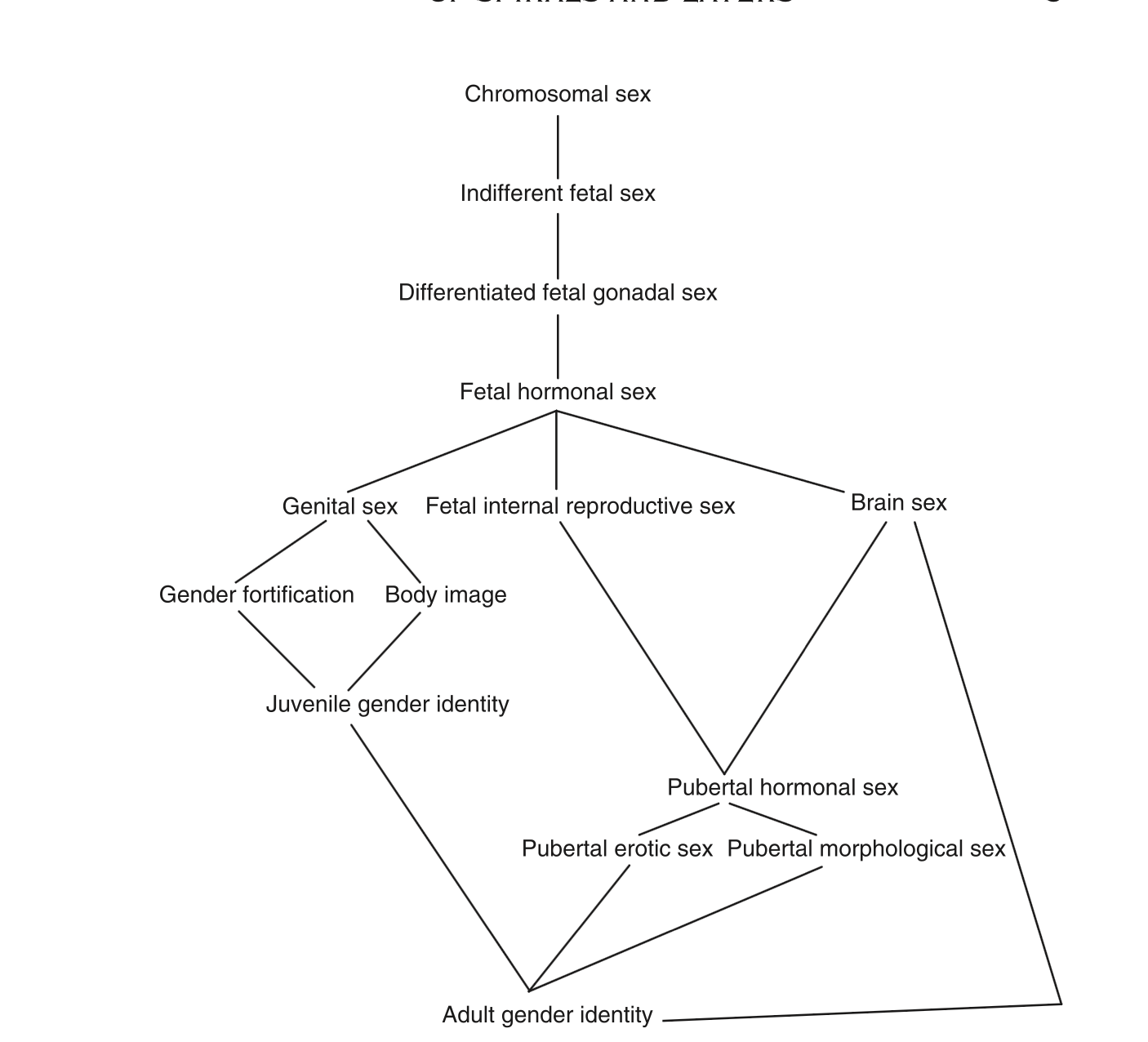
In, Sex/Gender Biology in a Social World, Sterling deep dives into the scientific pursuit of gender within the context of social pressures we experience within our culture. She describes both the biological and cultural contributions to our multifaceted gender identity and expression starting from conception and ending with adulthood. She identifies the many different sex and gender identities we cycle through throughout our development and how they each play a role in our final, “adult gender identity.” Sterling uses Money’s “sex layer model” to show this. You start with chromosomal sex (ie. XX, XY, or, rarely, some other combination of sex chromosomes), then “indifferent fetal sex,” and as you develop go through 11 other “layers” of sex until you end up at your adult gender identity. These layers aren’t linear as some layers form as a function of several that come before it. For example, brain sex and fetal internal reproductive sex both contribute to the pubertal hormonal sex of an individual, and gender fortification and body image both create your juvenile gender identity. Sterling uses this book to break down all of these different categories and talk about the different aspects of each one and how they play off of each other in order to come to some sort of definition or conclusion on what makes up our gender.
these are the “layers of sex” from Money
NY native, Anne Fausto Sterling was born in Queens, New York, in 1944. She graduated from The University of Washington with a degree in zoology in 1965 and later earned her Ph.D. in developmental genetics from Brown University in 1970. Currently, Sterling is the Nacy Duke Professor of Biology and Gender Studies at Brown and works within the molecular and cell biology department as well as the biochemistry department. During her time in academia, Sterling has written several books about gender intended for a general audience and has made over 60 scientific articles on similar subjects. She also is a Fellow of the American Association for the Advancement of Science where she has received many grants for both the sciences and humanities. Clearly, Sterling is known for her astounding scientific achievements and has made many contributions to modern-day feminist movements with her work on the intersection of gender and biology. Sex/Gender Biology in a Social World was written in 2012 and is just one of the written works Sterling has produced on gender. Her listed main areas of interest are, “rethinking the nature/nurture divide, women in science/gender, intersectionality, homosexuality and its construction, and the role of race in gender and sexuality.” Her Ph.D. and mountain of scientific excellence make her uniquely qualified for explaining and exploring gender through a variety of scientific methods.
For this book, Sterling references many researchers across several disciplines and creates a holistic view of gender through that lens. As said before, she uses Money’s “layers of sex” model to explain how our own gender changes as we grow up. At the beginning of the book, Sterling uses several stories and metaphors to explain how we have been and probably will always be a gendered society. Although our societal expressions of gender have changed throughout time and across different cultures, it will always be a part of the human experience. Starting from birth, your parents dress you and socialize you based on your sex or genitalia, and with this interpretation of your sex, your social gender identity is created. In modern-day America, we have pink for girls, blue for boys, and all childrens’ toys have a gender that they are intended for. Our society has determined what you are supposed to like and how you should act based on your perceived “boyness,” or “girlness.” This in combination with the infant starting to learn their anatomy by discovering their genitals, and the genitals of those around them creates their sense of body image.
Sterling also makes a point of how some different species have more than two sexes, and how some creatures have more than one type of male or female. For example, some insects have three distinct sexes, and there is a species of lizard that does not use males at all for reproduction. There are a variety of factors that determine what sex an animal will be too. Some frogs use temperature for sex determination, and there are so many other seemingly arbitrary environmental features that different species use to determine the sex of their offspring. Some species can even change their sex (ie. develop the opposite genitals and reproductive organs to their natal body) based on a lack of males or females in their vicinity. All of this boils down to Sterling making a point of how up in the air and fluid both sex and gender are. We can not truly understand them if we keep thinking of them as rigid and unchanging when in reality they keep growing and developing just as we do.
As the book continues Sterling circles back to explain the process of human child development in more detail and highlights the stage or “layer(s)” of sex one has reached based on their stage of life. When embryos are first beginning to develop they go into a stage of “equipotential development” where male and female fetuses are indistinguishable. At this point in time, the fetus is said to have reached the “indifferent fetal sex” layer, and soon the XX and XY babies will begin to develop in separate, yet similar, processes. Sterling also makes a note of intersex children and how sometimes sex can get a little more complicated than just male or female. Intersex babies may present as one gender while having the genetics of another, or even have a mix of male and female parts. She then goes into the different aspects of “brain sex.” In some species, like canary birds, the presence of a sex hormone will change the size/development of specific parts of the brain. For example, the injection of testosterone into a female canary’s brain will cause the “song” part to grow and that female will begin to sing male-specific songs. Environmental complexity also affects brain sex. In an experiment with rats, there were separate groups of male and female rats. Some were placed in a cage with no enrichment, while others were given toys and housed together to provide an enriched environment. Female rats in the enriched environment had significantly higher neural branching (think of more neural branching equating to more/better/faster communication within the brain) than males. And in the caged environment, males had higher levels of neural branching. This goes to show how complex brain sex is and how, in some ways, male and female brains develop differently. This, in turn, creates a big part of our adult gender identity.
Throughout the entire book, Sterling does an excellent job at providing enough scientific detail to provide context and clarity to her exploration of gender, while at the same time not jumping off into the deep end and making the book inaccessible to people with less biological knowledge. At some points in the book she lets herself dive a little deeper into genetic and biological factors of sex and gender and provides mind-gripping science and discovery to keep her readers invested in the book. Some chapters even come across more like scientific articles minus the chemical jargon. This is a wonderful way to expose people to the science behind our brains without losing them with an excess of detail. At the same time, Sterling also uses more anthropological and historical perspectives to analyze gender which only furthers her reach of audience.
While Sterling does a phenomenal job explaining all of these different perspectives, she also sometimes gets lost in story and metaphor. Part of her writing style is to use anecdotes to explain complex topics, but she sometimes spends too much time fleshing out those stories and loses focus on the point of her book. In chapter five, for example, she spends the first half recounting two conflicting scientists’ histories with each other in an attempt to explain gender identity and, more specifically, fetal sex. Although there is validity in bringing up these two scientists, the length of time she spent on their lives rather than their work concerning gender in the context of this book seemed excessive. This is not the only time she does this either. There are a few longer chapters in this book that could be shortened and clarified with some editing down of irrelevant information.
Anne Fausto Sterling’s Sex/Gender Biology in a Social World was well written and provided a wonderful intersection of science and humanities to explore what sex and gender are. Her in-depth recount of the neuroscience and biology behind gender was especially gripping while reading through this book. It truly is meant for people from all walks of life. You don’t have to know a lot about science or biology to understand what Sterling is saying, although having some prior knowledge is imperative to understanding the full picture. At the same time, you do not have to be an anthropological expert to follow along either. Sterling successfully made this a book for all people regardless of their background and education, as there are so many different yet connected perspectives on gender that she cycles through.
Work Cited:
Fausto-Sterling, Anne. Sex/Gender: Biology in a Social World. Routledge, 2012.
Sterling, Anne. “Home – Dr. Anne Fausto.” Anne Fausto Sterling, http://www.annefaustosterling.com/.
Over the past few years, TikTok has become a mainstream social media platform. This application, available for most smartphones, uses an algorithm to curate content for users, effectively getting them addicted to scrolling on the app. There are many subcultures on TikTok… For example, people who like dogs might find that the algorithm has put them on ‘dog TikTok,’ because their ‘For You’ page is filled with videos of dogs. The same concept applies to gender and sexuality. There are many different points of view represented on the application, and once the algorithm figures out what yours is, it will show you a plethora of content to reinforce that exact idea.
There is a large subculture (or really, a set of subcultures) on TikTok that perpetuates the gender binary system and all of the gender roles that come along with that. For example, this video is a representation of many of the different videos that are found on ‘straight TikTok’:
When the individual speaking in the video says, “Men will choose a peaceful woman before a beautiful woman,” they are enforcing many of the expectations that are placed on female-identifying people in our society. Moreover, the speaker is implying that women must be ‘peaceful,’ therefore implying that often, women are not peaceful. This implication tells women that they need not express their emotions; rather, they should focus on being as passive as possible in an effort to be chosen by a man.
Next, when the person speaking says, “Men seek for peace, and it don’t matter if you’re Black, blue, asian, Latina… they want to come home to a peaceful woman,” they are demonstrating a lack of awareness of the intersection between race and gender. This statement also reinforces the idea that men come home to women, therefore saying also that women should not be working professionals.
On top of that, the speaker discusses the intellect of women and expectations in that area that men hold. They say, “He wants a woman that’s resourceful, a woman that can think on her feet. So when he can’t hold it down if he’s ill and he’s unable to pay the bills, she can be resourceful and have her intellect to make things happen.” The first implication I see in this statement is that the woman should just be intellectual as a safeguard… the woman will never actually have to use these skills unless it comes down to it. The assumption that men always pay the bills is harmful to all people, regardless of gender, because that is not the case for everybody. By the same token, the fact that the speaker is bringing this point up implies that women are, in general, less naturally intellectual than men. Drawing this unfounded connection between gender and intellectual capacity is harmful to society as a whole.
Perhaps most disturbingly, our speaker talks about the ‘appropriate’ role of women in a sexual context. They say that men are “looking for a woman to supply their physical needs… A woman that looks good and proper and public but is a beast in bed” is the golden standard. First of all, in addition to ignoring the physical desires of the women at hand, this statement claims that the purpose of women is to fulfill mens’ sexual desires. This incredibly sexist ideology has the capacity to negatively influence the lives of many people. On top of this, the speaker is assuming a common definition of beauty… she is saying that women who have a certain physical appearance and demeanor are examples for what all other women should try to be when in pursuit of a relationship with a man.
In conclusion, the ideology contained within this video is based on the idea that women are socially inferior to men, and that female sovereignty should not exist when it comes to romantic and sexual relationships. The central claim is that women should constantly be cultivating their personas to match what they think men are looking for in women, in hopes that they will ‘meet the cut’ for some man.
Similar to the last clip, this piece of satire brings awareness to many of the appearance-based expectations that our society holds for women, and the stark contrast between these expectations and those for men. The actor, mimicking a man, says: “Alright, so I want a girl with huge, but perky boobs, small waist, huge butt, flawless skin (but can’t wear makeup). And I like blondes, but I think she should also be brunette… because I get bored quickly, you know?” This statement encapsulates many of the body standards that our modern society has for women, and also touches on the normalized fact that men sleep around while women are expected to be loyal.
In the caption of this video, the creator claims that this is how all men think. Although this is probably a sarcastic statement, it is representative of the way that many people think. Moreover, individuality is to be nonexistent: all men must act one way, and all women must act another way. Beyond pointing out, and perhaps reinforcing, the gender norms that are in place for men and women, this video illustrates the prevalence of the gender binary in our society.
Content Warning: This video contains a real-life portrayal of surgical body mutilation. Use viewer discretion.
In this shocking clip, we see a person that is identified as a man who has ‘overdeveloped’ breast tissue. His act of having the ‘excess’ tissue removed is labeled as life-changing. First of all, the video notes that this overdevelopment in the breast tissue of a man is an actual medical condition, which is known as ‘gynecomastia.’ Its causes are said to be “medications, drugs, testicular cancer, and hormonal imbalance.”
Without looking into the history of this condition, it’s plausible to assume that this condition was developed in response to a bodily appearance that was not in line with society’s idea of what a man should look like. Moreover, this condition does not pose any medical risk to the patient; it is merely aesthetic.
This video perpetuates a toxic standard of beauty, and is essentially telling men who have growth in their breast tissue that in order to be beautiful, they must undergo surgery. Explicitly, the caption says, “These [surgeries] literally change men’s lives.” In watching this video, men with growth in their breast tissue are inevitably going to receive the message that they are disgusting, and must go get surgery.
In conclusion, the three videos I have analyzed here are examples of the many TikTok videos that enforce gender-based stereotypes and human body standards that are present in our society. This is not to say that TikTok is a problematic platform that should not exist; rather, this suggests that we as a society should critically examine the role that social media plays in perpetuating harmful gender-based stereotypes and expectations on a day-to-day basis.