Davidson tries to be an inclusive school; at least on paper. We have resources like Lulabelle’s Market and the lavender lounge available for our students, but what is the experience of going to this school actually like? All I can comment on is my own experience, as a cis gay man, at Davidson, and how I think it could be improved.
I’d like to start with the acknowledgment that Davidson is a small, private, Christian, liberal arts school in the South. With all that comes some phobias and isms that are undesirable, and Davidson is not the only college with these flaws out there. That being said, I can count on my fingers how many other out, gay men I know who go here. And I would still have some fingers left over. My point is: there are very few of us. That feels isolating. I’ve found it difficult to feel like myself and connect with other gay men here.
Sure, we have YANASH and QSA, and other resources like the lavender lounge on campus, but with COVID none of the typical clubs or spaces have been up and running. YANASH and QSA hangouts are few and far between, and I’m not even sure if the lavender lounge is open or not. This begs the question, what can we do to improve the gay experience at Davidson?
I would like to propose the creation of either an app or a website dedicated to all the LGBTQIA+ resources on campus and also serve as a platform to connect current and future queer Davidson students. With this program we could have a list of all the resources Davidson currently offers for LGBTQIA+ students and include descriptions and locations for them as well. I think if more people knew about what Davidson has to offer there would be increased participation across the board. Furthermore, I think it would be easier for closeted students to find safe spaces and friends if there was a platform built for queer students. You could take it as far as having anonymous chat rooms for those closted students to be able to express themselves without any risk or potential danger.
Overall, I think the addition of either a website or an app with these features is paramount for the LGBTQIA+ population of Davidson. Currently, us Davidson gays have no real way of finding each other or connecting with the resources set up for us on campus, let’s change that!
If there’s any comp sci gays out there reading this feel free to put this idea into reality!
Pop icon Ariana Grande blessed us with a feminist masterpiece titled, “God is a Woman.” The title alone challenged many gendered stereotypes and the lyrics are a wonderful dive into female sexuality. Grande created something equally empowering as it is catchy. She reverses the patriarchal norm of male domination over women with lyrics like, “I’m tellin’ you the way I like it, how I want it,” and “And boy, if you confess, you might get blessed // See if you deserve what comes next.” Here, Grande is expressing the power she has over this man and how she is the one in control; something rare in heterosexual relationships. For most of history men have had all the power. They were the ones who owned property, and that sometimes included women. Nowadays, in the states at least, you can’t own a person but that power dynamic is still a festering pandemic lingering in our society. Women are supposed to be a submissive, pretty face. They are supposed to look good to attract a man and then stay home to raise their children. This translates to the bedroom as well. The expectation for heterosexual sex is male pleasure and fantasy, women are merely the vessel to achieve it. This is where Grande steps in to challenge the sexist norm and flip the script. She sings about female domination and pleasure; about women being the controlling force in both the bedroom and in life. She sings about the power she, along with all other women, have to take their deserved, rivaling spot in the fight for gender equality.
One of the most perplexing and scientifically mystifying areas of study is neuroscience. The study of the brain, memory, identity and neural networks is interconnected and infinitely complex due to the multitude of factors seen and unseen that contribute to what makes you, you. A specific application of this is in the biological study of sex, gender, and sexuality. We have no idea what truly creates gender in humans or any animal for that matter, but we have some fairly decent guesses. There is a potential prenatal hormonal factor that could contribute to gender; a genetic factor, epigenetic factor, a parental and sibling factor, a societal factor. There are too many “answers” as to why we experience gender the way we do to seemingly ever find the true cause, although I suspect it’s a combination of all of those aforementioned aspects in combination with some we have not even discovered yet. Over the years, biologists, psychologists, anthropologists, and sociologists have all performed many different types of studies to try and get closer to the big gender questions: Why do we experience it? Why are there so many different expressions of it? How can we better understand it? And we have made a lot of progress in this field. Anne Fausto Sterling brilliantly summarizes a lot of the major work done on gender exploration and does so from a lot of these unique scientific perspectives.
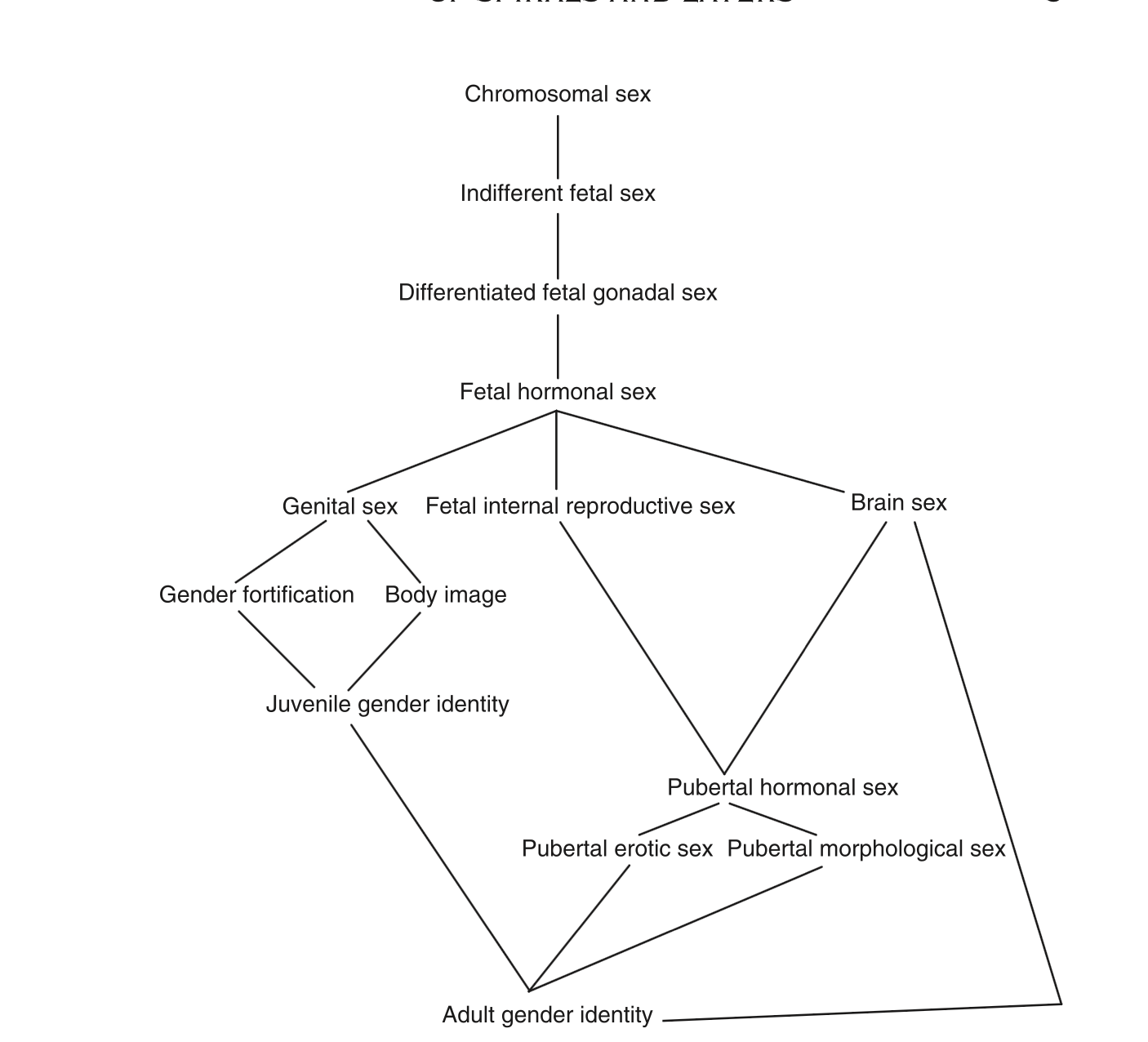
In, Sex/Gender Biology in a Social World, Sterling deep dives into the scientific pursuit of gender within the context of social pressures we experience within our culture. She describes both the biological and cultural contributions to our multifaceted gender identity and expression starting from conception and ending with adulthood. She identifies the many different sex and gender identities we cycle through throughout our development and how they each play a role in our final, “adult gender identity.” Sterling uses Money’s “sex layer model” to show this. You start with chromosomal sex (ie. XX, XY, or, rarely, some other combination of sex chromosomes), then “indifferent fetal sex,” and as you develop go through 11 other “layers” of sex until you end up at your adult gender identity. These layers aren’t linear as some layers form as a function of several that come before it. For example, brain sex and fetal internal reproductive sex both contribute to the pubertal hormonal sex of an individual, and gender fortification and body image both create your juvenile gender identity. Sterling uses this book to break down all of these different categories and talk about the different aspects of each one and how they play off of each other in order to come to some sort of definition or conclusion on what makes up our gender.
these are the “layers of sex” from Money
NY native, Anne Fausto Sterling was born in Queens, New York, in 1944. She graduated from The University of Washington with a degree in zoology in 1965 and later earned her Ph.D. in developmental genetics from Brown University in 1970. Currently, Sterling is the Nacy Duke Professor of Biology and Gender Studies at Brown and works within the molecular and cell biology department as well as the biochemistry department. During her time in academia, Sterling has written several books about gender intended for a general audience and has made over 60 scientific articles on similar subjects. She also is a Fellow of the American Association for the Advancement of Science where she has received many grants for both the sciences and humanities. Clearly, Sterling is known for her astounding scientific achievements and has made many contributions to modern-day feminist movements with her work on the intersection of gender and biology. Sex/Gender Biology in a Social World was written in 2012 and is just one of the written works Sterling has produced on gender. Her listed main areas of interest are, “rethinking the nature/nurture divide, women in science/gender, intersectionality, homosexuality and its construction, and the role of race in gender and sexuality.” Her Ph.D. and mountain of scientific excellence make her uniquely qualified for explaining and exploring gender through a variety of scientific methods.
For this book, Sterling references many researchers across several disciplines and creates a holistic view of gender through that lens. As said before, she uses Money’s “layers of sex” model to explain how our own gender changes as we grow up. At the beginning of the book, Sterling uses several stories and metaphors to explain how we have been and probably will always be a gendered society. Although our societal expressions of gender have changed throughout time and across different cultures, it will always be a part of the human experience. Starting from birth, your parents dress you and socialize you based on your sex or genitalia, and with this interpretation of your sex, your social gender identity is created. In modern-day America, we have pink for girls, blue for boys, and all childrens’ toys have a gender that they are intended for. Our society has determined what you are supposed to like and how you should act based on your perceived “boyness,” or “girlness.” This in combination with the infant starting to learn their anatomy by discovering their genitals, and the genitals of those around them creates their sense of body image.
Sterling also makes a point of how some different species have more than two sexes, and how some creatures have more than one type of male or female. For example, some insects have three distinct sexes, and there is a species of lizard that does not use males at all for reproduction. There are a variety of factors that determine what sex an animal will be too. Some frogs use temperature for sex determination, and there are so many other seemingly arbitrary environmental features that different species use to determine the sex of their offspring. Some species can even change their sex (ie. develop the opposite genitals and reproductive organs to their natal body) based on a lack of males or females in their vicinity. All of this boils down to Sterling making a point of how up in the air and fluid both sex and gender are. We can not truly understand them if we keep thinking of them as rigid and unchanging when in reality they keep growing and developing just as we do.
As the book continues Sterling circles back to explain the process of human child development in more detail and highlights the stage or “layer(s)” of sex one has reached based on their stage of life. When embryos are first beginning to develop they go into a stage of “equipotential development” where male and female fetuses are indistinguishable. At this point in time, the fetus is said to have reached the “indifferent fetal sex” layer, and soon the XX and XY babies will begin to develop in separate, yet similar, processes. Sterling also makes a note of intersex children and how sometimes sex can get a little more complicated than just male or female. Intersex babies may present as one gender while having the genetics of another, or even have a mix of male and female parts. She then goes into the different aspects of “brain sex.” In some species, like canary birds, the presence of a sex hormone will change the size/development of specific parts of the brain. For example, the injection of testosterone into a female canary’s brain will cause the “song” part to grow and that female will begin to sing male-specific songs. Environmental complexity also affects brain sex. In an experiment with rats, there were separate groups of male and female rats. Some were placed in a cage with no enrichment, while others were given toys and housed together to provide an enriched environment. Female rats in the enriched environment had significantly higher neural branching (think of more neural branching equating to more/better/faster communication within the brain) than males. And in the caged environment, males had higher levels of neural branching. This goes to show how complex brain sex is and how, in some ways, male and female brains develop differently. This, in turn, creates a big part of our adult gender identity.
Throughout the entire book, Sterling does an excellent job at providing enough scientific detail to provide context and clarity to her exploration of gender, while at the same time not jumping off into the deep end and making the book inaccessible to people with less biological knowledge. At some points in the book she lets herself dive a little deeper into genetic and biological factors of sex and gender and provides mind-gripping science and discovery to keep her readers invested in the book. Some chapters even come across more like scientific articles minus the chemical jargon. This is a wonderful way to expose people to the science behind our brains without losing them with an excess of detail. At the same time, Sterling also uses more anthropological and historical perspectives to analyze gender which only furthers her reach of audience.
While Sterling does a phenomenal job explaining all of these different perspectives, she also sometimes gets lost in story and metaphor. Part of her writing style is to use anecdotes to explain complex topics, but she sometimes spends too much time fleshing out those stories and loses focus on the point of her book. In chapter five, for example, she spends the first half recounting two conflicting scientists’ histories with each other in an attempt to explain gender identity and, more specifically, fetal sex. Although there is validity in bringing up these two scientists, the length of time she spent on their lives rather than their work concerning gender in the context of this book seemed excessive. This is not the only time she does this either. There are a few longer chapters in this book that could be shortened and clarified with some editing down of irrelevant information.
Anne Fausto Sterling’s Sex/Gender Biology in a Social World was well written and provided a wonderful intersection of science and humanities to explore what sex and gender are. Her in-depth recount of the neuroscience and biology behind gender was especially gripping while reading through this book. It truly is meant for people from all walks of life. You don’t have to know a lot about science or biology to understand what Sterling is saying, although having some prior knowledge is imperative to understanding the full picture. At the same time, you do not have to be an anthropological expert to follow along either. Sterling successfully made this a book for all people regardless of their background and education, as there are so many different yet connected perspectives on gender that she cycles through.
Work Cited:
Fausto-Sterling, Anne. Sex/Gender: Biology in a Social World. Routledge, 2012.
Sterling, Anne. “Home – Dr. Anne Fausto.” Anne Fausto Sterling, http://www.annefaustosterling.com/.
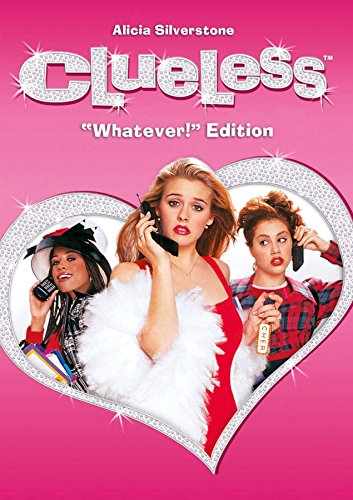
Arguably, one of the most iconic movies ever created is “Clueless.” This movie features everything you could want and more from a classic 90’s high school movie. The lead, Cher, is the “it girl” at Bronson Alcott High, and she seems to have her life fully figured out. With her side-kick Dionne, she takes on some typical challenges accustomed to the privileged teenage life, like failing her driver’s test, going to parties, and meeting a cute boy she might have a crush on. His name is Christian, and, despite Cher’s keen eye, she fails to realize that he is gay.
Cher tries every play in the book to try and seduce Chrisitan, she drops her pen to bait him into picking it up for her, invites him out to parties, and brings him to her house when her father is away. She puts an entire roll of cookie dough in the oven, in the hopes that the warm, sweet smell in combination with her domestic abilities will be enough to woo him. She ends up burning the cookies, and they move on to tour the house. As they walk through the backyard, Chrisitan is telling Cher what a beautiful art collection her father has and comments on all the statues talking about the various artists and meanings behind the works. This is a stereotype associated with gay men, a love and appreciation for art. This is only one of many different stereotypes the creators of “Clueless,” put on Christian, however.
All the characters from the movie continuously point out the effeminate qualities Christian has. His love for art and fashion comes to mind. He is also the most well-dressed and groomed man on the show. All these things are associated with and are stereotypical qualities of gay men. After the not-so-romantic night between Cher and Christian comes to an end, the movie flashes forward to Cher in the car with Dionne and her boyfriend, Murray. Murray is trying to teach Dionne how to drive while the two of them listen and try to counsel Cher about her failed date. After she says she was ready to, “go all the way,” and have sex with Christian, Murray laughs out loud and says, “are you bitches blind or something? Your man, Chrisitan, is a cake boy.” The sexist language he uses here and throughout the film is enough for a whole other essay, but he uses an old derogatory term, “cake boy,” meant to put down and make fun of effeminate men. He then goes on to list more stereotypically gay things that Christian does, like enjoying disco music and reading Oscar Wild. He then finishes his line by saying “he’s a friend of Dorthy if you know what I’m saying.” After all of that, Cher finally realizes that Christian is gay.
While the creators of the movie did a good job at making Chrisitan a likable character, they abused gay stereotypes and the “gay aesthetic” of the time to perpetuate a misguided view of what being gay means. The Hollywood interpretation of gay men specifically, was one of two character archetypes. Either a creepy, predatory character that you are meant to hate and fear, or an effeminate one that is clean, pristine, and loves to shop. Chrisitan is clearly the latter.
Having this “gay aesthetic” be so wildly loved, admired, and used in media is damaging to gay youth. We’re told this is what it means to be gay. You have to dress a certain way, act a certain way, and like specific things to be “gay.” This puts pressure on young gay men especially to behave like this idolized character of fashion, art, and shopping. If you don’t look put together you aren’t good enough to be gay. If you don’t love shopping with your girlfriends then you’re either in the closet or some kind of outcast. These characters often become the “gay best friend” of a powerful female character as well. Effeminate gay men were never portrayed as powerful or independent, they always had a popular girl to take care of them and protect them from the rampant homophobia and toxic masculinity of high school. This is damaging to watch as a young gay child. You are told that to fit in and be accepted, you have to be feminine and hide behind other people for safety. When you stand up for yourself a bully will knock you down, and if you don’t act “gay enough,” neither the gay nor straight people will want to include you. Yet, this feminine gay aesthetic was one of the only positive representations of gayness from before the 2010s. Despite how damaging it is to be told you must be and act a certain way, it was the only way to survive.
Gayness is more than being effeminate and liking clothes and Britney Spears, however. As more modern media is starting to realize, gayness looks different for everybody and there isn’t one box of mannerisms and inflections that you can sort us into. Gay people each have their own personalities, behaviors, and interests. Being gay is just one part of us, one identity we have, nothing more. It can mean to you whatever you want it to. That’s why having this kind of representation (as in characters like Christian) is damaging to the gay community. Although Christian is seen as this perfect, sexy man better than all the other men in Bronson Alcott High, his character perpetuates a harmful culture around being gay.
written for Autostraddle | autostraddle.com
work cited:
Heckerling, A. (1995). “Clueless” movie poster. Amazon. Paramount Pictures. Retrieved October 1, 2021, from https://www.amazon.com/Clueless-Alicia-Silverstone/dp/B01M9B4FDS.
Heckerling, A. (2021). Cher and Christian watching a movie. cheatsheet. Paramount Pictures. Retrieved October 1, 2021, from https://www.cheatsheet.com/entertainment/clueless-christian-was-almost-played-by-this-twilight-star.html/.