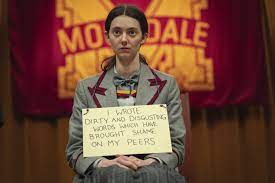
Aristotle and Dante Discover the Secrets of the Universe is a young-adult fiction novel written by Benjamin Alire Sáenz, a Mexican American author. The book was published on February 21st, 2012, and was later adapted into a movie released on September 8th, 2023. The story follows two Mexican American teenagers living in El Paso, Texas in 1987
The main characters are Aristotle Mendoza and Dante Quintana who become friends instantaneously after meeting at their local swimming pool. Aristotle also becomes close with Dante’s family and finds comfort in their emotional availability. About a year into their friendship, Dante is beaten in a hate crime for kissing another boy. Aristotle then retaliates physically against the perpetrator. Between these events, both boys go through identity revelations that are crucial to the development of their friendship. In this analysis I will focus on the book version of Aristotle’s character and how assumptions about gender, race, and sexuality affect his portrayal.
Both main characters are considered to have unusual names especially for their time, the late 80’s. When Aristotle first meets Dante, they bond over how uncommon their names are. Dante has completely accepted his name whilst Aristotle prefers to go by a nickname, Ari. Here we are presented with the feeling Aristotle knows all too well, discomfort regarding his name. There are many things in Aristotle’s life that pain him to think about, his identity is at the root of these issues. Teenage boys are often expected to be ‘tough’ and to not outwardly express their emotions but rather suppress them for the fear of appearing ‘feminine.’
Unfortunately, Aristotle has grown up seeing this modeled by his father. His father is a Vietnam War veteran with PTSD which deeply impacted his levels of emotional availability for Aristotle. There is no ill-intentioned behind his actions or toxic masculinity agenda his father is attempting to push, but the effect is still detrimental to Aristotle’s psychological development. Here is an example of an argument Aristotle conjures up:
“Obsession, Dad? You know what I’ve learned from you and Mom? I’ve learned not to talk. I’ve learned how to keep everything I feel buried deep inside of me. And I hate you for it” (218).
Having internalized this behavior, Aristotle struggles to navigate the sentimental aspect of his friendship with Dante. He struggles to comprehend how Dante can be so free and in touch with his emotions while also remaining ‘fierce’ and ‘strong.’
“I didn’t understand how you could live in a mean world and not have any of that meanness rub off on you. How could a guy live without some meanness?” (23).
This ‘meanness’ that Aristotle views as a necessity to survive in the world is another belief he has cultivated based on stereotypical gender norms for teenage boys. The concept of ‘silent strength’ is what hurts young boys the most. While Aristotle views this as a defense mechanism, it does the opposite for his mental wellbeing. He finds himself unable to sympathize for Dante when he is feeling hurt, this creates a strain on his end.
“Dante was crying again. And I felt mean because I didn’t feel like crying…I was harder than Dante. I think I’d tried to hide that hardness from him because I’d wanted him to like me” (50).
Dante is frequently used as a foil for Aristotle. Their family dynamics juxtapose one another, specifically in levels of intimacy. Mr. Quintana and Mr. Mendoza are stark opposites. Dante and his father are much more openly affectionate and involved in each other’s lives unlike Aristotle and his father. Their mothers, on the other hand, are relatively similar in terms of providing wisdom.
“Dante and I were cursed with parents who cared. Why couldn’t they just leave us alone?” (103).
Having involved and caring parents truly benefits children in the long run. As Aristotle and Dante begin to explore and come to terms with their sexualities, the support of their parents becomes invaluable.
“I think you love him more than you can bear.”
“Dad? Dad, no. No. I can’t. I can’t. Why are you saying these things?”
“Because I can’t stand watching all that loneliness that lives inside you. Because I love you, Ari.” My mother and father watched me cry” (288).
They exist in a politically tense climate for queer individuals because of the AIDs crisis of the 1980’s. Homophobia is extremely prevalent and at an all-time high. As previously divulged, Dante is a victim of a hate crime when he is caught kissing another boy in an alleyway. Aristotle’s rage spirals out of control and he accosts Julian, the perpetrator, at work and beats him. This response was expected from all the years of harbored emotions that have mutated into rage, an effect of the ‘suppression’ gender norm. These events are a breakthrough for Aristotle’s family as they begin to reconvene and heal together from the years of silence.
Community and race are one of the final overarching topics in the novel. Not being ‘Mexican enough’ is a huge talking point for Dante that confuses Aristotle. This is yet another foil between their characters.
“They don’t like me. They think I’m—well, they think I’m a little different. They’re really Mexican, you know. And I’m sort of, well, what did you call me?”
“A pocho.”
“That’s exactly what I am. My Spanish isn’t great.”
Aristotle feels secure and in touch with his Mexican culture while Dante feels very distant from it. Dante not speaking Spanish (well) is a very common attribute that leads to stratification within Mexican American/ Chicano communities. As a result of this Dante has developed an inferiority complex towards other Spanish-speaking Mexican American teenagers, like Aristotle. The pride of such tight knit Hispanic population in Texas can make the divide feel much greater. Ultimately, Sáenz accurately depicts many challenges faced by both queer persons and/ or Latino’s back then and now.
Similar to most girls, I was captivated by Disney princesses’ perfectly styled hair, the way their dress moved while they danced the night away, and of course, their happy ending with the prince of every girl’s dreams. What I failed to realize was that societal norms, such as expectations of gender and sexuality, were being covertly imposed upon me. One example of this is the Disney film Mulan, which tells the story of a girl who disguises herself as a man to take her father’s place in the Imperial Army, ultimately saving his life and the entire nation of China. Mulan’s heroism and nonconformity inspired many girls, including myself, teaching us to defy expectations and be true to ourselves. However, while conducting a deeper analysis of this film, I recognized its shortcomings and accomplishments in the execution of these messages.
A central topic in this film is gender and the way society portrays it. The gender roles of the depicted time period and culture are made evident early on; women are expected to become wives, while men are expected to be warriors. Mulan challenges these standards by posing as a man so she could fight in the Imperial Army. In the scene titled, “Becoming a Warrior”, Mulan alters her appearance by cutting her hair, wearing armor that broadens her figure, and binding her breasts, which is revealed later in the film. This shows the emphasis that is placed on appearance when distinguishing between genders. Moreover, it demonstrates that gender is both culturally implemented and fluid. Through these minimal changes, Mulan was able to pass as a man and conceal her femininity, despite being raised within rigid gender roles. This film succeeds in showing the importance of discovering and embracing one’s identity, even if that entails defying societal gender norms.
Another idea that the film Mulan explores is gender roles in terms of sexuality. The strict and traditional gender norms of this society are also present within their romantic relationships. Heterosexual, cis-gendered relationships are the only ones present, and the notion of a dominant male with a submissive woman is emphasized. For example, in the song “A Girl Worth Fighting For”, the male soldiers discuss their ideal wife and claim that their motivation for fighting derives from the desire to obtain a partner who fits these submissive standards. Even though each man has different requirements, they all agree that they want a partner who will praise them and think they “have no flaws”. All while failing to consider other attributes, such as the intellectual capacities and ambitions of their future wives. Through this, the film reinforces the power dynamic and ideals of a heterosexual relationship. It appoints the man as the authority figure capable of molding his partner and the woman as the subordinate with no noteworthy characteristics beyond her ability to please her husband.
“A Girl Worth Fighting For” with Lyrics
Possibly the most complex reference to gender and sexuality in this film is the portrayal of the relationship between Mulan and her love interest, Li Shang. Their connection slowly develops throughout the movie; however, it begins while Mulan is disguised as a male soldier. Some argue that their bond is purely platonic until her true identity is revealed. While others argue that there is underlying sexual chemistry from the start, thus indicating a dynamic outside of heterosexual norms. Many overlook the intricacy of this trope because the audience is aware that it is a relationship between a man and a woman, despite Mulan’s misleading appearance. The creators of Mulan include Li Shang’s homosexual attraction towards Mulan’s male persona, recognizing that it would avoid controversy and be perceived as heteronormative.
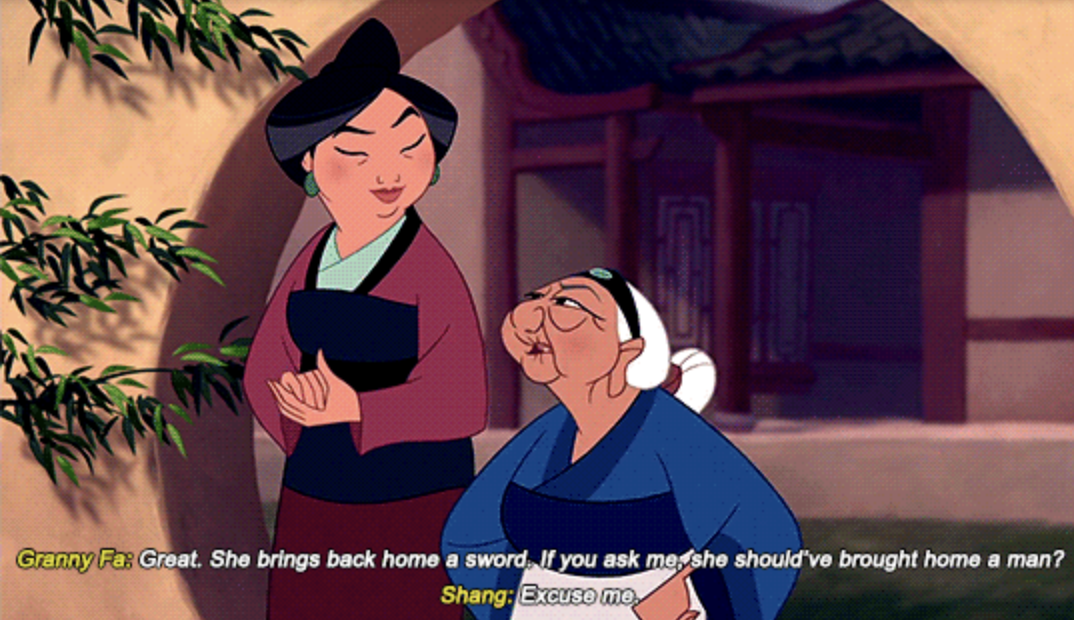
Another way to analyze the romantic storyline of this movie is how it affects Mulan’s nonconforming narrative. Mulan is raised within a society where her only role is to become a wife; instead, she challenges these norms by excelling in battle, a traditionally male-dominated realm. She goes through extensive efforts to carve her own path and reject the expectations of her culture, yet her conquest ends with a typical “fairytale ending”. In film’s closing scene, Mulan’s grandmother, Grandmother Fa, states, “Great. She brings home a sword. If you ask me, she should’ve brought home a man.” Shortly after Grandmother Fa’s line, Li Shang appears at Mulan’s home, implying the continuation of the relationship between Mulan and him. This scene not only undermines Mulan’s accomplishments as an individual, but it also fortifies the traditional gender roles that the movie claimed to oppose.
A snapshot of Grandmother Fa’s line from the closing scene.
The film Mulan can be considered as socially progressive and inspirational to its young female audience, due to its message that girls can accomplish the same feats as boys. However, it falls short of successfully defying societal norms. The consequence of this failure is that it validates the temporary nonconformity of an individual with the expectation that they will revert back to societal standards, such as participating in a heteronormative relationship.
The Netflix series Ginny & Georgia follows the complicated relationship between 15-year-old biracial teen Ginny Miller and her free-spirited, thirty-something mother, Georgia, as they settle in a picturesque New England town after years of being on the run. The show delves into themes of identity, family secrets, and social dynamics as both Ginny and Georgia search for their place in the world. Ginny grapples with her sense of belonging, wrestling with issues of race and the pressures of adolescence, while Georgia is determined to secure a better future for her family by any means necessary, even resorting to murder on various occasions. Beneath its surface drama, the series also offers an exploration of feminism and sexuality, highlighting how both characters challenge or conform to societal expectations around gender roles.
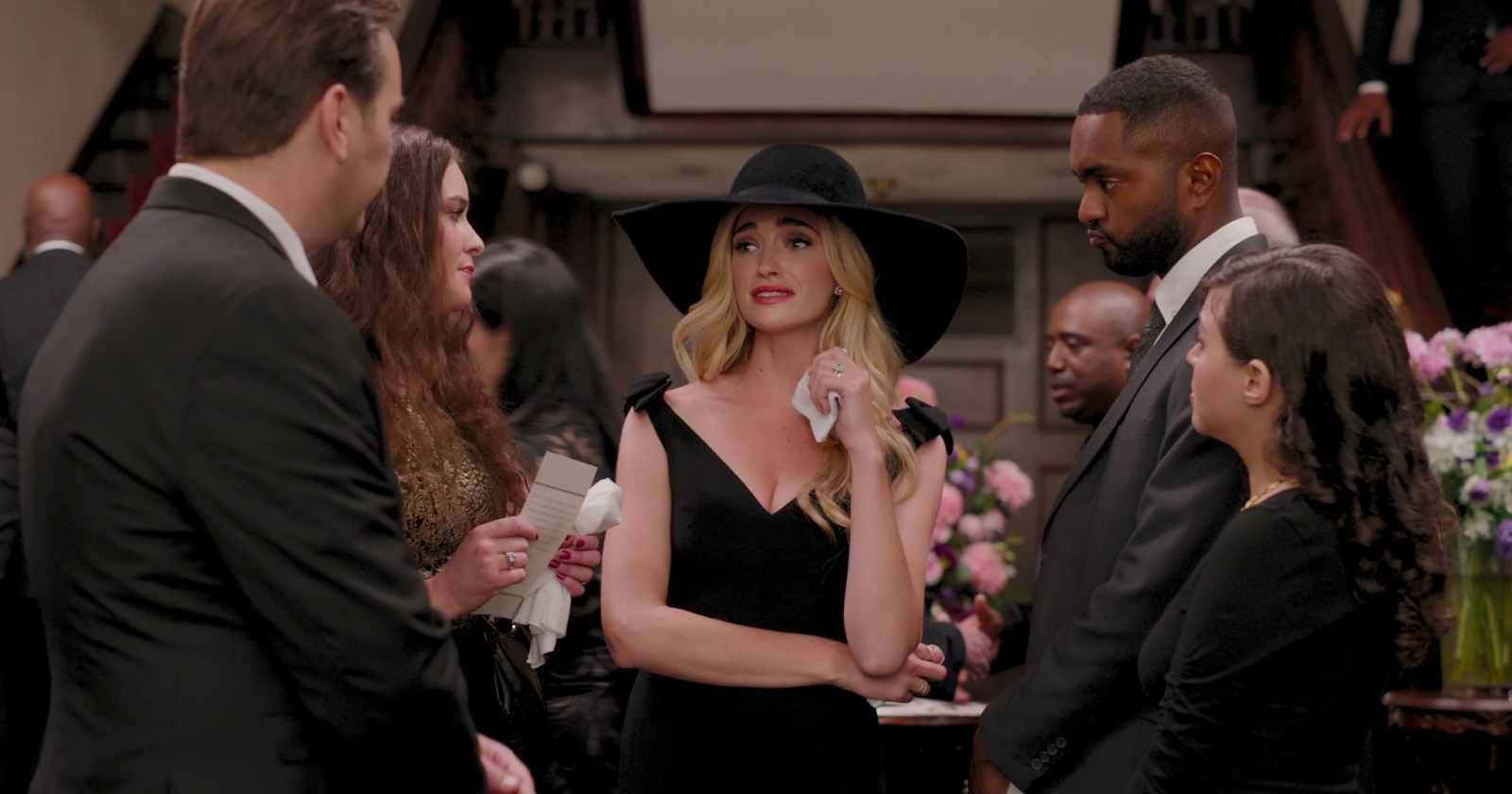
One of the show’s central themes is how both characters confront and challenge societal expectations of femininity and womanhood. Georgia embodies a pragmatic, survival-driven form of feminism, using her femininity and sexuality as tools to navigate a patriarchal world. While her methods are morally complex—sometimes involving manipulation or unethical decisions—Georgia’s actions reflect the reality of a single mother who has faced abuse and poverty. In the show, after witnessing her older, wealthy husband Kenny sexually assault Ginny, Georgia poisons him with wolfsbane in his protein shake. As he is on his way to work, he goes into cardiac arrest mimicking a heart attack. Georgia plays the poor, helpless widow at the funeral and later takes the inheritance to start a new life with her family. Her ability to use her circumstances to protect her family demonstrates a form of agency that can be seen as feminist, even as it challenges conventional ideas of empowerment. In society, feminism is often misconstrued as opposing traditional roles like being a family woman, while womanhood and motherhood are generally viewed as making women dependent on their male counterparts. As a young, single mother, Georgia defies traditional views on motherhood, embodying a fiercely protective, self-sufficient, and self-sacrificing matriarch. Her complicated morality, especially when she resorts to questionable means to safeguard her family, raises questions about what it means to be a feminist mother, blurring the lines between survival, empowerment, and ensuring her children do not face the same gendered oppressions she has.
Ginny reflects a more intersectional form of feminism. As a biracial teenager, she navigates the complexities of race, identity, and gender, with her feminism shaped by a growing awareness of social justice issues. Ginny’s journey is deeply intertwined with her struggles for self-expression and navigating the intersections of privilege and oppression. Her experiences offer a lens into the challenges that young women today face as they navigate their evolving sense of self within societal expectations. The biracial daughter of Georgia (a white woman) and Zion (a Black man), Ginny often feels like she does not fully belong in either the Black or white community. Georgia, despite her own struggles, represents a kind of privilege Ginny feels disconnected from. Ginny’s internal conflict around race becomes evident when she critiques Georgia for not understanding what it is like to be a person of color. Her relationship with Zion adds further tension, as he encourages her to more fully embrace her Black identity, leaving Ginny torn between the worlds of her two parents. The show explores code-switching as Ginny tries to navigate her biracial identity, feeling out of place among her white peers who dismiss or fetishize her Blackness, while also feeling distanced from the Black community due to her lighter skin and upbringing in white spaces. To highlight this, the show has Ginny straighten her hair as a symbol of her conformity to her predominantly white upbringing and high school environment. Further, in the scene depicted above, Ginny’s teacher praises her essay stating that it “speaks to her lived experience.” This moment highlights how Ginny feels tokenized and singled out because of her race, which leads to her outburst about being more than her skin color or background. The rest of the show goes deeper into how Ginny learns to express her identity authentically, challenging the societal norms that impose strict definitions of race and womanhood.
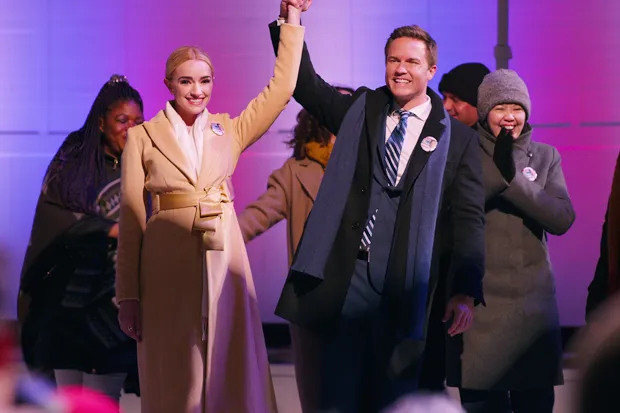
Both Ginny and Georgia also explore their sexualities in ways that reflect their generational differences and personal circumstances. Georgia’s use of her sexuality to manipulate men for protection and advancement brings up questions about the intersection of sexuality and power. While her actions could reinforce stereotypes of women using sex for gain, the show frames her choices as a form of survival in a world that often exploits women’s bodies and desires. Through flashbacks in the show, it is revealed that Georgia marries several wealthy men as a way to gain financial security. Georgia shows that she is conscious of the benefits her sexuality and charm bring to her by using them as tools for survival and upward mobility. Of note, her most recent love interest Paul is the mayor of the town she recently moved to. Georgia seduces him knowing that a powerful figure like him would provide security and social standing in their town. Georgia’s use of sexuality can thus be seen as both empowering and problematic, as it simultaneously challenges and reinforces harmful stereotypes about women and sex.
Ginny, on the other hand, experiences her sexual identity as typical of many teenagers, marked by confusion, experimentation, and self-discovery. In the media, young girls exploring their sexuality are often portrayed as engaging in dangerous or morally wrong behavior, typically accompanied by negative consequences. They are frequently criticized and shamed for their actions, while young boys are celebrated and glorified for engaging in similar behaviors. Simultaneously, the exploration of sexuality at a young age has become more normalized, and those who choose not to participate in it are often viewed as unusual or out of step with societal expectations. Ginny’s relationships with Marcus and Hunter, her two main love interests in the show, reflect the fluidity of sexual identity in contemporary discourse, while showcasing different dynamics of teenage relationships, including emotional intimacy and issues of consent and power. Ginny and Marcus, both sexually inexperienced, quickly form a deep connection, which they solidify physically early on. Their relationship remains secret for much of the first season, but when it eventually comes to light, it becomes the center of high school gossip, with people fixating on the drama and misunderstandings surrounding them. With Hunter, Ginny also faces criticism. While Hunter is well-liked and praised by many, Ginny struggles internally, feeling as though their relationship is not entirely authentic. She often questions whether she is with Hunter because it is what she is “supposed” to do. Overall, both relationships reflect different pressures young girls feel as they try to figure out who they are sexually.
For decades, transgender medicine has been a site of confusion, fascination, and intense conflict. There remains disagreement in how to provide gender-affirming medical interventions as well as how to determine who should receive it. Stef Shuster (they/them) tackles these questions in their book Trans Medicine: The Emergence and Practice of Treating Gender. They argue that the uncertainty in trans medicine has led to a medicalization of gender that identifies medical providers as experts and ignores trans people’s expertise in their individual bodies and experiences. Because contemporary medical perspectives are influenced by old assumptions about gender, this power dynamic perpetuates inequalities in healthcare.
When the era of what we now know to be trans medicine first began, the few healthcare providers who entered the field faced intense backlash from those who viewed such interventions to be inappropriate or even immoral (26). To protect themselves from the critique, medical providers who treated transgender patients corresponded extensively with each other, creating a shared understanding of trans medicine and establishing a sense of authority within the field (24). The focus became on “normalizing” trans people’s bodies and experiences—strict guidelines were set for who could be provided with medical intervention. Providers needed to be assured that their patient would be able to “successfully” live in their target gender; this definition of successful was entirely based in the medical and scientific community’s expectations for gender conformity and sexuality (24). Anything that deviated was met with suspicion that the patient was not truly transgender. Due to this, trans patients were judged based on appearance and were subject to intensive questioning about their personal life in order to establish their credibility (34). Trans people who did not fit these expectations were deemed unworthy of access to gender-affirming medical interventions (24). The author argues that due to the strict guidelines enacted to establish medical authority, trans people were forced to acquiesce to public expectations of gender conformity in order to receive gender-affirming medical care.
Still, uncertainty on how to determine who should receive gender-affirming care remained, leading physicians to reach out to psychiatrists and psychologists for assistance in assessment with the expectation that they would support their recommendations (50). Rather than working together, however, each group of healthcare providers argued that their field’s method of understanding transgenderism was sufficient. The author argues that this disagreement resulted in a battle over which field of medicine should claim power and authority over transgender treatment (49). Not long after psychiatrists and psychologists began assisting with the evaluation of trans patients, they began to offer recommendations for allowing or denying access to gender-affirming care, much to the physicians’ dismay, who thought their only role should be in assessing patients’ mental health (51). This resulted in a battle for not only power, but legitimacy as both sides questioned whether the other was equipped to claim authority.
Psychiatrists and psychologists, like physicians, focused on transgender patients’ personal lives in assessing them for receiving gender-affirming intervention: they also made recommendations based off gender conformity and physical appearance (59). However, they needed another way to distinguish their authority from that of physicians, so they turned to taking explicit sexual histories in order to ensure the credibility of transgender patients. They wanted to ensure that people were not using gender-affirming medical transition as a method of ignoring homosexuality (60-1). Shuster argues that this further subjected transgender people to adhering to the strict binary of gender and gender roles: therapists assumed that trans people would leave their existent families and go establish new, heterosexual ones where they would fulfill the familial role of their new gender. Therapists based their recommendation off trans patients’ intentions to do so (61-2). The efforts of both physicians and therapists were to assert their authority in trans medicine by establishing scientific guidelines in which to abide by and quell the uncertainty that existed in the field.
In contemporary transgender medicine, this uncertainty remains. Evidence-based medicine (EBM) has rapidly increased in popularity arising from critique that medicine needed to be more objective and standardized (77). Rather than basing guidelines off personal expectations as before, EBM represented an effort to base recommendations off scientific evidence. The author argues that in contemporary trans medicine, providers attempted to confirm the legitimacy of trans medicine by constructing evidence and codifying expectations (78). Codifying the trans experience led to it becoming a diagnosis: “gender dysphoria.” Shuster argues that this is a “double-edged sword:” a diagnosis increases the likelihood that insurance companies will reimburse out-of-pocket expenses for gender-affirming care, but it also implies that transgenderism is an illness (80).
Despite this, there was no clear path for clinical guidelines to follow in trans medicine because there was no scientific evidence: there were no randomized control trials determining risks or benefits of medical intervention (85). Trans medicine has rather been supported by case studies and patient reports (86). Because of the lack of scientific evidence, there remains ambiguity in the guidelines for providing gender-affirming care, leaving decision-making regarding trans care largely up to the discretion of the provider and allowing decision-making to be influenced by norms and societal factors. With healthcare providers vying to claim expertise, patients cannot claim the expertise over their gender identities themselves (88).
Shuster argues that this discomfort in the lack of scientific evidence has also resulted in a lack of confidence in healthcare providers in treating trans patients (90). Having been taught EBM, providers feel unequipped. Trans medicine is not taught broadly in medical schools (90). This discomfort and lack of experience in working with trans people leads to providers unintentionally exhibiting trans exceptionalism—where trans patients are perceived to be so unique that it is difficult for providers to use their knowledge and experience in other areas of medicine to inform their decision-making regarding trans patients (4). This makes it difficult for trans people to find a provider who feels comfortable working with them (91). The lack of scientific evidence backing gender-affirming care and lack of knowledge of the risks makes providers even more hesitant to offer access, particularly when trans people have coexisting conditions that may be affected. Though the guidelines no longer dictate gender conformity, their ambiguity allows providers to turn away trans people with mental health disorders or other health conditions due to the potential risk (95-97).
In summary, the author argues that due to the fact that medical providers are not trained in trans medicine, there exists uncertainty in how to assess trans patients and how to go about providing gender-affirming medical interventions. Because of this, there has a been an ongoing power struggle between different fields of healthcare in who can claim expertise in trans medicine and offer recommendations for care. This has medicalized understanding of gender and has given medical providers authority over gender, leaving trans patients at the whim of physicians’ interpretations of the ambiguous clinical guidelines based in EBM (104). This unintentionally perpetuates healthcare inequalities because decision-making is influenced by societal factors, cultural norms, and historical contexts (159). Their conclusive argument is that medical providers should not have authority over gender identity, nor should they impose medicalized understandings of gender onto trans people’s experiences: providers must advocate for their trans patients’ needs and place more trust in their patients’ expertise over their own bodies (164-6).
To support their arguments, the author employed several different methods of research. First, to provide historical context of transgender medicine, they examined letters of correspondence between medical providers in the 20th century found in the archives of the Kinsey Institute (11). These documents provided the discourse present in the medical and scientific communities on how providers were to make decisions regarding eligibility for gender-affirming medical interventions. From these Shuster gained knowledge of the assumptions that medical providers had when working with trans patients (11). They then conducted interviews with therapists and physicians from a wide variety of specialties and geographical locations. These interviews informed them how old assumptions of gender continue to influence contemporary structure of trans medicine and its lack of certainty today (12). The author also attended healthcare conferences and observed how providers taught each other to work with patient populations. Lastly, they examined diagnostic criteria and clinical guidelines related to transgender medicine from leading health organizations (13).
In conclusion, Shuster argues for the focus in trans medicine to be shifted away from the expertise of medical providers and onto the individual experiences of trans people. They call for better training in medical schools, increased research into the long-term effects of medical interventions such as hormones, and increased focus to be put on the healthcare disparities that trans people experience. Trans medicine is a place where science and values can coexist, and it needs to be redefined that way.
“To the straight people reading this book, let me say with all my love and solidarity, I am your ally” (Ward, 13). Who knew that such a normalized sexuality – heterosexuality – could result in the depressing lives of both parties? In Jane Ward’s scholarly monograph The Tragedy of Heterosexuality, she examines the normalized problems inside hetero-relationships, like misogyny, toxic masculinity, and gender roles. Because of these problems, women feel like many parts of their lives are trivial compared to men; on the other hand, men don’t feel secure in their own manhood to “pick up” a woman and keep them around. Let’s dive into why Ward says such things, and why Ward ends the book with “Straight men do not need to be queered; they need to learn to like women” (Ward, 171).
Beside The Tragedy of Heterosexuality, Jane Ward, a professor of Feminist Studies at University of California Santa Barbara, has written two other books: Not Gay: Sex Between Straight White Men, which was published in 2015, and Respectably Queer: Diversity Culture in LGBT Activist Organizations, which was published in 2008. With these published books, Ward has written about various topics, such as “trans relationships”, “the evolution of straight culture”, “the meaning of sex between straight-identfied men”, and more (these topics as well as the complete information of Jane Ward will be linked). Because of these previous works, Ward knows the reality of, in this case, straight people and their couple troubles. She has been aware of such topics early on, to which one could say she has an expertise in these fields. Even if not straight herself, Ward seems to know more than enough than one might expect.
As the book starts, Ward tells the reader that she views the life of “‘straight culture’…through a queer, feminist lens.” To put the problem of “straight culture” into perspective, Ward, as a queer person herself states, “Straight women’s lives are very, very hard. It’s not that it ‘gets better’ for queer people; it’s that heterosexuality is often worse.” With this line, I kind of reflected and thought how true it is – of course queer lives get better, but never realized how hard heterosexuality actually is. Growing up and accepting the fact that one is queer is already hard enough, but to put this context into the actual world of men trying to get with women is already depressing enough. This idea of sexism and toxic masculinity takes over straight culture, to which women and men can not have a successful life with one another because of these coinciding problems. How can men expect more from women when they can not expect more out of themselves? Men are too scared to break out of this heteronormative shell to which they resort of to the seduction of women and plain sexism.
There is a shift from women doing things to themselves – dieting, shaving, waxing, dying – to deem themselves worthy of a man’s “love,” now to men who realize that their bodies may not be enough to attract a woman’s love, such as being too bald, too short, or too fat. Because of this shift in men’s views, some men have started going to get help from pickup artists, which is, essentially, the idea of “how fast am I able to inappropriately touch you?” During this rise of pickup artists, Strauss’s book The Game was introduced; because of this, the pickup industry expanded into bootcamps, allowing for usually men to give men a lesson on how to get “game,” which is the same idea of seducing woman – how to get a woman into you and getting with her the same night (Ward, 87). As years passed, men slowly started to realize this isn’t what girls need or what – they want to feel seen, heard, and reassured; as a matter of fact, we know women don’t want to be seduced because women have developed “survival strategies…to manage sexual objectification” – these strategies being “bitch shields (i.e., being rude to, or ignoring, men) and shit tests (i.e., insulting men)” (Ward, 99). Women want men who are capable of showing these range of emotions, not the typical self-destructive men who needed a woman to “save” them and make them feel like woman actually had a job other than sex (Ward, 109). Like said earlier, as time moved, these pickup artist industry got more progressive (at least some of them, like Project Rockstar, who had better – younger, more attractive – instructors teaching men how to properly “game”: “thinking beyond consent to consider the quality of women’s sexual experiences, and using spot-on metaphors to help each other conceptualize good, humanizing sex” (Ward, 115). With this shift to a more progressive pickup artist industry,
One strength about Ward’s writing is her tendency to use others’ work as examples, which strengthen Ward’s own argument. For example, during chapter 4, Ward uses her queer acquaintances and friends as more opinions onto straight life and its culture; with these opinions, she is able to reinforce her own perspective to something more reliable and accurate. She’s also able to draw out something more from these different opinions and perspectives. Additionally, another strength with Ward’s writing is critique a problem – with detail – within straight culture, and is able to offer a solution or workarounds to be able to enjoy a relationship where men actually love women and vice versa.
While I admire almost everything about the book, one weakness about the book is the lack of perspectives coming from the other side. Yes, I agree this is something that shouldn’t have another side, and that dismantling this patriarchy is ultimately the step that allows for something more in these relationships. However, one effective strategy, I would say, is that Ward would be better off using rebuttals to her perspective, and counter those arguments, which also give the mentality of “Nothing-to-lose.” Here’s what I mean: for example, within the pickup industry, some men had “that nothing-to-lose frame of mind that allows men to approach women they would otherwise find intimidating” (Ward, 104). By refuting these opinions coming from the other side of this battle, we can then give women and men a same state of mind, allowing them to try these new, which they somehow deem “queer,” like exploring sexual, such as polyamory or “pegging.”
After reading this book, I realized that some of these issues did not occur to me. While I am queer myself and know there has always been issues within straight relationships, I never knew what specifically. Reflecting on my past years, I recognize how little my life has been filled with straight relationships and their problems. I have three sisters, so of course I’ve been exposed to that of hetero couples, but have never actually noticed the problems embedded within. This book has put out more than I realized could be wrong with straight relationships, such as how men are scared of hurting their manhood in any way and would rather dismiss their female partner and their feelings and/or interests (I knew men were scared of hurting their manhood, but did not know until now how they would treat their partner just to protect themselves). While this book has a specific audience range consisting of mostly straight people, I say anyone with an open-mind should read this book. While some people may not consider themselves straight, I think this book provides a great opportunity to know more of the world around us revolving around straight culture. To some degree, I would not say there is a specific audience; although it mostly takes place within these hetero-relationships and they should be the one to fix it – through communicating and experimenting – I think those outside of the straight community also play as a role to disassemble this hetero-patriarchy: as Ward, a queer person, says herself, “I wish for them that their lust for one another might be genuinely born out of mutual regard and solidarity.” For straight women, this book does a great job at giving light to these problems; it can be freeing to have a book dedicated to the ways your life can be improved. Thus, I think this book has something in store for everyone, and we could all learn a thing or two as the principle of love is something mentioned, even if towards straight men.
About a year ago, I went through my first real breakup. I was in a toxic, straight relationship with a man for nearly three years, and since our breakup, I have often wondered: how unique was my experience? Reading Jane Ward’s monograph, The Tragedy of Heterosexuality, I was struck by the degree to which my former relationship was indicative of a larger problem with straight culture, and the ways my experience aligned with many other women’s experiences. Ward outlines the patriarchal structures and influences of rape culture that inform straight men’s violence against and general lack of empathy toward women. She goes on to connect these structures and influences to the widespread dissatisfaction (at best) of women in straight relationships. Ward proposes that straight women are in danger and calls for a reversal of the ally relationship in which queer individuals become allies to straight women.
According to Ward, straight culture’s impact on straight women has elicited queer concern and confusion for decades; members of the LGBTQIA+ community have often described straight relationships as, at best, boring, but often toxic, and at worst, violent. Ward talks about her love for her queer life and argues “that the basic premise of the question—that heterosexuality is easier than queerness—requires renewed investigation” (Ward 2). Ward centers lesbian feminist scholarship and cites that the “tragedy of heterosexuality” is “a critical but still largely overlooked consequence of the drowning out of lesbian feminist ideas and experiences” (Ward 4). By centering lesbian and queer feminist perspectives, Ward posits the tragedy of heterosexuality is that “straight life is characterized by the inescapable influence of sexism and toxic masculinity” (Ward 8).
The Tragedy of Heterosexuality’s overarching argument is that heterosexuality is “a system equally organized around love and abuse,” and rooted in white supremacy and patriarchal structures (Ward 12). Many straight women, according to Ward, are unhappy—so what entices them to stay? By outlining the historical and structural contexts of straight culture, Ward situates straightness as a “fetish for normalcy” (Ward 15). Heterosexuality has often been framed as the norm, reinscribing gender roles and biological essentialism, among other sexist narratives that permeate straight culture. Ward argues we must address the ways in which heterosexual relationships reinscribe these narratives—the “we” presumably being individuals across the spectrum of sexuality.
Ward quickly addresses that her focus is straight culture, not necessarily sexuality itself. One prominent aspect of straight culture is normalized mutual dislike: “Across time and place, most forms of heterosexual coupling have been organized around men’s ownership of women (their bodies, their work, their children) rather than their attraction to, or interest in, women” (Ward 34). But Ward argues that in addition to men’s control of women, “straight women’s and men’s shared romantic and erotic attachments to an unequal gender binary” indicates a wider issue with and fear of detachment from the norms of the gender binary and sexuality, further reinforcing heterosexuality as a fetish for normalcy (Ward 22).
Ward, who is a professor of Feminist Studies at UC Santa Barbara, “has published on topics including the marriage self-help industry, the rise and fall of pickup artists, how early lesbian feminist ideas shaped contemporary gender politics, the meaning of sex between straight-identified men, queer childhood and parenting, the evolution of straight culture, the corporatization of gay pride festivals, the race politics of same-sex marriage, the social construction of whiteness, feminist pornography, and trans relationships” (Jane Ward). In addition to The Tragedy of Heterosexuality, she is known for her works Not Gay: Sex Between Straight White Men (2015) and Respectably Queer: Diversity and Culture in LGBT Activist Organizations (2008). Ward’s book, Not Gay, was featured in Newsweek, New York Magazine, Forbes, The Guardian, BBC, Washington Post, USA Today, Huffington Post, Salon, Vice, and Slate (Jane Ward). Her first book, Respectably Queer, was named by The Progressive magazine as a best book of 2008 and has been featured on NPR (Jane Ward). Ward, who herself identifies as queer, has published many works about queer existence, flipping the dominant narrative of straight as normalcy on its head.
In Ward’s discussion of the history of straight culture, she begins with the eugenicist marital hygiene ideals of the early 20th century: “…this era also initiates straight culture as a gendered mode of consumption in which the purchase of beauty products and relationship advice were vital to maintaining the delicate balance” (Ward 47). Then, midcentury advertising campaigns and educational films capitalized on these gendered modes of consumption to add more pressure on women: “…advertisers skillfully connected their products—from cosmetics to electronic dishwashers—to the project of heterosexual repair…” (Ward 53). Ward finishes out the historical context with the late-century explosion of a self-help industry “built on biopsychological claims about gender difference,” which further normalized heterosexual misery (Ward 30). To explore these circles of the late-century, and more recent iterations, of self-help, Ward discusses pickup artists and seduction coaches, and their redevelopment of a “woke masculinity” (Ward 31). Ward outlines the motives and degree to which these self-proclaimed dating experts contribute to the tragedy of heterosexuality: “Seduction coaches, at some level, know that heterosexuality’s continued fragility and failure produce a demand for interventions that can build a women’s sexual desire for average men and increase average men’s capacity to elicit that desire” (Ward 87).
Starkly contrasting the perspectives of seduction coach culture are the queer subcultural materials and interviews with queer people. For instance, one portion of the queer testimonials is entitled “It’s Sad How Much Women and Men Dislike Each Other,” in which queer individuals talk about the heartbreaking ways straight culture normalizes mutual dislike and straight women’s dissatisfaction with their male partner. As a rebuttal to the tragedy of heterosexuality, and particularly the issue of mutual dislike, Ward discusses the concept of “deep heterosexuality,” in which straight men would essentially take notes from lesbians and identify with women to develop a deep mutual regard (Ward 158).
The Tragedy of Heterosexuality’s greatest strength as an academic work is its grounding in reality, not the theoretical. Ward takes an anthropological approach, using real human testimonials supported by lesbian feminist scholarly literature; her inclusion of queer perspectives in the chapter “Sick and Boring Life” exemplifies the degree to which this work is rooted in lived human experience. In addition to these queer perspectives, her interviews and described interactions with modern pick-up artists and dating coaches emphasize the humans behind and the humans suffering because of hetero-patriarchal structures. What makes the book so powerful is the way in which Ward marries the academic and the personal; I related to nearly every single tragedy of heterosexuality—but before reading this I did not know these experiences were a part of a larger system. I thought it was normal and inevitable to feel stuck with a boyfriend who disappoints you, relies on you for therapeutic counseling, and acts in controlling, manipulative and misogynistic ways. Ward shows straight women (and men) that there is another way.
Though I heavily related to the content of this book, I find that one thing it was missing was the perspective of straight women. Much of the discussion of straight women’s experience is rooted in academia and considering this is a work about straight women, a lot of the included perspectives were not theirs. From Ward, we learned how queer people feel about straight relationships and how some straight men feel about straight relationships (although, not the ones who indicate an inclination toward deep heterosexuality), but to “save” straight women, do we not need to understand the feelings tied to the tragedy of heterosexuality, too? I think a chapter like the queer perspectives chapter, but with anecdotes from straight women, could have made the work stronger.
As a personal reading experience, I found this book to be very validating and liberating. As a scholarly experience, I found the book immensely enlightening in how Ward breaks down the structures that cultivate oppressive realities for straight women in heterosexual relationships. Any straight women or women who have been in a straight relationship should read this book to understand why straight relationships function as they do; frankly, they should read The Tragedy of Heterosexuality to understand that many of the shortcomings of their straight relationships are not their fault. I also think straight men could benefit from reading this book; Ward provides insight into the situations they place women in and outlines how heterosexual misery is not an inevitability.
As Ward calls for queer allyship, queer individuals should at least read excerpts from the book (potentially excluding the queer perspectives chapter if they are very well-versed in the realities of heteronormativity and the tragedy of heterosexuality). Examining the tragedy of heterosexuality from a queer lens is an example of why it is critical to view normative, dominant structures from those who have been marginalized by them. Queer people understand their own existence and straight existence, and the insights they can provide, as outlined by Ward, are invaluable in turning the tragedy of heterosexuality into healthy relationships bonded by deep heterosexuality.
Works Cited
Jane Ward: Scholarship for the Feminist Future, https://www.janewardphd.com/.
Ward, Jane. The Tragedy of Heterosexuality. New York University Press, 2020.
Although the emergence of trans-medicine as a discipline and the discourse surrounding it appears rather recent, transgender healthcare has existed since the early 20th century (Schuster 23). Despite this, physicians and other medical professionals are both hesitant and inexperienced in regard to the treatment of transgendered individuals. The book Trans Medicine, The Emergence and Practice of Treating Gender details how and why this disinclination to treat transgendered patients has occurred and the consequences of medical authority over gender and sexuality. Furthermore, the author seeks to identify practices and ideologies that have been normalized and “legitimized” in the decades of trans-medicine. Through this short publication, Schuster analyzes both contemporary and historical trans-medicine systems and norms in addition to specific examples highlighting the interactions between varying forms of healthcare and their implications on trans-medicine as a whole. From this we can understand how trans-healthcare provides a middle ground for intersection of personal values and scientific thought.
To compile the examples and evidence presented in the book, author Stef M. Schuster used a multi-sited research design (Schuster 11). The majority of Schuster’s research is his collection of correspondence between healthcare providers in the 20th and 21st century (Schuster 2). Schuster also relies upon biological artifacts, collections of discourse, and other forms of scientific literature. (Schuster 6). Additionally, the author is an associate sociology professor at Michigan State University with a M.A. and Ph.D. in sociology and has conducted a number of interviews with both therapists and physicians as well as attended scholarly conferences on the topic of trans-medicine (Schuster 12). His final source of data collection came in the form of analyzing clinical guidelines, standards of care, and diagnostic criteria used by both contemporary and historical physicians (Schuster 13). Finally, the author notes that terminology surrounding gender and sexuality is fluid and specific word choice in the book may not be representative of the terminology used in the past or future.
Early development of trans-medicine began in the mid-1950s in the post-World War II era (Schuster 23). Public trust in scientific communities to solve social and biological ills was at an all-time high (Schuster 23). According to Schuster, this increase in medical authority over gender and sexuality and the power difference between doctor and patient is one of the root causes of why trans-medicine has made little progress from the 20th to 21st centuries (Schuster 24). While there have been attempts to decentralize authority of medical providers, many still hold the view that the “doctor knows best” (Schuster 9). In terms of trans-healthcare, this mindset has resulted in a number of subsequent issues. Medicalization refers to “the process of how non-medical problems become defined and treated as medical problems” (Schuster 9). Through medicalization and especially regarding transgender-healthcare, social issues about bodies and bodily autonomy become scientific issues.
Schuster argues that the medicalization of transgenderism resulted in early physicians perceiving transgender patients as “severely troubled” and transgenderism was understood in terms of symptoms of “delusional thinking” (Schuster 24). On one hand, Schuster details how the medicalization of trans-sexuality excited physicians as it was a new uncharted form of medicine. On the other hand, many physicians were hesitant and felt unequipped to treat transgendered patients. As Schuster details in chapter 1, few endocrinologists and physicians in the U.S. were willing to assist transgender individuals out of fear of criticism from peers, revoking of medical licenses, and possible patient regret and future lawsuits following procedures (Schuster 24). It is from this medicalization and hesitance to treat patients that specific guidelines and evidence-based medicine (EBM) emerged. Providers began placing increased expectations onto their transgender patients in an attempt to ensure that the patient was truly willing to undergo hormone/surgical procedures. Schuster states that from these expectations, new scientific language, approaches, and guidelines for trans-medicine were created (Schuster 64). The Diagnostic and Statistical Manual of Mental Disorders (DSM) and the World Professional Association for Transgender Healthcare (WPATH) sought to define transgenderism and create a step-by-step protocol to treating transgender patients respectively (Schuster 80). While guidelines may serve as a “handrail” in other forms of medicine, Schuster explains that the steps outlined in the guidelines suggest a linear pathway, while gender transitions tend to be anything but linear and vary from individual to individual (Schuster 105). Furthermore, standardizing and defining transgenderism is ineffective as trans people’s experiences and self-concepts may not fit into binary modes of thought. Not all transgender patients have similar experiences and the notion that gender is fluid (not just extremes) is hard to process for many.
In addition to the medicalization of trans-sexuality, Schuster argues that certain strategies and mindsets have become normalized in trans-healthcare. One of these strategies is what he calls the “fake it till you make it” mindset (Schuster 131). Because few providers are trained in the social contexts and manifestation of gender, this lack of understanding causes discomfort amongst medical professionals. Many have trouble admitting their lack of knowledge in a field which further causes incorrect practices to become normalized over time (Schuster 134). Schuster also details the trope of the “self-assured expert” who present information in ways that leave little room for discourse and change (Schuster 138). Additionally, some solely follow clinical guidelines and understand trans identification as a clear, straight pathway “from point A (assigned gender at birth) to point B (undergoing a physical transition to the “other” binary gender)” (Schuster 138). The final and perhaps most prevalent strategy that Schuster recalls is “gate-keeping” and defining who is “truly” transgender (Schuster 106). To protect themselves from being sued by a patient, many providers were strict (and still are today) about who is able to obtain treatment procedures (Schuster 94). Schuster identified the following techniques that providers used to determine who would be able to receive hormone therapy. To begin, individuals who did not engage in illegal or risky activities indicated to providers that they could function as a “normal” person upon transitioning (Schuster 72). Second, those who were able to pass the “real life test” or live their life as if they had already received transgender treatment proved to providers that the patient was committed to go all the way with the procedures (Schuster 39). Finally, trans-patients whose ideologies closely aligned with traditional gender roles were significantly more likely to receive hormone therapy and surgical interventions (Schuster 16).
Schuster argues that progress in transgender medicine in recent times has been minimal. While he does not explicitly provide any solutions, he does detail specific providers who are making beneficial progress in trans-healthcare by utilizing smarter and favorable practices. He defines “flexible interpreters” as providers of trans-medicine who are able to “embrace the uncertainty in trans medicine and interpret the guidelines in ways that puts patients’ needs, and their varied ways of identifying as trans, first” (Schuster 117). In other words, these are medical professionals who are able to find a balance between social values and scientific fact and who refer to guidelines as recommendations rather than laws (Schuster 117). According to Schuster, flexible interpreters realize that guidelines take away focus on the individual and their healthcare needs (Schuster 118). When considering that each patient is unique, it is impossible to follow clinical guidelines exactly.
Schuster’s book thoroughly and concisely explains the emergence and history of trans-medicine from the 20th to 21st century. It highlights specific examples of social and medical trends that have impacted trans-healthcare over the years. For example, the book delves into topics such as the medicalization of sexuality through the DSM and WPATH and explains how this has had an effect on treatment strategies. Schuster draws upon various sources to formulate his claims and arguments with one of the sources being scholarly/medical conferences. However, the most convincing sources are direct quotes and letters of correspondence from the 1960s. These primary sources allowed the author to form arguments with supporting examples. This is demonstrated on page 31 in which Schuster presents a letter written by a transgender patient, “This letter is no trick and all I write is the truth and not made up. I want you to understand that my need to have this operation is not in passing, but is something of the deepest importance to me and has been for a long time…” This quote directly supports the author’s argument of the trope of transgender “trickster” where transgender people deliberately misrepresented information about themselves in order to gain access to hormones and surgery (Schuster 31). The abundance of direct quotes and examples make the book an informative and credible read.
While the author’s support of “flexible interpreters” is clear, the author says little about potential solutions and courses of action for the future of trans-medicine. Instead of offering specific solutions to the problems in trans-medicine that have been normalized over the years, Schuster simply critiques and summarizes these issues. While proposing healthcare solutions may be beyond the author’s expertise, with the immense amount of research collected to write this book, I would have expected the author to describe future plans and implications of his findings. In the conclusion and in the section titled “Redefining the treatment of gender,” the author states that “changing the protocols and shifting attention away from trans people as a problem to fix enables some providers to redefine the ‘treatment’ of gender in a way that shifts the attention to broader social inequalities that trans people experience in everyday life, rather than perpetuating inequalities in healthcare encounters” (Schuster 164). While I agree with this claim, it is a simple blanket statement that does not enact any specific changes or solutions.
Overall, Trans Medicine, The Emergence and Practice of Treating Gender, by Dr. Stef M. Schuster was an enjoyable and informative read. The book answers the questions of how medical authority over gender has occurred as well as what practices have become normalized over the years in trans-medicine and their specific consequences. While the author takes a clear stance against the current and past states of trans-healthcare, he does not dive in depth into solutions. In summary, I would recommend this book to anyone who is interested in history and specifically in the history of medicine and sexuality. Furthermore, I feel it is imperative that those pursuing a career in healthcare read this book. As healthcare and social values are increasingly interconnected, it is critical that our future healthcare providers adapt with the times to help serve diverse communities.
Works Cited
Shuster, Stephen M. Trans Medicine: The Emergence and Practice of Treating Gender. New York University Press, 2021.
“Women, it seemed, had no right to self-fulfillment that could stand for a moment against the claims of society on their wombs” (Russett 1989, 123).
Living in a society is equal to facing a variety of expectations, roles, and behaviors deemed acceptable or unacceptable. Women’s roles, in particular, have changed quite a lot in the past few centuries. Nowadays, people with uteruses have more reproductive freedom and opportunities to be economically equal to men than in the nineteenth century. The book Sexual Science: The Victorian Construction of Womanhood by Cynthia Eagle Russett describes how women were perceived in the Victorian times. It focuses mainly on the source of the viewpoints, on people who had the power to convince the society of those perceptions – scientists. The book describes their findings and conclusions about womanhood, one by one, and dismantles them in a very powerful way.
In the nineteenth century, women had little to no say over their bodies, minds, and rights. White male scientists focused greatly on explaining differences between sexes; in other words, why they had little to nothing in common and why women were inferior to men. They took control over proving that women are physically and mentally unable to be equal to men due to Nature’s challenges that people with uteruses had to face, such as menstruating or being able to carry a child. Scientists at that time accepted only facts that would agree with that claim and rejected all information against their beliefs.
The author, Cynthia Eagle Russett, was born in Pennsylvania in 1937. She was a historian, earned her Bachelor’s Degree from Trinity Colege and her Master’s and Ph.D from Yale University, where later she worked as a faculty member. She wrote several books, though she is best known for her exploration of Victorian “findings” about womanhood in Sexual Science: The Victorian Construction of Womanhood. Cynthia passed away in 2013, aged 76 years old, leaving behind a great legacy of fighting for women’s rights through exploring history.
A lot of what Cynthia Russett does is present statements and reasoning of white male scientists and let their words speak for themselves throughout the majority of the book; those alleged findings are challenged later on, at the very end. She mentions “experts” from a variety of fields of science, including phrenology, anthropology, craniology, biology, sociology, and many concepts within those fields of study. Victorian scientist greatly contributed to how women were perceived by the society at that time and what roles they were allowed to hold due to “the near-total absence of information in the field of sex differences, which made it inevitable that ideas now seen as preposterous were not preposterous at the time” (Russett 1989, 183). People listened to them; they had no other choice as no other credible source of information was available to them. Scientists were responsible for shaping society’s beliefs, despite the fact that later on they were proved wrong.
In the Victorian times, it was well-established that women were inferior to men. Many white male scientist were highly motivated to prove that statement to be correct. Any differences between men’s and women’s bodies, they emphasized, and automatically made men the one to hold the superior traits, no matter what they were. They held a firm belief that bigger equals better, which applied mainly to people’s bodies and brains. It was known that men were bigger than women, both in terms of physical appearance and brain volume/skull size. They claimed that “women’s brains were smaller and lighter than those of men” (35) and women’s skulls resembled more those of gorillas than men (36). Scientists refused to admit that heavy brains existed among “idiots, imbeciles, criminals, insane, and other defectives” (37). Women were also compared to children, said that “the brain of woman as a whole was always in a more or less infantile condition” (54). The full maturity of women was seen to be reached earlier than in men, which meant that a crucial part of development, women never attained. Men would always be better developed; they pass the “woman stage” and develop abstract thinking and reasoning. Half the population was automatically put in a disadvantaged position to be considered a significant contribution to society’s success. Simply put, a woman was an underdeveloped man (74).
A very important stigma that was emphasized during the Victorian times and still exists in many spaces today is menstruation. GIVE DATE Scientists claimed that “the phenomenon of menstruation was alone fully sufficient to explain why women could never hope to stand on a level of social and professional equality with men” (30). They connected it to the claim that the more someone eats, the more they think, and the more energy they have. Menstruation took away that energy. They used method of manipulation to make sure women understand the responsibility they bear – that of preserving the human race. They claimed that “the necessary outcome of an absolute intellectual equality of the sexes would be the extinction of the human race” (105). They also stated that the energy that men can put into thought and education, girls have to use during the development of their reproductive systems. Because of what Nature “gifted” them with, they were set for failure, both in educational and professional settings.
Scientists also decided that motherhood is a woman’s only role and goal in life. “She is the sex sacrificed for reproductive necessities,” they said (43). Alongside came the claim that the suffering connected to childbirth is exaggerated because women, just like Black people, do not feel pain; “[…] even the pains of childbirth caused little suffering to women” (56). Feeling pain was associated with courage, which was a characteristic of men and men only, therefore “[women’s] courage must be indifference; their endurance, insensibility” (57). That particular example shows a point previously mentioned about scientists deeming acceptable only information that fits their beliefs. Since there was a possibility that women were brave because of the way they could cope with pain, it needed to be dismantled, therefore they were claimed to be numb, unable to feel physical pain.
The book provides an opportunity for the reader to put the present and the past into perspective. Many people do not realize that the oppression that women face today started in the place of no evidence for many aspects of womanhood. Some individuals nowadays might say that societal roles are there for a reason and are based on science. As Cynthia Russett proves in her book, the science of the past is not what we would define as science in modern times. In Victorian times it was far from objective, not based on real evidence, and many findings at the time were assumed based on pre-existing beliefs. In other words, a group of white men decided that women are inferior and have no benefit from education or equal opportunities – and people listened, accepted it as the universal truth, and passed it over generations.
One of the things that readers might struggle with while reading the book is being overwhelmed by the amount of names and scientific facts presented. The author includes a great number of names; however, there is rarely any relevant information about their backgrounds. It would be a great addition to know the context of how popular a scientist was at the time, how influential, and to put more focus on explaining that to the reader. Additionally, a lot of theory was presented, though only addressed to be wrong or incorrect at the very end, if ever. The author might have tried to remain objective, which she succeeded in, though information shared in the book is disproportionate to the challenging of that information present. Moreover, women’s voices were not amplified enough, they played a passive role in the book. For example, there is no mention of general population’s response to most of the harmful claims made by the scientists (such as women compared to gorillas or children). It is an aspect that can be seen as missing, and might have made the book significantly stronger.
Sexual Science: The Victorian Construction of Womanhood by Cynthia Eagle Russett is a very important resource as it provides an accurate and well-researched historical context of women’s oppression. Even though what Victorian scientists claimed was seen as true a long time ago, a lot from what they said still applies to a certain extent to modern times. The book is a powerful tool for everyone, especially those involved in the fight for women’s rights. It can create a research-supported argument against the fact that, for example, women’s role is to bear children and their wombs can and should be controlled by the society and the government.
Photo of Jack Halberstam and cover of book by Vincent Tullo
In Jack Halberstam’s Wild Things: the disorder of desire, wildness is a multifaceted concept intertwined with queerness, queer bodies, and human desire. There are many ways of thinking of the “wild” and “wildness” in culture today. The wild speaks of uninhabited growth and unrestrained actions of something (un)natural, of people resisting societal rules, and of animals refusing to submit to humans. The wild is often something that we do not, and cannot, fully understand. Therefore, it is applied to a variety of things that do not make sense to a society that thinks in binaries of male and female, heterosexual and homosexual, and animal and human. With wild queerness comes wild desire. Wild desire is neither heterosexual nor homosexual, but also neither normal nor perverse (Halberstam 11). The people that exhibit wild desire have sexualities that are difficult to place in post-1800s conceptions of sexuality and that are sometimes linked to a longing to become wild and even fully feral (23). Halberstam also investigates what makes something wild, the rules of wildness, and our role in destroying or perpetuating the wild. Wild Things: the disorder of desire explores human fascination with the wild, wildness’ ability to escape binary thinking, and the benefits of being wild.
Through the book’s nine sections, Halberstam traces the wild through the past and the present to assert various arguments about the humanity-wildness connection but also to explain how the wild challenges human hierarchies that separate the human from the other. He begins by locating the original European-American ideas of wildness and longing for the wild in colonialism; wildness was something “native,” non-European, pagan, or savage that Europeans fell in love with and tried to replicate (35, 53-54). At the same time, he highlights Native American and Black uses of wildness; where wildness was once used to control and dehumanize these groups, they reject the idea of humanity as defined by Western standards, choosing to live outside any colonial or Western conception of what they should be (26). He then analyzes specific modern narratives of falconry to point out that some people do not only wish to replicate wildness, but also long to shed their humanity and become feral animals (79). These lines between human and animal blur even further in the section on pets and children that not only brings together wildness and domesticity, but also introduces “zombie humanism” wherein humans project living death onto others so that their humanity can only be discerned when compared with these (un)dead beings (116-120). First, he expands on the feral child, asserting that before entering the adult world, the child lives in a space of wild emotion and rejection of adult-imposed power systems, opting instead to follow the rules of the wild (130). Second, he expands on the trope of the zombie that represents modern anxiety over the blurring boundaries between the wild, the domestic, the living, and the dead (148-149). He finally concludes that the wild is all around us and urges us to deconstruct the world we know and let the wild accept us into its fold (180). Halberstam communicates these arguments as the wild and queerness continue to fascinate him in his professional career and personal experiences.
Jack Halberstam is known mostly for his scholarly writing and public speaking about gender, sexuality, and popular media. He holds a Ph.D. and an M.A. in English Literature from the University of Minnesota, Minneapolis and a B.A. with Highest Honors in English from the University of California Berkeley (“CV”). He is currently a professor of English and Gender Studies at Columbia University and the author of seven books including Female Masculinity and The Queer Art of Failure (Jack Halberstam). In 2018, Places Journal awarded him its Arcus/Places Prize for “innovative public scholarship on the relationship between gender, sexuality, and the built environment” (Jack Halberstam). He has also written articles for journals and magazines and is a co-editor and public speaker on topics such as queer failure, subcultures, gender variance, popular film, and animation (“Bio”). In recent years of his everyday life, Halberstam has gone by he/him pronouns but tried not to ‘police’ other iterations of his pronouns or his name, such as Judith or Jude (Sexsmith). His attitude towards his own gender expression in his personal life reflects the way of living outside binaries that he illustrates in Wild Things. This relationship between queerness, media, and the wild intrigues him so much that he is working on a second volume of this work titled The Wild Beyond: Music, Architecture, and Anarchy (Jack Halberstam).
Halberstam’s methodology for illustrating his arguments in Wild Things is to weave together a variety of media that supports his theories. The book is divided into two parts, the first of which is “Sex in the Wild” which explores wild sexualities and their histories. The first instance of wild sexuality that he mentions appears in chapter one, “Wilderness, Loss, and Death,” with Roger Casement, an Irish diplomat who was both an anti-colonialist figure and a man who sought sexual favors from men in the Congo and the Amazon whose rights he fought for. To Halberstam, Casement displays an ‘untimely sexuality:’ a desire for the wild, non-European person and his/her world understood as queer and yet established before the language of homosexuality (Halberstam 43). In discussing colonial wild desire, he also mentions anthropologist Michael Taussig’s theory that colonialism views the non-western other as savage and violent and in trying to subdue those wild traits ends up displaying those traits itself (37). Halberstam then uses The Rite of Spring in chapter two, “‘A New Kind of Wildness:’ The Rite of Spring and an Indigenous Aesthetics of Bewilderment,” as an example of that colonial view of wildness in art. Through examining its convention-breaking choreography, its inversion of musical chords and instrumentation, its creative team’s queer relationships with each other, and its riotous reception by critics, he presents the ballet as a replication of a fictional Native American rite and of queer fantasies of wildness (53-60). However, his analysis of Kent Monkman’s paintings points to a Native American embracing of this characterization of wildness through works like Seeing Red that parody western art by inserting queer symbols such as Monkman’s alter ego Miss Chief Eagle Testickle (74). Moving away from colonialism, the falconry accounts of J.A. Baker, Helen Macdonald, and T. H. White in chapter three, “The Epistemology of the Ferox: Sex, Death, and Falconry,” demonstrate wild desire outside of the hetero/homo binary that is not attributed to being in the closet or longing for human connection and while related to sexuality, is not actually sexual (79). The wild desire here is to live vicariously through birds and use their knowledge even when that knowledge makes no sense in human contexts (80, 82). According to the falconers, when people have this desire that does not fit human categories, they long for a similarly wild place where their desire does not have to be dissected or designated (94). Thus, part one of the book connects colonialism, art, and queer theory with different interpretations of wildness.
Part two of the book, “Animality,” explores wild animals, children, and forms of living. The introduction to part two, “Animals Wild and Tame,” examines capitalism’s role in human-animal relationships. Halberstam looks at Gabriel Rosenberg’s “How Meat Changed Sex: The Law of Interspecies Intimacy after Industrial Reproduction” which details a contradiction of anti-bestiality laws that forbid bestiality on moral grounds yet allow human-animal contact for meat production, suggesting that the difference between a companion and meat is not love but capital (120-122). Extrapolating from Jane Bennet’s book, Vibrant Matter, he states that pets are not alive in their wild original form, but are not dead like animals for slaughter (119). A pet is useful in its companionship but has to live by human rules; it can nip but cannot bite, so pets become prosthetic extensions of humans doomed to a half-wild life (119). Halberstam also looks at the child, that other half-wild creature, and compares Max from Maurice Sendak’s Where the Wild Things Are with Pi from Yann Martel’s Life of Pi. He notes that both boys understand that the wild separates people into predator-prey relationships, that it has a set of rules entirely different from the human realm, and that the only way to survive it is to follow those rules and participate in the ‘wild rumpus’ (134-139). Halberstam then returns to “zombie humanism” and how zombies force us to consider the value of life. In the film, White God, animals will revolt if given the chance as in the case of Hagen, an abandoned dog who spends the film meeting and killing other dogs, rising up against pound guards, and feeling indifferent when reunited with his previous owner (159-160). In looking at zombie films, Halberstam demonstrates that zombies’ motivation in The Walking Dead is not to become human but to destroy humanity as agents of the wild (170). He compares this motivation with how In the Flesh tries to question the importance of life over a zombified existence through a gay protagonist who committed suicide and then was revived as a zombie. (172). In his final chapter, “The Ninth Wave,” he analyzes the B-side of Kate Bush’s album Hounds of Love and encourages readers to surrender to the wild in their lives just as Bush seems to surrender to the themes of her music (176-180).
Wild Things’ use of multiple forms of media and of racial, class, and economic perspectives contributes greatly to its success. While referencing other scholars like Foucault, Wild Things works within queer theory by arguing against the view of wild desire as specifically homosexual, instead suggesting that it is something entirely different because the desire is not for a human subject. It also adds to philosophical discourse about the differences and similarities between humans and animals and to racial discourse on slavery as well as empowerment. By looking at where wild things appear in popular culture, making connections, and speculating as to the implications for our lives, the book calls for furtherinvestigation by queer scholars. A good amount of writing on this relationship between wildness and queerness exists, but Halberstam seems to have written the first monograph within the discipline. The book’s insistence on accepting the wild also fits into Halberstam’s previous work with accepting failure as a queer way to escape the status quo enforced by nationalism, capitalism, and heteronormativity. All of this is delivered through Halberstam’s succinct writing, lively tone, and reference pictures for a quick but deep read that makes one question one’s assumptions.
However, Wild Things falls short in a few areas. First, it requires that one know or research large amounts of (sometimes obscure) media. Without knowledge of the referenced material, one’s understanding of the book cannot be as deep as Halberstam assumes it is. One might even say he overuses media. Almost the entire book is quotes of other people, and what original main ideas he does have he sometimes struggles to make flow from chapter to chapter or to sum up efficiently. While he focuses on queer sexuality, he omits queer gender and misses out on analyzing the popular media trope of the wild woman. Most importantly, he offers a critique of modern thinking by pointing out certain issues, but does not attempt to convince the reader to take action. In the chapters on pets, he seems to oppose pet owning, but provides no alternative. He says nothing about his personal stance on pet owning and focuses almost exclusively on dogs, leaving out other more independent house pets such as cats. One is often left wondering if other scholars would agree with his assumptions about and connections between pieces of evidence.
Despite its flaws, I would recommend this work to scholars and those interested in learning more about queer theory or wildness as a concept. However, an open mind is essential to reading this book because of the heavy and occasionally controversial topics Halberstam takes on such as bestiality, animal domestication, and sexual exploitation. Overall, Wild Things presents a roaming yet insightful analysis of the wild and wildness.
Works Cited
1. Halberstam, Jack. Wild Things: the disorder of desire. Duke University Press, 2020.
I remember waiting for the third season of Sex Education to come out – I was reposting the promotional posters on my story on Instagram and sending it to my friends. When Sex Education finally came out, I was surprised at how different this season was from its previous seasons. Sex Education started as a show navigating the life of Otis, whose mother is a sex therapist. Because of this, Otis has learned the techniques of how to talk to someone. He then tries this at school with an unexpected friend at the time called Maeve. As a result, they both start making this a regular thing after success. Moving on from this, in season 3, the sex therapist students are not quite as much in this picture but are rather dealing with Moordale’s new principal Headmistress Hope who moves Moordale in a backward way, removing self-expression and promoting heterosexuality, while shaming anything different. Cal and Headmistress Hope are two of the new characters this season, and they are complete opposites, to say the least. Hope’s backward idea of how to run a school is a great reason to show why such classes like GSS exist.
One episode in particular that struck me was a scene from this seasons Ep. 4:
Firstly, this scene I want to talk about in particular. Prior to this scene, Headmistress Hope tells Viv, her student assistant, to tell the people of Moordale to separate themselves into two lines based on their gender. However, because Cal is non-binary, they don’t separate themselves into a line and have an argument with Hope. Cal then goes on to say “So we go to the vagina or penis line? Is that what you’re saying?” This itself shows how bent Hope’s thinking is: there are only two genders and that it depends on your genitalia. For centuries, we have always decided to look at someone’s genitalia and say “They are a boy” or “they are a girl,” and it’s time we step away from this disgusting perspective.
Sex Education Season 3, Ep. 4. Screenshot from video stated
Focusing more on this scene, the boys get a talk about homophobia and stating that homosexuals have a higher chance of getting an STD. Meanwhile, the girls are getting a talk about how sex is scary and can ruin your life. Maeve, one of the earliest main characters, however, tells the group speaker of the girls group that sex isn’t and shouldn’t be scary. Maeve gives a progressive speech suggesting that students should instead see that sex gives them insight into their body, like what they like, and that girls shouldn’t be the only one getting the talk of “sex is a mistake because it leads to unwanted pregnancy.” This ties into the idea of Foucault where the idea of sex shouldn’t be talked about and that people should be shamed for having these ideas and thoughts. And, further in this episode, the students of Moordale are scared because they’ve been involved in sexual activities prior to this meeting and that their lives could be in danger just because of what they’ve been told. Society makes sex seem as a bad thing and that only bad things will happen if you engage in the act of sex, but nothing will happen if you go about it in a safe direction.
Sex Education Season 3, Ep. 6
Another interesting part of season 3 lies within episode 6. Hope decides to publicly shame students who caused a bad reputation for Moordale. While she shames 3 students, Lily, a student who writes sexual stories about aliens and such things, and Cal in particular are shamed for being themselves. To explain, Cal is told that they are a messy troublemaker when all they have done to “disrespect” Moordale is ask for equity. Cal is constantly reminded by Hope to fit in a certain category by her forcefully putting labels on their gender when they are non-binary, but never lashes out against Hope. For Lily, she is told that she has brought shame to her peers with “dirty and disgusting words,” which comes from Lily’s sexual fantasy stories. Again, especially for teenagers in high school going through puberty, students should not be shamed for having sexual desires. Additionally, the idea of fantasies and fetishes shouldn’t be shamed either. Lily is a great character at showcasing these fantasies and, earlier in the season, Lily used to wear makeup and style her hair to indicate this love for her fantasies.
Season 3 was something entirely different, but I did enjoy it. It helps show how different people are from one another, and that we shouldn’t be putting others down for having differences or looking different. We should be encouraging these differences and seeing how much more a society could be if individuality was promoted. Sex Education does a great job in this season to showcase this.
As Lizzo’s presence in mainstream media has rapidly increased in recent years, so has the impact of her iconic messages of body positivity and self-love. Though many people know her for her 2019 album “Cuz I Love You” and her recent 2022 album “Special,” Lizzo has always been calling for reform in the way that society views women’s bodies. Her 2015 song “My Skin” and accompanying music video serves as a call to people everywhere to love and appreciate their bodies and skin.
Lizzo opens the music video with a brief monologue in which she states that learning to love yourself and your body is a journey that every person experiences—especially women. Her first verse paints a picture of why this is the case: society has created an impossible beauty standard that women feel that they must strive towards. Women are taught from birth to compare their bodies to what they see in media and to each others’, creating insecurity and self-hatred toward their own. This is an unspoken yet universal experience—one that Lizzo calls “the darkest, best kept secret.” As women compare their bodies to each others’, they are pitted against each other in competition for all the promises—love, respect, happiness—that society has convinced us we will receive if our bodies meet its standards. Lizzo articulates this in her lyrics “Let it bring us together, or it could tear us apart.” This comparison of bodies is currently tearing women apart. Lizzo is calling for women instead to unite against this harmful societal norm and revel in our universal beauty. She asserts that “the most beautiful thing that you have ever seen is even bigger than we think it means,” suggesting that the beauty of bodies and skin as well as self-love is much more significant and important than we give it credit for. She accompanies these lyrics with close-up images of diverse, seemingly unfiltered bodies painted in a beautiful light. These bodies are not perfect: they have fat, blemishes, stretch marks, hair, and other qualities that our societal standard would label as flaws. This representation of imperfect, diverse bodies in a popular music video tells women that their bodies are normal—and that their bodies are also beautiful, desirable, and worthy to be looked at.
Lizzo also applies this specifically to women of color. Societal beauty standards have created a very specific picture of what true beauty looks like: the “ideal body” is often portrayed as white and thin. Due to this association between whiteness and beauty, people of color are made to feel as if their skin inherently lacks beauty. The internalization of this belief takes away people’s ability to love and be proud of their skin, leaving shame in its wake. This can also be applied to fat women. Because thinness is seen as a requirement for beauty, fat women are made to feel as if they can’t be beautiful. In the chorus, Lizzo sings, “I woke up in this—in my skin. I can’t wash it away, so you can’t take it from me—my brown skin.” It is a call for women to reclaim the definition of beauty in their own skin. As Lizzo sings this in the music video, she runs her hands over her body with love and compassion and shows close-up images of her skin and hair, appreciating her body for its beauty.
As the music video nears its end, Lizzo, along with the other women in the music video, begin to pop the balloons that have been around them, sending glitter flying everywhere.
Throughout the video, it was not apparent that the balloons were filled with glitter—they seemed like regular balloons. As long as we believe the misconceptions that society has imposed on us, we cannot see the possibilities for ourselves that it hides. They initially appear unassuming, but when societal norms and standards of beauty are rejected, the result is magical. We can have full compassion for ourselves and unconditional love for our bodies and skin. Lizzo then runs her hands through the gold glitter and spreads it over her body, symbolizing an external layer of self-love and compassion.
This song and music video does a phenomenal job of encouraging women to reject societal standards of beauty and love their bodies as they are. Its inclusion of imperfect and diverse bodies adds representation to a historically image-conscious industry that has been plagued by photoshop, telling women everywhere that their bodies are normal and beautiful. Lizzo is an incredible role model for young women who face these standards—her unapologetic love for her body encourages others to do the same. Her popularity and presence in mainstream media gives hope that one day we can break free from societal standards and have universal unconditional love and respect for all bodies.
I’ve grown up watching my father do all the household chores. To many, this may be the ‘bare minimum,’ as it rightly is. However, patriarchy is so deep-rooted in Indian culture that such behavior is considered abnormal. Family members visiting our home would become physically uncomfortable watching my father cook, wash dishes, clean, and do the laundry, because that wasn’t ‘his job.’ In Indian society, men partaking in domestic chores is an alien concept.
This gender stereotype was challenged by an award-winning #ShareTheLoad initiative by an Indian laundry detergent company, Ariel, in 2015. The company launched this campaign through impactful advertisements, spotlighting the everyday, normalized gender inequality experienced in Indian households. They aimed to create “happier households where men and women Share The Load equally.”
In the advertisement, we see how a young child observes the polar opposite realities experienced by her parents. The daughter notices how her mother is never asleep next to her at night and is up late doing household chores. In the morning, her mother wakes up unrested, hastily tossing breakfast for her family. She returns home after a long day of work only to face the endless to-do list on her phone. Yet, her mother never lets her professional commitments come in the way of looking after her family. She’s seen tucking her daughter into bed, reading to her, and preparing materials for the next school day. In contrast, the daughter watches her dad get a good night’s sleep. He enjoys a relaxed morning, spending quality time with his daughter before heading to work. He seems carefree and unburdened. He is also oblivious to the amount of work his wife completes ‘behind the scenes’ at night to provide him with a comfortable lifestyle.
We can see the woman working- what Marxist feminist sociologists call- the triple shift. This refers to the idea that women in capitalist societies are expected to do paid and unpaid work and cater to their families’ emotional needs. Women are expected to juggle professional and familial responsibilities mechanically. Hence, the rise in the percentage of women employment in India is progressive only at face value. The reality is that there has been no change in the social expectations put on women. Women must work, be the best wives and mothers and conform to all social norms. Multi-tasking is glorified and regarded as a skill that ‘successful’ women have, prompting others to achieve this unrealistic standard.
In the advertisement, the daughter is the change initiator. When she notices her overworked mother, she wakes her father up and ushers him to the laundry room. The girl symbolizes the literal wake-up call that Ariel wanted to give India. The father is shocked to find his wife, completely exhausted, dozing off near the laundry machine in the middle of the night. He realizes how his lack of contribution affects his wife and makes an immediate change by taking over the laundry. The advertisement ends with a display of empirical evidence to support its argument. It draws a connection between the unequal division of household chores and women’s health, stating that 71% of women sleep less than men.
Apart from highlighting the unequal distribution of domestic work between men and women, the advertisement also emphasizes how children unconsciously pick up gender norms and roles. Children internalize gendered behaviors, roles, and activities by watching their parents. This advertisement was applauded for its ability to convey a meaningful message in a minimalistic way. It illustrated a scene that most Indians were familiar with and could relate to. It showed the Indian population that making a change doesn’t always entail grand gestures. One can change the status quo by something as simple as sharing the laundry with their partner.
However, the advertisement is far from perfect. In my opinion, the ads create a one-step forward, two-step back situation. The campaign fails to address the issue’s root- that household chores are not a woman’s job. The phrase ‘ShareTheLoad’ implies that household work is a woman’s job or ‘load’ to begin with and that men should ‘help’ them by ‘sharing’ the burden. It encourages the depiction of men as saviors who go out of their way to help the women in their families. Household work continues to be portrayed as a gender-specific role. The idea that domestic work is a life skill everyone should have regardless of gender is not translated through the screen.
Moreover, the campaign is very heteronormative. It does not do an excellent job of representing queer individuals and families. While the ad does a great job of exposing the inequalities faced by women in households, it continues to reinforce the idea that families can only consist of heterosexual couples. 2018 was a monumental year for LGBTQ+ rights in India. Article 377 of the Indian Penal code (which criminalized any form of queer sex) was struck down and deemed unconstitutional. However, removing the law did not manage to remove the social stigma around the LGBTQ community in India. The fear of representing queer relationships in mainstream media remains evident through the continuous display of heteronormativity.
Nevertheless, the campaign marked a significant first step towards encouraging companies to use their mainstream platforms to advocate for gender equality. I hope to see a more mainstream representation of the Queer community in India in the future!
Call Me By Your Name (2017), set in the Italian countryside during the summer of 1983, displays a passionate and complex romantic relationship between 17-year-old Elio and his father’s research assistant, Oliver. Before returning to the states, Oliver must travel to a different city in Italy to complete his summer’s research. Elio’s mother, seeing how close Oliver and Elio have gotten, suggests the two of them travel together. Though they remain relatively discreet with their displays of affection, being away from the local town where people know them and could out them, or worse, brings out a carefree side to the lovers. We see them dancing, embracing, and kissing in alleyways; however, there is a sense that this newfound freedom is fleeting as their unavoidable farewell rapidly approaches.
(approximate timestamp: 01:47:55)
Elio and Oliver dance in a cobblestoned alleyway and then embrace one another. Oliver breaks the embrace when he hears the song “Love My Way” by the Psychedelic Furs playing in the distance; earlier in the film, this was a song that both Elio and Oliver danced to at a party with female partners. The coincidence of hearing this song rings as a reminder of the moment’s impermanence—that the two of them have not always felt this free and will not always—but it simultaneously feels like a beautiful, cosmic sign that the two of them are connected in a meaningful way.
As they approached the strangers playing the song, the cement poles on Oliver’s left (in the green shirt) caught my eye. Their shape is phallic, and the coincidence of two, upright phallic structures juxtaposing Elio and Oliver’s figures left me with the impression that even in these moments where the two may “pass” as heterosexual, their gay identity is omnipresent.
(approximate timestamp: 01:48:36)
The feminine stranger is dancing alone, as the masculine stranger leans against the car smoking a cigarette, effortlessly cool and unphased, he is the epitome of suave, heteronormative masculinity and sexuality. Oliver’s instinct to dance with the woman strikes me as a performance of his own claim to masculinity and sexuality—he is carefree, fun, and charismatic, which are qualities that drew Elio to him. Almost immediately as he dances with the woman, the music is interrupted by a church bell ringing.
(approximate timestamp: 01:48:48)
Oliver grabs the woman’s arm, taking her to dance in front of the church where another version of the phallic symbol appears, this time with a chain attached. Oliver steps over this chain, as though crossing the threshold and submitting to the pressures of normativity. The heartbreaking conclusion to the film is Oliver calling Elio months after the end of summer to tell him he is getting married to a woman.
(approximate timestamp: 01:49:08)
Oliver has found a “ball-and-chain,” while Elio observes from the sidelines. Both Elio and Oliver are intoxicated, but Elio feels it more than Oliver, which hints that Elio is more naively intoxicated by their summer romance, and optimistic in ways that further break his heart in the end. Questioning Elio’s naivety, one wonders if there is an element of dishonesty in their relationship. We find out that Oliver has been in an on-again-off-again relationship with his ultimate fiancé for three years. Was it Oliver’s plan all along to submit to heteronormativity? Presumably, Elio momentarily changed Oliver’s mind, but he ultimate crosses the threshold at this moment.
Elio gets sick from the alcohol, and Oliver’s initial response is to laugh at Elio. He’s separate from Elio—safe from the optics of homosexuality. Oliver seems to laugh because he is also intoxicated, and finds humor in Elio’s vulnerable, very human moment, but there is something more sinister that comes about upon further thinking. The power dynamics in their relationship are questionable—a teenage boy and an older, college-aged student (presumably Oliver is pursuing a master’s or PhD). Laughing at Elio feels twisted and inappropriate, considering this could be his first time sick from alcohol and is certainly his first moment drunk and vulnerable with an older, male lover.
Call Me By Your Name operates under the assumption that privilege does not eliminate all forms of heteropatriarchal oppression and pain. This assumption is fair, though the film leans into a potentially problematic romanticization of wealth, prestige, whiteness, and academia. An assumption within these moments is that for young, formative queer people, many (presumably around half) will make the decision to pass for straight, or many will have a formative queer experience with an older lover. Call Me By Your Name leaves the impression a sacrifice of queer identity for the security of “fitting in” was commonplace, and highlights an immense dependence on family values and upbringing as determining whether someone makes this choice or not—almost implying it is naïve to think someone will not make the choice to pass if given the option.
Call Me By Your Name is heartbreaking, and worth watching if you want to understand a dynamic, albeit a very privileged one, between young gay lovers in the 1980s. It is a beautiful film to watch and a beautiful representation of young love and heartbreak.
“2018 US Open Highlights: Serena Williams’ dispute overshadows Naomi Osaka’s final win”
The origins of the words “sapphire,” “mammy,” and the stereotype of an “angry black woman (ABW),” date back from the 1800s to mid 1900s where caricatures, cinema, and other forms of media perpetuated these racial tropes (“The Sapphire Caricature”). The term sapphire was originally used to portray black women as angry, rude, loud, malicious, and masculine (“The Sapphire Caricature”). Often, sapphire imagery is accompanied by black men to demonstrate how “through her use of verbal putdowns” the black woman emasculates the man, “robbing” him of his manhood (“The Sapphire Caricature”). Similarly, the “mammy image” was created to justify the economic exploitation of house slaves where black women are “penalized if they do not appear warm and nurturing (Collins 267).” More modern examples of sapphire depictions are coined with the term “ABW.” While there is little empirical evidence supporting the stereotype that black women are more aggressive by nature, the U.S. mass media continues to push ABW headlines, videos, and imagery (J. Celeste).
Serena Williams is widely renowned as one of the greatest women’s tennis players of all time and an incredible overall athlete. She retired as a tennis legend with a total record of 858-156, 6 U.S. Open Championships, and 23 Grand Slam titles (“Serena Williams Fast Facts”).
While Serena Williams’ success is celebrated, she unfortunately became a target of the ABW stereotype on several occasions throughout her career. There are numerous videos titled “Serena Williams Rage Compilation” posted on social media platforms in addition to hundreds of newspaper and magazine articles covering her sporting disputes and frustrated moments. In fact, Williams’ portrayal as an ABW in the mass media is so significant that if you were to do an image search of the term “angry black woman,” the first few pictures are of Williams.
Of the many sources covering Serena Williams’ career disputes, I focused on one video published by the largest American cable sports coverage network, ESPN. The video, titled “2018 US Open Highlights: Serena Williams’ dispute overshadows Naomi Osaka’s final win,” covers the 2018 US Open Championship between Serena Williams and Japan’s Naomi Osaka. The video begins with a clip of Williams breaking her tennis racket out of frustration. The video crew proceeds to zoom in on the broken racket and then later replays the clip of a frustrated Williams throwing her racket down. Soon after, the referee accuses Williams of receiving coaching and cheating.
On multiple instances, Williams demands an apology from the referee stating, “you are attacking my character.” In response to this, the referee gives Williams yet another violation. While disputes and frustration often go unpenalized and are often overlooked or granted leniency in men’s tennis, Williams received multiple penalties for her actions. When pleading her case, Williams notes, “because I’m a woman you’re going to take this away from me.”
While the contents of the video itself are controversial, I additionally wanted to focus on the ways in which ESPN perpetuates the ABW stereotype through the title of the video, the clips they provide, and the specific zoom and camera angles chosen. Although the video is titled “U.S. Open Highlights,” very few clips in the video are dedicated to the tennis match itself. Rather than replaying points and impressive displays of athleticism, the “highlights” in this video are clips of a frustrated Serena Williams. The camera angles and zoom were methodically used in a way to emphasize Williams’ anger with an example being the amount of screen time Williams’ broken racket received and the frequent replaying of Williams arguing with the referee. By doing this, ESPN paints Williams as angry, similar to how post slavery media pushed the agenda that Black women were angry, aggressive, and emasculated men by “failing to be submissive.” Furthermore, the video title states, “Serena Williams’ dispute overshadows Naomi Osaka’s final win.” By naming the video in this way, it paints Williams as the “bad guy” and accuses her of ruining Osaka’s moment. This depiction of Williams as aggressive and malicious is representative of 20th and 21st Century ABW media. In addition to the title, the video’s description is equally disappointing…
While the match showcased the skill of two amazing Black female athletes, ESPN implies that the match will only be remembered because of Williams’ quarrel with the referee. Not only does this take away from Osaka’s victory, but it places further blame on Williams.
Through the notion of sapphires, mammies, and more recently “angry black women,” Black women have continued to fall victim to racial stereotypes depicting them as aggressive, malicious, and out to emasculate men. Following the 2018 U.S. Open Championships, ESPN perpetuated these racial tropes via a “highlight video” that covers a dispute between Serena Williams and a referee. While male tennis players receive little backlash from similar actions during matches (e.g., John McEnroe was known for his outbursts throughout his career), Williams was accused of “overshadowing” Naomi Osaka’s win and was given three penalties. While the term sapphire may be a thing of the past, the theme of portraying Black women as angry and aggressive in the media continues.
Collins, Patricia Hill. “Race and Ethnicity.” Controlling Images and Black Women’s Oppression , pp. 266–273.
ESPN. 2018 US Open Highlights: Serena Williams’ Dispute Overshadows Naomi Osaka’s Final Win. Youtube, 8 Sept. 2018, https://www.youtube.com/watch?v=uiBrForlj-k.
J. Celeste Walley-Jean. “Debunking the Myth of the ‘Angry Black Woman’: An Exploration of Anger in Young African American Women.” Black Women, Gender + Families, vol. 3, no. 2, 2009, pp. 68–86. JSTOR, https://www.jstor.org/stable/10.5406/blacwomegendfami.3.2.0068. Accessed 6 Oct. 2022.
“Serena Williams Fast Facts.” CNN, Cable News Network, 16 Sept. 2022, https://www.cnn.com/2013/09/13/us/serena-williams-fast-facts.
“The Sapphire Caricature.” Ferris State University, https://www.ferris.edu/HTMLS/news/jimcrow/antiblack/sapphire.htm.
After first hearing of the activity, I was excited and immediately wanted to partake in it. I love a challenge and love to uncover my true relationship with my body. I actually do not use that many products, especially with my hair products because they don’t work for my hair type anyway. I only usually wear deodorant and sparkly eyeshadow and eyeliner. I don’t usually wear foundation because I like the way my freckles look. However, at times I use foundation to conceal acne, which I still have shame over. I wear eyeshadow because I think of my outfits and makeup as art, and I take a lot of pride in that. At the same time, I feel like I also am considered more “beautiful” when I wear makeup and feel more comfortable around others. I also feel like I have to use deodorant because I am afraid of people thinking I smell bad.
For the 4 days I partook in the challenge, I went without all products. Overall I had a very positive experience because I felt in control and aware of how I am conditioned to gender myself. I especially felt proud about not not wearing deodorant because I was no longer inhibiting my body’s natural processes. The first day I actually did not think that I smelled bad. In fact, I actually like my natural scent; it is comforting to me. I felt more self-conscious about not wearing makeup at times because I considered myself to appear less femme and “pretty.” But, I still have fear around both, since the common assumption is that if you don’t use deodorant you aren’t as sanitary, clean, or concerned about your health. I felt constant fear that people could smell me, yet I tried to fight that instinct as much as possible. My friends did comment on how I smelled, but I didn’t let it get to me because they were just trying to protect me from other peoples’ negative perceptions of any body odor that doesn’t smell like roses.
No one commented on how I looked. This was different for me because usually I get waves of compliments when I wear makeup, femme accessories, and femme hairstyles. Less related to products but in regards to clothing, I also found that whenever I wear a dress and contacts people always tell me I look “cute.” However, in my glasses, pants, and pulled back hair, I just look “okay” to my friends and acquaintances. I am still trying to discover the balance between adequate grooming and “self-care” and not caring about appeasing gendered expectations of beauty. While I will be interning in DC over the summer, I fear I will have to appear “polished,” feminine, and conservative in order to keep my job, especially since I will be working in a governmental office. Unfortunately in politics, a lot of attention is given toward women’s appearance and I will have to navigate upholding my personal values with caution.
Through the challenge I realized that I still have a lot of shame around my body odor, body hair, acne, and face without makeup, but I also feel proud of my ability to analyze my own unconscious perceptions of beauty and femininity. I hope to continue on this path and create a routine that fits my needs and desires without upholding harmful gender and health stereotypes.