I step on the scale at 6:45 am and am currently down 14 pounds from what I weighed over the summer. I compete at 125lbs as a member of Davidson College’s Division 1 wrestling team. My body fat is around 10% (still considered a healthy value) and I am standing within 5% of my projected weight class. I finish a lift with my team and eat a low-calorie meal consisting of 2 slices of keto-bread, egg whites, and low-fat cheese. I rehydrate with 32 oz of water before going about my day. Later, I eat lunch comprised of chicken and rice and another 32 oz of water. At this point I check my weight again: the scale reads 131 lbs. I go to my second practice of the day and lose around 3.5-4 lbs. Again, I step on the scale before eating dinner. My dinner is composed of some beef, turkey, quinoa, and another 32 oz of water. I step on the scale before sleeping and end with a low-calorie protein shake before bed.
Wednesday, November 9 (3-days out from weigh-in)
I woke up and ate a low-calorie egg sandwich to provide me with some energy before going to work out with one of my teammates. We wrestle hard and I lose around 2 lbs. After practice I step on the scale: 129.6 lbs. I rehydrate and eat lunch a little while later. Again, I return for a 4:30 pm practice in all hoodie and sweatpants where I am able to drop my weight to 128 lbs. I eat a dinner consisting of a turkey burger patty, rice, and some shredded chicken. I check my weight before sleeping once again.
Friday, November 11 (Day of weigh ins)
I wake up around 128 lbs. This is a pretty good weight for me to wake up at when I compete at 125 lbs. I am definitely dehydrated and hungry. I eat a light breakfast of some eggs, a piece of toast, and turkey sausage. I drink a bottle of water throughout the day and show up to our pre-match practice at 128 lbs. We workout hard and I get down to the 125 lb weight allowance. I step on the scale and breathe a sigh of relief. I quickly rehydrate with Pedialyte, Gatorade, water and fuel up with bagels, honey, fruits, and more. My weight returns to normal, and I prepare to make the weight again the following week.
Notes:
Despite what my body-mass index would imply, this lifestyle is not healthy. I have become skilled at losing a large amount of weight at a time while causing minimal harm to my body. However, this process is immensely difficult mentally and physically. It’s no surprise that a large majority of wrestlers obtain eating disorders throughout the season. Weight cutting when taken to the extremes can be fatal. There definitely is an issue with weight classes and wrestling. I do not understand why everyone cannot wrestle their each other at their natural weights. Regardless, losing weight whether it be through dieting for athletic purposes or aesthetic purposes can lead to severe eating disorders, body dysmorphia, and harmful physical effects.
Although the emergence of trans-medicine as a discipline and the discourse surrounding it appears rather recent, transgender healthcare has existed since the early 20th century (Schuster 23). Despite this, physicians and other medical professionals are both hesitant and inexperienced in regard to the treatment of transgendered individuals. The book Trans Medicine, The Emergence and Practice of Treating Gender details how and why this disinclination to treat transgendered patients has occurred and the consequences of medical authority over gender and sexuality. Furthermore, the author seeks to identify practices and ideologies that have been normalized and “legitimized” in the decades of trans-medicine. Through this short publication, Schuster analyzes both contemporary and historical trans-medicine systems and norms in addition to specific examples highlighting the interactions between varying forms of healthcare and their implications on trans-medicine as a whole. From this we can understand how trans-healthcare provides a middle ground for intersection of personal values and scientific thought.
To compile the examples and evidence presented in the book, author Stef M. Schuster used a multi-sited research design (Schuster 11). The majority of Schuster’s research is his collection of correspondence between healthcare providers in the 20th and 21st century (Schuster 2). Schuster also relies upon biological artifacts, collections of discourse, and other forms of scientific literature. (Schuster 6). Additionally, the author is an associate sociology professor at Michigan State University with a M.A. and Ph.D. in sociology and has conducted a number of interviews with both therapists and physicians as well as attended scholarly conferences on the topic of trans-medicine (Schuster 12). His final source of data collection came in the form of analyzing clinical guidelines, standards of care, and diagnostic criteria used by both contemporary and historical physicians (Schuster 13). Finally, the author notes that terminology surrounding gender and sexuality is fluid and specific word choice in the book may not be representative of the terminology used in the past or future.
Early development of trans-medicine began in the mid-1950s in the post-World War II era (Schuster 23). Public trust in scientific communities to solve social and biological ills was at an all-time high (Schuster 23). According to Schuster, this increase in medical authority over gender and sexuality and the power difference between doctor and patient is one of the root causes of why trans-medicine has made little progress from the 20th to 21st centuries (Schuster 24). While there have been attempts to decentralize authority of medical providers, many still hold the view that the “doctor knows best” (Schuster 9). In terms of trans-healthcare, this mindset has resulted in a number of subsequent issues. Medicalization refers to “the process of how non-medical problems become defined and treated as medical problems” (Schuster 9). Through medicalization and especially regarding transgender-healthcare, social issues about bodies and bodily autonomy become scientific issues.
Schuster argues that the medicalization of transgenderism resulted in early physicians perceiving transgender patients as “severely troubled” and transgenderism was understood in terms of symptoms of “delusional thinking” (Schuster 24). On one hand, Schuster details how the medicalization of trans-sexuality excited physicians as it was a new uncharted form of medicine. On the other hand, many physicians were hesitant and felt unequipped to treat transgendered patients. As Schuster details in chapter 1, few endocrinologists and physicians in the U.S. were willing to assist transgender individuals out of fear of criticism from peers, revoking of medical licenses, and possible patient regret and future lawsuits following procedures (Schuster 24). It is from this medicalization and hesitance to treat patients that specific guidelines and evidence-based medicine (EBM) emerged. Providers began placing increased expectations onto their transgender patients in an attempt to ensure that the patient was truly willing to undergo hormone/surgical procedures. Schuster states that from these expectations, new scientific language, approaches, and guidelines for trans-medicine were created (Schuster 64). The Diagnostic and Statistical Manual of Mental Disorders (DSM) and the World Professional Association for Transgender Healthcare (WPATH) sought to define transgenderism and create a step-by-step protocol to treating transgender patients respectively (Schuster 80). While guidelines may serve as a “handrail” in other forms of medicine, Schuster explains that the steps outlined in the guidelines suggest a linear pathway, while gender transitions tend to be anything but linear and vary from individual to individual (Schuster 105). Furthermore, standardizing and defining transgenderism is ineffective as trans people’s experiences and self-concepts may not fit into binary modes of thought. Not all transgender patients have similar experiences and the notion that gender is fluid (not just extremes) is hard to process for many.
In addition to the medicalization of trans-sexuality, Schuster argues that certain strategies and mindsets have become normalized in trans-healthcare. One of these strategies is what he calls the “fake it till you make it” mindset (Schuster 131). Because few providers are trained in the social contexts and manifestation of gender, this lack of understanding causes discomfort amongst medical professionals. Many have trouble admitting their lack of knowledge in a field which further causes incorrect practices to become normalized over time (Schuster 134). Schuster also details the trope of the “self-assured expert” who present information in ways that leave little room for discourse and change (Schuster 138). Additionally, some solely follow clinical guidelines and understand trans identification as a clear, straight pathway “from point A (assigned gender at birth) to point B (undergoing a physical transition to the “other” binary gender)” (Schuster 138). The final and perhaps most prevalent strategy that Schuster recalls is “gate-keeping” and defining who is “truly” transgender (Schuster 106). To protect themselves from being sued by a patient, many providers were strict (and still are today) about who is able to obtain treatment procedures (Schuster 94). Schuster identified the following techniques that providers used to determine who would be able to receive hormone therapy. To begin, individuals who did not engage in illegal or risky activities indicated to providers that they could function as a “normal” person upon transitioning (Schuster 72). Second, those who were able to pass the “real life test” or live their life as if they had already received transgender treatment proved to providers that the patient was committed to go all the way with the procedures (Schuster 39). Finally, trans-patients whose ideologies closely aligned with traditional gender roles were significantly more likely to receive hormone therapy and surgical interventions (Schuster 16).
Schuster argues that progress in transgender medicine in recent times has been minimal. While he does not explicitly provide any solutions, he does detail specific providers who are making beneficial progress in trans-healthcare by utilizing smarter and favorable practices. He defines “flexible interpreters” as providers of trans-medicine who are able to “embrace the uncertainty in trans medicine and interpret the guidelines in ways that puts patients’ needs, and their varied ways of identifying as trans, first” (Schuster 117). In other words, these are medical professionals who are able to find a balance between social values and scientific fact and who refer to guidelines as recommendations rather than laws (Schuster 117). According to Schuster, flexible interpreters realize that guidelines take away focus on the individual and their healthcare needs (Schuster 118). When considering that each patient is unique, it is impossible to follow clinical guidelines exactly.
Schuster’s book thoroughly and concisely explains the emergence and history of trans-medicine from the 20th to 21st century. It highlights specific examples of social and medical trends that have impacted trans-healthcare over the years. For example, the book delves into topics such as the medicalization of sexuality through the DSM and WPATH and explains how this has had an effect on treatment strategies. Schuster draws upon various sources to formulate his claims and arguments with one of the sources being scholarly/medical conferences. However, the most convincing sources are direct quotes and letters of correspondence from the 1960s. These primary sources allowed the author to form arguments with supporting examples. This is demonstrated on page 31 in which Schuster presents a letter written by a transgender patient, “This letter is no trick and all I write is the truth and not made up. I want you to understand that my need to have this operation is not in passing, but is something of the deepest importance to me and has been for a long time…” This quote directly supports the author’s argument of the trope of transgender “trickster” where transgender people deliberately misrepresented information about themselves in order to gain access to hormones and surgery (Schuster 31). The abundance of direct quotes and examples make the book an informative and credible read.
While the author’s support of “flexible interpreters” is clear, the author says little about potential solutions and courses of action for the future of trans-medicine. Instead of offering specific solutions to the problems in trans-medicine that have been normalized over the years, Schuster simply critiques and summarizes these issues. While proposing healthcare solutions may be beyond the author’s expertise, with the immense amount of research collected to write this book, I would have expected the author to describe future plans and implications of his findings. In the conclusion and in the section titled “Redefining the treatment of gender,” the author states that “changing the protocols and shifting attention away from trans people as a problem to fix enables some providers to redefine the ‘treatment’ of gender in a way that shifts the attention to broader social inequalities that trans people experience in everyday life, rather than perpetuating inequalities in healthcare encounters” (Schuster 164). While I agree with this claim, it is a simple blanket statement that does not enact any specific changes or solutions.
Overall, Trans Medicine, The Emergence and Practice of Treating Gender, by Dr. Stef M. Schuster was an enjoyable and informative read. The book answers the questions of how medical authority over gender has occurred as well as what practices have become normalized over the years in trans-medicine and their specific consequences. While the author takes a clear stance against the current and past states of trans-healthcare, he does not dive in depth into solutions. In summary, I would recommend this book to anyone who is interested in history and specifically in the history of medicine and sexuality. Furthermore, I feel it is imperative that those pursuing a career in healthcare read this book. As healthcare and social values are increasingly interconnected, it is critical that our future healthcare providers adapt with the times to help serve diverse communities.
Works Cited
Shuster, Stephen M. Trans Medicine: The Emergence and Practice of Treating Gender. New York University Press, 2021.
My initial reaction to the no product day challenge was that it was a unique opportunity for me to determine how my confidence, peer interactions, and mindset would change if I was to avoid using everyday products for a whole day. I am someone who typically likes to partake in challenges like these where I can truly understand the effects through my own personal experiences.
I understand that this challenge would be slightly easier for myself than others as I am not someone who typically wears makeup, hair products, or other similar items. I do, however, use deodorant on a regular basis, sometimes reapplying multiple times per day. Additionally, while it is not explicitly stated in the challenge instructions, I decided against wearing a hat.
I wear deodorant because often times I am in a rush to class from morning workouts and a rush to dinner following afternoon workouts. As a result, my showers in the morning are very short and I feel that deodorant provides an extra layer of “protection” against my post workout odors. I often have the fear of people around me smelling my sweat following workouts and for the purpose of making other people and myself feel more comfortable, I often use a lot of deodorant. While many people would not consider a hat to be a product or item, I find myself often using a hat as a substitute for hair products. Rather than using hats to block the sun or as a fashion item, I often wear hats on bad hair days or days where I am feeling less confident in myself.
In the end, I was able to ultimately complete the challenge. I felt slightly uncomfortable as although I feel I did not smell that bad, in the back of my mind I wondered if other people could smell my post workout odor. Furthermore, I found myself to constantly be adjusting my hair, especially when I knew people were looking at me as I lacked the confidence that wearing a hat provided me with.
The hardest thing to go without was deodorant. I have gotten in such a habit of applying deodorant when I wake up and after I work out that I found myself almost reaching for it on several occasions. I am someone who keeps deodorant in my bag in case of emergencies so having to go without it for a whole day was slightly uncomfortable for me. The easiest product to go without was makeup as I have never worn makeup nor felt the need to ever in my life.
Even before my morning workouts, I often apply deodorant to prevent my teammates from smelling me during the lifts. When I returned from the morning workout, I was thinking about how I would dress lightly as to prevent my body from getting too hot and hopefully prevent sweating. Also, I did not tell anyone I was doing the challenge (outside of the class) and found that nobody noticed or approached me. This was not too surprising to me as most people tend to be polite. Prior to going into class, I did not have many expectations as I do not typically wear makeup and I doubt anyone picked up on the fact that I normally wear a hat.
What I learned from this challenge is how dependent I am on a product that really does not change the way people view me as a person. Nobody seemed to notice the fact that I was not wearing deodorant, nor did they care that I was not wearing a hat. In the future, I will be wearing less deodorant and will feel more confident in the appearance of my hair in the mornings.
“2018 US Open Highlights: Serena Williams’ dispute overshadows Naomi Osaka’s final win”
The origins of the words “sapphire,” “mammy,” and the stereotype of an “angry black woman (ABW),” date back from the 1800s to mid 1900s where caricatures, cinema, and other forms of media perpetuated these racial tropes (“The Sapphire Caricature”). The term sapphire was originally used to portray black women as angry, rude, loud, malicious, and masculine (“The Sapphire Caricature”). Often, sapphire imagery is accompanied by black men to demonstrate how “through her use of verbal putdowns” the black woman emasculates the man, “robbing” him of his manhood (“The Sapphire Caricature”). Similarly, the “mammy image” was created to justify the economic exploitation of house slaves where black women are “penalized if they do not appear warm and nurturing (Collins 267).” More modern examples of sapphire depictions are coined with the term “ABW.” While there is little empirical evidence supporting the stereotype that black women are more aggressive by nature, the U.S. mass media continues to push ABW headlines, videos, and imagery (J. Celeste).
Serena Williams is widely renowned as one of the greatest women’s tennis players of all time and an incredible overall athlete. She retired as a tennis legend with a total record of 858-156, 6 U.S. Open Championships, and 23 Grand Slam titles (“Serena Williams Fast Facts”).
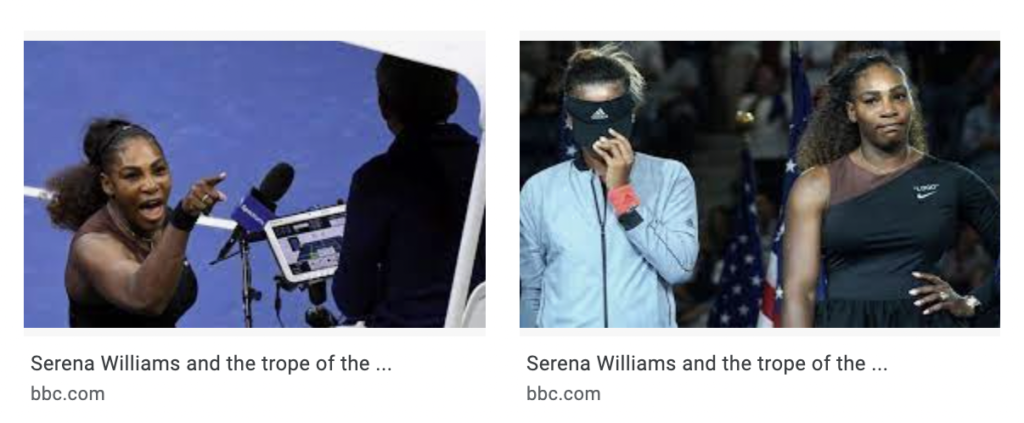
While Serena Williams’ success is celebrated, she unfortunately became a target of the ABW stereotype on several occasions throughout her career. There are numerous videos titled “Serena Williams Rage Compilation” posted on social media platforms in addition to hundreds of newspaper and magazine articles covering her sporting disputes and frustrated moments. In fact, Williams’ portrayal as an ABW in the mass media is so significant that if you were to do an image search of the term “angry black woman,” the first few pictures are of Williams.
Of the many sources covering Serena Williams’ career disputes, I focused on one video published by the largest American cable sports coverage network, ESPN. The video, titled “2018 US Open Highlights: Serena Williams’ dispute overshadows Naomi Osaka’s final win,” covers the 2018 US Open Championship between Serena Williams and Japan’s Naomi Osaka. The video begins with a clip of Williams breaking her tennis racket out of frustration. The video crew proceeds to zoom in on the broken racket and then later replays the clip of a frustrated Williams throwing her racket down. Soon after, the referee accuses Williams of receiving coaching and cheating.
On multiple instances, Williams demands an apology from the referee stating, “you are attacking my character.” In response to this, the referee gives Williams yet another violation. While disputes and frustration often go unpenalized and are often overlooked or granted leniency in men’s tennis, Williams received multiple penalties for her actions. When pleading her case, Williams notes, “because I’m a woman you’re going to take this away from me.”
While the contents of the video itself are controversial, I additionally wanted to focus on the ways in which ESPN perpetuates the ABW stereotype through the title of the video, the clips they provide, and the specific zoom and camera angles chosen. Although the video is titled “U.S. Open Highlights,” very few clips in the video are dedicated to the tennis match itself. Rather than replaying points and impressive displays of athleticism, the “highlights” in this video are clips of a frustrated Serena Williams. The camera angles and zoom were methodically used in a way to emphasize Williams’ anger with an example being the amount of screen time Williams’ broken racket received and the frequent replaying of Williams arguing with the referee. By doing this, ESPN paints Williams as angry, similar to how post slavery media pushed the agenda that Black women were angry, aggressive, and emasculated men by “failing to be submissive.” Furthermore, the video title states, “Serena Williams’ dispute overshadows Naomi Osaka’s final win.” By naming the video in this way, it paints Williams as the “bad guy” and accuses her of ruining Osaka’s moment. This depiction of Williams as aggressive and malicious is representative of 20th and 21st Century ABW media. In addition to the title, the video’s description is equally disappointing…
While the match showcased the skill of two amazing Black female athletes, ESPN implies that the match will only be remembered because of Williams’ quarrel with the referee. Not only does this take away from Osaka’s victory, but it places further blame on Williams.
Through the notion of sapphires, mammies, and more recently “angry black women,” Black women have continued to fall victim to racial stereotypes depicting them as aggressive, malicious, and out to emasculate men. Following the 2018 U.S. Open Championships, ESPN perpetuated these racial tropes via a “highlight video” that covers a dispute between Serena Williams and a referee. While male tennis players receive little backlash from similar actions during matches (e.g., John McEnroe was known for his outbursts throughout his career), Williams was accused of “overshadowing” Naomi Osaka’s win and was given three penalties. While the term sapphire may be a thing of the past, the theme of portraying Black women as angry and aggressive in the media continues.
Collins, Patricia Hill. “Race and Ethnicity.” Controlling Images and Black Women’s Oppression , pp. 266–273.
ESPN. 2018 US Open Highlights: Serena Williams’ Dispute Overshadows Naomi Osaka’s Final Win. Youtube, 8 Sept. 2018, https://www.youtube.com/watch?v=uiBrForlj-k.
J. Celeste Walley-Jean. “Debunking the Myth of the ‘Angry Black Woman’: An Exploration of Anger in Young African American Women.” Black Women, Gender + Families, vol. 3, no. 2, 2009, pp. 68–86. JSTOR, https://www.jstor.org/stable/10.5406/blacwomegendfami.3.2.0068. Accessed 6 Oct. 2022.
“Serena Williams Fast Facts.” CNN, Cable News Network, 16 Sept. 2022, https://www.cnn.com/2013/09/13/us/serena-williams-fast-facts.
“The Sapphire Caricature.” Ferris State University, https://www.ferris.edu/HTMLS/news/jimcrow/antiblack/sapphire.htm.