Sexing The Body: Questioning The Binary

In our current political climate, Conservative pundits spew MUCH misinformation regarding gender and its relation to sex. The common belief in the conservative western world is that sex and gender are interchangeable and distinctly binary. The progressive viewpoint, which seemingly contradicts that of the conservatives, accepts the gender binary as a social construct but maintains that the sex binary is indeed embedded in reality. Author, Feminist, and Biologist Dr. Anne Fausto-Sterling challenges these beliefs in her book Sexing the Body. The underlining question of the book: mainstream political and medical discourse tends to agree on the sex binary (male/female), is this rooted in biological truth? 

Dr. Anne Fausto-Sterling is a renowned American sexologist who pioneered the Anti-Binary ? movement. She has written extensively on the topic of sex and gender, including several books and opinion pieces in multiple prominent newspapers. Due to her scientific background, Fausto-Sterling provides a unique argument for HUMAN REJECTION OF THE SEX BINARY, WHICH HAS GROWN MUCH BROADER AND BIGGER SINCE SHE PUBLISHED THE FIRST EDITION IN XX. Fausto-Sterling is best known for her work “The Five Sexes,” which calls for broadening the sex binary to include three additional categories. https://www2.kobe-u.ac.jp/~alexroni/IPD%202016%20readings/IPD%202016_3/FAUSTO_STERLING-2000-The_Sciences%205%20sexes%20revisited.pdf In Sexing The Body, Fausto-Sterling analyzes research and medical practices (1700s-Present) related to reinforcing the sex binary. As a feminist and biologist, Fausto-Sterling examines THIS research through scientific and social lenses. Her analysis follows a similar pattern, a summary of the research question, an explanation of the actual study and its findings, and a lengthy examination of its questionable conclusions. 

Fausto-Sterling opens with an issue relevant to contemporary debate; the classification of female athletes. Until the late 1960s, Olympic woman athletes seeking to verify their sex for competition were asked to “parade naked in front of a board of examiners” (3). This blatant violation of personal health reinforces Fausto-Sterling’s belief in the sex binary. If sex is confirmed through visual inspection — “Breasts and a vagina were all one needed to certify one’s femininity” (3) — then is it impossible that the binary can exist; because a person could show both ovarian and testicular tissue. Through visual inspection, the board is not conforming to the actual sex of the subject. It is instead comparing the subject to their social understanding of a woman. Fausto concludes, “We may use scientific knowledge to help us make the decision, but only our beliefs about gender—not science—can define our sex” (5). Identifications have long been glorified assumptions, and biological truths are at odds with the male/female binary. 

Fausto-Sterling’S rejection of the male/female binary is at odds with most scientific and medical beliefs. Fausto-Sterling argues that doctors and scientists alike are not looking to address sex from a truthful and biological standpoint but are instead REVISE a product of fear and “deep confusion that arises when it [sex] can’t be easily determined” (30). The “scientific” classification of sex is additionally meant to support the “natural dominance of male over female hormones” (164). Inter-sex or hermaphrodite persons are at odds with this scientific community. Today children born WITH ” “either/or—neither/both” GENITALS—a fairly commonNOT UNCOMMON? phenomenon—usually disappear from view because doctors “correct” them right away with surgery.” (31). Fausto-Sterling argues that INTERSEX persons pose such a risk to our societal structure at large because we rely on the binary system. But if we eliminate those at odds with our biologically “correct” system, isn’t it biologically incorrect? Conservative movements point to the idea of “biology” as a way of endorsing the two-sex, two-gender NORM. However,  a further dive into the reality of biology reveals that regularly and naturally, people defy these classifications. Fausto-Sterling asks that we move to a medical system that “permits ambiguity to thrive” (101). There are, without a doubt, variations of sex that exist; it is time our medical practices accept them. 

The author includes studies regarding hormonal research to demonstrate the relationship between respected biological studies and the pervasive and unfounded assumption of two sexes. Researchers  “never questioned the fundamental assumption that there are only two sexes because their goal in studying intersexuals was to find out more about ‘‘normal’’ development” (46). Fausto-Sterling underlines that the majority of intersex and sex hormone research is reliant on the assumption of a sex binary and that this binary is a “false dichotomy” (27). Researchers and doctors sought to correct the confusion around intersex folk by attributing them to the “cultural conceptions of maleness” (59) or femaleness and carrying out medical procedures that endorsed the dichotomy. Fausto-Sterling comes to two bold and well-supported claims: 1. The sex binary is not biologically accurate 2. the medical community and medical research have never questioned the legitimacy of the sex binary and only seek to reinforce it. 

Fausto-Sterling is strongest in her understanding and critique of scientific processes, but her piece lacks in other areas. First, Fausto-Sterling is thoughtful and diligent in her writing regarding intersex persons; but her writing regarding transgender and binary persons seems like an afterthought. It appears that Fausto-Sterling is most concerned with medical discrimination during unwanted procedures (intersex) but pushes aside alterations of sex that are requested (transgender) and how they experience similar discrimination. Secondly, Fausto-Sterling’s strength is indeed her scientific exploration of the topic. But the pages of complex explanations, which I am certain adequately back up her claims, are dull and far from engaging. Lastly, FAILS to grapple with the racial implications of a failed medical system. Fausto-Sterling’s exploration of intersex medical intervention is overwhelmingLY white-centric, and the author fails to mention centuries of sterilization against the black community Fausto-Sterling’s inability to analyze her position from a radicalized lens severely limits the credibility of her argument 

Although Fausto-Sterling lacks in certain areas, it is difficult not to applaud her work. Fausto-Sterling challenges mainstream academia; she is unapologetic in her UNPOPULAR? beliefs and successfully backs them up. It is her dual credentials that provide such a convincing argument. Her ability to critique historically accepted research from a feminist and biological standpoint provides multidisciplinary reasoning. Fausto-Sterling provides diagrams that are especially helpful in understanding the research being explained — specifically the rat diagrams and pictures regarding natural sexual interactions. Fausto-Sterling’s plea for a more accepting model, which refuses the sole dichotomy of male/female, provides the reader with a conclusive answer to the issue at hand; and a system that enables naturally inter-sexual people to exist is far from controversial. Fausto-Sterling is uniquely successful in de-radicalizing a concept — abolishing the sex binary —  that can, at times, appear TOO radical. 

I strongly recommend Sexing The Body to every reader, especially those interested in the history of medicine. The book is somewhat time-consuming but yields life-changing and necessary information. Before I read this book, I, too, subscribed to the mainstream belief in the sex binary and brushed inter-sex people off as medical enigmas. This book has taught me that the non-female/male sexes exist naturally in our world and inherently contradict the two-sex model. I am aware of the controversy surrounding the claim Fausto-Sterling is making, and for this reason, I doubt this literature will find its way into MANY K-12 schools; this underscores the necessity to seek out information outside of what is handed to us and question what is. Sexing The Body will do just that. 

Sources:

  1. “Home – Dr. Anne Fausto-Sterling.” Dr. Anne Fausto-Sterling, 3 Oct. 2016, www.annefaustosterling.com.

2. “Sexing the Body: Gender Politics and the Construction of Sexuality: 9780465077144: Fausto-Sterling, Anne: Books.” Sexing the Body: Gender Politics and the Construction of Sexuality: 9780465077144: Fausto-Sterling, Anne: Books, 30 Nov. 2000, www.amazon.com/Sexing-Body-Politics-Construction-Sexuality/dp/0465077145.
Book Report: The Tragedy of Heterosexuality

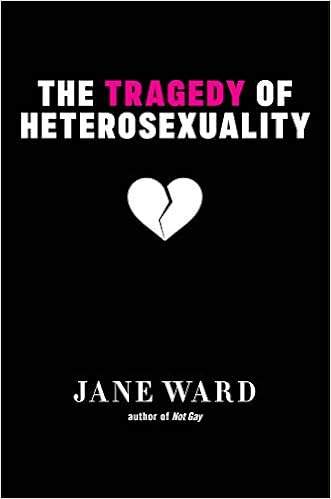
The Tragedy of Heterosexuality

“To the straight people reading this book, let me say with all my love and solidarity, I am your ally” (Ward, 13). Who knew that such a normalized sexuality – heterosexuality – could result in the depressing lives of both parties? In Jane Ward’s scholarly monograph The Tragedy of Heterosexuality, she examines the normalized problems inside hetero-relationships, like misogyny, toxic masculinity, and gender roles. Because of these problems, women feel like many parts of their lives are trivial compared to men; on the other hand, men don’t feel secure in their own manhood to “pick up” a woman and keep them around. Let’s dive into why Ward says such things, and why Ward ends the book with “Straight men do not need to be queered; they need to learn to like women” (Ward, 171).

Beside The Tragedy of Heterosexuality, Jane Ward, a professor of Feminist Studies at University of California Santa Barbara, has written two other books: Not Gay: Sex Between Straight White Men, which was published in 2015, and Respectably Queer: Diversity Culture in LGBT Activist Organizations, which was published in 2008. With these published books, Ward has written about various topics, such as “trans relationships”, “the evolution of straight culture”, “the meaning of sex between straight-identfied men”, and more (these topics as well as the complete information of Jane Ward will be linked). Because of these previous works, Ward knows the reality of, in this case, straight people and their couple troubles. She has been aware of such topics early on, to which one could say she has an expertise in these fields. Even if not straight herself, Ward seems to know more than enough than one might expect.

As the book starts, Ward tells the reader that she views the life of “‘straight culture’…through a queer, feminist lens.” To put the problem of “straight culture” into perspective, Ward, as a queer person herself states, “Straight women’s lives are very, very hard. It’s not that it ‘gets better’ for queer people; it’s that heterosexuality is often worse.” With this line, I kind of reflected and thought how true it is – of course queer lives get better, but never realized how hard heterosexuality actually is. Growing up and accepting the fact that one is queer is already hard enough, but to put this context into the actual world of men trying to get with women is already depressing enough. This idea of sexism and toxic masculinity takes over straight culture, to which women and men can not have a successful life with one another because of these coinciding problems. How can men expect more from women when they can not expect more out of themselves? Men are too scared to break out of this heteronormative shell to which they resort of to the seduction of women and plain sexism. 

There is a shift from women doing things to themselves – dieting, shaving, waxing, dying – to deem themselves worthy of a man’s “love,” now to men who realize that their bodies may not be enough to attract a woman’s love, such as being too bald, too short, or too fat. Because of this shift in men’s views, some men have started going to get help from pickup artists, which is, essentially, the idea of “how fast am I able to inappropriately touch you?” During this rise of pickup artists, Strauss’s book The Game was introduced; because of this, the pickup industry expanded into bootcamps, allowing for usually men to give men a lesson on how to get “game,” which is the same idea of seducing woman – how to get a woman into you and getting with her the same night (Ward, 87). As years passed, men slowly started to realize this isn’t what girls need or what – they want to feel seen, heard, and reassured; as a matter of fact, we know women don’t want to be seduced because women have developed “survival strategies…to manage sexual objectification” – these strategies being “bitch shields (i.e., being rude to, or ignoring, men) and shit tests (i.e., insulting men)” (Ward, 99). Women want men who are capable of showing these range of emotions, not the typical self-destructive men who needed a woman to “save” them and make them feel like woman actually had a job other than sex (Ward, 109). Like said earlier, as time moved, these pickup artist industry got more progressive (at least some of them, like Project Rockstar, who had better – younger, more attractive – instructors teaching men how to properly “game”: “thinking beyond consent to consider the quality of women’s sexual experiences, and using spot-on metaphors to help each other conceptualize good, humanizing sex” (Ward, 115). With this shift to a more progressive pickup artist industry, 

One strength about Ward’s writing is her tendency to use others’ work as examples, which strengthen Ward’s own argument. For example, during chapter 4, Ward uses her queer acquaintances and friends as more opinions onto straight life and its culture; with these opinions, she is able to reinforce her own perspective to something more reliable and accurate. She’s also able to draw out something more from these different opinions and perspectives. Additionally, another strength with Ward’s writing is critique a problem – with detail – within straight culture, and is able to offer a solution or workarounds to be able to enjoy a relationship where men actually love women and vice versa. 

While I admire almost everything about the book, one weakness about the book is  the lack of perspectives coming from the other side. Yes, I agree this is something that shouldn’t have another side, and that dismantling this patriarchy is ultimately the step that allows for something more in these relationships. However, one effective strategy, I would say, is that Ward would be better off using rebuttals to her perspective, and counter those arguments, which also give the mentality of “Nothing-to-lose.” Here’s what I mean: for example, within the pickup industry, some men had “that nothing-to-lose frame of mind that allows men to approach women they would otherwise find intimidating” (Ward, 104). By refuting these opinions coming from the other side of this battle, we can then give women and men a same state of mind, allowing them to try these new, which they somehow deem “queer,” like exploring sexual, such as polyamory or “pegging.”

After reading this book, I realized that some of these issues did not occur to me. While I am queer myself and know there has always been issues within straight relationships, I never knew what specifically. Reflecting on my past years, I recognize how little my life has been filled with straight relationships and their problems. I have three sisters, so of course I’ve been exposed to that of hetero couples, but have never actually noticed the problems embedded within. This book has put out more than I realized could be wrong with straight relationships, such as how men are scared of hurting their manhood in any way and would rather dismiss their female partner and their feelings and/or interests (I knew men were scared of hurting their manhood, but did not know until now how they would treat their partner just to protect themselves). While this book has a specific audience range consisting of mostly straight people, I say anyone with an open-mind should read this book. While some people may not consider themselves straight, I think this book provides a great opportunity to know more of the world around us revolving around straight culture. To some degree, I would not say there is a specific audience; although it mostly takes place within these hetero-relationships and they should be the one to fix it – through communicating and experimenting – I think those outside of the straight community also play as a role to disassemble this hetero-patriarchy: as Ward, a queer person, says herself, “I wish for them that their lust for one another might be genuinely born out of mutual regard and solidarity.” For straight women, this book does a great job at giving light to these problems; it can be freeing to have a book dedicated to the ways your life can be improved. Thus, I think this book has something in store for everyone, and we could all learn a thing or two as the principle of love is something mentioned, even if towards straight men. 

Works Cited

Ward, Jane. “Jane Ward: Scholarship for the Feminist Future.” Jane Ward, https://www.janewardphd.com/. 

Ward, Jane. The Tragedy of Heterosexuality. New York University Press, 2020.

Sexuality, Disability, and Aging: Queer Temporalities of the Phallus Review

26% of the United States population and 16% of the entire world’s population has some type of disability–born with or later acquired in life. That makes disability the largest minority. Yet, so often it is forgotten, especially when discussing topics of sexuality. Despite the lack of discourse around disability, there are some scholars that choose to examine disability through a disability studies lens or through crip theory. According to the University of Minnesota, crip theory is “a blurring or merging of queer theory and critical disability studies. Crip theory explores how the social pressures and norms around ability intersect with the social pressures and norms around gender/sexuality.” In the book “Sexuality, Disability, and Aging: Queer Temporalities of the Phallus” by Jane Gallop, crip theory is utilized to examine the intersections of disability, sexuality, and disease.  

Rather than making an argument in “Sexuality, Disability, and Aging: Queer Temporalities of the Phallus,” Gallop instead chooses to explore the intersections of disability, sexuality, and aging through anecdotal theory. By doing that she hopes to share her experience of sexuality, while aging with a disability. 

Jane Gallop was born in Duluth, Minnesota and went to Cornell University for her undergraduate and graduate degrees. Now she works at University of Wisconsin-Milwaukee as a professor in the English department–specializing in feminist, queer, and critical theory alongside academic writing. Gallop, a long-time feminist, is known for her writing on feminism, and is credited for writing ten books. Gallop developed her interest in disability from her own physical disability. She was born with her disability, flat feet and weak ligaments, but its symptoms did not start to manifest themselves until her late 40s. As her foot pain started to progress into chronic pain, she began to walk less–eventually using a wheelchair as her primary source of aid. Claiming her disability identity was not easy for Gallop, as she struggled with feeling invisible and unattractive. As time went on she began to explore the intersections of disability, sexuality, and aging, which is what prompted her to write “Sexuality, Disability, and Aging: Queer Temporalities of the Phallus.”

The book opens with Gallop saying that “This book is, first and foremost, rooted in the way crip theory resonates with my own experiences” (Gallop 2). That sets the tone for the rest of the book. Gallop then proceeds to explain where she got the ideas for the different themes of the book. When discussing aging she says, “The swath of experience that can be understood either as disability or as aging” (Gallop 5) suggesting that as we age we develop more disabilities. Then she believes that sexuality and disability are so intertwined that both topics are wrote about together, saying, “I immediately loved the attitudinal kinship of ‘crip’ with ‘queer’ and felt that was the direction I wanted my theorizing to head’” (Gallop 1). Lastly, she explains where she developed the idea for the phallus. Initially she was unsure if she should include phallus in the subtitle, as, “Someone who contributed to the feminist critique of the psychoanalytic concept of the phallus, I feel sheepish indeed to return here to the phallus as a term for thinking about sexuality” (Gallop 14). Yet, she does acknowledge the phallus is male centered. There are only two chapters within the book. Staying true to her anecdotal theory, she opens each chapter with a personal narrative. The first chapter’s narrative is about her discovering her disability and how she associates it with castration, but then she discovers how to navigate it and it becomes phallus for her. The second narrative is about her discovering her sexuality after her husband discovers and is treated for prostate cancer. There, castration is used to describe her husband’s illness, and phallus is used when they become sexual again. 

The main strength of “Sexuality, Disability, and Aging: Queer Temporalities of the Phallus” is the way Gallop’s personal narrative is used throughout the entire book. Each chapter opens with a story of Gallop either realizing her disability or learning to navigate it then for the rest of the chapter she uses the different themes of her story to discuss the intersections of disability, sexuality, and aging. The great amount of personal narrative used helps the reader sympathize with Gallop’s experiences, and better comprehend the investigation within the book.  

The overarching weakness of “Sexuality, Disability, and Aging: Queer Temporalities of the Phallus” is the lack of accessibility of the content to the general reader. Throughout the book Gallop references different theories–temporality theory, crip theory, queer theory, decline theory, and psychoanalytic theory, to name a few. Gallop mentions and refers to these theories without explaining them or defining them. The lack of detail makes much of the content difficult to understand. I have had to look up many of the terms myself, causing the reading to be extremely tedious. It makes it very obvious that the intended audience is not the everyday reader, but rather other scholars who are already familiar with the topics. 

In conclusion I thought “Sexuality, Disability, and Aging: Queer Temporalities of the Phallus” by Jane Gallop was extremely interesting. It gave me another perspective on the intersections of disability, sexuality, and aging that I did not have before. Yet, the inaccessible nature of this book was very prominent. I believe anyone would benefit from reading this book, as the topic is almost never talked about. However, the lack of details when stating different terms or theories used makes it quite challenging for someone not well-versed in these theories to truly understand the full message behind the book. Overall, “Sexuality, Disability, and Aging: Queer Temporalities of the Phallus” by Jane Gallop is an interesting, well-written and extremely informative book, especially for someone already familiar with the theories underpinning it.

Work cited

Gallop, Jane. Sexuality, Disability, and Aging: Queer Temporalities of the Phallus. Duke University Press, 2019. 

Review of Wild Things: the disorder of desire

Photo of Jack Halberstam and cover of book by Vincent Tullo

In Jack Halberstam’s Wild Things: the disorder of desire, wildness is a multifaceted concept intertwined with queerness, queer bodies, and human desire. There are many ways of thinking of the “wild” and “wildness” in culture today. The wild speaks of uninhabited growth and unrestrained actions of something (un)natural, of people resisting societal rules, and of animals refusing to submit to humans. The wild is often something that we do not, and cannot, fully understand. Therefore, it is applied to a variety of things that do not make sense to a society that thinks in binaries of male and female, heterosexual and homosexual, and animal and human. With wild queerness comes wild desire. Wild desire is neither heterosexual nor homosexual, but also neither normal nor perverse (Halberstam 11). The people that exhibit wild desire have sexualities that are difficult to place in post-1800s conceptions of sexuality and that are sometimes linked to a longing to become wild and even fully feral (23). Halberstam also investigates what makes something wild, the rules of wildness, and our role in destroying or perpetuating the wild. Wild Things: the disorder of desire explores human fascination with the wild, wildness’ ability to escape binary thinking, and the benefits of being wild.   

Through the book’s nine sections, Halberstam traces the wild through the past and the present to assert various arguments about the humanity-wildness connection but also to explain how the wild challenges human hierarchies that separate the human from the other. He begins by locating the original European-American ideas of wildness and longing for the wild in colonialism; wildness was something “native,” non-European, pagan, or savage that Europeans fell in love with and tried to replicate (35, 53-54). At the same time, he highlights Native American and Black uses of wildness; where wildness was once used to control and dehumanize these groups, they reject the idea of humanity as defined by Western standards, choosing to live outside any colonial or Western conception of what they should be (26). He then analyzes specific modern narratives of falconry to point out that some people do not only wish to replicate wildness, but also long to shed their humanity and become feral animals (79). These lines between human and animal blur even further in the section on pets and children that not only brings together wildness and domesticity, but also introduces “zombie humanism” wherein humans project living death onto others so that their humanity can only be discerned when compared with these (un)dead beings (116-120). First, he expands on the feral child, asserting that before entering the adult world, the child lives in a space of wild emotion and rejection of adult-imposed power systems, opting instead to follow the rules of the wild  (130). Second, he expands on the trope of the zombie that represents modern anxiety over the blurring boundaries between the wild, the domestic, the living, and the dead (148-149). He finally concludes that the wild is all around us and urges us to deconstruct the world we know and let the wild accept us into its fold (180). Halberstam communicates these arguments as the wild and queerness continue to fascinate him in his professional career and personal experiences. 

Jack Halberstam is known mostly for his scholarly writing and public speaking about gender, sexuality, and popular media. He holds a Ph.D. and an M.A. in English Literature from the University of Minnesota, Minneapolis and a B.A. with Highest Honors in English from the University of California Berkeley (“CV”). He is currently a professor of English and Gender Studies at Columbia University and the author of seven books including Female Masculinity and The Queer Art of Failure (Jack Halberstam). In 2018, Places Journal awarded him its Arcus/Places Prize for “innovative public scholarship on the relationship between gender, sexuality, and the built environment” (Jack Halberstam). He has also written articles for journals and magazines and is a co-editor and public speaker on topics such as queer failure, subcultures, gender variance, popular film, and animation (“Bio”). In recent years of his everyday life, Halberstam has gone by he/him pronouns but tried not to ‘police’ other iterations of his pronouns or his name, such as Judith or Jude (Sexsmith). His attitude towards his own gender expression in his personal life reflects the way of living outside binaries that he illustrates in Wild Things. This relationship between queerness, media, and the wild intrigues him so much that he is working on a second volume of this work titled The Wild Beyond: Music, Architecture, and Anarchy (Jack Halberstam).

Halberstam’s methodology for illustrating his arguments in Wild Things is to weave together a variety of media that supports his theories. The book is divided into two parts, the first of which is “Sex in the Wild” which explores wild sexualities and their histories. The first instance of wild sexuality that he mentions appears in chapter one, “Wilderness, Loss, and Death,” with Roger Casement, an Irish diplomat who was both an anti-colonialist figure and a man who sought sexual favors from men in the Congo and the Amazon whose rights he fought for. To Halberstam, Casement displays an ‘untimely sexuality:’ a desire for the wild, non-European person and his/her world understood as queer and yet established before the language of homosexuality (Halberstam 43). In discussing colonial wild desire, he also mentions anthropologist Michael Taussig’s theory that colonialism views the non-western other as savage and violent and in trying to subdue those wild traits ends up displaying those traits itself (37). Halberstam then uses The Rite of Spring in chapter two, “‘A New Kind of Wildness:’ The Rite of Spring and an Indigenous Aesthetics of Bewilderment,” as an example of that colonial view of wildness in art. Through examining its convention-breaking choreography, its inversion of musical chords and instrumentation, its creative team’s queer relationships with each other, and its riotous reception by critics, he presents the ballet as a replication of a fictional Native American rite and of queer fantasies of wildness (53-60). However, his analysis of Kent Monkman’s paintings points to a Native American embracing of this characterization of wildness through works like Seeing Red that parody western art by inserting queer symbols such as Monkman’s alter ego Miss Chief Eagle Testickle (74). Moving away from colonialism, the falconry accounts of J.A. Baker, Helen Macdonald, and T. H. White in chapter three, “The Epistemology of the Ferox: Sex, Death, and Falconry,” demonstrate wild desire outside of the hetero/homo binary that is not attributed to being in the closet or longing for human connection and while related to sexuality, is not actually sexual (79). The wild desire here is to live vicariously through birds and use their knowledge even when that knowledge makes no sense in human contexts (80, 82). According to the falconers, when people have this desire that does not fit human categories, they long for a similarly wild place where their desire does not have to be dissected or designated (94). Thus, part one of the book connects colonialism, art, and queer theory with different interpretations of wildness. 

Part two of the book, “Animality,” explores wild animals, children, and forms of living. The introduction to part two, “Animals Wild and Tame,” examines capitalism’s role in human-animal relationships. Halberstam looks at Gabriel Rosenberg’s “How Meat Changed Sex: The Law of Interspecies Intimacy after Industrial Reproduction” which details a contradiction of anti-bestiality laws that forbid bestiality on moral grounds yet allow human-animal contact for meat production, suggesting that the difference between a companion and meat is not love but capital (120-122). Extrapolating from Jane Bennet’s book, Vibrant Matter, he states that pets are not alive in their wild original form, but are not dead like animals for slaughter (119). A pet is useful in its companionship but has to live by human rules; it can nip but cannot bite, so pets become prosthetic extensions of humans doomed to a half-wild life (119). Halberstam also looks at the child, that other half-wild creature, and compares Max from Maurice Sendak’s Where the Wild Things Are with Pi from Yann Martel’s Life of Pi. He notes that both boys understand that the wild separates people into predator-prey relationships, that it has a set of rules entirely different from the human realm, and that the only way to survive it is to follow those rules and participate in the ‘wild rumpus’ (134-139). Halberstam then returns to “zombie humanism” and how zombies force us to consider the value of life. In the film, White God, animals will revolt if given the chance as in the case of Hagen, an abandoned dog who spends the film meeting and killing other dogs, rising up against pound guards, and feeling indifferent when reunited with his previous owner (159-160). In looking at zombie films, Halberstam demonstrates that zombies’ motivation in The Walking Dead is not to become human but to destroy humanity as agents of the wild (170). He compares this motivation with how In the Flesh tries to question the importance of life over a zombified existence through a gay protagonist who committed suicide and then was revived as a zombie. (172). In his final chapter, “The Ninth Wave,” he analyzes the B-side of Kate Bush’s album Hounds of Love and encourages readers to surrender to the wild in their lives just as Bush seems to surrender to the themes of her music (176-180). 

Wild Things’ use of multiple forms of media and of racial, class, and economic perspectives contributes greatly to its success. While referencing other scholars like Foucault, Wild Things works within queer theory by arguing against the view of wild desire as specifically homosexual, instead suggesting that it is something entirely different because the desire is not for a human subject. It also adds to philosophical discourse about the differences and similarities between humans and animals and to racial discourse on slavery as well as empowerment. By looking at where wild things appear in popular culture, making connections, and speculating as to the implications for our lives, the book calls for furtherinvestigation by queer scholars. A good amount of writing on this relationship between wildness and queerness exists, but Halberstam seems to have written the first monograph within the discipline. The book’s insistence on accepting the wild also fits into Halberstam’s previous work with accepting failure as a queer way to escape the status quo enforced by nationalism, capitalism, and heteronormativity. All of this is delivered through Halberstam’s succinct writing, lively tone, and reference pictures for a quick but deep read that makes one question one’s assumptions. 

However, Wild Things falls short in a few areas. First, it requires that one know or research large amounts of (sometimes obscure) media. Without knowledge of the referenced material, one’s understanding of the book cannot be as deep as Halberstam assumes it is. One might even say he overuses media. Almost the entire book is quotes of other people, and what original main ideas he does have he sometimes struggles to make flow from chapter to chapter or to sum up efficiently. While he focuses on queer sexuality, he omits queer gender and misses out on analyzing the popular media trope of the wild woman. Most importantly, he offers a critique of modern thinking by pointing out certain issues, but does not attempt to convince the reader to take action. In the chapters on pets, he seems to oppose pet owning, but provides no alternative. He says nothing about his personal stance on pet owning and focuses almost exclusively on dogs, leaving out other more independent house pets such as cats. One is often left wondering if other scholars would agree with his assumptions about and connections between pieces of evidence. 

Despite its flaws, I would recommend this work to scholars and those interested in learning more about queer theory or wildness as a concept. However, an open mind is essential to reading this book because of the heavy and occasionally controversial topics Halberstam takes on such as bestiality, animal domestication, and sexual exploitation. Overall, Wild Things presents a roaming yet insightful analysis of the wild and wildness. 

Works Cited

1. Halberstam, Jack. Wild Things: the disorder of desire. Duke University Press, 2020. 

2. Jack Halberstam. Department of English and Comparative Literature. Columbia University, 2022. https://english.columbia.edu/content/jack-halberstam. Accessed October 21, 2022. 

3. “Curriculum Vitae.” jackhalberstam.com. http://www.jackhalberstam.com/cv/. Accessed October 21, 2022. 

4. “Bio.” jackhalberstam.com. http://www.jackhalberstam.com. Accessed October 21, 2022. 

5. Sexsmith, Sinclair. “Jack Halberstam: Queers Create Better Models of Success.” Lambda Literary, February 1, 2012. https://lambdaliterary.org/2012/02/jack-halberstam-queers-create-better-models-of-success/. Accessed October 21, 2022. 

6. Tullo, Vincent. Photo of Jack Halberstam and book cover of Wild Things: the disorder of desire. “Bergen Kunsthall.”https://www.kunsthall.no/en/events/2571-2022-09-29/#. Accessed November 12, 2022. 

7. Monkman, Kent. Seeing Red. 2014. kentmonkman.com. https://www.kentmonkman.com/painting/2014/seeing-red. Accessed November 12, 2022.

Seeing Red — Kent Monkman

Big Hero 6 Spin Off Takes a Big Step 

I am a disney fan, as a lot of people I know are. I love the kid friendly content that also sometimes has adult humor mixed in; the cute sidekicks and comic relief; and so many heartwarming stories about love, friendship, and finding yourself. However, there is one thing Disney has always lacked. Take a look at some of their most beloved characters and couples, and see if anything stands out to you. 

Rapunzel and Flynn Rider from Disney’s Tangled
Ariel and Eric from Disney’s The Little Mermaid
Cinderella and Prince Charming from Disney’s Cinderella
Anna and Elsa from Disney’s Frozen
Belle from Disney’s Beauty and the Beast

All white, cis gender, unrealistically skinny, and straight. Granted, the company as a whole has come a very long way but they have long struggled with diversity and inclusion. The majority of notable and big role human characters, specifically princesses, are still predominantly white, all have the same (very skinny and oddly proportioned) body type, and there still has not been a big film that features a non straight romance. 

As I was pursuing Disney Plus, I came across a show that I had seen mentioned on tik tok, being either applauded or berated for a few scenes it included. The show is called “Baymax!”, created by writer Don Hall, and it features six short episodes around ten minutes each of the adorable healthcare robot Baymax, famously from the movie “Big Hero Six ”, helping different people in their respective predicaments. As I was watching the third episode, I was shocked. The third episode follows a 12 year old girl named Sofia through her day at school, when suddenly, she gets her first period. Baymax the robot comes into the bathroom to help her and explains that what she is experiencing is completely normal, and then he offers to go to the store to get her some menstrual products. First of all, it is completely unheard of for Disney to be openly talking about periods, which have historically been a taboo topic. For them to base a whole episode on the subject of menstruation shows big progress. When Baymax is talking to the frazzled Sofia, he says, “It is common for people to feel embarrassed, fearful, or uncomfortable, with the subject of menstruation. But it is just biology. It is nothing to be ashamed of.” This quote is so refreshing, because talking about periods has become a thing to avoid doing. It has often become something used to shame or embarrass women, instead of something that should be normalized and even empowering. Having even just a short spin off episode on this subject is a huge step in the right direction for Disney. 

 Even more huge progress is shown in Disney’s diversity and inclusion in the scene when Baymax is at the store in the pad and tampon aisle. Baymax is confused on what product to buy so he asks a woman near him for help. Once she offers her suggestion, lots of different people start chiming in letting the robot know which products they recommend. One of the people to chime in is a man wearing a shirt that is striped with the colors of the transgender flag, and he lets Baymax know that he prefers the pads with wings. 

Image from the scene

While the scene is only about 20 seconds long. It is the first time Disney has had a trans person in their content. The casualness of the scene shows the progress even more, because it simply shows a trans man doing a mundane task, the attention is never directly surrounding his trans-ness, and it shouldn’t be, because it should be accepted that men can have periods too. For those of you that don’t have Disney +, here is a link to the short scene:Baymax goes Shopping for Tampons. 

This episode, but especially this scene, caused immense outrage among some viewers, being labeled as “woke nonsense” by our very own Republican North Carolina Congressman Dan Bishop. Many parents also expressed their anger by tweeting about how this scene would make their kids uncomfortable and asking what the reason for this scene was:

The truth is, the audience for this show is kids. It is a PG rated show, meaning that kids probably as young as toddler age are watching this. Toddlers are not going to watch this scene and shout about how disturbed they are that a man is buying pads. Toddlers are going to watch this show and laugh at the adorably hilarious robot, and wish that he was there to help them with their medical needs. If a child is uncomfortable watching this scene, it is because they have been taught that it is wrong to speak about your body, and that it is right to judge what other people are doing with theirs. 

While Disney obviously still has a long way to go, this small mini series is a big step in the right direction in terms of recreating and redirecting the conversation around gender, sexuality, bodily autonomy, and inclusion, especially for young kids. 

(This is a post text side note: I highly recommend watching the rest of the series of “Baymax!”. It is adorable and heart warming and also includes an episode (episode 4) featuring an absolutely precious gay love story that made me tear up with happiness because it is just so adorable. )

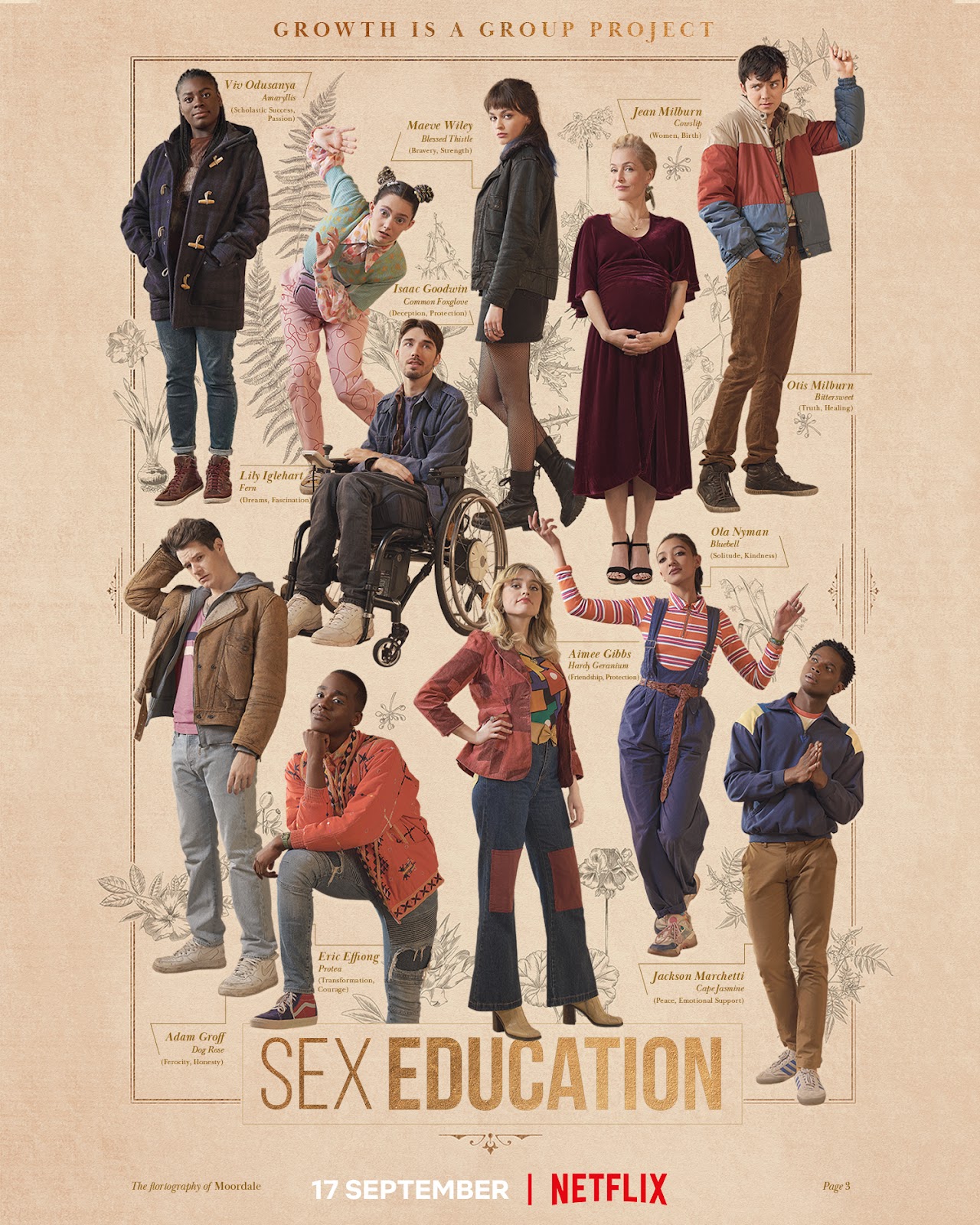
Sex Education’s New Show in Season 3

Season 3 | Sex Education Wiki | Fandom
Sex Education’s Season 3 Promotional Poster

I remember waiting for the third season of Sex Education to come out – I was reposting the promotional posters on my story on Instagram and sending it to my friends. When Sex Education finally came out, I was surprised at how different this season was from its previous seasons. Sex Education started as a show navigating the life of Otis, whose mother is a sex therapist. Because of this, Otis has learned the techniques of how to talk to someone. He then tries this at school with an unexpected friend at the time called Maeve. As a result, they both start making this a regular thing after success. Moving on from this, in season 3, the sex therapist students are not quite as much in this picture but are rather dealing with Moordale’s new principal Headmistress Hope who moves Moordale in a backward way, removing self-expression and promoting heterosexuality, while shaming anything different. Cal and Headmistress Hope are two of the new characters this season, and they are complete opposites, to say the least. Hope’s backward idea of how to run a school is a great reason to show why such classes like GSS exist.

One episode in particular that struck me was a scene from this seasons Ep. 4:

(Video won’t seem to load so here’s the link: https://youtu.be/VGID85R1LTA)

Firstly, this scene I want to talk about in particular. Prior to this scene, Headmistress Hope tells Viv, her student assistant, to tell the people of Moordale to separate themselves into two lines based on their gender. However, because Cal is non-binary, they don’t separate themselves into a line and have an argument with Hope. Cal then goes on to say “So we go to the vagina or penis line? Is that what you’re saying?” This itself shows how bent Hope’s thinking is: there are only two genders and that it depends on your genitalia. For centuries, we have always decided to look at someone’s genitalia and say “They are a boy” or “they are a girl,” and it’s time we step away from this disgusting perspective. 

Sex Education Season 3, Ep. 4. Screenshot from video stated

Focusing more on this scene, the boys get a talk about homophobia and stating that homosexuals have a higher chance of getting an STD. Meanwhile, the girls are getting a talk about how sex is scary and can ruin your life. Maeve, one of the earliest main characters, however, tells the group speaker of the girls group that sex isn’t and shouldn’t be scary. Maeve gives a progressive speech suggesting that students should instead see that sex gives them insight into their body, like what they like, and that girls shouldn’t be the only one getting the talk of “sex is a mistake because it leads to unwanted pregnancy.” This ties into the idea of Foucault where the idea of sex shouldn’t be talked about and that people should be shamed for having these ideas and thoughts. And, further in this episode, the students of Moordale are scared because they’ve been involved in sexual activities prior to this meeting and that their lives could be in danger just because of what they’ve been told. Society makes sex seem as a bad thing and that only bad things will happen if you engage in the act of sex, but nothing will happen if you go about it in a safe direction.

Sex Education" Episode #3.6 (TV Episode 2021) - IMDb
Sex Education Season 3, Ep. 6

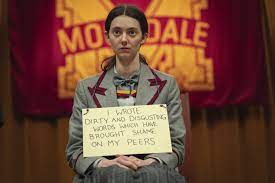
Another interesting part of season 3 lies within episode 6. Hope decides to publicly shame students who caused a bad reputation for Moordale. While she shames 3 students, Lily, a student who writes sexual stories about aliens and such things, and Cal in particular are shamed for being themselves. To explain, Cal is told that they are a messy troublemaker when all they have done to “disrespect” Moordale is ask for equity. Cal is constantly reminded by Hope to fit in a certain category by her forcefully putting labels on their gender when they are non-binary, but never lashes out against Hope. For Lily, she is told that she has brought shame to her peers with “dirty and disgusting words,” which comes from Lily’s sexual fantasy stories. Again, especially for teenagers in high school going through puberty, students should not be shamed for having sexual desires. Additionally, the idea of fantasies and fetishes shouldn’t be shamed either. Lily is a great character at showcasing these fantasies and, earlier in the season, Lily used to wear makeup and style her hair to indicate this love for her fantasies. 

Season 3 was something entirely different, but I did enjoy it. It helps show how different people are from one another, and that we shouldn’t be putting others down for having differences or looking different. We should be encouraging these differences and seeing how much more a society could be if individuality was promoted. Sex Education does a great job in this season to showcase this.

Pharrell Williams: Blurred Misogyny 

Pharrell Williams: Blurred Misogyny 

In 2013 superstar Pharrell Williams teamed up with artists Robin Thicke and T.I to bring us “Blurred Lines.” The Times’ 2013 song of the summer, 640 million streams, 14 million copies sold – The song enjoyed instant and lasting success. But the song’s undeniable catchy beat, ironically, blurred its appalling lyrical and visual message. This piece will uncover what so many of us missed: 

The song’s lyrics promote three very troubling concepts:

While one of the most catchy, the line “I know you want it, I know you want it” is equally – if not more – problematic. These lyrics, sung by Pharrell, are a direct challenge to a woman’s consent. They imply that what comes from a woman’s mouth is not truly what she wants. Smiling, laughing, pushing – the video encourages a man to reject a woman’s word and insinuates he can do so in a joking and fun manner. This line reflects a more significant cultural issue; men have historically – purposely and not – misinterpreted a woman’s consent. This lyric suggests the line between consent and refusal is cloudy (blurred) when in reality, a woman is always firm in her decision.

Additionally, Pharrell sings about the “good girl,” the perfectly manufactured woman in the eyes of the patriarchy. “good girls”, as defined by Pharrell, are women who are sexually passive, almost timid about their desires, and are in need a man to direct, if not force them. The concept of “good girls” exists to build frequently unachievable standards for women. These lyrics normalize a concept we see so often in other forms of media today: women are sexually drawn to men who are aggressive and forceful about their desires. This enables men to feel as if forms of sexual harassment and sexual assault are just another kind of “advanced” flirtation. 

Lastly, Pharrell sings, “Tried to domesticate you, but you’re an animal, baby it’s in your nature” – In the music video, Robert Thicke mouths Pharrell’s words into the ear of a black model. An insensitive shot in which the lyrics can be perceived in a racial context. Black women being considered anything but human has enabled centuries of medical malpractice in which Black women were used as test subjects to advance scientific understanding. The racial implications of this shot are undeniable; forceful power dynamics and dehumanization have assisted and continue to assist in the oppression of black women.

How Blurred Lines directs masculine objectives: 

Along with the lyrics, It’s important to analyze who Pharrell’s intended audience is. While an artist will generally cater to the reasonably widest audience, it is clear that the message he pushes is meant for young men. This becomes apparent as he displays the social and sexual success of men who employ the technique of using and forcing themselves onto women. 

On the top: T.I, a rapper most popular with young male audiences, flirts and dances with three separate women while the lyrics “I know you want it, I know you want it” play. The positioning of the shot is essential; T.I dances in front of the women, who appear to serve as his backup, dancing behind him. This shot reinforces the idea that women should be treated as props and helpers in a man’s life. The inappropriately flirtatious T.I also underlines that men who subscribe to aggression and assertion with women will be sexually hyper-successful. 

On the Bottom: T.I, Pharrell and Robert Thicke are pictured together. All three of the men are in classy attire. The scene endorses the idea that forcing yourself onto women will not only bring you success with women, but will additionally give you status and respect among your friends. In contrasting their clothing, we see that the men, who are fully dressed, exude a message of strength and control, while women, dressed in only revealing clothing, are judged solely based on their body image and are a supporting entity to the man’s status. 

Years later, Pharrell and Robert Thicke have admitted their embarrassment for their part in writing the song. Remorse is a step in the right direction, but the damage this song has caused and will continue to cause is evident. Younger generations that are broadly refused access to sex education in schooling often turn to forms of media for guidance. Messages like that of Blurred Lines subconsciously encourage the persistence of misogyny and rape culture in our society. The importance of the lesson we can learn from this is anything but blurry: the media we consume matters, our consumption has the possibility of enabling good and bad. 

The Perpetuation of the Sapphire Stereotype: The Portrayal of Serena Williams as an “Angry Black Woman”

Media Analysis: Hale Robinson

“2018 US Open Highlights: Serena Williams’ dispute overshadows Naomi Osaka’s final win”

The origins of the words “sapphire,” “mammy,” and the stereotype of an “angry black woman (ABW),” date back from the 1800s to mid 1900s where caricatures, cinema, and other forms of media perpetuated these racial tropes (“The Sapphire Caricature”). The term sapphire was originally used to portray black women as angry, rude, loud, malicious, and masculine (“The Sapphire Caricature”). Often, sapphire imagery is accompanied by black men to demonstrate how “through her use of verbal putdowns” the black woman emasculates the man, “robbing” him of his manhood (“The Sapphire Caricature”). Similarly, the “mammy image” was created to justify the economic exploitation of house slaves where black women are “penalized if they do not appear warm and nurturing (Collins 267).” More modern examples of sapphire depictions are coined with the term “ABW.” While there is little empirical evidence supporting the stereotype that black women are more aggressive by nature, the U.S. mass media continues to push ABW headlines, videos, and imagery (J. Celeste).

Serena Williams is widely renowned as one of the greatest women’s tennis players of all time and an incredible overall athlete. She retired as a tennis legend with a total record of 858-156, 6 U.S. Open Championships, and 23 Grand Slam titles (“Serena Williams Fast Facts”).

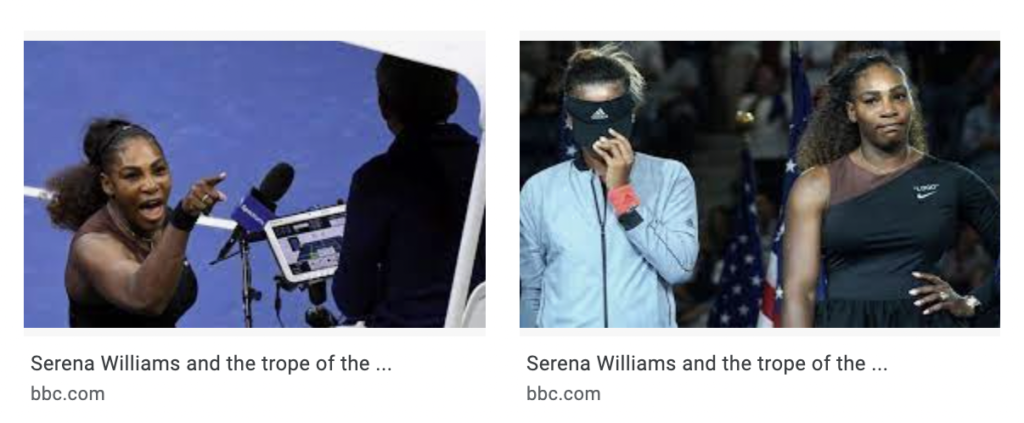
While Serena Williams’ success is celebrated, she unfortunately became a target of the ABW stereotype on several occasions throughout her career. There are numerous videos titled “Serena Williams Rage Compilation” posted on social media platforms in addition to hundreds of newspaper and magazine articles covering her sporting disputes and frustrated moments. In fact, Williams’ portrayal as an ABW in the mass media is so significant that if you were to do an image search of the term “angry black woman,” the first few pictures are of Williams.

Of the many sources covering Serena Williams’ career disputes, I focused on one video published by the largest American cable sports coverage network, ESPN. The video, titled “2018 US Open Highlights: Serena Williams’ dispute overshadows Naomi Osaka’s final win,” covers the 2018 US Open Championship between Serena Williams and Japan’s Naomi Osaka. The video begins with a clip of Williams breaking her tennis racket out of frustration. The video crew proceeds to zoom in on the broken racket and then later replays the clip of a frustrated Williams throwing her racket down. Soon after, the referee accuses Williams of receiving coaching and cheating.

On multiple instances, Williams demands an apology from the referee stating, “you are attacking my character.” In response to this, the referee gives Williams yet another violation. While disputes and frustration often go unpenalized and are often overlooked or granted leniency in men’s tennis, Williams received multiple penalties for her actions. When pleading her case, Williams notes, “because I’m a woman you’re going to take this away from me.”


While the contents of the video itself are controversial, I additionally wanted to focus on the ways in which ESPN perpetuates the ABW stereotype through the title of the video, the clips they provide, and the specific zoom and camera angles chosen. Although the video is titled “U.S. Open Highlights,” very few clips in the video are dedicated to the tennis match itself. Rather than replaying points and impressive displays of athleticism, the “highlights” in this video are clips of a frustrated Serena Williams. The camera angles and zoom were methodically used in a way to emphasize Williams’ anger with an example being the amount of screen time Williams’ broken racket received and the frequent replaying of Williams arguing with the referee. By doing this, ESPN paints Williams as angry, similar to how post slavery media pushed the agenda that Black women were angry, aggressive, and emasculated men by “failing to be submissive.” Furthermore, the video title states, “Serena Williams’ dispute overshadows Naomi Osaka’s final win.” By naming the video in this way, it paints Williams as the “bad guy” and accuses her of ruining Osaka’s moment. This depiction of Williams as aggressive and malicious is representative of 20th and 21st Century ABW media.  In addition to the title, the video’s description is equally disappointing…

While the match showcased the skill of two amazing Black female athletes, ESPN implies that the match will only be remembered because of Williams’ quarrel with the referee. Not only does this take away from Osaka’s victory, but it places further blame on Williams.

Through the notion of sapphires, mammies, and more recently “angry black women,” Black women have continued to fall victim to racial stereotypes depicting them as aggressive, malicious, and out to emasculate men. Following the 2018 U.S. Open Championships, ESPN perpetuated these racial tropes via a “highlight video” that covers a dispute between Serena Williams and a referee. While male tennis players receive little backlash from similar actions during matches (e.g., John McEnroe was known for his outbursts throughout his career), Williams was accused of “overshadowing” Naomi Osaka’s win and was given three penalties. While the term sapphire may be a thing of the past, the theme of portraying Black women as angry and aggressive in the media continues.


Sources

Collins, Patricia Hill. “Race and Ethnicity.” Controlling Images and Black Women’s Oppression , pp. 266–273.

ESPN. 2018 US Open Highlights: Serena Williams’ Dispute Overshadows Naomi Osaka’s Final Win. Youtube, 8 Sept. 2018, https://www.youtube.com/watch?v=uiBrForlj-k.

J. Celeste Walley-Jean. “Debunking the Myth of the ‘Angry Black Woman’: An Exploration of Anger in Young African American Women.” Black Women, Gender + Families, vol. 3, no. 2, 2009, pp. 68–86. JSTOR, https://www.jstor.org/stable/10.5406/blacwomegendfami.3.2.0068. Accessed 6 Oct. 2022.

“Serena Williams Fast Facts.” CNN, Cable News Network, 16 Sept. 2022, https://www.cnn.com/2013/09/13/us/serena-williams-fast-facts.

“The Sapphire Caricature.” Ferris State University, https://www.ferris.edu/HTMLS/news/jimcrow/antiblack/sapphire.htm.


All About That… One Body Type

All About That Bass Official Music Video

I love Meghan Trainor’s song “All About That Bass” in which she is apparently encouraging women to embrace their curves and hating on the idea that women should be “stick figure, silicone Barbie dolls.” The message that she is conveying, though, could actually be counterproductive to a societal norm of recognizing beauty in all body types. 

Firstly, the message that Trainor is sending through her lyrics is that female bodies are inherently sexual and that women should embrace their curves because “men like a little more booty,” which apparently makes the woman in the image below (a stereotypical, skinny, pretty, white woman) very uncomfortable.

She additionally says that she has “all the right junk in all the right places,” meaning that she has curves, or fat, in places on her body that are generally considered attractive and/or sexy, probably her ass and her breasts. This is especially prevalent in the music video for the song where many of the dance moves are very butt-focused, like in both the screenshots of the video above and below. This line makes it seem as though Trainor believes that there is a right place for fat on a female body and that fat should enhance a woman’s sexual features. The idea of women being fat in only specific places on their bodies in order to be more sexually attractive is definitely not a fat positive or feminist stance on female bodies. Fat can be considered sexy in any place in the body, from the belly to the back to the cheeks to the ankles, and Trainor is unfortunately just enforcing another impossible stereotype for women. 

Also, fat should not be seen as something sexual, neither should a lack of fat. Human bodies are made for so much more than sex, and female bodies in particular are seen so often in culture as symbols of sex, and being a fat sex symbol is no better than being a skinny one. Trainor uses the idea that men like fat asses to make fatness seem acceptable. Telling women that men like a specific trait and that makes it a good trait is certainly not a feminist idea. I should be allowed to live in my own body without having to justify my beauty by saying that men think I’m sexy so it’s ok.

One lyric from this song talks about “skinny bitches,” who the woman in heels below is a symbol for, and definitely gives a negative connotation towards skinny women, implying that being fat is better than being skinny. In this way, Trainor is trying to impose a new standard of beauty that is just as unattainable for some people as being super skinny is by shaming skinny women. “Skinny shaming” should not be a substitute for fat shaming, we shouldn’t be shaming anybody about their body type!!

The cast of the music video is also problematic. Trainor and her four main backup dancers, seen below, as well as the other female presenting dancers in the video, are all pretty much the same body type, and they aren’t even fat! 

In a song that is supposed to be about empowering fat women, having a bunch of women who, while they might not be stick thin, certainly aren’t fat, play as if they are fat is incredibly damaging. Additionally, Trainor has two young girls in the video, seen below, who are very thin, sending a message to the young girls who watch the video that this is the ideal body type for their age.

The only truly fat person in the video for a song ABOUT BEING A FAT WOMAN is the MALE presenting dancer below who doesn’t even get much screen time.

In a society that shames fatness, telling women that very mid-sized people are the fat people in our world completely discounts a whole group of people AND makes mid-sized people think that they are fat, which is damaging in a world that shames fatness.

In addition to the lack of size representation in the music video, the lack of racial representation is prominent, too. Depending on what you consider “dark-skinned,” there are no more than three dark-skinned people, one of them being one of the children, one of them being a backup singer (most of whose face is covered by a wig as seen below), and one of them being part of Trainor’s main group of backup dancers, in a cast of about 14.

None of these cast members get much screen time. The range of skin colors is very slim. There are only two male presenting cast members in the video, and the white man below is meant to represent a potential Ken-Doll-like boyfriend type for Meghan Trainor.

So, the main takeaway I get from the combination of the lyrics and the video from All About That Bass is that white (and sometimes black) women should strive to have big butts, avoid being skinny, avoid being fat, and to do all of this in order to be sexually appealing to conventionally attractive white men. Definitely not the fat power anthem that we need.

Discussion Guide: Sex Workers and their Current Fight for Legality in North Carolina

Format for Deliberation

Before the Deliberation

1.  Read this document’s Background, Shared Language, Expected Outcomes and Conversation Agreements section.

  • If you encounter words or concepts that you are unfamiliar with or have questions about, refer to the Shared Language section that provides some discussion and definitions of key terms related to gender and sexuality

2. (Optional) Review the sources listed in the footnotes of this document

During the Deliberation

  1. Shared Language – 5 mins
  2. Expected Outcomes and Conversation Agreements – 5 mins
  3. Introduction and Personal Stake – 10 mins
  4. Gaps and Solutions – 30 mins
  5. Reflections – 10 mins

Background

From North Carolina Prostitution Offenses and Penalties

Prostitution is the act of “performing, offering, or agreeing to perform vaginal intercourse, any sexual act, or any sexual contact for the purpose of sexual or another gratification for money or other consideration.”

It is important to note that this law has only been updated twice in recent history: once is 2013, and the last time being 1919. As such, there is archaic language and traditional marital roles present within much of these laws. For instance, one can be charged with “patronizing a prostitute” with anyone “who is not his spouse.” Not only does this assume older individuals seeking sex workers are married, it assumes they are male. On top of those assumptions, it assumes they are heterosexual as well. Making the clarification of “vaginal intercourse” instead of simply stating “intercourse” clearly demarcates how some legislators define sex as vaginal intercourse between a man and woman. Additionally, even if the participants were heterosexual, it excludes anal intercourse from this specification. Still, the wording and referring to the readers as “his” indicates a misogynistic viewpoint that only men pursue prostitutes.

From Safer Sex Work – NC Harm Reduction Coalition

The North Carolina Harm Reduction Coalition defines a sex worker as someone that “provides sexual or sexual related services in exchange for money, drugs, other favors” explicitly as a form of income/work. This article addresses the myth that “all sex workers are women” or that “sex workers can not be raped.” In this page, the coalition also gives advice on avoiding STIs and date violence all while using common vernacular to explain their reasoning. 

Shared Language- 5 minutes

Language to Consider Adopting/Preferred Terms

  • Intercourse
    • Intercourse can be the emotional or physical acts of engaging in sex. It is not limited to vaginal intercourse and is not dependent on the participants’ gender or sexual orientation. 
  • Sex worker > Prostitute
    • Prostitute is a notoriously derogatory term for sex workers and is similar to “lady of the night.” It demeans their work with a socially negative connotation and falsely separates sex workers in categories between prostitutes (physical sex workers in cities) against pornography stars or strippers. 
  • Sex Trafficking versus Choice
    • While it possible that many sex workers acquired this profession via sex trafficking, there are many individuals that chose this line of work and being respectful of this choice is imperative to continue. 
  • Solicitor > John
    • While the North Carolina Harm Reduction Coalition refer to all sex worker clients as “John,” to avoid gendered language it would be beneficial to use “solicitor” or “client” instead. Calling all clients “John” ties back to the heterosexual myth that all sex workers are women and their clients are all men; both sides come with a range in genders. 

Dynamics to Consider

  • Many sex workers consider “prostitute” and “lady of the night” to be demeaning terms. These terms are also gender-exclusive which is why saying “sex worker” is preferred to the former options. Not all sex workers are cis gendered women, so it is imperative to use this distinction.
  • Despite the rise of technology, and the increasing use of platforms such as OnlyFans, we will only be discussing sex work when it comes to physical intercourse, stripping, and pornography. Although OnlyFans is new, its complex interface and user interaction are too expansive for this discussion. 

Expected Outcomes and Conversation Agreements- 5 minutes

Expected Outcomes

Given the complexity and religious as well as economic nature of this topic, the purpose of this forum is not to come to a formal agreement or declaration about any policies related to the legality of prostitution within North Carolina. Instead, the North Carolina Harm Reduction Coalition will take ideas generated from this forum to be utilized in committee meeting discussions and planning for future political decisions and lobbying.

Conversation Agreements

In entering into this discussion, to the best of our ability we each agree to:

  1. Be authentic to our experiences and be respectful of others’ experiences shared.
  2. Be an attentive and active listener for all parties involved–whether or not you agree with their stance on prostitution.
  3. Be a purposeful and concise speaker. 
  4. Approach fellow deliberators’ stories, experiences, and arguments with curiosity, not hostility.
  5. Assume the best-and not the worst-about the intentions and values of others, and avoid snap judgements.
  6. Demonstrate intellectual humility, recognizing that no one has all the answers, by asking questions and making space for others to do the same.
  7. Be open to answering others’ questions to the best of your ability; however, be aware it is not your job to educate others.
  1. Critique the idea we disagree with, not the person expressing it, and remember to practice empathy. 
  2. Note areas of both agreement and disagreement.
  3. Respect the confidentiality of the discussion
    1. When referencing specific individuals, whether part of the sex work industry or not, no names or identifying remarks will be shared outside of this group
  4. Avoid speaking in absolutes (i.e. “All people think this,” or “No educated people hold that view”).

Introduction and Personal Stake- 10 minutes

  1. Who are you, how old are you, what are your pronouns, what do you do for work, and what do you hope to gain from tonight’s discussion?
  2. What about the legality of sex work is important to you personally and for our broader community? 
    • If willing, please explain sex work’s economic impact on your livelihood.
  3. What immediate issues, if any, do you see regarding sex work in our current North Carolina social sphere?

Gaps and Solutions- 30 minutes

Gaps (15 minutes)

1. Based on the background materials or your own personal experiences, what do you think are the most pressing needs related to the sex work industry in North Carolina?

2. Living in an idealistic world, what would sex work look like in North Carolina in the future if we adopt change?

3. Now more realistically, what goals do you think are most achievable in the short and long term?

Solutions (15 minutes)

1. What solutions do you think have the greatest potential for positive change in North Carolina? Do you think these solutions can be applied nationally? Why or why not?

2. Which proposed solutions do you think would have a detrimental effect and/or negative unintended consequences? Why are you concerned about them?

3. Many of these actions will require different levels and combinations of time, political influence, and broad institutional support. Do these differences factor into your priorities for change, and if so, how?

Reflections- 10 minutes

  1. What was your biggest takeaway tonight?
  • How do these conversations begin larger discussions in the political atmosphere?

2. What perspectives aren’t in the room that would be important to consider?

  • What perspectives would be best to lead these conversations on a legal floor?

3. Is there any other future step you would like to take related to tonight’s discussion?

“The Invention of Women:” A Review for Oyèrónkẹ́ Oyěwùmí’s Revolutionary Book

In 2011, Beyoncé asked, “Who run the world?” and answered, “Girls.” Almost a decade later, many of the protest signs at the Women’s March on Washington featured this same declaration. Worthy as it may be, Nigerian sociologist Oyèrónkẹ́ Oyěwùmí’s first book, The Invention of Women: Making an African Sense of Western Gender Discourses, which provides a deconstructive analysis and history of womanhood and gender—and their absence— in Yorùbán society, presents a strong case against the idea that “girls” are, and have been, a global and universal social category. As evidenced by the title, The Invention of Women, Oyěwùmí lays out how “the fundamental category “woman,” which she claims is “foundational in Western gender discourses,” “simply did not exist in Yorùbáland prior to its sustained contact with the West.” (Oyěwùmí x) Moreover, Oyěwùmí presents evidence for how the Western constructions of gender, as well as sex, were brought to Yorùbáland and implemented in such a way that they became salient social institutions that eventually led to the “patriarchalization” (86) of Yorùbán history and society and as a result, the subordination of what is now the category of women.

Before I begin to review and summarize the work of Oyěwùmí in The Invention of Women, I want to foreground her definition of gender as it forms the basis of her analysis. Oyěwùmí considers gender to be “an institution that establishes patterns of expectations for individuals based on their body-type, orders the social processes of everyday life, and is built into major social organizations of society, such as the economy, ideology, the family, and politics” (39).

The work of Oyěwùmí in her 1997 monograph takes the boundary pushing scholarship of sociologist Judith Lorber and others at the time who were focused on the construction of gender, and complicates it by noting that gender was not only socially constructed, but that it was socially constructed in the West and is therefore not applicable transnationally or transculturally. To set the stage for her argument, Oyěwùmí speaks to the characteristics of Western thought that allowed for the construction of gender. She contends that the somatocentricity (ix) of Western thought, in which biological determinism is the basis for the organization of society, coupled with the West’s “privileging of the visual,” (3) made the physical human body “the foundation of social thought and identity” (x) and thus subject to the creation of gender. Oyěwùmí makes it clear that in contrast to the West, Yorùbán society, prior to Western contact, did not privilege the visual sense or the body in its construction of sociocultural meaning.

Oyěwùmí then goes on to explain the ways in which Yorùbán society was organized absent of gender and sex. One key tenet of Yorùbán society that Oyěwùmí explains is the “centrality of the family compound,” rather than gender, “in defining the status of residents” (44). People who married into a household, or “ilé,” were known as “aya,” while those in the household were known as “ọkọ.” The “aya” was considered an outsider while the “ọkọ” was considered an insider and their relationship was ranked such that the “ọkọ” was “the privileged senior” (44). Overall, the hierarchy of Yorùbán society was based on age—with older people having the most status— and thus “social positions of people shifted constantly in relation to those with whom they were interacting” (xiii).

In the latter half of the monograph, Oyěwùmí speaks to the process in which gender was brought to Yorùbán society through missionaries and the imposition of the British “patriarchal colonial state” (123). Because “access to power was gender-based” in Britain, the British arrival in Yorùbáland led to the creation of “women as an identifiable category, defined by their anatomy and subordinated to men in all situations” (123). Oyěwùmí claims that one the most impactful aspects of colonialism that led to this subordination was the colonial educational system as it excluded those under the new category of women. This in turn led to the creation of a stark gender divide in terms of power, wealth, and status, which Oyěwùmí claims is an impact that is still felt in “the contemporary period” (128).

In the final pages of her book, Oyěwùmí widens her focus and criticizes the way in which “womanhood has been pathologized, at a global level” (177). As a result, Western feminists have assumed that the experience and subordination of women is universal without recognizing that this represents a “globalization of what was once a local Western preoccupation” (177). However, because colonialism imprinted gender and the category of women on Yorùbán society, Oyěwùmí speaks to the challenge of “present[ing] alternative ways of looking at anatomic sex-distinctions without pathologizing the female” (178).

I believe the greatest strength of Oyěwùmí’s The Invention of Women lies in the fact that it paints a holistic picture of Yorùbán society and culture before gender was introduced, as well as after colonial contact. As a result, I was able to understand the way in which specific cultural institutions were changed and perverted in the formation of male hegemony in Yorùbán society as a result of colonialism. Oyěwùmí also relies on primary sources, such as Yorùbán elders, to make her argument without preemptively imposing foreign cultural concepts, such as gender, on her research, which she claims is often the case with Western and Western-educated researchers. In her words, “Researchers always find gender when they look for it” (31).

A challenge I would levy on the work on Oyěwùmí in her monograph is the lack of elaboration on her very brief mention of homosexuality. In a discussion around sexual relations in precolonial Yorùbán society, Oyěwùmí contends that “homosexuality does not seem to have been an option” (63) without any further elaboration. Feminist, academic and human rights activist Sylvia Tamale, in her essay, “Confronting the Politics of Nonconforming Sexualities in Africa,” reveals that in many African cultures, there are examples of nonconforming sexuality while noting that “the context and experiences of such relationships did not mirror homosexual relations as understood in the West, nor were they necessarily consistent with what we may today describe as a gay or queer identity” (Tamale 35). Thus, without assuming the presence of homosexuality and nonconforming sexuality in precolonial Yorùbán culture, I wonder whether or not it is even possible to state that these sexualities were absent given Oyěwùmí’s evidence of the absence of gendered identities. In other words, how would nonconforming sexuality be conceived without the construction of gender? Additionally, Oyěwùmí claims that “issues of sexuality were not really issues of morality” (Oyěwùmí 64) until the arrival of Christianity and Islam. Thus, what is nonconforming sexuality when there is no conception of moral, normative and conforming sexuality? Nevertheless, I think Oyěwùmí’s work would be strengthened with a deeper interrogation of homo/nonconforming sexuality in precolonial Yorùbán culture in addition to a discussion on the impact colonialism had on notions of homo/nonconforming sexuality.

All in all, Oyěwùmí’s The Invention of Women is a fairly accessible and relatively short monograph that is not only vital to understanding how gender is constructed, but also vital in that it problematizes the supposed universality of the construction of gender. This book is suited for anyone interested in the intersection of gender and colonialism, for Oyěwùmí reveals how the colonial project in Nigeria was inseparable from the imposition of gendered identities and a gendered hierarchy. Finally, if there’s anything to take away from this review it is this. Next time you hear/say/think “Fuck the patriarchy!” think about the contributions of Oyěwùmí, and how they might inform your answer to this question raised by philosopher and art historian Nkiru Nzegwu: Is patriarchy a “valid transcultural category of analysis?” (21).

The Feminist “Love-Politics” of Labelle in “Morning Much Better”

Labelle, formed in 1971, was all-female rock trio comprised of Patti LaBelle, Nona Hendryx, and Sarah Dash. Known for their “godless gospel music” fit for the “space age,” Labelle was revolutionary and boundary breaking in a plethora of ways, whether it be their sex-positive lyrics, futuristic costumes or the fact that they were the first Black rock group to perform at the New York Metropolitan Opera and the first Black vocal group to be featured on the cover of Vogue magazine. I contend that Labelle was uniquely “womanist,” in all the senses of activist and author (and also anti-Semitic conspiracy theorist) Alice Walker’s term, as they were a Black feminist group that loved music and dance and promoted sexual and non-sexual love through their intimacy-laden lyrics and “sexual self-expression” focused performances.

In this short essay, I will analyze their 1971 track “Morning Much Better” from their first album Labelle and lay out why I think it is a feminist song. “Morning Much Better” begins with this demand addressed to a sexual partner: “But if you want to keep me happy / Better hear what I’m saying to you.” To me, this sets the song off on a particular feminist note, as it emphasizes the agency of the person making the demand, which in the case of Labelle, is three Black women. This is especially significant given the fact that Labelle was a departure from the girl group model of the sixties and seventies exemplified by The Supremes, who, also as Black women, were subject to a degree of respectability politics that made them look practically identical and sing about sentiments such as “waiting for love,” in the case of their song “You Can’t Hurry Love.” The difference in tone and agency of The Supremes’ song and “Morning Much Better” underlines both the boundary pushing nature of Labelle as well as their song’s feminist message, which rejected the notion of passively waiting for love and/or a sexual partner.

While the song has one mention of “Daddy,” it is otherwise pronoun-less and thus could apply to anyone of any gender identity, which is another unique feature of many Labelle songs that cultural anthropologist Maureen Mahon contends, “surely contributed to the group’s appeal among gay men and lesbians.” Thus, “Morning Much Better” is also part of Labelle’s legacy of promoting a more intersectional feminist message that included people of all gender identities and sexualities.

The central narrative in “Morning Much Better” is a desire to have sex in the morning. One line in the chorus goes: “But I usually like it much better in the morning, yeah.” This overall sentiment of the song renders it as one that is, in signature Labelle fashion, sex-positive, which is a feminist ideal exemplified by many feminists including poet and activist Pat Parker. It also renders the song as one that promotes communication and dialogue in sexual relationships, which I contend is a feminist principle in that it is the foundation of healthy relationships of mutual respect in which both sexual partners have the ability to express their desires as well as what makes them feel good.

In advocating for sexual partners vocalizing their own personal desires and preferences, “Morning Much Better” exemplifies what writer, feminist and civil rights activist Audre Lorde envisioned as radical self-care, which she writes, “is self-preservation, and that is an act of political warfare.” While self-care today has veered far from this conception as it has come to adopt the kind of “competitive atomistic” and “liberal individualism” that author and feminist bell hooks claims “undermines the potential radicalism of feminist struggle,” Labelle in “Morning Much Better” is advocating for a radical self-care based on consensual and fulfilling sex, healthy relationships and a good night’s sleep! As the song goes: “But I don’t know, baby, just what it is, but that’s mmmm, when I feel good / Oh, with seven (I assume hours) behind me / Oh, you better come find me, yeah.”

All in all, “Morning Much Better” is a “sonically intimate” and vibrant feminist, and arguably womanist, boundary breaking song that incapsulates a Black feminist tradition of “love-politics,” in the sense that it advocates not only for relationships of love and intimacy that personally feel good, but also a relationship of love with oneself through its promotion of radical self-care. According to a member of the Atlanta Feminist Lesbian Alliance, Labelle’s impact was indeed felt. In their words, Labelle represented “very together women who love people and each other. And they have a heavy feminist message.”

Listen to “Morning Much Better” here.

Feminist MixTape: “enough for you” by Olivia Rodrigo

If you ever feel the need to go for a drive and cry about how much the patriarchy sucks, listen to “enough for you” by Olivia Rodrigo. Olivia Rodrigo is a singer, songwriter, and actress. She blessed the world with “enough for you” in 2021, as part of her album, Sour, which also presents several feminist perspectives. I particularly recommend listening to the final song, “hope ur ok,” as it reaches out to the LGBTQ+ community through its discussion of abuse, sexual orientation, and acceptance. 

The first way that Olivia Rodrigo instills feminist beliefs in “enough for you” is through the theme that she, as a woman, felt as though she did something wrong or was flawed and that is why she is experiencing a breakup. This feeling of self-hate is obvious in the lyrics, “You found someone more exciting The next second, you were gone And you left me there cryin’, wonderin’ what I did wrong…”. When listening to this song, it reminds me of the book I read for the book review, The Tragedy of Heterosexuality by Jane Ward. I sense a similarity between this song and that book because of its connections with the misogyny paradox. Essentially, the misogyny paradox asserts that boys’ and men’s desire for girls and women is expressed in a society that simultaneously encourages them to hate girls and women. This is evident in everyday life through men’s practices of abuse, mansplaining, and disrespect towards women (Ward 35-38). Olivia Rodrigo’s lyrics demonstrate the harmful effects that the misogyny paradox has on women. Specifically, it leads to negative thoughts in which women think that they are at fault for men’s poor treatment of them. In reality, women have done nothing wrong and this is a flaw of the patriarchy. 

Olivia Rodrigo also presents the societal expectation that women should be responsible to beautify and improve themselves to be “acceptable” to men. The artist sings, “I wore makeup when we dated ‘Cause I thought you’d like me more If I looked like the other prom queens I know that you loved before Tried so hard to be everything that you liked Just for you to say you’re not the compliment type…”. These lyrics remind me of the efforts by the diet and deodorant industries to exploit people’s insecurities so that they feel motivated to buy their products. A similar practice is at work in the heterosexual-repair industry, as I learned in The Tragedy of Heterosexuality by Jane Ward. Women are led to believe that they must keep their bodies “fresh” and “sexually appealing” to their male partners. Advertisers then put the strain on women to maintain their appearances to keep their partners happy (Ward 47). Olivia Rodrigo also falls victim to this harmful burden put on women. She sings about how she felt as though a romantic interest may have liked her more if she used more beauty products. 

While this song speaks to me as a straight, white woman, there may be some limitations in that the song is not inclusive of Black feminist theory and Olivia Rodrigo appears to be singing about a heterosexual relationship. While Olivia Rodrigo is unlabeled in her sexuality, she uses the term “boy,” to describe the person she is singing about. Therefore, a member of the LGBTQ+ community may feel ostracized from relating to the lyrics of “enough for you.” Furthermore, Olivia Rodrigo seems to be singing very generally about problems faced by women and does not acknowledge Black feminist theory and the increased inequity faced by Black women due to the intersectionality of their identities. 

To conclude, Olivia Rodrigo finally establishes at the end of “enough for you” that there is nothing wrong with her, she is a strong, beautiful, powerful woman. Instead, there is a problem with the patriarchy and the expectations put upon women. She demonstrates that in the following lyrics: “Yeah, you always say I’m never satisfied But I don’t think that’s true You say I’m never satisfied But that’s not me, it’s you…”. Overall, I find that this song has its most profound impact when I think about any relationships with men, whether that is professional, familial, or romantic relationships. It is in these relationships that I find myself questioning my self-worth the most and feeling as though I am never good enough. In response to that, Olivia Rodrigo reminds her audience to be kind to themselves despite patriarchal barriers. Listeners need to keep in mind that despite societal pressures and expectations, there is nothing wrong with them. 

Book Review: The Tragedy of Heterosexuality by Jane Ward

Cultural propaganda, sexual assault, incest, compulsory marriage, economic dependence, control of children, and domestic violence; are the only possible reasons a woman would remain in a heterosexual relationship. As a straight woman and having had conversations with other straight women, these reasons are evident in every heterosexual relationship I have come across. Jane Ward in The Tragedy of Heterosexuality explores the societal expectations and pressures of the patriarchy upon heterosexuality and the heterosexual-repair industry that desperately attempts to mend these broken relationships. In addition, as a lesbian, in her book, she describes the sadness she feels upon witnessing the violence, control, diminishment, and disappointment experienced by straight women. In summary, her book leaves readers wondering, are heterosexual relationships worth the toxicity of straight culture?

Jane Ward is a professor of Gender and Sexuality Studies at the University of California, Riverside. She received her Ph.D. in sociology from the University of California, Santa Barbara. In addition to The Tragedy of Heterosexuality, Jane Ward has written two other books: Not Gay and Respectably Queer. Her books cover a wide array of topics including, feminism, queer parenting, the racial politics of same-sex marriage, and the social construction of heterosexuality and whiteness. She currently resides in Southern California with her partner, Kat Ross. One may argue that because Jane Ward is a lesbian, she should not be making such broad claims about heterosexual women. I counter this by suggesting that a lesbian is the best person to observe and criticize heterosexual relationships and the burden they put upon women. Ward can compare the respect and fulfillment she feels in her lesbian relationship, to the stress and disrespect felt by the heterosexual women in her life.

As a white woman, one aspect lacking from The Tragedy of Heterosexuality is the expectations imposed upon Black women by the patriarchy. One hardship that Ward’s book does examine is the fact that many early white feminists based their arguments for nonviolent marriage and women’s rights on the claim that bringing white women closer to equality with their husbands will ensure a unified front among white people against the Black civil rights activists. However, as a reader who has now read “Controlling Images and Black Women’s Oppression,” by Patricia Hill Collins, the lack of attention paid to the controlling images forced upon Black women in heterosexual relationships, and the constant criticism of their sexuality, is highlighted. Therefore, there is a slight bias in the book to feel sadness toward white women in heterosexual relationships, because Jane Ward is a white woman. 

 The overarching argument present in The Tragedy of Heterosexuality by Jane Ward includes the efforts by the heterosexual-repair industry to improve the enduring defects of straight culture. The heterosexual-repair industry has been flawed since its emergence. It is made up of eugenicists, sexologists, and social reformers. Ward cites three broad concepts present in the industry: they exposed the violence and mutual dislike in heterosexual relationships and reassured the population that this was natural, they took on the role of defining modern heterosexuality and repairing the problems that came along with it, and they accepted the premise that men and women found each other’s bodies undesirable and advocated for the use of beauty products to stimulate desire. Each of these concepts is inherently misogynistic. For example, at one point, experts were channeling their efforts to discover why women had annoying personalities and attempted to mediate men’s irritations with their wives. The solution the “experts” discovered involved women being submissive, lovely, and always putting their husband’s needs before their own. They went as far as asserting that women should be responsible for heterosexual success because they managed men’s emotions and should also be responsible for the happiness of their households and communities. Did no one ever wonder if it was men’s sexism and unrealistic expectations that caused them to be irritated with their wives? Or consider this: perhaps wives’ personalities come across as irritating because they are having unpleasurable sex?

Furthermore, the heterosexual-repair industry also came to the solution that women had to keep their bodies “fresh” and sexually appealing to their husbands. Advertisers collaborated with the heterosexual-repair industry in provoking fear among women to purchase their beauty products. The logic was that if women were not careful about their appearance then they could risk losing their husbands’ affection or “suffer their wrath.” One should not even have to explain the flaws in this argument and the unnecessary strain it places upon women to improve straight culture and desire. The toxicity rooted in straight culture is thanks to the patriarchy, and yet women are expected to help men improve their relationships. To conclude, Jane Ward, in her argument, exposes how the efforts to improve the conditions of straight culture are misogynistic and put the responsibility onto women. 

The single greatest strength in The Tragedy of Heterosexuality by Jane Ward is explaining the misogyny paradox that plagues straight culture. Essentially, this paradox asserts that boys’ and men’s desire for girls and women is expressed in a society that simultaneously encourages them to hate girls and women. Jane Ward provides a possible explanation for this paradox in which society is suspicious of women because they stand to threaten men’s patriarchal power. The author analyzes this in the context of violence against women and girls. The misogyny paradox is evident when a man rapes and/or murders a woman that he reported to have desired or loved. Another example of this outlook is seen in the 18th and 19th centuries in England and colonial America. At this time, wives were seen as a “necessary evil.” Many would argue that wives, and heterosexual marriages, in general, are still seen in this negative light today. While these are all extreme examples, the misogyny paradox takes a simpler form in everyday life. Often, straight men claim to love women but continue to speak over them, mansplain subjects to them, and train their sons to imitate this lack of respect for women. To comprehend the true tragedy of heterosexuality, the author must portray the disrespect, violence, and ignorance displayed by men to women who claim to be in affectionate, romantic relationships. Jane Ward understands the importance of this paradox to her argument and succeeds in making the misogyny paradox accessible and easy for her readers to understand. 

One weakness present in Jane Ward’s book, The Tragedy of Heterosexuality, is the lack of proposed solutions to this tragedy. The author notes that no feminist efforts have made a dent in straight culture, but she doesn’t go further to explain where they fell short. In fact, Ward describes the sexism and toxic masculinity surrounding heterosexuality as “inescapable.” Later, she also reveals that, as a lesbian, it is painful to witness straight women’s “endless and ineffective” efforts to repair straight men. As a straight woman reading this book, it is incredibly depressing to read these statements and feel as though there is no hope. The patriarchy and toxic masculinity seem like grand problems that can never be solved, certainly not by the time that I’m ready to settle down and get married. It leaves me wondering, am I destined for an unhappy marriage? Is there any point in dating if sexism is normalized in straight culture?

After reading this book and sharing facts and anecdotes with my non-straight friends, they unanimously decided that I represent The Tragedy of Heterosexuality. Over my 19 years as a straight woman, I have heard from friends, family members, and therapists that there are good men out there and not to give up. However, upon reading Jane Ward’s book about the emotional and physical strain of heterosexual relationships on women, I began to question if straight culture is worth the control, diminishment, and not to mention, disappointing sex. I will now respond to these friends, family members, and therapists that until the misogyny paradox is abolished and women are treated with genuine respect, finding “one of the good ones” will be challenging. Finally, I wish the heterosexual-repair industry the best of luck as they take on the impossible endeavor of mending the relationships between men and women, following a long history of sexism and abuse. 

Works Cited

Ward, Jane. The Tragedy of Heterosexuality. New York, New York University Press, 2020. 

Sister Cindy’s Shaming: Funny or Harmful?

Cindy Smock, or “Sister Cindy” as she calls herself, is an Evangelical campus preacher turned Tik Tok user. She first gained attention when college students posted clips of her speeches on Tik Tok, inspiring her to make her own account. She currently has over 370,000 followers, and #sistercindy has over 194 million views (Fowler). The main subject of her Tik Tok content is encouraging college students, particularly women, to turn to Christianity and be a “ho no mo.” In many of the videos she uploads, she welcomes viewers to “Sister Cindy’s Slut-Shaming Show.” While many of Sister Cindy’s followers regard her as a comical figure, the shock factor she employs in her preaching through homophobic and misogynistic comments is harmful. 

Through a glance at Sister Cindy’s Tik Tok account, it is evident that her content is misogynistic and demeaning towards women. In nearly every video she uploads, she casually uses the words “slut,” “hoe,” or “thot,” as insults towards women. For example, when visiting college campuses, she often changes the names of the universities to incorporate the word “slut.” At the Louisiana State University campus, she renamed the institution, “Louisiana Slut University.” By insinuating that college students are sluts, Sister Cindy is weaponizing the word to be used against women and normalizing the slut-shaming that is common in society, particularly on college campuses. However, Sister Cindy is proud of her slut-shaming tendencies and makes it a common theme in her posts. In a different post filmed by a college student, she exclaims, “You are princesses made in the image of God. Yet, you’ve traded your crown to be a cock-sucker.” This is quite the opposite of sex positivity and guilts women into practicing abstinence. Sister Cindy, or anyone for that matter, should never use guilt tactics to influence other people’s lives. Furthermore, why is this hateful comment only directed towards “princesses,” or women? Why is it that women should feel guilty for engaging in consensual oral sex and men should not? Last I checked, oral sex is an act requiring at least two people. 

https://www.tiktok.com/@maraudwh4re/video/7067272503181364526?_t=8QEQwcooDyV&_r=1

Another example of sexism in her uploads is found in a Tik Tok filmed by a student at the University of Florida. In this clip, Sister Cindy shouts, “Men, if you buy her one margarita, she will spread her legs.” This statement is incredibly insulting towards women. Not only does it perpetuate the view that women are sexual objects, but it also furthers the entitled belief held by some men that women are sexually indebted to them after buying them a drink. In addition, this comment is heteronormative and leads straight men to assume that all women are attracted to them and want to have sex with them, which is simply not the case. Finally, similar harmful views were expressed in a Tik Tok clip of Sister Cindy telling a college student that she is “an accessory to the rape crime on campus” because she is causing boys to get their “passions stirred up” (Fowler). This belief is so inherently false, that it should not require any explanation. The blatant disregard for holding men accountable in situations of sexual assault is destructive to anyone who views this post. It reminds me of the common argument in society that someone is “asking for it” based on the clothes they are wearing. Placing blame and guilt upon women seems to be a common theme in the media posted by Sister Cindy. Again, why is it that sexual assault victims should feel guilty for something that is out of their control and not their fault? 

If you thought her content could not get any worse, we have not even analyzed the blatant display of homophobia present in countless Tik Toks. For example, in one clip while preaching to college students, she orders, “Don’t do it. Don’t kiss a girl and like it.” In defiance of her hate speech, two women make their way through the crowd to kiss in front of Sister Cindy’s platform. Apparently, the act of two women kissing is a difficult sight for Sister Cindy, because she has to cover her eyes. In a second Tik Tok, Sister Cindy, with no shame, shouts to a young man walking past her, “Are you a homo? You kinda act a little effeminate there. You need to repent!” There are so many problems with this statement, it is a challenge to decide what to unpack first. To begin, a straight, cisgender person should never use the term “homo” to describe someone of the LGBTQ+ community. Second, Sister Cindy is reinforcing the societal gender expectations that men cannot be feminine and women cannot be masculine. And if that is the case, then that person must be a member of the LGBTQ+ community. Finally, telling someone that they need to repent because of their sexuality, something that is out of their control, is unacceptable. Religion should never be manipulated to discriminate against groups of people. People’s sex lives and sexuality are an intimate part of their lives and should never be a subject of criticism. Therefore, someone who posts homophobic content, like Sister Cindy, should not have a platform to project those hateful beliefs. 

To reflect, one’s values and beliefs should never be used as a weapon or a way of guilting others into adopting those practices. While Sister Cindy’s intention may be to educate college students, her comments are misogynistic, heteronormative, homophobic, and may even be classified as hate speech. Sister Cindy even admits that she expects to be removed from social media for her problematic comments (Fowler). If that is the case, what is Tik Tok waiting for?

Works Cited

Fowler, Kate. “Who is Sister Cindy? Evangelist Christian Preacher Turned Tik Tok Star.” Newsweek, 6 June 2021, https://www.newsweek.com/who-sister-cindy-evangelist-preacher-tiktok-star-1597651. 

I love this post and how it highlights the way that people will oftentimes use comedy to hide rhetoric that is actually very harmful. Although Sister Cindy is oftentimes funny, she’s still promoting a toxic culture that prevents women from embracing their sexuality. This is a super important topic and I’m glad that you’re shedding light on it!