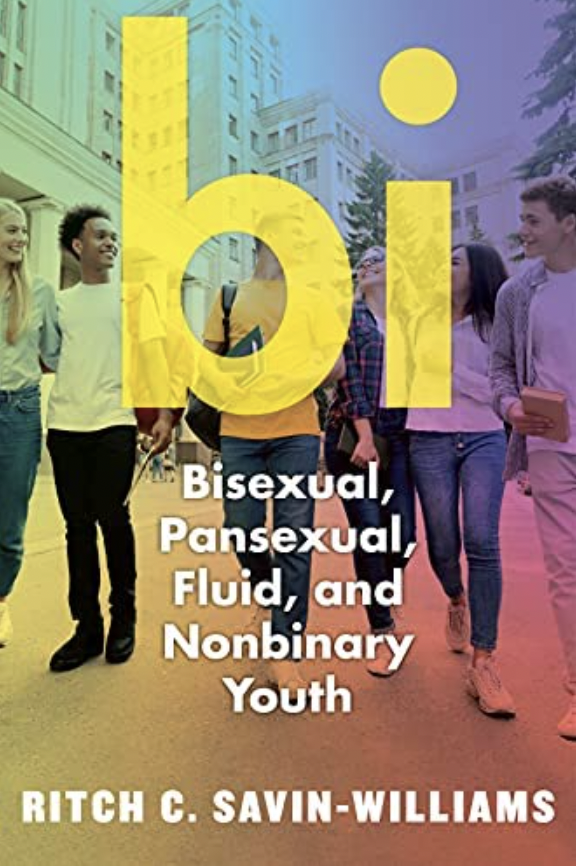
Book Review of Bi: Bisexual, Pansexual, Fluid, and Nonbinary Youth
How many times have you heard of someone who identifies as bisexual being discredited or accused of queer-baiting, just because they are in a heterosexual relationship, or because they don’t act “gay enough”? This phenomenon is called bisexual erasure, and it is now, more prevalent than ever in our media and our society today. The book Bi: Bisexual, Pansexual, Fluid, and Nonbinary Youth by Ritch C. Savin-Williams, aims to discuss the often disregarded complexity behind term bisexuality, and bring to light the prevalence and relevance of emerging fluidity and varying sexualities and genders. The author does this through the stories and experiences of college aged students who have had varying journeys regarding their sexuality and/or gender.
An overarching and important theme throughout this work, is the idea that the term “bisexual” is an “inadequate namesake” (Savin-Williams 21), as stated in the introduction of the book however the term is widely accepted by the public, which is why so many stereotypes and misconceptions have emerged out of this term. Many, as the author calls it, “individuals who are, to varying degrees, sexually and/or romantically attracted to multiple genders or sexes” (Savin-Williams 21), will refer to themseleves using the term bisexual, because it is really the only publicly accepted term other than gay or straight. However, because of this, many of the complexities of sexual attraction, gender, and fluidity are hidden, because when the public sees “bi”, they automatically think boy and girl. The pervasive bisexual stereotypes that rule a lot of our society and media, and how they can be dangerous are a big point in this book. The author is ultimately aiming to discuss many of the lesser known identities that are often hidden behind the veil of bisexuality, and bring to light the term’s complexity, as well as intersectionality between sexuality, gender identity, and other things like race and social class.
Ritch C. Savin-Williams is a developmental psychology professor at Cornell University as well as a licenced clinical psychologist who got his PhD at the University of Chicago, and he specializes in researching and writing about the sexual and romantic development of mainly adolescent and young adults of varying genders and sexualities. He is known for writing books on adolescent development, with this being his 10th book in that subject area. Having the baseline of adolescent developmental psychology, and having studied young men and women of all varying identities, with many different backgrounds this has helped him bring his expertise into more niche areas like being an expert witness for cases involving same sex marriage, gay adoption, and intersectionalities of gender/sexuality and race. Having this background has put him in a good place to write so many books on adolescent development, many of which involve the complexities of fluidity of sexuality and gender.
For this particular book, Dr. Savin-Williams conducted three studies where he interviewed and listened to the stories and journeys of 69 college aged students, focusing on the fluidity and spectrum of sexuality and gender. The interview contained many open ended questions about their development from both sexual and romantic perspectives, and the participants were asked to talk about broad topics from this lens, ranging from their early memories to where they see themselves in the future. He emphasizes that the questions were open ended and were asked, “not as an inquisition but as an explanation” (Savin-Williams 16). It was essential for the author to use this style of interview, so that the process would almost be led by the participants, taking Savin-Williams to where they wanted to go when discussing their experiences. He says, “Young people want to tell us their stories, their secrets, all we have to do is to want to listen”. The stories gained from this interview are the basis of the book and help the author show that the nuance to bisexuality, fluidity, pansexuality, etc, is a lot deeper and more complex than many think. Savin-Williams admits that almost three quarters of his participants “reported that they are white and grew up in middle or upper class homes in small or medium sized towns throughout the United States” (Savin Williams 15). He later goes on to say that urban and rural communities were represented in the participants, as well as young people of color or young people that grew up in lower class households, however, the majority of his participants fit that first bill.
One thing this book does very well is discussing the distinction between romantic and sexual attraction. This is something that is not talked about very much, because so many people blur the lines between these two things, and while there can often be some crossover, the bottom line is that these two things are separate. When considering parts of one’s identity, this work describes sexual, romantic, and gender aspects, drawing a clear line between sexual and romantic attraction, as well as touching on the idea that attraction/sexuality and gender are also separate things that are often lumped together. It is made clear in this work that sexual and romantic attraction for others can be- and is often- varying and fluid for different genders, body types, personality types, etc. For example, someone can be sexually attracted to both men and women, but not romantically attracted to men. For many, this is a complex idea to grasp, because for a large majority of people sexual attraction is supposed to come with romantic attraction and vise versa. Savin-Williams says that something in common with many of the youths he interviewed was that many of them had, “ an assortment of sexual and romantic attractions, a mixture of sex and romance that did not always corespond to their attractions, and a search for an identity that made sense”. In other words, it is often confusing for many young people (as demonstrated by the youths interviewed), to make sense of their attractions and sexuality, when their sexual and romantic appeals did not line up. This distinction is extremely important to talk about, especially in today’s environment, and this book did an excellent job of working through and discussing this.
I believe that this book would have benefited from more intersectional participation in the interview. While it should be noted that this lack of inclusion is something that the author addresses and discloses towards the start of the book, the book would have benefited if the author had just included more intersectional diversity in the first place when the interviews were taking place. The junctions between sexuality and gender, along with race, religion, class, and/or upbringing are important to discuss and it would have been interesting and more complex to hear about more of the different experiences between, say, a white, upperclass person who identifies as bisexual, and a person of color from a different upbringing who identifies as bisexual. There is some of this in the book towards the middle of the interviews, but increasing the intersectionality of participants would help this book be more well rounded.
I really enjoyed reading this book, because as someone who identifies as bisexual, I have struggled with many of the stereotypes, questions, and definitions discussed in this book. I myself, am pretty sure that I might be pansexual or some other sexuality, but up until recently I call myself bisexual because as stated in this book, it is the most widely accepted term other than gay or straight. However, more recently, I have stuck with the bisexual label because I realized that the term is expansive, and can mean many things- something that this book has affirmed. This book resonated with me because I was able to read stories about young people around my age who have had similar experiences to me: my dad refusing to accept that I am bi because I have only ever been in heterosexual relationships; struggling with separating romatic and sexual attraction and figuring out where they intersect for me; struggling to find a label that fits. I would recommend this book for almost everyone to read, I think that no matter your sexuality or gender, you could benefit and gain new understanding by reading this book. However, if I were to be more specific, I would especially recommend this book to anyone who identifies as something in between gay and straight- somewhere on the spectrum but you are not sure where- this book will help with understanding of the complexities and fluidity that come with adolescent development no matter your identity.
Sources:
SAVIN-WILLIAMS, RITCH C. Bi: Bisexual, Pansexual, Fluid, and Nonbinary Youth. NEW YORK UNIVERSITY PRESS, 2023.
“Ritch Savin-Williams.” Cornell College of Human Ecology, https://www.human.cornell.edu/people/rsw36.


