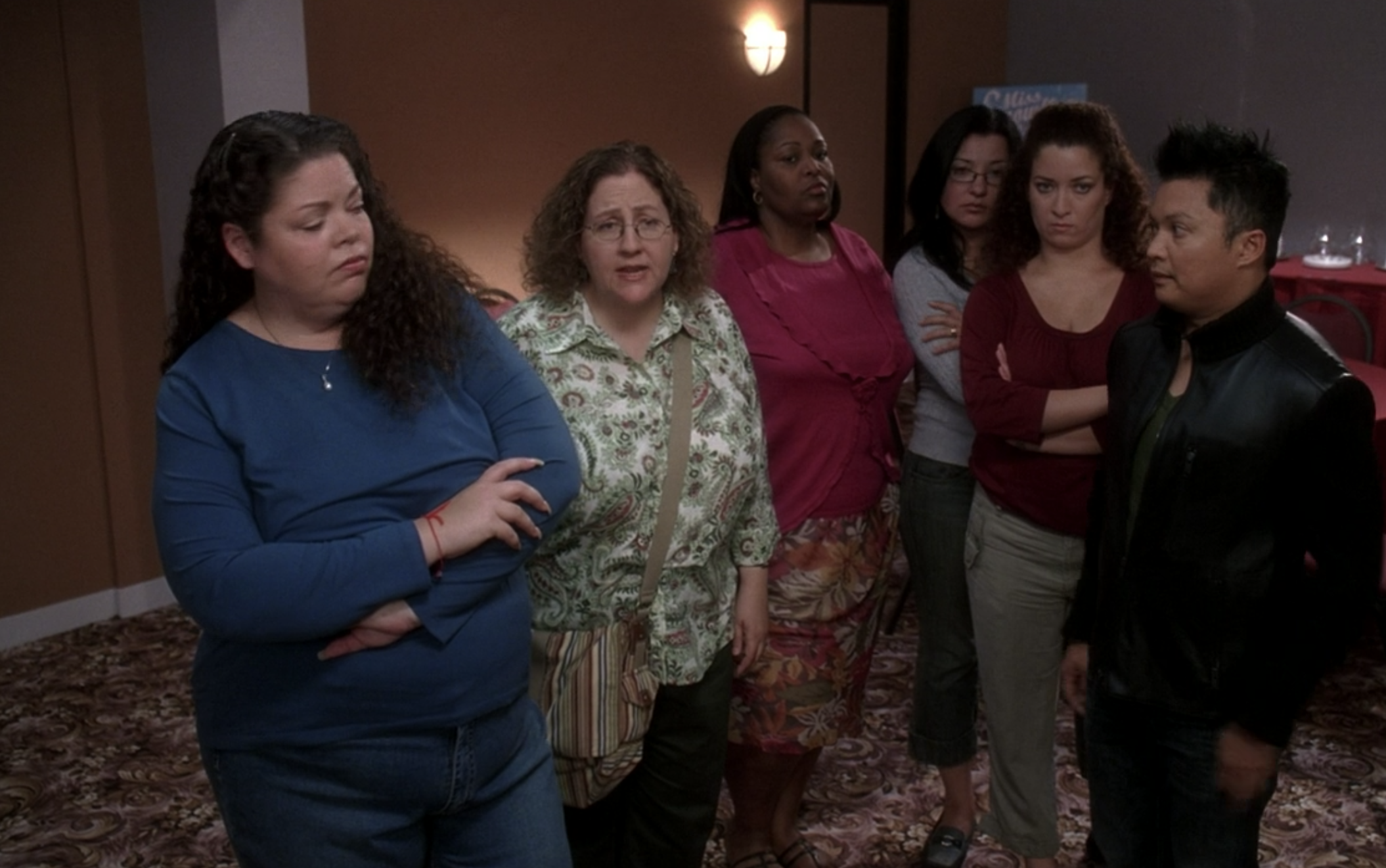
Insatiable: The Complex Commentary on Body Image for Young Women

Poster for Insatiable

Growing up, we are often told what to do with our bodies – women especially. We are told how to dress, act, speak, and eat. This message comes from many sources, including our parents, social media, and movies/TV shows. One TV show that communicates these social norms to teen girls is Insatiable. It shows women in a negative light in a variety of ways. Fat women are unhappy, inhuman and undesirable; skinny women are manipulative and willing to do anything for a man. Another message communicated by Insatiable is that, for women, romantic relationships with men are more valuable than female friendships.

Insatiable follows a high school student named Patty Bladell, played by Debby Ryan – a former Disney channel star, who already has a large following of pre-teen girls. Patty spends much of her life struggling with her weight until she breaks her jaw and is forced to go onto a liquid diet that causes her to lose 70 lbs. Once she becomes skinny everyone starts paying attention to her, including Bob Armstrong, a local lawyer and beauty pageant coach. 

Debby Ryan as “Fatty Patty” vs. “Sexy Patty”

Insatiable reinforces the idea that there is a wrong way for women’s bodies to be—fat and unhealthy—and a right way for women’s bodies to be—skinny, pretty, young, and sexy. Regardless of their weight, all women’s bodies are objectified, showing their power and agency coming from external factors such as appearance. Fat women are portrayed as unhealthy and undesirable; skinny women are portrayed as selfish and boy obsessed. 

These messages are communicated through scenes involving “Fatty Patty” and “Sexy Patty.” The scenes involving Fatty Patty alway portray fatness in a negative light. She is seen binge eating at home on a Friday night with her best friend instead of going to a football game. She says, “So, while my classmates were out losing their virginity, I was at home, stuffing another hole…” (“Pilot” 1:002 ). That links being sexually desirable and active to being skinny. It also denigrates a strong female friendship and places more value on heterosexual relations. There are also several instances when Patty is compared to a pig. Someone pasted a photo of her face taped to a pig on her locker, and she received the comment, “Smells like bacon,” (“Pilot” 2:34) from skinny girls. This is comparing Patty to an animal and dehumanizing her. Pigs are known for being dirty animals so comparing her to one conveys the message that being fat is “dirty.” Being fat is also associated with being unhealthy. When Patty starts her laps in gym class, she passes out after 15 seconds. Throughout the episode, flashbacks of Debby Ryan in a fat suit reminds the audience how bad Patty’s life was when she was fat. It instills the idea that being fat is undesirable, dirty and unhealthy within younger and teenage girls.

Just as Fatty Patty is used here as a cautionary tale, Sexy Patty is used to show how women use their sexuality to attain their end goal: men. Patty’s main goal is to get with Bob Armstrong, who is an older, married man and an accused child molester. Rather than being cautious, she makes light of this by saying, “Which means I might actually have a shot [at being with him]” (“Pilot” 12:35). Patty goes to great lengths to achieve her goal. Now that she is skinny she understands that she can use her sexuality as a tool to achieve this. Patty seduces a clerk at a convenience store to get him to commit a felony on her and Bob’s behalf. Patty also harms other women to achieve her goal. When Patty and Bob’s wife, Coralee, first meet, Patty calls Coralee “A shrew” (“Pilot” 20:45). Then, Patty says, “I was already driving a wedge between them. Long Island Lolita would have been proud” (“Pilot” 20:50). This is an allusion to Amy Fisher who had an affair with Joey Buttafuco when she was 16 and he was 38. Fisher shot Buttafuco’s wife in the hope she would be able to be with Joey. Coralee also objectifies Patty, based on her appearance. She tells Bob, “She looks like an underage hooker” (“Pilot” 20:15) immediately focusing on Patty’s sexual appearance. 

The title of this show, Insatiable, has multiple meanings. Patty is always hungry and wants to eat, but cannot eat everything she wants due to the fear she will get fat again  (which apparently is the worst thing imaginable). Insatiable also refers to women being hungry for power, often with the ultimate goal of being with men.

While Insatiable can be seen as a parody, the images and messages about women, their bodies, and how they achieve agency (or not) are pervasive. Even though these messages are ostensibly being ridiculed, the intended audience of pre-teen girls may not realize that much of it is satire. Insatiable is “funny” but its humor is based on negative ideas and stereotypes that are harmful to women, especially young viewers who don’t have a well-developed lens of media literacy and who will not understand that this is a parody not a guidebook on how women should behave.

Citations: “Pilot.” Insatiable, created by Lauren Gussis, season 1, episode 1, Netflix, 2018.
How I Met Your Mother – Sitcom For Skinny People?

Trigger Warning: fatphobia, mention of sexual assault

How I Met Your Mother (HIMYM) is a popular American sitcom that came out in 2005 and continued through 2014. Set in the New York City, it follows the story of a group of friends and their romantic relationships. The main character, Ted, is the narrator, and tells his children the story of how he met their mother, while also including the stories of all of his friends in the process. Barney, one of his best friends and our main focus today, is known for sleeping with a lot of women, inappropriate jokes, and, unfortunately, fatphobia.

“Over 200 women, spanning six continents, 17 nationalities, 74 sexual positions, and not a single fatty. It’s impressive.” (Season 5, Episode 14)

Barney’s idea of “success,” which involves sleeping with a variety of women from different backgrounds, emphasizes not one of them being fat. He presents sleeping with a fat woman as something to be ashamed of and avoid at all costs, expressing it as success if being able to avoid it.

“Let’s say the young lady you’re bringing home is dressed for winter. Under those layers, an unwelcome surprise could await you. The scale with body fat calculator I’ve hidden under the welcome mat makes sure you never have banger’s remorse.” (Season 8, Episode 19)

By going through so many measures to ensure he doesn’t sleep with a fat woman he shows the audience that they themselves should avoid it at all costs. Additionally, he points out that winter layers can make it impossible to assess whether someone is fat or not; it implies that any form of fat is unacceptable, even if not seen at first. I believe that, unfortunately, Barney is generally a liked character, meant to make the audience laugh and, perhaps, copy some of his behaviors. For example, his famous line “It’s gonna be LEGEN… wait for it… DARY. It’s gonna be LEGENDARY” is catchy and can easily be used by everyone to “spice up” what they’re saying. What if Barney’s other behaviors are copied like that as well?

The constant mockery of fat people, and especially fat women, is a big part of the show. The audience may laugh, but through those not-so-subtle jokes, they are subconsciously impacted. Barney’s comments can create problems that go way beyond a joke – it can lead to extensive weight bias or violence. Barney even made up a commandment, which is defined as “a divine rule” called “no fat chicks.” It is also catchy, like his famous saying mentioned earlier, and is incredibly harmful to others.

Marshall: He’s rich? Please tell me he wrote you a big, fat check. A check so fat, it doesn’t take its shirt off when it goes swimming.

Barney: That is a big, fat check. A check so fat, after you have sex with it, you don’t tell your buddies about it.

Robin: A check so fat, when it sits next to you on an airplane, you ask yourself if it should have bought two seats.

(Season 4, Episode 23)

Fat people are dismissed, mocked, laughed at, and excluded from any spaces in the show. Every male and female character in the show is skinny, besides one – Patrice. She is one of the main character’s, Robin’s, coworkers. She is a very kind person, and whenever she opens her mouth to say anything, she is met with frustration and something that can be described as a demonic scream from Robin.

As we can see, no matter what she says or does, she is verbally attacked. She can compliment Robin, bake her cookies, try to help her, or simply exist – she will be yelled at for all of those things. Some might blame it on Robin’s intense character, her upbringing, or many other things… but is it a coincidence that the only person in the show who is fat is also treated like that? Let that sink in.

Another very prevalent issue in the show is constant lack of consent. We all love FRIES – acronym for consent (Freely given, Reversible, Informed, Enthusiastic, and Specific). Barney fails to follow one of the most important aspects of it – consent being informed. He had created an entire “Playbook” with different schemes on how to get women to sleep with him; most of those scenarios include him changing his identity.

Women are sexually assaulted, objectified, disrespected, and presented as dumb in the show for falling for it. All of those schemes are meant to be funny, but instead are countless examples of sexual assault, which the show does not acknowledge whatsoever as anything else besides a joke.

As we can see, How I Met Your Mother is problematic for a plethora of reasons, including prevalent fatphobia and lack of consent. The media can impact individuals in a variety of ways, including indirectly, which makes the show incredibly harmful. Weight bias is seen as funny and met with no consequences. The show is currently, best to my knowledge, not easily accessible on streaming platforms, which might slightly limit the impact. The issues in the show should be addressed, and everyone should be aware of its problematic nature.

quotes from: https://knowmediaorg.tumblr.com/post/123573154453/how-i-met-your-mother-fatphobia

A Fatphobic Lucky Strike Ad: Another Bad Side of the Tobacco Industry

Written by John Rogers for Jezebel.

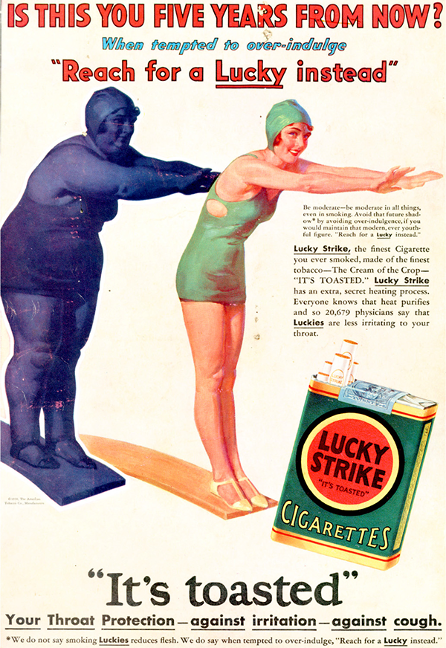
This horrific ad was created by Lucky Strike cigarettes in 1930 as an attempt to sell their unhealthy product. It is no longer in circulation today (thank goodness) but it can be found online, and looking at it provides important history on how advertising has always been manipulative. The ad purports that Lucky Strike cigarettes will reduce feelings of hunger, leading consumers to be less snacky, and thus, presumably avoid tacking on weight from overeating. This ad is targeted towards women, since it features a woman in the picture, and it suggests that ladies can avoid weight gain by smoking cigarettes. In this way, the ad reinforces harmful gender norms that women must avoid being fat in order to be attractive to potential partners. 

The ad is not just sexist towards women by holding them to high beauty standards. It is also deeply fatphobic, meaning that it reinforces the idea that fat is ugly and must be avoided. According to Marilyn Wann, “health is a problematic concept when linked with weight. Health is not a number, but rather a subjective experience with many influences.” So, implying that a certain weight is unhealthy or undesirable, as this ad does, is a constructed idea that harms fat people. They are less self-confident, ostracized from society, and given worse health care as a result of this fatphobic thinking.

On top of some sexist and fatphobic tendencies, the ad is racist as well. It presents the skinny woman as white, and darkens her fat shadow. This reinforces the historical idea that fat is a Black quality, and that Blackness is bad just like fat. By presenting the white woman as the ideal, and the dark woman as the problem to be avoided, this ad upholds a racist ideal of white superiority.

The intended purpose of the ad is to sell cigarettes, and the ad hopes that preying upon women’s fears of being fat will impel them to buy the product that is offered as a solution to weight gain. It has another angle as well. It claims that the cigarettes will protect consumer’s throats from irritation and a cough.  It is ridiculous by our 21st century standards to smoke unhealthy cigarettes as a way to resist weight gain or clear your throat, but this was a clever argument at the time of the ad. Doctors were paid to claim that cigarettes were healthy, allowing Lucky Strike to prey on consumers with misleading data. In this way, the ad uses the rhetorical appeal of ethos by appealing to over 20,000 doctor recommendations to back up claims of health benefits from smoking.

The advertisement uses the rhetorical appeals of pathos and logos as well. The scare tactic of the “fat shadow” that could occur in 5 years if one engages in “over-indulgence” is intended to create fear in the audience, a fear that will be dissuaded by the supposed benefits of smoking Lucky Strikes. Thus, the images in the ad appeal to pathos. In terms of logos, the ad makes an argument that cigarettes lead to less hunger, and less hunger leads to less eating, and less eating will prevent weigh gain. Of course, this logic is faulty, because it assumes that less eating will prevent weight gain, even though this is an open question. It also assumes that weight is a choice that results solely from eating habits, which reinforces problematic fatphobic ideas that Wann references. Humans have weights on a bell curve, just like height or other characteristics, so picking a “skinny” ideal that is a specific spot on the bell curve is not only misguided, it is impossible to accomplish.

The ad has two images. One is a basic image of a cigarette box, intended to make the packaging look clean and appealing. The other image is of a thin, conventionally attractive woman with a fat shadow. The then woman looks happy and calm, while the fat shadow has more of a grimace on her face. This illustrates the argument of the ad: buy Lucky Strike cigarettes to reduce hunger, or else weight gain will inevitably follow from an inability to control urges to eat.

Overall, the ad tries to convince women to buy Lucky Strike cigarettes with two claims that are both tied to health – the cigarettes will prevent weight gain by reducing hunger pangs, and they protect people’s throats by eliminating irritation and coughing. The ad is an example of problematic advertising that uses fatphobia to encourage people to buy unhealthy cigarettes. Ads like these were used throughout history to promote sexist, racist, and fatphobic ideas, convincing consumers that products which were actually harmful to them would help them avoid these made-up problems. Examining this history of constructing false needs is vitally important so that we can identify where ads are using these tactics today and snuff them out.

A cigarette ad riddled with fatphobia, false science, and problematic beauty standards

Latest on Desperate Housewives: depiction of women with assumptions and stereotypes

by Yuncong Hu

Written for Autostraddle

Last week, Desperate Housewives just released episode 9 of season 3, named “Beautiful Girls” after the character Gabrielle Solis’s plotline in this episode. Since 2004, when its first season started airing on ABC, the show has been positively received for its exploration on the inner dark sides and complicated personalities of the ordinary upper-class housewives, in contrast to the traditional plain, dour mother/wife figures on screen. Surprisingly in this episode, Gabrielle’s story isn’t technically boundary-breaking, and instead, it is borderline-misogynist.

For those of you who haven’t watched Desperate Housewives, Gabrielle Solis is one of the four female protagonists, all of whom are close friends and neighbors living in a fictitious suburb are called Wisteria Lane. Gabrielle has a Mexican heritage, and the other three housewives are white. In S309, Gabrielle’s divorce is finalized. With the failed attempt to go back to her modeling career in last episode, Gabrielle accepts the fact that she is becoming an unemployed divorcée. In need of a distraction from her empty life, she accepts invitation from her gay personal shopper, Vern, to coach young pageant girls for his new beauty pageant consulting firm. While she reluctantly takes the offer, she later finds herself enjoying coaching the girls as her modeling expertise is incredibly idolized by these younger women. However, when she is reminiscing on her old modeling days, she accidentally tells the girls about some ill-advised weight-loss methods such as sticking fingers in throats and smoking. Later on, some girls are caught by their parents smoking and vomiting, and Gabrielle is fired. She then comes to the mothers of the girls, confesses to them that beauty pageant coaching is now the one single meaningful thing in the life of a woman without husband and family, and makes a subtle offer to give illegal diet pills to them. The parents give her a second chance.

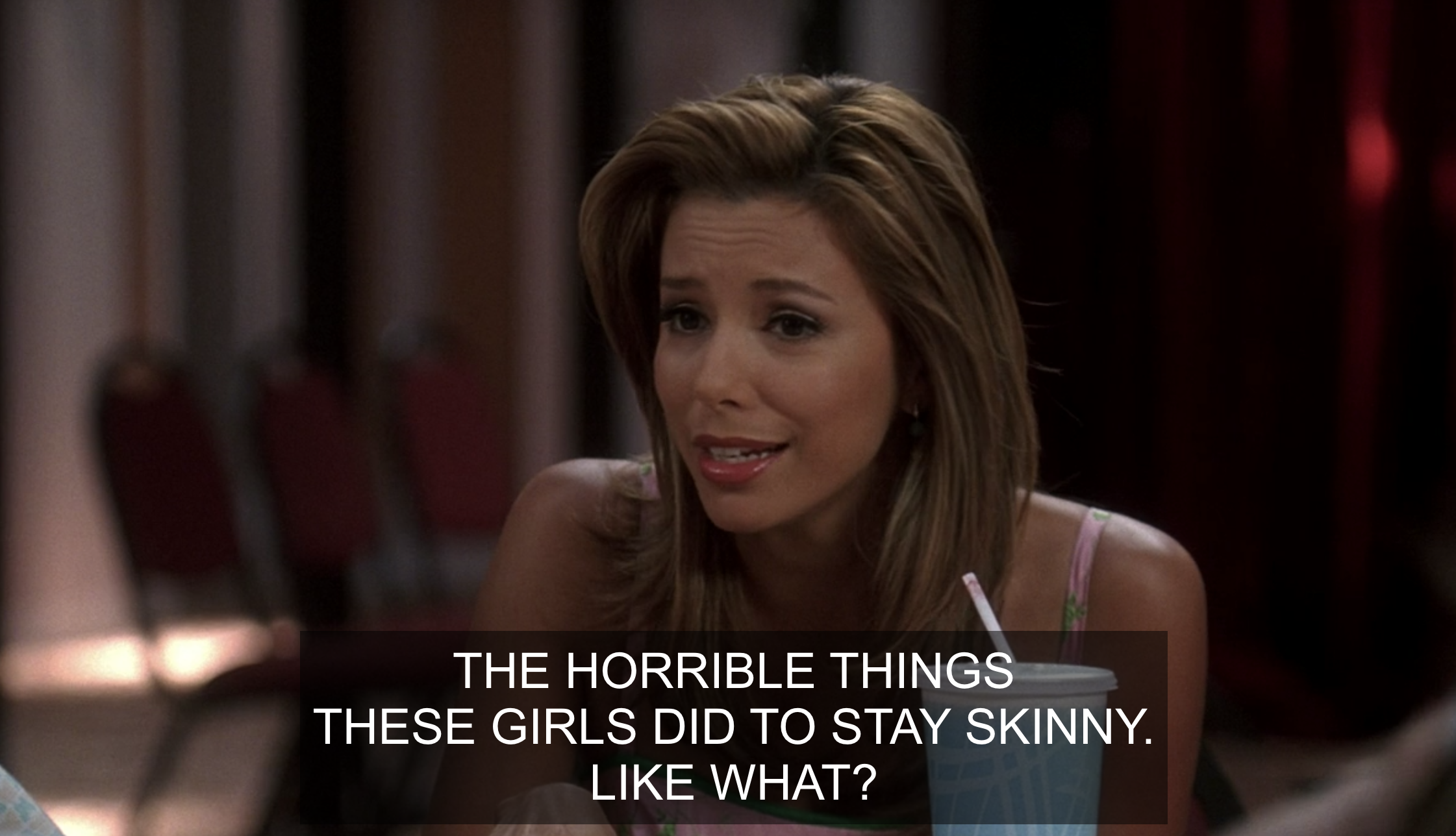
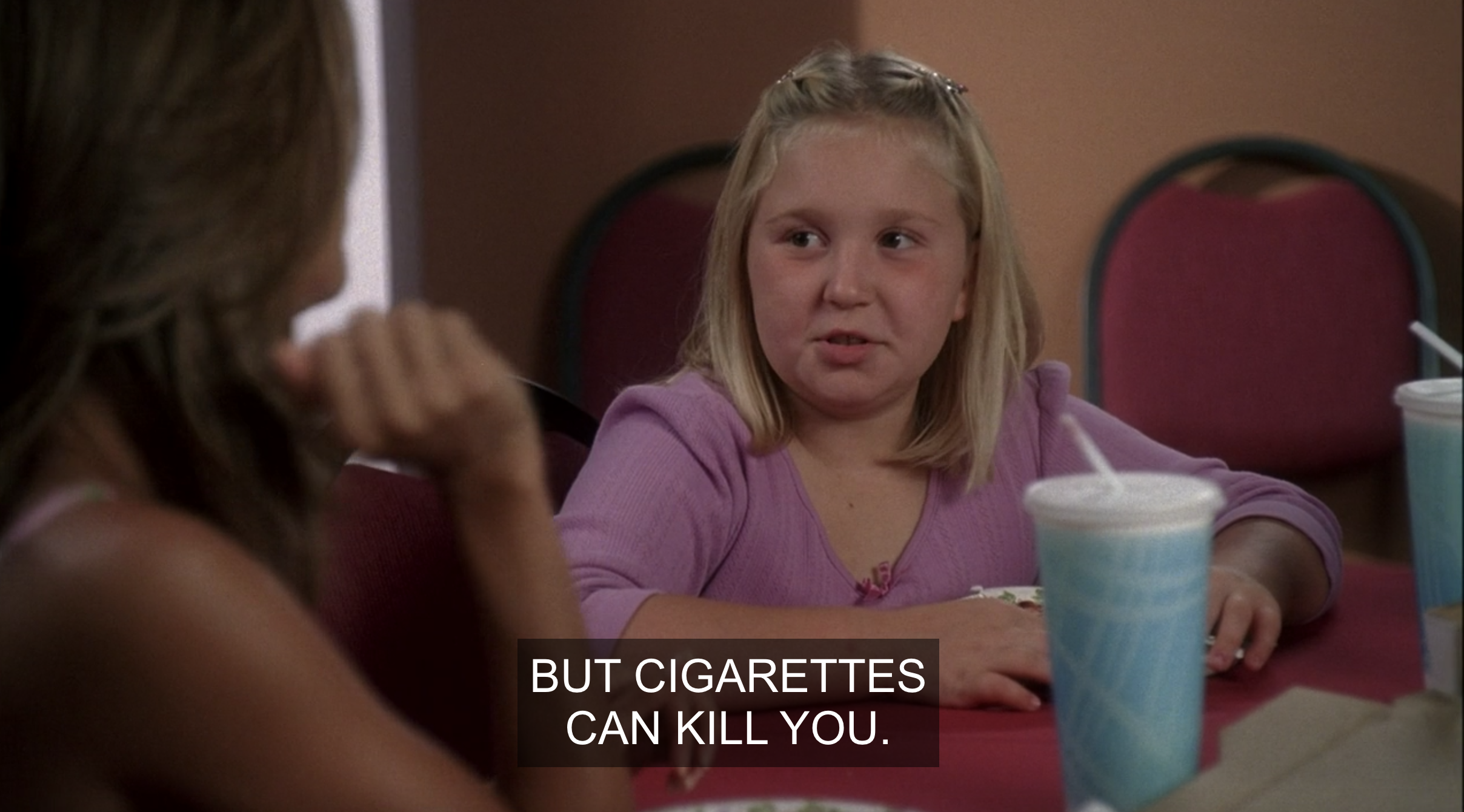
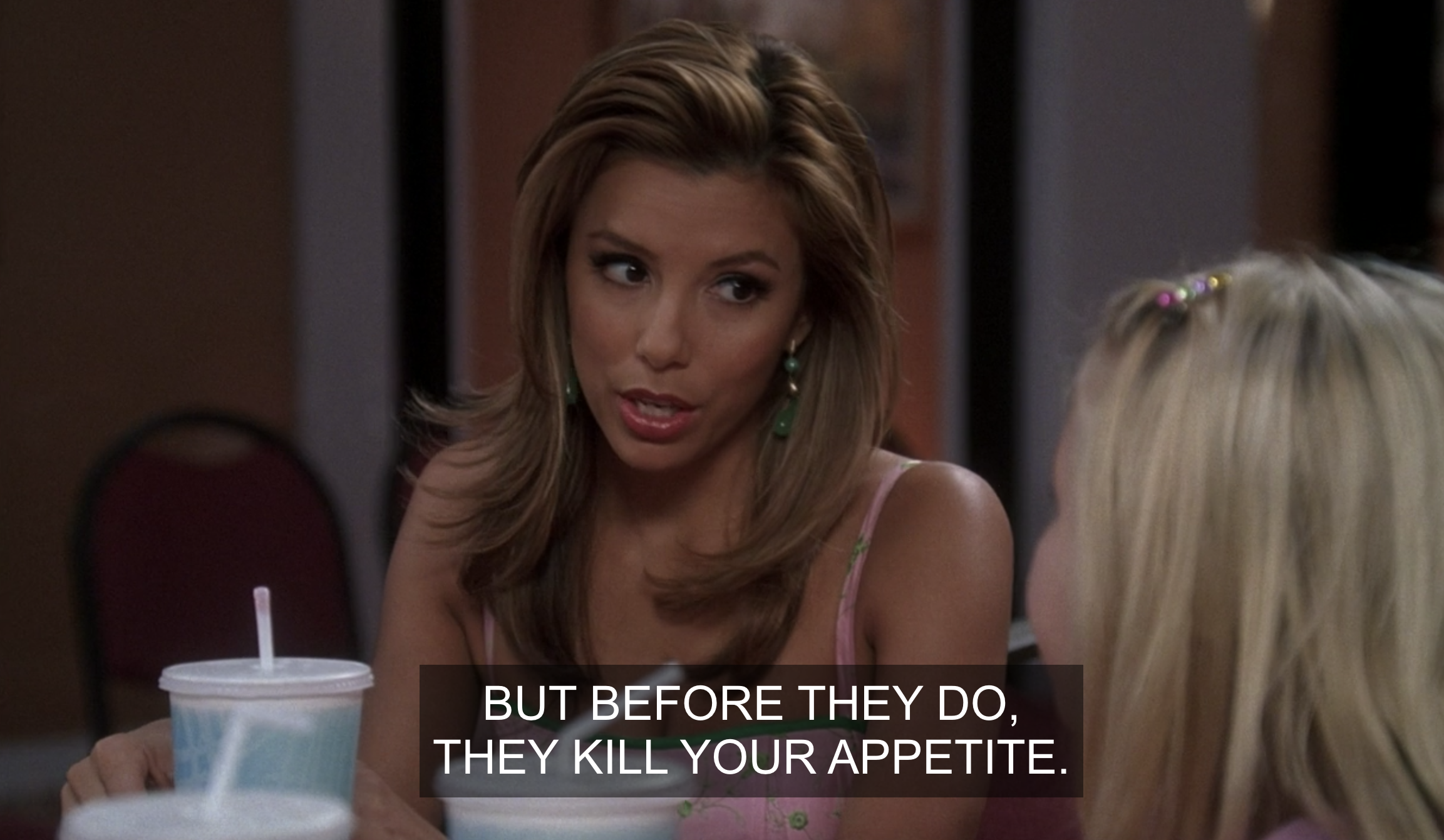
It is noticeable that Gabrielle’s conversation with the girls in this particular scene demonstrate how fat stigmatization is socially institutionalized in popular culture. Specifically, Gabrielle starts with the warning “You would not believe all the horrible things model do to stay skinny” and “I never did it” before she introduced the kids into smoking and vomiting as weight-loss methods. The children, though aware of “smoking will kill you”, still ask “Do you have to be skinny to be a model?”, to which she answers, “When was the last time you saw a fat person on a magazine cover?” This is a highly representative example of anti-fat beliefs being passed on by someone elder and experienced to a younger generation, thereby creating an invisible social structure that is constantly renewing and strengthening itself. In her introduction to Fat Studies Readers, Marilyn Wann comments on this structure, “Every person who lives in a fat-hating culture inevitably absorbs anti-fat beliefs, assumptions and stereotypes, and also inevitably comes to occupy a position in relation to power arrangements that are based on weight,” The power relationship in this narrative is clearly the contrast between professional fashion models and some 9-to-12-year-old who wish they could be beauty pageant girls. As a result, Gabrielle herself, without realizing it, teaches the girls about the established beauty standard that discriminate against fat people. Her expertise, just like the enormous power of social norms behind beauty standards, is invisible and very restrictive, as the girls immediately accepts the norms and attempt to fit into them. Even worse, when she acknowledges that the methods she mentions is “horrible”, she is also explaining the conventional rules for fat people, that they need to suffer to lose weight, that being fat is even more dreadful than being unhealthy. These rules are internalized by the girls and soon, they start to punish themselves for being fat.

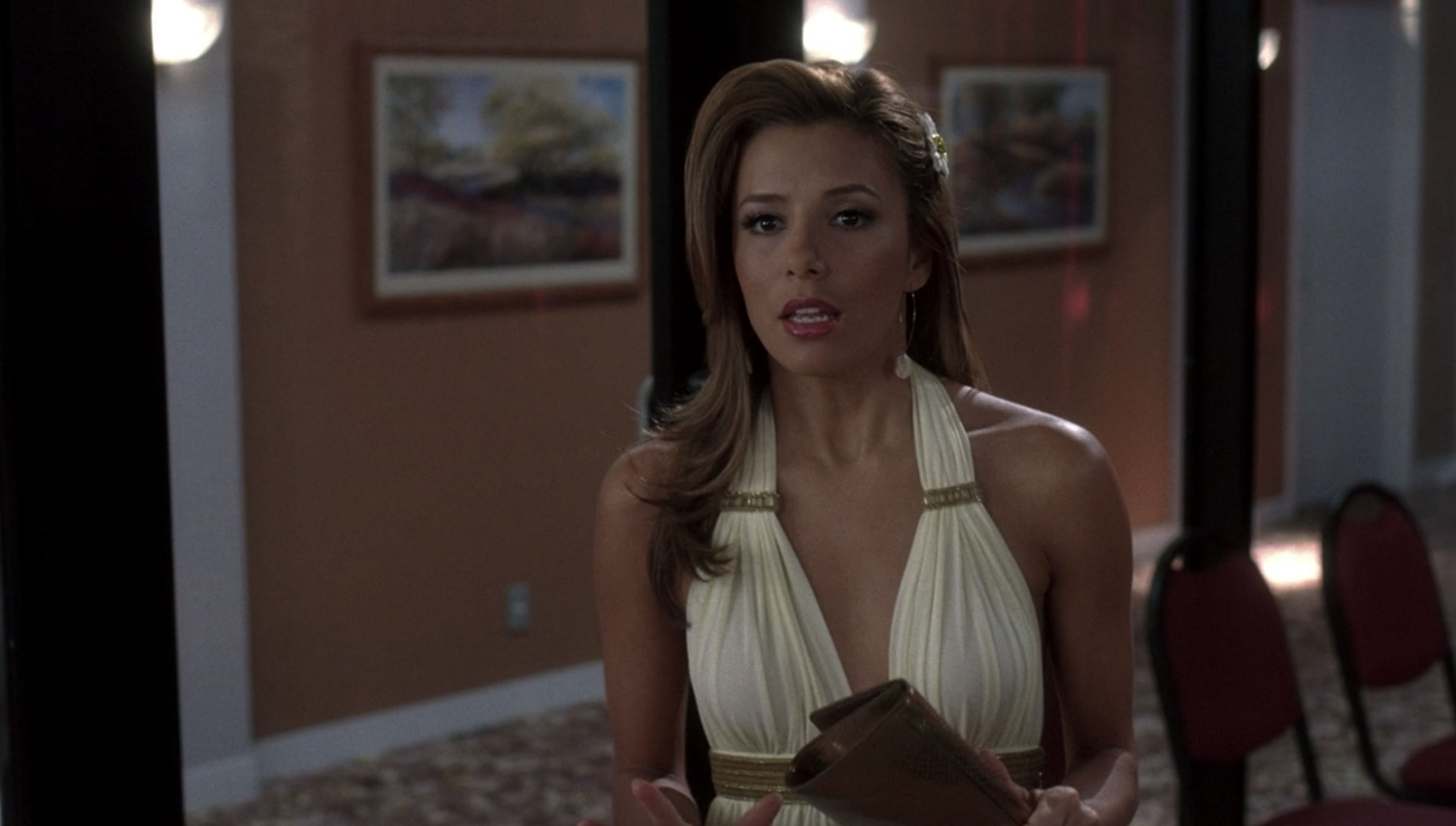
There is more to the fatphobia side of this episode. While it gives us an example of how fat-stigmatization transforms into social structures, it fails to offer any critical resolution towards it. This presentation of this story, which primarily focuses on weight and beauty standards, chooses to continue conforming to anti-fat beliefs and misrepresenting fat community. In the last scene, a sharp contrast is made between Gabrielle and the parents:

Eva Longoria, as Gabrielle, is intentionally put into better clothes, hair, accessories and make-up in this scene, while the other actors are clearly not. Gabrielle is wearing a full-length, Versace-styled ball gown while holding a clutch. Her hair is curly and silky, and she has full-makeup on. The other ladies are all wearing dowdy clothes, much less make-up and three of them can definitely be considered as fat. These women quickly changed their idea about firing Gabrielle after she mentions she has “highly effective non-FDA approved diet pills from Zurich”, and claim that “I guess the Christian thing is to forgive her” without admitting that they are attracted by the pills in reality. The plot and lines intuitively assume the beauty standards between two binaries – fat and thin, and coveys the implied message that thinner people do look better to its audience. Moreover, it falsely represents fat people by portraying them as automatically desiring losing weight at any cost. Therefore, it inevitably represents another effort to normalize weight-loss and anti-fat health promotion by making an assumption that fat people need to lose weight. In doing so, they neglect the group of audiences who belong to the self-accepting fat community.

In addition, the underlying assumption about Gabrielle’s social class is striking. She is a wealthy woman who can afford a personal shopper even after losing her steady income – her ex-husband. Her motivation for this job is not for survival, but only spiritual fulfilment. Just like Gabrielle, her other friends share the same social class and work motivation: they are married to lawyers, doctors, managers, etc. Essentially, the depiction of women’s struggle is mainly about upper-middle class, white women’s struggle (Gabrielle is the only POC protagonist in the show) A vast majority of women are already excluded in the production of this episode, as well as the whole series.

As the only non-white protagonist, the character of Gabrielle also indicates conformity to racial and gender stereotypes prevalent in America. She is undoubtedly, even in the script description, the most attractive housewife of all four, and a Latina ex-supermodel. There is a hyper-sexuality attached to her with her race, a form of over-sexualization of Latin women. The character has no choice but to be a gorgeous stereotype like a lot of other Latin women on screen, while diversity is allowed in white women. The same thing is applied to Gabrielle’s background. She is the only one who has a background story: she comes from a poor family, goes into modeling at a very young age, earns a new life through her new social circle, marries a rich husband and retires from fashion industry. Interestingly, Desperate Housewives does not introduce the backgrounds of other three white protagonists. They are assumed to be raised, educated and married normally as if they are in a standard white family, while Gabrielle needs an explanation of why she lives in a rich, white suburbs neighborhood. In other words, The abnormality in the life of a female, like Gabrielle, is highlighted and associated with her racialized background.            

Above all, the series Desperate Housewives does have many things to complement about: it gives a space for more female-centered narratives in the male-dominating media world, and it strives to tell stories from women’s points of view. Still, one must not neglect the problematic assumptions and stereotypes of women that it displays in only one episode. The production team need to inspect its work with more consciousness of preventing prejudices and assumption. And the audiences, while enjoying the marvelous episodes, should be aware of these problems.

Works Cited:

Wann, Marilyn. Foreword To Fat Studies Reader. NYU Press. 2009

Heroes So White: Lack of Diversity in the World of Superheroes

by Jo Papadopoulou

Written for Autostraddle

One of the first images that comes up when you google “superheroes.” Notice the number of non-male and non-white characters. (Screen Rant, 2019)

I once asked my 10-year-old sister who her favourite superhero was. “Flash!,” she answered excitedly. When I asked her why, she looked at me curiously and said “Cause he is fast, he is so fast sometimes it looks like he is flying, and he is so strong too!” Simple enough answer, right? Well, I then asked whether she knew of any female superheroes with the same abilities as Flash and she couldn’t come up with a reply. When asked about female superheroes, she only knew to list three: Wonder Woman, Supergirl, and Catwoman. None of them were her favourite though. An indicator that she probably didn’t choose her favourite based on gender but based on the abilities she could identify with best (she likes running, so Flash makes sense). However, what if she chose Flash because that was the only one she knew? There are other superheroes who are not cishet white males and have the same (and even more) abilities as Flash. She chose Flash because it was who she was most familiar with. It Is who TV series and ads and video games show her.

And that is not true only for my sister. Most kids, most people, only know the white, cishet male, super fit (and usually rich) superheroes. But they are not the only kind of superhero that exists. That is certainly not the only type of people who exist. So why are they the ones mainly shown? How can this very specific, very excluding group of superheroes represent the whole of them? The answer is, it can’t.

Diversity in Superheroes

For many years, the only superheroes shown on television are ones like Superman and Batman, white fit guys who fight crime and get all the beautiful girls. Companies have been trying to appeal to teenage white boys by promoting a heteronormative, fatphobic narrative. For decades, these companies have been creating false, dangerous role models for children and adults everywhere. And while most turn a blind eye to this, some people have always known how hurtful these role models are. All black, gay, fat, Latinx, trans (and many more identities not reprented) folx know. We have always noticed the lack of representation when it comes to superheroes. They never looked like us. We could never fully identify with them.

The “Original” Avengers of the Marvel Cinematic Universe, some of the most well-known superheroes by one of the most well-known entertainment companies. (Cinema Blend, 2019)

White Dudes (it’s always them)

White male superheroes are still dominating our screens and comic book pages (e.g. Iron Man, Spider-Man, Superman, Deadpool, etc.). When non-white characters are shown, they usually follow old, hurtful stereotypes (for example, Mantis of Guardians of the Galaxy appears as a submissive Asian woman and her main power is lulling people to sleep). When the companies try to create a more diverse environment around superheroes they usually go about it by adding characters of colour (e.g. Black Panther in the Marvel Cinematic Universe) and most (if not all) times these characters have huge success due to the fact that there’s so little diversity. So, the question that comes up is, are the companies really being more diverse and inclusive for the fans or for the money? (Sadly, usually capitalism wins over us).

Genre as Old as Time

This struggle with diversity has its roots mainly to the fact that the superhero genre was created some 40 or more years ago and has seldom changed since. Most, if not all, of the creators back then were rich white males making art for almost exclusively white male audiences. Because of nostalgia, a general fear of change, or pure laziness, the genre is still marked by the “white guy hero” trope that was the staple when it started.

Fighting the Status Quo

Another reason superheroes are still white guys is because a big part of what these heroes do is fight the status quo (e.g. bank robberies, coup d’états, etc.). And it is always shown from the perspective of the powerful, that is rich white men. For example, Bruce Wayne (aka Batman), who is a rich white cishet man, is at the center of Justice League sidelining the female characters and (few) characters of colour.

Fatphobia

Apart from being cishet guys and white, the majority of superheroes are slim and fit. In comic books, their abs and excessive muscles are always visible through their suits and in movies and TV shows actors go through long periods of dieting and strict work outs to achieve a “superhero-worthy” body. Whenever fat characters are included they are usually viewed as something to laugh at (e.g. Thor in Avengers: Endgame) or follow hurtful fatphobic stereotypes.

Chris Hemsworth as “Fat Thor”, as he was named by the fandom, in Avengers: Endgame. (“Avengers: Endgame”, Marvel 2019)

New Superheroes

To create a more diverse world, instead of dismantling the pre-existing wider superhero world, new ones are created without the stereotypes of the old ones. Companies like Marvel and DC, big entertainment companies, are starting to release novels with new, more inclusive, more diverse characters. Some examples are: América Chávez (the newest Miss America) is a Latina and a lesbian, Doreen Green (the newest Squirrel Girl) doesn’t have an incredibly slim body with abs and excessive muscles, and Miles Morales (the newest Spider-Man) is half African American and half Puerto Rican. But while it is great that all these diverse characters exist, they don’t appear in the companies’ big cinematic universes, they appear in comic book series not that accessible or well-known to the wider public. While the creation and existence of these characters is a huge step forward, it is still not enough. This diversity needs to be made more widespread and not stay limited to a few comic book characters. We, the fans, need to keep asking for more representation and we can only hope that the companies will listen.

We all deserve to be able to see ourselves as heroes.