Theory to praxis: fatphobia across culture

One brand new theory I came across in GSS 101 this year is fat studies. It has never occurred to me that studying fat is included in the realm of gender and sexuality studies. Before this semester, I was convinced by the stigmatization of fat in media that it is related to health problems and never aware of my privileges and oprressions associated with fatness. Furthermore, our discussion on fat studies made me realize how being fat and body sizes act as a social identity, just like gender and race.

But what confused me at first was the introduction to fatphobia existed in American context, as my impression of the U.S. society is not fatphobic. What considered “overly fat” in China may not be surprising in America. Only last year, there was a major Tik Tok trend in China when girls tried to fit themselves in children’s clothes to prove how slim they are. I witnessed a lot of women internalizing ridiculous body shame as I grow up, and naturally, I assume America accepts fat people better. Nevertheless, I know that it is not the case after taking GSS. In addition, I start to compare different forms of fatphobia in American context (what I have read in class) and in Chinese context (what I experienced in the past)

Inspired by this, I would envision myself doing a research after coming back to China, in which I would draw a comparison between how fatphobia is expressed in two countries. There might be genetic factors as well as differences in diet cultures that determine factors like average weights as well as people’s common ideas about “normal body.” It would also be interesting, considering America and the entire western world control media and culture export, and their values influence the east. For example, fitness training and gyms are becoming common in China nowadays, and that could also impact on the forms of fatphobia in China. Most important of all, by studying how fatphobia is expressed in different ways, I would be better capable of combating it, after understanding how it convinces people in different cultures.

Feminists mix-tape: “Like a Virgin” by Madonna

“Like a Virgin” is a song recorded by the pop diva Madonna in her second studio album “Like a Virgin.” It was released in 1984 and is still recognized as one of her most iconic work in her music career. Unlike some of today’s influencing feminist songs, such as “Single Ladies” or “Anaconda”, “Like a Virgin” does not have a clear gender perspective or hyper-sexuality. In fact, the song was originally written by male composers Tom Kelly and Billy Steinberg, while Steinberg claimed that the lyrics come from his personal experience. The demo was sung by Kelly before the song was brought to Madonna’s attention.

This well explains why the lyrics do not contain gender pronouns or a specific focus on heterosexual relationships. Madonna sings:

I was beat, incomplete

I‘ve been had, I was sad and blue

But you made me feel

Shiny and new

Like a virgin, touched for the very first time…

When “you” is addressed, their gender identity is nearly erased. Therefore, the song could be performed to anyone. Even the narrator “I” is not necessarily a 26-year-old blonde white woman. The song exile most class, race, gender advantages that may happen, and only stresses on one privilege most people, regardless of their identities, can strive for: love.

In addition, the song has a clever play on the word “virgin.” Taking it out, the song looks like a normal dance-ballad with lyrics like:

Yeah your love thaw out

What was scary and cold

But when Madonna comes back to the central phrase “like a virgin” with her sweet, teenage-girl-like voice, (80s and 90s teenager, not Olivia Rodrigo-type teenager) a bold and liberated sexuality is attached to the song. As Madonna commented on it: “I liked the play on words; I thought they were clever. They’re so geeky, they’re cool.” Placing “like a virgin” with other cliché love expressions makes this song seem intriguing. The character is presumable NOT a virgin, they only feels like they becomes a virgin once again because a brand new love has entered the life. When a woman, especially a woman like Madonna with her ultra-femininity performs this song, the claim of it correlates well with women’s bodily autonomy and an effort to normalize speeches of sexuality. Here, Madonna claims that her emotional life is ultimately the same as her sex life, that she could determine for herself she could be a virgin if she feels like it and her body feels like it. Therefore, the sensation of “unfit”, as a racy (in 80s standards) term is used, in this song is one of the factors that inevitably makes “Like a Virgin” a proud feminist song. The idea of virginity is dismissed, and sex does not shame her. Furthermore, the song could represent anyone, thus encouraging anyone to feel “like a virgin” anytime they want.

Works Cited:

Madonna, “Like a Virgin.” Like a Virgin, Sire Records.

https://en.wikipedia.org/wiki/Like_a_Virgin_(song)

Book review on Daring to Be Bad: Radical Feminism in America 1967-1975

Daring to Be Bad: Radical Feminism in America 1967-1975 is an academic monograph by Alice Echols, published in 1989. As the title suggests, the book offers a detailed account of the rise and fall of radical feminism in America from late ‘60s to ‘70s. Echols vividly depicts the achievements, struggles and conflicts within radical feminism, identifies and categorizes different theories and activists’ groups emerged from the movement, and attempts to explain how radical feminism eventually came to its doom. The book organizes a complex half-decade of political history into an easily comprehensible timeline, while summarizing many scholar ideologies towards radical feminism. It serves as an accessible scholarly introduction to readers who lack significant knowledges about this topic.

Echols contends that radical feminism, several years after its establishment, was eclipsed by cultural feminism, which was a “tendency that grew out of radical feminism” (5) Whereas radical feminists called for a political confrontation with the government and a subversion of the male supremacy society, cultural feminists were keen on creating an alternate counter-culture with only women. These are not the only two tendencies shared by women of the radical movements. Echols also introduces other categories of feminist ideologies, such as politicos, liberal feminists, new left women, socialist-feminists. She focuses on how, in the movement, radical feminism gradually dissipated, along with fatal flaws within the movement that prefigure its end. In her opinion, if one successfully articulates the reason for the popularity of radical feminist movements in ‘60s as well as their lethal flaws, it might be possible for she and her contemporaries to revitalize the movements.

As Echols concludes herself, her work is “not simply an intellectual history, a social history, or a collective biography” but “the combination of three”. (19) Her academic approach in this book is primarily historiographical. Employing a large number of direct quotes from speeches, interviews and writings, Echols presents a wide range of narratives from scholar’s and activists’ views from 1967-1975. Her sources of evidence consist of multiple types of texts, since her emphasis is not solely on the feminism theories, but also their practice, the interpersonal relationships between feminists, the engagement with other ongoing movements black movements, as well as media response. As the radical feminist movement was, in her own words, “factious”, she often introduces each sub-group and its theories in separate sections of a chapter, accompanied by a micro biography of their founders and leaders. However, her work is not uncritical. Though the historical narratives are kept objective and impartial, she presents her analysis on the feminists’ theories and approaches as conclusions.

The book is divided into 6 chapters, ordered chronologically. Each chapter marks a certain time period with distinct features attributed to it, such as 1973-1975 and the flourishment of cultural feminism. Generally, the radical feminism history in the book can be divided into three parts: the early days radical feminism as an affiliate to other radical movements, the rise of many radical feminism theories and organizations, and radical feminism’s decline that started the development of lesbian feminism and cultural feminism.

Beginning from 1965, the prototype of the actual radical feminism that appeared after 1967 emerged. As early as 1965, women activists still worked inside male-dominating movements, such as the new left and civil rights movement. Women’s issues were not taken seriously, as ““Male chauvinism” was a phrase that one did not utter unless one was ready to be laughed at.” (26) At the same time, the growing gender tensions on sex roles forced (SDS) to start holding workshops on women’s roles. Later on, women activists like Jo Freeman and Shulamith Firestone from the Chicago’s group embarked on the earliest women liberation movements by forming small independent women groups and issuing a manifesto about “defining their own struggles” (49) Echols argues that the black power before 1967 ultimately inspired the statement that “it was only valid form women the organize their own oppression and to define the terms of their struggle.” The radical feminists’ struggle begins with a fundamental “politico-feminist schism.” (52) “Politicos” and “Feminists” occupied opposing theoretical positions inside the women liberation groups by 1969. Politicos viewed capitalism as the main enemy of women’s liberation and claimed women’s movements as an important sector of the leftist movements at the time. By contrast, feminists believed male supremacy to be the biggest problem faced by women and refused to be in only a subordinate position under male-dominating movements. The earliest women liberation groups included D.C. Women Liberation, The Westside Group of Chicago, and New York Radical Women. Together, they articulated the early radical feminist theories and organized events and protests, such as consciousness-raising meetings. In chapter two, Echols demonstrates in detail how problems arose within women liberation groups. Besides the clashes between politicos and feminists, the theories divided on questions like whether men should be challenged or rejected, and whether consciousness-raising groups should demand for actions. In addition, Echols argues that the premise of consciousness-raising, as well as the largely embraced theories at the time, was dismissive of class and sexuality differences, as they contended that “differences still had the same root.” As the white upper- and middle-class women of liberation groups based their theories on assumptions that all women shared universal experiences which united them, bringing up differences was discouraged. The inner conflicts, the unorganized groups, as well as the growing sizes, all contributed to the early failures of radical feminism such as the dissolution of a large group like NYRW.

However, the tendency of the whole movement became much less politico and much more feminist towards 1969, when feminists faced increasing hostility from the larger movements. The sexism within the leftist movements at the time forced women to organize their movements outside of the left. Starting from 1969, radical feminism grew continuously into even more strains and more radical of theoretical positions. Echols contends that “In the early ‘70s radical feminism seemed to be flourishing” as “there was an explosion of radical feminism literature.” (197) Moreover, she also illustrates several flaws within these groups. For example, Redstockings continued on the previous generalized assumptions of all women by upper class, white women. It failed again, to see the need of specifying class and race differences in consciousness-raising. The in-movement schism still existed, and was expressed in opposition between pro-woman line and gender conditioning theory. The former, represented by Redstockings, believed women were forced by the material reality of the male-dominating society to take oppressed roles, while the latter, represented by Cell 16, maintained that women were “brainwashed.” (161) Accusations of elitism, especially against the most educated member, who were also main theorists and writers, were growing. Organizations like The Feminists and New York Radical Feminists were so obsessed with an egalitarian approach to achieve leader-less structure and a true sisterhood that they became greatly unorganized. In addition, prefiguration of cultural feminism started to appear when arguments from Cell 16 transformed into a more gender essentialism theory. Besides, they also proposed that “women withdraw from men personally as well as politically.” (164) It was also true that in 1970, “the newcomers often lacked the founders’ radical perspective” as they “seemed more interested in self-improvement than in the radical restructuring of society.” Radical feminism, in reality, started to decline.

The start of chapter five, titled “the Eruption of Differences,” marks the turning point of radical feminism. In the winter of 1970, Barbara Mehrhof and Pam Kearon organized the Class Workshop for women activists to discuss class. However, Echols maintains that class workshops were “response to the media’s growing fascination with the women’s liberation movement.” Class and elitism were assessed as a result of the resentment created when only few people(leaders) had attention of the press. The discussion about class equality did not have noticeable positive results; instead, it “had become a tyranny of personal conformity. Imagination, inspiration, and efficient political organization are suspected and throttled.” (210)

Meanwhile, Lesbianism emerged as more and more lesbian-feminists entered the movement and demanded for more inclusiveness within radical feminism. Lesbians faced mostly hostility among the heterosexual women liberationists, for lesbian sexuality was regarded as sexual rather than political. As evidenced by quotes from Roxanne Dunbar, “feminism…to get women out of bed rather than change the gender of their partners,” Most radical feminists were anti-sex. To convince the heterosexual women in the movement, lesbian-feminists like Rita Mae Brown promoted lesbianism with the term “women-identified women.” They legitimized lesbian as a political term and contradicted the stigmatization that lesbians were “male-identified bogeywomen.” (216) To them, their sexuality “involved sensuality rather than sexuality, communication rather than conquest.” Echols comments on the de-sexualization of lesbianism that “the movement’s acceptance of lesbianism was always conditional – contingent upon lesbians’ wiliness to de-emphasize sexuality…Lesbianism was never really legitimated on sexual grounds.” While the eruption of differences was not directly correlated to cultural feminism, she contends that “cultural feminism’s ascendence is in large measure attributable to the turmoil created by lesbianism and class.” From 1969, cultural feminists proposed arguments in “The Fourth World Manifesto” and “Mother Right.” The manifesto declared that the female culture formed a fourth world, since women were essentially a colonized group. In addition, Jane Alpert articulated in “Mother Right” that women exhibited a super power due to female biology, as she explained, “biology is hence the source and not the enemy of feminist revolution.” (250) A vision of women united by their shared “motherhood” (251) was described, and Echols concludes that the reason why cultural feminism was constructed and embraced was a “desire to put an end to the painful and often immobilizing discussions about women’s differences.” Cultural feminism was, inevitably, a logical solution which feminists sought for after a long time of turmoil and an intensifying tendency to essentialism.

Over 30 years after its first publication, Echols’ book is still not outdated and serves as a valuable text for those who are curious about radical feminist movements in 60s and 70s. While the book is relatively accessible so that people without fundamental knowledge in social movements or feminism can understand Echols’ ideas, the ways she structures her material are sometimes misleading. For example, the contradicting theories of pro-woman line and gender conditioning are firstly mentioned in conclusion of chapter 2. Without further explanation in chapter 2, this material is revisited in chapter 4 and finally addressed in detail. As the chapters describe mostly simultaneous events, similar situation happens multiple times and render one particular piece of content quite confusing. Other than that, the book is based on a cis-gender assumption. Mostly limited by ‘80s gender concepts(it was written in 1987), the book fails to address struggle of non-cis-gender women, as well as other non-binary communities. Though Echols provides ample insights into the race and class perspective of radical feminism, gender minorities other than gays and lesbians are ignored.

Work Cited:

Echols, Alice, “Daring to Be Bad”: Radical Feminism in America 1967-1975, University of Minnesota Press, 1989
Latest on Desperate Housewives: depiction of women with assumptions and stereotypes

by Yuncong Hu

Written for Autostraddle

Last week, Desperate Housewives just released episode 9 of season 3, named “Beautiful Girls” after the character Gabrielle Solis’s plotline in this episode. Since 2004, when its first season started airing on ABC, the show has been positively received for its exploration on the inner dark sides and complicated personalities of the ordinary upper-class housewives, in contrast to the traditional plain, dour mother/wife figures on screen. Surprisingly in this episode, Gabrielle’s story isn’t technically boundary-breaking, and instead, it is borderline-misogynist.

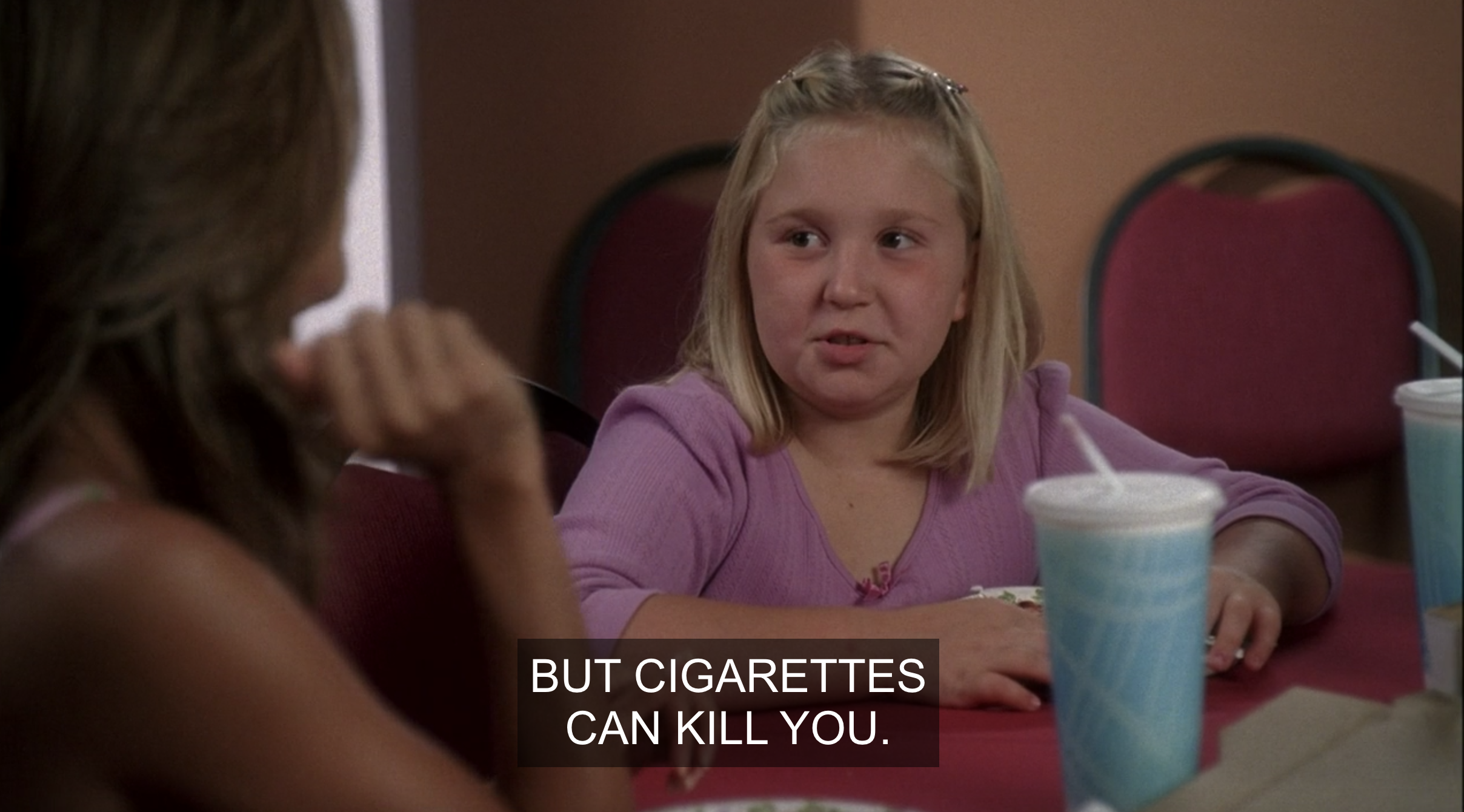
For those of you who haven’t watched Desperate Housewives, Gabrielle Solis is one of the four female protagonists, all of whom are close friends and neighbors living in a fictitious suburb are called Wisteria Lane. Gabrielle has a Mexican heritage, and the other three housewives are white. In S309, Gabrielle’s divorce is finalized. With the failed attempt to go back to her modeling career in last episode, Gabrielle accepts the fact that she is becoming an unemployed divorcée. In need of a distraction from her empty life, she accepts invitation from her gay personal shopper, Vern, to coach young pageant girls for his new beauty pageant consulting firm. While she reluctantly takes the offer, she later finds herself enjoying coaching the girls as her modeling expertise is incredibly idolized by these younger women. However, when she is reminiscing on her old modeling days, she accidentally tells the girls about some ill-advised weight-loss methods such as sticking fingers in throats and smoking. Later on, some girls are caught by their parents smoking and vomiting, and Gabrielle is fired. She then comes to the mothers of the girls, confesses to them that beauty pageant coaching is now the one single meaningful thing in the life of a woman without husband and family, and makes a subtle offer to give illegal diet pills to them. The parents give her a second chance.

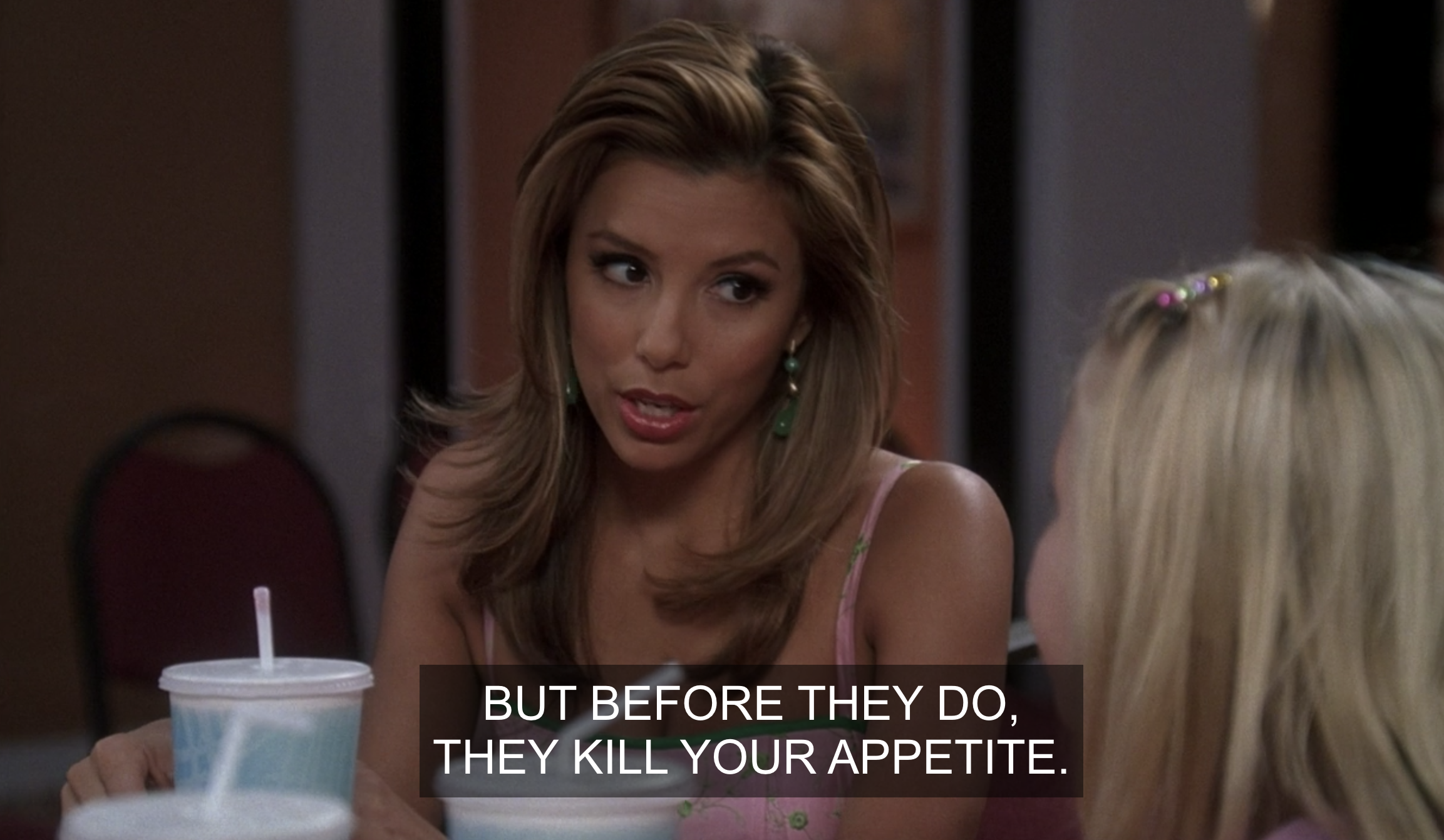
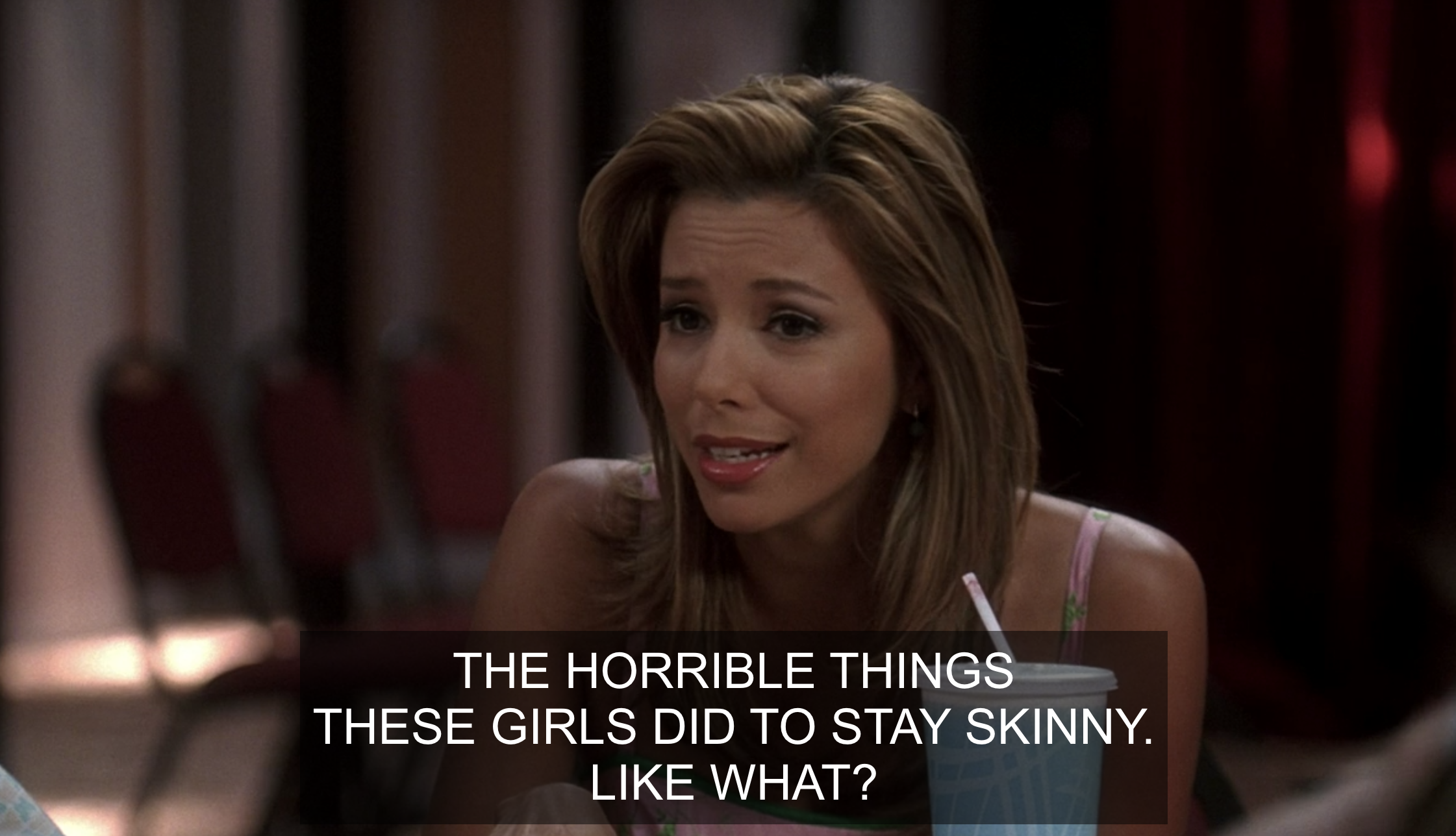
It is noticeable that Gabrielle’s conversation with the girls in this particular scene demonstrate how fat stigmatization is socially institutionalized in popular culture. Specifically, Gabrielle starts with the warning “You would not believe all the horrible things model do to stay skinny” and “I never did it” before she introduced the kids into smoking and vomiting as weight-loss methods. The children, though aware of “smoking will kill you”, still ask “Do you have to be skinny to be a model?”, to which she answers, “When was the last time you saw a fat person on a magazine cover?” This is a highly representative example of anti-fat beliefs being passed on by someone elder and experienced to a younger generation, thereby creating an invisible social structure that is constantly renewing and strengthening itself. In her introduction to Fat Studies Readers, Marilyn Wann comments on this structure, “Every person who lives in a fat-hating culture inevitably absorbs anti-fat beliefs, assumptions and stereotypes, and also inevitably comes to occupy a position in relation to power arrangements that are based on weight,” The power relationship in this narrative is clearly the contrast between professional fashion models and some 9-to-12-year-old who wish they could be beauty pageant girls. As a result, Gabrielle herself, without realizing it, teaches the girls about the established beauty standard that discriminate against fat people. Her expertise, just like the enormous power of social norms behind beauty standards, is invisible and very restrictive, as the girls immediately accepts the norms and attempt to fit into them. Even worse, when she acknowledges that the methods she mentions is “horrible”, she is also explaining the conventional rules for fat people, that they need to suffer to lose weight, that being fat is even more dreadful than being unhealthy. These rules are internalized by the girls and soon, they start to punish themselves for being fat.

There is more to the fatphobia side of this episode. While it gives us an example of how fat-stigmatization transforms into social structures, it fails to offer any critical resolution towards it. This presentation of this story, which primarily focuses on weight and beauty standards, chooses to continue conforming to anti-fat beliefs and misrepresenting fat community. In the last scene, a sharp contrast is made between Gabrielle and the parents:

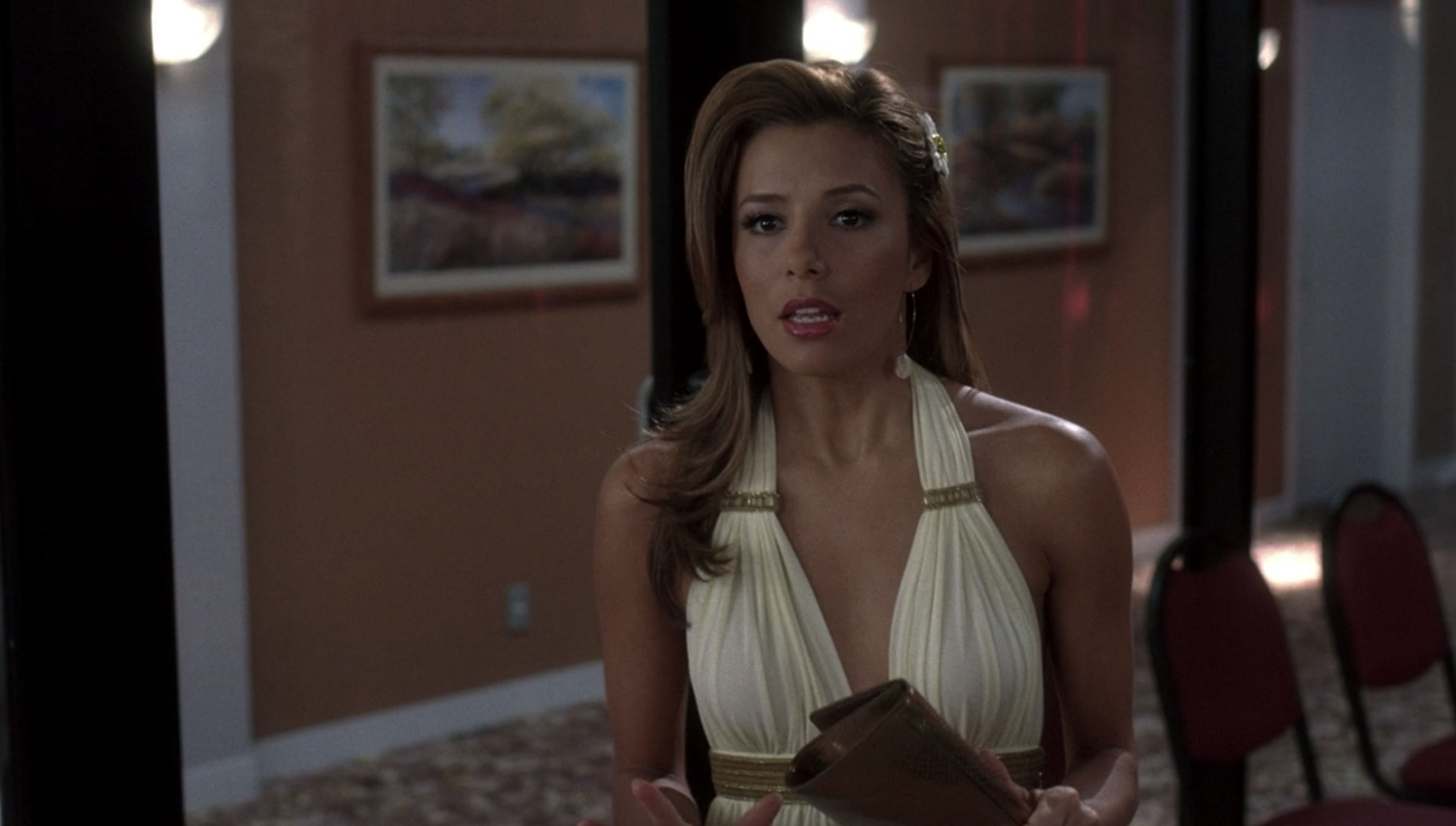
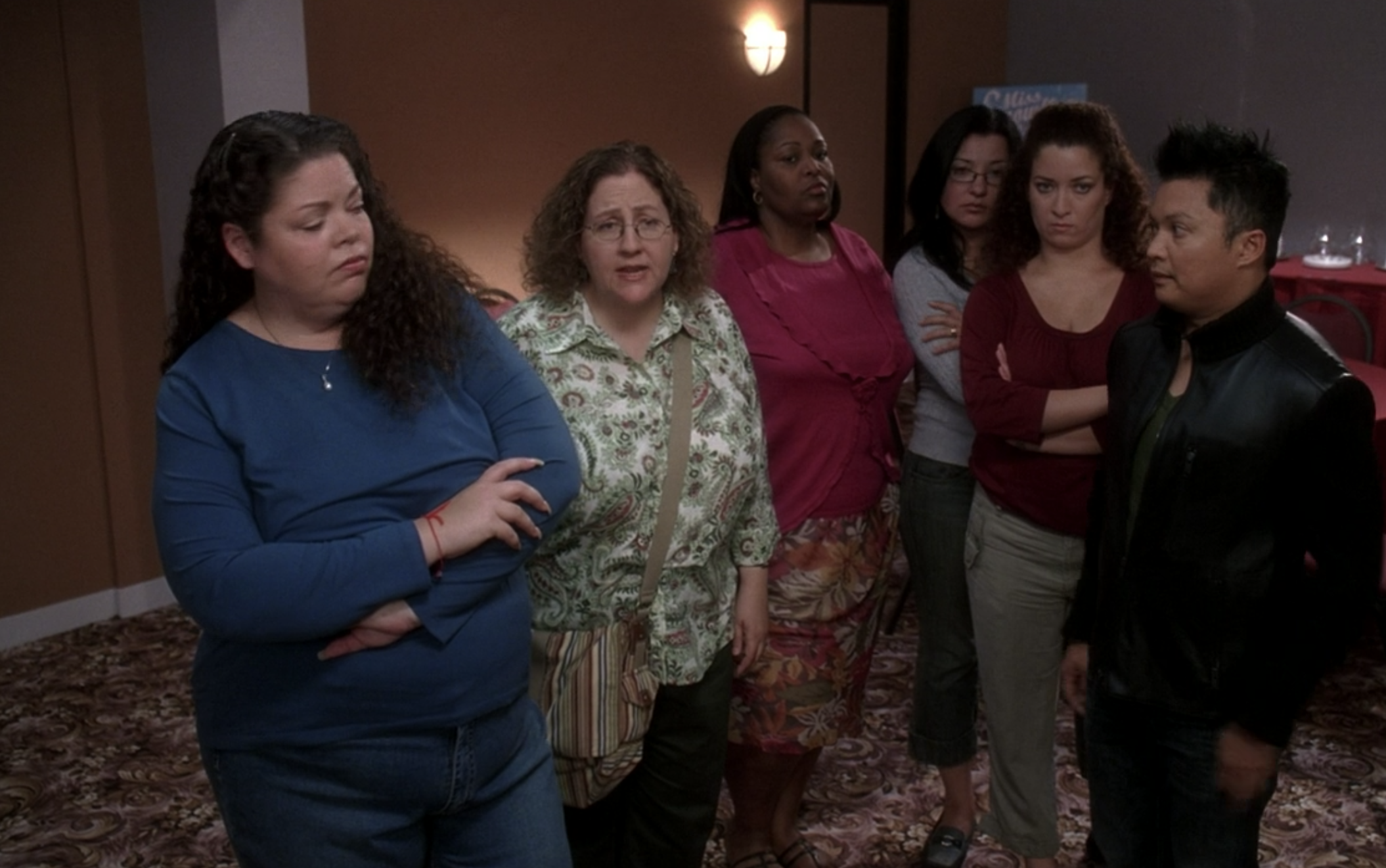
Eva Longoria, as Gabrielle, is intentionally put into better clothes, hair, accessories and make-up in this scene, while the other actors are clearly not. Gabrielle is wearing a full-length, Versace-styled ball gown while holding a clutch. Her hair is curly and silky, and she has full-makeup on. The other ladies are all wearing dowdy clothes, much less make-up and three of them can definitely be considered as fat. These women quickly changed their idea about firing Gabrielle after she mentions she has “highly effective non-FDA approved diet pills from Zurich”, and claim that “I guess the Christian thing is to forgive her” without admitting that they are attracted by the pills in reality. The plot and lines intuitively assume the beauty standards between two binaries – fat and thin, and coveys the implied message that thinner people do look better to its audience. Moreover, it falsely represents fat people by portraying them as automatically desiring losing weight at any cost. Therefore, it inevitably represents another effort to normalize weight-loss and anti-fat health promotion by making an assumption that fat people need to lose weight. In doing so, they neglect the group of audiences who belong to the self-accepting fat community.

In addition, the underlying assumption about Gabrielle’s social class is striking. She is a wealthy woman who can afford a personal shopper even after losing her steady income – her ex-husband. Her motivation for this job is not for survival, but only spiritual fulfilment. Just like Gabrielle, her other friends share the same social class and work motivation: they are married to lawyers, doctors, managers, etc. Essentially, the depiction of women’s struggle is mainly about upper-middle class, white women’s struggle (Gabrielle is the only POC protagonist in the show) A vast majority of women are already excluded in the production of this episode, as well as the whole series.

As the only non-white protagonist, the character of Gabrielle also indicates conformity to racial and gender stereotypes prevalent in America. She is undoubtedly, even in the script description, the most attractive housewife of all four, and a Latina ex-supermodel. There is a hyper-sexuality attached to her with her race, a form of over-sexualization of Latin women. The character has no choice but to be a gorgeous stereotype like a lot of other Latin women on screen, while diversity is allowed in white women. The same thing is applied to Gabrielle’s background. She is the only one who has a background story: she comes from a poor family, goes into modeling at a very young age, earns a new life through her new social circle, marries a rich husband and retires from fashion industry. Interestingly, Desperate Housewives does not introduce the backgrounds of other three white protagonists. They are assumed to be raised, educated and married normally as if they are in a standard white family, while Gabrielle needs an explanation of why she lives in a rich, white suburbs neighborhood. In other words, The abnormality in the life of a female, like Gabrielle, is highlighted and associated with her racialized background.            

Above all, the series Desperate Housewives does have many things to complement about: it gives a space for more female-centered narratives in the male-dominating media world, and it strives to tell stories from women’s points of view. Still, one must not neglect the problematic assumptions and stereotypes of women that it displays in only one episode. The production team need to inspect its work with more consciousness of preventing prejudices and assumption. And the audiences, while enjoying the marvelous episodes, should be aware of these problems.

Works Cited:

Wann, Marilyn. Foreword To Fat Studies Reader. NYU Press. 2009