White Chicks: Comedy or Crude?

As time has progressed and we as a society have developed, there are many films and depictions that used to be enjoyable that have now been found and called out to be incredibly offensive to various groups. Movies, shows and clips that were once found to be funny and lighthearted are recently being scrutinized for their disgustingly racist, sexist and overall inappropriate natures. One movie in particular, I will admit I watched, enjoyed and laughed at, is “White Chicks.” I would call this a “problematic favorite,” in the words of Dr. G, since there is so much wrong with this movie, yet it is still so laughable and funny. It was impossible to pick a single scene or moment from it to reflect on, but rather felt it necessary to address the film in its entirety, as well as the creators/actors and their continuous support of the film’s plot line and nature.

“White Chicks” YouTube Trailer

https://youtu.be/aeVkbNka9HM
https://www.netflix.com/title/60034587(link to stream the film on Netflix)

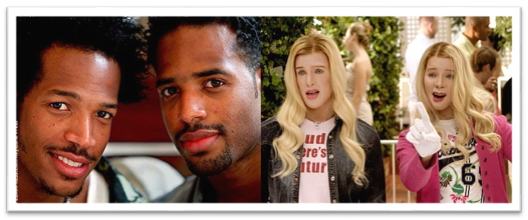
If you have yet to watch this movie in its entirety, I will give a brief rundown. This 2004 film revolves around two adult black men physically dressing up and impersonating two young blonde, white women in a silly effort to stop them from being kidnapped. Throughout the movie the two impersonators are very clearly not white women and, in fact, more resemble Michael Jackson in my opinion. Despite the painfully obvious fact that the two men are not the Wilson sisters, bystanders seem to be completely blindsided when they are revealed to be imposters, which I assume was supposed to add to the comedic value. I was shocked to find out that this movie received a rating of 4.7/5 stars on Google ratings, with very few statements popping up in the search regarding the offensively weird nature of this “comedy.”

Main characters before and after their “transformation” https://inewsnetwork.net/7881/arts-entertainment/white-chicks-is-it-offensive/

The weirdest thing about this film is that its crude and offensive nature is not just a single scene or joke, but the entire point and plotline that is fully defended by the creators to this day, even in this time where cancel culture is so incredibly prevalent. In an interview with Entertainment (https://ew.com/movies/marlon-wayans-defends-white-chicks-slams-cancel-culture/) the writer and director of the film, Marlon Wayans, pushes against the “cancel culture” and makes a statement claiming that the people that should be offended are the ones laughing the loudest (the “white chicks.”) However, I feel the movie is not only crudely offensive on the race level, but also in terms of gender. The men essentially pretend to be trans, and I feel like they very poorly represent having “male features” as a woman and just poke fun at the fact that they have features like big hands and feet or a larger butt since that is a sort of physical stereotype for African Americans.

The New York Times recently posted an article on the movie, which included some historical background on the practice of “whiteface” and defended why it is not on the same level as blackface. “While blackface has minstrel roots, whiteface arises from a different impulse. Often employed in comedies, the practice enables Black people to pass as white, putting them in proximity to the believed benefits and privileges the skin tone provides… the practice not only gives the infiltrator a financial and social advantage, it allows the racial passer to upset the perceived stability of racial identity.” The New York Times defended the film claiming it did have educational value, specifically in scenes showing the privilege the two men gain when in costume as the wealthy white girls. Another scene that I also agree shows something educational is when the two guys are dressed up in the car with their newfound white girl friends. When an explicit song comes on, the guys accidentally slip up and sing along using a racial slur. The girls all turn in shock to which he replies “So? Nobody’s around.” After coming to the agreement that no one is there to stop them, all the girls begin to shout the slur with no remorse, showing the fact that they only care to be inclusive and non-offensive when it is in public and helps their image.

(https://www.nytimes.com/2024/06/25/movies/white-chicks-anniversary.html)

Another portion of the film that is seen by some as educational and eye opening is Spencer, a straight black man, unknowingly pursuing “Tiffany” who is actually a black man in costume. Even the New York Times article on “White Chicks” states that Spencer’s blind pursuit of the imposter Tiffany “destabilizes his own assumptions about what defines manhood and whiteness.” While this movie seems to be purely hypothetical and comical, in a literal sense this romance raises a few questions in terms of sexuality. Can he really consider himself straight after pursuing a man the entire time? Would this be comparable to pursuing a transgender woman or is this a different story since the “transition” is purely dress up and not a pursuit of self-searching?

Overall, it is very much up in the air whether this movie leans on the funny educational side or if it’s just downright offensive and weird. Either way, it has come to be considered a cult classic by many and continues to be defended by the creators and many fans alike. With all that said, regardless of personal opinions, I do not see this movie being publicly cancelled anytime soon as I believe it would have already occurred.

Violence and Homoeroticism- NBC’s Hannibal

Thomas Harrison’s franchise has had many life-action adaptations from novel to screen over the years, one of its most ambitious was NBC’s Hannibal. Until then, most adaptations had focused on Hannibal the character, and/or Clarice Starling due to the cult classic Silence of the Lambs. NBC didn’t have rights to Silence of the Lambs and, therefore, no access to Clarice as a character. Showrunner Brian Fulmer adapted by giving many roles that Clarice fulfilled to Will Graham. 

The main focus of NBC’s Hannibal is our two main characters’ relationship. Will Graham, an FBI agent who can empathize with killers to catch them, and Hannibal, a serial killer and cannibal with a manipulative streak. Throughout the show, other characters constantly refer to their increasing closeness and the effect Hannibal has on Will. This influence is framed as Hannibal teaching Will about a new side of himself and guiding him towards it, this new side being violent. This could be seen through a queer lens: Hannibal and violence are so intrinsically tied that as Will becomes more attracted to his darker, more violent side, he is also more attracted to Hannibal as a person and as a killer. Many events happen that further exemplify this, but I wanted to focus on the final episode, the culmination of the show and of Will’s “becoming”, “The Wrath of the Lamb.”

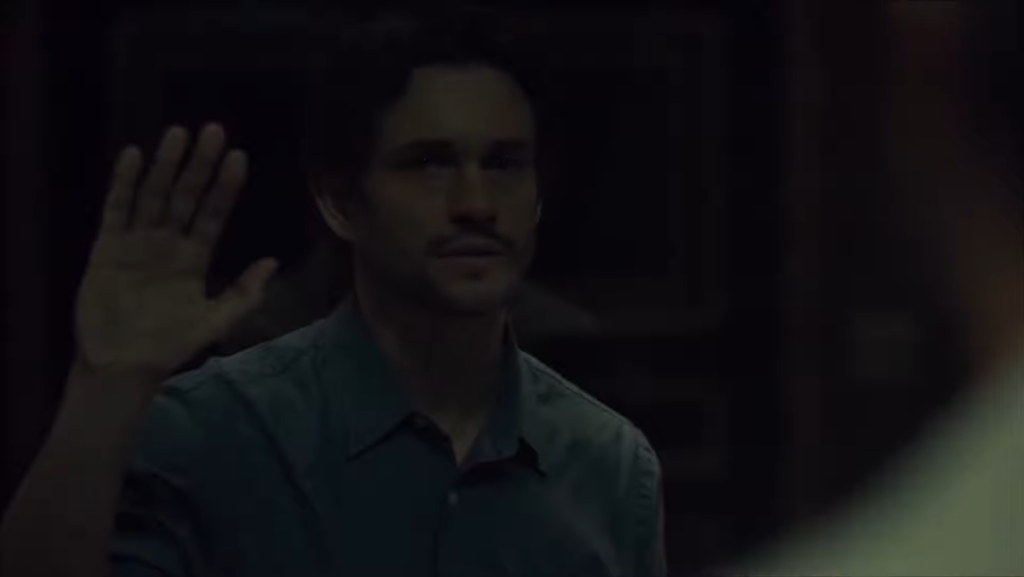
In this scene, near the start of the episode, Hannibal alludes to Will taking part in the murder of another character. His tone is prideful, but not towards Will, but towards himself. He sees Will’s violent and manipulative actions as a result of him- as evidence of how he has marked Will. Will refuses to comment as if he is aware of this. Hannibal then turns the conversation towards Will’s newfound family. Will married and even gained a stepson after Hannibal’s arrest and their separation mid-season. Throughout the series Will was characterized by his “otherness”, not just when it came to his relationship with Hannibal but also his general demeanor. He has described himself on a spectrum “closer to Asperger’s and autistics and narcissists and sociopaths.” The show doesn’t delve too much into this, but it serves the point that Will isn’t “normal” and he is vividly aware of it. This new life he has, away from Hannibal and away from his FBI work, is the best life a heteronormative audience would expect: a life with a wife and kid- away from the man who is implied to have feelings for him. It is almost framed as Will’s marriage fixing him and the effect Hannibal had on him.

Hannibal then says, “When life becomes maddingly polite, think of me, Will.” Here Hannibal refers to himself as another option for Will’s life. Rather than a supposedly peaceful life, he could come back to Hannibal and all the violence and acceptance that comes with him. Rather than being with his wife, he could be with him. Will responds by placing his hand on the glass that separates them, an act that shows that he reciprocates Hannibal’s intent to a certain extent, that he too yearns to be close again. Kind of. 

This scene sets up the big decision Will has to make in this episode, and the whole series, to be with Hannibal or not. Removing all the murder, this can be seen as a portrayal of compulsive heterosexuality in the way Will tries to reach normativity by marrying a woman and fitting society’s expectations of what a man should be. While the show frames Will as trying to run away from the violent impulses Hannibal brings forth it can also be said that he is trying to flee the feelings he feels for Hannibal in the way he touches the glass- wanting to get close while still keeping distance.

Start at 1:29 if embedding goes wrong

At the very end, we have Will helping Hannibal escape from prison and them fleeing to a house where they are ambushed by a killer called the Red Dragon. After killing the Red Dragon, Will and Hannibal embrace while covered in blood. This scene is the most vulnerable we have seen either of these characters and it is violent. The way they hold each other and even the way they look at each other through the fight- it is all raw emotion. It is reminiscent of the season 2 finale, only that instead of Hannibal grabbing Will, Will is grabbing Hannibal and even resting his cheek on his chest. Both still involve them holding each other while making their feelings known, but these are differing feelings. The season two finale was all about Hannibal’s betrayal over Will double-crossing him in trying to turn him over to the FBI. The show’s finale is all about Will coming to terms with himself. With the bloodlust he feels, with Hannibal’s love, and his reciprocation.

It wouldn’t be right to say that one’s pension for violence is the same as one’s sexuality in any sort of way, but when it comes to defying society, thematically there may be some give, especially when it comes to Will. To Will, Hannibal is violence itself and he is attracted to both. This may seem problematic to some but sometimes that’s what you need. Sometimes you need to see someone struggle with themselves as much as you do. It is not a new argument to say that queer audiences are attracted to horror. In an article by Medium, Gil Hatcher writes about NBC’s Hannibal, “…It’s the unconditional understanding that you are not a monster despite what the world may say that can bond so many queer people and it’s why many of us see Hannibal and Will’s relationship as a queer love story.” When in the eyes of society you are seen as a monster, you feel an attachment to other “monsters” in media. Brian Fuller, Hannibal’s showrunner, is a gay man and has been open about the queer themes within Hannibal. Obviously, he doesn’t speak for all queer people. People can see Hannibal and Will’s relationship and be offended at the tie between violence and homoeroticism within it, and they’d be right. It isn’t “good” representation, but it is many people’s reality. Many like Will feel “othered” so they need an out, for Will that’s Hannibal, for others it’s seeing that conflict between them on screen. Both are right, neither are wrong, that’s the beauty of media and representation, all sides can and are seen.

(watch Hannibal it’s a real good show it’s like an 18-hour art film)

A critique of queer gender identity and expression in The Magnus Archives

Definition of terms (Commonly used terms for mainstream queer identities are not defined and assumed understood by the reader):

  • Queer – Umbrella term for all non-normative expressions of gender and sexuality.
  • Mspec – Shorthand for multisexuality, an umbrella term for any attraction to more than one gender.
  • WLW – term for any romantic or sexual relationship between two women, regardless of sexuality. Vice versa for MLM.
  • Cissexism – The assumption of cisgender sex and gender as the societal norm.
  • Butch – Masculine presenting lesbian

A critique of queer gender identity and expression in The Magnus Archives:

The Magnus Archives is a horror anthology podcast, where each episode presents a statement of a supernatural encounter given to an organization called The Magnus Institute. The people giving the statement are referred to generally as statement givers. The central themes of the podcast revolve around power and complicity in institutionalized violence. This theme manifests in the majority of the cast, including the protagonist, becoming inhuman to some degree as they unintentionally or not work towards the goals of the eldritch gods of primal human fears. This context is relevant to my critique of the show, as the inhumanity of queer characters is not necessarily poor representation where it would be in other media, and likewise this aspect does not absolve the show of critique for its portrayal of queer characters. 

The Magnus Archives is overall a show with a highly diverse cast, and has significantly more queer representation than its contemporaries. The main character, Jonathan Sims, is clearly stated in-text to be asexual and biromantic. Over the course of the show, a relationship develops between Jon and his coworker Martin, who is gay in-text. I put emphasis on the textual mention of these identities, because many modern media tend to leave queer relationships and gender expression sub-textual, which allows the fandom to dispute the canonicity of these identities. This can be seen in basically any trans woman in any media ever, and many modern depictions of lesbian pairings. This occurs even when the subtext is not subtle, and/or has been confirmed by the creators outside of the text. See for example, Celeste (Trans woman protagonist), or Gundam: Witch from mercury (Lesbian protagonist married to another woman).
In addition to the protagonist’s homoromantic relationship, the main cast consists of Tim, a bi man, Georgie, who is m-spec, Melanie, a lesbian woman in a relationship with Georgie, as well as Daisy and Bassira, who have no textual stated sexuality but are substantially in a relationship. There are no straight members of the main cast, and a wide variety of sexual expression. While this level of queer diversity is not uncommon in the audiodrama scene, it is exceptional when compared to modern non-audiodrama media, and likely still has above average representation among the very queer medium of audiodrama. 

One may have noticed that every character mentioned as a member of the main cast is cisgender. While I give credit where credit is due, The Magnus Archives is not a perfect example of queer representation, and the majority of its issues center around the depiction of gender expression. I want to preface that the problems with The Magnus Archive’s representation of non-normative gender expression are a result of a cissexist society, and do not stem from any intentional bigotry on the part of the show’s creators. This does not make the issues any less relevant, but I don’t want it to seem like I am “canceling” Alex Newl and Jonathan Sims (Yes the protagonist and the show’s writer have the same name. Johnny is notoriously very bad at names).  

As previously mentioned, the majority of the cast is or becomes inhuman, however, the representation of WLW or MLM relationships and queer sexuality is both prevalent among the protagonists and prevalent in characters that retain their humanity, like Georgie and Melanie, as well as many statement givers. Contrast this with representation of trans and gender non-conforming expression. All of the main cast is cis, and the only gender non-conforming character on the main cast is Daisy, who I will get into later. Of the trans and gender non-conforming representation, all that is present with The Magnus Archives are four major villains, two who are sub-textually trans, and two statement givers.
I will start by addressing the transgender characters, textual and sub-textual. Nikola Orsinov is the main villain of season 3. She is an inhuman clown-mannequin entity who attempts to bring upon an apocalyptic event called “The Unknowing”. Nikola went by the name Grimaldi, with he/him pronouns, before she “killed” him and assumed the identity of Nikola.

ORSINOV 

Well, my father called me Nikola, and then I killed him, so I thought I rather deserved to have his second name too. Which makes me Nikola Orsinov. Pleased to meet you at last. (From: MAG097)

This is, likely unintentional, transgender subtext, and a reading of the text with trans coding for Nikola Orsinov is a very common interpretation within the fandom.

Next is Helen Richardson, or “The Distortion”. The Distortion is introduced in the show’s twenty sixth episode as an entity named Michael. It is a recurring antagonist that torments its victims by trapping them in non-euclidean architecture, and making them question their sanity. Michael is explicitly gender non-conforming, and asks to be referred to without gender identity.

MICHAEL
I am not a “who,” Archivist, I am a “what.” A “who” requires a degree of identity I can’t ever retain. 

In episode 101, Michael permanently transforms into the woman Helen Richardson, and exclusively uses she/her pronouns (in contrast to Michael’s use of both he/him and it/its). Helen is later killed by Jonathan Sims. Again this is a character who can very easily be read as a transgender woman, especially given The Distortion’s insistence on specific names and pronouns relative to their gender expression.

Among gender non-conformance, Not!Them is an agender entity and another significant villain, and Jude Perry and Alice “Daisy” Tonner are both masculine presenting cis women. Jude Perry is also textually lesbian and Daisy is sub-textually WLW. Jude is a minor antagonist and Daisy is a main cast member who assists but is explicitly antagonistic towards the protagonists (As well as a cop). 

There are two trans women statement givers out of the four hundred total statements, and both have their fates and suffering as a result of the transphobia, internal or external, that they experience. 

“This is Maeve’s nightmare. There is no other word for it. To be trapped unmoving within the body that has betrayed her so often. Feeling every sensation as it grows, and warps, and sprouts. Never knowing what new mutation it will visit on her next. She is unable to even hide. There is no promise of the peaceful sleep of the innocent dead, nor the dream of digital escape from the hell her body has come. She is here, and she is trapped within the same soft prison of skin she has always despised.” (From: MAG 170)

“I’d held some ambitions about directing myself one day, but it soon became obvious that that wasn’t going to happen. Maybe if I’d got a feature under my belt before I was outed as trans, it might have been different, but as it was, that revelation burned too many bridges. And when the dust had settled, it was made abundantly clear to me that I was never going to get a movie of my own, and it was either cinematography, or nothing.” (From: MAG 110)

While it is not unusual for the statement givers to suffer, it is a horror podcast,  Statement givers with queer sexualities are present in many statements without it being related to their misfortune.

Now that all the evidence is presented, my primary critique is the lack of non-antagonistic trans or gender non-conforming characters. I think the gender nonconformity of the show’s antagonists, or the queer-suffering of the trans statement givers, is fine in isolation. It’s only when compared with the multitude of human and not-evil cisgender characters with normative gender expression that these aspects become problematic. All the agender or non-binary characters being inhuman entities plays into existing tropes of alien or otherwise non-human non-binary representation in media. The two sub-textually transgender characters both evil and related to the two fear entities (“The Stranger” and “The Spiral”) centered around hiding one’s identity, deception, and tricking one’s perceptions, certainly play into the trope of the deceptive or predatory trans woman. The two trans women statement givers have their transness defined by their suffering, a common trope in media where queer representation tends to be centered around homophobia or transphobia, and there is no other textual reference to transgender people. Daisy and jude are both masculine women, a textual butch lesbian and sub-textual lesbian respectively, and they both are antagonistic. Jude is a leader in a cult centered around causing pain to others, and Daisy is associated with the fear god of “The Hunt”, the predator to one’s primal fear of being prey. This plays into tropes against masculine and butch women being depicted as aggressive in media, which is certainly the case here, and the characters also play into tropes of the predatory lesbian. While a harmful or toxic WLW relationship is fine to depict, again The Magnus Archive’s issue is having the masculine lesbians make up the aggressive and toxic partner in every toxic WLW pairing represented in the show.

These problems are significant but easy to solve. It’s likely that if the creators of The Magnus Archives had been more cognizant of their cissexist normative worldview, and of harmful tropes in trans and gender non-conforming character representation, these issues could have been avoided. Jonathan Sims has addressed the criticism towards Daisy’s character in the Q&A bonus episodes, and has stated that he would have written her differently if he had the chance to redo the show.  Everybody is influenced by the culture that they exist within. Cissexist and transphobic ideology permeates societal institutions and cultural thought. Trans people often need to deal with internalization of these norms, and it takes active effort to avoid writing your story through the lens of dominant cultural ideals.

It is clear that the creators of The Magnus Archives have taken an effort to address the issues with representation of queer gender identity and expression in the sequel series, The Magnus Protocol, which features a textually transgender character as the deuteragonist, and has already featured several trans and gender non-conforming statement givers in it’s currently thirty published episodes. Overall The Magnus Archives, despite its flaws, has some of the best queer representation in today’s media. It’s important to celebrate the strides that western anglophone cultures have made in the representation of queer characters, while acknowledging the work that still needs to be done to fully represent the diversity of human expression of gender and sexuality.

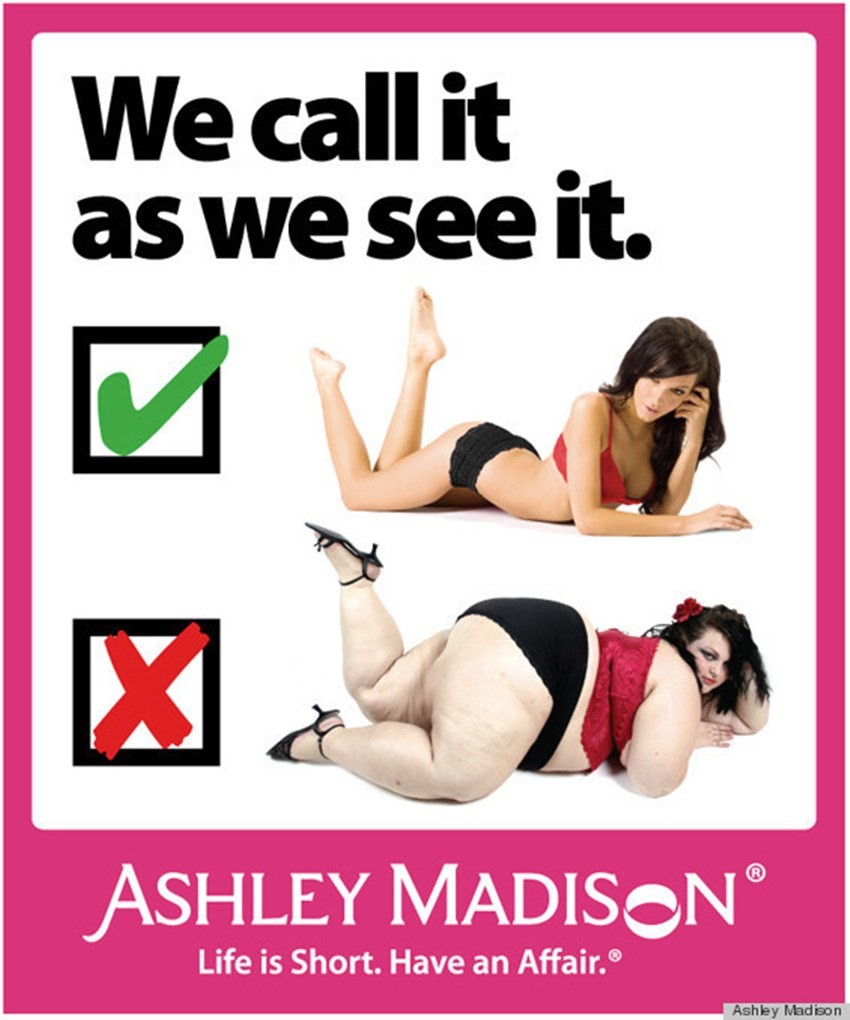
The disturbing truth about Ashley Madison & It’s advertising

While researching for this project, I came across a particularly disturbing piece of media that I would like to share in hopes that you find it just as ridiculous as I did. The advertisement above is from a highly controversial “Ashley Madison” online website. This website promotes marital affairs by providing users with a means to interact with others online in a way the site claims to be private. The platform has put up many advertisements across multiple media sources such as YouTube, ads on public TV, and full-blown business ads since the site’s creation. These advertisements often are very objectifying towards women and likely invoke shame in both men and women and heterosexual couples, as well as individuals in non-straight couples. In this blog post, I will analyze how this website and these advertisements are harmful to the full spectrum of genders, sexual orientations, and races.

Ashley Madison was launched in 2002. And was marketed towards individuals who were married. The media above is one of the most widely used advertisements that Ashley Madison uses. The slogan above reads, “Life is short. Have an affair.” Additionally, the image of the woman to the right is wearing a wedding band while holding her finger to her lips, which suggests that the site is secretive and users won’t be caught by their spouses. The woman to the right is also thin, with unnaturally red lips, which promotes unnatural and unattainable beauty standards.

Unsurprisingly, the site has seen its fair share of controversy. The most notable of these controversies happened in 2015 when hackers breached the website’s security and published the users’ names, messages, and credit card information. The data breach also revealed that the site exaggerated the number of users by using fake bots to replace real women. 

Now that I have briefly discussed the history and some issues with this platform, I want to return to the piece of media I showed at the top of this blog. In this advertisement, two women are pictured. The woman on the top is skinny with a green checked box to the left of her, while the woman on the bottom is much larger with a red X in the box next to her. The two women are wearing almost the same outfit, and aside from their difference in weight, they have similar features. 

I’m honestly shocked at how effectively this advertisement oppresses almost every single group of people. Starting with the most obvious, the advertisement is clearly trying to express that obese women are less attractive than unrealistically thin women. This message is extremely harmful to people considered to be obese, and since the advertisement was made public, it is a certainty that obese individuals saw this ad. Additionally, both of the women in the advertisement are white. In addition to this, the name “Ashey Madison” is a caucasian name, which, again, promotes unrealistic beauty standards by suggesting that caucasian women are the epitome of beauty. Another way in which this media is harmful is towards non-heterosexual people. While the advertisement doesn’t explicitly state that the women included in it are straight, the website seems to primarily advertise itself towards straight couples in search of affairs, with little to no mention or inclusion of non-straight couples. 

Perhaps the most egregious part of this advertisement is how it portrays women. The ad suggests to men that if their wives are fat, they should have an affair with a different woman. This narrative objectifies women while portraying men as agents who are free and able to have intercourse with any woman they please. The objectifying nature of Ashley Madison’s advertisements does not stop here either. In this video advertisement, a woman is being recorded running. There is a scene in the advertisement in which the camera zooms into the woman’s breasts as she is running. It is unbelievable and saddening how frequently this site portrays women for nothing more than their physical appearance.

Since the creation of Ashley Madison, the site has received much attention and backlash. The company took a big hit after the 2015 data breach, leading to the company’s CEO stepping down and a significant rebranding of the website, with a big emphasis on changing the slogan for the company. However, this rebranding was short-lived, and in 2017, the site unretired the slogan “Life is short. Have an affair.” Unfortunately, the website continues to produce harmful advertisements, and the user base is only getting larger, hitting 60 million worldwide users as of 2019. Ashley Madison is a harsh example of how hurtful media can be in the present day, and it is important for all of us to realize and push back against harmful media for a better future. 

 Steele, Anne (July 12, 2016). “Ashley Madison Parent Rebrands Itself as Ruby Corp.” The Wall Street Journal.

Benitez, Juan. “Hackers Expose First Ashley Madison Users.” CBS News, August 19, 2015, www.cbsnews.com/news/hackers-expose-first-ashley-madison-users/. Accessed September 27, 2024.

Ashley Madison. www.ashleymadison.com/en-us/. Accessed September 27, 2024.

Sims, Bryan. “Ashley Madison Review.” East Bay Express, September 22, 2015, www.eastbayexpress.com/ashley-madison-review/. Accessed September 27, 2024.

“Ashley Madison – What We Know So Far.” YouTube, uploaded by hMYDDn44p7g, www.youtube.com/watch?v=hMYDDn44p7g. Accessed September 27, 2024.

Casciato, Paul. “The Five Worst Examples of Body Shaming Ads.” Dazed Digital, April 24, 2016, www.dazeddigital.com/artsandculture/article/31606/1/the-five-worst-examples-of-body-shaming-ads. Accessed September 27, 2024.

One Episode, Many Assumptions.

The Office has been one of my favorite shows since seventh grade with its quirky and comical characters, interesting office side quests, and most importantly the Jam (Jim and Pam) romance. Though, it is no secret that this show contains a myriad of jokes and behaviors that are considered very inappropriate in today’s day and age. From watching it as a seventh grader compared to watching it within the recent years, I have gained a greater understanding of just what these jokes mean in relation to our society’s attitudes towards the LGBTQ community, sexuality, and gender.

Airing in 2006, The Office centers around Dunder Mifflin Paper Company, based in Scranton, Pennsylvania, and follows the lives, romances, and drama of the office’s members. Running the office is manager Michael Scott who is typically seen as the antagonist in instigating office drama with the support of his second in command, Dwight Schrute. The show is a comedy-based mockery of what an everyday office setting might resemble.

This picture represents the members of the office in The Office.

An episode in the series that exemplifies these inappropriate behaviors is Season Three, Episode One: “Gay Witch Hunt”. At the end of the episode prior to this, Michael Scott calls his accountant Oscar Nunez “faggy” in response to Oscar claiming he liked Shakespeare in Love more than Die Hard. When Toby Flenderson, the office’s human resources representative, questions Michael as to why he chose to use that word instead of calling Oscar lame, Michael replies by saying, “That’s what ‘faggy’ means!” There is a parallel between this statement and the information that is presented in Meg-John Barker’s Queer: A Graphic History, where she explains that in the 16th century English-speaking countries used “queer” to refer to “something strange or illegitimate” (Barker, 2016). The difference between using the F-slur or “queer” as an insult today versus hundreds of years ago is simply that humans know better. Society has been called out by the gay community for using these terms and it is time that we respect this simple request and stop promoting them in TV shows as a means of humor.

Even though Michael likely meant no harm in calling Oscar by this term, what he didn’t realize was that Oscar was in fact a gay man. Despite Michaels ignorance, there is no instance in which it would be ok to call anyone this word in a TV show, and especially not in reality. In an attempt to make Oscar feel less targeted, Michael goes on to defend himself by claiming that he had been calling people “faggy” since the second grade and then offers to take Oscar out for a beer to discuss how one “does that” to another guy. To Michael this may be a seemingly nice gesture but to one receiving this kind of offer it would seem violating and strange. No one, if not very few people, want to discuss their sexual lives and practices with someone. Definitely not with someone who just insulted your sexual orientation.

It isn’t just the previous instance in which an assumption about the gay community is made in this episode. When Michael inquires Dwight Schrute, his assistant manager, about whether Oscar appears to look gay, Dwight responds with, “Absolutely not…Well, he’s not dressed in women’s clothes, so…” The assumption behind this comment is extremely wrong and old-fashioned. Gay men do not need to dress like women to express their sexuality, and the same concept applies to gay women. It isn’t one’s choice of clothes, hairstyles, makeup, etc. that define their sexuality or sexual orientation. Though, it is something that is still widely assumed in today’s society when in reality people should be able to dress however they like without the worry of being misgendered or sexualized.

In another attempt to make amends to Oscar for outing him to the entire office, Michael calls a mandatory meeting. Michael seats Oscar in the center of the table with everyone surrounding him and says to Oscar, “Take this opportunity to officially come out to everybody here. However you want to do it. Go ahead. Stand up. I’m doing this for you.” Rewatching this I found it extremely annoying how Michael not only makes Oscar stand up to be re-outed in front of his co-workers, but the fact that he also claims how he was doing it “for him”. Coming out is something that should not be forced upon a person, especially not in an environment where they do not feel comfortable doing so or they are subject to judgement from peers. Though I personally do not have the ability to speak on what it means to come out, from what I can interpret it is something that is extremely special and freeing for a person who has been hiding their true identity.

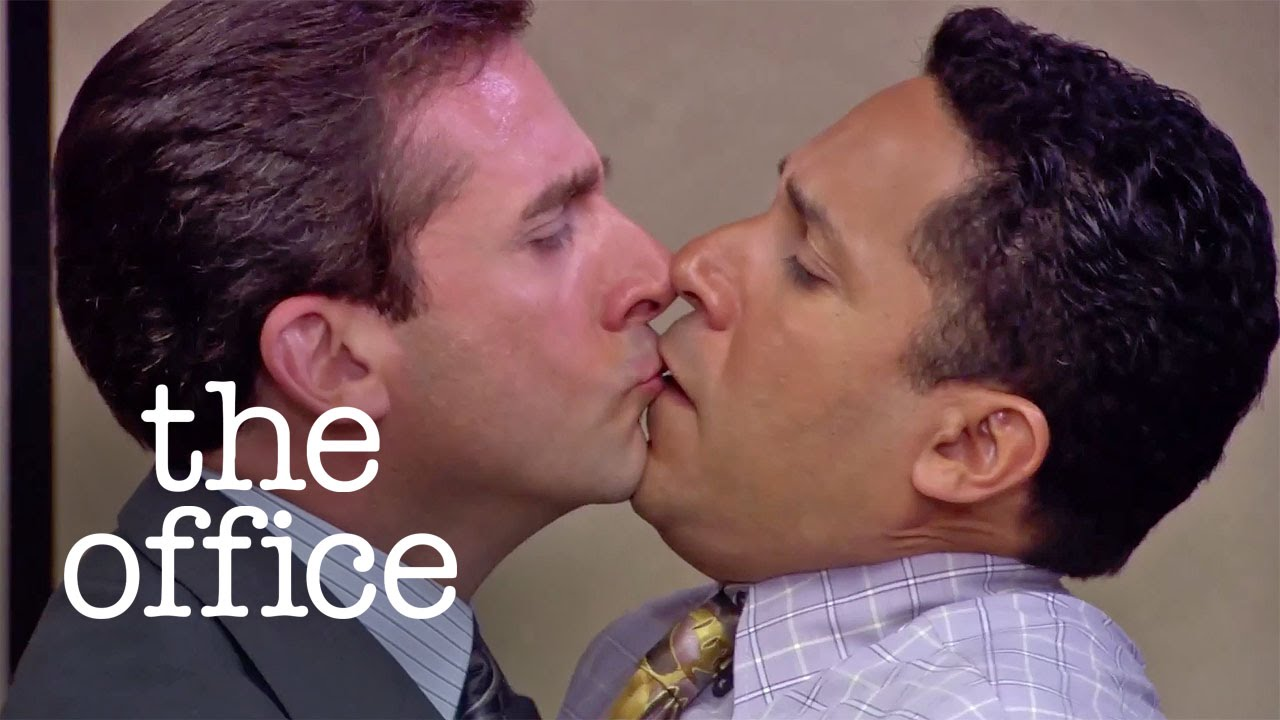
To top it all off, as the finale to Michael’s attempt in making Oscar feel welcomed as a gay office member, he forcibly kisses him as a way of expressing how he accepts Oscar’s “gayness”. If one didn’t think all of Michael’s previous actions were bad, they most certainly would now. Michael didn’t just violate Oscar’s personal space, he also kissed Oscar without receiving consent. It shouldn’t take having to forcibly kiss a person to show them you accept their sexuality or gender, rather, one could simply treat the person as they would to any.

Image of Michael forcibly kissing Oscar. (Video link: https://youtu.be/UOGenYI3cs4)

After dissecting this singular episode, it has become exceedingly obvious that several of the characters in The Office are tremendously ignorant and have incorrect assumptions or attitudes towards the LGBTQ community, gender, and sexuality. This TV show is just one example of how producers in the early 21st century created humor by writing scripted jokes that aimed to mock the gay community or minorities. In 2024 there are certainly less instances in which TV shows exhibit this kind of behavior, but “a few” is not good enough when it can and should stop all together.

“Same Love” by Macklemore: Making Big Moves in the Music Industry

In the famous song “Same Love,” Macklemore and Ryan Lewis use powerful language and symbolism to encourage support towards same-sex marriage. This song was especially adopted in response to the February 2012 bill that would legalize same-sex marriage in Washington. Along with a catchy melody, this song empowers people to stand up for what they believe in and not be afraid to voice their opinions. The fact that this media is a song adds to the impact of the lyrics, because music is a type of media that almost all groups of people can relate to. When singing these lyrics, the singer becomes an activist for the fight for social change that is expressed in the lyrics. 

According to the New York Times, “Same Love” was “the first song to explicitly embrace and promote gay marriage that has made it into the Top 40.″ A song like this with such a powerful message behind it changed the world’s views of the advocacy for same-sex marriages, and it created a space for people to stand up for what they believe in regarding this topic. One powerful lyric sequence from the song says, “No law’s gonna change us, we have to change us; Whatever God you believe in, we come from the same one; Strip away the fear, underneath it’s all the same love; About time we get raised up!” This section of the song encourages society to openly advocate for the right to embrace their own sexuality. The line “Whatever God you believe in,” is a powerful writing technique that draws in the religious listeners and says that no matter what religious upbringing you believe in, we were all made the same. 

This song also highlights the stereotypes that society has put in place about people being gay, and what being gay “should look like.” One lyric that exemplifies this is when Macklemore says, “A bunch of stereotypes all in my head, I remember doing the math like, ‘Yeah, I’m good at little league,’ a preconceived idea of what it all meant.” This passage from the song is a perfect example of social constructs of sexuality, and the biased stereotypes of gay people. The line, “Yeah, I’m good at little league,” represents the preconceived notion that men who are good at sports are straight, and men who are not into sports are gay. This idea is completely false, and it completely disregards the idea that sexuality is a spectrum to which every person’s experiences with it are different. This song fights for the idea that you are free to be your authentic self, and there are no rules for what that might look like. 

Additionally, one of the reasons why this song sent such a strong message to society at the time is because it strongly opposes the offensive and hurtful comments that are casually made by society about gay people every day. For example, one line explains, “If I was gay, I would think hip-hop hates me. Have you read the YouTube comments lately? ‘Man, that’s gay’ gets dropped on the daily.” This passage from the song does a great job holding people accountable for uninformed comments that are made by people both in the media and in everyday life. Using the phrase “Man, that’s gay” as a negative thing is extremely homophobic and hurtful to gay and queer people all over the world. Another factor that makes this message so powerful is that Macklemore has a wife and is not gay. This represents the idea that straight people can stand up for gay-rights, and it should not be something that is stigmatized by society. 

Although this song mainly focuses on the advocacy of same-sex relationships, it also touches on a few other issues presented in society. Macklemore argues that, “It’s the same hate that’s caused wars from religion, gender to skin color, the complexion of your pigment.” This presents the argument that if you are against racism and hate towards different religions, your views on sexuality should be no different. Everyone has the right to be who they are, and Macklemore explains that sexuality is just another part of what makes us who we are. 

Lastly, the chorus of the song, “I can’t change, even if I tried,” sends the message that being gay is not a choice that someone decides to make during their life. Like gender, sexuality is a wide spectrum, and there are no rules for what that looks like for each person. You are born with attraction towards certain traits, and that is something that is deeply rooted in us. That is simply the way that people are made, and hating on others for what they love should never be justified. As a whole, this song does a beautiful job expressing some of the thoughts and feelings that we as a society should be open to voicing in support of same-sex marriages. 

“No Product Day” Challenge Review

Riley Christopher

Last Tuesday I decided to attempt the “No Product Challenge”. Last Tuesday I drove home to Georgia for Thanksgiving break at around 5 am. I had to drop my roommate off at the airport and decided on the car ride home that this would be the perfect day to attempt the challenge. My roommate and I woke up a little later that we planned (as usual), and we rushed to get out the door. I did not have any time to wash my face or apply makeup, and I even forgot to put deodorant on before we left. Once we arrived at the airport and I dropped my roommate off, I decided since I had around a 5 hour car ride home I would attempt the “no product day” challenge.

I started off pretty strong and had only minor issues during the beginning of the day. While stopping at gas stations I felt very self conscious walking in without any makeup on. I do not normally wear a full face of makeup but I do wear some to cover up my basic insecurities. I have always been self conscious of my forehead because I believe it is rather big, so normally I fill in my very light blondish eyebrows with an eyebrow pencil to make my forehead appear smaller. While in the gas stations I felt very self conscious, so I just tried to remind myself that no one cared what I looked like (especially at 7 am) and that I looked beautiful regardless of what my forehead looks like. It is such a minor change, but it is something that I am used to covering up every day.

By the time I arrived home, I was exhausted and fell asleep for a couple hours before my boyfriend came over to my house with breakfast. In the beginning of our relationship I always wore a decent amount of makeup and always had my eyebrows filled in, but after dating for over a year I realized he truly does not care how I dress or look in front of him. What shocked me the most was that when he gave me a hug he commented on how good I smelled. At that point I had forgotten that I had not put on deodorant that morning, and it made me feel good knowing that I did not smell like bad body odor. I told him that I was participating in the “no product day” challenge and he immediately smiled. It made me feel really confident knowing that other people still thought I was pretty (and not stinky) when I did not use any products.

I only hung out with the rest of my family that night so I was completely comfortable not wearing any makeup. The only thing I noticed is that when I went to respond to my friends on snapchat, I was a bit nervous about sending just a bare picture of myself. In the spirit of the “no product day” challenge, I sent them anyways. This challenge has made me realize that I do not need makeup to be presentable and beautiful in the eyes of others and myself.

Trans Medicine: The Emergence and Practice of Treating Gender by stef shuster

Throughout the last century the treatment of trans individuals in modern society has evolved and become more publicizedWC. With this increasing exposure, the discourse surrounding the treatment of trans individuals and their rights also increases. One important area of discourse is trans medicine. In their monograph Trans Medicine: The Emergence and Practice of Treating Gender, stef shuster discusses the history of trans medicine from the mid-20th century to the early 21st century. Shuster utilizes a multi-sited research design to incorporate archival records of physicians interactions and perspectives with a combination of modern day interviews to demonstrate the gaps in trans medicine that have existed throughout time. As modern medicine develops and new technology is created, the opportunity and range of treatment for a trans individual increases. However, treatment of trans patients still needs to be altered. The monograph covers topics from physician gatekeeping, to the balance of treatment between psychologist and physicians, and uncertainty regarding treatment. 

This monograph focuses on trans-medicine from the perspectiveWC of a physician. It examines the variety of medical practices used throughout the 20th and early 21st century and it demonstrates the thought process exhibited by many physicians when dealing with trans patients. In an interview with Indian Public Radio, shuster declared that his monograph attempts to answer the following questions regarding trans medicine: “How do healthcare providers manage their uncertainty? How does their vast uncertainty challenge their sense of themselves as experts? What does trans medicine teach us about medicine in general?” I argue shuster succeeds in providing answers to these questions and accurately provides insight into the mind of a variety of physicians and their relationships with trans medicine. The monograph highlights the unique power dynamic between a trans patient and their physicianSAY MORE. ADD TRANSITIONS AND SIGNPOSTS THROUGHOUT, The common gender conforming interventions such as hormone interventions or surgical interventions are highly regulated and require approval from a physician or psychiatrist. Physicians are often crucial in the transitioning process so the relationship they have with their trans patients is extremely important.  Shuster additionally highlights gaps within trans medicine and the treatment of patients that must be addressed. Shuster argues that medicine has become so uniform in the attempt to improve the quality and prevent mistakes that it no longer teaches how to approach each situation from an individualistic perspective. A clear framework for trans medicine does not exist CLARIFY SEEMING CONTRADICTION so many physicians do not feel prepared or qualified to treat trans patients.

The author of Trans Medicine: The Emergence and Practice of Treating Gender is stef shuster. Stef is a professor of psychology at Michigan State University. They earned their bachelor’s degree in Sociology from Indiana University, Bloomington and their Ph.D in Sociology from University of Iowa. Their work at Michigan State University focuses on medical providers, social movement actors, and language used to regulate subjugated groups. Shuster discusses their personal history in an interview on Indiana Public Ration (Chambers). Stef states that they identify as a part of the queer communities. In the same interview stef states they began to identify as trans during college and discovered that as they began to consider gender conforming interventions for themselves there were gaps within the healthcare for trans individuals. As their experience in this community grew, they identified a clear lack of education for doctors and healthcare providers on how to treat trans people. They discovered that although many doctors were willing to have trans people as their patients, they felt ill equipped to properly treat them and did not want to be a disservice to them. These discussions inspired shuster to look further into the field of trans medicine. They ended up writing their dissertation on the perspective of healthcare providers in trans medicine, which eventually developed into the monograph discussed in this paper. 

The monograph is split into two sections, part one details the history of trans medicine and part two explores the modern day healthcare provider’s perspective on trans medicine. Shuster used a multi-sited research design ALONGSIDE BOTH HISTORICAL? AND QUALITATIVE METHODOLOGIES (11). Part one utilized historical archives from the Kinsey Institute which is composed of artifacts from the biologist and sexologist Alfred C. Kinsey who worked in the mid 20th century. Within these archives were detailed records from Harry Benjamin, an endocrinologist who was known for treating trans patients. Benjamin corresponded with many health care providers and trans patients throughout the mid 20th century. These letters of correspondence reveal an extremely flawed system surrounding healthcare that places the power directly in the hands of the physicians. During this time period the physicians willing to treat trans patients were extremely limited and those who did had a narrow minded view of the perception of trans people. Trans patients were expected to “feel disgust with their bodies, particularly their genitals, and always to want to dress in the clothing and play with the toys of the ‘opposite’ gender”(Shuster, 32). Patients who did not fit this description or have the financial means or social status deemed sufficient by the doctor were denied. MORE DETAILS–HOW DOES SHUSTER DISCUSS THEIR METHOD, DIGITAL ARCHIVES, SECONDARY MATERIALS OR PRIMARY SOURCES?

In part two of this monograph, shuster jumps in time to the modern status of trans medicine. This part consists of a series of interviews with 23 physicians about their history and experiences working with trans patients. These interviews demonstrate a wide variety of perspectives. In addition to these interviews, shuster attended a variety of medical conferences and observed the discussion of trans medicine. Conferences are designed to discuss emerging and new healthcare ideas and strategies. Finally, shuster examined the diagnostics and clinical guidelines created for trans-medicine. Combined these sources provide perspective on the individual and systemic level. 

Shuster provides an unbiasedWC review of the history of trans medicine. Although they discuss the flaws within many of the common practices by physicians, they do not place blame on the physicians instead accrediting misdeeds to the medical institution and training system as a whole. Additionally, the monograph provides a wide range of physicians perspectives, including those who have become somewhat experts in the field of trans medicine as well physicians who know very little. CLARIFY THIS SENTENCE WITH EXAMPLES–>Shuster also does a remarkable job of parsing out the individual components of trans medicine. They provide ample evidence and direct quotations that demonstrate each aspect that is discussed. 

This monograph provides a comprehensive overview of the history of Trans Medicine from the perspective of a healthcare provider, however it distinctly lacks information regarding the patient’s perspective. Excluding a few letters from patient’s during the mid-20th century, there are no modern day perspectives. It could have been helpful to include information from the patient discussing their experience with healthcare and the treatment they have received. Patient perspective is a crucial component in improving the system and adjusting to treat their needs. Although each patient is different, it can be helpful to know general strategies that are successful.  The two parts of the monograph focus on the mid-20th century and modern times, the early 21st century, how it does not discuss the status of trans medicine in the intervening years. Although many of the issues in part 1 of the monograph are still concerns in the second part, a large chunk of progress and history is absent in that could illustrate the specific event that caused any changes in the practice of trans medicine. Additionally the monograph provides no future directions towards the improvement of trans medicine. 

This monograph could serve as a powerful tool for physicians. Although it focuses on trans medicine the monograph emphasizes larger themes surrounding health care and interactions with patients. It stresses the importance of the doctor patient relationship and the trust that should be formed within this bond to make the best possible decision for the patient. Ultimately, it teaches physicians how to be more mindful. Each student coming out of medical school should be required to read this monograph to improve their understanding of trans medicine and develop an understanding of the history of trans medicine as well as the progress that still needs to be made. 

References:

Chambers, A. (2021, November 8). Sociologist stef shuster. other, Bloomington, Indiana; WFIU Public Radio. 

Stef Shuster. Department of Sociology | Michigan State University. (n.d.). Retrieved November 18, 2022, from https://sociology.msu.edu/people/directory/shuster-stef.html 

Shuster, S. M. (2021). Trans medicine: The emergence and practice of treating gender. New York University Press. 

Intersectional Feminism in bell hooks’ Feminist Theory: From Margin to Center

Although bell hooks’ Feminist Theory: From Margin to Center was found to be “provocative” when it was published in 1984, hooks’ ideas of intersectional feminism fit well in 4th wave feminism. In Feminist Theory, hooks aims to create a blueprint for a mass-based feminist revolution that speaks to all genders, races, and classes. hooks explores the limitations of various aspects of feminist theory and practice, how to improve them, and other experts’ opinions. 

bell hooks, born in Kentucky in 1952, studied English at Stanford University and the University of Wisconsin-Madison. In 1983, following years spent teaching and writing, she received her Doctorate in English from the University of California, Santa Cruz. Before her untimely death in 2021, she published around 40 books ranging from essays and poetry to children’s books, as well as scholarly articles. 

Her writings address ideas of intersectionality of race, gender, and capitalism, and how these concepts produce and perpetuate systems of oppression and domination. Despite her breadth of academic experience and qualification, hooks is known for her skill in writing for a the greater public with accessible language, furthering her goal of a common language for feminism.

In Feminist Theory, hooks approaches topics by analyzing how much progress has been made by 1984, then discusses what must be changed for feminist revolution. She enhances arguments by supporting or refuting other feminist scholars’ voices including Betty Friedan, Toni Morrison, Grace Lee Boggs and James Boggs, Charlotte Bunch, Lucia Valeska, and Paulo Freire.

hooks first criticizes Betty Friedan’s The Feminine Mystique, because it ignored women who did not fit the white, upper-middle class mold. She asserts that Black women are the most victimized group of women in terms of sexual oppression, bearing the brunt of sexist, racist, and classist oppression. Their marginality gives them a unique consciousness and central role in feminist movement.

In the second chapter, hooks expands on feminist revolution. She states how race, class, and sex work together to determine the extent to which an individual will be oppressed. Although this book was written in 1984, the importance of intersectional feminism remains relatively new in dominant feminist thought. According to hooks, the mainstream attempts at defining feminism in 1984 reflected the class nature of the movement, being liberal in origin, because society is more respective to feminist demands that don’t threaten the status quo. 

In chapter three, hooks addresses the significance of feminism as a channel for ideological meetings between people. She states that liberal white feminists never explained why feminism is important, believing that social equality was a universal concern. This resulted in failure to emphasize the necessity for mass-based movement and grassroots organizing, making feminism appear relevant only to women in feminist organizations. In reality, hooks believes that sexist oppression is the domination that most people experience. She argues that children are socialized from birth to accept group oppression and family liberation must be a result of feminist movement.

In chapter four, hooks explains the importance of solidarity among women. Male supremacist ideology encourages women to believe they obtain value only by relating to or bonding over men, which corresponds to the Bechdel Test. hooks analyzes the competitive nature of women, and how this must be unlearned in order to build a sustainable movement. She argues that many white bourgeois feminists exploit the stories of Black women for their issues, but don’t include them in the movement or acknowledge their racism. Women are taught to bond over images of women as victims, which white women liberationists embraced, allowing them to abdicate responsibility for their role in the maintenance and perpetuation of sexism, racism, and classism. They victimized themselves in order to make Black women the perpetrator, another result of a patriarchal society and form of white supremacy. hooks explains that women should work together to expose, examine, and eliminate sexist socialization within ourselves to build a foundation for solidarity. Feminist movement needs to show women how racism and sexism are connected, rather than pit one struggle against the other or blatantly dismiss racism.

The feminist movement has also splintered into special-interest groups because women doubt that other groups see the significance of their individual experiences. However, this erects unnecessary barriers to Sisterhood, because feminists must learn to fight oppressions that may not directly affect us as individuals. When we show our concern for the collective, we strengthen our solidarity.

In chapter five, hooks discusses why men are our comrades in feminism. When women lead the feminist movement, this assigns another “sex-role” to them of making feminist revolution (68). This rhetoric reinforces sexism, implying that women’s liberation is at the expense of men. However, men do not share a common social status, because patriarchy does not negate the existence of class and race privilege. Anti-male sentiments alienated many poor and working-class, especially non-white, women, from feminist movement, because Black women know the hardships all genders face in their communities. 

hooks also explains that working-class men attack and oppress women because they are usually “hurt” and emotionally scared because they do not have the privilege or power society has taught them ‘real men’ should possess” (75). She argues that when men beat or rape women, they may feel satisfied in exercising the only form of domination allowed to them in patriarchal society. Men must assume responsibility for transforming their consciousness.

Chapter six examines perspectives of power. hooks quotes Nancy Hartsock’s words that women must recognize how “power understood as energy, strength, and effective interaction needn’t be the same as power that requires the domination of others” (91). hooks says that feminist ideology should clarify for women the powers they exercise daily and show them how these powers can resist sexist domination and exploitation. For example, “one of the most significant forms of power held by the weak is the ‘refusal to accept the definition of oneself that is put forward by the powerful’” (92).

hooks also discusses the need to rethink the nature of work, once more criticizing Friedan for claiming that the most pressing problem for women was the need to get outside and work, to cease being ‘just’ housewives. This ignores how many working-class women find joy in housewifery outside of difficult, menial labor. Work can be an affirmation of one’s identity rather than a negation, as the powerful want women to view it. 

In chapter eight, hooks introduces how educating women is a feminist agenda. She explains how writing and literacy help develop an individual’s imagination and ability to think. A person’s access, through reading a variety of interpretations of reality, increases that person’s capacity to think for themself, to go against cultural norms, and to conceive of alternatives for society. However, many people don’t have literacy. Therefore, feminist ideas must also be spread by word-of-mouth. She proposes bringing women’s studies courses to local community centers. Ideology and mobilization are both vital parts to feminist movement, and hooks believes that revolutionary politics can only arrive from correct ideology.

In chapter nine, hooks discusses the feminist movement to end violence. She explains how the Western philosophical notion of hierarchical rule and coercive authority is the root cause of violence between those who dominate and those who are dominated, affecting male supremacy. hooks believes that battery is caused by the cultural belief that hierarchical rule and coercive authority are natural.

She introduces the idea of a “cycle of violence” for Black men and women. In the public world, the male worker may be subjected to psychological abuse by a boss or authority figure. Since he depends on the work situation for material survival, he suppresses this violence and releases it in what she calls a ‘control’ situation, at home and on women. hooks argues that the sexist and patriarchal notion of masculinity, exacerbated by capitalism, impacts men so that they feel degraded, alienated, and exploited in the work force. Men must begin to challenge notions of masculinity that equate manhood with the ability to exert power over others.

Furthermore, hooks explains how love and violence have become intertwined in this society, due to television and romance novels. Women are encouraged to accept violence as a sign of masculinity. Feminist efforts to end male violence against women must be expanded into a movement to end all forms of violence as social control.

In the next chapter, hooks asserts that effective parenting must make no distinction between maternal and paternal care. Until males are taught how to parent using the same model of effective parenting as is taught to women, they won’t participate equally in child care. hooks argues that community-based child care should become more prevalent, which could be improved through public day-care centers with all genders sharing responsibility for child care.

In chapter eleven, hooks explains the need to end sexual oppression. She explains how there is stigma regardless of how sexual people choose to be, including compulsive heterosexuality. Sexual freedom can exist only when individuals are no longer oppressed by a socially constructed sexuality based on biologically determined definitions of sexuality: repression, guilt, shame, dominance, conquest, and exploitation. Social relations must change to rid people from any of the violence and alienation of fixed images and norms. A line that still applies today is that “the right to choose must characterize all sexual interactions between individuals” (157).

hooks concludes Feminist Theory by explaining how feminist revolution must develop through gradual struggle. At the end of many small quantitative changes, everything will change gradually so that the whole system is completely different. However, a mass-based feminist movement requires ideology that can be shared with everyone, which can only be created if the experiences of marginalized people who suffer sexist oppression and other forms of group oppression are understood, addressed, and incorporated. Positive types of reforms focus foremost on educating masses about feminist movement on how it would transform their lives for the better. 

She also states that love is an essential part of the revolution, because love means commitment to others and their cause. This love is important particularly to those who are politically unconscious, because we cannot motivate them to join feminist struggle by asserting a political superiority that makes the movement just another oppressive hierarchy. The basis for revolution must be on cultural transformation and eradicating systems of domination. There are numerous examples of liberation struggles led by oppressed peoples globally who resist formidable powers that can serve as guidance.

Overall, this monograph explains complicated ideas clearly and accessibly. hooks wrote this monograph for the everyday human, and explains fundamental ideas in the beginning to ensure understanding. She references other voices effectively; enhancing the monograph with their diverse perspectives. 

hooks’ weakness is that she condemns women for enjoying forms of entertainment that many find enjoyable, such as romance novels and watching television. While I understand the patriarchal and dangerous sides of these consumption areas, she implies that they are ‘shallow’ pastimes. Furthermore, there are sections where she puts the impetus on women to help men overcome their internalized misogyny, when this isn’t women’s responsibility. 

I really enjoyed this monograph. It wasn’t too long, yet covered several different topics pertaining to a feminist revolution. Although it was written almost 40 years ago, many ideas still hold true, which is unsettling yet fascinating. It continued my education on intersectional feminism, which I’ve been interested in ever since reading bell hooks for the first time during my first year at Davidson. I think her ideas will continue to be applicable and relevant to all people for a long time.

Bibliography

Hooks, Bell. Feminist Theory: From Margin to Center. South End Press, 2000.

Wikimedia Foundation. “Bell Hooks.” Wikipedia, Wikimedia Foundation, 2 Nov. 2022, https://en.wikipedia.org/wiki/Bell_hooks.
Book Review-The Tragedy of Heterosexuality

How many of you consider heterosexuality to be the normal, and homosexuality to be the exception? How many of you live under the assumption that people who are homosexual wish to be heterosexual, and stick to societal norms? How many of you think that it must be easier to be heterosexual than homosexual, due to the innate biases of our world? Jane Ward, in The Tragedy of Heterosexuality addresses all of these questions and more, making the argument that the idea that heterosexuality is easier than queerness needs to be revisited. Ward explores exactly what is wrong with heterosexuality culture in the 21st century, and offers solutions for straight people and how they can fix their culture for good. She eventually lands on the conclusion that straight people could learn a lot more from the queer community, and engage in romantic and sexual relationships with more respect.

Read more: Book Review-The Tragedy of Heterosexuality

The main goal of The Tragedy of Heterosexuality is two-fold: first, to explain and explore the suffering that straight people, and particularly straight women endure in heterosexuality culture and two, to offer solutions to all of those concerns and pain points. Ward’s main solution finds her redefining heterosexuality in its entirety, in order to address the needs of both straight men and women in a healthy, respectful manner. The main thesis can be found early in the book on page 2, to set the foundation for the rest of Ward’s ideas, “this book argues that the basic premise of this question-that heterosexuality is easier than queerness-requires renewed investigation” (Ward, 2). Ward is not necessarily arguing that heterosexuality is always harder than queerness, but that there are situations in which heterosexuality definitely stands out as being especially cruel. 

Jane Ward is a self proclaimed “white feminist dyke” (Ward, 2016 69). She is a professor of gender and sexuality studies at the University of California, Riverside. She is a sociologist by training, and teaches courses in feminism, heterosexuality, and queer studies. The Tragedy of Heterosexuality is Ward’s third and most recent book, which was published in 2020. Before The Tragedy of Heterosexuality, Ward published Respectably Queer and Not Gay. Respectably Queer is based on her observations of three different queer organizations: the Los Angeles Gay and Lesbian Center, Bienestar, and Los Angeles-Christopher Street West. Not Gay explores same sex encounters between men who identify as heterosexual. It overall explores the history of queerness and straightness in men, looking to answer the question of if sexual encounters is the only thing that can make a man gay or straight. The Tragedy of Heterosexuality is the most well-known work of Ward, and even received the 2021 PROSE Award in Cultural Anthropology and Sociology. NY Times Reviewer explains that “The Tragedy of Heterosexuality wastes absolutely no time getting to the point, but while many of the sentences (including the title) made me laugh out loud, it is at heart a somber, urgent academic examination of the many ways in which opposite-sex coupling can hurt the very individuals who cling to it most.” It has received high praise, and has been deemed the most successful publication in the course of her career. 

The book is made up of 5 chapters: Let’s Call it What It Is: The Tragedy of Heterosexuality, He’s Just Not That into You: The Misogny Paradox, Pickup Artists: Inside the Seduction Industry, A Sick and Boring Life: Queer People Diagnose the Tragedy, and Deep Heretosexuality: Toward a Future in Which Straight Men Like Women So Much That they Actually Like Women. The book lacks a formal introduction, and rather just gets right into the heart of the point and the main argument. The first chapter lays out the goals of Ward, to give heterosexuality a diagnosis in the eyes of a lesbian feminist, and to display the evidence as to why her diagnosis makes sense, including evidence like “Disney/Pixar [who] are still using the big screen to communicate to little girls that finding a prince makes magic happen, changes the world, wins wars, beautifies everything, and brings girls closer to the divine” (Ward, 13) and “that blatant expressions of misogyny have become the commonplace language of heterosexual sex itself (“fuck that bitch”, “murder that pussy”, “beat that pussy up”, “choke her out”, “dig her out”, “nail her”, “pound her”, and so forth)) (Ward, 13). Ward clearly makes her argument, that heterosexual culture is harmful, and uses real world examples to explain how that harmful culture is used in our everyday lives. 

The second chapter, He’s Just Not That into You: The Misogyny Paradox, Ward defines what the Misogyny Paradox is: “men’s simultaneous desire for and hatred of women” (Ward, 33). Ward looks back into history, and specifically the early twentieth century. She uses case studies such as marriage manuals, where marriage experts “recognized men’s disinterest and violence toward women, and women’s resentment and fear of men, as fundamental obstacles for straight relationships” (Ward 38). Ward notices a pattern-that there is a tremendous amount of labor involved to make the man, or the husband, like the woman or the wife. In the twentieth century, an industry was designed to “train men and women to like each other” (Ward 38). This lays the foundation for how heterosexual relationships are meant to be understood, and includes the inherent basis that it takes time and training for men and women to enjoy each other’s presence, and that many times it does not occur naturally on its own terms. 

The third chapter, Pickup Artists: Inside the Seduction Industry, Ward takes a look at the contemporary seduction industry. Ward inserts herself into her research, and takes it upon herself to interview “seduction coaches”, and even attend two weekend-long seduction workshops. The self-help seduction industry that once was targeted towards women, now includes straight men as well. According to the text, this is because women now control the terms of sex and seduction, which can be traced back to the popularity of the #metoo movement. Instead of men wanting to be branded as “pickup artists”, they are now taught and expected to have a more holistic and “feminist friendly” approach in flirting and dating (Ward, 76). Although this is a good transition, the basis on which the seduction industry was created is, for lack of better words, foul. The seduction industry was built upon masculine sexual leadership, and toxic masculinity. Men would pick up women in a way that was demeaning and disrespectful, and yet a majority of women would still accept that behavior (ultimately knowing nothing different). Although we as a society have made a change in the positive direction of the seduction industry, Ward comments that “the most effective strategies for getting straight men on board with profeminist, antirape messages is giving them space to celebrate their masculinity in the same breath” (Ward, 106). Therefore, the transition that men have made is not truly “feminist”, but rather another space where they feel they can explore and express their masculinity. 

In chapter four, A Sick and Boring Life: Queer People Diagnose the Tragedy, Ward offers insight into how “radical queers” view heterosexual relationships. Ward offers an example at the beginning of the chapter about how in all of her lectures, all of the queer students sit together in a group, almost always. She explains how this is frequently dismissed as self-segregation and a coping mechanism, but how it can also be explained by members of the queer community not wanting to witness the sadness that happens in heterosexual communities. Ward explains that for queer people, heterosexuality can be “too sad or enraging to witness, too boring or traumatic to endure” (Ward, 114). She acknowledges how this may not be the case for all queer people, but also asserts her intention in explaining that this chapter is for the queer people who do feel that way. Ward designs a short survey that she posts to her social media profiles (specifically Twitter and Facebook) that is directed to queer identified people. She asked two questions: “do you prefer the company of straight-identified people over queer-identified people and why or why not?”, and “is there anything about straight people, or straight culture, that you find off-putting? Uncomfortable? Sad? Strange” (Ward, 120). Fifty three out of fifty eight respondents described heterosexual relationships as “boring” (Ward, 125), “sad” ( Ward, 127), “small,” and “scripted” (Ward, 140). Straight “rituals” such as baby showers and gender reveal parties are perceived as “bizarre,” “off-putting,” “not creative” (Ward, 143-144). Chapter four clearly shows the perception of heterosexuality by queer people, and how it is often seen in a negative light. Ward ends chapter four with a question, and potential for change, “is it possible that heterosexuality…can rescue itself from its own tragic condition?” (Ward, 154). 

In chapter five, Deep Heretosexuality: Toward a Future in Which Straight Men Like Women So Much That They Actually Like Women, Ward poses an answer for this question. She reasserts her intention in writing the book, that it is not to just be negative towards heterosexuality, but rather helps straight people find a solution for the way in which they experience sexual and romantic relationships. The last chapter has an inherent focus on straight men, and Ward explains that in order to be authentically straight, straight men “need to learn to like women” (Ward, 158). That means not just like women for what they offer you, but like women for truly what they are, what they accomplish, and what they pursue. Attraction can not just come from what is seen on the outside to have a healthy version of heterosexuality, but rather come from attraction of a women’s personality and lived experiences. 

Overall, I think Ward does a really strong job in inserting herself in her research. Instead of speaking from speculation, she makes a true effort to become a part of the communities and conversations that she is studying. For example, instead of just reading about or researching seduction workshops, Ward attends two and listens attentively and interacts with attendees. Another strength of the book is the casual language and the humor that is integrated throughout the novel. The concept of this novel is heavy, but Ward strikes a balance of recognizing the serious nature of this issue, while also keeping it lighthearted enough for all audiences to understand and absorb the information. 

One weakness of the novel is the perspectives of opinions. A lot of times throughout the novel, queer people were cited. She used information from a survey for queer people, and because of Ward’s identity, the entire novel is written from the perspective of a queer feminist. Although this may be the intention of Ward, I do think the research could have been strengthened by integrating different perspectives and specifically perspectives of the heterosexual community. 

The Tragedy of Heterosexuality, at its’ core, is a masterpiece. As a straight female, I resonated with so many of Ward’s points that I have not been able to put into words. It made me feel afraid, but also comforted, to know that I am not alone in feeling the way that I feel. I think every straight person should read this book to be aware of the culture that they are a part of, and where that culture comes from. Without even knowing it, I participate in a large heterosexual culture every single day. Because heterosexuality has been deemed as the “norm” by society, it is easy to forget that you are apart of something. By familiarizing myself with the culture and community of my sexuality, I now have the right knowledge to change the culture in a more positive and respectful manner that uplifts all women and men. 

Sources

Jane Ward: Department of Sociology: Michigan State University. Jane Ward | Department of Sociology | Michigan State University. (n.d.). Retrieved November 10, 2022, from https://sociology.msu.edu/events/archives/2022/dei-ward.html 

Ward, J. (2022). Tragedy of heterosexuality. New York University Press. 

Wikimedia Foundation. (2022, November 1). Jane Ward. Wikipedia. Retrieved November 10, 2022, from https://en.wikipedia.org/wiki/Jane_Ward 

Dangerous Weight Loss in “The Office”

In this blog post, I will be examining scenes from The Office Season 5, Episode 1: “Weight Loss.” Particularly, I will look at scenes where Kelly Kapoor, played by Mindy Kaling, describes her own strategies for quick weight loss. In the show, Kelly is established as the ‘ditsy,’ celebrity-obsessed office worker. She is Dunder Mifflin Paper Company’s Customer Service Representative, which fits her talkative, bubbly personality. Known as someone who tries to dress in current trends, is shown to be overly concerned about her appearance, and often discusses surface-level issues, it makes sense that she was chosen as the character who attempts weight loss through misleading popular culture trends. 

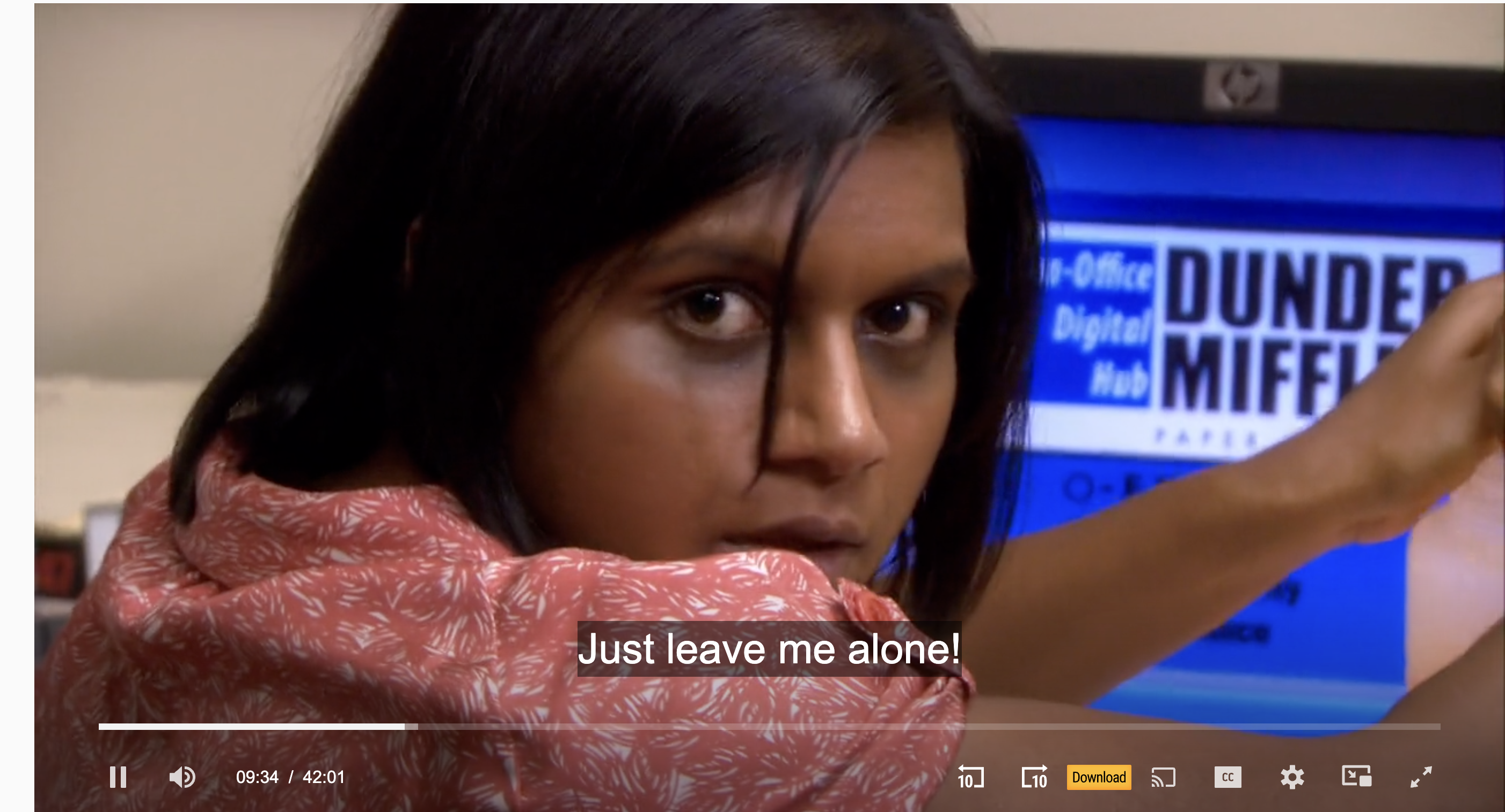
The first scene I will examine is from the beginning of the episode. In “Weight Loss,” the show’s branch of Dunder Mifflin is attempting to collectively lose the most weight in order to win a corporate contest. Some take the stairs rather than the elevator, some exercise, and some, like Kelly, fall prey to lose-weight-fast methods spread through social media and celebrities. In Kelly’s first scene of the episode, the camera focuses on the cubicle next to her’s, and the audience hears coughing (00:09:26-00:10:00). The camera pans over to Kelly, who is sitting at her desk screwing the cap on a large jug of liquid with shaking hands. Some syrup sits next to a few lemons. Holly, who works at the adjacent cubicle, peeks her head over and says “You’re shaking, are you all right?” To which Kelly replies “Just leave me alone!”

The next scene is Kelly’s interview with the cameraman. She mentions that she’s on the third day of her cleanse diet. This entails drinking only syrup, lemon juice, cayenne pepper, and water to replace all three meals of the day. Getting slightly more enthused, she explains that she ordered some bikinis in a size two, which is her goal size for losing weight. She sing-songs “Gonna look amazing,” but clearly is having to force any excitement and sounds exhausted.

Her appearance suggests this exhaustion. She has very dark undereye bags because she likely isn’t getting enough sleep due to coughing from this drink concoction. She sounds weak and tired, because this diet is not providing her body with the nutrients necessary for energy and simple survival. This scene shows the damage from diet culture. Kelly is trying to lose weight quickly by not adequately sustaining her body. However, this is just the beginning of what the dangerous effects of diet culture can be. It connects with eating disorder-perpetuating rhetoric that ‘skinny is best’ and that one must lose weight to be pretty, and that quick-fix cleanses like Kelly’s drink are a healthy way of losing weight. Later in this same week, during the weigh-in, Kelly collapses on to the ground, showing how this diet is not sustaining her body (00:14:20).

The next week, Kelly says that she swallowed a tapeworm and it’ll grow in her stomach, eating all the food she digests so that she can’t gain weight (00:19:00). She is continuing to attempt dangerous weight loss tricks, even after mentioning how she was on an IV in the hospital for three days after the fainting incident (00:14:40-00:14:45). Over halfway through the episode, Dunder Mifflin finally makes a statement that the company does not condone extreme weight loss habits (00:27:54-00:28:04). 

The problems with this episode connect to our introduction to fat studies this past week. This episode continues to perpetuate fatphobic beliefs that the best measure of health is a scale, even though simply how much we weigh is not an accurate measure of holistic health. The episode perpetuates the belief that having fat is bad and inherently unhealthy. In terms of Kelly’s juice cleanse, I did some more research and learned that it’s known as the “Master Cleanse,” which one consumes for 10 days to replace all meals.

On some websites, people love this diet. It helped them lose weight quickly and they were able to not eat food for all 10 days. When I was scrolling through the comments of a website from 2009, trying to find one saying that it’s not enough nutrients to sustain a body for 10 days, I only found one. Furthermore, this commenter suffered lots of backlash, with one person saying that “It is not unhealthy to give up food for a period of time…I think it’s an awesome cleanse and it works wonders. If you can’t give up food, then don’t. But don’t disrespect people that can do it.”

This comment felt unnecessarily aggressive, and the writer made fasting a matter of willpower to not eat. This glorifies the ability to not eat for 10 days, when this is often unhealthy for one’s body without approval of a physician.

My hope is that the producers of The Office aimed to reflect the weight loss trends of the time this season was filmed, in 2009. It’s an interesting commentary, but they don’t refute any of the potentially dangerous actions the workers are taking to lose weight until over halfway through the episode. Taken the wrong way, this episode and Kelly’s diet could be used as examples for how to lose weight quickly, particularly for women-identifying people, on whom society puts way more pressure to lose weight in order to be considered traditionally beautiful.

This episode is rife with assumptions on gender, race, and sexuality. Kelly’s struggle to lose weight demonstrates the disproportionate pressure on women-identifying people in western society to lose weight, more so than men. Her focus is completely on her appearance, shown by the comment about ordering bikinis in a size two. The men who discuss wanting to lose weight do it mostly for general health reasons.

Works Cited

Carell, Steve, and Mindy Kaling. “Weight Loss.” The Office, season 5, episode 1, NBC, 2005. 

Julson, Erica. “Master Cleanse (Lemonade) Diet: Does It Work for Weight Loss?” Healthline, Healthline Media, 17 July 2018, https://www.healthline.com/nutrition/master-cleanse-lemonade-diet.

McKinnon, Martha. “Cayenne Pepper Water Lemon Maple Syrup.” Simple Nourished Living, Martep Media Group LLC, 25 Feb. 2017, https://simple-nourished-living.com/cayenne-pepper-water-lemon-maple-syrup/.

“Dahmer” Netflix Series: Racism and Homophobia

The Netflix series “Dahmer- Monster: The Jeffery Dahmer Story” recounts the life of infamous serial killer and sex offender Jeffrey Dahmer and the stories of his victims. Dahmer was arrested in his Milwaukee apartment in July of 1991, thirteen years after he committed his first murder. In Dahmer’s apartment, police found several body parts in the refrigerator, a 57-gallon barrel containing several bodies left to decompose in a mixture of chemicals, and evidence that Dahmer had eaten some of his victims. After extended interviews with Dahmer, police learned that he killed seventeen men and boys during his reign of terror. The 10-episode series highlights what led up to Dahmer’s murders and how he covered it up for so many years.

In the series, writers and producers wanted to emphasize that Dahmer’s victim profile was mostly young black men. Although police were never able to get a clear answer from Dahmer, it is speculated that he attacked mostly black males because of the lack of police surveillance in predominantly black neighborhoods. The series presents many situations where racism directly affected Dahmer’s ability to kill. In the first episode, Dahmer is living next to a black woman and her two children in an apartment complex in a low-income area. The woman complained to the police about smells and suspicious activity coming from Dahmer’s apartment multiple times. The police brush it off and do not listen to her suspicions, allowing Dahmer to continue killing. 

This photo depicts the actress playing Glenda Cleveland (Dahmer’s next door neighbor in the series) and her daughter and niece standing outside Jeffrey Dahmer’s apartment complex speaking with police. Although in the show Glenda is Dahmer’s next door neighbor, in real life she lived in the apartment building next to Dahmer’s. Glenda was still the first person to report Dahmer’s suspicious activity to the police but was ignored on multiple occasions.

In this photo, Jeffrey Dahmer’s mugshot appears next to 15 of his victims. From this photograph you can clearly see a majority of Dahmer’s victims were young black males.

Later in the series, we see Dahmer appear in front of a white judge for child molestation charges. Dahmer was caught drugging and taking pictures of a young boy whose family immigrated from Laos, a country in Southeast Asia. The young boy’s father attempted to speak in front of the judge, but the judge claimed that he could not understand him because of his accent and cut him off. The judge then turned to Dahmer and gave him a light sentence of a year in a correctional facility and said he would leave the details of his conviction off of Dahmer’s record. Although the Dahmer Netflix series may have dramatized the court room details, it still does not change the fact that Dahmer was allowed to walk free only a year after harming a young boy and it was kept off his record. Because Dahmer was a young white male, the young boy’s family were Asian, and the trial took place in 1988, the judge seemed to be biased towards Dahmer. 

While committing heinous murders, Dahmer was also trying to discover his sexuality. In the series, Dahmer is seen struggling to find women attractive and fighting his feelings toward men and other tendencies. In the 4th episode, Dahmer tries to convey these feelings to his father, but his father completely changes the subject and does not want to speak of it. It is visible that Jeff feels different from others and just wants someone to listen to him. 

Jeffery Dahmer’s sexuality was not only overlooked by his father, but also the police investigating him. In the 2nd episode, Dahmer brings a young boy into his apartment and drugs him. The boy escapes and makes it to the front of the apartment complex, and Dahmer’s next-door neighbor calls the cops because she is worried that the boy is underage and injured. Dahmer’s apartment gets searched, but the cops do not want to “catch anything” so they did a poor job searching and left. Dahmer claimed that the boy was his boyfriend and the police decided not to investigate any more in fear of finding “gay sex toys”. Once the police left, Dahmer murdered the young boy. The series did air a real, recorded conversation between the Glenda Cleveland and police the night police searched Jeffery Dahmer’s apartment. 

Dahmer Video clip .pptx

This audio recording between Glenda Cleveland and police highlight the fact that police ignored Glenda Cleveland’s cries for help and wanted nothing to do with Dahmer because of his sexual preferences.

The blatant evidence of racism and homophobia broadcasted in the Dahmer Netflix series played a role in Jeffery Dahmer’s success as a serial killer. If his father had listened to Dahmer’s call for help or if the police had listened to the cries of those around him, especially the black woman living next door, then maybe Dahmer’s string of murders would have not been as large. The Netflix series has gotten a considerable amount of backlash from viewers and crime reporters for its historical accuracy. Multiple articles have been written about how producers dramatized the instances of racism and homophobia in the series. Although this might be true, there is still hard evidence that racism and homophobia affected Jeffrey Dahmer’s ability to get away with murder for so many years.

A Voice for the Voiceless: How Grey’s Anatomy Moves from “Silent All These Years” to “Shattering the Glass Ceiling”

Women are taught to never walk alone at night, to carry their keys between their fingers, and to dress modestly but not too modestly. I consider these basic “Woman 101” tips. And somehow, these tips are supposed to keep me and other women from becoming another 1 in 3. 

When current conditions are voiced, we as a society tend to turn a blind eye. Supreme Court Justice Brett Kavanaugh was confirmed to the court despite being accused by multiple women of sexual assault. Many women and girls limit their behaviors for fear of rape— for fear of being told that “boys will be boys,” “you were asking for it in that dress,” or “maybe next time you shouldn’t drink so much.” Concomitantly, adolescents have learned that consent does not matter—that it is irrelevant. 

While discussions are finite, popular media has begun to tackle the topic of rape. The season fifteen Grey’s Anatomy episode, “Silent All These Years,” written by Elisabeth R Finch, aims to initiate the dismantling of rape culture while highlighting the importance of consent and the lasting impacts of rape. The title, in and of itself, highlights just how oppressive and dismissive society becomes when women speak up about instances of sexual assault and rape. 

The episode begins when Khalilah Joi, guest-starring as a woman named Abby, arrives at Grey Sloan Memorial. With a cut to her face and bruises, coupled with skittish behavior, Dr. Jo Wilson recognizes the signs of rape. As the episode progresses, viewers learn that Abby was raped after leaving a bar. Aware of the victim-blaming narrative frequently used against women, Abby is hesitant to report the incident to the police or let her husband know. In attempting to break the stigma, Dr. Jo Wilson breaks protocol and shares her story of rape and sexual violence. She humanizes herself, therefore allowing Abby to see her as more than a woman in a white coat. When Abby agrees to a rape kit, something she knows will probably end up sitting in the back of a police station, Dr. Jo Wilson and Dr. Teddy Altman shift the power back to Abby. Before moving to the next portion of the rape kit, Abby must give them consent. She makes all the choices for herself. Something so seemingly simple is immensely powerful. Just hours before, Abby had lost all body autonomy. 

Dr. Jo Wilson sharing her story with Abby

That said, the most moving part of the episode comes prior to Abby’s surgery. Hesitant to go under anesthesia out of fear of being vulnerable again and fearful of seeing her attacker in the faces of the male staff and doctors, Abby resists the surgery. From that, the “hall of awesomeness” was assembled. The hospital’s female employees lined the entire length of the hallway right up to the operating room (which only had female doctors because girl power!!). The vast majority did not know Abby but showed up because they would want others to do the same if they were in that position. 

The “Hall of Awesomeness”

The show made an additional point to shift the fault from the woman. We live in a society that thrives off victim-blaming. Contrary, in “Silent All These Years,” Ben Warren, played by Jason Winston George, took the time to explain consent to his stepson Tuck Bailey, played by BJ Tanner: “If she stops having fun, just plain stop,” said Ben. “Time out. Game Over.”

Media portrayals of sexual assault correlate with increased victim blaming and the way the public discerns victims. Contrasting the standard image of women as sexual objects, Grey’s Anatomy humanizes the victim, emphasizing the importance of consent while moving away from victim blaming. 

I was talking to someone the other day who said he thought this episode was cringy. He viewed the “hall of awesomeness” as unrealistic and unnecessary, leaving him emotionally detached. And while I listened to his opinion and told him he had the right to hold that belief, I elaborated on my perspective. The unity and “women supporting women” narrative present throughout the episode not only reinforced the idea that you are never alone but highlighted just how essential lessons on consent and education about rape are. 

There is a common misconception that feminism is anti-male when the movement’s principle is contingent on equal rights for women. Women want to be heard, to be supported, and to be given a choice. This episode highlights this message. The creators gave a voice to the voiceless. They addressed the intersectionality between race and gender; Abby was played by a Black woman, serving as a nod to the increased vulnerability of Black women. They highlighted the healing power of female solidarity while recognizing that trauma is real and does not go away overnight. They emphasize that survivors are not alone and that they are not at fault. 

To anyone that finds Grey’s Anatomy over-dramatic, cringy, or over-rated, I encourage you to give it another chance. While it might not change your opinions on the show, it empowers survivors in a world that usually silences them. If not for yourself, do it for the one in three. 

Analyzing Born This Way by Lady Gaga

In Lady Gaga’s song Born This Way, the message told is how everyone is born a certain way, and everyone should be proud of it. This song can connect with queer activism since the lyrics “celebrates difference and diversity.”1 An interesting element to this song is its use of Christian themes to support its message. Usually, Christianity is used against the LGBTQ community to condemn same-sex relationships. However, in this song, Lady Gaga uses Christianity to express why it is okay to be who you are. Following the lines “No matter gay, straight, or bi’, lesbian, transgender life” and “No matter Black, white or beige, chola, or Orient’ made,” she says, “I’m beautiful in my way ’cause God makes no mistakes,” implying that God made you the way you are regarding race and sexuality, and that you should love yourself for it. This supports womanist thinking by implying that “[being] recognized as human, levelly human, is enough”.2 Born this way also possibly has hints of trans people inclusion, with the repeated lines “Don’t be a drag, just be a queen.” This is probably a play on words with drag queens, who are associated with the trans people community. While Born This Way is usually associated as an anthem for LGBTQ pride, some of Lady Gaga’s lyrics can be seen a problematic. Gaga refers to Asians as “Orient” in two of the lines of the song, appearing in “You’re Lebanese, you’re Orient’” and “No matter Black, white or beige, chola, or Orient’ made.” Even though the context of this word is meant to promote inclusivity amongst all races, the term “Orient” is outdated and can be seen as offensive. Another problem within the lyrics is when Gaga refers to God as “capital H-I-M.” This is problematic since Gaga is assuming god’s gender is a man. According to book 239 of Catechism of the Catholic Church, God has no assigned gender, stating “God is neither man nor woman: he is God.” Despite its limitations, this song displays ideas from transfeminism and queer feminism because its lyrics have themes of empowering the LGBTQ+ in addition to themes regarding racial minorities.

  1. https://ebookcentral-proquest-com.proxy048.nclive.org/lib/davidson/reader.action?docID=4782608
  2. Combahee River Collective: A Black Feminist Statement