About two to three weeks ago, I actually partook in the no-product day challenge. Rather than purposefully participating in this activity, this actually started for a few days coincidentally. However, after realizing I did not really need to use my deodorant, I decided to carry on with it to make it roughly a week. Because I identify as a man, the only product I use for body hygiene is my deodorant.Obviously, I wear deodorant so then I would not smell like body odor when around others.
As mentioned earlier, I used no product for about six to seven days, and I was rather surprised by myself. One thing that surprised me was how un-smelly I was with my deodorant. Furthermore, I realized that my deodorant would cause me to smell like body odor more frequently than whenever I did not use it. I also think that swimming helped me cleanse my body odor from the chlorine water that would rinse my body. Even though I use aluminum-free deodorant, its effectiveness of blocking the body odor smell is next to nothing, and makes my armpits sweat more as a result of applying the product.
For quite some time, I have noticed that I have had a body odor problem. After doing this challenge, I realized that the problem was not my natural process, but rather what I do to my body. Applying deodorant temporarily fixed the problem, but would worsen it long term. This challenge made me realize that it is best for your body to do its natural process. The functions of the human body should not be seen as “disgusting” or “uncivilized” – rather, we should all accept what our body does naturally and be proud of it. Products like deodorant are not designed to solve a problem with our bodies, but rather create one when we rely on them.
In Lady Gaga’s song Born This Way, the message told is how everyone is born a certain way, and everyone should be proud of it. This song can connect with queer activism since the lyrics “celebrates difference and diversity.”1 An interesting element to this song is its use of Christian themes to support its message. Usually, Christianity is used against the LGBTQ community to condemn same-sex relationships. However, in this song, Lady Gaga uses Christianity to express why it is okay to be who you are. Following the lines “No matter gay, straight, or bi’, lesbian, transgender life” and “No matter Black, white or beige, chola, or Orient’ made,” she says, “I’m beautiful in my way ’cause God makes no mistakes,” implying that God made you the way you are regarding race and sexuality, and that you should love yourself for it. This supports womanist thinking by implying that “[being] recognized as human, levelly human, is enough”.2 Born this way also possibly has hints of trans people inclusion, with the repeated lines “Don’t be a drag, just be a queen.” This is probably a play on words with drag queens, who are associated with the trans people community. While Born This Way is usually associated as an anthem for LGBTQ pride, some of Lady Gaga’s lyrics can be seen a problematic. Gaga refers to Asians as “Orient” in two of the lines of the song, appearing in “You’re Lebanese, you’re Orient’” and “No matter Black, white or beige, chola, or Orient’ made.” Even though the context of this word is meant to promote inclusivity amongst all races, the term “Orient” is outdated and can be seen as offensive. Another problem within the lyrics is when Gaga refers to God as “capital H-I-M.” This is problematic since Gaga is assuming god’s gender is a man. According to book 239 of Catechism of the Catholic Church, God has no assigned gender, stating “God is neither man nor woman: he is God.” Despite its limitations, this song displays ideas from transfeminism and queer feminism because its lyrics have themes of empowering the LGBTQ+ in addition to themes regarding racial minorities.
Gender roles have always been present in relationships. With any orientation, these masculine and feminine roles create expectations on how to act, dress, and conduct oneself in a relationship. Masculinity in relationships can be overpowering, especially in diaspora, the dispersion of peoples from their homeland. In Mexican culture, this can lead to Machismo, the concept of the ideal Mexican man. Having machismo can lead to being patriarchal and sexist. However, the role of a male figure amongst these Mexican diasporic relationships are not always like this. In Nichole Guidotti-Hernández’s most recent book, Archiving Mexican Masculinities in Diaspora, she collects the visual archives from Enrique Flores Magón and Leonard Nadel to document and interpret intimacy across relationships amongst Mexican men during the late 1800’s and early 1900’s.
The book is separated into two sections, each with their own conclusion. The first half of the book follows the gendered migrations and life of Enrique Flores Magón, a Mexican anarchist. Guidotti-Hernández focuses on Enrique’s virility amongst his relationships around the time he fled to El Paso, Texas. Guidotti-Hernández notes the masculine style of his word choice when writing letters throughout his life, drawing attention to his masculine virility. With Enrique’s first relationship, being with Paula Carmona, it is possible that his virility caused a breakup. Despite Paula having visual evidence of their relationship, Enrique did not, erasing the relationship from his side. The reason why this relationship was problematic in diaspora is because of Enrique’s masculinity – he was patriarchal and misogynistic. This shows how heteronormative gender roles can affect one’s intimate relationship in diaspora. The second half of the book looks at the homoerotic conflicts within the bracero program captured by photojournalist Leonard Nadel. Guidotti-Hernández says that Leonard traveled over five thousand miles with for his photojournalism, focusing on his bracero subjects from their homes in Central Mexico to processing centers in the United States and labor camps. In Leonard’s photographs Guidotti-Hernández traces the tensions between two sides of the braceros’ identity; one side represents braceros in a more mainstream image, being seen as the typical masculine character. However, the other side shows same-sex relationships between the Mexican laborers. Hernández exposes the unseen side of bracero life to show that feminine masculinity and homoeroticism livened bracero life and culture while avoiding the dominant influence of Mexican patriarchy and heterosexuality. The book is wrapped up with the conclusion of the relationship between Mexicans separated by the border. Despite a lack of solidarity, these Mexican communities developed political connections that were highly emotive and intimate through their agitation for labor rights. What we learn from the changes that occurred between anarchists of the 1910s and 1920s and braceros in the 1950s has to do with how emotional bonds and attachments were forged. Both the archives of Enrique Flores Magón and braceros required narration against machismo. This is because Mexican male migration patterns and narratives of sociality are interpreted through machismo.
The author of this book, Nichole M. Guidotti-Hernández, is currently a professor of English at Emory University. Her first book is Unspeakable Violence: Remapping U.S. and Mexican National Imaginaries, which is about the epistemic and physical violence that racialized and gendered peoples faced in the U.S. Mexico border from the mid 1800’s to the early 1900’s. Guidotti-Hernández has also written many articles for the feminist magazine Ms. and the feminist blog The Feminist Wire, discussing various topics from immigration to reproductive rights. Archiving Mexican Masculinities in Diaspora is her second and most recent book. This book can be applied to wider research or career trajectories involving Gender Studies and Latinx Culture and Literature Studies.
In Archiving Mexican Masculinities in Diaspora, there is an emphasis on visuals, hence why a lot of the research material used is photos and artwork. Most analyses are of the photos, as Guidotti-Hernández says that Photographs capture the best state of something. The archives of Enrique Flores Magón and of Leonard’s photography have been carefully selected to tell historical narratives. Guidotti-Hernández’s display of visual archives includes photos, artwork, police reports, newspaper reports, and personal letters. When analyzing, Guidotti-Hernández describes the background information of the image then ties its connection to the main topic at hand. For example, in the section of Enrique Flores Magón, there are two sketches by him of Paula Carmona, his first wife. Guidotti-Hernández gives us context about Enrique’s relationship with Paula, saying that they show an intimacy that counters Enrique’s narratives, yet he erases his relationship with Paula. He makes the false claim that he was married to his second partner, Teresa Arteaga, around the time he was in El Paso in 1908. Despite Enrique saying he married his second wife Teresa Arteaga by 1905, he still showed his love for Paula by creating art in 1908.
One strength of Archiving Mexican Masculinities in Diaspora is its in-depth analysis on every visual archive provided. By doing so, each archive reflects the effects of Mexican masculinity across time, relationships, and the location of the partners. As a result, Archiving Mexican Masculinities in Diaspora provides a look at gender dynamics of migrants from the mid-1800’s to the early 1900’s. These analyses also provide insight into the different types of relationships found in Mexican culture, such as father-son as well as partners and lovers, from homosocial and heteronormative. Another strength of this book is its connections to other cultures that had diasporic communities. In her section examining Leonard Nadel’s photography, Guidotti-Hernández brings attention to communities such as Japanese American sharecroppers and German prisoners of war. For example, she brings up how there were laborers imported from Japan to work with braceros during berry picking season. Guidotti-Hernández says that the history of multiethnic labor and racialized forms of capitalism were created by the homosocial labor conditions for Japanese and Mexican workers along with Japanese share cropping families. The connection between the two cultures emphasizes the effect of racialized capitalist systems that created these diasporic communities amongst laborers.
One potential weakness of Archiving Mexican Masculinities in Diaspora is that it feels drawn out at times. The book does sometimes feel longer than it should be, especially when analyzing its visual archives. While Guidotti-Hernández does a great job gathering and utilizing evidence to get a point across, sometimes it feels like there is too much being explained. This is a minor complaint for the book overall, as the number of visual archives presented to the reader does not shallow her overall message from the book. Depending on how you look at it, the plethora of archives presented only strengthens the claim.
Overall, I think that Archiving Mexican Masculinities in Diaspora does a great job explaining diasporic masculinity and how it reflects gender roles of Mexican culture. When looking at the intimacies of diasporic relationships, Guidotti-Hernández emphasizes the effects of virility and machismo within them. This is done by looking through the public and private aspects of Enrique Flores Magón’s relationships and looking at the two-sides of masculinity within bracero life captured by Leonard Nadel’s photography. This book was informative showing how Mexican masculinities formed by becoming outsiders through diaspora. I would recommend this American studies and ethnicity, gender studies, Latinx studies, and Latin American studies.
Historically, motor racing has been a male-dominated sport for many decades. It has been 46 years since a woman was entered in a Formula One race, and the demand for women competing in motorsport is ever growing. Motorsport has always been an elitist sport, sometimes favoring wealth over talent. Fortunately, for women aspiring a motorsport career, there is the W Series. On YouTube, W series uploaded a video called “W Series Explained: Our Mission.” The title is important because it leads the viewer to know that the video is intended to showcase the goals of W Series. The intended audience is presumably fans of motorsport, especially Formula One, and the purpose is to show that W Series gives women the opportunity to compete with men in higher level motor racing.
In the video “W Series Explained: Our Mission.”, it explains that W Series is a feeder series – a motorsport championship designed for drivers to graduate into bigger racing series, such as Formula Two and Formula One. However, unlike other feeder series like Formula 3, it is exclusively for women and has no entry fee for participation. The series is designed to favor most talented drivers rather than those with the most financial backing. Motorsport is reliant on money, making it extremely difficult for anyone lower and middle class to compete. Being accessible, W Series promotes diversity by allowing more people from different backgrounds to join the sport.
The video starts off displaying how it has been 50 years a female started a Formula One race, This statistic is emphasized by having to number of years gradually counting up to 50, showing that there has been a delay in female participation in motorsport.
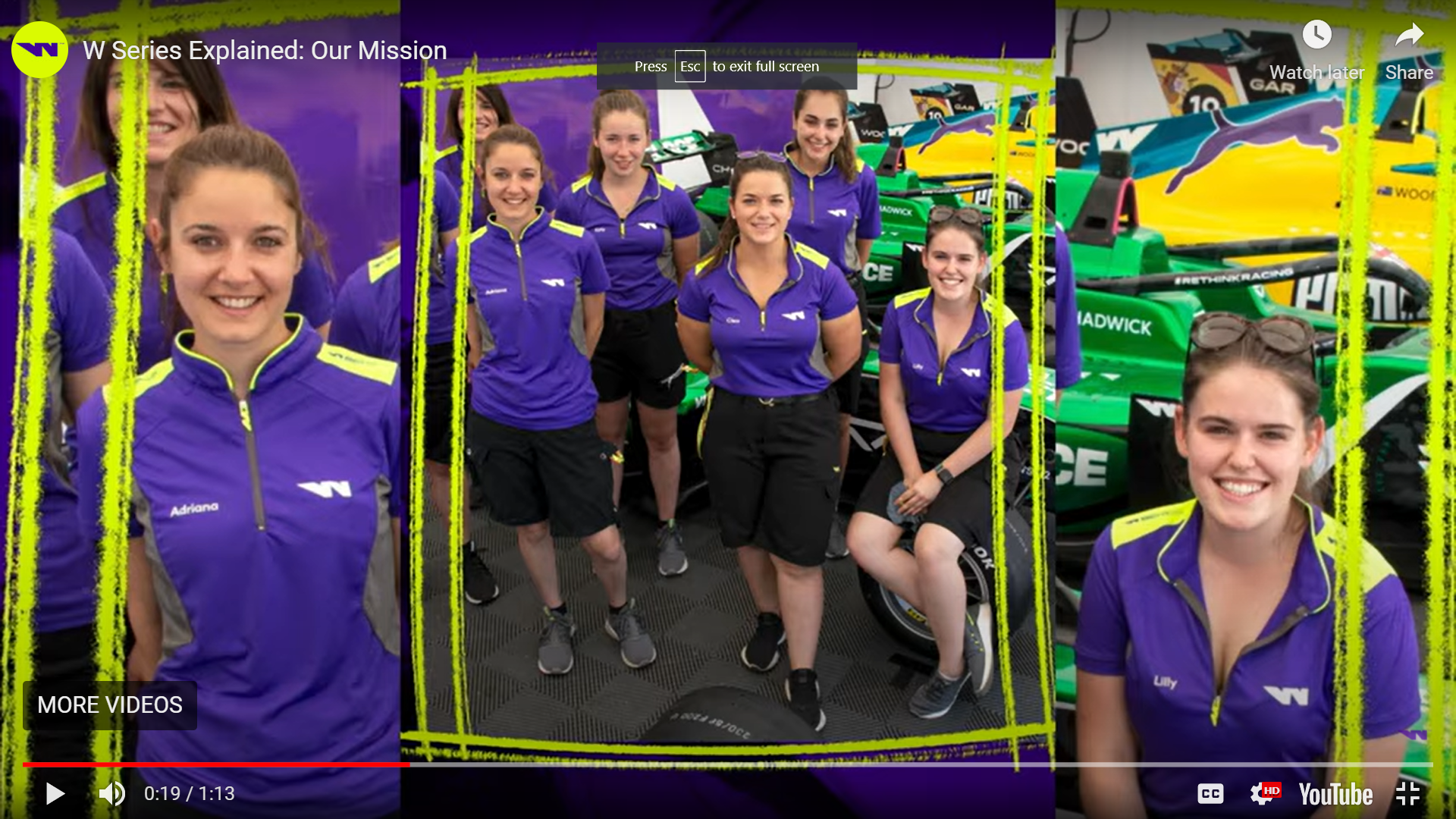
After showing this statistic it displays different pictures of the participants from W Series while saying “we believe that W Series can be an important cultural catalyst for female empowerment.” This section of the video functions to advertise why its mission is important not just for motorsport, but for women in sports as a whole.
After that, a graphic of the word “breaking down” is shattered into pieces, showing that W Series aims to be unrestrictive for female participants to enter. The video says that W Series is a free-to-enter championship to give every entrant an equal chance.
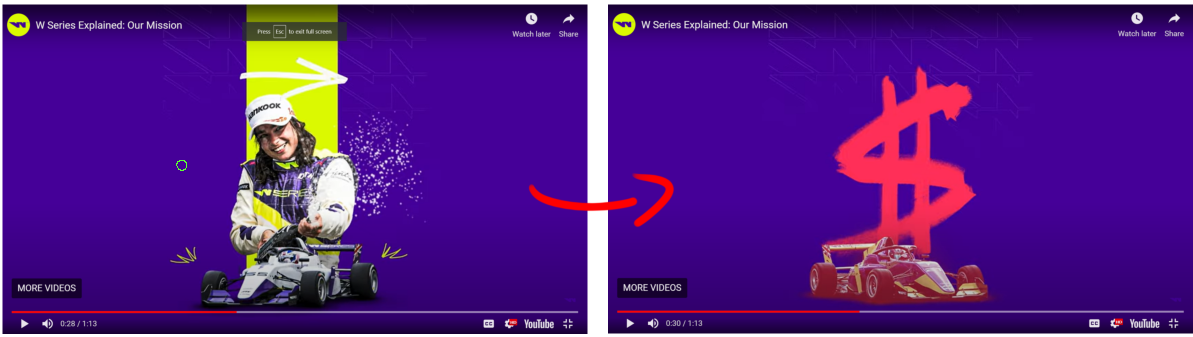
This is followed with an image of the reigning W Series champion, Jamie Chadwick, spraying champagne, followed by a dollar sign above a W-Series car, representing how the series is won by the driver with the most talent, and not those with the most financial backing.
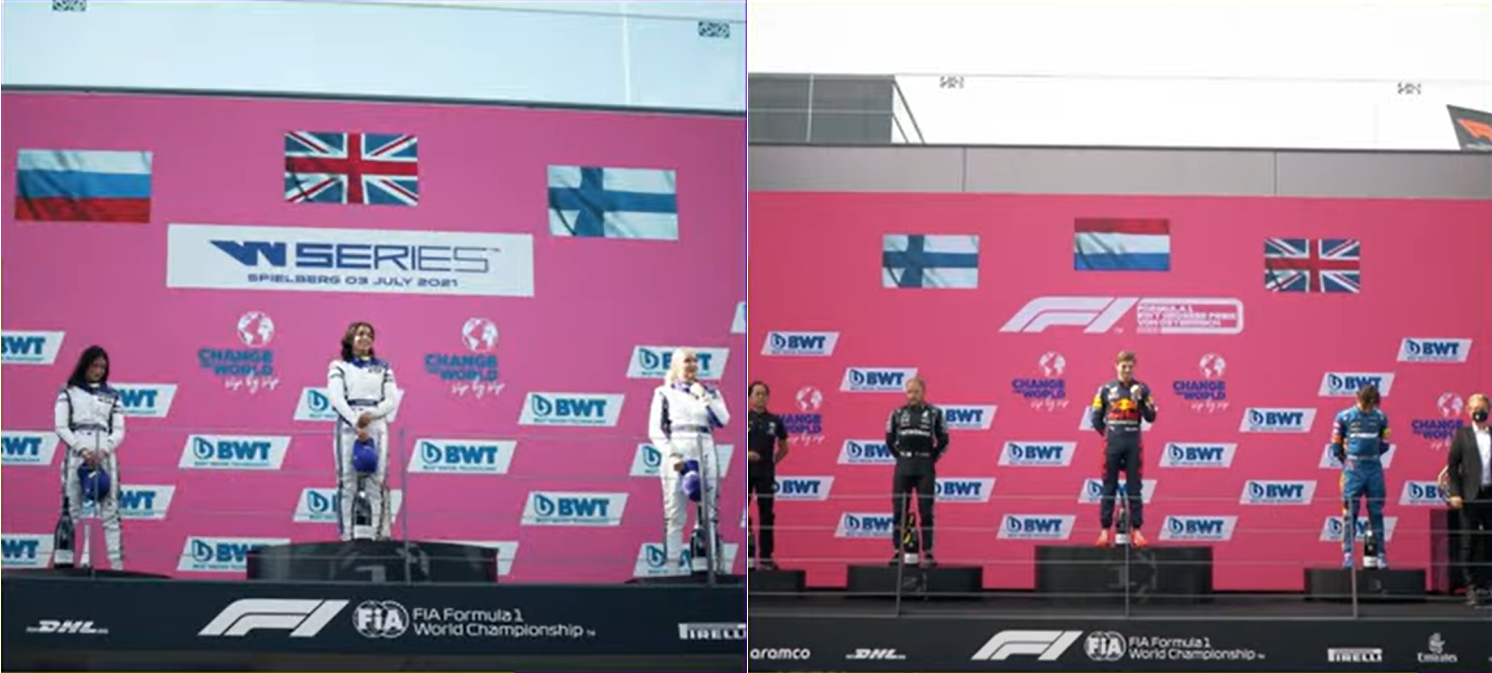
Another key point illustrated by the video is when it first shows an image of a podium ceremony from W Series, shortly followed by one from Formula One. Displaying these images, the video emphasizes how its goal is to have “female and male racing drivers compete on equal terms.” It is clear that one of the goals of W Series is to bring women in the top levels of motorsport along with men.
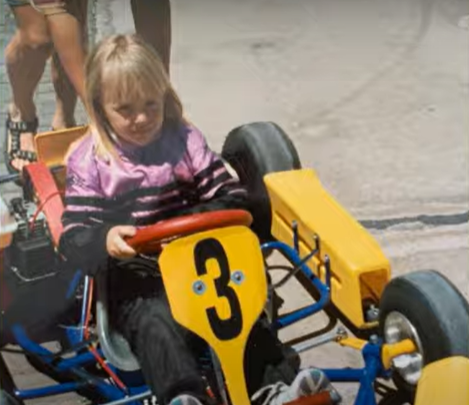
The final main point shown by this video is when it shows pictures of young girls driving go karts, saying “we want to inspire young girls at grassroots levels by highlighting today’s generation of talented female racing drivers.” With these images, the video is making it clear how there is a future generation of female racing drivers waiting for their big break in motorsport.
The video ends with the message “some say it’s a long road, but we’re in a hurry to get there” as a W Series-spec car drives off into the distance. This concluding message shows that W Series aims to achieve its goals as soon as possible, to ensure that Women have a place in motorsport.
This video overall has effectiveness telling its mission through its graphics and narration. The graphics displayed in the video match with messages being said by displaying easy-to-understand icons and images along with the commentary. To casual racing fans, this video does a great job delivering its message to argue that women can compete in motorsport. However, to more invested racing fans, including myself, W Series’ limitations for its goals can be easily recognized when examining other racing series that the sport intends to influence. W Series succeeds by allowing women from different backgrounds to compete in the series. However, W Series fails to solve the problem most women face when trying to compete outside of W Series. This is crucial since the ultimate argument of this video is that women have the chance to compete with men at top-level racing. While W Series itself may be inclusive, other racing series, particularly the ones it feeds into, are not. The main issue is that motorsport is very reliant on money, and in some cases, favors funding over talent. To enter in Formula 3, you need around €500,000. Even if you had financial backing from driver academies, it is very rare that they would completely cover the cost. In W Series, you are awarded €500,000 in prize money if you win the championship, which should just cover the cost to enter in Formula 3. For example, Jamie Chadwick had to return to W Series for a third season because she cannot secure funding for a seat in Formula Two or even Formula Three.
W Series aims to solve a problem that motor racing has faced for decades. It attempts to allow women from different backgrounds to be given the opportunity to enter in the highest level in motorsport. While W Series is taking a step in the right direction, it fails to achieve its goals due to external factors. Motorsport categories outside of W Series are still very much elitist, favoring mostly to male drivers with a decent amount of financial backing. If the ideas that W Series implements do not carry over to other motorsports, then inclusion of women in motorsport may still be hard to achieve.