A Disection Into A Feminist Anthem

On April 13th, 2024, No Doubt performed one of their most iconic songs “Just A Girl” at the Coachella Music Festival, 29 years after its initial release. Following their release, “Just A Girl” received positive reviews from multiple music critics and later “Just A Girl” became a feminist anthem for many feminists. Through its satirical lyrics, Gwen Stefani portrays the struggle it is to be a woman in America. Although released in 1995, “Just A Girl” is a song beyond its years. 

In the first clip that can be found on YouTube, Gwen Stefani is seen standing in front a red  crashed car: 

Gwen Stefani, a woman, standing in front of a crashed car is a metaphor for the common misconception that women are bad drivers. These sexist notions have been surrounding society for decades and yet, they hold no truth to them. Men are twice as likely to get into a fatal car crash (Kelly). 

While Gwen Stefani is standing in front of a crashed car, the lyrics that follow are: 

[Verse 1]
Take this pink ribbon off my eyes


I’m exposed, and it’s no big surprise


Don’t you think I know exactly where I stand?


This world is forcing me to hold your hand

The “pink ribbon” being removed from Gwen Stefani’s eyes is symbolism that displays the lies of womanhood. The pink color is a mask of the truth that hides behind the reality of what it is being a woman, constantly being suppressed and undermined. Pink is chosen to criticize the stereotype that pink is a “girl color”. These gender color assignments did not begin until the 20th century. Originally, pink was a color for boys and blue was a color for girls because, “pink, being a more decided and stronger color, is more suitable for the boy, while blue, which more delicate and dainty, is prettier for the girl” (Grannan). Which is contrary to the modern notion that pink is “girl” color.  This proves that colors should not be associated with a specific gender. 

 In Gwen Stefani’s lyrics she is being forced to hold hands which displays the patriarchal standards of women being forced to be with men to “have” a role in society. Often times, especially in the 90’s women are more recognized and treated with respect if they have a man by their side. Stefani shuts down and criticizes these widely held beliefs that women are worthy only if they are with a man. 

[Chorus]
‘Cause I’m just a girl, oh, little old me


Well, don’t let me out of your sight


Oh, I’m just a girl, all pretty and petite


So don’t let me have any rights

The use of the words “little”, “pretty and petite”, illustrate the societal view of women being seen as dainty and fragile. This ideology makes it difficult for women to progress when they are limited by being viewed as defenseless and needing a man to make any progress. 

[Post-Chorus]
Oh, I’ve had it up to here

[Verse 2]
The moment that I step outside


So many reasons for me to run and hide


I can’t do the little things I hold so dear


‘Cause it’s all those little things that I fear

“So many reasons for me to run and hide” displays the fear that woman constantly face when they are alone. Society has created woman to be afraid of so many things because of what many men have done to women such as rape, murder, etc. The inability in pursuing a normal life highlights the difference between a man and a woman’s day to day life. A man can do anything he wants without fearing for his safety, whereas a woman cannot. 

[Chorus]
‘Cause I’m just a girl, I’d rather not be


‘Cause they won’t let me drive late at night


Oh, I’m just a girl, guess I’m some kind of freak


‘Cause they all sit and stare with their eyes


Oh, I’m just a girl, take a good look at me


Just your typical prototype.

Stefani continues her song by demonstrating strict rules she must follow because she is a female. Because she is a female, she cannot drive late at night. It is incredibly common to be stopped by your parents from going out late at night because you are a woman. Being from a Hispanic household, I would have to beg my parents to let me drive out late. I always knew that if I was not a female, there would be no issue with me driving out at night. These sexist ideologies founded in multiple households do not end with a singular restriction. There are still multiple restrictions that girls from a young age must face because of their gender. These restrictions are even more so emphasized if they are from a non-white household. 
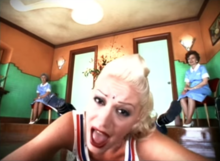
Throughout the video, Stefani is seen in an orange and cyan room with two ladies in blue dresses in a corner. Images of a men’s bathroom in black and white also flash throughout the video. Gwen Stefani is separated from the men’s bathroom which is dirty and grimy which is a foil of the clean bathroom with the two ladies to create symbolism of how society treats women like overly emotional creatures. Stefani stays in this clean bathroom throughout the music video to stay true that Stefani is “safe” in this restroom away from the rest of the world. 

In the end of the music video, both sides (the dirty bathroom vs the clean bathroom) come together to display that woman can handle the “dark parts” of the world, just like men. 

The enduring power of “Just A Girl” by No Doubt lies in its ability to capture the persistent struggles and stereotypes women face, even decades after its initial release. Gwen Stefani’s poignant and satirical lyrics, coupled with the vivid imagery in the music video, highlight the societal constraints placed on women and challenge these outdated norms. 

The song’s performance at the 2024 Coachella Music Festival underscores its timeless relevance and continued resonance with audiences. Through “Just A Girl,” No Doubt not only crafted a feminist anthem but also a cultural critique that remains strikingly relevant in the ongoing discourse on gender equality. The song and its accompanying visuals serve as a powerful reminder of the progress made and the journey still ahead in dismantling gender stereotypes and advocating for women’s autonomy and rights.

Works cited: 

Kelly, J. (2015, May 27). The Kelly Law Team. Phoenix Personal Injury Lawyer. https://www.jkphoenixpersonalinjuryattorney.com/whats-that-about-women-drivers-better-think-again/

‌Grannan, C. (2016). Has Pink Always Been a “Girly” Color?. In Encyclopædia Britannica. https://www.britannica.com/story/has-pink-always-been-a-girly-color

Discovering the Secrets of Aristotle

Aristotle and Dante Discover the Secrets of the Universe is a young-adult fiction novel written by Benjamin Alire Sáenz, a Mexican American author. The book was published on February 21st, 2012, and was later adapted into a movie released on September 8th, 2023. The story follows two Mexican American teenagers living in El Paso, Texas in 1987

www.history.com/topics/1980s/hiv-aids-crisis-timeline: Discovering the Secrets of Aristotle

Read the book instead of watching the movie, it’s significantly better.

Hani and Ishu’s Guide to Fake Dating: A Story of Discrimination

People are always grateful to see representation in media. The representation people seek can depict anything about a person’s identity, whether that’s related to sexuality, ethnicity, disabilities, etc. That being said, I think it’s equally as important to represent more unpleasant things that tie into identity– discrimination.

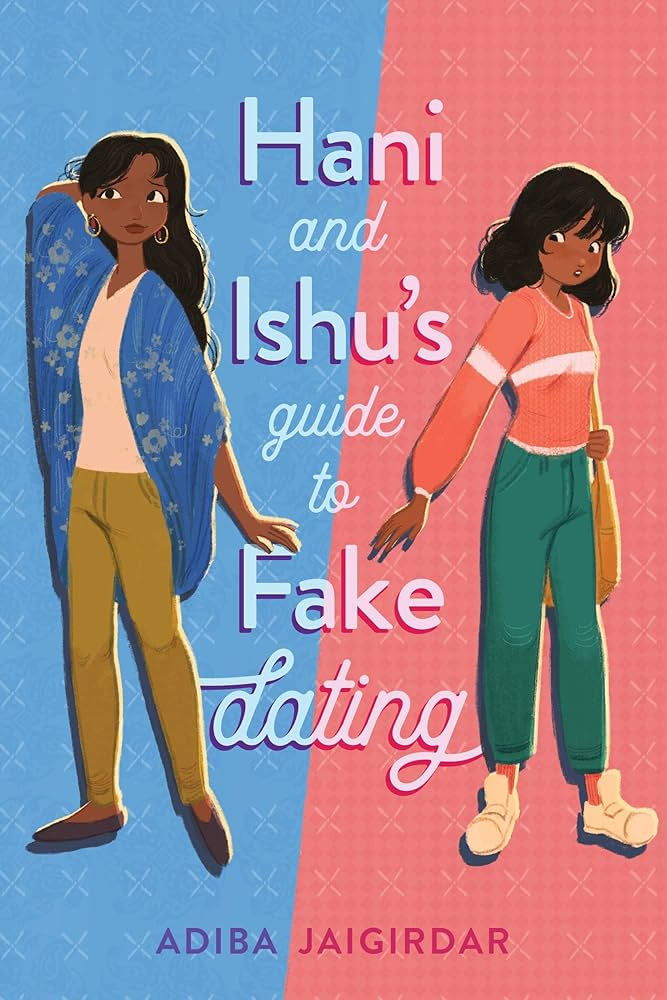
Hani and Ishu’s Guide to Fake Dating was published in 2021 by Adiba Jaigirdar, a Bangladeshi-Irish writer. It follows two girls, Humaira (on the left) and Ishita (on the right), who conjure a plan to “date” in order to gain something in return; Humaira wants her friends to accept that she’s bisexual, and Ishita wants to gain popularity in order to win Head Girl at their school. Though their relationship began as nothing but a plot for their own personal benefit, the girls end up developing feelings for one another and are in a real relationship at the end of the novel. It’s a story about acceptance, growth, and romance, but also about homophobia, toxic relationships, and xenophobia.

In the novel, we are introduced to Humaira’s group of friends– two girls named Aisling and Dee– who are what one could call “sheltered white girls.” In chapter five, they attempt to introduce Humaira to a boy, and, albeit begrudgingly, she gives the boy a chance. At the end of the date, Humaira still finds herself uninterested in the boy and claims this is because “right now, all men seem overwhelmingly attractive” (pg.36).  When she tells her friends she’s not interested in boys at the time and eventually that she’s bisexual due to the pressure she’s feeling, her friends react rather poorly.

“Have you even kissed a girl?” Aisling asks. 

“No,” I mumble. Unfortunately, I have kissed way too many boys —most of them unpleasant experiences.

“Then how can you say you’re bisexual?” Aisling asks. (p.36)

In this scene, Aisling denies Humaira’s sexuality because of her lack of experience with women, claiming that there’s no way she can be sure if she’s never been with a girl, which eventually leads to Humaira claiming she’s dating Ishita. Her subtle homophobia is surprisingly incredibly realistic. It’s represented in a way that isn’t explicitly homophobic, but rather a microaggression. A microaggression is described by a casual, minute action or phrase that communicates derogatory or aggressive attitudes towards minorities. Unfortunately, it’s a common experience to have your own identity opposed and be met with microaggressions, and Aisling is a clear example of this issue. This issue leads many people, including Humaira, to feel unaccepted and generally uncomfortable around people they were meant to be safe around. 

This one example isn’t the only example of Humaira’s friends’ controversial dialogue. Later, in chapter seventeen, Humaira and Ishita are at Dee’s birthday party. Dee decides she wants to play a drinking game at her party and claims that everyone must play because it’s her party. Humaira, however, tells the group she can’t participate because of her religious beliefs.

“I’m Muslim … I don’t drink,” I say finally. There’s silence for a moment, as if this is the first time everyone in the room has realized that I’m Muslim.

“Yeah, but you’re not that kind of a Muslim,” Dee says after a beat of silence. “You don’t even wear like the…” She makes a circular motion around her head. To indicate a hijab, I guess. (p.108)

At this point, Dee has not only expressed her biphobia, but her xenophobia as well. By saying Humaira is “not that kind of a Muslim,” she is grouping Muslim people into a certain stereotype and excluding Humaira from that group because she does not fit Dee’s image of what a Muslim person looks or acts like. This, again, can be viewed as another microaggression Humaira faces due to her friends. She is, once again, being denied of her identity because she does not follow Dee’s image of what a Muslm is. To Dee, a lack of one religious practice (in this case, wearing the hijab) means that she does not follow the religion, or at least she does not follow it to the extent that other Muslim people do. It’s a subtle act that is invalidating and overall disturbing, especially to those who can relate or understand.

Showing all sides of reality is a good thing, especially in media mostly catered towards younger audiences. Jaigirdar represents every part of being queer and identifying with something that is not considered “the norm” in an area. Though it’s something important to you, it will always be scrutinized by others, whether it’s welcomed or not. The novel shows this discrimination in a way that is realistic and displeasing, but so nice to see represented. Though they face constant hardship and prejudice, the novel is still such a sweet and short read that I personally would highly recommend, especially to queer people and/or people of color.

A Christmas Story

J&B Rare’s advertisement “She, a J&B Tale,” for Diageo Scotch whisky
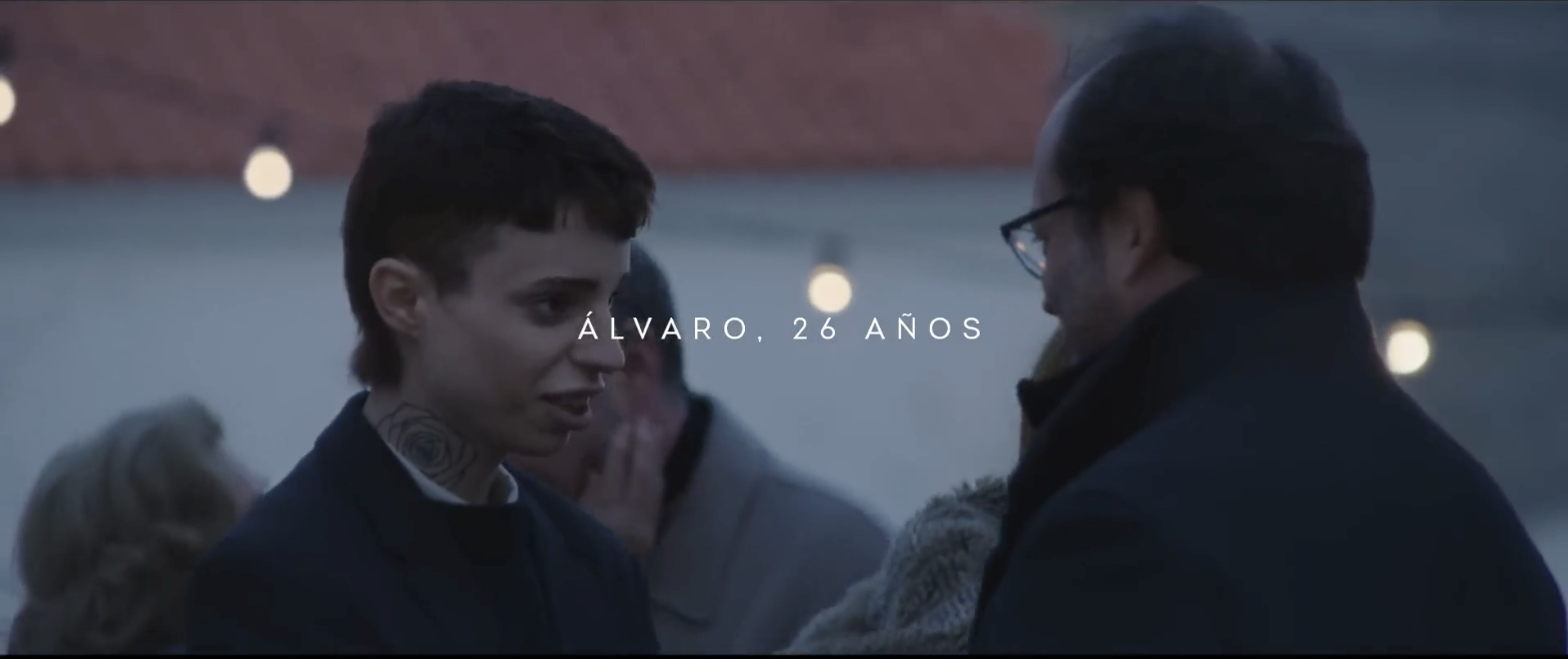
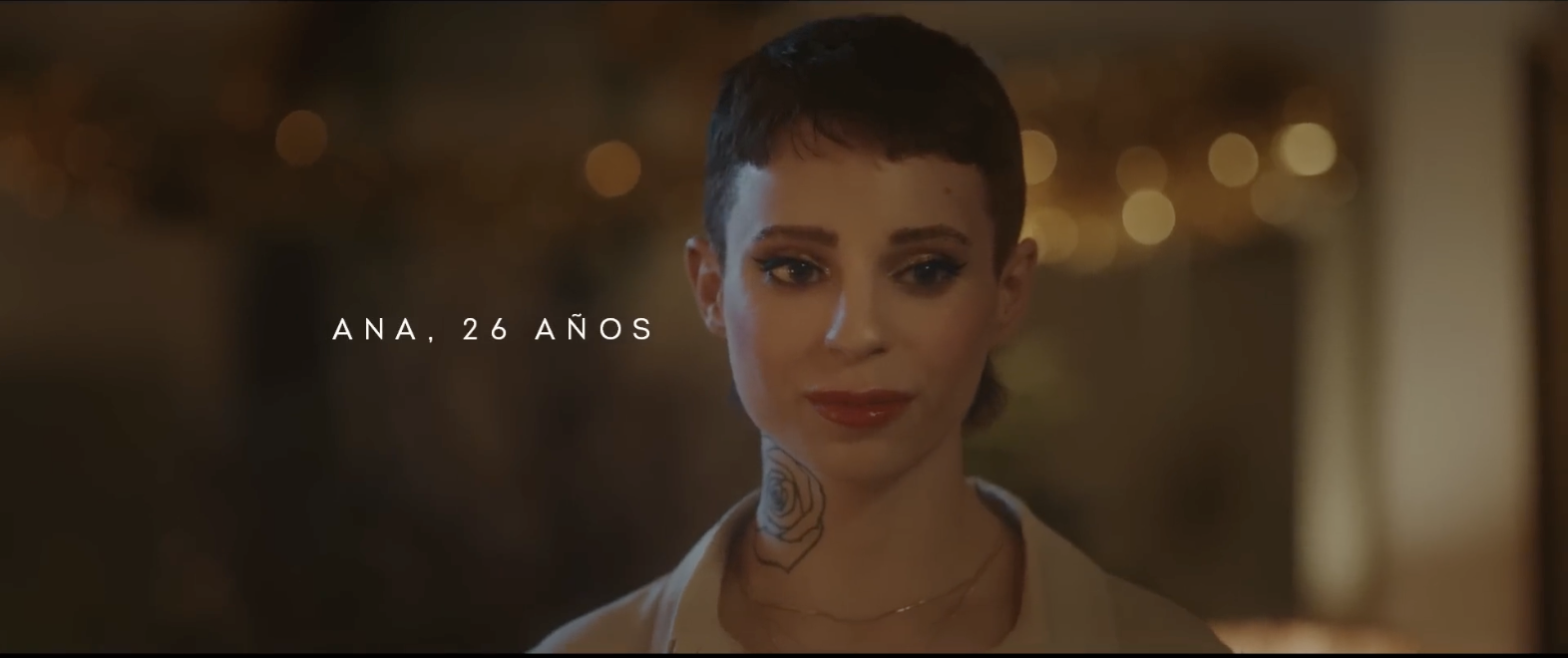
The protagonist of J&B’s advertisement
Ana

Lemonade’s Celebration of Oneself

Beauty standards and expectations about how people should act are omnipresent. They largely affect women, particularly Black women. These expectations and standards are perpetuated in various forms of media. 

Watching Beyoncé’s visual album Lemonade gives a much more comprehensive experience than simply listening to the album. The visual album is divided into 11 chapters, all with videos accompanying them. The music videos for each of the 11 songs in Lemonade are also in the visual album; the visual album incorporates a medley of references and cameos, including highlighting the prose of Warsan Shire. 

Beyoncé accompanied by notable individuals, including Zendaya and Amandla Stenberg, in the chapter “Redemption” while speaking Shire’s prose

Although much of the media is made with the white male gaze in mind, Beyoncé’s visual album Lemonade strays from this trend. Beyoncé tells her story from her perspective, how she wants to tell it, and narrates in the way she sees best fits. Women of color are victims of numerous harmful stereotypes in the media, such as the “angry Black woman” stereotype, and generally being portrayed as hypersexual. Black women are oftentimes minimized to be seen just as these harmful stereotypes, stripping them of their individuality. Lemonade shows Black women in more than one way. Beyoncé illustrates the diversity of Black women, smashing various stereotypical images down. 

Beyoncé allows herself and other Black women to express their emotions unapologetically within Lemonade. Women are generally expected to be composed, submissive, and suppress emotions. If a woman does express her emotions, she is often quickly labeled emotional or irrational. Black women expressing emotions are especially stigmatized. Beyoncé does not hide her emotions but instead showcases them. Each chapter’s title relates to emotion. The stages of emotion, as shown through the chapters, subverts the unidimensional view of Black women and successfully allows Beyoncé to illustrate Black women’s complexity. By showing the versatility of Black women, she defies the generally monolithic representation in the media. She humanizes Black women in the media by creating Lemonade and displaying emotions in a raw, exposed manner.

Beyoncé teary-eyed while singing “Sandcastles”

Throughout the visual album, Beyoncé does not shy away from expressing her anger to avoid the label of an “angry Black woman.” During “Hold Up,” Beyoncé is seen strutting down a street holding a baseball bat with a sly grin on her face. She releases her anger throughout the song, causing destruction, including smashing windows and battering cars. Her sheer fury continues to be seen in “Don’t Hurt Yourself,” where she continues to embrace emotions like anger that Black women are taught to subdue, labeling herself “the dragon breathing fire.” She has a right to be angry without worrying about how others perceive it. She exercises that right, illustrating that anger is a normal emotion that an individual should be able to express without being put within the “angry Black woman” trope. Later in the song, viewers can hear the anguish in her voice as she screams, “Tonight I’m fucking up all your shit, boy” while staring into the camera. She powerfully shares what she feels. It is much more normalized for men than women to express rage and anger, often even being labeled as a masculine trait. When women do express rage, they are quickly described as a bitch or crazy. She normalizes outwardly expressing anger without resistance from others.

Beyoncé smashing a car window in “Hold Up”

Beyoncé calls attention to how beauty standards have a greater impairment on women of color, including herself. Individuals portrayed in the media have been altered to fit beauty standards, so when viewers can not find themselves in the media- since anyone who once represented the viewer likely has been altered- it sends a message to the viewer that they are not good enough. In the chapter, “Denial,” Beyoncé shares how she resorted to trying to change: she fasted, wore white, tried to be prettier, grew her hair out, bathed in bleach, etc. Some of the ways she wanted to change herself to cope with feelings of inadequacy affect women regardless of race. However, many aspects of beauty standards constrict women of color disproportionately in comparison to white women. A lot of those have to do with the Eurocentric beauty standard and labels that women are supposed to conform to.

Beyoncé’s perception of herself and her identity evolve throughout Lemonade. By the end of the album, she has learned to embrace aspects of her identity that don’t fit the Eurocentric beauty standard. In the last song, “Formation,” she sings about how she likes her nose and her baby’s afro. She embraces aspects of her identity she once may have thought to be unsatisfactory since they did not align with the European beauty standard. The pressure to assimilate to fit beauty standards is not often talked about. Beyoncé’s honesty and vulnerability shed light on the problem. She admits to wanting to conform and then takes ownership of herself and her power.

Beyoncé and others powerfully dance during lyrics about embracing features in “Formation”

Beyoncé’s visual album Lemonade, is a work of art full of intention. From the outfits to scenery to poignant celebrity appearances, Beyoncé chose each aspect of the album to serve a purpose and can essentially all be analyzed. While Beyoncé does shed light on issues related to gender in Lemonade, that is only the tip of the iceberg of what she explores and sends messages about within. 

Mulan: Warrior or Wife?

Similar to most girls, I was captivated by Disney princesses’ perfectly styled hair, the way their dress moved while they danced the night away, and of course, their happy ending with the prince of every girl’s dreams. What I failed to realize was that societal norms, such as expectations of gender and sexuality, were being covertly imposed upon me. One example of this is the Disney film Mulan, which tells the story of a girl who disguises herself as a man to take her father’s place in the Imperial Army, ultimately saving his life and the entire nation of China. Mulan’s heroism and nonconformity inspired many girls, including myself, teaching us to defy expectations and be true to ourselves. However, while conducting a deeper analysis of this film, I recognized its shortcomings and accomplishments in the execution of these messages. 

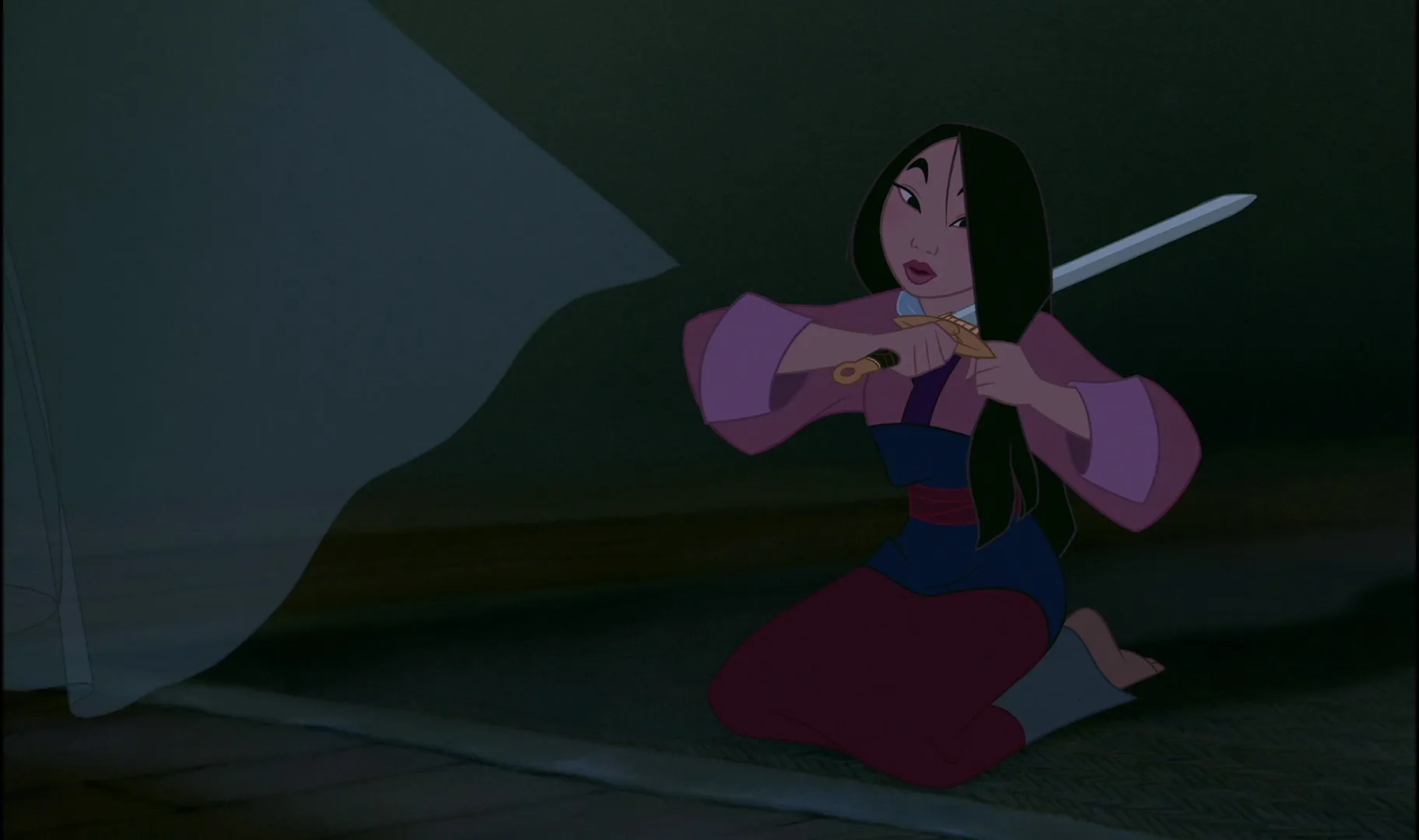
A central topic in this film is gender and the way society portrays it. The gender roles of the depicted time period and culture are made evident early on; women are expected to become wives, while men are expected to be warriors. Mulan challenges these standards by posing as a man so she could fight in the Imperial Army. In the scene titled, “Becoming a Warrior”, Mulan alters her appearance by cutting her hair, wearing armor that broadens her figure, and binding her breasts, which is revealed later in the film. This shows the emphasis that is placed on appearance when distinguishing between genders. Moreover, it demonstrates that gender is both culturally implemented and fluid. Through these minimal changes, Mulan was able to pass as a man and conceal her femininity, despite being raised within rigid gender roles. This film succeeds in showing the importance of discovering and embracing one’s identity, even if that entails defying societal gender norms. 

A snapshot of Mulan cutting her hair from the scene “Becoming a Warrior” (link: https://www.youtube.com/watch?v=4Magj6z-Ex8 ).

Another idea that the film Mulan explores is gender roles in terms of sexuality. The strict and traditional gender norms of this society are also present within their romantic relationships. Heterosexual, cis-gendered relationships are the only ones present, and the notion of a dominant male with a submissive woman is emphasized. For example, in the song “A Girl Worth Fighting For”, the male soldiers discuss their ideal wife and claim that their motivation for fighting derives from the desire to obtain a partner who fits these submissive standards. Even though each man has different requirements, they all agree that they want a partner who will praise them and think they “have no flaws”. All while failing to consider other attributes, such as the intellectual capacities and ambitions of their future wives. Through this, the film reinforces the power dynamic and ideals of a heterosexual relationship. It appoints the man as the authority figure capable of molding his partner and the woman as the subordinate with no noteworthy characteristics beyond her ability to please her husband.

“A Girl Worth Fighting For” with Lyrics

Possibly the most complex reference to gender and sexuality in this film is the portrayal of the relationship between Mulan and her love interest, Li Shang. Their connection slowly develops throughout the movie; however, it begins while Mulan is disguised as a male soldier. Some argue that their bond is purely platonic until her true identity is revealed. While others argue that there is underlying sexual chemistry from the start, thus indicating a dynamic outside of heterosexual norms. Many overlook the intricacy of this trope because the audience is aware that it is a relationship between a man and a woman, despite Mulan’s misleading appearance. The creators of Mulan include Li Shang’s homosexual attraction towards Mulan’s male persona, recognizing that it would avoid controversy and be perceived as heteronormative. 

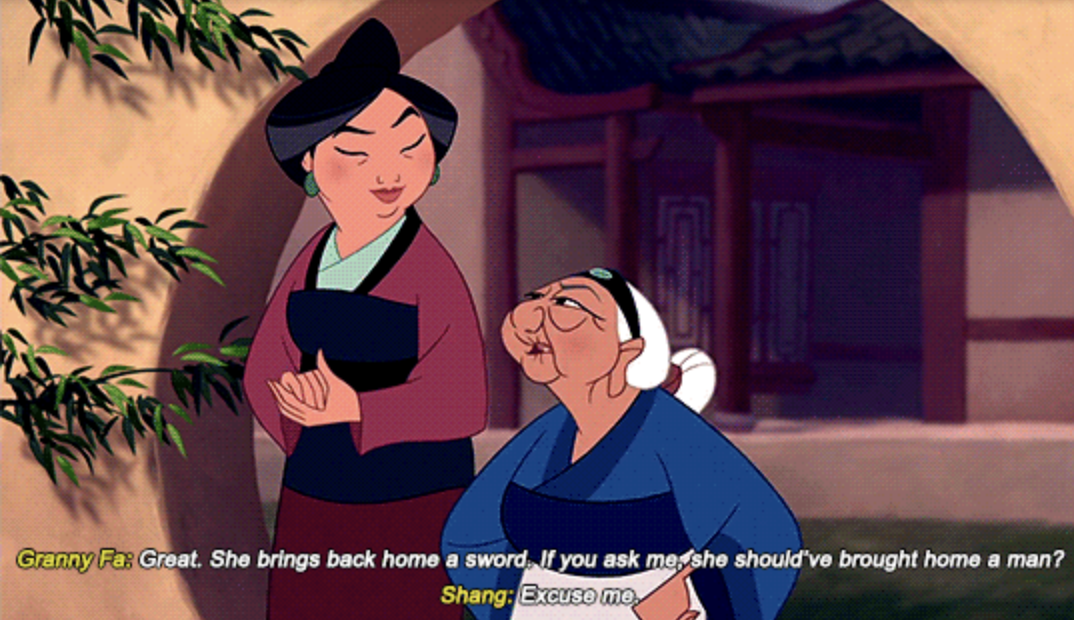
Another way to analyze the romantic storyline of this movie is how it affects Mulan’s nonconforming narrative. Mulan is raised within a society where her only role is to become a wife; instead, she challenges these norms by excelling in battle, a traditionally male-dominated realm. She goes through extensive efforts to carve her own path and reject the expectations of her culture, yet her conquest ends with a typical “fairytale ending”. In film’s closing scene, Mulan’s grandmother, Grandmother Fa, states, “Great. She brings home a sword. If you ask me, she should’ve brought home a man.” Shortly after Grandmother Fa’s line, Li Shang appears at Mulan’s home, implying the continuation of the relationship between Mulan and him. This scene not only undermines Mulan’s accomplishments as an individual, but it also fortifies the traditional gender roles that the movie claimed to oppose.  

A snapshot of Grandmother Fa’s line from the closing scene. 

The film Mulan can be considered as socially progressive and inspirational to its young female audience, due to its message that girls can accomplish the same feats as boys. However, it falls short of successfully defying societal norms. The consequence of this failure is that it validates the temporary nonconformity of an individual with the expectation that they will revert back to societal standards, such as participating in a heteronormative relationship.

Feminism and Fierce Sexuality: The Real Talk Behind Ginny & Georgia

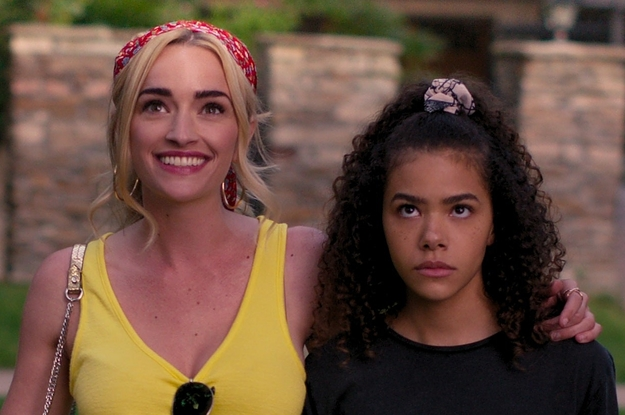
The Netflix series Ginny & Georgia follows the complicated relationship between 15-year-old biracial teen Ginny Miller and her free-spirited, thirty-something mother, Georgia, as they settle in a picturesque New England town after years of being on the run. The show delves into themes of identity, family secrets, and social dynamics as both Ginny and Georgia search for their place in the world. Ginny grapples with her sense of belonging, wrestling with issues of race and the pressures of adolescence, while Georgia is determined to secure a better future for her family by any means necessary, even resorting to murder on various occasions. Beneath its surface drama, the series also offers an exploration of feminism and sexuality, highlighting how both characters challenge or conform to societal expectations around gender roles.

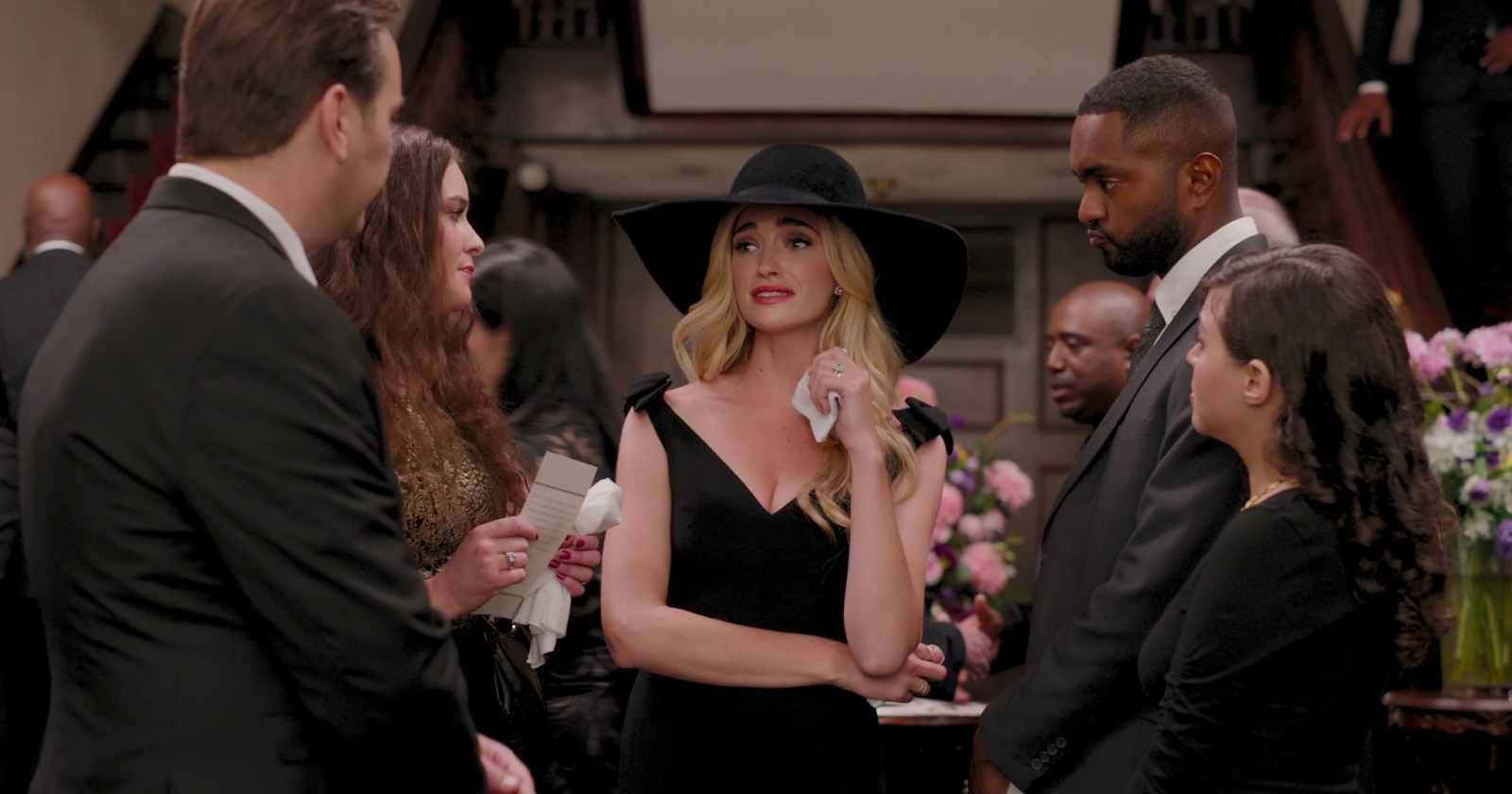
One of the show’s central themes is how both characters confront and challenge societal expectations of femininity and womanhood. Georgia embodies a pragmatic, survival-driven form of feminism, using her femininity and sexuality as tools to navigate a patriarchal world. While her methods are morally complex—sometimes involving manipulation or unethical decisions—Georgia’s actions reflect the reality of a single mother who has faced abuse and poverty. In the show, after witnessing her older, wealthy husband Kenny sexually assault Ginny, Georgia poisons him with wolfsbane in his protein shake. As he is on his way to work, he goes into cardiac arrest mimicking a heart attack. Georgia plays the poor, helpless widow at the funeral and later takes the inheritance to start a new life with her family. Her ability to use her circumstances to protect her family demonstrates a form of agency that can be seen as feminist, even as it challenges conventional ideas of empowerment. In society, feminism is often misconstrued as opposing traditional roles like being a family woman, while womanhood and motherhood are generally viewed as making women dependent on their male counterparts. As a young, single mother, Georgia defies traditional views on motherhood, embodying a fiercely protective, self-sufficient, and self-sacrificing matriarch. Her complicated morality, especially when she resorts to questionable means to safeguard her family, raises questions about what it means to be a feminist mother, blurring the lines between survival, empowerment, and ensuring her children do not face the same gendered oppressions she has.

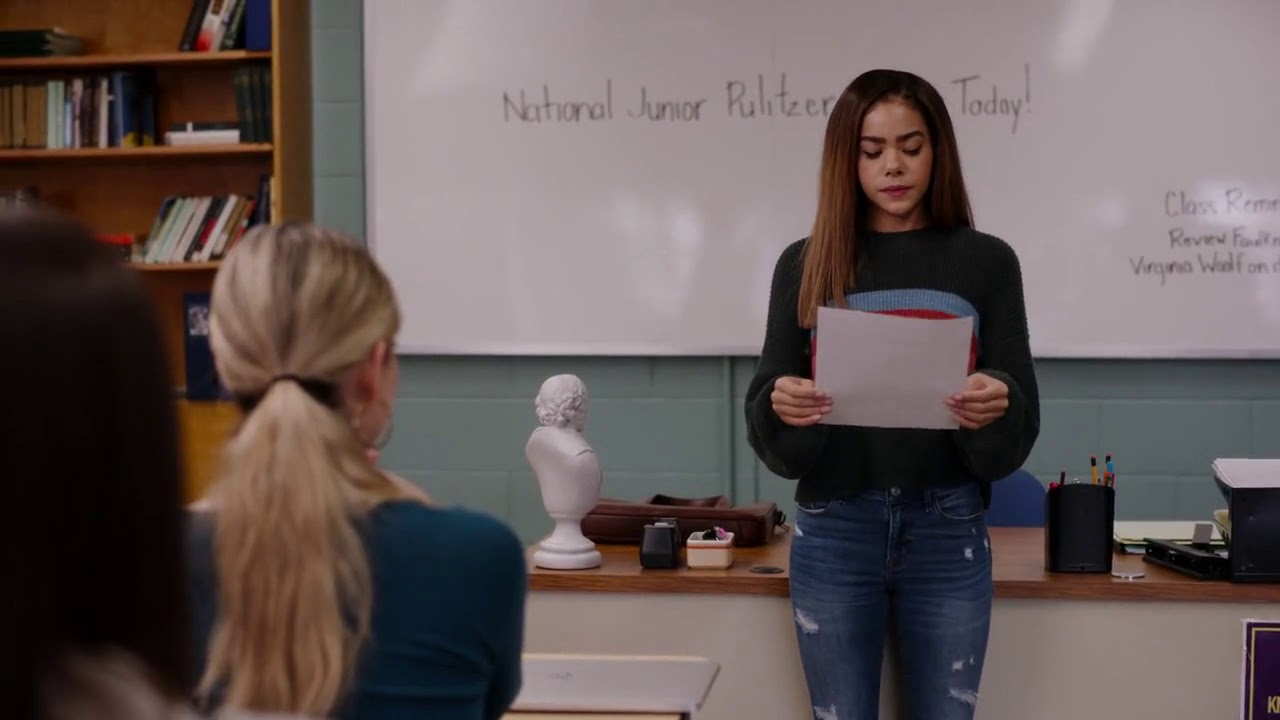
Ginny reflects a more intersectional form of feminism. As a biracial teenager, she navigates the complexities of race, identity, and gender, with her feminism shaped by a growing awareness of social justice issues. Ginny’s journey is deeply intertwined with her struggles for self-expression and navigating the intersections of privilege and oppression. Her experiences offer a lens into the challenges that young women today face as they navigate their evolving sense of self within societal expectations. The biracial daughter of Georgia (a white woman) and Zion (a Black man), Ginny often feels like she does not fully belong in either the Black or white community. Georgia, despite her own struggles, represents a kind of privilege Ginny feels disconnected from. Ginny’s internal conflict around race becomes evident when she critiques Georgia for not understanding what it is like to be a person of color. Her relationship with Zion adds further tension, as he encourages her to more fully embrace her Black identity, leaving Ginny torn between the worlds of her two parents. The show explores code-switching as Ginny tries to navigate her biracial identity, feeling out of place among her white peers who dismiss or fetishize her Blackness, while also feeling distanced from the Black community due to her lighter skin and upbringing in white spaces. To highlight this, the show has Ginny straighten her hair as a symbol of her conformity to her predominantly white upbringing and high school environment. Further, in the scene depicted above, Ginny’s teacher praises her essay stating that it “speaks to her lived experience.” This moment highlights how Ginny feels tokenized and singled out because of her race, which leads to her outburst about being more than her skin color or background. The rest of the show goes deeper into how Ginny learns to express her identity authentically, challenging the societal norms that impose strict definitions of race and womanhood.

Both Ginny and Georgia also explore their sexualities in ways that reflect their generational differences and personal circumstances. Georgia’s use of her sexuality to manipulate men for protection and advancement brings up questions about the intersection of sexuality and power. While her actions could reinforce stereotypes of women using sex for gain, the show frames her choices as a form of survival in a world that often exploits women’s bodies and desires. Through flashbacks in the show, it is revealed that Georgia marries several wealthy men as a way to gain financial security. Georgia shows that she is conscious of the benefits her sexuality and charm bring to her by using them as tools for survival and upward mobility. Of note, her most recent love interest Paul is the mayor of the town she recently moved to. Georgia seduces him knowing that a powerful figure like him would provide security and social standing in their town. Georgia’s use of sexuality can thus be seen as both empowering and problematic, as it simultaneously challenges and reinforces harmful stereotypes about women and sex.

Ginny, on the other hand, experiences her sexual identity as typical of many teenagers, marked by confusion, experimentation, and self-discovery. In the media, young girls exploring their sexuality are often portrayed as engaging in dangerous or morally wrong behavior, typically accompanied by negative consequences. They are frequently criticized and shamed for their actions, while young boys are celebrated and glorified for engaging in similar behaviors. Simultaneously, the exploration of sexuality at a young age has become more normalized, and those who choose not to participate in it are often viewed as unusual or out of step with societal expectations. Ginny’s relationships with Marcus and Hunter, her two main love interests in the show, reflect the fluidity of sexual identity in contemporary discourse, while showcasing different dynamics of teenage relationships, including emotional intimacy and issues of consent and power. Ginny and Marcus, both sexually inexperienced, quickly form a deep connection, which they solidify physically early on. Their relationship remains secret for much of the first season, but when it eventually comes to light, it becomes the center of high school gossip, with people fixating on the drama and misunderstandings surrounding them. With Hunter, Ginny also faces criticism. While Hunter is well-liked and praised by many, Ginny struggles internally, feeling as though their relationship is not entirely authentic. She often questions whether she is with Hunter because it is what she is “supposed” to do. Overall, both relationships reflect different pressures young girls feel as they try to figure out who they are sexually.

Can a Girlboss really be a Tradwife?

Growing up my own mother was a stay-at-home mom and she worked incredibly hard. More importantly, she chose that lifestyle when she and my dad decided to have children. I am beyond grateful and extraordinarily privileged to have had a mother who was at home when I got home from school, around to take me to sports practices, and take care of me when I was sick.

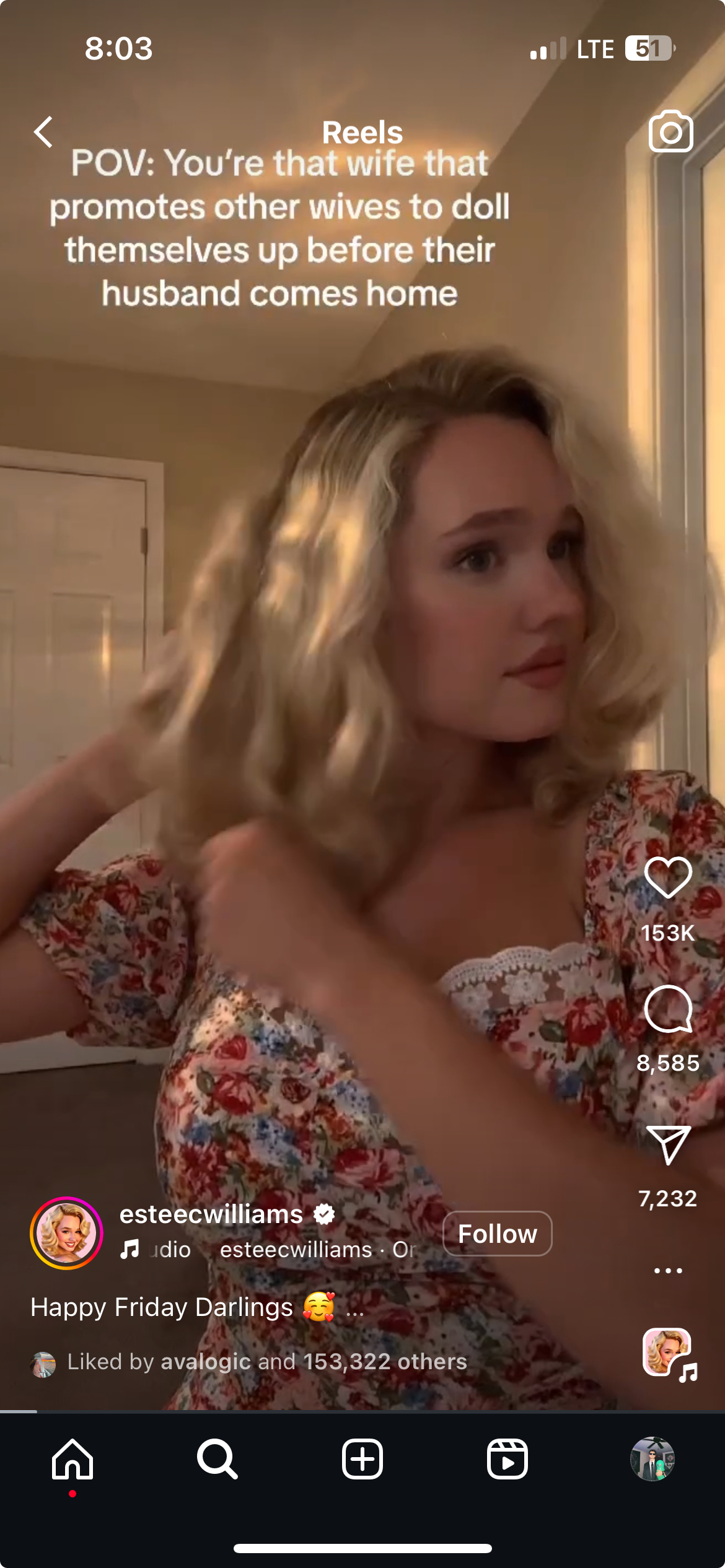
Picture of a social media tradwife, posting for her followers

According to Google, a “tradwife (a neologism for traditional wife or traditional housewife) is a woman who believes in and practices traditional gender roles and marriages.” Traditional refers to performing actions like women did in the 20th century, when they were seen primarily as caretakers and cooks for the family.

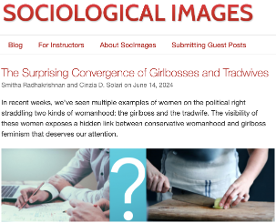
This view seems to be backwards from the modern 21st century view on what women are capable of doing both as mothers and as professionals. In no way do I think that it is bad or wrong to want to be a tradwife but, there is one issue I have with them and that is what the article The Surprising Convergence of Girlbosses and Tradwives aims to convey.

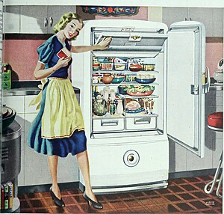
Example of the style of women tradwives are attempting to replicate

This article links the tradwife to the girlboss, which is a woman who is hyperfocused on her career. You might be asking how would a tradwife, a woman who is primarily taking care of her husband, children, and house, also be able to be a girlboss? Well, like my introduction to tradwives, many opt to film their tasks or thoughts and post them on social media. The article states that being a tradwife in modern society is nothing like the 20th century lifestyle.


“We might assume that tradwives hearken back to an earlier “backward” mode of femininity and marriage. But this way of being in the world is unmistakably modern because it involves “choice” and entrepreneurship. It is not enough for a tradwife to simply focus on her husband and kids, she must be entrepreneurial about it. She must blog about it, vlog about it, become an influencer. This is where the “girlboss” mentality comes in.”

(The Surprising Convergence of Girlbosses and Tradwives 2024)

The quote above highlights another aspect where modern tradwives are problematic. As soon as a tradwife becomes an influencer, her main objective has moved from caring for a family to influencing their following and pushing their ideals onto others. Because these women chose to utilize social media and display to the world their ideal way of life, they are using their influence as a powerful tool. They still attempt to attain the unrealistic beauty standards that are concurrent with the “backward” mode of femininity, yet they feel the need to post about it on social media as well. Social media tradwives, like the one in the screenshot before, preach putting family above all else, but at what point does the necessity to cater to a following dictate the actions of an influencer? Moreover, the need to both be entrepreneurs and caretakers and mothers takes away crucial time and energy necessary for each role. Being a social media influencer takes the demands of a full-time job by having to record, re-record, edit videos, brainstorm new ideas, etc. To balance those demands with the already strenuous lifestyle of taking care of a family is counterproductive.

I think that this article is a great read for those that care about the portrayals and standards of women in modern society. It highlights the backwards thinking of social media tradwives, who inherently believe in strong family centric and patriarchal values, but still feel compelled to post their lifestyle on social media. The article dives further into the reasons many women have to become tradwives, especially for women of color. The article cites black tradwives as saying, “we have decided it’s way too exhausting to run the family and corporate America at the same time” (Girlbosses and Tradwives 2024). There is definitely truth to this statement, especially since women of color are valued less in the labor market. For these women, who are paid less and discriminated against in the corporate workplace, the appeal to live as a tradwife is apparent.

Overall, the overlap between tradwife and girlboss is a real phenomenon in the modern age of social media. But when and where is the blurry line drawn between the two labels and at what point do the goals of and priorities of one overtake the other?

“Real” Men: How Toxic Masculinity Factors into HBO’s Euphoria

The HBO series Euphoria often comes up in discussions about contemporary representations of queerness, specifically trans representation, because one of the main characters, Jules, is a trans character played by a trans actress named Hunter Schafer. Jules is one of the few characters I have seen on screen who is a trans person played by a trans actor/actress, instead of a cis person playing someone who is trans or vice versa, so I think that her character deserves all of the recognition she receives. However, the aspect of the show I want to focus on, which is actually intertwined with Jules and her plotline, is the strain of toxic masculinity surrounding queerness that we see portrayed by the Jacobs family: Nate Jacobs and his father, Cal. 

First, Nate. Nate Jacobs is, I think, one of the most complicated characters in the entire show. Upon encountering him for the first time, it’s easy to assume that he is a typical straight man – he is in a hetero relationship with a girl named Maddy, and his preferences in women are detailed, extremely hetero-normative, and in alignment with the typical female beauty standard; slim shoulders, painted nails, full lips, high heels, lack of body hair, et cetera. However, there are aspects of Nate’s sexuality that are hidden from most of the people in his life. Maddy, his girlfriend, finds several explicit photos of male genitalia on his phone, and he also uses a gay dating app where he starts an online relationship with Jules towards the beginning of season one. He uses a pseudonym, “Tyler,” while knowing Jules’ true identity, and Jules sends him nude photographs of herself. 

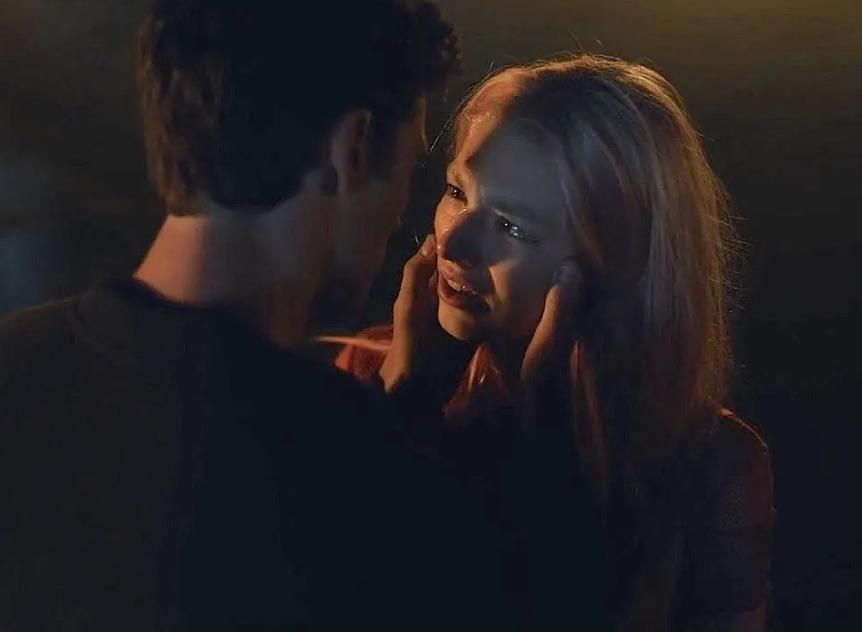
Jules also has sexual relations with Cal, Nate’s dad, in season one, episode one of the show. She told him she was older than she was and he secretly filmed their encounter. When she and Nate finally meet in person two episodes later, Nate blackmails Jules with the nude photos she had sent him, telling her not to tell anyone both about his dad and about their relationship. He is also very aggressive towards her, almost as if his attraction for her angers him because he doesn’t view her as a “real” woman. Jules tells him, “I think you’re a f***ing f*ggot, just like your daddy,” which he responds to by grabbing and yanking on her hair and then storming off.

The above photo is Nate and Jules. This is the scene where Nate reveals his true identity to Jules and blackmails her, and you can see that she’s crying (season 1, episode 4).

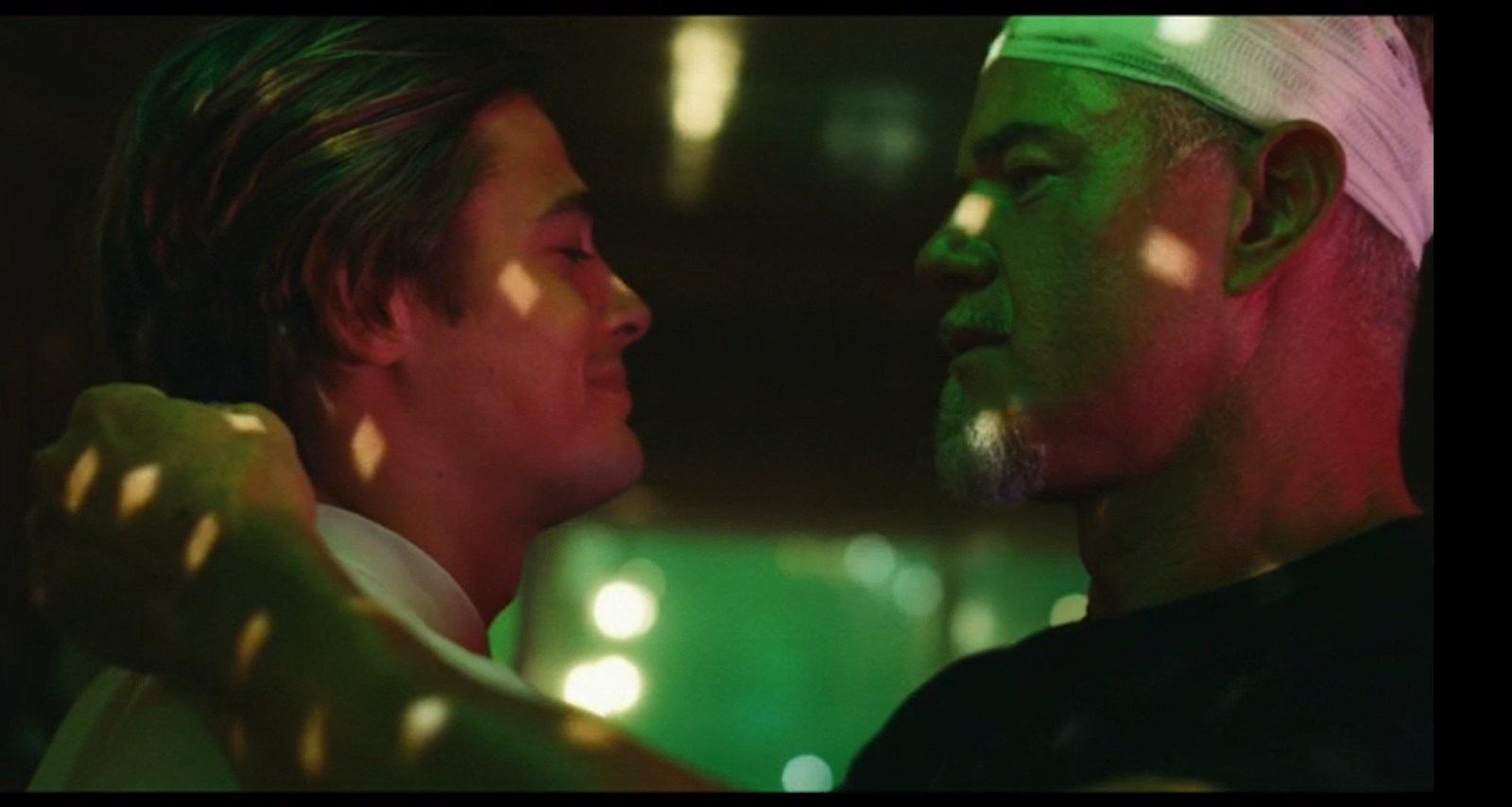
This brings us to Cal Jacobs. In season 2 of the show, the writers delve into Cal’s backstory; most importantly, his relationship with his high school best friend, Derek. Derek and Cal are both on the wrestling team, they spend every day together, and Cal feels like he can “talk to Derek about anything,” or “just sit in silence. They were that close.” On one of the last nights of the summer before they go to college, Derek insists they spend one more fun night together, just the two of them. They drive together to a bar out of town, which has mostly male patrons. Cal notices one of them touch another on the shoulder, and he and Derek down three shots each. Derek then puts a song on the jukebox, “Never Tear Us Apart” by INXS, and they start dancing. It’s friendly and performative at first, but as the song goes on, Derek pulls Cal into a hug, then looks into his eyes and kisses him. They hold each other and we see that Cal is crying. 

The lyrics of the song that’s playing are “Don’t ask me what you know is true – don’t have to tell you, I love your precious heart.”  I think this represents how Cal and Derek feel about each other; there is an unspoken love and mutual understanding between them, and they matter to each other more than anyone else in the world. However, they both feel the pressures of a heteronormative world and they know they can never be together. In the culture of sports, in their families, and during that time (the 1980s), there is an immense amount of pressure to conform to the standard of a straight, cis man who doesn’t often show his emotions. As they embrace, Cal is crying and he nods to Derek, as if to acknowledge the strength of their love but also to acknowledge that there is no way for them to actually be together. 

This is the scene of Derek and Cal’s first kiss (season 2, episode 3)

Later on, in the present day, Cal drives out of town again, very intoxicated, listening to INXS again to remind him of that night many years ago. He returns to the same bar, and heartbreakingly imagines himself dancing with Derek like he did back in high school. 

Present day Cal (on the right) imagining himself dancing with young Derek (on the left). (season 2, episode 4)

There are a lot of parallels between Nate and Cal and their struggles with their sexualities. Nate also plays sports and there are scenes of both of them in locker rooms trying not to look at their male teammates’ bodies, out of shame. The gay bar that Cal returns to is cowboy-themed, and there is a scene of him staring at a mural on the outside of several men in cowboy attire. During one of the scenes in season two, Nate puts on “Dead of Night” by Orville Peck as he drives, an artist who is often referenced as a part of the “gay cowboy” scene. The lyrics of this song are “see the boys as they walk on by, it’s enough to make a young man…” And finally, they both have ties to Jules, who is, of course, a woman, but neither Nate nor his dad view her as a “real woman” because of her transness. Nate’s attraction to Jules causes him a lot of shame. This is possibly why he prescribes himself a long mental checklist of the things he likes and dislikes in women; he is trying to overcome his queerness by forcing himself to conform to the typical standards of a straight man. 

I think that this show is valuable for examining the effects that toxic masculinity and pervasive homophobia can have on men, and also how this dynamic can play out intergenerationally. It is probably true that Nate’s character wouldn’t be so angry or messed up if his dad had been more loving and accepting of him, and if he hadn’t known about his dad’s sexual exploits outside of his marriage. I think both of these characters are extremely toxic and that their actions throughout the show have terrible implications and consequences, but I also think that it was wise of the writers to give some explanation as to why both of them turned out the way they did. We are all products of the societies we are born into and the environment in which we are raised, and understanding this can help to break down and dismantle the effects of toxic masculinity on boys and men and the people around them.

Euphoria’s Jules: Sexual and Gender Empowerment

As a nineteen year old living in America, I enjoy watching different shows and movies that appear on platforms such as Netflix, Disney+, Hulu, Prime Video, etc. I am a huge fan of shows such as Stranger Things, The Boys, Arrow, Never Have I Ever, just to name a few. All of these shows were appealing to me whether it was for the plot of the show, the many different twists, or even the action pack thrill. But one show in particular that I can say has had a huge impact on more than just myself is the HBO groundbreaking show Euphoria. Euphoria, created by Sam Levinson, is an astonishing series that delves into the complexities of adolescence through lenses such as gender and sexuality. The show’s vivid portrayal of these themes reflects contemporary societal issues while also using them to highlight the struggles that the characters face because of them. Jules Vaughn, portrayed by transgender actress Hunter Schafer, is a huge representation of all these different themes throughout the HBO series. Jules’ character challenges traditional norms of gender identity while offering a nuanced perspective on sexual fluidity.


Jules Vaughn

Jules embodies a fluid approach to gender, consistently defying many conventional binary definitions and norms. Things such as her fashion choices, behavior, and many different interactions illustrate a personal journey of self-discovery that transcends societal expectations. The series presents her grappling with her own internal conflicts and external pressures, particularly around femininity. 

Through many of Jules’ relationships, especially hers with Rue Bennett portrayed by actress Zendaya, Jules expresses a desire for authentic connection and love, highlighting that emotional intimacy often supersedes rigid gender roles. Her character challenges stereotypes by presenting gender as a spectrum rather than being a fixed identity. This representation is extremely significant, as it showcases a deep understanding of transgender experiences, struggles and desires, all while encouraging viewers to reconsider the limitations many individuals and social groups have imposed on gender norms and roles. 

Rue Bennett 

Euphoria presents a wide range of sexual identities and uses them to highlight the fluidity and complexity of adolescent sexuality. Different characters throughout the series navigate their desires in certain ways that are able to push boundaries and challenge typical societal norms. One of the main characters Jules, in particular a transgender female, embodies the role of a non-binary sexuality, showcasing the challenges and joys of discovering one’s self and identity in a world that typically demands conformity. Characters like Jules presented me with an idea that topics such as sexuality were going to be growing and explored in public media outlets due to the fact that the series refusing to shy away from many of the darker aspects of sexual exploration, such as manipulation and trauma, as it is shown in many different character’s experiences. 


The series used many different relationships that some viewers would describe as disturbing, to highlight the many different sexual structures and the defiance to conform to what was seen as “normal” In the very first episode of the first season, Jules is meeting up with a man on an online dating site with the screen name “dominant daddy”. It turns out the man was Cal Jacobs, a married man with two sons, with one of them being one of Jules’ classmates. This was very disturbing to watch progress throughout the series as it led into a downward spiral for Cal and the relationship between his family. But I do believe this was the first showing of how much fluidity Jules had in her sexual orientation as it was seen later that season in episode 7, she goes into the city to see one of her good friends and ends up sleeping with a woman named Anna. This helps the series compile the portrayal that Jules’ exploration of her sexuality further complicates her character, unveiling a rich tapestry of desire that includes both men and women. Her bisexuality challenges the binary narratives often seen in media, illustrating that equal attraction can be both diverse and multifaceted. 

Jules’ relationship with Rue served as a critical focal point, illustrating the intertwining of love, vulnerability, and emotional dependency. The series captures the highs and the extremely low lows of their bond, emphasizing the impact of personal struggles such as Rue’s addiction problem and many mental health issues. This relationship helps showcase that sexuality can be deeply intertwined with individual experiences and social contexts, highlighting the complex nature of love and attraction.  

Overall, I believe it can be said that Jules’ character in Euphoria well represented a vital examination of gender and sexuality, challenging the many viewers of the series to embrace complexity and things outside of societal norms. Her journey throughout the series not only represents the challenges faced by transgender individuals but also invites a broader conversation about the diverse nature of sexual identity. By pushing the boundaries of traditional representations, Jules becomes a significant figure in contemporary media, showcasing that media companies are recognizing that times are changing every single day and thus must be represented as well. 

Cancel Culture Knows No Nuances

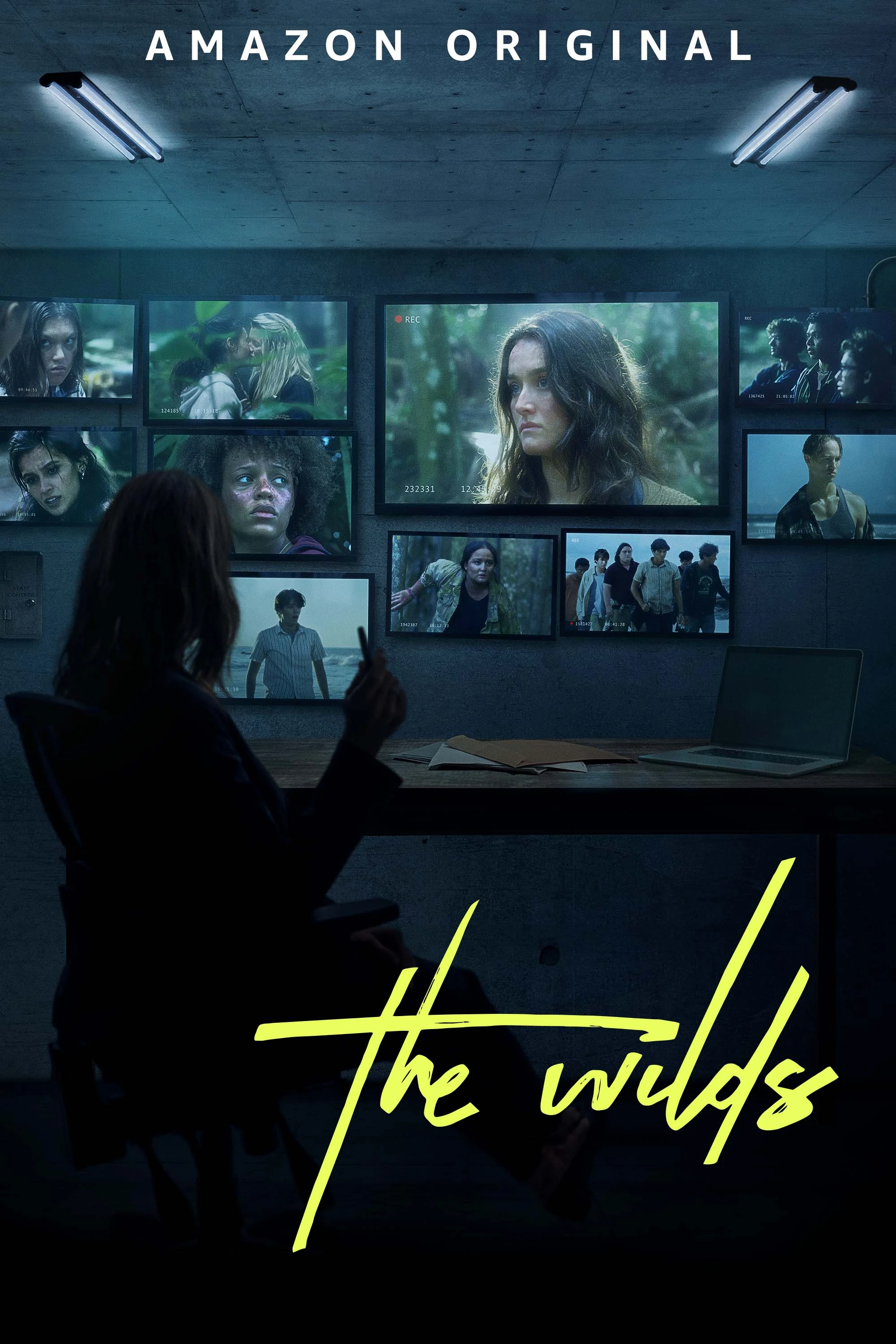
Figure 1. The Wilds Show Cover

The Wilds, an Amazon Prime, 2 season show, created by Sarah Streicher in 2020 follows a group of teens stranded on an island, all of whom have crossed paths in one way or another­ before the stranding–two brothers, two best friends, and 2 sets of students who went to school together. To those who have watched The Wilds, we all know season 2 did not live up to the hype of season 1. However, I think there are still meaningful stories told and dynamics to analyze in the second season. I am choosing to focus on the argument between two main characters, Ivan and Kirin, during their character-focused episode. While the two went to high school together, they ran in entirely different social circles. Kirin was the stereotypical popular, egotistical jock, and Ivan was a proud, witty, gay teen. I believe the selected scene, and their dynamic as a whole, is a commentary on the totality of “cancel culture”, and its modern-day lack of situational consideration. I cannot begin to imagine the struggles and intersectionality of living life as a young, gay, black man, but I will be discussing my understanding of the message as portrayed.

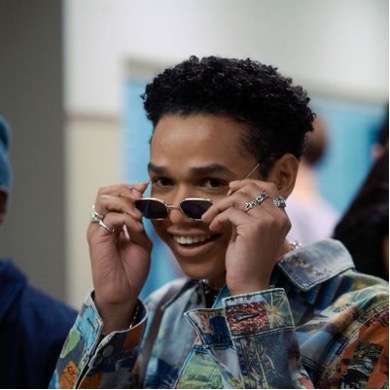
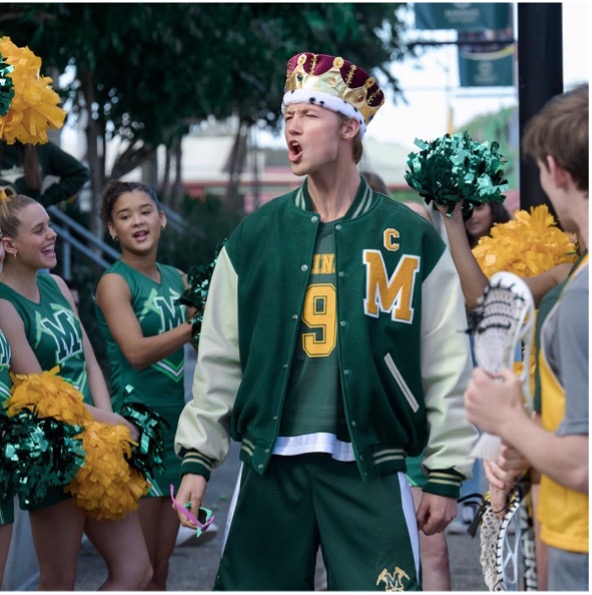
Figure 2. The Wilds Season 2, screenshots from episode 6.
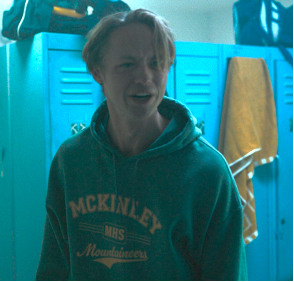
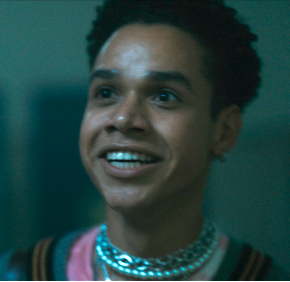
Kirin pictured left; Ivan pictured right.

The conflict begins with Ivan scrolling through the Instagram of Kirin’s lacrosse coach. While deep diving, he uncovers an old photo of the coach doing blackface for a Halloween costume. Ivan exposes this image and gets the coach fired. Ivan is riding the high of being deemed a “hero” and is clearly enjoying the attention he is receiving from exposing the coach. A brief interruption to this buzz, was catching Kirin hugging his coach goodbye and crying, causing Ivan to call him a “sympathizer”.

We don’t know the full story behind Kirin’s relationship with his coach until Ivan and his love interest, Luc, stumble on Kirin sitting alone in the locker room, drinking heavily. Ivan smiles down on him, and begins asking what’s going on, to which Kirin angrily responds that Ivan acts like a know-it-all, who doesn’t know anything about real life. He divulges into how the coach was a father to him, a good man with a wife and kids, someone who took him in when he needed family. Ivan pushes that he protected himself and the school from a bigot. He slowly gets closer to Kirin, with no intentions of defusing the situation but rather aggravating it.

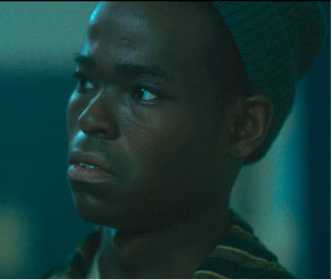
At no point does Kirin actually try to justify the coach’s racist actions, something I think slipped by Ivan, because to him it was an ‘all or nothing’ situation. As Kirin gets increasingly angry, Ivan excitedly pulls out his phone, stating he’s “been waiting for this. The white rage boiling point”. Kirin punches a locker, denying the “white rage” claim. Ivan continually taunts, “you wish that locker had been my face, don’t you?”, with a gleeful expression. The progression of the dialogue in the scene is upsetting and contains the use of a homophobic slur, so to those looking to watch, take this as a trigger warning. Ivan does not stop provoking Kirin and is uncomfortably exhilarated by his increasing anger. I think the following images speak for themselves, as Kirin is in a drunken, emotionally unstable state, Ivan appears gleeful, and Luc looks disturbed by Ivan’s comments.

Figure 3. The Wilds Season 2, screenshots from episode 6. From left to right; Kirin, Ivan, Luc.

Kirin screams at Ivan to shut up and get out, refusing to say the things Ivan is probing him to. The scene comes to a climax after Ivan does not cease tormenting Kirin. He insists on calling him homophobic slurs, to which Kirin finally does. Ivan has all of this on video, which gets Kirin expelled.


This is a heavy scene, leaving all 3 characters hurt and disturbed by what took place. In my analysis, I am in no way trying to justify any acts of racism or homophobia portrayed in this episode. Kirin is not in the right; being drunk, hurt, or having any other extenuating circumstance does not warrant bigotry.

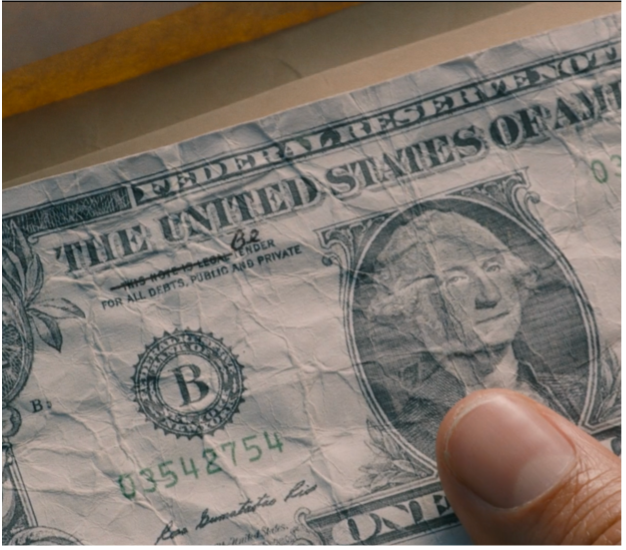
However, I do not believe viewers were supposed to interpret Ivan as being in the right either. The look in Ivan’s eyes as he taunts Kirin is hungry and uncomfortable, he wasn’t an underdog hero who prevented further harm but rather incited it. Kirin and his coach deserved consequences, and they received such, but it is revealed to the viewers that Ivan did too. Luc, so upset by the situation, breaks it off with him. He leaves Ivan with the message “Be tender” on a dollar bill he owed him.

Figure 4. The Wilds Season 2, screenshot from episode 6. “Be tender”.

I believe this goodbye sentiment supports the message that Ivan was overtly cruel, likely out of fear. As a young, gay, black man, much of the world is out to get him. His fear is understandable, trying to protect himself offensively, rather than leave himself vulnerable to attack. His fear and defensiveness causes him to not just encounter enemies but to make them out of strangers. Kirin had no right to say slurs, but he truly did not seem to do it out of a real hatred for gay or black people–it was borderline coercion. In reality, Kirin was hurting and Ivan was too. To Kirin, Ivan was an unsympathetic attention seeker, and to Ivan, Kirin was a sympathizer and bigot. I believe neither of them was correct, but this episode showed the two imperfect characters at incredibly low moments in their lives.

This is where I believe the show can be extended to a larger metaphor about the world. “Cancel culture”, while at times truly does give harmful people the consequences they deserve, has also become bloodthirsty. There is no black and white in the way society “cancels” people nowadays. Someone is good, until they inevitably mess up, and then they are irredeemably bad. The general media shows no mercy, nor the ability to portray someone as simply human, i.e., flawed.

Ivan felt that he was protecting his community by canceling the enemy he saw in Kirin. What he didn’t see was the nuances of the situation. Kirin didn’t say his coach shouldn’t be punished for blackface, and was, not so eloquently, expressing the massive grief he felt at losing another father figure. It is possible for his coach to have been a loving person to Kirin, while also being incredibly ignorant and insensitive to the impact of his actions. It is important to understand that situations are not so cut and dry. Someone could get canceled over a viral video that makes them out to be a horrible person, when in reality, we caught a glimpse into one of the worst days of someone’s life. I believe most of us could only hope to be shown grace, were we to mess up during one of our lowest moments.

Through this character pairing of Ivan and Kirin, The Wilds, portrays how quickly fear can devolve into violence. Kirin could not understand the root of Ivan’s defensive demeanor– someone who will be faced with hate and prejudice his whole life. Similarly, Ivan could not see where Kirin was coming from due to his preconceived notions about him. While this depiction was a hard watch, and deeply sad from multiple angles, the creators very masterfully challenged our usual assumptions about a protagonist and antagonist. You’d think with a white, straight jock versus a black, queer character, it’s not difficult to assume who is the hero and who is the villain of the scene. However, the show writers didn’t allow for such an easy interpretation. It is an uncomfortable position for a viewer to not know who is right or wrong.

Nowadays, there is a level of overcompensation when trying to be politically correct, in order to avoid the mob mentality of “cancel culture”. That’s not to say society didn’t need to advance its sensitivity and empathy towards others, but one must think critically and look for a larger picture before pointing a finger and slapping a label on someone. Humans will make mistakes, especially young ones, and deeming them an abhorrent person dismisses a chance to better themselves and learn. Ivan and Kirin eventually make amends, and show how capable of growth and compassion they are. Rather than crucify all who make mistakes, people should be allowed an opportunity to become a more understanding, educated, and loving person. 

Big Hero 6 Spin Off Takes a Big Step 

I am a disney fan, as a lot of people I know are. I love the kid friendly content that also sometimes has adult humor mixed in; the cute sidekicks and comic relief; and so many heartwarming stories about love, friendship, and finding yourself. However, there is one thing Disney has always lacked. Take a look at some of their most beloved characters and couples, and see if anything stands out to you. 

Rapunzel and Flynn Rider from Disney’s Tangled
Ariel and Eric from Disney’s The Little Mermaid
Cinderella and Prince Charming from Disney’s Cinderella
Anna and Elsa from Disney’s Frozen
Belle from Disney’s Beauty and the Beast

All white, cis gender, unrealistically skinny, and straight. Granted, the company as a whole has come a very long way but they have long struggled with diversity and inclusion. The majority of notable and big role human characters, specifically princesses, are still predominantly white, all have the same (very skinny and oddly proportioned) body type, and there still has not been a big film that features a non straight romance. 

As I was pursuing Disney Plus, I came across a show that I had seen mentioned on tik tok, being either applauded or berated for a few scenes it included. The show is called “Baymax!”, created by writer Don Hall, and it features six short episodes around ten minutes each of the adorable healthcare robot Baymax, famously from the movie “Big Hero Six ”, helping different people in their respective predicaments. As I was watching the third episode, I was shocked. The third episode follows a 12 year old girl named Sofia through her day at school, when suddenly, she gets her first period. Baymax the robot comes into the bathroom to help her and explains that what she is experiencing is completely normal, and then he offers to go to the store to get her some menstrual products. First of all, it is completely unheard of for Disney to be openly talking about periods, which have historically been a taboo topic. For them to base a whole episode on the subject of menstruation shows big progress. When Baymax is talking to the frazzled Sofia, he says, “It is common for people to feel embarrassed, fearful, or uncomfortable, with the subject of menstruation. But it is just biology. It is nothing to be ashamed of.” This quote is so refreshing, because talking about periods has become a thing to avoid doing. It has often become something used to shame or embarrass women, instead of something that should be normalized and even empowering. Having even just a short spin off episode on this subject is a huge step in the right direction for Disney. 

 Even more huge progress is shown in Disney’s diversity and inclusion in the scene when Baymax is at the store in the pad and tampon aisle. Baymax is confused on what product to buy so he asks a woman near him for help. Once she offers her suggestion, lots of different people start chiming in letting the robot know which products they recommend. One of the people to chime in is a man wearing a shirt that is striped with the colors of the transgender flag, and he lets Baymax know that he prefers the pads with wings. 

Image from the scene

While the scene is only about 20 seconds long. It is the first time Disney has had a trans person in their content. The casualness of the scene shows the progress even more, because it simply shows a trans man doing a mundane task, the attention is never directly surrounding his trans-ness, and it shouldn’t be, because it should be accepted that men can have periods too. For those of you that don’t have Disney +, here is a link to the short scene:Baymax goes Shopping for Tampons. 

This episode, but especially this scene, caused immense outrage among some viewers, being labeled as “woke nonsense” by our very own Republican North Carolina Congressman Dan Bishop. Many parents also expressed their anger by tweeting about how this scene would make their kids uncomfortable and asking what the reason for this scene was:

The truth is, the audience for this show is kids. It is a PG rated show, meaning that kids probably as young as toddler age are watching this. Toddlers are not going to watch this scene and shout about how disturbed they are that a man is buying pads. Toddlers are going to watch this show and laugh at the adorably hilarious robot, and wish that he was there to help them with their medical needs. If a child is uncomfortable watching this scene, it is because they have been taught that it is wrong to speak about your body, and that it is right to judge what other people are doing with theirs. 

While Disney obviously still has a long way to go, this small mini series is a big step in the right direction in terms of recreating and redirecting the conversation around gender, sexuality, bodily autonomy, and inclusion, especially for young kids. 

(This is a post text side note: I highly recommend watching the rest of the series of “Baymax!”. It is adorable and heart warming and also includes an episode (episode 4) featuring an absolutely precious gay love story that made me tear up with happiness because it is just so adorable. )

Sex Education’s New Show in Season 3

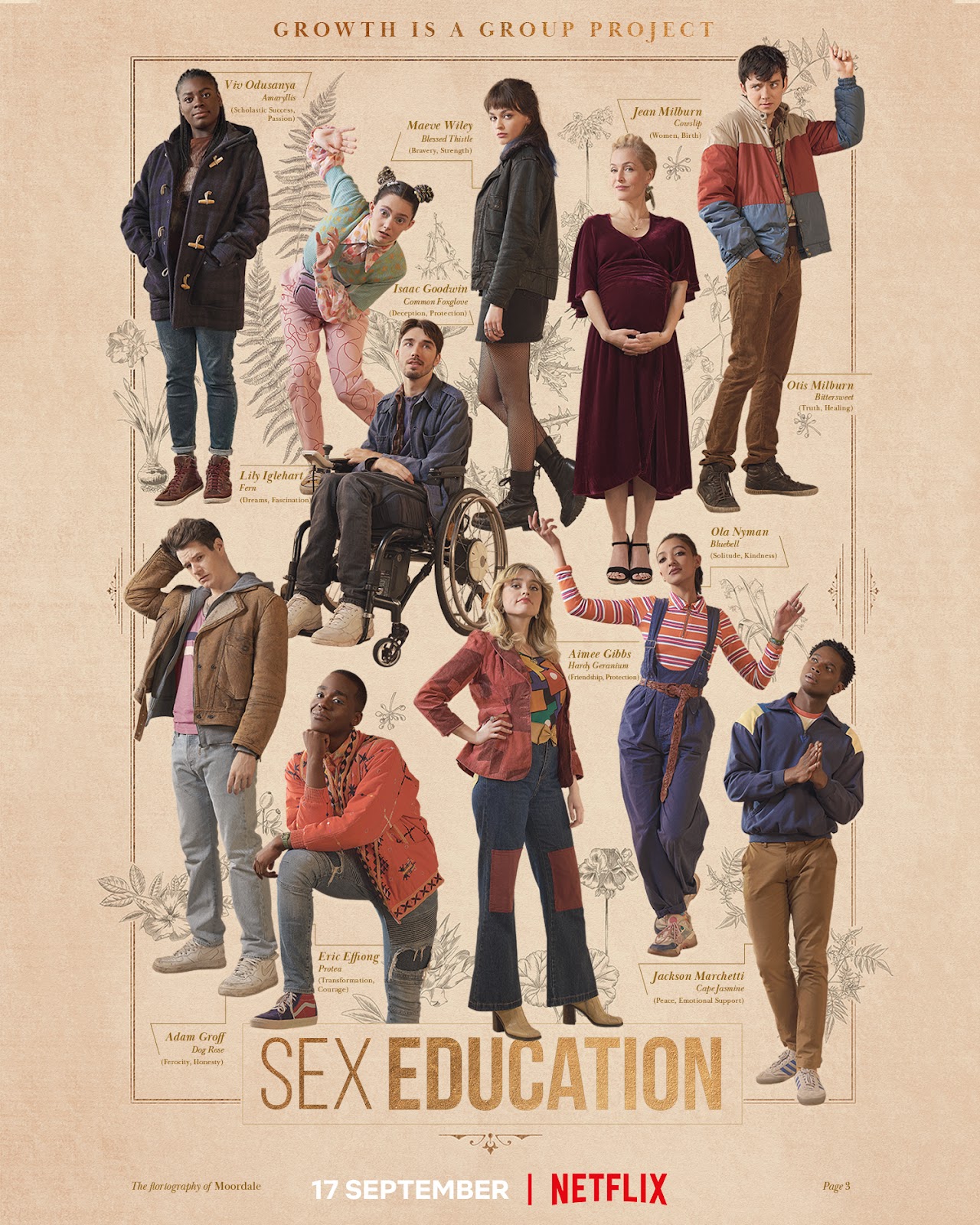
Season 3 | Sex Education Wiki | Fandom
Sex Education’s Season 3 Promotional Poster

I remember waiting for the third season of Sex Education to come out – I was reposting the promotional posters on my story on Instagram and sending it to my friends. When Sex Education finally came out, I was surprised at how different this season was from its previous seasons. Sex Education started as a show navigating the life of Otis, whose mother is a sex therapist. Because of this, Otis has learned the techniques of how to talk to someone. He then tries this at school with an unexpected friend at the time called Maeve. As a result, they both start making this a regular thing after success. Moving on from this, in season 3, the sex therapist students are not quite as much in this picture but are rather dealing with Moordale’s new principal Headmistress Hope who moves Moordale in a backward way, removing self-expression and promoting heterosexuality, while shaming anything different. Cal and Headmistress Hope are two of the new characters this season, and they are complete opposites, to say the least. Hope’s backward idea of how to run a school is a great reason to show why such classes like GSS exist.

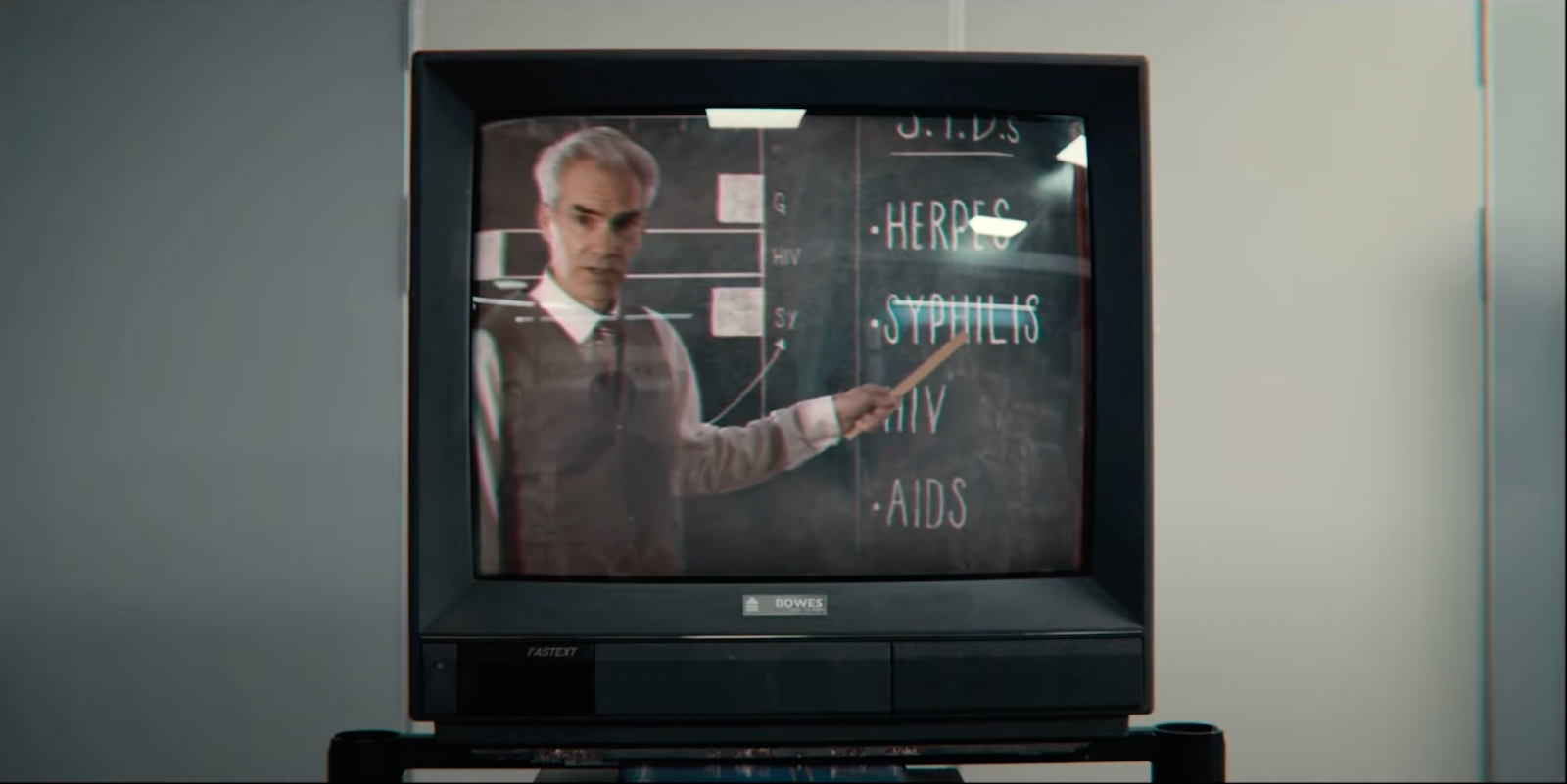
One episode in particular that struck me was a scene from this seasons Ep. 4:

(Video won’t seem to load so here’s the link: https://youtu.be/VGID85R1LTA)

Firstly, this scene I want to talk about in particular. Prior to this scene, Headmistress Hope tells Viv, her student assistant, to tell the people of Moordale to separate themselves into two lines based on their gender. However, because Cal is non-binary, they don’t separate themselves into a line and have an argument with Hope. Cal then goes on to say “So we go to the vagina or penis line? Is that what you’re saying?” This itself shows how bent Hope’s thinking is: there are only two genders and that it depends on your genitalia. For centuries, we have always decided to look at someone’s genitalia and say “They are a boy” or “they are a girl,” and it’s time we step away from this disgusting perspective. 

Sex Education Season 3, Ep. 4. Screenshot from video stated

Focusing more on this scene, the boys get a talk about homophobia and stating that homosexuals have a higher chance of getting an STD. Meanwhile, the girls are getting a talk about how sex is scary and can ruin your life. Maeve, one of the earliest main characters, however, tells the group speaker of the girls group that sex isn’t and shouldn’t be scary. Maeve gives a progressive speech suggesting that students should instead see that sex gives them insight into their body, like what they like, and that girls shouldn’t be the only one getting the talk of “sex is a mistake because it leads to unwanted pregnancy.” This ties into the idea of Foucault where the idea of sex shouldn’t be talked about and that people should be shamed for having these ideas and thoughts. And, further in this episode, the students of Moordale are scared because they’ve been involved in sexual activities prior to this meeting and that their lives could be in danger just because of what they’ve been told. Society makes sex seem as a bad thing and that only bad things will happen if you engage in the act of sex, but nothing will happen if you go about it in a safe direction.

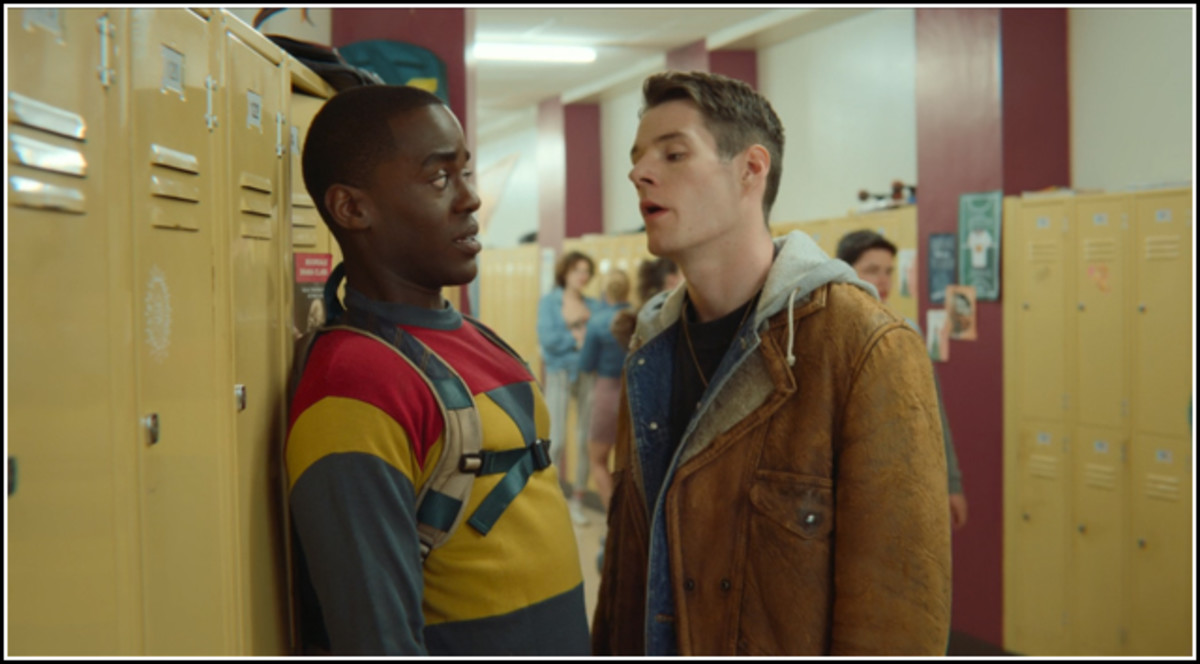
Sex Education" Episode #3.6 (TV Episode 2021) - IMDb
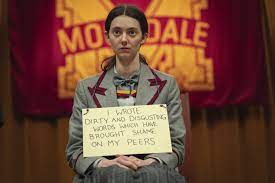
Sex Education Season 3, Ep. 6

Another interesting part of season 3 lies within episode 6. Hope decides to publicly shame students who caused a bad reputation for Moordale. While she shames 3 students, Lily, a student who writes sexual stories about aliens and such things, and Cal in particular are shamed for being themselves. To explain, Cal is told that they are a messy troublemaker when all they have done to “disrespect” Moordale is ask for equity. Cal is constantly reminded by Hope to fit in a certain category by her forcefully putting labels on their gender when they are non-binary, but never lashes out against Hope. For Lily, she is told that she has brought shame to her peers with “dirty and disgusting words,” which comes from Lily’s sexual fantasy stories. Again, especially for teenagers in high school going through puberty, students should not be shamed for having sexual desires. Additionally, the idea of fantasies and fetishes shouldn’t be shamed either. Lily is a great character at showcasing these fantasies and, earlier in the season, Lily used to wear makeup and style her hair to indicate this love for her fantasies. 

Season 3 was something entirely different, but I did enjoy it. It helps show how different people are from one another, and that we shouldn’t be putting others down for having differences or looking different. We should be encouraging these differences and seeing how much more a society could be if individuality was promoted. Sex Education does a great job in this season to showcase this.

Justice to the Closeted Homophobe

Netflix’s hit series Sex Education is one that attempts to address many of the multifaceted aspects of not only sex but the emotions, relationships, and trauma of both teenagers and adults alike. Instead of turning to adults about the multitude of issues regarding going through adolescence, the students of Moorsdale Secondary School seek the unprofessional but shrewd advice of fellow classmate Otis Milburn, son of sex therapist Jean Milburn. In the show, the character of Adam Groff stands out for me particularly. Adam is the son of the principal and a clear embodiment of the jerk jock trope. He is often seen tormenting Eric Effiong, an openly gay black character multiple times throughout the first season. Since the very beginning, it is obvious that Adam has trouble coming to terms with his own sexual orientation as he fails to sense arousal when engaging in intercourse with his then girlfriend Aimee. As the show slowly progresses, we can see Adam’s evolution from the jerk jock to the closeted homophobe trope. Although Hollywood often demonizes these characters from the start to the end, I would like to explore how Sex Education does Adam justice. 

Eric Effiong, being the best friend of Otis Milburn, quickly establishes that he isn’t one of the popular kids at school. Being both black and gay, and not to mention his affinity with drag, his minority status makes him an easy target for any bully. For emotionally and sexually repressed Adam, Eric couldn’t have been a better prey. As the son of the school’s strict principal, Adam fails to meet his father’s expectations in any way except for being a toxic masculine jock. Unable to recognize nor express his own attraction to Eric, he takes it out on Eric physically as a form of frustration relief and sexual expression. 

The closeted homophobe trope isn’t a stranger in Hollywood. While it does give a (most typically) gay man more complexity, it’s morally dubious to portray a large number of gay men as bitter and resentful when reality doesn’t necessarily reflect that situation. Netflix’s show does Adam more justice. Sex Education gives him more complexity. Contrary to many characters whose development reaches a climax without further exploration, Adam’s journey has just started after engaging in oral sex with Eric during detention. He begins to explore his overall identity and passion even more. Contrary to what the typical jock does, Adam begins to pick up dog racing and trains his dogs to do different tricks and stunts. As opposed to his bitter and resentful self in the first season, Adam finds a new passion and begins to smile more as he treads through this journey. It is truly a redemption arc.

It’s worth noting that the series not only does the closeted homophobe justice by giving him further development, but there’s also a lot of backstories given on why he potentially turned out this way. One primary source of influence is his father, Mr. Groff. Originally, I believed that Adam’s constant bullying is an outlet to express his frustrations of never living up to his father’s expectations or not receiving any fatherly love. Headmaster Groff has difficulty loving his family, repressing his emotions so much that he simply doesn’t feel them anymore. It’s not difficult to see who Adam takes after. 

After I talked so much about how the closeted homophobe is given justice in Sex Education, I would still refrain from fully endorsing this trope from appearing in future movies and series. Not only does it misrepresent a large portion of the LGBTQ+ community, an abundance of such character may influence the audience to think that many gay men portray themselves as such. Even when Sex Education gives Adam Groff more complexity, he isn’t yet a fully round character. This may be attributed to the way the directors would like to portray this character, but from my perspective, it is indeed morally questionable. 

It’s also worth speaking about the fact that the actor portraying Adam Groff isn’t gay in real life. Knowing this fact after research, I wonder if the show is taking opportunities away for LGBTQ+ actors. Although the show isn’t intentionally trying to mislead its viewers, having a straight man act as a gay man may destroy some of the authenticity of the experience depicted in the series. This simply reinforces the fact that Hollywood and popular media still has a long way to go in terms of fully representing the world’s people. But then again, an issue with representation that people are fighting for is always good, for if there are no issues, the whole business is one.

Take me to church music music video analysis

I was always aware as a child that I was bisexual. I was aware of homosexuality, which my mother, due to her religious beliefs, would never accept. As a fourth grader, I was aware of how strongly my mother pushed religion on me. Going to church was the most difficult part of my Sundays. “The music isn’t even that good,” I’d complain every time I went. One day while driving, Hozier’s “Take Me to Church” comes on the radio. It was fantastic, in my opinion. I’d sing it everywhere to please my mother, who was overjoyed that I was finally becoming religious. However, one day she tells me to stop singing this song, and when I ask why, she says it has nothing to do with religion, according to the pastor’s daughter, and it contains a horrifying hidden message. 

So, what is the message?

The music video for “Take Me to Church” begins with a bonfire, and the film is presented in black and white. “Fire becomes a signifier connoting danger and aggression, though potentially passion and power” in this opening scene (Caty). The bonfire foreshadows a negative action featured later in the music video. The following frame depicts two men (the main characters) in distress.

As this is happening, the lyrics contend:

[Verse 1]

“My lover’s got humor

She’s the giggle at a funeral

Knows everybody’s disapproval

I should’ve worshiped her sooner

If the Heavens ever did speak.”

In some traditions, humor at a funeral is considered blasphemous. Hozier describes how he “always saw the catholic church’s hypocrisy”(Hozier). The song expresses a desire to worship someone; however, in the Catholic church, worshiping a person is frowned upon because God is believed to be the only entity praised. We can see the rebellious ideologies against the Catholic Church in these lyrics. 

“I was born sick, but I love it

Command me to be well

A-, Amen, Amen, Amen”

Hozier continues his song by demonstrating how homosexuality is considered sinful by many religions: he mentions being born sick but loving it, implying his forbidden homosexual love. He is bringing awareness to millions of people who have concealed their identity and sexuality, leading many to live a double life or even commit suicide, through these lyrics.

[Chorus]

Take me to church

I’ll worship like a dog at the shrine of your lies

I’ll tell you my sins so you can sharpen your knife

Offer me my deathless death

Good God, let me give you my life

Take me to church

I’ll worship like a dog at the shrine of your lies

I’ll tell you my sins so you can sharpen your knife

Offer me my deathless death

Good God, let me give you my life

The chorus conveys a variety of messages, clarifies his admissions of wrongdoing, and reiterates his homosexuality. Despite knowing that he is wrong, Hozier wants to continue worshiping and is willing to accept the church’s penalty when he sings, “I’ll worship like a dog at the altar of your falsehoods.” The chorus symbolizes his loathing for his own faults.

  Throughout the music video, close-ups of a chained box held by one of the main actors are shown; he grabs onto this box almost as if it were a part of him. Later in the video, the main character is chased by a group of men dressed in black sweaters. He rushes to hide the chained box, but he is apprehended by this group of men. His partner rushes to find him, but his expression indicates that he is too late. The music video concludes with the chained box being burned. 

Through the frames, the chained box can be seen as a metaphor for the main characters’ hidden love due to their sexuality. The main character tries to conceal the chained box. However, he is stopped by a group of men, indicating that their sexuality is not permitted. In the final scene, a group of men can be seen beating on this box, which represents their hatred of homosexuality.

 Hozier ends his song with: 

That’s a fine-looking high horse

What you got in the stable?

We’ve a lot of starving faithful

That looks tasty

That looks plenty

This is hungry work

Here Hozier interprets “high horse” as describing the appearance if a muscular man. He’s saying that “the church’s high horse looks like an excellent sacrifice”. In other words, Hozier refers high horse to a state of mind of misogynist. This state of mind is followed by many people who are hungry or are in desire of being a part of the church. 

Homosexuality is considered sinful in many religions, including Christianity, where being part of the LGBTQ+ community is frowned upon. The music video for “Take me to Church” by Hozier emphasizes the Catholic church’s discrimination against homosexuality. The active oppression against homosexuality has caused millions of people to conceal their identity and sexuality, leading some to commit suicide or live double lives.  

“Take me to church” was released on September 13, 2013, by Hozier, an Irish musician, singer, and songwriter. “Take me to church” was a big hit that had streamed 82 million times in one year. Although many people assume that he is gay due to the song’s music video, Hozier has never stated his sexuality. Hozier makes a statement saying that many people think that he is gay, “which is fine” to him; however, he doesn’t believe that’s a factor whenever it comes to relationships and love. Hozier centered the idea around homosexuality to “reference something that was going on in Russia.” Hozier states that there was much anti-gay propaganda “passed in parliament” that “prohibited the LGBT community from advocating for their rights in public places”(Canty). There were a series of attacks in Russia as homosexuality was compared to pedophilia and bestiality that led to “an increase of attacks by far-right gangs.”(Canty)

To this day, “Take me to Church” is one of Hozier’s biggest hits. However, this brought much negative attention from both the media and the people. Hozier received “a few delightful letters from pastors who have some choice words to say,”; implying the oppositions pastors had with his music. Although many people disagree, Hozier also has a solid support of fans. He explains how he was “jarred by people’s excitement at seeing” he talks and how “most of the phone calls were very sweet”(Kenney). 

The “Take me to church” music video is an excellent example of different oppressions currently happening to people of the LGBTQ+ community. To summarize the video, Hozier uses various lenses to indicate the darkness seen with homosexuality. He uses a black-and-white frame structure that is seen not only in the background but in the character’s clothing. “Take me to church also” addresses discrimination against sexuality by building an emotional connection with the two main characters, stripped back by the lack of names, speech, and color, creating a clear, simplified message. Hozier brings awareness towards sexuality, specifically homosexuality, so we can see oppression happening to these characters. Hozier used the power of his race and fame to bring awareness towards past and present marginalization in the LGBTQ+ community.


Work Cited 

Canty, Brendan, director. Take Me to Church. YouTube, YouTube, 25 Mar. 2014, https://www.youtube.com/watch?v=PVjiKRfKpPI. Accessed 7 Oct. 2022. 

Kenney, Els. “The Meaning behind ‘Take Me to Church’.” Medium, Late Space, 4 Aug. 2020, https://medium.com/thelatespace/hoziers-take-me-to-church-b27663bc516f. 

“Take Me to Church by Hozier.” Genius, https://genius.com/albums/Hozier/Take-me-to-church.