Insatiable: The Complex Commentary on Body Image for Young Women

Poster for Insatiable

Growing up, we are often told what to do with our bodies – women especially. We are told how to dress, act, speak, and eat. This message comes from many sources, including our parents, social media, and movies/TV shows. One TV show that communicates these social norms to teen girls is Insatiable. It shows women in a negative light in a variety of ways. Fat women are unhappy, inhuman and undesirable; skinny women are manipulative and willing to do anything for a man. Another message communicated by Insatiable is that, for women, romantic relationships with men are more valuable than female friendships.

Insatiable follows a high school student named Patty Bladell, played by Debby Ryan – a former Disney channel star, who already has a large following of pre-teen girls. Patty spends much of her life struggling with her weight until she breaks her jaw and is forced to go onto a liquid diet that causes her to lose 70 lbs. Once she becomes skinny everyone starts paying attention to her, including Bob Armstrong, a local lawyer and beauty pageant coach. 

Debby Ryan as “Fatty Patty” vs. “Sexy Patty”

Insatiable reinforces the idea that there is a wrong way for women’s bodies to be—fat and unhealthy—and a right way for women’s bodies to be—skinny, pretty, young, and sexy. Regardless of their weight, all women’s bodies are objectified, showing their power and agency coming from external factors such as appearance. Fat women are portrayed as unhealthy and undesirable; skinny women are portrayed as selfish and boy obsessed. 

These messages are communicated through scenes involving “Fatty Patty” and “Sexy Patty.” The scenes involving Fatty Patty alway portray fatness in a negative light. She is seen binge eating at home on a Friday night with her best friend instead of going to a football game. She says, “So, while my classmates were out losing their virginity, I was at home, stuffing another hole…” (“Pilot” 1:002 ). That links being sexually desirable and active to being skinny. It also denigrates a strong female friendship and places more value on heterosexual relations. There are also several instances when Patty is compared to a pig. Someone pasted a photo of her face taped to a pig on her locker, and she received the comment, “Smells like bacon,” (“Pilot” 2:34) from skinny girls. This is comparing Patty to an animal and dehumanizing her. Pigs are known for being dirty animals so comparing her to one conveys the message that being fat is “dirty.” Being fat is also associated with being unhealthy. When Patty starts her laps in gym class, she passes out after 15 seconds. Throughout the episode, flashbacks of Debby Ryan in a fat suit reminds the audience how bad Patty’s life was when she was fat. It instills the idea that being fat is undesirable, dirty and unhealthy within younger and teenage girls.

Just as Fatty Patty is used here as a cautionary tale, Sexy Patty is used to show how women use their sexuality to attain their end goal: men. Patty’s main goal is to get with Bob Armstrong, who is an older, married man and an accused child molester. Rather than being cautious, she makes light of this by saying, “Which means I might actually have a shot [at being with him]” (“Pilot” 12:35). Patty goes to great lengths to achieve her goal. Now that she is skinny she understands that she can use her sexuality as a tool to achieve this. Patty seduces a clerk at a convenience store to get him to commit a felony on her and Bob’s behalf. Patty also harms other women to achieve her goal. When Patty and Bob’s wife, Coralee, first meet, Patty calls Coralee “A shrew” (“Pilot” 20:45). Then, Patty says, “I was already driving a wedge between them. Long Island Lolita would have been proud” (“Pilot” 20:50). This is an allusion to Amy Fisher who had an affair with Joey Buttafuco when she was 16 and he was 38. Fisher shot Buttafuco’s wife in the hope she would be able to be with Joey. Coralee also objectifies Patty, based on her appearance. She tells Bob, “She looks like an underage hooker” (“Pilot” 20:15) immediately focusing on Patty’s sexual appearance. 

The title of this show, Insatiable, has multiple meanings. Patty is always hungry and wants to eat, but cannot eat everything she wants due to the fear she will get fat again  (which apparently is the worst thing imaginable). Insatiable also refers to women being hungry for power, often with the ultimate goal of being with men.

While Insatiable can be seen as a parody, the images and messages about women, their bodies, and how they achieve agency (or not) are pervasive. Even though these messages are ostensibly being ridiculed, the intended audience of pre-teen girls may not realize that much of it is satire. Insatiable is “funny” but its humor is based on negative ideas and stereotypes that are harmful to women, especially young viewers who don’t have a well-developed lens of media literacy and who will not understand that this is a parody not a guidebook on how women should behave.

Citations: “Pilot.” Insatiable, created by Lauren Gussis, season 1, episode 1, Netflix, 2018.
University of Alabama Rush TikTok and the Perpetuation of the Perfect Southern Girl

Every August over two thousand college freshman flock to the University of Alabama two weeks before the start of the academic semester to begin the infamous and demanding Greek life rush process. These two weeks involve primarily female-presenting individuals who participate in a variety of daily social mixers and events designed to introduce potential new members (P.N.M.s) to life as a member of a sorority at the University of Alabama. Throughout the two weeks the P.N.Ms make judgements regarding their desired sororities and the current sorority members make judgements on which P.N.Ms they would like to allow into the sorority. This exclusionary process results in only a specific section of girls getting the house they desire with many P.N.M left disappointed with the selection they received or dropped from the process entirely.

This sorority rush tradition has existed for decades, but the process came directly into the spotlight last year when P.N.M.s began to post TikTok videos highlighting their experiences with the rush process. Millions of people both in the United States and other countries began to obsessively follow these P.N.M.s throughout their recruitment process. Much of the attention directed towards this recruitment process comes from viewer’s fascination with the outward perception demonstrated by the participants of this cultural phenomenon. Despite the participation of over two thousand new members in the sorority recruitment process, there is a uniformity to this process that allows for only a small amount of individual expression among participants. In order to, be recognized by the sorority a P.N.M must meet this standard. A standard P.N.M could be described as the stereotypical “perfect southern girl”; often pictured in a pink feminine outfit, with perfectly curled blond hair, and tanned skin. To be successful in this process and gain internet fame it is often necessary to be from a higher economic class, be of a lower body weight, societally judged as attractive, and have meticulously selected clothes and hair.

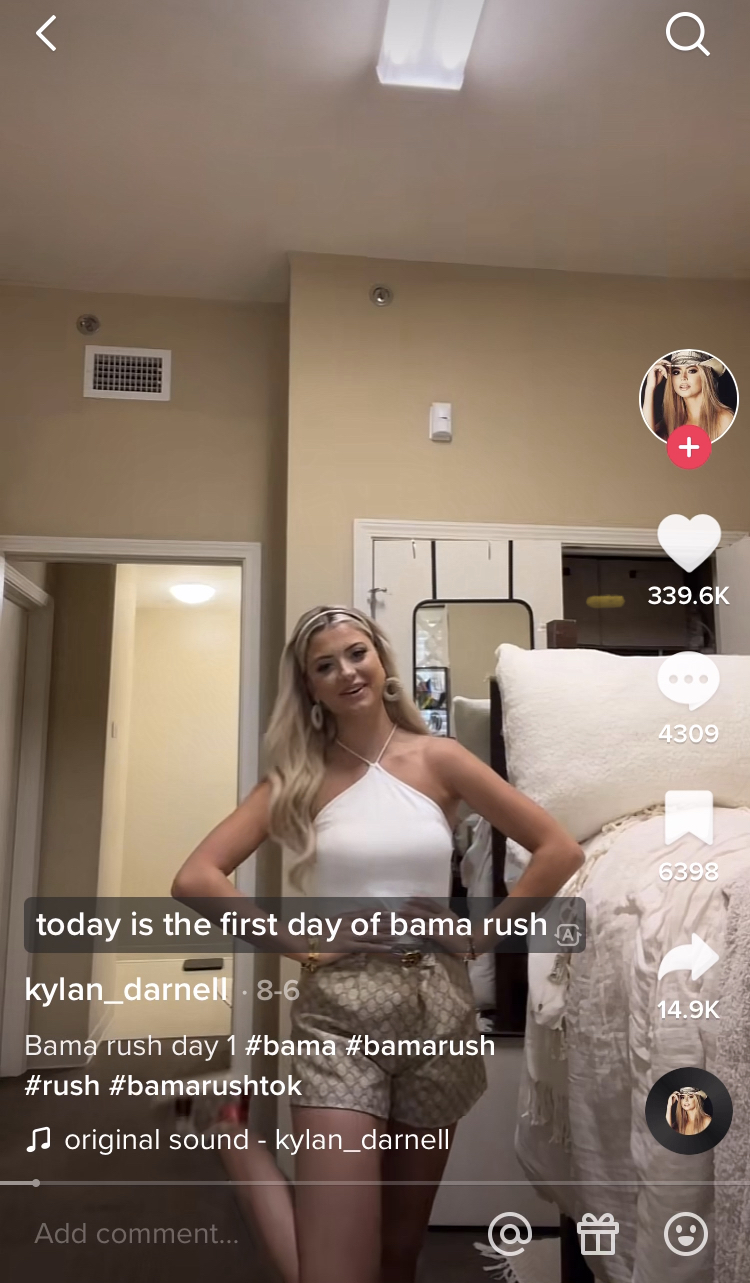
These ideals are demonstrated by the viral TikTok videos that can be found under the hashtag #BamaRush. The screenshot below depicts an Outfit of the Day video (OOTD) which is popular way for a P.N.M. to show off the intricately chosen outfits they have selected for that day’s activities. The clothes shown often come from high fashion brands. In this OOTD, which has 5.9 million views and over 300 thousand likes, the designer brands mentioned include: Gucci, Cartier and Louis Vuitton.

The creator of the video is a girl named Kylan Darnell who became one of the faces of Alabama Rush 2022. She now has over 500 thousand followers on TikTok and numerous brand deals with popular clothing and jewelry brands. Kylan is just one example of someone who rose to fame due to her documentation of her experience with the recruitment process. Her videos demonstrate a level of financial inaccessibility that is manifested throughout the sorority culture. In addition to the hundreds of dollars spent on the clothing for the recruitment process, the sorority dues per semester average $4100, which can be a financial burden for many participants and their families.

The media craze surrounding these sororities has become so large that current members have whole days of preparation designated as “media days.” On these days, each member focuses on producing content that can be posted on social media to capture the attention of P.N.Ms as well as other viewers. The content produced by these members portray a very specific type of member.

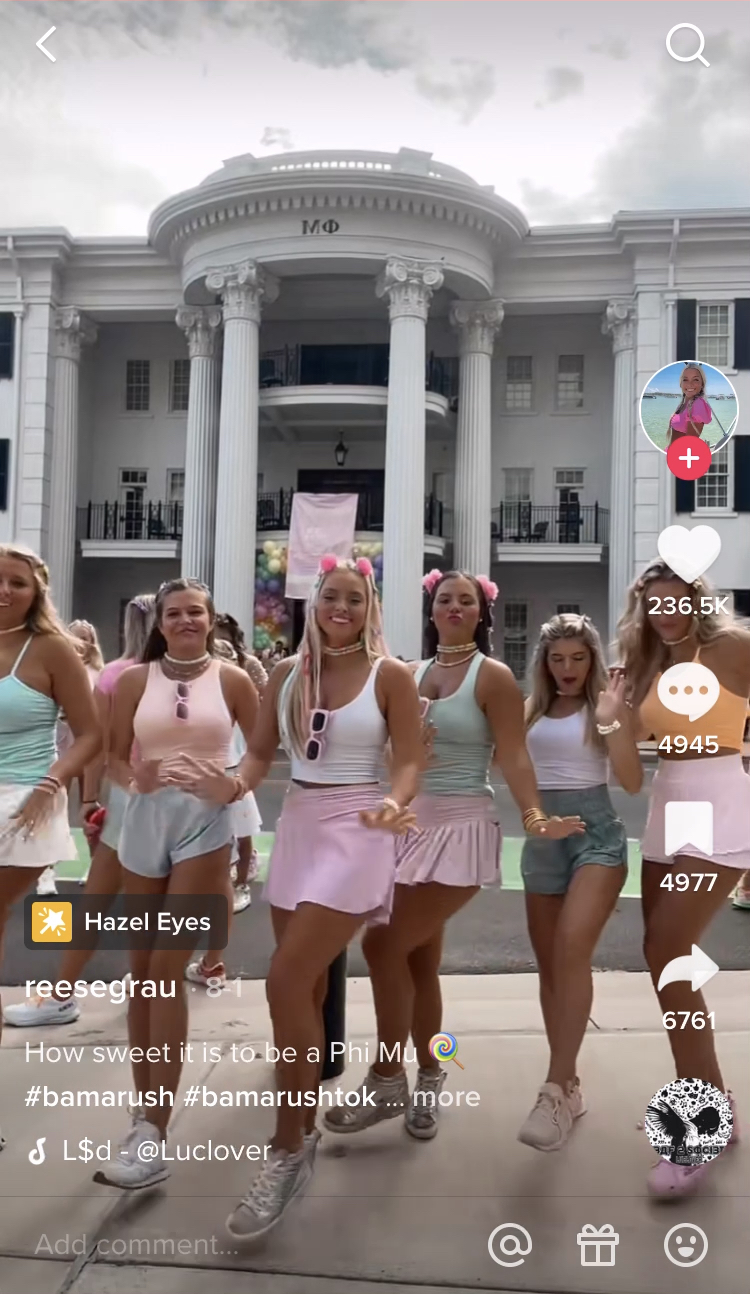
The screenshot above comes from a TikTok dance video created by the Phi Mu chapter. The video was designed to attract new members and portray the current image of the sorority. The people in the video are all dressed in pastels with short skirts and tight feminine tops. Additionally, the dance is performed in front the sorority house, which could be more properly described as a mansion. This videos presents the image of the perfect life, complete with beautiful hair, clothes, and an extravagent house.

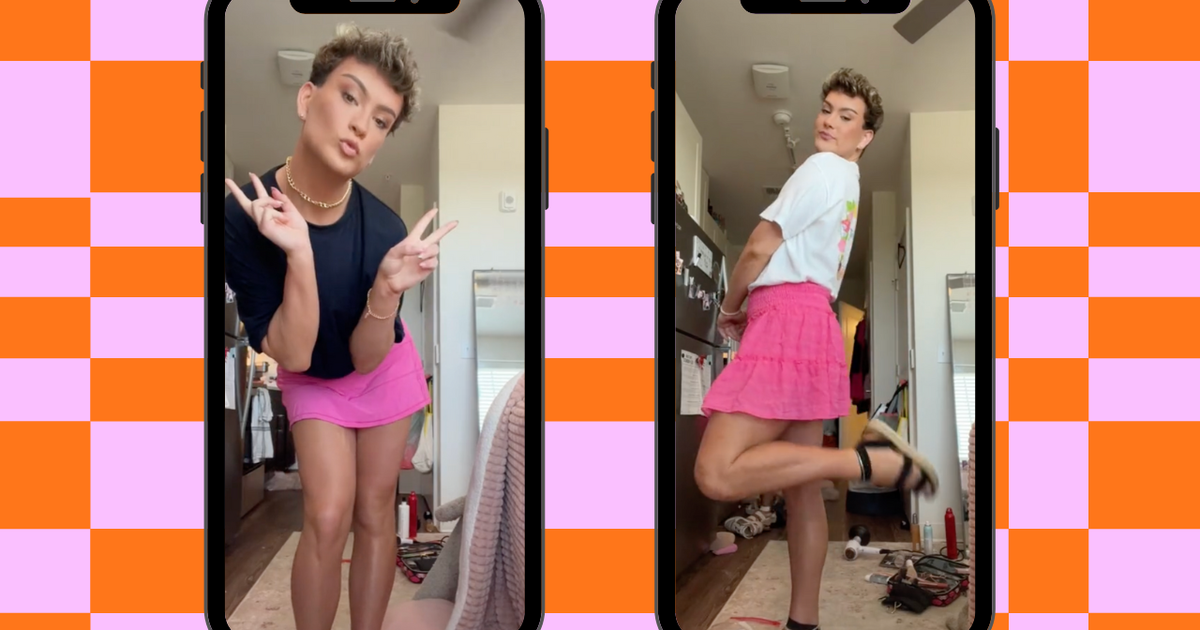
The exclusionary methods of rush extended beyond socioeconomic class and appearance, YourTango reports that of the twenty-six national sororities only three of them have made formal policies that include trans women. The exclusion of non-cisgender individuals is demonstrated within the Alabama Rush process. The image below shows Grant Sikes a nonbinary person who participated in the rush process this past year. Grant was not met with enthusiasm throughout the rush process. In an Instagram post Grant states “out of the almost 20 chapters- I was dropped by every single one except 2 before day 1.” Grant was not selected by any sororities at the end of recruitment.

These TikTok videos represent only a small selection of sorority life available at the University of Alabama and might not be representative of all Greek life. However, the intense public focus on these specific sororities and P.N.Ms demonstrate the hyper-feminization perpetuated by these sororities and consumed by the wider public. The mass amounts of media attention placed on the participants of the rush process endorses the negative ideals held up by the Greek life system.

Pharrell Williams: Blurred Misogyny 

Pharrell Williams: Blurred Misogyny 

In 2013 superstar Pharrell Williams teamed up with artists Robin Thicke and T.I to bring us “Blurred Lines.” The Times’ 2013 song of the summer, 640 million streams, 14 million copies sold – The song enjoyed instant and lasting success. But the song’s undeniable catchy beat, ironically, blurred its appalling lyrical and visual message. This piece will uncover what so many of us missed: 

The song’s lyrics promote three very troubling concepts:

While one of the most catchy, the line “I know you want it, I know you want it” is equally – if not more – problematic. These lyrics, sung by Pharrell, are a direct challenge to a woman’s consent. They imply that what comes from a woman’s mouth is not truly what she wants. Smiling, laughing, pushing – the video encourages a man to reject a woman’s word and insinuates he can do so in a joking and fun manner. This line reflects a more significant cultural issue; men have historically – purposely and not – misinterpreted a woman’s consent. This lyric suggests the line between consent and refusal is cloudy (blurred) when in reality, a woman is always firm in her decision.

Additionally, Pharrell sings about the “good girl,” the perfectly manufactured woman in the eyes of the patriarchy. “good girls”, as defined by Pharrell, are women who are sexually passive, almost timid about their desires, and are in need a man to direct, if not force them. The concept of “good girls” exists to build frequently unachievable standards for women. These lyrics normalize a concept we see so often in other forms of media today: women are sexually drawn to men who are aggressive and forceful about their desires. This enables men to feel as if forms of sexual harassment and sexual assault are just another kind of “advanced” flirtation. 

Lastly, Pharrell sings, “Tried to domesticate you, but you’re an animal, baby it’s in your nature” – In the music video, Robert Thicke mouths Pharrell’s words into the ear of a black model. An insensitive shot in which the lyrics can be perceived in a racial context. Black women being considered anything but human has enabled centuries of medical malpractice in which Black women were used as test subjects to advance scientific understanding. The racial implications of this shot are undeniable; forceful power dynamics and dehumanization have assisted and continue to assist in the oppression of black women.

How Blurred Lines directs masculine objectives: 

Along with the lyrics, It’s important to analyze who Pharrell’s intended audience is. While an artist will generally cater to the reasonably widest audience, it is clear that the message he pushes is meant for young men. This becomes apparent as he displays the social and sexual success of men who employ the technique of using and forcing themselves onto women. 

On the top: T.I, a rapper most popular with young male audiences, flirts and dances with three separate women while the lyrics “I know you want it, I know you want it” play. The positioning of the shot is essential; T.I dances in front of the women, who appear to serve as his backup, dancing behind him. This shot reinforces the idea that women should be treated as props and helpers in a man’s life. The inappropriately flirtatious T.I also underlines that men who subscribe to aggression and assertion with women will be sexually hyper-successful. 

On the Bottom: T.I, Pharrell and Robert Thicke are pictured together. All three of the men are in classy attire. The scene endorses the idea that forcing yourself onto women will not only bring you success with women, but will additionally give you status and respect among your friends. In contrasting their clothing, we see that the men, who are fully dressed, exude a message of strength and control, while women, dressed in only revealing clothing, are judged solely based on their body image and are a supporting entity to the man’s status. 

Years later, Pharrell and Robert Thicke have admitted their embarrassment for their part in writing the song. Remorse is a step in the right direction, but the damage this song has caused and will continue to cause is evident. Younger generations that are broadly refused access to sex education in schooling often turn to forms of media for guidance. Messages like that of Blurred Lines subconsciously encourage the persistence of misogyny and rape culture in our society. The importance of the lesson we can learn from this is anything but blurry: the media we consume matters, our consumption has the possibility of enabling good and bad. 

My Skin: An Anthem of Self-Love

As Lizzo’s presence in mainstream media has rapidly increased in recent years, so has the impact of her iconic messages of body positivity and self-love. Though many people know her for her 2019 album “Cuz I Love You” and her recent 2022 album “Special,” Lizzo has always been calling for reform in the way that society views women’s bodies. Her 2015 song “My Skin” and accompanying music video serves as a call to people everywhere to love and appreciate their bodies and skin.

Lizzo opens the music video with a brief monologue in which she states that learning to love yourself and your body is a journey that every person experiences—especially women. Her first verse paints a picture of why this is the case: society has created an impossible beauty standard that women feel that they must strive towards. Women are taught from birth to compare their bodies to what they see in media and to each others’, creating insecurity and self-hatred toward their own. This is an unspoken yet universal experience—one that Lizzo calls “the darkest, best kept secret.” As women compare their bodies to each others’, they are pitted against each other in competition for all the promises—love, respect, happiness—that society has convinced us we will receive if our bodies meet its standards. Lizzo articulates this in her lyrics “Let it bring us together, or it could tear us apart.” This comparison of bodies is currently tearing women apart. Lizzo is calling for women instead to unite against this harmful societal norm and revel in our universal beauty. She asserts that “the most beautiful thing that you have ever seen is even bigger than we think it means,” suggesting that the beauty of bodies and skin as well as self-love is much more significant and important than we give it credit for. She accompanies these lyrics with close-up images of diverse, seemingly unfiltered bodies painted in a beautiful light. These bodies are not perfect: they have fat, blemishes, stretch marks, hair, and other qualities that our societal standard would label as flaws. This representation of imperfect, diverse bodies in a popular music video tells women that their bodies are normal—and that their bodies are also beautiful, desirable, and worthy to be looked at.

Lizzo also applies this specifically to women of color. Societal beauty standards have created a very specific picture of what true beauty looks like: the “ideal body” is often portrayed as white and thin. Due to this association between whiteness and beauty, people of color are made to feel as if their skin inherently lacks beauty. The internalization of this belief takes away people’s ability to love and be proud of their skin, leaving shame in its wake. This can also be applied to fat women. Because thinness is seen as a requirement for beauty, fat women are made to feel as if they can’t be beautiful. In the chorus, Lizzo sings, “I woke up in this—in my skin. I can’t wash it away, so you can’t take it from me—my brown skin.” It is a call for women to reclaim the definition of beauty in their own skin. As Lizzo sings this in the music video, she runs her hands over her body with love and compassion and shows close-up images of her skin and hair, appreciating her body for its beauty.

As the music video nears its end, Lizzo, along with the other women in the music video, begin to pop the balloons that have been around them, sending glitter flying everywhere.

Throughout the video, it was not apparent that the balloons were filled with glitter—they seemed like regular balloons. As long as we believe the misconceptions that society has imposed on us, we cannot see the possibilities for ourselves that it hides. They initially appear unassuming, but when societal norms and standards of beauty are rejected, the result is magical. We can have full compassion for ourselves and unconditional love for our bodies and skin. Lizzo then runs her hands through the gold glitter and spreads it over her body, symbolizing an external layer of self-love and compassion.

This song and music video does a phenomenal job of encouraging women to reject societal standards of beauty and love their bodies as they are. Its inclusion of imperfect and diverse bodies adds representation to a historically image-conscious industry that has been plagued by photoshop, telling women everywhere that their bodies are normal and beautiful. Lizzo is an incredible role model for young women who face these standards—her unapologetic love for her body encourages others to do the same. Her popularity and presence in mainstream media gives hope that one day we can break free from societal standards and have universal unconditional love and respect for all bodies.

#Sharetheload

I’ve grown up watching my father do all the household chores. To many, this may be the ‘bare minimum,’ as it rightly is. However, patriarchy is so deep-rooted in Indian culture that such behavior is considered abnormal. Family members visiting our home would become physically uncomfortable watching my father cook, wash dishes, clean, and do the laundry, because that wasn’t ‘his job.’ In Indian society, men partaking in domestic chores is an alien concept.

This gender stereotype was challenged by an award-winning #ShareTheLoad initiative by an Indian laundry detergent company, Ariel, in 2015. The company launched this campaign through impactful advertisements, spotlighting the everyday, normalized gender inequality experienced in Indian households. They aimed to create “happier households where men and women Share The Load equally.”

https://youtu.be/QAxm23SjHDo

In the advertisement, we see how a young child observes the polar opposite realities experienced by her parents. The daughter notices how her mother is never asleep next to her at night and is up late doing household chores. In the morning, her mother wakes up unrested, hastily tossing breakfast for her family. She returns home after a long day of work only to face the endless to-do list on her phone. Yet, her mother never lets her professional commitments come in the way of looking after her family. She’s seen tucking her daughter into bed, reading to her, and preparing materials for the next school day.
In contrast, the daughter watches her dad get a good night’s sleep. He enjoys a relaxed morning, spending quality time with his daughter before heading to work. He seems carefree and unburdened. He is also oblivious to the amount of work his wife completes ‘behind the scenes’ at night to provide him with a comfortable lifestyle.

We can see the woman working- what Marxist feminist sociologists call- the triple shift. This refers to the idea that women in capitalist societies are expected to do paid and unpaid work and cater to their families’ emotional needs. Women are expected to juggle professional and familial responsibilities mechanically. Hence, the rise in the percentage of women employment in India is progressive only at face value. The reality is that there has been no change in the social expectations put on women. Women must work, be the best wives and mothers and conform to all social norms. Multi-tasking is glorified and regarded as a skill that ‘successful’ women have, prompting others to achieve this unrealistic standard.

In the advertisement, the daughter is the change initiator. When she notices her overworked mother, she wakes her father up and ushers him to the laundry room. The girl symbolizes the literal wake-up call that Ariel wanted to give India. The father is shocked to find his wife, completely exhausted, dozing off near the laundry machine in the middle of the night. He realizes how his lack of contribution affects his wife and makes an immediate change by taking over the laundry. The advertisement ends with a display of empirical evidence to support its argument. It draws a connection between the unequal division of household chores and women’s health, stating that 71% of women sleep less than men.

Apart from highlighting the unequal distribution of domestic work between men and women, the advertisement also emphasizes how children unconsciously pick up gender norms and roles. Children internalize gendered behaviors, roles, and activities by watching their parents. This advertisement was applauded for its ability to convey a meaningful message in a minimalistic way. It illustrated a scene that most Indians were familiar with and could relate to. It showed the Indian population that making a change doesn’t always entail grand gestures. One can change the status quo by something as simple as sharing the laundry with their partner.

However, the advertisement is far from perfect. In my opinion, the ads create a one-step forward, two-step back situation. The campaign fails to address the issue’s root- that household chores are not a woman’s job. The phrase ‘ShareTheLoad’ implies that household work is a woman’s job or ‘load’ to begin with and that men should ‘help’ them by ‘sharing’ the burden. It encourages the depiction of men as saviors who go out of their way to help the women in their families. Household work continues to be portrayed as a gender-specific role. The idea that domestic work is a life skill everyone should have regardless of gender is not translated through the screen.

Moreover, the campaign is very heteronormative. It does not do an excellent job of representing queer individuals and families. While the ad does a great job of exposing the inequalities faced by women in households, it continues to reinforce the idea that families can only consist of heterosexual couples. 2018 was a monumental year for LGBTQ+ rights in India. Article 377 of the Indian Penal code (which criminalized any form of queer sex) was struck down and deemed unconstitutional. However, removing the law did not manage to remove the social stigma around the LGBTQ community in India. The fear of representing queer relationships in mainstream media remains evident through the continuous display of heteronormativity.

Nevertheless, the campaign marked a significant first step towards encouraging companies to use their mainstream platforms to advocate for gender equality. I hope to see a more mainstream representation of the Queer community in India in the future!

Is All Representation Good Representation?: an Analysis of Power Imbalances in Call Me By Your Name

1983. Northern Italy. As soon as the opening credits roll, audiences are swept into the entirely different world of Call Me By Your Name. It’s a world of soft hues and cool breezes in the leisurely Italian countryside. A world of endless time and music and exploration. A world of romance and self-discovery. 

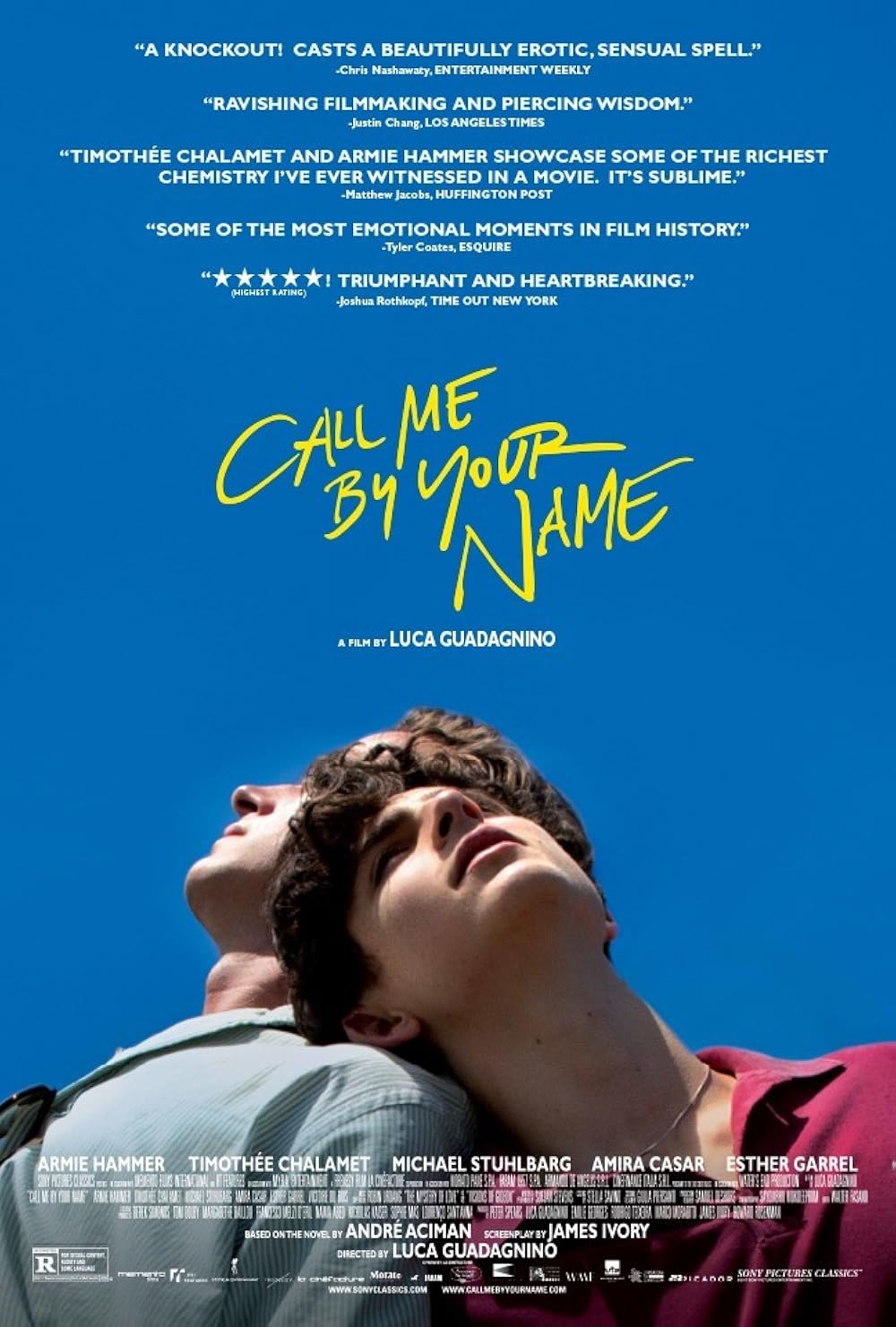
Yet this 2017 coming-of-age film is more than just the captivating cinematography and aesthetic landscape. Based on a 2007 fiction book written by Andre Aciman, Call Me By Your Name depicts the story of Elio, the 17-year-old son of a professor, whose father spends the summers doing archaeological research in Northern Italy. While his father works, Elio takes a break from his Parisian life and occupies his time by reading, transcribing music, riding his bike around the countryside, and spending time with his childhood friends. Except the summer of 1983 is different. Elio’s father hosts a graduate student as a summer research assistant, who stays with the family and does archaeological work for a number of weeks. As soon as Elio lays eyes on Oliver, the tall, confident, 24-year-old American who is to stay with the family, he is captivated. Soon enough, Elio and Oliver begin a whirlwind summer romance that leaves Elio confused, heartbroken, and hopeful. 

Though Call Me By Your Name may be a love story with a captivating ambiance, a leisurely pace, and just enough suspense to keep the viewer engaged, it is more than its beautiful storytelling. As a popular coming-of-age queer film, Call Me By Your Name had a large impact on the LGBTQ+ community and its representation. While Elio and Oliver may have had a beautiful love story, the film completely ignores a glaring red flag in their relationship: their large age gap. While their relationship is legal and consensual in the film, is it ethical? The difference between a young, inexperienced 17-year-old and a 24-year-old adult creates serious power imbalances in their relationship. Oliver is not only 7 years older, but also works for Elio’s father, and is much more experienced, both in sex and romance, than Elio is. On the other hand, Elio is a mere 17-year-old, who is just discovering his sexuality for the first time. In fact, Elio shares his lack of experience with Oliver before they ever begin their romance. In the scene at the monument to the Battle of Piave, Elio says to Oliver “If you only knew how little I know about the things that matter.”  Oliver bluntly asks, “What things that matter?,” and Elio responds quietly, “you know what things,” clearly referring to his lack of knowledge about matters of love, sex, and romance, as well as his lack of experience in homosexual relationships. Oliver bluntly tells Elio that they can not talk about such things, yet soon after, they begin their romance. This situation presents a very concerning power imbalance in their relationship, where Elio is not only 7 years younger, but also much less experienced than Oliver, yet the film never fully addresses it. Instead, it is glossed over, as the viewer is meant to focus on the beautiful landscape and the sweet, romantic aspects of the film.

Yet, by not addressing the concerning aspects of Elio and Oliver’s relationship, Call Me By Your Name is not only perpetuating unhealthy relationships, but also suggesting that an age gap is standard and normal for gay male relationships. This perpetuates harmful stereotypes about gay men, including that they are predatory towards younger people. 

Call Me By Your Name could have very easily been a beautiful coming-of-age film about discovering one’s sexuality and having new experiences, but it is ruined by the inappropriate, and largely unaddressed, age gap relationship. This negative representation actively harms the LGBTQ+ community and perpetuates negative stereotypes about gay men. Despite the beautiful and innovative cinematography, Call Me By Your Name simply missed the mark as a queer film. 

How Racism and Homophobia Allowed Jeffrey Dahmer to Get Away With Murder

The newest Netflix tv series Monster: The Jeffrey Dahmer Story broke the record for biggest series debut on Netflix with the most streams yet. The storyline follows the notorious Milwaukee serial killer, Jeffrey Dahmer, who killed a total of seventeen males ages fourteen to thirty three. The show begins with how Dahmer ultimately got caught and works backwards to fill in the questions about his childhood, adolescence, and adulthood in an attempt to answer why he was such a monster. I will warn, this blog post contains spoilers and content that may be disturbing for readers, especially people of color and the LGBTQ+ community. I aim to unpack how this documentary exposes the disturbing truth about how society and law enforcement views the needs and rights of marginalized groups. 

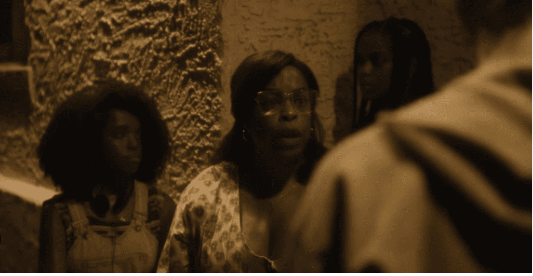
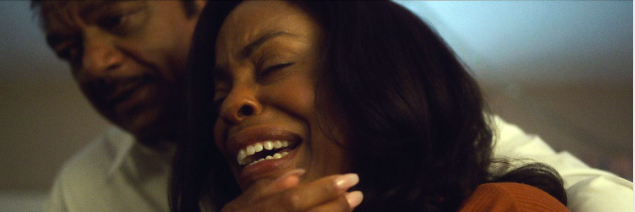
Here is an image of the scene. In this image is Glenda, her daughter, and her niece. Glenda can be seen yelling at the cop in an attempt to get him to believe her that Jeffrey is dangerous and should not be allowed to take the boy back inside.

While there are many examples within the documentary of both homophobia and racism, there is one case that struck me the most and has haunted me since. 14 year old Konerak Sinthasomphone, whose brother Dahmer was currently on probation for molesting, was taken home by Jeffrey Dahmer with the promise of receiving $100 if he could take pictures of him.  Jeffrey Dahmer then convinced Konerak to drink alcohol, which unbeknownst to the boy, had been drugged. Once the boy was severely intoxicated, Dahmer left to go get more alcohol, as he usually killed in a state of severe inebriation. At that time, the young boy managed to escape outside of the apartment building where he was found by Glenda Cleveland, Dahmer’s neighbor who had already filed many complaints about him. She called the police and two white officers arrived to find the boy highly intoxicated and unable to keep conscious or speak. However, when the only other white man in the situation arrived, Jeffrey Dahmer, and claimed that it was his boyfriend, they listened. He told the police that the boy was his 19 years old boyfriend who lived with him and simply had too much to drink. Instead of listening to Glenda, a woman of color, and her continuous pleas to check the identification of the boy who appeared much younger than 19, they decided to follow Dahmer to his apartment. The officers ultimately did not search around because Dahmer claimed that there was “gay stuff” that they would find. However, if they had entered the bedroom they would have found evidence of multiple gruesome murders commited by Dahmer right where they were standing. The idea that homophobia benefited a serial killer is disturbing, but not the only reason Dahmer escaped the scrutiny of the police. The police ask him what a man like him, meaning a white man, is doing living in that neighborhood for crack addicts. This question immediately demonstrates why Dahmer was able to easily convince them there was nothing of concern and why Glenda failed to be heard by law enforcement. Racism and homophobia enabled Dahmer. It allowed for that Laos boy to be returned and killed moments after the police left. The prejudice ingrained in our systems killed that boy and now the Sinthasomphone family, and many others, will never see their baby boy ever again.

What would you do if your gut was telling you there is something seriously wrong with your next door neighbor, but everyone ignores you? What about if multiple people in your community were going missing, but still little to no action has taken place? And if it all ended with the same person having been killing and eating all seventeen of those people? The disgusting reality of Jeffrey Dahmer’s case is that the killer is not the only one to blame. 

Above is an image of Glenda finding out in the show what Jeffrey Dahmer had been up to, a harsh realization that all of her instinct were correct, but still could not stop him. The raw emotion depicted by both this image and the one above contribute to the harsh impact of the show on viewers as they can see, even through acting, just how much emotional distress was caused.

There continue to be examples of groups, such as people of color and the LGBTQ+ community, being not only targeted with hate crimes, but also lacking the same legal response and repercussions that straight, white, cisgender men receive as victims. I believe the story of Jeffrey Dahmer calls into question whether we, as a society, need more physical, obvious proof to accuse white men? Or do we just not exhibit the same level of concern for people of marginalized groups who appear to be in danger? I believe both to be true, and Jeffrey Dahmer is only one example, but ultimately an ideal display of how members of society benefit from the prejudice exhibited toward those who are oppressed. 

In conclusion, this documentary perfectly exemplifies both homophobia and racism within our society. Jeffrey Dahmer a notorious serial killer who was able to get away with killing 17 boys and young men simply on the grounds that he targeted mainly gay men of color, who the police underpatrolled and law enforcement failed to represent. Jeffrey Dahmer would not have been able to escape for as long as he did if he himself was a member of a racial minority. He would not have been afforded the same graces that he was, and hopefully, would have been caught early on before he could brutally murder several innocent males. The repeatedly ignored signs of problematic behavior that Dahmer presented show something that in our society has not changed, as many serial killers tend to be white men. Due to their race and gender, these heinous killers commit multiple murders before getting caught, just as Dahmer did. 

This is an ongoing issue that needs to be addressed by our society. Crime should not know a color of skin or gender identity. Marginalized groups should not be targeted while cis white men get away with murder, especially those within our own law enforcement. Jeffrey Dahmer’s case may be over thirty years old, but it sheds light on an issue that still exists today. It is time to take action and ensure justice is served for all members of society equally, it is their human right. 

How I Met Your Mother – Sitcom For Skinny People?

Trigger Warning: fatphobia, mention of sexual assault

How I Met Your Mother (HIMYM) is a popular American sitcom that came out in 2005 and continued through 2014. Set in the New York City, it follows the story of a group of friends and their romantic relationships. The main character, Ted, is the narrator, and tells his children the story of how he met their mother, while also including the stories of all of his friends in the process. Barney, one of his best friends and our main focus today, is known for sleeping with a lot of women, inappropriate jokes, and, unfortunately, fatphobia.

“Over 200 women, spanning six continents, 17 nationalities, 74 sexual positions, and not a single fatty. It’s impressive.” (Season 5, Episode 14)

Barney’s idea of “success,” which involves sleeping with a variety of women from different backgrounds, emphasizes not one of them being fat. He presents sleeping with a fat woman as something to be ashamed of and avoid at all costs, expressing it as success if being able to avoid it.

“Let’s say the young lady you’re bringing home is dressed for winter. Under those layers, an unwelcome surprise could await you. The scale with body fat calculator I’ve hidden under the welcome mat makes sure you never have banger’s remorse.” (Season 8, Episode 19)

By going through so many measures to ensure he doesn’t sleep with a fat woman he shows the audience that they themselves should avoid it at all costs. Additionally, he points out that winter layers can make it impossible to assess whether someone is fat or not; it implies that any form of fat is unacceptable, even if not seen at first. I believe that, unfortunately, Barney is generally a liked character, meant to make the audience laugh and, perhaps, copy some of his behaviors. For example, his famous line “It’s gonna be LEGEN… wait for it… DARY. It’s gonna be LEGENDARY” is catchy and can easily be used by everyone to “spice up” what they’re saying. What if Barney’s other behaviors are copied like that as well?

The constant mockery of fat people, and especially fat women, is a big part of the show. The audience may laugh, but through those not-so-subtle jokes, they are subconsciously impacted. Barney’s comments can create problems that go way beyond a joke – it can lead to extensive weight bias or violence. Barney even made up a commandment, which is defined as “a divine rule” called “no fat chicks.” It is also catchy, like his famous saying mentioned earlier, and is incredibly harmful to others.

Marshall: He’s rich? Please tell me he wrote you a big, fat check. A check so fat, it doesn’t take its shirt off when it goes swimming.

Barney: That is a big, fat check. A check so fat, after you have sex with it, you don’t tell your buddies about it.

Robin: A check so fat, when it sits next to you on an airplane, you ask yourself if it should have bought two seats.

(Season 4, Episode 23)

Fat people are dismissed, mocked, laughed at, and excluded from any spaces in the show. Every male and female character in the show is skinny, besides one – Patrice. She is one of the main character’s, Robin’s, coworkers. She is a very kind person, and whenever she opens her mouth to say anything, she is met with frustration and something that can be described as a demonic scream from Robin.

As we can see, no matter what she says or does, she is verbally attacked. She can compliment Robin, bake her cookies, try to help her, or simply exist – she will be yelled at for all of those things. Some might blame it on Robin’s intense character, her upbringing, or many other things… but is it a coincidence that the only person in the show who is fat is also treated like that? Let that sink in.

Another very prevalent issue in the show is constant lack of consent. We all love FRIES – acronym for consent (Freely given, Reversible, Informed, Enthusiastic, and Specific). Barney fails to follow one of the most important aspects of it – consent being informed. He had created an entire “Playbook” with different schemes on how to get women to sleep with him; most of those scenarios include him changing his identity.

Women are sexually assaulted, objectified, disrespected, and presented as dumb in the show for falling for it. All of those schemes are meant to be funny, but instead are countless examples of sexual assault, which the show does not acknowledge whatsoever as anything else besides a joke.

As we can see, How I Met Your Mother is problematic for a plethora of reasons, including prevalent fatphobia and lack of consent. The media can impact individuals in a variety of ways, including indirectly, which makes the show incredibly harmful. Weight bias is seen as funny and met with no consequences. The show is currently, best to my knowledge, not easily accessible on streaming platforms, which might slightly limit the impact. The issues in the show should be addressed, and everyone should be aware of its problematic nature.

quotes from: https://knowmediaorg.tumblr.com/post/123573154453/how-i-met-your-mother-fatphobia

Dismantling Jules Vaughn

The show Euphoria, starring multiple famous actors like Hunter Schafer and Zendaya Coleman, shows a raw demonstration of the struggles teenagers go through daily. Euphoria is about a group of teenagers from California who are in high school. They experience a multitude of issues. Some important characters are Rue, Jules, Nate, Cassie, and Maddy. The group of friends is divided and united by their trauma, experiences, and conflicts with one another. The audience is shown clips of couples involved in toxic relationships and teenagers struggling with drug addiction. In this blog, I will discuss how this show illustrates the assumptions about gender, race, and sexuality of the main character, Jules Vaughn. 

To begin, Jules is introduced to the show as a transgender woman struggling with her identity for a long time. For instance, when she was 11 years old, her mother sent her to a psychiatric hospital because Jules had a history of self-harm and depression. She suffered from gender dysphoria – someone fighting against their biological and gender identity because they believe it is not the same. In Season 1, Episode 2, Jules talks to her therapist about a Supprelin implant embedded in her body that prevents her voice from dropping and stops her male genitals from developing. The thought of puberty scared her during her childhood because she felt out of place in her body from a young age. Although the journey of a transgender youth experiences highs and lows, Jules’s father serves as a positive example of a support system for LGBTQ+ youth. Jules has a father-daughter relationship rather than a mother-daughter relationship. This is unusual because typically, mothers are known for being more nurturing and accepting than fathers; however, in this case, the roles are versed and Jules’s father is the one who stays with Jules during her transition.

Sexuality also plays an important role in how Jules is presented to us. For example, we can categorize her sexual orientation as bisexual because she has a relationship with Rue Bennet, a female, and romantic feelings for Nate Jacobs, a male. In addition, she has sexual encounters with Rue in addition to Nate’s father. However, not everyone is accepting of Jules’s gender identity. Jules and Nate shared explicit text messages and images through a dating app. Nate catfishes her and creates a persona labeled ‘Tyler.’ He struggles with internalized homophobia, which causes him to lash out against Jules and blackmail her when he acquires some of her nude pictures. Also, internalized homophobia implies that Nate does not consider Jules a female but a male because she has a penis. He feels homosexual because he is attracted to someone with male genitalia. This is discovered when Nate’s girlfriend, Maddy, finds pictures of male genitalia on Nate’s phone. Nate blackmails Jules because he believed that she was going to make a report to the police about his father sleeping with Jules, a minor, and recording a sex tape, which would be considered child pornography. Other than this, every other character in Euphoria respects Jules’s pronouns and identity. However, in Season 1, Episode 8, Rue approaches Nate outside during a school dance and threatens him about ruining his life and his father’s if he does not leave Jules alone. Rue further expresses her anger towards Nate by saying that “I have no problem walking into any police station and telling them that Nat Jacob’s daddy likes to f*ck little kids.” This scene demonstrates the lengths that Rue would go to stand up for those who disrespect her friend Jules. You can see this in action in the YouTube video attached below. Warning: Inappropriate language is used. 

Lastly, Jules’s race is white, meaning she does not experience the same problems as a black transgender person in the LGBTQ+ Community. Euphoria follows the default of white representation in media rather than illustrating a diverse trans woman. Also, statistics have shown that across the United States, Latinx and Black trans women encounter more violence, discrimination, and hate crimes towards their identities. For example, in San Francisco, 47.9% of Black and 49.0% of Latina trans women experience hate crimes. Because the creators of Euphoria made Jules a white character, they failed to demonstrate the hardships experienced by other transgender POCs (Persons of Color). Another important aspect is that she gets involved in an interracial relationship with Rue, which shows us that Jules does not have a preference when dating someone. Jules’s interracial relationship with Rue illustrates that her experience of being marginalized in society allows her to be more empathetic toward other oppressed populations.

Euphoria portrays an accurate picture of teenagers who are transgender. Although Jules is a 17-year-old trans woman rather than an older trans woman who has encountered more obstacles, Euphoria mimics these real-life situations. A teenager struggles through a period where puberty and identities are questioned; however, adults are more secure about themselves, explaining the chaotic nature of Jules’s experiences. She has not only combated against gender dysphoria but her future and personal identity. Unlike other shows and movies, Euphoria shows us an accurate representation of the difficulties adolescents face throughout their lives that many prefer to conceal, although it can be inaccurate because the show is not based on true stories. It can be hard at times to digest the scenes presented by the actors, but it helps us better understand what it is like to experience these situations and develop sympathy. Although life is complex and complicated, it is essential to grow awareness about how people who are considered to be “different” in society face societal prejudice and learn to overcome these obstacles. 

Jules Vaughn

Sources: https://bmcpublichealth.biomedcentral.com/articles/10.1186/s12889-021-11107-x

Carl’s Jr.- Selling Burgers or Babes?

For many (like myself) Super Bowl advertisements are as much a draw as the actual football game. In the 2010s, the burger chain Carl’s Jr. notoriously released a series of hypersexualized advertisements that drew attention to the fast-food franchise for all the wrong reasons. While the “plot” varied from ad to ad, most featured very scantily-clad, white models writhing around and sensually biting into burgers. Interestingly, many advertisements also played into a kind of Americana fantasy, with Kate Upton styled in pin-up fashion at a drive-in movie in one ad, and Hannah Ferguson and Paris Hilton wearing western-inspired bikinis and washing a muddy truck in another, playing homage to the restaurant’s Texas roots.

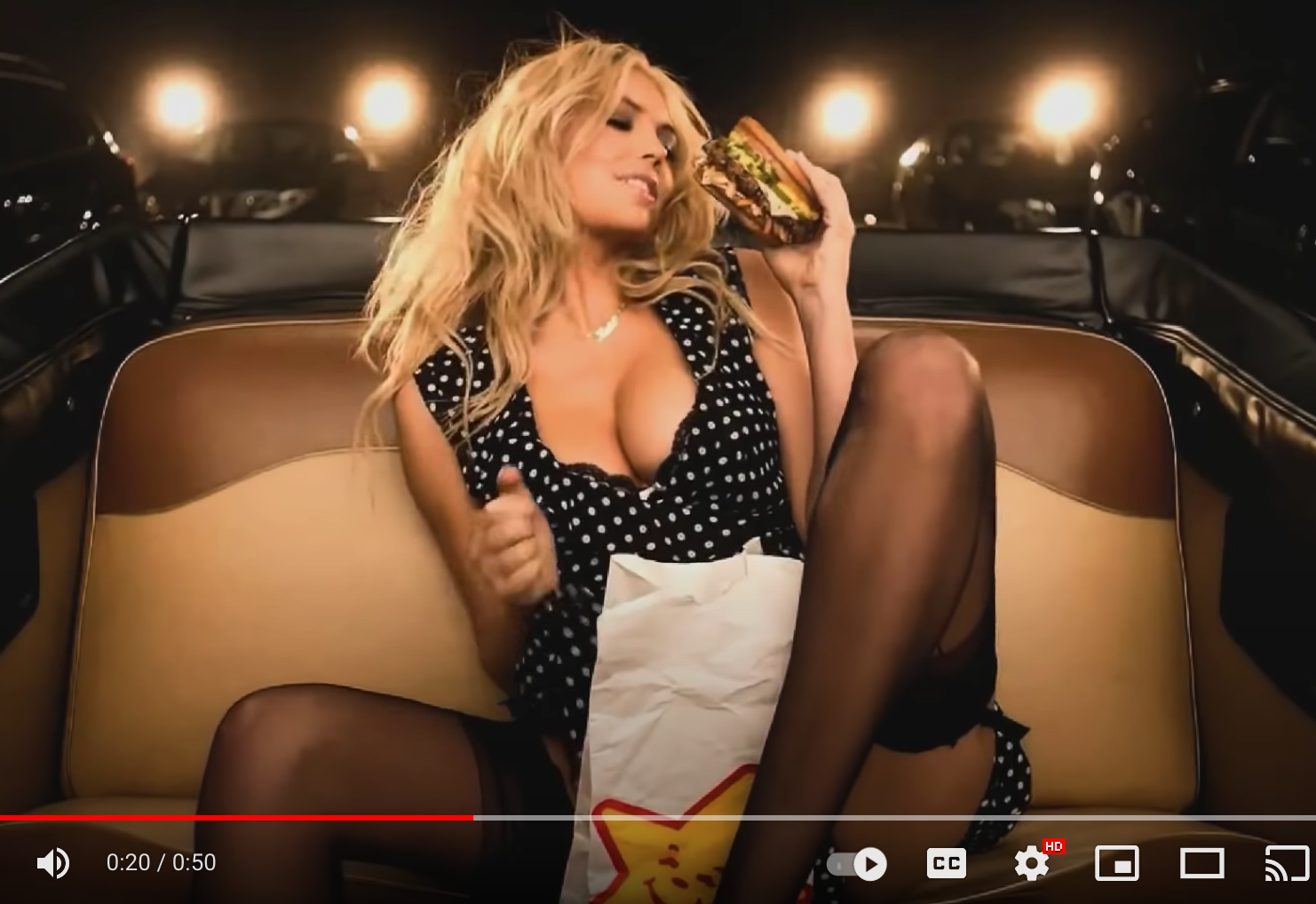
Kate Upton Ad

The 2012 commercial with Kate Upton advertises the restaurant’s jalapeno “patty melt” and features Upton sitting in a convertible car by herself and eating the burger in an incredibly sexual manner, The commercial switches between zoomed-in shots of Upton, a popular sex symbol of the 2010s, biting into the burger, untying her hair, and throwing her head back in ecstasy. She is also pictured sweating and fanning herself, with several close-up shots of perspiration on her cleavage, supposedly to advertise how “spicy” the burger is, with its “pepper jack cheese, jalapenos, and Santa Fe sauce.” Upton is also provocatively pictured straddling the takeout bag while eating the burger, mouth agape and squirming, revealing her lingerie, and meant to look like she is in the middle of a sex act. A young man in a neighboring car, presumably on a date with his girlfriend, stares at Upton in awe, before his girlfriend turns his head back toward the movie screen. To me, this advertisement was very reminiscent of Sandy’s character arc in Grease, from a modest, girl-next-door, to provocative bombshell. This interaction characterizes Upton as a spectacle for male consumption, as she is clearly putting on a performance targeted toward the male gaze. 

Hannah Ferguson/Paris Hilton Ad

Another 2014 commercial features model Hannah Ferguson and socialite Paris Hilton sensually washing a dirty truck while somehow simultaneously eating a “Texas BBQ Thickburger.” The majority of the commercial shows Ferguson pouring sudsy water on herself and posing around and on top of the truck, interspersed with slow-motion shots of her mouth biting into the burger. When Paris Hilton enters the scene at the end of the commercial, she makes a suggestive comment about Ferguson “missing a spot” while cleaning, before dramatically taking a bite of the jalapeno fry that had fallen out of the burger and onto the hood of the truck. The rock-and-roll music and cheesy airbrushed, slow-motion editing of the commercial posits the model’s bodies as the focal point, asserting that they, like the burger, are a commodity.

In both advertisements, the models are acting out a heteronormative male fantasy. The commercials are purposefully outrageous and unrealistic, starting with the ridiculous notion that supermodels choose to eat double-bacon cheeseburgers from Carl’s Jr. These women are meant to represent the epitome of female beauty, one that can only be attained through extreme restriction and surgical enhancement, yet behave like “one of the guys,” acting interested in cars and indulging in burgers and beer. The commercials are intentionally provocative, bordering on pornographic, which stands in stark contrast to the product Carl’s Jr. is advertising. There is no existing connection between cheeseburgers and washing cars in lingerie, for example, so the choice to situate the advertisement in this context clearly revolves around the sex appeal of these women’s bodies. 

The efficacy of these ads relies completely upon their titillating nature and the sex appeal of the models they exploit. The reason why these ads garnered such attention is because they were so explicit, yet surrounded the advertisement of an objectively unsexy subject: a sandwich. Had a fat, or stereotypically “unattractive” woman been the covergirl of the Carl’s Jr. ad campaign, the advertisements would have had the opposite effect, furthering the stereotypical association between fast food, obesity, and poverty. However, by associating the burgers with iconic sex symbols of the 2010s, Carl’s Jr. projected the image that a) if you eat their burgers you are sexy b) if you engage with their product you will encounter sexy women. The burger is an essential icon of America, and Carl’s Jr. played into this fantasy by unrealistically associating their burger with some of the most conventionally attractive popular figures of the era. Ultimately, these commercials perpetuated an unrealistic depiction of beauty and reinforced the idea that women are most attractive when appealing to the male gaze.

Teleflora – Let’s Sell Sex: Enforcing Gender Norms, Body Norms, and Racist Views

Lights, camera, (sensual) action! Teleflora, an online flower delivery service, debuted their “Valentine’s Night” commercial during the 2012 Superbowl (“Teleflora”). Through this strategic marketing, the company reached its intended demographic of a male-dominated audience. By design, the commercial aims to capture the attention of a heteronormative group of male spectators, which also has implications on societal norms surrounding sports and masculinity. The overt focus on societal norms and expectations surrounding the male perspective, in turn, leads to a regressive depiction of the featured female – a depiction filled with undertones of patriarchal and sexist views of women in society. 

Teleflora Ad – “Valentine’s Night”

As if a title like “Valentine’s Night” didn’t already scream sex and sensuality, the portrayal of a female in the intimate space of her bedroom furthers the theme of sex and sensuality emphasized by Teleflora. The camera in the commercial quite literally embodies the male gaze as it follows Brazilian model Adriana Lima from head to toe… sliding stockings over legs, fastening her lingerie, slipping into her red bottom heels, and slowly applying ruby red lipstick. This voyeuristic effect elicits a sense of intimacy between the audience and the “object” of the commercial. In a sense, the commercial objectifies the female body and promotes the expectation that women should “look pretty” not for themselves but for the gaze of others, specifically males. This expectation finds explicit emphasis in the female model’s own words… the only words uttered throughout the entire commercial.

Lima getting ready for “Valentine’s Night”

With the camera up close and personal, Adriana’s red lips come into focus as she says:  “Guys, Valentine’s Day is not that complicated. Give and you shall receive.” The message comes across as “Men, it’s simple… give women flowers and get [you know what] in return.” This transactional depiction not only demoralizes female agency but also plays upon the patriarchal tropes and symbols that permeate society and systems. Adriana’s words reinforce the harmful expectation that giving females a material object triggers an obligation for the female to return the favor. This notion couches females’ worth in their service to males; A male initiates a transaction and the female is expected to return the favor. This uneven distribution of power subverts female agency and reinforces the harmful notion of female inferiority to males – perpetuating sexism and patriarchy in modern-day marketing. In this context, sex transforms into a form of payment for the “Valentine’s Night” gift. 

Part of the commercial where Lima addresses her male dominated audience

Additionally, the female image presented in the commercial promotes narrow, unrealistic beauty standards. Teleflora plays upon societal beauty standards that idolize skinniness, long legs, toned arms, cleavage, fair skin, high cheekbones, and silky smooth hair among other features. Overall, these characteristics are not representative of the actual diversity of female body types and skin tones. In this way, harmful beauty norms surrounding the female body also intersect with the oppression of other forms of identity, like race and ethnicity.

At first glance, the commercial appears to provide a platform of ethnic representation, but upon further analysis, it does quite the opposite. Teleflora depicts Brazilian model, Adriana Lima, in an errotic light – a strategic marketing ploy to gain the attention of viewers (“Teleflora”). The commercial reinforces the sexualization of Hispanic women in the media and plays upon the trope of an “attraction to the exotic.” Though this marketing decision may capture the attention of more viewers, the question becomes, “At what cost?” Biases are shaped and reinforced by symbols and images people are exposed to everyday. Pairing sexual symbols with the image of a Hispanic woman only furthers stereotypes about the broader group of women who identify with the Hispanic culture and overshadows the diversity of beauty and body type within the ethnic group. The “Valentine’s Night” commercial positions an intersectionally marginalized identity in service to the dominant male (likely white) audience. Even though the dominant group is not present in the commercial itself, it still manages to influence the narrative and support the maintenance of oppressive depictions of the marginalized identities. 

In the end, Teleflora makes buying flowers “sexy” by pairing the flowers with a sexualized and unrealistic female depiction. Though this marketing tactic may have been helpful in reaching the targeted male audience, it has harmful implications for gender and sexuality norms. The commercial perpetuates symbols of females as objects rather than humans with agency and reinforces sexist and patriarchal notions of femininity. It also perpetuates racist views by exoticizing a Hispanic woman and reinforcing ethnic stereotypes about what a “sexy Hispanic woman” looks like or wants. Just as Teleflora’s red and white floral arrangements trigger images of Valentine’s Day, its narrow and sexualized depiction of a Brazilian female triggers deep-seated undertones of patriarchy, sexism, and racism. 

Work Cited:

“Teleflora – Valentine’s Night Video from Ad Age.” Ad Age, 5 Jan. 2012, https://adage.com/videos/teleflora-valentines-night/1187.

“Love My Way”: Homophobia and Internalized Shame in “Call Me By Your Name” 

Call Me By Your Name (2017), set in the Italian countryside during the summer of 1983, displays a passionate and complex romantic relationship between 17-year-old Elio and his father’s research assistant, Oliver. Before returning to the states, Oliver must travel to a different city in Italy to complete his summer’s research. Elio’s mother, seeing how close Oliver and Elio have gotten, suggests the two of them travel together. Though they remain relatively discreet with their displays of affection, being away from the local town where people know them and could out them, or worse, brings out a carefree side to the lovers. We see them dancing, embracing, and kissing in alleyways; however, there is a sense that this newfound freedom is fleeting as their unavoidable farewell rapidly approaches.

(approximate timestamp: 01:47:55)

Elio and Oliver dance in a cobblestoned alleyway and then embrace one another. Oliver breaks the embrace when he hears the song “Love My Way” by the Psychedelic Furs playing in the distance; earlier in the film, this was a song that both Elio and Oliver danced to at a party with female partners. The coincidence of hearing this song rings as a reminder of the moment’s impermanence—that the two of them have not always felt this free and will not always—but it simultaneously feels like a beautiful, cosmic sign that the two of them are connected in a meaningful way.

As they approached the strangers playing the song, the cement poles on Oliver’s left (in the green shirt) caught my eye. Their shape is phallic, and the coincidence of two, upright phallic structures juxtaposing Elio and Oliver’s figures left me with the impression that even in these moments where the two may “pass” as heterosexual, their gay identity is omnipresent.

(approximate timestamp: 01:48:36)

The feminine stranger is dancing alone, as the masculine stranger leans against the car smoking a cigarette, effortlessly cool and unphased, he is the epitome of suave, heteronormative masculinity and sexuality. Oliver’s instinct to dance with the woman strikes me as a performance of his own claim to masculinity and sexuality—he is carefree, fun, and charismatic, which are qualities that drew Elio to him. Almost immediately as he dances with the woman, the music is interrupted by a church bell ringing.

(approximate timestamp: 01:48:48)

Oliver grabs the woman’s arm, taking her to dance in front of the church where another version of the phallic symbol appears, this time with a chain attached. Oliver steps over this chain, as though crossing the threshold and submitting to the pressures of normativity. The heartbreaking conclusion to the film is Oliver calling Elio months after the end of summer to tell him he is getting married to a woman.

(approximate timestamp: 01:49:08)

Oliver has found a “ball-and-chain,” while Elio observes from the sidelines. Both Elio and Oliver are intoxicated, but Elio feels it more than Oliver, which hints that Elio is more naively intoxicated by their summer romance, and optimistic in ways that further break his heart in the end. Questioning Elio’s naivety, one wonders if there is an element of dishonesty in their relationship. We find out that Oliver has been in an on-again-off-again relationship with his ultimate fiancé for three years. Was it Oliver’s plan all along to submit to heteronormativity? Presumably, Elio momentarily changed Oliver’s mind, but he ultimate crosses the threshold at this moment.

(approximate timestamp: 01:49:21)
(approximate timestamp: 01:49:45)

Elio gets sick from the alcohol, and Oliver’s initial response is to laugh at Elio. He’s separate from Elio—safe from the optics of homosexuality. Oliver seems to laugh because he is also intoxicated, and finds humor in Elio’s vulnerable, very human moment, but there is something more sinister that comes about upon further thinking. The power dynamics in their relationship are questionable—a teenage boy and an older, college-aged student (presumably Oliver is pursuing a master’s or PhD). Laughing at Elio feels twisted and inappropriate, considering this could be his first time sick from alcohol and is certainly his first moment drunk and vulnerable with an older, male lover.

Call Me By Your Name operates under the assumption that privilege does not eliminate all forms of heteropatriarchal oppression and pain. This assumption is fair, though the film leans into a potentially problematic romanticization of wealth, prestige, whiteness, and academia. An assumption within these moments is that for young, formative queer people, many (presumably around half) will make the decision to pass for straight, or many will have a formative queer experience with an older lover. Call Me By Your Name leaves the impression a sacrifice of queer identity for the security of “fitting in” was commonplace, and highlights an immense dependence on family values and upbringing as determining whether someone makes this choice or not—almost implying it is naïve to think someone will not make the choice to pass if given the option.

Call Me By Your Name is heartbreaking, and worth watching if you want to understand a dynamic, albeit a very privileged one, between young gay lovers in the 1980s. It is a beautiful film to watch and a beautiful representation of young love and heartbreak.

The Obstacles Blocking the Pathway to Reproductive Rights

People, especially those who can give birth to a child, have been in a constant back and forth argument about having the choice to have or not have an abortion. 

Although Roe v. Wade was a big step in the reproductive rights movement, the idea of this choice of keeping or aborting a pregnancy goes back to before this impactful court decision. 

After the Dobbs vs. Jackson Women’s Health Organization (2022) decision was made, reproductive rights were taken away from many people in the United States. This decision led many individuals to lose their reproductive rights including the choice to have an abortion or even the decision to use birth control to avoid the possibility of pregnancy.

This image connects to what is occurring today especially in the United States because, for many people, going to the voting polls and taking part in elections is the only way to protect their reproductive rights. The image above shows a woman at a voting poll with a speech bubble that says “This is now a part of my birth control routine…”

What first stood out to me from this image was the way in which the woman is being portrayed. Based on things like her posture or even the colors used for her clothing, it seems like she is stressed or concerned even about the impact of her vote. In a way, this can connect to all people who were impacted by the Dobbs v. Jackson court case decision because many people are tired of having to fight for their own reproductive rights. Before and even after Roe v. Wade, reproductive rights were constantly being challenged by the government whether at the state or federal level, and people, especially women, were already having to go to voting polls to make their voices heard. Eventually, this got tiring for many once it was evident that the government did not really pay much attention to what the people wanted. This same sense of exhaustion and hopelessness can be seen in this image and the way in which the woman is standing at the voting poll in a posture that makes it seem like she has the weight of the world on her shoulders.

Going back to the colors of her clothing, for the most part these are all dark colors. The use of color for the clothing can reflect on the emotions being felt not only by the woman portrayed in this image, but by all people who are currently being impacted by Roe v. Wade being overturned. After the Dobb vs. Jackson Women’s Health Organization court case, women around the country felt a sense of defeat and loss of hope. These dark colors connect to the dark times that people are going through now that they do not have access to reproductive rights that for many were considered to be lifesaving, whether it is from a medical complication or simply as a way to avoid having an unsafe abortion. 

Another part of this image that caught my attention is the speech bubble. This idea that voting is a reproductive right alone says a lot about the accessibility to reproductive rights here in the United States. The text in the image is portrayed in a way that at least for me, it leads to a sense of uncertainty and worry even. Specifically, the use of the ellipsis in the end leads me to wonder about the even longer list of thoughts that people have when voting, especially on topics regarding reproductive rights. Reproductive rights alone encompass many different areas and having to vote for all these rights alone to then potentially not be heard can be quite a lot to have on your mind. 

This post also leads me to reflect on the lack of access to this right for people of color in the United States. For white people, it is a normal thing to be able to do things like vote, but many communities of color are given certain obstacles that make voting inaccessible to them. 

Obstacles like making voting polls farther away from people of color or having fewer voting polls than in places that are mainly made up of white communities leads to the voices of people of color to be ignored. Reproductive rights, before Roe v. Wade was overturned, were not as accessible to many people of color, but now that the case is overturned, women of color are left with few, if any, reproductive rights. This in itself is quite harmful because it leads many individuals to take part in unsafe abortions which can negatively impact a person’s health physically, mentally and emotionally. Going past the impact that this can have on a person’s health, limiting these rights, especially to women of color, has led to the deaths of many people who were only trying to ask for help, but instead were denied and left with options that were not safe for them at all. 

Overall, this social media post opens up the floor to the topic of reproductive rights, but it also reflects on the inequality seen in the voting system and the impact that this lack of choice can have towards people of color and their own reproductive rights.

“Gender” Reveal Gone Wrong: Gender Reveal Celebrations that Leave Behind Casualties

Boy or girl? Pink or blue? Penis or vagina? Imagine a newborn is on the way and a party is being thrown to celebrate this big milestone. Most of us have probably seen videos of joy on the faces of those celebrating this occasion. Maybe we’ve been to a celebration like this on our own, or even had one thrown for us, but what we don’t see are the casualties of some of these extravagant gender reveal parties and what gets left behind. 

Gender reveal parties are a common practice that many couples do to celebrate their expected child. But a time that is meant to be celebrated for some could have horrible repercussions for others. Matt Bernstein (he/they) with the Instagram handle @mattxiv who identifies as a “queer Jew with very long nails” in their Instagram bio recently posted about the horrible effects that over the top gender reveal parties could cause and brings into question the need for this practice that informs others of an unborn baby’s genitalia. 

Matt Bernstein’s Instagram post about gender reveals

This Instagram post has pictures, videos, and captions that all show how something as common as a gender reveal party is actually very absurd. It starts by saying that “society has progressed past the need for gender reveals” which sets us up for the rest of the post that then shows a gender reveal party where a couple puts blue dye in the water and celebrates that their expected child has a penis.

But this isn’t all that this couple and their loves ones are celebrating. They are also celebrating the fact that they are assigning a gender to their child based on the child’s genitalia and all the gender norms that go with the idea of being a boy with one of them being the color blue when the color blue doesn’t innately have a gender. These parents already made an important decision for their baby who can’t even talk yet. The gender these parents are assigning to their unborn child shapes the way this child will grow up from what they wear to how they act. Gender isn’t something that should be assigned, but instead chosen by each individual. 

Matt Bernstein’s Instagram post about a couple that polluted a water source for a gender reveal party. Source of this story is the Washington Post.

The couple shown in the Instagram post above are just one of the many couples who decide to celebrate their child with a gender reveal party. The blue dye shown in the waterfall at this couple’s gender reveal party contaminates a primary drought-stricken water source in Brazil for the town of Tangará da Serra (Paúl, Washington Post). Water is a human necessity and this couple’s celebration has taken that away from many locals in the area. This moment of celebration created a human rights issue.

Matt Bernstein’s Instagram post about extreme gender reveals

But this isn’t the only sad gender reveal story. Bernstein goes on by noting other gender reveal story headlines including, “2 dead after plane crashes during gender-reveal stunt in Mexico” (Deliso, ABC News Network) and “Gender reveal party couple face jail over deadly California wildfire” (BBC News). We now see that these extreme gender reveals that happen annually “have caused wildfires, plane crashes, and numerous deaths” (Bernstein). Gender reveal parties are widely celebrated and it’s a big issue not only for the extreme ones where someone has to figure out where to get their water, die, or go to jail; but also innately because these gender reveals are assigning gender to babies who can’t talk. 

Matt Bernstein’s gender reveal analogy Instagram post

After posting about situations where gender reveals have gone wrong, Bernstein tries to put the idea of gender reveals in a way people might understand. A clip from the cartoon SpongeBob SquarePants shows SpongBob tripping over a rock while carrying a pie that gets thrown onto Squidward’s face and blows up all of Bikini Bottom which is the town they live in. The analogy of SpongeBob SquarePants shows that something as seemingly harmless like a pie could cause so much damage to the surrounding town. This is just like those who do gender reveals without thinking about the consequences. Those who throw this party are only thinking about the fun everyone is having for a moment and not the long term harm. 

Matt Bernstein’s Instagram post about gender reveals

The post is then ended with the caption “if you feel compelled to tell everyone about the genitalia of your infant, just send out an email.” Bernstein once again shows how absurd this practice of gender reveals are by mentioning sending out an email that tells people of the unborn baby’s genitalia. 

Gender reveals are all based on genitalia. If a baby has both genitalia from the two different binaries, a parent may choose to pick one over the other so that it fits one of the two binaries. This could hurt the child in the long run who may have wanted the other genitalia that their parents didn’t choose for them and removed.

After analyzing this post, some questions need to be asked. Why is it called a gender reveal when what is actually being revealed is the sex of the child and not the socially constructed ideas of gender? Why aren’t there other genders being revealed and what colors would they be? Why are there no other colors besides these two? How are colors gendered? Why can’t we as a society say bye bye to the binary? There are no new genders being “revealed”, just the same two. It should be called a sex reveal instead! The people who do these “gender” reveals probably don’t know the difference between the two. Education about these topics are important and have been increasing slowly over the years, but more needs to be done. Gender reveals are so ingrained into society that these “gender celebrations” probably won’t stop anytime soon. How many casualties will it take to stop this practice?

Sources

Paúl, María Luisa. “They Dyed a Waterfall for a Gender Reveal. an Investigation Followed.” The Washington Post, WP Company, 30 Sept. 2022, https://www.washingtonpost.com/nation/2022/09/30/gender-reveal-waterfall-brazil-dyed/. 

Deliso, Meredith. “2 Dead after Plane Crashes during Gender-Reveal Stunt in Mexico.” ABC News, ABC News Network, 1 Apr. 2021, https://abcnews.go.com/International/dead-plane-crashes-gender-reveal-stunt-mexico/story?id=76824951. 

“Gender Reveal Party Couple Face Jail over Deadly California Wildfire.” BBC News, BBC, 21 July 2021, https://www.bbc.com/news/world-us-canada-57898993. 

“But Girls Can’t Like Lizards!” – Gender Stereotyping in a Popular Kids Show

Jessie, a Disney Channel show, ran for four seasons from 2011 to 2014. It follows the story of a woman in her twenties, Jessie, who’s an aspiring actress nannying for a family in New York City while trying to land a role. She nannies four kids – Emma, Luke, Ravi, and Zuri – whose parents are almost always traveling for work. I first watched Jessie when I was twelve years old and will admit that since then it has become one of my comfort shows. However, in the past few years I’ve started noticing that there are a lot of problematic things throughout the show, including a vast amount of gender and racial stereotyping. 

Although there are many issues with the show, I would like to focus specifically on the storyline of Ravi’s crush on a girl named Tanya in season one, episode 21 titled “A Doll’s Outhouse.” In Jessie, there is a lot of emphasis on following gender norms. Emma and Zuri are perfect examples of this as they are “girly girls” who follow traditional beauty standards and their interests include fashion, boys, makeup, and dolls. The most notable thing about Tanya’s character is that she doesn’t follow these gender norms and could be considered a “tomboy.”

Tanya sitting in Central Park.

The first time we see Tanya is in Central Park when Luke is trying to talk to Ravi but he’s not paying attention because he’s too busy staring at her while she’s painting a lizard on a canvas. Eventually Luke does get Ravi’s attention and the dialogue during this scene is as follows:

Because Tanya doesn’t dress like a “typical” girl, Luke sees her and assumes that she’s a guy. This idea that Tanya being a girl is shocking carries on throughout the episode. After Luke finds out that Ravi likes Tanya, he says Ravi should try to talk to her which then leads to the following conversation:

If Luke, the character representing the stereotypical tween boy (meaning his main interests are girls and sports and he hates doing homework and taking showers), had farted, it would’ve been turned into something funny. However, when Tanya farts it’s used as something to show how “unladylike” she is. Furthermore this fart is used as a reason for why it’s “understandable” for Luke to think she’s a guy.

One last notable example of Luke commenting on how Tanya seems like a boy, happens near the end of the episode when Ravi and Luke are preparing to duel because Ravi thinks Luke is trying to steal Tanya from him. Luke attempts to get Ravi to cancel the duel and this is a short part of their exchange:

Luke (left) and Ravi (right) during their duel while Emma (behind Luke) watches.

The Tanya slander continues in the duel scene as Emma listens to Tanya’s comments as she watches the duel and responds quietly to each one. These comments are problematic for many reasons, one of which is that Emma’s character is about three years older than her – Tanya is in elementary school and Emma is in middle school.

The final comment Emma makes during this scene is particularly upsetting to me. After the duel, Ravi realizes that Luke really wasn’t trying to steal Tanya and the two of them leave the park without Tanya. After they leave, Tanya and Emma have a brief interaction:

This would be upsetting in any situation, but in this case it’s even more so because of what demographic makes up the intended audience of Jessie. The show is intended to be for children ages 7-10. An important part of media, especially television and film, is for the audience to be able to see people like them represented. In this case, there may have been quite a few girls watching the show who felt they could relate to Tanya’s character. When Emma insinuates that because she isn’t pretty in the traditional sense and has “non-girly” interests, Tanya is going to be alone forever, that’s the message being sent to all the young girls like Tanya who watch Jessie. 

A similar message may also be sent to some young male viewers who identify with Ravi’s character. Ravi is the show’s token nerdy Indian character. He is often the butt of jokes (usually Luke’s) and in this episode is mocked for his lack of skills when it comes to romance. One particular line that stood out to me in this episode was when Ravi showed up to the duel wearing an old-fashioned soldier’s uniform. Ravi asked Luke why he hadn’t worn his proper dueling attire and Luke responded by saying “Because some of us don’t want to die alone” (14:36). Just like viewers who relate to Tanya, viewers who relate to Ravi are getting a similar message that because of their “nerdiness” they’re going to be alone forever.

Ravi in his proper dueling attire.

Most kids who are at the ages of the intended audience for shows like Jessie don’t have very well-developed critical thinking skills which means they aren’t able to think about shows the way older people can. I know that when I first watched Jessie all the problematic things about it didn’t register as problematic until I was older. There are so many messages sent by this show, even in this episode alone, and a majority of them are negative. This episode tells young girls and boys that if they’re “nerdy” and not conventionally attractive, they’re going to be alone for the rest of their lives and reinforces this idea that being conventionally attractive and dumb is synonymous with romantic success. That’s why it’s important to be very intentional about how shows for children are written. Writers need to be intentional about the messages they are sending to young viewers and Jessie is a great example of how not to write.