The Perpetuation of the Sapphire Stereotype: The Portrayal of Serena Williams as an “Angry Black Woman”

Media Analysis: Hale Robinson

“2018 US Open Highlights: Serena Williams’ dispute overshadows Naomi Osaka’s final win”

The origins of the words “sapphire,” “mammy,” and the stereotype of an “angry black woman (ABW),” date back from the 1800s to mid 1900s where caricatures, cinema, and other forms of media perpetuated these racial tropes (“The Sapphire Caricature”). The term sapphire was originally used to portray black women as angry, rude, loud, malicious, and masculine (“The Sapphire Caricature”). Often, sapphire imagery is accompanied by black men to demonstrate how “through her use of verbal putdowns” the black woman emasculates the man, “robbing” him of his manhood (“The Sapphire Caricature”). Similarly, the “mammy image” was created to justify the economic exploitation of house slaves where black women are “penalized if they do not appear warm and nurturing (Collins 267).” More modern examples of sapphire depictions are coined with the term “ABW.” While there is little empirical evidence supporting the stereotype that black women are more aggressive by nature, the U.S. mass media continues to push ABW headlines, videos, and imagery (J. Celeste).

Serena Williams is widely renowned as one of the greatest women’s tennis players of all time and an incredible overall athlete. She retired as a tennis legend with a total record of 858-156, 6 U.S. Open Championships, and 23 Grand Slam titles (“Serena Williams Fast Facts”).
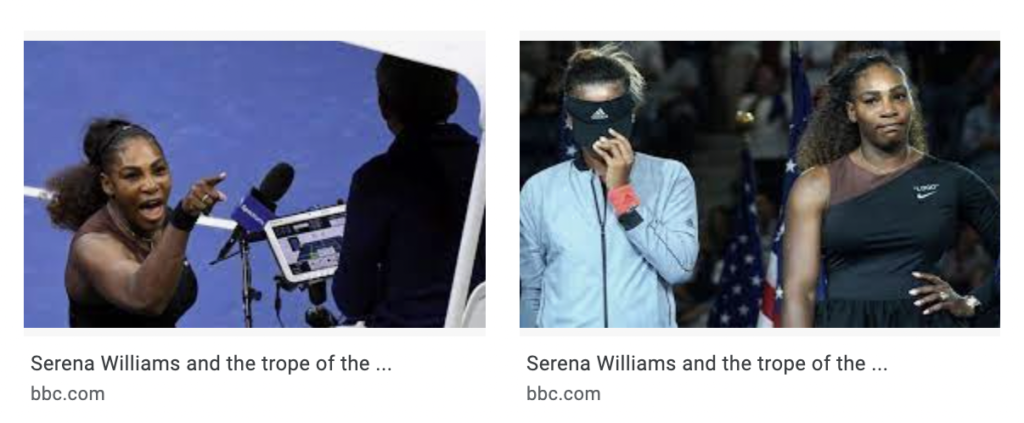
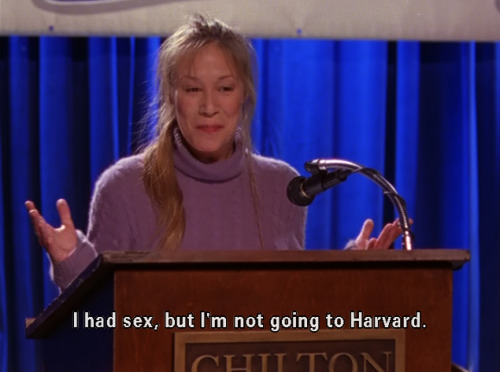
While Serena Williams’ success is celebrated, she unfortunately became a target of the ABW stereotype on several occasions throughout her career. There are numerous videos titled “Serena Williams Rage Compilation” posted on social media platforms in addition to hundreds of newspaper and magazine articles covering her sporting disputes and frustrated moments. In fact, Williams’ portrayal as an ABW in the mass media is so significant that if you were to do an image search of the term “angry black woman,” the first few pictures are of Williams.

Of the many sources covering Serena Williams’ career disputes, I focused on one video published by the largest American cable sports coverage network, ESPN. The video, titled “2018 US Open Highlights: Serena Williams’ dispute overshadows Naomi Osaka’s final win,” covers the 2018 US Open Championship between Serena Williams and Japan’s Naomi Osaka. The video begins with a clip of Williams breaking her tennis racket out of frustration. The video crew proceeds to zoom in on the broken racket and then later replays the clip of a frustrated Williams throwing her racket down. Soon after, the referee accuses Williams of receiving coaching and cheating.

On multiple instances, Williams demands an apology from the referee stating, “you are attacking my character.” In response to this, the referee gives Williams yet another violation. While disputes and frustration often go unpenalized and are often overlooked or granted leniency in men’s tennis, Williams received multiple penalties for her actions. When pleading her case, Williams notes, “because I’m a woman you’re going to take this away from me.”


While the contents of the video itself are controversial, I additionally wanted to focus on the ways in which ESPN perpetuates the ABW stereotype through the title of the video, the clips they provide, and the specific zoom and camera angles chosen. Although the video is titled “U.S. Open Highlights,” very few clips in the video are dedicated to the tennis match itself. Rather than replaying points and impressive displays of athleticism, the “highlights” in this video are clips of a frustrated Serena Williams. The camera angles and zoom were methodically used in a way to emphasize Williams’ anger with an example being the amount of screen time Williams’ broken racket received and the frequent replaying of Williams arguing with the referee. By doing this, ESPN paints Williams as angry, similar to how post slavery media pushed the agenda that Black women were angry, aggressive, and emasculated men by “failing to be submissive.” Furthermore, the video title states, “Serena Williams’ dispute overshadows Naomi Osaka’s final win.” By naming the video in this way, it paints Williams as the “bad guy” and accuses her of ruining Osaka’s moment. This depiction of Williams as aggressive and malicious is representative of 20th and 21st Century ABW media.  In addition to the title, the video’s description is equally disappointing…

While the match showcased the skill of two amazing Black female athletes, ESPN implies that the match will only be remembered because of Williams’ quarrel with the referee. Not only does this take away from Osaka’s victory, but it places further blame on Williams.

Through the notion of sapphires, mammies, and more recently “angry black women,” Black women have continued to fall victim to racial stereotypes depicting them as aggressive, malicious, and out to emasculate men. Following the 2018 U.S. Open Championships, ESPN perpetuated these racial tropes via a “highlight video” that covers a dispute between Serena Williams and a referee. While male tennis players receive little backlash from similar actions during matches (e.g., John McEnroe was known for his outbursts throughout his career), Williams was accused of “overshadowing” Naomi Osaka’s win and was given three penalties. While the term sapphire may be a thing of the past, the theme of portraying Black women as angry and aggressive in the media continues.


Sources

Collins, Patricia Hill. “Race and Ethnicity.” Controlling Images and Black Women’s Oppression , pp. 266–273.

ESPN. 2018 US Open Highlights: Serena Williams’ Dispute Overshadows Naomi Osaka’s Final Win. Youtube, 8 Sept. 2018, https://www.youtube.com/watch?v=uiBrForlj-k.

J. Celeste Walley-Jean. “Debunking the Myth of the ‘Angry Black Woman’: An Exploration of Anger in Young African American Women.” Black Women, Gender + Families, vol. 3, no. 2, 2009, pp. 68–86. JSTOR, https://www.jstor.org/stable/10.5406/blacwomegendfami.3.2.0068. Accessed 6 Oct. 2022.

“Serena Williams Fast Facts.” CNN, Cable News Network, 16 Sept. 2022, https://www.cnn.com/2013/09/13/us/serena-williams-fast-facts.

“The Sapphire Caricature.” Ferris State University, https://www.ferris.edu/HTMLS/news/jimcrow/antiblack/sapphire.htm.

Dahmer: Sexuality and Racism

Content Warning: this blog mentions rape, murder, and generally uncomfortable themes

For the past week, Dahmer—technically titled Monster: The Jeffrey Dahmer Story—has firmly stayed at #1 on Netflix. Dahmer has had one of Netflix’s greatest debuts since the premiere of Stranger Things season four. Dahmer non-linearly follows the life of Jeffrey Dahmer, a notorious serial killer who murdered 17 young men, most of whom were people of color, between 1978 and 1991. While true crime dramas and docuseries have recently risen in popularity, Dahmer reminds audience members that these were real people with lives before their death.

Dahmer also highlights two social issues that greatly contributed to Jeffrey Dahmer’s success as a serial killer: homophobia and racism. Jeffrey Dahmer was a homosexual, an aspect of his identity that made many, especially for the time, uncomfortable. As a result, they often overlooked his suspicious behavior in an effort to avoid him—and his sexuality—altogether. In the drama series, after Dahmer was discharged from the army due to alcohol abuse, his father, Lionel, relocates Jeffrey to live with his grandmother. Lionel did this in an attempt to inspire Jeffrey to clean up his act. This, of course, did not happen.

In episode five, it is revealed that Dahmer killed three men in his grandmother’s home and brought back the body of a fourth to dispose of. With both of them living under the same roof, how is it possible that Dahmer’s grandmother, Catherine, had no clue as to what her grandson was doing? In a situation where she would surely smell decomposing bodies and see/hear the various men Jeffrey brought back, would she not, at the very least, have her suspicions? While she may not have known the extent of Jeffrey’s actions, I do believe that she was choosing to ignore his behavior. While there is no direct evidence that Catherine was homophobic, she did attend a conservative church. I believed that Catherine ignored Jeffrey’s actions because she did not want to first acknowledge his sexuality. In other words, she was so unwilling to recognize his homosexuality that she overlooked his behavior altogether.

Homophobia also extends to the police officers who essentially returned Konerak Sinthasomphone back to Jeffrey Dahmer. In episode two, the audience is introduced to Konerak—Jeffrey Dahmer’s youngest victim who was only 14 years old. In this episode, Konerak escaped Dahmer’s apartment. Three neighbors found him half-naked and barely able to communicate or stand (Dahmer injected diluted acid into his brain while he was unconscious). Concerned, the neighbors called the police, but Dahmer convinced the two officers that Sinthasomphone was just drunk and they had gotten into an argument.

Jeffrey also asserted that Konerak was his 19-year-old boyfriend, despite there being no evidence. Konerak died because the two officers acted out of homophobic and racist impulses. They dismissed the concerns of the neighbors because they were not white. They felt less compassion for Konerak because he was Laotian and seemingly gay. They ignored the clearly, deeply concerning relationship (that was not even a relationship) between Konerack and Jeffrey because they fell into the assumption that gay relationships are bound to be ‘toxic.’ The two officers were so disturbed by the notion of homosexuality that they felt the need to be “de-loused” (a euphemism for “washing the gay away”) over the need to help a boy that was undeniably in danger.

Racism is a consistent theme in Dahmer, and there are quite a few scenes that I found very impactful. In episode five, Ron, a man who was drugged by Dahmer, attempts to have Dahmer arrested. However, Ron is quickly dismissed and told that while Dahmer may be an odd guy, being arrested a few times doesn’t make him guilty of everything. This is followed by the officer commenting that Ron should know this, implying that he had been arrested. Ron responds by stating that he had never been arrested and pointed out that the officer believed the word of a white man who had been arrested over that of a black man who had not.

As stated earlier, the majority of Dahmer’s victims were young men of color. Why is this? It’s because, frankly, Dahmer knew that he likely wouldn’t be caught. Police, especially at the time, did not care to look into missing person’s reports for POC individuals. It was the pervasive, systemic racism that allowed his deplorable actions to continue.

I do believe that Dahmer is a series worth watching, as I feel it identifies social inequalities that were fundamental in Jeffrey Dahmer’s success as a murderer. Of course, this does not mean that the series is completely flawless. There were certainly historical inaccuracies, such as the portrayal of Tony Hughes’ relationship with Dahmer. Additionally, I do not find the business aspect of this series to be entirely ethical. Rita Isbell, the sister of Errol Lindsey, gave an emotionally impactful speech during her courtroom testimony for the trial of Jeffrey Dahmer. This statement was included in the Netflix series. After watching Dahmer, Rita shared that she was never contacted about the series and was definitely not compensated. While Netflix is in no way obligated to compensate the families of the victims, not doing so is certainly tone-deaf—especially considering that the commodification of Dahmer’s murders was a theme.

As this blog post comes to an end, I wish to emphasize that while the series may be created for entertainment purposes, it contains the stories of real people. I encourage you to acknowledge the young men below, and if you have time, learn more about them.

Heartstopper’s Promotion of Positive Queer Representation

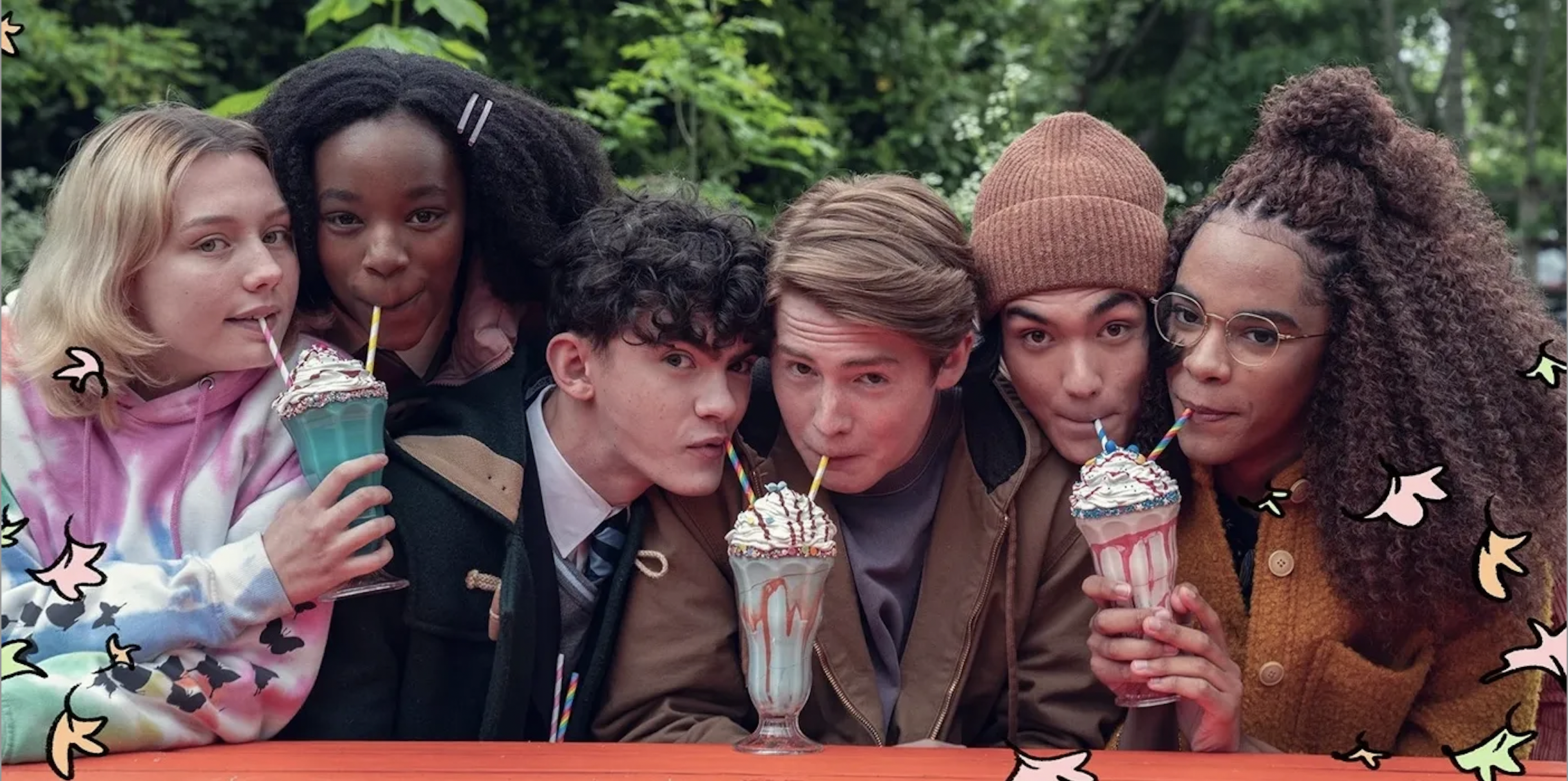
Heartstopper Cast Picture

Testing positive for covid on my last day of high school was not ideal, however it did provide me with the necessary free time to fuel my obsession for the hit Netflix series and webcomic, Heartstopper. I truly did not stop consuming content for my five days of isolation and at this point, I cannot count the times I’ve seen the show in its entirety, though I believe it’s getting close to double digits. I do not regret a second. If you are not familiar with the show, Heartstopper, written by Alice Oseman, originally started as an online comic released in September of 2016. Today, Oseman is working on their fourth volume with the show recently renewed for a second and third season. The story follows two boys, Nick Nelson (Kit Connor), a “straight”, popular rugby boy, and Charlie Spring (Joe Locke), a quiet drummer who was recently outed as gay, and their growing relationship as unlikely friends turn to lovers. This story is not only heart-warming, but also so important for the LGBTQ commnuity and more how queer characters are presented in the media. In my blog post, I will further explain why I believe this and specify how the show validates the identities of its queer characters.

One aspect of the Heartstopper storyline is the relationship forming between Charlie’s two friends Tao (William Gao) and Elle (Yasmin Finney). While the three of them formerly went to an all boys school together, Elle recently switched to a nearby girls school. With Tao and Elle spending more time apart, their feelings for each other strengthen. In many shows or movies, the language used to describe relationships between cis and trans people is harmful and invalidating, but Heartstopper trains audience members to view Tao and Elle’s growing relationship no differently than they would view any other heterosexual relationship. One way the show does this is in a conversation between Charlie and Tao. When Tao warns Charlie about having crushes on straight boys, he says, “As you token straight friend, it’s my duty to remind you that sometimes people are straight.”

Heartstopper (Season 1, Episode 2)

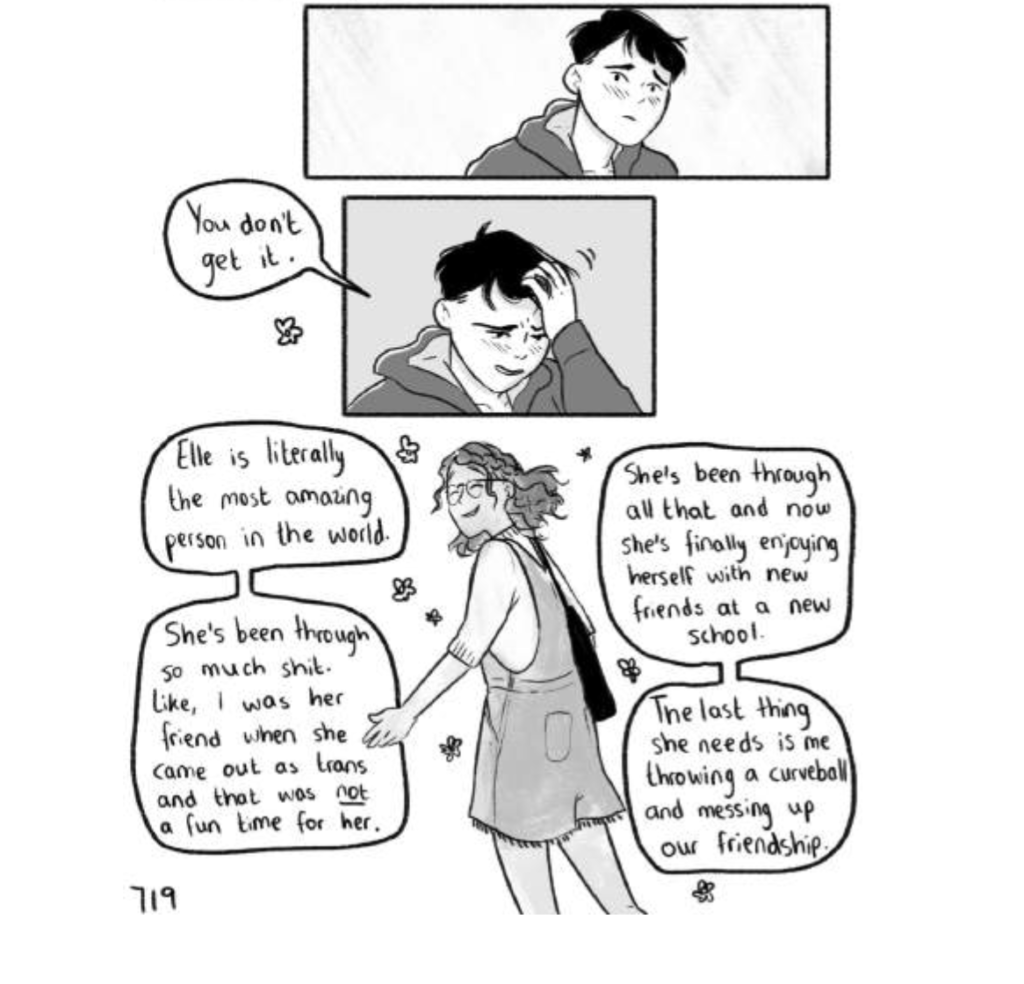
This line, while subtle, is incredibly important to the show. By clarifying Tao identifies as straight, the show later affirms Elle’s identity. Tao having a crush on Elle uplifts the fact that trans women are women, no exceptions. In addition, the only concern they both have with their crushes on each other is the thought of ruining their friendship. As Tao talks about why he hesitates to tell Elle his feelings, he says, “The last thing she needs is me throwing a curveball and messing up our friendship.”

Heartstopper Comic (Volume 3, P.719)

There is NEVER any discussion of Elle’s transness being an issue because that should never be an issue in the first place. By simply normalizing a relationship between a trans girl and a cis man, Heartstopper changes the audience members preconvienced biases about trans characters. 

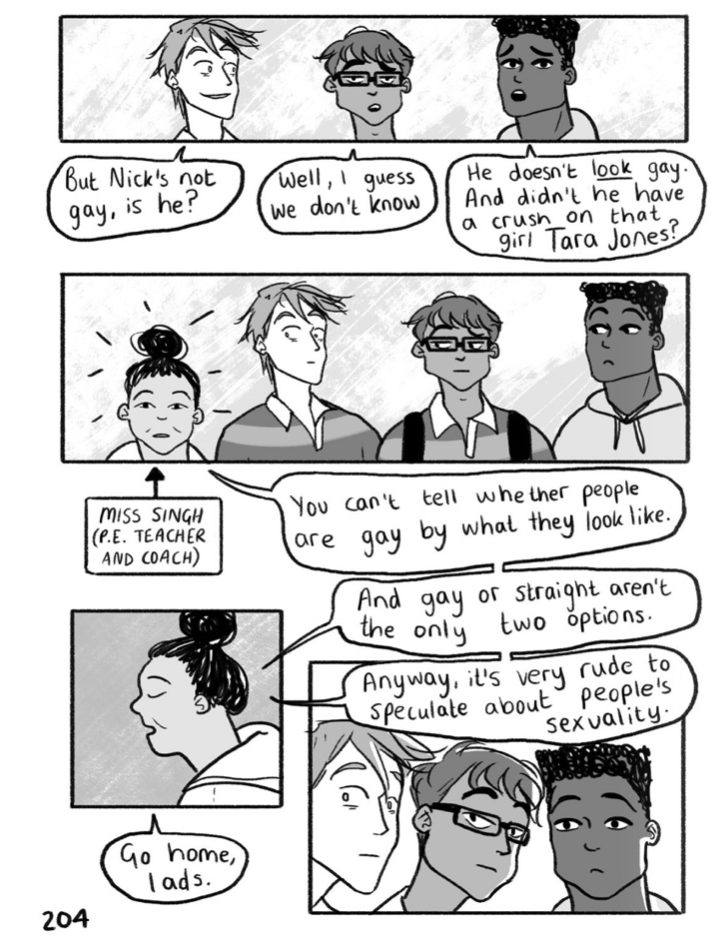
Heartstopper also uses language to break down biphobia, particularly the invalidation of bisexual men. Biphobia often takes shape in the erasure of bisexuality, meaning certain people believe one cannot be attracted to multiple genders. This assumption comes up in the Heartstopper comic. Before Nick and Charlie get together, Nick’s friends spend time discussing his sexuality. Miss Singh, the rugby coach, comments on their conversation, “You can’t tell whether people are gay by what they look like. And gay and straight aren’t the only two options. Anyway, it’s very rude to speculate about people’s sexuality.”

Heartstopper Comic (Volume 1, P. 204)

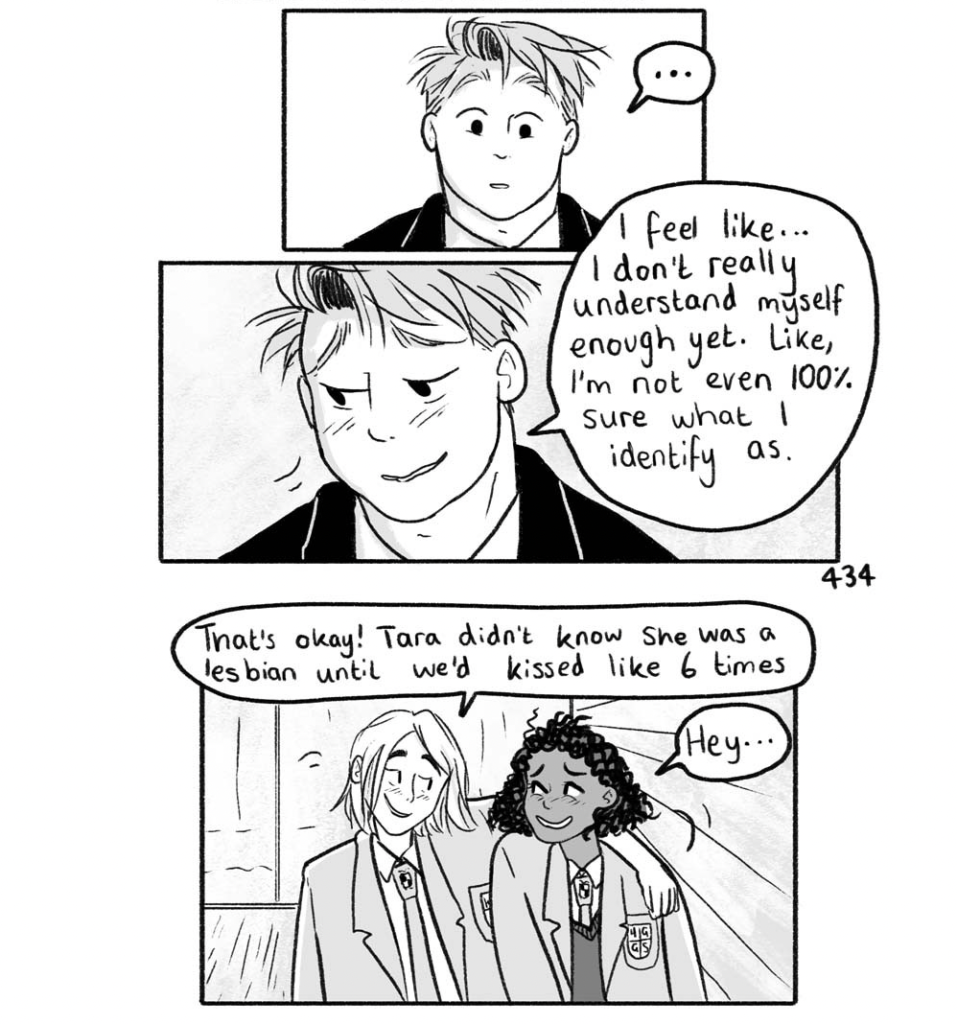
While Heartstopper aims to normalize LGBTQ+ identites, it also breaks down harmful ideology surrounding the queer community. Additionally, it replaces negative talk surrounding queer people with positive examples of queer discourse. After Nick and Charlie’s first kiss, Nick feels unsure about his sexuality. However, his new friends, Tara and Darcy, validate his questioning. Darcy adds in that, “Tara didn’t know she was a lesbian until [they’d] kisses like 6 times.”

 Heartstopper Comic (Volume 2, P. 434-435)

While the quote itself is intended to make readers laugh, it also promotes the idea that self discovery takes time. As friends surround Nick with positive encouragement, he feels more comfortable and confident in himself. This newfound self-understanding ultimately leads to Nick identifying as bisexual. After going out with Charlie for a few months, Nick feels he finally understands his sexuality and at the end of the first season, he decides to come out to his mom.
https://www.youtube.com/watch?v=4UCu5b4egAE
Heartstopper (Season 1, Episode 8)

While coming out scares him, Nick confidently tells her about both his boyfriend and his sexaulity. This scene shows incredible growth for Nick in not only overcoming his internalized homophobia but wanting to share his relationship with others. In addition, when his mom tells him that it’s okay if he doesn’t like girls, he assures her that “it’s definitely not just guys.” This interaction shows positive behavior on both sides; his mom supports him no matter his sexuality, and Nick feels secure in his identity. As bisexual men are not particularly prevelent on screen, Nick’s character is an incredible role model for both masculine guys who may be questioning their identities and audience members who may be concerned about the legitimacy of bisexuality. 

As you may have gathered by now, I cannot say enough about this story. Both the Heartstopper show and webcomic have done so much good worldwide, and I’m excited to see how the series continues to break down stereotypes and promote positive queer culture in later seasons. 

A Voice for the Voiceless: How Grey’s Anatomy Moves from “Silent All These Years” to “Shattering the Glass Ceiling”

Women are taught to never walk alone at night, to carry their keys between their fingers, and to dress modestly but not too modestly. I consider these basic “Woman 101” tips. And somehow, these tips are supposed to keep me and other women from becoming another 1 in 3. 

When current conditions are voiced, we as a society tend to turn a blind eye. Supreme Court Justice Brett Kavanaugh was confirmed to the court despite being accused by multiple women of sexual assault. Many women and girls limit their behaviors for fear of rape— for fear of being told that “boys will be boys,” “you were asking for it in that dress,” or “maybe next time you shouldn’t drink so much.” Concomitantly, adolescents have learned that consent does not matter—that it is irrelevant. 

While discussions are finite, popular media has begun to tackle the topic of rape. The season fifteen Grey’s Anatomy episode, “Silent All These Years,” written by Elisabeth R Finch, aims to initiate the dismantling of rape culture while highlighting the importance of consent and the lasting impacts of rape. The title, in and of itself, highlights just how oppressive and dismissive society becomes when women speak up about instances of sexual assault and rape. 

The episode begins when Khalilah Joi, guest-starring as a woman named Abby, arrives at Grey Sloan Memorial. With a cut to her face and bruises, coupled with skittish behavior, Dr. Jo Wilson recognizes the signs of rape. As the episode progresses, viewers learn that Abby was raped after leaving a bar. Aware of the victim-blaming narrative frequently used against women, Abby is hesitant to report the incident to the police or let her husband know. In attempting to break the stigma, Dr. Jo Wilson breaks protocol and shares her story of rape and sexual violence. She humanizes herself, therefore allowing Abby to see her as more than a woman in a white coat. When Abby agrees to a rape kit, something she knows will probably end up sitting in the back of a police station, Dr. Jo Wilson and Dr. Teddy Altman shift the power back to Abby. Before moving to the next portion of the rape kit, Abby must give them consent. She makes all the choices for herself. Something so seemingly simple is immensely powerful. Just hours before, Abby had lost all body autonomy. 

Dr. Jo Wilson sharing her story with Abby

That said, the most moving part of the episode comes prior to Abby’s surgery. Hesitant to go under anesthesia out of fear of being vulnerable again and fearful of seeing her attacker in the faces of the male staff and doctors, Abby resists the surgery. From that, the “hall of awesomeness” was assembled. The hospital’s female employees lined the entire length of the hallway right up to the operating room (which only had female doctors because girl power!!). The vast majority did not know Abby but showed up because they would want others to do the same if they were in that position. 

The “Hall of Awesomeness”

The show made an additional point to shift the fault from the woman. We live in a society that thrives off victim-blaming. Contrary, in “Silent All These Years,” Ben Warren, played by Jason Winston George, took the time to explain consent to his stepson Tuck Bailey, played by BJ Tanner: “If she stops having fun, just plain stop,” said Ben. “Time out. Game Over.”

Media portrayals of sexual assault correlate with increased victim blaming and the way the public discerns victims. Contrasting the standard image of women as sexual objects, Grey’s Anatomy humanizes the victim, emphasizing the importance of consent while moving away from victim blaming. 

I was talking to someone the other day who said he thought this episode was cringy. He viewed the “hall of awesomeness” as unrealistic and unnecessary, leaving him emotionally detached. And while I listened to his opinion and told him he had the right to hold that belief, I elaborated on my perspective. The unity and “women supporting women” narrative present throughout the episode not only reinforced the idea that you are never alone but highlighted just how essential lessons on consent and education about rape are. 

There is a common misconception that feminism is anti-male when the movement’s principle is contingent on equal rights for women. Women want to be heard, to be supported, and to be given a choice. This episode highlights this message. The creators gave a voice to the voiceless. They addressed the intersectionality between race and gender; Abby was played by a Black woman, serving as a nod to the increased vulnerability of Black women. They highlighted the healing power of female solidarity while recognizing that trauma is real and does not go away overnight. They emphasize that survivors are not alone and that they are not at fault. 

To anyone that finds Grey’s Anatomy over-dramatic, cringy, or over-rated, I encourage you to give it another chance. While it might not change your opinions on the show, it empowers survivors in a world that usually silences them. If not for yourself, do it for the one in three. 

Does Gender Exist in Heaven and Hell?

Crowley, played by David Tennant (left), and Aziraphale, played by Michael Sheen (right). 

The Amazon Studios T.V. series Good Omens was released in 2019-2020 and is based on a 1990 book of the same title by Neil Gaiman and Terry Pratchett. Set in London, the series tells the story of the angel Aziraphale and the demon Crowley. At the show’s beginning, Aziraphale and Crowley have worked together for eleven years to raise the antichrist, hoping their respective influences will neutralize his power and prevent Aarmageddon. However, they discover that they raised the wrong child, and the real antichrist has been misplaced. Now, they must find him before it is too late, dragging other beings–human and otherwise–into their caper as they go.

Good Omens poses an interesting question: does gender exist in Heaven and Hell? The answer is surprisingly straightforward: no it does not, or at least not in the way it does on Earth. According to the show’s lore, angels and demons are sexless, but can exhibit different sexes and genders in their “corporations” with a snap of their fingers. Choosing a sex disrupts the theoretical connection between gender and sex and allows each character to break, use, or reject all human gender norms. Characters in closer proximity to humans trend to use the binary, and those indifferent to humans are more fluid. This focus on gender as linked to humanity suggests that gender is a human construction rather than inherent or God-given, contrary to popular interpretations of Christianity. As these characters choose their gender, they provide excellent examples of diverse gender presentations, demonstrate how T.V. should handle ideas of gender, and assert that all gender presentations are valid. For brevity’s sake, I will focus on the non-human characters because they present more interesting interpretations of gender, starting with the protagonists.

Prior to the show, Crowley and Aziraphale have “fraternized” for about 6000 years. Throughout that time, in order to blend in, they have undergone the human process of finding aspects of gender that feel right to them. Even as societal ideas of gender change, they both follow a masculine pattern. They use he/him pronouns, wear “masculine” fashions (ranging from togas to suits), and choose masculine aliases like “Anthony.” They also align with masculine stereotypes; Crowley projects the tough-guy cliche while Aziraphale remains the dapper gentleman. Thus, the preference for masculinity is found, not assigned by sex or God. Through frequently choosing male genders, they create human personas for themselves so that performing gender is also performing humanness. 

Masculine presentations

Occasionally, an ethereal or occult being steps out of their favored gender presentation to achieve a goal, such as becoming the antichrist’s nanny. Nanny Ashtoreth appears only briefly in a flashback, but provides excellent trans representation. There is a long history in film of men in women’s clothing or trans women being the butt of the joke, but this scene is entirely serious. We understand that Crowley’s gender change is not an experiment or anything out of the ordinary; he is simply performing a gender that will get him the job he needs. The show’s context also provides the information that he lives as a woman for eleven years, demonstrating that he is not only performing the gender “woman,” but that heisa woman, regardless of any previous presentations.

If we step out of the fictional world of the show, we can also see that David Tennant’s costume reflects the normality of this gender change. Tennant wears a blazer, skirt, and hat that fit within Crowley’s preferred clothing style down to the matching color scheme. The clothes resist using spectacle or drawing attention to the fact that this is a male actor in women’s clothing. However, director Douglas Mackinonn also chose not to downplay this fact by casting an actress as the nanny. This portrayal reinforces that Nanny Ashtoreth is Crowley even if he is in a different bodily form or performing a different gender. Crowley utilizes both ends of the gender binary but is rarely seen in an androgynous form. However, his and Aziraphale’s colleagues in Heaven and Hell are often combine multiple aspects of gender at once.

Heaven and Hell have characters who do not limit themselves to the gender binary. These characters are intentionally written without gender, allowing the casting to focus solely on who fits the role best. This then allows for interplay with who portrays these characters and the genders they do or do not perform. Archangel Michael, who is nearly always male in religious contexts, allows a masculine name to coexist with she/her pronouns and is played by Doon Mackinchan. Similarly, Beelzebub is played by Anna Maxwell Martin, but uses he/him pronouns. This bending of genders also extends to other non-human beings. One of the four horsemen of the apocalypse, War, who is often personified as masculine, is distinctly feminine here. Some characters reject gender entirely. Pollution, another horseman, uses they/them pronouns perhaps because pollution is a genderless concept, or perhaps because they are too busy wreaking havoc to choose a gender. Unlike Crowley and Aziraphale, these beings take little interest in human lives, so their performances of gender are looser. These excellent interpretations of gender do not end with the Good Omens canon. The fandom of the show has taken that canon further with the support of the show’s creators. 

War and Pollution

In the Good Omens fandom, all interpretations of the characters’ genders are correct. Fans have created art of Crowley and Aziraphale as women, as a heterosexual couple, as gay men, and more. This art might be a reflection of fans’ desire to possess this power of escaping the gender binary or easily changing their gender presentation. 

“Gender?”
“Ineffable Wives”

Some fans have tried to narrow the range of gender possibilities. One fan asked producer/co-author Neil Gaiman over Twitter, “Is Crowley gender-fluid” (Mr. Relentless)? Gaiman replied, “Crowley’s Gender is Fallen Angel,” suggesting that Crowley’s gender is hardly his defining feature. Good Omens asserts that while gender is a human construction, all gender orientations, combinations, and expressions (or lack thereof) are valid (Neil Gaiman). As evidenced by the dedicated fans, many people find this show to demonstrate good depictions and increase visibility of people outside the gender binary. So while humans cannot change genders at will, perhaps we and other media can look to Good Omens as an example of how to further explore genders. 

Works Cited: 

  1. Good Omens. Written by Neil Gaiman, directed by Douglas Mackinonn, Amazon Studios and BBC Studios, 2019-2020, performances by David Tennant, Michael Sheen, and Frances McDormand.  
  2. “Crowley and Aziraphale.” RadioTimes. Jun 30, 2021. https://www.radiotimes.com/tv/fantasy/good-omens-2-crowley-aziraphale-romance-newsupdate/. Accessed Sept 24, 2022. 
  3. “David Tennant’s Iconic Crowley Looks | Good Omens | Prime Video.” YouTube. Uploaded by Amazon Prime Video UK, April 11, 2020. https://www.youtube.com/watch?v=03G_QjcAd-A&t=141s. Accessed Oct 3, 2022. 
  4. “Fall Asleep To Nanny Crowley’s Lullaby 🎶 #Shorts.” YouTube. Uploaded by Amazon Prime Video UK, Apr 20, 2020. https://www.youtube.com/watch?v=FB3SXx_2A74. Accessed Oct 3, 2022.  
  5. “Four Horsemen // Good Omens // Villain [+rus sub].” YouTube. Uploaded by SIDANI, Jun 4, 2019. https://www.youtube.com/watch?v=Y3UU2Qt75xc. Accessed Oct 3, 2022. 
  6. Mr. Relentless [@RelentlessHimbo]. “Hey @neilhimself is Crowley genderfluid or are we looking too deep into it? Sorry to bother you.” Jan 29, 2022, 4:30 pm., https://twitter.com/neilhimself/status/1487538631946371073?ref_src=twsrc%5Etfw%7Ctwcamp%5Etweetembed%7Ctwterm%5E1487538631946371073%7Ctwgr%5Ed0a0ac7302fad9067cbe212b028c1525490a1314%7Ctwcon%5Es1_&ref_url=https%3A%2F%2Fscreenrant.com%2Fgood-omens-crowley-aziraphales-genders-neil-gaiman%2F. 
  7. Neil Gaiman [@neilhimself]. “Crowley’s Gender is Fallen Angel.” Jan 29, 2022, 4:30 pm. https://twitter.com/neilhimself/status/1487538631946371073?ref_src=twsrc%5Etfw%7Ctwcamp%5Etweetembed%7Ctwterm%5E1487538631946371073%7Ctwgr%5Ed0a0ac7302fad9067cbe212b028c1525490a1314%7Ctwcon%5Es1_&ref_url=https%3A%2F%2Fscreenrant.com%2Fgood-omens-crowley-aziraphales-genders-neil-gaiman%2F. 
  8. “Gender?” thegoodomensdumpster.tumblr.com. https://thegoodomensdumpster.tumblr.com/image/186215878402. Accessed Sept 30, 2022.  

“Ineffable Wives.” Pinterest. https://www.pinterest.com/pin/70437481906134/. Accessed Oct 2, 2022.

Media Analysis: Half Following the Bible…?


For my media analysis, I am analyzing an Instagram post from the Instagram account @impact. Impact, in their bio, claims to post digestible and socially impactful content. Their account has 2.2 million followers, and is verified on Instagram. The certain post that I am analyzing was posted on Friday, September 30, 2022. The first slide is a graphic of Marjorie Taylor Greene (MTG), a member of congress representing Georgia district 14. She is extremely far right leaning. The first slide of the Instagram post includes the text, “two months ago, Marjorie Taylor Greene voted against gay marriage because it’s a sin. Now, she’s getting divorced from her husband after reportedly cheating on him with the manager of her gym” (Impact, September 30, 2022). The next slide shows a video with the caption, “Marjorie Taylor Greene is a US congresswoman and conspiracy theorist from Georgia, She’s spent much of her career preaching christianity and using religion as a mask for bigotry. Marjorie recently claimed that straight people will be extinct within five generations” (Impact, September 30, 2022). 

Her opinion that there are more people who are identifying as members of the LGBTQ+ community should not be framed in a negative light. Knowing that there is more identification and representation is a testament to the work that our society has done in terms of creating spaces where people feel comfortable to express their true identity (even though we still have A LOT of work to do). Her analysis of members of the LGBTQ+ community only starting to exist within the past couple of generations is WILDLY inaccurate-as we have seen from multiple readings (including D’Emilio, Rupp, etc.). Members of the LGBTQ+ community have existed as long as we have lived.

Her theory of the extinction of straight people is baffling, and honestly, stupid. In what case scenario would an entire sexuality be extinct? This brings up an entire new lens of many people who are extremely right leaning-that the existence and celebration of LGBTQ+ members take away from heterosexuality and being “straight”. The two can exist in conjunction with one another, and do not have to eliminate one sexuality or the other. In other words, LGBTQ+ members do not threaten the identity of others, and the identity of others should also not impact LGBTQ+ members. They can coexist in harmony, with equal unwavering support from either end.

The post (sadly) continues, as the next slide says that “Marjorie, who has claimed that LGBTQ peopel are “against god’s creation,” voted against codifying gay marriage into law. Now, she’s getting divorced from her husband after reportedly hacing two extramarital affairs–one with a “polyamorous tantric sex guru,” and one with the manager of her gym” (Impact, September 30, 2022). @impact brings up an incredible point-that Marjorie is entitled to do whatever she wants with her life, but it is hypocritical that she says that LGBTQ+ members are against god’s creation when she blatantly is going against the bible by cheating on her husband. If you are going to use the bible as your moral grounding-you can not “pick and choose” which parts you decide to follow, and which parts you decide to not follow based on your own convenience. Marjoie Greene Taylor has not allowed other people that luxury, so it is hypocritical that she chooses to live her life the way that she does. 

Overall, I commend @impact for drawing attention to the statements and actions of Marjorie Greene Taylor. The way that the post is laid out is easily digestible, and easy to understand for any viewer with any level of previous knowledge. They quote Marjorie herself, making her claims indisputable.

Sharing the Chocolate Pudding: Abortion Representation in Sex Education

Before the following scene, the main character Maeve is heckled by two young members of an anti-abortion group. They intend to create a feeling of shame and guilt strong enough to dissuade Maeve from getting her abortion. Maeve enters the abortion clinic holding onto these complicated feelings as well as some level of fear.

The scene continues to show the shame and fear that consumes this medical space, but also shows the kindness and empathy that helps Maeve get through the experience. As seen from the comments on this video, this episode of Sex Education is cherished for showing the experience of getting an abortion in a realistic and nuanced way. 

The shame surrounding abortion is also shown coming from the medical community. Sarah, who is getting an abortion at the same time as Maeve has been to this same clinic before for to get an abortion. Someone working in the clinic says to her, “Maybe there will be a chocolate [pudding] the next time you’re here, Sarah.” This medical professional is painting Sarah’s choice to get an abortion as an innate moral failure which is bound to happen again.

One of the most powerful things about Sex Education’s depiction of abortion is the way that support changes the experience for Maeve. Sarah says to Maeve, “Don’t worry love, I’ve got three kids and I feel way more guilty about the ones that I had than the ones I chose not to. It’s better not being a mom at all than being a bad one.” Maeve is able to console Sarah and tell her that her kids really love her. Then, leaving the clinic, Maeve sees that Otis waited for her to drive her home and even got her flowers. Both of these acts of kindness allowed Maeve to not feel like she was making the wrong decision in terminating her pregnancy.

While this episode is cherished as one of the best depictions of abortion in mainstream pop culture, Maeve’s story doesn’t give the full picture. For one, I have only ever seen in-clinic abortions depicted in television. The reality is that a large percentage of abortions are completed by taking a series of two pills at home. The in-person abortion makes for a more dramatic scene in a show, but it leaves you thinking that is everyone’s experience. 

Another lens worth considering is abortion access based on location, class, and race. Maeve’s experience was as simple as contacting the clinic and making an appointment. The clinic appeared to be in town, and Maeve had a friend willing to help with travel. Imagining a similar situation in Oklahoma, a young woman would have to search for abortion clinics across state borders. Without the right resources this could prove to be impossible for a young student. We also don’t see much financial discussion of Maeve’s abortion. In the United States, an abortion can cost anywhere from 750 to 1500 dollars depending on your insurance and how far you are into your pregrancy. Maeve, in her financial situation, likely would not have been able to afford this procedure in the United States. It is also worth thinking about Maeve’s position as a white woman in this show. Having seen countless stories about the struggles of being a person of color in a healthcare system built for white people, we can imagine that Maeve’s experience would have been different if she wasn’t white. For one, her fear may have increased exponentially being operated on by a team of mostly white doctors and nurses. She also may have experienced a greater travel barrier in getting to an abortion clinic as medical facilities are more frequent and better funded in areas with historically privileged families. Also, the medical advice given to her may have aligned better with the research that had previously been done on white bodies.

I believe that this scene is overall a positive representation of an abortion experience for a young person in high school. We see the pain and sadness, the shame and secrecy, and the moments of support and kindness. We may not see the full picture of what it means to get an abortion around the world for people with varying levels of privilege, but that isn’t what Sex Education is trying to do in this episode. ‘Sex Ed’ does a great job of displaying different types of people and their stories; in this episode they are telling the story of Maeve. In the lens of contemporary social justice centered media, this is a great perspective to consider. This remains true as long as you remember that this isn’t everyone’s experience with abortion and actively seek out other perspectives.

https://www.plannedparenthood.org/learn/abortion/considering-abortion

https://www.axios.com/2022/06/25/abortion-illegal-7-states-more-bans-coming

All About That… One Body Type

All About That Bass Official Music Video

I love Meghan Trainor’s song “All About That Bass” in which she is apparently encouraging women to embrace their curves and hating on the idea that women should be “stick figure, silicone Barbie dolls.” The message that she is conveying, though, could actually be counterproductive to a societal norm of recognizing beauty in all body types. 

Firstly, the message that Trainor is sending through her lyrics is that female bodies are inherently sexual and that women should embrace their curves because “men like a little more booty,” which apparently makes the woman in the image below (a stereotypical, skinny, pretty, white woman) very uncomfortable.

She additionally says that she has “all the right junk in all the right places,” meaning that she has curves, or fat, in places on her body that are generally considered attractive and/or sexy, probably her ass and her breasts. This is especially prevalent in the music video for the song where many of the dance moves are very butt-focused, like in both the screenshots of the video above and below. This line makes it seem as though Trainor believes that there is a right place for fat on a female body and that fat should enhance a woman’s sexual features. The idea of women being fat in only specific places on their bodies in order to be more sexually attractive is definitely not a fat positive or feminist stance on female bodies. Fat can be considered sexy in any place in the body, from the belly to the back to the cheeks to the ankles, and Trainor is unfortunately just enforcing another impossible stereotype for women. 

Also, fat should not be seen as something sexual, neither should a lack of fat. Human bodies are made for so much more than sex, and female bodies in particular are seen so often in culture as symbols of sex, and being a fat sex symbol is no better than being a skinny one. Trainor uses the idea that men like fat asses to make fatness seem acceptable. Telling women that men like a specific trait and that makes it a good trait is certainly not a feminist idea. I should be allowed to live in my own body without having to justify my beauty by saying that men think I’m sexy so it’s ok.

One lyric from this song talks about “skinny bitches,” who the woman in heels below is a symbol for, and definitely gives a negative connotation towards skinny women, implying that being fat is better than being skinny. In this way, Trainor is trying to impose a new standard of beauty that is just as unattainable for some people as being super skinny is by shaming skinny women. “Skinny shaming” should not be a substitute for fat shaming, we shouldn’t be shaming anybody about their body type!!

The cast of the music video is also problematic. Trainor and her four main backup dancers, seen below, as well as the other female presenting dancers in the video, are all pretty much the same body type, and they aren’t even fat! 

In a song that is supposed to be about empowering fat women, having a bunch of women who, while they might not be stick thin, certainly aren’t fat, play as if they are fat is incredibly damaging. Additionally, Trainor has two young girls in the video, seen below, who are very thin, sending a message to the young girls who watch the video that this is the ideal body type for their age.

The only truly fat person in the video for a song ABOUT BEING A FAT WOMAN is the MALE presenting dancer below who doesn’t even get much screen time.

In a society that shames fatness, telling women that very mid-sized people are the fat people in our world completely discounts a whole group of people AND makes mid-sized people think that they are fat, which is damaging in a world that shames fatness.

In addition to the lack of size representation in the music video, the lack of racial representation is prominent, too. Depending on what you consider “dark-skinned,” there are no more than three dark-skinned people, one of them being one of the children, one of them being a backup singer (most of whose face is covered by a wig as seen below), and one of them being part of Trainor’s main group of backup dancers, in a cast of about 14.

None of these cast members get much screen time. The range of skin colors is very slim. There are only two male presenting cast members in the video, and the white man below is meant to represent a potential Ken-Doll-like boyfriend type for Meghan Trainor.

So, the main takeaway I get from the combination of the lyrics and the video from All About That Bass is that white (and sometimes black) women should strive to have big butts, avoid being skinny, avoid being fat, and to do all of this in order to be sexually appealing to conventionally attractive white men. Definitely not the fat power anthem that we need.

The Danger In The Silence

TRIGGER WARNING: THIS POST CONTAINS DISCUSSION OF TRANSPHOBIA & VIOLENT ACTS

Silence is a powerful thing, for its absence leaves space for endless interpretations. As a social species, when us humans are faced with the choice between silence and noise, we often find ourselves mute. We tend to prefer the easiest option, the one that leaves us feeling most safe and secure in the welcoming arms of the status quo. However, in recent years, silence has lost its false sense of security, as we have become more aware of the ways in which oppression so frequently masquerades as silence. This is because silence at the expense of those not given a voice is not neutrality, but complicity- and thus is the crime of Silence of The Lambs.

The irony of this early 90’s psychological thriller is that its heavily-praised dialogue is also its greatest downfall. It is obvious early on in the film that every detail has been meticulously crafted to create a gothic aura of simultaneous beauty and repulsion. This is particularly evident in the delivery of its metaphor-heavy lines and narrative motifs surrounding bodily transformation, forbidden attraction, and literal disguise. Everything about the film, from its gloomy scenery to the distinctive voices of the characters themselves, is presented with a sort of melodramatic flare that is actually most revealing of the screenwriters’ confidence in their ability to take on a theatrically camp approach to the horror genre. However, what could have been an artistic masterpiece instead became an arrogant overuse of problematic cliches when the writers failed to give their gender-ambiguous villain the same level of careful consideration as the cismale villain, Hannibal Lector. 

For anyone not familiar with “Silence of The Lambs,” it tells the story of a young cisfemale FBI recruit, Clarisse, who is instructed to enlist the help of captured serial killer and cannibal, Hannibal Lector, to try to catch an active serial killer, nicknamed “Buffalo Bill.” The reasoning behind this strange plan of attack is that Buffalo Bill has recently kidnapped a high-profile senator’s daughter- meaning that the FBI have now become so desperate to catch the killer and save the girl that they are left with no choice but to ask Hannibal Lector (a genius psychiatrist prior to his imprisonment), for his insight in creating a psychological profile of the killer in order to uncover his whereabouts and identity. 

At the beginning of the story, all the FBI knows is that this active serial killer has been removing large chunks of skin off of ciswomen’s bodies, and dumping their naked corpses in various locations. Lector discerns that the killer’s goal must be to create a patchwork bodysuit out of the skin he has collected, which is why he has chosen to exclusively kidnap and murder plus-size women. Aside from the problematic way in which the cis-male investigators discuss these women in regards to their size, this plot line could have been successful on its own. However, instead of continuing with their established theme of detail-heavy dialogue and carefully considered backstories, the writers chose the easiest and most problematic motive possible for Buffalo Bill: he is confused about his gender identity, and thinks that he must be “a transexual.”

Hannibal Lector & Clarisse discussing the profile for the active killer

The movie does make a point of having Clarisse say, “there’s no correlation in literature between transexuals and violence. Transexuals are very passive,” to which Hannibal clarifies that Buffalo Bill was not actually a transexual, he only thought he was because he hated his own identity. However, between the cryssalized moths that the killer hides in his victim’s bodies to the confidence he appears to exude while dancing in front of a mirror “tucked” in a woman’s robe and makeup, the writers seem to have no problem portraying all of the stereotypes that they clearly associated with transgender women. This, plus the lack of any character development indicating that Buffalo Bill was actually wrong in his newfound gender identity- and this initial conversation serving as the only reminder that Buffalo Bill was not in fact transgender- suggests that the writer’s decision to make this villain “not really transgender” was actually more of an afterthought to avoid accusations of transphobia, rather than another detail that actually benefited the narrative somehow. It was as if they thought they could undo all of the inevitable harm this character would bring towards transwomen, simply by adding a quick randomply placed line about the character not actually being transgender.

Buffalo Bill dancing & putting on makeup while his victim tries to use his pet dog to escape

This is exactly where the silence in “Silence of The Lambs” becomes deadly. The  writers find themselves unable to fully commit to either interpretation of Bill’s gender identity- meaning that the visuals of Buffalo Bill dancing naked create far deeper impressions in the audience’s mind than the single line spoken about Bill’s identity crisis. It is clear that writers did not give Buffalo Bill’s character near as much thought as Hannibal Lector’s character or even the movie’s minor characters, which still manage to contribute to the overall narrative. As Christopher Schultz states, the “narrative suffers from an error of omission rather than intent.” The effect is that most viewers interpret Buffalo Bill to be a transwoman, and this presentation confirms the problematic trope in the film industry that transwomen are men disguised as women for the purpose of committing violent acts towards women. This is further emphasized not only by the murders that Buffalo Bill commits, but also by the literal suit made of women’s flesh that he wears. 

Though the writers may have added the “Buffalo Bill is not actually trans” detail as an afterthought to avoid accusations of transphobia, this undermining of the gender a person chooses to present is actually incredibly harmful as well. This is because the other conservative argument against transgender people is that they aren’t actualy trans, they’re just confused- or even worse, that people who identify as transgender only do so because of some sort of childhood trauma that they have yet to deal with. In this way, the choice to invite the discussion of gender identity into this element of the narrative at all was a poor one, as its execution is harmless regardless of the way that the audience understands Buffalo Bill’s gender.

Using Power to Sing About Abusing Power- Analyzing ‘Your Power’ by Billie Eilish

‘Your Power’ Music Video by Billie Eilish

“Try not to abuse your power,” Billie Eilish sang to a crowd of 15,000 fans in Charlotte last month. Every other song in the concert was accompanied by manic shouts of the lyrics, jumping, and choruses of “We love you Billie!” but once the familiar chord progression sounded from a single accompanying guitar, silence engulfed the auditorium. As Eilish tells Rolling Stone, the song “Your Power,” released in 2021, talks specifically about the relationship between a young girl and an older man in the entertainment industry. Her usage of he/him pronouns to describe the abuser and she/her pronouns to describe the victim additionally narrows this focus. 

The music video for the song opens with Billie sitting on top of a mountain in a desert wearing neutral, almost camouflaging colors. She has a snake in her lap who appears to be friendly. 

The first shot of Billie Eilish in the music video for ‘Your Power’

There’s a lot to unpack here. Firstly, her sitting on a mountain could imply that she has a certain element of power of her own. Perhaps, the higher up she goes, the more alone she feels because she has so much more to lose if something goes wrong. Perhaps, the reason she’s so high up in the first place is because she got accustomed to this dark, desolate place with snakes. She let herself relax around the snake, not knowing what it could potentially do to her. The clothing choice could also add to the atmosphere of desolation. She’s acclimated to her surroundings; like a chameleon she’s changed her colors to fit the role she’s meant to play. She’s in bed with the enemy because she knows it’ll take her higher up the mountain. It could also signify that she’s blended in so well that a) no one can tell that something’s wrong and b) no one can see her pain and help her. Another possible reason for the neutral tones and not something flashier or individualistic could be to signify that she is not a special case- she is just one of many victims who have gone through the same abuse.

The video is first a zoomed out view of the entire mountain landscape, which then slowly zooms into Billie sitting on the mountain. This could signify that things don’t always seem the way that they are. One might’ve thought it was an empty stretch of mountains at first, but it wasn’t- there’s someone sitting there. Similarly, one might’ve thought there was no foul play at hand, but there is- it’s an abusive power relationship. 

Zooming into Billie Eilish

Billie’s interactions with the snake are symbolism for the power dynamic explored in the song. When the snake crawls into Billie’s lap, her hands are limp and she makes no attempt to push it off, communicating perhaps that she’s scared and she doesn’t know how to.

Billie’s first interaction with the snake

Slowly through the course of the song, the snake wraps itself tighter and tighter around her. She’s also sitting at the ledge of the mountain, implying that she has nowhere to run and adds to the feeling of powerlessness.

Billie being strangled by the snake

The song ends with Billie being strangled by the snake and the camera zooms out to show that she is camouflaging with the background. No one would be able to see her pain and see what’s happening behind the scenes. 

Zooming out of Billie to show the mountains

While the music video has many subtle layers and nuances to unpack with multiple viewings, the lyrics are direct and straightforward, without being laced with too many metaphors.

The lines, “She was sleeping in your clothes but now she’s got to get to class,” add to the narrative of the younger girl with the older man. It is clear that he was sleeping with her, and she’s a student.

And you swear you didn’t know (didn’t know)

No wonder why you didn’t ask

She was sleeping in your clothes (in your clothes)

But now she’s got to get to class

Verse of ‘Your Power’

The line, “You said you thought she was your age,” is a clear indicator of the age gap. There is also a reference to the abuser’s ‘contract’ which is a reference to their professions in the entertainment industry, which adds to the complex power dynamic.

And you swear you didn’t know (didn’t know)
You said you thought she was your age

How dare you?
And how could you?
Will you only feel bad if it turns out
That they kill your contract?
Would you?

Verse of ‘Your Power’

The victim has so much more to lose as a young woman who has just started advancing in her career, as opposed to this man who appears to be her supervisor and has control over her future. She has nothing she can do, just like Billie with the snake: if she tells someone or tries to get herself out, she could fall off the ledge.

We must emphasize the usage of the word “try” in “Try not to abuse your power.”

Try not to abuse your power
I know we didn’t choose to change
You might not wanna lose your power
But power isn’t pain

Chorus of ‘Your Power’

This implies that men in power abuse it so often that it almost goes without saying that they will; it’s such a common occurrence that Billie almost says, “I know it’s hard and you’re used to doing this, but please try not to.” This adds to the submissive tone of the song and reinforces the idea that the women have to plead to not be taken advantage of. Rather than the song’s lyrics being, “Do not abuse your power,” the usage of the word ‘try’ implies that young women like Billie do not even have the power to stand up for themselves without them having to pay some kind of price for it or face brutal consequences in their careers and reputations.

The song’s lyrics alternate between using third and first person pronouns for the victim, possibly implying that Billie has gone through this, but that she isn’t the only one. She’s speaking about her own experiences, but is also indicating that several young people in the entertainment industry are also in complex power relationships and being used for sex.

I thought that I was special, you made me feel
Like it was my fault you were the devil, lost your appeal
Does it keep you in control? (In control)
For you to keep her in a cage?

Eilish uses first-person pronouns in the first two lines and third-person in the last line

Something must be said of what power means to Billie Eilish and how that could differ for different sections of society. Billie Eilish may have a snake around her body, but she is still on top of a mountain. That mountain is the privileges she has as a white, cis, rich celebrity. Some may not have that mountain, and it’s important to recognize that she is representing a single story that does not accurately represent intersectionality. 

Additionally, there is the question of the color of the snake. Perhaps it wasn’t intentional that a black snake was being wrapped around a white woman’s body to represent abusive power relationships. But intentions go out the window when we question impact. If the singer was intentional about the neutral palette of her clothes, then surely she was intentional about choosing a dark, contrasting colored snake. This could perpetuate the dangerous idea that a majority of abusers are people of color, which is untrue, especially in the predominantly white music industry that Billie Eilish is singing about. These are details that must not be overlooked when creating media for the consumption of millions of viewers.

Although the song has issues that must be addressed, it also touched a chord with several individuals who have had similar experiences. That night in Charlotte, I didn’t just hear a song about abusing power. I heard Billie Eilish use her power.

“I Kissed A Girl”- Analysis

I recently watched Katy Perry’s music video for her 2008 hit song, “I Kissed A Girl,” on YouTube, and was intrigued by some assumptions about sexuality that were sometimes not so subtle in the video. In this blog post, I will explain those assumptions and how they were presented in Perry’s production.  

It is not completely clear who Perry’s intended audience is for this music video, however, I can infer that it was intended for pop music fans. With that said, the video likely targets young Americans, since that demographic tends to be more interested in American pop music. Continuing to discuss intention, it seems that Perry’s music video’s intended purpose is to share an experience that she had when she kissed a girl for the first time.

“I Kissed A Girl” is a song that was sang and released in 2008 by Katy Perry, a 37-year-old female pop star from Santa Barbara, California. Before diving into my evaluation of the music video itself, I want to provide a brief biography of Katy Perry. For context, Katy Perry is an American singer and celebrity who was born in Santa Barbara, California to parents who were Pentecostal (a form of protestant Christianity) pastors. Growing up, Katy Perry’s family moved homes often to different places in the western United States. Perry’s family was strictly religious, and she left home at fifteen to pursue a music career in Nashville, Tennessee. Perry’s music breakthrough took place during the early 2000s. “I Kissed A Girl” remains one of Perry’s most popular songs.

To accompany Perry’s hit song, a music video for “I Kissed A Girl” was uploaded to YouTube in 2008. In this music video, Katy Perry sings her song “I Kissed A Girl,” while flirting with other female friends in a bedroom setting. Throughout the video, Katy Perry and her friends are all wearing lingerie, and at one point during the music video, Katy Perry has a pillow fight with some of her female friends in the scene. This pillow fight is an example of a scene here that has a flirtatious undertone.

While acting in a flirtatious way throughout the video, Katy Perry sings along to her song “I Kissed A Girl,” which overall communicates a regret for kissing a girl.

For instance, in the first few lines of her song as she approaches the chorus, Perry makes the following statements: “this was not the way I planned,” “not my intention,” “lost my discretion,” and “it’s not what I’m used to.” When I first clicked on the music video on YouTube, I was aware of the title, “I Kissed A Girl,” so when I heard the first few lines of Perry’s song, I interpreted her as trying to explain to the audience that she did not want to kiss the girl. The idea that presented in my mind as I was watching was “is she apologizing or trying to plead some sort of innocence because she kissed a girl?” When making these statements, Perry is alone with a devious smile in the video.

During the chorus part of her song, Perry makes these statements: “I kissed a girl and I liked it,” “I kissed a girl just to try it,” “I hope my boyfriend don’t mind it,” “it felt so wrong,” “it felt so right,” and “don’t mean I’m in love tonight.” When making these statements in the video, Perry displays a more genuine smile, while surrounded by other women.

Two key feelings are conveyed in these statements. First, it seems clear that Perry enjoyed kissing the girl. Second, it is suggested that Perry might regret kissing the girl, but it is clear that she feels that her kissing the girl was unacceptable. By saying that “it felt so wrong” and “just to try it,” and “I hope my boyfriend don’t mind it,” Perry is suggesting that her behavior was in some way potentially unacceptable by her, her boyfriend, or greater society.

All the statements mentioned up to this point only make up the first minute of the music video, which altogether is three minutes. Pausing here, an observer of the video up to this point can assume some norms of society that are represented. More specifically, the first minute of this video is enough for one to correctly assume that American society views homosexuality as something that does not fit with the societal norm (heterosexuality).

Perry’s music video takes an interesting approach to homosexuality not being the norm. While the words being sang in the music video are apologetic for kissing a girl, Perry’s behavior on screen challenges the norm. If a homophobic person were to watch Perry’s video, their comfort would be directly challenged. Perhaps this impact was Perry’s intention through her music video. Maybe she wanted her words to acknowledge that two girls kissing is not the norm, and her behavior to challenge society’s conception of this norm.

The earlier mentioned statements persist throughout the remainder of Perry’s music video, along with others that are consistent with Perry’s regretful and apologetic attitude. For instance, Perry says “it’s not what good girls do,” “my head gets so confused,” and “hard to obey.” These statements are consistent with the ones made in the first minute of Perry’s music video.

Later, towards the end of Perry’s video, she makes the statement “ain’t no big deal, it’s innocent” when singing more about kissing the girl. This statement towards the end of the music video suggests that Perry has come to accept that there is nothing wrong with her kissing a girl. Instead, she asserts that society is guilty of making homophobia an unfortunately powerful norm that American systems promote and protect.

The Infamous Cackle: The Rise of Drew Afualo and Her Presence on TikTok

As we all know, especially through the beginning of the Coronavirus pandemic, when individuals dealt with the stay-at-home order and many were without work or school, TikTok’s popularity soared. One of the content creators on this app that later found success after this rise was Drew Afualo. To note, Drew is from California and is now 26 years-old. Regardless, Drew, who uses she/her/hers pronouns, started posting on TikTok on March 25th, 2020. However, she did not reach her current target audience until the end of March 2021 with her video captioned “UR WELCOME.” That video now has 3.2 million views and counting and almost 700,000 likes. Since then, she now has a total of 149.1 million likes and over 6.2 million followers on her verified account. Her other accounts on Instagram, Snapchat, and Twitter garner her an extra half-a-million people. 

Making the majority of her content for mainstream heterosexual women, Drew confidently attacks stereotypical gender norms through nontraditional methods. If we were to analyze the social roles of gender, men would feel the need to be overly dominant and masculine to differentiate themselves from women. As seen in Alok Menon’s book report of Plucked: A History of Hair Removal, they outline how societies preferred there to be a “visible difference between males and females.” While that book report was directly talking about body hair removal, it applies to all other aspects of life. This need for differentiation furthers the tradition, in some men, that they have the right to control women who are socially seen as inferior and submissive. Drew’s stitches work to interrupt these societal norms and clap back at misogynistic creators by specifically undermining these norms for her impressionable audience. As such, Drew’s main following and uploading focuses on her target audience of women, especially teens/young adults, and feminists. For Drew, it seems her intended purpose is to directly influence and inform her younger audience that they do not need to degrade their self-worth at the pleasure of men.

In order to contextualize Drew’s videos, she typically takes 3-5 second long clips from other accounts to use for her own educational/entertainment purposes; these are called “stitches.”  So, in this video, you’ll first see about 5 seconds of a clip by another TikToker, and then Drew jumps in afterwards with her own commentary. In the video mentioned above, it utilizes this Tiktok stitch filter with a different content creator, @Maysunbabe. As of 2022, Drew uses this stitch feature to directly react to misogynistic men or anyone opposing feminist ideology; but, in the video I linked, she is responding specifically to the prompt of “weirdly specific things I consider red flags in men.” For her answer, Drew lists out men that “love the movie Wolf of Wall Street [sic],” “call women ‘females’,” “starts any debate about women’s equality at all,” etc. In each of these examples, men who believe that women should be called females or that women’s equality is a subject to debate feed into the ideology that women are inferior to males. When it comes to Wolf of Wall Street, the movie portrays women as a commodity for rich men to objectify and do with as they please. This association to women as objects of pleasure in this movie demonstrates how the male audience should not revere this film. Additionally, referring to women as “females” also demotes women, a term inherently for humans, as something less-than-human because “females” refers to any egg-bearers for all animal species. And starting an argument with any intention to oppose women’s equality diminishes the hundreds of years of fighting women across history have done to better women’s socioeconomic position in relation to men. The real-life culmination of these beliefs in men or partners, as well as the other beliefs listed in Drew’s video, encompass her main reasonings for posting: to go against mysogynists and anti-feminists while creating a space where women feel comfortable enough to share their experiences with these types of men and avoid similar ones in the future.

Nowadays, Drew’s content contains more elements of comedy, but her message and support for women remains the same. She will start off her videos with a brief stitch, deliver her signature laugh, and dive into conversation about why men are not socially above women. In this newer video, Drew is much more comfortable with the audience and takes on a casual tone. She sits in what appears to be her bedroom, looking down as if she is on Facetime, and has a conversation with her viewers. For this tiktok, she laughs at and mocks the notion that men treat women nicely, and that women have full political and bodily autonomy, as a response to a male creator who was upset at the “men ain’t shit” narrative. The male creator in question, Actlikemetoo, is currently banned on TikTok, but previously asked “What if men treated women the exact same way women treated men?” His main argument was that the newfound hatred women are fostering towards men is unfair, and that men do not treat women badly enough to warrant this current aversion. Drew argues back by mentioning a list of achievements, like the right to vote or own property, that women have only recently acquired in the past 100 years, noting how the way men have treated women throughout much of human history was never fair to begin with, and that Actlikemetoo is severely in the wrong.

Considering Drew’s content and relatable video styling, she is greatly appreciated as an influencer: as Photoshop and what we see online becomes more edited, ensuring there are people to look up to that prioritize healthy mindsets is incredibly valuable. For her audience of young women, they can rely on her to not only produce videos that diminish sexist ideologies but also make a comfortable atmosphere for other women to laugh at these misogynistic stitches. In the end, women should live for themselves and not have to change when they enter heterosexual relationships.Still, while the majority of her content is meant for mainstream heterosexual women, she confidently attacks stereotypical gender norms. If we were to analyze the social roles of gender, men would feel the need to be overly dominant and masculine to differentiate themselves from women. This furthers the tradition, in some men, that they have the right to control women who are socially seen as inferior and submissive. These norms are interrupted by Drew’s stitches, which focus on specifically undermining these norms for her impressionable audience. As such, Drew’s main following and uploading focuses on her target audience of women, especially teens/young adults, and feminists. For Drew, it seems her intended purpose is to directly influence and inform her audience that they do not need to degrade their self-worth at the pleasure of men. Influencers such as Drew are greatly appreciated: as Photoshop and what we see online becomes more edited, ensuring there are people to look up to that prioritize healthy mindsets is incredibly valuable. In the end, women should live for themselves and not have to change when they enter heterosexual relationships.

Selling Sex – The Theatrics of Perfume Ads

https://www.youtube.com/watch?v=RHONNUWnE44

Perfume ads are known to be dramatic and over the top while not actually saying anything substantive. Unlike ads for most things, where companies can show their product being used, perfume doesn’t do anything and you cannot smell a scent through a screen. This means that companies need to tap into the consumer’s emotions and desires through a video in order to sell their product. To do this, they create advertisements that sell a very specific aesthetic: sex. Perfume ads are loaded with sexual imagery and tones and often have roles played by celebrities or individuals who are the beauty standard. The advertisements are ultimately trying to say that if you buy our perfume or if you smell a certain way, you too will be sexually desired, beautiful, and successful. The specific perfume advertisement I chose to analyze was for Jean Paul Gaultier’s perfume “Le Male”. I originally saw a very condensed version of this on TikTok, but I will be looking at the full video for my media analysis. 

The opening scenes of this advertisement depict scenes of male presenting sailors in a port. These sailors are all muscular and well-defined, shirtless, and engaging in activities that are stereotypically masculine and physical – carrying and pulling ropes, arm wrestling, carrying large boxes. Most of them are white and the main character in the video is a blond, blue-eyed, tanned, (and shirtless) man. He becomes entranced by the female lead in the advertisement, a white blonde woman in bright red lipstick wearing a pink bustier/bodysuit. She sings opera from the top of a lighthouse, and the male sailor begins running towards her, cutting through the crowd of people and jumping over things. 

Along the way, he evades seduction attempts from other women in bodysuits and a group of shirtless male sailors (pictured above and below). These moments from the advertisement had overt bisexual undertones, which I thought was interesting. As one commenter stated, “Never in my life have I seen a commercial with bisexual energy like this. Gay energy, sure. Straight energy, totally. Bi energy? First time. I am very happy.” I thought this was a positive inclusion, but did not erase the much stronger tones of misogyny and heteronormativity. 

He eventually makes it to the top of the lighthouse and he and the woman kiss as the crowd of sailors and women in bodysuits look on. The advertisement includes a short scene of a young boy in a sailor outfit tipping his hat to them before they kiss. This scene of the young sailor was also included in the shortened version of TikTok, and is one of the reasons I selected this piece of media. Many portions of this advertisement felt unnecessary, but this was perhaps the most unnecessary scene in the whole video. 

Overall, this is an extremely over-sexualized advertisement that has absolutely nothing to do with the product it is selling (or even perfume in general). Additionally, it enforces the societal beauty standard, is unnecessarily gendered, and has misogynistic undertones. These can be seen through the individuals cast in this video, what they are wearing, and the plot of the advertisement itself. It suggests that women are a type of prize or reward, and that it is a man’s job to pursue and ultimately get to the woman. Even the name of the perfume “Le Male” translates into “The Male”, and implies that to be a “true male”, you have to look, act, and ultimately smell a certain way. The advertisement makes it clear what this “male” look is – shirtless, well muscled and defined, and gets the girl in the end. Beyond this, the creation and advertisement of a perfume specifically made for men suggests that men are only allowed to smell specific ways. This advertisement is not unique in these qualities, as I think it is very common for perfume ads to be very heteronormative, gendered, and marketed in a manner that sells sex or a specific aesthetic. As I stated previously, perfume ads are the perfect storm for these kinds of issues because it is impossible to advertise a perfume online in a way that allows people to smell the product. 

The comments on this ad from YouTube are a little bit all over the place. Many were in french, and others were praising the advertisement itself or the product: “I’m going to buy this because it will make me handsome and beautiful women will long for me”. I honestly wasn’t sure if this was a sarcastic comment or not, but either way, it targets one of the overarching problems with this advertisement and many perfume ads in general. There were a few comments criticizing the advertisement for the same issues I had recognized in the video: “Men and women are so sexualized these days. This is so unnecessary. What kind of implicit messages does this ad send?” and, “No hate but is it just me who thinks this contains gender roles and is slightly misogynistic?” It seems as if other viewers were able to pick up on the same reasons why I chose this advertisement to analyze. 

Let’s talk about Sex– Gilmore Girls

Gilmore Girls has long been lauded as an iconic feminist show of the early 2000s. Truthfully, this show is my guilty pleasure. Growing up, I watched the episodes on repeat with my mom while we sat on our couch with our takeout containers and our lazy dog. The main characters, Lorelai and Rory, are the mom-and-daughter duo that everyone roots for. Their relationship is one with quips, movie references, questionable fashion choices, and a lot of love. The show is remarkable because it is carried by these complex female characters.

Because of Gilmore Girls’ cult following and fast-talking characters, it is easy to overlook some of the more questionable dialogue and plot choices in the show. There are a number of fat jokes, racist undertones, and homophobic remarks. One of the more negative views of sex is found in the portrayal of Paris after she loses her virginity in season 3, episode 16. Paris, Rory’s incredibly ambitious, bossy, honest, and unapologetic friend, has sex with her then-boyfriend Jamie.

Not one to be coy, Paris immediately confides in Rory and asks her opinion on whether or not it was right for her to sleep with Jamie. Lorelai overhears the girls talking, and stands outside the doorway listening. Paris proceeds to ask Rory whether she has had sex with her ex-boyfriend Dean or her current boyfriend Jess. The camera pans to Lorelai, whose face looks terrified of the idea that her daughter has had sex. When Rory assures Paris that she is still a virgin, Lorelai smiles and sighs with relief. Later, she hugs Rory and tells her that she’s taking her shopping. Then she says to herself, “I’ve got the good kid.”

Paris and Rory are the top students in the class, and they are set to give a speech on live television later in the episode. However, college acceptance letters have just come out. Paris, who is the definition of hardworking and driven, gets rejected from her dream college. When she shows up to deliver the speech with Rory, she is late, her hair isn’t brushed, and she looks on the verge of a breakdown. She then proceeds to fall apart in front of the audience. She blurts, “I’m being punished. I had sex, so now I don’t get to go to Harvard.” She then points to Rory and says, “She’s never had sex. She’ll probably go to Harvard. She’s a shoo-in. Pack your chastity belt, Gilmore!” Paris runs off crying. When Lorelai and Rory get home, they open the mailbox and find stacks of acceptance letters. Rory is accepted to Harvard. Lorelai says, “Apparently, you’re the biggest virgin in the world.”

Today I (re)watch: Gilmore girls, 3.16 | Amaneceres Líricos

Although Paris obviously did not get rejected from Harvard because she had sex, the two ideas are clearly linked in the episode. Paris can either be sexually active or successful. Rory is “pure”, and she is accepted to every school. Virginity is celebrated, and sexuality is not acceptable if one wants to achieve their goals.

This idea is particularly evident when observing Lorelai’s reaction to Rory’s virginity status. She describes Rory as “the good kid” based solely on the fact that she has not had sex before an arbitrary time that is deemed appropriate. For a show that seems to be progressive and support feminist views, this scene is difficult to watch. It suggests that powerful women can be brought down by owning their sexuality or making the “wrong” sexual decisions. Rory and Paris are portrayed as antipodes of each other, with Rory basking in the glow of her virgin innocence. 

Also, it is interesting to view this episode through an intersectional lens. Both Paris and Rory are skinny, heterosexual, white women. Paris is very wealthy. Although Rory does not have as much money, she still attends an expensive private school. Both of these characters are quite privileged, and they are on the path to receiving the most exclusive educational opportunities. They are also both attractive young women, and I think that this reemphasizes the point that even the women with the most privilege can lose opportunities because of their sexuality. 

This episode is almost disturbingly sex-negative. It fits with Foucault’s theory that we are obsessed with talking about sex and that sex is not repressed, but it portrays sex in a negative light. Sex is openly discussed, but it is shown in the show to cause setbacks for women. They can only have sex after they are established in their academic and career goals. Rory’s decision to remain a virgin until she gets into college allows her to have more opportunities than Paris. 

Sarah Baker

Societies’ gender expectations and the suffocation of transgender people. 

Enough is enough. Don’t you think you have a right to express yourself without fear of being judged? Don’t you think you deserve equality like everyone else? Aren’t you tired of living a life full of society’s expectations and gender construction? Unfortunately, society’s failure in accepting transgender people in the community and hatred towards them has resulted in discrimination, unfairness, and devastating consequences for transgender people in society. A recent post on Instagram by username “Trevorproject” presents how transgender people have been facing several discriminations and hatred, leading from depression to suicide because of the social construction and acceptance of only gender binary (only male and female) in society.  

The post consists of digital artwork created by artist Caitlin Blunnie, a famous queer feminist. The post was posted on Instagram on the 24th of February 2022 by username “Trevorproject”, an official Instagram account of The Trevor Project, the largest suicide prevention and crisis intervention organization for the LGBTQIA community specially focused on youth. LGBTQIA community refers to the people that fall in the category of finding themself as either lesbian, gay, bisexual, transgender, queer (questioning), intersex, and asexual (agender). Similarly, The post has depicted a Black person facing their back with short hair. The background is an abstract representation of a pink sky and bright moon with tiny shining sparkling stars around the person. The slogan in the post says. “Trans youth deserve gender-affirming health care “. The bio of the post states that “our research has found that gender-affirming care can be lifesaving, and transgender youth who have accepting parents are less likely to attempt suicide.” 

The post talks about a disturbing announcement made against the LGBTQIA + policies by the texas department of family and protective services in the United States in January 2021. The legislated policy mentioned that gender-affirming care to transgender and nonbinary teenagers should be investigated as “child abuse.” Several LGBTQIA + activities, medical providers, and Instagram posts have criticized this policy as transphobic and damaging to safety and wellbeing, especially to transgender and non-binary people. Instead, the post states that gender-affirming care is not child abuse but is a necessary life-saving measure that helps in the physical as well as the mental wellbeing of transgender and non-binary people.  

The Instagram post reflects on how gender-affirming care and having accepting parents to transgender youth can play a vital role in preventing severe problems such as suicide and depression. This social media post has touched upon the crucial point on society’s social construct of the gender binary, a system in a society where all the individuals are classified only as either male or female, has failed to accept and recognize the existence of transgender and non-binary people in the community. 

Let us look at some of the responses to the social media post. Despite the awareness campaign in support of transgender and non-binary people, the comment section is a mix of admiration and hatred for transgender people. Let us see what people have to say on this social media post. One person has commented, “I hate having to live here “, while another commented, “My child and all people deserve to be treated equally for who they are, not whom society tells them they should be.” Through such posted comments, people have conveyed their struggle and the discrimination they face not fitting into society’s gender construction, making it difficult for them to live a normal life without being judged by society. Similarly, while several users took the social media post as an appreciation and a medium to raise their concerns and problems, some users made a joke out of the post.  

In response to the social media post, several users have posted a laughing emoji, while another user has said, “This is nonsense.”   This clearly shows that, despite ongoing efforts to alleviate discrimination and difficulties faced by the transgender and non-binary people in the community, our society still struggles to accept people of the LGBTQIA community. This reflects how being transgender and not fitting in societies’ gender binary perspective have made them feel very depressed and pressured. As a result, transgender people have faced a constant threat and challenge in living the life they want dealing with discrimination and difficulties. 

Our Society has been constantly supporting gender binary and heteronormative values where society assumes every individual to be heterosexual. With all of society’s expectations and pressure to conform to gender norms, society has failed to accept and respect the existence of people belonging to the LGBTQIA community. What about the non-binary people whose gender identity does not fit in society’s “male” or “female” binary? What about homosexual people who do not fit in society’s heteronormative values? What about the transgender people who do not fit it in the society’s “biological sex and gender “ perspective. Don’t they have a right to live in society normally like everyone without any hatred or discrimination? Such gender expectations have made it extremely hard for transgender and non-binary people to live in a society. Not fitting into society’s social construction of gender norms and values has made them feel trapped in the bodies they are born with because what they feel internally does not match what exists physically. Several people in the LGBTQIA community have constantly been a victim of mental pressure and such has led them to depression and even suicide.  

Despite all of today’s modern world’s understanding and advancement in numerous fields, acceptance of the LGBTQIA community, particularly transgender and binary people, is still a new concept to society. As a result, such individuals, particularly teenagers, have struggled to live the life they want. Every individual has the right to live in a manner that they want and are comfortable with. Society’s expectations and gender construction, on the other hand, have always posed a threat to transgender and non-binary people. Such expectations have led people to severe problems, from depression to suicide. 

Reference: 

https://www.instagram.com/p/CaXuOWBvUpM/