Gilmore Girls has long been lauded as an iconic feminist show of the early 2000s. Truthfully, this show is my guilty pleasure. Growing up, I watched the episodes on repeat with my mom while we sat on our couch with our takeout containers and our lazy dog. The main characters, Lorelai and Rory, are the mom-and-daughter duo that everyone roots for. Their relationship is one with quips, movie references, questionable fashion choices, and a lot of love. The show is remarkable because it is carried by these complex female characters.
Because of Gilmore Girls’ cult following and fast-talking characters, it is easy to overlook some of the more questionable dialogue and plot choices in the show. There are a number of fat jokes, racist undertones, and homophobic remarks. One of the more negative views of sex is found in the portrayal of Paris after she loses her virginity in season 3, episode 16. Paris, Rory’s incredibly ambitious, bossy, honest, and unapologetic friend, has sex with her then-boyfriend Jamie.
Not one to be coy, Paris immediately confides in Rory and asks her opinion on whether or not it was right for her to sleep with Jamie. Lorelai overhears the girls talking, and stands outside the doorway listening. Paris proceeds to ask Rory whether she has had sex with her ex-boyfriend Dean or her current boyfriend Jess. The camera pans to Lorelai, whose face looks terrified of the idea that her daughter has had sex. When Rory assures Paris that she is still a virgin, Lorelai smiles and sighs with relief. Later, she hugs Rory and tells her that she’s taking her shopping. Then she says to herself, “I’ve got the good kid.”
Paris and Rory are the top students in the class, and they are set to give a speech on live television later in the episode. However, college acceptance letters have just come out. Paris, who is the definition of hardworking and driven, gets rejected from her dream college. When she shows up to deliver the speech with Rory, she is late, her hair isn’t brushed, and she looks on the verge of a breakdown. She then proceeds to fall apart in front of the audience. She blurts, “I’m being punished. I had sex, so now I don’t get to go to Harvard.” She then points to Rory and says, “She’s never had sex. She’ll probably go to Harvard. She’s a shoo-in. Pack your chastity belt, Gilmore!” Paris runs off crying. When Lorelai and Rory get home, they open the mailbox and find stacks of acceptance letters. Rory is accepted to Harvard. Lorelai says, “Apparently, you’re the biggest virgin in the world.”
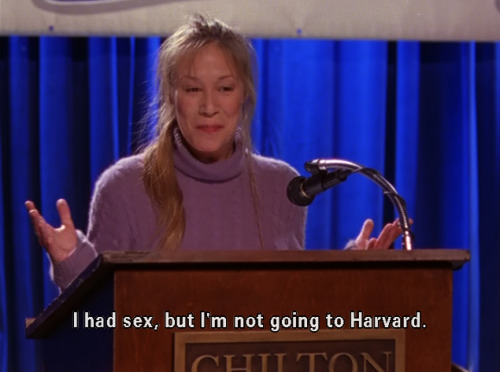
Although Paris obviously did not get rejected from Harvard because she had sex, the two ideas are clearly linked in the episode. Paris can either be sexually active or successful. Rory is “pure”, and she is accepted to every school. Virginity is celebrated, and sexuality is not acceptable if one wants to achieve their goals.
This idea is particularly evident when observing Lorelai’s reaction to Rory’s virginity status. She describes Rory as “the good kid” based solely on the fact that she has not had sex before an arbitrary time that is deemed appropriate. For a show that seems to be progressive and support feminist views, this scene is difficult to watch. It suggests that powerful women can be brought down by owning their sexuality or making the “wrong” sexual decisions. Rory and Paris are portrayed as antipodes of each other, with Rory basking in the glow of her virgin innocence.
Also, it is interesting to view this episode through an intersectional lens. Both Paris and Rory are skinny, heterosexual, white women. Paris is very wealthy. Although Rory does not have as much money, she still attends an expensive private school. Both of these characters are quite privileged, and they are on the path to receiving the most exclusive educational opportunities. They are also both attractive young women, and I think that this reemphasizes the point that even the women with the most privilege can lose opportunities because of their sexuality.
This episode is almost disturbingly sex-negative. It fits with Foucault’s theory that we are obsessed with talking about sex and that sex is not repressed, but it portrays sex in a negative light. Sex is openly discussed, but it is shown in the show to cause setbacks for women. They can only have sex after they are established in their academic and career goals. Rory’s decision to remain a virgin until she gets into college allows her to have more opportunities than Paris.
Sarah Baker
This is a really interesting analysis of Gilmore Girls. It is easy to forget how problematic the show is. Despite being comfortable talking and joking about sex, your description of Lorelai’s reaction to learning Rory didn’t have sex shows a connection in Lorelai’s mind between virginity and morality. She clearly thinks a young woman is objectively better if she hasn’t had sex. I also think you made a great point that it demonstrates how obsessed we are with talking about sex. Whether or not the female characters have had sex is seen as determing their identity and success, giving this one experience so much power.
I remember watching this show growing up. At the time I did not realize how much of a bad influence this can be -portraying losing virginity as a crime and shame can give wrong ideas to teenagers. Paris claiming she is being ‘punished’ for having sex and Rory eventually getting into Harvard; it is difficult to know what the writer and producer’s intention was for this show. Were they trying to say that girls who refrain from having sex are more likely to succeed? I agree with you that the episode is very sex-negative and sexist, considering that girls only take the consequences of ‘losing virginity’.
I think that rewatching a lot of the shows we watched when we were younger would reveal many similar episodes with similar themes. One that comes to mind for me is How I Met Your Mother, which I think I originally watched in middle school. Even at the time, I thought some of the scenes were questionable, but I think in the context of today there would be many obvious undertones of fatphobia, racism, sexism, and homophobia.
I never watched Gilmore Girls, but this episode is really interesting to me, especially the associations between virginity and academic success. They are not at all related, but this episode suggests that the status of your virginity determines your worth, value, and overall how “good” you are.
I LOVE Gilmore Girls and this was such a good scene to analyze! I was always surprised by Lorelai’s reaction because she seemed like she would the “cool” mom who wouldn’t care if her daughter had sex. I also thinks that this says A LOT about what society connects sex with. According to the show, you can’t have sex if you want to be smart (which is SO STUPID)!!!!
Gilmore Girls was one of my go-to shows when growing up. Rory was someone I looked up to, I thought her passion for learning was relatable, but I find it difficult to watch back now. This whole episode makes my skin crawl, and I agree that it depicts sex in a negative light. Also, I enjoyed your connection to Foucault! Great analysis!