A few weeks ago, I attended the Drag Show performance that was put on by Rusk and Q&A. It was so much fun! I have always wanted to go to a drag show and it was truly a special night. The performers were incredible, and I was especially impressed by the student performers. I was struck by how unapologetically themselves they were– each person had their own unique persona, and each performance was different. Some embodied very stereotypically feminine looks– blonde hair, high heels, makeup. Others wore outfits that concealed more. Some of the performers merely wanted us to have fun and enjoy their dancing, while others had deeper messages about race and inequality. My favorite performance was done by three Davidson students. I just thought it was so amazing to see the talent that we have at our school and the way that they were able to get the crowd so lively and excited. Everyone was having fun, and I loved seeing the ways that gender was fluidly expressed. In class, we have talked about gender norms and the problems with the gender binary. These performers expressed gender how they wanted to, in ways that worked for them. I wish that our whole class had attended because it was great. Gender is a social construct, and these performers proved that. Gender can be labeled if you want it to be, but gender can also change and be expressed in so many ways. I am a cisgender woman, so my gender has remained constant throughout my life. However, sometimes my expression changes. The show reminded me that there are so many ways to express gender and love the way that I present myself to the world. I would like to attend more events like this in the future.
Author: Former Student
No Product Day Reflection
Last week, when I was doing my final exams and spending time with my friends, I decided to do the No Product Day. I had done it earlier in the year when it was first proposed, but I will admit that I still put concealer under my eye-bags. This time, I wanted to commit. Because I am typically not a very active person and I shower every day, I was not too concerned about not wearing deodorant. However, I have a minimal but pretty regular makeup routine that I cling to, which includes light coverage to even out my skin tone, concealer on blemishes, and a bit of blush. Without it, I tend to think that I look sick or tired. However, I know that is just the internalized social norms. Throughout the day, I realized that it wasn’t a big deal if I wore makeup or not. My friends and my boyfriend didn’t notice or at least didn’t say anything. In fact, I was able to save time in my morning routine and I didn’t find myself adjusting my makeup throughout the day. I felt like I was giving my skin a bit of a rest. I definitely learned that it is not necessary to cover my face or use beauty products in order to feel like myself. This is an especially pertinent lesson because, as I am writing this, I currently have no makeup because the airline lost one of my suitcases when I flew home yesterday and it contained all of my beauty supplies. Although pretty upset, I am able to gain perspective knowing that it is not the end of the world. That being said, I do not think there is anything wrong with me wearing makeup. I like dressing up, and I think it makes me feel more confident. I am insecure about acne flare-ups, and I prefer to have them covered. Wearing makeup feels comfortable to me.
Feminist Mixtape: Try by Colbie Caillat
For the Feminist Mixtape assignment, I chose the song Try by Colbie Caillat. She wrote it as a rebellion against beauty standards, and the song resonated with both men and women. While the song may be viewed as merely that women should not wear makeup to feel beautiful, Caillat says that there is a deeper message– that everyone should learn to love themselves despite their imperfections. No one should have to change their appearance in order to please others. In the music video, a diverse set of women are shown with their makeup and hair done, and then as the song progresses, they (and Caillat) take off their makeup and reveal their true selves. They embrace the wrinkles, the smile lines, the messy hair. The song is empowering, and it aligns with the ideas of feminism.
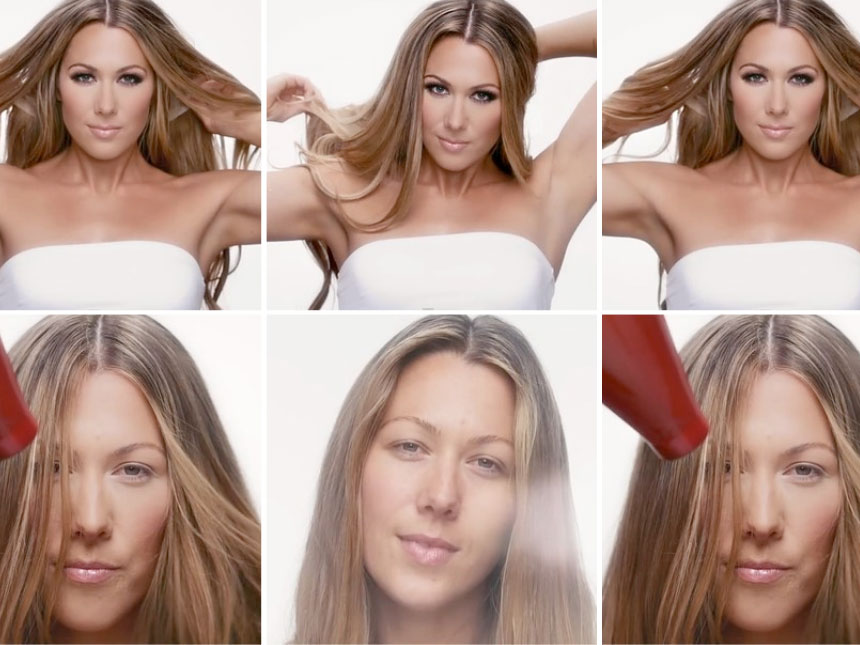
In class, we learned about the pressures that society puts on people, especially women, to fit a certain standard of beauty. Specifically, we analyzed the discipline of bodies, make-up, and hygiene through a Foucauldian framework, and how fat-shaming influences our perceptions of beauty. Jean Kilbourne’s Ted Talk that we watched talked about how the media– and specifically advertisements– portray women and reinforce the idea that skinny women are beautiful. We also read a few articles on how we as consumers have been told that we need certain products to be attractive. In a way, Caillat is promoting her own No Product Day challenge. This seems to be mainstream feminism.
A limitation of the song is that Caillat is still a woman who fits into the idealized standards of beauty– she is white, blonde, thin, and attractive. It may be easier for her to sing this “rebellion song” than someone who does not fit into our society’s standards of beauty.
Beneath the Surface: A Transnational History of Skin Lighteners
Beauty standards control our perception of society. While these standards may be different throughout the world, there are common understandings of what makes a person beautiful. Beauty is a market that influences the economy and the way that people view themselves and each other. One example that has been widely debated is the billion-dollar skin lightening industry. Although this is a surface-level change to one’s body, there are deeply rooted implications to a society that perpetuates the idea that skin lightening is a necessary product for beauty.
Skin lighteners are compounds that remove the top layer of skin to expose lighter layers underneath. Some contain extremely harsh chemicals, such as mercury. Skin lighteners are a huge industry around the globe, with products used by both wealthy and poor people. However, there is a movement to eliminate these lighteners, both because of health concerns due to the toxicity of many of the creams and because of anti-racist efforts.
In order to understand the importance of this issue, it is necessary to have a consciousness of colorism. This prejudice is based on skin color, oftentimes among people of the same racial group. There is generally a preference for people with lighter skin tones, much to the detriment of those with darker skin tones.
The author, Lynn M. Thomas, is a historian and professor at the University of Washington. Specifically, she studies politics and gender in Africa. She has written several other books, mainly centered around parts of Africa and society.
In Beneath the Surface, Thomas focuses on skin lightening in South Africa and the complex history associated with it. She argues that the history of skin lightening is rooted not only in racism, but in the intersectionality of different labels– specifically gender, sexuality, and class. Thomas understands that complex issues are layered, and there are various historical understandings that are crucial to study.

She is intentional about her methodology. Because she is a historian, Thomas is able to use archives and historical sources such as letters and volumes to sharpen her points. She has collected and studied historical writings and interviews. Also, as her argument moves toward culture and media references today, she uses various examples of these to explain her theories. For example, she mentions Lupita Nyong’o, a known Mexican-Kenyan actress, and how she gave a speech explaining how messages about her skin being too dark when she was growing up caused self-hatred. Now, by seeing other powerful darker-skinned women, she sees the beauty in her own skin.
A major strength of the author is that she chooses to write her book chronologically. She utilizes, as she calls it, the method of connective comparison, which “draws attention to how ‘things previously understood to be local come into being through complex global dynamics’ that are neither derivative nor linear” (Thomas 12). Thus, the historical implications of colonization and early instances of racism are explained and connected to the current politics of skin lighteners. She then explores Westernized cultural messages, and how cosmetic marketing was targeting women of color.
The market for skin lightening was huge in South Africa, especially in connection with apartheid and racial discrimination. Lighter skin was connected with more opportunities, and consumers utilized these products to gain advantages, marriage potential, and economic privilege.
However, a major issue associated with skin lightening creams is the dangerous health effects. Overuse of hydroquinone, the ingredient developed to lighten skin, led to blemishes called chubabas which appear as discoloration on the skin. Because of this, guidelines were developed on how much hydroquinone could be in a product.
For anti-racist activists, skin-lightening creams have another problem. When lighter skin is considered closer to the beauty standard, this sends a message that lighter skin is superior. When a multi-billion dollar industry is perpetuating these standards that are rooted in racism, that is concerning. Black activists worked to reframe these conceptions of beauty and light skin and created campaigns such as “Black is Beautiful.”
South Africa now bans skin lighteners, but demand is high enough that they remain popular and accessible. Thomas concludes by reminding the reader that beauty practices are rooted in politics that can be traced back for decades and are ingrained in our culture.

I recommend Thomas’ book because of how she approaches the topic through her writing. She articulates that, in order to avoid oversimplification of complicated historical issues, one needs to approach a subject with empathy and an appreciation of the layers of history. However, it is important to note that Thomas is a white woman who did not grow up learning about skin lighteners. It was later on in her academics that she became interested in this topic. I wonder how or if the book might have been different if it was written by a black author who has a history that is more intertwined with the subject matter.
Overall, I enjoyed the book and learned a lot. I think that any scholar who is interested in learning about complicated topics should read it. Therefore, I would recommend this book to our class. Skin lighteners appear on the surface to be a narrow topic, but Thomas includes so many cultural examples and historical details that the reader is able to unfold the complexities and politics of the issue. In our class, we talked a bit about beauty and beauty standards in our culture. They are so ingrained in how we think and act toward others. It is important to recognize the ways that these standards make people feel inferior. A large reason for this classification is due to our upholding of whiteness as something that should be on a pedestal for everyone to strive for. Because Foucault teaches us that power is reinforced throughout all levels of society, it is important to analyze our own perceptions of beauty and how they contribute to this unattainable standard.
Works Cited:
Thomas, Lynn M. Beneath the Surface: A Transnational History of Skin Lighteners. Duke University Press, 2020.
Let’s talk about Sex– Gilmore Girls
Gilmore Girls has long been lauded as an iconic feminist show of the early 2000s. Truthfully, this show is my guilty pleasure. Growing up, I watched the episodes on repeat with my mom while we sat on our couch with our takeout containers and our lazy dog. The main characters, Lorelai and Rory, are the mom-and-daughter duo that everyone roots for. Their relationship is one with quips, movie references, questionable fashion choices, and a lot of love. The show is remarkable because it is carried by these complex female characters.
Because of Gilmore Girls’ cult following and fast-talking characters, it is easy to overlook some of the more questionable dialogue and plot choices in the show. There are a number of fat jokes, racist undertones, and homophobic remarks. One of the more negative views of sex is found in the portrayal of Paris after she loses her virginity in season 3, episode 16. Paris, Rory’s incredibly ambitious, bossy, honest, and unapologetic friend, has sex with her then-boyfriend Jamie.
Not one to be coy, Paris immediately confides in Rory and asks her opinion on whether or not it was right for her to sleep with Jamie. Lorelai overhears the girls talking, and stands outside the doorway listening. Paris proceeds to ask Rory whether she has had sex with her ex-boyfriend Dean or her current boyfriend Jess. The camera pans to Lorelai, whose face looks terrified of the idea that her daughter has had sex. When Rory assures Paris that she is still a virgin, Lorelai smiles and sighs with relief. Later, she hugs Rory and tells her that she’s taking her shopping. Then she says to herself, “I’ve got the good kid.”
Paris and Rory are the top students in the class, and they are set to give a speech on live television later in the episode. However, college acceptance letters have just come out. Paris, who is the definition of hardworking and driven, gets rejected from her dream college. When she shows up to deliver the speech with Rory, she is late, her hair isn’t brushed, and she looks on the verge of a breakdown. She then proceeds to fall apart in front of the audience. She blurts, “I’m being punished. I had sex, so now I don’t get to go to Harvard.” She then points to Rory and says, “She’s never had sex. She’ll probably go to Harvard. She’s a shoo-in. Pack your chastity belt, Gilmore!” Paris runs off crying. When Lorelai and Rory get home, they open the mailbox and find stacks of acceptance letters. Rory is accepted to Harvard. Lorelai says, “Apparently, you’re the biggest virgin in the world.”
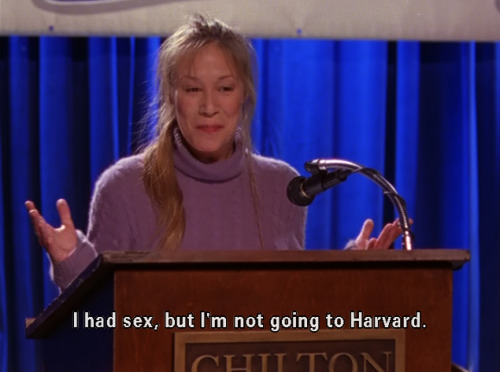
Although Paris obviously did not get rejected from Harvard because she had sex, the two ideas are clearly linked in the episode. Paris can either be sexually active or successful. Rory is “pure”, and she is accepted to every school. Virginity is celebrated, and sexuality is not acceptable if one wants to achieve their goals.
This idea is particularly evident when observing Lorelai’s reaction to Rory’s virginity status. She describes Rory as “the good kid” based solely on the fact that she has not had sex before an arbitrary time that is deemed appropriate. For a show that seems to be progressive and support feminist views, this scene is difficult to watch. It suggests that powerful women can be brought down by owning their sexuality or making the “wrong” sexual decisions. Rory and Paris are portrayed as antipodes of each other, with Rory basking in the glow of her virgin innocence.
Also, it is interesting to view this episode through an intersectional lens. Both Paris and Rory are skinny, heterosexual, white women. Paris is very wealthy. Although Rory does not have as much money, she still attends an expensive private school. Both of these characters are quite privileged, and they are on the path to receiving the most exclusive educational opportunities. They are also both attractive young women, and I think that this reemphasizes the point that even the women with the most privilege can lose opportunities because of their sexuality.
This episode is almost disturbingly sex-negative. It fits with Foucault’s theory that we are obsessed with talking about sex and that sex is not repressed, but it portrays sex in a negative light. Sex is openly discussed, but it is shown in the show to cause setbacks for women. They can only have sex after they are established in their academic and career goals. Rory’s decision to remain a virgin until she gets into college allows her to have more opportunities than Paris.
Sarah Baker