My Skin: An Anthem of Self-Love

As Lizzo’s presence in mainstream media has rapidly increased in recent years, so has the impact of her iconic messages of body positivity and self-love. Though many people know her for her 2019 album “Cuz I Love You” and her recent 2022 album “Special,” Lizzo has always been calling for reform in the way that society views women’s bodies. Her 2015 song “My Skin” and accompanying music video serves as a call to people everywhere to love and appreciate their bodies and skin.

Lizzo opens the music video with a brief monologue in which she states that learning to love yourself and your body is a journey that every person experiences—especially women. Her first verse paints a picture of why this is the case: society has created an impossible beauty standard that women feel that they must strive towards. Women are taught from birth to compare their bodies to what they see in media and to each others’, creating insecurity and self-hatred toward their own. This is an unspoken yet universal experience—one that Lizzo calls “the darkest, best kept secret.” As women compare their bodies to each others’, they are pitted against each other in competition for all the promises—love, respect, happiness—that society has convinced us we will receive if our bodies meet its standards. Lizzo articulates this in her lyrics “Let it bring us together, or it could tear us apart.” This comparison of bodies is currently tearing women apart. Lizzo is calling for women instead to unite against this harmful societal norm and revel in our universal beauty. She asserts that “the most beautiful thing that you have ever seen is even bigger than we think it means,” suggesting that the beauty of bodies and skin as well as self-love is much more significant and important than we give it credit for. She accompanies these lyrics with close-up images of diverse, seemingly unfiltered bodies painted in a beautiful light. These bodies are not perfect: they have fat, blemishes, stretch marks, hair, and other qualities that our societal standard would label as flaws. This representation of imperfect, diverse bodies in a popular music video tells women that their bodies are normal—and that their bodies are also beautiful, desirable, and worthy to be looked at.

Lizzo also applies this specifically to women of color. Societal beauty standards have created a very specific picture of what true beauty looks like: the “ideal body” is often portrayed as white and thin. Due to this association between whiteness and beauty, people of color are made to feel as if their skin inherently lacks beauty. The internalization of this belief takes away people’s ability to love and be proud of their skin, leaving shame in its wake. This can also be applied to fat women. Because thinness is seen as a requirement for beauty, fat women are made to feel as if they can’t be beautiful. In the chorus, Lizzo sings, “I woke up in this—in my skin. I can’t wash it away, so you can’t take it from me—my brown skin.” It is a call for women to reclaim the definition of beauty in their own skin. As Lizzo sings this in the music video, she runs her hands over her body with love and compassion and shows close-up images of her skin and hair, appreciating her body for its beauty.

As the music video nears its end, Lizzo, along with the other women in the music video, begin to pop the balloons that have been around them, sending glitter flying everywhere.

Throughout the video, it was not apparent that the balloons were filled with glitter—they seemed like regular balloons. As long as we believe the misconceptions that society has imposed on us, we cannot see the possibilities for ourselves that it hides. They initially appear unassuming, but when societal norms and standards of beauty are rejected, the result is magical. We can have full compassion for ourselves and unconditional love for our bodies and skin. Lizzo then runs her hands through the gold glitter and spreads it over her body, symbolizing an external layer of self-love and compassion.

This song and music video does a phenomenal job of encouraging women to reject societal standards of beauty and love their bodies as they are. Its inclusion of imperfect and diverse bodies adds representation to a historically image-conscious industry that has been plagued by photoshop, telling women everywhere that their bodies are normal and beautiful. Lizzo is an incredible role model for young women who face these standards—her unapologetic love for her body encourages others to do the same. Her popularity and presence in mainstream media gives hope that one day we can break free from societal standards and have universal unconditional love and respect for all bodies.
Theory to Praxis: Love Yourself Program

As a child, I was always told that I was overweight, fat, chunky, or too big for my age. The constant pressure of my family telling me I needed to go for a walk and my physician saying “We need to change your diet and include some more physical activity in your life”. I am sure this is not uncommon because societal pressures influence people’s mind every day. This affected my life and happiness for so much of my life but this does not have to happen to other people too.  

Looking through clubs and organizations at Davidson, I was shocked that there wasn’t one regarding body positivity as much as it is being discussed and presented in our society today. Yes, there is Changing Minds which offers information and support regarding mental disorders on campus which can include eating disorders, however, this campus needs something more distinctive to help gain awareness for body positivity. Something to make people feel more confident in their own skin as they should be. 

With this in mind, I propose to create a program at Davidson that focuses on providing information and support to anyone who feels uncomfortable in their own body and skin. This program would be called Love Yourself and its goal is to create a safe space for people to discuss and support other people who feel the same way. In addition to this goal, Love Yourself would partner with Changing Minds to add additional support and awareness. 

The program, Love Yourself, is open to absolutely everyone with the intentions of finding confidence in their image as well as assisting others who have similar thoughts and ideas. With meetings once a week, the program will create an environment that stimulates personal growth and activism. Love Yourself will consist of workshops which can include reading pieces like Deb Burgard’s “What is Health at Every Size” as we discussed in our course this semester as well as experimenting with projects such as creating body positivity posters around campus to help gain awareness for it. Our mental capacity is so important, especially during these times in college, so it is vital that students have a space where they can unleash their frustrations or concerns with themselves as well as participate in fun activities and learnings regarding these issues.

Overall, the intentions of this program are to allow anyone to come and discuss their feelings about themselves with complete confidence that they are not alone as well as engaging in the progressive movement in body positivity. People will have a safe space and large support group that blocks out the judgements of society which hopefully grows the community of support for this topic. The discourse in this program will be vital to help change the harmful impacts of society on people all around campus and eventually the world.  

Celebrities: That Doesn’t Look Like Me

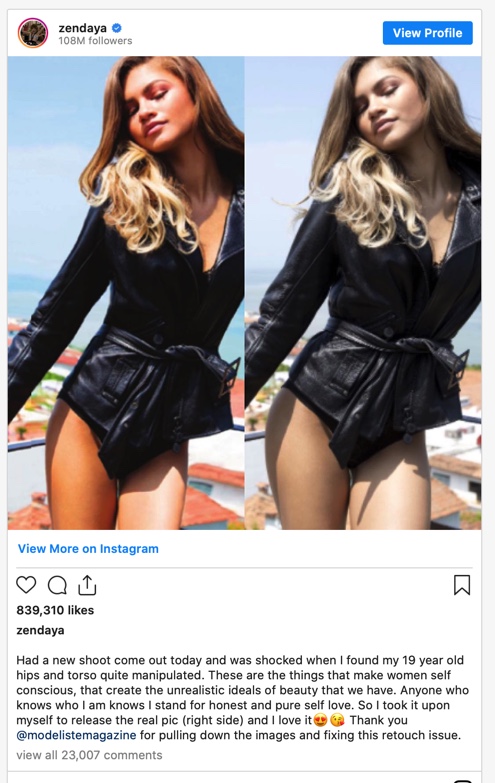
With social media, more specifically editing tools like photoshop, at the tips of everyone’s fingers, being a teenager today is hard. There is a constant feed of images that have been altered to fit society’s misconstrued beauty norms: airbrushed skin, whitened teeth, any ounce of fat pinched in or smoothed out. These images, mainly of or posted by celebrities, generate unrealistic expectations that collide with the very foundation of what it means to be human: having blemishes, curves, and for goodness sakes – everyone has fat on their bodies – it is normal. This “standard of beauty” often goes uncontested, but known body positivity advocate and celebrity, Zendaya, had no problem taking a stance against the editing done to one of her own modeling photos for Modeliste Magazine.

In the screenshot above, you are able to see not only the two images she has juxtaposed, but you can see her caption, likes, comments, and even how many followers she has. I think it’s safe to say that at 108 million followers, she has quite an audience and at 839,310 likes, that her post was well-received. The right image in the post is the beautiful, unedited image of Zendaya. She is wearing a black leather jacket with high-cut bottoms that flatter her curves and she is working a subtle, soft smile with her curled hair framing her face nicely. This gorgeous image makes it puzzling that someone would even think that there are aspects of it that need to be “perfected.” Yet, thanks to what society has falsely deemed as “beautiful,” the image was edited (left). By placing these two images side by side, it makes it glaringly obvious that multiple things have been “touched up.” Starting with the most noticeable, her skin has not only been airbrushed, but a filter has been placed over the initial image, altering both Zendaya’s skin tone and hair color. Next, editors have made her hair “smaller,” by pinching it in closer to her face and flattening it out. Another evident edit is that her waist and hips have been made smaller. 

The irony in the photoshopping of this photo is that Modeliste Magazine prides itself as being an authentic source for emerging fashion and beauty trends. However, their heavily retouched photos of Zendaya scream many things – none of those things being authentic or along the lines of what “beauty trends” should be. In addition to the way Zendaya juxtapositioned these two images, her caption speaks volumes regarding her important message. At 19 years old, she describes her shock, having images posted of herself with the realization that they did not look like her at all. She quickly noticed that her hips and torso had been altered (as she describes in her caption) and points out that “these are the things that make women self conscious, that create the unrealistic ideals of beauty that we have.” She then goes on to explain how important it is for her to represent “honest and pure self love.”

While Modeliste later took down the edited images and worked with Zendaya on publishing the complete unedited images, I think that there are multiple take-aways from Modeliste’s initial publication and Zendaya’s response. The magazine’s initial publication speaks volumes not only of society’s need to take away the uniqueness within beauty through photoshopping, but also the beauty norms that are implied as a result of this photoshopping. It implies that there is a standard for beauty and that the standard is thin, airbrushed, and lacking a single imperfection. As a result, people often don’t feel good enough and if we cannot feel at home in our own skins, where else are we supposed to go (Wann)? The amazing thing about beauty is that there is no standard. Zendaya makes it clear through both her post and caption, that beauty is more about self love and being real. Beauty is fat and thin and happy and natural with blemishes and so many other things. Beauty is all encompassing and inclusive. Photoshopping within these large platforms try to make beauty small and singular, whereas it is something that is limitless due to the diversity within the world we live in. Additionally, Zendaya’s response was empowering – not only for her, but for everyone who looks at social media and is overwhelmed by unattainable and unrealistic beauty norms. She makes it clear to her audience that the real her is beautiful and does not need to be edited. Her post radiates body positivity and breaks down the walls that confine beauty to be a singular thing. 

Works Cited

“Fashion Trends, Celebrity NEWS, Influencer STYLE, Beauty Tips, Luxury Travel.” Modeliste Magazine, 8 Sept. 2021, https://modelistemagazine.com/. 

Wann, Msrilyn. “Fat Studies: An Invitation to Revolution.” Fat Studies, pp. Forward XV. Zendaya. “Instagram.” Login • Instagram, 2015, https://www.instagram.com/zendaya/?hl=en.

Zendaya. “Instagram.” Login • Instagram, 2015, https://www.instagram.com/zendaya/?hl=en.