I was always aware as a child that I was bisexual. I was aware of homosexuality, which my mother, due to her religious beliefs, would never accept. As a fourth grader, I was aware of how strongly my mother pushed religion on me. Going to church was the most difficult part of my Sundays. “The music isn’t even that good,” I’d complain every time I went. One day while driving, Hozier’s “Take Me to Church” comes on the radio. It was fantastic, in my opinion. I’d sing it everywhere to please my mother, who was overjoyed that I was finally becoming religious. However, one day she tells me to stop singing this song, and when I ask why, she says it has nothing to do with religion, according to the pastor’s daughter, and it contains a horrifying hidden message.
So, what is the message?
The music video for “Take Me to Church” begins with a bonfire, and the film is presented in black and white. “Fire becomes a signifier connoting danger and aggression, though potentially passion and power” in this opening scene (Caty). The bonfire foreshadows a negative action featured later in the music video. The following frame depicts two men (the main characters) in distress.
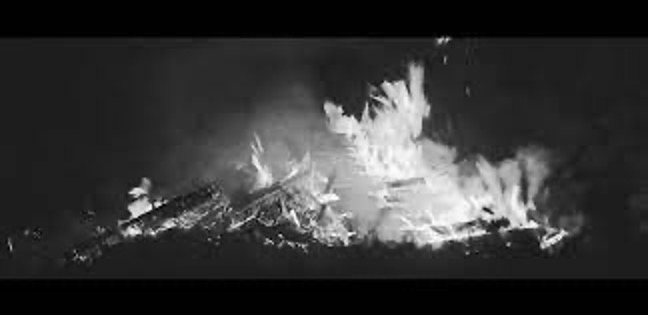
As this is happening, the lyrics contend:
[Verse 1]
“My lover’s got humor
She’s the giggle at a funeral
Knows everybody’s disapproval
I should’ve worshiped her sooner
If the Heavens ever did speak.”
In some traditions, humor at a funeral is considered blasphemous. Hozier describes how he “always saw the catholic church’s hypocrisy”(Hozier). The song expresses a desire to worship someone; however, in the Catholic church, worshiping a person is frowned upon because God is believed to be the only entity praised. We can see the rebellious ideologies against the Catholic Church in these lyrics.
“I was born sick, but I love it
Command me to be well
A-, Amen, Amen, Amen”
Hozier continues his song by demonstrating how homosexuality is considered sinful by many religions: he mentions being born sick but loving it, implying his forbidden homosexual love. He is bringing awareness to millions of people who have concealed their identity and sexuality, leading many to live a double life or even commit suicide, through these lyrics.
[Chorus]
Take me to church
I’ll worship like a dog at the shrine of your lies
I’ll tell you my sins so you can sharpen your knife
Offer me my deathless death
Good God, let me give you my life
Take me to church
I’ll worship like a dog at the shrine of your lies
I’ll tell you my sins so you can sharpen your knife
Offer me my deathless death
Good God, let me give you my life
The chorus conveys a variety of messages, clarifies his admissions of wrongdoing, and reiterates his homosexuality. Despite knowing that he is wrong, Hozier wants to continue worshiping and is willing to accept the church’s penalty when he sings, “I’ll worship like a dog at the altar of your falsehoods.” The chorus symbolizes his loathing for his own faults.
Throughout the music video, close-ups of a chained box held by one of the main actors are shown; he grabs onto this box almost as if it were a part of him. Later in the video, the main character is chased by a group of men dressed in black sweaters. He rushes to hide the chained box, but he is apprehended by this group of men. His partner rushes to find him, but his expression indicates that he is too late. The music video concludes with the chained box being burned.

Through the frames, the chained box can be seen as a metaphor for the main characters’ hidden love due to their sexuality. The main character tries to conceal the chained box. However, he is stopped by a group of men, indicating that their sexuality is not permitted. In the final scene, a group of men can be seen beating on this box, which represents their hatred of homosexuality.

Hozier ends his song with:
That’s a fine-looking high horse
What you got in the stable?
We’ve a lot of starving faithful
That looks tasty
That looks plenty
This is hungry work
Here Hozier interprets “high horse” as describing the appearance if a muscular man. He’s saying that “the church’s high horse looks like an excellent sacrifice”. In other words, Hozier refers high horse to a state of mind of misogynist. This state of mind is followed by many people who are hungry or are in desire of being a part of the church.
Homosexuality is considered sinful in many religions, including Christianity, where being part of the LGBTQ+ community is frowned upon. The music video for “Take me to Church” by Hozier emphasizes the Catholic church’s discrimination against homosexuality. The active oppression against homosexuality has caused millions of people to conceal their identity and sexuality, leading some to commit suicide or live double lives.
“Take me to church” was released on September 13, 2013, by Hozier, an Irish musician, singer, and songwriter. “Take me to church” was a big hit that had streamed 82 million times in one year. Although many people assume that he is gay due to the song’s music video, Hozier has never stated his sexuality. Hozier makes a statement saying that many people think that he is gay, “which is fine” to him; however, he doesn’t believe that’s a factor whenever it comes to relationships and love. Hozier centered the idea around homosexuality to “reference something that was going on in Russia.” Hozier states that there was much anti-gay propaganda “passed in parliament” that “prohibited the LGBT community from advocating for their rights in public places”(Canty). There were a series of attacks in Russia as homosexuality was compared to pedophilia and bestiality that led to “an increase of attacks by far-right gangs.”(Canty)
To this day, “Take me to Church” is one of Hozier’s biggest hits. However, this brought much negative attention from both the media and the people. Hozier received “a few delightful letters from pastors who have some choice words to say,”; implying the oppositions pastors had with his music. Although many people disagree, Hozier also has a solid support of fans. He explains how he was “jarred by people’s excitement at seeing” he talks and how “most of the phone calls were very sweet”(Kenney).
The “Take me to church” music video is an excellent example of different oppressions currently happening to people of the LGBTQ+ community. To summarize the video, Hozier uses various lenses to indicate the darkness seen with homosexuality. He uses a black-and-white frame structure that is seen not only in the background but in the character’s clothing. “Take me to church also” addresses discrimination against sexuality by building an emotional connection with the two main characters, stripped back by the lack of names, speech, and color, creating a clear, simplified message. Hozier brings awareness towards sexuality, specifically homosexuality, so we can see oppression happening to these characters. Hozier used the power of his race and fame to bring awareness towards past and present marginalization in the LGBTQ+ community.
Work Cited
Canty, Brendan, director. Take Me to Church. YouTube, YouTube, 25 Mar. 2014, https://www.youtube.com/watch?v=PVjiKRfKpPI. Accessed 7 Oct. 2022.
Kenney, Els. “The Meaning behind ‘Take Me to Church’.” Medium, Late Space, 4 Aug. 2020, https://medium.com/thelatespace/hoziers-take-me-to-church-b27663bc516f.
“Take Me to Church by Hozier.” Genius, https://genius.com/albums/Hozier/Take-me-to-church.