Theory to Praxis: Reimagining Greek Life at Davidson

As a school that was founded by white genteel slave owners and remained segregated until the 60s and all-male until the 70s, Davidson has a long history of elitism. Unfortunately, the college has done a poor job of repealing exclusive traditions and making the school as welcoming and safe as possible to people of all walks of life. One particularly glaring area of inequality is the social structure of Greek life on campus.

There are many things wrong with the status of Greek life at Davidson. Racial disparities are perhaps the most visible problem. My friend Michaela Gibbons is working on a project called Stories Yet To Be Told, conducting research on the history of Patterson Court Council (PCC) – the governing body of Greek life at Davidson. We have had many conversations about PCC this semester, and a lot of them have centered around PCC’s dominating whiteness. Kimberlé Crenshaw’s theory of intersectionality and Lorde’s “There are No Hierarchies of Oppression” (1983) emphasize that racial equality (and other equalities) are necessary to realize gender equality. All of the nine predominantly white PCC organizations have individual houses on campus, while the six PCC organizations for students of color must share space at the BSC (Black Student Coalition) house. This is clearly a problem for feminism, although solutions are somewhat difficult to propose. In this case, the simplest method to reduce white special power on campus may be to disband PCC or consolidate the predominantly white organizations.

Aside from racial inequality, another issue with Greek life at Davidson is its relationship to the gender binary. As a collection of organizations with membership based on male or female gender identification, PCC reinforces ideas that there are only two genders, which is clearly false when one understands Lorber’s perspective that gender is constructed. Since humans have made up the concept of gender, there is no reason to believe in all-or-nothing gender rules. And yet, PCC membership is exclusive to men and women. (Turner House, one of the eating houses, does allow anyone who is not a straight cis male to join, but this introduces the problematic circumstance of requiring people to out themselves). Furthermore, the predominance of “bristerhoods” (fraternity-eating house mixers) perpetuates heteronormativity. Requiring all PCC organizations to be open to all genders would be the easiest solution to make Davidson more feminist, although that would require converting some fraternal organizations to eating houses.

A final, and particularly glaring problem with PCC at Davidson is rape culture. We briefly talked in class about how society conditions males to violate and disrespect female bodies, and there is a prevailing willingness to let this slide. Society reinforces hegemonic sexual scripts, an orgasm gap, and poor understandings of consent, all of which lead to unequal sexual citizenship. This means that women have less power than men to make the choice to have sex. This is obviously problematic for feminism. At Davidson, PCC hopelessly perpetuates rape culture. For liability reasons, the school has strict rules about alcohol for parties at PCC houses. Because PCC organizations are too lazy or busy to plan detailed weekly parties and want to avoid strict scrutiny from the school, weekly parties are predominantly hosted at Armfield, the only residential space on campus where open consumption is permitted. Currently, Armfield apartments which host parties are exclusively rented by predominately white men with strong fraternity ties. This leads to constant sexual misconduct and a lack of safety at parties. Once again, it is not simple to find a solution to male ownership of party space at Davidson. However, some viable options would be disbanding PCC, creating more school-sponsored social events, and preventing Armfield apartments from having five male residents.

PCC is rife with inequalities, much of them a byproduct of Davidson’s elitist traditions. Thus, disbanding PCC and ending Greek life at Davidson is probably the most feminist solution. This would introduce a social vacuum for some time, but it couldn’t be any worse that the forced quarantine of the 2020-21 academic year.
Feminist Mix Tape: “Good as Hell” by Lizzo

Lizzo has recently risen to fame as one of the premier American pop stars, writing music with lyrics that are empowering and positive towards women. Her 2016 song, “Good as Hell,” is feminist and catchy.

Lizzo’s feminist lyrics relay a message that women are valuable in themselves and do not need validation from men to feel happy. This relates to first wave feminism arguments such as those from the Declaration of Sentiments, which states that “woman is man’s equal,” which means that women should occupy a place equal to men in society (Declaration of Sentiments 1). Lizzo’s message that “you know you a star you can touch the sky/ I know that it’s hard but you have to try” relates to this first wave perspective by emphasizing that self-worth comes from within, and men do not have the right to determine the worth of women.

In addition to containing the first wave feminist perspective that women are worth as much as men, the song also relates to second wave feminism. Betty Friedan’s argument in the Feminine Mystique claims that women have just as much of a right as men to work outside the home in professional roles (Friedan 278). This relates to Lizzo’s line advising her listener to “boss up and change your life.” This depiction of women as bosses normalizes women in the workplace, and emphasizes how women have a natural capacity to be leaders and have control, contrary to what the patriarchy dictates. Thus, Lizzo’s “Good as Hell” relates to second wave feminism by emphasizing women’s capacity for success in a professional setting.

One final way in which Lizzo’s “Good as Hell” relates to feminism outside of first wave and second wave perspectives is by centering women as its subject. By making women the default audience of the song, Lizzo goes against the patriarchal conception of maleness as the default state of being. This default state of maleness was pointed out by Luisa Capetillo (Capetillo 28). Lizzo rejects this patriarchal structure by making the subject of her song a woman, thus normalizing women as the default person.

Lizzo’s song is limited, however, in its conversation with transfeminism and intersectional feminism. Lizzo does not mention trans people, queer people, or people of different races in her songs. Therefore, her song does not relate to how feminism applies differently to women of color or members of the trans community. 

Despite this limitation, Lizzo’s “Good as Hell” is an important song in its relation to feminisms. It mentions the first wave perspective that women are equal to men, and emphasizes the second wave idea that women belong in the workplace as much as men do. It also centers women, a feminist stance. However, it does not have much to do with queer, trans, or women of color feminisms, so it is fairly surface-level in its feminism. Overall, the song is catchy, positive, and pro-women, so it is definitely worth a listen!

Book Review: *The Tragedy of Heterosexuality* by Jane Ward

For the dominant form of sexual orientation, heterosexuality sure looks disappointing. Consider the oft-referenced statistic that fifty percent of marriages end in divorce. Another statistic, that one in six women in the U.S. experience rape, shows a troubling rate of violence within heterosexuality. Such troubling information indicates that received ideas that queerness is harder than straightness may be quite misguided (4). In The Tragedy of Heterosexuality, Jane Ward describes the contradictions inherent in straight culture, and provides a lesbian feminist perspective on how heterosexuality might become less problematic and more fulfilling for both women and men (4). Her book is a salient and strong argument for a reformation of straight culture to be more feminist.

Continue reading “Book Review: *The Tragedy of Heterosexuality* by Jane Ward” →

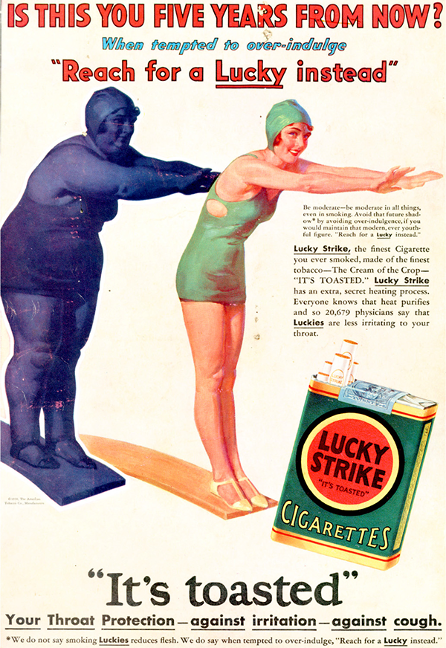
A Fatphobic Lucky Strike Ad: Another Bad Side of the Tobacco Industry

Written by John Rogers for Jezebel.

This horrific ad was created by Lucky Strike cigarettes in 1930 as an attempt to sell their unhealthy product. It is no longer in circulation today (thank goodness) but it can be found online, and looking at it provides important history on how advertising has always been manipulative. The ad purports that Lucky Strike cigarettes will reduce feelings of hunger, leading consumers to be less snacky, and thus, presumably avoid tacking on weight from overeating. This ad is targeted towards women, since it features a woman in the picture, and it suggests that ladies can avoid weight gain by smoking cigarettes. In this way, the ad reinforces harmful gender norms that women must avoid being fat in order to be attractive to potential partners. 

The ad is not just sexist towards women by holding them to high beauty standards. It is also deeply fatphobic, meaning that it reinforces the idea that fat is ugly and must be avoided. According to Marilyn Wann, “health is a problematic concept when linked with weight. Health is not a number, but rather a subjective experience with many influences.” So, implying that a certain weight is unhealthy or undesirable, as this ad does, is a constructed idea that harms fat people. They are less self-confident, ostracized from society, and given worse health care as a result of this fatphobic thinking.

On top of some sexist and fatphobic tendencies, the ad is racist as well. It presents the skinny woman as white, and darkens her fat shadow. This reinforces the historical idea that fat is a Black quality, and that Blackness is bad just like fat. By presenting the white woman as the ideal, and the dark woman as the problem to be avoided, this ad upholds a racist ideal of white superiority.

The intended purpose of the ad is to sell cigarettes, and the ad hopes that preying upon women’s fears of being fat will impel them to buy the product that is offered as a solution to weight gain. It has another angle as well. It claims that the cigarettes will protect consumer’s throats from irritation and a cough.  It is ridiculous by our 21st century standards to smoke unhealthy cigarettes as a way to resist weight gain or clear your throat, but this was a clever argument at the time of the ad. Doctors were paid to claim that cigarettes were healthy, allowing Lucky Strike to prey on consumers with misleading data. In this way, the ad uses the rhetorical appeal of ethos by appealing to over 20,000 doctor recommendations to back up claims of health benefits from smoking.

The advertisement uses the rhetorical appeals of pathos and logos as well. The scare tactic of the “fat shadow” that could occur in 5 years if one engages in “over-indulgence” is intended to create fear in the audience, a fear that will be dissuaded by the supposed benefits of smoking Lucky Strikes. Thus, the images in the ad appeal to pathos. In terms of logos, the ad makes an argument that cigarettes lead to less hunger, and less hunger leads to less eating, and less eating will prevent weigh gain. Of course, this logic is faulty, because it assumes that less eating will prevent weight gain, even though this is an open question. It also assumes that weight is a choice that results solely from eating habits, which reinforces problematic fatphobic ideas that Wann references. Humans have weights on a bell curve, just like height or other characteristics, so picking a “skinny” ideal that is a specific spot on the bell curve is not only misguided, it is impossible to accomplish.

The ad has two images. One is a basic image of a cigarette box, intended to make the packaging look clean and appealing. The other image is of a thin, conventionally attractive woman with a fat shadow. The then woman looks happy and calm, while the fat shadow has more of a grimace on her face. This illustrates the argument of the ad: buy Lucky Strike cigarettes to reduce hunger, or else weight gain will inevitably follow from an inability to control urges to eat.

Overall, the ad tries to convince women to buy Lucky Strike cigarettes with two claims that are both tied to health – the cigarettes will prevent weight gain by reducing hunger pangs, and they protect people’s throats by eliminating irritation and coughing. The ad is an example of problematic advertising that uses fatphobia to encourage people to buy unhealthy cigarettes. Ads like these were used throughout history to promote sexist, racist, and fatphobic ideas, convincing consumers that products which were actually harmful to them would help them avoid these made-up problems. Examining this history of constructing false needs is vitally important so that we can identify where ads are using these tactics today and snuff them out.

A cigarette ad riddled with fatphobia, false science, and problematic beauty standards