Written by John Rogers for Jezebel.
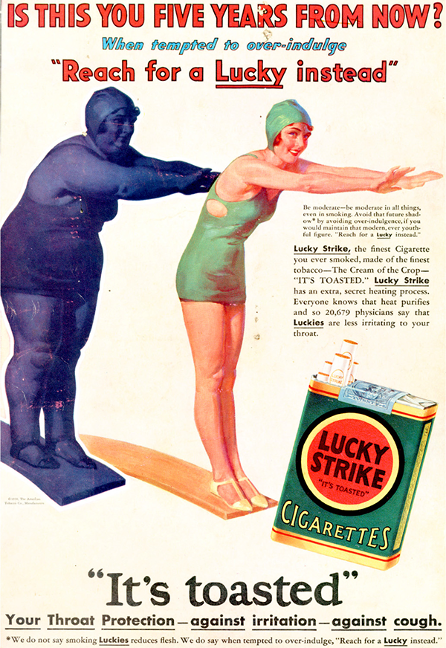
This horrific ad was created by Lucky Strike cigarettes in 1930 as an attempt to sell their unhealthy product. It is no longer in circulation today (thank goodness) but it can be found online, and looking at it provides important history on how advertising has always been manipulative. The ad purports that Lucky Strike cigarettes will reduce feelings of hunger, leading consumers to be less snacky, and thus, presumably avoid tacking on weight from overeating. This ad is targeted towards women, since it features a woman in the picture, and it suggests that ladies can avoid weight gain by smoking cigarettes. In this way, the ad reinforces harmful gender norms that women must avoid being fat in order to be attractive to potential partners.
The ad is not just sexist towards women by holding them to high beauty standards. It is also deeply fatphobic, meaning that it reinforces the idea that fat is ugly and must be avoided. According to Marilyn Wann, “health is a problematic concept when linked with weight. Health is not a number, but rather a subjective experience with many influences.” So, implying that a certain weight is unhealthy or undesirable, as this ad does, is a constructed idea that harms fat people. They are less self-confident, ostracized from society, and given worse health care as a result of this fatphobic thinking.
On top of some sexist and fatphobic tendencies, the ad is racist as well. It presents the skinny woman as white, and darkens her fat shadow. This reinforces the historical idea that fat is a Black quality, and that Blackness is bad just like fat. By presenting the white woman as the ideal, and the dark woman as the problem to be avoided, this ad upholds a racist ideal of white superiority.
The intended purpose of the ad is to sell cigarettes, and the ad hopes that preying upon women’s fears of being fat will impel them to buy the product that is offered as a solution to weight gain. It has another angle as well. It claims that the cigarettes will protect consumer’s throats from irritation and a cough. It is ridiculous by our 21st century standards to smoke unhealthy cigarettes as a way to resist weight gain or clear your throat, but this was a clever argument at the time of the ad. Doctors were paid to claim that cigarettes were healthy, allowing Lucky Strike to prey on consumers with misleading data. In this way, the ad uses the rhetorical appeal of ethos by appealing to over 20,000 doctor recommendations to back up claims of health benefits from smoking.
The advertisement uses the rhetorical appeals of pathos and logos as well. The scare tactic of the “fat shadow” that could occur in 5 years if one engages in “over-indulgence” is intended to create fear in the audience, a fear that will be dissuaded by the supposed benefits of smoking Lucky Strikes. Thus, the images in the ad appeal to pathos. In terms of logos, the ad makes an argument that cigarettes lead to less hunger, and less hunger leads to less eating, and less eating will prevent weigh gain. Of course, this logic is faulty, because it assumes that less eating will prevent weight gain, even though this is an open question. It also assumes that weight is a choice that results solely from eating habits, which reinforces problematic fatphobic ideas that Wann references. Humans have weights on a bell curve, just like height or other characteristics, so picking a “skinny” ideal that is a specific spot on the bell curve is not only misguided, it is impossible to accomplish.
The ad has two images. One is a basic image of a cigarette box, intended to make the packaging look clean and appealing. The other image is of a thin, conventionally attractive woman with a fat shadow. The then woman looks happy and calm, while the fat shadow has more of a grimace on her face. This illustrates the argument of the ad: buy Lucky Strike cigarettes to reduce hunger, or else weight gain will inevitably follow from an inability to control urges to eat.
Overall, the ad tries to convince women to buy Lucky Strike cigarettes with two claims that are both tied to health – the cigarettes will prevent weight gain by reducing hunger pangs, and they protect people’s throats by eliminating irritation and coughing. The ad is an example of problematic advertising that uses fatphobia to encourage people to buy unhealthy cigarettes. Ads like these were used throughout history to promote sexist, racist, and fatphobic ideas, convincing consumers that products which were actually harmful to them would help them avoid these made-up problems. Examining this history of constructing false needs is vitally important so that we can identify where ads are using these tactics today and snuff them out.
It’s always wild (but shouldn’t be surprising anymore) how vicious ads can be. You point out that this ad is extremely fatphobic, and I think it is interesting that even though it is only explicitly shaming the fat woman, the ad is targeting all women. Even though there is narrow portrayal (only two body types shown) in the ad, it may enable viewers to see a body type somewhat similar to theirs in either the fat or thin woman, and subconsciously consider the product to sustain or change their existing body. I liked how you touched on the ad’s portrayal and discussion of health, both in terms of the cigarettes and body size.