Media Analysis: Pre-Columbian Vessels

Wearing Peru’s national soccer team’s shirt, Moche district’s mayor Arturo Fernández smiles for the camera. Behind him, a red statue of a man raises his left arm in a fist. The red man sits in a cubic-like structure of the same colour, decorated with cream-coloured, geometric shapes. The statue has long hair and a white, large smile that looks more like just showing teeth than showing happiness. He wears a cylinder-shaped hat and big, circular earrings. Most surprisingly, apart from this, he is naked and his left arm holds his erect, disproportionally big penis, which rises diagonally to the same height as his nose. 

The statue was put in place in Early January 2022, in the district of Moche, Northern Peru.  Peruvian media and social media users got really engaged in a debate around this statue, which got coverage by newspapers, TV, streamers and, of course, social media users who did not wait to circulate memes about the statue. As a large-scale representation of Precolumbian vessels from civilizations that lived in the area between the II and VIII centuries, the statue would not have attracted as much coverage if not for one feature: The statue represents an erotic vessel characterised by an oversized, erect penis so big that, as the media put it, you can see it from kilometers away. In less than two months, since its inauguration in January, the statue has been vandalized, burnt down, and restored. For me, and probably for many other Peruvians too, this was sadly an expected reaction in a country as conservative and puritanical as Peru. 

While the debate has raised important observations about Peruvian society, it quickly became a two-sided, moralized argument. One side calls the other pervert and immoral, and advocates for the removal of the statue. The other side responds by calling them prudish, and archaic, and fuels the debate even more with happy pictures next to the statue to “challenge the conservatives.” But maybe the heat of the debate can interest us all in understanding more about these vessels and raise questions about Peruvian society too. 

What are the erotic vessels?

Most civilisations that inhabit what is now Peru between the II and VIII centuries developed pottery techniques that allowed them to produce pottery for daily use and for other purposes, such as religious and spiritual rituals. Notably, the Moche civilisation stands out for the realism and variety of techniques that were innovative in their times.

The erotic vessels were pottery pieces especially dedicated for religious purposes. As a farming community, the Moches centered their worldview around farming activities. Their calendar, visual representations, tales and oral traditions, rituals and religion were deeply connected to agriculture. Sex was also an activity connected to the fertility of the land and the production cycles. The erotic vessels are precisely a representation of this worldview. The vessels represent how different sexual acts were used to call for rain and good soil. 

Our bodies

The techniques used to model the vessels were as advanced as the Moches’ knowledge of the human body. The detail and genius to represent the human expression and body, including the genitalia, are a reflection of a different view of the flesh. The human body was seen, explored and represented without the shame that in our society we express between ourselves and our bodies. 

French philosopher Michael Foucault denounces the medicalization of the human experience. We give doctors almost full power to access our bodies, to tell us what is wrong with it. However, outside the medical practice, we punish the exploration of our own bodies. Outside a course of anatomy or biology, our bodies are kept distant from us, as the unexplored and not-to-be-explored territory. As a society, we effectively impose rules on how the body is to be explored, understood and taken care of. 

If we, as the Moches did, had a worldview that connects sex with the agricultural calendar, the dead and the gods, then we would have a very different set of rules to explore our own body in modern times. Surely our current view would be a less puritanical, prudish, guilty view of our physicality; however,  this does not mean we should advocate for Peruvians to return to a Moche worldview. Just as Foucault does not take a side with either the modern over the older worldview, I am not trying to advocate for the Moche’s over the modern worldview either. Instead, I am suggesting our relation to our own body is heavily regulated by our worldview, and people should view themselves in this context. 

Why does this matter? 

Going back to the debate around our phallic Moche friend, I try not to take a side with any of the two rivals. I am surely not suggesting to go full Moche worldview-lifestyle. This would be imposing another set of rules, with their own set of problems and complexities. It would also be practically impossible considering that our colonial history meant a witch hunt against indigenous worldviews and traditions. Instead, I am suggesting we stop for a moment and question whether the repressor can be ourselves. So far you may have thought that it is the others, the powerful, the majority, who impose a morality on us. But don’t you police yourself all the time? Don’t we follow rules for how our bodies ought to be explored, understood and treated just because we have been taught that? Why do you feel guilty when you break the rules? Where do the rules come from? 

So far, each side has become the perfect villain for the other. There cannot be conservatives without liberals and the way around. But if we are teaching our children rules, and if we are vigilant if our neighbours are feeling guilt for even thinking of breaking the rules, it sounds to me like we are the enemies who actually made it inside our homes like Foucault suggests. Insofar these rules are going around totally unquestioned, insofar as we police whether everyone meets the rules, we will be walking around with no certainty that we ourselves are not the repressive enemy. 

References

Museo Larco

Michael Foucault, The History of Sexuality, 1979.

Janus Woloszyn and Katarzyna Piwowar, “Sodomite, Siamese Twins, and Scholars: Same-Sex Relationships in Moche Art,”  American Anthropologist 117, no. 2 (June, 2015). 

Óscar Paz, “Atracción, polémica y hasta disparos por la estatua de un Huaco Erótico en Trujillo” (El Comercio, 2022).

Theory to Praxis: Steps to Changing Rape Culture at Davidson College

I have learned about so many new things this semester and I am grateful that I have a greater awareness of many issues in society today. One thing that is really important that I was able to learn a lot about was rape culture. Unfortunately, we did not have enough time in the semester to discuss rape culture far in depth, but we were able to discuss it for a class period, and I was still able to take away a lot. I found our in-class discussion very valuable to add to what I had learned on my own from my book for the book review. 

For the book review, I read the book Rape Culture on Campus by Meredith Minister. After reading this book for class, I became really invested in rape culture in general, but especially on college campuses since it is a very relevant topic to Davidson that pertains to everyone here. Through doing some digging around Davidson’s website and pulling from my previous knowledge, I, like many others on this campus, see a need for greater sexual assault resources. I would like to propose many steps that the college could take action on to implement more resources for not only sexual assault survivors, but also in preventing sexual assault on campus. Currently, I find that the prevention efforts are minimal on campus and I would like to lay out a plan for how to proceed in doing more sexual assault prevention on campus. 

Currently, there is a petition going around campus online for the Davidson community to sign that would require Davidson College to hire a second Title IX coordinator, in addition to a few other measures. The link to this petition was shared via email with our entire GSS 101 class recently. I contacted the creator of the petition, and she said that currently the petition has about 750 signatures, just over half of the required number of students of 1,322. Getting this petition to its goal would be a huge step in the right direction, however it will take some time to get to that many signatures. I have looked into and thought of a few ways that staff and faculty on campus can do better to provide a safer place for students regarding sexual assault. 

My first thought was in regards to the required courses on Moodle that freshmen now must complete before they arrive at Davidson. Since the Summer of 2019, freshmen have been required to complete two “Davidson Close-Up” courses that were created in association with students, faculty, and staff around campus. The two courses are Alcohol & Drugs and Sexual Health & Sexual Misconduct. I think that this is a great starting point for educating students as they begin their lives at college; however, being a current sophomore, I will tell you that I honestly do not remember most of what was in those courses. They were educational, but brief,  which is beneficial to a certain extent. Unfortunately, the college does not reinforce these things once students arrive on campus. Serving as an Orientation Leader this year for the incoming freshmen, I can tell you that the discussion with the health center in general was very short, and sexual assault was rarely touched on again once everyone was all moved in. I think that not only should the Davidson Close-Up course be required each returning Summer for students, but that a large assembly should also be held for those who want to attend where people can learn more about resources, prevention efforts, and ask questions should they have any. This would create a more open and reassuring atmosphere. 

In looking through the resource pages for Davidson College, I found that Campus Police actually offers Rape and Defense (R.A.D.) classes where students can learn tecniques for self-defense. I did not know this and I have never heard of this. This seems like a great program, but I had never heard of it until now and you have to contact Campus Police to learn more about taking the program. I am assuming that since I was unaware of this program, many others are as well. This led me to wonder why Campus Police does not just offer these classes for people to sign up for every couple of months? The skills learned in a class like this would be beneficial not just only on this campus, but outside of the Davidson bubble as well. I think without a class like this being offered, this is an important preventative resource that is hidden away and unused. 

One other thing that I found to be problematic with the college’s response to sexual assault is that I can tell many of the web pages have not been updated in a while. On at least three different Davidson web pages, I found Georgia Ringle’s name listed as someone to contact with questions or for help. For those who do not know, Georgia Ringle worked as the main health educator on campus through the Center for Student Health and Well-Being for years. She retired this past year and now there is a temporary person filling her shoes this year, but last I heard they are still looking for someone to hire long-term. Since she is no longer employed at the college, she is another resource lost for students. These web pages can be considered out of date since they have not been updated in about six months and campus is now lacking even more outlets for students in regards to sexual assault. 

To compile my thoughts, campus needs to do better to educate students yearly to keep up to date with prevention and resources for sexual assault, the health center needs to hire more staff, including a health educator, which means updating many online resources for information, and to promote more ways the college can help in protecting students. I think that all of these ideas I am proposing are practical and simple fixes; however, this will require the support of the college and require Davidson to recognize the ongoing issue at hand. By Davidson doing nothing to support students in this way, they are contributing to the continuation of rape culture on college campuses. Change and intervention will help break the cycle of rape culture around Davidson College’s small campus. 

*Also, if you have not signed the petition I discussed in my proposal above, please do! Here is the link: https://forms.gle/dNhujsTScpNccRaX6

Works Cited:

Javed, Ikra. “Davidson Close-Up: Sexual Health & Sexual Misconduct.” Davidson College Digital Learning, 10 Jan. 2020, https://digitallearning.davidson.edu/digitalprojects/davidson-close-up-sexual-health-sexual-misconduct/. 

“Sexual Assault.” Davidson College, https://www.davidson.edu/offices-and-services/public-safety/safety-resources/sexual-assault. 

“Sexual Misconduct.” Davidson College, https://www.davidson.edu/offices-and-services/dean-students/sexual-misconduct. 

“Three-Year Summary of Sexual Misconduct Reports.” Davidson College, https://www.davidson.edu/offices-and-services/dean-students/sexual-misconduct/three-year-summary-sexual-misconduct-reports.

Theory to Praxis: Ending Child Abuse and Building Resilient Families

Written by Anna Newman

Overview:

I will be implementing my knowledge of gender and sexuality studies, specifically on women’s rights, feminism, and rape culture, to plan a civic engagement experience over the summer. Through a collaboration with SAFEchild in Raleigh, North Carolina and Strong Girls United, the goal of the project will be to educate children on noticing and responding to child abuse appropriately before it escalates, while also learning more about the implications that domestic violence has on parenting.  

About the Partners: 

SAFEchild is a non-profit advocacy center that ensures children have a safe living environment, free from abuse. SAFEchild empowers the children and their families by providing counseling services and childcare. One important aspect of SAFEchild is a program they run called “Funny Tummy Feelings” which is a program that educates first-graders about noticing and appropriately handling child abuse when they see it or are subject to it. Funny Tummy Feelings has been implemented in the Wake County public school curriculum for first graders; however, the goal of this project is to expand Funny Tummy Feelings to the Strong Girls United program. 

Strong Girls United is a mentorship program for young girls which pairs collegiate athletes with elementary school girls and the groups meet to discuss confidence building, mental health, and new sports skills. I believe that Funny Tummy Feelings could also be a beneficial addition to the Strong Girls United curriculum. Unfortunately, rape and sexual abuse are pervasive parts of society, but one way to combat this is to educate about rape culture and the ways you can stand up to it and notice it before it escalates.

Connections to GSS:

This project will be focusing on providing children and mothers the skills needed to build confidence in response to child abuse and domestic violence. Confidence and mental resiliency begin at a young age, and if we can empower elementary school girls, we can empower an entire generation to put an end to domestic violence and child abuse. My research would overlap with several articles that we studied in class about feminism. In the article titled Committee on the Status of Women in India, the author discusses how marriage can become a “hindrance for women seeking career advancement” which demonstrates that a marriage with power imbalances is the basis for domestic violence and abuse of power. Betty Friedan talks in the Feminine Mystique that in the 1970’s, rape was not considered a penalty. Friedan also discusses the topic of women not being fulfilled simply by staying in the house, making beds, washing dishes, and cooking for the family, which relates to the lack of liberties that the woman has within a marriage. These hindrances that married women face are the basis for domestic violence and patriarchy. One notable quote from the Feminine Mystique is “when she stopped conforming to the conventional picture of femininity, she finally began to enjoy being a woman” (279). When women stop allowing their husbands to control and abuse them, they enjoyed being women. Additionally, bell hooks’ work called Feminism is for Everybody encourages the notion that equality is the goal of feminism, and the goal is not to subvert men. In relation to my book review on the book titled Medical Bondage, white male physicians were abusing enslaved women’s bodies by taking advantage of their position of power and conducting unsolicited gynecological research and painful experiments. The consequences of these experiments were destructive, both physically and mentally, for these women. The enslaved women’s experiences with the gynecological experiments parallel the domestic violence that women today face in abusive relationships. Abuse within a relationship affects the way a mother can parent a child, which demonstrates the vicious cycle of domestic violence at a young age starting with a lack of self-confidence, then getting wrapped up in abusive relationships, and to then raise kids in an environment filled with abuse and neglect. So, my goal for this project is to confront and help children notice domestic violence at a young age so that they can grow up to be confident people in healthy relationships. After doing an analysis on the film Moonlight in my writing class, it was brought to my attention that some abusive family dynamics are avoidable, while others are out of one’s control. In Moonlight, a young boy by the name of Chiron was being raised in an abusive and neglectful household because his mother was involved with dangerous drugs and did not have time for her child; however, the opportunities available for the mother to parent her child were lacking. While I’m doing my research, l will be sure to look at the context of the situation (what resources are available to the family?) versus judging the situation and the parenting choices. 

Limitations:

The limitation of this project is that Strong Girls United does not mention anything about transgender children, non-binary children, or gender-nonconforming children. This is a research question that l will be asking the SGU executive board in hopes that something is done to make the organization more inclusive of children of all gender identities. Part of feminism is creating equity across the genders, so this feminist project is aimed at creating equity for boys, girls, and gender non-conforming children. Overall, the goal of this project is to provide a form of mentorship for children seeking assistance with confidence, mental health training, and skills needed to confront abuse if they ever need to use them. 

Implementation of Plan: 

A few summers ago, my mom and l volunteered at SAFEchild and we babysat the children while their mothers were in a counseling meeting. I am hoping to resume my volunteering with SAFEchild by babysitting the children and then shadowing one of the leaders during the counseling meetings. I feel like I would gain another dimension of appreciation for the struggles that these families deal with by listening to the mothers speak. Also, it would be impactful to listen to the women’s stories of domestic abuse within their marriages and how this abuse impacts their ability to mother their children. 

After shadowing a counselor, l would ask one of the leaders/counselors at SAFEchild to be a guest speaker at one of the meetings with Strong Girls United. The counselor can focus on teaching a Funny Tummy Feelings course for the SGU children. The plan is to empower young girls by giving them to skills to notice and respond to child abuse in a confident way. One possibility of furthering my research experience would be to shadow a pediatric physiatrist to learn about the impacts of child abuse, neglect, and domestic violence on youth’s mental health.  

“God is a Woman” by Ariana Grande

https://www.youtube.com/watch?v=kHLHSlExFis

As Ariana says, “You’ll believe God is a woman” by the end of an intimate act. In her song, “God is a Woman”, Ariana emphasizes women empowerment and raises awareness to a topic that is frowned upon in society- woman finding pleasure in sexual relations. Ariana encourages female empowerment through lines such as “And I can tell that you know I know how I want it” and “I’m tellin’ you the way I like it, how I want it”. In doing so, Ariana sheds light on the idea of women placing their needs and desires above men, this way the act of intimacy shifts from being man-dominated to woman-dominated. These lyrics emphasize the importance of women openly speaking about their sexual desires and reclaiming their bodily autonomy. 

This idea of being confident in speaking about sexual desires relates to Foucault connections between knowledge and pleasure, and how sex is just not supposed to be a learning experience, but also an opportunity to teach us something about ourselves. There is an urge to know something from sex and pleasure, but there is still the paradox of the sex talk where sex is silenced, yet we still talk about it explicitly and incessantly. Ariana paves the way for women to skip the act of silence and feel confident in speaking about their needs in a sexual relation. 

However, it is important to note there are limitations that exist in how gender plays a role in her song. Ariana references intimacy in a relationship between a male and female both in the song and the music video. For example she sings, “And he sees the universe when I’m the company.” With the usage of the pronoun, “he,” Ariana excludes homosexual relationships. Also, the exclusion of queer relationships does not address other women’s sexual experience, such as those who are transgender and lesbian.

Despite this, “God is a Woman” by Ariana Grande encourages female sexual liberation and celebrates female pleasure. 

Book Review- *Fat Gay Men: Girth, Mirth, and The Politics of Stigma*.

The LGBTQ community is growing rapidy and gaining more support through the decades. However, many members within the community continue to experience discrimination because of their identity to other marginalized groups. Fat gay men have a hard time being accepted by the heteronormative society and the gay society. Members of this double marginalized group are often stigmatized and have a hard time feeling confident in who they are. Once the way fat bodies live and shape the world is understood, acceptance and celebration emerges. 

Jason Whitesel, professor of Women’s, Gender, and Sexuality Studies, enters the world of fat gay men in his book Fat Gay Men: Girth, Mirth, and the Politics of Stigma (2014). Whitesel discusses how members of a double marganilzed group (being fat and gay) have reconstructed their identities in the face of discrimination. Whitesel argues that fat gay men are stigmatized in the LGBTQ movement because of their size. He explains how gay big men are marginalized both for their sexual orientation in a heteronormative society and for their size in a gay society (2). Gay fat men want their dignity and respect in society. 

Whitesel’s use of ethnographic study allows people to better understand the stigmatized world of fat gay men. Whitesel does his research and observations by becoming a member of a fat gay men group called Girth & Mirth. Although his experiences and analysis is concentrated to that group, Whitesel does discuss the issues in a broader, open-ended lens. The Girth & Mirth is a group that provides fat gay men a safe-space and support. They like to refer to each other as a family rather than an organization. The Girth and Mirth family allows fat gay men to do activities like eating in public, socializing with others, and more “every day” activities they would not have otherwise been able to do on their own. People in this group discuss ways in which they found out about Girth & MIrth and how their life has changed since. Members have heard of this group through newspaper ads, friends, and more. Ultimately, Girth & Mirth saved the lives of many and provided fat gay men a place to come together and embrace their diffrences.

When trying to understand the everyday life of being a fat gay men, Whitesel becomes aware of his skinny privilage and ensures to not let it play a role when analyzing his research. In trying to understand the impact social events have on the fat gay community, Whitesel attends two. The first event is called the Super Weekend and the other is a national Convergence in Minnesota. Whitesel went into these events with only telling a few people he was doing research. Because Whitesel is a skinny gay man, he was known as a “chaser” (term given to skinny gay man who are attractive to bigger men) when he became a member of Girth & Mirth. By going in as a member and not letting it known he was doing research, Whitesel was able to get  more sincere and honest responses on how the fat gay men feel towards their status within the gay community. 

In Chapter 3, Performing the Fat Body we learn about The Super Weekend, an event where fat gay men gather at the Cabana Inn and “create an inverse world for themselves” (61). Big gay men are able to engage in reinventing themselves as objects of desire and reclaiming their right to self-definitions. People who attend the event are able to have a good time engaging in scatological humor and celebrating through food, dance, and sex. Whitesel attended this event as a member of the Girth and Mirth club, but also a coordinator of the event. Through his weekend and interaction there, Whitesel noticed that big gay men use campy humor to work through the stigma of being fat. It is important to note that The Super Weekend can be controversial as it can be over sexualized. For example, the doorknob award is given to the person who has had sex with the most people during the event. However, using this form of humor allows big men to “overcome their underdog status” (86).

Whitesel also participated in the annual Convergence of big men in Minnesota, which he describes in Chapter 4, Big Gay Men’s Struggle for Class Distinction. This event is much larger compared to the Super Weekend. Although Convergence is similar to Super Weekend, Convergence offers sightseeing, education seminars and theme dances. For example, the Convergence does a “prom”, “homecoming” type dance where fat gay men are able to dress up and participate in an event that they might have felt excluded when in high school. Although many members participate in such events years after their “normal” time, they still play a big role in their life and how they feel about their identity. In this event, Whitesel was advised to talk openly about his role as a researcher so more people can talk to him about how big gay men work through self-esteem issues (98). The Convergence allowed big gay man’s status in the society to be improved. 

By attending both The Super Weekend and The Convergence, Whitesel was able to understand how big gay men socially construct their culture differently (108). This allowed Whitesel to conclude that gay men reconfigure the shame of fat stigma by either turning themselves into sex objects, or by seeking class validation (137). Whitesel was able to fit in the Girth and Mirth group nicely due to his homosexual male staus, but made sure to be aware of his skinny privilege as he interacted with people during both events. By keeping an open mind, Whitesel was able to grasp a better understanding of the injuries and discrimination that big gay men face.

Although Whitesel described his observation in both events, there were areas that lacked information. For example, during the Super Weekend, he talks about the Chub-and-Chaser relationship but does not bring to attention the controversy and hierarchies that might exist. Events like this are spoken in a positive narrative, and lack explaining issues that might be present like the fetishization of fat bodies. 

Overall, Jason Whitesel does a good job giving a voice to fat gay men. Members of this double marginalized group are often silenced by the gay community and Whitesel brings attention to groups such as the Girth and Mirth Club and how they use their platform to create a safe and fun space for gay fat men to express themselves and participate in normal activities such as partying and eating in public places. In Fat Gay Men: Girth, Mirth, and the Politics of Stigma we learn of the injuries and discrimination fat gay men face and ways in which they embrace their figure and get rid of the shame they grew up with. 

In conclusion, Fat Gay Men: Girth, Mirth, and the Politics of Stigma by Jason Whitesel is an informative read for people who are interested in learning about the discrimination that occurs when you are part of a double marginalized group. This book enriches fat studies and highlights interesting ways in which social stigma, body size, and sexual identity intersect and impact the lives of people. However, it is important to note that having some knowledge of fat studies will be useful in understanding Whitesel’s conclusion on how the three social issues connect with one another.

Works Cited

Whitesel, J. (2014). Fat Gay Men: Girth, Mirth, and the Politics of Stigma. New York, NY: NYU Press.

Book Review: “Sex/Gender Biology in a Social World”

by Chase Waldner

One of the most perplexing and scientifically mystifying areas of study is neuroscience. The study of the brain, memory, identity and neural networks is interconnected and infinitely complex due to the multitude of factors seen and unseen that contribute to what makes you, you. A specific application of this is in the biological study of sex, gender, and sexuality. We have no idea what truly creates gender in humans or any animal for that matter, but we have some fairly decent guesses. There is a potential prenatal hormonal factor that could contribute to gender; a genetic factor, epigenetic factor, a parental and sibling factor, a societal factor. There are too many “answers” as to why we experience gender the way we do to seemingly ever find the true cause, although I suspect it’s a combination of all of those aforementioned aspects in combination with some we have not even discovered yet. Over the years, biologists, psychologists, anthropologists, and sociologists have all performed many different types of studies to try and get closer to the big gender questions: Why do we experience it? Why are there so many different expressions of it? How can we better understand it? And we have made a lot of progress in this field. Anne Fausto Sterling brilliantly summarizes a lot of the major work done on gender exploration and does so from a lot of these unique scientific perspectives. 

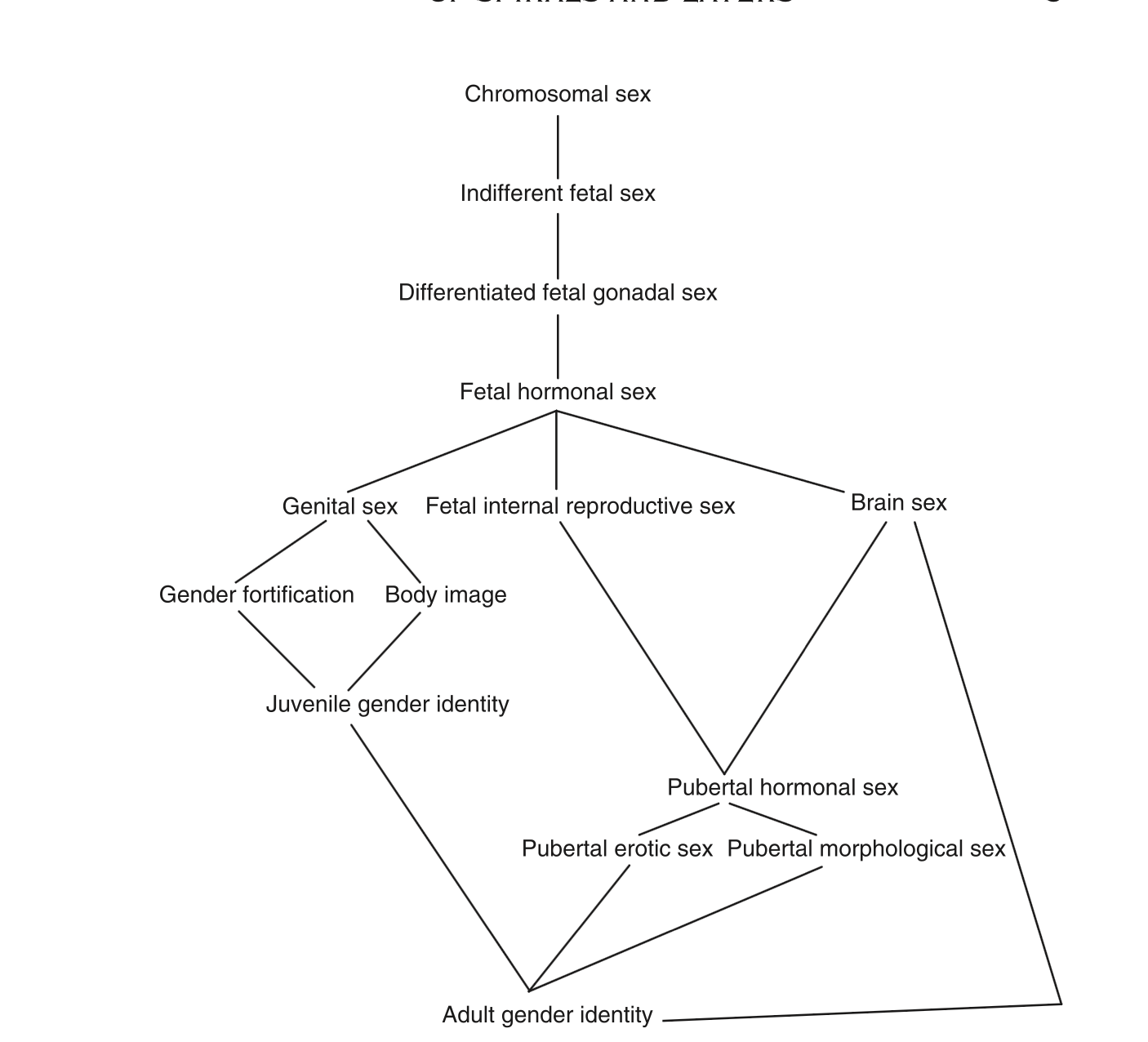
In, Sex/Gender Biology in a Social World, Sterling deep dives into the scientific pursuit of gender within the context of social pressures we experience within our culture. She describes both the biological and cultural contributions to our multifaceted gender identity and expression starting from conception and ending with adulthood. She identifies the many different sex and gender identities we cycle through throughout our development and how they each play a role in our final, “adult gender identity.” Sterling uses Money’s “sex layer model” to show this. You start with chromosomal sex (ie. XX, XY, or, rarely, some other combination of sex chromosomes), then “indifferent fetal sex,” and as you develop go through 11 other “layers” of sex until you end up at your adult gender identity. These layers aren’t linear as some layers form as a function of several that come before it. For example, brain sex and fetal internal reproductive sex both contribute to the pubertal hormonal sex of an individual, and gender fortification and body image both create your juvenile gender identity. Sterling uses this book to break down all of these different categories and talk about the different aspects of each one and how they play off of each other in order to come to some sort of definition or conclusion on what makes up our gender.

these are the “layers of sex” from Money

NY native, Anne Fausto Sterling was born in Queens, New York, in 1944. She graduated from The University of Washington with a degree in zoology in 1965 and later earned her Ph.D. in developmental genetics from Brown University in 1970. Currently, Sterling is the Nacy Duke Professor of Biology and Gender Studies at Brown and works within the molecular and cell biology department as well as the biochemistry department. During her time in academia, Sterling has written several books about gender intended for a general audience and has made over 60 scientific articles on similar subjects. She also is a Fellow of the American Association for the Advancement of Science where she has received many grants for both the sciences and humanities. Clearly, Sterling is known for her astounding scientific achievements and has made many contributions to modern-day feminist movements with her work on the intersection of gender and biology. Sex/Gender Biology in a Social World was written in 2012 and is just one of the written works Sterling has produced on gender. Her listed main areas of interest are, “rethinking the nature/nurture divide, women in science/gender, intersectionality, homosexuality and its construction, and the role of race in gender and sexuality.” Her Ph.D. and mountain of scientific excellence make her uniquely qualified for explaining and exploring gender through a variety of scientific methods. 

For this book, Sterling references many researchers across several disciplines and creates a holistic view of gender through that lens. As said before, she uses Money’s “layers of sex” model to explain how our own gender changes as we grow up. At the beginning of the book, Sterling uses several stories and metaphors to explain how we have been and probably will always be a gendered society. Although our societal expressions of gender have changed throughout time and across different cultures, it will always be a part of the human experience. Starting from birth, your parents dress you and socialize you based on your sex or genitalia, and with this interpretation of your sex, your social gender identity is created. In modern-day America, we have pink for girls, blue for boys, and all childrens’ toys have a gender that they are intended for. Our society has determined what you are supposed to like and how you should act based on your perceived “boyness,” or “girlness.” This in combination with the infant starting to learn their anatomy by discovering their genitals, and the genitals of those around them creates their sense of body image.

Sterling also makes a point of how some different species have more than two sexes, and how some creatures have more than one type of male or female. For example, some insects have three distinct sexes, and there is a species of lizard that does not use males at all for reproduction. There are a variety of factors that determine what sex an animal will be too. Some frogs use temperature for sex determination, and there are so many other seemingly arbitrary environmental features that different species use to determine the sex of their offspring. Some species can even change their sex (ie. develop the opposite genitals and reproductive organs to their natal body) based on a lack of males or females in their vicinity. All of this boils down to Sterling making a point of how up in the air and fluid both sex and gender are. We can not truly understand them if we keep thinking of them as rigid and unchanging when in reality they keep growing and developing just as we do.

As the book continues Sterling circles back to explain the process of human child development in more detail and highlights the stage or “layer(s)” of sex one has reached based on their stage of life. When embryos are first beginning to develop they go into a stage of “equipotential development” where male and female fetuses are indistinguishable. At this point in time, the fetus is said to have reached the “indifferent fetal sex” layer, and soon the XX and XY babies will begin to develop in separate, yet similar, processes. Sterling also makes a note of intersex children and how sometimes sex can get a little more complicated than just male or female. Intersex babies may present as one gender while having the genetics of another, or even have a mix of male and female parts. She then goes into the different aspects of “brain sex.” In some species, like canary birds, the presence of a sex hormone will change the size/development of specific parts of the brain. For example, the injection of testosterone into a female canary’s brain will cause the “song” part to grow and that female will begin to sing male-specific songs. Environmental complexity also affects brain sex. In an experiment with rats, there were separate groups of male and female rats. Some were placed in a cage with no enrichment, while others were given toys and housed together to provide an enriched environment. Female rats in the enriched environment had significantly higher neural branching (think of more neural branching equating to more/better/faster communication within the brain) than males. And in the caged environment, males had higher levels of neural branching. This goes to show how complex brain sex is and how, in some ways, male and female brains develop differently. This, in turn, creates a big part of our adult gender identity.

Throughout the entire book, Sterling does an excellent job at providing enough scientific detail to provide context and clarity to her exploration of gender, while at the same time not jumping off into the deep end and making the book inaccessible to people with less biological knowledge. At some points in the book she lets herself dive a little deeper into genetic and biological factors of sex and gender and provides mind-gripping science and discovery to keep her readers invested in the book. Some chapters even come across more like scientific articles minus the chemical jargon. This is a wonderful way to expose people to the science behind our brains without losing them with an excess of detail. At the same time, Sterling also uses more anthropological and historical perspectives to analyze gender which only furthers her reach of audience.

While Sterling does a phenomenal job explaining all of these different perspectives, she also sometimes gets lost in story and metaphor. Part of her writing style is to use anecdotes to explain complex topics, but she sometimes spends too much time fleshing out those stories and loses focus on the point of her book. In chapter five, for example, she spends the first half recounting two conflicting scientists’ histories with each other in an attempt to explain gender identity and, more specifically, fetal sex. Although there is validity in bringing up these two scientists, the length of time she spent on their lives rather than their work concerning gender in the context of this book seemed excessive. This is not the only time she does this either. There are a few longer chapters in this book that could be shortened and clarified with some editing down of irrelevant information.

Anne Fausto Sterling’s Sex/Gender Biology in a Social World was well written and provided a wonderful intersection of science and humanities to explore what sex and gender are. Her in-depth recount of the neuroscience and biology behind gender was especially gripping while reading through this book. It truly is meant for people from all walks of life. You don’t have to know a lot about science or biology to understand what Sterling is saying, although having some prior knowledge is imperative to understanding the full picture. At the same time, you do not have to be an anthropological expert to follow along either. Sterling successfully made this a book for all people regardless of their background and education, as there are so many different yet connected perspectives on gender that she cycles through.

Work Cited:

Fausto-Sterling, Anne. Sex/Gender: Biology in a Social World. Routledge, 2012.

Sterling, Anne. “Home – Dr. Anne Fausto.” Anne Fausto Sterling, http://www.annefaustosterling.com/.

Book Review: *Medical Bondage*

Sex, rape, injustice, medicine, slavery. These words spark an interconnected web of issues relating to sexism and racism in the antebellum era. Owens’ begins with ways in which the perpetuation of slavery and the expansion of the field of gynecology were directly proportional. When Congress prohibited the importation of slaves from Africa, slave owners feared that there would no longer be enough slaves to sustain the growing economy, so slave owners turned their focus to the reproductive health of female slaves in order to maintain and improve slave procreation. Slave owners and white, male physicians alike continued to expand the field of gynecology; however, their motives were unethical. The motive for the development of the field of gynecology was to maintain a growing economy built upon slave labor by experimenting on marginalized populations like black women and Irish immigrants. These experiments planted the seeds for racism and sexism in medicine that still plague society today, illustrating the power of science and a persuasion. 

As one of only two Black women in the US leading a program rooted in the medical humanities at a university, Dierdre Cooper Owens is an award-winning public speaker and activist. Time magazine claimed Owens are one of the most successful and “acclaimed experts in U.S. history”. Owens graduated with a Ph.D. in history form the University of California-Los Angeles. Currently, Owens is the Director of the Humanities in Medicine program at the University of Nebraska-Lincoln. With a doctoral degree in history, Owens’ is versed in the history of gender and racial discrimination; furthermore, her position as Director of the Humanities in Medicine program indicates her knowledge for the intersectionality of race, sex, and medicine which allows her to speak with intelligence and poise on the topics discussed in Medical Bondage. Medical Bondage, Owens’ first book, won The Darlene Clark Hine Award for the best book in African American women’s and gender history in 2018. As a black woman, Owens can write with an accurate, first-hand point of view because she herself may have been victim to racism and sexism, either in medicine or the workplace. 

In the first chapter, Owens discusses the “Birth of American Gynecology” in the hands of Dr. James Marion Sims and other antebellum-era white physicians. Dr. Sims invented the silk suture method through countless experiments on female slaves. The sorrowful reality of this process is that once the experiments were complete, and the female slave was proved “infertile”, they were sold back to their slave owner because they were no longer useful for research. In other words, female slaves were pawns for white males, the economy, and for the development of modern-day science and medicine. White supremacy, male dominance, and the slave holder mentality prevailed in that no credit was given to the female slaves for the brutality that they endured; in other words, the white males were apathetic to the fact that a population was suffering at the expense of their ingenuity, success, and scientific fame. To be specific, by experimenting on innocent women, white males asserted their dominance and searched for biological ways to justify differences between white women and black women, further perpetuating the idea of black inferiority and oppression. The physicians used science as a means of justifying racism and oppression, stating that black women are biologically inferior to white women. 

In the second chapter, Owens further describes the cruelties that black women face in the hands of white slave owners and white physicians. Black women were seen as pawns and merely “breeders” for producing more and more slaves to benefit white men. White men viewed black women and Irish immigrants (another marginalized and discriminated population) as “impervious to physical pain and unafraid of surgeries” (Owens 20), illustrating the dehumanization and alienation of blacks and minorities. This mindset of using black women and immigrants as pawns for research is explained in Thomas Wright’s and other southern physicians’ experimentations in that “they needed their black patients, as a means to learn about curing disease, much more than their black patients needed them” (Owens 27). In other words, the blatant disrespect of dragging a black woman’s body across the floor, disrobing her in front of other servants, and performing an invasive surgery without consent illustrates the selfish and egocentric nature of white physicians in the Antebellum era, as well at outlining one of the motives for their gynecological research: perpetuating systemic racism and sexism. One specific example of the brutality that black women faced was the Supreme Court case State of Missouri vs. Celia, a slave, which was the trial for Celia who murdered the slave master who repeatedly beat, raped, and impregnated her on several occasions. The jury decided that Celia be sentenced to death, but at the time of the murder, she was pregnant, so the State of Missouri decided to wait until the child was born before executing her. This cruel and unjust criminal justice system illustrates the slave master’s desperation for the slave procreation and the perpetuation of forced labor. 

The final three chapters parallel each other in that Owens explains reasons as to how physicians used scientific authority to justify their sexist and racist claims, as well as the various ways in which rape and mistreatment of black women went under the radar. The term “superbodies”, which is brought up in chapter five, suggests that rape does not even harm a black woman because they are physically dominant and capable of hard work which minimizes the pain and suffering of rape stories. For example, black women’s rapes were “private occurrences” and many of them went under the radar because it was considered normal and moral in the eyes of white supremacists. In short, gynecological medicine in the antebellum era was a field that allowed white physicians to stake inherently racist and sexist statements about women by using their title as doctors to bolster their claims. 

One of Owens’ strengths lies in her ability to synthesize information and find the intersections of medicine, race, and sex. The sexual discrimination and racial discrimination that arise in Medical Bondage relates to Audre Lorde’s “There is no Hierarchy of Oppression” In Audre Lorde’s “There is No Hierarchy of Oppressions”, the theme of oppression as a omnipresent challenge, not just individualistic, is revealed when Lorde states that “any attack against Black people is a lesbian and gay issue, because I and thousands of other Black women are part of the lesbian community” […] “I cannot afford the luxury of fighting one form of oppression only” (Lorde). In other words, oppression is bad in any of its forms: racism, sexism, heterosexism etc. One cannot classify one oppression to be less significant than another. In relation to Medical Bondage the brutality endured by women in bondage and the sexist claims created by male physicians is just as significant and oppressive as the racist classifications of white versus black female bodies. Black women were found to have “steatopygia (enlarged buttocks), elongated labia, low-hanging breasts, and lasciviousness” (19). These discriminatory and racist stereotypes perpetuated the racial binary of white versus black, which provided evidence for white supremacists to harass black women. These derogatory stereotypes relate to an article that I read in my writing class titled “Venus in Two Acts” written by Saidiya Hartman. Hartman brings up the term “Hottentot” which relates to Hottentot Venus, a stereotypical image of the black female physique, and further details the cruel language that is used to describe black women: “A sulky bitch. A dead negress. A syphilitic whore” (6, Venus in Two Acts). In short, Owens’ ability to create subtle connections with other texts, feminists, and activists illustrates the implicit strength of her argument. 

            A weak point in Owens’ book is when the term “superbodies” is brought up in Chapter 5 regarding black women seeming capable of harder work in the eyes of white men as a result of their “hypersexuality”, and their “physical strength” which was supposedly superior to that of white women. “Superbodies” is ironic in that it assumes black women are superior to white women because of their strength; however, women are supposed to be known for the weakness, fragility, tenderness, and submissiveness. Does the relationship drawn between “superbodies” and black women suggest that female slaves are not even human? “Superbodies” means “superhumans” or “superheros” which are all superior to humanity. Do female slaves not experience feelings, emotions, and physical suffering of normal humans? Black women were subject to racism and sexism and suffered the “ugly stereotypes that many American men, regardless of race, held about them as wanton seductresses,” (Owens 75) meaning that on top of racism coming from white men, black women experienced oppression from both white and black men who saw them solely for selfish sexual pleasure. However, I find the term “superbodies” to be hypocritical and illusionary by blurring the lines between white and black femininity. To strengthen the vagueness of this new term, Owens should have given an example for black women not showing emotion or pain or suffering and contrasting this with an example of white women’s fragility and emotion. 

In my opinion, the book Medical Bondage is an accurate representation of the intersectionality between sex, medicine, and race. While there are some weaknesses in the delivery of certain terms, Owens successfully describes the birth of American gynecology and draws connections between medicine and societal issues such as sexism and racism. Anyone seeking to learn more about the history of developing women’s health and the roots of prejudice in medicine that were planted during the antebellum era should read this book because the reading is accessible to the broader public and anyone who reads the book will benefit from its message about the ongoing quest for equity in medicine. 

Works Cited:

Owens, Deirdre Cooper. Medical Bondage Race, Gender, and the Origins of American Gynecology. University of Georgia Press, 2017. 

Lorde, Audre. “There is No Hierarchy of Oppressions”. Leaning into Lorde. Council on Interracial Books for Children, 1983.

Hartman, Saidiya. “Venus in Two Acts.” Small Axe, vol. 12 no. 2, 2008, p. 1-14. Project MUSE muse.jhu.edu/article/241115.

Walsh-Little, Maya. “Bio”. Dr. Deirdre Cooper Owens, https://www.deirdrecooperowens.com/bio

Dierdre Cooper Owens. “Charles and Linda Wilson Professor in the History of Medicine; Director, Humanities in Medicine”, University of Nebraska-Lincoln, 2019. 

Book Review: *Rape Culture on Campus*

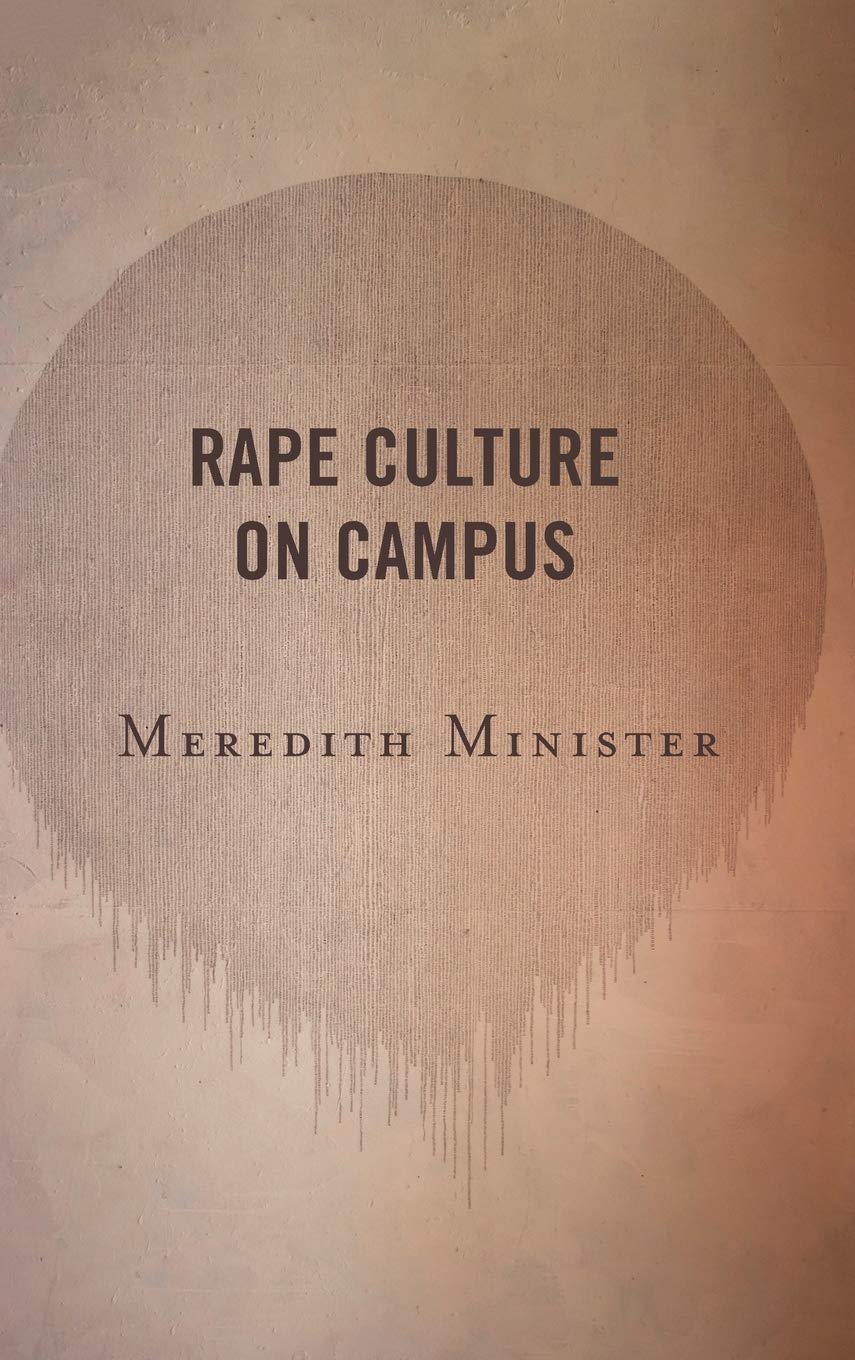
Meredith Minister’s Rape Culture on Campus Book Cover

Within college campuses, rape culture is a prominent issue that is often addressed on a surface level, leading to little or no change in the occurrence of sexual assualt and sexual violence. Meredith Minister breaks down how rape culture is continually perpetuated on college campuses and offers solutions to reducing the prominence of sexual assualt on campus in her book, Rape Culture on Campus. Minister emphasizes that not only is rape culture an issue that requires a change in ideolgies and how we approach sexual assault prevention, but also that rape culture is partially a result of binaries that often exclude gender, sexual, racial, and ethnic minorities. 

Minster begins her book by introducing how she defines rape culture, specifically saying that rape culture is “a socially accepted pattern that legitimates violence to police socially nonconforming activities, including expressions of sexuality and gender” (1). She equates the issue of rape culture existing in the first place to the way we view society and the people within that society. Colonial ways of thinking about gender and sexuality exacerbate the occurence of rape culture in society. She expands on her definition of rape culture by breaking the causes and continuation of rape culture down into pieces. Minister’s writing provides an up close look at how rape culture has defined college campuses and how colleges can do better to break the cycle of continuing the voilent pattern. Mininter draws on her educational expertise to include how purity culture, religion, and autonomy, in addition to policing and trigger warnings, do not assist in interrupting the rape culture pattern on college campuses. 

Simplifying Sexuality through Wine Labels

Written for Wear Your Voice by Molly Murphy

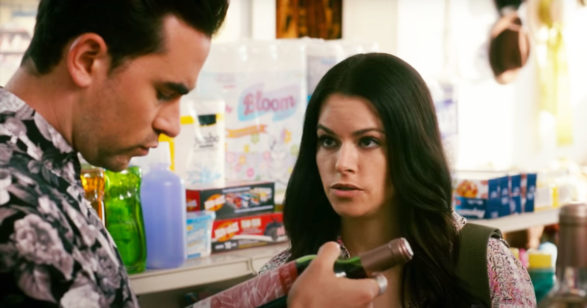
Let’s just be honest here, sexuality is complicated.  There are times that you don’t know exactly who you love and where you fit in. Having these feelings of insecurity and unsureness, and THEN trying to describe your own sexuality in a way that makes sense to others is even more complicated. In the hit series Schitt’s Creek, the main character engages in a conversation that perfectly balances the importance of openness and honesty in these conversations. This series follows a rich family of four who suddenly lose all of their money and their luxurious lifestyle. They are forced to pack up what is left of their property and move into a small town, their only remaining asset. Schitt’s Creek is the town that the father once bought the son as a joke for his birthday. That son and main character of the show is named David Rose. Presumably gay to the viewers and other characters in the show, he finds himself one night sleeping with a female and straight character named Stevie Budd. Stevie is confused, and decides to confront him while out wine shopping for an event. She hints, “Just to be clear, I am a red wine drinker, and I only drink red wine… and up until last night, I was under the impression that you too only drink red wine.” Catching on, David responds to her, “I do drink red wine. But I also drink white wine. I also have been known to sample Rosé. A couple summers back, I tried a Merlot that used to be a Chardonnay, it just got a bit complicated.” Stevie is a bit confused, and David goes on to say, “I like the wine, not the label. Does that make sense?” This iconic scene would go on to be quoted in many articles, printed on tee shirts, and used to give confidence to thousands of youth helping them come out to their parents and peers.


What is great about this use of a wine metaphor is how it is so unconventional, but so easy to comprehend. It allows even the most conservative and closed minded individual to understand that David is pansexual. And as a bonus- who doesn’t love wine? Everybody can relate to how David is describing to his sexuality through the use of this metaphor. David is able to bring forward his very complicated history of experimentation and self-discovery. He is so secure with himself and his journey, that he can calmly explain his sexuality to Stevie in an amusing way. David educates Stevie in a manner that is lighthearted but clear, and it is centered around inclusion and positivity. These conversations can be hard to have, but Stevie reacted in a way that let David come out to her while also not downplaying the importance of having “no labels” to David.

Society’s social constructs and biases make coming out a traumatic experience for so many people. How can they help not feel frightened at the possibility of having their loved ones turn on them for revealing their true self? Throughout every episode of Schitt’s Creek however, the creators challenged that idea that coming out needs to be traumatic. (As a disclaimer, they do not ever downplay the importance of that experience; having somebody working up that courage to finally be unapologetic and open with who they really are and love. There is an episode where David’s partner comes out to his parents in distress, but even then, his parents were only upset that he felt he couldn’t be honest with them about his sexuality, and not that he was actually gay.) By not making sexuality such a huge ordeal, it forces the viewers to imagine a world where there is no bias or judgment when two men are in love and holding hands in public. There is no talk among the characters of anybody’s sexuality beyond this scene, so the reaction to these couples is the same as any reaction would be to a heterosexual couple walking down the street holdings hands. This amazing directing is what sets Schitt’s Creek apart from other series. The series LBGTQ+ representation fosters an inclusive environment, free of bias and full of love and acceptance with no shame.  

Schitt’s Creek has made a difference in this world, right when we all needed it! It’s constant celebration of unconditional love and wholesome relationships between all of the characters really resonated with viewers, making it become one of the most popular and successful shows to ever hit the big screen. The series’ defiant representation of different races and sexualities throughout both acknowledge that facts that anybody in the audience who identifies with the characters are valid, and that they should be proud of themselves and love who they are. This show has won the battle of representation, and has helped pave the way in media for impenitent openness and inclusivity.

Sex Education: Discovering Yourself During The Turbulent Years of High School

Written by Abby Yokoyama for Wear Your Voice | https://www.wearyourvoicemag.com

Sex Education is not only educating the students of Moordale secondary school in the UK, but its viewers worldwide too. Sex Education is a comedy-teen drama Netflix show all about sex, pleasure, and discovering your identity as a high school student. In their third season that just released, the show portrays people of different sexual orientations and gender identities and highlights their struggles and triumphs after a stark shift in administration. This blog post will analyze the new administration’s effect on the student body, as well as one of the prominent homosexual relationships present in season three.

Every school needs a sex therapist, right? Jean Milburn, the main character Otis’s mother, was just that for the students of Moordale, helping students become more comfortable with their sexual experiences, sexual orientation and addressing their concerns. The positive response from the students because of Jean’s help made headlines, making Moordale known as the “sex school”. In season 3, Jean has left, along with head teacher Mr. Groff, leaving new head teacher, Hope, with the sole desire of clearing the school of this title. 

Jean is pre-Victorian, and Hope is the Victorian response to sex. According to Foucault, people were very open and much more comfortable with sex up until the Victorian era. Moordale goes from sexual freedom and openness with Jean to school uniforms, single file lines, and an outdated, inaccurate video on sex education with Hope. Sex became shameful and frowned upon. It was discouraged and even against the rules to be spoken about aloud between students and faculty. Any traces of sexuality were to be destroyed or removed, including The Penis wall, which, you guessed it, is a wall full of drawings of penises.  

Hope publicly shames students during school assembly

Hope’s initiative to get rid of sex at Moordale lines up with Foucault’s repressive hypothesis. She is shutting down all the progress and work Jean had done with the sexual concerns the students had been having, and pushing that aside for “more important” matters. She wants students to focus all of their energy on getting good grades and doing well in school. Sex is nothing but a distraction. Nothing good comes of it. So she erases all traces of it. This is similar to how sexuality was repressed during the Victorian era and the rise of the bourgeoisie in order for capitalism to become the main focus. Hope represents capitalism. She is implementing rules and guidelines that repress any sort of sexuality so that school is the top priority. She even publicly ridicules those who are open about their sexuality and interests, like a new student, Cal, who identifies as nonbinary. Because of the new uniforms, they don’t know which one to wear, the one for girls or the one for boys. Hope has the answer! Because Cal was assigned female at birth, of course they must wear the girls’ uniform. This blatantly ignores and suppresses queer peoples’ identities and expression, but at least Moordale will look good in the press. 

Cal (left) with friend Jackson in front of The Penis wall

Moreover, the repressive hypothesis argues that power works in a top-down fashion, which is reflected in the school’s hierarchy. Hope is at the top as the head teacher, and she uses that power to overtake anyone’s voice below her. She silences the students, and not even the teachers are allowed to help with any personal issues they may be facing.

Another prominent aspect of his season is Eric and Adam’s relationship, consisting of two gay men in very different places in their lives. Eric is confident and outspoken about his identity, and doesn’t care who knows it. However, while Eric is very secure in himself at home in the UK, when he travels to Nigeria for a wedding, those around him, namely his family, want him to repress his identity. Homosexuality is illegal in Nigeria, so his family is not nearly as socially aware of it. His grandmother keeps asking when he is going to meet a nice Christian girl and get married, which Eric and his family know will never happen. At the wedding, he meets a gay man named Oba who takes him to an underground gay club. Inside, Eric finds a booming scene full of queer people, similar to the latter hald of the nineteenth century where D’Emilio explains that gay people created underground spaces for queer people. Eric feels the most liberated he’s ever felt in a country he shouldn’t really be feeling in such a way, which only strengthens his confidence in his identity. 

Adam (left) and Eric’s (right) budding relationship

Adam, on the other hand, is just starting to figure himself out and is having a particularly hard time embracing his identity. In earlier seasons, Adam was portrayed as a straight homophobe, and because he was repressing his own homosexuality, he bullied Eric. Adam also has a difficult relationship with his father, and was sent to military school at the end of season 1, where he meets plenty of other gay people. The military used to be a place of discovery for homosexuals during the wars, and while Adam did not uncover his homosexual identity while in military school, it is ironic that that is where he was sent in the midst of his journey in figuring out who he is as a gay man. When he comes back to Moordale, he attempts to become more comfortable with his sexuality so he and Eric can start a relationship, but Adam is not prepared for such publicity and vulnerability in his identity. Because of his relationship with his father and always being looked down upon and ridiculed by him, Adam is closed-off and rarely vulnerable, which is proving to be very difficult in trying to rebuild his reputation and identity from straight bad boy to gay man.

Sex Education is an effective means for important information for this generation; it’s a funny, but heartwarming, honest and educational show that conveys an important and relevant idea of discovering yourself and identity during a critical time. It is important to educate teenagers about sex and encourage finding you identity and being yourself, and this show does just that. By the end of the season, Hope is gone, but thankfully, The Penis wall remains.

TikTok: Its Perpetuation of Gender-Based Stereotypes and Human Body Standards

Over the past few years, TikTok has become a mainstream social media platform. This application, available for most smartphones, uses an algorithm to curate content for users, effectively getting them addicted to scrolling on the app. There are many subcultures on TikTok… For example, people who like dogs might find that the algorithm has put them on ‘dog TikTok,’ because their ‘For You’ page is filled with videos of dogs. The same concept applies to gender and sexuality. There are many different points of view represented on the application, and once the algorithm figures out what yours is, it will show you a plethora of content to reinforce that exact idea. 

There is a large subculture (or really, a set of subcultures) on TikTok that perpetuates the gender binary system and all of the gender roles that come along with that. For example, this video is a representation of many of the different videos that are found on ‘straight TikTok’: 

When the individual speaking in the video says, “Men will choose a peaceful woman before a beautiful woman,” they are enforcing many of the expectations that are placed on female-identifying people in our society. Moreover, the speaker is implying that women must be ‘peaceful,’ therefore implying that often, women are not peaceful. This implication tells women that they need not express their emotions; rather, they should focus on being as passive as possible in an effort to be chosen by a man. 

Next, when the person speaking says, “Men seek for peace, and it don’t matter if you’re Black, blue, asian, Latina… they want to come home to a peaceful woman,” they are demonstrating a lack of awareness of the intersection between race and gender. This statement also reinforces the idea that men come home to women, therefore saying also that women should not be working professionals. 

On top of that, the speaker discusses the intellect of women and expectations in that area that men hold. They say, “He wants a woman that’s resourceful, a woman that can think on her feet. So when he can’t hold it down if he’s ill and he’s unable to pay the bills, she can be resourceful and have her intellect to make things happen.” The first implication I see in this statement is that the woman should just be intellectual as a safeguard… the woman will never actually have to use these skills unless it comes down to it. The assumption that men always pay the bills is harmful to all people, regardless of gender, because that is not the case for everybody. By the same token, the fact that the speaker is bringing this point up implies that women are, in general, less naturally intellectual than men. Drawing this unfounded connection between gender and intellectual capacity is harmful to society as a whole. 

Perhaps most disturbingly, our speaker talks about the ‘appropriate’ role of women in a sexual context. They say that men are “looking for a woman to supply their physical needs… A woman that looks good and proper and public but is a beast in bed” is the golden standard. First of all, in addition to ignoring the physical desires of the women at hand, this statement claims that the purpose of women is to fulfill mens’ sexual desires. This incredibly sexist ideology has the capacity to negatively influence the lives of many people. On top of this, the speaker is assuming a common definition of beauty… she is saying that women who have a certain physical appearance and demeanor are examples for what all other women should try to be when in pursuit of a relationship with a man. 

In conclusion, the ideology contained within this video is based on the idea that women are socially inferior to men, and that female sovereignty should not exist when it comes to romantic and sexual relationships. The central claim is that women should constantly be cultivating their personas to match what they think men are looking for in women, in hopes that they will ‘meet the cut’ for some man.

Similar to the last clip, this piece of satire brings awareness to many of the appearance-based expectations that our society holds for women, and the stark contrast between these expectations and those for men. The actor, mimicking a man, says: “Alright, so I want a girl with huge, but perky boobs, small waist, huge butt, flawless skin (but can’t wear makeup). And I like blondes, but I think she should also be brunette… because I get bored quickly, you know?” This statement encapsulates many of the body standards that our modern society has for women, and also touches on the normalized fact that men sleep around while women are expected to be loyal. 

In the caption of this video, the creator claims that this is how all men think. Although this is probably a sarcastic statement, it is representative of the way that many people think. Moreover, individuality is to be nonexistent: all men must act one way, and all women must act another way. Beyond pointing out, and perhaps reinforcing, the gender norms that are in place for men and women, this video illustrates the prevalence of the gender binary in our society. 

Content Warning: This video contains a real-life portrayal of surgical body mutilation. Use viewer discretion. 

In this shocking clip, we see a person that is identified as a man who has ‘overdeveloped’ breast tissue. His act of having the ‘excess’ tissue removed is labeled as life-changing. First of all, the video notes that this overdevelopment in the breast tissue of a man is an actual medical condition, which is known as ‘gynecomastia.’ Its causes are said to be “medications, drugs, testicular cancer, and hormonal imbalance.” 

Without looking into the history of this condition, it’s plausible to assume that this condition was developed in response to a bodily appearance that was not in line with society’s idea of what a man should look like. Moreover, this condition does not pose any medical risk to the patient; it is merely aesthetic. 

This video perpetuates a toxic standard of beauty, and is essentially telling men who have growth in their breast tissue that in order to be beautiful, they must undergo surgery. Explicitly, the caption says, “These [surgeries] literally change men’s lives.” In watching this video, men with growth in their breast tissue are inevitably going to receive the message that they are disgusting, and must go get surgery. 

In conclusion, the three videos I have analyzed here are examples of the many TikTok videos that enforce gender-based stereotypes and human body standards that are present in our society. This is not to say that TikTok is a problematic platform that should not exist; rather, this suggests that we as a society should critically examine the role that social media plays in perpetuating harmful gender-based stereotypes and expectations on a day-to-day basis.

Writing for Feministing | www.feministing.com

From Theory to Praxis: High School Outreach Program

Since I have not taken a gender and sexuality studies class before this semester, most of the concepts we discussed in class and from the readings were very new to me. This class has truly allowed me to broaden my horizons of how I view the world and society. Before this semester, I was only aware of gender and sexuality as binaries, but I now see how society has constructed them to be viewed this way. As we began discussing new topics in depth, I started to think about my education regarding gender and sexuality, or lack thereof, prior to this class. In middle school, I had the standard health and sex education classes, but we mostly touched on only the biological aspects of each rather than the emotional and psychological aspects. In high school, we did not have any type of sex education; in fact, it seemed forbidden to discuss any topics regarding gender and sexuality. However, this class has allowed me to understand how important and crucial it is to have open dialogue about these topics in everyday life. Therefore, for my theory to praxis final project I set out to open this dialogue in high schools in the Charlotte area.

As a member of Rape Awareness Committee, I volunteered to be in charge of our High School Outreach Program. In the beginning, I did it purely because I was from the Charlotte area so I had contacts at many local high schools, but as the semester went on, I realized how much of an impact we could truly make with this program due to the lack of health and sex education in the local high schools. Therefore, I began researching other sex education programs, narrowing down what exactly I wanted to focus on, and how we wanted to convey our message. After meeting with Georgia Ringle and Ashley Fry, I decided to focus on consent and positive and healthy relationships as these topics are pertinent and rarely discussed in schools. We found that most schools’ sex education programs are very abstinence-based so many students have never discussed these topics and a strong stigma surrounds conversation of these topics.

In working with the rest of my committee, we put together a presentation that focused on opening a discussion with students based on the norm of reciprocity: the more open and honest we are with them, the more open they will hopefully be with us. We begin our presentation by showing a video of Davidson students discussing key aspects of positive and healthy relationships and giving examples of personal sexual experiences where their knowledge of consent and choice was important. Following this video, we share why we personally are each here giving this presentation and a little bit about our own sexual identity and experiences. We hope that our willingness to share our beliefs and experiences will open a line of communication for the students to discuss their personal experiences and ask questions. In order to further engage the students and for us to frame the conversation towards the audience, we then have them fill out a series of anonymous questions regarding gender and sexual identity as well as personal experiences. This then leads us into our presentation about consent and healthy relationships. In addition to sharing definitions and characteristics of each, we ask students to share their beliefs and knowledge about each topic. We then give the students hypothetical situations and ask them what they would do in each case. One thing we want to emphasize is that there is more than one right way to handle any of these situations; each person will probably handle them a little bit differently. After hearing the students share their opinions on each situation, we each give our own answer and explanation for how we would potentially handle it.  We conclude our presentation by allowing everyone to write down questions anonymously on note cards, which we then read aloud and answer to the best of our ability for the group.

Overall, we have given two presentations so far and have multiple scheduled for the spring. Just from the two presentations we have given, I have been able to see how much of an impact we can have. In one of our presentations to seventh and eighth grade girls at Circle de Luz, several of the girls were already sexually active, but were unaware of the meaning of the words consent and contraception. Though this was highly concerning in the moment, by the end of the presentation, they were all confident in their own ability to ask for and give consent, aware of their choice, and knew to always use protection. Personally, the impact we were able to make from this one presentation was worth all the time and effort I put into creating this program. However, I am looking forward to our presentations in the spring and to seeing the further impact we can make the community.

Fraternity Gang Rape: Sex, Brotherhood, and Privilege on Campus

Power dynamics based on gendered interactions can be seen widely in Western societies in particular. The most prominent negative repercussions of these dynamics can be seen as instances of rape and sexual assault. Similar gendered interactions and discourses can be seen as heavily embedded into initiation and bonding rituals and fraternity culture at large. These rituals have been sometimes seen to rely on rape, sexual assault, and sexual discourse in general. In her book, Fraternity Gang Rape, Peggy Reeves Sanday chooses to focus on all male group bonding rituals at a college campus in the United States, particularly the bonding ritual of “pulling train,” or, gang rape. Peggy Reeves Sanday is a professor of Anthropology at the University of Pennsylvania. She has authored a number of books, focuses primarily on matriarchies and acquaintance rapes occurring in societies. She was a professor at the University of Pennsylvania at the time that the specific gang rape addressed in Part One of this book occurred and was teaching the victim.

Sanday constructs an argument that focuses on exploring how groups of men bond through the use of sex. This is further developed as not only being constructed through actions but also through discourse amongst the group. Her argument is crafted around these group acts existing to allow for homoerotic and sexual experiences to be shared between the men involved. This is particularly explored due to the heavily homophobic mentalities usually seen in these environments. Finally, Sanday focuses on how sex can be seen as a marker of power societally and the constructs that exist which uphold these dynamics.

Fraternity Gang Rape begins with a delving into a discussion of, societally, how the differences between men and women have been seen. This is primarily done through the lens of looking at the three sexual revolutions and models that have been used to understand gender power dynamics. While discussing the various sex models, Sanday constructs a picture of the act of rape as societally upheld by the sexist subjectivity that people have been raised within. Sanday also explores some of the problematic structures that exist within college, mainly fraternity, party culture. Namely these are seen as the seduction tactics used by males, which include feeding girls drinks until they are drunk enough to give in. The ability to do this successfully is often used as a marker of one’s masculinity and reinforces the gender hierarchy that exists within these party interactions.

Sanday constructs her study in two parts. The first part is specifically tailored towards what she calls “The XYZ Express,” which focuses on trends discovered following a specific incident that happened at a fraternity on the University of Pennsylvania’s campus in 1983. This part contains a lot of information that primarily applies to the the fraternity “XYZ” and various incidents recounted primarily by women. This goes through interviews with both members of the fraternity and a number of women who have unique relationships, either sexual, friendly, or both, with members of XYZ. Their interviews highlight social bargaining for a better position within the group’s hierarchy, primarily through having sex with members, an ability to hold your own while drinking with the brothers, or both, which is heavily encouraged by party culture. Sanday also depicts structures within XYZ that reinforce these dynamics, primarily what the brothers refer to as the “Little Sisters Program” as well as aggressive circle dances, which end with a mass heap of all of the brothers, sometimes on top of a woman. The concept of this program is that the brothers of XYZ essentially scout out females to be sexually available for members within their organization. The major rape that spurned Sanday’s writing of this book was the gang rape of one of her students, referred to as Laurel, whose rape was referred to as an audition for this program by brothers. Sanday uses this discourse and the actions of gang rapes and circle dances to discuss the manners in which these actions allow for brothers to bond homoerotically within a heavily homophobic and hegemonic masculine environment.

The second part of her study is heavily focused on phallocentrism, male power, and silencing the feminine. This part focuses on discourses and interactions that are seen in groups, primarily in male centric groups. This focuses heavily on rituals utilized to break young men out of “the feminine”, or their dependencies on their mothers seen prior to adulthood, with a heavy emphasis on the ways in which this is done through fraternity initiation rituals. Sanday discusses in particular detail the exact ways in which the fraternities psychologically mess with their pledges in order to shift their mindset from a loyalty to oneself to a loyalty to the fraternity. This is done not only to promote male social and sexual dominance, but also to construct widely felt male bonding throughout the new members. This is opened up to how initiation rituals in non-Western cultures either create rape free societies or uphold gender power dynamics similar to the ones seen in fraternities. Sanday raps up this part by focusing on how sexist subjectivity is created through discourses and how difficult these structures are to deconstruct as they are so embedded into our language and interactions.

The book ends with an afterword, written in 2006, discussing how much has actually changed since this book was first published. Sanday explores the various ways that hookup culture and these sorts of incidents are perpetuated not only by fraternity culture. An interesting discussion can be seen about the roles that sororities play in upholding the hookup and rape culture that is perpetuated by most fraternities.

Ultimately, Sanday argues that while these issues are discussed much more heavily than they used to be, the statistics haven’t really changed at all. This is primarily due to the persistence of privileged positions of all male organizations of cisgendered, heterosexual white males in society. While this is not 100 percent true about fraternities,  they are predominantly filled with white, cisgendered males. Sanday does comment on the prevalence of discourse regarding sexual assault and rape that is happening in what she dubs the “New Sexual Revolution,” with a particular focus on the affirmative consent policies that are becoming widespread in colleges and universities. She concludes that protecting those more vulnerable and deconstructing these power dynamics that uphold and allow for rape and sexual assault to occur commonly is the most important move we can make societally.

This book gives an interesting overview into a very serious occurrence seen in many all male university organizations. A particularly interesting perspective can be seen when looking at rape and sexual assaults through an anthropological sense instead of sociological. The discourses and interactions are vital to understanding more about why these events occur at the rates they do, whether through groups or by individuals. Furthermore, Sanday does a good job at comparing these discourses and structures across Western and non-Western cultures. However, a further delving into other experiences with in Western fraternity culture would be beneficial. Also, while Sanday provides commentary that this is applicable to groups of men that are not fraternities, more evidence and discussion of these alternative groups would be helpful to support her argument. Furthermore, the generalizability to other fraternities at the University of Pennsylvania or on other campuses is slightly problematic. Through this part, Sanday offers a limited gaze into a few other situations, providing token examples, but a wider spread study that expressed experiences truly representative of the diversity of colleges seen in the United States would provide a more appropriate generalizability.  The manner of splitting the book into two distinct parts makes the main argument hard to connect or follow at some points. Sanday also fails to discuss that all of these interactions she is exploring have occurred in aggressively heteronormative environments. While she briefly highlights homophobic discourse, the addition of this could be beneficial to helping strengthen her argument. This is presented as central to her argument, but discussion of it is lacking in comparison to her other points. I would recommend this book as a good eye opener to someone looking to delve into how fraternity culture upholds and reinforces gender power dynamics and privilege in a heteronormative, white centric perspective.

Sanday PR. Fraternity Gang Rape: Sex, Brotherhood, and Privilege on Campus. 2nd ed. New York: New York University Press; 2007.

Flirting with Danger

Every day, every single interaction, whether conscious or unconscious, shapes our identity and perception of the world. From the time we wake up in the morning until the time we go to bed at night, we are taking in information, processing it, and shifting our awareness of society based on the viewpoints we perceive. This impact of interactions and social cues has evolved over time into the hegemonic countercultures in different places around the globe. In her book Flirting with Danger, Lynn N. Phillips explores the ideology of power and choice within hetero-relationships formed by Western Culture through an in-depth analysis of the personal stories from young women.

Lynn N. Phillips coined the phrase “flirting with danger” in order to summarize women’s approach toward hetero-relations as established by previous interactions and media influence. In common situations of hetero-relations, the boundaries between “seduction and domination, pleasure and danger, responsibility and exploitation, agency and objectification, and consent and coercion” often become variable and murky (Phillips 3). However, women interpret this risky behavior as a “part of the ‘normal’ experience of their daily hetero-relational lives” (Phillips 3).  Through her research and analysis of women’s personal reflections of their relational experiences, Phillips successfully explores how women’s view of hetero-relations has evolved into the “need to flirt with danger” (Phillips 206).

Lynn N. Phillips draws on previous literature from feminist theorists in order to analyze her qualitative data. In doing so, she successfully creates a framework to guide our understanding of how society has shaped the subjectivity of power, choice, and desire within hetero-relations. In writing this book, Phillips aims to stimulate discourse regarding aspects of hetero-relations that are often excluded from feminist and social science literature. She specifically highlights the absence of conversation promoting “male accountability” and “female pleasure without penalties” (Phillips 77). While women do have the same sexual desires as men, “structural, ideological, and interpersonal barriers” created by Western Culture often prevent women from expressing these desires (Phillips 77).  Further, she hopes to gain a greater understanding of how women’s judgments, specifically regarding the meanings of male domination and sexualized power in their lives, have been shaped by personal experiences and outside influences. These subjectivities, formed from popular media and past hetero-relational experiences, are exemplified through four common themes of discourse: (1) “how to be a ‘good woman’,” (2) “what constitutes ‘normal’ male behavior,” (3) “what counts as ‘real victimization’,” and (4) “what should be expected from men and hetero-relationships” (Phillips 38, 52, 61, 69).  Through her comprehensive investigation of power and desire from personal narratives about hetero-sexual relations, Phillips successfully sets up a foundation for institutional change and further research surrounding “how issues of power and aggression might filter through same-sex relations” (Phillips 205).

Lynn M. Phillips consults with organizations on issues of sexuality, education, and victimization. As a Professor of Psychology and Gender Studies at Eugene Lang College of the New School University, she has experience in teaching and working with young adults. She has also written several other books on the topic of gender, sexuality, and relationships. For example, she was commissioned by the National Council for Research on Women to write The Girls Report: What We Know and Need to Know About Growing Up Female, and she is the author of Planned Parenthood’s Unequal Partners: Exploring Power and Consent in Adult-Teen Relationships. Her research in the field of gender and sexuality studies has sparked further inquiry surrounding the formation of the beliefs and messages guiding hetero-relations.

Phillips wrote Flirting with Danger in order to investigate her three central research questions: (1) How do “young women conceptualize the distinctions between good relationships and bad ones, between consent and coercion, and between agency and victimization?”, (2) How do “young women make sense of the violence and manipulation that all too often invade their hetero-relationships?”, (3)  What do young women “tolerate,…resist,…or perceive as ‘normal’ or ‘inevitable’ in their own and other women’s hetero-relational encounters?” (Phillips 5). In addition to using previous literature from feminist theorists such as bell hooks, Butler, Bartky, Collins, and more, Phillips conducted her own research study by interviewing young women from a small, progressive liberal arts college in the northeastern United States (Phillips 6). She placed letters in the campus mailboxes of all female students, inviting them to be interviewed about “power and intimacy in various relationships” (Phillips 6). She had in-depth conversations with the thirty young women who responded regarding their own personal experiences within hetero-relations as well as the hetero-relations of those around them.  Surprisingly, of the thirty young women that responded, twenty-seven of them “described at least one encounter that fit legal definitions of rape, battering, or harassment” but “only two women ever used such terms to describe a personal experience” (Phillips 7). Though Phillips does not discuss the official legal reporting of rape, battering, or harassment, this fact demonstrates the challenges of under-reporting. Many women are aware of what constitutes sexual assault and abuse, but refuse to consider themselves a victim when placed in the exact context. When in this situation of victimization, women have a “tendency to downplay the severity of their experience and blame themselves for their own abuse” (Phillips 157).  However, Phillips uses this fact alone as well as the contexts in which these young women’s hetero-relational subjectivities were constructed to understand young women’s personal perceptions, decisions, and attributions within hetero-relations. By placing these perspectives within cultural contexts, Phillips is able to identify common themes which contributed to their formation.

Through exploring prevailing themes within popular discourse relating to hetero-relations, Phillips creates a structure for the contexts, formulation, and application of “flirting with danger.” She specifically outlines four dominant themes of discourse with two conflicting discourses within each. For example, one dominant theme throughout her discussions was “how to be a ‘good woman’,” which broke down into “the pleasing woman discourse” and “the together woman discourse” (Phillips 38-39, 47).  The “pleasing woman” encompasses “the desire and ability to be pleasant, feminine, and subordinate to men,” stressing “morality, sexual ‘purity,’ and service to men and children” (Phillips 39). The “together woman” is “free, sexually sophisticated, and entitled to accept nothing less than full equality and satisfaction in her sexual encounters and romantic relationships” (Phillips 47). As exemplified though “how to be a ‘good woman’ discourse,” the two discourses within each dominant theme are viewed as mutually exclusive, thus creating the need to “flirt with danger” in order to obtain a “normal” hetero-relational experience (Phillips 38). As Phillips discusses, however, these two discourses should be seen as a spectrum rather than mutually exclusive, as hetero-relations will vary within each discourse based on the situation. Through exploring, establishing, and breaking down the social constructions of these dominant discourses, Phillips hopes to stimulate discussion surrounding the promotion of young women as sexual subjects who can find pleasure and safety within their hetero-relations with the final goal being a society without a “need to flirt with danger” (Phillips 206).

Within feminist literature, Phillips specifically draws from bell hooks’s Feminist Theory from Margin to Center in order to build off of previous theories regarding sexuality. In a passage referenced by Phillips, bell hooks describes “naming and criticizing the negative aspects of sexuality” as a “simple task for women” (Phillips 190). Further, bell hooks discusses difficulty of changing the norms of sexuality for women due to cultural constraints. Though Phillips agrees with the difficult task of creating new sexual ideals, especially in the present culture, she argues that naming is not such as simple a task as bell hooks portrays. Referencing the stories of the young women she interviewed, Phillips argues that women have difficulty making “straightforward claims about their own victimization” (Phillips 190). Women were able to speak against male sexual aggression in general, but unable to identify male sexual domination as victimizing within their own experiences. Similar to the views of bell hooks, Phillips contributes the inability to identify personal experiences as victimizing and the failure to establish new sexual paradigms to the cultural constraints of society today. By analyzing and critiquing the work of bell hooks in the context of her research, Phillips contributes to the conversation regarding feminist literature, enabling further research in this field.

One of the strengths of Phillips’s book is that it is relatable to a wider audience, concerning race, socio-economic status, and religion, as she draws on stories from all of the women in order to form her analysis. She uses specific examples of situations women found themselves in or brought upon themselves through poor decisions or risky behavior as evidence for all of her claims, further aiding her argument. This detailed investigation, however, is limited only to heterosexual relations; though some of these women identify as bisexual or questioning, she limits her research to only their hetero-relational experiences, excluding all other relations since she believes that “all women regardless of sexual orientation or sexual identity, are engaged in hetero-relations of some sort” (Phillips XI). Phillips did not take into account that these women’s same-sex relations could have made an impact on the formation of their ideas surrounding hetero-relations.  Therefore, in order to expand upon her study, Phillips suggests researchers should “explore how issues of power and aggression might filter through same-sex relationships as well,” building off of her framework and findings (Phillips 205).

Overall, in her book Flirting with Danger, Lynn M. Phillips successfully analyzes the hetero-relational experiences of thirty young women in order to create a structure for the formation of the beliefs behind their actions. Other feminist theorists as well as young women and men should read Phillips’s book in order to stimulate discourse and change the culture constructing these views and beliefs surrounding power, desire, and choice within hetero-relations.


Works Cited

Phillips, Lynn M. Flirting with Danger: Young Women’s Reflections on Sexuality and

Domination. New York: New York University Press, 2000. Print.

Burger or Blow Job?

“Sex sells.” This is a phrase that is ever popular in the advertising world and is used to sell products, services, and businesses alike. This strategy is usually seen as effective, but sometimes advertising companies purposefully push boundaries past what is deemed acceptable in order to evoke shock value in their viewers. In 2009, Burger King did just that with the release of an advertisement promoting their new “Super Seven Incher” burger. The advertisement had a limited release; it was only made public in Singapore, but was pulled from the market very shortly after it began circulation due to its controversial nature.

The images of the advertisement are overtly sexual and intend to depict a woman performing oral sex on the “Super Seven Incher.” The woman is the focus of the advertisement, as her profile from the neck up is shown on the left side of the ad. She is a white woman, has a blonde bob, and a face full of makeup. Her eyes are wide and her red lips are parted in an oval shape. Coming out from the right side of the page is the Super Seven Incher, aimed directly at the woman’s mouth. The advertisement is shaded darker at the corners and becomes increasingly lighter as the focus moves inwards towards the mouth and the burger. Below the image of the woman and the burger are the words “IT’LL BLOW YOUR MIND AWAY” in white, bold letters. Below the phrase is a yellow panel depicting the burger along with a drink and fries and a price of $6.25 for the whole meal. The description of the meal is in the lower right hand corner of the ad.

The target audience of this advertisement is very obviously the heterosexual male and it is supposed to be viewed through the framework of the male gaze. The sexual nature of the image is attention grabbing and conveys the message that by eating the Super Seven Incher, they will receive as much gratification as they would from receiving oral sex. By depicting the act in this way, the ad is designed to create a fantasy for heterosexual males, which can be fulfilled by eating this burger. Eating this burger will make heterosexual males happier, more satisfied, and more appealing to women, according to the ad.

Depicting the woman in the advertisement in such a hyper-feminine way insinuates that the woman’s sole purpose in the advertisement is to provide pleasure and act as a sexual object. Creators of the ad specifically used a young white woman with bright red lips and blonde hair, characteristics that are routinely associated with sex appeal, to target their audience. Although the advertisement was released in Singapore, the woman is white which reinforces the westernized beauty ideals that we see across most media. By portraying the woman in this way, the ad creators have established that this is what a “real woman” should look like and this is how she should act. The woman is submissive to the man and his desires (as represented by the burger) and the ad links her femininity to sexual objectification. Sex sells, but usually only if it is in a heteronormative way. If the roles had been reversed and an image was insinuating that a male was performing oral sex on a female, the reactions would have been different. People would have been taken aback by the overt sexuality, since a male gratifying female sexual desires is not something often portrayed in contemporary media. The same goes for if a woman was illustrated performing oral sex on a woman, a man on another man, or any other combination of gender identifications.

The imagery of the advertisement is extremely sexual and this is furthered by the use of language surrounding the ad. The name of the burger itself, the “Super Seven Incher,” has nothing to do with the taste appeal of the burger. It does not describe what is on the burger or its quality, but instead describes the length of the burger. This burger length is a not so subtle reference to male genitalia, adding to the visualization of the sexual image that is portrayed. In the quote under the burger, the words “IT’LL BLOW” are larger than the rest of the words on the page, immediately catching the viewer’s attention. Slang terms for performing oral sex are “blowing” or “giving a blow job,” so the use of this specific language was no accident. The most glaring use of language to conjure up sexual images was in the description of the burger in the lower right hand corner of the advertisement. The advertisement tells its audience to “Fill your desire with something long, juicy, and flame grilled” and “Yearn for more after you taste the mind blowing burger” Both of these particular quotes describe the burger, but they do so in a way that expresses the longing and need of the heterosexual male to have his desires fulfilled. The “yearning” and “desire” that is expressed can refer to the male’s need for sexual gratification, but can also refer to the female’s desire “for more,” not in reference to the burger, but alluding to it as a representation of male genitalia. Using the images along with the specific choice of words furthers the message of the advertisement and adds to its shock value.

Although the ad was removed from the market, it was successful in the regard that its shock value made it widely circulated and talked about. It successfully perpetuated the image of traditional gender roles and used sexual imagery to maintain heteronormativity. Its purpose was to push boundaries, spark conversation, and evoke a strong emotional response from its viewers, whether it was one of desire or disgust. By this ad fulfilling its purpose, Burger King got the publicity that it wanted, a publicity that has lasted longer than they could have imagined.

Works Cited:

Stransky, Tanner. “Burger King’s Super Seven Incher Ad: Subtlety Is Dead.” EW.com. N.p., 24 June 2009. Web.

“Top 10 Tasteless Ads.” Time.com. N.p. Web. <http://content.time.com/time/specials/packages/article/0,28804,1907218_1907236,00.html>