Theory to Praxis: Ending Child Abuse and Building Resilient Families

Written by Anna Newman

Overview:

I will be implementing my knowledge of gender and sexuality studies, specifically on women’s rights, feminism, and rape culture, to plan a civic engagement experience over the summer. Through a collaboration with SAFEchild in Raleigh, North Carolina and Strong Girls United, the goal of the project will be to educate children on noticing and responding to child abuse appropriately before it escalates, while also learning more about the implications that domestic violence has on parenting.  

About the Partners: 

SAFEchild is a non-profit advocacy center that ensures children have a safe living environment, free from abuse. SAFEchild empowers the children and their families by providing counseling services and childcare. One important aspect of SAFEchild is a program they run called “Funny Tummy Feelings” which is a program that educates first-graders about noticing and appropriately handling child abuse when they see it or are subject to it. Funny Tummy Feelings has been implemented in the Wake County public school curriculum for first graders; however, the goal of this project is to expand Funny Tummy Feelings to the Strong Girls United program. 

Strong Girls United is a mentorship program for young girls which pairs collegiate athletes with elementary school girls and the groups meet to discuss confidence building, mental health, and new sports skills. I believe that Funny Tummy Feelings could also be a beneficial addition to the Strong Girls United curriculum. Unfortunately, rape and sexual abuse are pervasive parts of society, but one way to combat this is to educate about rape culture and the ways you can stand up to it and notice it before it escalates.

Connections to GSS:

This project will be focusing on providing children and mothers the skills needed to build confidence in response to child abuse and domestic violence. Confidence and mental resiliency begin at a young age, and if we can empower elementary school girls, we can empower an entire generation to put an end to domestic violence and child abuse. My research would overlap with several articles that we studied in class about feminism. In the article titled Committee on the Status of Women in India, the author discusses how marriage can become a “hindrance for women seeking career advancement” which demonstrates that a marriage with power imbalances is the basis for domestic violence and abuse of power. Betty Friedan talks in the Feminine Mystique that in the 1970’s, rape was not considered a penalty. Friedan also discusses the topic of women not being fulfilled simply by staying in the house, making beds, washing dishes, and cooking for the family, which relates to the lack of liberties that the woman has within a marriage. These hindrances that married women face are the basis for domestic violence and patriarchy. One notable quote from the Feminine Mystique is “when she stopped conforming to the conventional picture of femininity, she finally began to enjoy being a woman” (279). When women stop allowing their husbands to control and abuse them, they enjoyed being women. Additionally, bell hooks’ work called Feminism is for Everybody encourages the notion that equality is the goal of feminism, and the goal is not to subvert men. In relation to my book review on the book titled Medical Bondage, white male physicians were abusing enslaved women’s bodies by taking advantage of their position of power and conducting unsolicited gynecological research and painful experiments. The consequences of these experiments were destructive, both physically and mentally, for these women. The enslaved women’s experiences with the gynecological experiments parallel the domestic violence that women today face in abusive relationships. Abuse within a relationship affects the way a mother can parent a child, which demonstrates the vicious cycle of domestic violence at a young age starting with a lack of self-confidence, then getting wrapped up in abusive relationships, and to then raise kids in an environment filled with abuse and neglect. So, my goal for this project is to confront and help children notice domestic violence at a young age so that they can grow up to be confident people in healthy relationships. After doing an analysis on the film Moonlight in my writing class, it was brought to my attention that some abusive family dynamics are avoidable, while others are out of one’s control. In Moonlight, a young boy by the name of Chiron was being raised in an abusive and neglectful household because his mother was involved with dangerous drugs and did not have time for her child; however, the opportunities available for the mother to parent her child were lacking. While I’m doing my research, l will be sure to look at the context of the situation (what resources are available to the family?) versus judging the situation and the parenting choices. 

Limitations:

The limitation of this project is that Strong Girls United does not mention anything about transgender children, non-binary children, or gender-nonconforming children. This is a research question that l will be asking the SGU executive board in hopes that something is done to make the organization more inclusive of children of all gender identities. Part of feminism is creating equity across the genders, so this feminist project is aimed at creating equity for boys, girls, and gender non-conforming children. Overall, the goal of this project is to provide a form of mentorship for children seeking assistance with confidence, mental health training, and skills needed to confront abuse if they ever need to use them. 

Implementation of Plan: 

A few summers ago, my mom and l volunteered at SAFEchild and we babysat the children while their mothers were in a counseling meeting. I am hoping to resume my volunteering with SAFEchild by babysitting the children and then shadowing one of the leaders during the counseling meetings. I feel like I would gain another dimension of appreciation for the struggles that these families deal with by listening to the mothers speak. Also, it would be impactful to listen to the women’s stories of domestic abuse within their marriages and how this abuse impacts their ability to mother their children. 

After shadowing a counselor, l would ask one of the leaders/counselors at SAFEchild to be a guest speaker at one of the meetings with Strong Girls United. The counselor can focus on teaching a Funny Tummy Feelings course for the SGU children. The plan is to empower young girls by giving them to skills to notice and respond to child abuse in a confident way. One possibility of furthering my research experience would be to shadow a pediatric physiatrist to learn about the impacts of child abuse, neglect, and domestic violence on youth’s mental health.  
Feminist Mixtape *Scars to Your Beautiful*

Scars to Your Beautiful by Alessia Cara

Written by: Anna Newman

http://www.tuneintoenglish.com/?p=36074

In the song Scars to Your Beautiful by Alessia Cara, the dangers of female beauty standards are revealed through lyrics referencing eating disorders, superficial appearances, and the dangers body comparison. While the song promotes body positivity, the artist simultaneously brings attention to the unattainable and highly demoralizing expectations that are forced upon women with respect to their appearance. 

The phrase in the song “She just wants to be, beautiful/She goes, unnoticed she knows, no limits/She craves” (0.05-0.11) relates to the expectations of beauty that are placed on women, as well as the misogynistic realities within marriage. The phrase “unnoticed she knows” relates to the idea of coverture within marriage in which the man usurps all of the rights from the woman and makes decisions for her, thus making her “unnoticed”. The phrase in the song “no limits/She craves” demonstrates that women are seeking more rights and privileges that they do not have, which relates to the oppressions that Betty Friedan describes in The Feminine Mystique. Friedan describes women as being “taught to pity the neurotic, unfeminine, unhappy women who wanted or be poets or physicists or presidents” (Friedan 270). The descriptor “neurotic” is juxtaposed with the titles of “poet”, “physicist”, or “president”, illustrating that women are shamed for being independent, intelligent, and self-sufficient humans. In other words, women are taught to be submissive, invisible, and voiceless, demonstrating the dangers of misogynistic relationships and the limitations in which they create.  

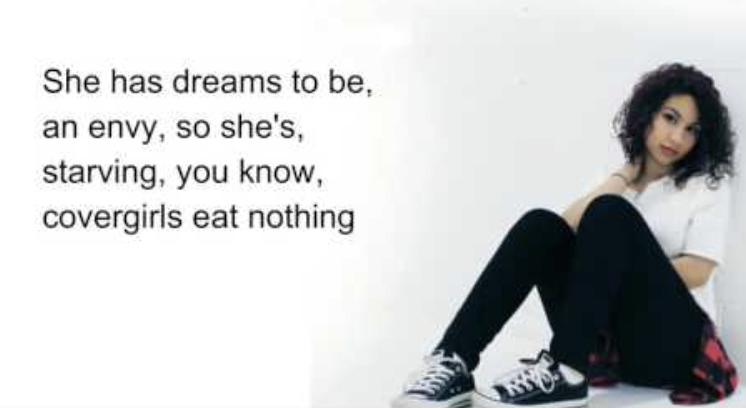
Another form of womanism relates to fat studies and the physical expectations imposed on women. To obtain the model ideal, a woman must exhibit stereotypically feminine qualities of slenderness and submissiveness. Models, and cover girls specifically, “eat nothing/She says beauty is pain and there’s beauty in everything/ What’s a little bit of hunger?” (1:58-2:05), which demonstrates the dangers of modeling. Virgie Tovar, a body positivity activist with a focus on fat discrimination, mentioned in her TED talk that “you have the right to remain fat” (Tovar TED Talk) which means that it is part of your bodily autonomy to be the size you want to be, and no one else can control that. Furthermore, Cara mentions that “you don’t have to change a thing/The world could change its heart” (1:01-1:03) which relates to the concept of Health at Every Size or HAES. HAES is a lifestyle change that encourages practices of self-love and health living “regardless of weight and appearance” (Burgard). Additionally, the phrase “beauty is pain” demonstrates the oppressions that women feel they must face in order to attain the feminine ideal, further demonstrating that pursuing a certain weight and appearance leads to unhealthy practices like eating disorders.  

The song, however, has limitations in the way that transwomen are represented. Based on the lyrics, the song assumes that women are cisgender. The repetition of the pronoun “she” and the word “girl” assumes the audience’s pronouns are she/her/hers and does not consider the plethora of different pronouns that one could have, demonstrating the limitations of the song as applying only to cisgender women. This limitation in the song, I believe, is unintentional; nevertheless, Alessia Cara could have been more cognizant of the audience she was delivering to and the pronouns she chose to use. 

Works Cited:

Cara, Alessia. “Scars to Your Beautiful”. 2015.

Book Review: *Medical Bondage*

Sex, rape, injustice, medicine, slavery. These words spark an interconnected web of issues relating to sexism and racism in the antebellum era. Owens’ begins with ways in which the perpetuation of slavery and the expansion of the field of gynecology were directly proportional. When Congress prohibited the importation of slaves from Africa, slave owners feared that there would no longer be enough slaves to sustain the growing economy, so slave owners turned their focus to the reproductive health of female slaves in order to maintain and improve slave procreation. Slave owners and white, male physicians alike continued to expand the field of gynecology; however, their motives were unethical. The motive for the development of the field of gynecology was to maintain a growing economy built upon slave labor by experimenting on marginalized populations like black women and Irish immigrants. These experiments planted the seeds for racism and sexism in medicine that still plague society today, illustrating the power of science and a persuasion. 

As one of only two Black women in the US leading a program rooted in the medical humanities at a university, Dierdre Cooper Owens is an award-winning public speaker and activist. Time magazine claimed Owens are one of the most successful and “acclaimed experts in U.S. history”. Owens graduated with a Ph.D. in history form the University of California-Los Angeles. Currently, Owens is the Director of the Humanities in Medicine program at the University of Nebraska-Lincoln. With a doctoral degree in history, Owens’ is versed in the history of gender and racial discrimination; furthermore, her position as Director of the Humanities in Medicine program indicates her knowledge for the intersectionality of race, sex, and medicine which allows her to speak with intelligence and poise on the topics discussed in Medical Bondage. Medical Bondage, Owens’ first book, won The Darlene Clark Hine Award for the best book in African American women’s and gender history in 2018. As a black woman, Owens can write with an accurate, first-hand point of view because she herself may have been victim to racism and sexism, either in medicine or the workplace. 

In the first chapter, Owens discusses the “Birth of American Gynecology” in the hands of Dr. James Marion Sims and other antebellum-era white physicians. Dr. Sims invented the silk suture method through countless experiments on female slaves. The sorrowful reality of this process is that once the experiments were complete, and the female slave was proved “infertile”, they were sold back to their slave owner because they were no longer useful for research. In other words, female slaves were pawns for white males, the economy, and for the development of modern-day science and medicine. White supremacy, male dominance, and the slave holder mentality prevailed in that no credit was given to the female slaves for the brutality that they endured; in other words, the white males were apathetic to the fact that a population was suffering at the expense of their ingenuity, success, and scientific fame. To be specific, by experimenting on innocent women, white males asserted their dominance and searched for biological ways to justify differences between white women and black women, further perpetuating the idea of black inferiority and oppression. The physicians used science as a means of justifying racism and oppression, stating that black women are biologically inferior to white women. 

In the second chapter, Owens further describes the cruelties that black women face in the hands of white slave owners and white physicians. Black women were seen as pawns and merely “breeders” for producing more and more slaves to benefit white men. White men viewed black women and Irish immigrants (another marginalized and discriminated population) as “impervious to physical pain and unafraid of surgeries” (Owens 20), illustrating the dehumanization and alienation of blacks and minorities. This mindset of using black women and immigrants as pawns for research is explained in Thomas Wright’s and other southern physicians’ experimentations in that “they needed their black patients, as a means to learn about curing disease, much more than their black patients needed them” (Owens 27). In other words, the blatant disrespect of dragging a black woman’s body across the floor, disrobing her in front of other servants, and performing an invasive surgery without consent illustrates the selfish and egocentric nature of white physicians in the Antebellum era, as well at outlining one of the motives for their gynecological research: perpetuating systemic racism and sexism. One specific example of the brutality that black women faced was the Supreme Court case State of Missouri vs. Celia, a slave, which was the trial for Celia who murdered the slave master who repeatedly beat, raped, and impregnated her on several occasions. The jury decided that Celia be sentenced to death, but at the time of the murder, she was pregnant, so the State of Missouri decided to wait until the child was born before executing her. This cruel and unjust criminal justice system illustrates the slave master’s desperation for the slave procreation and the perpetuation of forced labor. 

The final three chapters parallel each other in that Owens explains reasons as to how physicians used scientific authority to justify their sexist and racist claims, as well as the various ways in which rape and mistreatment of black women went under the radar. The term “superbodies”, which is brought up in chapter five, suggests that rape does not even harm a black woman because they are physically dominant and capable of hard work which minimizes the pain and suffering of rape stories. For example, black women’s rapes were “private occurrences” and many of them went under the radar because it was considered normal and moral in the eyes of white supremacists. In short, gynecological medicine in the antebellum era was a field that allowed white physicians to stake inherently racist and sexist statements about women by using their title as doctors to bolster their claims. 

One of Owens’ strengths lies in her ability to synthesize information and find the intersections of medicine, race, and sex. The sexual discrimination and racial discrimination that arise in Medical Bondage relates to Audre Lorde’s “There is no Hierarchy of Oppression” In Audre Lorde’s “There is No Hierarchy of Oppressions”, the theme of oppression as a omnipresent challenge, not just individualistic, is revealed when Lorde states that “any attack against Black people is a lesbian and gay issue, because I and thousands of other Black women are part of the lesbian community” […] “I cannot afford the luxury of fighting one form of oppression only” (Lorde). In other words, oppression is bad in any of its forms: racism, sexism, heterosexism etc. One cannot classify one oppression to be less significant than another. In relation to Medical Bondage the brutality endured by women in bondage and the sexist claims created by male physicians is just as significant and oppressive as the racist classifications of white versus black female bodies. Black women were found to have “steatopygia (enlarged buttocks), elongated labia, low-hanging breasts, and lasciviousness” (19). These discriminatory and racist stereotypes perpetuated the racial binary of white versus black, which provided evidence for white supremacists to harass black women. These derogatory stereotypes relate to an article that I read in my writing class titled “Venus in Two Acts” written by Saidiya Hartman. Hartman brings up the term “Hottentot” which relates to Hottentot Venus, a stereotypical image of the black female physique, and further details the cruel language that is used to describe black women: “A sulky bitch. A dead negress. A syphilitic whore” (6, Venus in Two Acts). In short, Owens’ ability to create subtle connections with other texts, feminists, and activists illustrates the implicit strength of her argument. 

            A weak point in Owens’ book is when the term “superbodies” is brought up in Chapter 5 regarding black women seeming capable of harder work in the eyes of white men as a result of their “hypersexuality”, and their “physical strength” which was supposedly superior to that of white women. “Superbodies” is ironic in that it assumes black women are superior to white women because of their strength; however, women are supposed to be known for the weakness, fragility, tenderness, and submissiveness. Does the relationship drawn between “superbodies” and black women suggest that female slaves are not even human? “Superbodies” means “superhumans” or “superheros” which are all superior to humanity. Do female slaves not experience feelings, emotions, and physical suffering of normal humans? Black women were subject to racism and sexism and suffered the “ugly stereotypes that many American men, regardless of race, held about them as wanton seductresses,” (Owens 75) meaning that on top of racism coming from white men, black women experienced oppression from both white and black men who saw them solely for selfish sexual pleasure. However, I find the term “superbodies” to be hypocritical and illusionary by blurring the lines between white and black femininity. To strengthen the vagueness of this new term, Owens should have given an example for black women not showing emotion or pain or suffering and contrasting this with an example of white women’s fragility and emotion. 

In my opinion, the book Medical Bondage is an accurate representation of the intersectionality between sex, medicine, and race. While there are some weaknesses in the delivery of certain terms, Owens successfully describes the birth of American gynecology and draws connections between medicine and societal issues such as sexism and racism. Anyone seeking to learn more about the history of developing women’s health and the roots of prejudice in medicine that were planted during the antebellum era should read this book because the reading is accessible to the broader public and anyone who reads the book will benefit from its message about the ongoing quest for equity in medicine. 

Works Cited:

Owens, Deirdre Cooper. Medical Bondage Race, Gender, and the Origins of American Gynecology. University of Georgia Press, 2017. 

Lorde, Audre. “There is No Hierarchy of Oppressions”. Leaning into Lorde. Council on Interracial Books for Children, 1983.

Hartman, Saidiya. “Venus in Two Acts.” Small Axe, vol. 12 no. 2, 2008, p. 1-14. Project MUSE muse.jhu.edu/article/241115.

Walsh-Little, Maya. “Bio”. Dr. Deirdre Cooper Owens, https://www.deirdrecooperowens.com/bio

Dierdre Cooper Owens. “Charles and Linda Wilson Professor in the History of Medicine; Director, Humanities in Medicine”, University of Nebraska-Lincoln, 2019. 

Prada takes a racist turn down the runway

Written by Anna Newman for the website Jezebel

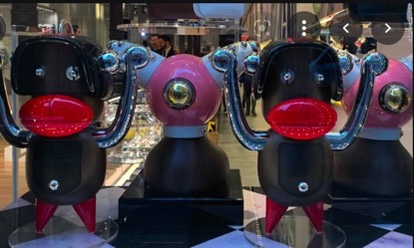
Fashion changes the world by controlling the definition of beauty. Designers like Prada, Chanel, Yves Saint Laurent, and Marc Jacobs hold positions of power as they are all high-fashion industries, catering to the materialistic needs of the white, upper-class. However, with this position of power comes global publicity and attention, which can be good and bad. One designer in particular, Prada, dug themselves into a hole of backlash after displaying a gadget with racist connotations in the window of the SOHO store in Manhattan. This gadget appeared to resemble the Golliwog, which was a blackface caricature in the 19th century. Given that Prada is a world-recognized and respected retailer, the world was shocked by this decision to display a gadget with references to “Little Black Sambo” and discriminatory black facial features. In response to this criticism, Prada took down the display, rightfully so; however, simply taking down the display was not enough to reconcile the damage that the retailer had caused. Prada decided to form a council within the company focused on diversity and inclusion for their clothing, accessories, and models. To go the extra step, Prada sent the proceeds from the remaining gadgets to a New York based non-profit that advocates for racial justice. In conclusion, the danger of the fashion industry is that they hold so much power and authority in determining what the beauty standards are and what the trends are, which means that people idolize these companies; when these companies begin suggesting racist ideas and connotations about their products, that is when we, as citizens, should start questioning where this position of power is coming from. Why does the high fashion industry have the authority to deem what is considered beautiful and trendy? To answer this question, we must refer to Foucault’s stance on how power is defined. Foucault believes that power is “multifaceted [and …] not just top-down” (Foucault) which means that even though we may think that Prada, being high ranking and respected worldwide, knows what real beauty and fashion trends are, true beauty is determined within society on a fluid level; it something that is ever changing and subjective, a concept that cannot be determined by a single company or power. 

Relating to challenging the norms, the Three to Infinity Movie about getting rid of gender labels in order to live a happy and boundary- free life for trans and queer people. The movie’s message is about challenging the norms of a binary society, recognizing that one does not have to be either male or female, realizing that you do not have to be the same gender you were at the time you were born, and accepting that gender can change and fluctuate throughout your life. This idea of an ambiguous and amorphously genderless society relates to the fashion and beauty construct that large franchises have created. These physically and monetarily unattainable fashion standards have been labeled and idolized by the industry as the sole way in which one can be beautiful, which creates discrimination on the socioeconomic and appearance level. Additionally, Marilyn Wann published an article called The Fat Studies Reader which discusses how the weight loss industry is worth 58.6 billion dollars and it feeds off of the public’s desire for a smaller, more model-like body. The weight loss industry and the high fashion industry go hand in hand; without the high fashion industry, the weight loss industry struggle to find an incentive for people to get involved with losing weight because the attractive, trendy, and chic styles would no longer be modeled on the bodies of skinny, white women and the end goal would be masked from the public. In conclusion, high fashion and social media has a significant impact on how people perceive themselves which creates tension and standards which are unachievable, demonstrating the self-serving and money seeking nature of the workplace. 

Figure 1: Blackface Prada gadgets