Scars to Your Beautiful by Alessia Cara
Written by: Anna Newman
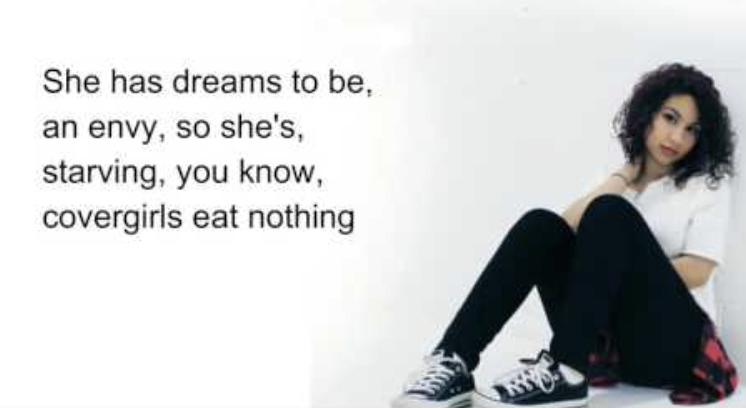
In the song Scars to Your Beautiful by Alessia Cara, the dangers of female beauty standards are revealed through lyrics referencing eating disorders, superficial appearances, and the dangers body comparison. While the song promotes body positivity, the artist simultaneously brings attention to the unattainable and highly demoralizing expectations that are forced upon women with respect to their appearance.
The phrase in the song “She just wants to be, beautiful/She goes, unnoticed she knows, no limits/She craves” (0.05-0.11) relates to the expectations of beauty that are placed on women, as well as the misogynistic realities within marriage. The phrase “unnoticed she knows” relates to the idea of coverture within marriage in which the man usurps all of the rights from the woman and makes decisions for her, thus making her “unnoticed”. The phrase in the song “no limits/She craves” demonstrates that women are seeking more rights and privileges that they do not have, which relates to the oppressions that Betty Friedan describes in The Feminine Mystique. Friedan describes women as being “taught to pity the neurotic, unfeminine, unhappy women who wanted or be poets or physicists or presidents” (Friedan 270). The descriptor “neurotic” is juxtaposed with the titles of “poet”, “physicist”, or “president”, illustrating that women are shamed for being independent, intelligent, and self-sufficient humans. In other words, women are taught to be submissive, invisible, and voiceless, demonstrating the dangers of misogynistic relationships and the limitations in which they create.
Another form of womanism relates to fat studies and the physical expectations imposed on women. To obtain the model ideal, a woman must exhibit stereotypically feminine qualities of slenderness and submissiveness. Models, and cover girls specifically, “eat nothing/She says beauty is pain and there’s beauty in everything/ What’s a little bit of hunger?” (1:58-2:05), which demonstrates the dangers of modeling. Virgie Tovar, a body positivity activist with a focus on fat discrimination, mentioned in her TED talk that “you have the right to remain fat” (Tovar TED Talk) which means that it is part of your bodily autonomy to be the size you want to be, and no one else can control that. Furthermore, Cara mentions that “you don’t have to change a thing/The world could change its heart” (1:01-1:03) which relates to the concept of Health at Every Size or HAES. HAES is a lifestyle change that encourages practices of self-love and health living “regardless of weight and appearance” (Burgard). Additionally, the phrase “beauty is pain” demonstrates the oppressions that women feel they must face in order to attain the feminine ideal, further demonstrating that pursuing a certain weight and appearance leads to unhealthy practices like eating disorders.
The song, however, has limitations in the way that transwomen are represented. Based on the lyrics, the song assumes that women are cisgender. The repetition of the pronoun “she” and the word “girl” assumes the audience’s pronouns are she/her/hers and does not consider the plethora of different pronouns that one could have, demonstrating the limitations of the song as applying only to cisgender women. This limitation in the song, I believe, is unintentional; nevertheless, Alessia Cara could have been more cognizant of the audience she was delivering to and the pronouns she chose to use.
Works Cited:
Cara, Alessia. “Scars to Your Beautiful”. 2015.
I love Alessia Cara! Your connections between the lyrics and Betty Friedan’s writing, Virgie Tovar’s words, and HAES’s message are really insightful and well-placed. I really appreciated your observation at the end regarding the pronouns Alessia uses in the song. It is sadly a wider societal problem how we assume if you are a woman you must have she/her pronouns and if you have she/her pronouns you must be a woman. Great work!
I think your analysis of the limitations of this song is really interesting and can probably be applied to most songs we consider “feminist.” Though I personally might feel seen and represented when I listen to chart-topping pop hits from female singers preaching “girl power,” there are many individuals who identify as feminists who probably don’t feel the same way. These people — nonbinary folks, trans women, and even cis and trans men — are not being celebrated in these songs for their contributions and commitments. We must think about how to alter these types of songs to still convey the same message without leaving anyone out.
This was one of my favorite songs when I was younger! I think this was a perfect song choice for this assignment. I love the connections and parallels you draw between her lyrics and our class readings. I especially think you did a great job when you relate it back to HAES and self-love! Great job (:
I really like this song and I haven’t heard it in so long! After reading your analysis, it seems to have a lot more meaning and implications than I ever thought. I never thought of this song in the way you analyzed it and it was really eye opening. I am glad that you brought in the association to fat studies because I think that is a very important part of the song and what I first think of in the song.
I absolutely love this song! Alessia Cara is a wonderful choice for this project, and your analysis of the song is amazing. I like how you incorporated Health at Every Size because although her song is focused on women having to look a certain way to fit beauty standards, body shape plays a role in that, so Alessia is not only displaying feminism, but she is also advocating for body positivity since the Western idea of beauty is small, skinny frame. Also, love the limitations you discussed which seem to be very prominent across many songs.