Theory To Praxis: Reconstructing Bathroom Labels at Davidson College

Davidson College is dedicated to “improv[ing] the Davidson campus climate for our transgender, genderqueer, and gender-variant students, faculty, staff, community members, and alumni” (LGBTQIA + resources, Davidson). However, much work still needs to be done to provide basic needs, such as comfortable bathroom stall usage, to the increasingly diverse student body. 

A Gender Inclusive Restroom Map can be found on the school’s website showing the gender-inclusive restroom options for the members and community of Davidson. At first glance, it appears that the school provides a wide range of gender-inclusive restroom options. After analyzing the map, all options are single-occupant restrooms which single out people who do not identify as cisgender. A few single-occupant restrooms on campus are still designated as either “male” or “female”. Shockingly, many places on campus designed to be “safe” places for students like Residence Halls (Akers, Knox, etc) and Student Life Buildings (Wildcat Den, Summit Coffee on Campus, etc) include no options for people in the LGBTQIA community who do not identify themselves as male or female. Academic buildings at Davidson College that do have single-occupant stalls tend to have them on the basement floor level. Students who need bathrooms not labeling them as “male” or “female” have a hard time accessing stalls quickly. 

It is evident that Davidson has a long way to go in creating a community that “welcomes and fosters mutual respect among all campus members” (LGBTQIA + resources, Davidson). I believe the best way to achieve this goal is by reconstructing bathroom labeling in restrooms at Davidson College. However, it is important to note that creating a safe bathroom environment that nurtures everyone’s needs will be a challenge and a long-term plan. To start, Davidson College should redesign the bathroom signs outside the door. Rather than having your typical ‘male’ and ‘female’ doll symbol, there should be a mixture of both figures where half is wearing a skirt and half is wearing pants. The same symbol should be used in all bathroom signs on campus. Changing the picture on a sign seems like a minor change, but is a big step towards creating a positive climate and raising awareness about gender diversity on campus. Along with labeling, the single-use bathroom should be changed from its traditional “unisex bathroom” title to “community bathroom.” Doing this, single-use bathrooms are rooted to meet everyone’s needs and eliminate the pressure of having to identify as ‘one sex’ as the term ‘unisex’ emphasizes. Using the term ‘community’ accounts for everyone on campus and eliminates gender and identity labeling. 

In the long run, Davidson can create a plan to create multi and single-community bathrooms on every floor starting in academic and residential buildings to provide options for everyone at Davidson and make basic tasks, like using the bathroom, accessible to all. Reconstructing the bathroom signs and labels is only the beginning. 

____________________________________________________________________________________________________________________

 LGBTQIA+ resources. Davidson. (n.d.). https://www.davidson.edu/offices-and-services/diversity-and-inclusion/lgbtqia-resources. 

“God is a Woman” by Ariana Grande

https://www.youtube.com/watch?v=kHLHSlExFis

As Ariana says, “You’ll believe God is a woman” by the end of an intimate act. In her song, “God is a Woman”, Ariana emphasizes women empowerment and raises awareness to a topic that is frowned upon in society- woman finding pleasure in sexual relations. Ariana encourages female empowerment through lines such as “And I can tell that you know I know how I want it” and “I’m tellin’ you the way I like it, how I want it”. In doing so, Ariana sheds light on the idea of women placing their needs and desires above men, this way the act of intimacy shifts from being man-dominated to woman-dominated. These lyrics emphasize the importance of women openly speaking about their sexual desires and reclaiming their bodily autonomy. 

This idea of being confident in speaking about sexual desires relates to Foucault connections between knowledge and pleasure, and how sex is just not supposed to be a learning experience, but also an opportunity to teach us something about ourselves. There is an urge to know something from sex and pleasure, but there is still the paradox of the sex talk where sex is silenced, yet we still talk about it explicitly and incessantly. Ariana paves the way for women to skip the act of silence and feel confident in speaking about their needs in a sexual relation. 

However, it is important to note there are limitations that exist in how gender plays a role in her song. Ariana references intimacy in a relationship between a male and female both in the song and the music video. For example she sings, “And he sees the universe when I’m the company.” With the usage of the pronoun, “he,” Ariana excludes homosexual relationships. Also, the exclusion of queer relationships does not address other women’s sexual experience, such as those who are transgender and lesbian.

Despite this, “God is a Woman” by Ariana Grande encourages female sexual liberation and celebrates female pleasure. 

Book Review- *Fat Gay Men: Girth, Mirth, and The Politics of Stigma*.

The LGBTQ community is growing rapidy and gaining more support through the decades. However, many members within the community continue to experience discrimination because of their identity to other marginalized groups. Fat gay men have a hard time being accepted by the heteronormative society and the gay society. Members of this double marginalized group are often stigmatized and have a hard time feeling confident in who they are. Once the way fat bodies live and shape the world is understood, acceptance and celebration emerges. 

Jason Whitesel, professor of Women’s, Gender, and Sexuality Studies, enters the world of fat gay men in his book Fat Gay Men: Girth, Mirth, and the Politics of Stigma (2014). Whitesel discusses how members of a double marganilzed group (being fat and gay) have reconstructed their identities in the face of discrimination. Whitesel argues that fat gay men are stigmatized in the LGBTQ movement because of their size. He explains how gay big men are marginalized both for their sexual orientation in a heteronormative society and for their size in a gay society (2). Gay fat men want their dignity and respect in society. 

Whitesel’s use of ethnographic study allows people to better understand the stigmatized world of fat gay men. Whitesel does his research and observations by becoming a member of a fat gay men group called Girth & Mirth. Although his experiences and analysis is concentrated to that group, Whitesel does discuss the issues in a broader, open-ended lens. The Girth & Mirth is a group that provides fat gay men a safe-space and support. They like to refer to each other as a family rather than an organization. The Girth and Mirth family allows fat gay men to do activities like eating in public, socializing with others, and more “every day” activities they would not have otherwise been able to do on their own. People in this group discuss ways in which they found out about Girth & MIrth and how their life has changed since. Members have heard of this group through newspaper ads, friends, and more. Ultimately, Girth & Mirth saved the lives of many and provided fat gay men a place to come together and embrace their diffrences.

When trying to understand the everyday life of being a fat gay men, Whitesel becomes aware of his skinny privilage and ensures to not let it play a role when analyzing his research. In trying to understand the impact social events have on the fat gay community, Whitesel attends two. The first event is called the Super Weekend and the other is a national Convergence in Minnesota. Whitesel went into these events with only telling a few people he was doing research. Because Whitesel is a skinny gay man, he was known as a “chaser” (term given to skinny gay man who are attractive to bigger men) when he became a member of Girth & Mirth. By going in as a member and not letting it known he was doing research, Whitesel was able to get  more sincere and honest responses on how the fat gay men feel towards their status within the gay community. 

In Chapter 3, Performing the Fat Body we learn about The Super Weekend, an event where fat gay men gather at the Cabana Inn and “create an inverse world for themselves” (61). Big gay men are able to engage in reinventing themselves as objects of desire and reclaiming their right to self-definitions. People who attend the event are able to have a good time engaging in scatological humor and celebrating through food, dance, and sex. Whitesel attended this event as a member of the Girth and Mirth club, but also a coordinator of the event. Through his weekend and interaction there, Whitesel noticed that big gay men use campy humor to work through the stigma of being fat. It is important to note that The Super Weekend can be controversial as it can be over sexualized. For example, the doorknob award is given to the person who has had sex with the most people during the event. However, using this form of humor allows big men to “overcome their underdog status” (86).

Whitesel also participated in the annual Convergence of big men in Minnesota, which he describes in Chapter 4, Big Gay Men’s Struggle for Class Distinction. This event is much larger compared to the Super Weekend. Although Convergence is similar to Super Weekend, Convergence offers sightseeing, education seminars and theme dances. For example, the Convergence does a “prom”, “homecoming” type dance where fat gay men are able to dress up and participate in an event that they might have felt excluded when in high school. Although many members participate in such events years after their “normal” time, they still play a big role in their life and how they feel about their identity. In this event, Whitesel was advised to talk openly about his role as a researcher so more people can talk to him about how big gay men work through self-esteem issues (98). The Convergence allowed big gay man’s status in the society to be improved. 

By attending both The Super Weekend and The Convergence, Whitesel was able to understand how big gay men socially construct their culture differently (108). This allowed Whitesel to conclude that gay men reconfigure the shame of fat stigma by either turning themselves into sex objects, or by seeking class validation (137). Whitesel was able to fit in the Girth and Mirth group nicely due to his homosexual male staus, but made sure to be aware of his skinny privilege as he interacted with people during both events. By keeping an open mind, Whitesel was able to grasp a better understanding of the injuries and discrimination that big gay men face.

Although Whitesel described his observation in both events, there were areas that lacked information. For example, during the Super Weekend, he talks about the Chub-and-Chaser relationship but does not bring to attention the controversy and hierarchies that might exist. Events like this are spoken in a positive narrative, and lack explaining issues that might be present like the fetishization of fat bodies. 

Overall, Jason Whitesel does a good job giving a voice to fat gay men. Members of this double marginalized group are often silenced by the gay community and Whitesel brings attention to groups such as the Girth and Mirth Club and how they use their platform to create a safe and fun space for gay fat men to express themselves and participate in normal activities such as partying and eating in public places. In Fat Gay Men: Girth, Mirth, and the Politics of Stigma we learn of the injuries and discrimination fat gay men face and ways in which they embrace their figure and get rid of the shame they grew up with. 

In conclusion, Fat Gay Men: Girth, Mirth, and the Politics of Stigma by Jason Whitesel is an informative read for people who are interested in learning about the discrimination that occurs when you are part of a double marginalized group. This book enriches fat studies and highlights interesting ways in which social stigma, body size, and sexual identity intersect and impact the lives of people. However, it is important to note that having some knowledge of fat studies will be useful in understanding Whitesel’s conclusion on how the three social issues connect with one another.

Works Cited

Whitesel, J. (2014). Fat Gay Men: Girth, Mirth, and the Politics of Stigma. New York, NY: NYU Press.

Changing Gender Roles: Get Tattoos. Scare People!

Written by Patricia Raudales Calvario for Wear Your Voice/ https://www.wearyourvoicemag.com

The animated comedy The Simpsons is widely known by the media for “predicting the future.” Scenes from past episodes are scaringly connected to current events. Whether or not you believe this theory to be accurate, you will find many Simpson reference memes on social media. Scenes from the show have contributed to meme culture. The meme culture is rapidly growing on many social media platforms like Facebook and Instagram. People see memes everywhere, and the description following the meme, although used to entertain, can show a lot about society’s current views.  

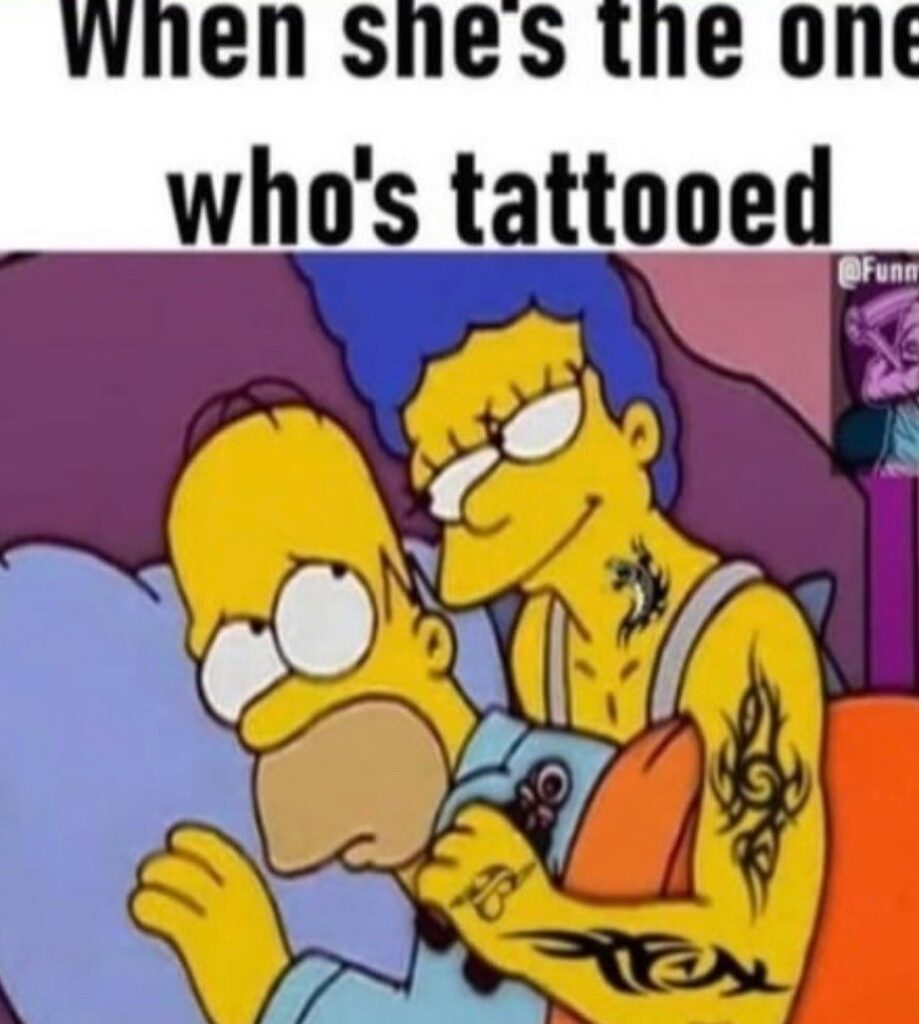
“When she’s the one who’s tattooed” meme shows the fear of Homer Simpson (the person on the left) as his wife, Marge Simpson (the person on the right), leans over him with a seductive face. This interaction goes far beyond Homer and Marge; the facial expressions themselves depict gender roles in society. Although women are now empowered in all aspects of life (social, educational, political, and psychological), seeing a woman embodying more “masculine” traits still frightens many, as seen in Homer’s face. Women who show confidence and are assertive are considered more “manly.” Women can be confident but also need to spread warmth and bring joy to others. Rather than being strong, women are expected to be relaxed and easygoing. Anything that contradicts these ideas is quite scary to society. 

Beyond the facial expressions shown in this meme, the creator edited a tattoo sleeve on Marge’s arm to create his “When she’s the one who’s tattooed” meme. This meme is looked at, laughed at, and then people move on to the next meme. However, it is crucial to be aware that memes such as this one tell us a lot about gender roles and identity in society. Memes go beyond giggles and laughs. Memes have meanings and values. 

Why does Homer look afraid in this meme? A tattooed female is leaning over him. This meme does a great job of showing the perception of women and men with tattoos that society holds. When a man has tattoos, he is a “strong man,” a “brave man.” This is why this meme would have not been successful or considered funny if the roles were reversed. Although more and more women are now getting tattoos to represent the femininity and morals they hold, they are not always viewed as “strong women” or “brave women.”  Instead, women with tattoos are described as “aggressive” or “more masculine.” This meme shows how it has become more socially acceptable for a man to have tattoos than a woman. 

The type of tattoos put on Marge’s arm is also specifically picked, creating a more masculine image. A simple google search of “tattoos for women” and “tattoos for men” can show what type of tattoos are acceptable for each gender. For example, Marge’s tattoos would be found within a “tattoos for men” Google search. A simple “tattoos for men” google images search will suggest dark and more frightening tattoo ideas. Tattoos of skulls, fires, lions, snakes, and “king” phrases will be the first to come out. Googling “tattoo ideas for women” would give you the complete opposite: sweet and fragile ideas. Top suggestions would include flowers, hearts, and butterfly tattoos. Google searches for tattoos should be nothing more than inspiration and should not determine the tattoo you think would be the most socially acceptable. No matter your gender identity, get a butterfly tattoo, a skull tattoo, get both. 

Memes like the one described above are dangerous and can complicate people trying to understand their gender identity. A woman can wear “masculine” tattoos and still hold more feminine characteristics. A man can wear “feminine” tattoos and still have masculine features. Tattoos are now becoming more popular in American life. Our role is to dissociate ourselves with putting labels on the type of tattoo one chooses to put on their body.  

Tattoos can have personal meanings to some people, and to others just be a form of art put on their bodies. Tattoos are not gendered, and one should get tattooed with whichever design they desire. Tattoos can be hidden from the public view, or they can be exposed for everyone to see. Regardless, get whatever tattoo you want. Be as creative, bold, and SCARY with your tattoos. Be Marge Simpson and frighten society!