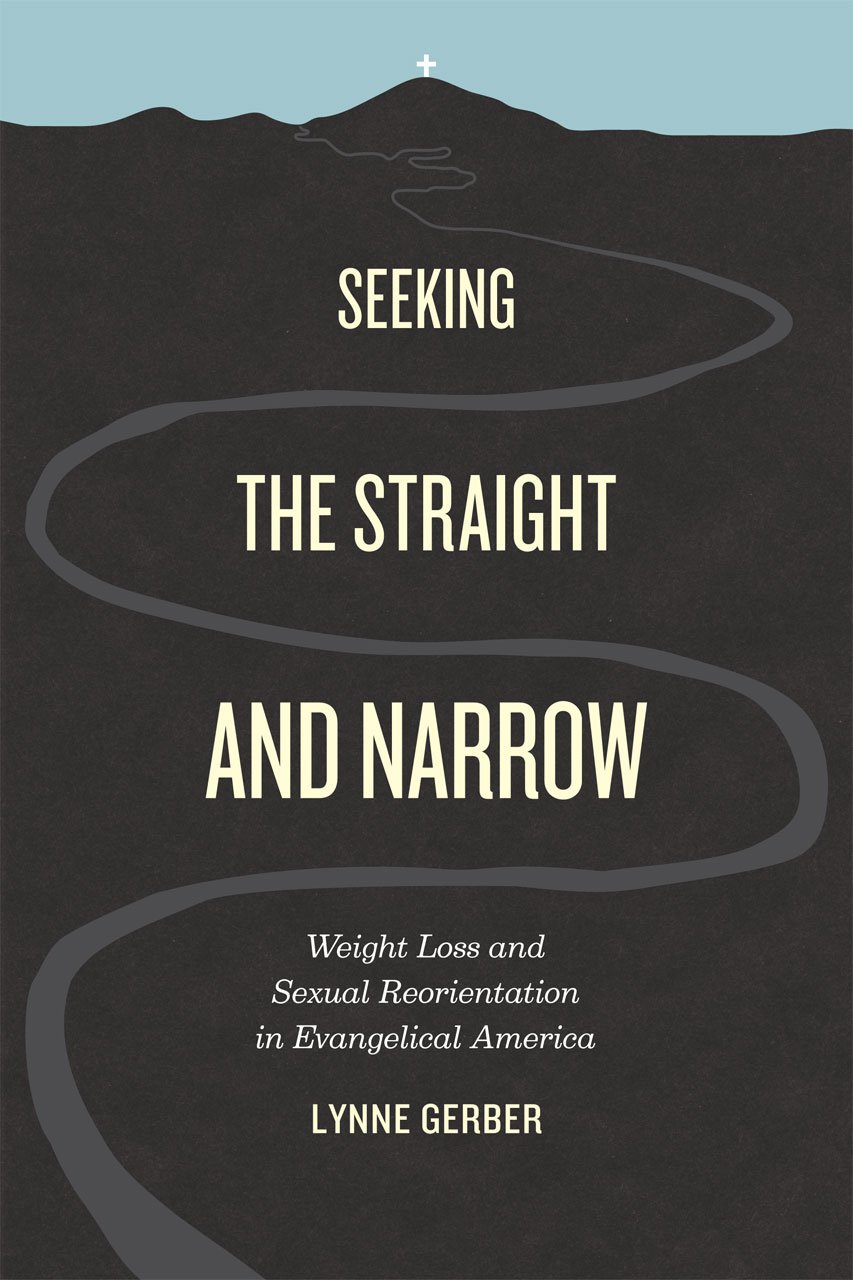
Seeking the Straight and Narrow: Weight Loss and Sexual Reorientation in Evangelical America by Lynne Gerber explores the intersection of weight and sexuality in the Evangelical church. The book draws focus to two Evangelical ministries that directly address these topics, First Place and Exodus International. First Place is a Christian weight loss program that was founded in 1981 by members of the First Baptist Church of Houston. The premise of the program is that Christians look to guidance and help from God for every other aspect of life, so they should be able to seek help from him for weight loss. First Place claims that it is grounded in both a spiritual and scientific approach to weight loss that benefits the person physically, mentally, emotionally, and spiritually. It uses divine assistance rather than intervention, and sees divine authority as complementary to scientific authority rather than contradictory. With the rise of the ideas that homosexuality is immutable and natural from the gay right’s movement, ex-gay ministries grew in opposition. Exodus International is an organizational umbrella for roughly one hundred and thirty ex-gay ministries that evolved when the new evangelical movements started to reach out to gay people in the 70s. These ministries use evangelicalism to focus on issues like drug addiction, cultural exploration, sexual promiscuity, and homosexuality. Gays and lesbians that were “newly saved” went to these ministries to reconsider their sexuality in the context of their faith. Exodus International was intent on helping people overcome their homosexuality rather than them being in the closet or taking the liberal approach of acceptance. The ministries see homosexuality as a moral and psychological issue that is undeniably a sin.
Although the connection between homosexuality and fatness is not a direct one at first glance and First Place and Exodus International exist in different realms of the Evangelical world, Gerber argues that they are in fact deeply connected. She states that “both are associated with excessive desires and excessive bodily expression, excesses that have long disturbed American culture and moral sensibilities” (Gerber 14). Also, homosexuality and fatness have been a “focus of containment” for the state, medicine, and religion. “Losing weight and reorienting sexual orientation are projects fueled by a tension between malleability and limitation that is very compelling in American culture” (3).” The interconnectedness between ex-gay ministries and weight loss ministries through the focus on the body, excess, containment, and malleabillity displays a strong similarity between the two groups that would not come to mind when first looking into these topics.
The monograph is split into an introduction, three chapters, each with two subchapters, and a conclusion. This setup provides for a very organized and clear structure of Gerber’s argument. The first chapter titled, “Framing Right and Wrong,” is split into two subsections, “Sin” and “Health.” This chapter discusses how evangelicals use sin and health as a way to argue what is morally right and wrong. Food is often talked about in relation to sin, sinful foods or the sin of overconsumption of food. Homosexuality as a whole is seen as a sin by many religious communities. Gerber discusses how the definition of sin varies from person to person. Some people believe that some sins are mild and “not what God created you to be” (39) or to be very harsh and “disobeying God’s commands” (40). On the other hand there are people that believe a sin is a sin and that all sins are seen as equal in the eyes of God. One of the most interesting things I found in this section was Gerber’s claim that gluttony is seen as a worse offense than homosexuality in the bible but in Evangelical American society, homosexuality is seen as worse. In “Health,” Gerber discusses how “the Lord is conflated with health” (53) and any behaviors that do not promote health are against God’s will. Each Evangelical group equates their ideal with health, heterosexual relationships being the only healthy relationships, and having low cholesterol or weight is the only way to be healthy. The next chapter, “Making Christian Bodies,” discusses how these programs place the responsibility of the outcome on the participants. If people want to see change, either in their sexuality or weight it is on them to make that change. This then puts the success or failure of the program on the participant and not the ineffectiveness of the programs. The third and final chapter titled, “Accountings,” is split into “Success/Failure” and “Breaking.” In “Success/Failure” Gerber discusses the approach of the ex-gay and fat-loss groups. Both use a flexible programming design which lets participants talk about their frustrations about how they are not seeing progress. This pulls attention away from the program and to the actions of the participants. The flexibility makes it so the program’s successes and failures can be justified and not questioned. The section “Breaking” posits that the rise in queer activism and fat positivity and acceptance movements has allowed for positive narritives about gay and fat Evangelicals. As a result of this rise, Exodus and First Place had to work against those new movements to retain their membership and participant devotion. This was, however, not successful as many participants in these programs reach a breaking point and leave. They then find acceptance in themselves and their fatness or gayness. “Sexual identity is no more inherently true than religious identity. If people feel they need to pick, they may pick either” (223). The final conclusion of the book discusses how these ex-members must face an internal battle between their fat or gay identities and their Evangelical identities because they feel they cannot exist as both harmoniously. Gerber comes to the acceptance that some people, although not necessary, feel like those identities are not compatible and must choose one.
Lynne Gerber is an independent researcher and scholar. She has held academic positions at both the University of California, Berkeley and Harvard Divinity School. Presently, she is an independent researcher based in San Francisco. At the time of writing this monograph, Gerber was a research fellow in the Religion, Politics, and Globalization program at the University of California, Berkeley. Gerber’s research focuses on religion, the body, and morality.
Gerber used qualitative research in her investigation through participant observation, interviews, and content analysis of ministry materials. She attended First Place meetings for seven and a half months and although she was not a Christian and they knew she was a researcher, the group welcomed her and filled in the gaps of what she might not understand without a Christian background. However, it was not as easy to get participant observation in Exodus International. The groups were not welcoming to a researcher that was neither gay nor Christian. They had experience with undercover journalists and also thought that she would not understand their teachings or process since she was not a part of the groups they worked with. Therefore, she conducted her research through public gatherings and conferences of ex-gay ministries. She also interviewed sixty three people, twenty eight from First Place, twenty eight from Exodus, and 7 former members of Exodus. She is transparent in the possibility of bias in her samples as the majority of them were white and in leadership roles.
One of the main strengths I found with Gerber’s book was how she took into account all perspectives on these issues and did not use her preconceived notions on the topics to influence her findings. She is very explicit in saying that everyone comes into the book expecting a different answer based on their beliefs about religion, gayness, or fatness. She knew that the people she interviewed and worked with throughout the process were expecting fair representation and that their vulnerable experiences were not going to be exploited. I think she shares their stories tastefully and respectfully, without any bias and without passing any judgement on them. I personally had thoughts about this book before reading it that were proved wrong. I think that the work is written very well and tells all sides of the story even if it’s not necessarily what some audience members want to hear. She acknowledges that there is validity to these programs while also talking about the pitfalls of them.
The main weakness I found in the book was that the samples that Gerber used in her research were mainly white- 5 out of 63 participants were people of color. Although Gerber explicitly recognizes this underrepresentation in her analysis, it does not change the fact that her findings are not an accurate representation of the population. The attitudes and experiences collected from the Exodus and First Place people are only really representative of the white experience. The social impacts of weight and sexuality are not independent of race, for example a fat white person, fat black person, skinny white person, and fat black person will all have very different attitudes towards their fatness or lack thereof and will all have very different experiences regarding their fatness. Another example is that black gay men are more likely to face adversity than white gay men. Queer theory has historically already been focused around the white experience and failing to complete a more diverse assessment adds to this issue. Painting a white centered narrative of experiences in these Evangelical programs does not provide a comprehensive, representative view on how the programs affect people and the success of them.
Overall, I enjoyed this scholarly read. I think it was a very interesting intersection between queer studies, fat studies, and religion studies. The book is written well and structured clearly, making it a read that is fairly easy to understand and follow while also being engaging. It is fascinating how these two Evangelical groups that seem to have nothing to do with each other, are very similar in their ways of teaching and programming, their beliefs around the things they are trying to fix, and how neither of them are very successful for their participants.
Works Cited:
Gerber, Lynne. Seeking the Straight and Narrow : Weight Loss and Sexual Reorientation in Evangelical America, University of Chicago Press, 2012. ProQuest Ebook Central, https://ebookcentral-proquest-com.proxy048.nclive.org/lib/davidson/detail.action?docID=772137.