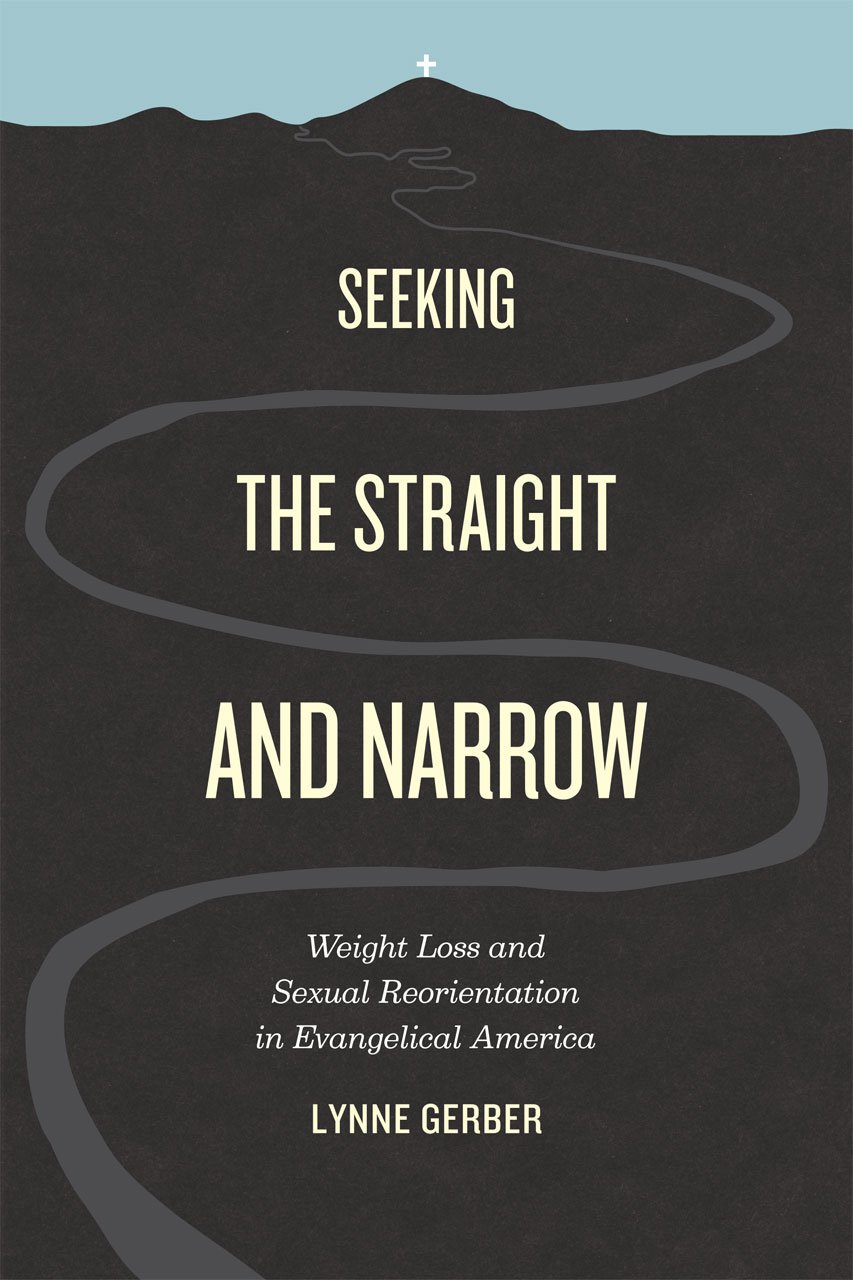
Book Review: Seeking the Straight and Narrow

Seeking the Straight and Narrow: Weight Loss and Sexual Reorientation in  Evangelical America: Gerber, Lynne: 9780226288123: Amazon.com: Books

Seeking the Straight and Narrow: Weight Loss and Sexual Reorientation in Evangelical America by Lynne Gerber explores the intersection of weight and sexuality in the Evangelical church. The book draws focus to two Evangelical ministries that directly address these topics, First Place and Exodus International. First Place is a Christian weight loss program that was founded in 1981 by members of the First Baptist Church of Houston. The premise of the program is that Christians look to guidance and help from God for every other aspect of life, so they should be able to seek help from him for weight loss. First Place claims that it is grounded in both a spiritual and scientific approach to weight loss that benefits the person physically, mentally, emotionally, and spiritually. It uses divine assistance rather than intervention, and sees divine authority as complementary to scientific authority rather than contradictory. With the rise of the ideas that homosexuality is immutable and natural from the gay right’s movement, ex-gay ministries grew in opposition. Exodus International is an organizational umbrella for roughly one hundred and thirty ex-gay ministries that evolved when the new evangelical movements started to reach out to gay people in the 70s. These ministries use evangelicalism to focus on issues like drug addiction, cultural exploration, sexual promiscuity, and homosexuality. Gays and lesbians that were “newly saved” went to these ministries to reconsider their sexuality in the context of their faith. Exodus International was intent on helping people overcome their homosexuality rather than them being in the closet or taking the liberal approach of acceptance. The ministries see homosexuality as a moral and psychological issue that is undeniably a sin. 

Although the connection between homosexuality and fatness is not a direct one at first glance and First Place and Exodus International exist in different realms of the Evangelical world, Gerber argues that they are in fact deeply connected. She states that “both are associated with excessive desires and excessive bodily expression, excesses that have long disturbed American culture and moral sensibilities” (Gerber 14). Also, homosexuality and fatness have been a “focus of containment” for the state, medicine, and religion. “Losing weight and reorienting sexual orientation are projects fueled by a tension between malleability and limitation that is very compelling in American culture” (3).” The interconnectedness between ex-gay ministries and weight loss ministries through the focus on the body, excess, containment, and malleabillity displays a strong similarity between the two groups that would not come to mind when first looking into these topics. 

The monograph is split into an introduction, three chapters, each with two subchapters, and a conclusion. This setup provides for a very organized and clear structure of Gerber’s argument. The first chapter titled, “Framing Right and Wrong,” is split into two subsections, “Sin” and “Health.” This chapter discusses how evangelicals use sin and health as a way to argue what is morally right and wrong. Food is often talked about in relation to sin, sinful foods or the sin of overconsumption of food. Homosexuality as a whole is seen as a sin by many religious communities. Gerber discusses how the definition of sin varies from person to person. Some people believe that some sins are mild and “not what God created you to be” (39) or to be very harsh and “disobeying God’s commands” (40). On the other hand there are people that believe a sin is a sin and that all sins are seen as equal in the eyes of God. One of the most interesting things I found in this section was Gerber’s claim that gluttony is seen as a worse offense than homosexuality in the bible but in Evangelical American society, homosexuality is seen as worse. In “Health,” Gerber discusses how “the Lord is conflated with health” (53) and any behaviors that do not promote health are against God’s will. Each Evangelical group equates their ideal with health, heterosexual relationships being the only healthy relationships, and having low cholesterol or weight is the only way to be healthy. The next chapter, “Making Christian Bodies,” discusses how these programs place the responsibility of the outcome on the participants. If people want to see change, either in their sexuality or weight it is on them to make that change. This then puts the success or failure of the program on the participant and not the ineffectiveness of the programs. The third and final chapter titled, “Accountings,” is split into “Success/Failure” and “Breaking.” In “Success/Failure” Gerber discusses the approach of the ex-gay and fat-loss groups. Both use a flexible programming design which lets participants talk about their frustrations about how they are not seeing progress. This pulls attention away from the program and to the actions of the participants. The flexibility makes it so the program’s successes and failures can be justified and not questioned. The section “Breaking” posits that the rise in queer activism and fat positivity and acceptance movements has allowed for positive narritives about gay and fat Evangelicals. As a result of this rise, Exodus and First Place had to work against those new movements to retain their membership and participant devotion. This was, however, not successful as many participants in these programs reach a breaking point and leave. They then find acceptance in themselves and their fatness or gayness. “Sexual identity is no more inherently true than religious identity. If people feel they need to pick, they may pick either” (223). The final conclusion of the book discusses how these ex-members must face an internal battle between their fat or gay identities and their Evangelical identities because they feel they cannot exist as both harmoniously. Gerber comes to the acceptance that some people, although not necessary, feel like those identities are not compatible and must choose one.

Lynne Gerber is an independent researcher and scholar. She has held academic positions at both the University of California, Berkeley and Harvard Divinity School. Presently, she is an independent researcher based in San Francisco. At the time of writing this monograph, Gerber was a research fellow in the Religion, Politics, and Globalization program at the University of California, Berkeley. Gerber’s research focuses on religion, the body, and morality. 

Gerber used qualitative research in her investigation through participant observation, interviews, and content analysis of ministry materials. She attended First Place meetings for seven and a half months and although she was not a Christian and they knew she was a researcher, the group welcomed her and filled in the gaps of what she might not understand without a Christian background. However, it was not as easy to get participant observation in Exodus International. The groups were not welcoming to a researcher that was neither gay nor Christian. They had experience with undercover journalists and also thought that she would not understand their teachings or process since she was not a part of the groups they worked with. Therefore, she conducted her research through public gatherings and conferences of ex-gay ministries. She also interviewed sixty three people, twenty eight from First Place, twenty eight from Exodus, and 7 former members of Exodus. She is transparent in the possibility of bias in her samples as the majority of them were white and in leadership roles. 

One of the main strengths I found with Gerber’s book was how she took into account all perspectives on these issues and did not use her preconceived notions on the topics to influence her findings. She is very explicit in saying that everyone comes into the book expecting a different answer based on their beliefs about religion, gayness, or fatness. She knew that the people she interviewed and worked with throughout the process were expecting fair representation and that their vulnerable experiences were not going to be exploited. I think she shares their stories tastefully and respectfully, without any bias and without passing any judgement on them. I personally had thoughts about this book before reading it that were proved wrong. I think that the work is written very well and tells all sides of the story even if it’s not necessarily what some audience members want to hear. She acknowledges that there is validity to these programs while also talking about the pitfalls of them. 

The main weakness I found in the book was that the samples that Gerber used in her research were mainly white- 5 out of 63 participants were people of color. Although Gerber explicitly recognizes this underrepresentation in her analysis, it does not change the fact that her findings are not an accurate representation of the population. The attitudes and experiences collected from the Exodus and First Place people are only really representative of the white experience. The social impacts of weight and sexuality are not independent of race, for example a fat white person, fat black person, skinny white person, and fat black person will all have very different attitudes towards their fatness or lack thereof and will all have very different experiences regarding their fatness. Another example is that black gay men are more likely to face adversity than white gay men. Queer theory has historically already been focused around the white experience and failing to complete a more diverse assessment adds to this issue. Painting a white centered narrative of experiences in these Evangelical programs does not provide a comprehensive, representative view on how the programs affect people and the success of them. 

Overall, I enjoyed this scholarly read. I think it was a very interesting intersection between queer studies, fat studies, and religion studies. The book is written well and structured clearly, making it a read that is fairly easy to understand and follow while also being engaging. It is fascinating how these two Evangelical groups that seem to have nothing to do with each other, are very similar in their ways of teaching and programming, their beliefs around the things they are trying to fix, and how neither of them are very successful for their participants.

Works Cited:

Gerber, Lynne. Seeking the Straight and Narrow : Weight Loss and Sexual Reorientation in Evangelical America, University of Chicago Press, 2012. ProQuest Ebook Central, https://ebookcentral-proquest-com.proxy048.nclive.org/lib/davidson/detail.action?docID=772137.

Theory to Praxis: A New Cross-Listed Course at Davidson College

One thing that has stood out to me after taking GSS101 this semester is how feminist and queer theory is inherently inaccessible to the average person. Theory has been kept in the realm of academia and most do not ever interact with or see feminist and queer theory until college, if ever. In my experience, I never learned about any theory in any of my years in public school and I had never heard of most of the scholars we discussed until reading their work in class. This course has been eye opening for me and I feel a more informed person after taking it. I personally think that it is important for everyone to, at the very least, know the basics of feminist and queer theory because I believe it informs critical thinking and social awareness. 

I am interested in the development of an interdisciplinary course that would be a part of the educational studies department and the gender and sexuality studies department at Davidson College. This course would cover how we can incorporate theory into elementary and middle school education. A focus would be on how we can create a standardized curriculum that would educate students on feminist and queer theory but in accessible terms so that it is easy to understand. Examples of projects in the course would be: to pare down Michel Foucault’s “History of Sexuality” into a simpler, easier to understand format, to develop a lesson plan that teaches about the waves of feminism and how they have shaped women’s rights, or to incorporate bell hook’s theory from “Black Women Shaping Feminist Theory” into a presentation and assignment suited for different grade levels. Throughout the development of this course and then into how this course is taken into the real world, it will be important to ensure that the information covered is intersectional and inclusive. 

Young students that do not feel like they fit in society’s definitions of gender or labels of sexuality will see early on that they are valid and that the whole concepts of gender and sexuality are ever changing and fluid. Introducing these ideas at a young age will cultivate a generation that will break down the gender binary, sexuality labels, and will create a more inclusive and accepting society.

Feminist Mixtape: The Man by Taylor Swift

Taylor Swift’s pop anthem, “The Man,” is a catchy, upbeat song aiming to address the inequality between how female artists and male artists are treated and talked about. With a driving bass line, fun and catchy melody, and easy to understand lyrics, this song is able to reach audiences young and old alike. In her song, Swift discusses how every aspect of her personality, looks, actions, and decisions would be seen in a different way if she were a man. In our society there is a double standard between what is acceptable for men to do and for women to do. 

The line “They’d say I played the field before I found someone to commit to” addresses how when a woman cycles through multiple relationships before settling down with “the one,” she is judged differently than a man would be even though it is very common for both men and women to have many relationships. Swift changes this negative narrative by stating “And that would be okay for me to do” confirming to her audience that having multiple partners in life is normal and not something to be ashamed of.

Later in the song, Swift says “When everyone believes ya/ What’s that like?” This line is referring to the #MeToo movement and how women that come forward about sexual assualt, harrassment, and rape are most often doubted and questioned. Victim blaming is present in our society and is disproportionately against women more than men. 

The final line that stood out to me when listening to this song was “What I was wearing, if I was rude/ Could all be separated from my good ideas and power moves.” Women’s clothing is all too often equated with their success and the quality of their work. Instead of focusing on what women actually have to say or what their ideas are, the focus is on what she is wearing. Specifically, when female artists, actresses, or celebrities are interviewed the topic is almost always about what they are wearing, or how they look. In contrast, men are typically interviewed on what their acting experience was like, or what the song is about, for example. 

I connected this song to the reading by Lorber called “The Social Construction of Gender.” In the reading she argues that “it does not matter what men or women actually do; it does not matter if they do the same exact thing, the social institution of gender insists only that what they do is perceived as different” (Lorber 58). In “The Man,” Taylor is arguing that if she did not change anything about her actions but existed as a man, she would be perceived differently by society and treated better. Simply because we as a society perceive some actions to be more acceptable when done by a certain gender, it has become unacceptable to cross those made-up gender barriers. The issue is that there is no rhyme or reason for why we have these expectations for what different genders can or cannot do. The idea that what a woman is wearing determines her worth or success or how many partners a woman has had determines her value is a baseless belief that society has created. Taylor Swift is one of, if not the, biggest artist currently. She has an enormous platform and the ability to create change with the message she shares through her artistry and voice. This song is an attempt to address the disparities between how female and male artists are treated and spark discussion on how we can create change. Her feminism is not perfect and she can do a lot more to include intersectionality in her feminism and to use her priviledge uplift marginalized voices.

Lesbihonest: Pitch Perfect is Not As Progressive As We Think

Written by Sarah Butchko for Autostraddle

Pitch Perfect, directed by Jason Moore and written by Kay Cannon, hit theaters in 2012 and has remained an iconic pop culture staple since. The movie follows the Barden Bellas, an all-girl acapella group trying to make a comeback after an embarrassing performance at the ICCA Finals the year before. While the group used to be composed of basic, white, acapella girls, the Bellas have become desperate to recruit a new team and end up taking in a group of misfits as the new Bellas. This could be a whole other discussion on the fatphobia, racism and plain bitchiness rooted in the recruitment of the Bellas, like how they have to “settle” for people who do not fit their prior standards of: white, skinny, and conventionally pretty. Back to the plot of the movie; the Bellas rival the Treblemakers, the all-male group on campus, and beating them at the 2012 ICCA Finals fuels their fire. Pitch Perfect takes the audience through the reinvention of the Bellas and the trials and tribulations of college acapella. There are many subplots in the movie, Beca and Jesse’s relationship, the enemies to lovers trope of Fat Amy and Bumper, and the not so subtle will-they-won’t-they of Beca and Chloe, to list a few. The movie has a cliche happy ending, Beca gets her man and the Bellas win the ICCAs. 

Although at first glance, the story is inclusive of different people and identities, with further consideration it uses these different identities as the butt of the joke and perpetuates harmful stereotypes. Comments and off color jokes about lesbians are heard throughout the movie. In the specific scene I am focusing on, the Bellas are going around and telling each other something that the others do not know about them. As Cynthia Rose is standing up to share, Fat Amy says, “I think we know where this is going, lesbihonest,” insinuating that Cynthia Rose is going to come out to them. Instead, she shares about her gambling problem that started when she broke up with her girlfriend. Fat Amy reacts saying, “Whoomp there it is,” as if it is such a huge deal that Cynthia Rose is gay. Prior to Cynthia Rose officially coming out to the Bellas, the group constantly makes comments suggesting that Cynthia Rose is lesbian. This pressure on Cynthia Rose to label her sexuality for the comfort of the others in the group relays a message to the audience saying that it is necessary to have a defined identity that others must be aware of. This continues the pressure of coming out in society and the idea that if you are anything but straight you must define it and let everyone know. This becomes harmful as the assumptions and judgements of Cynthia Rose from the Bellas may cause someone watching who is unsure of their sexuality and their definition of it to feel pressure to come out or define their identity. It can also create fear for the person watching that others are judging them and making assumptions about them. 

The first time the audience meets Cynthia Rose is at the audition for the acapella groups where she is misgendered because of the clothes she is wearing and the way she looks. The character who misgendered her, corrects himself saying “Whoop not a dude!” which is a joke that is supposed to entertain the audience. However, this “joke” perpetuates the gender binary in clothes, making it out of the ordinary when a woman expresses her gender in a way outside of the norm. The fact that the comment comes from a man makes it even more frustrating. 

Cynthia Rose, in her own words from Pitch Perfect 2, is “black, gay, and a woman.” This intersectional representation taken at face value can be seen as progressive and positive for the community, however, throughout the movie, Cynthia Rose is portrayed as a sexually aggressive black butch lesbian that keeps up a harmful stereotype about lesbians. She makes sexual comments and innuendos, and borderline sexually assaults Fat Amy, Stacy, and other characters. She repeatedly grabs Stacy’s boob and stares at her ass. When Fat Amy is hit by the burrito, Cynthia Rose jumps on her and attempts to give her “mouth-to-mouth” resuscitation which the audience can tell is not her true motive. These aggressive instances contribute to the butch lesbian stereotype that make hetero women wary- that the lesbian wants to get with you even if you are not interested. With the additional fact that not only is she an angry butch lesbian, she is an angry black butch lesbian, this representation becomes even more dangerous. My guess is that the producers did not intend to create this harmful character that perpetuates harmful stereotypes in society but with more attention paid to how this representation would come across could have made this movie a little less problematic. While it is important to have inclusive representation in media, representations that are not done well can be more damaging than not. 

Comment (Shea Bonacci)

I have watched the Pitch Perfect Movies so many times since they first came out. These are issues I never noticed or picked up on as a kid in the 5th grade. Reading through your post allowed me to walk through the movie with a completely different lens as a 20 year old. I like how you highlight that on the surface, most people view the movie as inclusive of different people and identities, but the irony is that those people are the butt of the joke. Assuming and expecting people to come out about their sexuality, the fatphobia present within the movie, the misgendering present, and the unrealistic representations of certain “stereotypes,” are all very present issues within the movies. Overall, great job!