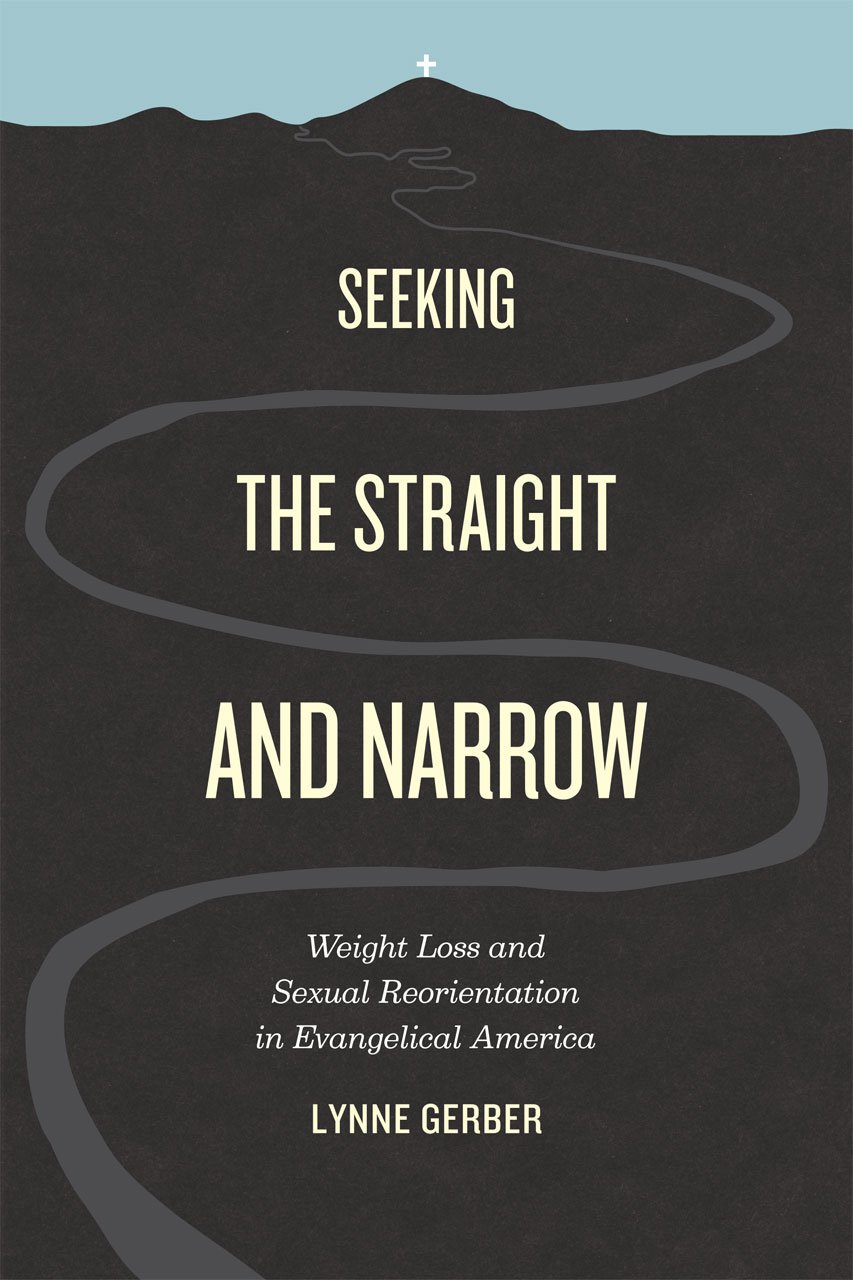
Book Review: Seeking the Straight and Narrow

Seeking the Straight and Narrow: Weight Loss and Sexual Reorientation in  Evangelical America: Gerber, Lynne: 9780226288123: Amazon.com: Books

Seeking the Straight and Narrow: Weight Loss and Sexual Reorientation in Evangelical America by Lynne Gerber explores the intersection of weight and sexuality in the Evangelical church. The book draws focus to two Evangelical ministries that directly address these topics, First Place and Exodus International. First Place is a Christian weight loss program that was founded in 1981 by members of the First Baptist Church of Houston. The premise of the program is that Christians look to guidance and help from God for every other aspect of life, so they should be able to seek help from him for weight loss. First Place claims that it is grounded in both a spiritual and scientific approach to weight loss that benefits the person physically, mentally, emotionally, and spiritually. It uses divine assistance rather than intervention, and sees divine authority as complementary to scientific authority rather than contradictory. With the rise of the ideas that homosexuality is immutable and natural from the gay right’s movement, ex-gay ministries grew in opposition. Exodus International is an organizational umbrella for roughly one hundred and thirty ex-gay ministries that evolved when the new evangelical movements started to reach out to gay people in the 70s. These ministries use evangelicalism to focus on issues like drug addiction, cultural exploration, sexual promiscuity, and homosexuality. Gays and lesbians that were “newly saved” went to these ministries to reconsider their sexuality in the context of their faith. Exodus International was intent on helping people overcome their homosexuality rather than them being in the closet or taking the liberal approach of acceptance. The ministries see homosexuality as a moral and psychological issue that is undeniably a sin. 

Although the connection between homosexuality and fatness is not a direct one at first glance and First Place and Exodus International exist in different realms of the Evangelical world, Gerber argues that they are in fact deeply connected. She states that “both are associated with excessive desires and excessive bodily expression, excesses that have long disturbed American culture and moral sensibilities” (Gerber 14). Also, homosexuality and fatness have been a “focus of containment” for the state, medicine, and religion. “Losing weight and reorienting sexual orientation are projects fueled by a tension between malleability and limitation that is very compelling in American culture” (3).” The interconnectedness between ex-gay ministries and weight loss ministries through the focus on the body, excess, containment, and malleabillity displays a strong similarity between the two groups that would not come to mind when first looking into these topics. 

The monograph is split into an introduction, three chapters, each with two subchapters, and a conclusion. This setup provides for a very organized and clear structure of Gerber’s argument. The first chapter titled, “Framing Right and Wrong,” is split into two subsections, “Sin” and “Health.” This chapter discusses how evangelicals use sin and health as a way to argue what is morally right and wrong. Food is often talked about in relation to sin, sinful foods or the sin of overconsumption of food. Homosexuality as a whole is seen as a sin by many religious communities. Gerber discusses how the definition of sin varies from person to person. Some people believe that some sins are mild and “not what God created you to be” (39) or to be very harsh and “disobeying God’s commands” (40). On the other hand there are people that believe a sin is a sin and that all sins are seen as equal in the eyes of God. One of the most interesting things I found in this section was Gerber’s claim that gluttony is seen as a worse offense than homosexuality in the bible but in Evangelical American society, homosexuality is seen as worse. In “Health,” Gerber discusses how “the Lord is conflated with health” (53) and any behaviors that do not promote health are against God’s will. Each Evangelical group equates their ideal with health, heterosexual relationships being the only healthy relationships, and having low cholesterol or weight is the only way to be healthy. The next chapter, “Making Christian Bodies,” discusses how these programs place the responsibility of the outcome on the participants. If people want to see change, either in their sexuality or weight it is on them to make that change. This then puts the success or failure of the program on the participant and not the ineffectiveness of the programs. The third and final chapter titled, “Accountings,” is split into “Success/Failure” and “Breaking.” In “Success/Failure” Gerber discusses the approach of the ex-gay and fat-loss groups. Both use a flexible programming design which lets participants talk about their frustrations about how they are not seeing progress. This pulls attention away from the program and to the actions of the participants. The flexibility makes it so the program’s successes and failures can be justified and not questioned. The section “Breaking” posits that the rise in queer activism and fat positivity and acceptance movements has allowed for positive narritives about gay and fat Evangelicals. As a result of this rise, Exodus and First Place had to work against those new movements to retain their membership and participant devotion. This was, however, not successful as many participants in these programs reach a breaking point and leave. They then find acceptance in themselves and their fatness or gayness. “Sexual identity is no more inherently true than religious identity. If people feel they need to pick, they may pick either” (223). The final conclusion of the book discusses how these ex-members must face an internal battle between their fat or gay identities and their Evangelical identities because they feel they cannot exist as both harmoniously. Gerber comes to the acceptance that some people, although not necessary, feel like those identities are not compatible and must choose one.

Lynne Gerber is an independent researcher and scholar. She has held academic positions at both the University of California, Berkeley and Harvard Divinity School. Presently, she is an independent researcher based in San Francisco. At the time of writing this monograph, Gerber was a research fellow in the Religion, Politics, and Globalization program at the University of California, Berkeley. Gerber’s research focuses on religion, the body, and morality. 

Gerber used qualitative research in her investigation through participant observation, interviews, and content analysis of ministry materials. She attended First Place meetings for seven and a half months and although she was not a Christian and they knew she was a researcher, the group welcomed her and filled in the gaps of what she might not understand without a Christian background. However, it was not as easy to get participant observation in Exodus International. The groups were not welcoming to a researcher that was neither gay nor Christian. They had experience with undercover journalists and also thought that she would not understand their teachings or process since she was not a part of the groups they worked with. Therefore, she conducted her research through public gatherings and conferences of ex-gay ministries. She also interviewed sixty three people, twenty eight from First Place, twenty eight from Exodus, and 7 former members of Exodus. She is transparent in the possibility of bias in her samples as the majority of them were white and in leadership roles. 

One of the main strengths I found with Gerber’s book was how she took into account all perspectives on these issues and did not use her preconceived notions on the topics to influence her findings. She is very explicit in saying that everyone comes into the book expecting a different answer based on their beliefs about religion, gayness, or fatness. She knew that the people she interviewed and worked with throughout the process were expecting fair representation and that their vulnerable experiences were not going to be exploited. I think she shares their stories tastefully and respectfully, without any bias and without passing any judgement on them. I personally had thoughts about this book before reading it that were proved wrong. I think that the work is written very well and tells all sides of the story even if it’s not necessarily what some audience members want to hear. She acknowledges that there is validity to these programs while also talking about the pitfalls of them. 

The main weakness I found in the book was that the samples that Gerber used in her research were mainly white- 5 out of 63 participants were people of color. Although Gerber explicitly recognizes this underrepresentation in her analysis, it does not change the fact that her findings are not an accurate representation of the population. The attitudes and experiences collected from the Exodus and First Place people are only really representative of the white experience. The social impacts of weight and sexuality are not independent of race, for example a fat white person, fat black person, skinny white person, and fat black person will all have very different attitudes towards their fatness or lack thereof and will all have very different experiences regarding their fatness. Another example is that black gay men are more likely to face adversity than white gay men. Queer theory has historically already been focused around the white experience and failing to complete a more diverse assessment adds to this issue. Painting a white centered narrative of experiences in these Evangelical programs does not provide a comprehensive, representative view on how the programs affect people and the success of them. 

Overall, I enjoyed this scholarly read. I think it was a very interesting intersection between queer studies, fat studies, and religion studies. The book is written well and structured clearly, making it a read that is fairly easy to understand and follow while also being engaging. It is fascinating how these two Evangelical groups that seem to have nothing to do with each other, are very similar in their ways of teaching and programming, their beliefs around the things they are trying to fix, and how neither of them are very successful for their participants.

Works Cited:

Gerber, Lynne. Seeking the Straight and Narrow : Weight Loss and Sexual Reorientation in Evangelical America, University of Chicago Press, 2012. ProQuest Ebook Central, https://ebookcentral-proquest-com.proxy048.nclive.org/lib/davidson/detail.action?docID=772137.

“Man’s World” by MARINA

“Man’s World” by MARINA

MARINA, previously known as Marina and the Diamonds, is an Indie/electro pop musician who is no stranger to female empowerment in her music and on social media. She recently dropped a new album Ancient Dreams in a Modern Land which spreads the important message of ecofeminism and the downfalls of a capitalist society. The most popular song on the track is “Man’s World.” “Man’s World” is an anthem of feminist power and resilience. This song not only recalls specific historical moments where women have been oppressed and mistreated, but also indicates discrimination and violence that LGBTQ+ individuals have faced. She references the Salem Witch trials in the lyrics:

“Burnt me at the stake, you thought I was a witch
Centuries ago, now you just call me a bitch”(MARINA, lines 5-6)

These lyrics are based on the incident where violence against women occurred due to society’s view of “abnormal” activity of girls and women during the Witch trials. Expectations of what a “women” should be and act like are still prevalent today and it causes those who don’t fall into those categories to be treated as outcast. It also points out how women used to be called “witches” to the more recent derogatory use of the word “bitch.” While also recalling the controversy regarding The Beverly Hills Hotel that Marilyn Monroe is linked to, MARINA’s lyrics state:

“Marilyn’s bungalow, it’s number seven
In the pink palace where men made her legend
Owned by a sheik who killed thousands of gay men
I guess that’s why he bought the campest hotel in LA then”(MARINA, lines 12-15)

This references the controversial event where the recent stakeholder of the Beverly Hills Hotel passed a law in the South China Sea, where he made queer sex and adultery punishable by stoning. These violent anti-gay policies caused a boycott of the Beverly Hills Hotel by many celebrities.

“Man’s World” hints at a theme explored in Contesting Cultures, where Uma Narayan states, “Women’s inequality and mistreatment are, unfortunately, ubiquitous features of many “Western” and “non-Western” cultural contexts (Narayan 401).” In cultures all over the world, women are mistreated and oppressed against. Violence towards women is everywhere even though the specific situations differ. This brings the question of intersectionality into the mix. While “Man’s World” doesn’t cover the topic of intersectionality, it’s important to note that through class, gender, race, and sexuality, women can be more susceptible to different levels of violence in their day-to-day experiences. Lorber writes, “Within many social groups, however, men are advantaged over women. The more economic resources, such as education and job opportunities, are available to a group, the more they tend to be monopolized by men (Lorber 61).” This goes hand in hand with the line “So don’t punish me for not being a man”(MARINA, line 23). From birth, our assigned gender places expectations on the life we are supposed to live and unfairly places cis-gender men at the top of the social structure.

While “Man’s World” comes from more of a Westernized approach to feminism, it’s still a solid start to educating listeners about violence and oppressions towards women and LGBTQ+ indiviudals. “I don’t wanna live in a man’s world anymore” (MARINA line 9) illustrates the strength and resilience women have demonstrated for centuries.


Works Cited

https://www.youtube.com/watch?v=obxFWNeGDOg

https://www.nytimes.com/2016/03/13/opinion/sunday/the-sultan-and-the-salad.html

A Review of Racial Castration: Managing Masculinity in Asian America

During my Davidson career, I have become increasingly interested in Asian American Studies. For my book review, I decided to take advantage of the flexibility of the topic and expand on my knowledge in the subject. In Racial Castration: Managing Masculinity in Asian America, David L. Eng creates the argument that race and sexuality are connected. Eng supports his argument by analyzing the subject of Asian American masculinity. By applying psychoanalytic theory to literary works, Eng shows that race and sexuality cannot be separated from each other. Overall, his argument brings new insight to the subject of Asian American masculinity and also Queer studies, but a couple writing decisions that Eng makes prevent full comprehension of the topic.

Firstly, Eng analyzes two works, China Men and Donald Duk, that question the historical photo of the “Golden Spike” ceremony, the event where the east and west sides of the transcontinental railroad were connected. In the photo, the Asian American workforce was not represented, rendering their work and the lives lost invisible. Eng begins his analysis with a deconstruction of photographs as a medium of information and connects them to gaze, look, and screen from the Four Fundamental Concepts of Psycho-Analysis. I believe, however, that this connection required too much explanation. While the information is applicable to China Men and Donald Duk, it isn’t necessary to be able to understand the analysis and arguments made in the rest of the book.

In Donald Duk, Frank Chin tells the story of a boy, Donald Duk, who at first rejects his Chinese American culture, but eventually grows to embrace it. Eng uses psychoanalysis to come to the conclusion that Donald Duk’s dreams provide him an outlet to escape societal structure. Through his unconsciousness, Donald Duk is able to connect with his Chinese culture and is eventually able to bring this connection to his conscious state. Eng, however, criticizes Chin’s vision for the Asian American identity for excluding Asian American women and gay men.

Next, Eng analyzes the primal scene in “The Shoyu Kid” by Lonny Kaneko. The story takes place in a Japanese concentration camp during World War II. Itchy, looking for the Shoyu Kid, finds him being sodomized by a white, male camp guard. This causes Itchy and his friends to lash out and denounce Japanese culture and homosexuality. Eng relates this scene to how people react to Asian American sterotypes of homosexuality and femininity. He criticizes this reaction, saying that, “Psychic Salvation for the Asian American male cannot be the monopoly of a masculinist compulsory heterosexuality” (Eng 136). Eng again challenges society’s view on race through the lense of sexuality.

Eng narrows her scope in her analysis of M. Butterfly by David Henry Hwang, looking at Gallimard’s racialized homosexuality. In this play, Gallimard has an affair with Song Liling. Even though Song is male, his Oriental identity prevents Gallimard from seeing Song’s penis. Eng explains this phenomenon of misgendering Song through Freud’s theory of the divided ego. Freud’s psychoanalytic theory is usually used to describe female castration, in which men will fetishize a part of a woman, such as her hair, in order to project a substitute of a penis onto her. Gallimard’s situation however, is an occurrence of racial castration. Gallimard’s reverse fetishism of Song’s asian identity projects Song as a female, even though his penis is clearly visible. Eng believes that this is possible due to the situation’s commonality with traditional power relations. In Gallimard’s relationship with Song, the white male is in the same dominant position as a traditional relationship between a white male and female. Eng argues that M. Butterfly portrays the silent oppression of compulsory heterosexuality and whiteness and that the key to eliminating their power is to make them visible.

In Racial Castration, Eng also addresses the Asian American phenomenon of male hysteria. Hysteria, understood to predominantly be experienced by women, occurs when the emotions that come from the refusal to accept a societal position cannot be explained through language and are thus expressed through the body. Freud attempts to explain the possibilities of male hysteria, but is unable to due to his positionality. Eng clams that, “in a patriarchal world, the presence of the male hysteric would paradoxically imply the refusal of that male subject to occupy a symbolic position that prizes his social role above those of all others” (177). Male hysteric, however can be theorized in the case of Asian American men due to systemic oppression. Hysteria occurs in Asian American men when they refuse to play the role of the emasculated man. Eng gives an example of such hysteria in Eat a Bowl of Tea by David Wong Louie. When Ben Loy is finally able to bring his wife from China to the U.S., he is unable to consummate their reunion due to his impotence, revealing his lack of power and masculinity.

While Asian American male hysteria was caused by Yellow Peril and its exclusion acts, Eng claims that the Model Minority myth also causes the same issue of hysteria. He labels the psychological burden of the myth, “internal exile”(199). By attempting gain acceptance and achieve assimilation by living out the Model Minority myth, Asian Americans are making personal sacrifices toward a lost cause. Eng refers to “Birthday” by Louie for his analysis of the model minority myth, which feels out of place in his argument due to the lack of psychoanalysis. This ultimately makes his connection between Yellow Peril in the Myth more of a mention than a strong argument.

In his last section on male hysteria, Eng refers to Pangs of Love once again, but this time to address the hysteria that could occur in the queer community. Bagel is a gay Asian American that lives with three other gay men who are white. In their house, everything is white. The only thing that isn’t is Bagel. Not only is he Chinese American, but his muscle tone, and his colored clothes make him out of place in the environment as well. Eng states that: This is a queer affiliation, which demands the imitation of whiteness but ultimately finds this imitation intolerable” (201). While Bagel identifies as queer, his surroundings symbolize the white, silent denial of assimilation into the queer community.

Eng concludes his book with the subject of queerness and diaspora. In his epilogue, Eng increases the scope of his discussion and proposes that the intersection of queerness and diaspora with Asian American studies should be addressed in scholarly conversation. She states that the knowledge jurisdiction of Asian American studies is expanding using post- 1965 Asian immigrant communities as an example, as most of their identity was created outside of the United States. I think that Eng is arguing that as knowledge continues to extend outside of the United States, a diasporic approach needs to be taken towards analysis.

Eng also addresses the argument of whether or not to place a hyphen between, “Asian American.” Eng sees the hyphen as a symbol of repression and believes that it should be omitted: “the elimination of the hyphen from this term clams not only psychic but also spatial entitlement to Asian American membership within the larger U.S. national collective” (211). Eng appears to be referring to a previous debate about the subject, but seeing that this book was published in 2001, I am too young to remember this academic conversation and will have to do further research to understand it.

While Eng uses the epilogue to present many questions, by doing so explicitly he makes it difficult for the reader to differentiate which ones will be answered later in his discourse. This leads to paragraphs that contain nothing but questions, breaking the reader’s attention. Ultimately, Eng’s approach to raising questions takes away from the structure and message of his closing remarks.

Finally, Eng analyzes Rolling the R’s by R. Zamora Linmark to show the power of intersecting queer and Asian American perspectives: “Indeed, Linmark extends this project to its imaginable limits by bringing together the model minority myth with the image of the flaming Filipino faggot” (227). Through Linmark’s work, Eng believes that the combination of identities, “allows this explosion and reworking of stereotypical images and categories” (228). In conclusion, Eng achieves her objective in Racial Castration and starts the conversation of how race and sexuality can bring valuable insight to the subject of Asian American masculinity.

Works Cited

Eng, David L. Racial castration: managing masculinity in Asian America. Duke University Press, 2001.