Hey guys! The other week at the Sex Positivity Fair I heard a song playing and I figured I would share it! It is not only very funny, but also informative! Hope you enjoy it and get a good laugh!
https://www.youtube.com/watch?v=cXM7WoaIUo4
Hey guys! The other week at the Sex Positivity Fair I heard a song playing and I figured I would share it! It is not only very funny, but also informative! Hope you enjoy it and get a good laugh!
https://www.youtube.com/watch?v=cXM7WoaIUo4
Alex Kane
Dr. Gonzalez
GSS101
11 May 2016
Grant Proposal
Introduction:
My project is to help create a new course for Davidson’s Classics Department. The goal of this course would be combine two important, seemingly contradictory, fields—Gender and Sexualities Studies and Classics. The course will begin by providing an overview of the history between feminism and classics, and how classicists have been in serious conversation with feminist theory since the 1970s, and the difficulties that have arisen from that discourse. The course will then apply a feminist lens to various aspects of antiquity, addressing various questions and problems. And hopefully, this course will add important nuance to a vital part of Davidson’s academic program.
Justification:
Classics and feminism are vital to one another. Classics needs feminism in order to stay relevant and interesting as we move further into the 21st century, and as we begin to value and study those who have been traditionally marginalized or ‘othered’ on account of race, gender, class, and sexuality. Without it, not only will classical studies become boring for students, it will essentially become irrelevant. And further, applying a feminist lens to classics will only deepen our understanding of the ancients—how they lived, what they thought, and what their actions meant. Likewise, feminism needs classics. So much of our society today—yes, even our problematic, elitist patriarchal structures—are handed down from the ancients. Knowledge of our past is certainly necessary to understand our present. And we can certainly learn a thing or two from the women of antiquity.
Methods:
I will start by doing extensive research over the summer, working with a professor who also feels strongly for the inclusion of feminist theory in the study of classics. The research will focus on two main areas. The first is the struggle of the feminist within the profession, such as fewer promotions and less pay then men in the field. The second is the difficulties that feminists have when ‘doing’ classics through a feminist lens. For instance, they must deal with little evidence (since ancient women rarely wrote), and even the evidence that does exist about women is often written by men, which adds a layer to its complexity when trying to analyze it. The summer will be spent trying to find evidence of these various things, as well as scholars who are actively trying to do feminist work in classics. The end result will hopefully be a syllabus for a class that can be taught within the Classics Department here at Davidson.
Seeing the importance of being afforded the opportunity to even be in a position to receive higher education is a blessing, in my opinion. Knowing this, and also knowing that so many other minority students do not get this opportunity, it becomes even more valuable when students of minority descent make it to these positions of power and give back to the community. I try to do my best and convey the importance of valuing education, but more so valuing passion with students I tutor. I work with middle schoolers and I feel middle school is a crucial point in time where you are either broken or built up. Being able to give positivity to the students that I work with gives me so much joy and sense of pride knowing that I’m helping them grow good habits, grow strong positive mindsets, and grow altogether.
Being at Davidson College is a wonderful opportunity and it has happened through some means of privilege. What immediately comes to mind is affirmative action- i.e. scholarships to college, scholarships to higher level high school institutions, high school programs with fancy connections who are dedicated to placing minorities in the elite colleges, minority quotas that colleges seek to fulfill, and so on. But what is not usually thought about is the fact that there still exists some faction of students across the world who do not have even the most basic of opportunities to even consider college, think about college, let alone attend college. They do not have the parents, guidance counselors, friends, family to provide them with the knowledge necessary, the tools necessary, the mental empowerment necessary to promote higher level education. We were all provided with something, some opportunity, in whatever shape or form, that helped to enable us to do well in high school, to value education, to even apply to Davidson College.
A form of support that has helped me gain access to higher education besides my parents teaching and my drive to do great education wise was the help from Leadership Enterprise for a Diverse America (LEDA). This is a seven-week intensive program that helps children focus on their writing, critical thinking skills, and ACT/SAT testing methods. They also stay with them throughout their undergraduate career in college for support in any area whether it be financial aid, academics, or personal problems. I appreciate their services because they helped me to gain access to prestigious colleges across the nation as well as scholarships that helped me to attend this higher education. I wish more people knew about opportunities like this because this would give them a better chance and a better understanding of how to get into top schools around the nation. 

History, as it is taught in primary education, provides the foundation on which individuals understand and attempt to make sense of the progression of society as they grow and develop into adulthood. The way history is taught and the particular histories of marginalized groups is ignored or glossed over impacts how people understand different groups, their contributions, and their importance. The Industrial Revolution is often heralded as a major turning point in global history that has significantly shaped the world into what it is today; however, the experiences of women, especially middle and working class women, are often taught superficially at best, while the experiences of gay men are largely overlooked. This creates false assumptions about what these groups did or did not contribute during this pivotal era, and promotes a homogenous, heteronormative understanding of modern history that positions women’s work and the existence of gay men as new phenomena. “Understanding” history in this way creates negative stereotypes, narratives, and perceptions of these communities that make achieving social equality more difficult.
I propose to do a comparative study of how the Industrial Revolution is taught in high school history classes with regard to gender, class, and sexuality in 10 schools across the United States, half of which would be public and the other half would be private. This study would seek to reveal differences in the way students are taught about marginalized groups in a critical era in history, and would endeavor to assess the strengths and shortcomings of different approaches. The end goal of this project would be to create a curricula that could be applied in both public and private high schools that would more accurately reflect and teach the experiences and contributions of women of different social classes and gay men in the Industrial Revolution. Given the influence of education in shaping students’ perspectives and understanding of the world around them, I will study and seek to answer the central question of how high schools can best teach the Industrial Revolution to promote a fair, equitable understanding of the experiences and contributions of marginalized groups, thinking specifically about the intersections of class, gender, and sexuality.
It is important to note that the underlying assumption in this study, beyond that the Industrial Revolution is taught in ways that do not reflect the social reality of the time, is that the Industrial Revolution primarily affected and so is taught in relation to white people in Western nations. This assumption should also be problematized in the final curriculum developed at the end of this project. This grant would enable me to examine the curricula of different public and private schools representing different regions of the United States to understand how the Industrial Revolution is taught similarly or differently, and to offer changes to better reflect the experiences of primarily working and middle class white women, as well as white gay men in the hope of giving students a better understanding of the contributions and experiences of these groups.
As an alternative to the Grant Proposal assignment, Caroline Okel, Vance Graves, Felicia Zi, and Collin Epstein created a poster for the Sex Positivity Fair hosted by 1972, ‘a group at Davidson College focused on gender expression on campus and issues affecting women’, according to their Facebook page. We chose to examine virginity as a social construct, hoping to start a conversation with attendees at the fair about how they experience virginity. We researched information on four topics related to virginity that caught our interest, and provided sticky notes and pens so that those who came to the fair could respond to our poster by adding their thoughts to it.
One of the topics that we were interested in exploring for our poster was the comparison between the expectation that people have for losing their virginity versus the experience that they actually have. As Hanne Blank describes in her book Virgin: The Untouched History, we are able to define virginity without describing its loss. She recognizes that we “speak of virginity loss rather than virginity itself… [because] virginity is because it ends” (Blank 96-97). Their definitely is a fascination with the topic of “the first time,” especially in a college setting, but we have noticed that for most people we know, the first time was not all what it is cracked up to be. For example, in Laura M. Carpenter’s Virginity Loss, she interviews people about their stories of losing their virginity. As Bryan Meyers summarizes in her book, “It was just so unbelievable that this, like, this thing you talk about your life is actually happening. And honestly, I think that… it’s not as, like, as mind-blowing as you expect it to be” (Carpenter 72). Therefore, we asked individuals to answer questions about their expectations that they have for their first time or that they had prior to their first time. We found that those who had not lost their virginity expressed desire for a first time with someone they loved and that they feel comfortable with. When actually discussing the first time, the sticky notes expressed more of a feeling of less than ideal conditions such as disappointment, a lack of feeling changed by the experience, and awkwardness. One person simply answered “NO” when asked if it met their expectations. This portion aimed to shed light on the fact that the first time may not be a romantic, life-changing moment like the virginity loss scenes portrayed in popular movies like Titanic and The Notebook and that this is perfectly okay.
A topic that was initially a starting point for conversation in our group was the definition of virginity. We were interested in social and cultural constructions of virginity, and the myth of the hymen was something we discussed and included in our poster, with the main takeaway being that no medical definition exists for what constitutes virginity. One of the open-ended questions we asked on the poster read, “How do you define virginity?” People posted a variety of answers, demonstrating that different individuals defined virginity differently, and that virginity had a different value for every individual. An answer that we found particularly striking was, “IT ISN’T REAL.” Our group also discussed stigmas and double standards surrounding the idea of virginity, such as social perceptions of male versus female virginities. We included a few memes from pop culture films to demonstrate these double standards, and people seemed to find them not only amusing, but relatable. A female responded to the question, “How did your parents influence your views?” with, “My parents taught me that virginity is purity. I should wait until marriage.” Another female responded with, “Same!”, demonstrating that these gendered perceptions still exist in today’s society. Given that most of the posts were anonymous, it was difficult to find connections between people’s answers and their gender, but the clear variety of answers demonstrated that virginity meant something different for everyone. Ultimately, our group was pleasantly surprised with the amount of people willing and eager to participate in the open-ended questions. It was interesting to generate conversation about a topic that is not normally discussed in everyday conversation and read what people had to say about it.
Another one of the topics we researched for our poster on virginity as a social construct is virginity in the LGBT* Community. We examined how views towards virginity differ between the straight and LGBT* communities. For example, it is often debated as to whether or not lesbian women can actually lose their virginities. This belief stems from the idea that one cannot have sex without the involvement of a penis. In order to change how we look at virginity in the LGBT* community, we need to change how we look at sex. Perhaps we, as a society, view things from a very heteronormative viewpoint. This is due to compulsory heterosexuality, a concept put forth by Adrienne Rich in “Compulsory Heterosexuality and Lesbian Existence” (1980). With this concept, it is believed that for most people, straight is the default sexuality. This view is very constricting when it comes to looking at how we view sex, and therefore the construct of virginity. Because we asked questions about what people believe to be sex, it was interesting to see whether or not Davidson students would comply with compulsory heterosexuality when answering questions. Interestingly enough, many of the students who answered questions about what they believe sex to be, left gender out of their answer, like when one student wrote that, “Sex is when two or more people have intimate relations with their sexual organs.” Another student just defined sex as, “when all parties orgasm.” It appears that these students took away something from our poster, or perhaps already came with thought that that when we discuss sex, we need to be more inclusive of other sexual orientations and gender identity.
We also explored historical and cultural representations of virginity in our poster. Historically, virgins have been represented in Western cultures in a series of narrow roles: women as pillars of virtue, men as pathetic or eccentric, and both as holy or deified. Cultural images of virgins contribute to what Barbara Risman refers to as “gender as structure” at the “interactional level of analysis: cultural expectations” in her essay Gender as Structure. These images are crucially dependent on a very heteronormative definition and expectation of gender.
Female virgins in history are usually portrayed as exceptionally virtuous, usually because of their virgin status (ex: Queen Elizabeth I). Culturally, virginal leaders garnered more respect as virgins, perhaps because of their apparent rejection of men.
On the other hand, men are typically portrayed as pathetic losers (ex: Steve Carrell in the 40-Year-Old-Virgin) or as eccentric geniuses (ex: rumors about Sir Isaac Newton). In either case, the attitude in which these men are viewed is a sort of bemused surprise. In contrast to women, the expected state for men is as not a virgin. However, failure to conform is not regarded as deeply shameful for men as it is for women.
The role both men and women have filled as virgins has been as holy people (ex: Joan of Arc, St. Augustine) and as deities. However, even as deities, male and female virgins are represented very differently. There are vastly more female virgin goddesses in Western traditions (ex: Artemis, Athena, the Virgin Mary) than male virgin gods (Jesus). Additionally, the implications for male and female people differ in that all women are implicitly expected to be Mary, but no/few men are held to the standard of Jesus.
It is important to understand that our telling of history is an important component of how we construct our culture. The clear dichotomy between male and female virginity represented in our culture reinforces the concept of “compulsory heterosexuality” that Adrienne Rich describes in her essay Compulsory Heterosexuality and Lesbian Existence. Learning about how virginity has been understood and portrayed historically allows us to understand virginity as a social construct, and puts the responses of students who reacted to our poster into a wider cultural and historical perspective.


Gender Boxes and Genital surgery: Are they Really So Different?
Grant Proposal
By Abbey Corcoran
Background: In a fit of inspiration fueled by the madness of our upcoming finals, my friends and I went to a trampoline park in Charlotte a couple weeks ago to let off some steam. While we were signing the waivers, I was appalled when I was unexpectedly confronted with having to check one of two boxes: male or female. When I tried to bypass the question, I was told I had to fill it out or forsake trampoline-ing. After I begrudgingly finished the waiver I watched parents as they filled out waivers for their children. I was amazed by how many were willing to select one of the two boxes for their children (with no qualms), which had given me such pause. Having just finished my book review on Contesting Intersex, I was feeling particularly skeptical of parents making decisions for their children and, I began to wonder what the difference is—if there is one—between parents marking something on a waiver and consenting to some sort of action based, loosely, on the subject matter they seem to have little reservations about addressing on waivers.
Research Question: I would like to look at the correlation and causation between parents’ willingness to sign waivers and forms delineating the gender/sex of their child and parents’ willingness to consent to gender reassignment surgeries on behalf of their children.
Method: Such a research question would require parents to fill out an anonymous survey, which would be designed to deduce what difference, if any, they found between checking a gender box for their child and consenting to surgery for their child. The potential demographic for the survey would most likely need to be limited by both geography (limit it to one county etc.) and age (only parents of children ages 0-4, for example). Incentive to participate would be ideal, if the budget allowed and the survey would be promoted and distributed vis-à-vis social media.
Altruistic Component: Separate from the survey, I would also be interested in creating a virtual presentation (ideally a video) educating parents on the socially constructed origins of gender and the dangers of the gender binary to accompany with the survey. Although a participant would not have access to the video until after they had completed the survey (as to not sway their answers), ideally the video would be shared in conjunction with the survey on social media platforms.
Budget: This grant would be utilized to cover compensation for the participants and for the production of the educational video.
This study would hopefully help us to understand the positionalities of parents, both when checking waivers and consenting to surgery, provide the intersex movement for bodily autonomy more material, and help us to understand something there is little scholarship on –the thought processes of parents when dealing with sexual nonconformities.
Andres Sanchez
Prof. Gonzalez
11 May 2016
GSS 101
Grant Proposal: Intersectionalties Between Migration and Sexuality
For my Grant Proposal, I aim to expose Davidson students to the ways in which queer Latino groups, specifically migrants of Latino roots, attribute sexuality as a cause for their migration to the U.S from their native country. The reason I chose this topic is because of my reading of Lawrence La Fountain-Stokes’s Queer Ricans, a work which focuses on assessing the ways in which Puerto Rican migrations in the 1950s was contributed just as much by the issue of sexuality when compared to social, political, and economic issued existent in Puerto Rico. When it comes to migration, people automatically focus on the idea of race and never really think about the role one’s sexuality plays into the matter.
The idea of my proposal involves inviting La Fountain-Stokes to be a guest speaker at Davidson and provide insight on his book Queer Ricans as well as his personal experience of being a gay Puerto Rican and the experiences of gay Latino immigrants he was exposed to during the publications of his work. My plan would not only include a lecture by Lawrence La Fountain-Stokes but would also focus on getting students engaged in the discourse by setting up Sexuality event cosponsored by OLAS, the GSS Department, the Hispanic Studies Department, and the Latino Studies Department. This event would focus on creating atmosphere of an art exhibit with different student groups presenting issues concerning migration, Latino Identity, and sexuality. The room where the presentations are exhibited would be open to anyone who wishes to learn about intersections of sexuality and Latino studies. The event would also require the reservation of the 900 room in Alvarez Union as well as money for materials students can use to create presentations and food. This event would be held hours before La Fountain-Stokes lecture.
By providing an exhibit event before La Fountain-Stokes lecture, the students would be given the opportunity to research the topic at large and learn about the intersectionalities of Latino Studies and sexuality while at the same time gaining knowledge essential to understanding La Fountain-Stokes lecture.
To make such event possible a budget would have to be made for the payment of Lawrence La Fountains’s lecture, the reimbursement of materials used by students for the exhibit, the money used for food, and payment to provide La Fountain-Stokes with lunch at a restaurant nearby. In addition, there would have to be approval by OLAS, the GSS Department , the Hispanic Studies Department, and the Latino studies Department.This event would hopefully serve to introduce students to the field of Latino Studies and the ways it intersects with migration and sexuality.
Works Cited:
La Fountain-Stokes, Lawrence. Cultural Studies of the Americas : Queer Ricans : Cultures
and Sexualities in the Diaspora. Minneapolis, MN, USA: University of Minnesota
Press, 2009. ProQuest ebrary. Web. 10 May 2016.

Abbey Griffin
GSS 101
May 10, 2016
Grant Proposal: Preferences in Children with Severe Special Needs
I wish to look at gender and sexuality identification in children with special needs, especially children who are nonverbal or non-communicative. I have been working with children with special needs in a classroom at Community School of Davidson for about two years now. All of the children are low functioning. However, what people often do not think about is no matter their mental functioning, the onset of puberty and the influx of hormones still occur around the teenage years. Often this change is confusing for the children and of course they do not function high enough to know what is appropriate behavior in public versus in private.
One of the children seems to have a particular attachment to me, as well as other young women. This got me thinking about sexuality and gender identity. I figure if we can research children who are nonverbal, we can begin to attribute innate desires to the “born this way” debate. It is unlikely that these children are aware of heterosexuality and pressures from society, allowing us to truly examine how gender and sexuality works from a developmental level.
Ethical concerns would need to be addressed and this proposal would need to be approved by the Institutional Review Board. This study would simply have on male and female psychology students entering the classroom as observers. Observers would self-report who seemed to cling to them or stare at them. Any sexual acts that take place, such as children beginning to touch themselves, would also be reported. Since these children are often around women, the inclusion of men in the study would need to be introduced to children before observation so that we know children are not simply attracted to novelty.
It is important for observers to be accurate, so we would train them on how to act and what to observe and record. Observers would also need to be dressed simply, so that attention is not based on attraction to color, texture, etc. Explicitly sexual advances would need to be noted because attraction to women could be in relation to their caring nature or sound of their voice rather than sexuality. Motions and actions of the children would be categorized by scorers into types of attraction, such as sexual attraction versus attraction more generally.
This study would hopefully further explain research on gender and sexuality and the origins of sexuality and gender identity. Observers would be psychology students interested in the study. Observers and scorers would be paid for their efforts as research assistants, which is what the grant would be necessary for.
Beyonce’s newly released visual album has brought in a lot of attention about the black women’s place in society. However, with that being said, many individuals have given their critique and their own interpretation of the album. These individuals include commentary from the white community. Comments from them have included how black women are being cheated on regardless of who they are. (i.e. if Beyonce can’t keep his man in line… than no one can). The attached article explains why white commentary on Lemonade is unacceptable. The writer mentions “To interpret LEMONADE in place of black women is to disrespect and neglect the voices of black women,” which shows exactly what many people are doing. See attached for the full article!
After exploring intersectionality this semester, I found this article very interesting. Mikael Owunna is the founded and contributor to Limit(less)–a website that advocates for the freedom of expression of LGBTQ Africans by telling their stories through photographs. Limit(less) aims to bridge the gaps in African communities between those who discriminate and those who are discriminated against. Limit9less) primarily focuses on Africans in the African Diaspora, but also reaches out to Africans trying to express themselves in the face of “homophobia, transphobia, racism, xenophobia and discrimination in their respective communities.”
This photo project reminded me of the past reading “Slivers of the Journey: Using Photovoice and Storytelling to Examine FTM Experiences of Health Care Access” by Wendy Hussey. The similarities these two pieces share is that they illustrate the discrimination and struggles those of the LGBTQ community experience.
http://www.huffingtonpost.com/jaimee-a-swift/this-photo-project-african-lgbtq_b_9775092.html
Continuing the post I wrote awhile ago about U.S. women’s soccer team not receiving the same amount of payment as the U.S. men’s national soccer team, I found this video a couple of days ago and found it relevant. In this video, male sport stars are asked a series of questions referring to their bodies, relationships, etc. that are framed in a way that would be so called “acceptable” to ask female athletes. What I found interesting in this video is the reactions of the men; their faces are utterly confused and disgusted by the questions and seem to reflect the sentiment “Why on earth would you ask such a pointless, objectifying question?” But at the end of the video, instead of expressing similar facial and vocal responses as the men, the women athlete interviewed simply laughs and “acts like a lady,” which was disheartening to watch.
https://www.youtube.com/watch?v=q_LDG8vM3_E
This project was produced by myself, Miles Powell, and William Botchway
Prior to this project, our group, like most booth visitors, had little to no idea how female condoms work. This is silly because benefits warrant fair consideration.
Benefits of female condom use are diverse.They are made of non-allergenic nitrile, so latex and hormone concerns are mitigated. They may be inserted up to eight hours before intercourse. Best of all, female condoms are an important tool for women’s empowerment. If a woman’s—or man’s, accounting for male-male anal intercourse– male partner doesn’t wish to wear a condom, she has full control over contraceptive use. She also becomes a more active participant, regardless of her partner’s attitudes. Female condoms may even offer slight clitoral stimulation. All sexually-active peole with biologically-male partners should at least consider what such a device has to offer them. They should also consider the downsides, however.

Female condoms have significant disadvantages. Their bulky packages, bagginess, and initial discomfort may discourage use, as may social stigmas owing to a lack of female condom awareness. They are costlier than male condoms (though this may be due to the aforementioned lack of awareness), which makes them especially impractical for the same poor regions typically targeted for sexual protection campaign. Everywhere, however, they have lower pregnancy prevention rates than male condoms do. Normal use is 75-82% effective in preventing pregnancy; for correct use, that number rises to 95%. Male condoms are 98% effective by the same year-long, regular-use metric (Advocates). Male condoms are undeniably more economical, but the balance between pros and cons in using female condoms suggests their use should be a fairly considered.
While working on this booth, our group realized that our research on female condoms connected to what we were learning in class. Generally, women are seen as the passive partner in the act of heterosexual sex. In The egg and the sperm: How science has constructed a romance based on stereotypical male-female roles, Emily Martin demonstrates that this false belief affects how reproductive biology is described: “The egg is seen as large and passive. It does not move or journey, but passively ‘is transported,’ ‘is swept,’ or even ‘drifts’ along the fallopian tube. In utter contrast, sperm are small, ‘streamlined,’ and invariably active. [emphasis in quote]” (489). The female condom allows women to make an active decision to have protected sex. They are able to protect themselves from STDs independent from the man and his body.
Speaking of biology, contraceptives have been a vital contribution to challenging the belief that women are solely meant to be child-rearers. The Boston Women’s Health Collective states that, “the courageous and dedicated work of people like Margaret Sanger started in the early twentieth century to spread and make available birth control methods that women could use, thereby freeing us from the traditional lifetime of pregnancies” (297). More awareness for female condoms will allow women to have another method of pregnancy protection, allowing them to be more than just mothers.
Traditionally, women, especially women of color haven’t been in charge of their reproductive health, as Jael Silliman discusses: “women of color are subjected to racist and sexist stereotypes which send messages that theys hould not be in charge of their own reproductive and sexual destinies” (14). The fact that the female condom allows women to control their reproductive health is incredibly important, as is the agency that it gives women of color who are systematically oppressed in more than one way.
This booth was the first experience that many of us had with female condoms, and we found that a lot of our visitors were new to them as well. A lot of people were shocked by how the condom looked, as well as confused as to how to use it. In addition to educating people about the female condom, our booth was supplied with a bunch of dental dams; there was a surplus somewhere, so they ended up at our booth. People had a lot of fun at our booth not only touching a female condom for the first time, but also tasting the many different flavors of dental dams. Overall, our booth—and the Sex Positivity Fair as a whole—served as a place where both the creators of booths and the visitors could step out of the comfort zones, and be free to try new things. Never did any of us think we would be tasting lube on a random Wednesday night, but that’s the fantastic part about an event like this, where people can learn and have fun while stepping (sometimes very far) outside of their comfort zones.
Works Cited
Martin, Emily. “The egg and the sperm: How science has constructed a romance based on stereotypical male-female roles.” Signs 16.3 (1991): 485-501.
Norsigian, Judy, et al. “The Boston women’s health book collective and our bodies, ourselves: A brief history and reflection.” JOURNAL-AMERICAN MEDICAL WOMENS ASSOCIATION 54 (1999): 35-36.
Silliman, Jael Miriam. Undivided rights: Women of color organize for reproductive justice. South End Press, 2004.
http://www.ripnroll.com/pages/female-condoms
http://www.aidsmap.com/Providing-and-promoting-the-female-condom/page/1746299/
https://www.guttmacher.org/about/journals/ipsrh/2010/introducing-female-condoms-female-sex-workers-central-america
https://www.nlm.nih.gov/medlineplus/ency/article/004002.htm
http://www.genderhealth.org/files/uploads/pepfar_watch/publications/unfinishedimperative.pdf
http://www.advocatesforyouth.org/publications/publications-a-z/416-condom-effectiveness
Erica Miller
Grant Proposal Alternative
Performing Parts: Gender, Sexuality, and Media Symposium
Prior to the symposium, we were instructed to watch Edouard Lock’s Amelia. At first watch, I thought the performance was constructed to create a piece in which gender roles did not influence the piece. In other words, a piece that was completely “gender free.” Upon further discussion, the deeper meaning of the piece was revealed. Lock created this piece to not only question gender roles on the performing stage, but also display how gender equality does not necessarily equate with gender neutrality and equality does not necessarily equate with progressiveness.
Our discussion focused around two of the duets in the piece. In the first, both individuals, one male and one female, were wearing suits, slicked back hair, make-up, and female point shoes. One would assume the goal was to become gender neutral. However, these performers were very gendered wearing both male and female stereotypical outfits. Lock intended to show that this elimination of strict gender roles did not by necessity promote female empowerment or gender equality. Similarly, he wanted to show that by just because you have a gender equal performance it does not by necessity be gender neutral. Emily Martin argues, “Stereotypes imply not only that female biological processes are less worthy than their male counterparts but also that women are less worthy than men” (485-486). I believe Lock would agree with this statement, but would argue that when on the stage, it must be displayed and constructed differently. Females on the stage can embrace these stereotypes, such as wearing tutu’s and pointe shoes, while their male counterparts are in suits, and demonstrate their strengths, creating gender equality without succumbing to gender neutrality.
The second duet involved two individuals that were often indistinguishable, and instead of focusing on the bodies exclusively, the camera would focus on the silhouettes of the individuals. However, the movements of the individuals were very controlling, making one individual submit to the will of the other, as a puppet to a puppeteer. Again, Lock is pushing against the notion that equality on the stage automatically links with progressiveness. As the Beijing Declaration reads, “inequalities between women and men have persisted and major obstacles remain,” however forcing equality will not always be the most effective way to go (2). Instead, a more progressive movement would have been partners alternating lift sequences, challenging the notion that females must rely on their male counterparts to lift them.
Lock challenges his viewers to look at the different representations of gender on the stage and how these representations fit into the mold of equality that we have envisioned in our lives. Holla summed it up best with, “The fact that there are still such incendiary notions should tell us that American women have a way to go before they enter the promised land of equality” (9).
Works Cited
Amelia. Chor. Edouard Lock. Performance.
Holla, H. “Blame It on Feminism.” Editorial. Mother Jones Sept. 1991: 24. Print.
The Fourth World Conference on Women. Beijing Declaration and Platform for Action. 15 Sept. 1995. Web.
Martin, Emily. “The Egg and the Sperm: How Science Has Constructed a Romance Based on Stereotypical Male-Female Roles.” Journal of Women in Culture and Society 16.31 (1991): 485-501. Web.
GSS – Artist Statement – Seminar GSS -Seminar Proposal – Performance Lecture
 1972 Sex Positivity Fair: Body Image by Rachael, Maryanna, Malia, and Caroline B.
“If we start from a position of neutrality, and do not make an a priori assumption that higher BMI is unhealthy, we are left with numerous studies showing health benefits based on quality nutrition, regular physical activity, social support, restful sleep, freedom from violence and stigma, abstention from smoking and excessive alcohol and drug use, access to quality medical care, and so on” (Burgard, 47).
According to Jen Baker in her TED Talk Total Body Love, “4% of women will call themselves beautiful, and in my experience men are very similar.” By creating an exhibit for the 1972 Sex Positivity Fair, we seek to discover why only 4% of women would call themselves beautiful. As students of GSS 101, we have learned to identify the voices seeking to force, in both subtle and blatant ways, the image of the “ideal” body upon us. We have learned to reject these voices in the name of Total Body Love. We have identified three voices that are loud, though sometimes unrecognized in our culture: advertising and media, the health/wellness industry, and the medical world.
In a society overridden by advertisements and media, we are constantly bombarded with both conspicuous and inconspicuous symbolism in images dictating what “attractive” means. These images pervading online, in the news, and even in public spaces, are in almost all instances edited to depict what those believe to be a desirable body type for both men and women. For example, in Agnes Rocamora’s article about the fashion industry titled “Personal Fashion Blogs: Screens and Mirrors in Digital Self Portraits,” she states, “in a field, fashion, where those in charge of taking photographs have been predominantly men, and those photographed women, visuals show the latter behind the camera actively engaged in an act of self-representation contrast with doxic views of men as photographing subject and women as photographed object” (Rocamora, 420). Our culture teaches us that the woman’s body is valued only when serving a specific audience – whether that is the male gaze, commercial gain, or even representations of purity or innocence. The woman’s ideal body type has changed drastically over time, however. Today the ideal female body type depicted in the media is widely accepted as unrealistic and photoshopped, and many companies have moved towards a “body positive” approach to their advertising as in the case of Aerie’s #AerieReal campaign featuring models with untouched bodies. Conversely, advertisements featuring the male body are frequently also photoshopped to unrealistic proportions of musculature, which acts to shape society’s interpretation of masculinity. However, this issue has yet to take off as a widely accepted false representation of the male body, which can lead to low self-esteem and poor body image in the male population.

The health and wellness industry contributes to an unrealistic body image by creating an unattainable picture of health. There are men and women whose bodies simply cannot be shaped and molded into the hard, athletic lines of a stereotypical gym-goer. The pressure to be toned and muscular has led to an increase in disorders like muscle dysmorphia: an obsessive preoccupation via a delusional or exaggerated belief that one’s body is too small, too skinny, insufficiently muscular, or insufficiently lean. Muscle Dysmorphia and other related disorders concerned with the strength of the body (together referred to as “The Adonis Complex”) are often overlooked. Because those affected by muscle dysmorphia are not seeking to drop significant amounts of weight, if at all, they are sometimes considered outside the realm of eating (or body) disorders. We are reminded of Marilyn Wann’s claim that “The weight divide is not just a fat/thin binary… People feel superiority or self-loathing based on each calorie or gram of food consumed or not consumed, in each belt notch, pound, or inch gained or lost, in each clothing size smaller or larger” (Wann xv). We learned that identifying voices seeking to shape body image in a way not immediately identifiable with the pressure to be thin or beautiful are especially insidious, and need to be addressed. 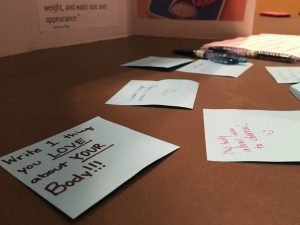 Because they are encouraged to subscribe to patriarchal standards of “masculinity,” many men are imprisoned by society’s definition of “healthy.” Harrison Pope argues in his book Rise of the Adonis Complex, “Over the last three decades, the Adonis Complex has spread dramatically among boys and men, and more and more men are struggling to improve their appearance in one way or another.” This obsession men experience with body image echoes Harrison Pope’s study, which reported “95% of college-aged men being dissatisfied with some part of their bodies.” Muscle dysmorphia and other disorders of the health/wellness world need to be more widely recognized in order to make effective and valuable changes.
Another voice seeking to define which bodies should be loved and which should be shamed comes out of the medical world. Fat studies scholars like Marilyn Wann and Deb Burgard argue that the unrealistic and scientifically false standards of “health” set up by health and wellness industries are perpetuated by members of the medical world through measures like BMI. BMI, or Body Mass Index, is one of a variety of “ideal” weight charts used by the federal government to mandate who is healthy and who is not. The problem with BMI is that it is too simple, and does not account for the full range of human diversity, especially in children. BMI works by juxtaposing height and weight to create a n
umber from 12-42. The oversimplification of the incredible varieties of the human body leads to the “medicalization of human diversity,” which “ inspires a misplaced search for a ‘cure’ for naturally occurring difference. Far from generating sympathy for fat people, medicalization of weight fuels anti-fat prejudice and discrimination in all areas of society” (Wann xiii). Medical professionals who seek to determine patient’s achievement of “good health” based on flawed scales like BMI contribute to the chorus of voices that say, falsely, that our bodies are too fat, not muscular enough, too short; basically, that our bodies are incorrect. We still need to seek advice from medical professionals; there are men and women who have completed years of training in order to help us live our best lives. Through this project, we discovered the importance of seeking medical professionals who understand and appreciate the diversity in human bodies and also encourage us to seek out a truly healthy lifestyle (in every sense of the word).
Works Cited
Rocamora, Agnès. “Personal fashion blogs: screens and mirrors in digital self-portraits.” Fashion Theory. Vol 15, No. 4, 2011.
Wann, Marilyn. Foreword to the Fat Studies Reader, by Marilyn Wann, xxi-xxvii. New York: New York University Press, 2009.
http://www.huffingtonpost.com/maureen-shaw/why-postpartum-depression_b_5980276.html
Continuing the conversation we had in class yesterday, I found this article in the Huffington Post that serves as an affect perspective about postpartum depression and how our society fuels the continuation of this social pressure onto new mothers. As this article states, motherhood is already highly politicized and therefore the public is weighing in on their opinions of “what a mother should truly be.” Postpartum depression is increasingly becoming a talking point, along with conversations about rape and the wage gap, but the issue could be more talked about.