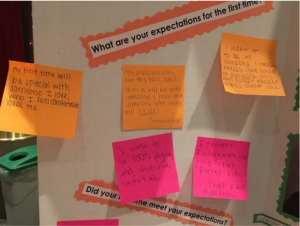
As an alternative to the Grant Proposal assignment, Caroline Okel, Vance Graves, Felicia Zi, and Collin Epstein created a poster for the Sex Positivity Fair hosted by 1972, ‘a group at Davidson College focused on gender expression on campus and issues affecting women’, according to their Facebook page. We chose to examine virginity as a social construct, hoping to start a conversation with attendees at the fair about how they experience virginity. We researched information on four topics related to virginity that caught our interest, and provided sticky notes and pens so that those who came to the fair could respond to our poster by adding their thoughts to it.
One of the topics that we were interested in exploring for our poster was the comparison between the expectation that people have for losing their virginity versus the experience that they actually have. As Hanne Blank describes in her book Virgin: The Untouched History, we are able to define virginity without describing its loss. She recognizes that we “speak of virginity loss rather than virginity itself… [because] virginity is because it ends” (Blank 96-97). Their definitely is a fascination with the topic of “the first time,” especially in a college setting, but we have noticed that for most people we know, the first time was not all what it is cracked up to be. For example, in Laura M. Carpenter’s Virginity Loss, she interviews people about their stories of losing their virginity. As Bryan Meyers summarizes in her book, “It was just so unbelievable that this, like, this thing you talk about your life is actually happening. And honestly, I think that… it’s not as, like, as mind-blowing as you expect it to be” (Carpenter 72). Therefore, we asked individuals to answer questions about their expectations that they have for their first time or that they had prior to their first time. We found that those who had not lost their virginity expressed desire for a first time with someone they loved and that they feel comfortable with. When actually discussing the first time, the sticky notes expressed more of a feeling of less than ideal conditions such as disappointment, a lack of feeling changed by the experience, and awkwardness. One person simply answered “NO” when asked if it met their expectations. This portion aimed to shed light on the fact that the first time may not be a romantic, life-changing moment like the virginity loss scenes portrayed in popular movies like Titanic and The Notebook and that this is perfectly okay.
A topic that was initially a starting point for conversation in our group was the definition of virginity. We were interested in social and cultural constructions of virginity, and the myth of the hymen was something we discussed and included in our poster, with the main takeaway being that no medical definition exists for what constitutes virginity. One of the open-ended questions we asked on the poster read, “How do you define virginity?” People posted a variety of answers, demonstrating that different individuals defined virginity differently, and that virginity had a different value for every individual. An answer that we found particularly striking was, “IT ISN’T REAL.” Our group also discussed stigmas and double standards surrounding the idea of virginity, such as social perceptions of male versus female virginities. We included a few memes from pop culture films to demonstrate these double standards, and people seemed to find them not only amusing, but relatable. A female responded to the question, “How did your parents influence your views?” with, “My parents taught me that virginity is purity. I should wait until marriage.” Another female responded with, “Same!”, demonstrating that these gendered perceptions still exist in today’s society. Given that most of the posts were anonymous, it was difficult to find connections between people’s answers and their gender, but the clear variety of answers demonstrated that virginity meant something different for everyone. Ultimately, our group was pleasantly surprised with the amount of people willing and eager to participate in the open-ended questions. It was interesting to generate conversation about a topic that is not normally discussed in everyday conversation and read what people had to say about it.
Another one of the topics we researched for our poster on virginity as a social construct is virginity in the LGBT* Community. We examined how views towards virginity differ between the straight and LGBT* communities. For example, it is often debated as to whether or not lesbian women can actually lose their virginities. This belief stems from the idea that one cannot have sex without the involvement of a penis. In order to change how we look at virginity in the LGBT* community, we need to change how we look at sex. Perhaps we, as a society, view things from a very heteronormative viewpoint. This is due to compulsory heterosexuality, a concept put forth by Adrienne Rich in “Compulsory Heterosexuality and Lesbian Existence” (1980). With this concept, it is believed that for most people, straight is the default sexuality. This view is very constricting when it comes to looking at how we view sex, and therefore the construct of virginity. Because we asked questions about what people believe to be sex, it was interesting to see whether or not Davidson students would comply with compulsory heterosexuality when answering questions. Interestingly enough, many of the students who answered questions about what they believe sex to be, left gender out of their answer, like when one student wrote that, “Sex is when two or more people have intimate relations with their sexual organs.” Another student just defined sex as, “when all parties orgasm.” It appears that these students took away something from our poster, or perhaps already came with thought that that when we discuss sex, we need to be more inclusive of other sexual orientations and gender identity.
We also explored historical and cultural representations of virginity in our poster. Historically, virgins have been represented in Western cultures in a series of narrow roles: women as pillars of virtue, men as pathetic or eccentric, and both as holy or deified. Cultural images of virgins contribute to what Barbara Risman refers to as “gender as structure” at the “interactional level of analysis: cultural expectations” in her essay Gender as Structure. These images are crucially dependent on a very heteronormative definition and expectation of gender.
Female virgins in history are usually portrayed as exceptionally virtuous, usually because of their virgin status (ex: Queen Elizabeth I). Culturally, virginal leaders garnered more respect as virgins, perhaps because of their apparent rejection of men.
On the other hand, men are typically portrayed as pathetic losers (ex: Steve Carrell in the 40-Year-Old-Virgin) or as eccentric geniuses (ex: rumors about Sir Isaac Newton). In either case, the attitude in which these men are viewed is a sort of bemused surprise. In contrast to women, the expected state for men is as not a virgin. However, failure to conform is not regarded as deeply shameful for men as it is for women.
The role both men and women have filled as virgins has been as holy people (ex: Joan of Arc, St. Augustine) and as deities. However, even as deities, male and female virgins are represented very differently. There are vastly more female virgin goddesses in Western traditions (ex: Artemis, Athena, the Virgin Mary) than male virgin gods (Jesus). Additionally, the implications for male and female people differ in that all women are implicitly expected to be Mary, but no/few men are held to the standard of Jesus.
It is important to understand that our telling of history is an important component of how we construct our culture. The clear dichotomy between male and female virginity represented in our culture reinforces the concept of “compulsory heterosexuality” that Adrienne Rich describes in her essay Compulsory Heterosexuality and Lesbian Existence. Learning about how virginity has been understood and portrayed historically allows us to understand virginity as a social construct, and puts the responses of students who reacted to our poster into a wider cultural and historical perspective.