By Alice Berndt
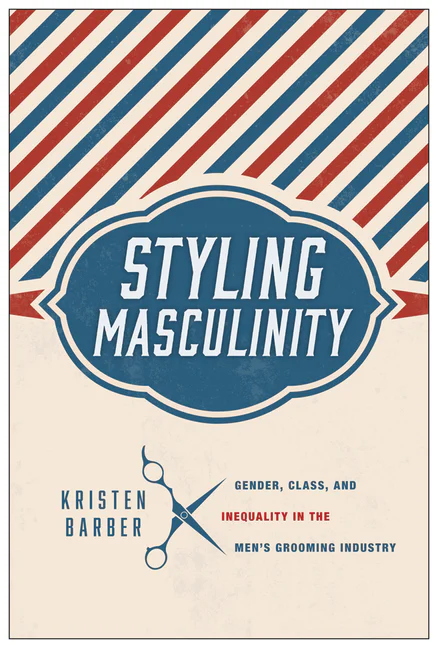
Since the inception of the metrosexual in the mid-1990s, the United States has seen a rise in male participation in the beauty and grooming industry, an industry that was founded by women and has typically been associated with a more feminine lifestyle. For white middle to upper class American men, there is a tension between the expectation to look clean and professional and the fear of appearing to try too hard to look this way. To balance these conflicting desires, modern men’s hair salons create carefully cultivated male aesthetics in their shops, from the decor and products to their employees’ mannerisms and dress codes. Kristen Barber explores this phenomenon in her monograph Styling Masculinity: Gender, Class, and Inequality in the Men’s Grooming Industry, published by Rutgers University Press in 2016. Barber begins with an initial research question: “What makes a men’s salon a men’s salon?” (Barber 162) To answer this question, she spends nine months in 2009 investigating the painstakingly masculinized spaces of two upscale men’s salons in Southern California, The Executive and Adonis, where she uncovers the aesthetics and gender politics of male participation in the beauty industry and the complex role female employees play in this space.
Kristen Barber is a sociologist, professor, and researcher with a focus on masculinities, culture, and work. She has a PhD in sociology from the University of Southern California, and her research centers on examining what “everyday boundary-crossing behavior can teach us about complex systems of inequality” (“Kristen Barber”). Besides Styling Masculinity, Barber co-authored the textbook Gendered Worlds 4th Edition and is the co-editor of a journal called Men and Masculinities. She currently works at Southern Illinois University as an associate professor of sociology and the director of the Women, Gender, and Sexuality Studies program.
To get to the bottom of her question about what exactly constitutes a “men’s salon,” Barber performs an ethnographic study of two such salons in Southern California, Adonis and The Executive. She chooses Southern California as the site of her study because it is “a mecca for commercial aestheticizing” (Barber 12). She states that the phenomenon exemplified by these salons is not exclusive to California alone but rather extends to the rest of the country as well, though how it manifests in different settings may vary. Barber spends nearly a year frequenting The Executive and Adonis, interviewing the owners, employees, and clientele, and observing the interactions between the male clients and the female workers as well as between the male clients and the space itself. She writes, “I am interested in meanings as they are constructed through people’s face-to-face exchanges and how the organization in which these exchanges are embedded shape relationships between groups of people, identity building processes, and the reproduction and reimagining of cultural norms” (13).
Continue reading “More Than Just a Haircut: Examining Gender Roles and Male Grooming in Kristen Barber’s *Styling Masculinity*”