By Alice Berndt
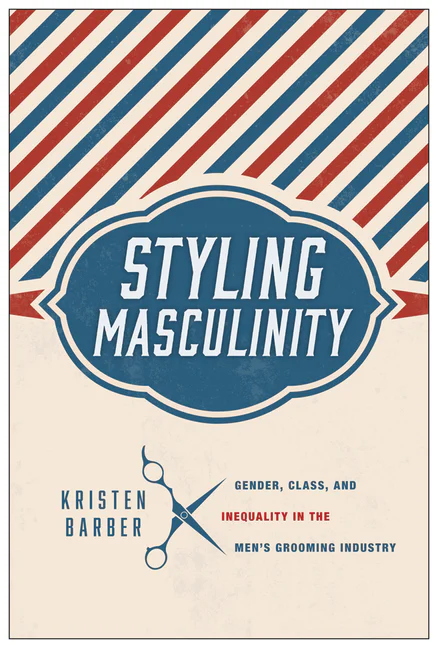
Since the inception of the metrosexual in the mid-1990s, the United States has seen a rise in male participation in the beauty and grooming industry, an industry that was founded by women and has typically been associated with a more feminine lifestyle. For white middle to upper class American men, there is a tension between the expectation to look clean and professional and the fear of appearing to try too hard to look this way. To balance these conflicting desires, modern men’s hair salons create carefully cultivated male aesthetics in their shops, from the decor and products to their employees’ mannerisms and dress codes. Kristen Barber explores this phenomenon in her monograph Styling Masculinity: Gender, Class, and Inequality in the Men’s Grooming Industry, published by Rutgers University Press in 2016. Barber begins with an initial research question: “What makes a men’s salon a men’s salon?” (Barber 162) To answer this question, she spends nine months in 2009 investigating the painstakingly masculinized spaces of two upscale men’s salons in Southern California, The Executive and Adonis, where she uncovers the aesthetics and gender politics of male participation in the beauty industry and the complex role female employees play in this space.
Kristen Barber is a sociologist, professor, and researcher with a focus on masculinities, culture, and work. She has a PhD in sociology from the University of Southern California, and her research centers on examining what “everyday boundary-crossing behavior can teach us about complex systems of inequality” (“Kristen Barber”). Besides Styling Masculinity, Barber co-authored the textbook Gendered Worlds 4th Edition and is the co-editor of a journal called Men and Masculinities. She currently works at Southern Illinois University as an associate professor of sociology and the director of the Women, Gender, and Sexuality Studies program.
To get to the bottom of her question about what exactly constitutes a “men’s salon,” Barber performs an ethnographic study of two such salons in Southern California, Adonis and The Executive. She chooses Southern California as the site of her study because it is “a mecca for commercial aestheticizing” (Barber 12). She states that the phenomenon exemplified by these salons is not exclusive to California alone but rather extends to the rest of the country as well, though how it manifests in different settings may vary. Barber spends nearly a year frequenting The Executive and Adonis, interviewing the owners, employees, and clientele, and observing the interactions between the male clients and the female workers as well as between the male clients and the space itself. She writes, “I am interested in meanings as they are constructed through people’s face-to-face exchanges and how the organization in which these exchanges are embedded shape relationships between groups of people, identity building processes, and the reproduction and reimagining of cultural norms” (13).
At The Executive, which has an older, more conservative feel, the owner Veronica allows Barber to interview her and her employees but not the clients. At Adonis, a younger, trendier salon, the owner Tyler is too busy to be interviewed himself but invites Barber to converse with his employees and customers. Barber also asks clients at both salons to fill out a questionnaire about their experiences and why they chose Adonis or The Executive over a traditional barber shop or salon that caters to both men and women. In addition to studying the decor, ambiance, and layout of the two salons, Barber pays close attention to the ways in which the employees and customers alike perform gender, both consciously and subconsciously, as they interact with one another.
Through her ethnographic work in Styling Masculinity, Barber outlines a new way of understanding contemporary men’s relationship with beauty salons. Though there is a plethora of research into women’s multifaceted roles in the beauty industry, there has been much less scholarship on men’s beauty and grooming habits. Further, the research that does focus on men inaccurately paints male interest in grooming as something new, only appearing in the past twenty or so years, and a sign of “the dissolution of gender inequality” (x). In reality, there is a long history of male beautification, from Julius Caesar to David Beckham, and the current space of male grooming both thrives on and relies on sexism and stereotypical gender roles. The past twenty years have been unique, however, because of an interest in the monetization of male grooming and the subsequent need for carefully curated male grooming spaces that do gender work. According to Barber, the women who are paid to pamper the men in these spaces, both physically and emotionally, are entirely missing from scholarship on the topic.
In chapter one, Barber provides historical context for her study. Throughout time, fashion and beauty have been a way for men to signal status and social class. In the past thirty years there has been a focus on the “commercialization of the beautiful male body” (39). Capitalizing on this, the beauty industry has honed in on men as a massive potential consumer base, producing male-specific products and reorganizing retail spaces to create “Man Zones” (44). Though these products are increasingly available to men, the male consumers themselves are still hesitant to purchase and participate.
Chapter two covers the physical structures of the salons themselves, showing how the layout, decor, and general aesthetic atmosphere of Adonis and The Executive help male clients feel comfortable in the traditionally female space of beauty and grooming. In these salons, men are offered beer upon arrival and can play video games or watch sports while they get their hair cut. The employees at Adonis, mostly female, are required to use “masculine verbiage” like saying “color camo” instead of “hair dye” (63). These women function as “gendered cultural mediators,” convincing men that being in these salons is “class appropriate and heterosexually masculine” (51). To further alleviate discomfort, these salons emphasize privacy by tucking clients into back rooms for services such as manicures or waxing, thereby rejecting the traditional idea of a barber shop as a space of homosocial bonding.
In chapter three, Barber does a deep dive into the gender dynamics between female stylists and their male clientele, specifically how the former function as “interpersonal tools” for the latter to “project [their] heteromasculine identities” onto (78). At Adonis, employees are expected to dress in a way that is stereotypically heterosexual, feminine, and attractive: “little dresses, tight jeans, noticeable makeup, and coiffed hair” (80). At The Executive, which is a bit more conservative, the women have a more professional dress code in an attempt to minimize male ogling. Owner Veronica says, “It’s a male environment. You’ve got to be familiar with what would provoke unwanted attention” (81). But this method places the responsibility of controlling male heterosexual desires onto the women, subverting its anti-sexist intentions. Regardless of explicit rules and dress codes, the women working at both salons have no choice but to lean into and “capitaliz[e] on men’s heterosexuality” to turn a profit (100).
Chapter four explores emotional and physical care, the ways in which female employees “do gender” that are perhaps less obvious than prancing around in short skirts and serving men beer. Barber argues that a female stylist can act as the “other woman” for her male client, providing him not only with emotional support but also the physical touch that he may lack in his outside life. Barber outlines a link between touch and trust, describing how the physical contact these men receive from their stylists — scalp massages, facials, and shampooings — allow them to relax and trust the woman whose hands are in their hair, often leading to more personal confiding. Barber writes, “Building friendships with their hairstylists or manicurists allows some men to find intimate and confidential relationships that they otherwise lack” (110). Though these relationships are often positive and platonic, there is also the potential for it to lead to unwanted sexual advances.
In the final chapter, Barber takes a detour from her main argument to explore how female employees themselves perpetuate rigid gender roles and divisions through their perspectives on and attitudes towards their work, or what Barber calls their “occupational choice narratives” (133). Many of the employees at The Executive claim to prefer working with “easygoing” men over women who are “overly emotional and demanding” (133, 132). Though these women claim to be “men’s women” and not “girly girls,” they still “do gender” by reinforcing stereotypes of femininity in lumping all women together and positioning them as inferior to men.
One loose thread in Barber’s findings is that they are limited to this very specific focus group — both in terms of the geographical location of the salons and the identities of the clients. She studies two men’s salons in the same part of the country, which also happens to be a particularly image-obsessed location. Readers might wonder how this framework can be applied to the rest of the country; what would happen if Barber examined a hair salon in rural Oklahoma? Would female stylists there treat male clients differently than female clients? Are there even men’s salons in more rural parts of the country? To give her credit, Barber does acknowledge this limitation. In her introduction she states that while Southern California is unique “as an example of the classed and urban phenomenon of male salons,” it is also true that “high-service men’s salons like the ones in this book are popping up across the country, from Seattle and Dallas to Charlotte and Boston” (12). She positions her study as a reflection of national and global trends in the rise of male grooming. But still, beyond geographical limitations, this study excludes working class men, (most) gay men, and men of color — all men outside the specific identity of white, heterosexual, middle to upper class man.
Despite the limited scope of her study, Barber’s findings about the role that women play in this setting are extremely valuable in understanding the service industry more broadly — in any part of the country. In Styling Masculinity, Barber uncovers the emotional and physical labor that women provide to create and uphold men’s salons as masculinized spaces — a characteristic of the beauty industry that is unique to the past twenty years. From owner to receptionist to stylist and massage therapist, the women in men’s salons take on various gender roles and participate in care work to bolster their male clients’ egos and make them feel comfortable within a traditionally feminine space. Barber ends her book with a call to action, suggesting that if female beauty workers come together and unionize, they have the power to take back an industry that was built by women and still relies heavily on women today. Through this monograph, Barber sheds light on the complex gender dynamics occurring every day in a place as innocuous as a hair salon, urging readers to look more closely at other similar industries. If nothing else, after reading this book you will never experience a haircut the same way again.
Works Cited
Barber, Kristen. Styling Masculinity: Gender, Class, and Inequality in the Men’s Grooming Industry. Rutgers University Press, 2016.
“Kristen Barber.” Southern Illinois University Website. Accessed 21 Oct 2021. https://cola.siu.edu/sociology/faculty-staff/faculty/barber.php.
This is a really interesting topic for a book. I don’t think that I ever would have thought to analyze something like this. I think that you did a really great job providing informational and concise summaries of each chapter, highlighting the important points. I agree with Barber’s point that men are underrepresented in the salon industry and are often no the group taken into consideration. You also bring up a great point in the research within Barber’s observations. By choosing only two salons to focus on and they both are within the same geographic location. This potentially makes her analyses unreliable due to the lack of representation within the groups that she looked further into. This is a good catch on your part to find a major weakness within her work. I think that it is very important that you highlighted this point. Really great review1
This is such an interesting topic and I’m glad you were able to explore it. I was very interested in the roles women and men play within the salon. Even in a common service industry, there is this underlying social hierarchy between the server and the client, which ironically is between women and men. Like what you said in your last paragraph, I do not look at haircuts the same way I did.