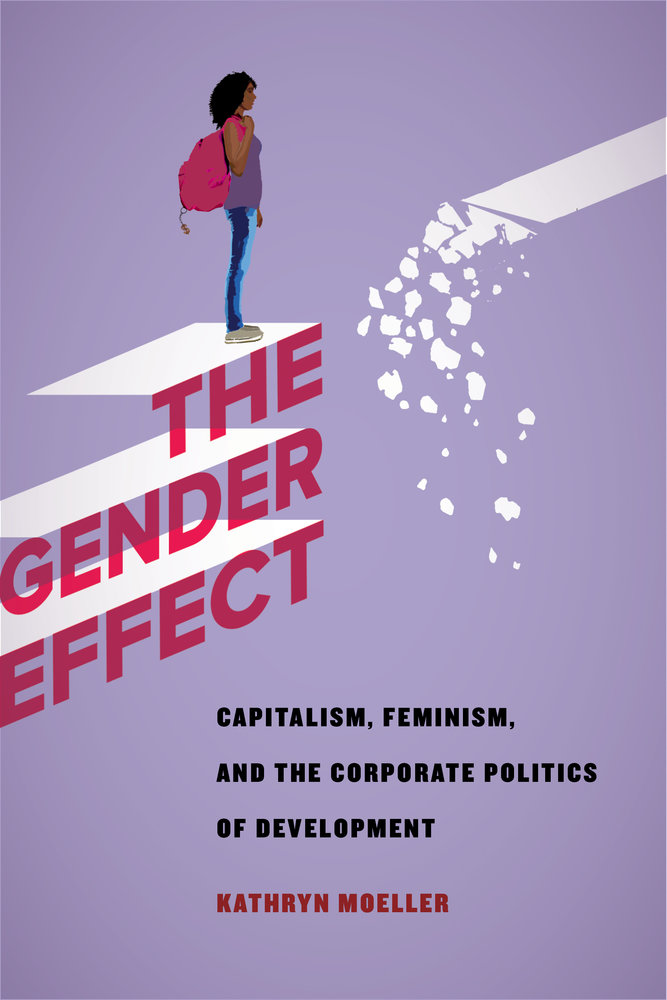
In the 1990s, the idea of “investing in women” started circulating around large corporations and foundations. In developing countries, it was thought that this idea could help women, their families and their countries out of poverty. In return, it was then thought that women would pay specific attention to children’s nutrition, education and healthcare when considering where to spend their money and thus raise the country’s human capital. Educating women and girls was the most effective way to fight poverty and encourage development in the Global South. This approach has since been adopted by powerful corporations and institutions, such as the United Nations, the World Bank, and the United Kingdom’s Department for International Development. Using her ethnographic case study of the Nike Foundation’s Girl Effect initiative as an example, the author Kathryn Moeller argues that these corporate led campaigns end up benefiting corporations but at the expense of women and equality in The Gender Effect: Capitalism, Feminism, and the Corporate Politics of Development.
Moeller is a self- described critical feminist scholar, educator and author with an interdisciplinary of ethnographic scholarship. She has been doing research for the past decade, examining the U.S. transnational corporations’ investments in Black and Brown girls’ and women’s education and economic development. Her expertise in this area creates a space in society for these issues, exposing them and bringing them to light.
In 2008, the Nike Foundation, the philanthropic branch of Nike, released a video titled “The Gender Effect” arguing for girls’ access to education to decrease poverty. However, that was the only effort Nike made regarding this issue. This book dissects the Girl Effect. Moeller argues that the real effect of significant corporate “investment” in the equality of women has been to shift attention away from the historically awful work conditions and treatment that continually affect poverty in the Global South. She also argues that this de-politicizes the demands of the women for fair-labor practices, working against the very women they are supposed to be helping. Large corporations use a logic of development that positions girls and women as instruments of poverty alleviation. They seek to address the problems of gendered poverty and inequality but this “…shifts the burden of development onto girls and women without transforming the structural conditions that produce poverty” (44). She argues that there is no justice for these women, and corporations are basically ignoring the low wages, unsafe working conditions, discriminatory hiring practices, and sexual violence they subject them too. This allows corporations to create an image that is socially responsible and accepted, and also ensure market expansion and generate long term growth. Moeller describes the financial support of these so-called philanthropic organizations such as the Nike Foundation, United Nations Global Compact, Clinton Global Initiative, whose goal is to help educate young girls. This research was done and presented in the form of interviews, conferences, research studies, and direct observation that she made herself. She details that companies such as Nike, Goldman Sachs and Walmart have used some of their philanthropic efforts to reduce the negative publicity of past scandals even though justice is never served. Specifically with the Nike Foundation, the focus on women through the development of the Girl Effect was to shift attention away from labor strikes and campaigns against them, essentially granting themselves the praise that comes with benevolent institutions without any of the hard work and systemic changes that were needed.
Moeller’s chosen methodology, and expertise, was ethnography. I think this choice was perfect for what the book needed to convey and accomplish. Ethnography allows readers to dive deep into culture and understand the ability to explain human behavior. By doing such extensive research, readers can fully understand the role these women are forced to take and the burden that they feel.
I thought there were many strengths to this book and the way she wrote it. I enjoyed the case study aspect of the Nike Foundation, which was the majority of the book. By using a specific company, and one that is so relevant and accessible to the world, it forces the reader to realize how close they are to the issue. Moeller does a great job presenting the problem as it is and conceptualizing women first and foremost as a means for economic growth. I also really admired how she framed me to think of these inequalities as inequalities that needed to be dealt with rather than as a stance for empowerment. We need equality, not empowerment for some women to rise up to where men are in society. She also incorporated a lot of Foucault quotes, and he has been very inspirational for Moeller and other feminists. I thought that his ideas about the body’s capabilities and sexuality and power aligned with Moeller’s arguments really well. Although I enjoyed reading this book, I must admit that I also found it incredibly hard to read at times. I think that can be a limitation in the modern world when people want information fast and easy. Her book also focuses a lot on theories. I appreciated the inclusion of instances she supported the theories with, but having more concrete statements would be beneficial to readers like me.
Overall, this book was a good read. I enjoyed the feminist take on the Girl Effect Model, and its ability to highlight the intersectionality of capitalism and feminism. This book forces readers to understand how you can truly be an active ally versus just a supporter. We must work hard to break down these systems, and demand true investment in women and girls across the world.
Moeller, Kathryn. The Gender Effect. University of California Press, 2018.
This book sounds super interesting! I feel like a lot of organizations focus so much on one thing that they don’t consider or ignore to consequence. Your review is very clear, I feel like I can understand what this book is explaining and your strength and weaknesses are very understandable.
I think this is a really relevant topic, especially today. This speaks to the performativity of these huge corporate brands promoting that they support equality without actually doing anything to back it up, or a lot of the time, even going against it. This can be seen not only related to gender but the LGBTQ+ community. These companies slap rainbows on their merchandise and air commercials that claim they are such an inclusive brand working towards a just world, when in reality, most of them are just doing this to make money from it without taking any real action to back up their claims. These corporations must be held accountable for upholding the messages they promote.