Feminist MixTape: “enough for you” by Olivia Rodrigo

If you ever feel the need to go for a drive and cry about how much the patriarchy sucks, listen to “enough for you” by Olivia Rodrigo. Olivia Rodrigo is a singer, songwriter, and actress. She blessed the world with “enough for you” in 2021, as part of her album, Sour, which also presents several feminist perspectives. I particularly recommend listening to the final song, “hope ur ok,” as it reaches out to the LGBTQ+ community through its discussion of abuse, sexual orientation, and acceptance. 

The first way that Olivia Rodrigo instills feminist beliefs in “enough for you” is through the theme that she, as a woman, felt as though she did something wrong or was flawed and that is why she is experiencing a breakup. This feeling of self-hate is obvious in the lyrics, “You found someone more exciting The next second, you were gone And you left me there cryin’, wonderin’ what I did wrong…”. When listening to this song, it reminds me of the book I read for the book review, The Tragedy of Heterosexuality by Jane Ward. I sense a similarity between this song and that book because of its connections with the misogyny paradox. Essentially, the misogyny paradox asserts that boys’ and men’s desire for girls and women is expressed in a society that simultaneously encourages them to hate girls and women. This is evident in everyday life through men’s practices of abuse, mansplaining, and disrespect towards women (Ward 35-38). Olivia Rodrigo’s lyrics demonstrate the harmful effects that the misogyny paradox has on women. Specifically, it leads to negative thoughts in which women think that they are at fault for men’s poor treatment of them. In reality, women have done nothing wrong and this is a flaw of the patriarchy. 

Olivia Rodrigo also presents the societal expectation that women should be responsible to beautify and improve themselves to be “acceptable” to men. The artist sings, “I wore makeup when we dated ‘Cause I thought you’d like me more If I looked like the other prom queens I know that you loved before Tried so hard to be everything that you liked Just for you to say you’re not the compliment type…”. These lyrics remind me of the efforts by the diet and deodorant industries to exploit people’s insecurities so that they feel motivated to buy their products. A similar practice is at work in the heterosexual-repair industry, as I learned in The Tragedy of Heterosexuality by Jane Ward. Women are led to believe that they must keep their bodies “fresh” and “sexually appealing” to their male partners. Advertisers then put the strain on women to maintain their appearances to keep their partners happy (Ward 47). Olivia Rodrigo also falls victim to this harmful burden put on women. She sings about how she felt as though a romantic interest may have liked her more if she used more beauty products. 

While this song speaks to me as a straight, white woman, there may be some limitations in that the song is not inclusive of Black feminist theory and Olivia Rodrigo appears to be singing about a heterosexual relationship. While Olivia Rodrigo is unlabeled in her sexuality, she uses the term “boy,” to describe the person she is singing about. Therefore, a member of the LGBTQ+ community may feel ostracized from relating to the lyrics of “enough for you.” Furthermore, Olivia Rodrigo seems to be singing very generally about problems faced by women and does not acknowledge Black feminist theory and the increased inequity faced by Black women due to the intersectionality of their identities. 

To conclude, Olivia Rodrigo finally establishes at the end of “enough for you” that there is nothing wrong with her, she is a strong, beautiful, powerful woman. Instead, there is a problem with the patriarchy and the expectations put upon women. She demonstrates that in the following lyrics: “Yeah, you always say I’m never satisfied But I don’t think that’s true You say I’m never satisfied But that’s not me, it’s you…”. Overall, I find that this song has its most profound impact when I think about any relationships with men, whether that is professional, familial, or romantic relationships. It is in these relationships that I find myself questioning my self-worth the most and feeling as though I am never good enough. In response to that, Olivia Rodrigo reminds her audience to be kind to themselves despite patriarchal barriers. Listeners need to keep in mind that despite societal pressures and expectations, there is nothing wrong with them. 
Book Review: The Tragedy of Heterosexuality by Jane Ward

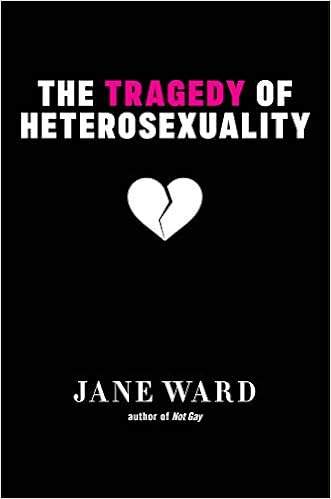
Cultural propaganda, sexual assault, incest, compulsory marriage, economic dependence, control of children, and domestic violence; are the only possible reasons a woman would remain in a heterosexual relationship. As a straight woman and having had conversations with other straight women, these reasons are evident in every heterosexual relationship I have come across. Jane Ward in The Tragedy of Heterosexuality explores the societal expectations and pressures of the patriarchy upon heterosexuality and the heterosexual-repair industry that desperately attempts to mend these broken relationships. In addition, as a lesbian, in her book, she describes the sadness she feels upon witnessing the violence, control, diminishment, and disappointment experienced by straight women. In summary, her book leaves readers wondering, are heterosexual relationships worth the toxicity of straight culture?

Jane Ward is a professor of Gender and Sexuality Studies at the University of California, Riverside. She received her Ph.D. in sociology from the University of California, Santa Barbara. In addition to The Tragedy of Heterosexuality, Jane Ward has written two other books: Not Gay and Respectably Queer. Her books cover a wide array of topics including, feminism, queer parenting, the racial politics of same-sex marriage, and the social construction of heterosexuality and whiteness. She currently resides in Southern California with her partner, Kat Ross. One may argue that because Jane Ward is a lesbian, she should not be making such broad claims about heterosexual women. I counter this by suggesting that a lesbian is the best person to observe and criticize heterosexual relationships and the burden they put upon women. Ward can compare the respect and fulfillment she feels in her lesbian relationship, to the stress and disrespect felt by the heterosexual women in her life.

As a white woman, one aspect lacking from The Tragedy of Heterosexuality is the expectations imposed upon Black women by the patriarchy. One hardship that Ward’s book does examine is the fact that many early white feminists based their arguments for nonviolent marriage and women’s rights on the claim that bringing white women closer to equality with their husbands will ensure a unified front among white people against the Black civil rights activists. However, as a reader who has now read “Controlling Images and Black Women’s Oppression,” by Patricia Hill Collins, the lack of attention paid to the controlling images forced upon Black women in heterosexual relationships, and the constant criticism of their sexuality, is highlighted. Therefore, there is a slight bias in the book to feel sadness toward white women in heterosexual relationships, because Jane Ward is a white woman. 

 The overarching argument present in The Tragedy of Heterosexuality by Jane Ward includes the efforts by the heterosexual-repair industry to improve the enduring defects of straight culture. The heterosexual-repair industry has been flawed since its emergence. It is made up of eugenicists, sexologists, and social reformers. Ward cites three broad concepts present in the industry: they exposed the violence and mutual dislike in heterosexual relationships and reassured the population that this was natural, they took on the role of defining modern heterosexuality and repairing the problems that came along with it, and they accepted the premise that men and women found each other’s bodies undesirable and advocated for the use of beauty products to stimulate desire. Each of these concepts is inherently misogynistic. For example, at one point, experts were channeling their efforts to discover why women had annoying personalities and attempted to mediate men’s irritations with their wives. The solution the “experts” discovered involved women being submissive, lovely, and always putting their husband’s needs before their own. They went as far as asserting that women should be responsible for heterosexual success because they managed men’s emotions and should also be responsible for the happiness of their households and communities. Did no one ever wonder if it was men’s sexism and unrealistic expectations that caused them to be irritated with their wives? Or consider this: perhaps wives’ personalities come across as irritating because they are having unpleasurable sex?

Furthermore, the heterosexual-repair industry also came to the solution that women had to keep their bodies “fresh” and sexually appealing to their husbands. Advertisers collaborated with the heterosexual-repair industry in provoking fear among women to purchase their beauty products. The logic was that if women were not careful about their appearance then they could risk losing their husbands’ affection or “suffer their wrath.” One should not even have to explain the flaws in this argument and the unnecessary strain it places upon women to improve straight culture and desire. The toxicity rooted in straight culture is thanks to the patriarchy, and yet women are expected to help men improve their relationships. To conclude, Jane Ward, in her argument, exposes how the efforts to improve the conditions of straight culture are misogynistic and put the responsibility onto women. 

The single greatest strength in The Tragedy of Heterosexuality by Jane Ward is explaining the misogyny paradox that plagues straight culture. Essentially, this paradox asserts that boys’ and men’s desire for girls and women is expressed in a society that simultaneously encourages them to hate girls and women. Jane Ward provides a possible explanation for this paradox in which society is suspicious of women because they stand to threaten men’s patriarchal power. The author analyzes this in the context of violence against women and girls. The misogyny paradox is evident when a man rapes and/or murders a woman that he reported to have desired or loved. Another example of this outlook is seen in the 18th and 19th centuries in England and colonial America. At this time, wives were seen as a “necessary evil.” Many would argue that wives, and heterosexual marriages, in general, are still seen in this negative light today. While these are all extreme examples, the misogyny paradox takes a simpler form in everyday life. Often, straight men claim to love women but continue to speak over them, mansplain subjects to them, and train their sons to imitate this lack of respect for women. To comprehend the true tragedy of heterosexuality, the author must portray the disrespect, violence, and ignorance displayed by men to women who claim to be in affectionate, romantic relationships. Jane Ward understands the importance of this paradox to her argument and succeeds in making the misogyny paradox accessible and easy for her readers to understand. 

One weakness present in Jane Ward’s book, The Tragedy of Heterosexuality, is the lack of proposed solutions to this tragedy. The author notes that no feminist efforts have made a dent in straight culture, but she doesn’t go further to explain where they fell short. In fact, Ward describes the sexism and toxic masculinity surrounding heterosexuality as “inescapable.” Later, she also reveals that, as a lesbian, it is painful to witness straight women’s “endless and ineffective” efforts to repair straight men. As a straight woman reading this book, it is incredibly depressing to read these statements and feel as though there is no hope. The patriarchy and toxic masculinity seem like grand problems that can never be solved, certainly not by the time that I’m ready to settle down and get married. It leaves me wondering, am I destined for an unhappy marriage? Is there any point in dating if sexism is normalized in straight culture?

After reading this book and sharing facts and anecdotes with my non-straight friends, they unanimously decided that I represent The Tragedy of Heterosexuality. Over my 19 years as a straight woman, I have heard from friends, family members, and therapists that there are good men out there and not to give up. However, upon reading Jane Ward’s book about the emotional and physical strain of heterosexual relationships on women, I began to question if straight culture is worth the control, diminishment, and not to mention, disappointing sex. I will now respond to these friends, family members, and therapists that until the misogyny paradox is abolished and women are treated with genuine respect, finding “one of the good ones” will be challenging. Finally, I wish the heterosexual-repair industry the best of luck as they take on the impossible endeavor of mending the relationships between men and women, following a long history of sexism and abuse. 

Works Cited

Ward, Jane. The Tragedy of Heterosexuality. New York, New York University Press, 2020. 

Book Review – Bodyminds Reimagined by Sami Schalk

Ondessa Kiliru-Liontree

Black literature is often criticized more heavily and held to a higher standard than the literature of other races. The lack of historical Black narratives has left many Black writers focused on constructing non-fictional literature and realistic portrayals to rewrite history and break down racist ideologies. Non-fiction has always and will continue to have a place in society, however, much can be learned and expressed through speculative fiction. Bodyminds Reimagined investigates Black speculative fiction as a necessary avenue to understand the implications of the intersectionality of (dis)ability, race, and gender. However, many Black authors criticize this hybrid genre and accuse other Black writers of betraying their mission. The question then arises, does Black speculative fiction have a place in Black literature and provide alternative modes for understanding oppression?

Continue reading “Book Review – Bodyminds Reimagined by Sami Schalk” →

Troubles with the Growing Confidence Cult

Hit songs like “Truth Hurts” by Lizzo or “Sorry Not Sorry” by Demi Lovato, hashtags like #realmemonday or #wellnesswednesday, and advertisements like Dove’s self-esteem project represent the influx of self-confidence messaging in today’s mainstream media. Women, in particular, are targeted by these messages. They are told to embrace their fears and insecurities by self-help books, celebrities, and television shows. Subsequently, there is a growing “confidence cult” as the authors of Confidence Culture, Shani Orgad and Rosalind Gill, suggest. 

Confidence Culture

Read more

Using Power to Sing About Abusing Power- Analyzing ‘Your Power’ by Billie Eilish

‘Your Power’ Music Video by Billie Eilish

“Try not to abuse your power,” Billie Eilish sang to a crowd of 15,000 fans in Charlotte last month. Every other song in the concert was accompanied by manic shouts of the lyrics, jumping, and choruses of “We love you Billie!” but once the familiar chord progression sounded from a single accompanying guitar, silence engulfed the auditorium. As Eilish tells Rolling Stone, the song “Your Power,” released in 2021, talks specifically about the relationship between a young girl and an older man in the entertainment industry. Her usage of he/him pronouns to describe the abuser and she/her pronouns to describe the victim additionally narrows this focus. 

The music video for the song opens with Billie sitting on top of a mountain in a desert wearing neutral, almost camouflaging colors. She has a snake in her lap who appears to be friendly. 

The first shot of Billie Eilish in the music video for ‘Your Power’

There’s a lot to unpack here. Firstly, her sitting on a mountain could imply that she has a certain element of power of her own. Perhaps, the higher up she goes, the more alone she feels because she has so much more to lose if something goes wrong. Perhaps, the reason she’s so high up in the first place is because she got accustomed to this dark, desolate place with snakes. She let herself relax around the snake, not knowing what it could potentially do to her. The clothing choice could also add to the atmosphere of desolation. She’s acclimated to her surroundings; like a chameleon she’s changed her colors to fit the role she’s meant to play. She’s in bed with the enemy because she knows it’ll take her higher up the mountain. It could also signify that she’s blended in so well that a) no one can tell that something’s wrong and b) no one can see her pain and help her. Another possible reason for the neutral tones and not something flashier or individualistic could be to signify that she is not a special case- she is just one of many victims who have gone through the same abuse.

The video is first a zoomed out view of the entire mountain landscape, which then slowly zooms into Billie sitting on the mountain. This could signify that things don’t always seem the way that they are. One might’ve thought it was an empty stretch of mountains at first, but it wasn’t- there’s someone sitting there. Similarly, one might’ve thought there was no foul play at hand, but there is- it’s an abusive power relationship. 

Zooming into Billie Eilish

Billie’s interactions with the snake are symbolism for the power dynamic explored in the song. When the snake crawls into Billie’s lap, her hands are limp and she makes no attempt to push it off, communicating perhaps that she’s scared and she doesn’t know how to.

Billie’s first interaction with the snake

Slowly through the course of the song, the snake wraps itself tighter and tighter around her. She’s also sitting at the ledge of the mountain, implying that she has nowhere to run and adds to the feeling of powerlessness.

Billie being strangled by the snake

The song ends with Billie being strangled by the snake and the camera zooms out to show that she is camouflaging with the background. No one would be able to see her pain and see what’s happening behind the scenes. 

Zooming out of Billie to show the mountains

While the music video has many subtle layers and nuances to unpack with multiple viewings, the lyrics are direct and straightforward, without being laced with too many metaphors.

The lines, “She was sleeping in your clothes but now she’s got to get to class,” add to the narrative of the younger girl with the older man. It is clear that he was sleeping with her, and she’s a student.

And you swear you didn’t know (didn’t know)

No wonder why you didn’t ask

She was sleeping in your clothes (in your clothes)

But now she’s got to get to class

Verse of ‘Your Power’

The line, “You said you thought she was your age,” is a clear indicator of the age gap. There is also a reference to the abuser’s ‘contract’ which is a reference to their professions in the entertainment industry, which adds to the complex power dynamic.

And you swear you didn’t know (didn’t know)
You said you thought she was your age

How dare you?
And how could you?
Will you only feel bad if it turns out
That they kill your contract?
Would you?

Verse of ‘Your Power’

The victim has so much more to lose as a young woman who has just started advancing in her career, as opposed to this man who appears to be her supervisor and has control over her future. She has nothing she can do, just like Billie with the snake: if she tells someone or tries to get herself out, she could fall off the ledge.

We must emphasize the usage of the word “try” in “Try not to abuse your power.”

Try not to abuse your power
I know we didn’t choose to change
You might not wanna lose your power
But power isn’t pain

Chorus of ‘Your Power’

This implies that men in power abuse it so often that it almost goes without saying that they will; it’s such a common occurrence that Billie almost says, “I know it’s hard and you’re used to doing this, but please try not to.” This adds to the submissive tone of the song and reinforces the idea that the women have to plead to not be taken advantage of. Rather than the song’s lyrics being, “Do not abuse your power,” the usage of the word ‘try’ implies that young women like Billie do not even have the power to stand up for themselves without them having to pay some kind of price for it or face brutal consequences in their careers and reputations.

The song’s lyrics alternate between using third and first person pronouns for the victim, possibly implying that Billie has gone through this, but that she isn’t the only one. She’s speaking about her own experiences, but is also indicating that several young people in the entertainment industry are also in complex power relationships and being used for sex.

I thought that I was special, you made me feel
Like it was my fault you were the devil, lost your appeal
Does it keep you in control? (In control)
For you to keep her in a cage?

Eilish uses first-person pronouns in the first two lines and third-person in the last line

Something must be said of what power means to Billie Eilish and how that could differ for different sections of society. Billie Eilish may have a snake around her body, but she is still on top of a mountain. That mountain is the privileges she has as a white, cis, rich celebrity. Some may not have that mountain, and it’s important to recognize that she is representing a single story that does not accurately represent intersectionality. 

Additionally, there is the question of the color of the snake. Perhaps it wasn’t intentional that a black snake was being wrapped around a white woman’s body to represent abusive power relationships. But intentions go out the window when we question impact. If the singer was intentional about the neutral palette of her clothes, then surely she was intentional about choosing a dark, contrasting colored snake. This could perpetuate the dangerous idea that a majority of abusers are people of color, which is untrue, especially in the predominantly white music industry that Billie Eilish is singing about. These are details that must not be overlooked when creating media for the consumption of millions of viewers.

Although the song has issues that must be addressed, it also touched a chord with several individuals who have had similar experiences. That night in Charlotte, I didn’t just hear a song about abusing power. I heard Billie Eilish use her power.

The Infamous Cackle: The Rise of Drew Afualo and Her Presence on TikTok

As we all know, especially through the beginning of the Coronavirus pandemic, when individuals dealt with the stay-at-home order and many were without work or school, TikTok’s popularity soared. One of the content creators on this app that later found success after this rise was Drew Afualo. To note, Drew is from California and is now 26 years-old. Regardless, Drew, who uses she/her/hers pronouns, started posting on TikTok on March 25th, 2020. However, she did not reach her current target audience until the end of March 2021 with her video captioned “UR WELCOME.” That video now has 3.2 million views and counting and almost 700,000 likes. Since then, she now has a total of 149.1 million likes and over 6.2 million followers on her verified account. Her other accounts on Instagram, Snapchat, and Twitter garner her an extra half-a-million people. 

Making the majority of her content for mainstream heterosexual women, Drew confidently attacks stereotypical gender norms through nontraditional methods. If we were to analyze the social roles of gender, men would feel the need to be overly dominant and masculine to differentiate themselves from women. As seen in Alok Menon’s book report of Plucked: A History of Hair Removal, they outline how societies preferred there to be a “visible difference between males and females.” While that book report was directly talking about body hair removal, it applies to all other aspects of life. This need for differentiation furthers the tradition, in some men, that they have the right to control women who are socially seen as inferior and submissive. Drew’s stitches work to interrupt these societal norms and clap back at misogynistic creators by specifically undermining these norms for her impressionable audience. As such, Drew’s main following and uploading focuses on her target audience of women, especially teens/young adults, and feminists. For Drew, it seems her intended purpose is to directly influence and inform her younger audience that they do not need to degrade their self-worth at the pleasure of men.

In order to contextualize Drew’s videos, she typically takes 3-5 second long clips from other accounts to use for her own educational/entertainment purposes; these are called “stitches.”  So, in this video, you’ll first see about 5 seconds of a clip by another TikToker, and then Drew jumps in afterwards with her own commentary. In the video mentioned above, it utilizes this Tiktok stitch filter with a different content creator, @Maysunbabe. As of 2022, Drew uses this stitch feature to directly react to misogynistic men or anyone opposing feminist ideology; but, in the video I linked, she is responding specifically to the prompt of “weirdly specific things I consider red flags in men.” For her answer, Drew lists out men that “love the movie Wolf of Wall Street [sic],” “call women ‘females’,” “starts any debate about women’s equality at all,” etc. In each of these examples, men who believe that women should be called females or that women’s equality is a subject to debate feed into the ideology that women are inferior to males. When it comes to Wolf of Wall Street, the movie portrays women as a commodity for rich men to objectify and do with as they please. This association to women as objects of pleasure in this movie demonstrates how the male audience should not revere this film. Additionally, referring to women as “females” also demotes women, a term inherently for humans, as something less-than-human because “females” refers to any egg-bearers for all animal species. And starting an argument with any intention to oppose women’s equality diminishes the hundreds of years of fighting women across history have done to better women’s socioeconomic position in relation to men. The real-life culmination of these beliefs in men or partners, as well as the other beliefs listed in Drew’s video, encompass her main reasonings for posting: to go against mysogynists and anti-feminists while creating a space where women feel comfortable enough to share their experiences with these types of men and avoid similar ones in the future.

Nowadays, Drew’s content contains more elements of comedy, but her message and support for women remains the same. She will start off her videos with a brief stitch, deliver her signature laugh, and dive into conversation about why men are not socially above women. In this newer video, Drew is much more comfortable with the audience and takes on a casual tone. She sits in what appears to be her bedroom, looking down as if she is on Facetime, and has a conversation with her viewers. For this tiktok, she laughs at and mocks the notion that men treat women nicely, and that women have full political and bodily autonomy, as a response to a male creator who was upset at the “men ain’t shit” narrative. The male creator in question, Actlikemetoo, is currently banned on TikTok, but previously asked “What if men treated women the exact same way women treated men?” His main argument was that the newfound hatred women are fostering towards men is unfair, and that men do not treat women badly enough to warrant this current aversion. Drew argues back by mentioning a list of achievements, like the right to vote or own property, that women have only recently acquired in the past 100 years, noting how the way men have treated women throughout much of human history was never fair to begin with, and that Actlikemetoo is severely in the wrong.

Considering Drew’s content and relatable video styling, she is greatly appreciated as an influencer: as Photoshop and what we see online becomes more edited, ensuring there are people to look up to that prioritize healthy mindsets is incredibly valuable. For her audience of young women, they can rely on her to not only produce videos that diminish sexist ideologies but also make a comfortable atmosphere for other women to laugh at these misogynistic stitches. In the end, women should live for themselves and not have to change when they enter heterosexual relationships.Still, while the majority of her content is meant for mainstream heterosexual women, she confidently attacks stereotypical gender norms. If we were to analyze the social roles of gender, men would feel the need to be overly dominant and masculine to differentiate themselves from women. This furthers the tradition, in some men, that they have the right to control women who are socially seen as inferior and submissive. These norms are interrupted by Drew’s stitches, which focus on specifically undermining these norms for her impressionable audience. As such, Drew’s main following and uploading focuses on her target audience of women, especially teens/young adults, and feminists. For Drew, it seems her intended purpose is to directly influence and inform her audience that they do not need to degrade their self-worth at the pleasure of men. Influencers such as Drew are greatly appreciated: as Photoshop and what we see online becomes more edited, ensuring there are people to look up to that prioritize healthy mindsets is incredibly valuable. In the end, women should live for themselves and not have to change when they enter heterosexual relationships.

Sorry, But Pantene Ain’t Cutting It.

Pantene’s “Sorry, Not Sorry” ad urging women to stop apologizing  

Well-intentioned, well-meaning, but well-executed? Yeah, that would be a no. In Pantene’s 2014 ad entitled “Sorry, Not Sorry,” an attempt is made to call attention to the tendency -specifically for women- to apologize. The ad cuts from scene to scene of female-identifying individuals of varying racial and ethnic backgrounds apologizing to male-identifying individuals. Examples featured include a woman sitting in a conference room asking her male colleague, “sorry, can I ask a stupid question?” or a woman sitting in an office waiting room apologizing for a man’s arm taking up too much of her personal space, causing her to say “sorry” and move her arm. These are just two of the many examples Pantene touches upon in their ad. Then, suddenly, a dramatic cut is made, and the screen states in big, bold black lettering, “don’t be sorry, be strong and shine.” The scenes are preceded to be re-told. The woman in the conference room confidently says, “I have a question,” and the woman in the waiting room refuses to move her arm when the man gets in her space.

Screenshot from commercial of women moving her arm to make space for a man’s arm

Screenshots from commercial of Pantene’s message to women 

This command feels more imposing rather than empowering. Additionally, The “be” in “be Strong” is directed at women and their hair, implying women are not strong if they apologize and not strong if they do not use Pantene products. This messaging works to diminish the power of apologies and perpetuate certain beauty standards for hair care.

My major qualm with this ad is that it does not get at the root issue occurring; rather, the ad shames women for their inherent sorry problem. Granted, there is only so much Pantene can achieve in a 1:17 clip, but they should have known what they were signing up for. Therefore, this ad feels like it’s shaming women rather than “empowering women” because there is no acknowledgment about why women feel the urge to apologize so frequently. As seen above in the ad, the use of grammatical imperatives is practically yelling at women saying they are not enough. Therefore this is the individual women’s fault, which is simply incorrect. This sorry issue is a societal condition, not a group of women who don’t understand social cues. 

On top of the scenes of apologies and dramatic phrases flashing across the screen, the spa-esque background music irked me. A single piano key is repeatedly played at a slow tempo; suddenly, once the message to stop apologizing flashes across the screen and the scenes are repeated with no apologies from the women, the piano playing gets faster. A fast strumming of a guitar is now audible. The stark change in tempo and guitar accompaniment sounds so disjointed and comes across as cheesy. While Pantene is trying to empower women, the music is another example of how their ad falls short. 

This brings me to my second point, the way the ad tried to relate the message to their product is half-baked and undercooked. Profiting off of “women empowerment” poses its own moral dilemma that unfortunately seems inevitable in our capitalist society, but if you’re gonna do it, at least do it well. Sure, one could argue that no men apologizing in the video implicitly depicts the patriarchy being at fault in the matter and the greater systemic issue in educating our youth. But I think that would be giving this ad too much credit. Instead, this ad comes across as this sorry problem being a “women’s problem,” which is seen through the commands for women to “be strong,” and even in the left-hand corner of the cover of the ad saying, “why are women always over-apologizing?” These phrases feed into the idea that women don’t just apologize sometimes but “always.” The ad makes this dangerous generalization that paints women in one light and fuels the gender binary. 

This ad promotes the binary of men and women and thus leaves no room for representation of other genders. I would be remiss if I did not contextualize this ad. In 2014, this ad was labeled as groundbreaking and perceived as empowering. However, reading it from the vantage point of 2022, the ad lacks an understating of intersectionality and its relation to patriarchal society. Events such as the Women’s March in 2017 remade the concept of intersectionality more visible to the public. The Guiding Visions and Definition of Principles for the March explicitly addressed intersectionality in its framework. Pantene’s ad does not promote intersectional thinking, therefore, does not successfully get out the complexities of the “sorry” issue being a product of the capitalist patriarchy. Only conventionally attractive women are depicted in the ad. There was no attempt at body inclusivity or representation around disability or even an attempt to address how gender nonconforming individuals fit into this equation. 

In 2014, many articles came out applauding Pantene’s ad and discussing how it helped specifically women reflect on the idea of the apology. The Washington Post wrote, “pantene calls out women for saying sorry,” and The Huffington Post claimed Pantene “puts the power back in women’s language.” These praising reviews work to a. shame women for their word choice, and b. reinforce a gender binary by suggesting that there is such a thing as “women’s language” to even begin with. 

Digging deeper into the “Shine Strong” campaign, I discovered how this ad was released alongside Pantene’s “Shine Strong Fund.” This fund’s purpose was to write grants and give women access to influential leaders. However, when I tried to access the campaign, I was greeted with the words “page not found” on the Pantene website, which left me feeling even more certain the only apology needed is one from Pentene to do better.

Screenshot of Pantene’s web page on the “Shine Strong Fund.” 

References:

Bennett, Jessica. “Pantene’s ‘I’m Sorry’ Ad Tells Women to Stop Apologizing #Shinestrong.” Time, Time, 18 June 2014, https://time.com/2895799/im-sorry-pantene-shinestrong/. 

Butler, Bethonie. “This Pantene Commercial Calls Women out for Saying ‘Sorry’ Too Often.” The Washington Post, WP Company, 30 Nov. 2021, https://www.washingtonpost.com/blogs/she-the-people/wp/2014/06/18/this-pantene-commercial-calls-women-out-for-saying-sorry-too-often/.

The Huffington Post Canada. “The One Speaking Tic Women Need to Stop Right Now.” HuffPost, HuffPost, 19 June 2014, https://www.huffpost.com/archive/ca/entry/pantene-not-sorry-ad_n_5511108.

“Shine Strong .” Pantene , Pantene , https://pantene.com/shinestrong.

“Sorry, Not Sorry .” YouTube , Cause Marketing , 12 Mar. 2017, https://www.youtube.com/watch?v=TcGKxLJ4ZGI. Accessed 3 Mar. 2022.

“What the Women’s March Teaches Us about Intersectionality.” Anti-Defamation League, ADL, 24 Jan. 2017, https://www.adl.org/blog/what-the-womens-march-teaches-us-about-intersectionality. 

Media Analysis: W Series Explained: Our Mission

Historically, motor racing has been a male-dominated sport for many decades. It has been 46 years since a woman was entered in a Formula One race, and the demand for women competing in motorsport is ever growing. Motorsport has always been an elitist sport, sometimes favoring wealth over talent. Fortunately, for women aspiring a motorsport career, there is the W Series. On YouTube, W series uploaded a video called “W Series Explained: Our Mission.” The title is important because it leads the viewer to know that the video is intended to showcase the goals of W Series. The intended audience is presumably fans of motorsport, especially Formula One, and the purpose is to show that W Series gives women the opportunity to compete with men in higher level motor racing.

In the video “W Series Explained: Our Mission.”, it explains that W Series is a feeder series – a motorsport championship designed for drivers to graduate into bigger racing series, such as Formula Two and Formula One. However, unlike other feeder series like Formula 3, it is exclusively for women and has no entry fee for participation. The series is designed to favor most talented drivers rather than those with the most financial backing. Motorsport is reliant on money, making it extremely difficult for anyone lower and middle class to compete. Being accessible, W Series promotes diversity by allowing more people from different backgrounds to join the sport.

The video starts off displaying how it has been 50 years a female started a Formula One race, This statistic is emphasized by having to number of years gradually counting up to 50, showing that there has been a delay in female participation in motorsport.

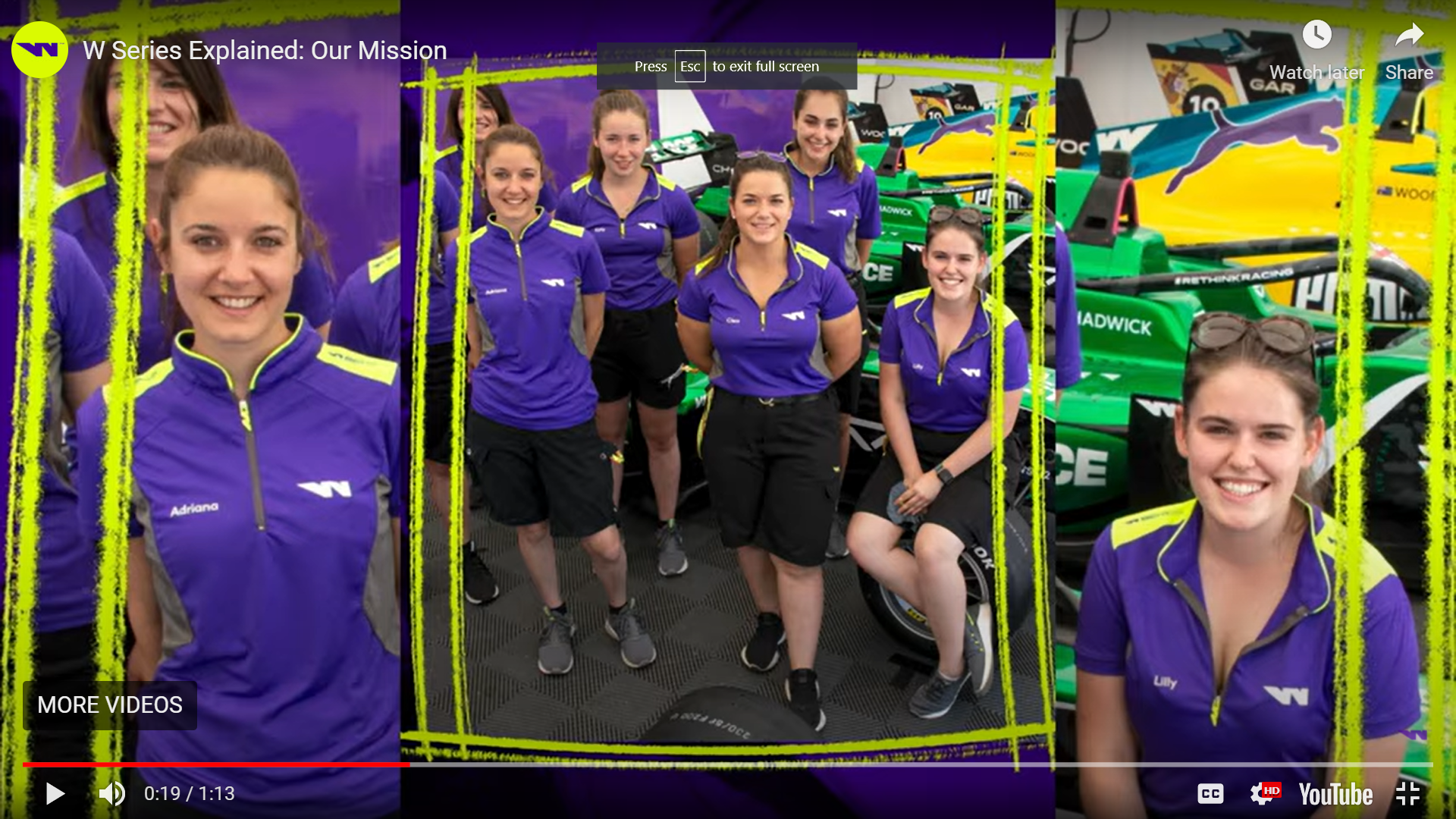
After showing this statistic it displays different pictures of the participants from W Series while saying “we believe that W Series can be an important cultural catalyst for female empowerment.” This section of the video functions to advertise why its mission is important not just for motorsport, but for women in sports as a whole.

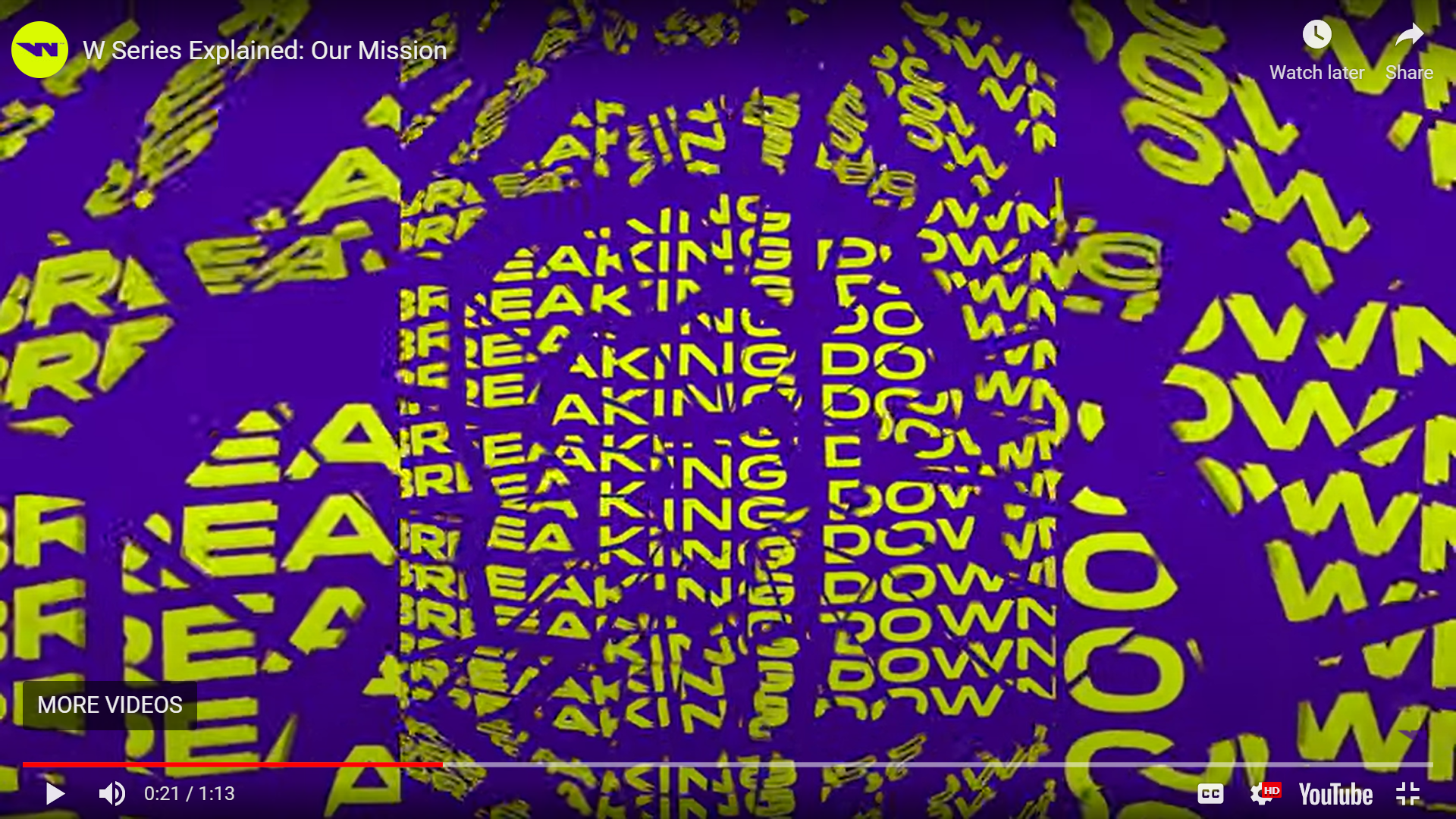
After that, a graphic of the word “breaking down” is shattered into pieces, showing that W Series aims to be unrestrictive for female participants to enter. The video says that W Series is a free-to-enter championship to give every entrant an equal chance.

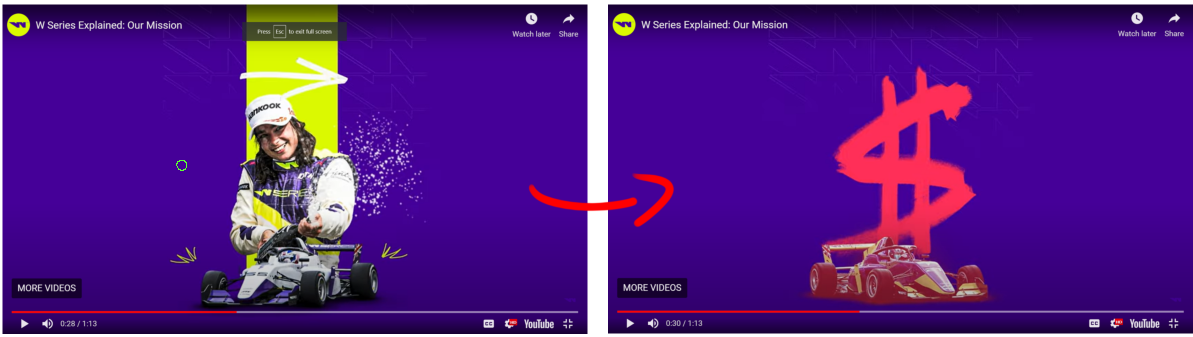
This is followed with an image of the reigning W Series champion, Jamie Chadwick, spraying champagne, followed by a dollar sign above a W-Series car, representing how the series is won by the driver with the most talent, and not those with the most financial backing.

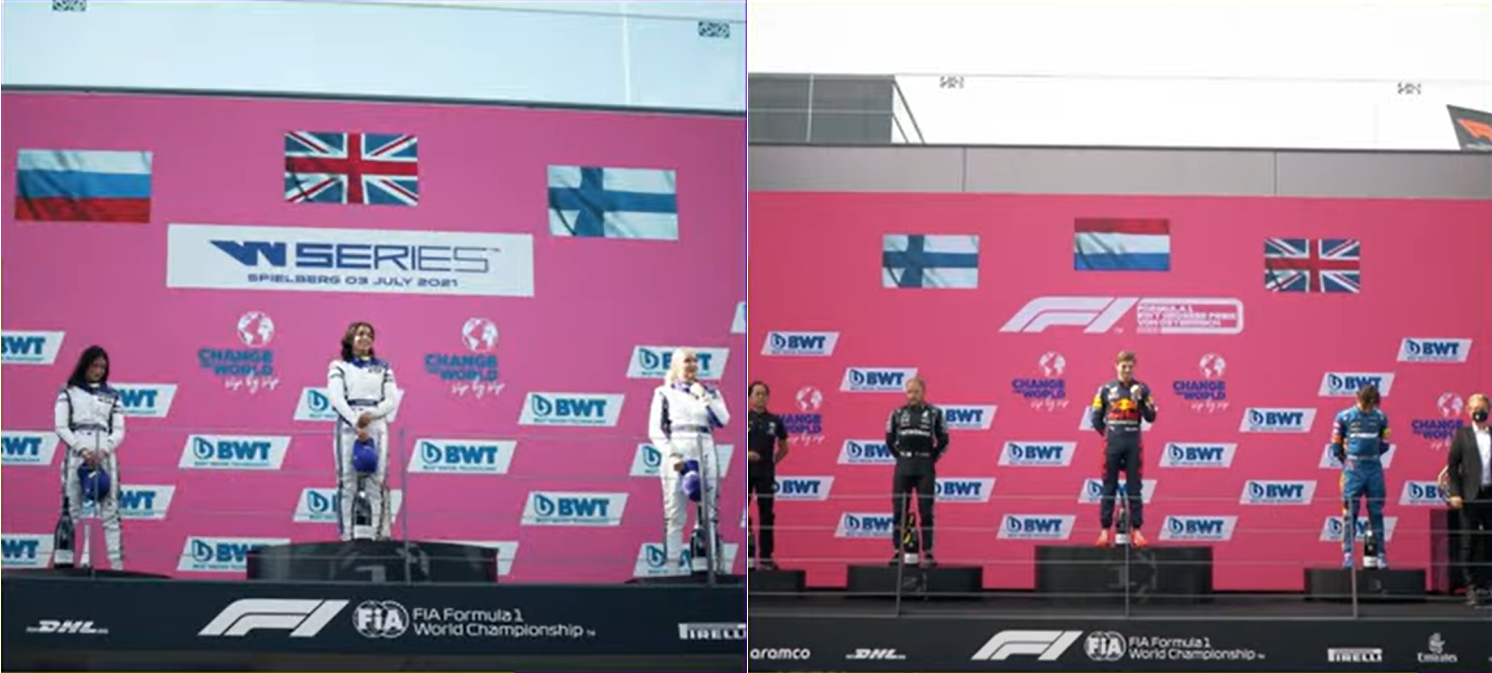
Another key point illustrated by the video is when it first shows an image of a podium ceremony from W Series, shortly followed by one from Formula One. Displaying these images, the video emphasizes how its goal is to have “female and male racing drivers compete on equal terms.” It is clear that one of the goals of W Series is to bring women in the top levels of motorsport along with men.

The final main point shown by this video is when it shows pictures of young girls driving go karts, saying “we want to inspire young girls at grassroots levels by highlighting today’s generation of talented female racing drivers.” With these images, the video is making it clear how there is a future generation of female racing drivers waiting for their big break in motorsport.

The video ends with the message “some say it’s a long road, but we’re in a hurry to get there” as a W Series-spec car drives off into the distance. This concluding message shows that W Series aims to achieve its goals as soon as possible, to ensure that Women have a place in motorsport.

This video overall has effectiveness telling its mission through its graphics and narration. The graphics displayed in the video match with messages being said by displaying easy-to-understand icons and images along with the commentary. To casual racing fans, this video does a great job delivering its message to argue that women can compete in motorsport. However, to more invested racing fans, including myself, W Series’ limitations for its goals can be easily recognized when examining other racing series that the sport intends to influence. W Series succeeds by allowing women from different backgrounds to compete in the series. However, W Series fails to solve the problem most women face when trying to compete outside of W Series. This is crucial since the ultimate argument of this video is that women have the chance to compete with men at top-level racing. While W Series itself may be inclusive, other racing series, particularly the ones it feeds into, are not. The main issue is that motorsport is very reliant on money, and in some cases, favors funding over talent. To enter in Formula 3, you need around €500,000. Even if you had financial backing from driver academies, it is very rare that they would completely cover the cost. In W Series, you are awarded €500,000 in prize money if you win the championship, which should just cover the cost to enter in Formula 3. For example, Jamie Chadwick had to return to W Series for a third season because she cannot secure funding for a seat in Formula Two or even Formula Three.

 W Series aims to solve a problem that motor racing has faced for decades. It attempts to allow women from different backgrounds to be given the opportunity to enter in the highest level in motorsport. While W Series is taking a step in the right direction, it fails to achieve its goals due to external factors. Motorsport categories outside of W Series are still very much elitist, favoring mostly to male drivers with a decent amount of financial backing. If the ideas that W Series implements do not carry over to other motorsports, then inclusion of women in motorsport may still be hard to achieve.

Source: https://www.youtube.com/watch?v=sDDadLGOjUE

Is Vogue Still Setting Unrealistic Body Standards or Breaking Them Down?

Vogue’s “What’s Changing About Fashion’s Relationship to the Body?” featuring Kim Kardashian who talks about the negative comments she has heard about her body both in person and on social media.

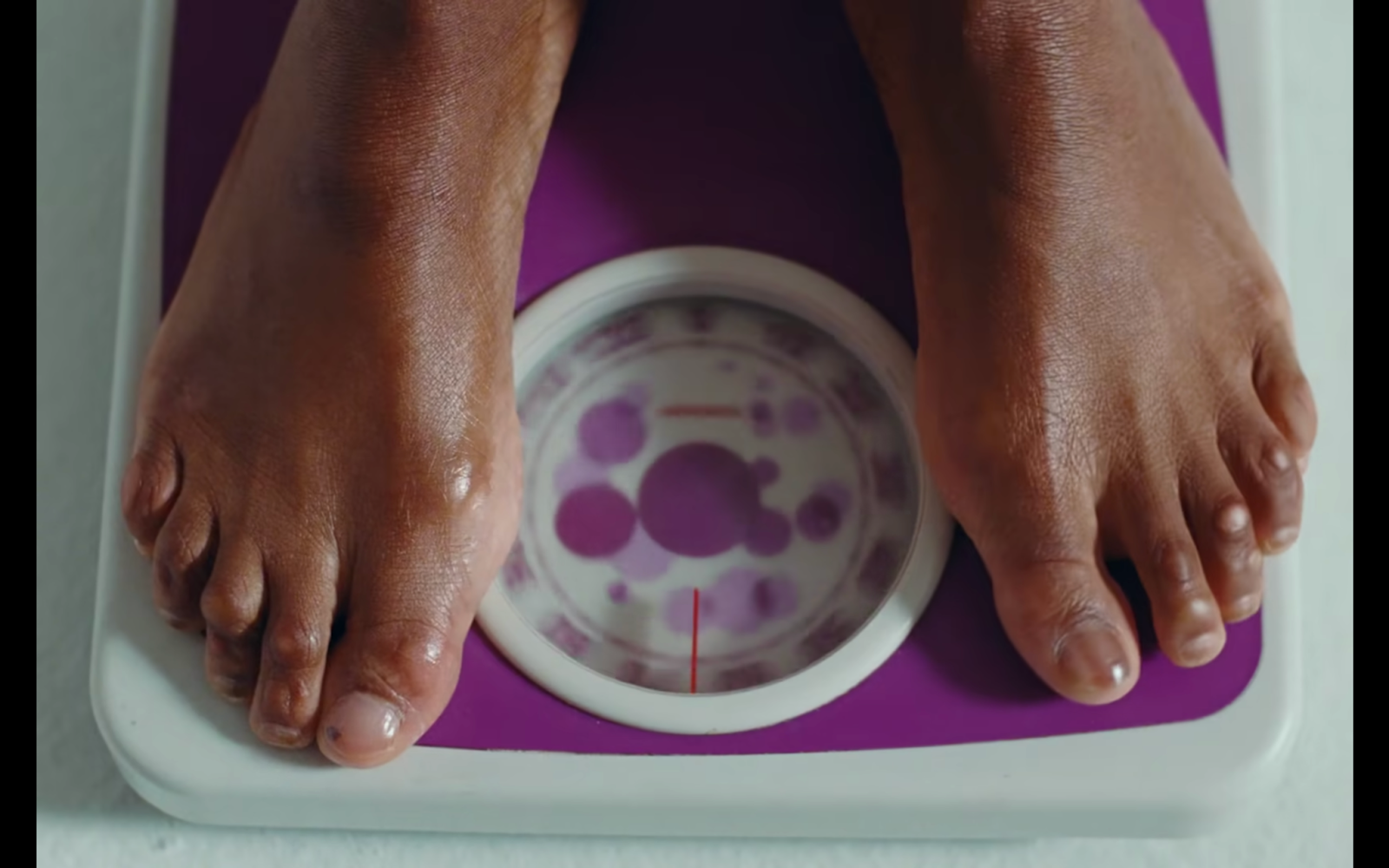
One of the most prevalent issues within the fashion industry is its lack of diversity. Lately, I have been seeing more and more online content discussing this topic. Among this content is a Vogue video I found on Youtube titled “What’s Changing About Fashion’s Relationship to the Body?” The three minute video stars pop culture phenomenon Kim Kardashian alongside other successful female-identifying models of various races, nationalities, sizes, and ages. There are various shots of the models throughout the video as they offer overlapping commentary on their personal experiences loving and owning their bodies. Of course, the video is well-directed and entertaining through its editing and background music. It captures the challenges of finding self worth and confidence in an industry that has set impossible beauty standards not only through discussion but through visual cues. We see scenes of women exercising and weighing themselves whilst hearing the models talk about the negative body shaming they have faced. Historical female sculptures are shown in a probable effort to depict the everlasting beauty standards for women. Vogue clearly wanted to promote body acceptance through this video though there are several ironies that belittle its goal which commenters are not afraid to share. 

Screenshot of a woman weighing herself on a scale while models talk about the body shame they have received.

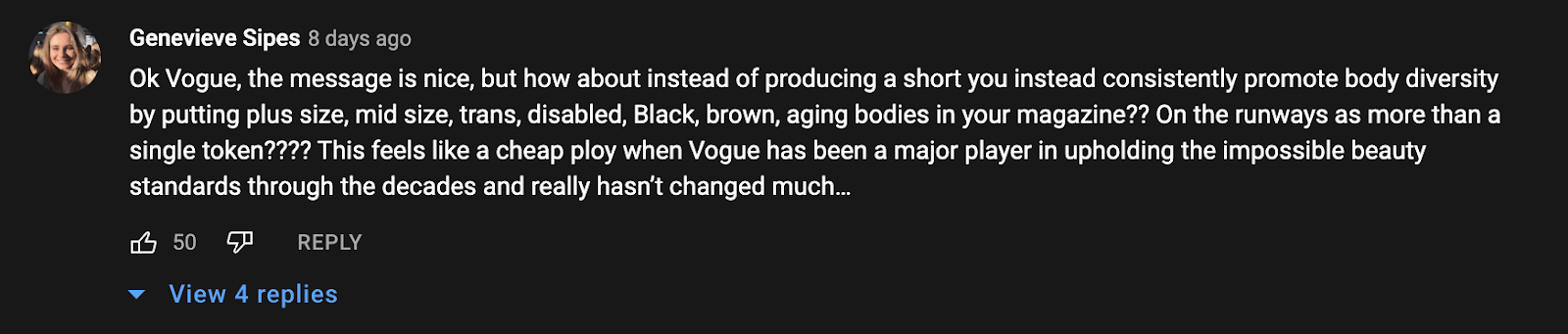
First of all, Vogue is a major contributor to the beauty standards set by the fashion industry. They have taught women that in order to be pretty and fashionable, they must be unattainably skinny and have flawless skin. Many commenters on the video echo this feeling as they reveal Vogue is in fact partially responsible for making them feel uncomfortable with their own bodies. One commenter points out that while the magazine is trying to reverse some of its past mistakes by capturing different bodies, it is not enough. If they want to change the narrative, they have to do more. The company definitely has the power to do so as Vogue is the epitome of fashion for many people. Vogue thinks so too as the “About Vogue” reads “Vogue is the authority on fashion news, culture trends, beauty coverage, videos, celebrity style, and fashion week updates.” They could use their power for good and create a new standard that every body is beautiful. 

The video was not received well not only because it was created by Vogue but because it featured Kim Kardashian. Like Vogue, Kardashian herself has set unrealistic body standards. While Kardashian just as rightly deserves to own her body like anyone else, commenters take issue with her being in a video alongside other women who have battled the beauty standards, not created them. Kardashian readjusts her pose in a short clip and asks if  “this looks good.” Kim Kardashian trying to look her best in a video promoting body authenticity and acceptance makes Vogue’s intentions seem fake. They could have easily made this video without Kardashian, which would have generated more positive reception. Instead, they likely added her to reach a larger audience and generate more profit. It seems like Vogue’s real goal was to appear politically correct whilst making money. Yet, they do capture many other models besides Kardashian who have faced struggles loving their bodies. But does this diverse cast of models appear on the runways too?

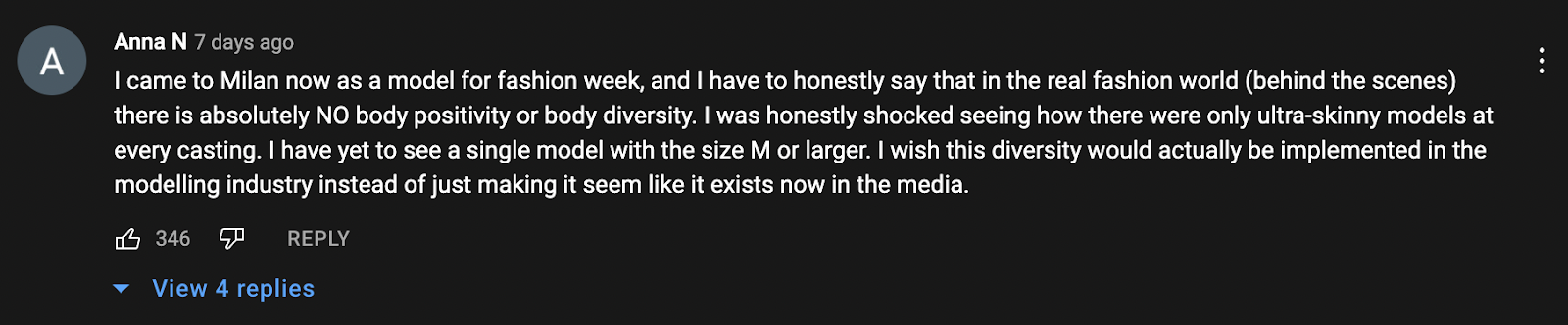
Another commenter who claims to work in the modeling industry argues that this diversity in the video is nonexistent in the actual industry and only appears in the media. I find this fact unsurprising as it’s easy to create the false appearance of something. Despite all the pushes towards diversity, the fashion industry is changing at a slow rate. Vogue doesn’t completely overlook this notion, writing that “body acceptance is a long and winding road” in the description box. They may be trying to suggest that the industry has a long way to go before it is inclusive. Nevertheless, it’s probable that the diversity on screen is mostly absent in real life. 

The video sparked major debate among viewers for good reasons. Others interested in social justice would likely agree with me and the other commenters. It is hard for an audience to watch a video produced by a company that lowered their self-esteem in the first place and celebrate them. Although, I believe Vogue had good intentions. They are making an effort to rebrand themselves and pave the way for increased body diversity in fashion. Obviously, it will take more than a three minute video to achieve this goal and after a bit more research, I found other online content that Vogue has published surrounding body inclusivity. However, none of it avoided criticism including their March 2017 cover on Modern American Women that was criticized for not being diverse enough. It featured seven light skinned models including one plus size model. If they have faced this kind of scrutiny before, I have to wonder whether they expected the same comments or praise for their efforts to celebrate body diversity. Did they want to be celebrated for including models of all backgrounds instead of the usual suspects like Kendall Jenner or Gigi Hadid? Are they trying to forget their damaging past? Perhaps, by continuing to produce more inclusive content, they hoped to show their commitment to body diversity. Nonetheless, this video, various articles, and magazine covers act as baby steps towards a future with representation for all shapes and sizes. Just like many other companies in the fashion industry, Vogue has a long way to go with much more to learn. 

References

Torgerson, Rachel. “Vogue’s ‘Diverse’ Cover Slammed for Not Being Diverse Enough.” Cosmopolitan, 9 February 2017, https://www.cosmopolitan.com/style-beauty/fashion/a8696839/vogue-march-2017-cover-controversy/.

Sister Cindy’s Shaming: Funny or Harmful?

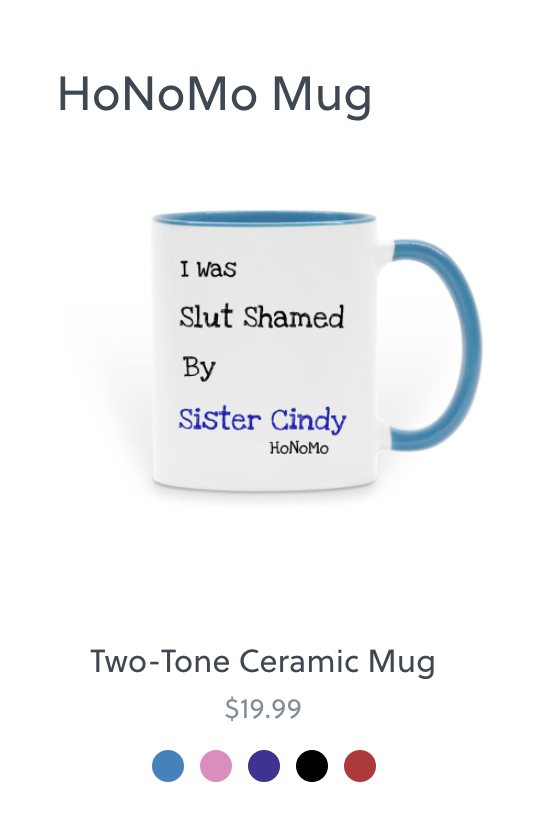
Cindy Smock, or “Sister Cindy” as she calls herself, is an Evangelical campus preacher turned Tik Tok user. She first gained attention when college students posted clips of her speeches on Tik Tok, inspiring her to make her own account. She currently has over 370,000 followers, and #sistercindy has over 194 million views (Fowler). The main subject of her Tik Tok content is encouraging college students, particularly women, to turn to Christianity and be a “ho no mo.” In many of the videos she uploads, she welcomes viewers to “Sister Cindy’s Slut-Shaming Show.” While many of Sister Cindy’s followers regard her as a comical figure, the shock factor she employs in her preaching through homophobic and misogynistic comments is harmful. 

Through a glance at Sister Cindy’s Tik Tok account, it is evident that her content is misogynistic and demeaning towards women. In nearly every video she uploads, she casually uses the words “slut,” “hoe,” or “thot,” as insults towards women. For example, when visiting college campuses, she often changes the names of the universities to incorporate the word “slut.” At the Louisiana State University campus, she renamed the institution, “Louisiana Slut University.” By insinuating that college students are sluts, Sister Cindy is weaponizing the word to be used against women and normalizing the slut-shaming that is common in society, particularly on college campuses. However, Sister Cindy is proud of her slut-shaming tendencies and makes it a common theme in her posts. In a different post filmed by a college student, she exclaims, “You are princesses made in the image of God. Yet, you’ve traded your crown to be a cock-sucker.” This is quite the opposite of sex positivity and guilts women into practicing abstinence. Sister Cindy, or anyone for that matter, should never use guilt tactics to influence other people’s lives. Furthermore, why is this hateful comment only directed towards “princesses,” or women? Why is it that women should feel guilty for engaging in consensual oral sex and men should not? Last I checked, oral sex is an act requiring at least two people. 

https://www.tiktok.com/@maraudwh4re/video/7067272503181364526?_t=8QEQwcooDyV&_r=1

Another example of sexism in her uploads is found in a Tik Tok filmed by a student at the University of Florida. In this clip, Sister Cindy shouts, “Men, if you buy her one margarita, she will spread her legs.” This statement is incredibly insulting towards women. Not only does it perpetuate the view that women are sexual objects, but it also furthers the entitled belief held by some men that women are sexually indebted to them after buying them a drink. In addition, this comment is heteronormative and leads straight men to assume that all women are attracted to them and want to have sex with them, which is simply not the case. Finally, similar harmful views were expressed in a Tik Tok clip of Sister Cindy telling a college student that she is “an accessory to the rape crime on campus” because she is causing boys to get their “passions stirred up” (Fowler). This belief is so inherently false, that it should not require any explanation. The blatant disregard for holding men accountable in situations of sexual assault is destructive to anyone who views this post. It reminds me of the common argument in society that someone is “asking for it” based on the clothes they are wearing. Placing blame and guilt upon women seems to be a common theme in the media posted by Sister Cindy. Again, why is it that sexual assault victims should feel guilty for something that is out of their control and not their fault? 

If you thought her content could not get any worse, we have not even analyzed the blatant display of homophobia present in countless Tik Toks. For example, in one clip while preaching to college students, she orders, “Don’t do it. Don’t kiss a girl and like it.” In defiance of her hate speech, two women make their way through the crowd to kiss in front of Sister Cindy’s platform. Apparently, the act of two women kissing is a difficult sight for Sister Cindy, because she has to cover her eyes. In a second Tik Tok, Sister Cindy, with no shame, shouts to a young man walking past her, “Are you a homo? You kinda act a little effeminate there. You need to repent!” There are so many problems with this statement, it is a challenge to decide what to unpack first. To begin, a straight, cisgender person should never use the term “homo” to describe someone of the LGBTQ+ community. Second, Sister Cindy is reinforcing the societal gender expectations that men cannot be feminine and women cannot be masculine. And if that is the case, then that person must be a member of the LGBTQ+ community. Finally, telling someone that they need to repent because of their sexuality, something that is out of their control, is unacceptable. Religion should never be manipulated to discriminate against groups of people. People’s sex lives and sexuality are an intimate part of their lives and should never be a subject of criticism. Therefore, someone who posts homophobic content, like Sister Cindy, should not have a platform to project those hateful beliefs. 

To reflect, one’s values and beliefs should never be used as a weapon or a way of guilting others into adopting those practices. While Sister Cindy’s intention may be to educate college students, her comments are misogynistic, heteronormative, homophobic, and may even be classified as hate speech. Sister Cindy even admits that she expects to be removed from social media for her problematic comments (Fowler). If that is the case, what is Tik Tok waiting for?

Works Cited

Fowler, Kate. “Who is Sister Cindy? Evangelist Christian Preacher Turned Tik Tok Star.” Newsweek, 6 June 2021, https://www.newsweek.com/who-sister-cindy-evangelist-preacher-tiktok-star-1597651. 

I love this post and how it highlights the way that people will oftentimes use comedy to hide rhetoric that is actually very harmful. Although Sister Cindy is oftentimes funny, she’s still promoting a toxic culture that prevents women from embracing their sexuality. This is a super important topic and I’m glad that you’re shedding light on it!

Feminist Mixtape: The Man by Taylor Swift

Taylor Swift’s pop anthem, “The Man,” is a catchy, upbeat song aiming to address the inequality between how female artists and male artists are treated and talked about. With a driving bass line, fun and catchy melody, and easy to understand lyrics, this song is able to reach audiences young and old alike. In her song, Swift discusses how every aspect of her personality, looks, actions, and decisions would be seen in a different way if she were a man. In our society there is a double standard between what is acceptable for men to do and for women to do. 

The line “They’d say I played the field before I found someone to commit to” addresses how when a woman cycles through multiple relationships before settling down with “the one,” she is judged differently than a man would be even though it is very common for both men and women to have many relationships. Swift changes this negative narrative by stating “And that would be okay for me to do” confirming to her audience that having multiple partners in life is normal and not something to be ashamed of.

Later in the song, Swift says “When everyone believes ya/ What’s that like?” This line is referring to the #MeToo movement and how women that come forward about sexual assualt, harrassment, and rape are most often doubted and questioned. Victim blaming is present in our society and is disproportionately against women more than men. 

The final line that stood out to me when listening to this song was “What I was wearing, if I was rude/ Could all be separated from my good ideas and power moves.” Women’s clothing is all too often equated with their success and the quality of their work. Instead of focusing on what women actually have to say or what their ideas are, the focus is on what she is wearing. Specifically, when female artists, actresses, or celebrities are interviewed the topic is almost always about what they are wearing, or how they look. In contrast, men are typically interviewed on what their acting experience was like, or what the song is about, for example. 

I connected this song to the reading by Lorber called “The Social Construction of Gender.” In the reading she argues that “it does not matter what men or women actually do; it does not matter if they do the same exact thing, the social institution of gender insists only that what they do is perceived as different” (Lorber 58). In “The Man,” Taylor is arguing that if she did not change anything about her actions but existed as a man, she would be perceived differently by society and treated better. Simply because we as a society perceive some actions to be more acceptable when done by a certain gender, it has become unacceptable to cross those made-up gender barriers. The issue is that there is no rhyme or reason for why we have these expectations for what different genders can or cannot do. The idea that what a woman is wearing determines her worth or success or how many partners a woman has had determines her value is a baseless belief that society has created. Taylor Swift is one of, if not the, biggest artist currently. She has an enormous platform and the ability to create change with the message she shares through her artistry and voice. This song is an attempt to address the disparities between how female and male artists are treated and spark discussion on how we can create change. Her feminism is not perfect and she can do a lot more to include intersectionality in her feminism and to use her priviledge uplift marginalized voices.

Feminist Mixtape: “BO$$” by Fifth Harmony

Although Fifth Harmony may no longer be together, the message in their hit song “BO$$” remains relevant and important. The lyrics paired with the strong brassy sound of the instrumentals make this song an anthem of empowerment for women. 

This song portrays ideas of second wave feminism, defying ideas that women must stay in the home and only be a housewife, and instead empowers women to work and get the money they deserve, demanding respect from everyone around them. This can relate to one of the most prominent works from the second wave, The Feminine Mystique by Betty Friedan, saying “She can say ‘no’ to those mass daydreams of the women’s magazines and television, ‘no’ to the depth researchers and manipulators who are trying to ruin her life” (Friedan 280). Lyrics such as “Workin’ for the money ‘cause it’s what my momma taught me So yo ass better show me some re-spect” reject stereotypes continually placed on women, similar to Friedan’s quote and the idea of second wave feminism overall.

Additionally, given the fact all five members are women of color, the song can be interpreted as a message of empowerment for all women, no matter their race or ethnicity. The lyrics repeatedly include strong Black women, saying “I’m on my Michelle Obama sh-” and “purse so heavy getting Oprah dollars,” highlighting the successes of notable women of color.

Not only are the lyrics empowering, but the music video sends a strong message of feminism and defying gender roles. Within the first ten seconds, messages such as “Find yourself. And be that,” or “Dreams don’t work unless you do,” are displayed across black screen for us to really read and understand their importance. There is also a scene of arm wrestling with the five girls against a group of men, where they all take their turn beating each man in a match. Arm wrestling has always been portrayed as a sign of strength and masculinity, I’ve noticed particularly in TV shows or media, so having all the girls beat the group of boys shows the reversed gender roles the message of the song conveys. 

Something that could have added more nuance and depth to the song is the mentioning of certain struggles or difficulties the members, or women in general, have to face. Lyrics such as “Don’t want yo compliments, use common sense,” or “I ain’t thirsting for no bae” hint at struggles women face by highlighting assumptions often made about women, but the message of the song could have been more impactful if deeper, more direct struggles women universally can relate to were included. Bringing back the fact that all of the members are women of color, while I love that they included other iconic Black women in the song, it would have been more impactful to see the members mention moments of struggle and triumph from their perspective as women of color. This would add more interest and depth, avoid repetition, and make it more relatable to women of color everywhere.

Theory to Praxis: Reimagining Greek Life at Davidson

As a school that was founded by white genteel slave owners and remained segregated until the 60s and all-male until the 70s, Davidson has a long history of elitism. Unfortunately, the college has done a poor job of repealing exclusive traditions and making the school as welcoming and safe as possible to people of all walks of life. One particularly glaring area of inequality is the social structure of Greek life on campus.

There are many things wrong with the status of Greek life at Davidson. Racial disparities are perhaps the most visible problem. My friend Michaela Gibbons is working on a project called Stories Yet To Be Told, conducting research on the history of Patterson Court Council (PCC) – the governing body of Greek life at Davidson. We have had many conversations about PCC this semester, and a lot of them have centered around PCC’s dominating whiteness. Kimberlé Crenshaw’s theory of intersectionality and Lorde’s “There are No Hierarchies of Oppression” (1983) emphasize that racial equality (and other equalities) are necessary to realize gender equality. All of the nine predominantly white PCC organizations have individual houses on campus, while the six PCC organizations for students of color must share space at the BSC (Black Student Coalition) house. This is clearly a problem for feminism, although solutions are somewhat difficult to propose. In this case, the simplest method to reduce white special power on campus may be to disband PCC or consolidate the predominantly white organizations.

Aside from racial inequality, another issue with Greek life at Davidson is its relationship to the gender binary. As a collection of organizations with membership based on male or female gender identification, PCC reinforces ideas that there are only two genders, which is clearly false when one understands Lorber’s perspective that gender is constructed. Since humans have made up the concept of gender, there is no reason to believe in all-or-nothing gender rules. And yet, PCC membership is exclusive to men and women. (Turner House, one of the eating houses, does allow anyone who is not a straight cis male to join, but this introduces the problematic circumstance of requiring people to out themselves). Furthermore, the predominance of “bristerhoods” (fraternity-eating house mixers) perpetuates heteronormativity. Requiring all PCC organizations to be open to all genders would be the easiest solution to make Davidson more feminist, although that would require converting some fraternal organizations to eating houses.

A final, and particularly glaring problem with PCC at Davidson is rape culture. We briefly talked in class about how society conditions males to violate and disrespect female bodies, and there is a prevailing willingness to let this slide. Society reinforces hegemonic sexual scripts, an orgasm gap, and poor understandings of consent, all of which lead to unequal sexual citizenship. This means that women have less power than men to make the choice to have sex. This is obviously problematic for feminism. At Davidson, PCC hopelessly perpetuates rape culture. For liability reasons, the school has strict rules about alcohol for parties at PCC houses. Because PCC organizations are too lazy or busy to plan detailed weekly parties and want to avoid strict scrutiny from the school, weekly parties are predominantly hosted at Armfield, the only residential space on campus where open consumption is permitted. Currently, Armfield apartments which host parties are exclusively rented by predominately white men with strong fraternity ties. This leads to constant sexual misconduct and a lack of safety at parties. Once again, it is not simple to find a solution to male ownership of party space at Davidson. However, some viable options would be disbanding PCC, creating more school-sponsored social events, and preventing Armfield apartments from having five male residents.

PCC is rife with inequalities, much of them a byproduct of Davidson’s elitist traditions. Thus, disbanding PCC and ending Greek life at Davidson is probably the most feminist solution. This would introduce a social vacuum for some time, but it couldn’t be any worse that the forced quarantine of the 2020-21 academic year.

Feminist Mixtape: “Beautiful is Boring” by BONES UK

“Beauty is in the eye of the beholder.” A lovely saying that we’ve all heard many times. However, society’s idea of beauty is less defined by the eye of the beholder than as a concept that changes with the typical depictions of people in media of the time. Jean Kilbourne’s TED Talk on Killing Us Softly IV: Advertising Images of Women gives a comprehensive look at and interpretation of her research on how women have been portrayed in media since the late 1960’s. When listening to the song “Beautiful is Boring” by BONES UK, the connections make themselves. 

The first verse includes the lyric, “They said they did not want my face in their magazine/’Cause I’m not beautiful”. The singer doesn’t suit society’s definition of beautiful, and therefore is denied access to certain levels of visibility. In regard to societal standards of beauty, Kilbourne says, “From my perspective of over 40 years, the image of women in advertising is worse than ever. The pressure on women to be young, thin, and beautiful is more intense than ever before” (3:27-3:37). The singer doesn’t care about how society defines beautiful, young and thin and perfect. The second verse has the lyric, “It does not please me to be easy on any of your eyes”. Clearly, the singer’s priority does not fall with how others perceive her. This confidence and self-assuredness isn’t something that comes naturally however. Kilbourne points out that “the self-esteem of girls in America often plummets when they reach adolescence. Girls tend to feel fine about themselves when they are 8, 9, 10 years old, but they hit adolescence and they often hit a wall. And certainly, part of this wall is this terrible emphasis on physical perfection” (Kilbourne 6:51-7:17). Many times, as Kilbourne states, the expectations from society to look a certain way and be perfect can be crushing. It can absolutely destroy a young person’s confidence. 

The singer isn’t unaware of this, despite her own confidence and self-assuredness. The third verse has a lyric that critiques society on “teaching children to be anything other than who they are”. Kilbourne has many points on the alteration of children’s perceptions of themselves in society by media, from girls being “more prone to eating disorders, depression, and low self-esteem” (13:17-13:24), boys being “encouraged to look at girls as sex objects, …encouraged to be sexually precocious” (10:17-10:33), and women of color being “considered beautiful only insofar as they resemble the white ideal: light skin, straight hair, Caucasian features, round eyes” (5:25-5:39). The whole message of the song, “beautiful is boring”, argues that people are much more interesting when they exist as themselves than conform to society. This message is inherently feminist, as it pushes against the factors in society that hold women back from being their complete selves.

Theory to Praxis: Ending Child Abuse and Building Resilient Families

Written by Anna Newman

Overview:

I will be implementing my knowledge of gender and sexuality studies, specifically on women’s rights, feminism, and rape culture, to plan a civic engagement experience over the summer. Through a collaboration with SAFEchild in Raleigh, North Carolina and Strong Girls United, the goal of the project will be to educate children on noticing and responding to child abuse appropriately before it escalates, while also learning more about the implications that domestic violence has on parenting.  

About the Partners: 

SAFEchild is a non-profit advocacy center that ensures children have a safe living environment, free from abuse. SAFEchild empowers the children and their families by providing counseling services and childcare. One important aspect of SAFEchild is a program they run called “Funny Tummy Feelings” which is a program that educates first-graders about noticing and appropriately handling child abuse when they see it or are subject to it. Funny Tummy Feelings has been implemented in the Wake County public school curriculum for first graders; however, the goal of this project is to expand Funny Tummy Feelings to the Strong Girls United program. 

Strong Girls United is a mentorship program for young girls which pairs collegiate athletes with elementary school girls and the groups meet to discuss confidence building, mental health, and new sports skills. I believe that Funny Tummy Feelings could also be a beneficial addition to the Strong Girls United curriculum. Unfortunately, rape and sexual abuse are pervasive parts of society, but one way to combat this is to educate about rape culture and the ways you can stand up to it and notice it before it escalates.

Connections to GSS:

This project will be focusing on providing children and mothers the skills needed to build confidence in response to child abuse and domestic violence. Confidence and mental resiliency begin at a young age, and if we can empower elementary school girls, we can empower an entire generation to put an end to domestic violence and child abuse. My research would overlap with several articles that we studied in class about feminism. In the article titled Committee on the Status of Women in India, the author discusses how marriage can become a “hindrance for women seeking career advancement” which demonstrates that a marriage with power imbalances is the basis for domestic violence and abuse of power. Betty Friedan talks in the Feminine Mystique that in the 1970’s, rape was not considered a penalty. Friedan also discusses the topic of women not being fulfilled simply by staying in the house, making beds, washing dishes, and cooking for the family, which relates to the lack of liberties that the woman has within a marriage. These hindrances that married women face are the basis for domestic violence and patriarchy. One notable quote from the Feminine Mystique is “when she stopped conforming to the conventional picture of femininity, she finally began to enjoy being a woman” (279). When women stop allowing their husbands to control and abuse them, they enjoyed being women. Additionally, bell hooks’ work called Feminism is for Everybody encourages the notion that equality is the goal of feminism, and the goal is not to subvert men. In relation to my book review on the book titled Medical Bondage, white male physicians were abusing enslaved women’s bodies by taking advantage of their position of power and conducting unsolicited gynecological research and painful experiments. The consequences of these experiments were destructive, both physically and mentally, for these women. The enslaved women’s experiences with the gynecological experiments parallel the domestic violence that women today face in abusive relationships. Abuse within a relationship affects the way a mother can parent a child, which demonstrates the vicious cycle of domestic violence at a young age starting with a lack of self-confidence, then getting wrapped up in abusive relationships, and to then raise kids in an environment filled with abuse and neglect. So, my goal for this project is to confront and help children notice domestic violence at a young age so that they can grow up to be confident people in healthy relationships. After doing an analysis on the film Moonlight in my writing class, it was brought to my attention that some abusive family dynamics are avoidable, while others are out of one’s control. In Moonlight, a young boy by the name of Chiron was being raised in an abusive and neglectful household because his mother was involved with dangerous drugs and did not have time for her child; however, the opportunities available for the mother to parent her child were lacking. While I’m doing my research, l will be sure to look at the context of the situation (what resources are available to the family?) versus judging the situation and the parenting choices. 

Limitations:

The limitation of this project is that Strong Girls United does not mention anything about transgender children, non-binary children, or gender-nonconforming children. This is a research question that l will be asking the SGU executive board in hopes that something is done to make the organization more inclusive of children of all gender identities. Part of feminism is creating equity across the genders, so this feminist project is aimed at creating equity for boys, girls, and gender non-conforming children. Overall, the goal of this project is to provide a form of mentorship for children seeking assistance with confidence, mental health training, and skills needed to confront abuse if they ever need to use them. 

Implementation of Plan: 

A few summers ago, my mom and l volunteered at SAFEchild and we babysat the children while their mothers were in a counseling meeting. I am hoping to resume my volunteering with SAFEchild by babysitting the children and then shadowing one of the leaders during the counseling meetings. I feel like I would gain another dimension of appreciation for the struggles that these families deal with by listening to the mothers speak. Also, it would be impactful to listen to the women’s stories of domestic abuse within their marriages and how this abuse impacts their ability to mother their children. 

After shadowing a counselor, l would ask one of the leaders/counselors at SAFEchild to be a guest speaker at one of the meetings with Strong Girls United. The counselor can focus on teaching a Funny Tummy Feelings course for the SGU children. The plan is to empower young girls by giving them to skills to notice and respond to child abuse in a confident way. One possibility of furthering my research experience would be to shadow a pediatric physiatrist to learn about the impacts of child abuse, neglect, and domestic violence on youth’s mental health.