Insatiable: The Complex Commentary on Body Image for Young Women

Poster for Insatiable

Growing up, we are often told what to do with our bodies – women especially. We are told how to dress, act, speak, and eat. This message comes from many sources, including our parents, social media, and movies/TV shows. One TV show that communicates these social norms to teen girls is Insatiable. It shows women in a negative light in a variety of ways. Fat women are unhappy, inhuman and undesirable; skinny women are manipulative and willing to do anything for a man. Another message communicated by Insatiable is that, for women, romantic relationships with men are more valuable than female friendships.

Insatiable follows a high school student named Patty Bladell, played by Debby Ryan – a former Disney channel star, who already has a large following of pre-teen girls. Patty spends much of her life struggling with her weight until she breaks her jaw and is forced to go onto a liquid diet that causes her to lose 70 lbs. Once she becomes skinny everyone starts paying attention to her, including Bob Armstrong, a local lawyer and beauty pageant coach. 

Debby Ryan as “Fatty Patty” vs. “Sexy Patty”

Insatiable reinforces the idea that there is a wrong way for women’s bodies to be—fat and unhealthy—and a right way for women’s bodies to be—skinny, pretty, young, and sexy. Regardless of their weight, all women’s bodies are objectified, showing their power and agency coming from external factors such as appearance. Fat women are portrayed as unhealthy and undesirable; skinny women are portrayed as selfish and boy obsessed. 

These messages are communicated through scenes involving “Fatty Patty” and “Sexy Patty.” The scenes involving Fatty Patty alway portray fatness in a negative light. She is seen binge eating at home on a Friday night with her best friend instead of going to a football game. She says, “So, while my classmates were out losing their virginity, I was at home, stuffing another hole…” (“Pilot” 1:002 ). That links being sexually desirable and active to being skinny. It also denigrates a strong female friendship and places more value on heterosexual relations. There are also several instances when Patty is compared to a pig. Someone pasted a photo of her face taped to a pig on her locker, and she received the comment, “Smells like bacon,” (“Pilot” 2:34) from skinny girls. This is comparing Patty to an animal and dehumanizing her. Pigs are known for being dirty animals so comparing her to one conveys the message that being fat is “dirty.” Being fat is also associated with being unhealthy. When Patty starts her laps in gym class, she passes out after 15 seconds. Throughout the episode, flashbacks of Debby Ryan in a fat suit reminds the audience how bad Patty’s life was when she was fat. It instills the idea that being fat is undesirable, dirty and unhealthy within younger and teenage girls.

Just as Fatty Patty is used here as a cautionary tale, Sexy Patty is used to show how women use their sexuality to attain their end goal: men. Patty’s main goal is to get with Bob Armstrong, who is an older, married man and an accused child molester. Rather than being cautious, she makes light of this by saying, “Which means I might actually have a shot [at being with him]” (“Pilot” 12:35). Patty goes to great lengths to achieve her goal. Now that she is skinny she understands that she can use her sexuality as a tool to achieve this. Patty seduces a clerk at a convenience store to get him to commit a felony on her and Bob’s behalf. Patty also harms other women to achieve her goal. When Patty and Bob’s wife, Coralee, first meet, Patty calls Coralee “A shrew” (“Pilot” 20:45). Then, Patty says, “I was already driving a wedge between them. Long Island Lolita would have been proud” (“Pilot” 20:50). This is an allusion to Amy Fisher who had an affair with Joey Buttafuco when she was 16 and he was 38. Fisher shot Buttafuco’s wife in the hope she would be able to be with Joey. Coralee also objectifies Patty, based on her appearance. She tells Bob, “She looks like an underage hooker” (“Pilot” 20:15) immediately focusing on Patty’s sexual appearance. 

The title of this show, Insatiable, has multiple meanings. Patty is always hungry and wants to eat, but cannot eat everything she wants due to the fear she will get fat again  (which apparently is the worst thing imaginable). Insatiable also refers to women being hungry for power, often with the ultimate goal of being with men.

While Insatiable can be seen as a parody, the images and messages about women, their bodies, and how they achieve agency (or not) are pervasive. Even though these messages are ostensibly being ridiculed, the intended audience of pre-teen girls may not realize that much of it is satire. Insatiable is “funny” but its humor is based on negative ideas and stereotypes that are harmful to women, especially young viewers who don’t have a well-developed lens of media literacy and who will not understand that this is a parody not a guidebook on how women should behave.

Citations: “Pilot.” Insatiable, created by Lauren Gussis, season 1, episode 1, Netflix, 2018.

Pharrell Williams: Blurred Misogyny 

Pharrell Williams: Blurred Misogyny 

In 2013 superstar Pharrell Williams teamed up with artists Robin Thicke and T.I to bring us “Blurred Lines.” The Times’ 2013 song of the summer, 640 million streams, 14 million copies sold – The song enjoyed instant and lasting success. But the song’s undeniable catchy beat, ironically, blurred its appalling lyrical and visual message. This piece will uncover what so many of us missed: 

The song’s lyrics promote three very troubling concepts:

While one of the most catchy, the line “I know you want it, I know you want it” is equally – if not more – problematic. These lyrics, sung by Pharrell, are a direct challenge to a woman’s consent. They imply that what comes from a woman’s mouth is not truly what she wants. Smiling, laughing, pushing – the video encourages a man to reject a woman’s word and insinuates he can do so in a joking and fun manner. This line reflects a more significant cultural issue; men have historically – purposely and not – misinterpreted a woman’s consent. This lyric suggests the line between consent and refusal is cloudy (blurred) when in reality, a woman is always firm in her decision.

Additionally, Pharrell sings about the “good girl,” the perfectly manufactured woman in the eyes of the patriarchy. “good girls”, as defined by Pharrell, are women who are sexually passive, almost timid about their desires, and are in need a man to direct, if not force them. The concept of “good girls” exists to build frequently unachievable standards for women. These lyrics normalize a concept we see so often in other forms of media today: women are sexually drawn to men who are aggressive and forceful about their desires. This enables men to feel as if forms of sexual harassment and sexual assault are just another kind of “advanced” flirtation. 

Lastly, Pharrell sings, “Tried to domesticate you, but you’re an animal, baby it’s in your nature” – In the music video, Robert Thicke mouths Pharrell’s words into the ear of a black model. An insensitive shot in which the lyrics can be perceived in a racial context. Black women being considered anything but human has enabled centuries of medical malpractice in which Black women were used as test subjects to advance scientific understanding. The racial implications of this shot are undeniable; forceful power dynamics and dehumanization have assisted and continue to assist in the oppression of black women.

How Blurred Lines directs masculine objectives: 

Along with the lyrics, It’s important to analyze who Pharrell’s intended audience is. While an artist will generally cater to the reasonably widest audience, it is clear that the message he pushes is meant for young men. This becomes apparent as he displays the social and sexual success of men who employ the technique of using and forcing themselves onto women. 

On the top: T.I, a rapper most popular with young male audiences, flirts and dances with three separate women while the lyrics “I know you want it, I know you want it” play. The positioning of the shot is essential; T.I dances in front of the women, who appear to serve as his backup, dancing behind him. This shot reinforces the idea that women should be treated as props and helpers in a man’s life. The inappropriately flirtatious T.I also underlines that men who subscribe to aggression and assertion with women will be sexually hyper-successful. 

On the Bottom: T.I, Pharrell and Robert Thicke are pictured together. All three of the men are in classy attire. The scene endorses the idea that forcing yourself onto women will not only bring you success with women, but will additionally give you status and respect among your friends. In contrasting their clothing, we see that the men, who are fully dressed, exude a message of strength and control, while women, dressed in only revealing clothing, are judged solely based on their body image and are a supporting entity to the man’s status. 

Years later, Pharrell and Robert Thicke have admitted their embarrassment for their part in writing the song. Remorse is a step in the right direction, but the damage this song has caused and will continue to cause is evident. Younger generations that are broadly refused access to sex education in schooling often turn to forms of media for guidance. Messages like that of Blurred Lines subconsciously encourage the persistence of misogyny and rape culture in our society. The importance of the lesson we can learn from this is anything but blurry: the media we consume matters, our consumption has the possibility of enabling good and bad. 

My Skin: An Anthem of Self-Love

As Lizzo’s presence in mainstream media has rapidly increased in recent years, so has the impact of her iconic messages of body positivity and self-love. Though many people know her for her 2019 album “Cuz I Love You” and her recent 2022 album “Special,” Lizzo has always been calling for reform in the way that society views women’s bodies. Her 2015 song “My Skin” and accompanying music video serves as a call to people everywhere to love and appreciate their bodies and skin.

Lizzo opens the music video with a brief monologue in which she states that learning to love yourself and your body is a journey that every person experiences—especially women. Her first verse paints a picture of why this is the case: society has created an impossible beauty standard that women feel that they must strive towards. Women are taught from birth to compare their bodies to what they see in media and to each others’, creating insecurity and self-hatred toward their own. This is an unspoken yet universal experience—one that Lizzo calls “the darkest, best kept secret.” As women compare their bodies to each others’, they are pitted against each other in competition for all the promises—love, respect, happiness—that society has convinced us we will receive if our bodies meet its standards. Lizzo articulates this in her lyrics “Let it bring us together, or it could tear us apart.” This comparison of bodies is currently tearing women apart. Lizzo is calling for women instead to unite against this harmful societal norm and revel in our universal beauty. She asserts that “the most beautiful thing that you have ever seen is even bigger than we think it means,” suggesting that the beauty of bodies and skin as well as self-love is much more significant and important than we give it credit for. She accompanies these lyrics with close-up images of diverse, seemingly unfiltered bodies painted in a beautiful light. These bodies are not perfect: they have fat, blemishes, stretch marks, hair, and other qualities that our societal standard would label as flaws. This representation of imperfect, diverse bodies in a popular music video tells women that their bodies are normal—and that their bodies are also beautiful, desirable, and worthy to be looked at.

Lizzo also applies this specifically to women of color. Societal beauty standards have created a very specific picture of what true beauty looks like: the “ideal body” is often portrayed as white and thin. Due to this association between whiteness and beauty, people of color are made to feel as if their skin inherently lacks beauty. The internalization of this belief takes away people’s ability to love and be proud of their skin, leaving shame in its wake. This can also be applied to fat women. Because thinness is seen as a requirement for beauty, fat women are made to feel as if they can’t be beautiful. In the chorus, Lizzo sings, “I woke up in this—in my skin. I can’t wash it away, so you can’t take it from me—my brown skin.” It is a call for women to reclaim the definition of beauty in their own skin. As Lizzo sings this in the music video, she runs her hands over her body with love and compassion and shows close-up images of her skin and hair, appreciating her body for its beauty.

As the music video nears its end, Lizzo, along with the other women in the music video, begin to pop the balloons that have been around them, sending glitter flying everywhere.

Throughout the video, it was not apparent that the balloons were filled with glitter—they seemed like regular balloons. As long as we believe the misconceptions that society has imposed on us, we cannot see the possibilities for ourselves that it hides. They initially appear unassuming, but when societal norms and standards of beauty are rejected, the result is magical. We can have full compassion for ourselves and unconditional love for our bodies and skin. Lizzo then runs her hands through the gold glitter and spreads it over her body, symbolizing an external layer of self-love and compassion.

This song and music video does a phenomenal job of encouraging women to reject societal standards of beauty and love their bodies as they are. Its inclusion of imperfect and diverse bodies adds representation to a historically image-conscious industry that has been plagued by photoshop, telling women everywhere that their bodies are normal and beautiful. Lizzo is an incredible role model for young women who face these standards—her unapologetic love for her body encourages others to do the same. Her popularity and presence in mainstream media gives hope that one day we can break free from societal standards and have universal unconditional love and respect for all bodies.

How I Met Your Mother – Sitcom For Skinny People?

Trigger Warning: fatphobia, mention of sexual assault

How I Met Your Mother (HIMYM) is a popular American sitcom that came out in 2005 and continued through 2014. Set in the New York City, it follows the story of a group of friends and their romantic relationships. The main character, Ted, is the narrator, and tells his children the story of how he met their mother, while also including the stories of all of his friends in the process. Barney, one of his best friends and our main focus today, is known for sleeping with a lot of women, inappropriate jokes, and, unfortunately, fatphobia.

“Over 200 women, spanning six continents, 17 nationalities, 74 sexual positions, and not a single fatty. It’s impressive.” (Season 5, Episode 14)

Barney’s idea of “success,” which involves sleeping with a variety of women from different backgrounds, emphasizes not one of them being fat. He presents sleeping with a fat woman as something to be ashamed of and avoid at all costs, expressing it as success if being able to avoid it.

“Let’s say the young lady you’re bringing home is dressed for winter. Under those layers, an unwelcome surprise could await you. The scale with body fat calculator I’ve hidden under the welcome mat makes sure you never have banger’s remorse.” (Season 8, Episode 19)

By going through so many measures to ensure he doesn’t sleep with a fat woman he shows the audience that they themselves should avoid it at all costs. Additionally, he points out that winter layers can make it impossible to assess whether someone is fat or not; it implies that any form of fat is unacceptable, even if not seen at first. I believe that, unfortunately, Barney is generally a liked character, meant to make the audience laugh and, perhaps, copy some of his behaviors. For example, his famous line “It’s gonna be LEGEN… wait for it… DARY. It’s gonna be LEGENDARY” is catchy and can easily be used by everyone to “spice up” what they’re saying. What if Barney’s other behaviors are copied like that as well?

The constant mockery of fat people, and especially fat women, is a big part of the show. The audience may laugh, but through those not-so-subtle jokes, they are subconsciously impacted. Barney’s comments can create problems that go way beyond a joke – it can lead to extensive weight bias or violence. Barney even made up a commandment, which is defined as “a divine rule” called “no fat chicks.” It is also catchy, like his famous saying mentioned earlier, and is incredibly harmful to others.

Marshall: He’s rich? Please tell me he wrote you a big, fat check. A check so fat, it doesn’t take its shirt off when it goes swimming.

Barney: That is a big, fat check. A check so fat, after you have sex with it, you don’t tell your buddies about it.

Robin: A check so fat, when it sits next to you on an airplane, you ask yourself if it should have bought two seats.

(Season 4, Episode 23)

Fat people are dismissed, mocked, laughed at, and excluded from any spaces in the show. Every male and female character in the show is skinny, besides one – Patrice. She is one of the main character’s, Robin’s, coworkers. She is a very kind person, and whenever she opens her mouth to say anything, she is met with frustration and something that can be described as a demonic scream from Robin.

As we can see, no matter what she says or does, she is verbally attacked. She can compliment Robin, bake her cookies, try to help her, or simply exist – she will be yelled at for all of those things. Some might blame it on Robin’s intense character, her upbringing, or many other things… but is it a coincidence that the only person in the show who is fat is also treated like that? Let that sink in.

Another very prevalent issue in the show is constant lack of consent. We all love FRIES – acronym for consent (Freely given, Reversible, Informed, Enthusiastic, and Specific). Barney fails to follow one of the most important aspects of it – consent being informed. He had created an entire “Playbook” with different schemes on how to get women to sleep with him; most of those scenarios include him changing his identity.

Women are sexually assaulted, objectified, disrespected, and presented as dumb in the show for falling for it. All of those schemes are meant to be funny, but instead are countless examples of sexual assault, which the show does not acknowledge whatsoever as anything else besides a joke.

As we can see, How I Met Your Mother is problematic for a plethora of reasons, including prevalent fatphobia and lack of consent. The media can impact individuals in a variety of ways, including indirectly, which makes the show incredibly harmful. Weight bias is seen as funny and met with no consequences. The show is currently, best to my knowledge, not easily accessible on streaming platforms, which might slightly limit the impact. The issues in the show should be addressed, and everyone should be aware of its problematic nature.

quotes from: https://knowmediaorg.tumblr.com/post/123573154453/how-i-met-your-mother-fatphobia

The Obstacles Blocking the Pathway to Reproductive Rights

People, especially those who can give birth to a child, have been in a constant back and forth argument about having the choice to have or not have an abortion. 

Although Roe v. Wade was a big step in the reproductive rights movement, the idea of this choice of keeping or aborting a pregnancy goes back to before this impactful court decision. 

After the Dobbs vs. Jackson Women’s Health Organization (2022) decision was made, reproductive rights were taken away from many people in the United States. This decision led many individuals to lose their reproductive rights including the choice to have an abortion or even the decision to use birth control to avoid the possibility of pregnancy.

This image connects to what is occurring today especially in the United States because, for many people, going to the voting polls and taking part in elections is the only way to protect their reproductive rights. The image above shows a woman at a voting poll with a speech bubble that says “This is now a part of my birth control routine…”

What first stood out to me from this image was the way in which the woman is being portrayed. Based on things like her posture or even the colors used for her clothing, it seems like she is stressed or concerned even about the impact of her vote. In a way, this can connect to all people who were impacted by the Dobbs v. Jackson court case decision because many people are tired of having to fight for their own reproductive rights. Before and even after Roe v. Wade, reproductive rights were constantly being challenged by the government whether at the state or federal level, and people, especially women, were already having to go to voting polls to make their voices heard. Eventually, this got tiring for many once it was evident that the government did not really pay much attention to what the people wanted. This same sense of exhaustion and hopelessness can be seen in this image and the way in which the woman is standing at the voting poll in a posture that makes it seem like she has the weight of the world on her shoulders.

Going back to the colors of her clothing, for the most part these are all dark colors. The use of color for the clothing can reflect on the emotions being felt not only by the woman portrayed in this image, but by all people who are currently being impacted by Roe v. Wade being overturned. After the Dobb vs. Jackson Women’s Health Organization court case, women around the country felt a sense of defeat and loss of hope. These dark colors connect to the dark times that people are going through now that they do not have access to reproductive rights that for many were considered to be lifesaving, whether it is from a medical complication or simply as a way to avoid having an unsafe abortion. 

Another part of this image that caught my attention is the speech bubble. This idea that voting is a reproductive right alone says a lot about the accessibility to reproductive rights here in the United States. The text in the image is portrayed in a way that at least for me, it leads to a sense of uncertainty and worry even. Specifically, the use of the ellipsis in the end leads me to wonder about the even longer list of thoughts that people have when voting, especially on topics regarding reproductive rights. Reproductive rights alone encompass many different areas and having to vote for all these rights alone to then potentially not be heard can be quite a lot to have on your mind. 

This post also leads me to reflect on the lack of access to this right for people of color in the United States. For white people, it is a normal thing to be able to do things like vote, but many communities of color are given certain obstacles that make voting inaccessible to them. 

Obstacles like making voting polls farther away from people of color or having fewer voting polls than in places that are mainly made up of white communities leads to the voices of people of color to be ignored. Reproductive rights, before Roe v. Wade was overturned, were not as accessible to many people of color, but now that the case is overturned, women of color are left with few, if any, reproductive rights. This in itself is quite harmful because it leads many individuals to take part in unsafe abortions which can negatively impact a person’s health physically, mentally and emotionally. Going past the impact that this can have on a person’s health, limiting these rights, especially to women of color, has led to the deaths of many people who were only trying to ask for help, but instead were denied and left with options that were not safe for them at all. 

Overall, this social media post opens up the floor to the topic of reproductive rights, but it also reflects on the inequality seen in the voting system and the impact that this lack of choice can have towards people of color and their own reproductive rights.

The Perpetuation of the Sapphire Stereotype: The Portrayal of Serena Williams as an “Angry Black Woman”

Media Analysis: Hale Robinson

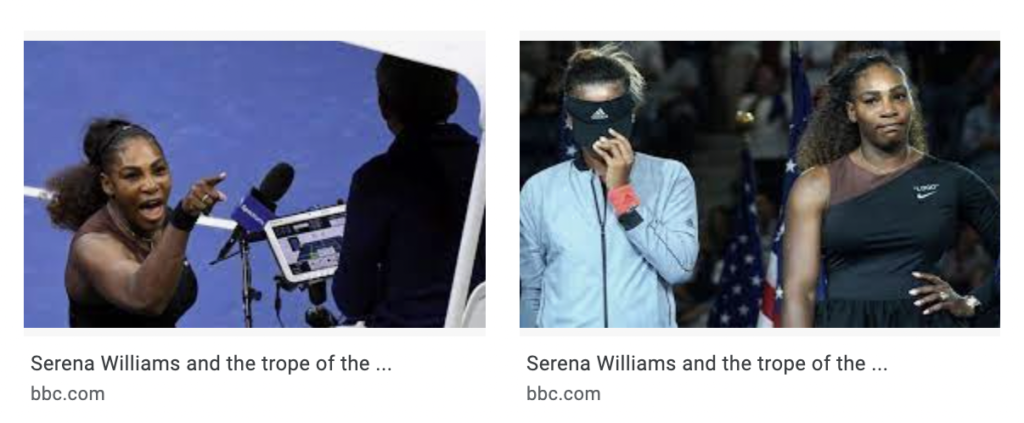
“2018 US Open Highlights: Serena Williams’ dispute overshadows Naomi Osaka’s final win”

The origins of the words “sapphire,” “mammy,” and the stereotype of an “angry black woman (ABW),” date back from the 1800s to mid 1900s where caricatures, cinema, and other forms of media perpetuated these racial tropes (“The Sapphire Caricature”). The term sapphire was originally used to portray black women as angry, rude, loud, malicious, and masculine (“The Sapphire Caricature”). Often, sapphire imagery is accompanied by black men to demonstrate how “through her use of verbal putdowns” the black woman emasculates the man, “robbing” him of his manhood (“The Sapphire Caricature”). Similarly, the “mammy image” was created to justify the economic exploitation of house slaves where black women are “penalized if they do not appear warm and nurturing (Collins 267).” More modern examples of sapphire depictions are coined with the term “ABW.” While there is little empirical evidence supporting the stereotype that black women are more aggressive by nature, the U.S. mass media continues to push ABW headlines, videos, and imagery (J. Celeste).

Serena Williams is widely renowned as one of the greatest women’s tennis players of all time and an incredible overall athlete. She retired as a tennis legend with a total record of 858-156, 6 U.S. Open Championships, and 23 Grand Slam titles (“Serena Williams Fast Facts”).

While Serena Williams’ success is celebrated, she unfortunately became a target of the ABW stereotype on several occasions throughout her career. There are numerous videos titled “Serena Williams Rage Compilation” posted on social media platforms in addition to hundreds of newspaper and magazine articles covering her sporting disputes and frustrated moments. In fact, Williams’ portrayal as an ABW in the mass media is so significant that if you were to do an image search of the term “angry black woman,” the first few pictures are of Williams.

Of the many sources covering Serena Williams’ career disputes, I focused on one video published by the largest American cable sports coverage network, ESPN. The video, titled “2018 US Open Highlights: Serena Williams’ dispute overshadows Naomi Osaka’s final win,” covers the 2018 US Open Championship between Serena Williams and Japan’s Naomi Osaka. The video begins with a clip of Williams breaking her tennis racket out of frustration. The video crew proceeds to zoom in on the broken racket and then later replays the clip of a frustrated Williams throwing her racket down. Soon after, the referee accuses Williams of receiving coaching and cheating.

On multiple instances, Williams demands an apology from the referee stating, “you are attacking my character.” In response to this, the referee gives Williams yet another violation. While disputes and frustration often go unpenalized and are often overlooked or granted leniency in men’s tennis, Williams received multiple penalties for her actions. When pleading her case, Williams notes, “because I’m a woman you’re going to take this away from me.”


While the contents of the video itself are controversial, I additionally wanted to focus on the ways in which ESPN perpetuates the ABW stereotype through the title of the video, the clips they provide, and the specific zoom and camera angles chosen. Although the video is titled “U.S. Open Highlights,” very few clips in the video are dedicated to the tennis match itself. Rather than replaying points and impressive displays of athleticism, the “highlights” in this video are clips of a frustrated Serena Williams. The camera angles and zoom were methodically used in a way to emphasize Williams’ anger with an example being the amount of screen time Williams’ broken racket received and the frequent replaying of Williams arguing with the referee. By doing this, ESPN paints Williams as angry, similar to how post slavery media pushed the agenda that Black women were angry, aggressive, and emasculated men by “failing to be submissive.” Furthermore, the video title states, “Serena Williams’ dispute overshadows Naomi Osaka’s final win.” By naming the video in this way, it paints Williams as the “bad guy” and accuses her of ruining Osaka’s moment. This depiction of Williams as aggressive and malicious is representative of 20th and 21st Century ABW media.  In addition to the title, the video’s description is equally disappointing…

While the match showcased the skill of two amazing Black female athletes, ESPN implies that the match will only be remembered because of Williams’ quarrel with the referee. Not only does this take away from Osaka’s victory, but it places further blame on Williams.

Through the notion of sapphires, mammies, and more recently “angry black women,” Black women have continued to fall victim to racial stereotypes depicting them as aggressive, malicious, and out to emasculate men. Following the 2018 U.S. Open Championships, ESPN perpetuated these racial tropes via a “highlight video” that covers a dispute between Serena Williams and a referee. While male tennis players receive little backlash from similar actions during matches (e.g., John McEnroe was known for his outbursts throughout his career), Williams was accused of “overshadowing” Naomi Osaka’s win and was given three penalties. While the term sapphire may be a thing of the past, the theme of portraying Black women as angry and aggressive in the media continues.


Sources

Collins, Patricia Hill. “Race and Ethnicity.” Controlling Images and Black Women’s Oppression , pp. 266–273.

ESPN. 2018 US Open Highlights: Serena Williams’ Dispute Overshadows Naomi Osaka’s Final Win. Youtube, 8 Sept. 2018, https://www.youtube.com/watch?v=uiBrForlj-k.

J. Celeste Walley-Jean. “Debunking the Myth of the ‘Angry Black Woman’: An Exploration of Anger in Young African American Women.” Black Women, Gender + Families, vol. 3, no. 2, 2009, pp. 68–86. JSTOR, https://www.jstor.org/stable/10.5406/blacwomegendfami.3.2.0068. Accessed 6 Oct. 2022.

“Serena Williams Fast Facts.” CNN, Cable News Network, 16 Sept. 2022, https://www.cnn.com/2013/09/13/us/serena-williams-fast-facts.

“The Sapphire Caricature.” Ferris State University, https://www.ferris.edu/HTMLS/news/jimcrow/antiblack/sapphire.htm.


All About That… One Body Type

All About That Bass Official Music Video

I love Meghan Trainor’s song “All About That Bass” in which she is apparently encouraging women to embrace their curves and hating on the idea that women should be “stick figure, silicone Barbie dolls.” The message that she is conveying, though, could actually be counterproductive to a societal norm of recognizing beauty in all body types. 

Firstly, the message that Trainor is sending through her lyrics is that female bodies are inherently sexual and that women should embrace their curves because “men like a little more booty,” which apparently makes the woman in the image below (a stereotypical, skinny, pretty, white woman) very uncomfortable.

She additionally says that she has “all the right junk in all the right places,” meaning that she has curves, or fat, in places on her body that are generally considered attractive and/or sexy, probably her ass and her breasts. This is especially prevalent in the music video for the song where many of the dance moves are very butt-focused, like in both the screenshots of the video above and below. This line makes it seem as though Trainor believes that there is a right place for fat on a female body and that fat should enhance a woman’s sexual features. The idea of women being fat in only specific places on their bodies in order to be more sexually attractive is definitely not a fat positive or feminist stance on female bodies. Fat can be considered sexy in any place in the body, from the belly to the back to the cheeks to the ankles, and Trainor is unfortunately just enforcing another impossible stereotype for women. 

Also, fat should not be seen as something sexual, neither should a lack of fat. Human bodies are made for so much more than sex, and female bodies in particular are seen so often in culture as symbols of sex, and being a fat sex symbol is no better than being a skinny one. Trainor uses the idea that men like fat asses to make fatness seem acceptable. Telling women that men like a specific trait and that makes it a good trait is certainly not a feminist idea. I should be allowed to live in my own body without having to justify my beauty by saying that men think I’m sexy so it’s ok.

One lyric from this song talks about “skinny bitches,” who the woman in heels below is a symbol for, and definitely gives a negative connotation towards skinny women, implying that being fat is better than being skinny. In this way, Trainor is trying to impose a new standard of beauty that is just as unattainable for some people as being super skinny is by shaming skinny women. “Skinny shaming” should not be a substitute for fat shaming, we shouldn’t be shaming anybody about their body type!!

The cast of the music video is also problematic. Trainor and her four main backup dancers, seen below, as well as the other female presenting dancers in the video, are all pretty much the same body type, and they aren’t even fat! 

In a song that is supposed to be about empowering fat women, having a bunch of women who, while they might not be stick thin, certainly aren’t fat, play as if they are fat is incredibly damaging. Additionally, Trainor has two young girls in the video, seen below, who are very thin, sending a message to the young girls who watch the video that this is the ideal body type for their age.

The only truly fat person in the video for a song ABOUT BEING A FAT WOMAN is the MALE presenting dancer below who doesn’t even get much screen time.

In a society that shames fatness, telling women that very mid-sized people are the fat people in our world completely discounts a whole group of people AND makes mid-sized people think that they are fat, which is damaging in a world that shames fatness.

In addition to the lack of size representation in the music video, the lack of racial representation is prominent, too. Depending on what you consider “dark-skinned,” there are no more than three dark-skinned people, one of them being one of the children, one of them being a backup singer (most of whose face is covered by a wig as seen below), and one of them being part of Trainor’s main group of backup dancers, in a cast of about 14.

None of these cast members get much screen time. The range of skin colors is very slim. There are only two male presenting cast members in the video, and the white man below is meant to represent a potential Ken-Doll-like boyfriend type for Meghan Trainor.

So, the main takeaway I get from the combination of the lyrics and the video from All About That Bass is that white (and sometimes black) women should strive to have big butts, avoid being skinny, avoid being fat, and to do all of this in order to be sexually appealing to conventionally attractive white men. Definitely not the fat power anthem that we need.

Feminist Mix Tape: “Bitch”

  When it comes to strong feminist music, there’s nothing quite like the songs from the 90s. When considering which of these songs best encapsulates that iconic spirit of 3rd wave feminism and assertive, powerful women taking control over their own sexuality, Meredith Brooks’s hit song “Bitch” is the clear winner. The overarching theme of the song is a woman owning her individuality, and unapologetically celebrating the many facets of her identity that make up who she is as a person. 

   The title itself is an ironic critique of the way that men will claim that they want a “strong woman,” and then call her a “bitch” when she actually speaks her mind or refuses to conform to certain gender norms. This is referenced most clearly with the line “So take me as I am / This may mean you’ll have to be a stronger man,” which is essentially saying “If my strength and agency make you feel threatened in your masculinity, then that is your problem, not mine. I will not make myself weaker for your comfort, so you will simply have to be a stronger man.” 

   Her expression of the ways in which modern feminism begins to recognize the intersecting identities of womanhood is evident in the chorus of the song, where she lists the many facets of her sense of self; “I’m a bitch, I’m a lover / I’m a child, I’m a mother / I’m a sinner, I’m a saint / I do not feel ashamed.” The first line addresses how she can be both independent (referencing how society calls free-thinking women “bitches”) and loving at the same time. The second line addresses the way in which our society has determined that once a woman becomes a mother, this is all that she is allowed to be. With the words, “I’m a child, I’m a mother,” Meredith states that the responsibility and stability that come with the role of motherhood are not concepts incompatible with the freedom and creativity of childhood. The third line again challenges this notion that women must be “one or the other,” but this time in regards to her innocence and intentions. 
   A final important line to consider is Brooks’s “And don’t try to save me,” where she acknowledges society’s tendency to disregard women who refuse to be silenced, and instead label them “hysterical.” She predicts that men will assume her duality is an illness or issue from which she needs deliverance, and reminds them she is not some “damsel in distress” in need of saving- so do not even try.

“The Invention of Women:” A Review for Oyèrónkẹ́ Oyěwùmí’s Revolutionary Book

In 2011, Beyoncé asked, “Who run the world?” and answered, “Girls.” Almost a decade later, many of the protest signs at the Women’s March on Washington featured this same declaration. Worthy as it may be, Nigerian sociologist Oyèrónkẹ́ Oyěwùmí’s first book, The Invention of Women: Making an African Sense of Western Gender Discourses, which provides a deconstructive analysis and history of womanhood and gender—and their absence— in Yorùbán society, presents a strong case against the idea that “girls” are, and have been, a global and universal social category. As evidenced by the title, The Invention of Women, Oyěwùmí lays out how “the fundamental category “woman,” which she claims is “foundational in Western gender discourses,” “simply did not exist in Yorùbáland prior to its sustained contact with the West.” (Oyěwùmí x) Moreover, Oyěwùmí presents evidence for how the Western constructions of gender, as well as sex, were brought to Yorùbáland and implemented in such a way that they became salient social institutions that eventually led to the “patriarchalization” (86) of Yorùbán history and society and as a result, the subordination of what is now the category of women.

Before I begin to review and summarize the work of Oyěwùmí in The Invention of Women, I want to foreground her definition of gender as it forms the basis of her analysis. Oyěwùmí considers gender to be “an institution that establishes patterns of expectations for individuals based on their body-type, orders the social processes of everyday life, and is built into major social organizations of society, such as the economy, ideology, the family, and politics” (39).

The work of Oyěwùmí in her 1997 monograph takes the boundary pushing scholarship of sociologist Judith Lorber and others at the time who were focused on the construction of gender, and complicates it by noting that gender was not only socially constructed, but that it was socially constructed in the West and is therefore not applicable transnationally or transculturally. To set the stage for her argument, Oyěwùmí speaks to the characteristics of Western thought that allowed for the construction of gender. She contends that the somatocentricity (ix) of Western thought, in which biological determinism is the basis for the organization of society, coupled with the West’s “privileging of the visual,” (3) made the physical human body “the foundation of social thought and identity” (x) and thus subject to the creation of gender. Oyěwùmí makes it clear that in contrast to the West, Yorùbán society, prior to Western contact, did not privilege the visual sense or the body in its construction of sociocultural meaning.

Oyěwùmí then goes on to explain the ways in which Yorùbán society was organized absent of gender and sex. One key tenet of Yorùbán society that Oyěwùmí explains is the “centrality of the family compound,” rather than gender, “in defining the status of residents” (44). People who married into a household, or “ilé,” were known as “aya,” while those in the household were known as “ọkọ.” The “aya” was considered an outsider while the “ọkọ” was considered an insider and their relationship was ranked such that the “ọkọ” was “the privileged senior” (44). Overall, the hierarchy of Yorùbán society was based on age—with older people having the most status— and thus “social positions of people shifted constantly in relation to those with whom they were interacting” (xiii).

In the latter half of the monograph, Oyěwùmí speaks to the process in which gender was brought to Yorùbán society through missionaries and the imposition of the British “patriarchal colonial state” (123). Because “access to power was gender-based” in Britain, the British arrival in Yorùbáland led to the creation of “women as an identifiable category, defined by their anatomy and subordinated to men in all situations” (123). Oyěwùmí claims that one the most impactful aspects of colonialism that led to this subordination was the colonial educational system as it excluded those under the new category of women. This in turn led to the creation of a stark gender divide in terms of power, wealth, and status, which Oyěwùmí claims is an impact that is still felt in “the contemporary period” (128).

In the final pages of her book, Oyěwùmí widens her focus and criticizes the way in which “womanhood has been pathologized, at a global level” (177). As a result, Western feminists have assumed that the experience and subordination of women is universal without recognizing that this represents a “globalization of what was once a local Western preoccupation” (177). However, because colonialism imprinted gender and the category of women on Yorùbán society, Oyěwùmí speaks to the challenge of “present[ing] alternative ways of looking at anatomic sex-distinctions without pathologizing the female” (178).

I believe the greatest strength of Oyěwùmí’s The Invention of Women lies in the fact that it paints a holistic picture of Yorùbán society and culture before gender was introduced, as well as after colonial contact. As a result, I was able to understand the way in which specific cultural institutions were changed and perverted in the formation of male hegemony in Yorùbán society as a result of colonialism. Oyěwùmí also relies on primary sources, such as Yorùbán elders, to make her argument without preemptively imposing foreign cultural concepts, such as gender, on her research, which she claims is often the case with Western and Western-educated researchers. In her words, “Researchers always find gender when they look for it” (31).

A challenge I would levy on the work on Oyěwùmí in her monograph is the lack of elaboration on her very brief mention of homosexuality. In a discussion around sexual relations in precolonial Yorùbán society, Oyěwùmí contends that “homosexuality does not seem to have been an option” (63) without any further elaboration. Feminist, academic and human rights activist Sylvia Tamale, in her essay, “Confronting the Politics of Nonconforming Sexualities in Africa,” reveals that in many African cultures, there are examples of nonconforming sexuality while noting that “the context and experiences of such relationships did not mirror homosexual relations as understood in the West, nor were they necessarily consistent with what we may today describe as a gay or queer identity” (Tamale 35). Thus, without assuming the presence of homosexuality and nonconforming sexuality in precolonial Yorùbán culture, I wonder whether or not it is even possible to state that these sexualities were absent given Oyěwùmí’s evidence of the absence of gendered identities. In other words, how would nonconforming sexuality be conceived without the construction of gender? Additionally, Oyěwùmí claims that “issues of sexuality were not really issues of morality” (Oyěwùmí 64) until the arrival of Christianity and Islam. Thus, what is nonconforming sexuality when there is no conception of moral, normative and conforming sexuality? Nevertheless, I think Oyěwùmí’s work would be strengthened with a deeper interrogation of homo/nonconforming sexuality in precolonial Yorùbán culture in addition to a discussion on the impact colonialism had on notions of homo/nonconforming sexuality.

All in all, Oyěwùmí’s The Invention of Women is a fairly accessible and relatively short monograph that is not only vital to understanding how gender is constructed, but also vital in that it problematizes the supposed universality of the construction of gender. This book is suited for anyone interested in the intersection of gender and colonialism, for Oyěwùmí reveals how the colonial project in Nigeria was inseparable from the imposition of gendered identities and a gendered hierarchy. Finally, if there’s anything to take away from this review it is this. Next time you hear/say/think “Fuck the patriarchy!” think about the contributions of Oyěwùmí, and how they might inform your answer to this question raised by philosopher and art historian Nkiru Nzegwu: Is patriarchy a “valid transcultural category of analysis?” (21).

Brandon Reid Theory to Praxis: Deliberation Guide

Title:

An Open, Honest Deliberation About Positions on Abortion

Central Question:

To what extent should the U.S. government intervene on the issue of abortion?

Intended Audience:

For this deliberation on the United States government’s intervention (or lack thereof) on the issue of abortion, Davidson students will be invited to participate. I am interested in helping Davidson students articulate a clear stance on the U.S. government’s intervention on abortion. Although students who are confidently supporters of the polar pro-life or pro-choice positions might be initially most prepared for this deliberation, I want this deliberation to be accessible to all students. With that said, student’s whose views align somewhere else on the pro-life/pro-choice spectrum will be encouraged to participate too. Additionally, I want experts on the issue of abortion to participate, so that there is a greater understanding of the issue that can be achieved. Those experts will include doctors, activists, and legal experts from across the ideological spectrum.

Continue reading “Brandon Reid Theory to Praxis: Deliberation Guide” →

The Feminist “Love-Politics” of Labelle in “Morning Much Better”

Labelle, formed in 1971, was all-female rock trio comprised of Patti LaBelle, Nona Hendryx, and Sarah Dash. Known for their “godless gospel music” fit for the “space age,” Labelle was revolutionary and boundary breaking in a plethora of ways, whether it be their sex-positive lyrics, futuristic costumes or the fact that they were the first Black rock group to perform at the New York Metropolitan Opera and the first Black vocal group to be featured on the cover of Vogue magazine. I contend that Labelle was uniquely “womanist,” in all the senses of activist and author (and also anti-Semitic conspiracy theorist) Alice Walker’s term, as they were a Black feminist group that loved music and dance and promoted sexual and non-sexual love through their intimacy-laden lyrics and “sexual self-expression” focused performances.

In this short essay, I will analyze their 1971 track “Morning Much Better” from their first album Labelle and lay out why I think it is a feminist song. “Morning Much Better” begins with this demand addressed to a sexual partner: “But if you want to keep me happy / Better hear what I’m saying to you.” To me, this sets the song off on a particular feminist note, as it emphasizes the agency of the person making the demand, which in the case of Labelle, is three Black women. This is especially significant given the fact that Labelle was a departure from the girl group model of the sixties and seventies exemplified by The Supremes, who, also as Black women, were subject to a degree of respectability politics that made them look practically identical and sing about sentiments such as “waiting for love,” in the case of their song “You Can’t Hurry Love.” The difference in tone and agency of The Supremes’ song and “Morning Much Better” underlines both the boundary pushing nature of Labelle as well as their song’s feminist message, which rejected the notion of passively waiting for love and/or a sexual partner.

While the song has one mention of “Daddy,” it is otherwise pronoun-less and thus could apply to anyone of any gender identity, which is another unique feature of many Labelle songs that cultural anthropologist Maureen Mahon contends, “surely contributed to the group’s appeal among gay men and lesbians.” Thus, “Morning Much Better” is also part of Labelle’s legacy of promoting a more intersectional feminist message that included people of all gender identities and sexualities.

The central narrative in “Morning Much Better” is a desire to have sex in the morning. One line in the chorus goes: “But I usually like it much better in the morning, yeah.” This overall sentiment of the song renders it as one that is, in signature Labelle fashion, sex-positive, which is a feminist ideal exemplified by many feminists including poet and activist Pat Parker. It also renders the song as one that promotes communication and dialogue in sexual relationships, which I contend is a feminist principle in that it is the foundation of healthy relationships of mutual respect in which both sexual partners have the ability to express their desires as well as what makes them feel good.

In advocating for sexual partners vocalizing their own personal desires and preferences, “Morning Much Better” exemplifies what writer, feminist and civil rights activist Audre Lorde envisioned as radical self-care, which she writes, “is self-preservation, and that is an act of political warfare.” While self-care today has veered far from this conception as it has come to adopt the kind of “competitive atomistic” and “liberal individualism” that author and feminist bell hooks claims “undermines the potential radicalism of feminist struggle,” Labelle in “Morning Much Better” is advocating for a radical self-care based on consensual and fulfilling sex, healthy relationships and a good night’s sleep! As the song goes: “But I don’t know, baby, just what it is, but that’s mmmm, when I feel good / Oh, with seven (I assume hours) behind me / Oh, you better come find me, yeah.”

All in all, “Morning Much Better” is a “sonically intimate” and vibrant feminist, and arguably womanist, boundary breaking song that incapsulates a Black feminist tradition of “love-politics,” in the sense that it advocates not only for relationships of love and intimacy that personally feel good, but also a relationship of love with oneself through its promotion of radical self-care. According to a member of the Atlanta Feminist Lesbian Alliance, Labelle’s impact was indeed felt. In their words, Labelle represented “very together women who love people and each other. And they have a heavy feminist message.”

Listen to “Morning Much Better” here.

Brandon Reid Feminist Mixtape: Flawless- Beyonce and Chimamanda Ngozi Adichie

For my feminist mixtape assignment, I decided to submit Beyonce and Chimamanda Ngozi Adichie’s hit song “Flawless.” For context, Beyonce is a Black woman music artist who grew up in Houston, Texas. According to Wikipedia, Beyonce’s mother is Louisiana Creole and her father is African American. Chimamanda Ngozi Adichi is a Black woman writer who spent her childhood in Nigeria. Adichi’s parents are both Nigerian, and according to Wikipedia, Adichi has worked to support LGBT rights in Africa.

Continue reading “Brandon Reid Feminist Mixtape: Flawless- Beyonce and Chimamanda Ngozi Adichie” →

Feminist Mixtape: “Exactly How I Feel (Feat. Gucci Mane)”

Lizzo’s Cuz I Love You album took pop culture by storm in 2019. Track 8, “Exactly How I Feel (feat. Gucci Mane),” is the perfect combo of upbeat chords, techno beats, and empowering messages of self-love. Lizzo evokes messages of second-wave feminist thought, specifically connecting to the book’s ideas that became a worldwide phenomenon entitled Our Bodies, Ourselves, originally published in 1973. The book discusses how “body education has been liberating for us and may be a starting point for the liberation of many other women” (Boston Women’s Health Book Collective, 296). Lizzo’s song coincides with these messages because she is promoting bodily autonomy; as she sings, “Love ’cause I want to,” not because society is telling her to do so, solely to procreate. Or even “Smile if I want to.” She is showing control over her body and that she is the person who gets to decide “exactly” how she feels each day when she wakes up. 

Lizzo’s song also connects to black feminist thought scholar Patricia Hill Collins. Collins argues how images of black women have been controlled by “elite white males” to put black women into boxes where they are either the “mammy,” “matriarch,” “welfare mother,” or “jezebel.” Collins articulates how these forms of control ultimately work as “justifications for racial oppression, the politics of gender subordination, and economic exploitations” (Patricia Hill Collins, 271). Lizzo’s lyrics and identity of being a black woman simultaneously work to break down these stereotypes. She sings, “Can’t hold back my tears/That would be a crime/‘Cause I look pretty cryin'” and “Cry ’cause I want to/Smile if I want to”/Get so mad I could scream.” Lizzo tells us exactly how she feels and all the versions of herself. Each holds power, whether she is crying or smiling, and all these actions happen on her own terms. Lizzo does all this impressively in two minutes; she can present herself as a fully actualized black woman, which employs black feminist thought. She asks the listener, “Ain’t I so amazing? And to that, I answer yes, yes you are Lizzo. 

However, some limitations make it hard to claim this to be “exactly” right on the mark with all feminist frames of thought in 2022. First off, the inclusion of Gucci Mane rapping on the track, on the one hand, displays bell hook’s idea that black women need support from black men in their fight for liberation. As hooks writes, “The formation of a liberatory feminist theory and praxis is a collective responsibility, one that must be shared” (bell hooks, 17). On the other hand, Gucci Mane’s lyricism feels at loggerheads with feminist intersectional thought. He raps, “My heart ain’t got no feelings,” which promotes ideas of toxic masculinity and shows no apparent solidarity for women. Additionally, searching the lyrics, there are no explicit references to intersectional feminism, and subsequently no mention of womanism, transfeminism, or queer feminism. Despite these limitations, “Exactly How I Feel” has a universal message that anyone can relate to, about validating all feelings that arise and crushing the binaries of “good” and “bad,” reminding us we are all humans at the end of the day. 

Feminist Mixtape: “9 to 5” by Dolly Parton

Dolly Parton is a well-known force in the music industry and, in general, the world. She is a nine-time grammy winner, while also having written over three thousand songs for various film and television projects. On top of her musical success, she has also had many philanthropic efforts, which include supporting child literacy programs and funding a COVID-19 vaccine. As you can tell by the previously stated information, Parton is an inspirational figure to all. 

One of Parton’s most well-known songs is “9 to 5.” Parton wrote the song for a movie with the same title that dealt with an American 9 to 5 workday. The song won a Grammy for Best Female Country Vocal Performance and for Best Country Song, both at the 1982 Grammys. It has been streamed more than 3.5 million times on Spotify alone. 

Continue reading “Feminist Mixtape: “9 to 5” by Dolly Parton” →

Feminist Mixtape – “Video” by India Arie

Video by India Arie connects to the Womanist movement and body neutrality. It broadcasts ideologies found in the womanist movement by rejecting the ideals associated with whiteness and femininity. Black women are often ignored in the conversation about equality and representation. India Arie sings about not needing wealth or fancy things to be happy. Through this language, she is rejecting the idea of wealth in order to be feminine. This is part of what the womanist movement rejected from the first-wave feminists. First-wave feminism focused on white, upper-middle-class women instead of the intersectionality and marginalization of different women. India Arie also aims to spread body neutrality by accepting herself and not nourishing the unrealistic beauty standard. She makes references to not shaving her legs, not combing her hair, not getting plastic surgery, and not wearing pantyhose. This is deconstructing the ideals and standards set for women. In the class reading about body hair, it explains how in the late nineteenth century, body hair removal was normalized to show racial superiority and modernization. The Instagram book review writes, “Maintenance of white women’s ‘proper’ physical appearance became about maintaining ‘health’ of the white race in the face of migration and racial unrest” (@alokvmenon). This was an effort by men to control (white) women’s femininity and sexuality. The understanding of black women as inferior because they have body hair connects back to the womanist movement. The standards, acceptance, and discrimination between white and black women were very different. Black women had to deal not only with sexism but also racism. White men during this time aimed to control Black women while simultaneously interpreting them as racially inferior. The need for a movement that accepted all women regardless of race, socioeconomic status, and body size came from the rejection of Black women into the feminist movement. The chorus says, “I’m not the average girl from your video. And I ain’t built like a supermodel. But I learned to love myself unconditionally. Because I am a queen.” This song expresses modern feminist thought by inspiring women to take control of their lives and do what makes them happy. As a Black woman, India Arie tells the story of acceptance, self-love, and independence from the controlling society we live in. 

This song is personally inspiring to me as a Black woman because it rejects the beauty standard that is reinforced through all aspects of society. So often, young girls are told they are too fat, too skinny, not tall enough, too tall, etc. This song teaches young girls that they are beautiful just the way they are. Unlike many current artists, India aims to empower not degrade women. I grew up listening to her in my household which I believe positively impacted my self-esteem.