Hit songs like “Truth Hurts” by Lizzo or “Sorry Not Sorry” by Demi Lovato, hashtags like #realmemonday or #wellnesswednesday, and advertisements like Dove’s self-esteem project represent the influx of self-confidence messaging in today’s mainstream media. Women, in particular, are targeted by these messages. They are told to embrace their fears and insecurities by self-help books, celebrities, and television shows. Subsequently, there is a growing “confidence cult” as the authors of Confidence Culture, Shani Orgad and Rosalind Gill, suggest.
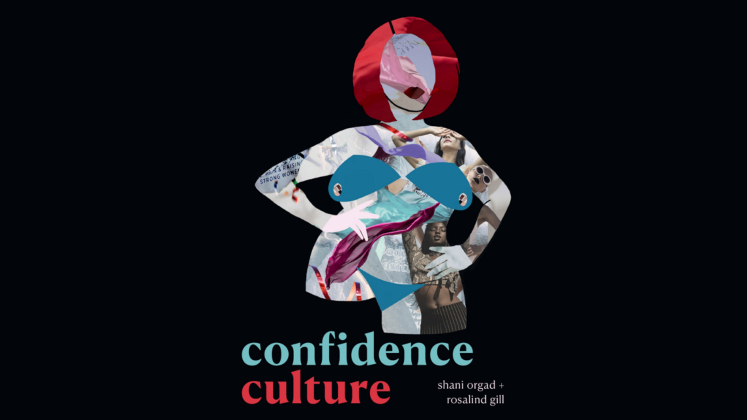
Confidence Culture “aims to investigate the ideas, images, and practices that make up confidence culture” in order to “interrogate the cultural prominence of confidence” (21). “Confidence” according to Orgad and Gill is both a culture and a cult in which discussions spread without being questioned. Orgad and Gill challenge this idea by questioning several aspects of confidence culture including its deeply gendered nature. As they explain, confidence culture inordinately affects cisgender women. It teaches women that they are to blame for the barriers they face due to a lack of self-confidence. It asks women to change themselves instead of fixing a broken system. By doing so, confidence culture causes ignorance to the patriarchal society in which women must work harder to be treated as their male counterparts. The authors attempt to find a better way of looking at confidence as a non-obligatory and non-dominant part of today’s world in which women are faulted for their own marginalization.
Shani Orgad and Rosalind Gill have considerable experience researching the field of feminism and gender studies. Orgad is a professor in the Department of Media and Communications at the London School of Economics. She has a Bachelor’s degree in Media and Communications along with Sociology and Anthropology. Her research areas include gender, feminism, inequality, and contemporary culture. Gill is a professor of cultural and social analysis at City, University of London. Gill’s research areas include sociology, gender studies, and media and communications. She has a Bachelor’s degree in Sociology and Psychology with a PhD in Social Psychology. Both authors have produced several books, articles, and chapters. Most notably, Gill wrote a highly acclaimed article on post-feminism. Their newest book Confidence Culture recently earned the authors an interview with Forbes and New York Times. Orgad’s and Gill’s background affirm that Confidence Culture is well within their realm of expertise as it mostly revolves around feminism and inequality. With this expertise, they do a thorough and organized job critiquing the confidence cult.
Orgad’s and Gill’s book examines five areas in which the confidence cult dominates throughout five chapters beginning and ending with an introduction and conclusion. The chapters are organized as follows: body confidence, workplace confidence, motherhood confidence, relationship confidence, and transnational confidence. By using familiar examples of confidence culture in each chapter such as Amy Schumer’s I Feel Pretty, Orgad and Gill engage their audience. These media examples, which range from magazine covers to self-help books, also function as the research that supports their comments on confidence culture. It is important to note that their research is mostly focused on the USA and UK.
Chapter one, entitled “Body Confidence,” opens with the mentioning of Love Island. This popular TV show is a major source of body confidence issues. After a familiar opening to the chapter, the authors delve into the commercial body confidence industry which encapsulates the unrealistic body standards and fake diversity we see on our screens. Though many companies are promoting body positivity for every size and celebrities are showing off their body insecurities on social media, this hasn’t solved the problem. The authors believe in the positivity of these messages, but propose that they make women’s personal insecurities feel less valid. After all, shouldn’t a woman feel confident in her body after seeing a single plus size model on the cover of Vogue alongside an array of skinny models? Instead of simply telling women to love their bodies, we need women to give themselves “a mental makeover” in the words of Orgad and Gill. The authors offer a unique take on this subject as not many people would speak negatively about a movement that is supposed to be about positivity.
In chapter two, Orgad and Gill switch their focus to the workplace. “Confidence in the Workplace” opens with an introduction to the 2019 film Late Night with Mindy Kahling and its relevance to job confidence. Similar to Love Island, Late Night introduces the chapter’s subject in a fascinating fashion. They organize this chapter in two sections, advice literature and current discussions. Readers learn about three prominent self-help books for working women called Lean In, The Confidence Code, and Girl, Stop Apologizing. These works are analyzed and faulted for their role in deemphasizing barriers for women in the workplace. Talks by successful businesswomen are mentioned too for their similar effect. These ideas may seem controversial to many since without these books and talks, several women would not have had the confidence to speak up for themselves within their respective jobs.
“Confident Relating” in chapter three addresses relationship confidence with others and ourselves too. The chapter starts with references to Cosmopolitan and Glamour covers implying to readers that they need some self-confidence to have happy, healthy relationships. This media assumes that it is women who create the problem in relationships and their confidence is key to solving the issue. Gender imbalance not only exists on magazine covers but within confidence apps too. They are unequally marketed towards women. These messages can be hypocritical when magazines encourage self-confidence through forms of seeming self-perfection and apps encourage women to embrace all of their flaws. As self-care has become a massive trend during the pandemic, the authors provide a relevant take which should hopefully ease women’s confusion on the hypocrisy of self-confidence.
In chapter four, “Confident Mothering,” we witness an investigation into the parenting of confident girls. The authors point out that there is a large market for confident parenting, particularly for mothers. Orgad and Gill use the Dove Legacy campaign, I Mom So Hard vlogs, the American Girl website, and Serena Williams letter to her mother as evidence of the confident mothering cult. This subgroup of the confidence cult challenges the ideas of feminism. The authors’ evidence not only recognizes the struggles that mothers face, but also their obligation to be the sole representation of empowerment for their daughter. Confidence culture tells mothers that they must teach their daughter to love herself without any help from others. It also informs mothers that they shouldn’t encourage their daughters’ independence. This chapter would undoubtedly trouble mothers who buy into the confident mothering market. However, it offers key insights on the relationship between feminism and mothering within the confidence cult.
Chapter five takes a look at transnational confidence culture. Orgad and Gill begin with Meghan Markle’s speech on gender violence to young girls in South Africa. Other examples within the chapter focus on how the confidence cult is spreading particularly throughout underdeveloped areas in the global South. The movement is known as Confidence without Borders. Companies and non-governmental organizations are manufacturing for young girls through self-care and confidence acts. Despite its good intentions, this movement can easily gloss over inequalities of the global North and South as a result of colonialism. Orgad and Gill offer some insight on how this issue should be addressed, which shows that they don’t just want to state a problem. They want to solve it by actively removing the barriers women face in order to discourage the need for confidence culture.
The organization and evidence within Confidence Culture creates a persuasive overarching argument from Shani Orgad and Rosalind Gill. In particular, their examples in each chapter provide ample supporting evidence for their argument. Thus, their argument seems less opinionated and more factual to readers since there is so much agreeing proof. It is hard to disagree when there are ten different media sources that say otherwise. The contemporary evidence makes every chapter entertaining as well because many readers recognize exactly what the authors are referring to. It is clear that research is a strong suit of Orgad and Gill. They certainly used a plethora of sources to back up their claims.
While the authors gathered enough evidence, they could have included more advice on how women can escape the confidence cult. They spend the majority of the book examining it from an outside perspective that doesn’t buy into the “confidence is key” mentality. However, besides a sentence or two, they don’t thoroughly explain how confidence culture should change. How should women resist it so they don’t feel blamed for their lack of confidence? They might have considered using their own experiences overcoming challenges as women or being subject to confidence culture.
Overall, Orgad and Gill offer an encapsulating take on the confidence culture that we see in the media today. Their highly structured research, in part due to their educated backgrounds, provides a clear message on confidence culture. Their critical investigation of the culture spreads across five areas: the body, the workplace, relationships, mothering, and around the world. This is an interesting read for anyone who is interested in feminism, social media, or even marketing. It challenges preconceived notions that self-confidence is necessary for success. It is also thoroughly enjoyable because who wouldn’t want to read about Lizzo’s relation to the growing confidence cult?
References
Orgad, Shani, and Rosalind Gill. Confidence Culture. Durham: Duke University Press, 2022.
This was a super interesting book to choose, and I’m definitely going to add this book to my “to-read” list because I’ve definitely noticed the growing “confidence cult.” I agree with your critique and definitely feel like that could add to the book, because some people don’t want to be in the confidence cult. Nice job!!
I really enjoyed this post. I feel like this related strongly to the idea of “toxic positivity” which kind of fits the same realm. “Confidence cult” is not a term I’ve heard before, but after reading I am definitely able to recognize its effects in many aspects of society. Thanks for sharing!