“What’s Up?” was a pop, smash hit released in 1992 by the band 4 Non Blondes ahead of their debut album Bigger, Better, Faster, More!. The alternative rock band, originating in San Francisco, California, immediately stood out amongst its peers due to being made up entirely of women. This was an incredibly rare thing in music at the time, especially in the rock genre. The band prided itself on being unique and non-conformative which is partly the reason for choosing the peculiar name 4 Non Blondes. This lack of conformity can further be seen within the lyrics of the song.
The lyrics for “What’s Up” were originally written by lead singer Linda Perry as she worked as a waitress years before joining the band. In its opening, Perry describes her feelings of being stagnant in life and expresses her infuriation towards the patriarchal institutions that contribute to the difficulties of trying to achieve your dreams as a woman. She says, “I realized quickly when I knew I should, that the world was made up of this brotherhood of man”. This sentiment questions womanism and is incredibly similar to that which Betty Friedan spoke about in The Feminine Mystique. Friedan talks about the unhappiness created by the existing gender roles and women pondering “Is this all?” (Friedan 271). She further opens up by admitting that sometimes she cries in bed about and even screams out in exasperation, “What’s Going On?”. This phrase is echoed for almost all of the remainder of the song as Perry voices her disbelief that such institutions even exist and persist in the first place. It is important to note Perry’s position as a radical, as she calls out the patriarchy as well as calls for, in her own words, “a revolution”. I would argue that her position as one and her overall message, are relatable to those of famous Black radical Angela Davis. Davis was an incredibly powerful part of the Black empowerment movement, working within the Black Panther Party to push for the advancement of Black people. She is notable for also helping to strengthen the role of Black women within the party, which had originally been created with the express purpose of bettering Black men. Davis protested vehemently against existing, oppressive structures and was beaten, jailed and vilified for this work. Through her calls for revolution, Perry is carrying on this radical tradition.
Although she does not explicitly state it within the lyrics, I would argue that Perry is also speaking on the behalf of the LGBTQ community as she herself was a proud lesbian. During their rise to fame in San Francisco, the band performed at many lesbian bars and picked up a somewhat cult following with the local queer community. It wouldn’t be a longshot to say that Perry had them in mind when writing her lyrics. At the time, the climate surrounding the LGBTQ community may have been a daunting force that prevented her from speaking more explicitly on the subject within this song, which I see as a slight limitation. Regardless, the song speaks out against the established, oppressive patriarchal institutions thus making it radical and deserving of its spot in the history of music.
Dolly Parton is a well-known force in the music industry and, in general, the world. She is a nine-time grammy winner, while also having written over three thousand songs for various film and television projects. On top of her musical success, she has also had many philanthropic efforts, which include supporting child literacy programs and funding a COVID-19 vaccine. As you can tell by the previously stated information, Parton is an inspirational figure to all.
One of Parton’s most well-known songs is “9 to 5.” Parton wrote the song for a movie with the same title that dealt with an American 9 to 5 workday. The song won a Grammy for Best Female Country Vocal Performance and for Best Country Song, both at the 1982 Grammys. It has been streamed more than 3.5 million times on Spotify alone.
Video by India Arie connects to the Womanist movement and body neutrality. It broadcasts ideologies found in the womanist movement by rejecting the ideals associated with whiteness and femininity. Black women are often ignored in the conversation about equality and representation. India Arie sings about not needing wealth or fancy things to be happy. Through this language, she is rejecting the idea of wealth in order to be feminine. This is part of what the womanist movement rejected from the first-wave feminists. First-wave feminism focused on white, upper-middle-class women instead of the intersectionality and marginalization of different women. India Arie also aims to spread body neutrality by accepting herself and not nourishing the unrealistic beauty standard. She makes references to not shaving her legs, not combing her hair, not getting plastic surgery, and not wearing pantyhose. This is deconstructing the ideals and standards set for women. In the class reading about body hair, it explains how in the late nineteenth century, body hair removal was normalized to show racial superiority and modernization. The Instagram book review writes, “Maintenance of white women’s ‘proper’ physical appearance became about maintaining ‘health’ of the white race in the face of migration and racial unrest” (@alokvmenon). This was an effort by men to control (white) women’s femininity and sexuality. The understanding of black women as inferior because they have body hair connects back to the womanist movement. The standards, acceptance, and discrimination between white and black women were very different. Black women had to deal not only with sexism but also racism. White men during this time aimed to control Black women while simultaneously interpreting them as racially inferior. The need for a movement that accepted all women regardless of race, socioeconomic status, and body size came from the rejection of Black women into the feminist movement. The chorus says, “I’m not the average girl from your video. And I ain’t built like a supermodel. But I learned to love myself unconditionally. Because I am a queen.” This song expresses modern feminist thought by inspiring women to take control of their lives and do what makes them happy. As a Black woman, India Arie tells the story of acceptance, self-love, and independence from the controlling society we live in.
This song is personally inspiring to me as a Black woman because it rejects the beauty standard that is reinforced through all aspects of society. So often, young girls are told they are too fat, too skinny, not tall enough, too tall, etc. This song teaches young girls that they are beautiful just the way they are. Unlike many current artists, India aims to empower not degrade women. I grew up listening to her in my household which I believe positively impacted my self-esteem.
If you ever feel the need to go for a drive and cry about how much the patriarchy sucks, listen to “enough for you” by Olivia Rodrigo. Olivia Rodrigo is a singer, songwriter, and actress. She blessed the world with “enough for you” in 2021, as part of her album, Sour, which also presents several feminist perspectives. I particularly recommend listening to the final song, “hope ur ok,” as it reaches out to the LGBTQ+ community through its discussion of abuse, sexual orientation, and acceptance.
The first way that Olivia Rodrigo instills feminist beliefs in “enough for you” is through the theme that she, as a woman, felt as though she did something wrong or was flawed and that is why she is experiencing a breakup. This feeling of self-hate is obvious in the lyrics, “You found someone more exciting The next second, you were gone And you left me there cryin’, wonderin’ what I did wrong…”. When listening to this song, it reminds me of the book I read for the book review, The Tragedy of Heterosexuality by Jane Ward. I sense a similarity between this song and that book because of its connections with the misogyny paradox. Essentially, the misogyny paradox asserts that boys’ and men’s desire for girls and women is expressed in a society that simultaneously encourages them to hate girls and women. This is evident in everyday life through men’s practices of abuse, mansplaining, and disrespect towards women (Ward 35-38). Olivia Rodrigo’s lyrics demonstrate the harmful effects that the misogyny paradox has on women. Specifically, it leads to negative thoughts in which women think that they are at fault for men’s poor treatment of them. In reality, women have done nothing wrong and this is a flaw of the patriarchy.
Olivia Rodrigo also presents the societal expectation that women should be responsible to beautify and improve themselves to be “acceptable” to men. The artist sings, “I wore makeup when we dated ‘Cause I thought you’d like me more If I looked like the other prom queens I know that you loved before Tried so hard to be everything that you liked Just for you to say you’re not the compliment type…”. These lyrics remind me of the efforts by the diet and deodorant industries to exploit people’s insecurities so that they feel motivated to buy their products. A similar practice is at work in the heterosexual-repair industry, as I learned in The Tragedy of Heterosexuality by Jane Ward. Women are led to believe that they must keep their bodies “fresh” and “sexually appealing” to their male partners. Advertisers then put the strain on women to maintain their appearances to keep their partners happy (Ward 47). Olivia Rodrigo also falls victim to this harmful burden put on women. She sings about how she felt as though a romantic interest may have liked her more if she used more beauty products.
While this song speaks to me as a straight, white woman, there may be some limitations in that the song is not inclusive of Black feminist theory and Olivia Rodrigo appears to be singing about a heterosexual relationship. While Olivia Rodrigo is unlabeled in her sexuality, she uses the term “boy,” to describe the person she is singing about. Therefore, a member of the LGBTQ+ community may feel ostracized from relating to the lyrics of “enough for you.” Furthermore, Olivia Rodrigo seems to be singing very generally about problems faced by women and does not acknowledge Black feminist theory and the increased inequity faced by Black women due to the intersectionality of their identities.
To conclude, Olivia Rodrigo finally establishes at the end of “enough for you” that there is nothing wrong with her, she is a strong, beautiful, powerful woman. Instead, there is a problem with the patriarchy and the expectations put upon women. She demonstrates that in the following lyrics: “Yeah, you always say I’m never satisfied But I don’t think that’s true You say I’m never satisfied But that’s not me, it’s you…”. Overall, I find that this song has its most profound impact when I think about any relationships with men, whether that is professional, familial, or romantic relationships. It is in these relationships that I find myself questioning my self-worth the most and feeling as though I am never good enough. In response to that, Olivia Rodrigo reminds her audience to be kind to themselves despite patriarchal barriers. Listeners need to keep in mind that despite societal pressures and expectations, there is nothing wrong with them.
Crunch. Bits of crushed-up peanuts add an element of surprise as I chew. The chunky texture intertwined with the smooth layers of peanut butter creates a satisfying experience. Extra crunchy peanut butter. A treasured delicacy of mine. When the dining hall does not fill my grumbling stomach’s desires, I chow down in my dorm room alone on my favorite snack. A yummy snack? Yes. A snack that works as a form of resistance against the normative intimacies of eating in the public sphere? Well, that is an idea I had not even begun to consider until reading Anita Mannur’s 2022 monograph entitled Intimate Eating: Racialized Spaces and Radical Futures.
Mannur, a self-proclaimed “professor, writer, thinker, recovering optimist,” works as an Associate Professor of English at Miami University. Mannur teaches interdisciplinary courses centered on race, class, gender, and sexuality. Additionally, she is the author of Culinary Fictions: Food in South Asian Diasporic Culture and co-editor of Eating Asian America: A Food Studies Reader. Mannur received her BA in Comparative Literature at the University of Wisconsin-Madison and Ph.D. at the University of Massachusetts Amherst. Mannur’s background and primary research in food studies as well as her interdisciplinary teaching approach qualify her to examine food in Intimate Eating.
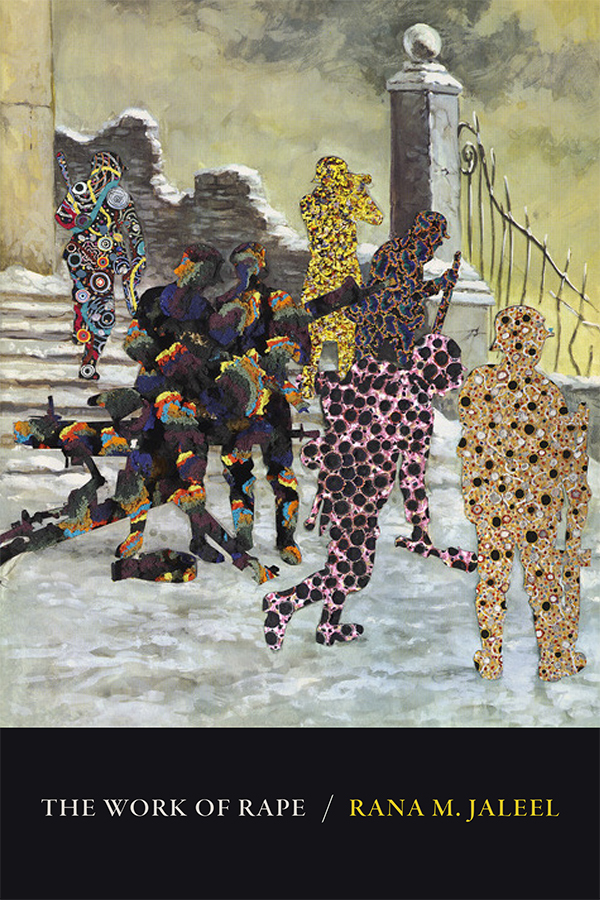
For as long as humankind has existed, so has the potential for humans to commit acts of unfathomable, immoral depravity upon one another. One need only take a glimpse into a historical text cataloging the past of any modern nation or region if they wish to be met with accounts of violence and conflict. Violence and conflict so atrocious, so steeped in cruelty, that one may doubt that they could have possibly even occurred at all, let alone at the hands of mere humans. Yet sadly, this is the truth of the matter. From our origin mankind has miraculously progressed and evolved to be able to create unbelievable innovations that better our quality of life and marvelous works of art that encapsulate the beauty of life itself. Yet, as a species, we have failed to outgrow our seemingly innate penchant for violence amongst one another. It is with this goal in mind that nations not only formulate laws to punish those who would commit violence against others but also join with one another to hold entire countries accountable for committing such acts of violence on a much larger scale. Committees such as the United Nation are well-reputed as to being strongly in vocal opposition to instances of mass murder and genocide which they define in-depth, yet it was not until the 1990s, a mere fifty years after the group’s conception, that the United Nations began to take steps towards prosecuting perpetrators of mass rape. The belatedness of said decision is shocking as rape is widely regarded as being a disgusting, dehumanizing act akin to, if not worse than murder. It is this issue of mass occurrences of sexual violence and their treatment within national law that Dr. Rana Jaleel, Professor in the Department of Gender, Sexuality, and Women’s Studies at the University of California, explores in depth in her book titled The Work of Rape.
In her work, Jaleel creates a comprehensive analysis of the driving forces behind the United Nation’s decision to define mass rape as not only a crime, but a crime against humanity, and genocide. Jaleel also explores how that definition has existed in disagreement with various United States policymaking decisions. Jaleel posits that it is primarily due to global instances of mass rape such as that which occurred during the Bosnian and Rwandan Genocides, as well as the tireless efforts of feminist scholars, that rape was redefined on the global scale to not be seen as independent acts of individuals within larger conflicts, but as an internationally punishable crime against humanity and genocide. Jaleel finishes her argument by stating that said redefinition was not an isolated event and that as legislation continues to be passed by countries such as the United States, the act of rape will continue to be redefined and fleshed out.
Jaleel’s argument is strengthened by her own qualifications as a respected scholar in the field of Gender and Sexuality Studies. She has obtained her PhD in American Studies, her JD from the Yale Law School, and her MFA in Poetry. Currently, she is an assistant professor in the Department of Gender, Sexuality, and Women’s Studies at the University of California, but prior to this she worked as the Center for Reproductive Rights Fellow at Columbia Law School. Although this is her first published work, it reflects a deep knowledge of the subject and is indicative of just how much she has to offer the field of Gender and Sexuality Studies. This work seems to be a steppingstone in her goal of exploring how concepts like reproductive labor, sex/gender, race, property, and sexuality are sustained or redefined through the recognition and analysis of harm, and what a great start she is off to.
Cultural propaganda, sexual assault, incest, compulsory marriage, economic dependence, control of children, and domestic violence; are the only possible reasons a woman would remain in a heterosexual relationship. As a straight woman and having had conversations with other straight women, these reasons are evident in every heterosexual relationship I have come across. Jane Ward in The Tragedy of Heterosexuality explores the societal expectations and pressures of the patriarchy upon heterosexuality and the heterosexual-repair industry that desperately attempts to mend these broken relationships. In addition, as a lesbian, in her book, she describes the sadness she feels upon witnessing the violence, control, diminishment, and disappointment experienced by straight women. In summary, her book leaves readers wondering, are heterosexual relationships worth the toxicity of straight culture?
Jane Ward is a professor of Gender and Sexuality Studies at the University of California, Riverside. She received her Ph.D. in sociology from the University of California, Santa Barbara. In addition to The Tragedy of Heterosexuality, Jane Ward has written two other books: Not Gay and Respectably Queer. Her books cover a wide array of topics including, feminism, queer parenting, the racial politics of same-sex marriage, and the social construction of heterosexuality and whiteness. She currently resides in Southern California with her partner, Kat Ross. One may argue that because Jane Ward is a lesbian, she should not be making such broad claims about heterosexual women. I counter this by suggesting that a lesbian is the best person to observe and criticize heterosexual relationships and the burden they put upon women. Ward can compare the respect and fulfillment she feels in her lesbian relationship, to the stress and disrespect felt by the heterosexual women in her life.
As a white woman, one aspect lacking from The Tragedy of Heterosexuality is the expectations imposed upon Black women by the patriarchy. One hardship that Ward’s book does examine is the fact that many early white feminists based their arguments for nonviolent marriage and women’s rights on the claim that bringing white women closer to equality with their husbands will ensure a unified front among white people against the Black civil rights activists. However, as a reader who has now read “Controlling Images and Black Women’s Oppression,” by Patricia Hill Collins, the lack of attention paid to the controlling images forced upon Black women in heterosexual relationships, and the constant criticism of their sexuality, is highlighted. Therefore, there is a slight bias in the book to feel sadness toward white women in heterosexual relationships, because Jane Ward is a white woman.
The overarching argument present in The Tragedy of Heterosexuality by Jane Ward includes the efforts by the heterosexual-repair industry to improve the enduring defects of straight culture. The heterosexual-repair industry has been flawed since its emergence. It is made up of eugenicists, sexologists, and social reformers. Ward cites three broad concepts present in the industry: they exposed the violence and mutual dislike in heterosexual relationships and reassured the population that this was natural, they took on the role of defining modern heterosexuality and repairing the problems that came along with it, and they accepted the premise that men and women found each other’s bodies undesirable and advocated for the use of beauty products to stimulate desire. Each of these concepts is inherently misogynistic. For example, at one point, experts were channeling their efforts to discover why women had annoying personalities and attempted to mediate men’s irritations with their wives. The solution the “experts” discovered involved women being submissive, lovely, and always putting their husband’s needs before their own. They went as far as asserting that women should be responsible for heterosexual success because they managed men’s emotions and should also be responsible for the happiness of their households and communities. Did no one ever wonder if it was men’s sexism and unrealistic expectations that caused them to be irritated with their wives? Or consider this: perhaps wives’ personalities come across as irritating because they are having unpleasurable sex?
Furthermore, the heterosexual-repair industry also came to the solution that women had to keep their bodies “fresh” and sexually appealing to their husbands. Advertisers collaborated with the heterosexual-repair industry in provoking fear among women to purchase their beauty products. The logic was that if women were not careful about their appearance then they could risk losing their husbands’ affection or “suffer their wrath.” One should not even have to explain the flaws in this argument and the unnecessary strain it places upon women to improve straight culture and desire. The toxicity rooted in straight culture is thanks to the patriarchy, and yet women are expected to help men improve their relationships. To conclude, Jane Ward, in her argument, exposes how the efforts to improve the conditions of straight culture are misogynistic and put the responsibility onto women.
The single greatest strength in The Tragedy of Heterosexuality by Jane Ward is explaining the misogyny paradox that plagues straight culture. Essentially, this paradox asserts that boys’ and men’s desire for girls and women is expressed in a society that simultaneously encourages them to hate girls and women. Jane Ward provides a possible explanation for this paradox in which society is suspicious of women because they stand to threaten men’s patriarchal power. The author analyzes this in the context of violence against women and girls. The misogyny paradox is evident when a man rapes and/or murders a woman that he reported to have desired or loved. Another example of this outlook is seen in the 18th and 19th centuries in England and colonial America. At this time, wives were seen as a “necessary evil.” Many would argue that wives, and heterosexual marriages, in general, are still seen in this negative light today. While these are all extreme examples, the misogyny paradox takes a simpler form in everyday life. Often, straight men claim to love women but continue to speak over them, mansplain subjects to them, and train their sons to imitate this lack of respect for women. To comprehend the true tragedy of heterosexuality, the author must portray the disrespect, violence, and ignorance displayed by men to women who claim to be in affectionate, romantic relationships. Jane Ward understands the importance of this paradox to her argument and succeeds in making the misogyny paradox accessible and easy for her readers to understand.
One weakness present in Jane Ward’s book, The Tragedy of Heterosexuality, is the lack of proposed solutions to this tragedy. The author notes that no feminist efforts have made a dent in straight culture, but she doesn’t go further to explain where they fell short. In fact, Ward describes the sexism and toxic masculinity surrounding heterosexuality as “inescapable.” Later, she also reveals that, as a lesbian, it is painful to witness straight women’s “endless and ineffective” efforts to repair straight men. As a straight woman reading this book, it is incredibly depressing to read these statements and feel as though there is no hope. The patriarchy and toxic masculinity seem like grand problems that can never be solved, certainly not by the time that I’m ready to settle down and get married. It leaves me wondering, am I destined for an unhappy marriage? Is there any point in dating if sexism is normalized in straight culture?
After reading this book and sharing facts and anecdotes with my non-straight friends, they unanimously decided that I represent The Tragedy of Heterosexuality. Over my 19 years as a straight woman, I have heard from friends, family members, and therapists that there are good men out there and not to give up. However, upon reading Jane Ward’s book about the emotional and physical strain of heterosexual relationships on women, I began to question if straight culture is worth the control, diminishment, and not to mention, disappointing sex. I will now respond to these friends, family members, and therapists that until the misogyny paradox is abolished and women are treated with genuine respect, finding “one of the good ones” will be challenging. Finally, I wish the heterosexual-repair industry the best of luck as they take on the impossible endeavor of mending the relationships between men and women, following a long history of sexism and abuse.
Works Cited
Ward, Jane. The Tragedy of Heterosexuality. New York, New York University Press, 2020.
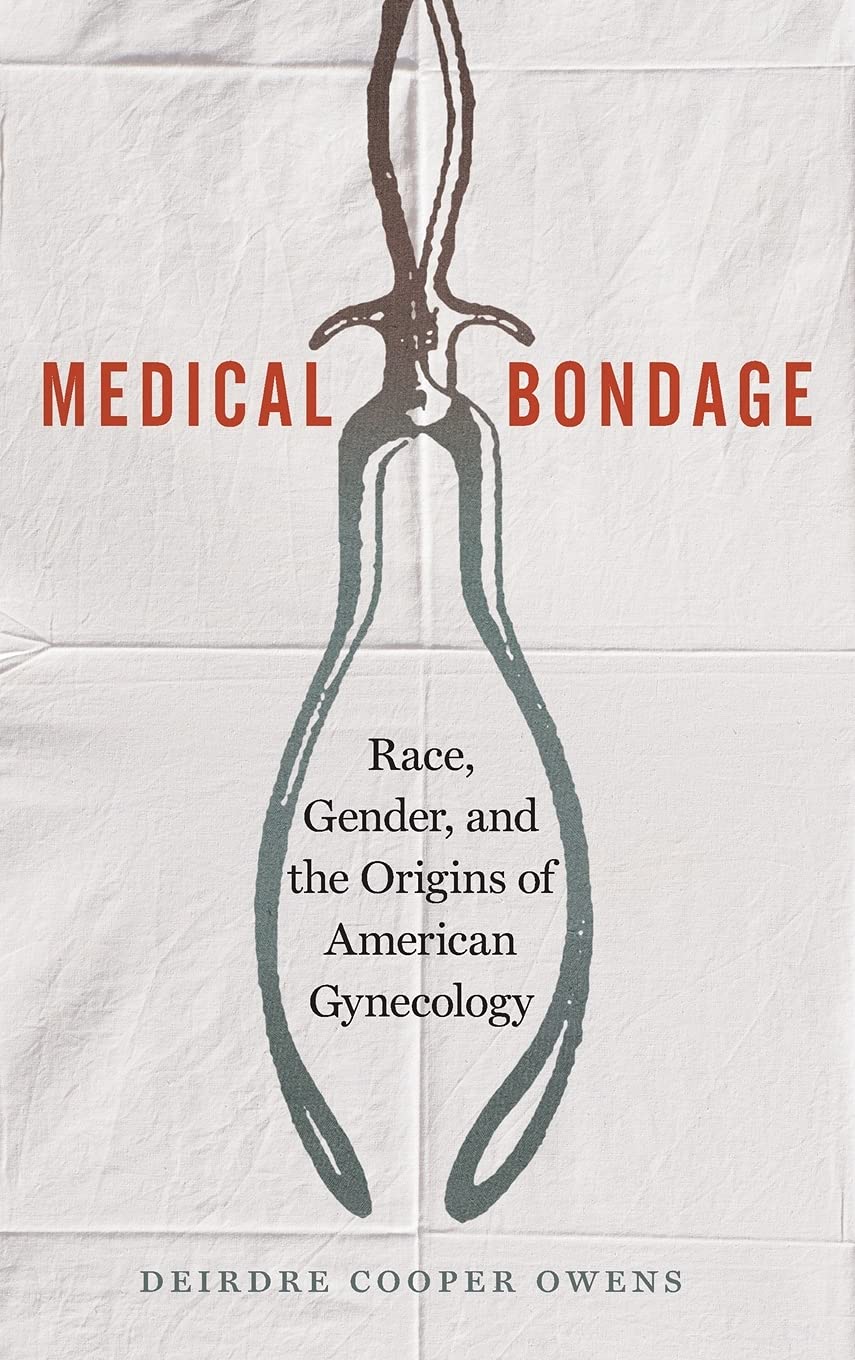
American gynecology would not be what it is today without Black women. In fact, the first women’s hospital in the United States was on a small enslaved persons farm in Mount Meigs, Alabama. In Medical Bondage: Race, Gender, and the Origins of American Gynecology (Medical Bondage), Dr. Deirde Cooper Owens examines the history of gynecological practices and the way that they came about, all while painting a picture of the women who shaped American gynecology. The book investigates both southern plantations and northern urban centers to showcase how nineteenth century ideas about topics such as race influenced relationships between doctors and their patients. Cooper Owens makes two significant arguments about the correlation between slavery and medicine: reproductive medicine was esstential to the maintenance and success of southern slavery and that southern doctors knew enslaved women’s reproductive labor helped them to revolutionize professional women’s medicine. Medical Bondage also, most importantly,retells history from the perspectives of exploited groups. By examining nineteenth century literature and correspondence between doctors and other archival materials, Cooper Owens explains how exploited groups changed the course of American gynecology, ultimately creating a field that would be forever changed by the experiments done on their bodies.
Hit songs like “Truth Hurts” by Lizzo or “Sorry Not Sorry” by Demi Lovato, hashtags like #realmemonday or #wellnesswednesday, and advertisements like Dove’s self-esteem project represent the influx of self-confidence messaging in today’s mainstream media. Women, in particular, are targeted by these messages. They are told to embrace their fears and insecurities by self-help books, celebrities, and television shows. Subsequently, there is a growing “confidence cult” as the authors of Confidence Culture, Shani Orgad and Rosalind Gill, suggest.
As we all know, especially through the beginning of the Coronavirus pandemic, when individuals dealt with the stay-at-home order and many were without work or school, TikTok’s popularity soared. One of the content creators on this app that later found success after this rise was Drew Afualo. To note, Drew is from California and is now 26 years-old. Regardless, Drew, who uses she/her/hers pronouns, started posting on TikTok on March 25th, 2020. However, she did not reach her current target audience until the end of March 2021 with her video captioned “UR WELCOME.” That video now has 3.2 million views and counting and almost 700,000 likes. Since then, she now has a total of 149.1 million likes and over 6.2 million followers on her verified account. Her other accounts on Instagram, Snapchat, and Twitter garner her an extra half-a-million people.
Making the majority of her content for mainstream heterosexual women, Drew confidently attacks stereotypical gender norms through nontraditional methods. If we were to analyze the social roles of gender, men would feel the need to be overly dominant and masculine to differentiate themselves from women. As seen in Alok Menon’s book report of Plucked: A History of Hair Removal, they outline how societies preferred there to be a “visible difference between males and females.” While that book report was directly talking about body hair removal, it applies to all other aspects of life. This need for differentiation furthers the tradition, in some men, that they have the right to control women who are socially seen as inferior and submissive. Drew’s stitches work to interrupt these societal norms and clap back at misogynistic creators by specifically undermining these norms for her impressionable audience. As such, Drew’s main following and uploading focuses on her target audience of women, especially teens/young adults, and feminists. For Drew, it seems her intended purpose is to directly influence and inform her younger audience that they do not need to degrade their self-worth at the pleasure of men.
In order to contextualize Drew’s videos, she typically takes 3-5 second long clips from other accounts to use for her own educational/entertainment purposes; these are called “stitches.” So, in this video, you’ll first see about 5 seconds of a clip by another TikToker, and then Drew jumps in afterwards with her own commentary. In the video mentioned above, it utilizes this Tiktok stitch filter with a different content creator, @Maysunbabe. As of 2022, Drew uses this stitch feature to directly react to misogynistic men or anyone opposing feminist ideology; but, in the video I linked, she is responding specifically to the prompt of “weirdly specific things I consider red flags in men.” For her answer, Drew lists out men that “love the movie Wolf of Wall Street [sic],” “call women ‘females’,” “starts any debate about women’s equality at all,” etc. In each of these examples, men who believe that women should be called females or that women’s equality is a subject to debate feed into the ideology that women are inferior to males. When it comes to Wolf of Wall Street, the movie portrays women as a commodity for rich men to objectify and do with as they please. This association to women as objects of pleasure in this movie demonstrates how the male audience should not revere this film. Additionally, referring to women as “females” also demotes women, a term inherently for humans, as something less-than-human because “females” refers to any egg-bearers for all animal species. And starting an argument with any intention to oppose women’s equality diminishes the hundreds of years of fighting women across history have done to better women’s socioeconomic position in relation to men. The real-life culmination of these beliefs in men or partners, as well as the other beliefs listed in Drew’s video, encompass her main reasonings for posting: to go against mysogynists and anti-feminists while creating a space where women feel comfortable enough to share their experiences with these types of men and avoid similar ones in the future.
Nowadays, Drew’s content contains more elements of comedy, but her message and support for women remains the same. She will start off her videos with a brief stitch, deliver her signature laugh, and dive into conversation about why men are not socially above women. In this newer video, Drew is much more comfortable with the audience and takes on a casual tone. She sits in what appears to be her bedroom, looking down as if she is on Facetime, and has a conversation with her viewers. For this tiktok, she laughs at and mocks the notion that men treat women nicely, and that women have full political and bodily autonomy, as a response to a male creator who was upset at the “men ain’t shit” narrative. The male creator in question, Actlikemetoo, is currently banned on TikTok, but previously asked “What if men treated women the exact same way women treated men?” His main argument was that the newfound hatred women are fostering towards men is unfair, and that men do not treat women badly enough to warrant this current aversion. Drew argues back by mentioning a list of achievements, like the right to vote or own property, that women have only recently acquired in the past 100 years, noting how the way men have treated women throughout much of human history was never fair to begin with, and that Actlikemetoo is severely in the wrong.
Considering Drew’s content and relatable video styling, she is greatly appreciated as an influencer: as Photoshop and what we see online becomes more edited, ensuring there are people to look up to that prioritize healthy mindsets is incredibly valuable. For her audience of young women, they can rely on her to not only produce videos that diminish sexist ideologies but also make a comfortable atmosphere for other women to laugh at these misogynistic stitches. In the end, women should live for themselves and not have to change when they enter heterosexual relationships.Still, while the majority of her content is meant for mainstream heterosexual women, she confidently attacks stereotypical gender norms. If we were to analyze the social roles of gender, men would feel the need to be overly dominant and masculine to differentiate themselves from women. This furthers the tradition, in some men, that they have the right to control women who are socially seen as inferior and submissive. These norms are interrupted by Drew’s stitches, which focus on specifically undermining these norms for her impressionable audience. As such, Drew’s main following and uploading focuses on her target audience of women, especially teens/young adults, and feminists. For Drew, it seems her intended purpose is to directly influence and inform her audience that they do not need to degrade their self-worth at the pleasure of men. Influencers such as Drew are greatly appreciated: as Photoshop and what we see online becomes more edited, ensuring there are people to look up to that prioritize healthy mindsets is incredibly valuable. In the end, women should live for themselves and not have to change when they enter heterosexual relationships.
Recently, there has been a gradual increase of feminism, queerness, and anti-racism incorporated in popular culture in response to the public, especially the younger generation. Some media accurately portray gender ideas and racial representation, but some screenwriters or producers are ill-informed and fail after attempting to appeal to a younger generation. I will be introducing one of the TV series that comparatively did well for an audience that cares about social justice: a British comedy-drama, “Sex Education.” I would like to focus on [Season one, episode five] of the series written by Sophie Goodhart and Laura Hunter, which says a lot about all three – feminism, queerness, and anti-racism.
In episode five, two important incidents happen simultaneously that show the character’s struggles based on their identity. First, it starts with a nude picture anonymously being released at school -a photo of someone’s vagina, which gets teased for its color and shape. The owner of the vagina photo, Ruby, approaches Maeve -the main female character who accepts clients for sex therapy- asking for help to find a person and stop him or her from revealing her name. Despite Ruby being mean and rude to everyone, Maeve agrees to help without compensation and starts the investigation with Otis -a main male character whose mom is a sex therapist and ends up working as a sex therapist for his peers.
With Maeve leading the first part of the story, the nude picture represents and tackles female anxiety and insecurity that are often not discussed enough. The students in school humiliate and judge the vagina photo that it is ‘brown and shaped weird’ as if there is a specific ‘normal’ way of how the female body is supposed to be. Degrading women based on their body parts is considered Hostile Sexism, which seemed to be engrained in their school’s culture for both boys and girls. Not only does seeing Ruby scared of the threats of being revealed as the owner of the photo portrays the problem of the shaming culture, but also the later confession by Maeve represents the toxic environment of Hostile Sexism. She shouts to Otis why she has been called ‘Cock Biter’ for four years: “Do you know how long I’ve been called Cock Biter? Four years. People I’ve never met call me Cock Biter to my face. I bit Simon Furthassle’s scrote. I had sex with four guys at the same time, I fucked my second cousin. I’ll give you a hand job for a fiver if you like. Do you know how it started? Simon tried to kiss me at Claire Tyler’s 14th birthday. I said no. So he told everyone I’d given him a blow job and bitten his dick, and that was it. This kind of thing sticks. And it hurts, and no one deserves to be shamed, not even Ruby.” (Sex education, Season 1 Episode 5) Her speech sums up the hostile environment girls or women are in this society: the victim-blaming and male gaze. She gets blamed for not kissing Simon back when she is a victim in the situation. While out of revenge, he objectifies her by giving her the name ‘Cock Biter’ which follows her for four years, emotionally distressing her.
While the episode criticizes such culture by showing the female character’s fear and anger, it also reconciles the conflict in the last scene. When everyone is gathered in the hall and the headmaster emphasizes that faculties are looking for the owner of the photo -another insensitive way to blame the victim – girls start to stand up shouting “It’s my vagina!” It represents how they accept their insecurities about bodies and stand up to the shaming culture. The episode touches upon social problems toward women and demonstrates an ideal way of tackling the problem; although it might not be a practical way, in reality, it still is worth watching to reflect on our society.
The second conflict arises when Otis agrees to help Maeve because he promised his best friend, Eric for a birthday tradition they have been doing every year: they dress up in drag and see Hedwig and the Angry Inch together. However, Otis leaves Eric alone to get on the bus and breaks the promise to help Maeve continue her investigation. Left alone, Eric gets his wallet and bag robbed having to walk back alone at night. As a black queer man dressed up, he gets beaten on the road, traumatized, and returns home. Not only does Eric and Otis’ friendship got destroyed, Eric feels broken inside and grows resentment about his identity being humiliated and hated in society. When he comes back home, his dad says: “If you are going to live like this… you have to toughen up.” (Sex education, season 1 episode 5) As an audience, we understand Dad’s frustration and concern about Eric’s queerness, but it represents victim-blaming that he is criticizing his son who is traumatized. Experiencing homophobia from a stranger, Eric gives up his identity and dress up as a straight man when he goes to school the next day. The episode shows the struggle of queer identity in our society including their families and friends that it is hard to find a safe place for them. It is also rare to see the representation of the struggle of people of color identifying themselves as Queer.
Season one, episode five of Sex Education portrays multiple societal problems people feel and experience regarding feminism, queerness, and anti-racism. It shows the struggles and accurately points out what causes them, which makes the show worth watching for people who care about social justice.
Historically, motor racing has been a male-dominated sport for many decades. It has been 46 years since a woman was entered in a Formula One race, and the demand for women competing in motorsport is ever growing. Motorsport has always been an elitist sport, sometimes favoring wealth over talent. Fortunately, for women aspiring a motorsport career, there is the W Series. On YouTube, W series uploaded a video called “W Series Explained: Our Mission.” The title is important because it leads the viewer to know that the video is intended to showcase the goals of W Series. The intended audience is presumably fans of motorsport, especially Formula One, and the purpose is to show that W Series gives women the opportunity to compete with men in higher level motor racing.
In the video “W Series Explained: Our Mission.”, it explains that W Series is a feeder series – a motorsport championship designed for drivers to graduate into bigger racing series, such as Formula Two and Formula One. However, unlike other feeder series like Formula 3, it is exclusively for women and has no entry fee for participation. The series is designed to favor most talented drivers rather than those with the most financial backing. Motorsport is reliant on money, making it extremely difficult for anyone lower and middle class to compete. Being accessible, W Series promotes diversity by allowing more people from different backgrounds to join the sport.
The video starts off displaying how it has been 50 years a female started a Formula One race, This statistic is emphasized by having to number of years gradually counting up to 50, showing that there has been a delay in female participation in motorsport.
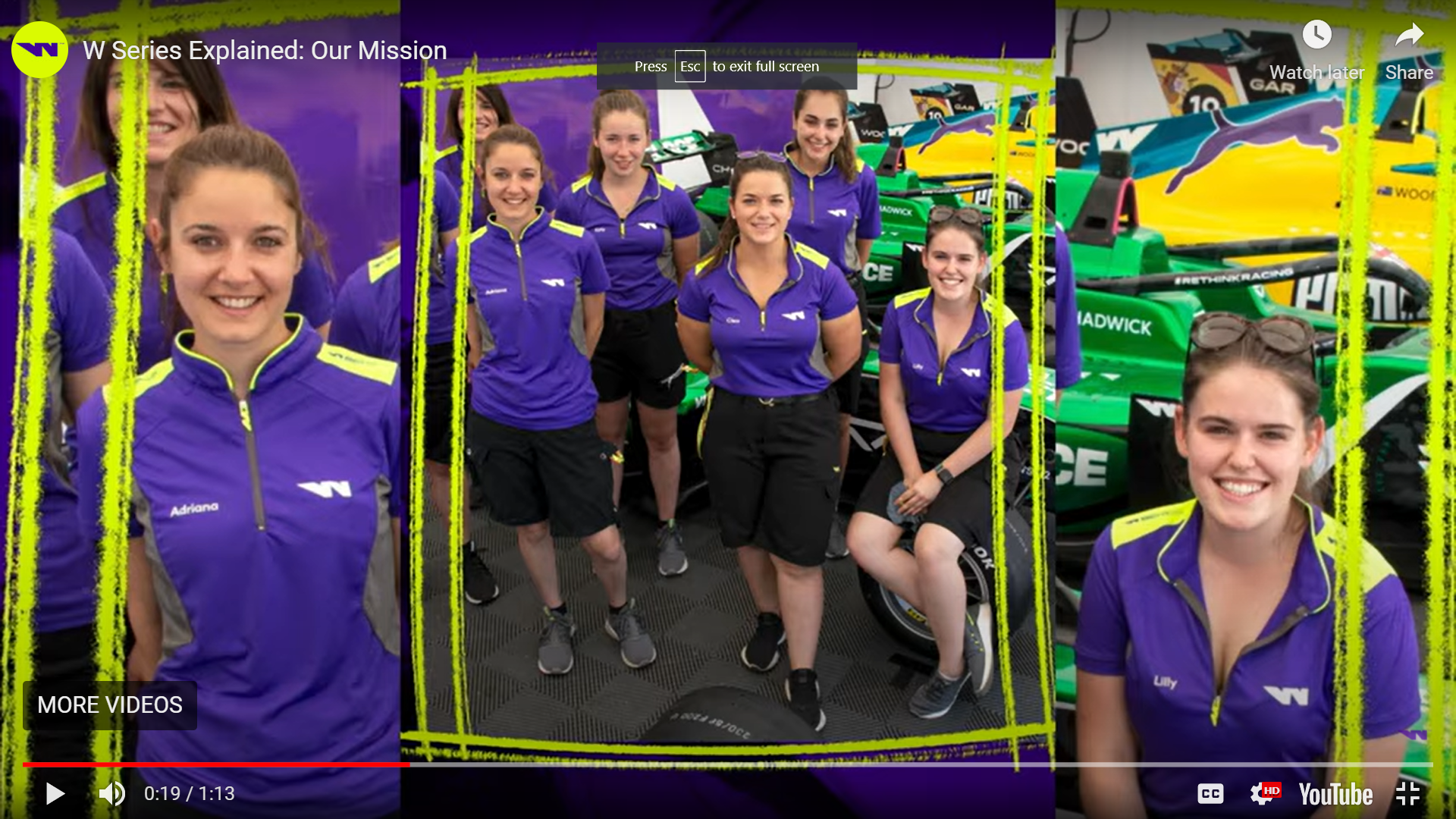
After showing this statistic it displays different pictures of the participants from W Series while saying “we believe that W Series can be an important cultural catalyst for female empowerment.” This section of the video functions to advertise why its mission is important not just for motorsport, but for women in sports as a whole.
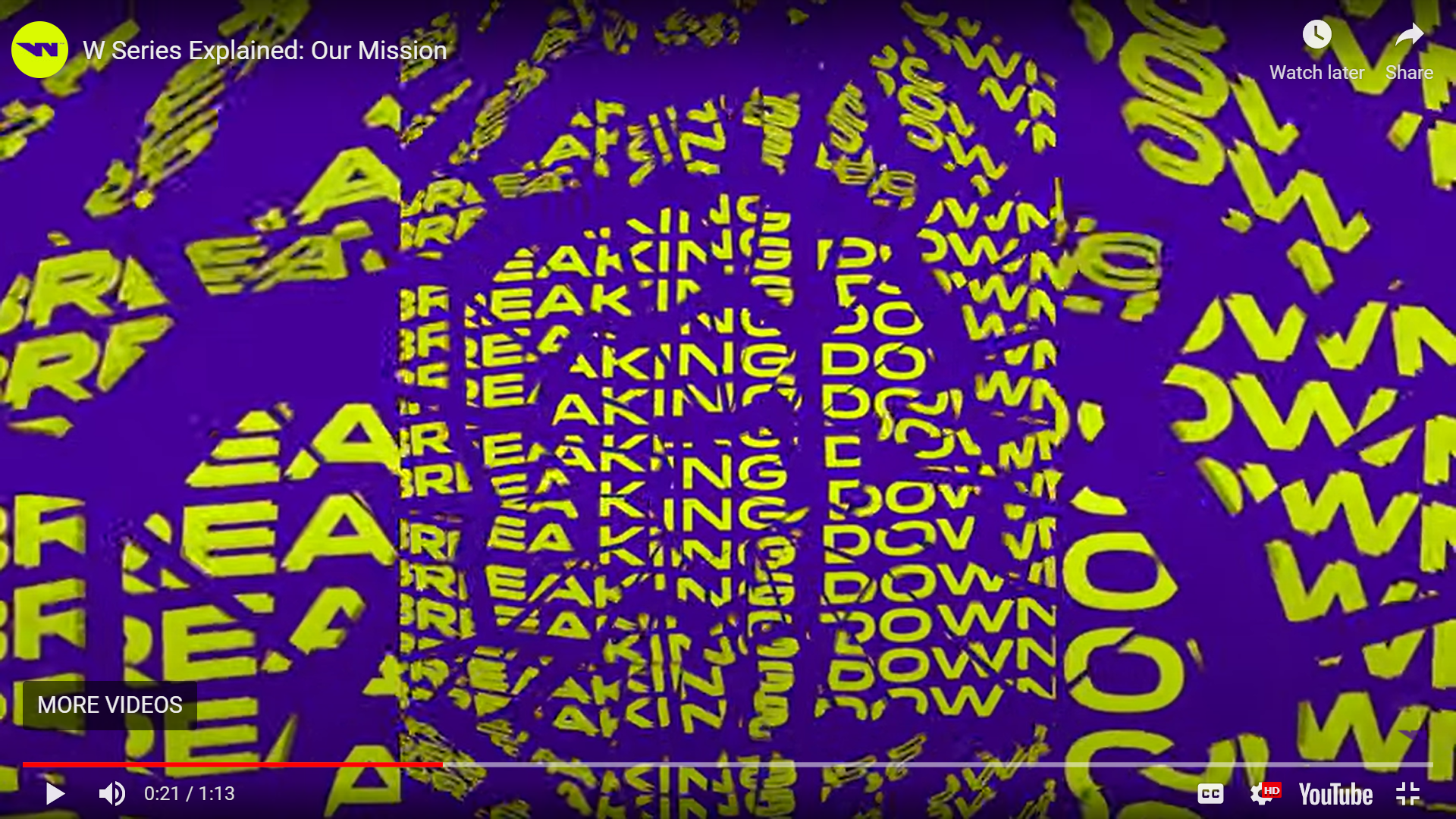
After that, a graphic of the word “breaking down” is shattered into pieces, showing that W Series aims to be unrestrictive for female participants to enter. The video says that W Series is a free-to-enter championship to give every entrant an equal chance.
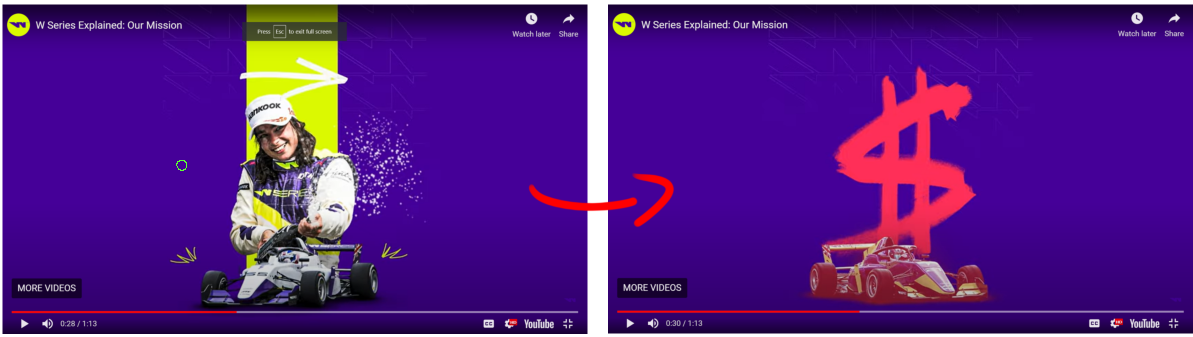
This is followed with an image of the reigning W Series champion, Jamie Chadwick, spraying champagne, followed by a dollar sign above a W-Series car, representing how the series is won by the driver with the most talent, and not those with the most financial backing.
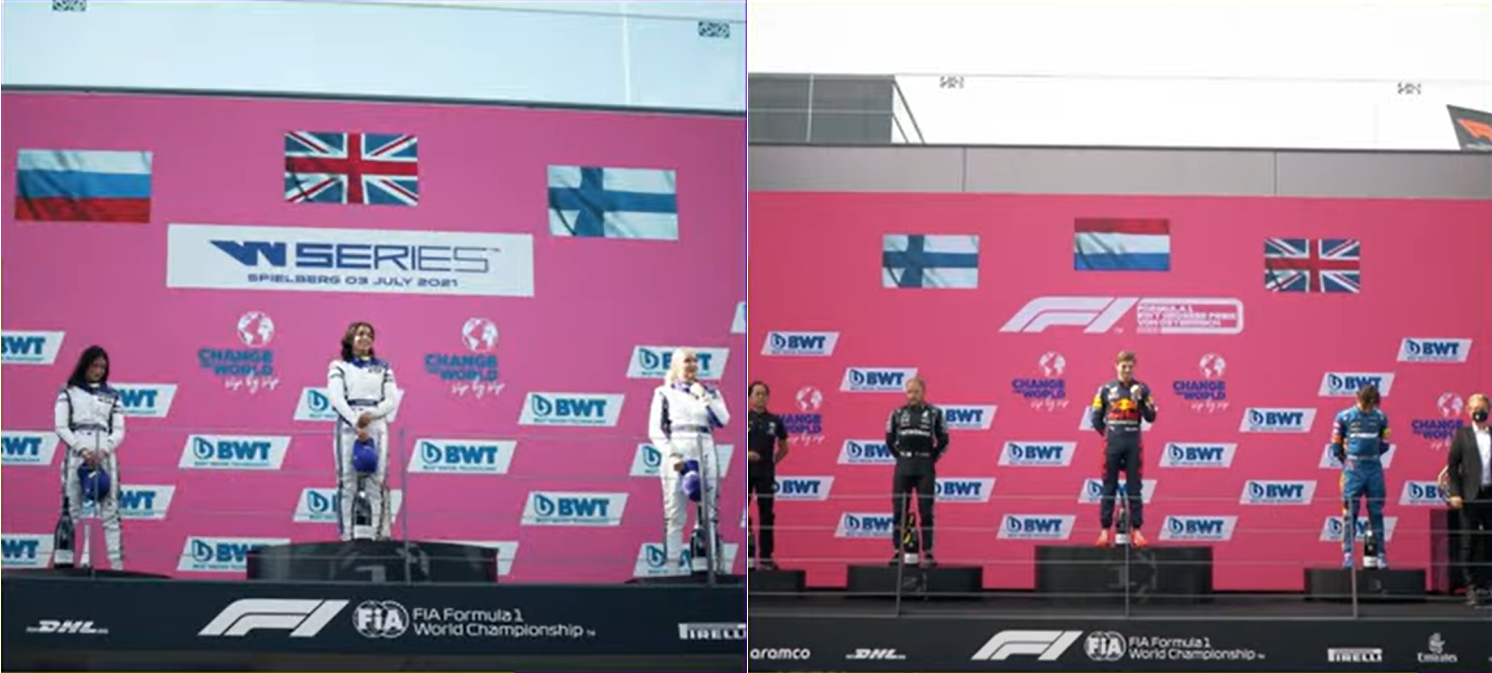
Another key point illustrated by the video is when it first shows an image of a podium ceremony from W Series, shortly followed by one from Formula One. Displaying these images, the video emphasizes how its goal is to have “female and male racing drivers compete on equal terms.” It is clear that one of the goals of W Series is to bring women in the top levels of motorsport along with men.
The final main point shown by this video is when it shows pictures of young girls driving go karts, saying “we want to inspire young girls at grassroots levels by highlighting today’s generation of talented female racing drivers.” With these images, the video is making it clear how there is a future generation of female racing drivers waiting for their big break in motorsport.
The video ends with the message “some say it’s a long road, but we’re in a hurry to get there” as a W Series-spec car drives off into the distance. This concluding message shows that W Series aims to achieve its goals as soon as possible, to ensure that Women have a place in motorsport.
This video overall has effectiveness telling its mission through its graphics and narration. The graphics displayed in the video match with messages being said by displaying easy-to-understand icons and images along with the commentary. To casual racing fans, this video does a great job delivering its message to argue that women can compete in motorsport. However, to more invested racing fans, including myself, W Series’ limitations for its goals can be easily recognized when examining other racing series that the sport intends to influence. W Series succeeds by allowing women from different backgrounds to compete in the series. However, W Series fails to solve the problem most women face when trying to compete outside of W Series. This is crucial since the ultimate argument of this video is that women have the chance to compete with men at top-level racing. While W Series itself may be inclusive, other racing series, particularly the ones it feeds into, are not. The main issue is that motorsport is very reliant on money, and in some cases, favors funding over talent. To enter in Formula 3, you need around €500,000. Even if you had financial backing from driver academies, it is very rare that they would completely cover the cost. In W Series, you are awarded €500,000 in prize money if you win the championship, which should just cover the cost to enter in Formula 3. For example, Jamie Chadwick had to return to W Series for a third season because she cannot secure funding for a seat in Formula Two or even Formula Three.
W Series aims to solve a problem that motor racing has faced for decades. It attempts to allow women from different backgrounds to be given the opportunity to enter in the highest level in motorsport. While W Series is taking a step in the right direction, it fails to achieve its goals due to external factors. Motorsport categories outside of W Series are still very much elitist, favoring mostly to male drivers with a decent amount of financial backing. If the ideas that W Series implements do not carry over to other motorsports, then inclusion of women in motorsport may still be hard to achieve.
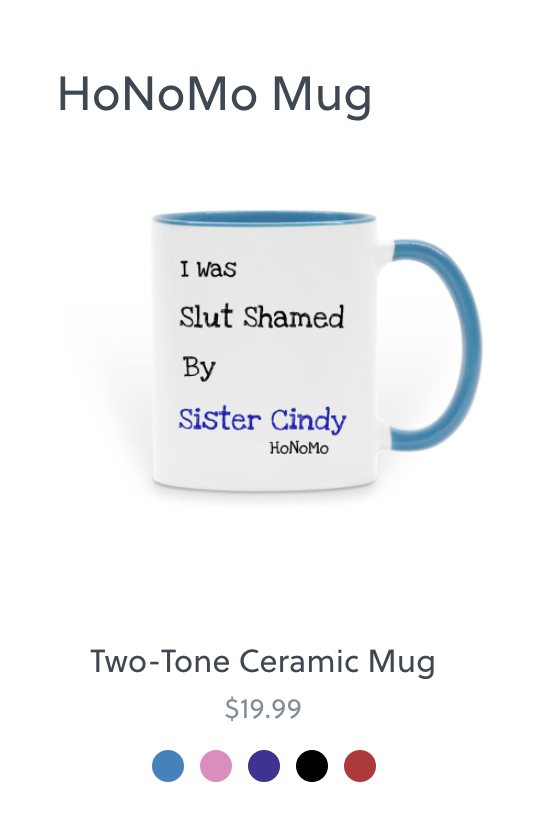
Cindy Smock, or “Sister Cindy” as she calls herself, is an Evangelical campus preacher turned Tik Tok user. She first gained attention when college students posted clips of her speeches on Tik Tok, inspiring her to make her own account. She currently has over 370,000 followers, and #sistercindy has over 194 million views (Fowler). The main subject of her Tik Tok content is encouraging college students, particularly women, to turn to Christianity and be a “ho no mo.” In many of the videos she uploads, she welcomes viewers to “Sister Cindy’s Slut-Shaming Show.” While many of Sister Cindy’s followers regard her as a comical figure, the shock factor she employs in her preaching through homophobic and misogynistic comments is harmful.
Through a glance at Sister Cindy’s Tik Tok account, it is evident that her content is misogynistic and demeaning towards women. In nearly every video she uploads, she casually uses the words “slut,” “hoe,” or “thot,” as insults towards women. For example, when visiting college campuses, she often changes the names of the universities to incorporate the word “slut.” At the Louisiana State University campus, she renamed the institution, “Louisiana Slut University.” By insinuating that college students are sluts, Sister Cindy is weaponizing the word to be used against women and normalizing the slut-shaming that is common in society, particularly on college campuses. However, Sister Cindy is proud of her slut-shaming tendencies and makes it a common theme in her posts. In a different post filmed by a college student, she exclaims, “You are princesses made in the image of God. Yet, you’ve traded your crown to be a cock-sucker.” This is quite the opposite of sex positivity and guilts women into practicing abstinence. Sister Cindy, or anyone for that matter, should never use guilt tactics to influence other people’s lives. Furthermore, why is this hateful comment only directed towards “princesses,” or women? Why is it that women should feel guilty for engaging in consensual oral sex and men should not? Last I checked, oral sex is an act requiring at least two people.
Another example of sexism in her uploads is found in a Tik Tok filmed by a student at the University of Florida. In this clip, Sister Cindy shouts, “Men, if you buy her one margarita, she will spread her legs.” This statement is incredibly insulting towards women. Not only does it perpetuate the view that women are sexual objects, but it also furthers the entitled belief held by some men that women are sexually indebted to them after buying them a drink. In addition, this comment is heteronormative and leads straight men to assume that all women are attracted to them and want to have sex with them, which is simply not the case. Finally, similar harmful views were expressed in a Tik Tok clip of Sister Cindy telling a college student that she is “an accessory to the rape crime on campus” because she is causing boys to get their “passions stirred up” (Fowler). This belief is so inherently false, that it should not require any explanation. The blatant disregard for holding men accountable in situations of sexual assault is destructive to anyone who views this post. It reminds me of the common argument in society that someone is “asking for it” based on the clothes they are wearing. Placing blame and guilt upon women seems to be a common theme in the media posted by Sister Cindy. Again, why is it that sexual assault victims should feel guilty for something that is out of their control and not their fault?
If you thought her content could not get any worse, we have not even analyzed the blatant display of homophobia present in countless Tik Toks. For example, in one clip while preaching to college students, she orders, “Don’t do it. Don’t kiss a girl and like it.” In defiance of her hate speech, two women make their way through the crowd to kiss in front of Sister Cindy’s platform. Apparently, the act of two women kissing is a difficult sight for Sister Cindy, because she has to cover her eyes. In a second Tik Tok, Sister Cindy, with no shame, shouts to a young man walking past her, “Are you a homo? You kinda act a little effeminate there. You need to repent!” There are so many problems with this statement, it is a challenge to decide what to unpack first. To begin, a straight, cisgender person should never use the term “homo” to describe someone of the LGBTQ+ community. Second, Sister Cindy is reinforcing the societal gender expectations that men cannot be feminine and women cannot be masculine. And if that is the case, then that person must be a member of the LGBTQ+ community. Finally, telling someone that they need to repent because of their sexuality, something that is out of their control, is unacceptable. Religion should never be manipulated to discriminate against groups of people. People’s sex lives and sexuality are an intimate part of their lives and should never be a subject of criticism. Therefore, someone who posts homophobic content, like Sister Cindy, should not have a platform to project those hateful beliefs.
To reflect, one’s values and beliefs should never be used as a weapon or a way of guilting others into adopting those practices. While Sister Cindy’s intention may be to educate college students, her comments are misogynistic, heteronormative, homophobic, and may even be classified as hate speech. Sister Cindy even admits that she expects to be removed from social media for her problematic comments (Fowler). If that is the case, what is Tik Tok waiting for?
Works Cited
Fowler, Kate. “Who is Sister Cindy? Evangelist Christian Preacher Turned Tik Tok Star.” Newsweek, 6 June 2021, https://www.newsweek.com/who-sister-cindy-evangelist-preacher-tiktok-star-1597651.
I love this post and how it highlights the way that people will oftentimes use comedy to hide rhetoric that is actually very harmful. Although Sister Cindy is oftentimes funny, she’s still promoting a toxic culture that prevents women from embracing their sexuality. This is a super important topic and I’m glad that you’re shedding light on it!
King Princess, in her Genius lyrics interview breaking down the song, states how “gay people have always existed in religious texts, but never in a way that is respectful.” Within the lyric “honey, on your knees,” King Princess is referring to being bowed down to like a god or saint. It is a strong move to take back this power through the inclusions and allusions to religion throughout the song. Other areas in this song, including “cause when this day is done, I still got shit to run” mention how she is in charge and in control of what she decides. It also sends the message that one can succeed in life with or without the relationship, and how important healthy independence still is even while being with someone. This is a component of empowerment: understanding our worth in both the presence of and in the absence of a partner, and being with someone who does not discredit or misinterpret this fact as selfishness. Her albums have definitely opened up conversations about gender and sexuality, and the open space a person can live in between the binary. Through my recent readings, I have learned that King Princess has, however, faced controversies regarding the “Cheap Queen” album, as some may argue it is capitalizing off of queerness instead of helping to foster an inclusive community, and there are several stories online regarding some problematic actions done by King Princess. So, in general, while songs may result in a boost of confidence among listening, the intentions of the artists can be contested.
“Nina Cried Power” by Hozier ft. Mavis Staples may not be regarded as a feminist tune, as it is more of an anthem of the Civil Rights movement, but it is an exceptional song of revolution and includes the names of some incredible activists in the lyrics, including Nina Simone, and the voice of Mavis Staples herself. I think it always deserves a replay on Spotify. It is an incredible composition and promotes intersectionality, so I figured I might add it to our class playlist based off of our discussions and focuses throughout the semester as well.
Although Fifth Harmony may no longer be together, the message in their hit song “BO$$” remains relevant and important. The lyrics paired with the strong brassy sound of the instrumentals make this song an anthem of empowerment for women.
This song portrays ideas of second wave feminism, defying ideas that women must stay in the home and only be a housewife, and instead empowers women to work and get the money they deserve, demanding respect from everyone around them. This can relate to one of the most prominent works from the second wave, The Feminine Mystique by Betty Friedan, saying “She can say ‘no’ to those mass daydreams of the women’s magazines and television, ‘no’ to the depth researchers and manipulators who are trying to ruin her life” (Friedan 280). Lyrics such as “Workin’ for the money ‘cause it’s what my momma taught me So yo ass better show me some re-spect” reject stereotypes continually placed on women, similar to Friedan’s quote and the idea of second wave feminism overall.
Additionally, given the fact all five members are women of color, the song can be interpreted as a message of empowerment for all women, no matter their race or ethnicity. The lyrics repeatedly include strong Black women, saying “I’m on my Michelle Obama sh-” and “purse so heavy getting Oprah dollars,” highlighting the successes of notable women of color.
Not only are the lyrics empowering, but the music video sends a strong message of feminism and defying gender roles. Within the first ten seconds, messages such as “Find yourself. And be that,” or “Dreams don’t work unless you do,” are displayed across black screen for us to really read and understand their importance. There is also a scene of arm wrestling with the five girls against a group of men, where they all take their turn beating each man in a match. Arm wrestling has always been portrayed as a sign of strength and masculinity, I’ve noticed particularly in TV shows or media, so having all the girls beat the group of boys shows the reversed gender roles the message of the song conveys.
Something that could have added more nuance and depth to the song is the mentioning of certain struggles or difficulties the members, or women in general, have to face. Lyrics such as “Don’t want yo compliments, use common sense,” or “I ain’t thirsting for no bae” hint at struggles women face by highlighting assumptions often made about women, but the message of the song could have been more impactful if deeper, more direct struggles women universally can relate to were included. Bringing back the fact that all of the members are women of color, while I love that they included other iconic Black women in the song, it would have been more impactful to see the members mention moments of struggle and triumph from their perspective as women of color. This would add more interest and depth, avoid repetition, and make it more relatable to women of color everywhere.