Sex Education’s New Show in Season 3

Season 3 | Sex Education Wiki | Fandom
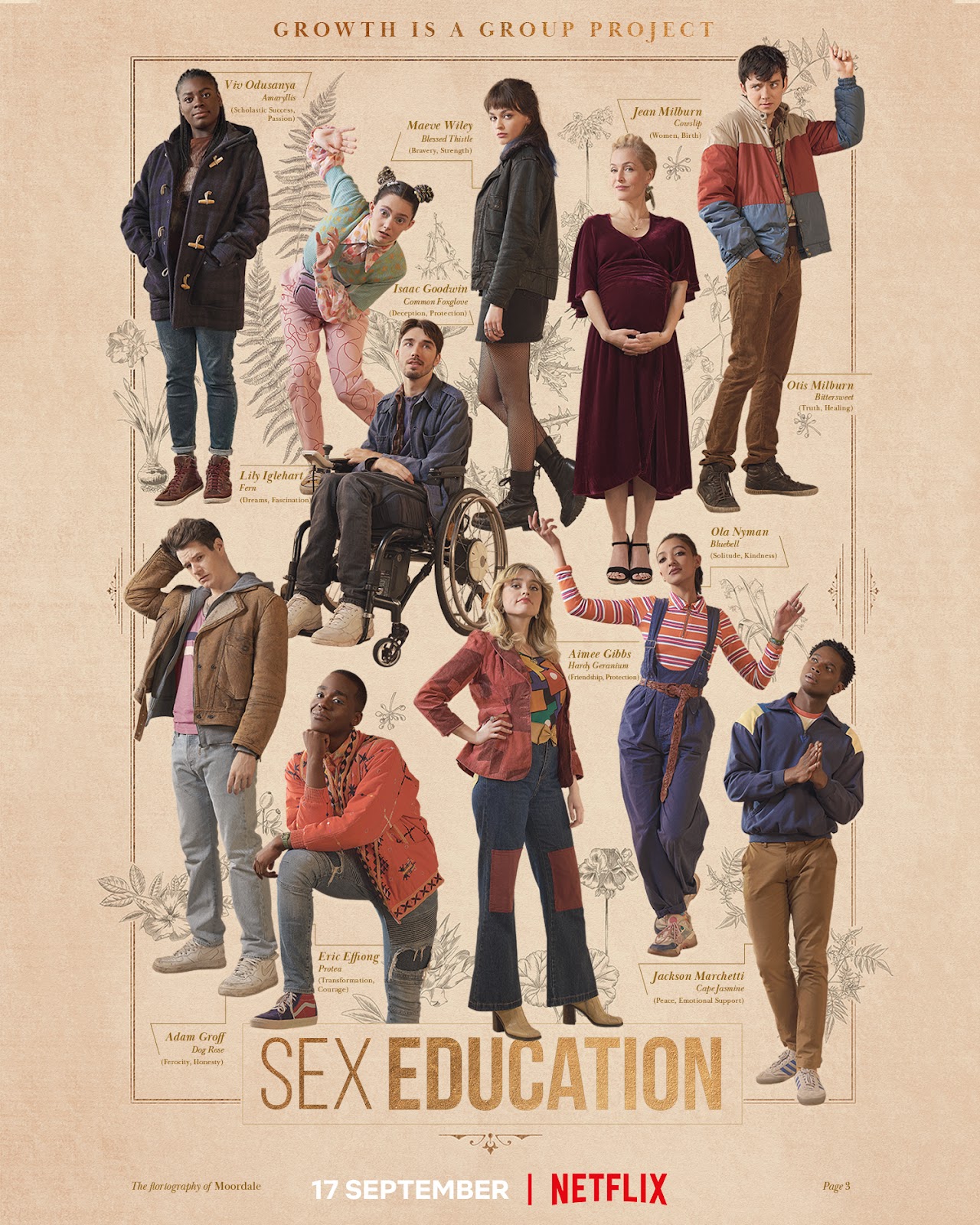
Sex Education’s Season 3 Promotional Poster

I remember waiting for the third season of Sex Education to come out – I was reposting the promotional posters on my story on Instagram and sending it to my friends. When Sex Education finally came out, I was surprised at how different this season was from its previous seasons. Sex Education started as a show navigating the life of Otis, whose mother is a sex therapist. Because of this, Otis has learned the techniques of how to talk to someone. He then tries this at school with an unexpected friend at the time called Maeve. As a result, they both start making this a regular thing after success. Moving on from this, in season 3, the sex therapist students are not quite as much in this picture but are rather dealing with Moordale’s new principal Headmistress Hope who moves Moordale in a backward way, removing self-expression and promoting heterosexuality, while shaming anything different. Cal and Headmistress Hope are two of the new characters this season, and they are complete opposites, to say the least. Hope’s backward idea of how to run a school is a great reason to show why such classes like GSS exist.

One episode in particular that struck me was a scene from this seasons Ep. 4:

(Video won’t seem to load so here’s the link: https://youtu.be/VGID85R1LTA)

Firstly, this scene I want to talk about in particular. Prior to this scene, Headmistress Hope tells Viv, her student assistant, to tell the people of Moordale to separate themselves into two lines based on their gender. However, because Cal is non-binary, they don’t separate themselves into a line and have an argument with Hope. Cal then goes on to say “So we go to the vagina or penis line? Is that what you’re saying?” This itself shows how bent Hope’s thinking is: there are only two genders and that it depends on your genitalia. For centuries, we have always decided to look at someone’s genitalia and say “They are a boy” or “they are a girl,” and it’s time we step away from this disgusting perspective. 

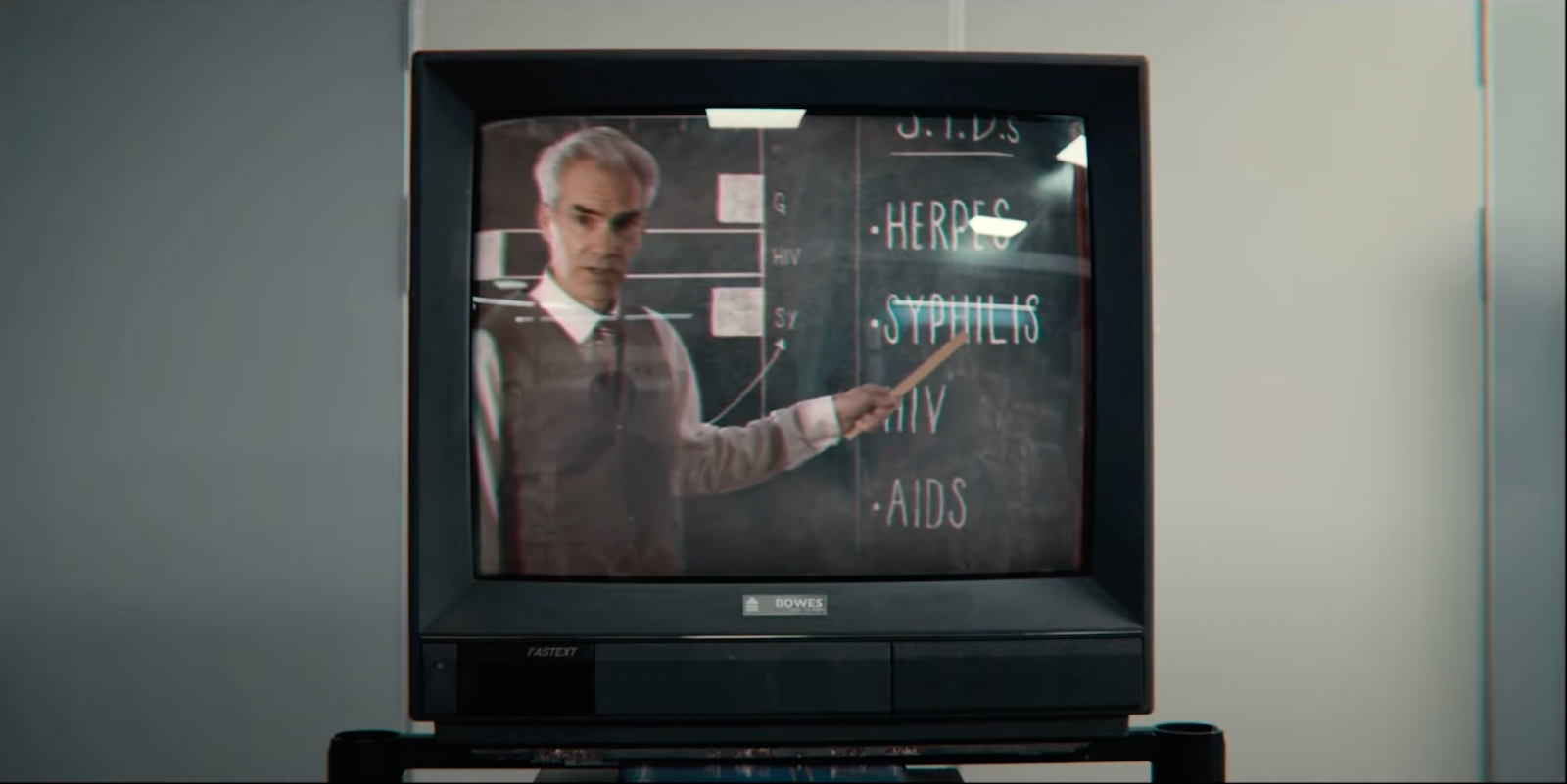
Sex Education Season 3, Ep. 4. Screenshot from video stated

Focusing more on this scene, the boys get a talk about homophobia and stating that homosexuals have a higher chance of getting an STD. Meanwhile, the girls are getting a talk about how sex is scary and can ruin your life. Maeve, one of the earliest main characters, however, tells the group speaker of the girls group that sex isn’t and shouldn’t be scary. Maeve gives a progressive speech suggesting that students should instead see that sex gives them insight into their body, like what they like, and that girls shouldn’t be the only one getting the talk of “sex is a mistake because it leads to unwanted pregnancy.” This ties into the idea of Foucault where the idea of sex shouldn’t be talked about and that people should be shamed for having these ideas and thoughts. And, further in this episode, the students of Moordale are scared because they’ve been involved in sexual activities prior to this meeting and that their lives could be in danger just because of what they’ve been told. Society makes sex seem as a bad thing and that only bad things will happen if you engage in the act of sex, but nothing will happen if you go about it in a safe direction.

Sex Education" Episode #3.6 (TV Episode 2021) - IMDb
Sex Education Season 3, Ep. 6

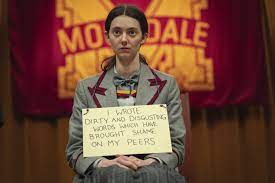
Another interesting part of season 3 lies within episode 6. Hope decides to publicly shame students who caused a bad reputation for Moordale. While she shames 3 students, Lily, a student who writes sexual stories about aliens and such things, and Cal in particular are shamed for being themselves. To explain, Cal is told that they are a messy troublemaker when all they have done to “disrespect” Moordale is ask for equity. Cal is constantly reminded by Hope to fit in a certain category by her forcefully putting labels on their gender when they are non-binary, but never lashes out against Hope. For Lily, she is told that she has brought shame to her peers with “dirty and disgusting words,” which comes from Lily’s sexual fantasy stories. Again, especially for teenagers in high school going through puberty, students should not be shamed for having sexual desires. Additionally, the idea of fantasies and fetishes shouldn’t be shamed either. Lily is a great character at showcasing these fantasies and, earlier in the season, Lily used to wear makeup and style her hair to indicate this love for her fantasies. 

Season 3 was something entirely different, but I did enjoy it. It helps show how different people are from one another, and that we shouldn’t be putting others down for having differences or looking different. We should be encouraging these differences and seeing how much more a society could be if individuality was promoted. Sex Education does a great job in this season to showcase this.

Pharrell Williams: Blurred Misogyny 

Pharrell Williams: Blurred Misogyny 

In 2013 superstar Pharrell Williams teamed up with artists Robin Thicke and T.I to bring us “Blurred Lines.” The Times’ 2013 song of the summer, 640 million streams, 14 million copies sold – The song enjoyed instant and lasting success. But the song’s undeniable catchy beat, ironically, blurred its appalling lyrical and visual message. This piece will uncover what so many of us missed: 

The song’s lyrics promote three very troubling concepts:

While one of the most catchy, the line “I know you want it, I know you want it” is equally – if not more – problematic. These lyrics, sung by Pharrell, are a direct challenge to a woman’s consent. They imply that what comes from a woman’s mouth is not truly what she wants. Smiling, laughing, pushing – the video encourages a man to reject a woman’s word and insinuates he can do so in a joking and fun manner. This line reflects a more significant cultural issue; men have historically – purposely and not – misinterpreted a woman’s consent. This lyric suggests the line between consent and refusal is cloudy (blurred) when in reality, a woman is always firm in her decision.

Additionally, Pharrell sings about the “good girl,” the perfectly manufactured woman in the eyes of the patriarchy. “good girls”, as defined by Pharrell, are women who are sexually passive, almost timid about their desires, and are in need a man to direct, if not force them. The concept of “good girls” exists to build frequently unachievable standards for women. These lyrics normalize a concept we see so often in other forms of media today: women are sexually drawn to men who are aggressive and forceful about their desires. This enables men to feel as if forms of sexual harassment and sexual assault are just another kind of “advanced” flirtation. 

Lastly, Pharrell sings, “Tried to domesticate you, but you’re an animal, baby it’s in your nature” – In the music video, Robert Thicke mouths Pharrell’s words into the ear of a black model. An insensitive shot in which the lyrics can be perceived in a racial context. Black women being considered anything but human has enabled centuries of medical malpractice in which Black women were used as test subjects to advance scientific understanding. The racial implications of this shot are undeniable; forceful power dynamics and dehumanization have assisted and continue to assist in the oppression of black women.

How Blurred Lines directs masculine objectives: 

Along with the lyrics, It’s important to analyze who Pharrell’s intended audience is. While an artist will generally cater to the reasonably widest audience, it is clear that the message he pushes is meant for young men. This becomes apparent as he displays the social and sexual success of men who employ the technique of using and forcing themselves onto women. 

On the top: T.I, a rapper most popular with young male audiences, flirts and dances with three separate women while the lyrics “I know you want it, I know you want it” play. The positioning of the shot is essential; T.I dances in front of the women, who appear to serve as his backup, dancing behind him. This shot reinforces the idea that women should be treated as props and helpers in a man’s life. The inappropriately flirtatious T.I also underlines that men who subscribe to aggression and assertion with women will be sexually hyper-successful. 

On the Bottom: T.I, Pharrell and Robert Thicke are pictured together. All three of the men are in classy attire. The scene endorses the idea that forcing yourself onto women will not only bring you success with women, but will additionally give you status and respect among your friends. In contrasting their clothing, we see that the men, who are fully dressed, exude a message of strength and control, while women, dressed in only revealing clothing, are judged solely based on their body image and are a supporting entity to the man’s status. 

Years later, Pharrell and Robert Thicke have admitted their embarrassment for their part in writing the song. Remorse is a step in the right direction, but the damage this song has caused and will continue to cause is evident. Younger generations that are broadly refused access to sex education in schooling often turn to forms of media for guidance. Messages like that of Blurred Lines subconsciously encourage the persistence of misogyny and rape culture in our society. The importance of the lesson we can learn from this is anything but blurry: the media we consume matters, our consumption has the possibility of enabling good and bad. 

#Sharetheload

I’ve grown up watching my father do all the household chores. To many, this may be the ‘bare minimum,’ as it rightly is. However, patriarchy is so deep-rooted in Indian culture that such behavior is considered abnormal. Family members visiting our home would become physically uncomfortable watching my father cook, wash dishes, clean, and do the laundry, because that wasn’t ‘his job.’ In Indian society, men partaking in domestic chores is an alien concept.

This gender stereotype was challenged by an award-winning #ShareTheLoad initiative by an Indian laundry detergent company, Ariel, in 2015. The company launched this campaign through impactful advertisements, spotlighting the everyday, normalized gender inequality experienced in Indian households. They aimed to create “happier households where men and women Share The Load equally.”

https://youtu.be/QAxm23SjHDo

In the advertisement, we see how a young child observes the polar opposite realities experienced by her parents. The daughter notices how her mother is never asleep next to her at night and is up late doing household chores. In the morning, her mother wakes up unrested, hastily tossing breakfast for her family. She returns home after a long day of work only to face the endless to-do list on her phone. Yet, her mother never lets her professional commitments come in the way of looking after her family. She’s seen tucking her daughter into bed, reading to her, and preparing materials for the next school day.
In contrast, the daughter watches her dad get a good night’s sleep. He enjoys a relaxed morning, spending quality time with his daughter before heading to work. He seems carefree and unburdened. He is also oblivious to the amount of work his wife completes ‘behind the scenes’ at night to provide him with a comfortable lifestyle.

We can see the woman working- what Marxist feminist sociologists call- the triple shift. This refers to the idea that women in capitalist societies are expected to do paid and unpaid work and cater to their families’ emotional needs. Women are expected to juggle professional and familial responsibilities mechanically. Hence, the rise in the percentage of women employment in India is progressive only at face value. The reality is that there has been no change in the social expectations put on women. Women must work, be the best wives and mothers and conform to all social norms. Multi-tasking is glorified and regarded as a skill that ‘successful’ women have, prompting others to achieve this unrealistic standard.

In the advertisement, the daughter is the change initiator. When she notices her overworked mother, she wakes her father up and ushers him to the laundry room. The girl symbolizes the literal wake-up call that Ariel wanted to give India. The father is shocked to find his wife, completely exhausted, dozing off near the laundry machine in the middle of the night. He realizes how his lack of contribution affects his wife and makes an immediate change by taking over the laundry. The advertisement ends with a display of empirical evidence to support its argument. It draws a connection between the unequal division of household chores and women’s health, stating that 71% of women sleep less than men.

Apart from highlighting the unequal distribution of domestic work between men and women, the advertisement also emphasizes how children unconsciously pick up gender norms and roles. Children internalize gendered behaviors, roles, and activities by watching their parents. This advertisement was applauded for its ability to convey a meaningful message in a minimalistic way. It illustrated a scene that most Indians were familiar with and could relate to. It showed the Indian population that making a change doesn’t always entail grand gestures. One can change the status quo by something as simple as sharing the laundry with their partner.

However, the advertisement is far from perfect. In my opinion, the ads create a one-step forward, two-step back situation. The campaign fails to address the issue’s root- that household chores are not a woman’s job. The phrase ‘ShareTheLoad’ implies that household work is a woman’s job or ‘load’ to begin with and that men should ‘help’ them by ‘sharing’ the burden. It encourages the depiction of men as saviors who go out of their way to help the women in their families. Household work continues to be portrayed as a gender-specific role. The idea that domestic work is a life skill everyone should have regardless of gender is not translated through the screen.

Moreover, the campaign is very heteronormative. It does not do an excellent job of representing queer individuals and families. While the ad does a great job of exposing the inequalities faced by women in households, it continues to reinforce the idea that families can only consist of heterosexual couples. 2018 was a monumental year for LGBTQ+ rights in India. Article 377 of the Indian Penal code (which criminalized any form of queer sex) was struck down and deemed unconstitutional. However, removing the law did not manage to remove the social stigma around the LGBTQ community in India. The fear of representing queer relationships in mainstream media remains evident through the continuous display of heteronormativity.

Nevertheless, the campaign marked a significant first step towards encouraging companies to use their mainstream platforms to advocate for gender equality. I hope to see a more mainstream representation of the Queer community in India in the future!

The Perpetuation of the Sapphire Stereotype: The Portrayal of Serena Williams as an “Angry Black Woman”

Media Analysis: Hale Robinson

“2018 US Open Highlights: Serena Williams’ dispute overshadows Naomi Osaka’s final win”

The origins of the words “sapphire,” “mammy,” and the stereotype of an “angry black woman (ABW),” date back from the 1800s to mid 1900s where caricatures, cinema, and other forms of media perpetuated these racial tropes (“The Sapphire Caricature”). The term sapphire was originally used to portray black women as angry, rude, loud, malicious, and masculine (“The Sapphire Caricature”). Often, sapphire imagery is accompanied by black men to demonstrate how “through her use of verbal putdowns” the black woman emasculates the man, “robbing” him of his manhood (“The Sapphire Caricature”). Similarly, the “mammy image” was created to justify the economic exploitation of house slaves where black women are “penalized if they do not appear warm and nurturing (Collins 267).” More modern examples of sapphire depictions are coined with the term “ABW.” While there is little empirical evidence supporting the stereotype that black women are more aggressive by nature, the U.S. mass media continues to push ABW headlines, videos, and imagery (J. Celeste).

Serena Williams is widely renowned as one of the greatest women’s tennis players of all time and an incredible overall athlete. She retired as a tennis legend with a total record of 858-156, 6 U.S. Open Championships, and 23 Grand Slam titles (“Serena Williams Fast Facts”).

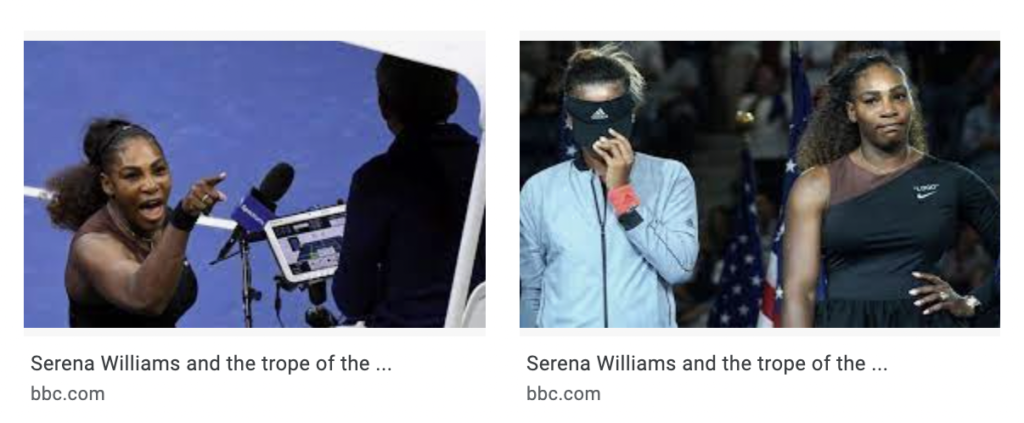
While Serena Williams’ success is celebrated, she unfortunately became a target of the ABW stereotype on several occasions throughout her career. There are numerous videos titled “Serena Williams Rage Compilation” posted on social media platforms in addition to hundreds of newspaper and magazine articles covering her sporting disputes and frustrated moments. In fact, Williams’ portrayal as an ABW in the mass media is so significant that if you were to do an image search of the term “angry black woman,” the first few pictures are of Williams.

Of the many sources covering Serena Williams’ career disputes, I focused on one video published by the largest American cable sports coverage network, ESPN. The video, titled “2018 US Open Highlights: Serena Williams’ dispute overshadows Naomi Osaka’s final win,” covers the 2018 US Open Championship between Serena Williams and Japan’s Naomi Osaka. The video begins with a clip of Williams breaking her tennis racket out of frustration. The video crew proceeds to zoom in on the broken racket and then later replays the clip of a frustrated Williams throwing her racket down. Soon after, the referee accuses Williams of receiving coaching and cheating.

On multiple instances, Williams demands an apology from the referee stating, “you are attacking my character.” In response to this, the referee gives Williams yet another violation. While disputes and frustration often go unpenalized and are often overlooked or granted leniency in men’s tennis, Williams received multiple penalties for her actions. When pleading her case, Williams notes, “because I’m a woman you’re going to take this away from me.”


While the contents of the video itself are controversial, I additionally wanted to focus on the ways in which ESPN perpetuates the ABW stereotype through the title of the video, the clips they provide, and the specific zoom and camera angles chosen. Although the video is titled “U.S. Open Highlights,” very few clips in the video are dedicated to the tennis match itself. Rather than replaying points and impressive displays of athleticism, the “highlights” in this video are clips of a frustrated Serena Williams. The camera angles and zoom were methodically used in a way to emphasize Williams’ anger with an example being the amount of screen time Williams’ broken racket received and the frequent replaying of Williams arguing with the referee. By doing this, ESPN paints Williams as angry, similar to how post slavery media pushed the agenda that Black women were angry, aggressive, and emasculated men by “failing to be submissive.” Furthermore, the video title states, “Serena Williams’ dispute overshadows Naomi Osaka’s final win.” By naming the video in this way, it paints Williams as the “bad guy” and accuses her of ruining Osaka’s moment. This depiction of Williams as aggressive and malicious is representative of 20th and 21st Century ABW media.  In addition to the title, the video’s description is equally disappointing…

While the match showcased the skill of two amazing Black female athletes, ESPN implies that the match will only be remembered because of Williams’ quarrel with the referee. Not only does this take away from Osaka’s victory, but it places further blame on Williams.

Through the notion of sapphires, mammies, and more recently “angry black women,” Black women have continued to fall victim to racial stereotypes depicting them as aggressive, malicious, and out to emasculate men. Following the 2018 U.S. Open Championships, ESPN perpetuated these racial tropes via a “highlight video” that covers a dispute between Serena Williams and a referee. While male tennis players receive little backlash from similar actions during matches (e.g., John McEnroe was known for his outbursts throughout his career), Williams was accused of “overshadowing” Naomi Osaka’s win and was given three penalties. While the term sapphire may be a thing of the past, the theme of portraying Black women as angry and aggressive in the media continues.


Sources

Collins, Patricia Hill. “Race and Ethnicity.” Controlling Images and Black Women’s Oppression , pp. 266–273.

ESPN. 2018 US Open Highlights: Serena Williams’ Dispute Overshadows Naomi Osaka’s Final Win. Youtube, 8 Sept. 2018, https://www.youtube.com/watch?v=uiBrForlj-k.

J. Celeste Walley-Jean. “Debunking the Myth of the ‘Angry Black Woman’: An Exploration of Anger in Young African American Women.” Black Women, Gender + Families, vol. 3, no. 2, 2009, pp. 68–86. JSTOR, https://www.jstor.org/stable/10.5406/blacwomegendfami.3.2.0068. Accessed 6 Oct. 2022.

“Serena Williams Fast Facts.” CNN, Cable News Network, 16 Sept. 2022, https://www.cnn.com/2013/09/13/us/serena-williams-fast-facts.

“The Sapphire Caricature.” Ferris State University, https://www.ferris.edu/HTMLS/news/jimcrow/antiblack/sapphire.htm.


A Voice for the Voiceless: How Grey’s Anatomy Moves from “Silent All These Years” to “Shattering the Glass Ceiling”

Women are taught to never walk alone at night, to carry their keys between their fingers, and to dress modestly but not too modestly. I consider these basic “Woman 101” tips. And somehow, these tips are supposed to keep me and other women from becoming another 1 in 3. 

When current conditions are voiced, we as a society tend to turn a blind eye. Supreme Court Justice Brett Kavanaugh was confirmed to the court despite being accused by multiple women of sexual assault. Many women and girls limit their behaviors for fear of rape— for fear of being told that “boys will be boys,” “you were asking for it in that dress,” or “maybe next time you shouldn’t drink so much.” Concomitantly, adolescents have learned that consent does not matter—that it is irrelevant. 

While discussions are finite, popular media has begun to tackle the topic of rape. The season fifteen Grey’s Anatomy episode, “Silent All These Years,” written by Elisabeth R Finch, aims to initiate the dismantling of rape culture while highlighting the importance of consent and the lasting impacts of rape. The title, in and of itself, highlights just how oppressive and dismissive society becomes when women speak up about instances of sexual assault and rape. 

The episode begins when Khalilah Joi, guest-starring as a woman named Abby, arrives at Grey Sloan Memorial. With a cut to her face and bruises, coupled with skittish behavior, Dr. Jo Wilson recognizes the signs of rape. As the episode progresses, viewers learn that Abby was raped after leaving a bar. Aware of the victim-blaming narrative frequently used against women, Abby is hesitant to report the incident to the police or let her husband know. In attempting to break the stigma, Dr. Jo Wilson breaks protocol and shares her story of rape and sexual violence. She humanizes herself, therefore allowing Abby to see her as more than a woman in a white coat. When Abby agrees to a rape kit, something she knows will probably end up sitting in the back of a police station, Dr. Jo Wilson and Dr. Teddy Altman shift the power back to Abby. Before moving to the next portion of the rape kit, Abby must give them consent. She makes all the choices for herself. Something so seemingly simple is immensely powerful. Just hours before, Abby had lost all body autonomy. 

Dr. Jo Wilson sharing her story with Abby

That said, the most moving part of the episode comes prior to Abby’s surgery. Hesitant to go under anesthesia out of fear of being vulnerable again and fearful of seeing her attacker in the faces of the male staff and doctors, Abby resists the surgery. From that, the “hall of awesomeness” was assembled. The hospital’s female employees lined the entire length of the hallway right up to the operating room (which only had female doctors because girl power!!). The vast majority did not know Abby but showed up because they would want others to do the same if they were in that position. 

The “Hall of Awesomeness”

The show made an additional point to shift the fault from the woman. We live in a society that thrives off victim-blaming. Contrary, in “Silent All These Years,” Ben Warren, played by Jason Winston George, took the time to explain consent to his stepson Tuck Bailey, played by BJ Tanner: “If she stops having fun, just plain stop,” said Ben. “Time out. Game Over.”

Media portrayals of sexual assault correlate with increased victim blaming and the way the public discerns victims. Contrasting the standard image of women as sexual objects, Grey’s Anatomy humanizes the victim, emphasizing the importance of consent while moving away from victim blaming. 

I was talking to someone the other day who said he thought this episode was cringy. He viewed the “hall of awesomeness” as unrealistic and unnecessary, leaving him emotionally detached. And while I listened to his opinion and told him he had the right to hold that belief, I elaborated on my perspective. The unity and “women supporting women” narrative present throughout the episode not only reinforced the idea that you are never alone but highlighted just how essential lessons on consent and education about rape are. 

There is a common misconception that feminism is anti-male when the movement’s principle is contingent on equal rights for women. Women want to be heard, to be supported, and to be given a choice. This episode highlights this message. The creators gave a voice to the voiceless. They addressed the intersectionality between race and gender; Abby was played by a Black woman, serving as a nod to the increased vulnerability of Black women. They highlighted the healing power of female solidarity while recognizing that trauma is real and does not go away overnight. They emphasize that survivors are not alone and that they are not at fault. 

To anyone that finds Grey’s Anatomy over-dramatic, cringy, or over-rated, I encourage you to give it another chance. While it might not change your opinions on the show, it empowers survivors in a world that usually silences them. If not for yourself, do it for the one in three. 

Discussion Guide: Sex Workers and their Current Fight for Legality in North Carolina

Format for Deliberation

Before the Deliberation

1.  Read this document’s Background, Shared Language, Expected Outcomes and Conversation Agreements section.

  • If you encounter words or concepts that you are unfamiliar with or have questions about, refer to the Shared Language section that provides some discussion and definitions of key terms related to gender and sexuality

2. (Optional) Review the sources listed in the footnotes of this document

During the Deliberation

  1. Shared Language – 5 mins
  2. Expected Outcomes and Conversation Agreements – 5 mins
  3. Introduction and Personal Stake – 10 mins
  4. Gaps and Solutions – 30 mins
  5. Reflections – 10 mins

Background

From North Carolina Prostitution Offenses and Penalties

Prostitution is the act of “performing, offering, or agreeing to perform vaginal intercourse, any sexual act, or any sexual contact for the purpose of sexual or another gratification for money or other consideration.”

It is important to note that this law has only been updated twice in recent history: once is 2013, and the last time being 1919. As such, there is archaic language and traditional marital roles present within much of these laws. For instance, one can be charged with “patronizing a prostitute” with anyone “who is not his spouse.” Not only does this assume older individuals seeking sex workers are married, it assumes they are male. On top of those assumptions, it assumes they are heterosexual as well. Making the clarification of “vaginal intercourse” instead of simply stating “intercourse” clearly demarcates how some legislators define sex as vaginal intercourse between a man and woman. Additionally, even if the participants were heterosexual, it excludes anal intercourse from this specification. Still, the wording and referring to the readers as “his” indicates a misogynistic viewpoint that only men pursue prostitutes.

From Safer Sex Work – NC Harm Reduction Coalition

The North Carolina Harm Reduction Coalition defines a sex worker as someone that “provides sexual or sexual related services in exchange for money, drugs, other favors” explicitly as a form of income/work. This article addresses the myth that “all sex workers are women” or that “sex workers can not be raped.” In this page, the coalition also gives advice on avoiding STIs and date violence all while using common vernacular to explain their reasoning. 

Shared Language- 5 minutes

Language to Consider Adopting/Preferred Terms

  • Intercourse
    • Intercourse can be the emotional or physical acts of engaging in sex. It is not limited to vaginal intercourse and is not dependent on the participants’ gender or sexual orientation. 
  • Sex worker > Prostitute
    • Prostitute is a notoriously derogatory term for sex workers and is similar to “lady of the night.” It demeans their work with a socially negative connotation and falsely separates sex workers in categories between prostitutes (physical sex workers in cities) against pornography stars or strippers. 
  • Sex Trafficking versus Choice
    • While it possible that many sex workers acquired this profession via sex trafficking, there are many individuals that chose this line of work and being respectful of this choice is imperative to continue. 
  • Solicitor > John
    • While the North Carolina Harm Reduction Coalition refer to all sex worker clients as “John,” to avoid gendered language it would be beneficial to use “solicitor” or “client” instead. Calling all clients “John” ties back to the heterosexual myth that all sex workers are women and their clients are all men; both sides come with a range in genders. 

Dynamics to Consider

  • Many sex workers consider “prostitute” and “lady of the night” to be demeaning terms. These terms are also gender-exclusive which is why saying “sex worker” is preferred to the former options. Not all sex workers are cis gendered women, so it is imperative to use this distinction.
  • Despite the rise of technology, and the increasing use of platforms such as OnlyFans, we will only be discussing sex work when it comes to physical intercourse, stripping, and pornography. Although OnlyFans is new, its complex interface and user interaction are too expansive for this discussion. 

Expected Outcomes and Conversation Agreements- 5 minutes

Expected Outcomes

Given the complexity and religious as well as economic nature of this topic, the purpose of this forum is not to come to a formal agreement or declaration about any policies related to the legality of prostitution within North Carolina. Instead, the North Carolina Harm Reduction Coalition will take ideas generated from this forum to be utilized in committee meeting discussions and planning for future political decisions and lobbying.

Conversation Agreements

In entering into this discussion, to the best of our ability we each agree to:

  1. Be authentic to our experiences and be respectful of others’ experiences shared.
  2. Be an attentive and active listener for all parties involved–whether or not you agree with their stance on prostitution.
  3. Be a purposeful and concise speaker. 
  4. Approach fellow deliberators’ stories, experiences, and arguments with curiosity, not hostility.
  5. Assume the best-and not the worst-about the intentions and values of others, and avoid snap judgements.
  6. Demonstrate intellectual humility, recognizing that no one has all the answers, by asking questions and making space for others to do the same.
  7. Be open to answering others’ questions to the best of your ability; however, be aware it is not your job to educate others.
  1. Critique the idea we disagree with, not the person expressing it, and remember to practice empathy. 
  2. Note areas of both agreement and disagreement.
  3. Respect the confidentiality of the discussion
    1. When referencing specific individuals, whether part of the sex work industry or not, no names or identifying remarks will be shared outside of this group
  4. Avoid speaking in absolutes (i.e. “All people think this,” or “No educated people hold that view”).

Introduction and Personal Stake- 10 minutes

  1. Who are you, how old are you, what are your pronouns, what do you do for work, and what do you hope to gain from tonight’s discussion?
  2. What about the legality of sex work is important to you personally and for our broader community? 
    • If willing, please explain sex work’s economic impact on your livelihood.
  3. What immediate issues, if any, do you see regarding sex work in our current North Carolina social sphere?

Gaps and Solutions- 30 minutes

Gaps (15 minutes)

1. Based on the background materials or your own personal experiences, what do you think are the most pressing needs related to the sex work industry in North Carolina?

2. Living in an idealistic world, what would sex work look like in North Carolina in the future if we adopt change?

3. Now more realistically, what goals do you think are most achievable in the short and long term?

Solutions (15 minutes)

1. What solutions do you think have the greatest potential for positive change in North Carolina? Do you think these solutions can be applied nationally? Why or why not?

2. Which proposed solutions do you think would have a detrimental effect and/or negative unintended consequences? Why are you concerned about them?

3. Many of these actions will require different levels and combinations of time, political influence, and broad institutional support. Do these differences factor into your priorities for change, and if so, how?

Reflections- 10 minutes

  1. What was your biggest takeaway tonight?
  • How do these conversations begin larger discussions in the political atmosphere?

2. What perspectives aren’t in the room that would be important to consider?

  • What perspectives would be best to lead these conversations on a legal floor?

3. Is there any other future step you would like to take related to tonight’s discussion?

Feminist Mix Tape: “Bitch”

  When it comes to strong feminist music, there’s nothing quite like the songs from the 90s. When considering which of these songs best encapsulates that iconic spirit of 3rd wave feminism and assertive, powerful women taking control over their own sexuality, Meredith Brooks’s hit song “Bitch” is the clear winner. The overarching theme of the song is a woman owning her individuality, and unapologetically celebrating the many facets of her identity that make up who she is as a person. 

   The title itself is an ironic critique of the way that men will claim that they want a “strong woman,” and then call her a “bitch” when she actually speaks her mind or refuses to conform to certain gender norms. This is referenced most clearly with the line “So take me as I am / This may mean you’ll have to be a stronger man,” which is essentially saying “If my strength and agency make you feel threatened in your masculinity, then that is your problem, not mine. I will not make myself weaker for your comfort, so you will simply have to be a stronger man.” 

   Her expression of the ways in which modern feminism begins to recognize the intersecting identities of womanhood is evident in the chorus of the song, where she lists the many facets of her sense of self; “I’m a bitch, I’m a lover / I’m a child, I’m a mother / I’m a sinner, I’m a saint / I do not feel ashamed.” The first line addresses how she can be both independent (referencing how society calls free-thinking women “bitches”) and loving at the same time. The second line addresses the way in which our society has determined that once a woman becomes a mother, this is all that she is allowed to be. With the words, “I’m a child, I’m a mother,” Meredith states that the responsibility and stability that come with the role of motherhood are not concepts incompatible with the freedom and creativity of childhood. The third line again challenges this notion that women must be “one or the other,” but this time in regards to her innocence and intentions. 
   A final important line to consider is Brooks’s “And don’t try to save me,” where she acknowledges society’s tendency to disregard women who refuse to be silenced, and instead label them “hysterical.” She predicts that men will assume her duality is an illness or issue from which she needs deliverance, and reminds them she is not some “damsel in distress” in need of saving- so do not even try.

Feminist Mixtape: You Don’t Own Me by Lesley Gore 


For years, discrimination among men and women on social, political, and social aspects in society has been a growing issue. Women have been constantly fighting against the oppression of not being given equal rights as men. Such had led to the concept of Feminism, a worldview that women have equal rights as men on all political, social, and economic rights. 

There has been a lot of effort to promote the idea of feminism through various mediums.  Music has become one of the most engaging tools to promote feminism and raise awareness in today’s world. In this assignment, I have analyzed the song titled “ You Don’t Own Me” by Lesly Sue Goldstein, who is a popular American singer, actress, and activist. On September 21, 1963, she recorded one of the greatest feminist anthems of all time “ You don’t own me” at age 17.  The lyrics were written by Aka Johnny Madara and David White.  Lesley identified herself as ab Lesbian and was an advocate for the LGBTQ+ community. 

 The song “ You don’t own me “, emphasizes the need for equality between men and women on several social, political, and economic issues. Lesley unpacks the issue of a misogynistic society, discrimination, and oppression of women in the society to advocate the rights of women on the ground of the equality of sexes.

“You don’t own me, I’m not just one of your many toys’
“Don’t tie me down ’cause I’d never stay”
“I’m free, and I love to be free, To live my life the way I want”

Through these lyrics, Lesley addresses the idea of liberal feminism. The first few lines mentioned above emphasize the importance of women’s individuality and independence. The song argues how a woman is autonomous and capable of controlling her words independently of men. Lesley reflects on how the dominance of male society has led to the suppression and suffocation of women. Such has hindered the equality and liberty of women in society. Through the title  “ You don’t own me “, Lesley acknowledges the fact that freedom of choice is an important factor in feminism. This issue of liberal feminism in this song also unpacks several concepts we covered in class such as male supremacy, misogynistic society, and the concept of an egalitarian worldview of marriage. Such leads to the issue of Radical feminism.

Angela Davis provides, an author we covered during class discussion provides a similar insight on the misogynistic society and the expectation of women leading to liberal feminism. Similar to the song, Angela Davis acknowledges the fact that women’s enlightenment is a key to eradicating misogynistic worldview. She provides an insight into several discriminative anti-feminist societal structures putting women behind on social, economical, and political rights. She raises the issue of discrimination in the suffrage movement,  male supremacy, working-class black women, domestic violence, important economic equality (unequal paycheck ), and Radical feminism. Such harsh reality in society has influenced the supremacy leaving women behind. 

” You don’t own me ” by Lesley advocates and encourages women to stand for their rights and reflects the need to end the misogynistic and discriminative society to challenge inequalities faced by a woman.

References :

Working Women, Black Women, and the History of the Suffrage Movement, (1983) Angela Davis

“The Invention of Women:” A Review for Oyèrónkẹ́ Oyěwùmí’s Revolutionary Book

In 2011, Beyoncé asked, “Who run the world?” and answered, “Girls.” Almost a decade later, many of the protest signs at the Women’s March on Washington featured this same declaration. Worthy as it may be, Nigerian sociologist Oyèrónkẹ́ Oyěwùmí’s first book, The Invention of Women: Making an African Sense of Western Gender Discourses, which provides a deconstructive analysis and history of womanhood and gender—and their absence— in Yorùbán society, presents a strong case against the idea that “girls” are, and have been, a global and universal social category. As evidenced by the title, The Invention of Women, Oyěwùmí lays out how “the fundamental category “woman,” which she claims is “foundational in Western gender discourses,” “simply did not exist in Yorùbáland prior to its sustained contact with the West.” (Oyěwùmí x) Moreover, Oyěwùmí presents evidence for how the Western constructions of gender, as well as sex, were brought to Yorùbáland and implemented in such a way that they became salient social institutions that eventually led to the “patriarchalization” (86) of Yorùbán history and society and as a result, the subordination of what is now the category of women.

Before I begin to review and summarize the work of Oyěwùmí in The Invention of Women, I want to foreground her definition of gender as it forms the basis of her analysis. Oyěwùmí considers gender to be “an institution that establishes patterns of expectations for individuals based on their body-type, orders the social processes of everyday life, and is built into major social organizations of society, such as the economy, ideology, the family, and politics” (39).

The work of Oyěwùmí in her 1997 monograph takes the boundary pushing scholarship of sociologist Judith Lorber and others at the time who were focused on the construction of gender, and complicates it by noting that gender was not only socially constructed, but that it was socially constructed in the West and is therefore not applicable transnationally or transculturally. To set the stage for her argument, Oyěwùmí speaks to the characteristics of Western thought that allowed for the construction of gender. She contends that the somatocentricity (ix) of Western thought, in which biological determinism is the basis for the organization of society, coupled with the West’s “privileging of the visual,” (3) made the physical human body “the foundation of social thought and identity” (x) and thus subject to the creation of gender. Oyěwùmí makes it clear that in contrast to the West, Yorùbán society, prior to Western contact, did not privilege the visual sense or the body in its construction of sociocultural meaning.

Oyěwùmí then goes on to explain the ways in which Yorùbán society was organized absent of gender and sex. One key tenet of Yorùbán society that Oyěwùmí explains is the “centrality of the family compound,” rather than gender, “in defining the status of residents” (44). People who married into a household, or “ilé,” were known as “aya,” while those in the household were known as “ọkọ.” The “aya” was considered an outsider while the “ọkọ” was considered an insider and their relationship was ranked such that the “ọkọ” was “the privileged senior” (44). Overall, the hierarchy of Yorùbán society was based on age—with older people having the most status— and thus “social positions of people shifted constantly in relation to those with whom they were interacting” (xiii).

In the latter half of the monograph, Oyěwùmí speaks to the process in which gender was brought to Yorùbán society through missionaries and the imposition of the British “patriarchal colonial state” (123). Because “access to power was gender-based” in Britain, the British arrival in Yorùbáland led to the creation of “women as an identifiable category, defined by their anatomy and subordinated to men in all situations” (123). Oyěwùmí claims that one the most impactful aspects of colonialism that led to this subordination was the colonial educational system as it excluded those under the new category of women. This in turn led to the creation of a stark gender divide in terms of power, wealth, and status, which Oyěwùmí claims is an impact that is still felt in “the contemporary period” (128).

In the final pages of her book, Oyěwùmí widens her focus and criticizes the way in which “womanhood has been pathologized, at a global level” (177). As a result, Western feminists have assumed that the experience and subordination of women is universal without recognizing that this represents a “globalization of what was once a local Western preoccupation” (177). However, because colonialism imprinted gender and the category of women on Yorùbán society, Oyěwùmí speaks to the challenge of “present[ing] alternative ways of looking at anatomic sex-distinctions without pathologizing the female” (178).

I believe the greatest strength of Oyěwùmí’s The Invention of Women lies in the fact that it paints a holistic picture of Yorùbán society and culture before gender was introduced, as well as after colonial contact. As a result, I was able to understand the way in which specific cultural institutions were changed and perverted in the formation of male hegemony in Yorùbán society as a result of colonialism. Oyěwùmí also relies on primary sources, such as Yorùbán elders, to make her argument without preemptively imposing foreign cultural concepts, such as gender, on her research, which she claims is often the case with Western and Western-educated researchers. In her words, “Researchers always find gender when they look for it” (31).

A challenge I would levy on the work on Oyěwùmí in her monograph is the lack of elaboration on her very brief mention of homosexuality. In a discussion around sexual relations in precolonial Yorùbán society, Oyěwùmí contends that “homosexuality does not seem to have been an option” (63) without any further elaboration. Feminist, academic and human rights activist Sylvia Tamale, in her essay, “Confronting the Politics of Nonconforming Sexualities in Africa,” reveals that in many African cultures, there are examples of nonconforming sexuality while noting that “the context and experiences of such relationships did not mirror homosexual relations as understood in the West, nor were they necessarily consistent with what we may today describe as a gay or queer identity” (Tamale 35). Thus, without assuming the presence of homosexuality and nonconforming sexuality in precolonial Yorùbán culture, I wonder whether or not it is even possible to state that these sexualities were absent given Oyěwùmí’s evidence of the absence of gendered identities. In other words, how would nonconforming sexuality be conceived without the construction of gender? Additionally, Oyěwùmí claims that “issues of sexuality were not really issues of morality” (Oyěwùmí 64) until the arrival of Christianity and Islam. Thus, what is nonconforming sexuality when there is no conception of moral, normative and conforming sexuality? Nevertheless, I think Oyěwùmí’s work would be strengthened with a deeper interrogation of homo/nonconforming sexuality in precolonial Yorùbán culture in addition to a discussion on the impact colonialism had on notions of homo/nonconforming sexuality.

All in all, Oyěwùmí’s The Invention of Women is a fairly accessible and relatively short monograph that is not only vital to understanding how gender is constructed, but also vital in that it problematizes the supposed universality of the construction of gender. This book is suited for anyone interested in the intersection of gender and colonialism, for Oyěwùmí reveals how the colonial project in Nigeria was inseparable from the imposition of gendered identities and a gendered hierarchy. Finally, if there’s anything to take away from this review it is this. Next time you hear/say/think “Fuck the patriarchy!” think about the contributions of Oyěwùmí, and how they might inform your answer to this question raised by philosopher and art historian Nkiru Nzegwu: Is patriarchy a “valid transcultural category of analysis?” (21).

The Feminist “Love-Politics” of Labelle in “Morning Much Better”

Labelle, formed in 1971, was all-female rock trio comprised of Patti LaBelle, Nona Hendryx, and Sarah Dash. Known for their “godless gospel music” fit for the “space age,” Labelle was revolutionary and boundary breaking in a plethora of ways, whether it be their sex-positive lyrics, futuristic costumes or the fact that they were the first Black rock group to perform at the New York Metropolitan Opera and the first Black vocal group to be featured on the cover of Vogue magazine. I contend that Labelle was uniquely “womanist,” in all the senses of activist and author (and also anti-Semitic conspiracy theorist) Alice Walker’s term, as they were a Black feminist group that loved music and dance and promoted sexual and non-sexual love through their intimacy-laden lyrics and “sexual self-expression” focused performances.

In this short essay, I will analyze their 1971 track “Morning Much Better” from their first album Labelle and lay out why I think it is a feminist song. “Morning Much Better” begins with this demand addressed to a sexual partner: “But if you want to keep me happy / Better hear what I’m saying to you.” To me, this sets the song off on a particular feminist note, as it emphasizes the agency of the person making the demand, which in the case of Labelle, is three Black women. This is especially significant given the fact that Labelle was a departure from the girl group model of the sixties and seventies exemplified by The Supremes, who, also as Black women, were subject to a degree of respectability politics that made them look practically identical and sing about sentiments such as “waiting for love,” in the case of their song “You Can’t Hurry Love.” The difference in tone and agency of The Supremes’ song and “Morning Much Better” underlines both the boundary pushing nature of Labelle as well as their song’s feminist message, which rejected the notion of passively waiting for love and/or a sexual partner.

While the song has one mention of “Daddy,” it is otherwise pronoun-less and thus could apply to anyone of any gender identity, which is another unique feature of many Labelle songs that cultural anthropologist Maureen Mahon contends, “surely contributed to the group’s appeal among gay men and lesbians.” Thus, “Morning Much Better” is also part of Labelle’s legacy of promoting a more intersectional feminist message that included people of all gender identities and sexualities.

The central narrative in “Morning Much Better” is a desire to have sex in the morning. One line in the chorus goes: “But I usually like it much better in the morning, yeah.” This overall sentiment of the song renders it as one that is, in signature Labelle fashion, sex-positive, which is a feminist ideal exemplified by many feminists including poet and activist Pat Parker. It also renders the song as one that promotes communication and dialogue in sexual relationships, which I contend is a feminist principle in that it is the foundation of healthy relationships of mutual respect in which both sexual partners have the ability to express their desires as well as what makes them feel good.

In advocating for sexual partners vocalizing their own personal desires and preferences, “Morning Much Better” exemplifies what writer, feminist and civil rights activist Audre Lorde envisioned as radical self-care, which she writes, “is self-preservation, and that is an act of political warfare.” While self-care today has veered far from this conception as it has come to adopt the kind of “competitive atomistic” and “liberal individualism” that author and feminist bell hooks claims “undermines the potential radicalism of feminist struggle,” Labelle in “Morning Much Better” is advocating for a radical self-care based on consensual and fulfilling sex, healthy relationships and a good night’s sleep! As the song goes: “But I don’t know, baby, just what it is, but that’s mmmm, when I feel good / Oh, with seven (I assume hours) behind me / Oh, you better come find me, yeah.”

All in all, “Morning Much Better” is a “sonically intimate” and vibrant feminist, and arguably womanist, boundary breaking song that incapsulates a Black feminist tradition of “love-politics,” in the sense that it advocates not only for relationships of love and intimacy that personally feel good, but also a relationship of love with oneself through its promotion of radical self-care. According to a member of the Atlanta Feminist Lesbian Alliance, Labelle’s impact was indeed felt. In their words, Labelle represented “very together women who love people and each other. And they have a heavy feminist message.”

Listen to “Morning Much Better” here.

Brandon Reid Feminist Mixtape: Flawless- Beyonce and Chimamanda Ngozi Adichie

For my feminist mixtape assignment, I decided to submit Beyonce and Chimamanda Ngozi Adichie’s hit song “Flawless.” For context, Beyonce is a Black woman music artist who grew up in Houston, Texas. According to Wikipedia, Beyonce’s mother is Louisiana Creole and her father is African American. Chimamanda Ngozi Adichi is a Black woman writer who spent her childhood in Nigeria. Adichi’s parents are both Nigerian, and according to Wikipedia, Adichi has worked to support LGBT rights in Africa.

Continue reading “Brandon Reid Feminist Mixtape: Flawless- Beyonce and Chimamanda Ngozi Adichie” →

Feminist Mixtape: “The Pill” by Loretta Lynn

In our society, women are expected to want nothing more than to have kids and stay at home to take care of them, whereas men’s work for the family is considered done once the child is conceived. No one bats an eye when fathers spend most of their time out of the house while the mother is always at home with the kids. Many women resent this expectation and wish to be able to be more than mothers and have other life experiences and careers. In her song “The Pill”, Loretta Lynn condemns the way in which women are expected to be mothers and nothing else. She celebrates her newfound access to ‘the pill’, as in the birth control pill, that has given her her freedom back in the sense that she now has autonomy over her own body and reproduction. This control over her life allows her to choose to be more than just a mother and do the things that she has always wanted to do.

She reveals how she has felt that she was treated like an animal with the line “you’ve set this chicken your last time”, in which she demonstrates how she feels as if she’s been seen as a farm animal whose only job is to reproduce. In this way, she describes how she’s felt more like a body than a person. She recounts how “all these years I’ve stayed at home while you had all your fun” and she was forced to be the only one taking care of her children while her husband could leave the house to have fun, and that now that she can control whether or not she has kids, she can enjoy all of the things that life has to offer that she was unable to before. Not to mention the physical and economic toll that comes with giving birth, as Lynn feels that “all I’ve seen of this old world, Is a bed and a doctor bill”. Women are forced to deal with the effects of being pregnant and having children, and thus this is why it is so important for people who are able to get pregnant to access to birth control methods that allow them to choose when they want to pregnant or not. This is a problem that is still prevalent today as the debates about reproductive rights, Planned Parenthood services, and abortions are all topics of political debates in which women’s access to these fundamental services is revoked.

As a wealthy white woman, Lynn’s song most closely resembles the first-wave feminism movement in which white women were the central figures and women of color were pushed to the wayside. Lynn neglects to reveal anything about the expectations for white women versus women of color and the intersectionality that is so clearly present between gender and race. In addition, birth control is not accessible to all people who need it and wealthy women are going to be more likely to have access to these reproductive products than women of low socioeconomic status. LGBTQ perspectives are also important to consider, as we need to remember that women are not the only people who require these types of reproductive products and transgender individuals are likely to have even more trouble gaining access to birth control methods. While Lynn provides an important perspective on how autonomy over our own reproductive processes can lead to a plethora of new opportunities for women, there is much to feminism that is not represented in her song.

Feminist Mixtape: “Exactly How I Feel (Feat. Gucci Mane)”

Lizzo’s Cuz I Love You album took pop culture by storm in 2019. Track 8, “Exactly How I Feel (feat. Gucci Mane),” is the perfect combo of upbeat chords, techno beats, and empowering messages of self-love. Lizzo evokes messages of second-wave feminist thought, specifically connecting to the book’s ideas that became a worldwide phenomenon entitled Our Bodies, Ourselves, originally published in 1973. The book discusses how “body education has been liberating for us and may be a starting point for the liberation of many other women” (Boston Women’s Health Book Collective, 296). Lizzo’s song coincides with these messages because she is promoting bodily autonomy; as she sings, “Love ’cause I want to,” not because society is telling her to do so, solely to procreate. Or even “Smile if I want to.” She is showing control over her body and that she is the person who gets to decide “exactly” how she feels each day when she wakes up. 

Lizzo’s song also connects to black feminist thought scholar Patricia Hill Collins. Collins argues how images of black women have been controlled by “elite white males” to put black women into boxes where they are either the “mammy,” “matriarch,” “welfare mother,” or “jezebel.” Collins articulates how these forms of control ultimately work as “justifications for racial oppression, the politics of gender subordination, and economic exploitations” (Patricia Hill Collins, 271). Lizzo’s lyrics and identity of being a black woman simultaneously work to break down these stereotypes. She sings, “Can’t hold back my tears/That would be a crime/‘Cause I look pretty cryin'” and “Cry ’cause I want to/Smile if I want to”/Get so mad I could scream.” Lizzo tells us exactly how she feels and all the versions of herself. Each holds power, whether she is crying or smiling, and all these actions happen on her own terms. Lizzo does all this impressively in two minutes; she can present herself as a fully actualized black woman, which employs black feminist thought. She asks the listener, “Ain’t I so amazing? And to that, I answer yes, yes you are Lizzo. 

However, some limitations make it hard to claim this to be “exactly” right on the mark with all feminist frames of thought in 2022. First off, the inclusion of Gucci Mane rapping on the track, on the one hand, displays bell hook’s idea that black women need support from black men in their fight for liberation. As hooks writes, “The formation of a liberatory feminist theory and praxis is a collective responsibility, one that must be shared” (bell hooks, 17). On the other hand, Gucci Mane’s lyricism feels at loggerheads with feminist intersectional thought. He raps, “My heart ain’t got no feelings,” which promotes ideas of toxic masculinity and shows no apparent solidarity for women. Additionally, searching the lyrics, there are no explicit references to intersectional feminism, and subsequently no mention of womanism, transfeminism, or queer feminism. Despite these limitations, “Exactly How I Feel” has a universal message that anyone can relate to, about validating all feelings that arise and crushing the binaries of “good” and “bad,” reminding us we are all humans at the end of the day. 

Feminine Mix-Tape of “Prom Queen” by Beach Bunny

The song “Prom Queen” was released on August 10th, 2018 by Lili Trifilio, who uses the name Beach Bunny, for her band. Trifilio began releasing music on her own in 2015, and began releasing music with her current band in 2017. None of Beach Bunny’s previous songs had reached 50 million streams on Spotify, but Prom Queen was a breakthrough. As of April 27th, 2022 the song has 218,116,371 streams, more than quadrupling her previous songs! 

The song addresses common teenage struggles of wanting to be thin, in general, and in this instance for the upcoming dance, prom. Trifilio sings about the social pressures of being thin, and placing too much weight on the actual weight of yourself. The song blew up on Tiktok, which is no coincidence considering Tiktok is a social media platform by majority used by the teenager/young adult community. The song resonated with many teenage users, who posted videos relating to the lyrics. The sound has been used 105,200 times as of April 27th, 2022.

Trifilio starts the song out with the line: “Shut up, count your calories” already alluding to her struggling with body images. As the song progresses, we get more detail, “Wish I was like you, blue-eyed blondie, perfect body” and “I was never cut out for prom queen” she explains how she isn’t stick thin so the public would never choose her to be prom queen. 

@harleysinthehouse

why can’t i be perfect like soooo many other people. it’s not fair. no matter how hard i try

♬ Prom Queen – Beach Bunny
This is just one example of the many Tiktoks, of teenagers relating to these body confidence issues.

She then starts talking about how she feels like she has to be thin for boys to like her. She expresses that through the lines “If I’m pretty, will you like me?” Following with “They say, “Beauty makes boys happy”. This is a common and such a sad societal norm that I think directly connects to the Fat studies we did towards the end of February. Specifically, the conversation we had in class relating to the Jezebel article about the history of deodorants and how it relates to diets. 

Just like advertisements made women feel like they had to wear deodorant to be attractive, and appeal to sexual partners, advertisements and media have done the same thing for body weight. The advertisers have invented a problem, not being stick-thin, in order to sell products, such as diet meal plans, or waist trainers, but in doing so, they’ve made a profitable income but also damaged our generation and so many to come. Teenagers are reached within the song prom queen, but people of all ages are so concerned with being thin in order to attract a partner, when in reality, by feeding into this, we are letting the advertisers win and profit.

Trifilio closes out the song talking about how she is starving herself and the final lines read “They say beauty is pain, you’ll only be happy if you look a certain way. I wanna be ok. I wanna be ok”. Trifilio wants to be comfortable in her own skin so badly, but because society tells her she must look a certain way, she is unsatisfied.

Lili, Trifilio. “Beach Bunny- Prom Queen (Official Video).” Youtube, Beach Bunny, December 31, 2018, https://www.youtube.com/watch?v=dc6SSu5pnHw.

Kot, Greg. “Meet Chicago’s Newest Rising Band Beach Bunny.” Chicago Tribune, 5 Feb. 2020, https://www.chicagotribune.com/entertainment/music/greg-kot/ct-ent-beach-bunny-0209-20200206-te2hfolpy5hxtaa3cei3st7gru-story.html.

Book Review- “Her Stories”

What comes to mind when you hear the words “soap opera”? Grey’s Anatomy? One Tree Hill? Jane the virgin? Whichever show you thought of, you probably thought of a modern example in the genre. But have you ever stepped back and wondered about the history behind the genre? Or what role does it play in society? If you’re anything like me, the answer is no! Even after binge-watching all eighteen seasons of Grey’s Anatomy. Yes, eighteen full seasons, never once did I stop and think about the impact a soap opera could have. Whether you answered yes or no, but especially if you answered yes, I recommend you read the book Her Stories, by Elana Levine! She spent twelve years researching and connecting pieces of soap opera history in order to grasp and explain the effect of how soaps influence the role of women, and how it affects society.

In a three-part book Levine gives a very informative, yet extremely interesting explanation of the impact of soaps. As the author herself puts it: “Her Stories is a history of the US daytime television soap opera as a gendered cultural form and a central force in the economic and social power of American broadcast network television from the late 1940s through the 2010s” (4). She believes that social identities and changes in television were heavily influenced by soap operas. She works to prove her points by exploring developments and trends in media and society depending on the time period and current events.

Elana Levine grew up in Chicago Illinois. She attended Indiana University and received her Bachelor’s in English and Telecommunications in 1992. She then moved on to the University of Wisconsin-Madison to earn her Masters in Communication Arts in 1997. Next, she remained at the University of Wisconsin-Madison to earn her Ph.D. in Communication Arts in 2002. With her Ph.D., She started out as an assistant professor in the department of journalism and mass communication at the University of Wisconsin-Milwaukee from 2002-to 2008. She continued to work her way up and from 2016 to the current day, she is a professor at the University of Wisconsin-Milwaukee in the department of Journalism, Advertising, and Media studies. Along the way she got married and gave birth to two sons. She currently lives with her family in Milwaukee Wisconsin. With her degrees alone, it is clear research in soap operas is her passion project, she examines how soap operas affect the past, present, and future, and reveals that soaps were her main focus of grad school, even were the focus of her thesis. Accompanying the teaching, she continues to research and write. 

The book’s introduction starts out with Levine thanking those that made her 12 years of researching and writing possible. She conducted many interviews with those currently in the daytime soap opera industry including Holly Cato, fans of the field, and past members of the industry. In addition to the interviews, the majority of her research utilized the qualitative methodology, by digging into and analyzing the archives of soap operas. In order to gain access, she connected with many universities including Northwestern and UCLA to view episodes, scripts, and summaries of soap operas. With that, she also utilized the quantitative methodology through graphs and images to further her points. After describing the early technique of superimpositions to show a character’s state of mind, Levine shows an image of an example in the show Search for Tomorrow (26). Additionally, she mentions every soap opera she cites an exact episode, she has seen it (as opposed to reading a script or summary). She watched many episodes, and seasons of shows and this book also contains interpretations of her own, along with those discussed with colleagues, in a more casual style than an interview.

Part one consists of chapters one and two and stretches through the time period of 1940-1960, known as the post-World War II era. Chapter one explains the transitions of soap operas being streamed on the radio onto the television, where we now enjoy them. She takes us through popular trends for the time period, as networks were learning how to film this type of a show. The progression was astounding. Beginning with actors featured in Big Sister “standing in front of a microphone reading a script”(22), and amounting to visual storytelling effects, such as reaction shots used to “mimic characters’ states of mind”(26). Chapter two zeros in on the role of soap operas, and how they began to make gender assumptions. When tv programs began to be used instead of radios, tv stations feared that divorces would increase because women wouldn’t be able to get their work done around the house. That being said, “white, middle class, suburban homemaker”(45) women were their targeted audience. They created soap operas to entertain this crowd and succeeded in offering a therapeutic element into these women’s lives, by having characters that related to the struggles of post-war life for women.

Part two consists of chapters three through five and takes us through the peak of soap opera economic and cultural power. The period covered spans from the mid-1960s to the 1980s. Chapter three goes into detail about how much popularity soaps had gained, because of this more and more networks started broadcasting and airing soaps. By the beginning of the 1960s, soaps had earned their permanent spot on television (vs. being a Radioshow). The audience still targeted the wealthy white woman housewife, but in chapter four we see heavy shifts. Chapter four demonstrates, how with the power soaps held they could now experiment with more than just housewife struggles. Starting out as a subtle, yet notable change, the Soap General Hospital in the 1960s goes into detail about the lives of Jessie and her husband Dr. Phil, with their marital problems both at home and in the hospital, their shared workplace. Female characters “no longer to be confined to the sphere of home and family” (107). As this show was successful, among others expanding women outside of the home, channels started incorporating more current social issues, such as reproductive drama, “stories about pregnancies wanted and unwanted, term and aborted” (120). Another big shift is in the 1960’s women’s sexual desire became much more explicit and shared through soap operas. All of these shifts had a huge impact on society, making women watching these networks feel heard, and their struggles normalized, soap operas now show women are more than just stay-at-home housewives. 

Finally, chapter five focuses on the peak of soap opera culture in the 1980’s and prefaces the downfall. With peak popularity, the audience had clearly broadened to more than housewives. “Male fans included shift workers home during the day, corporate types taking lunch at men’s club, college professors and professional athletes with flexible work schedules” (157). Eventually, soap operas began showing later at night too, so that the audience was not constrained to only those with schedules allowing them to watch during the day. Students in school, elder people, and working women were all added to the audience, bringing soap operas to their absolute peak of popularity. With that increased audience, additional sponsors came in as well, making the business more profitable. Characters of color also slowly integrated into the main characters of soap operas through the trend of supercouples. Supercouples was a story that followed two lovers that were not supposed to be together due to society’s normalities. Supercouples showed couples “triumphs over structural forces” (187) such as economic equality, “class, race, and external threats” (186).  Finally, the start to decline, although the supercouples storylines were popular, they failed to keep up with changing culture and for that became unsustainable and began losing popularity towards the very end of the 1980s. 

   That beginning of the end, brings us to part three of the book which captures chapters six through eight, during the time period of the late 1980s through 2010s. Chapter six explains the struggles and eventual failures within the networks of soap operas that led to the slow decline of the industry from it’s peak of popularity. Levine blames structural instability for the main three causes of the decline. Those three causes are: “conceptions of the audience and the problem of measuring the audience, the challenge of different ownership structures and their implications for creative control, and the limitations of existing distribution system” (201). Chapter seven expands upon the ways the industry of soap operas tried to save itself, and bring viewers back. They tried to incorporate new techniques hoping to expand their audience once again. Aesthetic experimentation such as the integration of music video style performances were thrown in as a final effort to appeal to younger audiences. Unfortunately, the soap operas only received temporary rise in viewership and then back to a steady decline. Despite producers’ best efforts, by the late 2000s “a wave of cancellations… had drastically shrunken the business” (234). Lastly, chapter eight explains more efforts to make the business as successful as it once was but failing. By 2012 the soap opera cancellations had come to a close and only four daytime soaps remained on air. To end the book, Levine brings us almost up to current day, 2020, and says that there is limited space for soaps nowadays when the traditional housewife was the long thought of natural viewer. Women are not all housewives that have open periods in the middle of the day to watch as they please. The industry of course isn’t dead! But nowhere near where it was 40 years ago.

One element Levine did to make this book more enjoyable was her descriptions of soap opera scenes. When I originally read the introduction of the book to get a glimpse as to what I was about to read, Levine went into depth about all the soaps she’s seen, read about, studied archives of, and the line: “Indeed my analysis is rooted in part in my own personal archive, episodes I haved saved to videotape, DVD, or digital format over decades” (14) made me uneasy. My knowledge on early soap operas was so limited, and I had sure not seen any myself. I feared this book was going to be using analogies, comparisons and examples from shows I’d never seen and I’d be lost and missing the main points of the research. This was not the case. Levine did a spectacular job of giving just the right amount of information/plot summary to the readers so that I was not overwhelmed, confused, or getting hung up on unnecessary details. I felt all her examples of past soap operas were well thought out and explained clearly to further her points and argument.

One element that I think Levine could have improved on is sentence structure. This is a nitpicky type of critique because I honestly loved the content of this book. I thought all of her points were well stated and all backed up with evidence easy to understand. That being said, when I am reading or writing I try to vary my sentence length. Sometimes, shorter sentences are needed. When there is continuous paragraphs of long, detailed, descriptive sentences it is really tiresome for the reader and easy to lose focus. My English teacher from this semester said: “Varying sentence length is how you distinguish between a good writer and a great writer”. That goes to say, I do think Levine is a great writer. She also packs in about 70 years of soap opera history, and 12 years of research into 298 pages of content, so it is understandable for it to be necessary to have long detailed sentences often. 

In conclusion, this book is relevant for anyone and everyone to read. Levine takes an everyday media, soap opera, something we are all familiar with and have an understanding of, and does a deep dive. That common understanding does an excellent job of enticing and making the material relevant in to all audiences. In addition to giving a summary of soap operas, she explains the unrealized takeaways weaved into the storylines. Recognizing and understanding when these biases are being pushed onto you is so important when forming opinions. Additionally, I could not summarize everything, there are far more fascinating trends and interesting details following the progression of soap operas (especially in chapter four) that had to be left out. That being said, Levine has an expansive vocabulary, that may be difficult to get through for younger audiences, I’d say it’s a great read for anyone 13+. In other words, go read this book!

Levine, Elana. Her Stories: Daytime Soap Opera & US Television History. Duke U.P., 2020.