Theory to Praxis: Ending Child Abuse and Building Resilient Families

Written by Anna Newman

Overview:

I will be implementing my knowledge of gender and sexuality studies, specifically on women’s rights, feminism, and rape culture, to plan a civic engagement experience over the summer. Through a collaboration with SAFEchild in Raleigh, North Carolina and Strong Girls United, the goal of the project will be to educate children on noticing and responding to child abuse appropriately before it escalates, while also learning more about the implications that domestic violence has on parenting.  

About the Partners: 

SAFEchild is a non-profit advocacy center that ensures children have a safe living environment, free from abuse. SAFEchild empowers the children and their families by providing counseling services and childcare. One important aspect of SAFEchild is a program they run called “Funny Tummy Feelings” which is a program that educates first-graders about noticing and appropriately handling child abuse when they see it or are subject to it. Funny Tummy Feelings has been implemented in the Wake County public school curriculum for first graders; however, the goal of this project is to expand Funny Tummy Feelings to the Strong Girls United program. 

Strong Girls United is a mentorship program for young girls which pairs collegiate athletes with elementary school girls and the groups meet to discuss confidence building, mental health, and new sports skills. I believe that Funny Tummy Feelings could also be a beneficial addition to the Strong Girls United curriculum. Unfortunately, rape and sexual abuse are pervasive parts of society, but one way to combat this is to educate about rape culture and the ways you can stand up to it and notice it before it escalates.

Connections to GSS:

This project will be focusing on providing children and mothers the skills needed to build confidence in response to child abuse and domestic violence. Confidence and mental resiliency begin at a young age, and if we can empower elementary school girls, we can empower an entire generation to put an end to domestic violence and child abuse. My research would overlap with several articles that we studied in class about feminism. In the article titled Committee on the Status of Women in India, the author discusses how marriage can become a “hindrance for women seeking career advancement” which demonstrates that a marriage with power imbalances is the basis for domestic violence and abuse of power. Betty Friedan talks in the Feminine Mystique that in the 1970’s, rape was not considered a penalty. Friedan also discusses the topic of women not being fulfilled simply by staying in the house, making beds, washing dishes, and cooking for the family, which relates to the lack of liberties that the woman has within a marriage. These hindrances that married women face are the basis for domestic violence and patriarchy. One notable quote from the Feminine Mystique is “when she stopped conforming to the conventional picture of femininity, she finally began to enjoy being a woman” (279). When women stop allowing their husbands to control and abuse them, they enjoyed being women. Additionally, bell hooks’ work called Feminism is for Everybody encourages the notion that equality is the goal of feminism, and the goal is not to subvert men. In relation to my book review on the book titled Medical Bondage, white male physicians were abusing enslaved women’s bodies by taking advantage of their position of power and conducting unsolicited gynecological research and painful experiments. The consequences of these experiments were destructive, both physically and mentally, for these women. The enslaved women’s experiences with the gynecological experiments parallel the domestic violence that women today face in abusive relationships. Abuse within a relationship affects the way a mother can parent a child, which demonstrates the vicious cycle of domestic violence at a young age starting with a lack of self-confidence, then getting wrapped up in abusive relationships, and to then raise kids in an environment filled with abuse and neglect. So, my goal for this project is to confront and help children notice domestic violence at a young age so that they can grow up to be confident people in healthy relationships. After doing an analysis on the film Moonlight in my writing class, it was brought to my attention that some abusive family dynamics are avoidable, while others are out of one’s control. In Moonlight, a young boy by the name of Chiron was being raised in an abusive and neglectful household because his mother was involved with dangerous drugs and did not have time for her child; however, the opportunities available for the mother to parent her child were lacking. While I’m doing my research, l will be sure to look at the context of the situation (what resources are available to the family?) versus judging the situation and the parenting choices. 

Limitations:

The limitation of this project is that Strong Girls United does not mention anything about transgender children, non-binary children, or gender-nonconforming children. This is a research question that l will be asking the SGU executive board in hopes that something is done to make the organization more inclusive of children of all gender identities. Part of feminism is creating equity across the genders, so this feminist project is aimed at creating equity for boys, girls, and gender non-conforming children. Overall, the goal of this project is to provide a form of mentorship for children seeking assistance with confidence, mental health training, and skills needed to confront abuse if they ever need to use them. 

Implementation of Plan: 

A few summers ago, my mom and l volunteered at SAFEchild and we babysat the children while their mothers were in a counseling meeting. I am hoping to resume my volunteering with SAFEchild by babysitting the children and then shadowing one of the leaders during the counseling meetings. I feel like I would gain another dimension of appreciation for the struggles that these families deal with by listening to the mothers speak. Also, it would be impactful to listen to the women’s stories of domestic abuse within their marriages and how this abuse impacts their ability to mother their children. 

After shadowing a counselor, l would ask one of the leaders/counselors at SAFEchild to be a guest speaker at one of the meetings with Strong Girls United. The counselor can focus on teaching a Funny Tummy Feelings course for the SGU children. The plan is to empower young girls by giving them to skills to notice and respond to child abuse in a confident way. One possibility of furthering my research experience would be to shadow a pediatric physiatrist to learn about the impacts of child abuse, neglect, and domestic violence on youth’s mental health.  

Feminist Mixtape: God is a Woman by Ariana Grande

by Chase Waldner

Ariana Grande Goes Heavy-Handed and Provocative in "God Is a Woman" | GQ

Pop icon Ariana Grande blessed us with a feminist masterpiece titled, “God is a Woman.” The title alone challenged many gendered stereotypes and the lyrics are a wonderful dive into female sexuality. Grande created something equally empowering as it is catchy. She reverses the patriarchal norm of male domination over women with lyrics like, “I’m tellin’ you the way I like it, how I want it,” and “And boy, if you confess, you might get blessed // See if you deserve what comes next.” Here, Grande is expressing the power she has over this man and how she is the one in control; something rare in heterosexual relationships. For most of history men have had all the power. They were the ones who owned property, and that sometimes included women. Nowadays, in the states at least, you can’t own a person but that power dynamic is still a festering pandemic lingering in our society. Women are supposed to be a submissive, pretty face. They are supposed to look good to attract a man and then stay home to raise their children. This translates to the bedroom as well. The expectation for heterosexual sex is male pleasure and fantasy, women are merely the vessel to achieve it. This is where Grande steps in to challenge the sexist norm and flip the script. She sings about female domination and pleasure; about women being the controlling force in both the bedroom and in life. She sings about the power she, along with all other women, have to take their deserved, rivaling spot in the fight for gender equality.

DRI Grant Proposal: Intersectional Feminism Workshop and Research Project

Prompt from DRI Application Directions 

Introduction: 

The purpose of this project is to study the types of feminism and their intersectionality that Davidson students identity with, as well as how a structured workshop impacts students’ feminisms. For the project, we would create an intersectional feminism workshop and survey students before and after they participate to gauge how their identification with and knowledge of intersectional feminism changed. There are two main objectives. The first is to have a greater understanding of the student body’s feminist views. The second is to create more space for inclusive feminist frameworks on our predominantly white campus. 

Justification: 

As a first-year student of color, I’ve already noticed that most of the feminisms from students are white and centered around issues of the west. They are also not all-encompassing of queer/trans feminists or feminists of color. A 2019 Davidsonian perspective article discusses the need for intersectional feminism, especially for women in STEM, and raises the question: is Davidson the most welcoming, inclusive place it can be for all women on campus? The author of the piece acknowledges that she doesn’t see the inequalities that others see on campus because she is a white cis woman, but even posing this question requires a look into how the campus’ environment fuels inequalities. 

This research project is also essential because it studies all students on campus, not just marginalized communities (students of color, queer/trans students, etc.). The campus places the burden on marginalized students to grapple with their own trauma or uncomfort through group therapy sessions, communal dinners, etc., rather than addressing attitudes that may be coming from the dominant culture. This workshop is one way to strike that notion.  

Furthermore, there is a handful of literature on the importance of dismantling privilege on PWIs and creating supportive spaces for students of color. Intersectionality and Dismantling Institutional Privilege: The case of the NSF ADVANCE Program suggests frameworks for dismantling race and gender-based institutional privileges. While the academy relies on eliteness, intersectional frameworks can minimize the effects of its violence.

Implementation: 

First, I would create a survey that assesses the types of feminisms with which students identify. Questions would include how students feel about different social, political, and economic issues. The survey would also address how they see feminism on Davidson’s campus. I would create a second survey for after the workshop that is similar to the first. This gauges how an interactive educational workshop can impact one’s feminism. 

Second, I would work with GSS professors to plan an intersectional feminism workshop that addresses different types of feminism, creating inclusive spaces as an individual, and why intersectionality is necessary at a PWI. 

I would advertise this workshop through flyers, GSS classes, and Sociology classes, as many students need to participate in research for their major requirements. 

Preparation: 

I am prepared to execute this research project for three reasons. 

First, although I’ve only taken GSS-101, I feel equipped to begin or expand conversations about types of feminism and the need for intersectionality. In GSS-101, we read works from many feminists, including Kimberlé Crenshaw who coined the term intersectionality. 

Second, in high school, I led an annual feminism workshop for my school. This is because I read a lot of feminist and queer theory including authors like bell hooks, Sara Ahmed, and Judith Butler. 

Third, during my senior year of high school, I executed a research project that was structured similar to this project. I surveyed local middle and high schoolers about their experience with menstrual stigma before and after presenting about menstrual stigma and global menstrual oppression.

Dissemination:

I’ll detail the findings of the research project in a report that is presented to the general Davidson community. This will provide faculty and students with an understanding of how inclusive the feminisms that Davidson students identity with, as well as if workshops are a practical means of making students’ feminisms more inclusive and intersectional.  

I would also present these findings to the Freshman Orientation Team to propose a similar workshop for incoming first-year students. This would help incoming freshmen begin to grapple with their privileges before beginning classes, contributing to a supportive environment on campus.  

I’d also share this report with other student groups at PWIs that may have similar questions about how supportive and inclusive their campuses are for marginalized communities. 

Example Survey Questions: 

  • Do you identify as a feminist? 
    • If so, how do you describe your feminism? 
    • If not, why not? 
  • Do you consider yourself an intersectional feminist? 
    • If so, how do you define intersectionality? 
    • If not, why not?
  • In your experience, is the Davidson community inclusive? 
    • If so, please provide examples.
    • If not, why not?
  • In your experience, do you see intersectionality on Davidson’s campus?
    • If so, please provide examples.  
  • In your experience, do you see feminism on Davidson’s campus? 
    • If so, please provide examples.  

Works Cited: 

Arday, Jason, and Heidi Safia Mirza, editors. Dismantling Race in Higher Education: Racism, Whiteness and Decolonising the Academy. 1 ed., Palgrave Macmillan, Cham, 2018. Link Springer, https://doi.org/10.1007/978-3-319-60261-5.

Crenshaw, Kimberlé. “Why intersectionality can’t wait.” The Washington Post, 24 September 2015, https://www.washingtonpost.com/news/in-theory/wp/2015/09/24/why-intersectionality-cant-wait/.

Helena. “Teaching Intersectionality: Activities and Resources.” DISORIENT, 2020, https://disorient.co/teaching-intersectionality-activity/. Accessed 22 November 2021.

Hickman, Ross. “Exclusion, Harm, and Disillusionment at Davidson.” Davidsonian, 10 November 2021, https://www.davidsonian.com/editorial-exclusion-harm-and-disillusionment-at-davidson/.

Hunt, Valerie H., et al. “Intersectionality and Dismantling Institutional Privilege: The Case of the NSF ADVANCE Program.” Race, Gender, & Class, vol. 19, no. 1/2, 2012, pp. 266-290. JSTOR, https://www.jstor.org/stable/43496873.

Stanton, Domna C., and Abigail J. Stewart, editors. Feminisms in the Academy. University of Michigan Press, 1995, https://www.press.umich.edu/10669/feminisms_in_the_academy.

Winters-Mccabe, Annabel. “Let’s Talk About Feminism On Our Campus Now.” Davidsonian, 3 October 2019, https://www.davidsonian.com/lets-talk-about-feminism-on-our-campus-now/.

“God is a Woman” by Ariana Grande

https://www.youtube.com/watch?v=kHLHSlExFis

As Ariana says, “You’ll believe God is a woman” by the end of an intimate act. In her song, “God is a Woman”, Ariana emphasizes women empowerment and raises awareness to a topic that is frowned upon in society- woman finding pleasure in sexual relations. Ariana encourages female empowerment through lines such as “And I can tell that you know I know how I want it” and “I’m tellin’ you the way I like it, how I want it”. In doing so, Ariana sheds light on the idea of women placing their needs and desires above men, this way the act of intimacy shifts from being man-dominated to woman-dominated. These lyrics emphasize the importance of women openly speaking about their sexual desires and reclaiming their bodily autonomy. 

This idea of being confident in speaking about sexual desires relates to Foucault connections between knowledge and pleasure, and how sex is just not supposed to be a learning experience, but also an opportunity to teach us something about ourselves. There is an urge to know something from sex and pleasure, but there is still the paradox of the sex talk where sex is silenced, yet we still talk about it explicitly and incessantly. Ariana paves the way for women to skip the act of silence and feel confident in speaking about their needs in a sexual relation. 

However, it is important to note there are limitations that exist in how gender plays a role in her song. Ariana references intimacy in a relationship between a male and female both in the song and the music video. For example she sings, “And he sees the universe when I’m the company.” With the usage of the pronoun, “he,” Ariana excludes homosexual relationships. Also, the exclusion of queer relationships does not address other women’s sexual experience, such as those who are transgender and lesbian.

Despite this, “God is a Woman” by Ariana Grande encourages female sexual liberation and celebrates female pleasure. 

Feminist Mix-tape: The Man by Taylor Swift

Taylor Swift portrayed as a man in the music video.

Taylor Swift dominates the music industry in 2021, but it was not easy to get to the top when she was fighting misogyny for her whole career. In February of 2019, Swift released her hit song “The Man” confronting sexism in the music industry, and declaring that if she was a man, she’d be the man. Her lyrics compare her achievements and life as an artist to the same of a man, and how society interprets both very differently. Men are far more respected in the music industry, and women who make it to the same place as men are often portrayed as “lucky”. Some lyrics that struck me the most include these two: 

“I’m so sick of running as fast as I can
Wondering if I’d get there quicker
If I was a man (Swift, lines 11-12)”

and similarly,

“They’d say I hustled
Put in the work

They wouldn’t shake their heads and question how much of this I deserve (Swift, lines 19-21)”

            These ideas date back to the first wave of feminism. This reminded me of when our class read “Declarations of Sentiments and Resolutions” from the Women’s Rights Convention held at Seneca Falls in July of 1848. This document argues that women are oppressed by the government and the patriarchal society of which they are a part. One quote that emphasizes the ideas that are present in Swift’s song is, “That woman is man’s equal—was intended to be so by the Creator, and the highest good of the race demands that she should be recognized as such,” (Stanton 1). Women were first fighting for suffrage against the existing notion that they should not have careers outside of the household, but instead their only duty was to tend to the home and take care of children. This was a time of expanding the women’s role to the outside world and creating new opportunities. They were regarded as incapable and had to fight exponentially harder to just obtain a similar place in society among men.  Unfortunately, I think that this is still a present idea that is attributed when women outrank men. It is almost seen as intrusive when a woman holds a lot of power, as if she is not welcomed to have such a high status. Society resorts to wondering how she got there or if she had connections, instead of recognizing her hard work and drive. Women in this position are also called bossy and bitchy, instead of being viewed a strong leader like men.  

            One limitation of how this song represents feminism is that Swift herself is a wealthy, white female who through hard work was able to make it to the top. I think this view is not inclusive with the intersectionality of different races, disabilities, etc. that other female artists have to face. Swift did not have these added obstacles to work past on her journey to success. Overall, this song, accompanied by its music video, is a way to expose the sexism within the music industry and how women need to work harder for the same results and recognition that men receive.

Music video link: https://www.youtube.com/watch?v=AqAJLh9wuZ0

Citation:

Stanton, Elizabeth Cady, 1815-1902. Address of Mrs. Elizabeth Cady Stanton, Delivered at Seneca Falls & Rochester, N.Y., July 19th & August 2d, 1848. New York :R.J. Johnston, 1870.

Swift, Taylor. “The Man.” Lover, Republic Records. accessed November 9, 2021.

Feminist Mix Tape: “Good as Hell” by Lizzo

Lizzo has recently risen to fame as one of the premier American pop stars, writing music with lyrics that are empowering and positive towards women. Her 2016 song, “Good as Hell,” is feminist and catchy.

Lizzo’s feminist lyrics relay a message that women are valuable in themselves and do not need validation from men to feel happy. This relates to first wave feminism arguments such as those from the Declaration of Sentiments, which states that “woman is man’s equal,” which means that women should occupy a place equal to men in society (Declaration of Sentiments 1). Lizzo’s message that “you know you a star you can touch the sky/ I know that it’s hard but you have to try” relates to this first wave perspective by emphasizing that self-worth comes from within, and men do not have the right to determine the worth of women.

In addition to containing the first wave feminist perspective that women are worth as much as men, the song also relates to second wave feminism. Betty Friedan’s argument in the Feminine Mystique claims that women have just as much of a right as men to work outside the home in professional roles (Friedan 278). This relates to Lizzo’s line advising her listener to “boss up and change your life.” This depiction of women as bosses normalizes women in the workplace, and emphasizes how women have a natural capacity to be leaders and have control, contrary to what the patriarchy dictates. Thus, Lizzo’s “Good as Hell” relates to second wave feminism by emphasizing women’s capacity for success in a professional setting.

One final way in which Lizzo’s “Good as Hell” relates to feminism outside of first wave and second wave perspectives is by centering women as its subject. By making women the default audience of the song, Lizzo goes against the patriarchal conception of maleness as the default state of being. This default state of maleness was pointed out by Luisa Capetillo (Capetillo 28). Lizzo rejects this patriarchal structure by making the subject of her song a woman, thus normalizing women as the default person.

Lizzo’s song is limited, however, in its conversation with transfeminism and intersectional feminism. Lizzo does not mention trans people, queer people, or people of different races in her songs. Therefore, her song does not relate to how feminism applies differently to women of color or members of the trans community. 

Despite this limitation, Lizzo’s “Good as Hell” is an important song in its relation to feminisms. It mentions the first wave perspective that women are equal to men, and emphasizes the second wave idea that women belong in the workplace as much as men do. It also centers women, a feminist stance. However, it does not have much to do with queer, trans, or women of color feminisms, so it is fairly surface-level in its feminism. Overall, the song is catchy, positive, and pro-women, so it is definitely worth a listen!

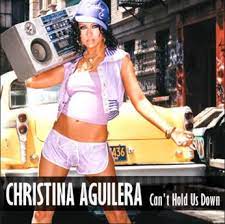
Feminist Mixtape: *Can’t Hold Us Down* by Christina Aguilera

Can’t Hold Us Down by Christina Aguilera

Christina Aguilera is a strong feminist icon. With countless songs regarding feminism and female empowerment, Christina Aguilera consistently emphasizes the importance of respecting women in society. The song Can’t Hold Us Down by Christina Aguilera was released in the year 2002 which was shortly after the third feminist wave that occurred during the 1990s. In the song, she focuses on the double standards pit against women in contrast to men as well as the restrictions women face due to their silencing authorized by men and society.  

In the beginning of the song, Aguilera sings “Should I keep quiet just because I am a woman”. This line presents the familiar idea of silencing women and the assumptions that a woman’s word has no value. This idea is not only seen between the exchange of men and women on a daily basis, but it was and is also seen within the cultures of third world families as was discussed in Uma Narayan’s Contesting Cultures. In Narayan’s piece, she mentions how she was taught that “good daughters hold their tongue”, and this phrase alone embodies the circulated idea of women’s silencing in all aspects of a woman’s life (Narayan 398). In regards to Aguilera questioning that she should keep quiet because she is a woman, she later sings “Take a deep breath and say it loud”. This phrase inspires woman that listen to the song to voice their thoughts and opinions because they simply have the right and should not have any fear.  

Later on in the song, Aguilera sings “The guy gets all the glory the more he can score, while the girl can do the same yet you call her a whore”. These two lines in the song are powerful because it exemplifies the double standard between men and women presented in our world. It raises the question of why should men be able to do one thing while women are shamed to do the same? Aguilera wants to declare how this idea is a problem and her call to action comes when she sings “All my ladies come together and make a change”. 

One main critique of Christina Aguilera’s song is her fail to include and mention the LGBTQ community. Her consistent usage of male and female relations makes the assumption that these acts of silencing and double standards only occur to heterosexual members of the community and exclude other prominent relationships between transmen/women.  

Overall, Can’t Hold Us Down presents circulated ideas and focuses regarding the feminist community and calls for female empowerment and confidence.  

Feminist Mixtape *Scars to Your Beautiful*

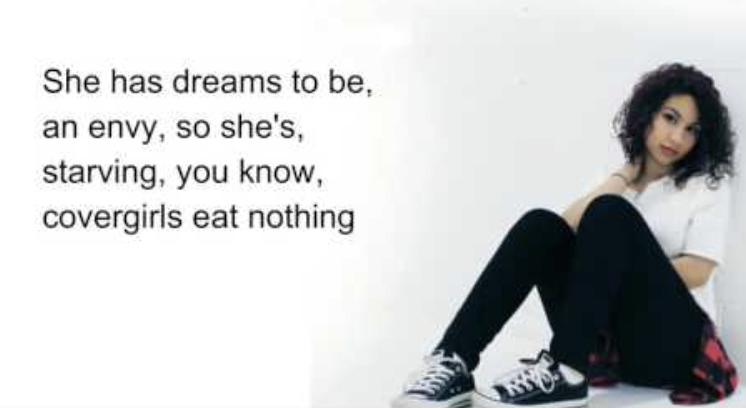
Scars to Your Beautiful by Alessia Cara

Written by: Anna Newman

http://www.tuneintoenglish.com/?p=36074

In the song Scars to Your Beautiful by Alessia Cara, the dangers of female beauty standards are revealed through lyrics referencing eating disorders, superficial appearances, and the dangers body comparison. While the song promotes body positivity, the artist simultaneously brings attention to the unattainable and highly demoralizing expectations that are forced upon women with respect to their appearance. 

The phrase in the song “She just wants to be, beautiful/She goes, unnoticed she knows, no limits/She craves” (0.05-0.11) relates to the expectations of beauty that are placed on women, as well as the misogynistic realities within marriage. The phrase “unnoticed she knows” relates to the idea of coverture within marriage in which the man usurps all of the rights from the woman and makes decisions for her, thus making her “unnoticed”. The phrase in the song “no limits/She craves” demonstrates that women are seeking more rights and privileges that they do not have, which relates to the oppressions that Betty Friedan describes in The Feminine Mystique. Friedan describes women as being “taught to pity the neurotic, unfeminine, unhappy women who wanted or be poets or physicists or presidents” (Friedan 270). The descriptor “neurotic” is juxtaposed with the titles of “poet”, “physicist”, or “president”, illustrating that women are shamed for being independent, intelligent, and self-sufficient humans. In other words, women are taught to be submissive, invisible, and voiceless, demonstrating the dangers of misogynistic relationships and the limitations in which they create.  

Another form of womanism relates to fat studies and the physical expectations imposed on women. To obtain the model ideal, a woman must exhibit stereotypically feminine qualities of slenderness and submissiveness. Models, and cover girls specifically, “eat nothing/She says beauty is pain and there’s beauty in everything/ What’s a little bit of hunger?” (1:58-2:05), which demonstrates the dangers of modeling. Virgie Tovar, a body positivity activist with a focus on fat discrimination, mentioned in her TED talk that “you have the right to remain fat” (Tovar TED Talk) which means that it is part of your bodily autonomy to be the size you want to be, and no one else can control that. Furthermore, Cara mentions that “you don’t have to change a thing/The world could change its heart” (1:01-1:03) which relates to the concept of Health at Every Size or HAES. HAES is a lifestyle change that encourages practices of self-love and health living “regardless of weight and appearance” (Burgard). Additionally, the phrase “beauty is pain” demonstrates the oppressions that women feel they must face in order to attain the feminine ideal, further demonstrating that pursuing a certain weight and appearance leads to unhealthy practices like eating disorders.  

The song, however, has limitations in the way that transwomen are represented. Based on the lyrics, the song assumes that women are cisgender. The repetition of the pronoun “she” and the word “girl” assumes the audience’s pronouns are she/her/hers and does not consider the plethora of different pronouns that one could have, demonstrating the limitations of the song as applying only to cisgender women. This limitation in the song, I believe, is unintentional; nevertheless, Alessia Cara could have been more cognizant of the audience she was delivering to and the pronouns she chose to use. 

Works Cited:

Cara, Alessia. “Scars to Your Beautiful”. 2015.

Feminist Mixtape: “Woman” by Kesha

Rainbow by Kesha

Kesha is no doubt a cultural icon and one of the most notable artists of our generation. Kesha’s studio album Rainbow made the headlines for its themes on forgiveness, self-worth, and female empowerment. “Woman” by Kesha falls directly under this category of female empowerment by emphasizing the importance of women’s independence. “Woman” has become a feminist anthem with its emphasis on liberation from patronizing attitudes as well as economic freedom, two elements that liberal feminism encompasses. 

Kesha begins “Woman” by telling those around her to “be serious” and “shut up” (Kesha 0:00-0:04). The act of telling others to be serious or shut up may have been a controversial decision, as women are socialized to not be outspoken or direct. However, by starting “Woman” with the attitude that she’s in charge, Kesha already sets the tone for the rest of the song. 

Kesha then lists a series of items she’s bought with her own money: she pays her own bills, she’s bought “these diamond rings,” she owns “automobiles,” etc. (Kesha 0:07-0:13). Kesha then explains that she buys what she wants because she “work[s] real hard every day” (Kesha 0:27). This notion is commenting on traditional gender roles, especially situated in American history which places men as breadwinners and therefore the ones in power. However, women are as capable as working hard and generating wealth, Kesha’s main theme of the song. 

Kesha then moves into the chorus: “I’m a motherfucking woman, baby, alright / I don’t need a man to be holding me too tight” (Kesha 0:29-0:34). By tying womanhood around economic independence and, specifically, independence from men, “Woman” embodies liberal feminism. Liberal feminism focuses on the individual and empowerment within oppressive systems such as capitalism. Betty Friedan’s The Feminist Mystique highlights this concept by describing the typical suburban woman and her dissatisfaction with “the domestic routine of the housewife” (Friedan 277). Rather than dismantling the system, Friedan opts for women to “look for jobs equal to their actual capacities” and for the government to provide more education for women (Friedan 280). While this concept may seem outdated, it’s very similar to Kesha’s message that a working woman is a free woman. However, working women are still alienated from their labor, eliciting the question of if working women are truly free. Specifically related to Kesha, I’m sure much of her profits go to her recording studio, her manager, etc. rather than directly into her bank account. 

The bridge of “Woman” repeats a couple of notable phrases. First, she sings “don’t buy me a drink, I make my money,” continuing the theme of liberal feminism and the expectation that women don’t have their own capital (Kesha 1:45-1:48). This line also comments on the expectation that men should pay for women’s dinners or drinks, a gender norm rooted in stereotypes about who has the ability and power to pay. Then, she sings, “don’t touch my weave, don’t call me honey” (Kesha 1:48-1:50). This line touches on patronizing attitudes many women (and specifically women of color) face from men. Although people of all races wear weaves, black women most notably face discrimination and micro-aggressions regarding their textured and thick hair. 

My main criticism of “Woman” is that Kesha ties womanhood to capitalism despite capitalism being an oppressor to women as well. Not only do unjust laws such as the wage gap or unpaid maternity leave disproportionately affect women (and women of color), the system of capitalism was built for the subjugation of all people. Furthermore, Kesha centers womanhood around men, but I believe that womanhood should be situated around the narratives of and love between women. Nevertheless, you will still find me loudly belting “I’m a motherfucking woman” as I grapple with my own beliefs about womanhood and feminism.

Bound to be Visible

For https://www.autostraddle.com/ 

Do you ever see an ad and just think. . . an effort was made. Was it successful? Absolutely not. But the company tried. Is that always enough though? How close to a good amount of effort is close enough to accomplish the purpose? How far off does a company need to be to be ineffective? These are all questions I’ve been asking myself and my friends in regards to the “High Neck Longline Bra” from Girlfriend Collective that swept the media (well, swept my targeted ads on social media) a bit ago. This product is marketed as a supportive and compressive sports bra, but the caption on their Instagram ad, pictured below, is “Full coverage plus a layer of power mesh for extra support. *Wink*”. Yes, they wrote out the word wink in asterisks. No, I’m not sure why they didn’t just use a semicolon-parenthesis combo. 

Girlfriend Collective [@girlfriend]. Picture of Instagram ad for Girlfriend Collective’s High Neck Longline Bra. Instagram.

If you’re in a pretty intense sport, you might look at this bra and see a good supportive bra. If you’re somewhere in the genderqueer category, you can squint a little bit and see a potential binder alternative. Not only is it possible, but this realization already happened very visibly in the comment section. This realization has both positive and negative side effects, as I’ll explain later. Below are some of the comments on this ad, with names and profile pictures marked out for privacy. My personal favorites are “Binder 💞light💞” and “besties this is a binder”. 

Screenshot of comments on Girlfriend Collective’s Instagram ad. Girlfriend Collective [@girlfriend]. Picture of various comments on the ad above. Instagram.

These sorts of comments are harmless, or at least seem to be. Using sports bras as binders is not a new concept to people with breasts that do not identify as cisgender women. Buying actual binders can sometimes be inaccessible to people who might not be out to the people they live with. Many times, young people will bind unsafely with Ace bandages or sports tape instead of a binder to either avoid outing themselves or accommodate their financial situation. At times like these, it’s easier for someone to convince their parents to buy a sports bra over something marketed as a binder.

Does it actually work as a binder though? According to two of the TikToks I found, yes!! Isn’t that exciting? Accounts @salemnight (he/they) and @cowboinary (they/them) on TikTok both did reviews on the High Neck Longline Bra from Girlfriend Collective. Salem gave a holistic and visual review of how the bra looked in comparison to his other binders and bras as well as answering some common questions, while @cowboinary focused more on how the bra felt and compressed in comparison to their other binders. These TikToks I found after simply searching “girlfriend collective binder” can serve as an incredibly useful resource to young people or closeted people looking for binders that are accessible to them, as well as assuring people that it does actually work as a binder. 

Screenshot of comments on Girlfriend Collective’s Instagram ad. Girlfriend Collective [@girlfriend]. Picture of an exchange in the comments of ad pictured above. Instagram.

However, the visibility and accessibility of this product might also serve as a detriment to its usefulness in some ways. Above, with names and profile pictures yet again blocked out for privacy, you can see an exchange between two users in the comments section of this Girlfriend Collective ad on Instagram. One person asks “WHY would you want a HIGH neck bra??” Another user responds explaining that it’s a binder, marketed as a sports bra “so those who are in the closet or in an unsafe environment to come out in can get one to help with dysphoria without outing themselves and risking harm”. The first user responds positively in a reply. However, imagine for a second that you’re a young trans man, looking for a way to convince your transphobic parents to buy you a binder or allow you to get one without coming out. They think it’s an odd request, to get a high neck bra, go onto Instagram, ask this question, and get a response that could potentially force you into an uncomfortable situation. This may or may not happen, but it’s not ideal, right?

The rise of social media and marketing on these platforms has resulted in a multitude of both problems and benefits. Benefit: people are funny in the comments of what, to them, is an obvious secret binder. Problem: the discrete nature of the marketing can be ruined by people thinking it’s funny. Benefit: TikTok provides a platform where multiple people can assure you in different ways that a product is going to work how it says it will. Problem: TikTok provides a platform that brings so much attention to a certain product that even a month later, most sizes are sold out (including my own, sadly). These pros and cons don’t necessarily cancel themselves out, but it’s an interesting and complex issue that companies who aim to produce these discrete products should consider.

So. With this High Neck Longline Bra ad, I just think. . . an effort was made. Was it successful? In my mind, partially. It’s rather expensive for an improper binder at $42, where there are other less expensive options. However, the brand is incredible with size-inclusivity and sustainability. The company tried. Is that always enough though? How close to discrete is close enough to accomplish this subtlety? How far off from discrete does the company need to be to have people aware that this is a secret binder? Is the *Wink* enough, or should they have just put a semicolon and a parenthesis? Many of these questions are unanswerable, as we don’t yet have enough experience with these hurdles (I really do think they should’ve just used a little 😉 though). These questions and conversations are important, regardless of our lack of answers, as our goal as consumers and producers of media should always be to learn more and adapt to the times. While we have these conversations around discrete marketing, I’ll be watching my email carefully for an update on when the bra/binders come back into stock. For, uh, research.

Book Review: “Sex/Gender Biology in a Social World”

by Chase Waldner

One of the most perplexing and scientifically mystifying areas of study is neuroscience. The study of the brain, memory, identity and neural networks is interconnected and infinitely complex due to the multitude of factors seen and unseen that contribute to what makes you, you. A specific application of this is in the biological study of sex, gender, and sexuality. We have no idea what truly creates gender in humans or any animal for that matter, but we have some fairly decent guesses. There is a potential prenatal hormonal factor that could contribute to gender; a genetic factor, epigenetic factor, a parental and sibling factor, a societal factor. There are too many “answers” as to why we experience gender the way we do to seemingly ever find the true cause, although I suspect it’s a combination of all of those aforementioned aspects in combination with some we have not even discovered yet. Over the years, biologists, psychologists, anthropologists, and sociologists have all performed many different types of studies to try and get closer to the big gender questions: Why do we experience it? Why are there so many different expressions of it? How can we better understand it? And we have made a lot of progress in this field. Anne Fausto Sterling brilliantly summarizes a lot of the major work done on gender exploration and does so from a lot of these unique scientific perspectives. 

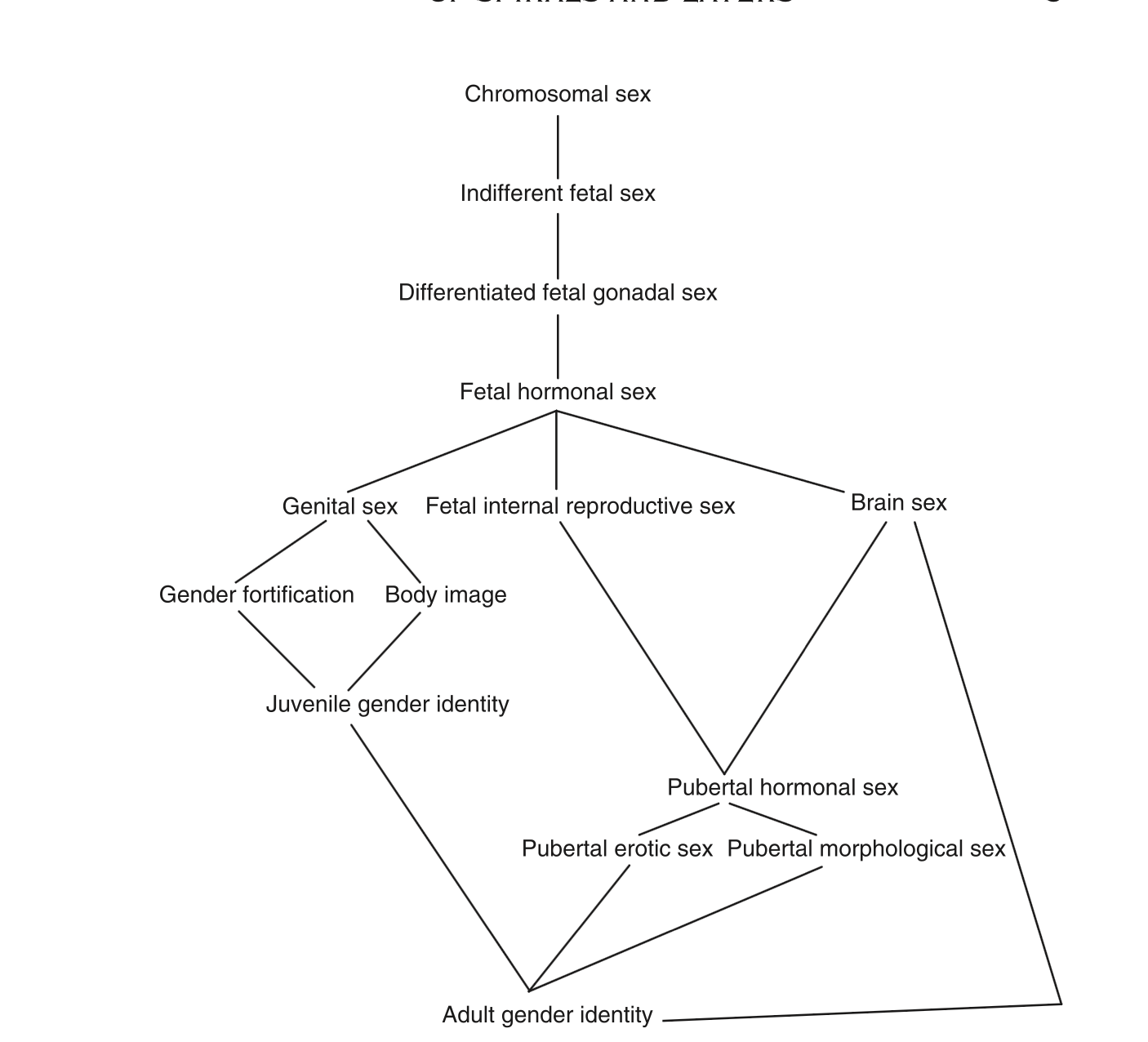
In, Sex/Gender Biology in a Social World, Sterling deep dives into the scientific pursuit of gender within the context of social pressures we experience within our culture. She describes both the biological and cultural contributions to our multifaceted gender identity and expression starting from conception and ending with adulthood. She identifies the many different sex and gender identities we cycle through throughout our development and how they each play a role in our final, “adult gender identity.” Sterling uses Money’s “sex layer model” to show this. You start with chromosomal sex (ie. XX, XY, or, rarely, some other combination of sex chromosomes), then “indifferent fetal sex,” and as you develop go through 11 other “layers” of sex until you end up at your adult gender identity. These layers aren’t linear as some layers form as a function of several that come before it. For example, brain sex and fetal internal reproductive sex both contribute to the pubertal hormonal sex of an individual, and gender fortification and body image both create your juvenile gender identity. Sterling uses this book to break down all of these different categories and talk about the different aspects of each one and how they play off of each other in order to come to some sort of definition or conclusion on what makes up our gender.

these are the “layers of sex” from Money

NY native, Anne Fausto Sterling was born in Queens, New York, in 1944. She graduated from The University of Washington with a degree in zoology in 1965 and later earned her Ph.D. in developmental genetics from Brown University in 1970. Currently, Sterling is the Nacy Duke Professor of Biology and Gender Studies at Brown and works within the molecular and cell biology department as well as the biochemistry department. During her time in academia, Sterling has written several books about gender intended for a general audience and has made over 60 scientific articles on similar subjects. She also is a Fellow of the American Association for the Advancement of Science where she has received many grants for both the sciences and humanities. Clearly, Sterling is known for her astounding scientific achievements and has made many contributions to modern-day feminist movements with her work on the intersection of gender and biology. Sex/Gender Biology in a Social World was written in 2012 and is just one of the written works Sterling has produced on gender. Her listed main areas of interest are, “rethinking the nature/nurture divide, women in science/gender, intersectionality, homosexuality and its construction, and the role of race in gender and sexuality.” Her Ph.D. and mountain of scientific excellence make her uniquely qualified for explaining and exploring gender through a variety of scientific methods. 

For this book, Sterling references many researchers across several disciplines and creates a holistic view of gender through that lens. As said before, she uses Money’s “layers of sex” model to explain how our own gender changes as we grow up. At the beginning of the book, Sterling uses several stories and metaphors to explain how we have been and probably will always be a gendered society. Although our societal expressions of gender have changed throughout time and across different cultures, it will always be a part of the human experience. Starting from birth, your parents dress you and socialize you based on your sex or genitalia, and with this interpretation of your sex, your social gender identity is created. In modern-day America, we have pink for girls, blue for boys, and all childrens’ toys have a gender that they are intended for. Our society has determined what you are supposed to like and how you should act based on your perceived “boyness,” or “girlness.” This in combination with the infant starting to learn their anatomy by discovering their genitals, and the genitals of those around them creates their sense of body image.

Sterling also makes a point of how some different species have more than two sexes, and how some creatures have more than one type of male or female. For example, some insects have three distinct sexes, and there is a species of lizard that does not use males at all for reproduction. There are a variety of factors that determine what sex an animal will be too. Some frogs use temperature for sex determination, and there are so many other seemingly arbitrary environmental features that different species use to determine the sex of their offspring. Some species can even change their sex (ie. develop the opposite genitals and reproductive organs to their natal body) based on a lack of males or females in their vicinity. All of this boils down to Sterling making a point of how up in the air and fluid both sex and gender are. We can not truly understand them if we keep thinking of them as rigid and unchanging when in reality they keep growing and developing just as we do.

As the book continues Sterling circles back to explain the process of human child development in more detail and highlights the stage or “layer(s)” of sex one has reached based on their stage of life. When embryos are first beginning to develop they go into a stage of “equipotential development” where male and female fetuses are indistinguishable. At this point in time, the fetus is said to have reached the “indifferent fetal sex” layer, and soon the XX and XY babies will begin to develop in separate, yet similar, processes. Sterling also makes a note of intersex children and how sometimes sex can get a little more complicated than just male or female. Intersex babies may present as one gender while having the genetics of another, or even have a mix of male and female parts. She then goes into the different aspects of “brain sex.” In some species, like canary birds, the presence of a sex hormone will change the size/development of specific parts of the brain. For example, the injection of testosterone into a female canary’s brain will cause the “song” part to grow and that female will begin to sing male-specific songs. Environmental complexity also affects brain sex. In an experiment with rats, there were separate groups of male and female rats. Some were placed in a cage with no enrichment, while others were given toys and housed together to provide an enriched environment. Female rats in the enriched environment had significantly higher neural branching (think of more neural branching equating to more/better/faster communication within the brain) than males. And in the caged environment, males had higher levels of neural branching. This goes to show how complex brain sex is and how, in some ways, male and female brains develop differently. This, in turn, creates a big part of our adult gender identity.

Throughout the entire book, Sterling does an excellent job at providing enough scientific detail to provide context and clarity to her exploration of gender, while at the same time not jumping off into the deep end and making the book inaccessible to people with less biological knowledge. At some points in the book she lets herself dive a little deeper into genetic and biological factors of sex and gender and provides mind-gripping science and discovery to keep her readers invested in the book. Some chapters even come across more like scientific articles minus the chemical jargon. This is a wonderful way to expose people to the science behind our brains without losing them with an excess of detail. At the same time, Sterling also uses more anthropological and historical perspectives to analyze gender which only furthers her reach of audience.

While Sterling does a phenomenal job explaining all of these different perspectives, she also sometimes gets lost in story and metaphor. Part of her writing style is to use anecdotes to explain complex topics, but she sometimes spends too much time fleshing out those stories and loses focus on the point of her book. In chapter five, for example, she spends the first half recounting two conflicting scientists’ histories with each other in an attempt to explain gender identity and, more specifically, fetal sex. Although there is validity in bringing up these two scientists, the length of time she spent on their lives rather than their work concerning gender in the context of this book seemed excessive. This is not the only time she does this either. There are a few longer chapters in this book that could be shortened and clarified with some editing down of irrelevant information.

Anne Fausto Sterling’s Sex/Gender Biology in a Social World was well written and provided a wonderful intersection of science and humanities to explore what sex and gender are. Her in-depth recount of the neuroscience and biology behind gender was especially gripping while reading through this book. It truly is meant for people from all walks of life. You don’t have to know a lot about science or biology to understand what Sterling is saying, although having some prior knowledge is imperative to understanding the full picture. At the same time, you do not have to be an anthropological expert to follow along either. Sterling successfully made this a book for all people regardless of their background and education, as there are so many different yet connected perspectives on gender that she cycles through.

Work Cited:

Fausto-Sterling, Anne. Sex/Gender: Biology in a Social World. Routledge, 2012.

Sterling, Anne. “Home – Dr. Anne Fausto.” Anne Fausto Sterling, http://www.annefaustosterling.com/.

Book Review: *The Gender Effect: Capitalism, Feminism, and the Corporate Politics of Development*

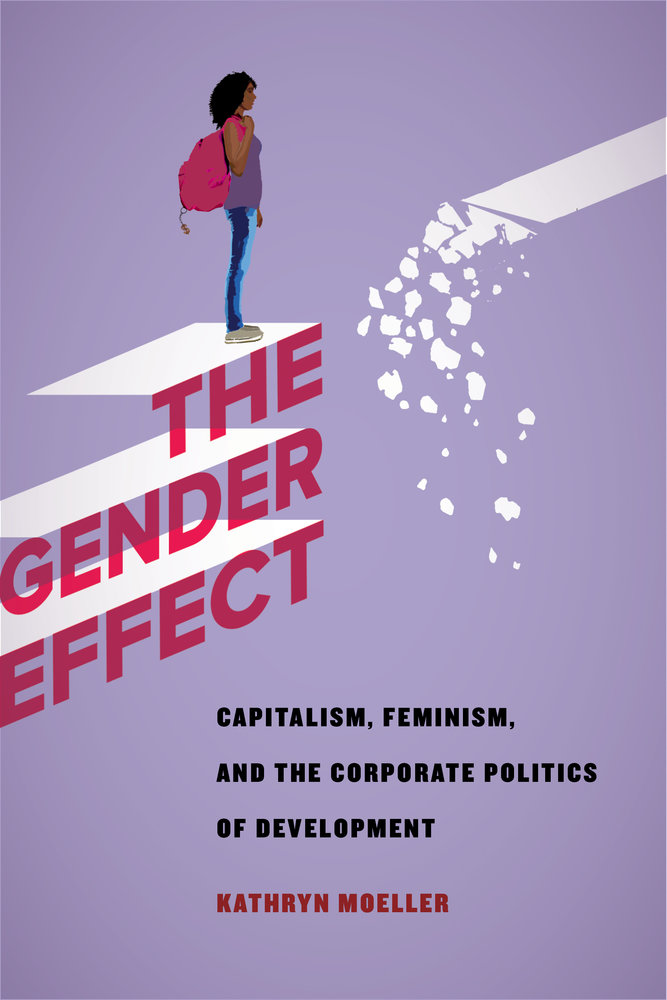
Book cover

In the 1990s, the idea of “investing in women” started circulating around large corporations and foundations. In developing countries, it was thought that this idea could help women, their families and their countries out of poverty. In return, it was then thought that women would pay specific attention to children’s nutrition, education and healthcare when considering where to spend their money and thus raise the country’s human capital. Educating women and girls was the most effective way to fight  poverty and encourage development in the Global South. This approach has since been adopted by powerful corporations and institutions, such as the United Nations, the World Bank, and the United Kingdom’s Department for International Development. Using her ethnographic case study of the Nike Foundation’s Girl Effect initiative as an example, the author Kathryn Moeller argues that these corporate led campaigns end up benefiting corporations but at the expense of women and equality in The Gender Effect: Capitalism, Feminism, and the Corporate Politics of Development. 

Continue reading “Book Review: *The Gender Effect: Capitalism, Feminism, and the Corporate Politics of Development*” →

Book Review: *Latinas in the Criminal Justice System*

Criminal justice systems are the systems in our government that enforce the law, protect the public, prevent crimes, and arrect people accused of crimes. However, criminal justice systems pick and choose who to protect; Latinas often suffer from the criminal justice systems rather than receiving help and support. In Vera Lopez and Lisa Pasko’s Latinas in the Criminal Justice System: Victims, Targets, and Offenders, readers are shown countless testimonies and interviews about system-impacted Latinas and their negative experiences with criminal justice systems. Lopez and Pasko use data and information from academic scholars and practitioners that work closely with system-impacted Latinas. Latinas in the Criminal Justice System explores Latinas’ negative involvement in the criminal justice systems through four distinct parts: the victimization of Latinas, how Latinas become ‘offenders’ and are forced into the systems, immigration and discrimination, and community programming for system-impacted Latinas (Lopez and Pasko).

Overall, Lopez and Pasko’s main argument focuses on the system-impacted Latinas and how the criminal justice systems have negatively affected their lives, especially the police. Lopez and Pasko explain how Latina women’s involvement in the systems is due to several factors: an increase in women immigrating to the United States than in previous decades, an increase in women advocating about domestic violence, and so on. This negative impact occurs because Latinas struggle fighting for their freedom since the systems do not support or help them. Latinas in the Criminal Justice System focuses specifically on Latinas because, according to Lopez and Pasko, there is not enough literature that explains and details the experiences of Latinas when facing the criminal justice systems. Whenever Latinas face the criminal justice systems, there are many of her aspects that are judged: her documentation status, her sexuality, her race makeup, and her ability to speak English (Lopez and Pasko). Lopez and Pasko go in-depth in the subject of system-impacted Latinas and describe the hardships and obstacles Latinas face when they are confronted with problems that require the involvement of the criminal justice systems.  

The authors bring substantial knowledge about feminist criminology in Latinas in the Criminal Justice System. Firstly, Vera Lopez, Ph.D. is a Professor of Justice and Social Inquiry in the School of Social Transformation at Arizona State University (NYU Press). She has studied feminist criminology and has researched girls’ and women’s involvement in the criminal justice systems. Her most famous book is titled Complicated Lives: Girls, Parents, Drugs, and Juvenile Justice.

Secondly, Lisa Pasko, Ph. D. is currently an Associate Professor of Sociology and Criminology at the University of Denver (NYU Press). She is also affiliated faculty in the Gender and Women’s Studies Program. Pasko is co-author of The Female Offender: Girls, Women, and Crime and Girls, Women, and Crime: Selected Readings. Pasko has primarily studied female offenders, violence in youths, adolescent behavior, delinquency, and the juvenile justice systems as well as sexualities for more than fifteen years.

As previously mentioned, in Latinas in the Criminal Justice System, Lopez and Pasko discuss system-impacted Latinas and how they are negatively impacted by criminal justice systems. In the introduction, the reader is introduced to the four parts that make up the book. Each part delves into a distinct aspect of Latinas’ involvement with criminal justice systems. Lopez and Pasko’s methodology consist of surveys, questionnaires, interviews, and information gathered from government offices.

In the first part, Lopez and Pasko describe the victimization of Latinas and how intersectionality plays a crucial role when it comes to the bullying of Latina girls. Many Latinas experience domestic violence; Lopez and Pasko discuss the tactics abusers use to control their victims, specifically isolation and fear. Abusers separate their victims from family members and friends to instill fear into them and prevent them from finding resources to receive help and support. Latinas who suffer from domestic violence struggle with escaping because of the lack of resources available to them. Regardless of their documentation status, Latinas who are isolated do not have connections that support them and aid them in searching for resources, leading to depression and feeling stuck in an abusive situation (Lopez and Pasko 30). Lopez and Pasko also discuss how Latine culture induces fear in Latinas. Latinas do not want to become the family ‘chisme’, so they fear reporting domestic violence to avoid facing judgment from their families. Also, undocumented Latinas feel like they do not have a choice but to endure their abusive situations because of fear towards the police and their immigration status. They know that the authorities will judge them rather than support them, worsening their situation. Through interviews, surveys, and testimonies, Lopez and Pasko gathered these details and factors that made Latinas afraid of criminal justice systems during their abusive situations. However, Latina women are not the only ones who are victims of violence; Latina girls, especially LGBTQ+ Latinas, face bullying in school settings. According to surveys given to high-school aged students, LGBTQ+ Latinas are more likely to face bullying than heterosexual Latinas. This study and results show the importance of taking intersectionality into consideration; Latinas face many obstacles and struggles, but those obstacles and struggles increase when identities intersect (i.e., being LGBTQ+ and Latina).

In the second part, Lopez and Pasko describe how Latinas become ‘offenders’ and how distinct settings induce Latinas to become ‘offenders’. Lopez and Pasko report research that shows that Latinas who have been in trouble with the law have experienced a variety of difficulties in their lives, such as childhood trauma, abuse, and self-image struggles, and Lopez and Pasko also mention that there has been in increase in girls who are juvenile offenders. After collecting some information from a juvenile diversion program, Lopez and Pasko found that Latinas were more likely to be charged with misdemeanor charges, disorderly conducts, and person offenses than their white counterparts. Moreover, Lopez and Pasko addressed how certain settings and situations cause Latinas to become ‘offenders’. The results from surveys and interviews showed that Latina girls witnessed violence in their homes or communities, a family member involved in a gang, a parent with substance abuse problems, and an important figure in their life jailed more than white girls reported. Lopez and Pasko also address how school settings and authorities promote violence in Latinas by not aiding them when needed; they just wait until Latinas show any sign of violence so that they can expulse them from school and detain them. Latinas are viewed by authorities, judges, and administrators as lazy and untrustworthy, preventing Latinas from willingly reaching for help and support. In this part of the monograph, the authors discuss how Latina girls move in and out of the system and are forced to be on the run. Several girls battle substance abuse, gang affiliation, and homelessness. Latina girls who have a warrant against them must stay with friends and/or partners to have a place to live in, but there are problems that can arise with that: some friends and/or partners could introduce Latina girls to drugs or abuse, forcing Latina girls to leave or feel stuck to avoid further issues with authorities (Lopez and Pasko 112). Rehabilitation is hard for Latina girls, especially if they are connected to gangs; they cannot leave gangs easily, which can lead to further rehabilitation and trauma for Latinas.

In the third part, Lopez and Pasko talk about immigration and discrimination. The opening chapter mentions the several reasons many Latinas immigrate from their home countries to the United States. Most Latinas immigrate from Central America, Mexico, and the Caribbean, and their reasons include poverty, inequality, and state repression. However, Latinas also immigrate for gendered reasons, such as domestic violence and sexual abuse. Lopez and Pasko discuss how the ‘border’ between the United States and Latin America is not only physical; there are language and culture barriers that become obstacles in immigrants’ lives, and systems take advantage of these barriers to criminalize Latines, especially Latinas due to their intersectionality of being a woman and a Latina. Lopez and Pasko explore the case of Adriana and Esther, two Latinas who were sentenced to prison and later deported to Mexico. Language was a huge barrier that affected them in different settings: during their sentencing, in prison, and when receiving medical attention. Language also impacted Adriana and Esther’s reintegration into Mexican society. Esther talks about how she was discriminated during her deportation; she received looks filled with judgment. Esther also mentions how she had to conform to gender norms in Mexico to not be perceived as a criminal and have the ability to start anew. The authors also discuss how immigration separates families (Lopez and Pasko 201). Mothers and children are split from each other, causing emotional trauma and distress in both the mother and the child.

In the fourth part, Lopez and Pasko discuss about the limited resources available to undocumented Latina girls, how Latinas cope with discrimination, and intervention programs installed for system-impacted Latinas. In one case study, Lopez and Pasko discuss Lupe’s experiences growing up as a Latina who was affiliated with a gang (Lopez and Pasko 264). Lupe mentions growing up being a star student and excelling in class. However, when she entered a private middle school, she lost confidence, and her grades reflected her feelings of unworthiness, leading her to join a gang through her cousins. After leaving the gang due to a cousin getting killed during gang violence, Lupe reflected on her past actions, decided to change, and pursued higher education after high school. Due to her undocumented status, she had a lot of hurdles to overcome, especially financial problems. However, the Colorado ASSET law helped Lupe cut her tuition in half. The ASSET law allows undocumented students to receive in-state tuition, making college more affordable for Lupe. Lopez and Pasko also mention how Latina girls react to discrimination based on their mother’s teachings. The results from questionnaires showed that Latina girls exhibit proud feelings of their culture, especially when motivated by their mothers. Latina girls who received positive teachings about their culture from their parents were more likely to dismiss discrimination and feel less impacted by others’ views. Finally, the fourth part is wrapped up with intervention programs and how they should be customized to fit Latinas’ perspectives, cultures, and intersectionality. According to surveys, Latinas believed that intervention programs should focus on how culture is impactful to their behaviors and how respect should be a mutual feeling between patients and staff. An example of a great intervention program is Xinachtli. This intervention program focuses on both gender and culture when it comes to Latinas’ perspectives and experiences. Xinachtli focuses on removing existing stereotypes on identities so that patients can define their own identities.

Overall, the strongest aspect of Lopez and Pasko’s book is the combination of perspectives of system-impacted Latinas. The variety of views and studies shows a collaborative input from academic scholars and practitioners that work closely with system-impacted Latinas. This combination also allows a conversation to occur regarding system-impacted Latinas and bring this topic to the forefront of criminology, more specifically feminist criminology. Many perspectives are brought together to discuss the issue of system-impacted Latinas, and it sets literature focused on Latinas, allowing further research to develop on this topic.

Alternatively, a weakness in Latinas in the Criminal Justice System is that some studies used surveys and questionnaires to gather their data, and self-reported data can have bias and could affect the accuracy of studies. Also, certain questionnaires that require rating an event could be rated differently depending on the individual. For example, some situations may be rated as stressful for one person while another could rate it as calm. Self-reported data can affect the accuracy of results due to how individuals answer questions.

In conclusion, Latinas in the Criminal Justice System discussed the issue and lack of literature around system-impacted Latinas. Vera Lopez and Lisa Pasko united distinct perspectives and brought up different aspects that Latinas face while facing criminal justice systems. This monograph also brings intersectionality into the book, allowing Latinas to think about their identities and see how they impact each other. Furthermore, this allows for more research to be addressed towards system-impacted Latinas, and it could lead to the creation of better, more effective intervention programs to support system-impacted Latinas. Ultimately, Latinas in the Criminal Justice System adds important information towards feminist criminology, and it combines distinct aspects of criminal justice systems that Latinas face.

Works Cited

Lopez, Vera and Pasko, Lisa. Latinas in the Criminal Justice System: Victims, Targets, and Offenders, New

York, USA: New York University Press, 2021. https://doi.org/10.18574/nyu/9781479804641

NYU Press. “Vera Lopez.” NYU Press, NYU Press, 21 Feb. 2019. https://nyupress.org/author/vera-lopez/.

NYU Press. “Lisa Pasko.” NYU Press, NYU Press, 21 Feb. 2019. https://nyupress.org/author/lisa-pasko/.

West Virginia University. “Lisa Pasko, Ph.D..” Research Center on Violence, West Virginia University,

https://violenceresearch.wvu.edu/executive-board/research-associates/lisa-pasko

*Fearing the Black Body: The Racial Origins of Fat Phobia* Review

Unlike existing historical scholarship, Fearing the Black Body: The Racial Origins of Fat Phobia by Sabrina Strings is one of the first historical studies that emphasizes the interconnectedness of race, gender, and morality in the development of thin fetishism and fat phobia. Strings argues that anti-fat bias is not recent discourse, instead claiming that fat phobia has been circulating since the Renaissance. The transatlantic slave trade and spread of Protestantism were key historical events that contributed to the bias toward slenderness and fear of fatness. Another important point Strings makes is that fat phobia did not originate from  health issues but was instead implemented  to justify the race and class hierarchy. 

Continue reading “*Fearing the Black Body: The Racial Origins of Fat Phobia* Review” →

Book Review: *The Tragedy of Heterosexuality* by Jane Ward

For the dominant form of sexual orientation, heterosexuality sure looks disappointing. Consider the oft-referenced statistic that fifty percent of marriages end in divorce. Another statistic, that one in six women in the U.S. experience rape, shows a troubling rate of violence within heterosexuality. Such troubling information indicates that received ideas that queerness is harder than straightness may be quite misguided (4). In The Tragedy of Heterosexuality, Jane Ward describes the contradictions inherent in straight culture, and provides a lesbian feminist perspective on how heterosexuality might become less problematic and more fulfilling for both women and men (4). Her book is a salient and strong argument for a reformation of straight culture to be more feminist.

Continue reading “Book Review: *The Tragedy of Heterosexuality* by Jane Ward” →