“I Kissed A Girl”- Analysis

I recently watched Katy Perry’s music video for her 2008 hit song, “I Kissed A Girl,” on YouTube, and was intrigued by some assumptions about sexuality that were sometimes not so subtle in the video. In this blog post, I will explain those assumptions and how they were presented in Perry’s production.  

It is not completely clear who Perry’s intended audience is for this music video, however, I can infer that it was intended for pop music fans. With that said, the video likely targets young Americans, since that demographic tends to be more interested in American pop music. Continuing to discuss intention, it seems that Perry’s music video’s intended purpose is to share an experience that she had when she kissed a girl for the first time.

“I Kissed A Girl” is a song that was sang and released in 2008 by Katy Perry, a 37-year-old female pop star from Santa Barbara, California. Before diving into my evaluation of the music video itself, I want to provide a brief biography of Katy Perry. For context, Katy Perry is an American singer and celebrity who was born in Santa Barbara, California to parents who were Pentecostal (a form of protestant Christianity) pastors. Growing up, Katy Perry’s family moved homes often to different places in the western United States. Perry’s family was strictly religious, and she left home at fifteen to pursue a music career in Nashville, Tennessee. Perry’s music breakthrough took place during the early 2000s. “I Kissed A Girl” remains one of Perry’s most popular songs.

To accompany Perry’s hit song, a music video for “I Kissed A Girl” was uploaded to YouTube in 2008. In this music video, Katy Perry sings her song “I Kissed A Girl,” while flirting with other female friends in a bedroom setting. Throughout the video, Katy Perry and her friends are all wearing lingerie, and at one point during the music video, Katy Perry has a pillow fight with some of her female friends in the scene. This pillow fight is an example of a scene here that has a flirtatious undertone.

While acting in a flirtatious way throughout the video, Katy Perry sings along to her song “I Kissed A Girl,” which overall communicates a regret for kissing a girl.

For instance, in the first few lines of her song as she approaches the chorus, Perry makes the following statements: “this was not the way I planned,” “not my intention,” “lost my discretion,” and “it’s not what I’m used to.” When I first clicked on the music video on YouTube, I was aware of the title, “I Kissed A Girl,” so when I heard the first few lines of Perry’s song, I interpreted her as trying to explain to the audience that she did not want to kiss the girl. The idea that presented in my mind as I was watching was “is she apologizing or trying to plead some sort of innocence because she kissed a girl?” When making these statements, Perry is alone with a devious smile in the video.

During the chorus part of her song, Perry makes these statements: “I kissed a girl and I liked it,” “I kissed a girl just to try it,” “I hope my boyfriend don’t mind it,” “it felt so wrong,” “it felt so right,” and “don’t mean I’m in love tonight.” When making these statements in the video, Perry displays a more genuine smile, while surrounded by other women.

Two key feelings are conveyed in these statements. First, it seems clear that Perry enjoyed kissing the girl. Second, it is suggested that Perry might regret kissing the girl, but it is clear that she feels that her kissing the girl was unacceptable. By saying that “it felt so wrong” and “just to try it,” and “I hope my boyfriend don’t mind it,” Perry is suggesting that her behavior was in some way potentially unacceptable by her, her boyfriend, or greater society.

All the statements mentioned up to this point only make up the first minute of the music video, which altogether is three minutes. Pausing here, an observer of the video up to this point can assume some norms of society that are represented. More specifically, the first minute of this video is enough for one to correctly assume that American society views homosexuality as something that does not fit with the societal norm (heterosexuality).

Perry’s music video takes an interesting approach to homosexuality not being the norm. While the words being sang in the music video are apologetic for kissing a girl, Perry’s behavior on screen challenges the norm. If a homophobic person were to watch Perry’s video, their comfort would be directly challenged. Perhaps this impact was Perry’s intention through her music video. Maybe she wanted her words to acknowledge that two girls kissing is not the norm, and her behavior to challenge society’s conception of this norm.

The earlier mentioned statements persist throughout the remainder of Perry’s music video, along with others that are consistent with Perry’s regretful and apologetic attitude. For instance, Perry says “it’s not what good girls do,” “my head gets so confused,” and “hard to obey.” These statements are consistent with the ones made in the first minute of Perry’s music video.

Later, towards the end of Perry’s video, she makes the statement “ain’t no big deal, it’s innocent” when singing more about kissing the girl. This statement towards the end of the music video suggests that Perry has come to accept that there is nothing wrong with her kissing a girl. Instead, she asserts that society is guilty of making homophobia an unfortunately powerful norm that American systems promote and protect.
Sister Cindy’s Shaming: Funny or Harmful?

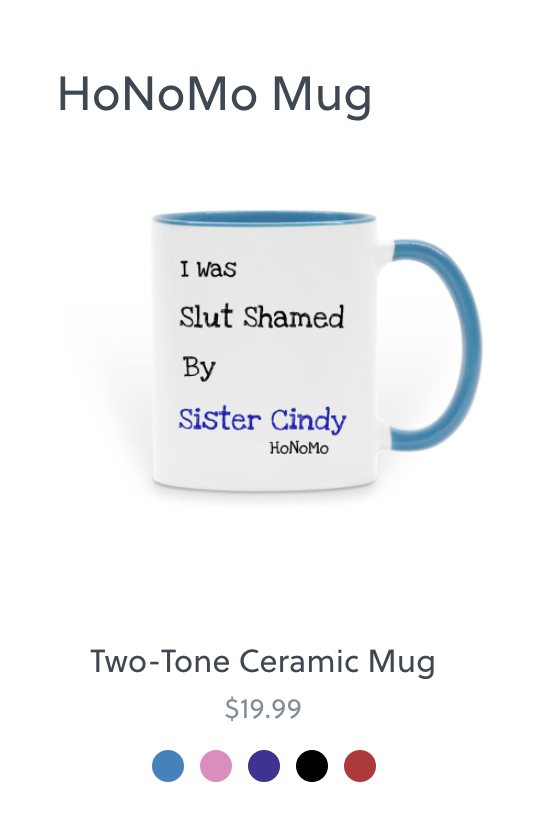
Cindy Smock, or “Sister Cindy” as she calls herself, is an Evangelical campus preacher turned Tik Tok user. She first gained attention when college students posted clips of her speeches on Tik Tok, inspiring her to make her own account. She currently has over 370,000 followers, and #sistercindy has over 194 million views (Fowler). The main subject of her Tik Tok content is encouraging college students, particularly women, to turn to Christianity and be a “ho no mo.” In many of the videos she uploads, she welcomes viewers to “Sister Cindy’s Slut-Shaming Show.” While many of Sister Cindy’s followers regard her as a comical figure, the shock factor she employs in her preaching through homophobic and misogynistic comments is harmful. 

Through a glance at Sister Cindy’s Tik Tok account, it is evident that her content is misogynistic and demeaning towards women. In nearly every video she uploads, she casually uses the words “slut,” “hoe,” or “thot,” as insults towards women. For example, when visiting college campuses, she often changes the names of the universities to incorporate the word “slut.” At the Louisiana State University campus, she renamed the institution, “Louisiana Slut University.” By insinuating that college students are sluts, Sister Cindy is weaponizing the word to be used against women and normalizing the slut-shaming that is common in society, particularly on college campuses. However, Sister Cindy is proud of her slut-shaming tendencies and makes it a common theme in her posts. In a different post filmed by a college student, she exclaims, “You are princesses made in the image of God. Yet, you’ve traded your crown to be a cock-sucker.” This is quite the opposite of sex positivity and guilts women into practicing abstinence. Sister Cindy, or anyone for that matter, should never use guilt tactics to influence other people’s lives. Furthermore, why is this hateful comment only directed towards “princesses,” or women? Why is it that women should feel guilty for engaging in consensual oral sex and men should not? Last I checked, oral sex is an act requiring at least two people. 

https://www.tiktok.com/@maraudwh4re/video/7067272503181364526?_t=8QEQwcooDyV&_r=1

Another example of sexism in her uploads is found in a Tik Tok filmed by a student at the University of Florida. In this clip, Sister Cindy shouts, “Men, if you buy her one margarita, she will spread her legs.” This statement is incredibly insulting towards women. Not only does it perpetuate the view that women are sexual objects, but it also furthers the entitled belief held by some men that women are sexually indebted to them after buying them a drink. In addition, this comment is heteronormative and leads straight men to assume that all women are attracted to them and want to have sex with them, which is simply not the case. Finally, similar harmful views were expressed in a Tik Tok clip of Sister Cindy telling a college student that she is “an accessory to the rape crime on campus” because she is causing boys to get their “passions stirred up” (Fowler). This belief is so inherently false, that it should not require any explanation. The blatant disregard for holding men accountable in situations of sexual assault is destructive to anyone who views this post. It reminds me of the common argument in society that someone is “asking for it” based on the clothes they are wearing. Placing blame and guilt upon women seems to be a common theme in the media posted by Sister Cindy. Again, why is it that sexual assault victims should feel guilty for something that is out of their control and not their fault? 

If you thought her content could not get any worse, we have not even analyzed the blatant display of homophobia present in countless Tik Toks. For example, in one clip while preaching to college students, she orders, “Don’t do it. Don’t kiss a girl and like it.” In defiance of her hate speech, two women make their way through the crowd to kiss in front of Sister Cindy’s platform. Apparently, the act of two women kissing is a difficult sight for Sister Cindy, because she has to cover her eyes. In a second Tik Tok, Sister Cindy, with no shame, shouts to a young man walking past her, “Are you a homo? You kinda act a little effeminate there. You need to repent!” There are so many problems with this statement, it is a challenge to decide what to unpack first. To begin, a straight, cisgender person should never use the term “homo” to describe someone of the LGBTQ+ community. Second, Sister Cindy is reinforcing the societal gender expectations that men cannot be feminine and women cannot be masculine. And if that is the case, then that person must be a member of the LGBTQ+ community. Finally, telling someone that they need to repent because of their sexuality, something that is out of their control, is unacceptable. Religion should never be manipulated to discriminate against groups of people. People’s sex lives and sexuality are an intimate part of their lives and should never be a subject of criticism. Therefore, someone who posts homophobic content, like Sister Cindy, should not have a platform to project those hateful beliefs. 

To reflect, one’s values and beliefs should never be used as a weapon or a way of guilting others into adopting those practices. While Sister Cindy’s intention may be to educate college students, her comments are misogynistic, heteronormative, homophobic, and may even be classified as hate speech. Sister Cindy even admits that she expects to be removed from social media for her problematic comments (Fowler). If that is the case, what is Tik Tok waiting for?

Works Cited

Fowler, Kate. “Who is Sister Cindy? Evangelist Christian Preacher Turned Tik Tok Star.” Newsweek, 6 June 2021, https://www.newsweek.com/who-sister-cindy-evangelist-preacher-tiktok-star-1597651. 

I love this post and how it highlights the way that people will oftentimes use comedy to hide rhetoric that is actually very harmful. Although Sister Cindy is oftentimes funny, she’s still promoting a toxic culture that prevents women from embracing their sexuality. This is a super important topic and I’m glad that you’re shedding light on it!

Theory of Praxis Assignment

After taking GSS 101, a theme that stood out to me was understanding gender as a social construct. Growing up I had a very limited mindset about gender and sexuality and accepted many of the ideas as they were presented to me. However, over the years I have understood more about the complexities and many identities within gender and sexuality. With this in mind, it led to me thinking about how I can use these ideas to influence an art piece for campus to spread awareness and normalize identities that aren’t ‘cis-gender heterosexual’. While there are already many sculptures, especially of bodies, around campus I wanted to propose a new sculpture of a body that implements the ideas of the diversity of gender identities and sexual orientations. My piece is inspired by the metal sculpture on campus by Jaume Plensa, titled Waves III. This piece is made up of letters from all different languages to signify unity and diversity. It is based upon cultural identity and the way that one individual holds a connection to a greater culture.

My idea is to create a sculpture on Davidson’s campus that intersects the ideas of gender as socially constructed as well as show the variety of identities among individuals. The sculpture would be made out of glass and would depict a human form, without genitalia, to represent an individual not tied to a gender. The position of the body would be arranged so that the arms were extended outward to signify openness of the individual. The idea is to show the complexities of humans and the many identities, both genders and sexual orientations that exist. The form of the body would be composed of words carved into the glass form of sexual identities, such as: “queer, bisexual, lesbian” and words associated with gender identities: “she, they, him, non-binary, trans.” And instead of the exterior of the form being perfectly smooth, shards of glass would poke out in all different directions to create an ambiguous body shape.The words would be repeated all over and done in different fonts to completely cover the entire form. The sculpture would symbolize the many identities that don’t receive recognition in a heteronormative society. This sculpture would work towards normalizing those identities that are not cis-gender heterosexuals, but also serve as a reminder of the hardships of LGTBQ+ individuals. The title of this piece would be “Complexities of Intersectionality” and would capture the chaotic and diverse nature of the gender and sexuality spectrum. While this sculpture wouldn’t explicitly touch upon identities within class and race that also affect an individuals experience, this would be the starting point to begin examining identities and start the conversation about other impacts on an individuals’ experience.

References:

https://www.davidsoncollegeartgalleries.org/uncategorized/seen-on-campus-jaume-plensas-waves-iii/

Theory to Praxis: Reimagining Greek Life at Davidson

As a school that was founded by white genteel slave owners and remained segregated until the 60s and all-male until the 70s, Davidson has a long history of elitism. Unfortunately, the college has done a poor job of repealing exclusive traditions and making the school as welcoming and safe as possible to people of all walks of life. One particularly glaring area of inequality is the social structure of Greek life on campus.

There are many things wrong with the status of Greek life at Davidson. Racial disparities are perhaps the most visible problem. My friend Michaela Gibbons is working on a project called Stories Yet To Be Told, conducting research on the history of Patterson Court Council (PCC) – the governing body of Greek life at Davidson. We have had many conversations about PCC this semester, and a lot of them have centered around PCC’s dominating whiteness. Kimberlé Crenshaw’s theory of intersectionality and Lorde’s “There are No Hierarchies of Oppression” (1983) emphasize that racial equality (and other equalities) are necessary to realize gender equality. All of the nine predominantly white PCC organizations have individual houses on campus, while the six PCC organizations for students of color must share space at the BSC (Black Student Coalition) house. This is clearly a problem for feminism, although solutions are somewhat difficult to propose. In this case, the simplest method to reduce white special power on campus may be to disband PCC or consolidate the predominantly white organizations.

Aside from racial inequality, another issue with Greek life at Davidson is its relationship to the gender binary. As a collection of organizations with membership based on male or female gender identification, PCC reinforces ideas that there are only two genders, which is clearly false when one understands Lorber’s perspective that gender is constructed. Since humans have made up the concept of gender, there is no reason to believe in all-or-nothing gender rules. And yet, PCC membership is exclusive to men and women. (Turner House, one of the eating houses, does allow anyone who is not a straight cis male to join, but this introduces the problematic circumstance of requiring people to out themselves). Furthermore, the predominance of “bristerhoods” (fraternity-eating house mixers) perpetuates heteronormativity. Requiring all PCC organizations to be open to all genders would be the easiest solution to make Davidson more feminist, although that would require converting some fraternal organizations to eating houses.

A final, and particularly glaring problem with PCC at Davidson is rape culture. We briefly talked in class about how society conditions males to violate and disrespect female bodies, and there is a prevailing willingness to let this slide. Society reinforces hegemonic sexual scripts, an orgasm gap, and poor understandings of consent, all of which lead to unequal sexual citizenship. This means that women have less power than men to make the choice to have sex. This is obviously problematic for feminism. At Davidson, PCC hopelessly perpetuates rape culture. For liability reasons, the school has strict rules about alcohol for parties at PCC houses. Because PCC organizations are too lazy or busy to plan detailed weekly parties and want to avoid strict scrutiny from the school, weekly parties are predominantly hosted at Armfield, the only residential space on campus where open consumption is permitted. Currently, Armfield apartments which host parties are exclusively rented by predominately white men with strong fraternity ties. This leads to constant sexual misconduct and a lack of safety at parties. Once again, it is not simple to find a solution to male ownership of party space at Davidson. However, some viable options would be disbanding PCC, creating more school-sponsored social events, and preventing Armfield apartments from having five male residents.

PCC is rife with inequalities, much of them a byproduct of Davidson’s elitist traditions. Thus, disbanding PCC and ending Greek life at Davidson is probably the most feminist solution. This would introduce a social vacuum for some time, but it couldn’t be any worse that the forced quarantine of the 2020-21 academic year.

Theory to Praxis: A Program that Teaches GSS Concepts to Parents

Growing up, we are taught by society that gender dictates our roles in society. However, societal pressure is enforced by the people around us, our groups, and our cultures. Using the concepts taught in GSS, parents could raise their children in a healthy, judgment-free space. Also, occupations that work with children should employ the ideas taught in GSS as well. This includes teachers, child psychologists, counselors, pediatricians, coaches, and daycare workers. By employing GSS concepts, children will not be separated into boys and girls during gym class, children will not feel pressured to act a certain way to fit their societal role, and children will not be bullied for being fat if HAES is taught and the BMI index is reconstructed or removed.

I believe the most notable impact would come from parents teaching their children. Thus, I propose that a program or intervention should be created that teaches parents about GSS concepts; this way we can prepare parents to not enforce gender roles and allow their children to grow and to discover themselves and their identities without the influence of social constructs. Deconstructing Society would be a program that focuses on talking about GSS concepts to parents or future parents to provide them with information that will be helpful while they are raising a child. Deconstructing Society will create conversations around heteronormativity, gender roles, and sexuality. The purpose of this program would be to inform parents of the social construction of concepts and to help parents learn these concepts to properly educate their children on similar topics and to provide a healthy environment for their children to thrive.

However, Deconstructing Society could also be used to reach other audiences. Although aiding parents with GSS concepts would help parents provide a judgment-free zone for their children, Deconstructing Society could be used in colleges to discuss topics, such as rape culture, hookup culture, and similar topics discussed with parents. This program’s focus would be with parents. There are certain occupations available that could employ this program. For example, a family therapist could use this program to inform parents on how they can be supportive towards their gay child. Ultimately, Deconstructing Society would help parents create a safe and healthy environment for their children to thrive without being restricted by societal views due to heteronormativity and gender roles.

Feminist Mixtape: God is a Woman by Ariana Grande

by Chase Waldner

Ariana Grande Goes Heavy-Handed and Provocative in "God Is a Woman" | GQ

Pop icon Ariana Grande blessed us with a feminist masterpiece titled, “God is a Woman.” The title alone challenged many gendered stereotypes and the lyrics are a wonderful dive into female sexuality. Grande created something equally empowering as it is catchy. She reverses the patriarchal norm of male domination over women with lyrics like, “I’m tellin’ you the way I like it, how I want it,” and “And boy, if you confess, you might get blessed // See if you deserve what comes next.” Here, Grande is expressing the power she has over this man and how she is the one in control; something rare in heterosexual relationships. For most of history men have had all the power. They were the ones who owned property, and that sometimes included women. Nowadays, in the states at least, you can’t own a person but that power dynamic is still a festering pandemic lingering in our society. Women are supposed to be a submissive, pretty face. They are supposed to look good to attract a man and then stay home to raise their children. This translates to the bedroom as well. The expectation for heterosexual sex is male pleasure and fantasy, women are merely the vessel to achieve it. This is where Grande steps in to challenge the sexist norm and flip the script. She sings about female domination and pleasure; about women being the controlling force in both the bedroom and in life. She sings about the power she, along with all other women, have to take their deserved, rivaling spot in the fight for gender equality.

Book Review: *Her Stories: Daytime Soap Opera and Television History*

Soap operas are entertaining, attention-grabbing daytime shows full of drama and emotion. They are shown in the middle of the day, originally meant for housewives completing housework, waiting for their husband to come home from work. Soap operas may seem like a corny, somewhat outdated genre of television show, but Her Stories: Daytime Soap Opera and US Television History by Elana Levine describes how their impact on the development of society has been essential. Since they no longer have the impact they once did, people may be surprised by the power they held for decades, but soap operas are a monumental phenomenon in television history, and have contributed so much to the advancement of not only broadcast television, but women’s culture as well. 

Levine’s central argument is that “the history of the US daytime TV soap opera is a history of a media form, but it is also a history of a prominent cultural construction of femininity and its imbrication within the institutional and artistic evolution of the primary mass medium in American society for nearly three-quarters of a century” (6-7). The power and influence soap operas have had on American broadcast television and women’s culture in general may be largely unknown by many, but is essential to understanding many aspects of the development of society.

Elana Levine is a soap opera enthusiast, enthralled by the unique daytime television they have provided since the 1940s. She earned an undergraduate degree in English and Telecommunications from Indiana University, and graduate degrees in Media and Cultural Studies from the University of Wisconsin-Madison. Levine is a professor of media, cinema, and digital studies at the University of Wisconsin-Milwaukee in the English department, with areas of teaching and research in television studies/history, gender, sexuality, and media, as well as cultural/production studies and feminized popular culture. She has several publications related mostly to television and media history, with a focus on women’s studies. 

Levine’s uses mainly qualitative methodology, but includes others as well. Much of her research includes archival research of countless scenes from different soap operas, interviews, articles, and other monographs to reference important examples of the impact on women’s culture. Though few, Levine also includes some quantitative research and visuals, such as a graph used to represent the cost per minute of network daytime television ad time (85). She also incorporates some text analysis and close reading from works by prominent feminist writers. For example, Levine analyzes Betty Freidan’s The Feminine Mystique, including critiques that “spaces included varied expressions of the dissatisfactions of the white, middle-class, patriarchal ideal, and did not simply parrot the dominant ideology” (45), and comparing this to the world of Hollywood and gender and femininity altogether. The use of many different methods of research give different and interesting sources of support that all work together to emphasize the impact soaps had on the development of network television and women’s culture.

Part 1 of 3 in Her Stories includes chapters 1 and 2 from early the early 1940s to late 1960s. It describes soaps’ transition from radio to television, specifically its economic and creative contributions to television. While transitioning to television, soaps were some of the first broadcasts to pay close attention to visuals and sound, focusing closely on the details of production and set design such as how to maximize emotion through “face-to-face cutting,” or creating minimalistic sets for more emphasis on “working out of emotional conflicts” (24). By 1954, sponsors, networks, creators, and audiences proclaimed that soaps were here to stay. Soaps became more and more popular, and were becoming so lucrative that CBS was encouraging other networks to invest in them. It also describes the “social construction of gendered identities… offering up understandings of the struggles of postwar American life, shaping notions of gender, marriage, and family desperately in need of therapeutic intervention” (43). In this chapter, Levine brings in examples from popular texts, such as Betty Friedan’s The Feminine Mystique. Though Friedan does not specifically mention television or soap operas, it explains that “the focus of soap opera on the very matters of femininity, masculinity, marriage, and family life so central to the feminine mystique make it a crucial space for considering popular culture as a site for constructions of gender identity” (45). This was important to understanding how soap operas became helpful for viewers, particularly women, after the war and served as a sort of escape and relaxation from stress postwar. Many elements were used to define women as housewives, such as advertisements for items like kitchen appliances, or even the time of day at which they run, reinforcing women’s role as such. 

Part 2 includes chapter 3, 4, and 5, focusing on the mid 1960s to late 1980s. Levine that the soap opera was the foundation of the network era business model. Sponsors, audience members, and many others were extremely invested in soaps, and the relatively low production costs allowed for a fair amount of profit. Overall, soap operas were becoming even bigger and influential in business and television, and the narrative later “turns to relevance” and focuses on the social changes made in soaps. There began to be more pushback on the “white, middle-class, reproductive femininity” that put women into a box (11). Levine argues that soaps implemented more liberal-leaning views on relevant issues at the time such as racism, abortion, sexuality, and expectations of gender. Culture changed as soaps changed, and with such a wide viewership, soaps had tons of influence on what it meant to be a woman at the time.

Part 3 includes chapter 6, 7, and 8, from the late 1980s to the 2010s, focusing primarily on soaps’ downfall. The feminine “housewife” viewership that was often the main audience no longer needed soaps to relate to or define themselves because the concept of femininity and what it meant to be a woman was much broader than what it once was. Femininity in soaps was expanding, but they were not able to maintain viewership because of how quickly and widely women’s culture was growing. This part highlights struggles not only to keep up culturally, but economically since the decline in viewership. In order to maintain their audience and keep people coming back for more, production tried switching things up, doing their best to be as inclusive as possible, or completely rejecting the formula of soaps in hopes of staying afloat. These attempts did more harm than good, and the demise of soaps seemed inevitable. 

One noticeable strength in this monograph is the immense detail Levine uses to describe the many different aspects that contributed to the culture and creation of soap operas and how it impacted viewers. Within every chapter, there are several subsections that highlight different aspects of the time and topic. For example, Chapter 4: “Turning to Relevance” focuses primarily on soaps beginning to include relevant politics and culture into their shows. Just a few subsections of this chapter include soaps’ “generational conflict” (110), “racial and ethnic difference” (115), and “stories of pregnancy and abortion” (120). Each of these subsections contribute to the overarching idea of soaps’ incorporation of relevant information at the time, but with specific focuses on different aspects that contributed to the shows and relevant culture outside of it. While they mainly focus on gender and femininity, they also include important elements that had a prominent impact on culture at the time, adding nuance to the chapters and the monograph as a whole.

Although there is plenty of detail and information on the many different topics and aspects of the history of soap opera, not until towards the end of the monograph do we see any sort of pushback or other-sided perspectives on the left-leaning stances soap operas often incorporated. Soaps often highlighted liberal views in their shows concerning abortion, rape, sexuality, even just giving women more freedom and breakaway from gender roles, and many more, but since these were newer views at the time portrayed on such a big scale, surely there must have been more pushback and implications than what is included in the monograph. Including all peoples’ perspectives at the time would create more depth to the already very nuanced history of soap operas, and would not only give readers a better view of America’s reaction to their favorite television shows, but also America’s social development as a country. 

Overall, Her Stories: Daytime Soap Opera and US Television History was an interesting and entertaining read. As someone who is a bit too young to have experienced soap operas’ peak, delving into the world of soaps provided an unexpected perspective into the progression of gender roles and norms, and other social issues. The format of the book made it concise and easier to read, working chronologically chapter by chapter through the history of soap operas while describing its influence on media and culture, as well its downfall and why that was. Throughout every section, there is a clear topic about how the phenomenon of soap operas influenced US broadcast network television or culture in general. Soap operas may not be what first come to mind when I think of the change in women’s culture and politics, but this was an eye-opening book on such a realization, and how it was a central part of the history of television and women’s culture.

Levine, Elana. Her Stories: Daytime Soap Opera & US Television History. Duke U.P., 2020. 

Book Review: *The Tragedy of Heterosexuality* by Jane Ward

For the dominant form of sexual orientation, heterosexuality sure looks disappointing. Consider the oft-referenced statistic that fifty percent of marriages end in divorce. Another statistic, that one in six women in the U.S. experience rape, shows a troubling rate of violence within heterosexuality. Such troubling information indicates that received ideas that queerness is harder than straightness may be quite misguided (4). In The Tragedy of Heterosexuality, Jane Ward describes the contradictions inherent in straight culture, and provides a lesbian feminist perspective on how heterosexuality might become less problematic and more fulfilling for both women and men (4). Her book is a salient and strong argument for a reformation of straight culture to be more feminist.

Continue reading “Book Review: *The Tragedy of Heterosexuality* by Jane Ward” →

Old Spice: Perpetuating Genderism Through Advertising

Written by Billy Schoel for Autostraddle

Who would’ve guessed?! We all know Old Spice: the pinnacle of male hygiene and every straight man’s best friend. The American-based men’s hygiene company has produced multitudes of popular commercials over the years, now laying claim to the largest share of the men’s grooming product industry. Even with the over-the-top, absurdist style of advertising that they’ve become known for, their commercials still perpetuate the heteronormative worldviews present in most contemporary advertising. In the recent commercial titled “The Man Your Man Could Smell Like”, Old Spice makes assumptions that support and perpetuate unrealistic expectations, heteronormative approaches to society, and the gender binary.

While this absolute gem of heteronormative marketing is only a mere thirty seconds, its featured fast-paced monologue is where the meat of this advertisement lies. For those who don’t have the pleasure of watching our knight in shining armor, I would be honored to transcribe: “Hello ladies. Look at your man. Now back at me. Now back at your man. Now back at me. Sadly, he isn’t me. But if he stopped using lady scented body wash and switched to Old Spice, he could smell like he’s me. Look down. Back up. Where are you? You’re on a boat with the man your man could smell like. What’s in your hand? Back at me. I have it. It’s an oyster with two tickets to that thing you love. Look again. The tickets are now diamonds. Anything is possible when your man smells like Old Spice and not a lady. I’m on a horse.” Visuals aside, see any problems? I sure do. Let’s talk about it.

Within the opening five seconds, the commercial establishes its audience and general premise. A well-defined, half-naked man nearly bursting with masculine energy exclaims “Hello ladies…look at your man…sadly, he isn’t me.” From the get-go, the commercial sets unrealistic expectations for men by comparing them to a representation of perfect masculinity. Despite the delivery’s fast-paced and absurdist nature, the commercial still establishes the inferiority of men who don’t meet the society’s standards of masculinity. The man continues, “if he stopped using lady-scented body wash and switched to Old Spice, he could smell like he’s me.” Not only does this disparage identities outside heteronormative masculinity by implying the inferiority of “lady-scented” body washes, but it also enforces unrealistic expectations for men. Additionally, by stating “he could smell like he’s me” instead of “he could smell like me”, the commercial continues its degradation of imperfect masculinity by clearly defining the ideal man and the other, forcing their separation and inequality.

The public dragging of the “imperfect man” quickly proceeds with the progression of the scene, painting a beautiful, idyllic picture of the life of the “perfect man.” He states, “you’re on a boat with a man your man could smell like.” Of course, this broadens the disparity between the perfect and imperfect men, implying that the lady would prefer the more masculine alternative over other men, even if they represented normal men in society. The precedence given to overly-masculine men concludes with the final moments of the commercial, the man stating, “Anything is possible when your man smells like Old Spice and not a lady.” Not only does it appear that Old Spice doesn’t know “ladies” smell good, too, but the quote places direct preference towards the ideal of overly-masculine men smelling unquestionably overly-masculine (talk about a tongue-twister), perpetuating, and ultimately strengthening, heteronormative conventions such as the gender binary.

Speaking of the oh-so-popular topic, this post would be quite incomplete without mentioning the commercial’s shameless defense of society’s gender binary. For starters, let’s address the assumed heterosexual relationship that the commercial stamps down as its starting point. Old Spice confines the audience into normality. Who is being addressed? A woman! Who must she love? A man—of course! What else could it be?! You mean to tell me that people have non-heterosexual relationships?! Nope, not never. Moreover, Old Spice expands the binary’s gap by implying that girls not only want just men, but the most masculine men life can offer. Men should not be wearing Old Spice to be hygienic—why would they? Men should wear Old Spice to be masculine, to attract women, to be men. Duh! Why would any woman ever be attracted to anything but the most masculine of men?! Despite my flippancy, the assumptions that this commercial makes are significant. In a world where gender/identity equality was reality, the heteronormative structures of society that enable this commercial’s marketability and ultimate efficacy would be relics of the past. Truly, the marketing of deodorant as a way to enhance heteronormative validation for men, even among their own partners, is almost as absurd as a deodorant commercial abruptly ending with “I’m on a horse.”

Also—newsflash—Old Spice works on everyone! While I’ve yet to find a man who doesn’t like Old Spice, I know plenty of other people who wear Old Spice too. Just because it is marketed to men doesn’t mean that only men use it! It’s deodorant, not a walking beacon of unapologetic masculinity. No matter how hard Old Spice tries to be the lodestar of manliness, at the end of the day, it’s a hygiene company. I could go on—but the point is that they shouldn’t be the deciding factor on what’s masculine, what’s attractive, or even what’s normal in our society. Old Spice may be a great deodorant company, but their marketing clearly needs some tweaks. Don’t even get me started on the fact that the tone of the whole commercial is rather belittling—I have to save something to write about next week.

Heroes So White: Lack of Diversity in the World of Superheroes

by Jo Papadopoulou

Written for Autostraddle

One of the first images that comes up when you google “superheroes.” Notice the number of non-male and non-white characters. (Screen Rant, 2019)

I once asked my 10-year-old sister who her favourite superhero was. “Flash!,” she answered excitedly. When I asked her why, she looked at me curiously and said “Cause he is fast, he is so fast sometimes it looks like he is flying, and he is so strong too!” Simple enough answer, right? Well, I then asked whether she knew of any female superheroes with the same abilities as Flash and she couldn’t come up with a reply. When asked about female superheroes, she only knew to list three: Wonder Woman, Supergirl, and Catwoman. None of them were her favourite though. An indicator that she probably didn’t choose her favourite based on gender but based on the abilities she could identify with best (she likes running, so Flash makes sense). However, what if she chose Flash because that was the only one she knew? There are other superheroes who are not cishet white males and have the same (and even more) abilities as Flash. She chose Flash because it was who she was most familiar with. It Is who TV series and ads and video games show her.

And that is not true only for my sister. Most kids, most people, only know the white, cishet male, super fit (and usually rich) superheroes. But they are not the only kind of superhero that exists. That is certainly not the only type of people who exist. So why are they the ones mainly shown? How can this very specific, very excluding group of superheroes represent the whole of them? The answer is, it can’t.

Diversity in Superheroes

For many years, the only superheroes shown on television are ones like Superman and Batman, white fit guys who fight crime and get all the beautiful girls. Companies have been trying to appeal to teenage white boys by promoting a heteronormative, fatphobic narrative. For decades, these companies have been creating false, dangerous role models for children and adults everywhere. And while most turn a blind eye to this, some people have always known how hurtful these role models are. All black, gay, fat, Latinx, trans (and many more identities not reprented) folx know. We have always noticed the lack of representation when it comes to superheroes. They never looked like us. We could never fully identify with them.

The “Original” Avengers of the Marvel Cinematic Universe, some of the most well-known superheroes by one of the most well-known entertainment companies. (Cinema Blend, 2019)

White Dudes (it’s always them)

White male superheroes are still dominating our screens and comic book pages (e.g. Iron Man, Spider-Man, Superman, Deadpool, etc.). When non-white characters are shown, they usually follow old, hurtful stereotypes (for example, Mantis of Guardians of the Galaxy appears as a submissive Asian woman and her main power is lulling people to sleep). When the companies try to create a more diverse environment around superheroes they usually go about it by adding characters of colour (e.g. Black Panther in the Marvel Cinematic Universe) and most (if not all) times these characters have huge success due to the fact that there’s so little diversity. So, the question that comes up is, are the companies really being more diverse and inclusive for the fans or for the money? (Sadly, usually capitalism wins over us).

Genre as Old as Time

This struggle with diversity has its roots mainly to the fact that the superhero genre was created some 40 or more years ago and has seldom changed since. Most, if not all, of the creators back then were rich white males making art for almost exclusively white male audiences. Because of nostalgia, a general fear of change, or pure laziness, the genre is still marked by the “white guy hero” trope that was the staple when it started.

Fighting the Status Quo

Another reason superheroes are still white guys is because a big part of what these heroes do is fight the status quo (e.g. bank robberies, coup d’états, etc.). And it is always shown from the perspective of the powerful, that is rich white men. For example, Bruce Wayne (aka Batman), who is a rich white cishet man, is at the center of Justice League sidelining the female characters and (few) characters of colour.

Fatphobia

Apart from being cishet guys and white, the majority of superheroes are slim and fit. In comic books, their abs and excessive muscles are always visible through their suits and in movies and TV shows actors go through long periods of dieting and strict work outs to achieve a “superhero-worthy” body. Whenever fat characters are included they are usually viewed as something to laugh at (e.g. Thor in Avengers: Endgame) or follow hurtful fatphobic stereotypes.

Chris Hemsworth as “Fat Thor”, as he was named by the fandom, in Avengers: Endgame. (“Avengers: Endgame”, Marvel 2019)

New Superheroes

To create a more diverse world, instead of dismantling the pre-existing wider superhero world, new ones are created without the stereotypes of the old ones. Companies like Marvel and DC, big entertainment companies, are starting to release novels with new, more inclusive, more diverse characters. Some examples are: América Chávez (the newest Miss America) is a Latina and a lesbian, Doreen Green (the newest Squirrel Girl) doesn’t have an incredibly slim body with abs and excessive muscles, and Miles Morales (the newest Spider-Man) is half African American and half Puerto Rican. But while it is great that all these diverse characters exist, they don’t appear in the companies’ big cinematic universes, they appear in comic book series not that accessible or well-known to the wider public. While the creation and existence of these characters is a huge step forward, it is still not enough. This diversity needs to be made more widespread and not stay limited to a few comic book characters. We, the fans, need to keep asking for more representation and we can only hope that the companies will listen.

We all deserve to be able to see ourselves as heroes.

Audi’s Display of Sexism and Stereotyping

In 2017, Audi, a German car manufacturer known for its luxury vehicles, released an advertisement to its Chinese market that sparked much controversy around the world. In their attempt to promote used cars to potential customers living in China, the brand not only displayed apparent examples of sexism, but promoted racist stereotypes. This commercial starts off with an Asian heterosexual couple standing at the alter about to get married. Right before their marriage was officially declared, the groom’s mother interrupts the officiant and begins handling the bride roughly, attempting to inspect parts of her body. Only after the bride’s future mother-in-law examines some of her physical aspects, like her eyes, nose, ears, and teeth does she declare the bride fit to marry her son and gives her approval. The terrified bride is seemingly relieved after her future mother gives the couple her consent, until the mother’s focus turns to the bride’s breasts, bring her back to a panicked state. After this blatant objectification, the commercial’s narrator voices “An important decision must be made carefully” as a red Audi Sudan zooms down a highway (Greatdung 0:22-0:23).

YouTube, 17 July 2017

This sexist Audi advertisement centers around the objectification of a woman by not only debasing the bride’s value to just her physical attributes, particularly her facial features, but also by comparing her to something one can buy and own. By insinuating that marrying a living breathing person is an equivalent decision to buying a car, Audi turns the bride into an object that can be materialized and possessed. Not only is the bride objectified by her future mother-in-law, but with the attention shifting to her breasts, she also becomes sexualized. This overt objectification and sexualization of a woman not only advance the harmful ideology of women not being actual people and simply objects for the benefit of men, it can have dangerous consequences that go beyond these beliefs. The United Nations International Children’s Emergency Fund (UNICEF) makes this connection by declaring “The objectification and sexualization of girls in the media are linked to violence against women and girls worldwide” (UNICEF USA 2021). This treatment can also have a multitude of negative consequences on the targeted individual’s mental health that can last throughout a lifetime. With the massive platform stemming from the ability to air advertisements to millions of people, comes much responsibility to further notions of equality rather than ideologies that have the potential to cause an immense amount of harm. 

Not only is objectification based on gender a prominent issue in this ad, but race also plays a problematic role. The stereotype of the “tiger mom,” a term coined by Amy Chua which describes Chinese mothers as strict, controlling, and borderline abusive, is also deployed in this Audi advertisement. One aspect of this stereotype is the fixation Asian mothers have on the physical appearance of their daughters (Chua 2011). In this case, the need for the bride’s soon to be mother-in-law to examine her physical features, deciding whether they meet her standards prior to the couple’s marriage further perpetuates this stereotype. Most Asian mothers do not align with this parenting style and utilize a wide range of other strategies, contrary to popular belief. The bride also remains passive during this offensive interaction, exemplifying to this advertisement’s audience that this is the appropriate reaction in the face of maltreatment, which could be easily internalized by woman and child viewers. By displaying this inaccurate idea of what Chinese mothers usually place high value on, as well as the expectation of women staying passive, not only does Audi promote sexism, but also racist stereotypes.

Connecting these ideas, Audi exhibits how the intersection of both gender and race can work together, producing an even greater amount of discrimination for individuals like the bride in their commercial. On the basis of Kimberlé Williams Crenshaw’s concept of intersectionality, two social categorizations of the bride’s identity, being Asian and a woman, create a somewhat unique distinction of the discrimination she faces in this Audi advertisement. Unfortunately, this situation is not rare and many individuals who share these similarities in their identity experience this prejudice on a day-to-day basis. 

Shortly after this commercial aired, it received mass amount of criticism and backlash from the public. One commenter even voiced “The annoying thing about Audi’s used-car ad, besides its objectification of women, is that it thinks Chinese customers deserve only commercials like this” (Washington Post 2019). Others simply called the advisement sexist and disgusting. Many people initiated plans to boycott this company and convinced those around them to partake in this form of protest. Following this severe condemnation, Audi apologized for its ignorance related to this particular incident, assured the public an internal investigation would take place to avoid a mistake like this in the future, and removed this advertisement from television. Audi’s response to this backlash and quick withdraw of their commercial displays the power the public holds and how each individual’s voice matters when speaking out against discrimination. 

Unfortunately, this type of sexist and racist commercial is not the only one of its kind. These companies must continue to be held responsible for the harmful ideologies their advertisements promote and be hyper aware of the massive audience they have the ability to reach just through the commercials they release. These examples of sexism and racism through promoting stereotypes and targeting certain audiences unfairly in advertising must come to an end in order to create a more egalitarian world. These large-scale brands have the responsibility to advance impactful and beneficial messages to the massive audience they are capable of reaching, instead of carelessly feeding this harmful ideology to the masses. 

Works Cited: 

Chua, Amy. Battle Hymn of the Tiger Mother. Penguin Books, 2011. 

Greatdung. “Audi Used Car Commercial in China. Full of Sex Discrimination.” YouTube, YouTube, 17 July 2017, www.youtube.com/watch?v=WiBva8pEgTc. 

Smith, Jamiee, and Hannah Gould. “Not an Object: On Sexualization and Exploitation of Women and Girls.” UNICEF USA, 11 Jan. 2021, www.unicefusa.org/stories/not-object-sexualization-and-exploitation-women-and-girls/30366. 

Wang, Amy B. “An Audi Commercial in China Compared Women to Used Cars. It Didn’t Go Well.” The Washington Post, WP Company, 18 Apr. 2019, www.washingtonpost.com/news/worldviews/wp/2017/07/18/an-audi-commercial-in-china-compared-women-to-used-cars-it-didnt-go-well/. 

From Theory to Praxis: Masculine Ideals in Male Athletics

One of the topics that really stood out for me from our GSS class was the discussion of body image. What especially resonated with me was when we talked about Adonis Complex and how people are concerned about their own bodies more than ever before. Since I talked about this topic in my literature review, I decided to focus on it more and apply it to my life. Being a male student-athlete, I am surrounded by an extremely heteronormative environment. It is easy to become ignorant and think that male athletics is only for heterosexual athletes because all the biggest stars are stereotypical masculine men. With the idealized image of masculinity comes the concept of muscle dysmorphia. It is a subset of the Adonis Complex that emphasizes a muscular male physique. As an athlete I feel this pressure of not only being in shape but also getting bigger even though it does not necessarily improve your performance on the court. From my personal experiences, this pressure comes from inside the team but also from outside observers.

Taking this class taught me so many new things and broadened my view of society. I think I can apply the ideas I have learned in this class to my own life and especially the athletic environment. I see gender and sexuality now as more of a spectrum rather than a binary. I am proposing a research project in which I survey several male athletic teams on campus to determine their attitudes towards masculine body image and appearance. I am interested if the perceptions of masculinity are similar across these different teams and if they differ from my personal experiences after taking this class.

Because of this class has changed my perceptions, I am excited to find out how my peers opinions will compare to those of society as a whole and my own views. This class has been a valuable experience for me and I am now much more aware of the structures and institutions that shape our society even though they may not be visible.

From Theory to Praxis: Medical Care of LGBT Individuals

Over this semester, I have been exposed to a broad spectrum of concepts, issues, and questions through our readings and discussions. GSS has given me a new lens through which I see the world and a deeper understanding of the structures and institutions in place that govern our lives. As a senior, I will soon be entering the job market and am really looking forward to taking my newly acquired GSS knowledge to my future endeavors. I am looking for a job in the medical field, a field in which LGBT individuals are underserved and often reluctant to pursue care. In this context, lesbian, gay, bisexual, and transgender individuals are often grouped together in a way that implies homogeneity, which is not the case. These individuals are distinct in terms of race, socioeconomic status, age, and ethnicity in addition to their gender and sexual identities. What groups these people together is the underlying discrimination and stigma that they face in society as a result of living at the intersection of multiple different groups. The intersectionality of marginalized groups is a topic that came up frequently in our class discussion and has really opened my eyes as to how a person’s identity is not defined by just one element or trait, it is the combination of these interlinked traits that make up one’s identity.

There has been a long history of discrimination stemming from a lack of understanding of LGBT individuals in the medical field (i.e. the listing of homosexuality as a mental disorder in the DSM). However, as understanding has improved, the treatment of LGBT individuals in the medical setting has gotten somewhat better. There are certain diseases that disproportionately affect the LGBT community such as HIV and other STDs, and these disparities stem from structural and legal factors, social discrimination, access and availability of medical care, and the lack of culturally informed health care.

There are many things that those in the medical field can do to encourage an inclusive and welcoming medical environment. Below are some suggestions to be implemented in different medical environments, which I hope to bring with me to my future occupation:

  1. Allow patients to privately self-input information about gender identity and sexual orientation (ensure that there are a wide range of options on the questionnaire).
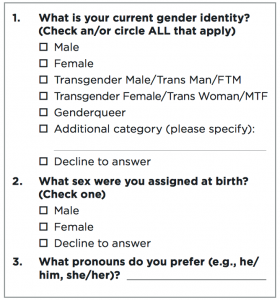
  2. Allow patients to specify the pronouns that they prefer.
  3. Be open and non-judgmental when collecting sexual histories of patients.
  4. Refrain from making assumptions about individuals based on appearance.
  5. Do not assume heterosexuality (i.e. Ask “Do you have a
    partner?” rather than “Do you have a boy/girlfriend?” when conducting sexual
    history).
  6. Make sure all staff are trained to interact respectfully
    with LGBT patients (i.e. ensuring use of their preferred pronouns).
  7. Make sure that the medical environment has a non-discrimination policy that includes discrimination based on gender identity and sexual orientation and publicly display this policy.
  8. The use of brochures and medical information that include images of LGBT people as well as medical information that specifically addresses concerns that
    these individuals face.

All of these suggestions are important, as a clinician may be one of the first people whom an individual discloses non-heterosexual behavior to, and for this to happen, individuals need to be in a space where they feel comfortable. The goals of medicine include providing quality and effective care, and through these suggestions and the scope of my GSS knowledge, I plan to do my best to create an inclusive and welcoming environment for all patients.

Works Cited

http://www.lgbthealtheducation.org/wp-content/uploads/Improving-the-Health-of-LGBT-People.pdf

http://www.aafp.org/dam/AAFP/documents/medical_education_residency/program_directors/Reprint289D_LGBT.pdf

Theory to Praxis: Intersectionality within RAC

This past semester, one thing that really interested me in GSS101 was the concept of intersectionality. It is important to recognize everyone’s co-existing identities, and I sometimes feel like certain organizations on campus have a hard time of doing that, if there is not representation of those different identities within the club. For example, I am a member of the Rape Awareness Club at Davidson, and we struggle to make sure that our events are queer inclusive. There are queer members in the club (myself included), but we find it difficult to include non-hetero sexual assault as one of our main concerns without assigning a queer person as a “spokesperson” for the entire community.

Next semester, I plan on finding ways to incorporate the queer community into our weekly meetings, no matter what we’re discussing. Perhaps we can try to designate a specific committee to talking about how RAC can involve the queer community in order to get us started. Another idea would be to invite those who would want to get involved from Q&A (another club on campus). Events such as the sex positivity fair and Take Back the Night should be advertised as queer inclusive.

RAC does a lot of good work on campus, and they spearhead a lot of the most notable events. So, it is extremely important for RAC to recognize the aspects they may be lacking. Intersectionality is not an easy concept to understand. Additionally, it takes a lot of effort to obtain and maintain an intersectional, inclusive environment. I plan on approaching the club as a whole, and hopefully discussing together what would work best in order to recognize non-hetero sexual assault as well.

Theory to Praxis: Training a Summer Camp Staff in South Alabama in a GSS Framework

During the summer, I work at an Episcopal summer camp in south Alabama in which the majority of both the staff and the campers come from predominantly white, conservative communities. Many members of the camp community attend private schools, which indicates a certain level of socioeconomic privilege, and about 60% of staff and campers identify as religious. All of this is coupled with regional customs and beliefs that tend toward overbearing patriarchy and heteronormativity. However, every year we are encountering more diverse staff and more diverse campers, some of which identify as LGBTQ. Therefore, many of our GSS 101 topics are relevant to the camp, but a majority of the staff are uninformed on issues of gender, sexuality, rape culture, and the intersections of these issues with race and disability. So, I would like to use the materials and research from GSS to develop policies and training for staff in order to foster an inclusive camp community.

I have noticed multiple situations in my years at camp that are worth addressing. The first, and possibly mostly difficult to overcome, is the physical infrastructure that reinforces the gender binary. For housing purposes, cabins are delineated strictly as “male” or “female.” However, in the last couple of years, we have had two campers who have identified as trans. This has been a tricky situation to navigate due to the lack of resources for gender-neutral housing and demonstrated transphobia, particularly on the part of male staff. At this time, there is no written policy concerning the housing of trans* identifying campers, and I think it would be worthwhile to establish such a policy, even if we are not in a position to be the most accommodating, so that parents and campers know that we are open to considering options that work for all campers.

The establishment of this strict binary reinforces heteronormative expectations based on a perceived obligation to spend time with and impress the opposite sex. For example, there are camp traditions such as adopting cabin “sweethearts” who are counselors of the opposite gender, or serenading cabins of the opposite gender. At times, fake marriages are staged between a male and female counselor. All of these promote heterosexual relationships without any regard for campers (or staff) who may not be interested in such thing. The language used by staff can also contribute to this idea by suggesting that the “norm” is interest in heterosexual relationships, such as a counselor asking a female camper “Is there a boy you like?”

To counteract potentially ostracizing language on the part of the staff, it is important to incorporate a workshop into the pre-existing week long staff training that in the most simple way possible addresses gender, sexuality, and their role at camp. However, it is also worth noting that a large number of the staff I have worked with have expressed blatant sexism, homophobia, and transphobia through the language they use around other staff members. Many come from strong religious and cultural backgrounds that have influenced their personal belief systems. Therefore, the most effective training would like not involve attempts to change individual’s ideologies; instead, the focus should be on establishing languages and practices that are designed to keep all campers safe, not just those who identify as cisgender and heterosexual.
Potentially, staff could do an assessment of their own implicit biases using online materials as a way to be aware of the biases that they bring to the camp setting. Since I have heard staff perpetuating widespread stereotypes about different groups, i.e. gay men, or lesbians, perhaps training could also include an activity in which the the staff engage with any stereotypes that they represent. This would give counselors the opportunity to become aware of how other people perceive them, and perhaps experience first hand the overgeneralization that accompany stereotypes so that they can work to counteract them at camp.

Finally, a very tangible area that could use both revised camp policy and staff instruction is camp dress code. As it stands, the camp recommendation is that all girls bring a one-piece swimsuit to camp, but when a girl does not, the expectation is that she will be asked to wear a t-shirt over her swimsuit, whether it is a tankini or a bikini. Male staff strongly support the enforcement of the policy and have used terminology such as “it protects them from boys” to justify their beliefs. This type of language reinforces rape culture, since the idea is that women who do not cover their bodies appropriately are at fault if men advance upon them. Instead, the policy and training of staff should reflect a level of accountability for all parties such that the objectification and potential victim-blaming of women is not tolerated. Particularly for younger campers who are are too young to understand why they might be asked to cover up when the heat index reaches 114 degrees, being asked to put on a t-shirt over a new swimsuit reinforces the shaming of female bodies as young as 7 years old.

Breaking down the gender binary, heteronormativity, and nascent rape culture would be very solid steps forward for the camp setting. I have no doubt that some of these ideas would be met with some degree of resistance by the staff, but in the long run, they would promote a healthier, more inclusive camp environment.