Feminist Mix-tape: The Man by Taylor Swift

Taylor Swift portrayed as a man in the music video.

Taylor Swift dominates the music industry in 2021, but it was not easy to get to the top when she was fighting misogyny for her whole career. In February of 2019, Swift released her hit song “The Man” confronting sexism in the music industry, and declaring that if she was a man, she’d be the man. Her lyrics compare her achievements and life as an artist to the same of a man, and how society interprets both very differently. Men are far more respected in the music industry, and women who make it to the same place as men are often portrayed as “lucky”. Some lyrics that struck me the most include these two: 

“I’m so sick of running as fast as I can
Wondering if I’d get there quicker
If I was a man (Swift, lines 11-12)”

and similarly,

“They’d say I hustled
Put in the work

They wouldn’t shake their heads and question how much of this I deserve (Swift, lines 19-21)”

            These ideas date back to the first wave of feminism. This reminded me of when our class read “Declarations of Sentiments and Resolutions” from the Women’s Rights Convention held at Seneca Falls in July of 1848. This document argues that women are oppressed by the government and the patriarchal society of which they are a part. One quote that emphasizes the ideas that are present in Swift’s song is, “That woman is man’s equal—was intended to be so by the Creator, and the highest good of the race demands that she should be recognized as such,” (Stanton 1). Women were first fighting for suffrage against the existing notion that they should not have careers outside of the household, but instead their only duty was to tend to the home and take care of children. This was a time of expanding the women’s role to the outside world and creating new opportunities. They were regarded as incapable and had to fight exponentially harder to just obtain a similar place in society among men.  Unfortunately, I think that this is still a present idea that is attributed when women outrank men. It is almost seen as intrusive when a woman holds a lot of power, as if she is not welcomed to have such a high status. Society resorts to wondering how she got there or if she had connections, instead of recognizing her hard work and drive. Women in this position are also called bossy and bitchy, instead of being viewed a strong leader like men.  

            One limitation of how this song represents feminism is that Swift herself is a wealthy, white female who through hard work was able to make it to the top. I think this view is not inclusive with the intersectionality of different races, disabilities, etc. that other female artists have to face. Swift did not have these added obstacles to work past on her journey to success. Overall, this song, accompanied by its music video, is a way to expose the sexism within the music industry and how women need to work harder for the same results and recognition that men receive.

Music video link: https://www.youtube.com/watch?v=AqAJLh9wuZ0

Citation:

Stanton, Elizabeth Cady, 1815-1902. Address of Mrs. Elizabeth Cady Stanton, Delivered at Seneca Falls & Rochester, N.Y., July 19th & August 2d, 1848. New York :R.J. Johnston, 1870.

Swift, Taylor. “The Man.” Lover, Republic Records. accessed November 9, 2021.

Feminist Mix Tape: “Good as Hell” by Lizzo

Lizzo has recently risen to fame as one of the premier American pop stars, writing music with lyrics that are empowering and positive towards women. Her 2016 song, “Good as Hell,” is feminist and catchy.

Lizzo’s feminist lyrics relay a message that women are valuable in themselves and do not need validation from men to feel happy. This relates to first wave feminism arguments such as those from the Declaration of Sentiments, which states that “woman is man’s equal,” which means that women should occupy a place equal to men in society (Declaration of Sentiments 1). Lizzo’s message that “you know you a star you can touch the sky/ I know that it’s hard but you have to try” relates to this first wave perspective by emphasizing that self-worth comes from within, and men do not have the right to determine the worth of women.

In addition to containing the first wave feminist perspective that women are worth as much as men, the song also relates to second wave feminism. Betty Friedan’s argument in the Feminine Mystique claims that women have just as much of a right as men to work outside the home in professional roles (Friedan 278). This relates to Lizzo’s line advising her listener to “boss up and change your life.” This depiction of women as bosses normalizes women in the workplace, and emphasizes how women have a natural capacity to be leaders and have control, contrary to what the patriarchy dictates. Thus, Lizzo’s “Good as Hell” relates to second wave feminism by emphasizing women’s capacity for success in a professional setting.

One final way in which Lizzo’s “Good as Hell” relates to feminism outside of first wave and second wave perspectives is by centering women as its subject. By making women the default audience of the song, Lizzo goes against the patriarchal conception of maleness as the default state of being. This default state of maleness was pointed out by Luisa Capetillo (Capetillo 28). Lizzo rejects this patriarchal structure by making the subject of her song a woman, thus normalizing women as the default person.

Lizzo’s song is limited, however, in its conversation with transfeminism and intersectional feminism. Lizzo does not mention trans people, queer people, or people of different races in her songs. Therefore, her song does not relate to how feminism applies differently to women of color or members of the trans community. 

Despite this limitation, Lizzo’s “Good as Hell” is an important song in its relation to feminisms. It mentions the first wave perspective that women are equal to men, and emphasizes the second wave idea that women belong in the workplace as much as men do. It also centers women, a feminist stance. However, it does not have much to do with queer, trans, or women of color feminisms, so it is fairly surface-level in its feminism. Overall, the song is catchy, positive, and pro-women, so it is definitely worth a listen!

Feminist Mixtape: *He Thinks He’ll Keep Her* by Mary Chapin Carpenter

Mary Chapin Carpenter is an American rock, folk, and country music singer-songwriter who signed in the late 1980s with Columbia Records, who promoted her as a country singer. One of her most famous songs is her 1992 hit, He Thinks He’ll Keep Her. This song is widely credited with illustrating the salvation of a woman freeing herself from the traditional atomic family into the workplace. The song begins by documenting a few items that make it evident that she is a housewife – one who appears to do everything for her husband. For example: making his coffee, his bed, doing his laundry, and keeping him fed. Following a few of these examples, the verses, “When she was twenty-one she wore her mother’s lace and said “forever” with a smile upon her face,” briefly touch on the “norm” of marriage as something that is supposed to happen when coming of the right age. The lines that come after continue to paint the picture of outdated stereotypical gender roles: taking care of the kids; putting on a surface front that portrays a perfect family despite her unhappiness that is prevalent in this song; and her keeping everything in line and on time like clockwork. The line, “He thinks he’ll keep her,” is inserted occasionally at the end of some verses, alluding to the strength that she will eventually find to leave the husband that takes her for granted and confines her abilities. This does indeed happen and there is a shift when she talks about being thirty-six and finally putting her foot down to leave him. One line that I think carries a lot of weight is “for fifteen years she had a job and not one raise in pay, now she’s in the typing pool at minimum wage.” I feel these verses highlight the difficulty of working hard for many years without any sort of compensation other than a rabbit-hole of a comfort zone that can seem extremely terrifying to leave. More importantly, she does in fact leave and even though she is starting from the bottom, she is slowly working to make her own way. 

This can be tied back to a few of the readings we did in class. For example, in Towards Equality, it highlights that marriage and motherhood should not be disabilities for women and in this song – it is very clear that the duties being performed by the woman are constraining both her happiness and ability to go out and do things for herself. Additionally, in Our Bodies, Our Selves, it emphasizes choice over destiny and I feel like this relates back to women being not properly educated about their bodies and having children that they did not necessarily want or getting married simply because that is what “everyone” did by a certain age. In a similar way, The Feminine Mystique, discusses that housewives feel trapped within themselves and their own minds – convincing them of the falsehood that motherhood and marriage is all that life has to give them. In this song, it isn’t until she leaves her husband that she finds her own life and what she wants. 

The song, however, does have specific limitations as a representation of feminisms broadly constructed. For example, her limited scope of just female and male relationships excludes the LGBTQ community and it implies that the type of situation being described in the song only occurs between heterosexual members of the community.

“Mary Chapin Carpenter – He Thinks He’ll Keep Her.” Genius, https://genius.com/Mary-chapin-carpenter-he-thinks-hell-keep-her-lyrics. 

Feminist Mixtape *Scars to Your Beautiful*

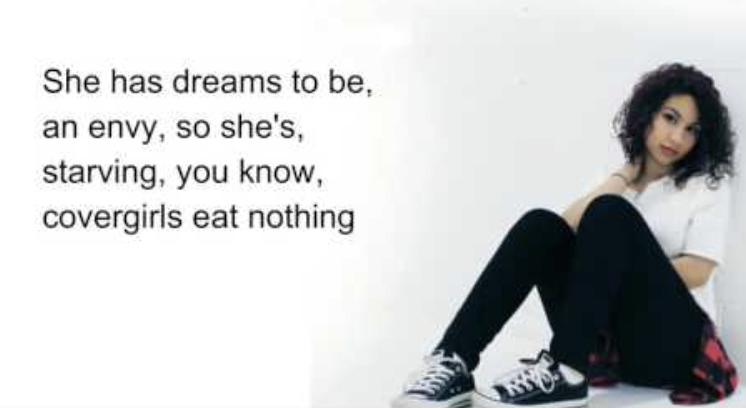
Scars to Your Beautiful by Alessia Cara

Written by: Anna Newman

http://www.tuneintoenglish.com/?p=36074

In the song Scars to Your Beautiful by Alessia Cara, the dangers of female beauty standards are revealed through lyrics referencing eating disorders, superficial appearances, and the dangers body comparison. While the song promotes body positivity, the artist simultaneously brings attention to the unattainable and highly demoralizing expectations that are forced upon women with respect to their appearance. 

The phrase in the song “She just wants to be, beautiful/She goes, unnoticed she knows, no limits/She craves” (0.05-0.11) relates to the expectations of beauty that are placed on women, as well as the misogynistic realities within marriage. The phrase “unnoticed she knows” relates to the idea of coverture within marriage in which the man usurps all of the rights from the woman and makes decisions for her, thus making her “unnoticed”. The phrase in the song “no limits/She craves” demonstrates that women are seeking more rights and privileges that they do not have, which relates to the oppressions that Betty Friedan describes in The Feminine Mystique. Friedan describes women as being “taught to pity the neurotic, unfeminine, unhappy women who wanted or be poets or physicists or presidents” (Friedan 270). The descriptor “neurotic” is juxtaposed with the titles of “poet”, “physicist”, or “president”, illustrating that women are shamed for being independent, intelligent, and self-sufficient humans. In other words, women are taught to be submissive, invisible, and voiceless, demonstrating the dangers of misogynistic relationships and the limitations in which they create.  

Another form of womanism relates to fat studies and the physical expectations imposed on women. To obtain the model ideal, a woman must exhibit stereotypically feminine qualities of slenderness and submissiveness. Models, and cover girls specifically, “eat nothing/She says beauty is pain and there’s beauty in everything/ What’s a little bit of hunger?” (1:58-2:05), which demonstrates the dangers of modeling. Virgie Tovar, a body positivity activist with a focus on fat discrimination, mentioned in her TED talk that “you have the right to remain fat” (Tovar TED Talk) which means that it is part of your bodily autonomy to be the size you want to be, and no one else can control that. Furthermore, Cara mentions that “you don’t have to change a thing/The world could change its heart” (1:01-1:03) which relates to the concept of Health at Every Size or HAES. HAES is a lifestyle change that encourages practices of self-love and health living “regardless of weight and appearance” (Burgard). Additionally, the phrase “beauty is pain” demonstrates the oppressions that women feel they must face in order to attain the feminine ideal, further demonstrating that pursuing a certain weight and appearance leads to unhealthy practices like eating disorders.  

The song, however, has limitations in the way that transwomen are represented. Based on the lyrics, the song assumes that women are cisgender. The repetition of the pronoun “she” and the word “girl” assumes the audience’s pronouns are she/her/hers and does not consider the plethora of different pronouns that one could have, demonstrating the limitations of the song as applying only to cisgender women. This limitation in the song, I believe, is unintentional; nevertheless, Alessia Cara could have been more cognizant of the audience she was delivering to and the pronouns she chose to use. 

Works Cited:

Cara, Alessia. “Scars to Your Beautiful”. 2015.

Feminist Mixtape: “Woman” by Kesha

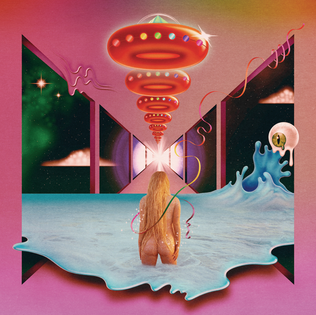
Rainbow by Kesha

Kesha is no doubt a cultural icon and one of the most notable artists of our generation. Kesha’s studio album Rainbow made the headlines for its themes on forgiveness, self-worth, and female empowerment. “Woman” by Kesha falls directly under this category of female empowerment by emphasizing the importance of women’s independence. “Woman” has become a feminist anthem with its emphasis on liberation from patronizing attitudes as well as economic freedom, two elements that liberal feminism encompasses. 

Kesha begins “Woman” by telling those around her to “be serious” and “shut up” (Kesha 0:00-0:04). The act of telling others to be serious or shut up may have been a controversial decision, as women are socialized to not be outspoken or direct. However, by starting “Woman” with the attitude that she’s in charge, Kesha already sets the tone for the rest of the song. 

Kesha then lists a series of items she’s bought with her own money: she pays her own bills, she’s bought “these diamond rings,” she owns “automobiles,” etc. (Kesha 0:07-0:13). Kesha then explains that she buys what she wants because she “work[s] real hard every day” (Kesha 0:27). This notion is commenting on traditional gender roles, especially situated in American history which places men as breadwinners and therefore the ones in power. However, women are as capable as working hard and generating wealth, Kesha’s main theme of the song. 

Kesha then moves into the chorus: “I’m a motherfucking woman, baby, alright / I don’t need a man to be holding me too tight” (Kesha 0:29-0:34). By tying womanhood around economic independence and, specifically, independence from men, “Woman” embodies liberal feminism. Liberal feminism focuses on the individual and empowerment within oppressive systems such as capitalism. Betty Friedan’s The Feminist Mystique highlights this concept by describing the typical suburban woman and her dissatisfaction with “the domestic routine of the housewife” (Friedan 277). Rather than dismantling the system, Friedan opts for women to “look for jobs equal to their actual capacities” and for the government to provide more education for women (Friedan 280). While this concept may seem outdated, it’s very similar to Kesha’s message that a working woman is a free woman. However, working women are still alienated from their labor, eliciting the question of if working women are truly free. Specifically related to Kesha, I’m sure much of her profits go to her recording studio, her manager, etc. rather than directly into her bank account. 

The bridge of “Woman” repeats a couple of notable phrases. First, she sings “don’t buy me a drink, I make my money,” continuing the theme of liberal feminism and the expectation that women don’t have their own capital (Kesha 1:45-1:48). This line also comments on the expectation that men should pay for women’s dinners or drinks, a gender norm rooted in stereotypes about who has the ability and power to pay. Then, she sings, “don’t touch my weave, don’t call me honey” (Kesha 1:48-1:50). This line touches on patronizing attitudes many women (and specifically women of color) face from men. Although people of all races wear weaves, black women most notably face discrimination and micro-aggressions regarding their textured and thick hair. 

My main criticism of “Woman” is that Kesha ties womanhood to capitalism despite capitalism being an oppressor to women as well. Not only do unjust laws such as the wage gap or unpaid maternity leave disproportionately affect women (and women of color), the system of capitalism was built for the subjugation of all people. Furthermore, Kesha centers womanhood around men, but I believe that womanhood should be situated around the narratives of and love between women. Nevertheless, you will still find me loudly belting “I’m a motherfucking woman” as I grapple with my own beliefs about womanhood and feminism.

Book Review: *Her Stories: Daytime Soap Opera and Television History*

Soap operas are entertaining, attention-grabbing daytime shows full of drama and emotion. They are shown in the middle of the day, originally meant for housewives completing housework, waiting for their husband to come home from work. Soap operas may seem like a corny, somewhat outdated genre of television show, but Her Stories: Daytime Soap Opera and US Television History by Elana Levine describes how their impact on the development of society has been essential. Since they no longer have the impact they once did, people may be surprised by the power they held for decades, but soap operas are a monumental phenomenon in television history, and have contributed so much to the advancement of not only broadcast television, but women’s culture as well. 

Levine’s central argument is that “the history of the US daytime TV soap opera is a history of a media form, but it is also a history of a prominent cultural construction of femininity and its imbrication within the institutional and artistic evolution of the primary mass medium in American society for nearly three-quarters of a century” (6-7). The power and influence soap operas have had on American broadcast television and women’s culture in general may be largely unknown by many, but is essential to understanding many aspects of the development of society.

Elana Levine is a soap opera enthusiast, enthralled by the unique daytime television they have provided since the 1940s. She earned an undergraduate degree in English and Telecommunications from Indiana University, and graduate degrees in Media and Cultural Studies from the University of Wisconsin-Madison. Levine is a professor of media, cinema, and digital studies at the University of Wisconsin-Milwaukee in the English department, with areas of teaching and research in television studies/history, gender, sexuality, and media, as well as cultural/production studies and feminized popular culture. She has several publications related mostly to television and media history, with a focus on women’s studies. 

Levine’s uses mainly qualitative methodology, but includes others as well. Much of her research includes archival research of countless scenes from different soap operas, interviews, articles, and other monographs to reference important examples of the impact on women’s culture. Though few, Levine also includes some quantitative research and visuals, such as a graph used to represent the cost per minute of network daytime television ad time (85). She also incorporates some text analysis and close reading from works by prominent feminist writers. For example, Levine analyzes Betty Freidan’s The Feminine Mystique, including critiques that “spaces included varied expressions of the dissatisfactions of the white, middle-class, patriarchal ideal, and did not simply parrot the dominant ideology” (45), and comparing this to the world of Hollywood and gender and femininity altogether. The use of many different methods of research give different and interesting sources of support that all work together to emphasize the impact soaps had on the development of network television and women’s culture.

Part 1 of 3 in Her Stories includes chapters 1 and 2 from early the early 1940s to late 1960s. It describes soaps’ transition from radio to television, specifically its economic and creative contributions to television. While transitioning to television, soaps were some of the first broadcasts to pay close attention to visuals and sound, focusing closely on the details of production and set design such as how to maximize emotion through “face-to-face cutting,” or creating minimalistic sets for more emphasis on “working out of emotional conflicts” (24). By 1954, sponsors, networks, creators, and audiences proclaimed that soaps were here to stay. Soaps became more and more popular, and were becoming so lucrative that CBS was encouraging other networks to invest in them. It also describes the “social construction of gendered identities… offering up understandings of the struggles of postwar American life, shaping notions of gender, marriage, and family desperately in need of therapeutic intervention” (43). In this chapter, Levine brings in examples from popular texts, such as Betty Friedan’s The Feminine Mystique. Though Friedan does not specifically mention television or soap operas, it explains that “the focus of soap opera on the very matters of femininity, masculinity, marriage, and family life so central to the feminine mystique make it a crucial space for considering popular culture as a site for constructions of gender identity” (45). This was important to understanding how soap operas became helpful for viewers, particularly women, after the war and served as a sort of escape and relaxation from stress postwar. Many elements were used to define women as housewives, such as advertisements for items like kitchen appliances, or even the time of day at which they run, reinforcing women’s role as such. 

Part 2 includes chapter 3, 4, and 5, focusing on the mid 1960s to late 1980s. Levine that the soap opera was the foundation of the network era business model. Sponsors, audience members, and many others were extremely invested in soaps, and the relatively low production costs allowed for a fair amount of profit. Overall, soap operas were becoming even bigger and influential in business and television, and the narrative later “turns to relevance” and focuses on the social changes made in soaps. There began to be more pushback on the “white, middle-class, reproductive femininity” that put women into a box (11). Levine argues that soaps implemented more liberal-leaning views on relevant issues at the time such as racism, abortion, sexuality, and expectations of gender. Culture changed as soaps changed, and with such a wide viewership, soaps had tons of influence on what it meant to be a woman at the time.

Part 3 includes chapter 6, 7, and 8, from the late 1980s to the 2010s, focusing primarily on soaps’ downfall. The feminine “housewife” viewership that was often the main audience no longer needed soaps to relate to or define themselves because the concept of femininity and what it meant to be a woman was much broader than what it once was. Femininity in soaps was expanding, but they were not able to maintain viewership because of how quickly and widely women’s culture was growing. This part highlights struggles not only to keep up culturally, but economically since the decline in viewership. In order to maintain their audience and keep people coming back for more, production tried switching things up, doing their best to be as inclusive as possible, or completely rejecting the formula of soaps in hopes of staying afloat. These attempts did more harm than good, and the demise of soaps seemed inevitable. 

One noticeable strength in this monograph is the immense detail Levine uses to describe the many different aspects that contributed to the culture and creation of soap operas and how it impacted viewers. Within every chapter, there are several subsections that highlight different aspects of the time and topic. For example, Chapter 4: “Turning to Relevance” focuses primarily on soaps beginning to include relevant politics and culture into their shows. Just a few subsections of this chapter include soaps’ “generational conflict” (110), “racial and ethnic difference” (115), and “stories of pregnancy and abortion” (120). Each of these subsections contribute to the overarching idea of soaps’ incorporation of relevant information at the time, but with specific focuses on different aspects that contributed to the shows and relevant culture outside of it. While they mainly focus on gender and femininity, they also include important elements that had a prominent impact on culture at the time, adding nuance to the chapters and the monograph as a whole.

Although there is plenty of detail and information on the many different topics and aspects of the history of soap opera, not until towards the end of the monograph do we see any sort of pushback or other-sided perspectives on the left-leaning stances soap operas often incorporated. Soaps often highlighted liberal views in their shows concerning abortion, rape, sexuality, even just giving women more freedom and breakaway from gender roles, and many more, but since these were newer views at the time portrayed on such a big scale, surely there must have been more pushback and implications than what is included in the monograph. Including all peoples’ perspectives at the time would create more depth to the already very nuanced history of soap operas, and would not only give readers a better view of America’s reaction to their favorite television shows, but also America’s social development as a country. 

Overall, Her Stories: Daytime Soap Opera and US Television History was an interesting and entertaining read. As someone who is a bit too young to have experienced soap operas’ peak, delving into the world of soaps provided an unexpected perspective into the progression of gender roles and norms, and other social issues. The format of the book made it concise and easier to read, working chronologically chapter by chapter through the history of soap operas while describing its influence on media and culture, as well its downfall and why that was. Throughout every section, there is a clear topic about how the phenomenon of soap operas influenced US broadcast network television or culture in general. Soap operas may not be what first come to mind when I think of the change in women’s culture and politics, but this was an eye-opening book on such a realization, and how it was a central part of the history of television and women’s culture.

Levine, Elana. Her Stories: Daytime Soap Opera & US Television History. Duke U.P., 2020. 

Book Review: *Medical Bondage*

Sex, rape, injustice, medicine, slavery. These words spark an interconnected web of issues relating to sexism and racism in the antebellum era. Owens’ begins with ways in which the perpetuation of slavery and the expansion of the field of gynecology were directly proportional. When Congress prohibited the importation of slaves from Africa, slave owners feared that there would no longer be enough slaves to sustain the growing economy, so slave owners turned their focus to the reproductive health of female slaves in order to maintain and improve slave procreation. Slave owners and white, male physicians alike continued to expand the field of gynecology; however, their motives were unethical. The motive for the development of the field of gynecology was to maintain a growing economy built upon slave labor by experimenting on marginalized populations like black women and Irish immigrants. These experiments planted the seeds for racism and sexism in medicine that still plague society today, illustrating the power of science and a persuasion. 

As one of only two Black women in the US leading a program rooted in the medical humanities at a university, Dierdre Cooper Owens is an award-winning public speaker and activist. Time magazine claimed Owens are one of the most successful and “acclaimed experts in U.S. history”. Owens graduated with a Ph.D. in history form the University of California-Los Angeles. Currently, Owens is the Director of the Humanities in Medicine program at the University of Nebraska-Lincoln. With a doctoral degree in history, Owens’ is versed in the history of gender and racial discrimination; furthermore, her position as Director of the Humanities in Medicine program indicates her knowledge for the intersectionality of race, sex, and medicine which allows her to speak with intelligence and poise on the topics discussed in Medical Bondage. Medical Bondage, Owens’ first book, won The Darlene Clark Hine Award for the best book in African American women’s and gender history in 2018. As a black woman, Owens can write with an accurate, first-hand point of view because she herself may have been victim to racism and sexism, either in medicine or the workplace. 

In the first chapter, Owens discusses the “Birth of American Gynecology” in the hands of Dr. James Marion Sims and other antebellum-era white physicians. Dr. Sims invented the silk suture method through countless experiments on female slaves. The sorrowful reality of this process is that once the experiments were complete, and the female slave was proved “infertile”, they were sold back to their slave owner because they were no longer useful for research. In other words, female slaves were pawns for white males, the economy, and for the development of modern-day science and medicine. White supremacy, male dominance, and the slave holder mentality prevailed in that no credit was given to the female slaves for the brutality that they endured; in other words, the white males were apathetic to the fact that a population was suffering at the expense of their ingenuity, success, and scientific fame. To be specific, by experimenting on innocent women, white males asserted their dominance and searched for biological ways to justify differences between white women and black women, further perpetuating the idea of black inferiority and oppression. The physicians used science as a means of justifying racism and oppression, stating that black women are biologically inferior to white women. 

In the second chapter, Owens further describes the cruelties that black women face in the hands of white slave owners and white physicians. Black women were seen as pawns and merely “breeders” for producing more and more slaves to benefit white men. White men viewed black women and Irish immigrants (another marginalized and discriminated population) as “impervious to physical pain and unafraid of surgeries” (Owens 20), illustrating the dehumanization and alienation of blacks and minorities. This mindset of using black women and immigrants as pawns for research is explained in Thomas Wright’s and other southern physicians’ experimentations in that “they needed their black patients, as a means to learn about curing disease, much more than their black patients needed them” (Owens 27). In other words, the blatant disrespect of dragging a black woman’s body across the floor, disrobing her in front of other servants, and performing an invasive surgery without consent illustrates the selfish and egocentric nature of white physicians in the Antebellum era, as well at outlining one of the motives for their gynecological research: perpetuating systemic racism and sexism. One specific example of the brutality that black women faced was the Supreme Court case State of Missouri vs. Celia, a slave, which was the trial for Celia who murdered the slave master who repeatedly beat, raped, and impregnated her on several occasions. The jury decided that Celia be sentenced to death, but at the time of the murder, she was pregnant, so the State of Missouri decided to wait until the child was born before executing her. This cruel and unjust criminal justice system illustrates the slave master’s desperation for the slave procreation and the perpetuation of forced labor. 

The final three chapters parallel each other in that Owens explains reasons as to how physicians used scientific authority to justify their sexist and racist claims, as well as the various ways in which rape and mistreatment of black women went under the radar. The term “superbodies”, which is brought up in chapter five, suggests that rape does not even harm a black woman because they are physically dominant and capable of hard work which minimizes the pain and suffering of rape stories. For example, black women’s rapes were “private occurrences” and many of them went under the radar because it was considered normal and moral in the eyes of white supremacists. In short, gynecological medicine in the antebellum era was a field that allowed white physicians to stake inherently racist and sexist statements about women by using their title as doctors to bolster their claims. 

One of Owens’ strengths lies in her ability to synthesize information and find the intersections of medicine, race, and sex. The sexual discrimination and racial discrimination that arise in Medical Bondage relates to Audre Lorde’s “There is no Hierarchy of Oppression” In Audre Lorde’s “There is No Hierarchy of Oppressions”, the theme of oppression as a omnipresent challenge, not just individualistic, is revealed when Lorde states that “any attack against Black people is a lesbian and gay issue, because I and thousands of other Black women are part of the lesbian community” […] “I cannot afford the luxury of fighting one form of oppression only” (Lorde). In other words, oppression is bad in any of its forms: racism, sexism, heterosexism etc. One cannot classify one oppression to be less significant than another. In relation to Medical Bondage the brutality endured by women in bondage and the sexist claims created by male physicians is just as significant and oppressive as the racist classifications of white versus black female bodies. Black women were found to have “steatopygia (enlarged buttocks), elongated labia, low-hanging breasts, and lasciviousness” (19). These discriminatory and racist stereotypes perpetuated the racial binary of white versus black, which provided evidence for white supremacists to harass black women. These derogatory stereotypes relate to an article that I read in my writing class titled “Venus in Two Acts” written by Saidiya Hartman. Hartman brings up the term “Hottentot” which relates to Hottentot Venus, a stereotypical image of the black female physique, and further details the cruel language that is used to describe black women: “A sulky bitch. A dead negress. A syphilitic whore” (6, Venus in Two Acts). In short, Owens’ ability to create subtle connections with other texts, feminists, and activists illustrates the implicit strength of her argument. 

            A weak point in Owens’ book is when the term “superbodies” is brought up in Chapter 5 regarding black women seeming capable of harder work in the eyes of white men as a result of their “hypersexuality”, and their “physical strength” which was supposedly superior to that of white women. “Superbodies” is ironic in that it assumes black women are superior to white women because of their strength; however, women are supposed to be known for the weakness, fragility, tenderness, and submissiveness. Does the relationship drawn between “superbodies” and black women suggest that female slaves are not even human? “Superbodies” means “superhumans” or “superheros” which are all superior to humanity. Do female slaves not experience feelings, emotions, and physical suffering of normal humans? Black women were subject to racism and sexism and suffered the “ugly stereotypes that many American men, regardless of race, held about them as wanton seductresses,” (Owens 75) meaning that on top of racism coming from white men, black women experienced oppression from both white and black men who saw them solely for selfish sexual pleasure. However, I find the term “superbodies” to be hypocritical and illusionary by blurring the lines between white and black femininity. To strengthen the vagueness of this new term, Owens should have given an example for black women not showing emotion or pain or suffering and contrasting this with an example of white women’s fragility and emotion. 

In my opinion, the book Medical Bondage is an accurate representation of the intersectionality between sex, medicine, and race. While there are some weaknesses in the delivery of certain terms, Owens successfully describes the birth of American gynecology and draws connections between medicine and societal issues such as sexism and racism. Anyone seeking to learn more about the history of developing women’s health and the roots of prejudice in medicine that were planted during the antebellum era should read this book because the reading is accessible to the broader public and anyone who reads the book will benefit from its message about the ongoing quest for equity in medicine. 

Works Cited:

Owens, Deirdre Cooper. Medical Bondage Race, Gender, and the Origins of American Gynecology. University of Georgia Press, 2017. 

Lorde, Audre. “There is No Hierarchy of Oppressions”. Leaning into Lorde. Council on Interracial Books for Children, 1983.

Hartman, Saidiya. “Venus in Two Acts.” Small Axe, vol. 12 no. 2, 2008, p. 1-14. Project MUSE muse.jhu.edu/article/241115.

Walsh-Little, Maya. “Bio”. Dr. Deirdre Cooper Owens, https://www.deirdrecooperowens.com/bio

Dierdre Cooper Owens. “Charles and Linda Wilson Professor in the History of Medicine; Director, Humanities in Medicine”, University of Nebraska-Lincoln, 2019. 

Book Review: *Latinas in the Criminal Justice System*

Criminal justice systems are the systems in our government that enforce the law, protect the public, prevent crimes, and arrect people accused of crimes. However, criminal justice systems pick and choose who to protect; Latinas often suffer from the criminal justice systems rather than receiving help and support. In Vera Lopez and Lisa Pasko’s Latinas in the Criminal Justice System: Victims, Targets, and Offenders, readers are shown countless testimonies and interviews about system-impacted Latinas and their negative experiences with criminal justice systems. Lopez and Pasko use data and information from academic scholars and practitioners that work closely with system-impacted Latinas. Latinas in the Criminal Justice System explores Latinas’ negative involvement in the criminal justice systems through four distinct parts: the victimization of Latinas, how Latinas become ‘offenders’ and are forced into the systems, immigration and discrimination, and community programming for system-impacted Latinas (Lopez and Pasko).

Overall, Lopez and Pasko’s main argument focuses on the system-impacted Latinas and how the criminal justice systems have negatively affected their lives, especially the police. Lopez and Pasko explain how Latina women’s involvement in the systems is due to several factors: an increase in women immigrating to the United States than in previous decades, an increase in women advocating about domestic violence, and so on. This negative impact occurs because Latinas struggle fighting for their freedom since the systems do not support or help them. Latinas in the Criminal Justice System focuses specifically on Latinas because, according to Lopez and Pasko, there is not enough literature that explains and details the experiences of Latinas when facing the criminal justice systems. Whenever Latinas face the criminal justice systems, there are many of her aspects that are judged: her documentation status, her sexuality, her race makeup, and her ability to speak English (Lopez and Pasko). Lopez and Pasko go in-depth in the subject of system-impacted Latinas and describe the hardships and obstacles Latinas face when they are confronted with problems that require the involvement of the criminal justice systems.  

The authors bring substantial knowledge about feminist criminology in Latinas in the Criminal Justice System. Firstly, Vera Lopez, Ph.D. is a Professor of Justice and Social Inquiry in the School of Social Transformation at Arizona State University (NYU Press). She has studied feminist criminology and has researched girls’ and women’s involvement in the criminal justice systems. Her most famous book is titled Complicated Lives: Girls, Parents, Drugs, and Juvenile Justice.

Secondly, Lisa Pasko, Ph. D. is currently an Associate Professor of Sociology and Criminology at the University of Denver (NYU Press). She is also affiliated faculty in the Gender and Women’s Studies Program. Pasko is co-author of The Female Offender: Girls, Women, and Crime and Girls, Women, and Crime: Selected Readings. Pasko has primarily studied female offenders, violence in youths, adolescent behavior, delinquency, and the juvenile justice systems as well as sexualities for more than fifteen years.

As previously mentioned, in Latinas in the Criminal Justice System, Lopez and Pasko discuss system-impacted Latinas and how they are negatively impacted by criminal justice systems. In the introduction, the reader is introduced to the four parts that make up the book. Each part delves into a distinct aspect of Latinas’ involvement with criminal justice systems. Lopez and Pasko’s methodology consist of surveys, questionnaires, interviews, and information gathered from government offices.

In the first part, Lopez and Pasko describe the victimization of Latinas and how intersectionality plays a crucial role when it comes to the bullying of Latina girls. Many Latinas experience domestic violence; Lopez and Pasko discuss the tactics abusers use to control their victims, specifically isolation and fear. Abusers separate their victims from family members and friends to instill fear into them and prevent them from finding resources to receive help and support. Latinas who suffer from domestic violence struggle with escaping because of the lack of resources available to them. Regardless of their documentation status, Latinas who are isolated do not have connections that support them and aid them in searching for resources, leading to depression and feeling stuck in an abusive situation (Lopez and Pasko 30). Lopez and Pasko also discuss how Latine culture induces fear in Latinas. Latinas do not want to become the family ‘chisme’, so they fear reporting domestic violence to avoid facing judgment from their families. Also, undocumented Latinas feel like they do not have a choice but to endure their abusive situations because of fear towards the police and their immigration status. They know that the authorities will judge them rather than support them, worsening their situation. Through interviews, surveys, and testimonies, Lopez and Pasko gathered these details and factors that made Latinas afraid of criminal justice systems during their abusive situations. However, Latina women are not the only ones who are victims of violence; Latina girls, especially LGBTQ+ Latinas, face bullying in school settings. According to surveys given to high-school aged students, LGBTQ+ Latinas are more likely to face bullying than heterosexual Latinas. This study and results show the importance of taking intersectionality into consideration; Latinas face many obstacles and struggles, but those obstacles and struggles increase when identities intersect (i.e., being LGBTQ+ and Latina).

In the second part, Lopez and Pasko describe how Latinas become ‘offenders’ and how distinct settings induce Latinas to become ‘offenders’. Lopez and Pasko report research that shows that Latinas who have been in trouble with the law have experienced a variety of difficulties in their lives, such as childhood trauma, abuse, and self-image struggles, and Lopez and Pasko also mention that there has been in increase in girls who are juvenile offenders. After collecting some information from a juvenile diversion program, Lopez and Pasko found that Latinas were more likely to be charged with misdemeanor charges, disorderly conducts, and person offenses than their white counterparts. Moreover, Lopez and Pasko addressed how certain settings and situations cause Latinas to become ‘offenders’. The results from surveys and interviews showed that Latina girls witnessed violence in their homes or communities, a family member involved in a gang, a parent with substance abuse problems, and an important figure in their life jailed more than white girls reported. Lopez and Pasko also address how school settings and authorities promote violence in Latinas by not aiding them when needed; they just wait until Latinas show any sign of violence so that they can expulse them from school and detain them. Latinas are viewed by authorities, judges, and administrators as lazy and untrustworthy, preventing Latinas from willingly reaching for help and support. In this part of the monograph, the authors discuss how Latina girls move in and out of the system and are forced to be on the run. Several girls battle substance abuse, gang affiliation, and homelessness. Latina girls who have a warrant against them must stay with friends and/or partners to have a place to live in, but there are problems that can arise with that: some friends and/or partners could introduce Latina girls to drugs or abuse, forcing Latina girls to leave or feel stuck to avoid further issues with authorities (Lopez and Pasko 112). Rehabilitation is hard for Latina girls, especially if they are connected to gangs; they cannot leave gangs easily, which can lead to further rehabilitation and trauma for Latinas.

In the third part, Lopez and Pasko talk about immigration and discrimination. The opening chapter mentions the several reasons many Latinas immigrate from their home countries to the United States. Most Latinas immigrate from Central America, Mexico, and the Caribbean, and their reasons include poverty, inequality, and state repression. However, Latinas also immigrate for gendered reasons, such as domestic violence and sexual abuse. Lopez and Pasko discuss how the ‘border’ between the United States and Latin America is not only physical; there are language and culture barriers that become obstacles in immigrants’ lives, and systems take advantage of these barriers to criminalize Latines, especially Latinas due to their intersectionality of being a woman and a Latina. Lopez and Pasko explore the case of Adriana and Esther, two Latinas who were sentenced to prison and later deported to Mexico. Language was a huge barrier that affected them in different settings: during their sentencing, in prison, and when receiving medical attention. Language also impacted Adriana and Esther’s reintegration into Mexican society. Esther talks about how she was discriminated during her deportation; she received looks filled with judgment. Esther also mentions how she had to conform to gender norms in Mexico to not be perceived as a criminal and have the ability to start anew. The authors also discuss how immigration separates families (Lopez and Pasko 201). Mothers and children are split from each other, causing emotional trauma and distress in both the mother and the child.

In the fourth part, Lopez and Pasko discuss about the limited resources available to undocumented Latina girls, how Latinas cope with discrimination, and intervention programs installed for system-impacted Latinas. In one case study, Lopez and Pasko discuss Lupe’s experiences growing up as a Latina who was affiliated with a gang (Lopez and Pasko 264). Lupe mentions growing up being a star student and excelling in class. However, when she entered a private middle school, she lost confidence, and her grades reflected her feelings of unworthiness, leading her to join a gang through her cousins. After leaving the gang due to a cousin getting killed during gang violence, Lupe reflected on her past actions, decided to change, and pursued higher education after high school. Due to her undocumented status, she had a lot of hurdles to overcome, especially financial problems. However, the Colorado ASSET law helped Lupe cut her tuition in half. The ASSET law allows undocumented students to receive in-state tuition, making college more affordable for Lupe. Lopez and Pasko also mention how Latina girls react to discrimination based on their mother’s teachings. The results from questionnaires showed that Latina girls exhibit proud feelings of their culture, especially when motivated by their mothers. Latina girls who received positive teachings about their culture from their parents were more likely to dismiss discrimination and feel less impacted by others’ views. Finally, the fourth part is wrapped up with intervention programs and how they should be customized to fit Latinas’ perspectives, cultures, and intersectionality. According to surveys, Latinas believed that intervention programs should focus on how culture is impactful to their behaviors and how respect should be a mutual feeling between patients and staff. An example of a great intervention program is Xinachtli. This intervention program focuses on both gender and culture when it comes to Latinas’ perspectives and experiences. Xinachtli focuses on removing existing stereotypes on identities so that patients can define their own identities.

Overall, the strongest aspect of Lopez and Pasko’s book is the combination of perspectives of system-impacted Latinas. The variety of views and studies shows a collaborative input from academic scholars and practitioners that work closely with system-impacted Latinas. This combination also allows a conversation to occur regarding system-impacted Latinas and bring this topic to the forefront of criminology, more specifically feminist criminology. Many perspectives are brought together to discuss the issue of system-impacted Latinas, and it sets literature focused on Latinas, allowing further research to develop on this topic.

Alternatively, a weakness in Latinas in the Criminal Justice System is that some studies used surveys and questionnaires to gather their data, and self-reported data can have bias and could affect the accuracy of studies. Also, certain questionnaires that require rating an event could be rated differently depending on the individual. For example, some situations may be rated as stressful for one person while another could rate it as calm. Self-reported data can affect the accuracy of results due to how individuals answer questions.

In conclusion, Latinas in the Criminal Justice System discussed the issue and lack of literature around system-impacted Latinas. Vera Lopez and Lisa Pasko united distinct perspectives and brought up different aspects that Latinas face while facing criminal justice systems. This monograph also brings intersectionality into the book, allowing Latinas to think about their identities and see how they impact each other. Furthermore, this allows for more research to be addressed towards system-impacted Latinas, and it could lead to the creation of better, more effective intervention programs to support system-impacted Latinas. Ultimately, Latinas in the Criminal Justice System adds important information towards feminist criminology, and it combines distinct aspects of criminal justice systems that Latinas face.

Works Cited

Lopez, Vera and Pasko, Lisa. Latinas in the Criminal Justice System: Victims, Targets, and Offenders, New

York, USA: New York University Press, 2021. https://doi.org/10.18574/nyu/9781479804641

NYU Press. “Vera Lopez.” NYU Press, NYU Press, 21 Feb. 2019. https://nyupress.org/author/vera-lopez/.

NYU Press. “Lisa Pasko.” NYU Press, NYU Press, 21 Feb. 2019. https://nyupress.org/author/lisa-pasko/.

West Virginia University. “Lisa Pasko, Ph.D..” Research Center on Violence, West Virginia University,

https://violenceresearch.wvu.edu/executive-board/research-associates/lisa-pasko

Book Review: *The Tragedy of Heterosexuality* by Jane Ward

For the dominant form of sexual orientation, heterosexuality sure looks disappointing. Consider the oft-referenced statistic that fifty percent of marriages end in divorce. Another statistic, that one in six women in the U.S. experience rape, shows a troubling rate of violence within heterosexuality. Such troubling information indicates that received ideas that queerness is harder than straightness may be quite misguided (4). In The Tragedy of Heterosexuality, Jane Ward describes the contradictions inherent in straight culture, and provides a lesbian feminist perspective on how heterosexuality might become less problematic and more fulfilling for both women and men (4). Her book is a salient and strong argument for a reformation of straight culture to be more feminist.

Continue reading “Book Review: *The Tragedy of Heterosexuality* by Jane Ward” →

More Than Just a Haircut: Examining Gender Roles and Male Grooming in Kristen Barber’s *Styling Masculinity*

By Alice Berndt

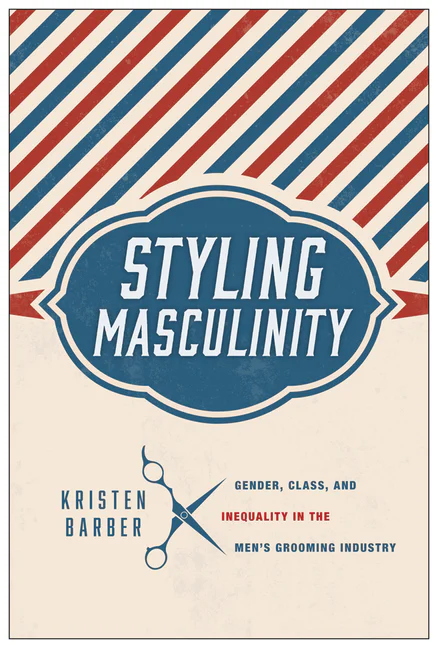
Image Credits: Rutgers University Press

Since the inception of the metrosexual in the mid-1990s, the United States has seen a rise in male participation in the beauty and grooming industry, an industry that was founded by women and has typically been associated with a more feminine lifestyle. For white middle to upper class American men, there is a tension between the expectation to look clean and professional and the fear of appearing to try too hard to look this way. To balance these conflicting desires, modern men’s hair salons create carefully cultivated male aesthetics in their shops, from the decor and products to their employees’ mannerisms and dress codes. Kristen Barber explores this phenomenon in her monograph Styling Masculinity: Gender, Class, and Inequality in the Men’s Grooming Industry, published by Rutgers University Press in 2016. Barber begins with an initial research question: “What makes a men’s salon a men’s salon?” (Barber 162) To answer this question, she spends nine months in 2009 investigating the painstakingly masculinized spaces of two upscale men’s salons in Southern California, The Executive and Adonis, where she uncovers the aesthetics and gender politics of male participation in the beauty industry and the complex role female employees play in this space.

Kristen Barber is a sociologist, professor, and researcher with a focus on masculinities, culture, and work. She has a PhD in sociology from the University of Southern California, and her research centers on examining what “everyday boundary-crossing behavior can teach us about complex systems of inequality” (“Kristen Barber”). Besides Styling Masculinity, Barber co-authored the textbook Gendered Worlds 4th Edition and is the co-editor of a journal called Men and Masculinities. She currently works at Southern Illinois University as an associate professor of sociology and the director of the Women, Gender, and Sexuality Studies program.

To get to the bottom of her question about what exactly constitutes a “men’s salon,” Barber performs an ethnographic study of two such salons in Southern California, Adonis and The Executive. She chooses Southern California as the site of her study because it is “a mecca for commercial aestheticizing” (Barber 12). She states that the phenomenon exemplified by these salons is not exclusive to California alone but rather extends to the rest of the country as well, though how it manifests in different settings may vary. Barber spends nearly a year frequenting The Executive and Adonis, interviewing the owners, employees, and clientele, and observing the interactions between the male clients and the female workers as well as between the male clients and the space itself. She writes, “I am interested in meanings as they are constructed through people’s face-to-face exchanges and how the organization in which these exchanges are embedded shape relationships between groups of people, identity building processes, and the reproduction and reimagining of cultural norms” (13).

Continue reading “More Than Just a Haircut: Examining Gender Roles and Male Grooming in Kristen Barber’s *Styling Masculinity*” →

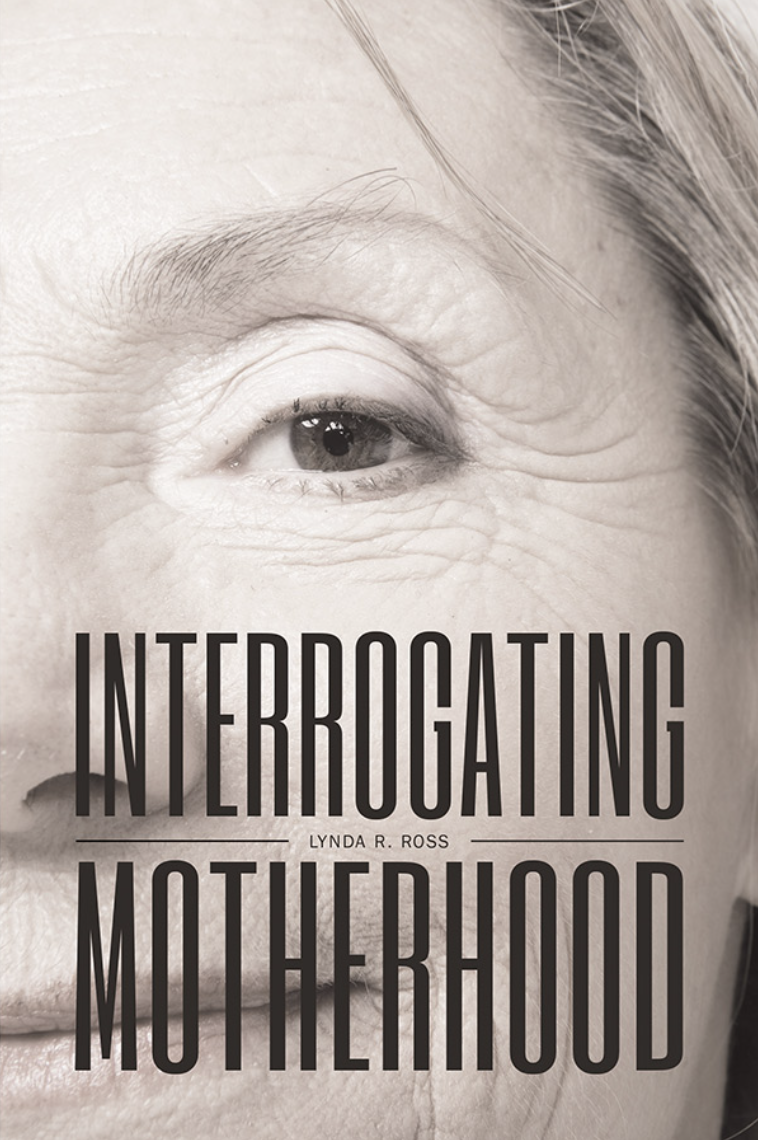
Book Review: *Interrogating Motherhood*

Motherhood can be a controversial topic yet is also held as a gold standard of womanhood. This is not only complicated by diversity of individuals and life goals, but the pressure that is put on mothers and the shame associated with mothering in a particular way or rejecting motherhood entirely. Discussion of motherhood is much more prevalent than fatherhood, with discourse more strongly focused on the different aspects of what it means to be a mother. This is the case because of the widely accepted notion that women hold more responsibility as a parent while men are more or less excused. Critical discussions of motherhood can be controversial because of these norms and expectations of gendered parental roles and childcare that are entrenched in policy, history, and day to day life. Nevertheless, it is important to engage with this topic as individuals and a collective to shed light on the private and public role that motherhood plays on mothers themselves, as well as shaping motherhood down the line. 

Lynda Ross is an associate professor at Athabasca University, in Athabasca, Canada. She is a professor in the Women’s and Gender Studies department and teaches courses about violence against women, and women and psychology (“Lynda R. Ross”). A primary interest of hers is the social construction of motherhood (“Lynda Ross and Shauna Wilton”). In her monograph, Interrogating Motherhood, Ross sets out to explore and explain the context in which motherhood in Western society rests, particularly in the United States.

            Interrogating Motherhood’s central argument is that women’s lives are made more complex and challenging by motherhood, because they receive little support considering the immense physical and emotional toll they go through. Ross states that “although childbirth is a universal biological event, it is obviously not independent of the economic, social, and cultural context in which it occurs” (Ross 70), and the result is that the experience of mothering is a very isolating one (127). In her book, Ross outlines the societal structures that emphasize the values place on mothering, but not mothers themselves. Her book’s eight chapters that walk through this argument are titled “The Study of Motherhood,” “Reflections on Motherhood: Theory and Popular Culture,” “Paid Employment and the Practice of Motherhood,” “Enabling Policies: In Theory and in Practice” (guest authored by Shauna Wilton), “Mothering and Poverty,” “Mothers, Mothering, and Mental Health,” “’Other’ Mothers, ‘Other’ Mothering,” and “The Future of Motherhood.” In these chapters she outlines how attachment theory, employment of women, policies surrounding maternity leave and paternity leave, mothers who struggle with parenting because of poverty or mental health, and mothers that face additional obstacles because they fall outside of the cookie cutter “good mother.”

Ross does not employ her own methodology in this book, but rather draws information from a plethora of relevant research and literature. She weaves this collection of facts and statistics from a variety of sources together to create view of motherhood in America that has more breadth than any of the individual works could reasonably provide. Alongside other authors, she draws from four of her own papers on attachment theory and postpartum depression to contribute her own expertise to the narrative. The second chapter of Interrogating Motherhood offers a history on the theory surrounding motherhood, and in it, Ross unpacks how attachment theory has contributed to the norm that maternal selflessness and ever presence is required for the successful raising of well cared-for children (18), partially because of the way theory and the media are influenced by external societal pressures (29). She illuminates that the accepted notion of what a “good mother” is does not assist mothers but instead leaves them without support (83). At the same time, this demonizes parents who do not fit into the narrow white, middle-class, heterosexual, and married mold (104), and further perpetuating the stereotype and expectation that mothers should be the primary caregivers for their children.

Although scholarly and offering a historical survey on motherhood theory, this book is extremely accessible to readers. In addition to being available online as a free PDF, this text is well organized and covers many diverse but not mutually exclusive topics related to motherhood, parenthood, and the historical and social forces that have shaped raising a child as a highly complex and gendered process. Ross also carefully balances her evidence within larger context and narratives within each chapter to paint a holistic picture of the dynamics impacting women. For example, in the chapter “Paid Employment and the Practice of Motherhood,” Ross contrasts the United States’ minimal maternity leave with that of Norway’s (45) to highlight how the difference in policy reflects how mothers are valued. Viewing this topic through a wide lens is essential due to the interrelated nature of its content, in which Ross executes by organizing the text’s content into well-defined categories.             

However, Interrogating Motherhood is somewhat held back by its breadth; since almost all of the information brought to readers’ attention is from outside of Ross’s personal research, there are a staggering amount of topics introduced that are not given equal depth and significance in the greater context of the book. For example, her commentary on how attachment theory supports norms of gender roles in parenting involves discussion of how constructions of Western society have influenced attachment style theory (125), and how this scholarly support has helped perpetuate these norms through media (29). On the other hand, when she attempts to summarize the impacts of the “anxiety, isolation, and sense of overwhelmed” that mothers may face in general, her conclusion is simply that these feelings “are not good for women” (127). Because of this, Interrogating Motherhood is essentially a literature review on policies and norms surrounding motherhood in the United States. Compared to the depth of analysis outlined in the introduction to the book, the text fails to interrogate motherhood beyond basic facts and their immediate outcomes.

Something that could have contributed to the strength of the book is the consideration of women who feel isolated from motherhood. Ross pinpoints the forced obligation of women’s responsibility to their children that some mothers must grapple with (114), but this leaves room for discussion of women who choose not to become mothers or regret becoming mothers. In addition, this book only focuses on Western society’s motherhood norms and expectations (1). The author acknowledges this, but the book could benefit from more cultural context, particulary in the discussions of family and gender roles.

            Ross’s Interrogating Motherhood sets out to unpack the nuanced, personal, and often controversial topic of what it means to be a mother, and how the idea of a “good mother” cannot be enacted in today’s society in a way that is supportive of a mother as well as her children. She covers a lot of ground in her discussion throughout the text and provides a well-supported argument. However, her lack of personal contribution to the research discussed reveals herself in her hesitance to jump into describing a more holistic perspective on the challenges mothers face beyond her two main areas of expertise: attachment theory, and mental health in pregnancy and motherhood (in chapters 2 and 6, respectively, as well as the introductory and concluding chapters). However, her call to action at the conclusion of the book is compelling; “a paradigm shift in how we understand mothering and motherhood is needed” (124) beyond essential policy shifts that need to occur, so that mothers are able to receive support, care, and attention alongside their children.

Works Cited:

“Lynda R. Ross.” CSPI, 1 Apr. 2010, https://www.canadianscholars.ca/authors/lynda-r-ross.

“Lynda Ross & Shauna Wilton.” JourMS, 11 Aug. 2016, https://jourms.org/lynda-ross-shauna-wilton/).

Ross, Lynda R. Interrogating Motherhood. Athabasca University Press, 2016.

Real Men Clean? A husband in the household goes viral on TikTok.

Written by Jack Muldoon for Jezebel www.jezebel.com

Maya and Hunter Leppard are the social media duo whose recent day in the life series has launched them to star status. The videos displaying a wife doing her day job and her husband cooking, cleaning and other daily chores have allowed the couple to rack up just short of 500,000 followers.

The quickly-paced video has racked up just shy of 20 million views and over a million likes. It is just one in a series of viral videos in the same bane. https://vm.tiktok.com/ZMRGHLM9W/

The tone of the video may seem mocking at first, with the meme favorite Home Depot soundtrack playing in the background and #girlboss description, this short clip could be written off as another misogynistic joke about a wife’s expectations. It appears however that the roles in the house are for real, and while they certainly want the series to be a laughing matter, the joke does not lie in the wife and husbands’ roles in the house. The short video has Hunter completing household tasks that are often still viewed in many parts of society as feminine. Making the bed, cooking breakfast, and feeding the dog are somehow the highlights of a video with over a million likes. While the humorous commentary does have a part to play, it is the fact a man is completing these tasks while supporting his working wife that draws most of the attention.

 These videos claim to fame is a man doing mundane tasks that millions of people complete every day, and this was seen as undeserved by some commenters. They argued that there was nothing extraordinary about this video and that the completion of these tasks by men should be as normal as working a construction job. The people, however salty they may be that their daily life hasn’t made them famous, are absolutely correct. These commenters are likely missing the point of the video though. The goal was not to get famous from displaying how different their life is from the “normal”, but to dispel the idea of a normal straight relationship that many still hold. While society has moved past the 1950’s era of housewives, the notion that a husband supporting his wife’s career by taking care of the house is an oddity still persists. While the number of stay-at-home husbands has hit their highest numbers ever at 2.2 million in 2016, they still only account for 16% of stay-at-home spouses. (https://athomedad.org/advocacy/statistics-on-stay-at-home-dads/). Seeing women take a role in the household that was traditionally reserved for men could be a small part in dispelling incredibly harmful notions about gender that still linger in society. Exposure to these videos and other media displaying women as the breadwinners will undoubtedly signal to young girls that the concept of marriage does not mean they need to put goals to the side and hit a pause button on their careers. These videos do participate in the idea that women are the ones typically supporting their husband’s career by addressing the relationship is not what society normally expects. While this does play into the myth in some ways, and a woman being the breadwinner in media without it being discounted as odd may be better representation, I would argue that this video is a benefit because it provides young people with an exampling differing that held in the mainstream.

Other commenters prove that these genderless still have strong gendered connotations in society. The couple recently mocked commentators who claim that this dynamic is unnatural and that Maya’s and all women’s job in a straight relationship is to support their significant other. These comments are proving the theory that every action we take is gendered, even when we believe that we have progressed as a society to the point that cleaning is not associated with women, there will always be people who assign these roles and judge those who do not conform to their standards. This video series utilizes a new medium, TikTok to help disprove a harmful trope. Young people seeing a financially strong wife and a husband complete housework and will hopefully help in dispelling the mythos of the traditional straight marriage, and as the video says, smash the patriarchy that upholds these standards.

The most recent video in the series put Maya’s point of view center stage with a retitled “Day in the life of a working wife”. https://vm.tiktok.com/ZMRGH6JwV/

The societal pressure still lays on women to be the ones taking care of the house, but these viral videos and their “like to smash the patriarchy” slogan could be helping. With the massive viewing they have, these videos may offer a fun and upbeat alternative to the societal norm. Young girls can see Maya hard at work, pursuing her goals while maintaining a healthy relationship like a true #girlboss. Seeing these strong examples at a young age and in a lively video could provide a new option that opposes the gender norms children are being conditioned to accept. 

Old Spice: Perpetuating Genderism Through Advertising

Written by Billy Schoel for Autostraddle

Who would’ve guessed?! We all know Old Spice: the pinnacle of male hygiene and every straight man’s best friend. The American-based men’s hygiene company has produced multitudes of popular commercials over the years, now laying claim to the largest share of the men’s grooming product industry. Even with the over-the-top, absurdist style of advertising that they’ve become known for, their commercials still perpetuate the heteronormative worldviews present in most contemporary advertising. In the recent commercial titled “The Man Your Man Could Smell Like”, Old Spice makes assumptions that support and perpetuate unrealistic expectations, heteronormative approaches to society, and the gender binary.

While this absolute gem of heteronormative marketing is only a mere thirty seconds, its featured fast-paced monologue is where the meat of this advertisement lies. For those who don’t have the pleasure of watching our knight in shining armor, I would be honored to transcribe: “Hello ladies. Look at your man. Now back at me. Now back at your man. Now back at me. Sadly, he isn’t me. But if he stopped using lady scented body wash and switched to Old Spice, he could smell like he’s me. Look down. Back up. Where are you? You’re on a boat with the man your man could smell like. What’s in your hand? Back at me. I have it. It’s an oyster with two tickets to that thing you love. Look again. The tickets are now diamonds. Anything is possible when your man smells like Old Spice and not a lady. I’m on a horse.” Visuals aside, see any problems? I sure do. Let’s talk about it.

Within the opening five seconds, the commercial establishes its audience and general premise. A well-defined, half-naked man nearly bursting with masculine energy exclaims “Hello ladies…look at your man…sadly, he isn’t me.” From the get-go, the commercial sets unrealistic expectations for men by comparing them to a representation of perfect masculinity. Despite the delivery’s fast-paced and absurdist nature, the commercial still establishes the inferiority of men who don’t meet the society’s standards of masculinity. The man continues, “if he stopped using lady-scented body wash and switched to Old Spice, he could smell like he’s me.” Not only does this disparage identities outside heteronormative masculinity by implying the inferiority of “lady-scented” body washes, but it also enforces unrealistic expectations for men. Additionally, by stating “he could smell like he’s me” instead of “he could smell like me”, the commercial continues its degradation of imperfect masculinity by clearly defining the ideal man and the other, forcing their separation and inequality.

The public dragging of the “imperfect man” quickly proceeds with the progression of the scene, painting a beautiful, idyllic picture of the life of the “perfect man.” He states, “you’re on a boat with a man your man could smell like.” Of course, this broadens the disparity between the perfect and imperfect men, implying that the lady would prefer the more masculine alternative over other men, even if they represented normal men in society. The precedence given to overly-masculine men concludes with the final moments of the commercial, the man stating, “Anything is possible when your man smells like Old Spice and not a lady.” Not only does it appear that Old Spice doesn’t know “ladies” smell good, too, but the quote places direct preference towards the ideal of overly-masculine men smelling unquestionably overly-masculine (talk about a tongue-twister), perpetuating, and ultimately strengthening, heteronormative conventions such as the gender binary.

Speaking of the oh-so-popular topic, this post would be quite incomplete without mentioning the commercial’s shameless defense of society’s gender binary. For starters, let’s address the assumed heterosexual relationship that the commercial stamps down as its starting point. Old Spice confines the audience into normality. Who is being addressed? A woman! Who must she love? A man—of course! What else could it be?! You mean to tell me that people have non-heterosexual relationships?! Nope, not never. Moreover, Old Spice expands the binary’s gap by implying that girls not only want just men, but the most masculine men life can offer. Men should not be wearing Old Spice to be hygienic—why would they? Men should wear Old Spice to be masculine, to attract women, to be men. Duh! Why would any woman ever be attracted to anything but the most masculine of men?! Despite my flippancy, the assumptions that this commercial makes are significant. In a world where gender/identity equality was reality, the heteronormative structures of society that enable this commercial’s marketability and ultimate efficacy would be relics of the past. Truly, the marketing of deodorant as a way to enhance heteronormative validation for men, even among their own partners, is almost as absurd as a deodorant commercial abruptly ending with “I’m on a horse.”

Also—newsflash—Old Spice works on everyone! While I’ve yet to find a man who doesn’t like Old Spice, I know plenty of other people who wear Old Spice too. Just because it is marketed to men doesn’t mean that only men use it! It’s deodorant, not a walking beacon of unapologetic masculinity. No matter how hard Old Spice tries to be the lodestar of manliness, at the end of the day, it’s a hygiene company. I could go on—but the point is that they shouldn’t be the deciding factor on what’s masculine, what’s attractive, or even what’s normal in our society. Old Spice may be a great deodorant company, but their marketing clearly needs some tweaks. Don’t even get me started on the fact that the tone of the whole commercial is rather belittling—I have to save something to write about next week.

Smelling Like a Female: Versace Eros Pour Femme 2014 Campain

Written by Tramanh Le for Jezebel www.jezebel.com

Two years after the launch of Versace Eros in 2012, Versace launched Eros Pour Femme. The story of Eros continues when the ad opens with the return of the male model from the 2021 campaign entering the same mysterious setting. He is again shirtless to show a sculpture-like muscular physique holding a bow and arrow to symbolize the Greek god Eros. A few seconds later, we see a slim, female figure with an elegant pose floating towards the light from the dark water. From her silhouette, you can see she wears a dress with gladiator sandals, which continues the Greek motif. When the female model emerges from the water, the two encounter each other.

In this snapshot, there is a sensual scene where the female model, Lara Stone, slowly brushes Eros’s hand to take the golden arrow. Enchanting music accompanies this scene to help create a dramatic effect for the seduction of Eros by Lara Stone. Although this sensual act is supposed to symbolize the strength of women, her strength is only validated by the ability to seduce a male. In the 2012 Versace Eros campaign, there was only a male actor, who was accompanied by a fast-paced and intense soundtrack. This choice in focusing on just the male model assumes that men are powerful by themselves and do not need to have a woman to contribute to this power. However, a woman’s strength is characterized by the ability to successfully seduce a male. This depiction of women is a common trend in advertising with a woman depicted as a support or the seductress next to a man.

In this last snapshot, the light from Olympus shines on Lara Stone as she lies on her side with a seductive pose while holding the golden arrow she had successfully taken from Eros. Placed next to her is an enlarged, glamorous, and golden fragrance bottle adorned with the iconic Versace Medusa head. In contrast to this scene, the Eros campaign’s ending scene is dark and mysterious with a turquoise blue bottle, which has historically been a color associated with males. We can see the different marketing techniques companies use in order to sell specifically to men and women. This bright and gold bottle is for women, while this dark and blue one is for men.

Not only does the bottle look like it is for women, but the fragrance smells feminine. The words pour femme show that this fragrance is the female scent interpretation of Versace Eros cologne. Those words also state that this perfume is only for women. The heart of the Pour Femme fragrance contains jasmine infusion and jasmine sambac absolute, which Versace states on their website, “conveys an authentic and timeless femininity.” Unlike its counterpart, Versace Eros does not have floral notes that dominate the scent. The Versace website states that the fragrance was supposed to “interpret the sublime masculinity through a luminous aura with an intensely vibrant and glowing freshness.” My question is what determines which scents are feminine or masculine. The answer is the cultural and societal frameworks that have constructed certain scents as either feminine or masculine, not that we are biologically wired to do so. Perfume companies have taken advantage of these frameworks and contributed to the manufactured idea of gendered smells in order to sell products specific to men and women separately. Because we associate floral scents with femininity, it shows normativity of gendered scents.

Versace Eros Pour Femme | Fragrances – YouTube

Versace Eros 100 ml for Men | US Online Store

Versace Eros pour Femme 100 ml for Women | US Online Store

“We Raise Our Cups” to Anaïs Mitchell’s Hadestown

Written by Zoe Smithwick, for Autostraddle.com

When I think about a musical geared towards social justice and societal change, my first thought would not be about a depression-era retelling of a Greek myth. BUT, if I tell you that this same musical is entirely women-directed, inspired by cultural and political tones in modern society, and focused on shedding light on the application of age-old themes to current topics of discussion, I bet you would change your mind. After watching Hadestown, I was blown away by the ability to not only tell the classic story of Orpheus and his journey to retrieve Eurydice from “Hadestown,” but also the ability to resonate with many of the songs and emotions portrayed in the show.

Hadestown Broadway Trailer

To start, there is the attention to feminism in every aspect of the show. Anaïs Mitchell, a singer/songwriter, came up with the vision for Hadestown and wrote the music, lyrics, and book associated with it. The musical started off as a story told through an album that Mitchell was writing, which, with help from director Rachel Chavkin, became an off-broadway and finally a broadway and touring musical. The musical made headlines with Mitchell as the first woman in years to have sole credit on a Broadway show. 

Looking back to high school, who dominated the theater-kid scene? Overly-dramatic girls who always outnumbered the less-enthusiastic guys. Yet looking at the professional scene, it seems as though a majority of the main roles on Broadway and the majority of directors/playwrights happen to be male-dominated. It’s interesting to see such a shift in a field that is primarily more “feminine” to where the majority (as per-usual) is cishet white men. This shift impacts women so heavily because in creating an atmosphere where women are not even able to succeed in their stereotypical niche, how would they be able to break out of the shell of modern gender roles? Mitchell’s work allows for younger girls and women to be empowered by her bold leadership in such a male-dominated field, not unlike the movement for women in STEM. Some other shows with similar experiences of women leading the way have been covered in this New York Times article by Michael Paulson and this Bustle article by Leah Marilla Thomas.

Additionally, Mitchell’s creative choices in music allowed for the show to highlight the female vocal range (specifically catering to Eurydice and Persephone’s songs), while she made the male range the separate ends of the range (Hermes in the middle, Orpheus at the top, and Hades at the bottom). In doing so, she allows the female characters to have a strength and versatility that is not provided to the male characters, which reflects in their individual portrayals; Eurydice and Persephone are both strong figures in their relationships and hold a lot of power over their male counterparts, whereas Orpheus’ high range mimics his innocence while Hades’ low range presents his power-driven personality. 

In the video trailer above, at the 0:32 mark, you can hear an example of Patrick Page as Hades singing in his gravelly, seemingly unnaturally low voice, marking his love for Persephone and somewhat “claiming” her as his territory. At 0:24, you can hear Persephone’s objections to the intolerable conditions that Hadestown creates for everyone there, adding to her constant efforts to ameliorate Hades’ world. On the contrary, you can hear Orpheus’ song of desire at 1:25, calling out to Eurydice and saying that he will do essentially anything in his power to bring her back to be with him, even traverse the treacherous conditions of the underworld. Meanwhile, Eurydice sings her version of his song at 0:50, singing of her experiences in Hadestown and of her love for Orpheus. In singing her song, Eurydice asserts that she chooses her path, so after stepping away from Orpheus and voluntarily joining Hades in Hadestown, she is ready to return to her husband.

Even in the setting of the show (depression-era, coal-mining, steampunk-esque), the woman’s place is considered. The silencing of women by men and society as a whole is reflected in Eurydice’s and Persephone’s main conflicts being with men and with their powerless position in the ways of the world. By recreating the myth in such a setting, Mitchell was able to communicate the timelessness of the issues faced by each character. Hades’ character was based heavily on a capitalist, upper-class leader who, while his morals were “broken” in a sense, was constantly trying to get back on a path to win back his wife. Orpheus, an artist stuck in his own head, dealing with the dilemma of how to win back his wife and conquering any obstacle in his path to love. Eurydice, a poor girl, trying to find a balance between surviving and listening to the Fates who govern her every decision. Persephone, a woman who has seen how bad the world can be, struggling to maintain an acceptable life for everyone. The intersection between doing what it takes to survive in desperate times and living a life full of wonder and love, as seen in Orpheus’ and Eurydice’s drastically different characters. We can see this in our world today, looking at how the power-hungry upper-class rules the world, how the climate is changing and those who have the power to change it aren’t doing so, and looking at poverty and finding the balance between a life of struggle and a carefree philosophy. 

Works Cited

Browne, David. “The Hell With Broadway: The Story of Anais Mitchell’s ‘Hadestown’.” Rolling Stone, Rolling Stone, 22 Oct. 2019, www.rollingstone.com/music/music-features/broadway-hadestown-best-musical-tony-anais-mitchell-842447/.

Brunner, Jeryl. “Hadestown Is A Broadway Musical Like No Other.” Forbes, Forbes Magazine, 29 July 2019, www.forbes.com/sites/jerylbrunner/2019/04/18/hadestown-is-a-broadway-musical-like-no-other/?sh=45e1beef4905.

Kallstrom, Megan. “Hadestown’s Tonys Triumph Was a Win for Women.” Slate Magazine, Slate, 11 June 2019, slate.com/culture/2019/06/hadestown-tony-awards-women-rachel-chavkin.html.

Sernaker, Emily, et al. “The Ms. Q&A: What Led Anaïs Mitchell to Hadestown.” Ms. Magazine, 15 Sept. 2020, msmagazine.com/2019/09/02/the-ms-qa-what-led-anais-mitchell-to-hadestown/.

Thomas, Leah Marilla. “Anaïs Mitchell’s ‘Hadestown’ Is Making Broadway History For Women – But She Wants It To Be Normal For The Next Generation.” Bustle, Bustle, 6 May 2019, www.bustle.com/p/anais-mitchells-hadestown-is-making-broadway-history-for-women-but-she-wants-it-to-be-normal-for-the-next-generation-17130069.», Dominique Rossi