Changing Gender Roles: Get Tattoos. Scare People!

Written by Patricia Raudales Calvario for Wear Your Voice/ https://www.wearyourvoicemag.com

The animated comedy The Simpsons is widely known by the media for “predicting the future.” Scenes from past episodes are scaringly connected to current events. Whether or not you believe this theory to be accurate, you will find many Simpson reference memes on social media. Scenes from the show have contributed to meme culture. The meme culture is rapidly growing on many social media platforms like Facebook and Instagram. People see memes everywhere, and the description following the meme, although used to entertain, can show a lot about society’s current views.  

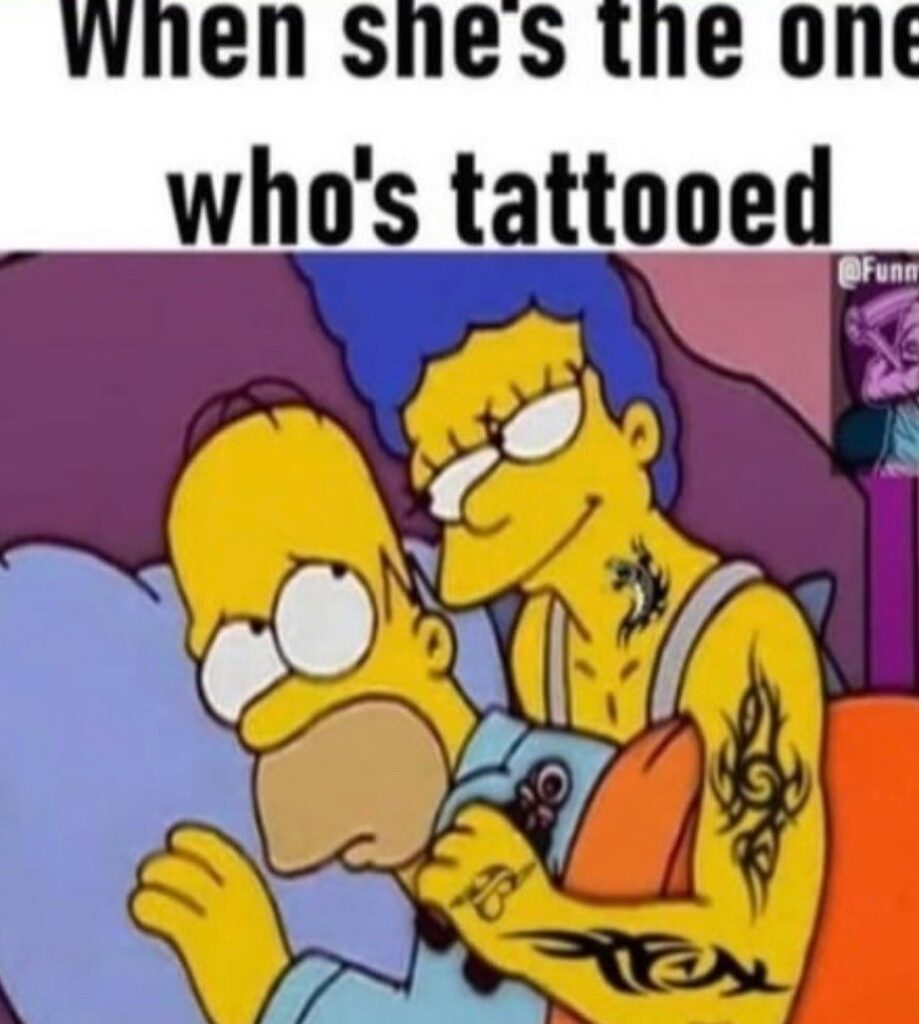
“When she’s the one who’s tattooed” meme shows the fear of Homer Simpson (the person on the left) as his wife, Marge Simpson (the person on the right), leans over him with a seductive face. This interaction goes far beyond Homer and Marge; the facial expressions themselves depict gender roles in society. Although women are now empowered in all aspects of life (social, educational, political, and psychological), seeing a woman embodying more “masculine” traits still frightens many, as seen in Homer’s face. Women who show confidence and are assertive are considered more “manly.” Women can be confident but also need to spread warmth and bring joy to others. Rather than being strong, women are expected to be relaxed and easygoing. Anything that contradicts these ideas is quite scary to society. 

Beyond the facial expressions shown in this meme, the creator edited a tattoo sleeve on Marge’s arm to create his “When she’s the one who’s tattooed” meme. This meme is looked at, laughed at, and then people move on to the next meme. However, it is crucial to be aware that memes such as this one tell us a lot about gender roles and identity in society. Memes go beyond giggles and laughs. Memes have meanings and values. 

Why does Homer look afraid in this meme? A tattooed female is leaning over him. This meme does a great job of showing the perception of women and men with tattoos that society holds. When a man has tattoos, he is a “strong man,” a “brave man.” This is why this meme would have not been successful or considered funny if the roles were reversed. Although more and more women are now getting tattoos to represent the femininity and morals they hold, they are not always viewed as “strong women” or “brave women.”  Instead, women with tattoos are described as “aggressive” or “more masculine.” This meme shows how it has become more socially acceptable for a man to have tattoos than a woman. 

The type of tattoos put on Marge’s arm is also specifically picked, creating a more masculine image. A simple google search of “tattoos for women” and “tattoos for men” can show what type of tattoos are acceptable for each gender. For example, Marge’s tattoos would be found within a “tattoos for men” Google search. A simple “tattoos for men” google images search will suggest dark and more frightening tattoo ideas. Tattoos of skulls, fires, lions, snakes, and “king” phrases will be the first to come out. Googling “tattoo ideas for women” would give you the complete opposite: sweet and fragile ideas. Top suggestions would include flowers, hearts, and butterfly tattoos. Google searches for tattoos should be nothing more than inspiration and should not determine the tattoo you think would be the most socially acceptable. No matter your gender identity, get a butterfly tattoo, a skull tattoo, get both. 

Memes like the one described above are dangerous and can complicate people trying to understand their gender identity. A woman can wear “masculine” tattoos and still hold more feminine characteristics. A man can wear “feminine” tattoos and still have masculine features. Tattoos are now becoming more popular in American life. Our role is to dissociate ourselves with putting labels on the type of tattoo one chooses to put on their body.  

Tattoos can have personal meanings to some people, and to others just be a form of art put on their bodies. Tattoos are not gendered, and one should get tattooed with whichever design they desire. Tattoos can be hidden from the public view, or they can be exposed for everyone to see. Regardless, get whatever tattoo you want. Be as creative, bold, and SCARY with your tattoos. Be Marge Simpson and frighten society!         

A Fatphobic Lucky Strike Ad: Another Bad Side of the Tobacco Industry

Written by John Rogers for Jezebel.

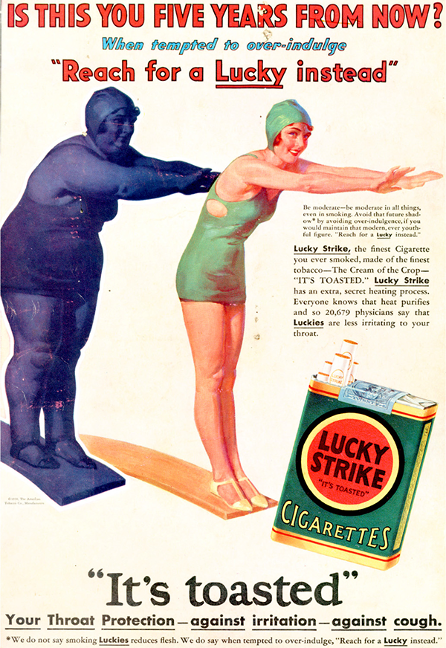
This horrific ad was created by Lucky Strike cigarettes in 1930 as an attempt to sell their unhealthy product. It is no longer in circulation today (thank goodness) but it can be found online, and looking at it provides important history on how advertising has always been manipulative. The ad purports that Lucky Strike cigarettes will reduce feelings of hunger, leading consumers to be less snacky, and thus, presumably avoid tacking on weight from overeating. This ad is targeted towards women, since it features a woman in the picture, and it suggests that ladies can avoid weight gain by smoking cigarettes. In this way, the ad reinforces harmful gender norms that women must avoid being fat in order to be attractive to potential partners. 

The ad is not just sexist towards women by holding them to high beauty standards. It is also deeply fatphobic, meaning that it reinforces the idea that fat is ugly and must be avoided. According to Marilyn Wann, “health is a problematic concept when linked with weight. Health is not a number, but rather a subjective experience with many influences.” So, implying that a certain weight is unhealthy or undesirable, as this ad does, is a constructed idea that harms fat people. They are less self-confident, ostracized from society, and given worse health care as a result of this fatphobic thinking.

On top of some sexist and fatphobic tendencies, the ad is racist as well. It presents the skinny woman as white, and darkens her fat shadow. This reinforces the historical idea that fat is a Black quality, and that Blackness is bad just like fat. By presenting the white woman as the ideal, and the dark woman as the problem to be avoided, this ad upholds a racist ideal of white superiority.

The intended purpose of the ad is to sell cigarettes, and the ad hopes that preying upon women’s fears of being fat will impel them to buy the product that is offered as a solution to weight gain. It has another angle as well. It claims that the cigarettes will protect consumer’s throats from irritation and a cough.  It is ridiculous by our 21st century standards to smoke unhealthy cigarettes as a way to resist weight gain or clear your throat, but this was a clever argument at the time of the ad. Doctors were paid to claim that cigarettes were healthy, allowing Lucky Strike to prey on consumers with misleading data. In this way, the ad uses the rhetorical appeal of ethos by appealing to over 20,000 doctor recommendations to back up claims of health benefits from smoking.

The advertisement uses the rhetorical appeals of pathos and logos as well. The scare tactic of the “fat shadow” that could occur in 5 years if one engages in “over-indulgence” is intended to create fear in the audience, a fear that will be dissuaded by the supposed benefits of smoking Lucky Strikes. Thus, the images in the ad appeal to pathos. In terms of logos, the ad makes an argument that cigarettes lead to less hunger, and less hunger leads to less eating, and less eating will prevent weigh gain. Of course, this logic is faulty, because it assumes that less eating will prevent weight gain, even though this is an open question. It also assumes that weight is a choice that results solely from eating habits, which reinforces problematic fatphobic ideas that Wann references. Humans have weights on a bell curve, just like height or other characteristics, so picking a “skinny” ideal that is a specific spot on the bell curve is not only misguided, it is impossible to accomplish.

The ad has two images. One is a basic image of a cigarette box, intended to make the packaging look clean and appealing. The other image is of a thin, conventionally attractive woman with a fat shadow. The then woman looks happy and calm, while the fat shadow has more of a grimace on her face. This illustrates the argument of the ad: buy Lucky Strike cigarettes to reduce hunger, or else weight gain will inevitably follow from an inability to control urges to eat.

Overall, the ad tries to convince women to buy Lucky Strike cigarettes with two claims that are both tied to health – the cigarettes will prevent weight gain by reducing hunger pangs, and they protect people’s throats by eliminating irritation and coughing. The ad is an example of problematic advertising that uses fatphobia to encourage people to buy unhealthy cigarettes. Ads like these were used throughout history to promote sexist, racist, and fatphobic ideas, convincing consumers that products which were actually harmful to them would help them avoid these made-up problems. Examining this history of constructing false needs is vitally important so that we can identify where ads are using these tactics today and snuff them out.

A cigarette ad riddled with fatphobia, false science, and problematic beauty standards

Why can only white men drink beer?

A Budweiser beer advertisement from the 1950s

What do you first think of whenever you look at this ad? Budweiser is a very popular beer company, so it particularly stands out. When I first looked at it, I thought to myself “Hmm, this advertisement is probably from the 1900s”. Budweiser created this advertisement in the 1950s and the intended audience of it seems to be pretty clear: white men. The purpose can also be quite clear: sell Budweiser beer to white men. These are the things you can decipher when you just take a slight glance at this advertisement. 

As you dive deeper into the symbolic art that is presented in the advertisement, these things unearth more purpose and intention from the advertiser. Let us talk think about and analyze the actions of the two people in this ad. For instance, looking at the white man, he holds a hammer. As he is holding this hammer, it seems he is working hard on building something and we can assume this is either something for home or it is a part of his job. When looking at the white woman who we can assume is his wife, she is pouring him a glass of Budweiser beer. There is nothing hardworking about what she is doing, she is just simply acting upon her husband’s needs. This image sparks more controversial topics. In the 1950s, they would say “Well that is the role of a women, isn’t it?”. They would assume that the role of the women is to take care of her husband and fulfill all of his needs. Whenever we compare these two actions of the man and the woman, it really reflects those assumed and assigned gender roles that society claimed to be “right” in the 1900s. The typical woman staying at home, tending to her husband, the breadwinner. In contrast, the husband is the hardworking spouse in the relationship who has a job, does the “handyman” work at home, and acts upon all the “masculine” things society expects him to do. Just by looking at the actions of the two in the ad, it easily already brings those gender assumptions to the audience’s minds. However, when looking at the advertising techniques of Budweiser, you can question them on why they ignited these prominent gender roles in the ad. Well, since it was the 1950s, it was assumed that after a long day of hard work, men needed to decompress, so their wives could pour them some Budweiser beer at the end of the day. 

These points can also be proven by the facial expressions of the man and the woman in the advertisement. By the looks of the man’s face with his wrinkled forehead lines and his subtle yet irritated facial expression, he seems to be stressed out and tired from a long day of labor and responsibilities. Let’s remember, the 1950s were times when gender roles were prominent. Where the golden standard was the men working and laboring during the day while the women stayed at home with the children. So, because men are stressed out at the end of the day, this is why Budweiser aims at this audience of white men who have jobs. Budweiser tries to convince you that alcohol, specifically their beer, will help you decompress and relax at the end of the day. Now, looking at the intended audience of the advertisement, it sparks conversation on the assumptions of gender roles. For example, why is Budweiser assuming that only white men drink beer? Why can’t they advertise it to women or even non-white men? This question does have an obvious answer which has to do with the time that the advertisement was released, however, this only shows how prominent these gender stereotypes and standards as well as racial issues were during the 1950s. It shows how companies and businesses convinced society that men have specific roles and women have specific roles. It shows how there was so much assumption on what race was superior during the time and which were inferior. Moving on, let’s start looking at the women pouring the Budweiser beer for who we assume is her husband. She looks so content while pouring the beer. She looks as if she has no problems in this world. That may be true, or it may not be. Budweiser is trying to convince the audience that since it is the 1950s where women are at home while men are working during the day, the least they could do for their hardworking husbands is pour them a glass of Budweiser beer. Budweiser is trying to force these couples into these roles in order to advertise their product.  

Looking back at the advertising strategies that Budweiser tried to use, it may have been effective during the 1950s. However, that does not make it necessarily “right” to advertise in the first place. When people look at the advertisement in modern time, there are so many gender, racial, and class issues within the ad. However, we can learn to appreciate that advertisements such as this one was produced in history, because we can now analyze them and learn from them. That is the major takeaway we can obtain from media that occurred a long time ago, and that is what we need for social justice. 

Writing for Feministing / www.feministing.com

What is Mick Fleetwood’s Obsession with Balls?

Fleetwood Mac’s Rumors Album Cover

It’s been almost 50 years since the release of Fleetwood Mac’s Rumors (1977), but this album is still as popular as ever. From song versions sung by the Glee cast to a viral TikTok trend involving cranberry juice and “Dreams,” teenagers and adults alike fangirl over this influential record. They live for the drama, the ethereal energy, and the tack piano. But why, oh why, is there a pair of balls dangling between Mick Fleetwood’s legs, and who draped Stevie Nicks across Fleetwood like a damsel in distress? This blog post is an analysis of the album cover to Fleetwood Mac’s magnum opus and what it says about power dynamics between genders. 

If you’ve ever watched Superman, you know how much power superheroes exude solely from their stances. On the Rumors album cover, Mick Fleetwood stands tall and proud, one foot resting on a stool. His chest is proudly stretched, and his hand rests firmly on his hip. He’s set in place, grounded as he holds a crystal ball. On the other hand, Stevie Nicks is anything but steady. Her body is positioned closer to the floor, and her arm flexes behind her as if she’s turning (or possibly falling). She lacks balance, utilizing Fleetwood’s leg for support. At first glance, their stances are nothing to consider. However, this contrast of poses creates a clear power dynamic between Fleetwood and Nicks: Fleetwood is an object of power while Nicks floats along with little structure, reliant on Fleetwood’s body. These same power dynamics have dominated modern-day family and economic systems. During the 1950s, the cult of domesticity established the prevailing trend of male breadwinners. Even today, men are still seen as financial providers and political leaders of whom women are in desperate need. 

Along with posture, the juxtaposition of masculinity and femininity is apparent in Nicks’ attire. Nicks dons a black flowy shawl and is dressed as Rhiannon, the Welsh witch known from the song of the same name from Fleetwood Mac’s eponymous 1975 album. Throughout history, witches have been one of the most widespread images of female empowerment and resistance to patriarchal norms. Persecution of witches has existed as early as the creation of the Bible; the witch trials in The United States (most famously Salem, Massachusetts) and the United Kingdom merely dispersed witch hysteria throughout the world. Witch hunts often punished powerless women who were on the fringes of society: women of color, women that spoke against the man, outwardly sexual women, etc. Essentially, women – generally speaking, people – that didn’t conform to expectations set by society and the patriarchy were susceptible to being charged with witchcraft. Witchcraft’s connection to the feminine is also apparent in a witch’s connection to nature. While nature isn’t necessarily feminine, much of the discourse around women and motherhood connects to the Earth. Furthermore, women and the Earth alike have been subject to much exploitation, oppression, and destruction. Witches communicate with these forces of the environment, blurring the line between humans and nature. Now, what does this have to do with Stevie Nicks or Rumors? For much of the ‘80s, tabloids and haters alike speculated that Stevie Nicks was a witch. Rather than run from these harrowing accusations, Nicks embraced the identity – she embraced Rhiannon. Nicks even appeared on American Horror Story as the “White Witch.” She became this mystical, feminine icon in the male-dominated genre of rock, a “fuck you” to both the industry and patriarchy. This begs the question: if Nicks is a model of feminine power, what does the Rumors album cover say about the relationship between man and woman? Why is Fleetwood holding a crystal ball, Rhiannon’s median of art? Has he taken it, are they sharing it? Why is Fleetwood towering over Nicks, positioned as if he’s Captain Morgan overpowering the feminine? Is he part of the witch hunt? Expanding on the analysis of their gender dynamics from their posture, the cover art suggests an imperial conquest of wild and unruly women, i.e., witches. 

The last narrative piece that brings this analysis full circle is how Fleetwood himself is accessorized: with a pair of balls that hang below his pelvis. Why is it so crucial that Fleetwood reminds not just Nicks but the listeners (and therefore the world) of his genitals? The answer to this question is simple. He wants everyone to remember that he has balls. He wants his power as a man – as a person with a penis and testicles – to be known. We live in a world where power systems predominantly benefit those with one set of genitalia, so images related to testicles or phallic symbols can also be correlated to potency and strength. Today, we see phallic imagery in areas related to power, such as swords, rockets, skyscrapers, and cigars. These images create a subconscious association in our minds with hegemonic masculinity, a constant reminder of who and what is in charge. Similarly, Mick Fleetwood’s balls generate a reminder of his position in society and in relation to Rhiannon.  

Does this mean you should stop listening to the silky melodies of Fleetwood Mac? Absolutely not – I’ll always need my daily dose of Stevie! However, you should study and recognize the many messages the cover art delivers. Rumors has one of the most recognizable album designs of all time, so dissecting images that circulate pop culture is vital to understanding the social contexts in which we live. That being said, the next time you add “Songbird” to your Spotify queue, analyze the different stories hidden within the album cover and question any resemblances to your own relationship to gender and power.

Written by Anaya Patel with Autostraddle

Harry Styles Likes Women’s Clothing and He Doesn’t Care Who Knows It (Not Even Candace Owens)

By Alice Berndt

Written for Jezebel

Vogue Online, 13 Nov 2020

On November 13, 2020, jaws dropped and 1D fans swooned when the cover image for Vogue’s December issue was released. The shot features former boy bander and current pop sensation Harry Styles dressed in a black and white lace gown and black cropped blazer, his hair swept to the side in an intentionally effortless flop. He is the first man to appear solo on the cover of Vogue in 127 years. As the cover reads, “Harry Styles makes his own rules.” [Vogue]

Framed against a sprawling green meadow and clear blue sky, the British singer squints into the sunny distance. He holds a blue balloon to his lips, mid-blow, showing off an array of chunky rings, including one in the shape of an “H” and another in an “S.” The photo is iconically Harry — sexy, androgynous, playful, and edgy. 

Since the beginning of One Direction’s seemingly eternal “hiatus” back in 2015, Styles has been making a name for himself as a solo pop rock artist. In addition to releasing hit singles like “Sign of the Times” and “Watermelon Sugar,” he has also become a fashion icon, breaking free from his 1D wardrobe of V-necks and skinny jeans and embracing more traditionally feminine styles like colorful blouses, bootcut pants, and dresses. For the most part, fans and the public have been accepting of his style transformation, which recalls music legends of the past including David Bowie and Prince. But for some, this Vogue cover took it a step too far. 

Screenshot: Twitter / @RealCandaceO

In a move that sparked contentious debate, conservative commentator Candace Owens retweeted Vogue’s post on Styles’ cover shoot and wrote:

“There is no society that can survive without strong men. The East knows this. In the west, the steady feminization of our men at the same time that Marxism is being taught to our children is not a coincidence. It is an outright attack. Bring back manly men.”

[Twitter]

Yowza. Owens received immediate backlash from liberals, feminists, and Styles’ fans alike who claimed she was being sexist and close-minded. She was criticized for her assumption that masculinity and strength (or lack thereof) are directly connected to wardrobe — a man cannot be “manly” if he wears a dress. 

This assumption stems from centuries of clothing acting as a marker of gender — men wear pants and women wear dresses and skirts. Period. But is Owens implying that the inverse is true as well — that women cannot be feminine if they wear pants? Certainly Owens herself has been spotted wearing pants on more than one occasion. Commentators wondered how an article of clothing could limit or “attack” masculinity and strength but not femininity or grace. 

Screenshot: Instagram / @harrystyles

In a reclamation of Owens’ derogatory words, Styles posted an image to Instagram from his cover shoot with Variety and captioned the post “Bring back manly men.” The caption combined with the cheeky photo — Styles in a powder blue pantsuit eating a banana — pokes fun at his haters, addressing the situation while also making light of it. 

Styles is certainly not the first celebrity to be criticized for their clothing choices, so why did this get so much attention? Perhaps because it’s far less common for a woman to publicly shame a man for his outfit than vice versa. We’re used to female celebrities being called out for “scandalous” or “overly sexy” clothing (Billie Eilish’s British Vogue cover, for example), but typically male celebrities wear what they want or what their stylists give them and that’s that. It also cannot be ignored that Styles has a massive fanbase that has grown alongside his career since the inception of One Direction in 2010 and is prepared to defend him regardless of the context.

In talking about gender and fans, we must engage in a conversation about privilege. A quote from Styles on the Vogue cover reads, “Anytime you’re putting barriers up in your life, you’re limiting yourself.” For Styles, a straight white male celebrity with a net worth of over $80 million, he has the comfort and freedom to express himself through his clothing without fear. [Vogue]

For many others, including female-identifying, LGBTQ+, and POC celebrities, what they wear is often the biggest target for ridicule, criticism, and objectification. These individuals must first break down the barriers placed in front of them by society before they can even consider those they may have built for themselves. 

With that simple act of reclamation via his Instagram post, Styles had, in the minds of many, “won” the argument. For many others — celebrities or not — the complexities of how they use clothing to express themselves is a never-ending fight, both internally and externally. [Vogue]

Vogue Online, 13 Nov 2020

Don’t get me wrong, I worship Harry Styles as much as the next Gen Zer and wouldn’t dare question his status as a cultural icon. As actress and director Olivia Wilde says of Styles, “It’s pretty powerful and kind of extraordinary to see someone in his position redefining what it can mean to be a man with confidence.” By breaking free from the societal binary of gendered clothing, Styles utilizes his privilege to pave the way for others. But his work is far from being done. [Vogue]

TikTok: Its Perpetuation of Gender-Based Stereotypes and Human Body Standards

Over the past few years, TikTok has become a mainstream social media platform. This application, available for most smartphones, uses an algorithm to curate content for users, effectively getting them addicted to scrolling on the app. There are many subcultures on TikTok… For example, people who like dogs might find that the algorithm has put them on ‘dog TikTok,’ because their ‘For You’ page is filled with videos of dogs. The same concept applies to gender and sexuality. There are many different points of view represented on the application, and once the algorithm figures out what yours is, it will show you a plethora of content to reinforce that exact idea. 

There is a large subculture (or really, a set of subcultures) on TikTok that perpetuates the gender binary system and all of the gender roles that come along with that. For example, this video is a representation of many of the different videos that are found on ‘straight TikTok’: 

When the individual speaking in the video says, “Men will choose a peaceful woman before a beautiful woman,” they are enforcing many of the expectations that are placed on female-identifying people in our society. Moreover, the speaker is implying that women must be ‘peaceful,’ therefore implying that often, women are not peaceful. This implication tells women that they need not express their emotions; rather, they should focus on being as passive as possible in an effort to be chosen by a man. 

Next, when the person speaking says, “Men seek for peace, and it don’t matter if you’re Black, blue, asian, Latina… they want to come home to a peaceful woman,” they are demonstrating a lack of awareness of the intersection between race and gender. This statement also reinforces the idea that men come home to women, therefore saying also that women should not be working professionals. 

On top of that, the speaker discusses the intellect of women and expectations in that area that men hold. They say, “He wants a woman that’s resourceful, a woman that can think on her feet. So when he can’t hold it down if he’s ill and he’s unable to pay the bills, she can be resourceful and have her intellect to make things happen.” The first implication I see in this statement is that the woman should just be intellectual as a safeguard… the woman will never actually have to use these skills unless it comes down to it. The assumption that men always pay the bills is harmful to all people, regardless of gender, because that is not the case for everybody. By the same token, the fact that the speaker is bringing this point up implies that women are, in general, less naturally intellectual than men. Drawing this unfounded connection between gender and intellectual capacity is harmful to society as a whole. 

Perhaps most disturbingly, our speaker talks about the ‘appropriate’ role of women in a sexual context. They say that men are “looking for a woman to supply their physical needs… A woman that looks good and proper and public but is a beast in bed” is the golden standard. First of all, in addition to ignoring the physical desires of the women at hand, this statement claims that the purpose of women is to fulfill mens’ sexual desires. This incredibly sexist ideology has the capacity to negatively influence the lives of many people. On top of this, the speaker is assuming a common definition of beauty… she is saying that women who have a certain physical appearance and demeanor are examples for what all other women should try to be when in pursuit of a relationship with a man. 

In conclusion, the ideology contained within this video is based on the idea that women are socially inferior to men, and that female sovereignty should not exist when it comes to romantic and sexual relationships. The central claim is that women should constantly be cultivating their personas to match what they think men are looking for in women, in hopes that they will ‘meet the cut’ for some man.

Similar to the last clip, this piece of satire brings awareness to many of the appearance-based expectations that our society holds for women, and the stark contrast between these expectations and those for men. The actor, mimicking a man, says: “Alright, so I want a girl with huge, but perky boobs, small waist, huge butt, flawless skin (but can’t wear makeup). And I like blondes, but I think she should also be brunette… because I get bored quickly, you know?” This statement encapsulates many of the body standards that our modern society has for women, and also touches on the normalized fact that men sleep around while women are expected to be loyal. 

In the caption of this video, the creator claims that this is how all men think. Although this is probably a sarcastic statement, it is representative of the way that many people think. Moreover, individuality is to be nonexistent: all men must act one way, and all women must act another way. Beyond pointing out, and perhaps reinforcing, the gender norms that are in place for men and women, this video illustrates the prevalence of the gender binary in our society. 

Content Warning: This video contains a real-life portrayal of surgical body mutilation. Use viewer discretion. 

In this shocking clip, we see a person that is identified as a man who has ‘overdeveloped’ breast tissue. His act of having the ‘excess’ tissue removed is labeled as life-changing. First of all, the video notes that this overdevelopment in the breast tissue of a man is an actual medical condition, which is known as ‘gynecomastia.’ Its causes are said to be “medications, drugs, testicular cancer, and hormonal imbalance.” 

Without looking into the history of this condition, it’s plausible to assume that this condition was developed in response to a bodily appearance that was not in line with society’s idea of what a man should look like. Moreover, this condition does not pose any medical risk to the patient; it is merely aesthetic. 

This video perpetuates a toxic standard of beauty, and is essentially telling men who have growth in their breast tissue that in order to be beautiful, they must undergo surgery. Explicitly, the caption says, “These [surgeries] literally change men’s lives.” In watching this video, men with growth in their breast tissue are inevitably going to receive the message that they are disgusting, and must go get surgery. 

In conclusion, the three videos I have analyzed here are examples of the many TikTok videos that enforce gender-based stereotypes and human body standards that are present in our society. This is not to say that TikTok is a problematic platform that should not exist; rather, this suggests that we as a society should critically examine the role that social media plays in perpetuating harmful gender-based stereotypes and expectations on a day-to-day basis.

Writing for Feministing | www.feministing.com

From Theory to Praxis: Masculine Ideals in Male Athletics

One of the topics that really stood out for me from our GSS class was the discussion of body image. What especially resonated with me was when we talked about Adonis Complex and how people are concerned about their own bodies more than ever before. Since I talked about this topic in my literature review, I decided to focus on it more and apply it to my life. Being a male student-athlete, I am surrounded by an extremely heteronormative environment. It is easy to become ignorant and think that male athletics is only for heterosexual athletes because all the biggest stars are stereotypical masculine men. With the idealized image of masculinity comes the concept of muscle dysmorphia. It is a subset of the Adonis Complex that emphasizes a muscular male physique. As an athlete I feel this pressure of not only being in shape but also getting bigger even though it does not necessarily improve your performance on the court. From my personal experiences, this pressure comes from inside the team but also from outside observers.

Taking this class taught me so many new things and broadened my view of society. I think I can apply the ideas I have learned in this class to my own life and especially the athletic environment. I see gender and sexuality now as more of a spectrum rather than a binary. I am proposing a research project in which I survey several male athletic teams on campus to determine their attitudes towards masculine body image and appearance. I am interested if the perceptions of masculinity are similar across these different teams and if they differ from my personal experiences after taking this class.

Because of this class has changed my perceptions, I am excited to find out how my peers opinions will compare to those of society as a whole and my own views. This class has been a valuable experience for me and I am now much more aware of the structures and institutions that shape our society even though they may not be visible.

DirecTV Has No Strings Attached to Feminism

In the spring of 2014, DirecTV, a satellite television company, released a series of commercials on network television starring marionettes for the sake of advertising. The commercials, though eye-catching, did not garner much attention until one starred a white, sexualized female marionette wearing lingerie and standing in a bedroom.  The marionette, who exists as an object on screen, is placed in contrast to her human husband. She claims that ever since her husband signed up for DirecTV he keeps talking about how he doesn’t have to look at “those ugly wires”. The bashful marionette, who has her own set of wires, continually asks her husband, “do you still think I’m pretty?” to which her husband replies, “baby of course I do”. As a result, the marionette whips off her bathrobe exposing her lingerie beneath. She directs movements toward her husband while asking “do you like what you see?” as he lays on the bed and serves as a spectator. Not only does this commercial exemplify the male gaze and society’s limited acceptance of sexuality and outside the “norm”, but it also serves as a microcosm for women’s portrayal in media.

Through the actions of the marionette and her husband, this DirecTV commercial focuses on the concept of the male gaze. First coined by Laura Mulvey in 1975, it explains how society views women through a male’s perspective.  The marionette wife, dressed in a bathrobe, approaches her husband with concerns about her physical appearance.  When the husband squashes her insecurities surrounding her appearance she sexually takes off her bathrobe to uncover risqué, red lingerie hiding beneath. She proceeds to make movements and noises provoking sexual behavior in order to captivate her husband.  DirecTV plays into this concept of the male gaze by illustrating women as sexualized objects within a matrix of compulsive heterosexuality. The husband lurches up in bed once he lays eyes on his wife’s undergarments and scans her entire body up and down, further objectifying his string-puppet wife as a figure for show.  Once his wife asks a series of questions about her physical appearance, he quickly changes the tone of his voice to urge his wife to continue moving her body for him to see. This relationship portrayed on the screen is entirely based off of appearance with little focus on anything else—every dialogue between the couple pertains to her attempting to gain his approval and then showing him what she has to offer sexually. This theme of male gaze has been so prevalent throughout American history, especially in current day advertising, and the portrayal of the marionette continues to illustrate America as a “man’s world” with the wife’s only purpose to entertain the man.

Furthermore, although interventions into misogyny and patriarchy have been made, our society hasn’t been able to break beyond the heterosexual norm, which is illustrated through the interactions and stereotypes deployed in this commercial.  Katz examines heterosexuality, in The Invention of Heterosexuality, by exploring its changing definition throughout time. He explains how during World War II, the concept of the “cult of domesticity” prevailed. There was this “reassociation of women with the home”, which forced the “predominance of the hetero norm” and caused “an era of heterosexual hegemony” to ensue (Katz 237).  This DirecTV commercial is starkly similar to these concepts that emerged during the war, forcing us to question whether any progress for women in society has really been made throughout the years, as this commercial is covered in sexism and stereotypes which were hyper-prevelant throughout the 1950’s.  The marionette is placed in the bedroom, which alludes to women in the home.  Her blonde hair additionally plays into the stereotype that blondes are dumber than brunettes—thus this woman could not possibly be associated with work outside the home. Likewise, the husband is sitting, somewhat tired looking on the bed, as if he just endured a difficult day at his job. DirecTV is attempting to “play it safe” by staying within sexual norms that our society is comfortable with.

Moreover, the lack of intersectionality in this commercial is striking. Both the wife and husband are straight, Caucasian individuals in the upper-middle class due to the fact they can afford a cable plan in addition to an expensive TV and home. DirecTV wants to appeal to its viewers, and so we cannot only hold them accountable for this portrayal. They must think our society is additionally not ready to discontinue the heterosexual norm.

Women are repeatedly portrayed in media as sexual objects. This commercial is only one of the many times that women have been portrayed as “less intelligent”, “obedient”, “pleasing” beings compared to their male counterparts. The figure of the husband, moreover, helps to portray the wife as a being with the primary intent to serve her husband. Even beyond spectating his wife, the husband holds the remote with control of the channels to signify he additionally has control of the home. His wife is literally a puppet beyond the obvious—the husband holds the strings and decides what role she should play. The wife is not in control, she is at mercy of the husband, and strives to gain his approval, which is illustrated by her repeated questions concerning her appearance.

One journalist from Time magazine states, “our suggestion to the wired wife? Cut and run” (Time).  Using sex to sell is not a new concept in advertising.  Instead of evolving with the changing times, this method has persisted in current advertising. Even more shocking, this advertisement received more criticism about being “creepy” than it did about its sexist nature. The inhuman puppet-wife distracts the viewer from the sexist nature of the commercial—the viewer is unable to see the objectification of women as the problem in the advertisement. The sexualized wife embodies Sigmund Freud’s “uncanny” since she is strange, yet familiar to us because this type of advertising is ubiquitous in our culture (Freud 1). The wife should not have to gain affirmation from her husband about her looks nor should she have to be portrayed as a sexualized object in order to appease the male viewer.  Women should not have to be sexualized at the expense of a company trying to sell their product.  They are not synonymous with sex and it’s about time we cut the strings between this binary.


Works Cited

“DirecTV Marionettes Pretty.” YouTube. YouTube, 28 Apr. 2014. Web. 9 Sept. 2016. <https://www.youtube.com/watch?v=noFdLFMvh3Y>.

Dockterman, Eliana. “Selling Sexism: Why the Latest Commercials Are so Misogynist.” Time. Time, n.d. Web. 8 Sept. 2016.

Freud, Sigmund. The “Uncanny” 1 (n.d.): n. pag. Web.

Katz, Jonathan. The Invention of Heterosexuality. New York: Dutton, 1995. Print.

The Making of Man?

Advertisements should ideally be smart and catchy, leaving viewers with an immediate desire to purchase that product. In the United States, some see the Super Bowl, with its hefty fees for commercial time, as the pinnacle of advertising. In 2014, an ad for Summer’s Eve Cleansing Wash appeared on screens across the country. The ad begins with a husband showering and using what he believes to be body wash while his wife brushes her teeth in the bathroom. When she realizes he is using the wash designed to douche, she explains the benefits of this brand to him – a quick sell of the product. The husband, however, ignores all the information his wife describes after she first mentions its intended use. His face sinks, as he feels his masculinity threatened, and proceeds to attempt an outrageous amount of tasks to assert his manliness, such as drumming like a true rock star and prepping for a boxing workout by eating raw eggs. He finishes these activities by jumping onto the couch next to his wife, crushing a beer can against his skull as she rolls her eyes, most likely intending to mirror the look on viewers’ faces as they watch this ridiculous sequence. Despite the silent, eye-rolling critique from the wife, this ad does not give a powerfully positive message about gender equality or inclusivity. Instead, on the largest stage in advertising, Summer’s Eve chose to display gender conventions. Specifically, while the creators of this ad intended to make the man look foolish and the woman look smart and realistic, a deeper analysis reveals this ad as more offensive than progressive.

The horrified look on the husband’s face as his wife reveals the advertised nature of the product he is using re-emphasizes obsolete gender stereotypes, hinting that not only should women avoid talking about their bodies, but that men cannot even comprehend these conversations. As the wife begins discussing the benefits of her cleansing wash, the man immediately stops listening, more worried about his threatened identity, and, in the end, contributing to a woman’s lack of confidence in opening up a dialogue about her body. This ad, as many have before, manages to sell a product to women by shaming its key clients. In the Victorian Era, “True Women were defined by their distance from lust” and any sexual topics, and, in a way, this ad brings women back to that time period, suggesting many people, especially men, will not listen to a discussion as “inappropriate” as one about a woman’s bodily functions (Katz 232). In an attempt to deflect the conversation from a potentially uncomfortable topic, the husband physically leaves the scene and begins a new activity, leaving the wife appearing like a lecturer as opposed to a participant in a dialogue. While this ad is clearly targeted to women, portraying her husband as a child-like figure who ultimately discourages her discussion about her body, only further strengthens those dichotomous gender stereotypes.

The extremity of the activities the husband takes part in to recover his masculinity ignores any attempts to disrupt timeworn gender stereotypes, showing that any signs of femininity in a man must be eradicated. The husband karate chops wooden blocks, tows a car with his teeth, and even fashions himself a Spartan helmet, all in an effort to cleanse himself of any traces of femininity stemming from accidentally using the genital wash. While the man is clearly mocked in the ad for his excessive actions, this parody ultimately affirms the hegemonic structure that men are fundamentally different from women, and therefore need specific products. This ad exemplifies this facet of the marketing industry that “spend[s] massive amounts of time and money ratifying and supporting the versions of masculinity that we enjoy and trust,” (Halberstam 1). Validating a world in which men must be completely masculine, this ad “depend[s] absolutely on the subordination of alternative masculinities,” (Halberstam 1). The ad ignores the existence of men who can still enjoy playing sports while being the primary caregiver for their children or manicuring their appearance. Or even use a vaginal wash product manufactured for and advertised to women that, in fact, is basically just soap.

The characters in this commercial represent a white, seemingly upper class, heterosexual relationship, again omitting many other gender, sexual, and even race and class identities from the customer base of the product. Many ads today attempt to cast diverse actors, in order for their products to appeal to more people. This commercial not only displays traditional gender norms, but also portrays a stereotypical heterosexual relationship, which does not exist for many people, including those who might want to purchase the product. Even as scientists and sociologists alike release more information debunking previous assumptions about gender and sexuality, “a scientific fact, once established, may sometimes be disproved in one field, remain a “fact” in others, and have a future life in the popular mind” (Fausto-Sterling 169). While many more people today are realizing and accepting non-heterosexual and/or gender queer people, advertisements like these are still ignoring the emerging acceptance of these lifestyles. This ad, even while using younger actors who may be part of this tolerant generation, does not cater to those who identify outside of gender and sexuality norms.

Advertisements must balance between appealing to the masses and pioneering the portrayal of new societal trends, but this ad focuses much more on old and insulting conventions of gender roles as opposed to engaging people in the 21st century. The creators undoubtedly thought an ad, even one meant for a women’s product, playing during the Super Bowl, must connect with the typical audience of a football game, again making assumptions about the gender make-up of the audience. This targeting, however, not only excludes many people, but also makes gross stereotypes about those who enjoy sporting events. While not everyone today recognizes or accepts the changing discourse on gender and sexuality, advertisements have the ability to change public opinion. An ad created specifically for a women’s product, therefore, should best portray the shifting culture acceptance of previously undermined groups, like women and those who do not identify with traditional ideas of gender and sexuality.


Works Cited

Fausto-Sterling, Anne. Sexing the Body: Gender Politics and the Construction of Sexuality. New York: Basic Books, 2000.

Halberstam, Judith. Female Masculinity. Durham: Duke University Press, 1998.

Katz, Jonathan N. The Invention of Heterosexuality. New York: Dutton, 1995.

Wilchina, Riki Anne. Quuer Theory, Gender Theory: An Instant Primer. Los Angeles: Alyson, 2004.

Between Women: The Diversity of Same-Sex Relationships of Women in Victorian England

Between Women: Friendship, Desire, and Marriage in Victorian England by Sharon Marcus is a convincing, captivating, and original analysis that uncovers the importance and significance of the relationships between women in typical Victorian life. Marcus discusses how not many women in Victorian England had sexual relationships with each other or lived together in long-standing relationships like marriages. However, she also examines how women in Victorian England were involved in close and intimate relationships, which people at the time “believed cultivated the feminine virtues of sympathy and altruism”—that often had an element of objectification and closeness and affection (in a sexual manner). Marcus’s assertion that female bonds were “not only tolerated but promoted as necessary elements of middle-class femininity” (259) proposes an essential counteracting to the domineering opinions today that people in Victorian England saw all same-sex relationships as disgraceful and appalling.

Marcus goes on to argue that the wishes and needs of women at the time were motivated by consumerism and capitalism, and their friendships were recognized, reinforced, and strengthened by their “families, societies, and churches.” As she explains across a sequence of close readings, same-sex relationships and intimacy occurred in tandem and agreement with and even often promoted heterosexual relationships. Therefore, of course the people around women would support these same-sex relationships because these relationships in turn promoted heterosexual relationships, which led to reproduction and other societal expectations of women at the time.

Marcus goes on to support that images of women in the media at the time did not turn women into submissive and passive people, but on the contrary, represented the “erotic appetite for femininity” of women at that period. The appeal for femininity and fulfilling the ideals and expectations of being a woman in Victorian England drove women to this “erotic appetite. ” Marcus also showed how the relationships between women were a vital and central element of femininity through the analysis of literature, memoirs, letters, and more, and her immense collection of evidence further proves her argument.

When exploring the array of different types of female friendships, she focuses on how in many cases, female friendships just meant regular friendships, and how other times it meant lesbian relationships. Marcus goes on to describe how when same-sex “female marriages” were formed, that to her, they were not the controversial topic that same-sex relationships are today or that people thought they were. Even though these marriages were not legally formed, they were acknowledged in more wide scale social groups. Marcus also writes about a different sort of same-sex relationship between women and that is the relationships between mothers and daughters, and daughters with their dolls that were depicted in illustrations, and how these images had deceptive masochistic and sadistic insinuations and implications.

Sharon Marcus is the Orlando Harriman Professor of English and Comparative Literature at Columbia University. Her area of study is 19th-century British and French literature, specifically, she focuses on “performance studies, theater, and the novel; literary theory; gender and sexuality studies.” (Columbia U. Website) She is the author of Apartment Stories: City and Home in Nineteenth-Century Paris and London (University of California Press, 1999) and also won the Perkins Prize for best study of narrative for Between Women, along with several other awards for this book. Her essays have appeared in The Blackwell Companion to Comparative Literature, The Cambridge History of Victorian Literature, and more. Marcus has also written for The Boston Globe, The Chronicle Review, The Wall Street Journal, and The New York Times Book Review. Marcus was also the recipient of Fulbright, Woodrow Wilson, and ACLS fellowships, and a Columbia Distinguished Faculty Award. In 2014, Marcus was appointed Dean of Humanities at Columbia University.

In conclusion, Between Women by Sharon Marcus is a persuasive and unique examination that unearths the meaning and substance of the interactions between women in standard Victorian life. Very few women in Victorian England had sexual or long-lasting relationships like marriages. Marcus discusses how women in Victorian England were often involved in close and intimate relationships, which they thought encouraged the feminine features of compassion and selflessness. Her claim that female relationships were not only allowed but encouraged and endorsed as necessary for conventional femininity suggests an fundamental response to the widespread opinion that the people in Victorian England saw all same-sex relationships (no matter the degree of sex or sexuality played in the relationship) as outrageous and horrifying.

Women’s Progress and the Future of Marriage: Review of Generation Unbound

American social norms surrounding marriage and family structures have undeniably exploded since the 1950s golden age of Ozzie and Harriet-style unions. Over the past five or six decades, the United States has experienced a rapid decline in marriage and an enormous rise in births to unmarried mothers, especially among poorer, less educated Americans. Family sociologists agree that, in general, childbirth outside of marriage objectively increases poverty levels and inequality for children. In her 2014 work Generation Unbound: Drifting into Sex and Parenthood without Marriage,” Isabel Sawhill explores the causes and consequences of these striking changes in the United States’ marriage culture. She presents the reader with several explanations for the societal developments, including economic changes due to deindustrialization and globalization and a general liberalization of norms surrounding sex and marriage. However, unlike her colleagues in the field of family sociology, Sawhill identifies changes in women’s role in society as the overwhelmingly most powerful catalyst in the decline in marriage and increased childbirth to unwed mothers. In turn, Sawhill’s solution to the consequences presented by these developments is also ultimately a feminist one, as she argues that men must accept women’s changing roles and agree to function in a more androgynous union with a non-gendered divison of labor.

Throughout the expository introductory chapters of the book, Sawhill joins the existing dialogue of her contemporaries, including Charles Murray, Bradford Wilcox, and Robert Putnam, to establish a fact agreed upon by all family policy analysts and family sociologists: marriage is objectively the most successful union for stable parenthood, but marriage as an institution is rapidly declining in the lower socio-economic classes in the United States. What the U.S. has developed, in turn, is a cycle of poverty that fosters unstable family structures and unstable family structures that foster poverty. Sawhill’s main impetus to research the topic lies in the welfare of children. Her main argument is that marriage has seen such a rapid decline in recent decades because of the relative social progress women have made and the subsequent change in women’s opportunities and gendered expectations. Sawhill sees these developments as undeniably positive ones; however, progress for women has led to unintended consequences for children, as children have no autonomy over what type of family structure into which they are born, but must suffer any consequences assiociated with an unstable family. Sawhill’s argument develops into a suggested remedy for the future, in which she proposes that the government subsidize long acting reversible contraceptives (LARCs) to drive down the fertility of women drifting into motherhood with little active intention to do so.

Isabel Sawhill works at the Brookings Institution as a senior fellow in Economic Studies. She serves as the co-director of the Center on Children and Families, as well as the president of the board of the National Campaign to Prevent Teen and Unplanned Pregnancy. In recent years, she has focused especially on economically disadvantaged children in the United States, though throughout her life her research has examined various economic and social topics. She has extensively researched unplanned pregnancy, the economic consequences unplanned children face, and how the United States can best prevent unintended pregnancy.

Isabel Sawhill lays out her argument with extensive discussion and analysis of empirical, quantitative evidence representing the trends in marriage in twenty-first century America. Along with her contemporaries in the field of family sociology, Sawhill uses statistical evidence to determine that children fare best when they grow up in a household headed by their married parents. Despite marriages’ positive outcomes for children, though, Sawhill tells the reader that “marriage is on the wane,” going so far as to claim that marriage is an “endangered institution” (Sawhill 17-18). The bulk of her research is thus to explain why marriage rates have fallen so drastically; her findings bring her to the conclusion that “the changing status of women is the most important driver of changes in the family” (Sawhill 28). From the advent of the birth control pill, to increased numbers of women in college and the labor force, women have far more opportunities now than they did the so-called golden age of marriage, making them less inclined to marry, especially at a young age.

Sawhill also engages with her contemporary interlocutors by highlighting the growing class divide in family structures between the well-educated upper class and the less-educated lower classes. While women in the less educated, lower socio-economic classes have increasingly forgone marriage, while having children outside of marriage more and more often. However, women of higher socio-economic status are entering into so-called neotraditional marriages, which resemble 1950s-style unions, but are predicated on much greater egalitarianism between the husband and wife. Sawhill suggests several remedies to the negative consequences for children produced from what Sawhill considers unstable family structures. She argues that the U.S. government should subsidize long-acting reversible contraceptives (LARCs) to push down the fertility rates among the lower socio-economic classes in which fertility is high but marriage rates are low. She also supports increases in traditional government welfare programs to provide monetary and medical assistance to those in need.

The greatest strength of Isabel Sawhill’s work, I argue, is her introduction of a new explanation for the divergences in family structures in the United States during the past few decades. Her thesis, arguing that changes in women’s status in American society have been the greatest catalyst for breaking down the traditional family structure of the twentieth century, is an argument relatively untouched by Sawhill’s contemporaries. While family sociologists and policy makers have engaged in debate over the cause of changes in family structures, Sawhill presents a perspective unique from her colleagues by making her argument centered around the cultural shifts that occurred due to feminist movements. This argument strong and logical; the advent of accessible and relatively affordable contraception, the legalization on abortion through Roe v. Wade, no fault divorce, women’s increased presence in higher education institutions and improved status in the work force, etc. have all undeniably shifted marriage norms and structures (Sawhill26-30). She explains the bifurcation between upper and lower economic class families through the lens of gendered norms as well; well-educated, wealthy women are delaying marriage and childbearing while they gain education and profession status, but “at the other end of the economic spectrum, families are falling apart” (37). Sawhill explains this development as a result of lower-income men refusing to approach partnerships and marriage with an egalitarian view of gender.

Arguably Sawhill’s biggest weakness in her text is her explicit call to drive down the fertility rates of the less educated, lower income rungs of American society. Though she provides copious evidence that the instability present in many lower income families harms innocent children, her suggested remedies evoke the disturbing history of eugenics and birth control. Though Planned Parenthood provides undeniable benefits in 2016, and although Margret Sanger is often portrayed as a champion of women’s rights and social progress, we must remember the initial intentions of Planned Parenthood and birth control in general. While Sawhill herself may advocate purely on behalf of blameless children, her call for government-subsidized fertility control of less educated, poorer women threatens the agency of women on the sole basis of their economic status, as well as treading frighteningly close to outright eugenics. While children do unfairly suffer due to their parents decisions, we must always respect the agency and value of people regardless of their education attainment or economic status.

Overall, Isabel Sawhill provides an interesting and important commentary on the developments of marriage norms in the United States, with her predictions for the future and suggested remedies for the negative consequences associated with these changing social norms. The book exists in a field presumably off the radar of the average person, even among the more educated ranks. However, family structures and practices affect the future generation of thinkers, leaders, and influencers of our economy and society, and evidence shows us that the environment in which they are coming of age has a much greater affect on them than we may realize. Because Sawhill’s topic of analysis includes such a broad range of people—that is, all of American society—everyone could benefit from reading her text. I would openly recommend this text, but would explicitly suggest any reader to examine closely her remedies for the future and approach the work with a critical eye.

Sawhill, Isabel V. Generation Unbound: Drifting into Sex and Parenthood without Marriage. Washington, D.C.: Brookings Institution, 2014. Print.

Flirting with Danger

Every day, every single interaction, whether conscious or unconscious, shapes our identity and perception of the world. From the time we wake up in the morning until the time we go to bed at night, we are taking in information, processing it, and shifting our awareness of society based on the viewpoints we perceive. This impact of interactions and social cues has evolved over time into the hegemonic countercultures in different places around the globe. In her book Flirting with Danger, Lynn N. Phillips explores the ideology of power and choice within hetero-relationships formed by Western Culture through an in-depth analysis of the personal stories from young women.

Lynn N. Phillips coined the phrase “flirting with danger” in order to summarize women’s approach toward hetero-relations as established by previous interactions and media influence. In common situations of hetero-relations, the boundaries between “seduction and domination, pleasure and danger, responsibility and exploitation, agency and objectification, and consent and coercion” often become variable and murky (Phillips 3). However, women interpret this risky behavior as a “part of the ‘normal’ experience of their daily hetero-relational lives” (Phillips 3).  Through her research and analysis of women’s personal reflections of their relational experiences, Phillips successfully explores how women’s view of hetero-relations has evolved into the “need to flirt with danger” (Phillips 206).

Lynn N. Phillips draws on previous literature from feminist theorists in order to analyze her qualitative data. In doing so, she successfully creates a framework to guide our understanding of how society has shaped the subjectivity of power, choice, and desire within hetero-relations. In writing this book, Phillips aims to stimulate discourse regarding aspects of hetero-relations that are often excluded from feminist and social science literature. She specifically highlights the absence of conversation promoting “male accountability” and “female pleasure without penalties” (Phillips 77). While women do have the same sexual desires as men, “structural, ideological, and interpersonal barriers” created by Western Culture often prevent women from expressing these desires (Phillips 77).  Further, she hopes to gain a greater understanding of how women’s judgments, specifically regarding the meanings of male domination and sexualized power in their lives, have been shaped by personal experiences and outside influences. These subjectivities, formed from popular media and past hetero-relational experiences, are exemplified through four common themes of discourse: (1) “how to be a ‘good woman’,” (2) “what constitutes ‘normal’ male behavior,” (3) “what counts as ‘real victimization’,” and (4) “what should be expected from men and hetero-relationships” (Phillips 38, 52, 61, 69).  Through her comprehensive investigation of power and desire from personal narratives about hetero-sexual relations, Phillips successfully sets up a foundation for institutional change and further research surrounding “how issues of power and aggression might filter through same-sex relations” (Phillips 205).

Lynn M. Phillips consults with organizations on issues of sexuality, education, and victimization. As a Professor of Psychology and Gender Studies at Eugene Lang College of the New School University, she has experience in teaching and working with young adults. She has also written several other books on the topic of gender, sexuality, and relationships. For example, she was commissioned by the National Council for Research on Women to write The Girls Report: What We Know and Need to Know About Growing Up Female, and she is the author of Planned Parenthood’s Unequal Partners: Exploring Power and Consent in Adult-Teen Relationships. Her research in the field of gender and sexuality studies has sparked further inquiry surrounding the formation of the beliefs and messages guiding hetero-relations.

Phillips wrote Flirting with Danger in order to investigate her three central research questions: (1) How do “young women conceptualize the distinctions between good relationships and bad ones, between consent and coercion, and between agency and victimization?”, (2) How do “young women make sense of the violence and manipulation that all too often invade their hetero-relationships?”, (3)  What do young women “tolerate,…resist,…or perceive as ‘normal’ or ‘inevitable’ in their own and other women’s hetero-relational encounters?” (Phillips 5). In addition to using previous literature from feminist theorists such as bell hooks, Butler, Bartky, Collins, and more, Phillips conducted her own research study by interviewing young women from a small, progressive liberal arts college in the northeastern United States (Phillips 6). She placed letters in the campus mailboxes of all female students, inviting them to be interviewed about “power and intimacy in various relationships” (Phillips 6). She had in-depth conversations with the thirty young women who responded regarding their own personal experiences within hetero-relations as well as the hetero-relations of those around them.  Surprisingly, of the thirty young women that responded, twenty-seven of them “described at least one encounter that fit legal definitions of rape, battering, or harassment” but “only two women ever used such terms to describe a personal experience” (Phillips 7). Though Phillips does not discuss the official legal reporting of rape, battering, or harassment, this fact demonstrates the challenges of under-reporting. Many women are aware of what constitutes sexual assault and abuse, but refuse to consider themselves a victim when placed in the exact context. When in this situation of victimization, women have a “tendency to downplay the severity of their experience and blame themselves for their own abuse” (Phillips 157).  However, Phillips uses this fact alone as well as the contexts in which these young women’s hetero-relational subjectivities were constructed to understand young women’s personal perceptions, decisions, and attributions within hetero-relations. By placing these perspectives within cultural contexts, Phillips is able to identify common themes which contributed to their formation.

Through exploring prevailing themes within popular discourse relating to hetero-relations, Phillips creates a structure for the contexts, formulation, and application of “flirting with danger.” She specifically outlines four dominant themes of discourse with two conflicting discourses within each. For example, one dominant theme throughout her discussions was “how to be a ‘good woman’,” which broke down into “the pleasing woman discourse” and “the together woman discourse” (Phillips 38-39, 47).  The “pleasing woman” encompasses “the desire and ability to be pleasant, feminine, and subordinate to men,” stressing “morality, sexual ‘purity,’ and service to men and children” (Phillips 39). The “together woman” is “free, sexually sophisticated, and entitled to accept nothing less than full equality and satisfaction in her sexual encounters and romantic relationships” (Phillips 47). As exemplified though “how to be a ‘good woman’ discourse,” the two discourses within each dominant theme are viewed as mutually exclusive, thus creating the need to “flirt with danger” in order to obtain a “normal” hetero-relational experience (Phillips 38). As Phillips discusses, however, these two discourses should be seen as a spectrum rather than mutually exclusive, as hetero-relations will vary within each discourse based on the situation. Through exploring, establishing, and breaking down the social constructions of these dominant discourses, Phillips hopes to stimulate discussion surrounding the promotion of young women as sexual subjects who can find pleasure and safety within their hetero-relations with the final goal being a society without a “need to flirt with danger” (Phillips 206).

Within feminist literature, Phillips specifically draws from bell hooks’s Feminist Theory from Margin to Center in order to build off of previous theories regarding sexuality. In a passage referenced by Phillips, bell hooks describes “naming and criticizing the negative aspects of sexuality” as a “simple task for women” (Phillips 190). Further, bell hooks discusses difficulty of changing the norms of sexuality for women due to cultural constraints. Though Phillips agrees with the difficult task of creating new sexual ideals, especially in the present culture, she argues that naming is not such as simple a task as bell hooks portrays. Referencing the stories of the young women she interviewed, Phillips argues that women have difficulty making “straightforward claims about their own victimization” (Phillips 190). Women were able to speak against male sexual aggression in general, but unable to identify male sexual domination as victimizing within their own experiences. Similar to the views of bell hooks, Phillips contributes the inability to identify personal experiences as victimizing and the failure to establish new sexual paradigms to the cultural constraints of society today. By analyzing and critiquing the work of bell hooks in the context of her research, Phillips contributes to the conversation regarding feminist literature, enabling further research in this field.

One of the strengths of Phillips’s book is that it is relatable to a wider audience, concerning race, socio-economic status, and religion, as she draws on stories from all of the women in order to form her analysis. She uses specific examples of situations women found themselves in or brought upon themselves through poor decisions or risky behavior as evidence for all of her claims, further aiding her argument. This detailed investigation, however, is limited only to heterosexual relations; though some of these women identify as bisexual or questioning, she limits her research to only their hetero-relational experiences, excluding all other relations since she believes that “all women regardless of sexual orientation or sexual identity, are engaged in hetero-relations of some sort” (Phillips XI). Phillips did not take into account that these women’s same-sex relations could have made an impact on the formation of their ideas surrounding hetero-relations.  Therefore, in order to expand upon her study, Phillips suggests researchers should “explore how issues of power and aggression might filter through same-sex relationships as well,” building off of her framework and findings (Phillips 205).

Overall, in her book Flirting with Danger, Lynn M. Phillips successfully analyzes the hetero-relational experiences of thirty young women in order to create a structure for the formation of the beliefs behind their actions. Other feminist theorists as well as young women and men should read Phillips’s book in order to stimulate discourse and change the culture constructing these views and beliefs surrounding power, desire, and choice within hetero-relations.


Works Cited

Phillips, Lynn M. Flirting with Danger: Young Women’s Reflections on Sexuality and

Domination. New York: New York University Press, 2000. Print.
The Gender Binary in Relation to Dance

The music video Sergei Polunin in “Take Me to Church” by Hozier is able to reveal assumptions commonly held in dance around gender.

The camera work is steady. The video starts with a shot of the ceiling and then descends down to Sergei Polunin. For most of the video the camera is a short ways away, however, it’s focus is on him intermittently adding to the intensity of emotion in certain moments. For some shots the camera is close up and filming from almost beneath Sergei Polunin, this interesting style adds a dimension into how he is presented.

The white wooden church like structure Sergei Polunin is dancing in is expansive. The space is simple, there is a loft in a small portion of the second story but beyond that the space is open. The walls are incomplete, the frames showing, and the windows appear to be large holes in the walls. The floor is solid stone tiles of a light gray color, slightly dirty. The light beaming in is bright and glows in white fog that is rolling over the floor.

Sergei Polunin is dressed plainly in tight skin tone shorts and dirtied ballet shoes. He is wearing less than is generally worn for classical ballet. Additionally he is showing a multitude of tattoos. The tattoos are bold and dark on his stomach and sides. Sergei Polunin also has tattoos on his arms, wrist, hand, foot and chest. His hair is dark strait and growing out to be a little shaggy.

The song Sergei Polunin is dancing to, “Take Me to Church” by Hozier, has deep emotionality and is a great coupling with Sergei Polunin’s style of dance. Within the song there is variation of intensity that compliments the burst of action in the choreography.  

There is a dichotomy between his fully controlled spins and the moments where Sergei Polunin holds his head, his body seeming to break down. Sergei Polunin demonstrates an opposition and union of movement, one example of this is his ability to collapse all the way to the floor with grace. His movements are decisive and even as he is incorporating modern dance into ballet there is still form and structure to his movements. The motion of Sergei Polunin starts slow, tensioned and then unfurls into ballet spins and flashier choreography. Always returning back to ballet dance he is able to add emotionally charged moments that are almost theatrical in nature. There is an emotionality in his moves, particularly when there is a softer moment in the music.

In ballet there are many contrasts between classic female form and classic male form. The way Sergei Polunin holds his head is loose. He begins the piece with his hands on his hair bending his head down. His head is lifted but not tensioned. The way his head moves adds to the burst of motion he has and the emotionality. This contrasts greatly with the way female ballet dancers hold their heads which are generally very poised and tilted slightly up at the chin. The feminine head position is held with grace and firm ease.

The hands are important in ballet. In feminine form they are held softy with the second finger extended out just slightly. They remain smooth, slow changing and delicate. However in male classical ballet the hands are interrupted from delicacy often by lifting a women or focusing on quick burst of muscularity. Sergei Polunin has some form to his fingers during specific ballet moves but he also has flat hands for catching himself on the ground and curled finger pushing through his hair. He also at one point makes a fists with his hands which is something not often done by classically trained female ballerinas.  

The way Sergei Polunin expands his limbs through the space is mostly in quick fast points of movement where he is expanding and contracting often. There is a focus on concentrated muscular feats. He has a looseness of his limbs as certain points. Feminine classical ballet is different, the movements are generally supposed to be slow deliberate extensions that show off flexibility and endurance. The motion through space is graceful and full of very structured form.

Sergei Polunin’s movements come in explosive bursts, the focus on agility and strength. The motions are an embodiment of masculinity, protruding, angular and quick. This assertive action can easily tie into gender stereotypes in general and the conception that our contemporary society still holds about gender. In the gender binary men are noted for strength, assertive attitudes and loud demeanors. Differing from this, women are noted for grace, delicacy and consideration. Women have been expected to uphold this smooth action and water-like nature. Considering the role society has placed on women it is no surprise that femininity in dance is associated with smooth graceful movements. There is an emphasis on posture, detail, fluidity and rounding of the body.

Sergei Polunin’s movements, to “Take Me to Church” by Hozier, uncovers some of the gender bias and associations that are so deeply ingrained in our society, that are reflected in the form, movement and posture of dance.

Philosotoddler Questions Gender Stereotypes

“Do I wear blue because I’m a boy, or am I a boy because I wear blue?” asks a perplexed young toddler, dubbed the “philosotoddler,” in a meme on a Buzzfeed Pinterest post.  A seemingly simple question that, once pondered, actually conjures up all sorts of questions, conjectures, and arguments in today’s gender culture.  The post, originally intended to be nothing more than a joke about the confusing life of a toddler, has no philosophical meaning when looked at in its original context by an average viewer.  The intended audience for this post is the modern internet-user, in particular a Pinterest user, which means it is likely aimed more at younger audiences, especially teens and such who are frequently on Pinterest.  Because the post was originally meant to be simple entertainment, many people have surely seen this meme and have thought nothing of it.  Most peple who see this post have likely grown up in the heteronormative, gender stereotype-enforcing culture in which we live today, therefore they did not read deeper into the meaning of the picture and merely laughed at the “philosotoddler’s” deep inquiries about life.  However, when the post is viewed through the probing lens of gender and sexuality, the reader can truly realize a much deeper meaning hidden between the lines.

This perspective first reveals that, by merely making the assumption that blue is masculine, the post abides by the heteronormative trends that have consumed society for hundreds of years.  The meme addresses the role of gender stereotypes and the idea that certain qualities or accessories are so associated with a certain gender that they are seen as identifiers of that gender.  For example, a baby wearing blue is typically assumed to be a boy.  He is a boy because he has male genitalia, and he is expected to eventually exhibit the qualities that are typically seen as being masculine.  This progression is the logic most people use in society even today, because these are the ideas of heteronormativity.  The baby has already been assigned the gender “male” because of his biological sex.  Almost automatically, the baby, not even old enough to speak or express his/her own identity, already has expectations to fill and assumptions to meet because of gender stereotypes.  These concepts were not part of the original poster’s intentions in discerning meaning from the post, but these topics, heteronormativity and gender stereotypes, are the main focus of this meme when analyzed through the lens of gender and sexuality.

Looking at the original post makes it clear that Buzzfeed originally posted the meme as a joke; along with this meme, there are many others with the same picture, but with different captions: “How did she turn the spoon into an airplane?”  “How can you really know something if you haven’t put it in your mouth?”  The point of the other memes is merely to joke about the “deep questions” of being a toddler, yet this meme in particular means much more than that, and many Pinterest users have noticed this idea.  For example, another user pinned the meme, stating, “It’s a good question to ask.  Gender stereotypes are so big for young children.”  Because such basic assumptions are made about gender in this meme, it means much more than Buzzfeed originally intended, and has a greater significance than many of the other amusing memes with the confused toddler.

Looking deeper into the meaning of the post through analysis from the perspective of gender and sexuality, one can find meaning in the use of a baby as the one posing this meaningful question.  The baby has not yet had a chance to understand gender stereotypes, yet he is already being influenced and even defined by them.  The gender norms of society are being forced upon him and shaping his future, already affecting his learning of what gender is and what it means to be a boy.  The normative gender idea of dressing baby boys in blue is already affecting the baby, before he even has a say in what he wants. Because of the color blue, the baby already has expectations to be masculine and to fulfill the role of a boy in society.  Associations and assumptions such as these will only continue to happen and expand as he grows and begins to understand more about life.  Blue is a boy’s color.  Trucks and cars are toys boys play with.  Boys are tough and masculine.  It all begins with the color blue.

This tendency to enforce gender stereotypes also has a connection with following the heteronormative ideals of society.  For example, teaching young boys that they should be masculine goes along with the idea that they are not feminine.  Being feminine is for girls, and so is wearing pink, and being emotional and fragile.  Because of heteronormativity, one assumes that this boy, who will grow up to be masculine, will grow to like girls.  The baby is put in a categorical gender at a young age, and this gender gives him a natural, expected role in life.  He will follow the idea that girls have a feminine, even subordinate role in comparison to men, and he will grow up surrounded by the idea that romantic relations are most fitting for those of opposite sexes.  All of these assumptions and expectations are related to the heteronormative culture that begins at such a young age that it can affect the shaping of one’s future.

In conclusion, although this Pinterest meme was not originally intended to demonstrate such meaningful and controversial topics such as gender roles and heteronormativity, many users were able to see a deeper meaning in the post.  There is irony in the fact that the “philosotoddler,” meant to be nothing more than a joke, actually did end up posing more of a philosophical question about normative gender roles in today’s culture.  The meme can be seen as an implementation of our tendency to assume the roles of gender in society, and to make assumptions based on gender that cause expectations to be held throughout life.  Maybe a better question for the toddler to ask would be when will we stop adhering to gender roles and heteronormativity and allow kids to discover their own roles in life instead of having them assigned at birth?

Original Buzzfeed post: https://www.buzzfeed.com/jpmoore/the-philosotoddler-meme?utm_term=.mkMeWBl2l#.epMbEklKl

Post from user about gender roles: https://www.pinterest.com/pin/450360031460785367/


Kids Don’t Care About Their Genitals

One of the most engaging topics of the gender and sexuality field is the categorization of children into male and female genders when they are born. The idea that a doctor defines a child’s gender at birth is a socially constructed practice rooted in defining gender as male or female based on genitalia. This idea of gender identity will strengthen as children grow up, through media exposure and toys they are given to play with. Parents often reinforce these stereotypes and buy their children either “boy” or “girl” toys. These gender specific toys usually differ from each other in color and theme. Toys that are labeled as “girl toys” are often pink or purple. They are usually princess themed toys, horses, and replica home appliances. Toys that are supposedly meant for boys are action figures, cars, and LEGOs for example.

The meme I found challenges these stereotypes of gender specific toys by poking fun at them. It was originally created by Kristen Myers. The meme gives advice on “How to tell if a toy is for boys or girls?” It guides the viewers on how toys should only be categorized as adults’ toys and children’s toys by their intended use. If a toy is meant to be operated with your genitals, it is a toy for an adult and not supposed to be used by kids. If it is not intended to beused with your genitals it is a toy for kids of all genders. This attacks the gender stereotypes because it says that toys that are meant for kids are for all genders and not specifically for boys or girls. My other supporting piece of media exemplifies this gendering of kids toys. It is a toy commercial by the popular toy company Barbie. The company is advertising their new product, a pink toy kitchen. In this commercial a girl calls for her friend and asks if she wants to help her to make dinner on Friday. The commercial goes on and the girls cook imaginary dinner using the Barbie Gourmet Kitchen. The main focus in this commercial is to picture how much fun the girls are having while doing things that are “natural for girls.” It would be “unnatural” to have two boys or even one boy and one girl cooking food with this toy. It is noticeable that the girl who asks for her friend to come over is wearing pink dress, and her friend is wearing red and yellow outfit. This shows us how this toy is meant to be “girls toy” because of the stereotypic appearance from both of the girls in this commercial. This idea of selling replica home appliances to girls emphasizes the femininity associated with domestic work. Girls are taught to enjoy cooking and other tasks around the house.

Target audience and purposes of these two media pieces are very different. The meme is meant to entertain people who understand the idea of having non-gender specific toys, and that it is totally normal for children of all genders to play with any toys. For people, who believe that it is unnatural for boys to play with “girls toys” or vice versa, this meme is educating through its use of humor. When kids see this picture, they are encouraged to think of where their toys fall in this category and how all toys can be gender neutral regardless of color or other factors. For the Barbie Gourmet Kitchen commercial, the target audience is young girls ages 5-10. It is also targeted to the parents of these girls, who are buying the product for their daughters. The purpose of this commercial is to sell the product and that is why it is emphasizing the fun the girls are having. The joyful music and happy girls are intended to make parents think that this product is good for their daughters. This commercial is especially targeted to traditional families, where gender roles are emphasized and parents want their daughters grow up to become traditional feminine women.

Both of these pieces have multiple details that are trying to catch reader or viewer’s attention. The use of big font in the meme pops up and gives the meme a title. The title presents the idea that the meme is challenging gender norms. Like all memes, this one is easy and quick to read. The main purpose here is to be funny and educate the audience by using humor as a tool. Little details in this meme are important. The colors that are used play a significant role. The question “Do you operate the toy with your genitalia?” is in a blue circle because it represents the neutral part of this meme. The line that says yes leads to a red circle with a text “this toy is not for children” and the other line saying no leads to yellow circle with a text “it is for children of all genders.” It is important that the gender-neutral answer is in yellow circle because yellow is considered one of the gender-neutral colors. The adult toy answer is in a red circle because it can be considered “dirty” or “naughty.” The use of the word genitals increases the humor of this meme because talking openly about genitalia can be considered funny. In the TV commercial, the high tempo and joyful music, the girls with high-pitched voices, and the decorated room are details that draw the viewers’ attention. The commercial’s purpose is to attract people and create a happy feeling, and this commercial does it.

The Barbie Gourmet Kitchen TV commercial supports the stereotypes that the meme is trying to challenge. The femininity and masculinity that the kids’ toys represent are being challenged when kids are encouraged to think about these issues themselves. Memes like the one analyzed above try to make people understand that traditional gender roles are outdated and children of this generation should not be forced to accept the gender assigned by a doctor at birth.

Works Cited:

Michelle, B. (2014). How to tell if a toy’s for boys or girls…. Retrieved September 17, 2016, from https://secretlyfabulous.wordpress.com/2014/12/07/how-to-tell-if-a-toys-for-boys-or-girls

Toys Commercials Barbie gourment kitchen Kuchnia Barbie Mattel–. (2014) Retrieved September 17, 2016, from https://www.youtube.com/watch?v=Opbg3lxserc