Sister Cindy’s Shaming: Funny or Harmful?

Cindy Smock, or “Sister Cindy” as she calls herself, is an Evangelical campus preacher turned Tik Tok user. She first gained attention when college students posted clips of her speeches on Tik Tok, inspiring her to make her own account. She currently has over 370,000 followers, and #sistercindy has over 194 million views (Fowler). The main subject of her Tik Tok content is encouraging college students, particularly women, to turn to Christianity and be a “ho no mo.” In many of the videos she uploads, she welcomes viewers to “Sister Cindy’s Slut-Shaming Show.” While many of Sister Cindy’s followers regard her as a comical figure, the shock factor she employs in her preaching through homophobic and misogynistic comments is harmful. 
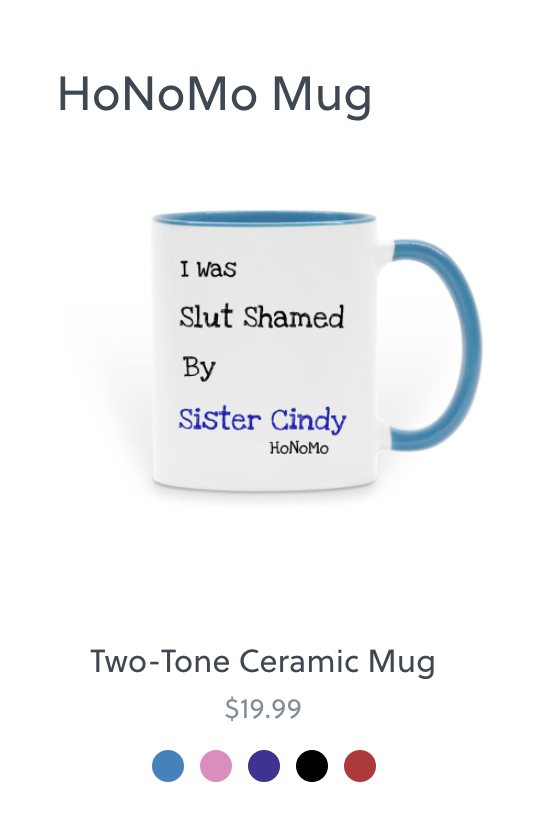
Through a glance at Sister Cindy’s Tik Tok account, it is evident that her content is misogynistic and demeaning towards women. In nearly every video she uploads, she casually uses the words “slut,” “hoe,” or “thot,” as insults towards women. For example, when visiting college campuses, she often changes the names of the universities to incorporate the word “slut.” At the Louisiana State University campus, she renamed the institution, “Louisiana Slut University.” By insinuating that college students are sluts, Sister Cindy is weaponizing the word to be used against women and normalizing the slut-shaming that is common in society, particularly on college campuses. However, Sister Cindy is proud of her slut-shaming tendencies and makes it a common theme in her posts. In a different post filmed by a college student, she exclaims, “You are princesses made in the image of God. Yet, you’ve traded your crown to be a cock-sucker.” This is quite the opposite of sex positivity and guilts women into practicing abstinence. Sister Cindy, or anyone for that matter, should never use guilt tactics to influence other people’s lives. Furthermore, why is this hateful comment only directed towards “princesses,” or women? Why is it that women should feel guilty for engaging in consensual oral sex and men should not? Last I checked, oral sex is an act requiring at least two people. 

https://www.tiktok.com/@maraudwh4re/video/7067272503181364526?_t=8QEQwcooDyV&_r=1

Another example of sexism in her uploads is found in a Tik Tok filmed by a student at the University of Florida. In this clip, Sister Cindy shouts, “Men, if you buy her one margarita, she will spread her legs.” This statement is incredibly insulting towards women. Not only does it perpetuate the view that women are sexual objects, but it also furthers the entitled belief held by some men that women are sexually indebted to them after buying them a drink. In addition, this comment is heteronormative and leads straight men to assume that all women are attracted to them and want to have sex with them, which is simply not the case. Finally, similar harmful views were expressed in a Tik Tok clip of Sister Cindy telling a college student that she is “an accessory to the rape crime on campus” because she is causing boys to get their “passions stirred up” (Fowler). This belief is so inherently false, that it should not require any explanation. The blatant disregard for holding men accountable in situations of sexual assault is destructive to anyone who views this post. It reminds me of the common argument in society that someone is “asking for it” based on the clothes they are wearing. Placing blame and guilt upon women seems to be a common theme in the media posted by Sister Cindy. Again, why is it that sexual assault victims should feel guilty for something that is out of their control and not their fault? 

If you thought her content could not get any worse, we have not even analyzed the blatant display of homophobia present in countless Tik Toks. For example, in one clip while preaching to college students, she orders, “Don’t do it. Don’t kiss a girl and like it.” In defiance of her hate speech, two women make their way through the crowd to kiss in front of Sister Cindy’s platform. Apparently, the act of two women kissing is a difficult sight for Sister Cindy, because she has to cover her eyes. In a second Tik Tok, Sister Cindy, with no shame, shouts to a young man walking past her, “Are you a homo? You kinda act a little effeminate there. You need to repent!” There are so many problems with this statement, it is a challenge to decide what to unpack first. To begin, a straight, cisgender person should never use the term “homo” to describe someone of the LGBTQ+ community. Second, Sister Cindy is reinforcing the societal gender expectations that men cannot be feminine and women cannot be masculine. And if that is the case, then that person must be a member of the LGBTQ+ community. Finally, telling someone that they need to repent because of their sexuality, something that is out of their control, is unacceptable. Religion should never be manipulated to discriminate against groups of people. People’s sex lives and sexuality are an intimate part of their lives and should never be a subject of criticism. Therefore, someone who posts homophobic content, like Sister Cindy, should not have a platform to project those hateful beliefs. 

To reflect, one’s values and beliefs should never be used as a weapon or a way of guilting others into adopting those practices. While Sister Cindy’s intention may be to educate college students, her comments are misogynistic, heteronormative, homophobic, and may even be classified as hate speech. Sister Cindy even admits that she expects to be removed from social media for her problematic comments (Fowler). If that is the case, what is Tik Tok waiting for?

Works Cited

Fowler, Kate. “Who is Sister Cindy? Evangelist Christian Preacher Turned Tik Tok Star.” Newsweek, 6 June 2021, https://www.newsweek.com/who-sister-cindy-evangelist-preacher-tiktok-star-1597651. 

I love this post and how it highlights the way that people will oftentimes use comedy to hide rhetoric that is actually very harmful. Although Sister Cindy is oftentimes funny, she’s still promoting a toxic culture that prevents women from embracing their sexuality. This is a super important topic and I’m glad that you’re shedding light on it!


Can Society Really Determine Perceived Genders?

Mastermind magazine produced this image of Willow and Jaden Smith in the 2019 fall issue. Mastermind magazine releases bi-annually and focuses on current events and attitudes of the younger generations. It is a space to be creative and display a range of talents and people. The intended audience ranges from young adults to millennials. This exclusive magazine was founded in 2017 and is available for purchase online and paperback. They chose to include Willow and Jaden in the 2019 issue because of their impact on gender expression, unique styles, and confidence as individuals. Willow and Jaden both actively participate and advocate within queer spaces. They also have developed into queer fashion, music, and film symbols. Willow and Jaden reinforce that beauty, individuality, and confidence does not have to fit into the narrow boundaries of what society portrays as normal and abnormal. As young, black, queer adults, Willow and Jaden represent the positive ways non-conforming people can live in our nation. As the younger generations become more accepting and educated on topics of gender and sexuality, we come to realize that beauty and gender have no particular features, shape, or color, and Willow and Jaden depict this with no remorse. The photograph from the magazine presents a symmetric reflection of Willow and Jaden gazing upward, hands identically pressed to their cheeks. They are challenging this notion of physical difference between men and women. If one did not know the Smith siblings prior, would the gendered differences be obvious? I believe this is the question they are forcing the audience to reconcile with and reflect on. This photograph examines the viewer’s bias and understanding of how gender functions as invented categorizations to divide people. 

Although intersectionality of gender and race play into the lives of Willow and Jaden, it does not consume this photograph. As a person of color, perhaps I brush over the fact of their blackness when gazing at the photograph, or perhaps it was looking for an intentional gender-directed reaction. However, I want to acknowledge the intersectionality in this photo as another product of social construction that produces real consequences. Willow and Jaden also come from a previously wealthy family which contributes to their success and ability to be openly unique individuals. Intersectionality plays an important role when discussing aspects of gender and sexuality because it often influences and dedicates the way we interact with it.

Willow and Jaden break down the gender norms and stereotypes associated with the binary in the photograph. As Jonathan Van Ness explains in his Netflix special, Can We Say Bye-Bye to the Gender Binary, gender is performed and enforced in society. This can be seen through the segregation of colors inflicted on people in society. Jaden projects a commonly feminine look with his pink eyebrows and hair. In the context of public expectation and presentation, blue is typically for boys, and pink is for girls. Pink has not always been associated with femininity. Pink was more of a boy’s color, if a gendered color at all, in the late 19th and early 20th centuries. People dressing in gendered clothes is a relatively new invention. Jaden proves in this photograph that people can dress, alter, and perform gender in any way they choose. It also connects deeper to the ideas of how the binary should project and display itself. Men are supposed to be tough and masculine whereas women are soft and emotional. Jaden and Willow’s gazes are identical with soft, innocent-like features. Neither of them is visibly wearing makeup, contributing to the vulnerable look. They both wear rings in the photo, revealing that jewelry does not belong to a singular gender. Willow does have earrings and a nose piercing, however, this just means that every individual is different. It is celebrating diversity, preferences, and choices between human beings. Willow Smith wears a similar short hairstyle to Jaden further breaking down the ideas of what is supposed to be masculine. Society loves to associate female beauty with hair, but Willow shows that beauty exists beyond long this. As Lorber explains, “​​For the individual, gender construction starts with an assignment to a sex category on the basis of what the genitalia look like at birth… A sex category becomes a gender status through naming, dress, and the use of other gender markers” (Labor 55). Gender is not determined by biological or psychological differences. There are no features that accurately reproduce the binary, but instead, it is a construction of our surroundings, interactions, media depictions, and upbringing. This calls to question the title of this photograph. If their names were not written across the page, neatly drawn into their boxes, would it be obvious which image was Jaden and which one was Willow? In a way, it feels as though the magazine wants to be progressive, but not to the extent of complete freedom. If the magazine did reject all gender norms, it would not have placed the lettering where it did. Alternatively, it could simply be educating viewers who are unfamiliar with the Smith siblings. There are multiple ways to interpret the purpose and placement of the title. 

Willow and Jaden Smith have become icons of the younger generation for their confidence, identity expression, and talent. Mastermind magazine exhibits Willow and Jaden’s beauty and originality in this edition. The photograph calls to question our notions of gender and forces us to reconcile with our constructed worldview. The upcoming generations are more and more open to diverse gender expressions, giving me hope that many adolescents looked to this photograph as inspiration, not with hostility. 

Diet Culture Diary

Monday, Dec. 6th at Davidson College:

This afternoon, I am mindlessly scrolling though Tik Tok and come across a string of videos under a new trend. This particular trend includes somber background sounds with the user staying in frame of the video. The user then types out multiple text boxes which describe the current obstacles they are facing onto the screen while editing. The point of the video is supposed to be a “there it is again… that funny feeling” vibe, with this user’s season of life being home to bad habits and thought patterns resurfacing. Several of the texts I saw included sayings like “my bad relationship with food is coming back” or “the pressure to lose weight” or “feeling trapped in my own body.” The comments under this videos are proof that the user is not alone in this particular experience, in fact, the idea of food and the need to restrict oneself from it is anything but a rare occurrence within the Tik Tok community. The beauty standards of today, the lacking representation of all body types in the media, and the shortage of healthy attitudes circulating on weight all contribute to this phenomenon.

Tuesday, Dec. 7th at Davidson College:

On this day, I began watching the fourth season of Selling Sunset on Netflix, which is a show that follows The Oppenheim Real Estate Group and the women who work there. It highlights the seemingly luxurious lives these women lead and the extravagant homes they sell along the way. One element that I have been noticing that is increasingly lacking is the representation of people who do not either fit the beauty standard, or do not fit into the smaller sizes that all of the characters seemed to maintain. This exclusion of different body types is not uncommon, unfortunately. It can be detected in almost every form of TV, and if they are included, they are portrayed as a “before” image, or a life that is inherently less. We know this is true because we phrase body types that do not fit the mold, or the set “beauty standard” as “different” when, in actuality, they are normal and more common than the unrealistic standards, they are just not popularly projected as desirable in the media.

Wednesday, Dec. 8th at Davidson College:

This day, I was searching online for at-home, easy workouts that work to strengthen core. After I few clicks, I started noticing how the headlines of articles started to change and become increasingly toxic. There are sites dedicated to providing “helpful tips” for losing weight fast, but the actual methods posted for doing so do not seem at all helpful or healthy for a person to attempt. Public platforms that list these habits as effective are promoting detrimental eating habits. Someone in recovery for an eating disorder may find such easy access to these sites and the wrongful messages they send especially damaging. The impact diet culture has on the media we consume is seen across all boards, and does not aid in the movement of body positivity in the slightest.

Feminist Mixtape: “Beautiful is Boring” by BONES UK

“Beauty is in the eye of the beholder.” A lovely saying that we’ve all heard many times. However, society’s idea of beauty is less defined by the eye of the beholder than as a concept that changes with the typical depictions of people in media of the time. Jean Kilbourne’s TED Talk on Killing Us Softly IV: Advertising Images of Women gives a comprehensive look at and interpretation of her research on how women have been portrayed in media since the late 1960’s. When listening to the song “Beautiful is Boring” by BONES UK, the connections make themselves. 

The first verse includes the lyric, “They said they did not want my face in their magazine/’Cause I’m not beautiful”. The singer doesn’t suit society’s definition of beautiful, and therefore is denied access to certain levels of visibility. In regard to societal standards of beauty, Kilbourne says, “From my perspective of over 40 years, the image of women in advertising is worse than ever. The pressure on women to be young, thin, and beautiful is more intense than ever before” (3:27-3:37). The singer doesn’t care about how society defines beautiful, young and thin and perfect. The second verse has the lyric, “It does not please me to be easy on any of your eyes”. Clearly, the singer’s priority does not fall with how others perceive her. This confidence and self-assuredness isn’t something that comes naturally however. Kilbourne points out that “the self-esteem of girls in America often plummets when they reach adolescence. Girls tend to feel fine about themselves when they are 8, 9, 10 years old, but they hit adolescence and they often hit a wall. And certainly, part of this wall is this terrible emphasis on physical perfection” (Kilbourne 6:51-7:17). Many times, as Kilbourne states, the expectations from society to look a certain way and be perfect can be crushing. It can absolutely destroy a young person’s confidence. 

The singer isn’t unaware of this, despite her own confidence and self-assuredness. The third verse has a lyric that critiques society on “teaching children to be anything other than who they are”. Kilbourne has many points on the alteration of children’s perceptions of themselves in society by media, from girls being “more prone to eating disorders, depression, and low self-esteem” (13:17-13:24), boys being “encouraged to look at girls as sex objects, …encouraged to be sexually precocious” (10:17-10:33), and women of color being “considered beautiful only insofar as they resemble the white ideal: light skin, straight hair, Caucasian features, round eyes” (5:25-5:39). The whole message of the song, “beautiful is boring”, argues that people are much more interesting when they exist as themselves than conform to society. This message is inherently feminist, as it pushes against the factors in society that hold women back from being their complete selves.

Feminist Mixtape: God is a Woman by Ariana Grande

by Chase Waldner

Ariana Grande Goes Heavy-Handed and Provocative in "God Is a Woman" | GQ

Pop icon Ariana Grande blessed us with a feminist masterpiece titled, “God is a Woman.” The title alone challenged many gendered stereotypes and the lyrics are a wonderful dive into female sexuality. Grande created something equally empowering as it is catchy. She reverses the patriarchal norm of male domination over women with lyrics like, “I’m tellin’ you the way I like it, how I want it,” and “And boy, if you confess, you might get blessed // See if you deserve what comes next.” Here, Grande is expressing the power she has over this man and how she is the one in control; something rare in heterosexual relationships. For most of history men have had all the power. They were the ones who owned property, and that sometimes included women. Nowadays, in the states at least, you can’t own a person but that power dynamic is still a festering pandemic lingering in our society. Women are supposed to be a submissive, pretty face. They are supposed to look good to attract a man and then stay home to raise their children. This translates to the bedroom as well. The expectation for heterosexual sex is male pleasure and fantasy, women are merely the vessel to achieve it. This is where Grande steps in to challenge the sexist norm and flip the script. She sings about female domination and pleasure; about women being the controlling force in both the bedroom and in life. She sings about the power she, along with all other women, have to take their deserved, rivaling spot in the fight for gender equality.

Feminist Mix Tape: “Good as Hell” by Lizzo

Lizzo has recently risen to fame as one of the premier American pop stars, writing music with lyrics that are empowering and positive towards women. Her 2016 song, “Good as Hell,” is feminist and catchy.

Lizzo’s feminist lyrics relay a message that women are valuable in themselves and do not need validation from men to feel happy. This relates to first wave feminism arguments such as those from the Declaration of Sentiments, which states that “woman is man’s equal,” which means that women should occupy a place equal to men in society (Declaration of Sentiments 1). Lizzo’s message that “you know you a star you can touch the sky/ I know that it’s hard but you have to try” relates to this first wave perspective by emphasizing that self-worth comes from within, and men do not have the right to determine the worth of women.

In addition to containing the first wave feminist perspective that women are worth as much as men, the song also relates to second wave feminism. Betty Friedan’s argument in the Feminine Mystique claims that women have just as much of a right as men to work outside the home in professional roles (Friedan 278). This relates to Lizzo’s line advising her listener to “boss up and change your life.” This depiction of women as bosses normalizes women in the workplace, and emphasizes how women have a natural capacity to be leaders and have control, contrary to what the patriarchy dictates. Thus, Lizzo’s “Good as Hell” relates to second wave feminism by emphasizing women’s capacity for success in a professional setting.

One final way in which Lizzo’s “Good as Hell” relates to feminism outside of first wave and second wave perspectives is by centering women as its subject. By making women the default audience of the song, Lizzo goes against the patriarchal conception of maleness as the default state of being. This default state of maleness was pointed out by Luisa Capetillo (Capetillo 28). Lizzo rejects this patriarchal structure by making the subject of her song a woman, thus normalizing women as the default person.

Lizzo’s song is limited, however, in its conversation with transfeminism and intersectional feminism. Lizzo does not mention trans people, queer people, or people of different races in her songs. Therefore, her song does not relate to how feminism applies differently to women of color or members of the trans community. 

Despite this limitation, Lizzo’s “Good as Hell” is an important song in its relation to feminisms. It mentions the first wave perspective that women are equal to men, and emphasizes the second wave idea that women belong in the workplace as much as men do. It also centers women, a feminist stance. However, it does not have much to do with queer, trans, or women of color feminisms, so it is fairly surface-level in its feminism. Overall, the song is catchy, positive, and pro-women, so it is definitely worth a listen!

Book Review: “Beneath the Surface”

Cover of Beneath the Surface: A Transnational History of Skin Lightening by Lynn M. Thomas

Beauty standards have long had a hold on popular culture. Beauty allows for people to advance in the social hierarchies of our societies, as well as provide a sense of self worth. The history of beauty can be described as a history of struggle, as society deems it more and more necessary to alter the physical, material body to meet social standards. Skin lightening is one of the most criticized beauty practices throughout the latest century. As a booming industry that is engaged across all socioeconomic levels, discourse around skin lighteners informs us about the changing meanings of skin color and how it affects racial hierarchies and anti-racism activism. Beneath The Surface looks into the transnational history of skin lightening practices through the perspective of South Africa and the United States and outward. 

Lynn M. Thomas’ main argument in Beneath The Surface is that bodily surfaces are vectors of antiracist struggles through its complications of skin meaning and privilege– especially in the time of aparthied rule in South Africa. She also describes how skin lighteners and other beauty practices both reinforce and challenge pre-existing assumptions about race, class, and gender. Thomas comes to the conclusion that “surfaces matter. The unrelenting presence of beauty practices in our globalized world stems from their ability to play on and reproduce a range of inequalities while, at the same time, offering hope and stirring feelings of self-worth” (Thomas 236). 

Lynn M. Thomas, co-editor of this monograph, is indeed qualified to discuss the topics of materialism and its effects on the concepts of race, class, and gender in our lives. Currently a history professor at the University of Washington, Thomas is known to be a historian of politics and gender in East and Southern Africa. She acknowledges her love for history due to her “desire to gain knowledge of the past in order to better understand the problems and possibilities of the present” (Thomas). tShe is best known for being the co-editor of The Modern Girl Around The World: Consumption, Modernity, and Globalization where she explores the rise of capitalist consumer culture, mass media, and its resulting new conceptions of race and gender. 

Through her uses of archives, popular culture trends, and oral history sources, Thomas traces the wavering opinions of skin lighteners and the varying meanings of skin color throughout time. In the first chapter, she examines indigenous and traditional practices on bodily surfaces. Smearing practices like the use of Tambookie grass and egg whites on skin as a method of lightening skin tones led to colonists labeling the natives as inferior for attempting to “whitein” themselves. White lead was also a popular skin lightener as it was commonly found in European portraits and used in Chinese and Japanese cultures.

Chapter 2 elaborates on the role mass media played in influencing South African consumers through the advertisement of skin lighteners. Local newspapers like Bantu World–the first South African newspaper to advertise cosmetics and include women sections– portrayed women in the “modern girl” stereotype that framed women as engulfed in self-indulgence and rejecting her duties. Bleeding into the next chapter, Thomas acknowledges how the success of African American cosmetic companies influenced how the skin lightening industry was perceived in South Africa and neighboring countries. There was a distinct difference between cosmetic use and racial respectability across the Atlantic, however, as South African beauty culture was dominated by black men discourse and run by white owned companies. In contrast with the United States, African American women controlled both the manufacturing and advertisement of their skin lightening and other cosmetic products. Chapter 3 expands upon the idea of growing black consumerism and how white South Africans dominated the cosmetic business in South Africa. Simultaneously emerging with the shifting dynamics of the industry were the concepts of race consciousness as ideas regarding color privileges became more evident, encouraging South Africans to pass for white using skin lighteners. 

Chapters 4 through 6 further elaborated on the impact mass media had on people’s changing perceptions of racial and gender hierarchies. Through magazines, film, and photography, the media began portraying lighter skin in association with success and opportunity, emphasized by Thomas’ comment: “Skin color, as one highly visible marker of race, loomed large in this world where whiteness was synonymous with power and privilege, and small differences in appearance could carry significant consequences” (Thomas 106). Meanwhile, criticism from medical professionals and anti-racist activists remained persistent in developing regulations for skin lightening practices in South Africa. From the medical standpoint, the discovery of hydroquinone as a new and “substitute” ingredient of mercury created more speculation about the safety of the products, ultimately leading to the ban of mercury based cosmetics and closer examination of over-the-counter products. As discourse around the health of consumers increased, so did conversations acknowledging the psychological damage of beauty desires on Black women. Criticisms between medical professionals and antiracism activists entwined eventually, leading to regulations on skin lighteners being set across South Africa.

The final chapter looks at the issues of the modern day and the nuances that come with the everlasting problems of racism and capitalism. Thomas points out the irony in the apartheid museum being located on top of an old, wealthy skin lightener manufacturing company. Instances like these prove that the skin lightening industry still has a hold on today’s society, and that the meaning and politics around skin color will continue to evolve and change.

The greatest strength of Beneath The Surface was Thomas’ ability to trace the altering meanings and understandings of skin color. Her attention to detail–the products, advertisement, manufacturing, target audience, usage, and health problems– it all relates back to how bodily surfaces were a focal point of racial identification and how people used skin lighteners to use that focus to their own advantage. It’s astonishing to realize that beauty practices can be such a destructive force, yet they will continue to be utilized and invested in as people continue to modify their physical appearance to fit into social desires. A weakness I believe to have found is Thomas’ lack of perspective outside of South Africa and the United States. Although South Africa is a unique viewpoint that allows us to analyze changing conceptions of skin color from colonial times to the postcolonial present, I think addressing other perspectives of African countries would bring more knowledge of historical beauty practices and develop more nuances among the practices and their relations to the cultivation of racial hierarchies.

I personally enjoy this book because of its unique perspective of skin lightening as an agent of disturbing the efforts of antiracist thinkers and activists. I never thought cosmetics would have such an impact on how we perceive racial and gender dynamics, let alone evolving beauty standards. 

References

“Department of History.” Lynn M. Thomas | Department of History | University of Washington, https://history.washington.edu/people/lynn-m-thomas. 

Thomas, Lynn M. Beneath the Surface: A Transnational History of Skin Lighteners. Wits University Press, 2020. 

Feminist Mixtape *Scars to Your Beautiful*

Scars to Your Beautiful by Alessia Cara

Written by: Anna Newman

http://www.tuneintoenglish.com/?p=36074

In the song Scars to Your Beautiful by Alessia Cara, the dangers of female beauty standards are revealed through lyrics referencing eating disorders, superficial appearances, and the dangers body comparison. While the song promotes body positivity, the artist simultaneously brings attention to the unattainable and highly demoralizing expectations that are forced upon women with respect to their appearance. 

The phrase in the song “She just wants to be, beautiful/She goes, unnoticed she knows, no limits/She craves” (0.05-0.11) relates to the expectations of beauty that are placed on women, as well as the misogynistic realities within marriage. The phrase “unnoticed she knows” relates to the idea of coverture within marriage in which the man usurps all of the rights from the woman and makes decisions for her, thus making her “unnoticed”. The phrase in the song “no limits/She craves” demonstrates that women are seeking more rights and privileges that they do not have, which relates to the oppressions that Betty Friedan describes in The Feminine Mystique. Friedan describes women as being “taught to pity the neurotic, unfeminine, unhappy women who wanted or be poets or physicists or presidents” (Friedan 270). The descriptor “neurotic” is juxtaposed with the titles of “poet”, “physicist”, or “president”, illustrating that women are shamed for being independent, intelligent, and self-sufficient humans. In other words, women are taught to be submissive, invisible, and voiceless, demonstrating the dangers of misogynistic relationships and the limitations in which they create.  

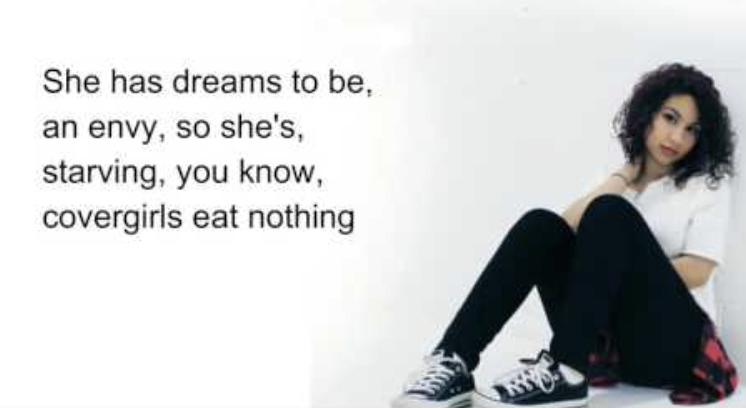
Another form of womanism relates to fat studies and the physical expectations imposed on women. To obtain the model ideal, a woman must exhibit stereotypically feminine qualities of slenderness and submissiveness. Models, and cover girls specifically, “eat nothing/She says beauty is pain and there’s beauty in everything/ What’s a little bit of hunger?” (1:58-2:05), which demonstrates the dangers of modeling. Virgie Tovar, a body positivity activist with a focus on fat discrimination, mentioned in her TED talk that “you have the right to remain fat” (Tovar TED Talk) which means that it is part of your bodily autonomy to be the size you want to be, and no one else can control that. Furthermore, Cara mentions that “you don’t have to change a thing/The world could change its heart” (1:01-1:03) which relates to the concept of Health at Every Size or HAES. HAES is a lifestyle change that encourages practices of self-love and health living “regardless of weight and appearance” (Burgard). Additionally, the phrase “beauty is pain” demonstrates the oppressions that women feel they must face in order to attain the feminine ideal, further demonstrating that pursuing a certain weight and appearance leads to unhealthy practices like eating disorders.  

The song, however, has limitations in the way that transwomen are represented. Based on the lyrics, the song assumes that women are cisgender. The repetition of the pronoun “she” and the word “girl” assumes the audience’s pronouns are she/her/hers and does not consider the plethora of different pronouns that one could have, demonstrating the limitations of the song as applying only to cisgender women. This limitation in the song, I believe, is unintentional; nevertheless, Alessia Cara could have been more cognizant of the audience she was delivering to and the pronouns she chose to use. 

Works Cited:

Cara, Alessia. “Scars to Your Beautiful”. 2015.

Bound to be Visible

For https://www.autostraddle.com/ 

Do you ever see an ad and just think. . . an effort was made. Was it successful? Absolutely not. But the company tried. Is that always enough though? How close to a good amount of effort is close enough to accomplish the purpose? How far off does a company need to be to be ineffective? These are all questions I’ve been asking myself and my friends in regards to the “High Neck Longline Bra” from Girlfriend Collective that swept the media (well, swept my targeted ads on social media) a bit ago. This product is marketed as a supportive and compressive sports bra, but the caption on their Instagram ad, pictured below, is “Full coverage plus a layer of power mesh for extra support. *Wink*”. Yes, they wrote out the word wink in asterisks. No, I’m not sure why they didn’t just use a semicolon-parenthesis combo. 

Girlfriend Collective [@girlfriend]. Picture of Instagram ad for Girlfriend Collective’s High Neck Longline Bra. Instagram.

If you’re in a pretty intense sport, you might look at this bra and see a good supportive bra. If you’re somewhere in the genderqueer category, you can squint a little bit and see a potential binder alternative. Not only is it possible, but this realization already happened very visibly in the comment section. This realization has both positive and negative side effects, as I’ll explain later. Below are some of the comments on this ad, with names and profile pictures marked out for privacy. My personal favorites are “Binder 💞light💞” and “besties this is a binder”. 

Screenshot of comments on Girlfriend Collective’s Instagram ad. Girlfriend Collective [@girlfriend]. Picture of various comments on the ad above. Instagram.

These sorts of comments are harmless, or at least seem to be. Using sports bras as binders is not a new concept to people with breasts that do not identify as cisgender women. Buying actual binders can sometimes be inaccessible to people who might not be out to the people they live with. Many times, young people will bind unsafely with Ace bandages or sports tape instead of a binder to either avoid outing themselves or accommodate their financial situation. At times like these, it’s easier for someone to convince their parents to buy a sports bra over something marketed as a binder.

Does it actually work as a binder though? According to two of the TikToks I found, yes!! Isn’t that exciting? Accounts @salemnight (he/they) and @cowboinary (they/them) on TikTok both did reviews on the High Neck Longline Bra from Girlfriend Collective. Salem gave a holistic and visual review of how the bra looked in comparison to his other binders and bras as well as answering some common questions, while @cowboinary focused more on how the bra felt and compressed in comparison to their other binders. These TikToks I found after simply searching “girlfriend collective binder” can serve as an incredibly useful resource to young people or closeted people looking for binders that are accessible to them, as well as assuring people that it does actually work as a binder. 

Screenshot of comments on Girlfriend Collective’s Instagram ad. Girlfriend Collective [@girlfriend]. Picture of an exchange in the comments of ad pictured above. Instagram.

However, the visibility and accessibility of this product might also serve as a detriment to its usefulness in some ways. Above, with names and profile pictures yet again blocked out for privacy, you can see an exchange between two users in the comments section of this Girlfriend Collective ad on Instagram. One person asks “WHY would you want a HIGH neck bra??” Another user responds explaining that it’s a binder, marketed as a sports bra “so those who are in the closet or in an unsafe environment to come out in can get one to help with dysphoria without outing themselves and risking harm”. The first user responds positively in a reply. However, imagine for a second that you’re a young trans man, looking for a way to convince your transphobic parents to buy you a binder or allow you to get one without coming out. They think it’s an odd request, to get a high neck bra, go onto Instagram, ask this question, and get a response that could potentially force you into an uncomfortable situation. This may or may not happen, but it’s not ideal, right?

The rise of social media and marketing on these platforms has resulted in a multitude of both problems and benefits. Benefit: people are funny in the comments of what, to them, is an obvious secret binder. Problem: the discrete nature of the marketing can be ruined by people thinking it’s funny. Benefit: TikTok provides a platform where multiple people can assure you in different ways that a product is going to work how it says it will. Problem: TikTok provides a platform that brings so much attention to a certain product that even a month later, most sizes are sold out (including my own, sadly). These pros and cons don’t necessarily cancel themselves out, but it’s an interesting and complex issue that companies who aim to produce these discrete products should consider.

So. With this High Neck Longline Bra ad, I just think. . . an effort was made. Was it successful? In my mind, partially. It’s rather expensive for an improper binder at $42, where there are other less expensive options. However, the brand is incredible with size-inclusivity and sustainability. The company tried. Is that always enough though? How close to discrete is close enough to accomplish this subtlety? How far off from discrete does the company need to be to have people aware that this is a secret binder? Is the *Wink* enough, or should they have just put a semicolon and a parenthesis? Many of these questions are unanswerable, as we don’t yet have enough experience with these hurdles (I really do think they should’ve just used a little 😉 though). These questions and conversations are important, regardless of our lack of answers, as our goal as consumers and producers of media should always be to learn more and adapt to the times. While we have these conversations around discrete marketing, I’ll be watching my email carefully for an update on when the bra/binders come back into stock. For, uh, research.

Book Review *Everyday Sexism: The Project That Inspired a Worldwide Movement*

The overwhelming truth of our world today is the ignorance or dismissal of still- rampant misogyny is as harmful as ever. In some cases, it feels as if the most effective way for the public to understand and agree there is a problem to actively work against, the accounts must be clearly laid out in front of our eyes. Laura Bates, journalist and feminist who details her own reports of assault, takes this to heart as she transforms what began as a catalog for women to share personal experiences of sexism, into a full-forged book of facts and real life stories of how misogyny is woven into everyday life. After her own experience of being harassed on London transport in 2012, Bates becomes passionate about the reality that if she went through this act, other women most definitely have their own stories to share as well.

The beginning of this movement was founded on the idea that the day to day instances of harassment and under representation of any degree deserve to be reported and known, so the argument that this does not occur in current day society can be rebutted. The Everyday Sexism Project, which began in London but became a worldwide phenomenon, is still running as a website, and anyone can report cases of misogynistic actions. After the online platform gained momentum, Bates formatted the stories told into one of the boldest works on the fight against sexism. The power of this collection comes from it being exclusively compiled of real life and relevant circumstances of misogyny being alive today, from women who have lived to tell the tale. 

Laura Bates has certainly already left her mark on the gender and sexualities field, from her numerous publications to her awards won in the craft. An English feminist writer who graduated from the University of Cambridge, Bates has published five works of literature, including Misogynation: The True Scale of Sexism (2018), The Burning (2019), and Men Who Hate Women (2020) as her most recent works. She is also working with the Women Under Siege Project, which is based in New York and has a mission of chronicling how gender violence has been utilized in warfare. Articles she has contributed to this platform include “The Impact of Nurturing Male Violence,” “Shutting us down: How online misogyny prevents women from fully participating in misogyny,” and “A crime upon a crime: rape, victim-blaming, and stigma.” Bates is strong in her assertion of important conversations into her work as she tackles women’s issues. Her relentless dedication to both breaking down injustice and empowering women, which go hand in hand, has led her to earn many honors, including the British Empire Medal in 2015 for services to gender equality and Cosmopolitan’s Ultimate New Feminist Award in 2013. More recently, she has been elected as a Fellow of the Royal Society of Literature as a result of all of the new and upcoming works she has provided. Bates’s publication of Everyday Sexism, in particular, began her trajectory as a feminist writer and opened more doors for how the misogyny women face can be addressed in future literary works. 

The approach Laura Bates takes covers how sexist behavior exists in all places, but it is easy for those who do not experience it’s harm to become oblivious to its effect when it goes unreported. Through the one hundred thousand entries posted, it can no longer be waved off as an invalid, already resolved issue. This myth is debunked further with every inclusion of personal stories from cat-calling, unfairness in the workforce, to violent rapes. Laura Bates declares these crimes against women need to be addressed on a wide, global platform. 

Bates presents both qualitative and quantitative research as the methods of which to layer this argument. The qualitative accounts are derived from the inclusion of women’s personal stories and experiences. While the Everyday Sexism itself website gained over 100,000 submissions before this book was published, the book includes around 15 short excerpts of what these posts had to say. This strengthened the work tremendously, since it backed up Bates’s argument of how misogyny is interwoven into the trials of daily life through following up a point with an undeniable example that proves it. Quantitatively, each chapter begins with a list of vital statistics regarding the topic. This is equally as advantageous to the case at hand, since it sets in place a series of irrefutable numbers and percentages that cannot be overlooked. Both methods, when imputed together, are effective in conveying the serious message of what women have faced both historically and, now, face currently. 

The first four chapters, after the introduction, focus primarily on “Silenced Women: The Invisible Problem”, “Women in Politics,” “Girls,” and “Young Women Learning.” Bates sets up her argument in a way that naturally flows and substantiates as it goes along. To start, she pinpoints three elements that lead silencing to occur: “these three powerful silencing factors- the invisibility of the problem, the social acceptance of it, and the blaming of victims- are corroborated loud and clear by the reports we received, particularly from young women who are learning such lessons hard and early” (29). Later on, in the chapter of women in politics, Bates offers striking statistics, including how at the current rate of progress, it will be 2121 before gender parity is achieved in Congress, according to the Institute for Women’s Policy Research. Bates follows this up with stating how women are enormously underrepresented in politics around the entire globe, and how “one frustrating consequence of women being underrepresented in politics is that often any woman is seen first and foremost to represent all women, as if she speaks and advocates for them, and can be judges as if all womankind stands or falls by her actions” (66). This is especially problematic when taking into account women who are also marginalized by their disabilities, sexuality, or skin color, “none of whom are miraculously included in the debate simply by the introduction of a white, middle-class voice” (66). Bates starts her book with powerful sentiments that cannot be overseen. 

The next following chapters include “Women in Public Spaces,” “Women in the Media,” “Women in the Workplace,” and “Motherhood.” These four sections are incredibly telling as they combine all of the different areas where women may face the most discrimination. One particular area this is amplified is street harassment. Bates includes stories of women who “describe the emotional and psychological ways street harassment affects them to an extent that those who do not experience it might struggle to imagine” (173) including the self-hatred and shame that can result from it. Bates also adds how “women of color, trans women, and women of the wider LGBT community experience disproportionate levels of street harassment (the Stop Street Harassment study found that 45 percent of all LGBT people surveyed experienced physically aggressive harassment or assault compared to 38 percent of all heterosexual people) (178). The implications of mistreatment in these key areas is extremely harmful, as Bate expresses, since it devalues the way women view their presence in their fields of study, and how much more difficult it becomes to advance. Also, it is detrimental for institutions to refuse to evaluate how they may be playing a complicit role in this issue. 

The final four chapters of this book incorporate “Double Discrimination,” “What About the Men?” “Women Under Threat,” and “People Standing Up.” The final excerpts of Bates’s work are arguably the most dire to address today. This is where Bates highlights intersectionality as a key term. She explains how “since the Everyday Sexism Project started, many of the stories we have catalogued have described not only sexism but sexism intermingled with other forms of prejudice- racism, homophobia, transphobia, classism, ageism, disablism, stigma around mental health problems, and more” (291). It is indisputable that transgressions are commonly made against multiple identities at once, and Bates’s inclusion of double discrimination as an entire chapter gives this book an added layer of depth. She states how anyone different from the dominant norms including heterosexuality, white, cisgendered, and nondisabled are met with serious threats. From a feminist perspective “if we are to tackle the fact that women have historically been oppressed because of characteristics that are seen to be different from the male norm, how can we protest such treatment while simultaneously excluding from our own movement the needs and agendas of those with other significant characteristics?” (293). Bates seeks for intersectionality to be synonymous, or rightfully included in every action of the feminist movement, which is crucial for her case to not be met with protest of it being catered exclusively towards white women, which is a route taken time and time again with feminist works that do not account for all women. 

One particular area where Bates’s strengths as a feminist writer come to fruition is her thoroughness when it comes to detail. Each chapter is filled to the brim with resources, research, and insight into the topic at hand. Her word choice is poignant and powerful, and causes readers to be introspective and process what is on the page, and how it is ever present in the world around them. Her inclusion of intersectionality and how incredibly important it is to understand how the issues white, middle class women experience cannot be the loudest voice in the room, since they cannot speak for everyone, sets her tone and supports her argument as one that is inclusive. 

One identifiable weakness is how, although there was a chapter dedicated to the presence of double discriminatory factors, this was not brought up until the very end. Bates did an exceptional job of spotlighting it as she wrote, but it could have been included throughout more of the book. If it were touched upon inside more of the work, readers might gain a greater sense of how pressing and real it truly is. Also, Bates does not elaborate much on what the word “women” covers for her, so this either means it is an umbrella not necessary to exclusively define for the book to still carry the same message, or it is a binary approach. After reading, I believe Bates refers to this term more closely to the first option. 

Critics rave of Everyday Sexism as a pioneering work, and after analyzing it, this remains true. The layout is concise, and the material is nothing short of compelling and raw. Bates has most definitely succeeded in bringing forth a book that is both personal and provocative in how it addresses the issues that need to be dissected. Every skeptic of misogyny and gender discrimination as a real deterrent of women’s empowerment and equality should read this book. College-age students specifically may gain the most from diving into this work, as it is important to pinpoint how these misogynistic mentalities penetrate our world as we are learning individuals, so we can dismantle them together. Overall, this work from Laura Bates is a must-read for all. 

Book Review: *Her Stories: Daytime Soap Opera and US Television History*

Soap operas have been a major part of television history, anyone who owns a TV has at some point in their lives watched a soap opera show. These programs have highly influenced popular culture. The monograph Her Stories by Elana Levine highlights the impacts soap operas have had on the US broadcasting industry as well as on “cultural constructions of gender and social identity”. Similar to the popular girls in high school, soap operas can be the trendsetters for what is and is not acceptable in our society. Soap operas often set the standard and definitions for gender and sexuality, many teens grow up watching these shows that can ultimately determine and impact each generation’s cultural beliefs. 

In Levine’s own words, Her Stories “is American television history, a lens through which to see the economic, creative, technological, social, and experiential path of television across seventy years that exposes its gendered structure” (6). This age was the start of the “cultural construction of femininity” as well. In the 1940s these serials were mainly viewed by American housewives and highlighted the differences between men’s and women’s lives that could push some to envision cultural changes. This book tells the history of soap operas and more specifically the shifts in culture and identities. Levine lays out this history, from the 1940s to 2010s, to support her claim that soap operas have shaped US culture on gender and identities. 

Elana Levine is a Professor at the University of Wisconsin-Milwaukee, she teaches Media, Cinema, and Digital Studies. Not only was she an avid soap opera watcher but it was her main focus in graduate school. She dedicated many of her papers and academic research to soap operas. This book was written over a span of twelve years, focusing on how the past, present, and future have been shaped by soaps. Levine got her undergraduate degree in English and Telecommunications from Indiana University and graduate degrees in Media and Cultural Studies from the University of Wisconsin-Madison where she currently teaches. Just from her degrees, it is obvious that soap operas and television’s effects on culture are the main focus of her studies. This topic could be researched for years, each generation tends to be impacted slightly differently. It could also go into depth on how this has affected teens mentally as they figure out who they are and how they fit into society. 

Levine’s research is mainly from archives, she combines her own personal experiences and research analysis with books, manuscripts from soap creators/networks, episodes, blogs, and websites. She is able to take into consideration the facts and opinions of that current time period and connect it to what occurs in the soap opera. She watches the soap opera shows or reads the scripts and she then analyzes them and makes connections on how they differ depending on the era.  

As stated above Levine goes through the history of soap operas and the cultural impacts they had on each decade. Focusing on two main changes, the first being “Change in US broadcast network television as an economic and social institution” (page 5). The second is “change in cultural and constructions of gender and intersecting aspects of social identity including race, class, and sexuality”(page 5). The first change is more on how TV changes and gets influenced/ influences society, whereas the second is how these changes affect cultural ideas and beliefs on intersectionality. These changes are constantly occurring in society but TV and soap operas specifically had and have a major impact on culture. 

This book is split into three parts each focusing on a different time period. “Part 1: The New TV Soap” is from the late 1940s to early 1960s focusing on the transition from radios to television and post-war soap operas. “Part 2: The Classic Network Era” is from the mid-1960s to the late 1980s and discusses the evolution of television businesses and content. “Part 3: A Post Network Age” from the late 1980s to 2010s is on issues of the post-network era.

The first chapter is called “Serials in Transition (From Radio to Television)”, as the name implies this chapter is describing the transition from radio to TV. Early television was trying to find ways to get people to watch more television, by appealing to current social expectations they can convince viewers to watch more television. Chapter Two: “Daytime Therapy (Help and Healing in the Postwar Soap)” discusses the postwar mentality on gender identities and family roles. Dissecting the soap opera, As the World Turns, helps show how this “eras investment in emotional realism” created characters that questioned traditional roles. This was the first era in television where characters started questioning and expressing current traditions and identities. 

In part two, Chapter three: “Building Network Power (The Broadcasting Business and the Craft of Soap Opera),” Levine examines the economic growth and development of television-influenced soaps. These “developments in the ownership and control of soaps were crucial shifts in the business, enabling network dominance”(83). Soaps were one of the most profitable forms of entertainment so they became very popular on many networks. At this time soap operas were still created with young housewives as the main audience. Chapter four: “Turning to Relevance (Social Issue Storytelling)” explains the new social issues emerging in soap operas in the 60s. General Hospital, a popular soap opera, was created in the early 19060s during a transitional period for soaps. The social issues being questioned changed, this show particularly “combined a focus on gender-specific ‘disorders’ of the psyche with a sense that gendered roles and the problems associated with them were changing, no longer confined to the sphere of home and family” (107). This chapter focuses on normalizing and expressing family and marital issues. This leads into Chapter five: “Love in the Afternoon (The Fracturing Fantasies of the Soap Boom)” introduces the soap romances that grew in popularity throughout the 1980s.  These fantasies often lacked an “explicit connection to the issues of the day” (154), which created a reprieve from societal issues. Though 1980s soaps were popular they were short-lived. 

The last section focuses on the late 1980s to 2010s starting with Chapter six: “Struggles for Survival (Stagnation and Innovation)”. This section focuses on the convergence era when networks began struggling to make a profit. The decline was due to many reasons but mainly structural instabilities in the dramas and the network, although despite many challenges the companies adapted to current audiences and technologies. Chapter seven: “Reckoning with the Past (Reimagining Characters and Stories)” focuses on the “Stories and Characters of the soaps”(12) across this same period of time. Many shows brought back soaps challenging family and couple dynamics but in this new era they then had to decide on how to incorporate race, sexuality and gender. Chapter eight: “Can Her Stories Go On? (Soap Opera in Digital Age)” discusses this era from the 2000s to 2010s. This chapter “details the major business, production, and storytelling changes that the soaps have experienced in the 2010s” (281), these changes ultimately led to a decline of daytime soap operas. Although it has declined, soap operas are still a major and important part of American media culture and influence current social standards and traditions. 

In Her Stories, Levine does a great job of connecting the economic/technological side of broadcasting with the decade and current social standards. This is clear in part three, Chapter six analyzes the economic decline of daytime soap operas and the reasons behind that decline. Chapter seven explains how the industry tried to save these shows by bringing back and incorporating social issues, thus adapting to the current societal wants and needs. And finally, chapter eight how despite these changes current modernizations in technology have hindered and continued the decline in soap operas. These three chapters, in the same time period, help to build on each other while giving different perspectives for the current state of the broadcasting networks. Levine’s main strength in her work is her organization, her entire book is structured to give the reader the best possible understanding of the history of daytime soap operas. She is able to take a complicated history and describe all the different factors that affected and determined the current shows being broadcast. 

Although her organization is strong her topic is so broad and her summary is misleading, in the introduction she summarizes each chapter and at the beginning of each chapter, she summarizes what is about to be said. This can be helpful so the reader can follow along easier, but it also makes it difficult to connect back to the main focus in her work. The author’s introduction gave the impression that most of this monograph would explain how soap operas have impacted social and cultural standards but a lot of the book seemed to be focused on the economic growth of broadcasting networks. Yes, the author still analyzed how many of the show’s characters and plots were based on social norms in that time period, but the overall book was the entire history of Broadcasting. 

Overall I enjoyed this book, the topic and history were interesting. It makes you consider how not only are we impacted by social constructs that we watch but what and how soaps create is also dependent on how we respond and what we enjoy in that time period. Although there was less focus on social and cultural impact than I was expecting I would still recommend reading this book especially if you enjoy the economic and historical perspectives of broadcasting. 

Levine, Elana. Her Stories: Daytime Soap Opera and US Television History. Duke University Press Books, (2020). Print.

From a Pantsuit to They/Them: How “One Day at a Time” Promotes Everyday Conversations on Gender and Sexuality

Main Characters of One Day at a Time. From left to right: Alex, Lydia, Penelope, Schneider, and Elena.

Are you looking for a new show to watch where you can get your fill of comedy and strong feminism? No?…Um, uh, okay then; you probably do not need to continue reading this then. Yes?…Well then One Day at a Time is definitely the show for you. Based off of the original show One Day at a Time that first aired in the 70s, the modern One Day at a Time (2017-2020) is available on Netflix and brings humor, feminism, sexuality, and family all together. The show follows a Cuban-American family in California, which includes the grandmother who immigrated from Cuba, Lydia, played by the stunning Rita Moreno, the daughter of the grandmother, Penelope, and then the daughter’s two children, Elena and Alex. It is so hard to pick one episode of this show that displays feminism and social justice best because every episode of the show introduces or addresses a large variety of modern issues elegantly. For this reason, I will highlight a few episodes from the show that display how modern and influential the show is. Honestly, explaining just one episode does not serve the show enough justice for how significant it is. 

The very first episode of this Netflix original show introduces some of the main characters that appear throughout the show’s duration, including the mom, Penelope, and her daughter, Elena. Elena is fifteen years old at the beginning of the show and the first episode focuses on her opposition to having a quinceañera. Elena is opposed to having a quinceañera because of its misogynistic roots and does not want to be put on display like a show horse (and personally, I cannot blame her for feeling that way). This is very upsetting news to her family as they fully embrace their Cuban roots because they are proud, as they should be. While Penelope and Lydia try to get Elena to embrace her Cuban roots with them, Lydia also tries to tell Penelope that she does not need the antidepressants she has been prescribed. Lydia is a little old fashioned and does not agree with the use of antidepressants. Going against her mother’s opinion, Penelope eventually does take the antidepressants for the betterment of her mental health. This is promising since being a single mother, and a non-white single mother especially, is not easy to say the least. Elena does eventually decide to have a quinceañera by the end of the episode to please her family, as long as some things are done to Elena’s liking, such as what the dress she will wear will look like. Lydia eventually makes her a pantsuit to wear to her quinceañera, and it is a truly touching moment later in season one. 

Elena in her school uniform at home.

Further into the first season, the show addresses sex, porn, and sexuality. When porn, a video of a threesom specifically for those who are curious, is found on Alex’s computer, the household breaks into chaos on what to do. Penelope approaches Alex about this, but he remains adamant that it was not him watching the porn. We later learn in the episode that it was actually Elena watching it on Alex’s computer. Penelope tries to give Elena the sex talk so she is prepared if things begin to go further with her boyfriend at the time, but in the process, Elena comes out to her mom as gay. Penelope is surprised, but supportive (phew, thank god). Side note: it is also mentioned in that same episode that Elena loves to read Autostraddle articles, so yay, we have made it to television everyone (and honestly I think she has got good taste in blogs)! Elena being honest to her mother and coming out shows bravery while Penelope approaching Elena shows motherly compassion, all while tying in humor in addition to expression of sexuality. 

In season two, Elena invites over a friend of video gamers who introduce themselves to the rest of the family with their preferred pronouns, confusing Penelope and Lydia as to why the teenagers are doing this. One friend of Elena’s, Syd, uses they/them pronouns. Elena’s friends introducing themselves with their pronouns casually normalizes this concept for the audience and provides a learning opportunity on gender for Elena’s family as well. As season two continues, Syd and Elena begin to grow closer to each other, eventually forming a relationship together. The two are very awkward with each other at first when they both learn that the other is gay, but it is a joyous and funny moment well written into the episode. Their relationship hits bumps like any relationship does, but it also displays Elena still figuring out her sexuality and who she is as an openly gay person now. Syd has had girlfriends before, but Elena has not and watching Elena learn to be authentically herself is an encouraging storyline. Syd being supportive of Elena discovering who she is is another lesson with sexuality seen in the show. One Day at a Time brings many modern issues into play and goes deeper than the surface level, taking many factors into account. It hits on many difficult subjects, but it is all portrayed tastefully with humor added in. 

Elena and Syd both learn that the other is gay in this awkward, but funny scene from season two.

These are only a few of the many topics that are crucial to today’s society that this show addresses, without giving too much away for those interested in watching the show now. This show is honest and displays how sometimes feminism is not what everyone understands, however, when one feels strong enough to educate others around them, like Elena, then these ideas continue positively. Elena is a really important part to introducing and addressing many social justice issues head on through being intelligent and well educated. One Day at a Time addresses queerness, sexuality, feminism, gender, heritage, race, class, and so much more. This show is amazing, funny, and progressive, and I highly recommend it be a show that you add to your Netflix list (at least for those who said yes at the beginning of this article anyways, and if you said no, why did you still read this far?). One Day at a Time tells us that educating others on today’s issues, including feminism and sexuality is often not a simple task. However, taking the time to explain ideas thoroughly is worth it in the end for both the ones who care deeply enough to teach others, and the ones that listen and are just beginning to learn.

Written for Autostraddle | www.autostraddle.com

Works Cited

Kellett, Gloria Calderon, and Mike Royce. One Day at a Time, Netflix, www.netflix.com. 

Lawler, Kelly. “Isabella Gomez as Elena Alvarez in ‘One Day at a Time’.” USA Today, 23 Jan. 2017, www.usatoday.com/story/life/tv/2017/01/23/one-day-at-a-time-coming-out-story-elena-netflix/96787436/. 

“ME GAY TOO – One Day At a Time Elena and Syd.” Youtube, Netflix, 2018, www.youtube.com/watch?v=GFRZXDXlHek. 

Poniewozik, James. “From Left, Marcel Ruiz, Rita Moreno, Justina Machado, Todd Grinnell and Isabella Gomez in ‘One Day at a Time,’ on Netflix.” The New York Times, 4 Jan. 2017, www.nytimes.com/2017/01/04/arts/television/review-the-2017-class-divide-in-a-new-one-day-at-a-time.html. 

Old Spice: Perpetuating Genderism Through Advertising

Written by Billy Schoel for Autostraddle

Who would’ve guessed?! We all know Old Spice: the pinnacle of male hygiene and every straight man’s best friend. The American-based men’s hygiene company has produced multitudes of popular commercials over the years, now laying claim to the largest share of the men’s grooming product industry. Even with the over-the-top, absurdist style of advertising that they’ve become known for, their commercials still perpetuate the heteronormative worldviews present in most contemporary advertising. In the recent commercial titled “The Man Your Man Could Smell Like”, Old Spice makes assumptions that support and perpetuate unrealistic expectations, heteronormative approaches to society, and the gender binary.

While this absolute gem of heteronormative marketing is only a mere thirty seconds, its featured fast-paced monologue is where the meat of this advertisement lies. For those who don’t have the pleasure of watching our knight in shining armor, I would be honored to transcribe: “Hello ladies. Look at your man. Now back at me. Now back at your man. Now back at me. Sadly, he isn’t me. But if he stopped using lady scented body wash and switched to Old Spice, he could smell like he’s me. Look down. Back up. Where are you? You’re on a boat with the man your man could smell like. What’s in your hand? Back at me. I have it. It’s an oyster with two tickets to that thing you love. Look again. The tickets are now diamonds. Anything is possible when your man smells like Old Spice and not a lady. I’m on a horse.” Visuals aside, see any problems? I sure do. Let’s talk about it.

Within the opening five seconds, the commercial establishes its audience and general premise. A well-defined, half-naked man nearly bursting with masculine energy exclaims “Hello ladies…look at your man…sadly, he isn’t me.” From the get-go, the commercial sets unrealistic expectations for men by comparing them to a representation of perfect masculinity. Despite the delivery’s fast-paced and absurdist nature, the commercial still establishes the inferiority of men who don’t meet the society’s standards of masculinity. The man continues, “if he stopped using lady-scented body wash and switched to Old Spice, he could smell like he’s me.” Not only does this disparage identities outside heteronormative masculinity by implying the inferiority of “lady-scented” body washes, but it also enforces unrealistic expectations for men. Additionally, by stating “he could smell like he’s me” instead of “he could smell like me”, the commercial continues its degradation of imperfect masculinity by clearly defining the ideal man and the other, forcing their separation and inequality.

The public dragging of the “imperfect man” quickly proceeds with the progression of the scene, painting a beautiful, idyllic picture of the life of the “perfect man.” He states, “you’re on a boat with a man your man could smell like.” Of course, this broadens the disparity between the perfect and imperfect men, implying that the lady would prefer the more masculine alternative over other men, even if they represented normal men in society. The precedence given to overly-masculine men concludes with the final moments of the commercial, the man stating, “Anything is possible when your man smells like Old Spice and not a lady.” Not only does it appear that Old Spice doesn’t know “ladies” smell good, too, but the quote places direct preference towards the ideal of overly-masculine men smelling unquestionably overly-masculine (talk about a tongue-twister), perpetuating, and ultimately strengthening, heteronormative conventions such as the gender binary.

Speaking of the oh-so-popular topic, this post would be quite incomplete without mentioning the commercial’s shameless defense of society’s gender binary. For starters, let’s address the assumed heterosexual relationship that the commercial stamps down as its starting point. Old Spice confines the audience into normality. Who is being addressed? A woman! Who must she love? A man—of course! What else could it be?! You mean to tell me that people have non-heterosexual relationships?! Nope, not never. Moreover, Old Spice expands the binary’s gap by implying that girls not only want just men, but the most masculine men life can offer. Men should not be wearing Old Spice to be hygienic—why would they? Men should wear Old Spice to be masculine, to attract women, to be men. Duh! Why would any woman ever be attracted to anything but the most masculine of men?! Despite my flippancy, the assumptions that this commercial makes are significant. In a world where gender/identity equality was reality, the heteronormative structures of society that enable this commercial’s marketability and ultimate efficacy would be relics of the past. Truly, the marketing of deodorant as a way to enhance heteronormative validation for men, even among their own partners, is almost as absurd as a deodorant commercial abruptly ending with “I’m on a horse.”

Also—newsflash—Old Spice works on everyone! While I’ve yet to find a man who doesn’t like Old Spice, I know plenty of other people who wear Old Spice too. Just because it is marketed to men doesn’t mean that only men use it! It’s deodorant, not a walking beacon of unapologetic masculinity. No matter how hard Old Spice tries to be the lodestar of manliness, at the end of the day, it’s a hygiene company. I could go on—but the point is that they shouldn’t be the deciding factor on what’s masculine, what’s attractive, or even what’s normal in our society. Old Spice may be a great deodorant company, but their marketing clearly needs some tweaks. Don’t even get me started on the fact that the tone of the whole commercial is rather belittling—I have to save something to write about next week.

Prada takes a racist turn down the runway

Written by Anna Newman for the website Jezebel

Fashion changes the world by controlling the definition of beauty. Designers like Prada, Chanel, Yves Saint Laurent, and Marc Jacobs hold positions of power as they are all high-fashion industries, catering to the materialistic needs of the white, upper-class. However, with this position of power comes global publicity and attention, which can be good and bad. One designer in particular, Prada, dug themselves into a hole of backlash after displaying a gadget with racist connotations in the window of the SOHO store in Manhattan. This gadget appeared to resemble the Golliwog, which was a blackface caricature in the 19th century. Given that Prada is a world-recognized and respected retailer, the world was shocked by this decision to display a gadget with references to “Little Black Sambo” and discriminatory black facial features. In response to this criticism, Prada took down the display, rightfully so; however, simply taking down the display was not enough to reconcile the damage that the retailer had caused. Prada decided to form a council within the company focused on diversity and inclusion for their clothing, accessories, and models. To go the extra step, Prada sent the proceeds from the remaining gadgets to a New York based non-profit that advocates for racial justice. In conclusion, the danger of the fashion industry is that they hold so much power and authority in determining what the beauty standards are and what the trends are, which means that people idolize these companies; when these companies begin suggesting racist ideas and connotations about their products, that is when we, as citizens, should start questioning where this position of power is coming from. Why does the high fashion industry have the authority to deem what is considered beautiful and trendy? To answer this question, we must refer to Foucault’s stance on how power is defined. Foucault believes that power is “multifaceted [and …] not just top-down” (Foucault) which means that even though we may think that Prada, being high ranking and respected worldwide, knows what real beauty and fashion trends are, true beauty is determined within society on a fluid level; it something that is ever changing and subjective, a concept that cannot be determined by a single company or power. 

Relating to challenging the norms, the Three to Infinity Movie about getting rid of gender labels in order to live a happy and boundary- free life for trans and queer people. The movie’s message is about challenging the norms of a binary society, recognizing that one does not have to be either male or female, realizing that you do not have to be the same gender you were at the time you were born, and accepting that gender can change and fluctuate throughout your life. This idea of an ambiguous and amorphously genderless society relates to the fashion and beauty construct that large franchises have created. These physically and monetarily unattainable fashion standards have been labeled and idolized by the industry as the sole way in which one can be beautiful, which creates discrimination on the socioeconomic and appearance level. Additionally, Marilyn Wann published an article called The Fat Studies Reader which discusses how the weight loss industry is worth 58.6 billion dollars and it feeds off of the public’s desire for a smaller, more model-like body. The weight loss industry and the high fashion industry go hand in hand; without the high fashion industry, the weight loss industry struggle to find an incentive for people to get involved with losing weight because the attractive, trendy, and chic styles would no longer be modeled on the bodies of skinny, white women and the end goal would be masked from the public. In conclusion, high fashion and social media has a significant impact on how people perceive themselves which creates tension and standards which are unachievable, demonstrating the self-serving and money seeking nature of the workplace. 

Figure 1: Blackface Prada gadgets

Smelling Like a Female: Versace Eros Pour Femme 2014 Campain

Written by Tramanh Le for Jezebel www.jezebel.com

Two years after the launch of Versace Eros in 2012, Versace launched Eros Pour Femme. The story of Eros continues when the ad opens with the return of the male model from the 2021 campaign entering the same mysterious setting. He is again shirtless to show a sculpture-like muscular physique holding a bow and arrow to symbolize the Greek god Eros. A few seconds later, we see a slim, female figure with an elegant pose floating towards the light from the dark water. From her silhouette, you can see she wears a dress with gladiator sandals, which continues the Greek motif. When the female model emerges from the water, the two encounter each other.

In this snapshot, there is a sensual scene where the female model, Lara Stone, slowly brushes Eros’s hand to take the golden arrow. Enchanting music accompanies this scene to help create a dramatic effect for the seduction of Eros by Lara Stone. Although this sensual act is supposed to symbolize the strength of women, her strength is only validated by the ability to seduce a male. In the 2012 Versace Eros campaign, there was only a male actor, who was accompanied by a fast-paced and intense soundtrack. This choice in focusing on just the male model assumes that men are powerful by themselves and do not need to have a woman to contribute to this power. However, a woman’s strength is characterized by the ability to successfully seduce a male. This depiction of women is a common trend in advertising with a woman depicted as a support or the seductress next to a man.

In this last snapshot, the light from Olympus shines on Lara Stone as she lies on her side with a seductive pose while holding the golden arrow she had successfully taken from Eros. Placed next to her is an enlarged, glamorous, and golden fragrance bottle adorned with the iconic Versace Medusa head. In contrast to this scene, the Eros campaign’s ending scene is dark and mysterious with a turquoise blue bottle, which has historically been a color associated with males. We can see the different marketing techniques companies use in order to sell specifically to men and women. This bright and gold bottle is for women, while this dark and blue one is for men.

Not only does the bottle look like it is for women, but the fragrance smells feminine. The words pour femme show that this fragrance is the female scent interpretation of Versace Eros cologne. Those words also state that this perfume is only for women. The heart of the Pour Femme fragrance contains jasmine infusion and jasmine sambac absolute, which Versace states on their website, “conveys an authentic and timeless femininity.” Unlike its counterpart, Versace Eros does not have floral notes that dominate the scent. The Versace website states that the fragrance was supposed to “interpret the sublime masculinity through a luminous aura with an intensely vibrant and glowing freshness.” My question is what determines which scents are feminine or masculine. The answer is the cultural and societal frameworks that have constructed certain scents as either feminine or masculine, not that we are biologically wired to do so. Perfume companies have taken advantage of these frameworks and contributed to the manufactured idea of gendered smells in order to sell products specific to men and women separately. Because we associate floral scents with femininity, it shows normativity of gendered scents.

Versace Eros Pour Femme | Fragrances – YouTube

Versace Eros 100 ml for Men | US Online Store

Versace Eros pour Femme 100 ml for Women | US Online Store