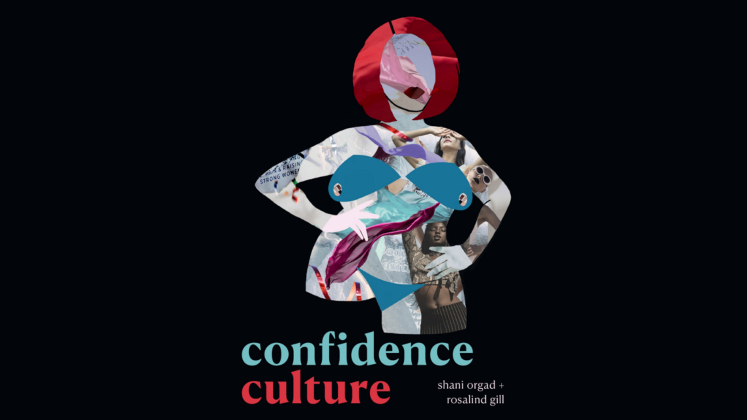
Hit songs like “Truth Hurts” by Lizzo or “Sorry Not Sorry” by Demi Lovato, hashtags like #realmemonday or #wellnesswednesday, and advertisements like Dove’s self-esteem project represent the influx of self-confidence messaging in today’s mainstream media. Women, in particular, are targeted by these messages. They are told to embrace their fears and insecurities by self-help books, celebrities, and television shows. Subsequently, there is a growing “confidence cult” as the authors of Confidence Culture, Shani Orgad and Rosalind Gill, suggest.
In the modern, globalized economy, outsourced labor to the Global South maintains the lives of those producing capital in the Global North. This state of economics is frequently described as neoliberal: the freedom of capital movement and the indoctrination of outsourced labor by marginalized groups. Furthermore, the neoliberal state exacerbates a class of feminized labor with origins in formerly colonized states. The outsourcing of labor to postcolonial states is a critical issue for Kalindi Vora in her book, Life Support: Biocapital and the New History of Outsourced Labor. In a struggle with definitions and mechanisms of labor, Vora succeeds in forming new concepts of reproductive labor with foundational examples from India’s working class. She expands on the inextricable link between reproductive labor and the body–a continuity from colonization to today. Additionally, Vora relies on feminist ethnography and definitions to centralize the identities of Women of Color who are the most frequently biocapitalized reproductive laborers.
Relying on the concepts of ‘biocapital’ and ‘biopower,’ Vora coins a new term, “vital energy,” with respect to the transfer of energies in the maintenance of capitalism. Vora contextualizes biocapital as a colonial-originated practice of indenturing people into subjected labor practices which continues in the modern neoliberal economy through signifying outsourced labor as less equal to the productive work of the colonizing state. In doing so, she uncovers the nuances of feminized, post-colonial and transnational labor relations. Vora employs previous feminist ethnographies and self-administered ethnography on surrogacy, call centers and IT-work in India to analyze reproductive labor outsourcing from the worker’s perspective. Throughout the book, she balances explaining the macro-level systems of power at play between the global North and South and sharing lived experiences captured in ethnography. The introduction and first chapter contextualize biocapital as a colonial-originated practice of indenturing people into subjected labor practices which continues in the modern neoliberal economy through signifying outsourced labor as less equal to the productive work of the colonizing state. Vora defines “vital energy” as the bodily energy used by workers who maintain the life of the productive economic system.
Dr. Kalindi Vora employs her knowledge of history, social justice and technology to assist her interviews of Indian workers and analysis of previous ethnographies. Vora is a current professor at Yale University and director of the Feminist Research Institute at UC-Davis. She holds a PhD in History of Consciousness from UC-Santa Cruz. Her current research focuses on “historical and contemporary social justice concerns connected to artificial intelligence and robotics technologies, on autoimmunity and patient self-tracking and self-treatment, and on establishing approaches to research in STEM fields informed by feminist, anti-racist and other social justice standpoints” (Yale University). Other works by Vora include Technoprecarious(2020) and Surrogate Humanity: Race, Robots, and the Politics of Technological Futures (2018), co-authored with Dr. Neda Atanasoski.
Vora begins her research in Life Support by analyzing the colonial underpinning of transnational reproductive labor. In the section, “Legacies of Imperial Labor,” Vora situates modern philosophies of labor systems as products of colonialism and slavery. For example, Vora battles with the consensuality of exploitive modern labor. The reproductive labor Vora analyzes is considered “consensual” in the modern economy, but it is the “unequal distribution” of freedoms which have led the transition to consensual labor from a history of enslavement. Vora considers the Assisted Reproductive Technologies Bill (2012) through which the government of India provides inadequate protection to surrogates. She argues that the Indian law leaves surrogates as a location for the free-market economy to commodify and exploit women’s bodies. Ultimately, Vora claims that there is no consideration of the relationship between the “surrogate’s social world and the infant she carries.” The contractual relationship with the commissioning parents which segregates the surrogate from the child instrumentalizes “freedom” to control and make invisible the activities of the surrogate including their sexual, gendered and inherently physical and mental labor. In following chapters, Vora employs previous ethnographic studies in addition to her own on reproductive laborers in India to understand the particularities of biocapital and the inseparability between the corporeal and labor.
Vora uses call center agents as another example of reproductive labor. In analyzing previous ethnographies of call centers and representations of call center agents in popular media, Vora describes the personification of agents into their “data forms:” a projection of themselves which relies on Western cultural understandings and social cues. The agent is producing affective labor for the company. Vora uses this understanding of call agents to analyze discrepancies between capital accumulation in the US and “cheap service labor” in India. She argues that the vital energy which agents use to produce a personification is exported capital accumulated by economic actors in the US at the benefit of the corporation. In contrast, Indian labor is “cheapened” because the reproductive laborer’s positionality in the global economy does not allow for capital accumulation. Reaping capital from the body of service workers is what Vora describes as the transfer of “vital energy.”
Finally, Vora most prominently employs her own ethnography when analyzing IT-support centers in Bangalore, India. Vora acknowledges that her interviewees represent a higher class of IT workers who have the flexibility of working bi-continentally. Many IT workers in India do not have this luxury, but the experience of those interviewed highlights the discrepancies between the ‘software bro’ in Silicon Valley and Bangalore. Vora discovers that while Silicon Valley is a creative, developmental tech hub, IT workers in Bangalore are prescribed a script for their output. Indian engineers are commonly subjected to strenuous training and testing before being judged on their capability to then be fed to companies to produce pre-existing software. There is no “development” in the Indian sector of IT. One interviewee explains that the Indian vocational education system for engineering produces an environment with little innovative output. Vora claims that this cycle of reproduction “constrains” the worker from innovating solutions that could help their community, but rather produces capital for economic actors in the United States.
Vora’s central contribution is her definition of “vital energy.” This new term helps identify the transnational labor dynamics of the modern, globalized economy. “Vital energy” is able to grasp the impact of reproductive labor on the individual worker. Whereas much research on labor markets focuses on the market as a whole or macro level trade dynamics, Vora focuses on the individual labor as the source of economic reproduction. This transition from the market to the individual is critical to Vora’s analysis and understanding of biopower. Vital energy is a product of biopower which emanates from a capitalist system which indentures outsourced labor for the capital growth of the Global North. This analysis is a critical understanding of the neoliberal economy.
To reach her understanding, Vora employs previous ethnographies and analysis of media representation. She acknowledges that her interpretation of someone else’s interpretation is twice removed from the source and could be highly flawed. Although she does ground her work in her own interviews with Indian IT workers and surrogates, her analysis of others’ ethnographic research may not be appropriate to pin on the individual worker; however, given the progress Vora makes in her research, I recommend this book to students in Economics, Biology, Computer Science, Sociology and Gender and Sexuality. Vora is successful in centralizing the individual worker and the person-level impacts of outsourced reproductive labor. Her analysis would be beneficial to students entering these fields as they encounter these globalized processes and think about their own positionality in the neoliberal economy.
Following my reading of Life Support, I am compelled to find other invisibilized reproductive labor practices. While Vora focuses on transnational labor, I wonder if there are examples of vital energy in domestic labor practices where the exchange does not rely on the veil of sovereign borders. Additionally, Vora admits that the production of vital energy is nearly impossible to quantify. This recognition reminds me that reproductive and home labor does not count towards our calculation of GDP which disproportionately reduces the contribution of women to our understanding of economic growth. I am curious to find a method for quantifying reproductive labor. While ethnographic research highlights the impact of exploitative labor practices and centralizes the labor of invisibilized workers, I argue that quantification could change public perception of this labor and increase visibility.
Dr. Vora explaining development of term “Life Support” (See clip 17:00-21:30)
Vora, Kalindi. Life Support: Biocapital and the New History of Outsourced Labor. University of Minnesota Press, 2015.
Is being queer so tragic? Clearly, there is a common narrative that idealises straight over queer relationships: “No one would choose to be queer” or “being straight is so much easier.” While there is much privilege in being straight in a heteronormative society, this “tragedy of queerness” has gone unexamined. In fact, this narrative conflicts with simple, observable situations in our society: Why do women not benefit from straight relationships as much as men do? Why are queer people proud of their queerness if it is such a tragic thing? Jane Ward takes on the challenge of examining this narrative —the tragedy of queerness— and proposes that, even more worrisome is The Tragedy of Heterosexuality.
In The Tragedy of Heterosexuality, Ward argues that “under the weight of heteronormativity […] people have come to understand heterosexuality as the most instinctive and fulfilling form of sexual relating.” While she recognises the difficulties of queer relations, she questions whether straight relations bring such ease and fulfillment. For Ward, heterosexuality is the tragedy because of the patriarchal and misogynistic nature of heterosexual relations that, paradoxically, teaches men to desire and hate women while also romanticises violence. For queer people, this means that actually, heterosexual relations are nothing to wish for. But for straight people, this clearly fleshes out the problem of misogyny, to put it mildly. Thus, Ward advocates for a reconstruction of heterosexuality: “a future in which straight men like women so much that they actually like women.” This is a straight relationship that does not perpetuate misogyny.
This deep analysis of heterosexual relations is presented in a digestible and extremely engaging way. The book is written masterfully: it combines the different aspects of an academic analysis, with stories, quotes and interviews that make it easier for the reader to make the argument personal, and includes the insights of the author as a queer and Feminist scholar. She is also the author of Not Gay: Sex between Straight White Men (2015) and Respectability Queer: Diversity Culture in LGTB Activist Organizations (2008). She received her PhD in Sociology by the University of California Santa Barbara in 2003. Currently, Dr. Jane Ward is a professor of Gender and Sexuality Studies at the University of California Riverside, where she teaches courses on feminist, queer and heterosexuality studies. Her experience is clearly reflected in her book, The Tragedy of Heterosexuality (2020).
Growing up in South Korea, a homogeneous country where more than fifty percent of the population believes homosexuality is not justifiable (World Values Survey 2017-2020), I am unfamiliar with the history and significance of drag shows. So, after I received an email from Dr. Gonzalez about Q&A Drag Show, I searched about its history and development. It was interesting to find out that the first instances of drag were during the Victorian period when English actresses impersonated men in theater, after the long history of theater and stages excluding female participation. The impersonation of the opposite sex was popular until 1933 when Hollywood’s production code banned the culture. After that, drag balls, what we know now as a drag show, mainly featured homosexuals and people of color impersonating the other sex that provided space for marginalized people in society.
Going to the event was a new and interesting experience for me, both the performances and the audiences (students). Each performer impersonated a character with a story and message they want to deliver to the audience, for instance, the first performer was a pop star, and the last performer portrayed body positivity and self-love. Each stage was more than just impersonating the other gender, it was also about expressing themselves through dance, music, and engaging with the audience. Students, including me, were excited and attentive. I loved the confidence performers had and the energy I could feel from the crowd that everyone was enjoying and appreciating the moment.
For an openly queer woman on this campus, I sure do spend a lot of time in closets.
Over the years, I’ve come to realize that clothing and fashion are creative outlets for me. I enjoy trying out different styles, mixing and matching, and dressing according to my mood. It’s astounding how quickly a cute outfit and makeup can flip a bad day into a great one.
When I decided to do the No-Product Day Challenge, I knew what was expected of me, and was excited for the test. In a way, this was nothing but trying out a different look. I couldn’t have been more wrong. From the very start of the day, not being able to moisturize and perform my morning ‘self-care routine’ threw me off my rhythm. I didn’t realize that I’d associated ‘me-time’ with rubbing my soothing lavender scented lotion down my skin, applying my favorite raspberry chapstick on my lips and repeatedly stabbing my eye in an attempt to perfect my eyeliner. By skipping all these items on my morning checklist, I didn’t care that I looked any different, but I definitely felt different.
I view my products the way writers view their pens and singers use their voices: they’re my medium of expression. That day, I kept thinking about how my brown eyeshadow would’ve worked perfectly with my brown top and my dark lipstick would’ve provided the perfect contrast to my white pants. It wasn’t that I didn’t feel beautiful without them- they just would’ve added to the look. I can eat my cereal without milk. I would just prefer not to, given the choice.
I have gone days without using any products. I know I don’t need them, but the idea that they’re inherently unnecessary or that humans should learn to live without materialistic possessions is archaic. The products I use reaffirm my identity and are a part of who I am. The loss of them for a day definitely made me feel like I was losing a crucial creative outlet.
“Try not to abuse your power,” Billie Eilish sang to a crowd of 15,000 fans in Charlotte last month. Every other song in the concert was accompanied by manic shouts of the lyrics, jumping, and choruses of “We love you Billie!” but once the familiar chord progression sounded from a single accompanying guitar, silence engulfed the auditorium. As Eilish tells Rolling Stone, the song “Your Power,” released in 2021, talks specifically about the relationship between a young girl and an older man in the entertainment industry. Her usage of he/him pronouns to describe the abuser and she/her pronouns to describe the victim additionally narrows this focus.
The music video for the song opens with Billie sitting on top of a mountain in a desert wearing neutral, almost camouflaging colors. She has a snake in her lap who appears to be friendly.
The first shot of Billie Eilish in the music video for ‘Your Power’
There’s a lot to unpack here. Firstly, her sitting on a mountain could imply that she has a certain element of power of her own. Perhaps, the higher up she goes, the more alone she feels because she has so much more to lose if something goes wrong. Perhaps, the reason she’s so high up in the first place is because she got accustomed to this dark, desolate place with snakes. She let herself relax around the snake, not knowing what it could potentially do to her. The clothing choice could also add to the atmosphere of desolation. She’s acclimated to her surroundings; like a chameleon she’s changed her colors to fit the role she’s meant to play. She’s in bed with the enemy because she knows it’ll take her higher up the mountain. It could also signify that she’s blended in so well that a) no one can tell that something’s wrong and b) no one can see her pain and help her. Another possible reason for the neutral tones and not something flashier or individualistic could be to signify that she is not a special case- she is just one of many victims who have gone through the same abuse.
The video is first a zoomed out view of the entire mountain landscape, which then slowly zooms into Billie sitting on the mountain. This could signify that things don’t always seem the way that they are. One might’ve thought it was an empty stretch of mountains at first, but it wasn’t- there’s someone sitting there. Similarly, one might’ve thought there was no foul play at hand, but there is- it’s an abusive power relationship.
Zooming into Billie Eilish
Billie’s interactions with the snake are symbolism for the power dynamic explored in the song. When the snake crawls into Billie’s lap, her hands are limp and she makes no attempt to push it off, communicating perhaps that she’s scared and she doesn’t know how to.
Billie’s first interaction with the snake
Slowly through the course of the song, the snake wraps itself tighter and tighter around her. She’s also sitting at the ledge of the mountain, implying that she has nowhere to run and adds to the feeling of powerlessness.
Billie being strangled by the snake
The song ends with Billie being strangled by the snake and the camera zooms out to show that she is camouflaging with the background. No one would be able to see her pain and see what’s happening behind the scenes.
Zooming out of Billie to show the mountains
While the music video has many subtle layers and nuances to unpack with multiple viewings, the lyrics are direct and straightforward, without being laced with too many metaphors.
The lines, “She was sleeping in your clothes but now she’s got to get to class,” add to the narrative of the younger girl with the older man. It is clear that he was sleeping with her, and she’s a student.
And you swear you didn’t know (didn’t know)
No wonder why you didn’t ask
She was sleeping in your clothes (in your clothes)
But now she’s got to get to class
Verse of ‘Your Power’
The line, “You said you thought she was your age,” is a clear indicator of the age gap. There is also a reference to the abuser’s ‘contract’ which is a reference to their professions in the entertainment industry, which adds to the complex power dynamic.
And you swear you didn’t know (didn’t know) You said you thought she was your age
How dare you? And how could you? Will you only feel bad if it turns out That they kill your contract? Would you?
Verse of ‘Your Power’
The victim has so much more to lose as a young woman who has just started advancing in her career, as opposed to this man who appears to be her supervisor and has control over her future. She has nothing she can do, just like Billie with the snake: if she tells someone or tries to get herself out, she could fall off the ledge.
We must emphasize the usage of the word “try” in “Try not to abuse your power.”
Try not to abuse your power I know we didn’t choose to change You might not wanna lose your power But power isn’t pain
Chorus of ‘Your Power’
This implies that men in power abuse it so often that it almost goes without saying that they will; it’s such a common occurrence that Billie almost says, “I know it’s hard and you’re used to doing this, but please try not to.” This adds to the submissive tone of the song and reinforces the idea that the women have to plead to not be taken advantage of. Rather than the song’s lyrics being, “Do not abuse your power,” the usage of the word ‘try’ implies that young women like Billie do not even have the power to stand up for themselves without them having to pay some kind of price for it or face brutal consequences in their careers and reputations.
The song’s lyrics alternate between using third and first person pronouns for the victim, possibly implying that Billie has gone through this, but that she isn’t the only one. She’s speaking about her own experiences, but is also indicating that several young people in the entertainment industry are also in complex power relationships and being used for sex.
I thought that I was special, you made me feel Like it was my fault you were the devil, lost your appeal Does it keep you in control? (In control) For you to keep her in a cage?
Eilish uses first-person pronounsin the first two lines and third-person in the last line
Something must be said of what power means to Billie Eilish and how that could differ for different sections of society. Billie Eilish may have a snake around her body, but she is still on top of a mountain. That mountain is the privileges she has as a white, cis, rich celebrity. Some may not have that mountain, and it’s important to recognize that she is representing a single story that does not accurately represent intersectionality.
Additionally, there is the question of the color of the snake. Perhaps it wasn’t intentional that a black snake was being wrapped around a white woman’s body to represent abusive power relationships. But intentions go out the window when we question impact. If the singer was intentional about the neutral palette of her clothes, then surely she was intentional about choosing a dark, contrasting colored snake. This could perpetuate the dangerous idea that a majority of abusers are people of color, which is untrue, especially in the predominantly white music industry that Billie Eilish is singing about. These are details that must not be overlooked when creating media for the consumption of millions of viewers.
Although the song has issues that must be addressed, it also touched a chord with several individuals who have had similar experiences. That night in Charlotte, I didn’t just hear a song about abusing power. I heard Billie Eilish use her power.
It is not completely clear who Perry’s intended audience is for this music video, however, I can infer that it was intended for pop music fans. With that said, the video likely targets young Americans, since that demographic tends to be more interested in American pop music. Continuing to discuss intention, it seems that Perry’s music video’s intended purpose is to share an experience that she had when she kissed a girl for the first time.
“I Kissed A Girl” is a song that was sang and released in 2008 by Katy Perry, a 37-year-old female pop star from Santa Barbara, California. Before diving into my evaluation of the music video itself, I want to provide a brief biography of Katy Perry. For context, Katy Perry is an American singer and celebrity who was born in Santa Barbara, California to parents who were Pentecostal (a form of protestant Christianity) pastors. Growing up, Katy Perry’s family moved homes often to different places in the western United States. Perry’s family was strictly religious, and she left home at fifteen to pursue a music career in Nashville, Tennessee. Perry’s music breakthrough took place during the early 2000s. “I Kissed A Girl” remains one of Perry’s most popular songs.
To accompany Perry’s hit song, a music video for “I Kissed A Girl” was uploaded to YouTube in 2008. In this music video, Katy Perry sings her song “I Kissed A Girl,” while flirting with other female friends in a bedroom setting. Throughout the video, Katy Perry and her friends are all wearing lingerie, and at one point during the music video, Katy Perry has a pillow fight with some of her female friends in the scene. This pillow fight is an example of a scene here that has a flirtatious undertone.
While acting in a flirtatious way throughout the video, Katy Perry sings along to her song “I Kissed A Girl,” which overall communicates a regret for kissing a girl.
For instance, in the first few lines of her song as she approaches the chorus, Perry makes the following statements: “this was not the way I planned,” “not my intention,” “lost my discretion,” and “it’s not what I’m used to.” When I first clicked on the music video on YouTube, I was aware of the title, “I Kissed A Girl,” so when I heard the first few lines of Perry’s song, I interpreted her as trying to explain to the audience that she did not want to kiss the girl. The idea that presented in my mind as I was watching was “is she apologizing or trying to plead some sort of innocence because she kissed a girl?” When making these statements, Perry is alone with a devious smile in the video.
During the chorus part of her song, Perry makes these statements: “I kissed a girl and I liked it,” “I kissed a girl just to try it,” “I hope my boyfriend don’t mind it,” “it felt so wrong,” “it felt so right,” and “don’t mean I’m in love tonight.” When making these statements in the video, Perry displays a more genuine smile, while surrounded by other women.
Two key feelings are conveyed in these statements. First, it seems clear that Perry enjoyed kissing the girl. Second, it is suggested that Perry might regret kissing the girl, but it is clear that she feels that her kissing the girl was unacceptable. By saying that “it felt so wrong” and “just to try it,” and “I hope my boyfriend don’t mind it,” Perry is suggesting that her behavior was in some way potentially unacceptable by her, her boyfriend, or greater society.
All the statements mentioned up to this point only make up the first minute of the music video, which altogether is three minutes. Pausing here, an observer of the video up to this point can assume some norms of society that are represented. More specifically, the first minute of this video is enough for one to correctly assume that American society views homosexuality as something that does not fit with the societal norm (heterosexuality).
Perry’s music video takes an interesting approach to homosexuality not being the norm. While the words being sang in the music video are apologetic for kissing a girl, Perry’s behavior on screen challenges the norm. If a homophobic person were to watch Perry’s video, their comfort would be directly challenged. Perhaps this impact was Perry’s intention through her music video. Maybe she wanted her words to acknowledge that two girls kissing is not the norm, and her behavior to challenge society’s conception of this norm.
The earlier mentioned statements persist throughout the remainder of Perry’s music video, along with others that are consistent with Perry’s regretful and apologetic attitude. For instance, Perry says “it’s not what good girls do,” “my head gets so confused,” and “hard to obey.” These statements are consistent with the ones made in the first minute of Perry’s music video.
Later, towards the end of Perry’s video, she makes the statement “ain’t no big deal, it’s innocent” when singing more about kissing the girl. This statement towards the end of the music video suggests that Perry has come to accept that there is nothing wrong with her kissing a girl. Instead, she asserts that society is guilty of making homophobia an unfortunately powerful norm that American systems promote and protect.
As we all know, especially through the beginning of the Coronavirus pandemic, when individuals dealt with the stay-at-home order and many were without work or school, TikTok’s popularity soared. One of the content creators on this app that later found success after this rise was Drew Afualo. To note, Drew is from California and is now 26 years-old. Regardless, Drew, who uses she/her/hers pronouns, started posting on TikTok on March 25th, 2020. However, she did not reach her current target audience until the end of March 2021 with her video captioned “UR WELCOME.” That video now has 3.2 million views and counting and almost 700,000 likes. Since then, she now has a total of 149.1 million likes and over 6.2 million followers on her verified account. Her other accounts on Instagram, Snapchat, and Twitter garner her an extra half-a-million people.
Making the majority of her content for mainstream heterosexual women, Drew confidently attacks stereotypical gender norms through nontraditional methods. If we were to analyze the social roles of gender, men would feel the need to be overly dominant and masculine to differentiate themselves from women. As seen in Alok Menon’s book report of Plucked: A History of Hair Removal, they outline how societies preferred there to be a “visible difference between males and females.” While that book report was directly talking about body hair removal, it applies to all other aspects of life. This need for differentiation furthers the tradition, in some men, that they have the right to control women who are socially seen as inferior and submissive. Drew’s stitches work to interrupt these societal norms and clap back at misogynistic creators by specifically undermining these norms for her impressionable audience. As such, Drew’s main following and uploading focuses on her target audience of women, especially teens/young adults, and feminists. For Drew, it seems her intended purpose is to directly influence and inform her younger audience that they do not need to degrade their self-worth at the pleasure of men.
In order to contextualize Drew’s videos, she typically takes 3-5 second long clips from other accounts to use for her own educational/entertainment purposes; these are called “stitches.” So, in this video, you’ll first see about 5 seconds of a clip by another TikToker, and then Drew jumps in afterwards with her own commentary. In the video mentioned above, it utilizes this Tiktok stitch filter with a different content creator, @Maysunbabe. As of 2022, Drew uses this stitch feature to directly react to misogynistic men or anyone opposing feminist ideology; but, in the video I linked, she is responding specifically to the prompt of “weirdly specific things I consider red flags in men.” For her answer, Drew lists out men that “love the movie Wolf of Wall Street [sic],” “call women ‘females’,” “starts any debate about women’s equality at all,” etc. In each of these examples, men who believe that women should be called females or that women’s equality is a subject to debate feed into the ideology that women are inferior to males. When it comes to Wolf of Wall Street, the movie portrays women as a commodity for rich men to objectify and do with as they please. This association to women as objects of pleasure in this movie demonstrates how the male audience should not revere this film. Additionally, referring to women as “females” also demotes women, a term inherently for humans, as something less-than-human because “females” refers to any egg-bearers for all animal species. And starting an argument with any intention to oppose women’s equality diminishes the hundreds of years of fighting women across history have done to better women’s socioeconomic position in relation to men. The real-life culmination of these beliefs in men or partners, as well as the other beliefs listed in Drew’s video, encompass her main reasonings for posting: to go against mysogynists and anti-feminists while creating a space where women feel comfortable enough to share their experiences with these types of men and avoid similar ones in the future.
Nowadays, Drew’s content contains more elements of comedy, but her message and support for women remains the same. She will start off her videos with a brief stitch, deliver her signature laugh, and dive into conversation about why men are not socially above women. In this newer video, Drew is much more comfortable with the audience and takes on a casual tone. She sits in what appears to be her bedroom, looking down as if she is on Facetime, and has a conversation with her viewers. For this tiktok, she laughs at and mocks the notion that men treat women nicely, and that women have full political and bodily autonomy, as a response to a male creator who was upset at the “men ain’t shit” narrative. The male creator in question, Actlikemetoo, is currently banned on TikTok, but previously asked “What if men treated women the exact same way women treated men?” His main argument was that the newfound hatred women are fostering towards men is unfair, and that men do not treat women badly enough to warrant this current aversion. Drew argues back by mentioning a list of achievements, like the right to vote or own property, that women have only recently acquired in the past 100 years, noting how the way men have treated women throughout much of human history was never fair to begin with, and that Actlikemetoo is severely in the wrong.
Considering Drew’s content and relatable video styling, she is greatly appreciated as an influencer: as Photoshop and what we see online becomes more edited, ensuring there are people to look up to that prioritize healthy mindsets is incredibly valuable. For her audience of young women, they can rely on her to not only produce videos that diminish sexist ideologies but also make a comfortable atmosphere for other women to laugh at these misogynistic stitches. In the end, women should live for themselves and not have to change when they enter heterosexual relationships.Still, while the majority of her content is meant for mainstream heterosexual women, she confidently attacks stereotypical gender norms. If we were to analyze the social roles of gender, men would feel the need to be overly dominant and masculine to differentiate themselves from women. This furthers the tradition, in some men, that they have the right to control women who are socially seen as inferior and submissive. These norms are interrupted by Drew’s stitches, which focus on specifically undermining these norms for her impressionable audience. As such, Drew’s main following and uploading focuses on her target audience of women, especially teens/young adults, and feminists. For Drew, it seems her intended purpose is to directly influence and inform her audience that they do not need to degrade their self-worth at the pleasure of men. Influencers such as Drew are greatly appreciated: as Photoshop and what we see online becomes more edited, ensuring there are people to look up to that prioritize healthy mindsets is incredibly valuable. In the end, women should live for themselves and not have to change when they enter heterosexual relationships.
Perfume ads are known to be dramatic and over the top while not actually saying anything substantive. Unlike ads for most things, where companies can show their product being used, perfume doesn’t do anything and you cannot smell a scent through a screen. This means that companies need to tap into the consumer’s emotions and desires through a video in order to sell their product. To do this, they create advertisements that sell a very specific aesthetic: sex. Perfume ads are loaded with sexual imagery and tones and often have roles played by celebrities or individuals who are the beauty standard. The advertisements are ultimately trying to say that if you buy our perfume or if you smell a certain way, you too will be sexually desired, beautiful, and successful. The specific perfume advertisement I chose to analyze was for Jean Paul Gaultier’s perfume “Le Male”. I originally saw a very condensed version of this on TikTok, but I will be looking at the full video for my media analysis.
The opening scenes of this advertisement depict scenes of male presenting sailors in a port. These sailors are all muscular and well-defined, shirtless, and engaging in activities that are stereotypically masculine and physical – carrying and pulling ropes, arm wrestling, carrying large boxes. Most of them are white and the main character in the video is a blond, blue-eyed, tanned, (and shirtless) man. He becomes entranced by the female lead in the advertisement, a white blonde woman in bright red lipstick wearing a pink bustier/bodysuit. She sings opera from the top of a lighthouse, and the male sailor begins running towards her, cutting through the crowd of people and jumping over things.
Along the way, he evades seduction attempts from other women in bodysuits and a group of shirtless male sailors (pictured above and below). These moments from the advertisement had overt bisexual undertones, which I thought was interesting. As one commenter stated, “Never in my life have I seen a commercial with bisexual energy like this. Gay energy, sure. Straight energy, totally. Bi energy? First time. I am very happy.” I thought this was a positive inclusion, but did not erase the much stronger tones of misogyny and heteronormativity.
He eventually makes it to the top of the lighthouse and he and the woman kiss as the crowd of sailors and women in bodysuits look on. The advertisement includes a short scene of a young boy in a sailor outfit tipping his hat to them before they kiss. This scene of the young sailor was also included in the shortened version of TikTok, and is one of the reasons I selected this piece of media. Many portions of this advertisement felt unnecessary, but this was perhaps the most unnecessary scene in the whole video.
Overall, this is an extremely over-sexualized advertisement that has absolutely nothing to do with the product it is selling (or even perfume in general). Additionally, it enforces the societal beauty standard, is unnecessarily gendered, and has misogynistic undertones. These can be seen through the individuals cast in this video, what they are wearing, and the plot of the advertisement itself. It suggests that women are a type of prize or reward, and that it is a man’s job to pursue and ultimately get to the woman. Even the name of the perfume “Le Male” translates into “The Male”, and implies that to be a “true male”, you have to look, act, and ultimately smell a certain way. The advertisement makes it clear what this “male” look is – shirtless, well muscled and defined, and gets the girl in the end. Beyond this, the creation and advertisement of a perfume specifically made for men suggests that men are only allowed to smell specific ways. This advertisement is not unique in these qualities, as I think it is very common for perfume ads to be very heteronormative, gendered, and marketed in a manner that sells sex or a specific aesthetic. As I stated previously, perfume ads are the perfect storm for these kinds of issues because it is impossible to advertise a perfume online in a way that allows people to smell the product.
The comments on this ad from YouTube are a little bit all over the place. Many were in french, and others were praising the advertisement itself or the product: “I’m going to buy this because it will make me handsome and beautiful women will long for me”. I honestly wasn’t sure if this was a sarcastic comment or not, but either way, it targets one of the overarching problems with this advertisement and many perfume ads in general. There were a few comments criticizing the advertisement for the same issues I had recognized in the video: “Men and women are so sexualized these days. This is so unnecessary. What kind of implicit messages does this ad send?” and, “No hate but is it just me who thinks this contains gender roles and is slightly misogynistic?” It seems as if other viewers were able to pick up on the same reasons why I chose this advertisement to analyze.
Gilmore Girls has long been lauded as an iconic feminist show of the early 2000s. Truthfully, this show is my guilty pleasure. Growing up, I watched the episodes on repeat with my mom while we sat on our couch with our takeout containers and our lazy dog. The main characters, Lorelai and Rory, are the mom-and-daughter duo that everyone roots for. Their relationship is one with quips, movie references, questionable fashion choices, and a lot of love. The show is remarkable because it is carried by these complex female characters.
Because of Gilmore Girls’ cult following and fast-talking characters, it is easy to overlook some of the more questionable dialogue and plot choices in the show. There are a number of fat jokes, racist undertones, and homophobic remarks. One of the more negative views of sex is found in the portrayal of Paris after she loses her virginity in season 3, episode 16. Paris, Rory’s incredibly ambitious, bossy, honest, and unapologetic friend, has sex with her then-boyfriend Jamie.
Not one to be coy, Paris immediately confides in Rory and asks her opinion on whether or not it was right for her to sleep with Jamie. Lorelai overhears the girls talking, and stands outside the doorway listening. Paris proceeds to ask Rory whether she has had sex with her ex-boyfriend Dean or her current boyfriend Jess. The camera pans to Lorelai, whose face looks terrified of the idea that her daughter has had sex. When Rory assures Paris that she is still a virgin, Lorelai smiles and sighs with relief. Later, she hugs Rory and tells her that she’s taking her shopping. Then she says to herself, “I’ve got the good kid.”
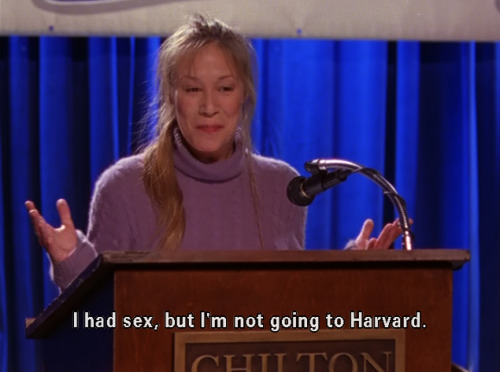
Paris and Rory are the top students in the class, and they are set to give a speech on live television later in the episode. However, college acceptance letters have just come out. Paris, who is the definition of hardworking and driven, gets rejected from her dream college. When she shows up to deliver the speech with Rory, she is late, her hair isn’t brushed, and she looks on the verge of a breakdown. She then proceeds to fall apart in front of the audience. She blurts, “I’m being punished. I had sex, so now I don’t get to go to Harvard.” She then points to Rory and says, “She’s never had sex. She’ll probably go to Harvard. She’s a shoo-in. Pack your chastity belt, Gilmore!” Paris runs off crying. When Lorelai and Rory get home, they open the mailbox and find stacks of acceptance letters. Rory is accepted to Harvard. Lorelai says, “Apparently, you’re the biggest virgin in the world.”
Although Paris obviously did not get rejected from Harvard because she had sex, the two ideas are clearly linked in the episode. Paris can either be sexually active or successful. Rory is “pure”, and she is accepted to every school. Virginity is celebrated, and sexuality is not acceptable if one wants to achieve their goals.
This idea is particularly evident when observing Lorelai’s reaction to Rory’s virginity status. She describes Rory as “the good kid” based solely on the fact that she has not had sex before an arbitrary time that is deemed appropriate. For a show that seems to be progressive and support feminist views, this scene is difficult to watch. It suggests that powerful women can be brought down by owning their sexuality or making the “wrong” sexual decisions. Rory and Paris are portrayed as antipodes of each other, with Rory basking in the glow of her virgin innocence.
Also, it is interesting to view this episode through an intersectional lens. Both Paris and Rory are skinny, heterosexual, white women. Paris is very wealthy. Although Rory does not have as much money, she still attends an expensive private school. Both of these characters are quite privileged, and they are on the path to receiving the most exclusive educational opportunities. They are also both attractive young women, and I think that this reemphasizes the point that even the women with the most privilege can lose opportunities because of their sexuality.
This episode is almost disturbingly sex-negative. It fits with Foucault’s theory that we are obsessed with talking about sex and that sex is not repressed, but it portrays sex in a negative light. Sex is openly discussed, but it is shown in the show to cause setbacks for women. They can only have sex after they are established in their academic and career goals. Rory’s decision to remain a virgin until she gets into college allows her to have more opportunities than Paris.
War and social media have coexisted for the last two decades or so, however, the role social media is playing in the recent Russian invasion of Ukraine stands out from other ongoing conflicts, whether it be the current bombardment and mass starvation of Yemen, the ongoing civil war in Syria, or the practically invisible suppression of West Papuans in their prolonged struggle for independence. I contend that the distinction lies in the way the Western world is responding to the crisis in Ukraine. As a very active American consumer of social media, primarily on Instagram and Twitter, I have noticed an outpouring of support for Ukraine from my American peers previously averse to posting on matters of politics and current events as well as from American and European individuals and institutions with prominent social media followings, including corporations, celebrities and government officials (see images below). These individuals and institutions are what I am referring to when I say “the Western world.” Even my own college of Davidson in North Carolina is currently flying the Ukrainian flag beneath the American one in the center of campus.
I am pointing out this distinction that is the Western world’s response to the war in Ukraine because I think it can teach us an important lesson on a) the political construction of whiteness, b) how race and gender influence how the West perceives and responds to human suffering around the world, c) who is entitled to resistance to violent aggression in the eyes of the West, and d) who is given unequivocal support from the West in their respective fights against imperialist aggression.
I will perform my analysis using a TikTok I encountered on Twitter depicted below. First of all, for a TikTok to make it onto Twitter, especially the politics-focused Twitter spaces I am a part of, it needs to be one that is very prominent and being widely discussed and shared. In the case of this TikTok, it had over 750,000 likes, 16,000 comments and 15,000 shares and 14.2 million views alone at the time that I encountered it. The TikTok itself centered a horizontal video of a young girl confronting a taller and armed male soldier. The video follows the girl as she yells at the solider who responds by walking away and laughing. The environment in the background resembles a desert with a sandy road and hardly any trees. For a moment at the end, the video cuts to an old woman who is crying being interviewed by RT, a Russian media outlet. Above the video, there is text that reads: “LITTLE GIRL TRY TO STOP” followed by two broken heart emojis and a sad face emoji, which is then followed by: “PRAY FOR UKRAINE” [Ukrainian flag emoji] [broken heart emoji]. The caption for the TikTok read: “#ukraine #army #fyp #fyyyyyyyyyyyyyyy #RUSIA #emotional.” The TikTok was posted by @staystrongukrainee, which had 127,400 followers on the app, and now appears to have been removed (most likely for spreading misinformation).
As evidenced by the strange caption and the questionable editing of the video, this TikTok exhibits many standard “red flags” of misinformation. In fact, the TikTok is an example of misinformation as the video it references as depicting Ukraine is really a ten-year-old video depicting a Palestinian girl named Ahed Tamimi confronting an Israeli soldier in the Palestinian territory known as the West Bank. It is precisely the fake nature of this TikTok that interests me the most, as I believe its ability to exist as a piece of misinformation to illicit support, solidarity and sympathy for Ukraine in the current conflict reveals a lot about the political construction of whiteness, as well as the role of race and gender in shaping Western discourse around the Ukrainian conflict specifically, but also war and resistance in general.
First and foremost, I want to speak on this video’s ability to be used as a tool for misinformation and how that is related to whiteness. Ahed Tamimi, who has blonde hair and a fare skin tone, is white passing.
Before I delve into this, I want to touch on the history of this term. “Passing” was first used in runaway slave notices from 19th century America, which Andrea Guzman claims “brings us back to the tension between being white and being free. Are they really the same thing?” This history is significant as it reveals that the concept of “passing” for white is a political construction with implications of power and freedom. It also reveals the fact that whiteness has historically been a threshold demarcated by upper-class, property-owning white people. The runaway slaves could not decide themselves whether they were or were not white passing, but rather their whiteness was contingent on the whims of white people as revealed by the fact that poor white people were sometimes cast as “mulatto” by other whites and sold into slavery.
This is all related to the case for Ahed Tamimi in this example of misinformation as it was her white appearance that allowed this video of her to be repurposed for the Ukrainian conflict, which is situated in a country where the majority of the population has fare skin and, in some regards, is considered white. In fact, some journalists are noting how the skewed coverage of the Ukrainian conflict compared to others around the world (Syria, Yemen, Somalia and West Papua as some examples) is due to its nature as a nation of white people. Another source astutely classified the skewed nature of the coverage as “blatant racism.”
But while Tamimi’s white passing appearance has allowed an account like @staystrongukrainee to co-opt and frame her resistance against the Israeli soldier to be an assumed example of resistance from a Ukrainian girl against a Russian soldier, Tamimi’s identity as a Palestinian, and therefore a non-white, non-Western individual, did not afford her resistance to Israeli aggression the same level of support and sympathy from the Western world that has been afforded to cases of Ukrainian resistance against Russian aggression. Kuan-Yun Wang, in an analysis of American and Canadian media coverage of Tamimi notes that “the media frame Tamimi and the Palestinians as violent initiators.” Wang found that the media also decry her persona as “fake’ and ‘propaganda,'” all of which Wang claims to “achieve the purpose of legitimising the use of state violence on colonised bodies, which ultimately reflects settler-colonial history in North America.” In terms of Tamimi’s reception in Israel, one member of the Israeli government has called her a terrorist, while the current Prime Minister, and Education Minister at the time, Naftali Bennett stated Tamimi deserved to be incarcerated for life following another instance of her slapping a soldier in 2018, which she served time in prison for. I will also speak on popular gendered tropes used against Tamimi in Israel later on.
This is all in stark contrast to the women in Ukraine who have taken up armed resistance against the recent Russian aggression and have been hailed by Western media outlets (examples: France24, Vanity Fair,Slate) and labeled as “brave” and as “heroes,” as seen in the tweets below.
While Tamimi’s relation to whiteness (being non-white but white passing) has impacted the way her resistance is received and, in this case, commodified to illicit certain reactions, her gender has also been used to further delegitimize her resistance, unlike the case of the Ukrainian women. For example, Yasmeen Serhan in an article for The Atlantic noted that “a young girl known for her long, curly hair isn’t the image one might typically come to expect of a national freedom fighter.” While the validity of Tamimi’s status as a “hero” figure is questioned due to her age, appearance and gender, the Ukrainian women being heralded on Twitter and in the media are not subjected to such scrutiny, even when, in another case of misinformation used to illicit support for Ukrainian women fighters, the women are wearing neo-Nazi symbols on their bullet-proof vests. Additionally, I have yet to come across any source that labels the Ukrainian women fighters as “fiery,” which is the sexist term The Mirrorused to characterize Tamimi.
The fetishization of Tamimi’s hair is also very prevalent in media and individual accounts of her. The Washington Post described the appearance of her hair as “wild locks swept up in a hair band,” which is yet another example of the emphasis on Tamimi’s supposed feistiness and “wild” nature, which is notably not how men, or the Ukrainian women I’ve referenced, that participate in resistance are ever described. A popular nickname for Tamimi among Israelis and others is “Shirley Temper,” which both fetishizes her hair, in its reference to the hair of Shirley Temple, and weaponizes her gender as something that is associated with rage. The general focus on her hair above everything also points to a form of dehumanization that Tamimi, and not the Ukrainian women, experience.
Other accounts of Tamimi have described her as a “metoo heroic victim” and have classified her resistance as “provocative,” which is yet another sexist term commonly used to objectify and victim-blame women. One Twitter user, who notably has their profile picture set as the Ukrainian flag, objectifies Tamimi in referencing her “usefulness.” They wrote: “Shirley Temper’s arrest was the grand finale of her parents’ grooming. Now that she’s no longer a photogenic little girl, she’s no longer useful.”
Returning to the focus of this analysis, it is clear from these examples that resistance to violent aggression is not created equal according to the West. While Ukrainians are heralded for resisting the violent invasion of Russia, Palestinians like Tamimi who resist the violence of Israeli soldiers (unarmed, in the case of Tamimi) are put under intense scrutiny, delegitimized, objectified and ridiculed. Additionally, it is clear race and gender play key roles in how resistance to violence is negotiated and classified by the West. As evidenced by the TikTok I’ve been referencing, the political construction of whiteness, and its ability to be weaponized at the whims of those looking to achieve certain goals, also plays a key role. Tamimi’s white passing appearance was weaponized to create misinformation to illicit Western sympathy for Ukraine, while her identity as a non-white Palestinian girl (at the time of the 2012 video) complicated and invalidated her actual act of resistance in the eyes of the West.
Tamimi’s relationship to whiteness can be understood using the words of Bree Newsome Bass, an artist and organizer based in North Carolina, who writes that “The ongoing conflict in Eurasia again shows that whiteness is not an ethnicity but a fluid power construct, a product of colonialism, where inclusion/exclusion fluctuates largely according to the whims of the ruling white elite. Where is the dividing line between Europe & Asia? Between East & West? Between European & non-European? Between white & nonwhite? Anti-Black racism remains the only constant that holds this fragile construct together. There must be clarity on who is unequivocally excluded.”
Bass’ inclusion of anti-Black racism is also relevant to the Ukrainian conflict, as African international students, migrants and residents of Ukraine have experienced immense racism, as well as acts of violence, in their attempts to escape the fighting.
This case of misinformation from TikTok I have dissected is important in that it reveals the impact of whiteness as a “power construct,” to use Bass’ terminology, that factors into the negotiation of whether or not certain people are entitled to resistance, whether or not it is acceptable that certain people suffer, and whether or not certain people are given unequivocal support from the West, even in the extreme cases of displaying connections to Nazism, like some fighters in the Ukrainian army.
As the Ukrainian conflict continues to this day, alongside numerous other conflicts and cases of Western imperialism around the world that have been purposefully swept under the rug and overlooked, it is important that we do not perpetuate narratives or spread media that supports the racist Western double standard regarding resistance that is rooted in whiteness and its weaponization. All peoples are entitled to resistance against oppressive forces, and we must recognize that.
Enough is enough. Don’t you think you have a right to express yourself without fear of being judged? Don’t you think you deserve equality like everyone else? Aren’t you tired of living a life full of society’s expectations and gender construction? Unfortunately, society’s failure in accepting transgender people in the community and hatred towards them has resulted in discrimination, unfairness, and devastating consequences for transgender people in society. A recent post on Instagram by username “Trevorproject” presents how transgender people have been facing several discriminations and hatred, leading from depression to suicide because of the social construction and acceptance of only gender binary (only male and female) in society.
The post consists of digital artwork created by artist Caitlin Blunnie, a famous queer feminist. The post was posted on Instagram on the 24th of February 2022 by username “Trevorproject”, an official Instagram account of The Trevor Project, the largest suicide prevention and crisis intervention organization for the LGBTQIA community specially focused on youth. LGBTQIA community refers to the people that fall in the category of finding themself as either lesbian, gay, bisexual, transgender, queer (questioning), intersex, and asexual (agender). Similarly, The post has depicted a Black person facing their back with short hair. The background is an abstract representation of a pink sky and bright moon with tiny shining sparkling stars around the person. The slogan in the post says. “Trans youth deserve gender-affirming health care “. The bio of the post states that “our research has found that gender-affirming care can be lifesaving, and transgender youth who have accepting parents are less likely to attempt suicide.”
The post talks about a disturbing announcement made against the LGBTQIA + policies by the texas department of family and protective services in the United States in January 2021. The legislated policy mentioned that gender-affirming care to transgender and nonbinary teenagers should be investigated as “child abuse.” Several LGBTQIA + activities, medical providers, and Instagram posts have criticized this policy as transphobic and damaging to safety and wellbeing, especially to transgender and non-binary people. Instead, the post states that gender-affirming care is not child abuse but is a necessary life-saving measure that helps in the physical as well as the mental wellbeing of transgender and non-binary people.
The Instagram post reflects on how gender-affirming care and having accepting parents to transgender youth can play a vital role in preventing severe problems such as suicide and depression. This social media post has touched upon the crucial point on society’s social construct of the gender binary, a system in a society where all the individuals are classified only as either male or female, has failed to accept and recognize the existence of transgender and non-binary people in the community.
Let us look at some of the responses to the social media post. Despite the awareness campaign in support of transgender and non-binary people, the comment section is a mix of admiration and hatred for transgender people. Let us see what people have to say on this social media post. One person has commented, “I hate having to live here “, while another commented, “My child and all people deserve to be treated equally for who they are, not whom society tells them they should be.” Through such posted comments, people have conveyed their struggle and the discrimination they face not fitting into society’s gender construction, making it difficult for them to live a normal life without being judged by society. Similarly, while several users took the social media post as an appreciation and a medium to raise their concerns and problems, some users made a joke out of the post.
In response to the social media post, several users have posted a laughing emoji, while another user has said, “This is nonsense.” This clearly shows that, despite ongoing efforts to alleviate discrimination and difficulties faced by the transgender and non-binary people in the community, our society still struggles to accept people of the LGBTQIA community. This reflects how being transgender and not fitting in societies’ gender binary perspective have made them feel very depressed and pressured. As a result, transgender people have faced a constant threat and challenge in living the life they want dealing with discrimination and difficulties.
Our Society has been constantly supporting gender binary and heteronormative values where society assumes every individual to be heterosexual. With all of society’s expectations and pressure to conform to gender norms, society has failed to accept and respect the existence of people belonging to the LGBTQIA community. What about the non-binary people whose gender identity does not fit in society’s “male” or “female” binary? What about homosexual people who do not fit in society’s heteronormative values? What about the transgender people who do not fit it in the society’s “biological sex and gender “ perspective. Don’t they have a right to live in society normally like everyone without any hatred or discrimination? Such gender expectations have made it extremely hard for transgender and non-binary people to live in a society. Not fitting into society’s social construction of gender norms and values has made them feel trapped in the bodies they are born with because what they feel internally does not match what exists physically. Several people in the LGBTQIA community have constantly been a victim of mental pressure and such has led them to depression and even suicide.
Despite all of today’s modern world’s understanding and advancement in numerous fields, acceptance of the LGBTQIA community, particularly transgender and binary people, is still a new concept to society. As a result, such individuals, particularly teenagers, have struggled to live the life they want. Every individual has the right to live in a manner that they want and are comfortable with. Society’s expectations and gender construction, on the other hand, have always posed a threat to transgender and non-binary people. Such expectations have led people to severe problems, from depression to suicide.
I think we can all remember a time being in the car and your parents singing songs from when they were younger. For some kids it’s embarrassing, some it’s funny, and some willingly sing along. I was a singer. My brother on the other hand would ignore us and roll his eyes with embarrassment. The song Lola by the Kinks was always a family favorite. The catchy toon and repetition of Lolaaa made it easy to remember and hard to get out of our heads. This past weekend, however, the song came on and my dad started singing. When I heard the final line this time around “But I know what I am and I’m glad I’m a man. And so is Lola” I realized the song is about a transgender woman.
I went home and listened again while looking at the lyrics. Upon doing this I realized the only lyrics I’d known all these years had been the chorus! The rest of the song contains some really hurtful, offensive, and untrue information about transgenders! After this, I did more digging and went to watch the music video. Here I witnessed even more disapproving messages that you couldn’t get from the lyrics alone.
The music video illustrated like a comic book clearly depicts the main character’s (the singer’s) negative view of Lola and other transgender people. In the whole song, he is singing about how he has been deceived and lied to about her identity. He doesn’t accept that Lola has transitioned into a woman at all. Instead, he feels as though she (Lola) is actually a man and is lying to the public appearing as a woman. He introduces this idea of being lied to first through coca-cola.
I met her in a club down in old Soho
Where you drink champagne and it tastes just like Coca-Cola
The singer does this again later in the song where he talks about the artificial candlelight.
Well, we drank champagne and danced all night
Under electric candlelight
In both of these lines, he points out that everything is not what it seems in this club. The champagne, which is typically high quality and expensive, tastes like a cheap soda. While with the next line he brings to our attention that the candle is fake, getting us familiar with the idea that he is being lied to in this club. He then moves on to talk about Lola.
The lines “But when she squeezed me tight, she nearly broke my spine” and “I can’t understand why she walks like a woman and talks like a man”
These lines are greatly offensive to all women. Who is this singer to suggest that women can’t be strong and give a tighter hug? Or who is he to say the feminine tone of voice must be a certain pitch and if you don’t meet that pitch you “talk like a man”. And then within the next line began the additional hurtful messages not heard in the lyrics, but shown in the music video.
The line reads “She said, Little boy, won’t you come home with me?” Lola is asking the singer to go home with her, but the music video depicts the singer for the first and only time as a doll/puppet. To me, this imagery was extremely disturbing. It felt like the singer was suggesting that Lola was taking advantage of the singer and keeping him there against his will. Like he has no say, he’s under Lola’s control.
The next line again doesn’t read offensively but is paired with the music video, showing the underlying rude message the singer implied. The line reads: “But when I looked in her eyes, well, I almost fell for my Lola”. The image shows the singer and Lola with switched hair colors and in the singer’s right arm he holds a box labeled Turkish Delights.
Now I thought this was odd that the Turkish delights were labeled because nowhere in the lyrics are they mentioned, and it seemed odd to specify that in a low detail cartoon comic book image. This prompted a google search “What do Turkish delights mean? ” According to google, they are a gelatin pastry usually dusted with a bit of icing sugar. Seems innocent enough. A second search: “What do Turkish delights symbolize?” and there it was. The truth behind how he viewed transgenders. The Turkish delight symbolizes evil sin and temptation. Implying loving Lola, the transgender woman is evil and a sin, even though it is tempting.
As the song is coming to a close another lyric reads: “She said, Little boy, gonna make you a man”. This line again made me feel as though the singer was claiming she took advantage of him. Calling him a “Little boy” and not asking for consent just saying she will make him a man feels creepy in the way the singer has framed it. When in reality the singer just doesn’t want to be held accountable for being attracted to a transgender woman.
The song closes out with the line I said earlier: “But I know what I am and I’m glad I’m a man and so is Lola”. The singer then repeats Lo-Lo-Lo-Lola until it eventually fades out and the song ends. That final line solidifies he still sees Lola as a man, despite the fact that she is not. Granted this song did come out in the 1970’s so transgender people and knowledge was in little supply the song is still unacceptable. Despite the song being dated, it still feeds into the hurtful and incorrect stereotypes of transgender people that we deal with today. I can’t believe these hurtful messages went undetected by me through so many years of listening to this song! But alas, the ugly truth of the singer’s view on transgender people will never be forgotten.
(Both images were screenshots of the music video. The link to the music video can be found here: https://www.youtube.com/watch?v=6CzrYXcXweI
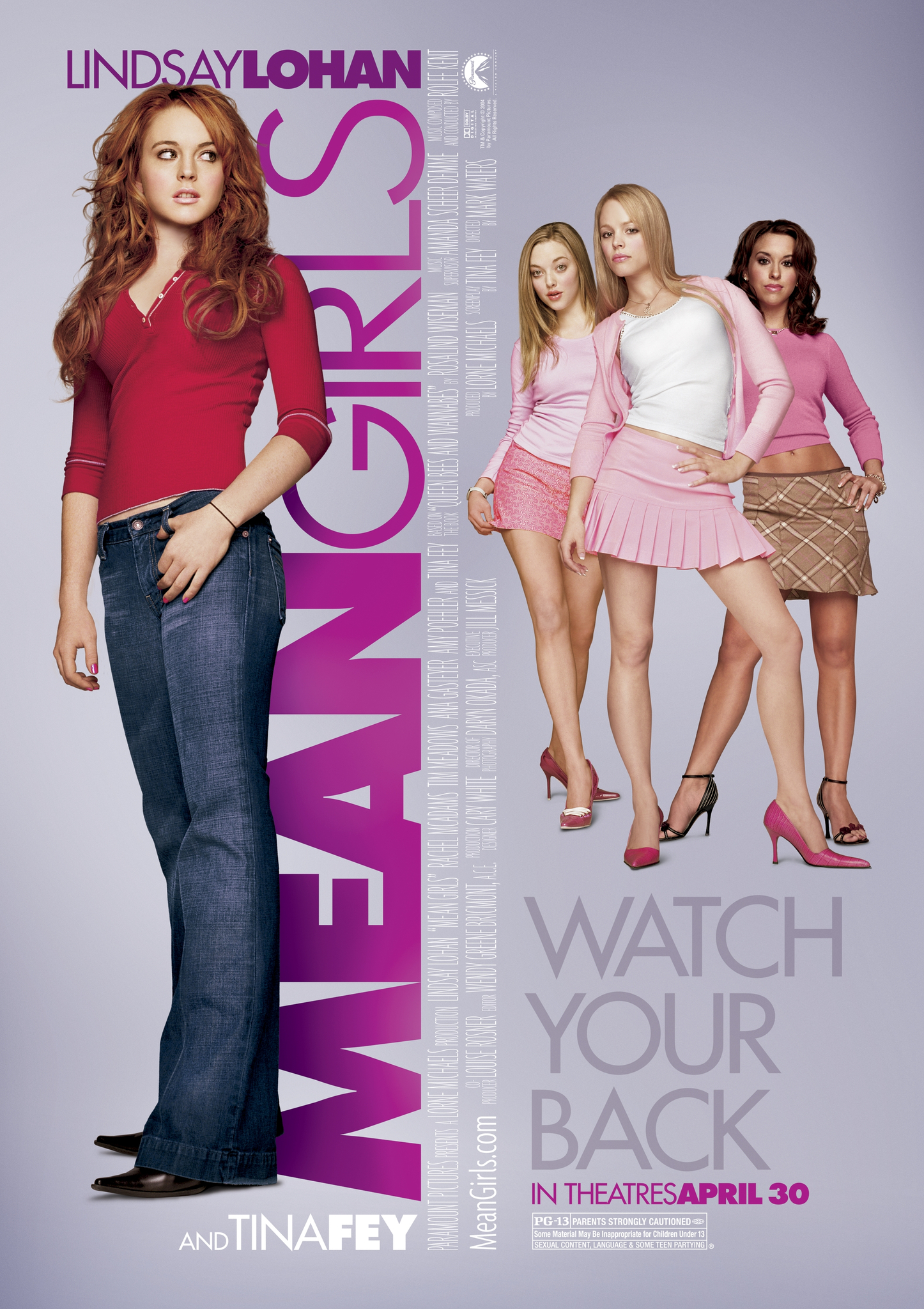
Mean Girls was released in 2004 and was quickly embraced as a cult classic, especially by young women. The movie follows Cady, who has recently moved from Africa (country unspecified) and has to navigate the drama and politics of “girl world,” where mean girl Regina George and her friend group, “The Plastics,” control the high school social scene. Cady joins The Plastics as a spy for her new, unpopular friends Janis and Damian, but her loyalties and goals become muddled when she has a crush on Regina’s ex-boyfriend Aaron. Tina Fey wrote the chick flick, which was partially inspired by her own high school experiences.
Body image issues, especially relating to weight, are prevalent throughout Mean Girls. Disparaging comments about the appearance of women are common in the movie. One example of diet culture that stands out is how Cady weaponizes the fear of fatness against Regina as part of her plot to destroy Regina’s popularity. While there are many mentions of weight and body image throughout the movie, this specific subplot brings to light many of the stereotypes connected to anti-fatness and diet culture.
In the cafeteria, Cady gives Regina “weight loss bars” which are actually Swedish Kalteen bars that her mother used to give children in Africa to help them gain weight (a plot point that is problematic for its own reasons). Cady deceptively gives her these bars in an attempt to rid Regina of her “hot body” by inducing her to gain weight non-consensually. This correlation between gaining weight and becoming unattractive is implied and never questioned. Regina immediately grabs the bar from Cady and stuffs it in her mouth. When Regina points out the packaging is in “Swedish or something,” Cady says the bars have an ingredient that is not legal in the US. Regina then names several weight-loss drugs that she’s memorized and asks if these are the illegal ingredient, but she still eats the bar when Cady says they are not. Regina mentions she wants to lose three pounds and waits expectantly until Gretchen and Karen assure her she is already skinny enough, to which her only response is “shut up.”
This scene is clearly supposed to be a mockery due to Regina’s obsession with weight loss. There is dramatic irony since the audience knows the bars are going to cause the opposite effect of what Regina wanted. The audience is laughing at Regina for being so eager to try this new weight-loss method, despite it being dangerous enough that the active ingredient is illegal in the US. The audience is also supposed to be making fun of Regina for being so obsessed with weight loss that she has memorized the names of common weight-loss drugs (ephedrine and phentermine, both of which can cause heart issues). While these moments are supposed to be funny, the thing that is being made fun of is not the beauty standards themselves; it is how fully the obsession with thinness controls young women. The movie frames Regina’s obsession with weight as stemming from her own vanity and shallowness, with little exploration of the outside pressures and standards that might be causing this harmful behavior. This view of disordered eating puts all blame on the individual and acts as if she is making these dangerous and foolish decisions in a vacuum. Unfortunately, Regina is not wrong in her belief that being skinny will benefit her. Fat people are given worse medical care, paid less, and treated worse overall than non-fat people in our thin-obsessed world. Regina’s beliefs are troubling, but not because they are unfounded, because of the damaging culture and realities that have led to these beliefs. Regina’s obsession is sad, but it is not uncommon, and trivializing the diet culture so many people fall victim to invalidates the real (and sometimes deadly) harm of fatphobia. Additionally, all the lead female characters throughout the movie are thin, so there is a level of removal from the most serious effects of fatphobia that allows the audience to laugh at Regina without considering the extremely harmful consequences that attitudes like hers have on actually fat people.
The end of the scene, where Regina stares at Karen and Gretchen until they tell her that she’s already skinny, enforces this idea that anyone would prefer being skinny over being fat, and it would be offensive to let someone think they are fat without correcting them. Regina considers telling someone they are not actually fat to be such a common courtesy that it means nothing to her, and she tells them to “shut up.” This idea strongly contrasts the body neutrality and Health At Every Size movements, which claim that body size is not necessarily a good thing or a bad thing, just a characteristic that varies among individuals. Karen and Gretchen’s comments also exemplify bonding around body image issues, which is a common practice for young women.
The idea that fatphobia is ingrained in the message of Mean Girls was confirmed for me near the end of the movie when Cady decides there is no use in being a mean girl because putting down others will not benefit her. In her internal dialogue, one of the examples that helps Cady come to this realization is that “calling someone fat doesn’t make you skinnier.” This is one of the most serious moments of the movie, and it clarifies that the writers of the movie consider it to be an unquestioned truth that anyone would prefer being skinny to being fat. Cady’s growth is realizing that you should not bully fat people because it is unkind and will not help you avoid the same fate, and not because there is nothing wrong with being fat in the first place. This moment enforces the idea that fatness is an inherently negative characteristic, so the kind thing to do is ignore someone’s fatness or pity them for it. While Cady thinks she’s being kind, this idea continues to stigmatize fatness.
At the surface, Mean Girls seems to address body insecurity and diet culture. However, the movie makes fun of the results of these issues, and the young women who fall prey to them, without any discussion of where these beliefs come from. Representation like Mean Girls minimizes the dangers of diet culture and fatphobia.
Works Cited
Burgard, D. (2009). What is “health at every size”? In E. Rothblum & S. Solovay (Eds.), The fat studies reader (pp. 42–53). New York University Press.
Waters, M. (2004). Mean Girls [Film]. Lorne Michaels Productions.
Witter, B. (2020, May 19). Tina Fey used her real life as inspiration for the unforgettable characters in ‘mean girls’. Biography.com. Retrieved March 4, 2022, from https://www.biography.com/news/tina-fey-mean-girls-characters
Throughout Grey’s Anatomy’s , Shonda Rhimes seems eager to write and direct episodes that highlight pressing social justice issues and challenge gender and racial stereotypes. While many of her episodes tackle social issues regarding race, gender, sexuality, mental health, drug use, she also includes a lot of representation of marginalized groups. Many of her episodes showcase people across all marginalized groups taking on the empowering and glorified profession of surgery.
Specifically, an episode in the 14th season highlights stereotypes about women in relation to mental health issues such as anxiety and depression. This episode mostly features Miranda Bailey, an African American woman who is also Chief of Surgery at Grey Sloan Memorial Hospital. Dr. Bailey is an inspiring figure not only for her admirable work ethic and striking leadership abilities, but also for representing groups particularly marginalized in society: she is black, fat, and a woman.
In this episode, Dr. Bailey confidently claims that she is suffering a heart attack, seeking medical attention at Seattle Presbyterian Hospital. Despite providing her professional opinion and self-diagnosis to the medical staff treating her, her suspicion of a heart attack is relentlessly shut down by doctors who are white, cis-men. Bailey stays loyal to her own professional judgment and requests that she speak to the Seattle Presbyterian’s Chief of Surgery, Dr. Maxwell. Maxwell immediately dismisses Bailey’s belief that she is suffering from a heart attack. He looks at her with sympathy, places a comforting hand on her shoulder, and assures her that his medical opinion is correct. This effectively portrays the harmful stereotype that women are inherently less intelligent than men. It reinforces the idea that women don’t belong in professions where many urgent, important, and high-pressure decisions must be made with utmost skill and knowledge. Maxwell, who actually holds the same position as Bailey in hospital authority, quickly assumes invalidity in her opinion and overlooks her judgment confidently. As a white, cis-man with an intensely glorified job, he feels he holds authority over Bailey, whose blackness, fatness, and identification as a woman devalues her skill and judgment as a highly qualified surgeon.
To make matters worse, Maxwell then suggests she consider mental-health related factors that could be the cause of her physical discomfort. “Do not go down that road with me,” she says. Maxwell continues to ask Bailey about “big stressors” and her history of mental illness. Bailey quickly recognizes that Maxwell’s inference is based solely on stereotypes that women are unable to handle their emotions and anxiety. Bailey asserts her confidence as a black woman who deals with OCD, claiming that she views it as a piece of her story rather than a disadvantage. Refusing his inference, she requests a new doctor. This scene shows Bailey resisting the socially ingrained idea that women are more mentally and emotionally immature and unstable compared to men. Too often, women’s heart disease is overlooked as merely a manifestation of anxiety or stress. This emerges in relation to the overarching idea that white men are inherently stronger, smarter, and better prepared for success than women of color.
Unfortunately, rather than upholding Bailey’s request for a new cardiologist, Maxwell refers Bailey to a psychiatrist, who is also a white cis-man. He speaks to Bailey in a condescending tone, insisting that he help “treat” the mental issues he believes are causing her physical pain. He describes her as a woman “who has a big job with a lot of responsibilities,” who “manages life and death scenarios on the daily,” “has a history of mental illness,” and has “limited coping skills.” His assumption that someone like Bailey could not possibly handle the stress that comes with such a highly respected and important job feeds into the belief that such positions belong to white men. It reinforces the stereotype that only white men could ever qualify for such an intense, emotionally strenuous, extraordinary profession; this is because society has held the idea that only they have the mental capacity and qualities to handle and deserve such a responsibility.
The title of the episode, “Don’t Fear the Reaper,” contradicts the episode’s message in an abstract and interesting way. The title originates from a song written by Buck Dharma, a member of a band called Blue Oyster Cult. The song is basically about the inevitability of death and how it shouldn’t be feared. It’s less of a comment on the gender and racial stereotypes of the episode and more of one on the humanity of the situation she is in. The “death” aspect reflects Bailey’s grueling work life and stressful home life. The title insinuates that Bailey should surrender to the forces weighing her down, such as the inevitable stress of her job and as an individual part of intersecting marginalized communities. It implies that despite how secure and empowered she is in herself, she must allow herself to succumb to the natural struggles of life. While this episode title represents the humanization of Bailey, it also places greater emphasis on her struggle, which reinforces negative stereotypes about people like her. This tainted message takes away from the episode’s message on gender and racial stereotypes. Although this message does tie into Grey’s Anatomy’s overarching theme of the imperfectness of humanity, it dulls the episode’s commentary on more pressing social issues.
Overall, the writers successfully tackle stereotypes about women regarding anxiety and heart disease. Miranda Bailey, a fierce and resilient black woman who is Chief of Surgery at Grey Sloan Memorial Hospital, is known for speaking on issues concerning gender, race or sexuality stereotypes. The writers of Grey’s Anatomy utilized such admirable qualities of her character to effectively comment on the harmful gender and racial stereotypes that are ingrained in our society.