Social Meaning of “It’s My Vagina”

Sex Education, Season 1 Episode 5

Recently, there has been a gradual increase of feminism, queerness, and anti-racism incorporated in popular culture in response to the public, especially the younger generation. Some media accurately portray gender ideas and racial representation, but some screenwriters or producers are ill-informed and fail after attempting to appeal to a younger generation. I will be introducing one of the TV series that comparatively did well for an audience that cares about social justice: a British comedy-drama, “Sex Education.” I would like to focus on [Season one, episode five] of the series written by Sophie Goodhart and Laura Hunter, which says a lot about all three – feminism, queerness, and anti-racism. 

In episode five, two important incidents happen simultaneously that show the character’s struggles based on their identity. First, it starts with a nude picture anonymously being released at school -a photo of someone’s vagina, which gets teased for its color and shape. The owner of the vagina photo, Ruby, approaches Maeve -the main female character who accepts clients for sex therapy- asking for help to find a person and stop him or her from revealing her name. Despite Ruby being mean and rude to everyone, Maeve agrees to help without compensation and starts the investigation with Otis -a main male character whose mom is a sex therapist and ends up working as a sex therapist for his peers. 

With Maeve leading the first part of the story, the nude picture represents and tackles female anxiety and insecurity that are often not discussed enough. The students in school humiliate and judge the vagina photo that it is ‘brown and shaped weird’ as if there is a specific ‘normal’ way of how the female body is supposed to be. Degrading women based on their body parts is considered Hostile Sexism, which seemed to be engrained in their school’s culture for both boys and girls. Not only does seeing Ruby scared of the threats of being revealed as the owner of the photo portrays the problem of the shaming culture, but also the later confession by Maeve represents the toxic environment of Hostile Sexism. She shouts to Otis why she has been called ‘Cock Biter’ for four years: “Do you know how long I’ve been called Cock Biter? Four years. People I’ve never met call me Cock Biter to my face. I bit Simon Furthassle’s scrote. I had sex with four guys at the same time, I fucked my second cousin. I’ll give you a hand job for a fiver if you like. Do you know how it started? Simon tried to kiss me at Claire Tyler’s 14th birthday. I said no. So he told everyone I’d given him a blow job and bitten his dick, and that was it. This kind of thing sticks. And it hurts, and no one deserves to be shamed, not even Ruby.” (Sex education, Season 1 Episode 5) Her speech sums up the hostile environment girls or women are in this society: the victim-blaming and male gaze. She gets blamed for not kissing Simon back when she is a victim in the situation. While out of revenge, he objectifies her by giving her the name ‘Cock Biter’ which follows her for four years, emotionally distressing her. 

While the episode criticizes such culture by showing the female character’s fear and anger, it also reconciles the conflict in the last scene. When everyone is gathered in the hall and the headmaster emphasizes that faculties are looking for the owner of the photo -another insensitive way to blame the victim – girls start to stand up shouting “It’s my vagina!” It represents how they accept their insecurities about bodies and stand up to the shaming culture. The episode touches upon social problems toward women and demonstrates an ideal way of tackling the problem; although it might not be a practical way, in reality, it still is worth watching to reflect on our society. 

<Wherever I look> https://www.google.com/url?sa=i&url=https%3A%2F%2Fwherever-i-look.com%2Ftv-series%2Fsex-education-season-1-episode-5-recap-review-with-spoilers&psig=AOvVaw0kKRq3k8obirBI0z2ifmJK&ust=1646503177547000&source=images&cd=vfe&ved=0CAsQjRxqFwoTCKidmLCFrfYCFQAAAAAdAAAAABAh

The second conflict arises when Otis agrees to help Maeve because he promised his best friend, Eric for a birthday tradition they have been doing every year: they dress up in drag and see Hedwig and the Angry Inch together. However, Otis leaves Eric alone to get on the bus and breaks the promise to help Maeve continue her investigation. Left alone, Eric gets his wallet and bag robbed having to walk back alone at night. As a black queer man dressed up, he gets beaten on the road, traumatized, and returns home. Not only does Eric and Otis’ friendship got destroyed, Eric feels broken inside and grows resentment about his identity being humiliated and hated in society. When he comes back home, his dad says: “If you are going to live like this… you have to toughen up.” (Sex education, season 1 episode 5) As an audience, we understand Dad’s frustration and concern about Eric’s queerness, but it represents victim-blaming that he is criticizing his son who is traumatized. Experiencing homophobia from a stranger, Eric gives up his identity and dress up as a straight man when he goes to school the next day. The episode shows the struggle of queer identity in our society including their families and friends that it is hard to find a safe place for them. It is also rare to see the representation of the struggle of people of color identifying themselves as Queer. 

Season one, episode five of Sex Education portrays multiple societal problems people feel and experience regarding feminism, queerness, and anti-racism. It shows the struggles and accurately points out what causes them, which makes the show worth watching for people who care about social justice.
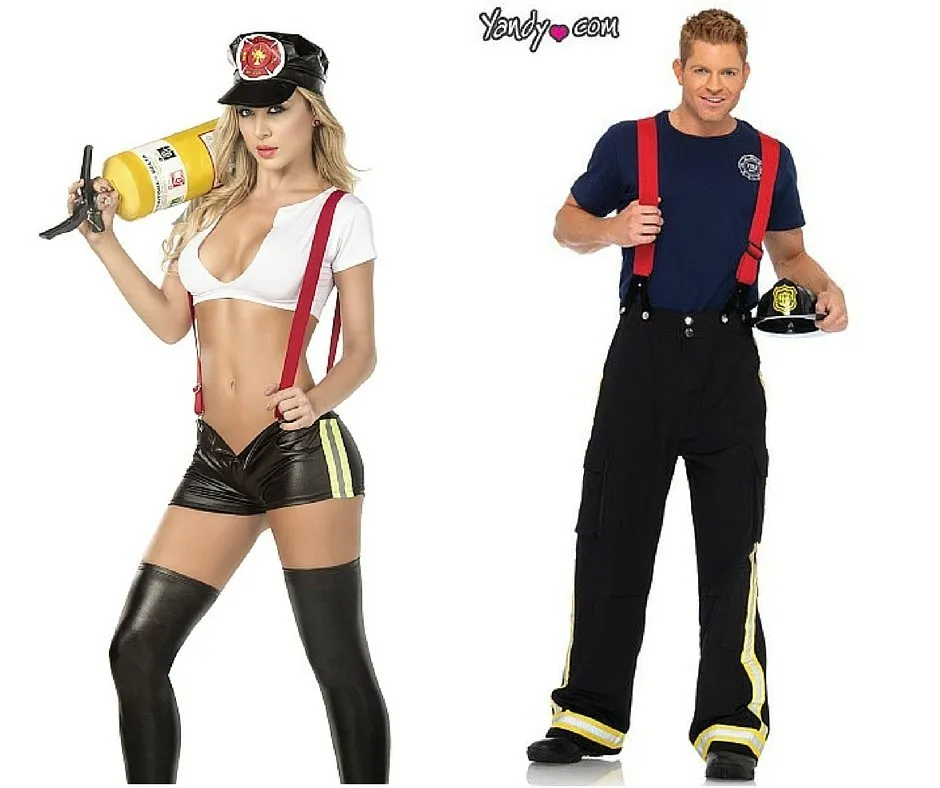
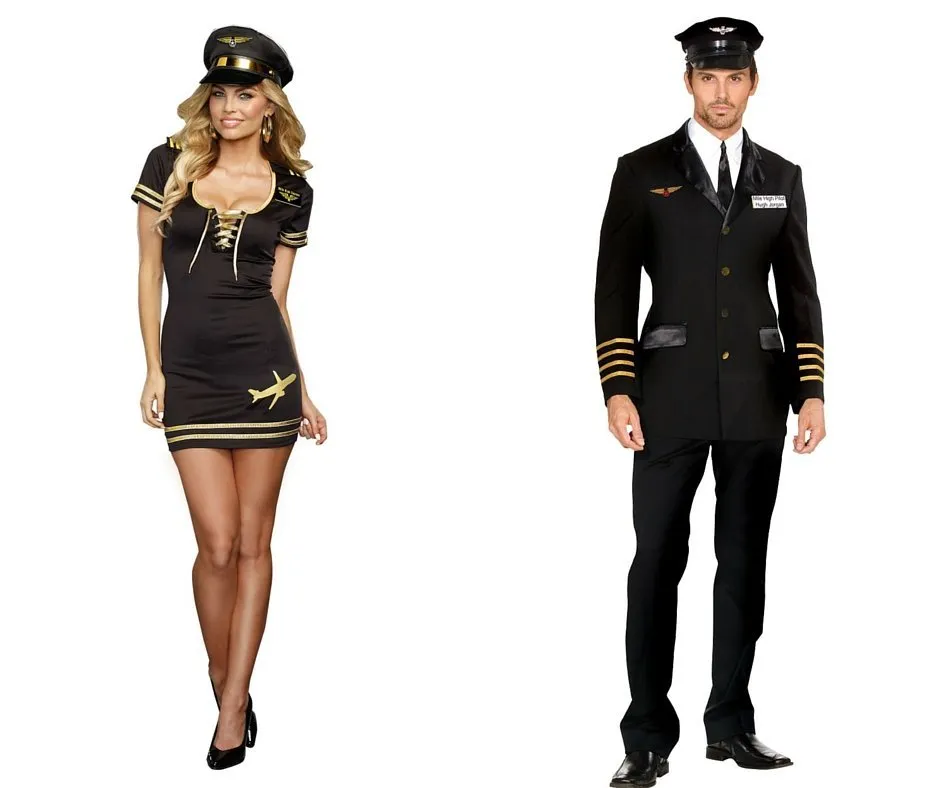
The Halloween Costume Industry: Sexy or Sexist?

03/04/2022

Emma Anglin

October after October, year after year, Americans across the country don costumes and temporarily adopt a new identity for the sake of one night: Halloween. Another thing to be counted on consistently? The over-sexualization of women through costume. While men often are allotted a full set of clothes, whether that be to look like a pilot, a firefighter, a doctor, or even military personnel, women are handed a tiny skirt, skimpy shirt, and expected to embrace the “sexiness” of it all. This disparity perpetuates existing sexism in the United States and objectifies women everywhere, creating a host of issues across the board.

These costumes (and others of the same nature) create an impossible standard for women, setting the expectation that they only exist to satisfy the male gaze. Working women have been sexualized merely to fit the narrative of phallocentric sexual fantasies for decades, as the patriarchy works to assign a woman’s worth based on her sex appeal. The paradox created by this situation is that if a woman is not considered traditionally attractive, she will likely face more trouble with establishing credibility in a male-dominated field, but if she is seen as too attractive, that credibility is lost as she begins to be viewed as only a sexual object. Women in the workforce are doing the same jobs as their male counterparts, meaning that their work is typically not inherently sexual, yet men in the professional world do not face nearly as much sexualization. These women are not asking to be sexualized purely for working, and many hold down jobs to maintain their livelihood. 

Aside from promoting blatant misogyny, these costumes reinforce the gender binary. Halloween costumes are heavily gendered and therefore rely on intense stereotypes for advertising. With the nature of female-branded costumes being small and revealing and the male-branded costumes being full sets of clothing, the costume industry is assuming that everyone who identifies as a woman wants to dress femininely and adhere to these stereotypes and vice-versa for those who identify as men. Further, these assumptions overlook those who identify as non-binary or gender non-conforming, as it is incredibly rare to find a factory-made Halloween costume that does not promote sexiness as being connected to women and authority as being connected to men.

To expand, the costumes for men are often made to allow them to embody someone of authoritative, powerful status, such as a soldier or police officer. This feeds directly into the patriarchal view that men should be the people in power and women should exist to assist those men. In these gendered costumes, the masculine costume is often the figure of power, an example being how the masculine healthcare costume is a doctor with a surgical mask while the feminine costume is a “sexy nurse” in a small dress with cutouts and fishnet tights. The women in these advertisements are marketed as attractive, submissive sidekicks to the dominating male figures. This causes even more offense when it’s noted that in these real-life professions, there are few differences between uniforms for men and women. The point of a uniform is to have coherence among staff, and these costumes completely ignore the way that women actually exist in the workplace, which is in nearly the exact same uniforms as their male counterparts, especially in the professions represented in these advertisements. 

These costumes also reinforce the idea that there is a “correct” body type, as the “sexy” women in the costume ads all have the same tiny waist and hourglass figure. Many women actually want to retaliate against societal expectations and reclaim their sexuality through costumes, and if these costumes are being marketed to a very slim demographic, literally and figuratively, the already small space for fat women to feel sexy is narrowed further. This issue of representation furthers the fatphobic societal view that fatness is “bad” or “gross,” and although unwanted hypersexualization of women is not something that should be condoned, it is not uncommon to find women to do want to embrace their sense of sexuality for one night when it’s “allowed.” These women should be able to explore their “sexy” side without worrying about constraints surrounding their size or opinions on their body from outsiders who expect all women to fit inside the same box when it comes to body type. 

Within the Halloween costume industry, the sexualization of women through costumes has contributed to cultures of sexism and fatphobia. The industry designs with little regard to body type and plays into long-standing stereotypes of and expectations surrounding women, while also erasing non-binary people from the advertisements completely. While there are women who may have the desire to reclaim their sense of sexuality through these costumes, many view these costumes as objectifying and offensive. The costume industry should provide variety for women in terms of costume, with options that suit both the sexy side and that that is more true to the reality of what women wear in the professional world. Without options like these being widely advertised, women will continue to be sexualized and objectified by the producers, consumers, and advertisers of Halloween costumes.

References:

Bahadur, N. (2015, September 29). The Difference Between Men’s and Women’s Halloween Costumes Is Very Scary. HuffPost. https://www.huffpost.com/entry/the-difference-between-mens-and-womens-halloween-costumes-is-very-scary_n_560973ebe4b0dd8503086437

The Power of Men’s Skincare: How Moisturizer will Supposedly Make You Look Muscular and Manly

In this ad by Lumin titled Mansplaining How To Avoid Dull Skin, we see a man trying to convince another man to pay more attention to his skin and to use their moisturizer. At the beginning of the ad, the man is looking in the mirror when a hand pops out and offers him skincare, at which he says skeptically, “skincare… for men?!”. The man who gave him the cream then goes through all the reasons why he should be using the skincare product and taking care of his skin, most of the reasons relating to being masculine and being attractive. He says that skipping skincare is like skipping leg days (and shows a man with skinny legs), he points at all the problems with the man’s skin, and at the end of the ad, the man is convinced of the need for the product and is shown using it, the other man saying to him, “We got this, I’ll spot you”.

 This ad incorporates lots of prevalent ideas about gender norms and expectations. In US society today, women are typically expected to put more effort into their appearance than men in terms of skincare – this ad is trying to market their moisturizer to the male market using certain gendered advertising strategies to market a typically feminine product to a masculine market. The title of the ad plays on the idea of mansplaining, which was first used in the comment section of an article from 2008 called “Men Explain Things To Me”, and is used when men explain things to women in a condescending manner and with the assumption that the women is ignorant of the topic. The man in the video claims that “skipping skincare is like skipping leg day”. The advertisers are assuming that most men work out and would appreciate a fitness reference. In saying this, they are comparing skincare to something more stereotypically masculine in order to dissociate it from femininity to make it seem more acceptable to be used by men. They show a man with skinny legs working out his arms, to instill fear into men that it’s just as bad to have bad skin as it is to have skinny legs. This brings in the idea of body image, and how toxic masculinity tells men that they need to be muscular and strong in order to be attractive, worthy, and manly. The ad uses words like ‘strong’ and ‘weak’ to play on common insecurities of men and guilt men into feeling like they are actually less masculine by not paying attention to their skin. The man in the video shown as the one with ‘skinny legs’ is also shown in all pink clothes and using pink weights. This is another way that they make this man resemble femininity, thus relating not taking care of your skin as something that’s bad because it makes you look more girly. With this logic, they’re saying that being girly is an inherently bad thing and something to be embarrassed about, whereas it should be normalized for men to wear pink and do things that may be considered girly and be proud of it. This ad is shaming men who may prefer to embrace the feminine aspects of themselves and tells men that they need to be manly in order to be respected by others and that men who are not hyper-masculine are failing as men.

This ad also brings up what we saw in the Poretsky and Everts readings in which they discuss how companies have created problems and insecurities in order to sell a product to solve that problem. In this case, men are told that they should be worried about having dull, wrinkly skin, and that this cream is something that they need to buy in order to be more attractive. The man in the video seems to have not cared about these aspects of his skin before, and now will spend money to fix something that Lumin has deemed a problem, not himself. In these ways, this simple, 30-second advertisement has very deliberately and blatantly played into gender stereotypes and marketing strategies that perpetuate stereotypical ideas of ‘masculinity’ and create insecurities in order to sell a product. In addition, all of the settings shown within the ad tell the viewer something about class and wealth, as all of the rooms and fixtures are expensive and fancy looking. This may be a way for the advertisers to make it feel like people who use this cream are fancy and wealthy, and so anyone who uses it will also come across this way.

It is also noteworthy that Lumin’s ads feature many men of color, non-white men, and racially ambiguous men. It is impossible for us to know whether this diversity is due to genuine race-blind casting or simply an attempt to appeal to the growing public awareness of the lack of diversity in advertising in order for the company to appear woke.

The whole Lumin skincare line is advertised as being specifically for men, which relates to other posts I’ve seen online about examples of things being unnecessarily gendered so that they can be advertised as ‘for men’ or ‘for women’. The whole Lumin skincare line is advertised as being specifically for men, which relates to other posts I’ve seen online about examples of things being unnecessarily gendered so that they can be advertised as ‘for men’ or ‘for women’. Companies then use different marketing strategies for the two so that they appeal to each gender in different ways. These gendered products are completely unnecessary and are simply ploys for the companies to make more money by perpetuating gender norms and stereotypes. I would be interested to see the scientific evidence (or lack thereof) of what makes these “men’s” products different from women’s products, as they claim substantial differences between men and women’s skin on their website. Personally, I see no need for products to be different from one another in accordance to gender, but plenty of people buy into the need for such products. Where do these gendered products leave non-binary people, gender-fluid people, transgender people, and anyone not within the gender binary? They are left with needing to choose either the male product or the female product.

Sorry, But Pantene Ain’t Cutting It.

Pantene’s “Sorry, Not Sorry” ad urging women to stop apologizing  

Well-intentioned, well-meaning, but well-executed? Yeah, that would be a no. In Pantene’s 2014 ad entitled “Sorry, Not Sorry,” an attempt is made to call attention to the tendency -specifically for women- to apologize. The ad cuts from scene to scene of female-identifying individuals of varying racial and ethnic backgrounds apologizing to male-identifying individuals. Examples featured include a woman sitting in a conference room asking her male colleague, “sorry, can I ask a stupid question?” or a woman sitting in an office waiting room apologizing for a man’s arm taking up too much of her personal space, causing her to say “sorry” and move her arm. These are just two of the many examples Pantene touches upon in their ad. Then, suddenly, a dramatic cut is made, and the screen states in big, bold black lettering, “don’t be sorry, be strong and shine.” The scenes are preceded to be re-told. The woman in the conference room confidently says, “I have a question,” and the woman in the waiting room refuses to move her arm when the man gets in her space.

Screenshot from commercial of women moving her arm to make space for a man’s arm

Screenshots from commercial of Pantene’s message to women 

This command feels more imposing rather than empowering. Additionally, The “be” in “be Strong” is directed at women and their hair, implying women are not strong if they apologize and not strong if they do not use Pantene products. This messaging works to diminish the power of apologies and perpetuate certain beauty standards for hair care.

My major qualm with this ad is that it does not get at the root issue occurring; rather, the ad shames women for their inherent sorry problem. Granted, there is only so much Pantene can achieve in a 1:17 clip, but they should have known what they were signing up for. Therefore, this ad feels like it’s shaming women rather than “empowering women” because there is no acknowledgment about why women feel the urge to apologize so frequently. As seen above in the ad, the use of grammatical imperatives is practically yelling at women saying they are not enough. Therefore this is the individual women’s fault, which is simply incorrect. This sorry issue is a societal condition, not a group of women who don’t understand social cues. 

On top of the scenes of apologies and dramatic phrases flashing across the screen, the spa-esque background music irked me. A single piano key is repeatedly played at a slow tempo; suddenly, once the message to stop apologizing flashes across the screen and the scenes are repeated with no apologies from the women, the piano playing gets faster. A fast strumming of a guitar is now audible. The stark change in tempo and guitar accompaniment sounds so disjointed and comes across as cheesy. While Pantene is trying to empower women, the music is another example of how their ad falls short. 

This brings me to my second point, the way the ad tried to relate the message to their product is half-baked and undercooked. Profiting off of “women empowerment” poses its own moral dilemma that unfortunately seems inevitable in our capitalist society, but if you’re gonna do it, at least do it well. Sure, one could argue that no men apologizing in the video implicitly depicts the patriarchy being at fault in the matter and the greater systemic issue in educating our youth. But I think that would be giving this ad too much credit. Instead, this ad comes across as this sorry problem being a “women’s problem,” which is seen through the commands for women to “be strong,” and even in the left-hand corner of the cover of the ad saying, “why are women always over-apologizing?” These phrases feed into the idea that women don’t just apologize sometimes but “always.” The ad makes this dangerous generalization that paints women in one light and fuels the gender binary. 

This ad promotes the binary of men and women and thus leaves no room for representation of other genders. I would be remiss if I did not contextualize this ad. In 2014, this ad was labeled as groundbreaking and perceived as empowering. However, reading it from the vantage point of 2022, the ad lacks an understating of intersectionality and its relation to patriarchal society. Events such as the Women’s March in 2017 remade the concept of intersectionality more visible to the public. The Guiding Visions and Definition of Principles for the March explicitly addressed intersectionality in its framework. Pantene’s ad does not promote intersectional thinking, therefore, does not successfully get out the complexities of the “sorry” issue being a product of the capitalist patriarchy. Only conventionally attractive women are depicted in the ad. There was no attempt at body inclusivity or representation around disability or even an attempt to address how gender nonconforming individuals fit into this equation. 

In 2014, many articles came out applauding Pantene’s ad and discussing how it helped specifically women reflect on the idea of the apology. The Washington Post wrote, “pantene calls out women for saying sorry,” and The Huffington Post claimed Pantene “puts the power back in women’s language.” These praising reviews work to a. shame women for their word choice, and b. reinforce a gender binary by suggesting that there is such a thing as “women’s language” to even begin with. 

Digging deeper into the “Shine Strong” campaign, I discovered how this ad was released alongside Pantene’s “Shine Strong Fund.” This fund’s purpose was to write grants and give women access to influential leaders. However, when I tried to access the campaign, I was greeted with the words “page not found” on the Pantene website, which left me feeling even more certain the only apology needed is one from Pentene to do better.

Screenshot of Pantene’s web page on the “Shine Strong Fund.” 

References:

Bennett, Jessica. “Pantene’s ‘I’m Sorry’ Ad Tells Women to Stop Apologizing #Shinestrong.” Time, Time, 18 June 2014, https://time.com/2895799/im-sorry-pantene-shinestrong/. 

Butler, Bethonie. “This Pantene Commercial Calls Women out for Saying ‘Sorry’ Too Often.” The Washington Post, WP Company, 30 Nov. 2021, https://www.washingtonpost.com/blogs/she-the-people/wp/2014/06/18/this-pantene-commercial-calls-women-out-for-saying-sorry-too-often/.

The Huffington Post Canada. “The One Speaking Tic Women Need to Stop Right Now.” HuffPost, HuffPost, 19 June 2014, https://www.huffpost.com/archive/ca/entry/pantene-not-sorry-ad_n_5511108.

“Shine Strong .” Pantene , Pantene , https://pantene.com/shinestrong.

“Sorry, Not Sorry .” YouTube , Cause Marketing , 12 Mar. 2017, https://www.youtube.com/watch?v=TcGKxLJ4ZGI. Accessed 3 Mar. 2022.

“What the Women’s March Teaches Us about Intersectionality.” Anti-Defamation League, ADL, 24 Jan. 2017, https://www.adl.org/blog/what-the-womens-march-teaches-us-about-intersectionality. 

LET GO LEGO: LEGO Friends Failed Attempt to Deconstruct Gender Norms

I have always rooted for LEGO. As my all time favorite toy, LEGOs taught me that I can build anything and bring my dreams to life. I want the company to be a beacon of hope for a more inclusive world, where young people of all unique identities will be inspired to imagine and create. With LEGO vowing to make products “free of gender bias and harmful stereotypes” in 2021, I thought their discriminatory targeted marketing would finally come to an end, specifically with their biggest cash cow, LEGO Friends. The product debuted in 2012, branded as LEGOs “for girls.” In the attempt to peak girls’ interest, the company designed the toy sets with copious amounts of pink and story lines of caring and domestic life rather than that of adventure. Not only did LEGO profit from utilizing these preexisting gender roles, but  perpetuated expectations of how girls must play differently. The year 2022 marks the 10 year anniversary of LEGO Friends and subsequently the special release of 8 new LEGO Friends sets. When coming across a commercial for the sets, I can say I was simultaneously extremely proud and extremely disappointed. 

The commercial starts off with showing a child of color, a child in a wheelchair, and an older character painting posters for a friendship festival. The video then presents the same scene made out of LEGOs. In the background, children sing “We are different…together forever!” The children laugh together and push the friend in the wheelchair to the festival. More children of varying gender presentations join as they visit food trucks with tacos and smoothies. The advertisement ends with two live actors playing with their corresponding LEGO figurines. 

Off the bat, there is a clear inclusion of more diverse characters than the original five girls of LEGO Friends. The characters differ not only in regards to gender, including more masculine presenting figurines, but in ability, race, and age as well. In chanting, “we are different together forever,” the commercial is clearly acknowledging this inherent distinctness of the characters’ physical characteristics while also equalizing their value, as friends and as LEGO builders. Likewise, the commercial does not portray the character in a wheelchair playing with others as someone to pity. The children’s laughs and bubbly demeanor make the scene not only feel normal, but fun and appealing. The young audience might look at these joyous characters and want to experience the same, want to be their friends, regardless of any physical differences. When characters of all genders, skin tones, and abilities are seen playing with the exact same set, the constructed norms that previously dominated LEGO Friends go out the window. The audience is no longer forced to believe that girls have to play a certain way, that boys can’t enjoy pink, or that children of color or with disabilities aren’t as likely to construct a beautiful LEGO masterpiece.  

The commercial ends with the words, “Colorful Together, Better Together, Different Together.” For being exclusively displayed on kids TV channels, it is a truly empowering message that defies the biased history of the company. However, upon further examination of the commercial, my happy bubble of pride for LEGOs new progressive ways popped.    

While the live actors were not unfairly categorized or stereotyped in the advertisement, the same cannot be said for the LEGO people. All of the female presenting figurines in the LEGO set itself are wearing some shade of pink, while their male presenting counterparts are not. This pattern in the design suggests that the commercial’s strive for gender equity was purely performative, as pink is still being used to maintain a binary that perceives girls as separate. Likewise, out of the upwards of 15 new characters, all of the female characters are wearing short skirts and shorts. The majority also wear crop tops and sleeveless tops, while the males wear long sleeve shirts and longer pants. Are these kids living in different climate zones or is LEGO getting off on revealing female figurines’ bodies? The most concerning aspect of the design is that LEGO also gave female characters breasts. Keep in mind that these figurines are meant to be children, like their target audience…who can be as young as 4-years-old. Gendered distinctions like these continue to normalize the sexualization of girls and embed into children’s minds that girls have to act, dress, and play differently. 

So when LEGO claimed children should be “Different Together,” did they really mean it? Are girls on the same playing field if they are still sexualized and marked by pink? Clearly, LEGO still has a lot of work to do. As the world’s largest toy company, they have the responsibility to evaluate how their products affect the self-perceptions of the impressionable youth. I will continue to root for the goal of empowering all children to create without restriction and in a way that affirms who they truly are as people, not as categories. Hopefully LEGO will do the same.  

LEGO Friends 2022 Commercial: https://m.youtube.com/watch?v=ubNasSqK2KM

Washing Ourselves of Racism: Colorism in Media

International product advertisements are oftentimes the subjects of laughter for people around the world due to the presence of many cultural references or jokes that simply don’t translate well. Although these advertisements may not necessarily bring upon waves of international sales, they still usually manage to bring about fun conversation and good times. However, in the case of a viral advertisement for Qiaobi, a Chinese laundry detergent company, the only feelings being brought out of viewers are confusion and disgust. The advert, created to target Chinese audiences, was intended to be an outlandish, comedic take on just how effective Qiaobi detergent is at fighting dirt and grime to provide the most pristine clothes possible with every washing cycle. Ironically, all the advertisement has done is drug the company’s name through the mud. In a decision that can hopefully be defined as an ignorant, uninformed mistake instead of a prejudiced attack, the company decided that the best possible avenue for displaying the product’s cleaning power was to wash the melanin off of a black man. If this jumps out at you as being completely inappropriate and offensive, then congratulations; You’re at least not a blatant racist. Unfortunately, this advertisement is, in addition to some of its misogynistic elements.

The advertisement opens with an appearance of normalcy as it focuses on a young Chinese woman putting a load of laundry into a washer. However, the peaceful scene is immediately interrupted by the entrance of a black man covered in paint who stares at the woman provocatively before catcalling her. This scene is already triggering as it seems to paint catcalling, an offensive, misogynistic practice that many women, unfortunately, have to experience, as acceptable. Delving deeper into the scene, one can easily see how it upholds the racist idea that black people are sexually deviant, predatory creatures. These notions date all the way back to the Jim Crow era South where they were adopted by the white populace, still reeling from their defeat in the civil war, in order to accuse black men of rape and justify public lynchings.  This allowed the Southern community to put fear in the hearts of the local black populace while simultaneously supporting the power of the white authority in America. Unfortunately, these sentiments did not remain in America and have instead infected the cultures of countries across the globe. This can be seen in India where skin lightening creams are heavily marketed as the only way for women to be attractive or in countries such as Venezuela where the media is dominated by fair-skinned women. In addition to these issues, the scene itself is just unnecessarily triggering. Women experience harassment continuously in our problematic society, and this is only made worse by the trend in media to continuously use situations such as this just to add drama. Honestly, why does a commercial about laundry detergent need harassment to get its message across? Surprisingly, the woman beckons the man forward and seemingly reciprocates his attraction but instead shoves the man into the washer, before turning it on. I can honestly admit that I am a big fan of cartoonish violence in the right context, but I can’t help but feel uneasy about the image of a black man being roughly forced into a washing machine. The washing machine runs for a few seconds and then through some manner of tv commercial magic, the man exits the machine. However, when he exits the washing machine, he is now a fair-skinned Chinese man, much to the woman’s approval. We the viewer are then reminded that this is somehow supposed to be a commercial for laundry detergent when the company the logo appears on the screen as their signature jingle plays. This scene highlights the largest, most glaring issue within the ad, which is that it pushes the narrative that blackness is tied with impurity and filth while on the other hand whiteness is connected to purity and cleanliness. This sentiment is not a new one as it has been used to justify and further prejudice against all colored peoples.

The aftermath of the 1898 Wilmington Massacre where white citizens forcefully usurped the democratically elected interracial local government

Racism and colorism run so deeply in our society as humans that even our vocabulary reflects it. For evidence of this one only needs to delve into the pages of a dictionary of the English language. In the entry for the word “black”, we see definitions such as “dirty” and “characterized by hostility or angry discontent”. On the other hand, under the term “white” we see definitions such as “free from moral impurity” and “favorable”.  

Advertisements such as this one only serve the purpose of further ingrain these notions into our vocabulary and minds. It’s glaringly obvious why this advertisement went viral and rightfully received its badge of notoriety. One has to wonder; how did the advertisers think viewers with black skin (that doesn’t come off) would feel? Or did they simply not care?

Media Analysis: W Series Explained: Our Mission

Historically, motor racing has been a male-dominated sport for many decades. It has been 46 years since a woman was entered in a Formula One race, and the demand for women competing in motorsport is ever growing. Motorsport has always been an elitist sport, sometimes favoring wealth over talent. Fortunately, for women aspiring a motorsport career, there is the W Series. On YouTube, W series uploaded a video called “W Series Explained: Our Mission.” The title is important because it leads the viewer to know that the video is intended to showcase the goals of W Series. The intended audience is presumably fans of motorsport, especially Formula One, and the purpose is to show that W Series gives women the opportunity to compete with men in higher level motor racing.

In the video “W Series Explained: Our Mission.”, it explains that W Series is a feeder series – a motorsport championship designed for drivers to graduate into bigger racing series, such as Formula Two and Formula One. However, unlike other feeder series like Formula 3, it is exclusively for women and has no entry fee for participation. The series is designed to favor most talented drivers rather than those with the most financial backing. Motorsport is reliant on money, making it extremely difficult for anyone lower and middle class to compete. Being accessible, W Series promotes diversity by allowing more people from different backgrounds to join the sport.

The video starts off displaying how it has been 50 years a female started a Formula One race, This statistic is emphasized by having to number of years gradually counting up to 50, showing that there has been a delay in female participation in motorsport.

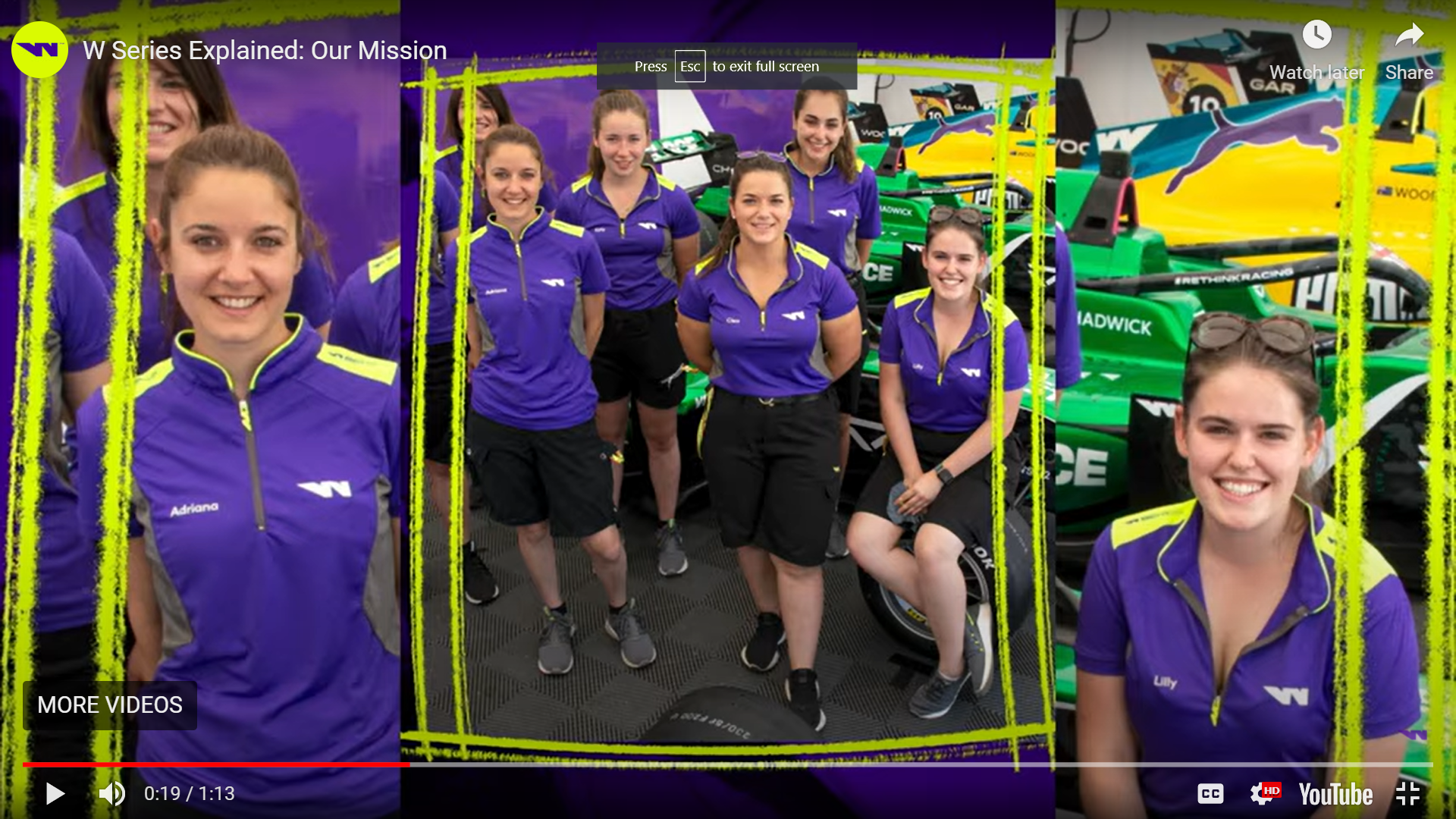
After showing this statistic it displays different pictures of the participants from W Series while saying “we believe that W Series can be an important cultural catalyst for female empowerment.” This section of the video functions to advertise why its mission is important not just for motorsport, but for women in sports as a whole.

After that, a graphic of the word “breaking down” is shattered into pieces, showing that W Series aims to be unrestrictive for female participants to enter. The video says that W Series is a free-to-enter championship to give every entrant an equal chance.

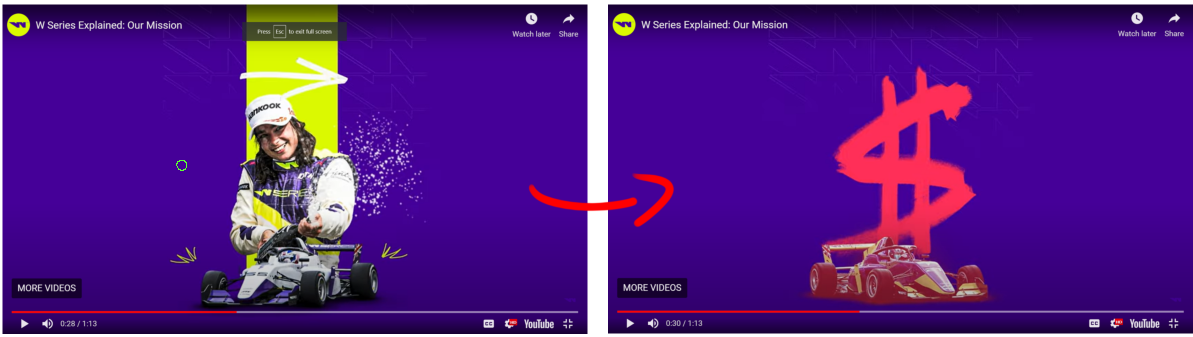
This is followed with an image of the reigning W Series champion, Jamie Chadwick, spraying champagne, followed by a dollar sign above a W-Series car, representing how the series is won by the driver with the most talent, and not those with the most financial backing.

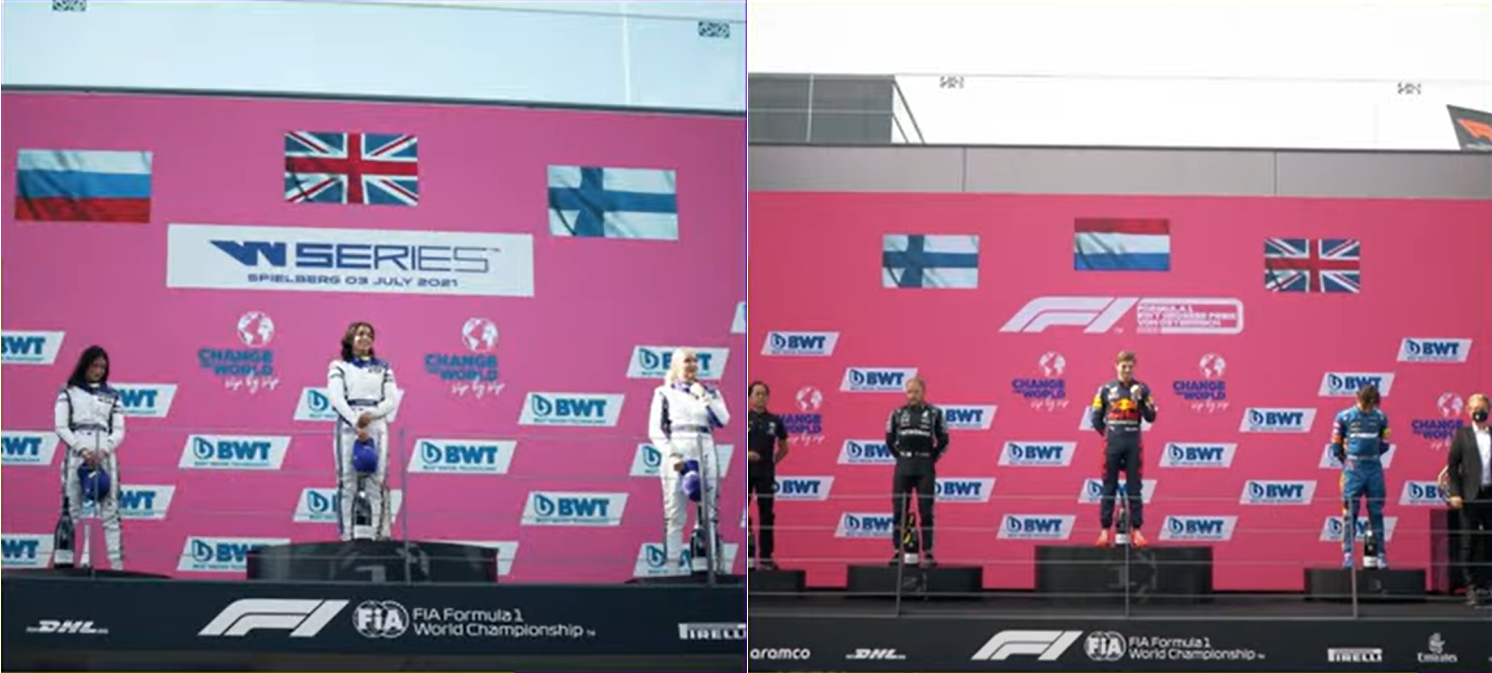
Another key point illustrated by the video is when it first shows an image of a podium ceremony from W Series, shortly followed by one from Formula One. Displaying these images, the video emphasizes how its goal is to have “female and male racing drivers compete on equal terms.” It is clear that one of the goals of W Series is to bring women in the top levels of motorsport along with men.

The final main point shown by this video is when it shows pictures of young girls driving go karts, saying “we want to inspire young girls at grassroots levels by highlighting today’s generation of talented female racing drivers.” With these images, the video is making it clear how there is a future generation of female racing drivers waiting for their big break in motorsport.

The video ends with the message “some say it’s a long road, but we’re in a hurry to get there” as a W Series-spec car drives off into the distance. This concluding message shows that W Series aims to achieve its goals as soon as possible, to ensure that Women have a place in motorsport.

This video overall has effectiveness telling its mission through its graphics and narration. The graphics displayed in the video match with messages being said by displaying easy-to-understand icons and images along with the commentary. To casual racing fans, this video does a great job delivering its message to argue that women can compete in motorsport. However, to more invested racing fans, including myself, W Series’ limitations for its goals can be easily recognized when examining other racing series that the sport intends to influence. W Series succeeds by allowing women from different backgrounds to compete in the series. However, W Series fails to solve the problem most women face when trying to compete outside of W Series. This is crucial since the ultimate argument of this video is that women have the chance to compete with men at top-level racing. While W Series itself may be inclusive, other racing series, particularly the ones it feeds into, are not. The main issue is that motorsport is very reliant on money, and in some cases, favors funding over talent. To enter in Formula 3, you need around €500,000. Even if you had financial backing from driver academies, it is very rare that they would completely cover the cost. In W Series, you are awarded €500,000 in prize money if you win the championship, which should just cover the cost to enter in Formula 3. For example, Jamie Chadwick had to return to W Series for a third season because she cannot secure funding for a seat in Formula Two or even Formula Three.

 W Series aims to solve a problem that motor racing has faced for decades. It attempts to allow women from different backgrounds to be given the opportunity to enter in the highest level in motorsport. While W Series is taking a step in the right direction, it fails to achieve its goals due to external factors. Motorsport categories outside of W Series are still very much elitist, favoring mostly to male drivers with a decent amount of financial backing. If the ideas that W Series implements do not carry over to other motorsports, then inclusion of women in motorsport may still be hard to achieve.

Source: https://www.youtube.com/watch?v=sDDadLGOjUE

Mocking Ye’s Muse: How Memeifying Voices Threatens the Security of Women

If you’ve been on TikTok in the past week, you’ve most certainly heard the voice of iconic actor, artist, socialite and former dominatrix Julia Fox explaining how her role as director Josh Safdie’s muse for the film “Uncut Gems” compares to her relationship with Kanye West. Fox was recently the guest on Alex Cooper’s podcast, “Call Her Daddy,” where she spilled the tea on her (now former) relationship with Kanye, participation in sex work, and dived into sensitive topics of substance abuse, sexual assault, and her upbringing in the East Village. Immediately after the release of her podcast episode, TikTok was blowing up to the tune of Fox’s unmissable vocal fry and uptalk, pronouncing “uncut gems” as “uncut jaaams.” Countless celebrities, social media influencers and small creators have been using her voiceover in their own videos, poking fun at Fox’s voice and statement. 

Specific clip of the “Call Her Daddy” interview promoted by Spotify’s TikTok Account

As someone who has always been told my voice is too “feminine,” too “gay,” I argue that turning someone’s voice and pronunciation into a punchline is not only hurtful, but typically reinforces sexism and homophobia. Vocal iterations are a critical identifying variable of our gender and ethnocultural perception by others. If you hear a voice without any context, you may subconsciously identify that voice with a specific gender, sexuality, race and class. In our perception of others’ voices, we tend to make large assumptions about their background and experience. These assumptions are the foundation of stereotyped accents. People love critiquing others’ accents. There is a phenomenon, an obsession, with contrasting British and American or Northern and Southern (USA) accents. There exists an eroticization of voices which are unique or different from one’s own. This fascination creates space for judgment and assumptions about one’s character, experience and background. Ultimately, for feminine-presenting folx, voices are hypersexualized and criticized. Fox’s vocal fry is one example of a vocal iteration criticized for its perceived sensuality and ignorance. Vocal fry and uptalk are typically associated with the “valley girl” accent and stereotype made famous by the Kardashian family. Young women predominantly use vocal fry and uptalk either due to environmental vocal influences, cultural choice or due to social inhibitions. Due to the patriarchal structure of society and a history of mansplaining, women often end their statements on a higher register, as if they are asking a question. In our society, women ask the questions and men know the answers. (sidenote: In highschool, I recognized the same occurrence in my voice when my Debate coach suggested that I had a slight British accent. I associate my uptalk with an upbringing of patriarchal mansplaining in my family and community and people questioning my sexuality and masculinity. I always had something to prove and was therefore never sure if I was hitting the nail on the head in my statements.)

Compilation of TikToks using Julia Fox’s voice

While the Kardashians are a brilliant, iconic, hard-working group of women, criticism of their “lack of talent,” perceived lack of intelligence and media-espoused hyper-sexuality have created a harmful association between them and the Valley Girl. Youtuber “marinashutup” explains in her video for Everyday Feminism, “Why do Women Talk Like Kim Kardashian?” that women who use vocal fry are perceived to be less educated, gold diggers or reliant on “daddy’s money” and unprofessional. This vocal stereotype has harmful implications for feminine-presenting folx. According to the same video, a study by Duke University found that employers are 86% more likely to hire a feminine-presenting candidate without vocal fry than a candidate with vocal fry. This statistic shows how assumptive people are towards other’s voices. When this level of discrimination exists against predominantly young, white women, the implications of vocal discrimination across racial and class categorizations is likely to be significant. 

Video for Everyday Feminism about vocal fry and uptalk

Turning vocal fry into a meme reinforces the idea that these vocal iterations are nothing more than a joke and that the words they carry are insignificant. The popular focus on Fox’s vocal fry has left her experiences and emotions to be nothing more than a TikTok meme. This suppression of intelligence and valid experience is universal for people with vocal fry and uptalk. As a result, life-threatening incidents of sexual assault which disproportionately threaten women go unbelieved. Additionally, knowing that they are unlikely to be believed, people with vocal fry and uptalk are discouraged from reporting violence against them. Fox speaks about this experience in “Call Her Daddy.” After coming out that a former romantic and business partner had sexually assault her at his nightclub, many of her friends and those in her community of the Lower East side did not believe her. She remembers being called “dramatic,” a typical stereotype of the Valley Girl vocal fry. Fox recounts the second time she was assaulted, but still today has not identified her attacker. She blames her experience the first time with her inability to come out after the second. This is a blatant example of how women are so often discouraged from reporting sexual violence. It is empowering that she was able to defend herself the first time, but when her community turned their back on her voice, she was silenced.

“Call Her Daddy: Julia Fox [VIDEO]” exclusively on Spotify (Video may require Spotify Premium)

Do Pelotons Lead to Even More Insecurity?

When Peloton dropped a holiday ad right before Christmas 2020, they expected it to be received as an ad showing a husband gifting his wife a Peloton bike for Christmas because he loves her. However, Peloton received major backlash for their commercial, as it was received in the complete opposite way that it was intended. 

Snapshot from the controversial Peloton Commercial

The commercial starts off with a man gifting a woman, who the audience can assume is his wife, a Peloton exercise bike. When she gets onto the bike she says, “A little nervous, but excited. Let’s do this.” The commercial then shows the woman doing daily Peloton sessions and taking selfies and videos during every single one, while also explaining how she is surprised that she has been doing it everyday (and even getting up at 6 a.m.). As evident from the photo above, there is a constant look of fear in the woman’s eyes. She is also very obviously grimacing, which suggests that she is uncomfortable. She looks scared that she is not going to get approval from her husband if she does not use the bike he got her, so she makes sure to document the whole process as proof. She does not look excited about the bike, and looks like she is being forced to exercise. Because the commercial was not understood by viewers as the creators intended it to be, the grimace on the woman’s face heightened the negative parts of Peloton.

For the whole commercial, she is unsure, timid, and shy, all while acting like she needs approval from her husband (which is why she started the workouts in the first place). The commercial pans to an instructor shouting her out and the woman saying “She just said my name!” All of these clips are then compiled into a documentary that the woman created to show her husband how grateful she is for the gift. She thanks him by saying, “A year ago, I didn’t realize how much this would change me. Thank you.” 

The controversy within the commercial comes with the claim that it’s sexist. The husband wanted his wife to get in shape so he gave her a peloton to “force” her to work out, and then, when she shows him the final video, he looks satisfied with the transformation. The other controversy within the commercial is how the woman is portrayed. There are many scenes in the commercial where you can see her big eyes with a look of fear in them. She is constantly taking videos of her on the Peloton to prove to her husband that she is using it, while also saying that she is surprised that she is still going, which means that she is feeling the effects of working out and is exhausted. At the end of the commercial, she compiles her videos to show to her husband. After her husband sees the video, he just gives her a smile and no other words of affirmation.

This Peloton commercial and its choice of actors proves further stereotypes and standards that society places on women. At the beginning of the commercial, the woman was not working out and was surprised to get a Peloton, which is obvious through her surprise when her husband gifts her one. She was timid while working out and is still timid at the end when she shows her husband the video that she made. The woman in the commercial is also already a healthy weight. She is what society would consider “skinny,” and society believes that if a person is skinny, they are healthy. However, she is still seemingly forced to work out by her husband, which further supports the impossible standards that society puts on women’s bodies. Women will never be able to achieve a “perfect body” and will always feel like they have to work to achieve a body that others will find attractive, even when they are already at a healthy weight.

The commercial also completely skews why people decide to workout. The Peloton commercial portrays the woman as only working out because her husband thinks that she should. When she starts using the Peloton, it’s obvious that she is “out-of-shape” and trying to get into a schedule for working out. She is trying to figure out how to use the bike, while also visibly struggling in all the classes. It makes it seem like she is doing it for him, and not just for herself.  While some women work out because they want to change their appearance others workout because it helps their mental health. This Peloton commercial puts forward many toxic ideas about women’s workout culture. 

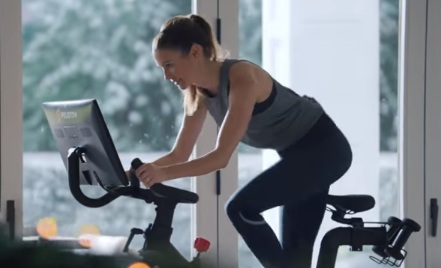
Snapshot from another Peloton Commercial

The previously mentioned ad is not the only problematic ad that Peloton has released. The majority of Peloton commercials are considered controversial. Peloton creates their ads to be targeted towards a certain demographic, which is the group of people who can afford a fifteen hundred dollar exercise bike. As evident in the photo above, Peloton commercials almost always include a skinny woman on her Peloton bike, which has a designated platform in her well-decorated house. The snapshot above includes a thin white woman on her bike in front of a wall that is all windows, which can lead a viewer to infer that she is well-off. Peloton’s CEO John Foley even said that Peloton’s target demographic are “people who have children, live in suburbs, have nice homes, they have the money and space but don’t necessarily have time.” The majority of people in the commercials are also white. All of these factors put forward an unrealistic expectation of what people’s peloton experiences are going to be. It also gives off the impression that everyone riding a peloton has to be a “put-together rich person.” This is further complicated by the majority of the commercials including white people. Does this mean that Peloton’s vision of a “well-off” person is a white person?

Broadcasting exclusively skinny women working out can make fat people feel like a Peloton is not meant for them. It can also create unrealistic body standards for people working out on Pelotons. If Peloton is broadcasting skinny white women as the ideal Peloton users, other Peloton users could use this as unrealistic and unhealthy goals that would turn their workout journey into more of a “self-hate” journey than a “self-love” journey, all while trying to get their bodies to look like the ones they see in commercials. 

Peloton tries to put forward a “life-changing” experience with their workout machines, but they are not successful– but this could all be part of their marketing scheme. Leaving viewers feeling insecure and feeling desirous can lead to more business for Peloton. Their commercials leaves viewers feeling insecure about their own bodies and workout routines, all while projecting harmful ideals about body types, along with certain demographics of Peloton users. 

References:

Peloton Commercial: https://www.vox.com/culture/2019/12/3/20993432/peloton-new-commercial-horror-movie

CEO Quote: https://www.cnbc.com/2016/01/08/pelotons-race-for-home-cycling.html

Photos: https://www.vox.com/culture/2019/12/3/20993432/peloton-new-commercial-horror-movie

Peloton Commercial Song – Indoor Exercise Bike

Is Vogue Still Setting Unrealistic Body Standards or Breaking Them Down?

Vogue’s “What’s Changing About Fashion’s Relationship to the Body?” featuring Kim Kardashian who talks about the negative comments she has heard about her body both in person and on social media.

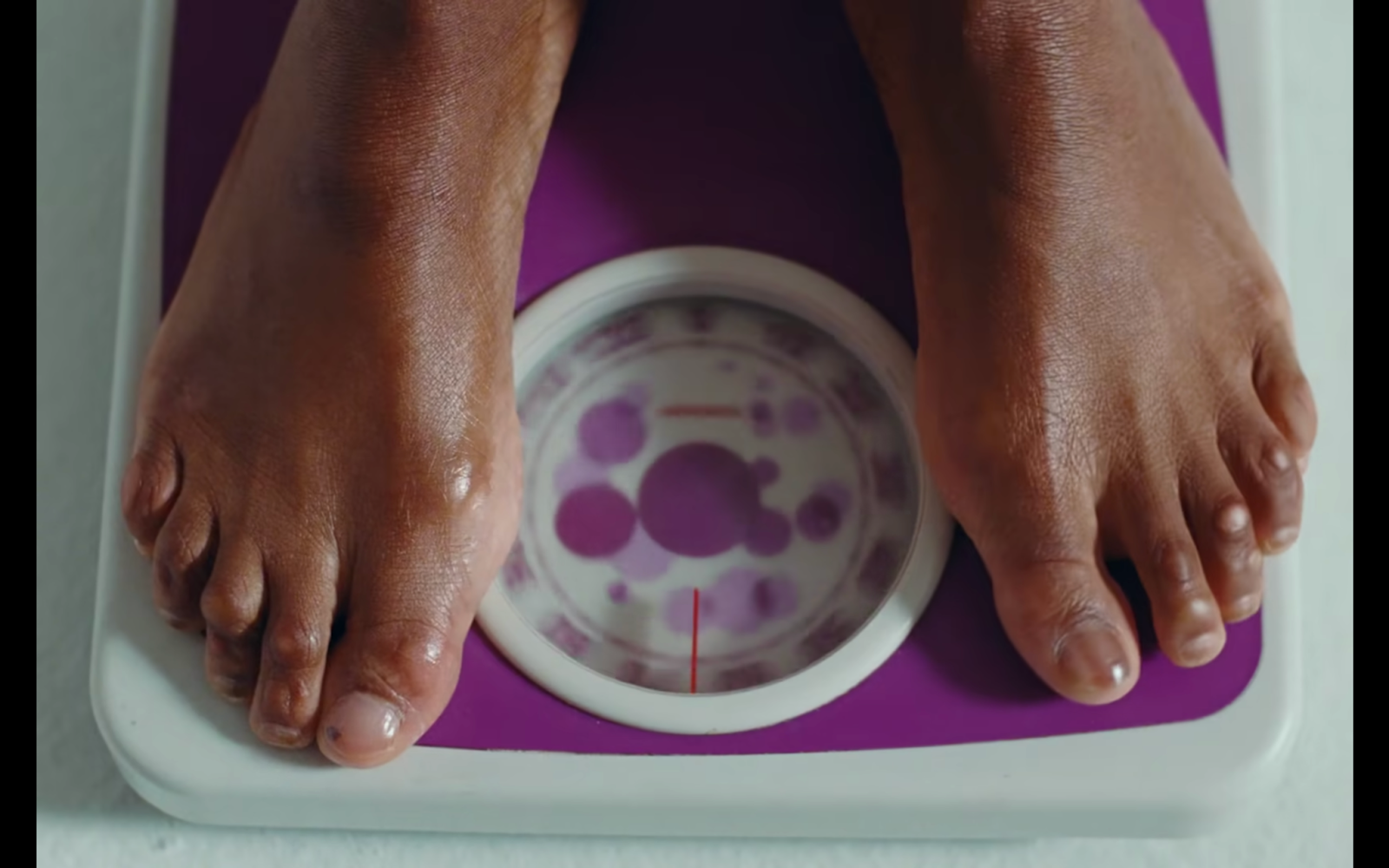
One of the most prevalent issues within the fashion industry is its lack of diversity. Lately, I have been seeing more and more online content discussing this topic. Among this content is a Vogue video I found on Youtube titled “What’s Changing About Fashion’s Relationship to the Body?” The three minute video stars pop culture phenomenon Kim Kardashian alongside other successful female-identifying models of various races, nationalities, sizes, and ages. There are various shots of the models throughout the video as they offer overlapping commentary on their personal experiences loving and owning their bodies. Of course, the video is well-directed and entertaining through its editing and background music. It captures the challenges of finding self worth and confidence in an industry that has set impossible beauty standards not only through discussion but through visual cues. We see scenes of women exercising and weighing themselves whilst hearing the models talk about the negative body shaming they have faced. Historical female sculptures are shown in a probable effort to depict the everlasting beauty standards for women. Vogue clearly wanted to promote body acceptance through this video though there are several ironies that belittle its goal which commenters are not afraid to share. 

Screenshot of a woman weighing herself on a scale while models talk about the body shame they have received.

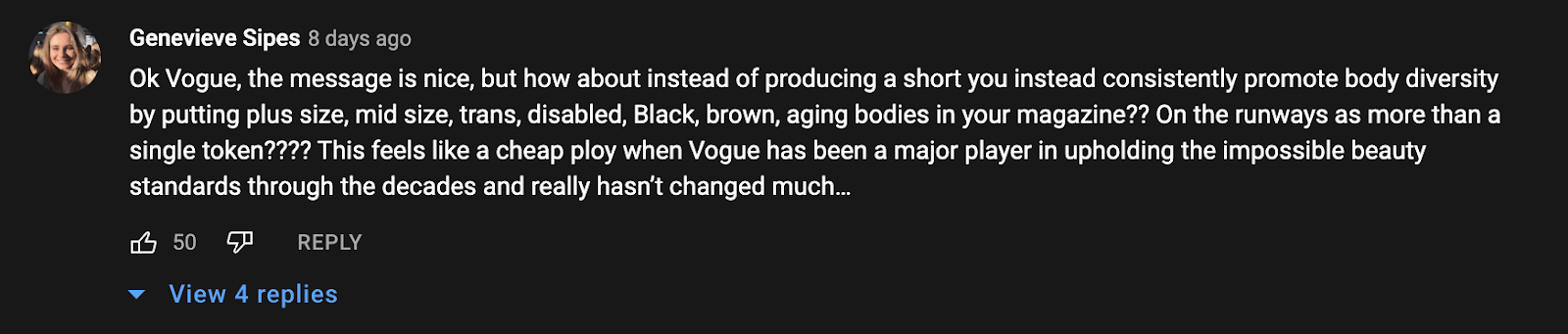
First of all, Vogue is a major contributor to the beauty standards set by the fashion industry. They have taught women that in order to be pretty and fashionable, they must be unattainably skinny and have flawless skin. Many commenters on the video echo this feeling as they reveal Vogue is in fact partially responsible for making them feel uncomfortable with their own bodies. One commenter points out that while the magazine is trying to reverse some of its past mistakes by capturing different bodies, it is not enough. If they want to change the narrative, they have to do more. The company definitely has the power to do so as Vogue is the epitome of fashion for many people. Vogue thinks so too as the “About Vogue” reads “Vogue is the authority on fashion news, culture trends, beauty coverage, videos, celebrity style, and fashion week updates.” They could use their power for good and create a new standard that every body is beautiful. 

The video was not received well not only because it was created by Vogue but because it featured Kim Kardashian. Like Vogue, Kardashian herself has set unrealistic body standards. While Kardashian just as rightly deserves to own her body like anyone else, commenters take issue with her being in a video alongside other women who have battled the beauty standards, not created them. Kardashian readjusts her pose in a short clip and asks if  “this looks good.” Kim Kardashian trying to look her best in a video promoting body authenticity and acceptance makes Vogue’s intentions seem fake. They could have easily made this video without Kardashian, which would have generated more positive reception. Instead, they likely added her to reach a larger audience and generate more profit. It seems like Vogue’s real goal was to appear politically correct whilst making money. Yet, they do capture many other models besides Kardashian who have faced struggles loving their bodies. But does this diverse cast of models appear on the runways too?

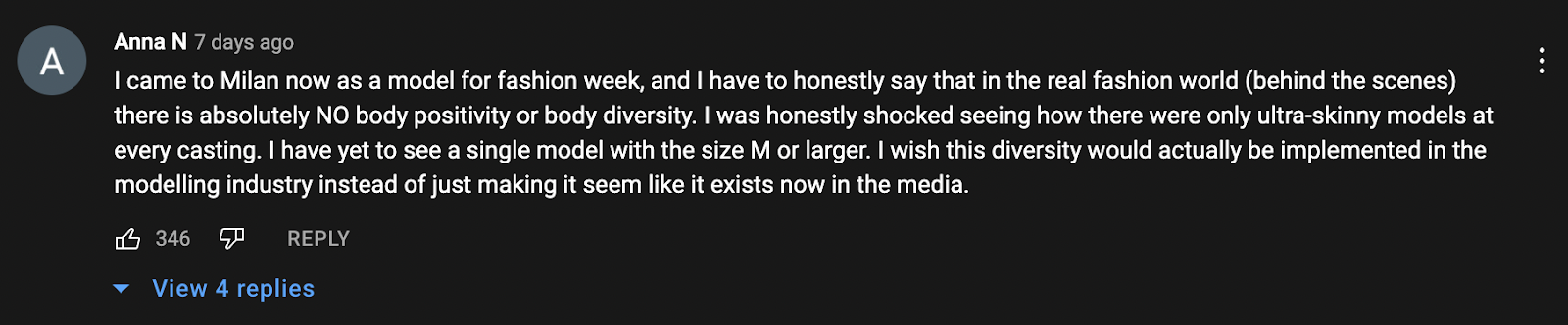
Another commenter who claims to work in the modeling industry argues that this diversity in the video is nonexistent in the actual industry and only appears in the media. I find this fact unsurprising as it’s easy to create the false appearance of something. Despite all the pushes towards diversity, the fashion industry is changing at a slow rate. Vogue doesn’t completely overlook this notion, writing that “body acceptance is a long and winding road” in the description box. They may be trying to suggest that the industry has a long way to go before it is inclusive. Nevertheless, it’s probable that the diversity on screen is mostly absent in real life. 

The video sparked major debate among viewers for good reasons. Others interested in social justice would likely agree with me and the other commenters. It is hard for an audience to watch a video produced by a company that lowered their self-esteem in the first place and celebrate them. Although, I believe Vogue had good intentions. They are making an effort to rebrand themselves and pave the way for increased body diversity in fashion. Obviously, it will take more than a three minute video to achieve this goal and after a bit more research, I found other online content that Vogue has published surrounding body inclusivity. However, none of it avoided criticism including their March 2017 cover on Modern American Women that was criticized for not being diverse enough. It featured seven light skinned models including one plus size model. If they have faced this kind of scrutiny before, I have to wonder whether they expected the same comments or praise for their efforts to celebrate body diversity. Did they want to be celebrated for including models of all backgrounds instead of the usual suspects like Kendall Jenner or Gigi Hadid? Are they trying to forget their damaging past? Perhaps, by continuing to produce more inclusive content, they hoped to show their commitment to body diversity. Nonetheless, this video, various articles, and magazine covers act as baby steps towards a future with representation for all shapes and sizes. Just like many other companies in the fashion industry, Vogue has a long way to go with much more to learn. 

References

Torgerson, Rachel. “Vogue’s ‘Diverse’ Cover Slammed for Not Being Diverse Enough.” Cosmopolitan, 9 February 2017, https://www.cosmopolitan.com/style-beauty/fashion/a8696839/vogue-march-2017-cover-controversy/.

Sister Cindy’s Shaming: Funny or Harmful?

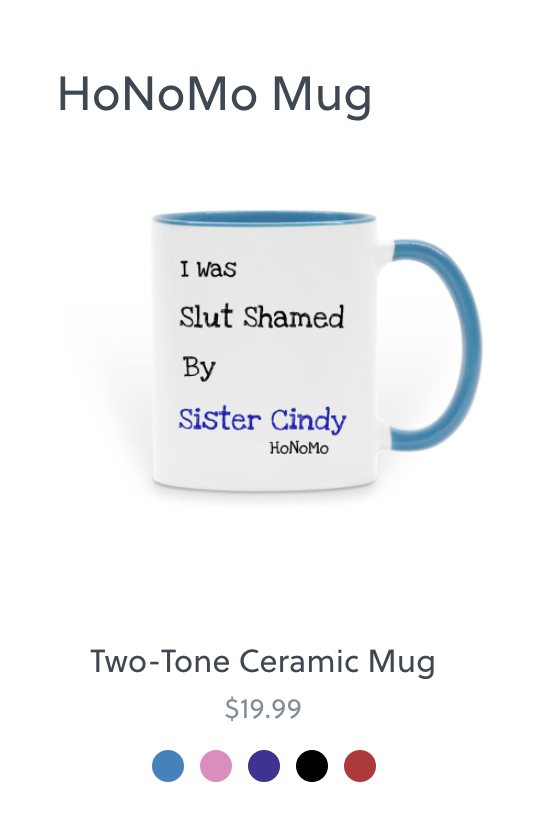
Cindy Smock, or “Sister Cindy” as she calls herself, is an Evangelical campus preacher turned Tik Tok user. She first gained attention when college students posted clips of her speeches on Tik Tok, inspiring her to make her own account. She currently has over 370,000 followers, and #sistercindy has over 194 million views (Fowler). The main subject of her Tik Tok content is encouraging college students, particularly women, to turn to Christianity and be a “ho no mo.” In many of the videos she uploads, she welcomes viewers to “Sister Cindy’s Slut-Shaming Show.” While many of Sister Cindy’s followers regard her as a comical figure, the shock factor she employs in her preaching through homophobic and misogynistic comments is harmful. 

Through a glance at Sister Cindy’s Tik Tok account, it is evident that her content is misogynistic and demeaning towards women. In nearly every video she uploads, she casually uses the words “slut,” “hoe,” or “thot,” as insults towards women. For example, when visiting college campuses, she often changes the names of the universities to incorporate the word “slut.” At the Louisiana State University campus, she renamed the institution, “Louisiana Slut University.” By insinuating that college students are sluts, Sister Cindy is weaponizing the word to be used against women and normalizing the slut-shaming that is common in society, particularly on college campuses. However, Sister Cindy is proud of her slut-shaming tendencies and makes it a common theme in her posts. In a different post filmed by a college student, she exclaims, “You are princesses made in the image of God. Yet, you’ve traded your crown to be a cock-sucker.” This is quite the opposite of sex positivity and guilts women into practicing abstinence. Sister Cindy, or anyone for that matter, should never use guilt tactics to influence other people’s lives. Furthermore, why is this hateful comment only directed towards “princesses,” or women? Why is it that women should feel guilty for engaging in consensual oral sex and men should not? Last I checked, oral sex is an act requiring at least two people. 

https://www.tiktok.com/@maraudwh4re/video/7067272503181364526?_t=8QEQwcooDyV&_r=1

Another example of sexism in her uploads is found in a Tik Tok filmed by a student at the University of Florida. In this clip, Sister Cindy shouts, “Men, if you buy her one margarita, she will spread her legs.” This statement is incredibly insulting towards women. Not only does it perpetuate the view that women are sexual objects, but it also furthers the entitled belief held by some men that women are sexually indebted to them after buying them a drink. In addition, this comment is heteronormative and leads straight men to assume that all women are attracted to them and want to have sex with them, which is simply not the case. Finally, similar harmful views were expressed in a Tik Tok clip of Sister Cindy telling a college student that she is “an accessory to the rape crime on campus” because she is causing boys to get their “passions stirred up” (Fowler). This belief is so inherently false, that it should not require any explanation. The blatant disregard for holding men accountable in situations of sexual assault is destructive to anyone who views this post. It reminds me of the common argument in society that someone is “asking for it” based on the clothes they are wearing. Placing blame and guilt upon women seems to be a common theme in the media posted by Sister Cindy. Again, why is it that sexual assault victims should feel guilty for something that is out of their control and not their fault? 

If you thought her content could not get any worse, we have not even analyzed the blatant display of homophobia present in countless Tik Toks. For example, in one clip while preaching to college students, she orders, “Don’t do it. Don’t kiss a girl and like it.” In defiance of her hate speech, two women make their way through the crowd to kiss in front of Sister Cindy’s platform. Apparently, the act of two women kissing is a difficult sight for Sister Cindy, because she has to cover her eyes. In a second Tik Tok, Sister Cindy, with no shame, shouts to a young man walking past her, “Are you a homo? You kinda act a little effeminate there. You need to repent!” There are so many problems with this statement, it is a challenge to decide what to unpack first. To begin, a straight, cisgender person should never use the term “homo” to describe someone of the LGBTQ+ community. Second, Sister Cindy is reinforcing the societal gender expectations that men cannot be feminine and women cannot be masculine. And if that is the case, then that person must be a member of the LGBTQ+ community. Finally, telling someone that they need to repent because of their sexuality, something that is out of their control, is unacceptable. Religion should never be manipulated to discriminate against groups of people. People’s sex lives and sexuality are an intimate part of their lives and should never be a subject of criticism. Therefore, someone who posts homophobic content, like Sister Cindy, should not have a platform to project those hateful beliefs. 

To reflect, one’s values and beliefs should never be used as a weapon or a way of guilting others into adopting those practices. While Sister Cindy’s intention may be to educate college students, her comments are misogynistic, heteronormative, homophobic, and may even be classified as hate speech. Sister Cindy even admits that she expects to be removed from social media for her problematic comments (Fowler). If that is the case, what is Tik Tok waiting for?

Works Cited

Fowler, Kate. “Who is Sister Cindy? Evangelist Christian Preacher Turned Tik Tok Star.” Newsweek, 6 June 2021, https://www.newsweek.com/who-sister-cindy-evangelist-preacher-tiktok-star-1597651. 

I love this post and how it highlights the way that people will oftentimes use comedy to hide rhetoric that is actually very harmful. Although Sister Cindy is oftentimes funny, she’s still promoting a toxic culture that prevents women from embracing their sexuality. This is a super important topic and I’m glad that you’re shedding light on it!

Media Analysis: Pre-Columbian Vessels

Wearing Peru’s national soccer team’s shirt, Moche district’s mayor Arturo Fernández smiles for the camera. Behind him, a red statue of a man raises his left arm in a fist. The red man sits in a cubic-like structure of the same colour, decorated with cream-coloured, geometric shapes. The statue has long hair and a white, large smile that looks more like just showing teeth than showing happiness. He wears a cylinder-shaped hat and big, circular earrings. Most surprisingly, apart from this, he is naked and his left arm holds his erect, disproportionally big penis, which rises diagonally to the same height as his nose. 

The statue was put in place in Early January 2022, in the district of Moche, Northern Peru.  Peruvian media and social media users got really engaged in a debate around this statue, which got coverage by newspapers, TV, streamers and, of course, social media users who did not wait to circulate memes about the statue. As a large-scale representation of Precolumbian vessels from civilizations that lived in the area between the II and VIII centuries, the statue would not have attracted as much coverage if not for one feature: The statue represents an erotic vessel characterised by an oversized, erect penis so big that, as the media put it, you can see it from kilometers away. In less than two months, since its inauguration in January, the statue has been vandalized, burnt down, and restored. For me, and probably for many other Peruvians too, this was sadly an expected reaction in a country as conservative and puritanical as Peru. 

While the debate has raised important observations about Peruvian society, it quickly became a two-sided, moralized argument. One side calls the other pervert and immoral, and advocates for the removal of the statue. The other side responds by calling them prudish, and archaic, and fuels the debate even more with happy pictures next to the statue to “challenge the conservatives.” But maybe the heat of the debate can interest us all in understanding more about these vessels and raise questions about Peruvian society too. 

What are the erotic vessels?

Most civilisations that inhabit what is now Peru between the II and VIII centuries developed pottery techniques that allowed them to produce pottery for daily use and for other purposes, such as religious and spiritual rituals. Notably, the Moche civilisation stands out for the realism and variety of techniques that were innovative in their times.

The erotic vessels were pottery pieces especially dedicated for religious purposes. As a farming community, the Moches centered their worldview around farming activities. Their calendar, visual representations, tales and oral traditions, rituals and religion were deeply connected to agriculture. Sex was also an activity connected to the fertility of the land and the production cycles. The erotic vessels are precisely a representation of this worldview. The vessels represent how different sexual acts were used to call for rain and good soil. 

Our bodies

The techniques used to model the vessels were as advanced as the Moches’ knowledge of the human body. The detail and genius to represent the human expression and body, including the genitalia, are a reflection of a different view of the flesh. The human body was seen, explored and represented without the shame that in our society we express between ourselves and our bodies. 

French philosopher Michael Foucault denounces the medicalization of the human experience. We give doctors almost full power to access our bodies, to tell us what is wrong with it. However, outside the medical practice, we punish the exploration of our own bodies. Outside a course of anatomy or biology, our bodies are kept distant from us, as the unexplored and not-to-be-explored territory. As a society, we effectively impose rules on how the body is to be explored, understood and taken care of. 

If we, as the Moches did, had a worldview that connects sex with the agricultural calendar, the dead and the gods, then we would have a very different set of rules to explore our own body in modern times. Surely our current view would be a less puritanical, prudish, guilty view of our physicality; however,  this does not mean we should advocate for Peruvians to return to a Moche worldview. Just as Foucault does not take a side with either the modern over the older worldview, I am not trying to advocate for the Moche’s over the modern worldview either. Instead, I am suggesting our relation to our own body is heavily regulated by our worldview, and people should view themselves in this context. 

Why does this matter? 

Going back to the debate around our phallic Moche friend, I try not to take a side with any of the two rivals. I am surely not suggesting to go full Moche worldview-lifestyle. This would be imposing another set of rules, with their own set of problems and complexities. It would also be practically impossible considering that our colonial history meant a witch hunt against indigenous worldviews and traditions. Instead, I am suggesting we stop for a moment and question whether the repressor can be ourselves. So far you may have thought that it is the others, the powerful, the majority, who impose a morality on us. But don’t you police yourself all the time? Don’t we follow rules for how our bodies ought to be explored, understood and treated just because we have been taught that? Why do you feel guilty when you break the rules? Where do the rules come from? 

So far, each side has become the perfect villain for the other. There cannot be conservatives without liberals and the way around. But if we are teaching our children rules, and if we are vigilant if our neighbours are feeling guilt for even thinking of breaking the rules, it sounds to me like we are the enemies who actually made it inside our homes like Foucault suggests. Insofar these rules are going around totally unquestioned, insofar as we police whether everyone meets the rules, we will be walking around with no certainty that we ourselves are not the repressive enemy. 

References

Museo Larco

Michael Foucault, The History of Sexuality, 1979.

Janus Woloszyn and Katarzyna Piwowar, “Sodomite, Siamese Twins, and Scholars: Same-Sex Relationships in Moche Art,”  American Anthropologist 117, no. 2 (June, 2015). 

Óscar Paz, “Atracción, polémica y hasta disparos por la estatua de un Huaco Erótico en Trujillo” (El Comercio, 2022).

Can Society Really Determine Perceived Genders?

Mastermind magazine produced this image of Willow and Jaden Smith in the 2019 fall issue. Mastermind magazine releases bi-annually and focuses on current events and attitudes of the younger generations. It is a space to be creative and display a range of talents and people. The intended audience ranges from young adults to millennials. This exclusive magazine was founded in 2017 and is available for purchase online and paperback. They chose to include Willow and Jaden in the 2019 issue because of their impact on gender expression, unique styles, and confidence as individuals. Willow and Jaden both actively participate and advocate within queer spaces. They also have developed into queer fashion, music, and film symbols. Willow and Jaden reinforce that beauty, individuality, and confidence does not have to fit into the narrow boundaries of what society portrays as normal and abnormal. As young, black, queer adults, Willow and Jaden represent the positive ways non-conforming people can live in our nation. As the younger generations become more accepting and educated on topics of gender and sexuality, we come to realize that beauty and gender have no particular features, shape, or color, and Willow and Jaden depict this with no remorse. The photograph from the magazine presents a symmetric reflection of Willow and Jaden gazing upward, hands identically pressed to their cheeks. They are challenging this notion of physical difference between men and women. If one did not know the Smith siblings prior, would the gendered differences be obvious? I believe this is the question they are forcing the audience to reconcile with and reflect on. This photograph examines the viewer’s bias and understanding of how gender functions as invented categorizations to divide people. 

Although intersectionality of gender and race play into the lives of Willow and Jaden, it does not consume this photograph. As a person of color, perhaps I brush over the fact of their blackness when gazing at the photograph, or perhaps it was looking for an intentional gender-directed reaction. However, I want to acknowledge the intersectionality in this photo as another product of social construction that produces real consequences. Willow and Jaden also come from a previously wealthy family which contributes to their success and ability to be openly unique individuals. Intersectionality plays an important role when discussing aspects of gender and sexuality because it often influences and dedicates the way we interact with it.

Willow and Jaden break down the gender norms and stereotypes associated with the binary in the photograph. As Jonathan Van Ness explains in his Netflix special, Can We Say Bye-Bye to the Gender Binary, gender is performed and enforced in society. This can be seen through the segregation of colors inflicted on people in society. Jaden projects a commonly feminine look with his pink eyebrows and hair. In the context of public expectation and presentation, blue is typically for boys, and pink is for girls. Pink has not always been associated with femininity. Pink was more of a boy’s color, if a gendered color at all, in the late 19th and early 20th centuries. People dressing in gendered clothes is a relatively new invention. Jaden proves in this photograph that people can dress, alter, and perform gender in any way they choose. It also connects deeper to the ideas of how the binary should project and display itself. Men are supposed to be tough and masculine whereas women are soft and emotional. Jaden and Willow’s gazes are identical with soft, innocent-like features. Neither of them is visibly wearing makeup, contributing to the vulnerable look. They both wear rings in the photo, revealing that jewelry does not belong to a singular gender. Willow does have earrings and a nose piercing, however, this just means that every individual is different. It is celebrating diversity, preferences, and choices between human beings. Willow Smith wears a similar short hairstyle to Jaden further breaking down the ideas of what is supposed to be masculine. Society loves to associate female beauty with hair, but Willow shows that beauty exists beyond long this. As Lorber explains, “​​For the individual, gender construction starts with an assignment to a sex category on the basis of what the genitalia look like at birth… A sex category becomes a gender status through naming, dress, and the use of other gender markers” (Labor 55). Gender is not determined by biological or psychological differences. There are no features that accurately reproduce the binary, but instead, it is a construction of our surroundings, interactions, media depictions, and upbringing. This calls to question the title of this photograph. If their names were not written across the page, neatly drawn into their boxes, would it be obvious which image was Jaden and which one was Willow? In a way, it feels as though the magazine wants to be progressive, but not to the extent of complete freedom. If the magazine did reject all gender norms, it would not have placed the lettering where it did. Alternatively, it could simply be educating viewers who are unfamiliar with the Smith siblings. There are multiple ways to interpret the purpose and placement of the title. 

Willow and Jaden Smith have become icons of the younger generation for their confidence, identity expression, and talent. Mastermind magazine exhibits Willow and Jaden’s beauty and originality in this edition. The photograph calls to question our notions of gender and forces us to reconcile with our constructed worldview. The upcoming generations are more and more open to diverse gender expressions, giving me hope that many adolescents looked to this photograph as inspiration, not with hostility. 

Non-product day reflection

When I went to sleep the night before I told myself “Tomorrow is no-product day,” but it was not until the professor mentioned it the next morning that I realised I was supposed to be doing the challenge. I went through my morning in my mind: “woke up, brushed my teeth, had breakfast, went to class.” Not a single product, I don’t even comb my hair. 

“I’m doing great” I thought, but as the morning progressed I had to repeat the exercise over and over. I would remember that I was supposed to be doing the challenge, panic about it, go back through my day until my last check-point. And still nothing, not a single product. It was not until that night when I decided to use body wash for my hair as well, which is supposed to work just fine but not leave my hair as soft as my shampoo. 

In retrospect, the challenge was not hard at all. It was the thoughts that came after that bothered me. Am I investing enough in myself? Do I need to buy something for my skin or a comb for my hair? All this brought memories back when I decided to stop using deodorant in high school but for the summers. But also made me ask about the other face of the coin, what if I actually liked make-up, hair products, perfumes, etc.? And there is the conflicting thought: Do I not use enhancement products out of pragmatism? (That is not using them because I’m just being me) Or are those preferences not the result of growing up in a society that punishes in men all enhancements, even self-care?

Theory to Praxis: Combatting Period Poverty at Davidson and in Charlotte

One public health issue that falls within the realm of gender and sexuality studies -particularly reproductive justice- is period poverty. Insufficient access to menstrual supplies or environments that allow safe changing of products means that people who experience periods face additional challenges to their everyday hygiene, which has a direct impact on other aspects of their life. For example, a survey of U.S. teens found that 4 out of 5 individuals “either missed or knew someone who missed class time because they did not have access to period products” (Capozzi). In addition to encompassing the lack of menstrual products available to people that need them, the term period poverty also references the lack of health education because of stigma around periods, lack of funding and resources, or other reasons.

Period poverty is often cited as an issue for developing nations, and while this is true, it is also a pervasive problem for people in many situations where their needs cannot be met. Not everyone who needs period products is a woman, but since they are marketed towards women, they are unnecessarily expensive (llano). In the United States, this means that people living in poverty or experiencing homelessness are especially susceptible to period poverty. It is important to note that youth experiencing homelessness are disproportionately LGBTQ people of color (Griffith), so period poverty is not just a women’s health issue, but a very intersectional one.

Two ways Davidson can make menstrual care less stigmatized and more accessible for the community are by increasing the availability of period products in public restrooms and providing opportunities to support menstrual justice in the greater community.

  1. Many of the public women’s restrooms on campus have free tampons available in them- Wall, Union, the library, and Chambers are a few examples. However, they are often out of stock, which eliminates any benefit of them being offered there. In addition, they are only ever set out by the sinks in the women’s restrooms, but not the men’s. Increasing options for gender-neutral restrooms is something we have discussed in class and other students have brought up in their proposals, and I would argue that offering free menstrual products in all public campus restrooms would be a small, good first step to implement towards that goal.
  1. Davidson has the wealth to provide widespread access to menstrual products in public restrooms, but this kind of accessibility is unfortunate not the norm. To encourage action on this issue, I propose putting up posters about period poverty in restrooms. These would include a definition of what period poverty is, as well as a QR code that leads you to the links of organizations to support. For example, Flo Charlotte is an organization that collects and distributes menstrual hygiene supplies to those in need around Charlotte. Their mission statement emphasizes that they “focus primarily on families experiencing homeless, but [they] also support domestic violence shelters, schools, and safe havens for LGBTQ+ teens and young adults” (Flo Charlotte). They accept donations of menstrual hygiene supplies, but also monetary donations, so the posters could even have a QR code that links straight to their PayPal. It would be great to have these posters up in the bathrooms of public buildings on campus to inform people of all genders about this issue and what they can do to combat it.

References

Capozzi, Lindsay. “Period Poverty: The Public Health Crisis We Don’t Talk About.” Children’s Hospital of Philadelphia Policy Lab, 6 Apr. 2021, https://policylab.chop.edu/blog/period-poverty-public-health-crisis-we-dont-talk-about.

Flo Charlotte, https://www.flocharlotte.com/.

Griffith, Daiana. “LGBTQ Youth Are at Greater Risk of Homelessness and Incarceration.” Prison Policy Initiative, 22 Jan. 2019, https://www.prisonpolicy.org/blog/2019/01/22/lgbtq_youth/.

llano, Alejandra De. “The Pink Tax: Why Are Feminine Products More Expensive?” CavsConnect, 10 Mar. 2021, https://www.cavsconnect.com/opinion/2021/03/10/the-pink-tax-why-are-feminine-products-more-expensive/.