Should we or should we not “say gay?” 

The issue is: queer representation in elementary curricular media. How does “Queer representation” differ from sex ed? Is sex different from sexuality? What are the roles of the home v school in conversation of sex and sexuality at the elementary age?

Answers to these questions depend on religion, definitions, trust in our education system, opinions on youth development and desire for control. While the experts on this topic are parents, youth educators, and the Queer community at large, the discussion falls within the walls of political institutions and is the fuel of outrage in young adults protesting policy decisions on the issue. All are stakeholders in this discussion. Invisibilized stakeholders are Queer youth living in the state passing policy to eliminate queer representation from extracurricular media. In particular, trans youth are excluded from the discussion and invisibilized by the umbrella term “gay.” Teachers are other invisibilized stakeholders. The conversation is dominated by parents and policymakers, while the actual material impact falls on youth and educators. For this discussion, I would organize a group of students from my high school in Fayetteville, Arkansas. FHS is an extremely large public high school, so it won’t be hard to organize a concise yet diverse group of students from organizations such as Model UN, Debate, “Dog Crew,” Q&A, and “Ambassadors.” It would be great to have one representative from each extracurricular organization. We will also include faculty and parents who are interested in participating. I choose high school students because while they are not in elementary school, there is still a feeling of connection to your elementary years before you graduate high school. Simultaneously, they are at an age of maturity which permits them to have difficult, “adult” conversations.

Potential Perspectives from participants include:

  • Queer representation is anti-christian; indoctrination
  • Queer representation is sexual; elementary age is pre-mature to sexual exposure
  • Elementary teachers aren’t equipped to discuss matters of sex or sexuality with students; (ultimately, this perspective reinforces heteropatriarchy as teachers will continue to represent heterosexual relationships in their teaching)
  • Queer representation is not sex; sexuality and sex are different; representation should be visible
  • Queer representation incites ideas of sex; should be discussed along with consent and autonomy

I have identified many potential perspectives on the topic; however, there are two critical opposing sides: those who want Queer representation in elementary education and those who oppose it. Those in favor of Queer representation are predominantly Queer people and allies along with institutional democrats who will do anything to oppose republicans. Those in opposition to queer representation have varying reasons for doing so; this array of opinions will need to be unpacked in order to reach a greater understanding of the whole problem. This process will be tedious and supports having the three broad, interlocking questions noted above. It is important to have those most frequently unheard speak first in this conversation. Beginning with question one and moving in a circle, each person will share their perspective on the question and respond to the person(s) before them and any additional previous perspectives that have been shared in a constructive manner which builds mutual connectivity. After every few people, we should take a pause to summarize the sentiments shared so that everyone is on the same page with where the conversation stands. As the conversation moves around the circle, we create a mind map that resembles a circular loom. 

Three important boundaries to set before entering the conversation:

  1. No attacks on personal qualities
  2. No direct attacks to any particular person in the conversation
  3. No generalizations of a particular population of people

Initial agreements and deliberative dispositions:

  1. We hold the safety and intellectual development of children at the forefront of priorities in our public education system (whether or not this is true, this must be the goal when discussing what should and shouldn’t be present in education). 
  2. Every child deserves equal opportunity and access to safety and development (1) no matter their gender, race, class, religion, size and sexuality. 
  3. Each speaker is entitled to their own experience and should not make assumptions about another’s experience without reaching a mutual understanding with that person. 
  4. Each participant should listen generously. That is, each participant should attempt to understand and reconcile where another speaker is coming from in their sentiment. 

Background Knowledge:

The conversation will situate around the “Don’t Say Gay Bill” recently signed into law in Florida. Before the conversation, participants are encouraged to read the bill: https://www.flsenate.gov/Session/Bill/2022/1557/BillText/er/PDF.

Two more precursor readings will be opinion pieces from youth: https://www.nytimes.com/2022/03/12/opinion/florida-dont-say-gay-bill.html

And studies of teachers’ opinions: https://www.npr.org/2022/03/30/1089462508/teachers-fear-the-chilling-effect-of-floridas-so-called-dont-say-gay-law

Definitions will be discussed in-group, as our first two questions rely significantly on definitions. As mentioned previously, the discussion format will flow circularly. After each circle, we will go around once more to vocalize responses to others’ statements. If people would like to respond more than once, they can do so, but it is likely that deliberation will dwindle to a particular set of people. We will attempt to spend 30 minutes on each of the three questions above. Participants will know these questions ahead of time and be able to have informed thoughts based on the pre-readings before approaching the discussion. If participants wish not to speak on a particular question, they may pass to the next person. We will pass a talking piece around the circle and respect the speaker with the talking piece by listening generously.

Feminist Mixtape: “Follow Your Arrow” by Kacey Musgraves

Like Goldilocks with her porridge that’s either “too hot” or “too cold,” women are often discussed in the same frivolous manner, as being too skinny, too fat, too promiscuous or too prudish. But while Goldilocks and the Three Bears is merely a fairytale, societal expectations on women are a harsh reality. Kacey Musgraves, in her song, “Follow Your Arrow,” rejects these paradoxical expectations and asserts that people should follow the path they desire, regardless of what anyone else has to say about it. 

Musgraves doesn’t bother dolling up her lyrics in metaphors and frilly lyricism, and instead opts for a straightforward assertion of how women are never enough. She starts the song by addressing the expectation that women have to simultaneously get drunk and have sex, but also not drink too much or have sex before marriage. This verse tackles the phallocentric mindset of the world, in which women are merely accessories for men and their sexual desires. 

She then addresses weight and body image expectations placed on women in the lines:

If you can’t lose the weight, then you’re just fat

But if you lose too much, then you’re on crack

This reminds me of “Health at Every Size,” which emphasizes that one should not focus on achieving a specific “ideal weight” but should instead appreciate the “wonderful diversity of body shapes, sizes and features,” (Burgard, 42).

Despite its directness, the song still has a lot to unpack between the lines. Not once does Musgraves address the song specifically to women, but any listener would assume she is through the societal  connotations of the words she uses. She says that society would call you a ‘prude’ for refusing a drink, and says that if you don’t save yourself for marriage you’re a horrible person. Though the official lyric is ‘horrible,’ Musgraves cleverly pronounces it as ‘whore-ibble’ to rhyme with bore. Both ‘prude’ and ‘whore’ are used almost exclusively to describe women. 

LGBTQ+ references are scattered throughout the song, touching on the intersections of being queer and a woman. For instance, Musgraves sings, “kiss lots of boys, or kiss lots of girls if that’s what you’re into.” She also sings, “When the straight and narrow gets a little too straight, roll up a joint,” which could also be a reference to break free from our heteronormative confines and to escape from our “little too straight” world. In the bridge of the song, she also sings the line, “love who you love,” which is a more straightforward reference to queerness. This intersectionality that Musgraves touches upon through these lyrics reminds me of Audre Lorde’s, “There is no Hierarchy of Oppressions,” where she writes that she “cannot afford the luxury of fighting one form of oppression only,” and that her identities will always be interwoven. While Musgraves sings some lines that can be applicable to all women, she also sings some that can only be applicable to queer women.

Musgraves brings up one more intersection when she talks about the issues women from religious households face in the lines, “If you don’t go to Church, you’ll go to Hell,” and “if you’re the first one on the front row you’re a self-righteous son of a-” Here she unpacks the stigma of being too religious and not being religious enough. She also sings the lines, “You’re damned if you do and you’re damned if you don’t, so might as well just do whatever you want,” to emphasize the point that women will be criticized regardless of what they do.

Kacey Musgraves has reshaped the conservative country music scene as a queer icon who is also religious. Most of her music has themes of self acceptance and love. 

It must be noted that though Musgraves is singing to all women in this song, she makes no distinction or specific mention of women of color, so Black Feminist Theory cannot be applied to analyze this song. 

Though mainstream media makes it hard for us women to believe, we will always be “just right” if we just follow our arrows as Kacey Musgraves tells us to.

Sophia Beall Token: Queer Rights In Ukraine & Unexpected Introspection

In early March I attended a talk given by Dr. Ewington at Nummit about queer rights in Ukraine with respect to the ongoing war in Russia. I knew arriving at this event that I would gain a certain amount of insight about the LGBGTQ community in Ukraine (considering that I knew absolutely nothing about the topic prior to this talk), but I certainly did not foresee the level of introspection that would occur as a result of the information that I learned- as details from the talk ended up relating much more to concepts in my own personal life than what I initially expected. This introspection stemmed from 2 ideas that Dr. Ewington introduced in the talk that surprised me both by their content, and the fact that I had never considered them before.

The first of these concepts was the idea that the Soviet Union wasn’t necessarily all bad in the eyes of Ukranians. Initially, I was shocked by this statement, which Dr. Ewington mentioned quite casually in the process of making a separate point entirely. Her wording was something along the lines of “but as we know, a lot of Ukranians were upset by the fall of the Soviet Union…” It was an anecdote, a minor point by comparison of everything that she covered in this talk, but it was the detail that shocked me the most because it revealed my heavily biased understanding of the USSR. Ironically, I had considered myself to be decently knowledgeable about World War I & II and the Cold War, because my family’s move from Alabama to South Carolina in the summer between sixth and seventh grade meant that I learned about these subjects for 2 years in a row, since the state curriculums did not line up evenly. Despite my later understanding that American school systems generally teach through a biased, nationalistic lens (falsely disguised as American “patriotism”) specifically meant to reinforce the idea that the United States has always been the universal “hero” and the countries we have gone to war against are the natural “villains,” I realized from this talk about Ukraine that I never actually applied this context to my understanding of foreign governments during World War I, World War II, and the Cold War.

When Dr. Ewington made this comment, I asked her to clarify, admitting that I had always thought that the USSR was a totalitarianistic government that allowed its citizens less freedoms than they gained in the years following, rather than more. She then explained that although it was heavily controlling, it did allow for significantly more individual thought & freedom than what Putin currently allows for in Russia and intends to allow in Ukraine. Therefore, members of the LGBTQ community did in fact have more rights under the reign of the USSR than they will have if Putin gains complete control over Ukraine. She then elaborated on Putin’s rise to power in Russia, which brings me to my second point of the image that this Russian dictator intends to display to the world.

Dr. Ewington put words to a concept that I previously did not fully understand, which is why so many Republican men of the “good ole boy” type seem to have an infatuation with Russia and Vladmir Putin. She explained that they look to Russia as the picture of masculinity, which inadvertently provided some clarity on a topic I had wondered about years ago regarding a high school relationship; why an ex-boyfriend of mine had been so weirdly obsessed with content related to Putin, out of any political figure for him to idolize as a history major with a substantial following on Reddit. (For context, in retrospect this ex-boyfriend did fit within a certain stereotype of conservative men that would be conceivably more likely to feel empowered by Putin’s representation of masculinity, as a student at a southern military college with a love for World War I weaponry who also happened to have a bit of a Napoleon complex concerning his stature.)

During this part of the talk, Dr. Ewington explained that the pattern of masculine, aggressive, autocratic Russian leaders goes far back in Russian history, and that Putin’s intent to embrace this was likely a reaction the idea of “a loss of manhood” across the world, created by more progressive ideologies in the western world and a movement away from the idea that men must always be the leaders of the household. Putin has gone to great lengths to appoint himself as the representation of this problematic understanding of masculinity, with images of him hunting, riding horses shirtless, and performing various athletic feats circulating the internet- which is almost amusing (if it weren’t for the horrifyingly unethical nature of the vast majority of his actions as president), considering that none of these extracurriculars are remotely relevant to one’s ability to competently rule over a country. Dr. Ewington pointed out that this image of himself that he intends to create is one of indisputable power and authority earned through physical strength and athletic prowess, not unlike the ways in which Americans valued and respected the white cismale soldiers who fought in the world wars and returned to their wives and children able to claim victory for the United States. Ultimately, Putin, like Trump, has sought to become a figurehead for the white cismen who feel emasculated by recent steps towards gender and racial equality, so that he may remind them of their right to claim authority over all, simply because they are men. This is especially exemplified by his “I will take what I want” mentality, as we see from his extreme efforts to maintain his position of power in Russia far past the conclusion of his intended term as president, and more obviously, his effort to take over Ukraine. Essentially Putin’s sudden intensified interest in claiming “rightful” ownership over Ukraine (with his reasoning being that Russia once had control over it during the reign of the USSR) is a quite literal manifestation of the misplaced nostalgia that many conservative men feel today, and their panicked grasping for social relevance and implied dominance in a time when other voices are finally starting to be heard.

Analyzing Born This Way by Lady Gaga

In Lady Gaga’s song Born This Way, the message told is how everyone is born a certain way, and everyone should be proud of it. This song can connect with queer activism since the lyrics “celebrates difference and diversity.”1 An interesting element to this song is its use of Christian themes to support its message. Usually, Christianity is used against the LGBTQ community to condemn same-sex relationships. However, in this song, Lady Gaga uses Christianity to express why it is okay to be who you are. Following the lines “No matter gay, straight, or bi’, lesbian, transgender life” and “No matter Black, white or beige, chola, or Orient’ made,” she says, “I’m beautiful in my way ’cause God makes no mistakes,” implying that God made you the way you are regarding race and sexuality, and that you should love yourself for it. This supports womanist thinking by implying that “[being] recognized as human, levelly human, is enough”.2 Born this way also possibly has hints of trans people inclusion, with the repeated lines “Don’t be a drag, just be a queen.” This is probably a play on words with drag queens, who are associated with the trans people community. While Born This Way is usually associated as an anthem for LGBTQ pride, some of Lady Gaga’s lyrics can be seen a problematic. Gaga refers to Asians as “Orient” in two of the lines of the song, appearing in “You’re Lebanese, you’re Orient’” and “No matter Black, white or beige, chola, or Orient’ made.” Even though the context of this word is meant to promote inclusivity amongst all races, the term “Orient” is outdated and can be seen as offensive. Another problem within the lyrics is when Gaga refers to God as “capital H-I-M.” This is problematic since Gaga is assuming god’s gender is a man. According to book 239 of Catechism of the Catholic Church, God has no assigned gender, stating “God is neither man nor woman: he is God.” Despite its limitations, this song displays ideas from transfeminism and queer feminism because its lyrics have themes of empowering the LGBTQ+ in addition to themes regarding racial minorities.

  1. https://ebookcentral-proquest-com.proxy048.nclive.org/lib/davidson/reader.action?docID=4782608
  2. Combahee River Collective: A Black Feminist Statement

Transgender Fertility Care Talk

I loved this talk a lot! It was presented by Dr. Matrika Johnson, a 2002 Davidson alum, who now owns and runs her own fertility clinic. Instead of simply talking about the care she provides for her transgender patients, she structured this event more like a discussion where she would give us case studies and have us consider possible treatment options. Before we continued on with treatments, she gave us the definitions of top surgery, IVF, IUI, and reciprocal IVF. Initially, I had never heard of top surgery in this implication; I knew that the general idea was to have the physical body match more of what the gender typically looks like (e.g. transgender male removing breast tissue to look more like a “real man”). However, I never considered the fact that if both partners were to go onto hormones and/or become pregnant, any remaining breast tissue could be stimulated and grow. This seems like such a conflicting decision because, with top surgery, this individual took great lengths to have their outer appearance match how they truly feel and the fact that could be reversed would be nerve-racking. Pregnancy is already a mental toll due to the physical changes one undergoes; but, the addition of having a significant gender-related body part change as well can be a difficult decision.

Regardless, I greatly appreciated Dr. Johnson’s approach to this fertility care. She seems to not only value the patients themselves (such as through open insurance conversations), but also the status of their fertility. What I mean by insurance conversations is, in some cases, Dr. Johnson has to refer to her patients by their birth sex on paperwork despite their transition. For instance, if a transgender male received a mammogram, he’s charted as a female because no insurance codes exist for a male getting checked for breast cancer. While not being Dr. Johnson’s fault, this is definitely something that insurance companies need to become more understanding about in the future for all their transgender clients. 

The only aspect of this presentation that I questioned the most was the recommendation for all transgender females to store their sperm before making the transition. Essentially, after taking estrogen for a long time, the production of sperm stops and thus any future genetic reproduction abilities. While this recommendation is good in theory, my issue with it is the fact that, if you’re transitioning from male to female, the last thing that’d be on my mind would be to save some of my sperm– the very identifier I’d want to leave behind of the male sex. And, especially since transitioning is occurring around younger age groups, reproductive options may not even be thought about. Unless further counseling concerning this option is done, this recommendation may seem a little insensitive to the struggles a transgender female had to go through.

Black German Heritage Zoom

This event was quite nuanced to the readings we have done for class. I feel as though much of the papers and media we have absorbed was through the lens of America and seeing the differences with Germany was interesting. However, the closest assignment we’ve done to this talk was definitely The Half of It. Ellie, the only Chinese girl in her town, was visually and culturally isolated from many of her peers. John Amoateng-Kantara was similarly isolated: he noted how any time he walked down the street, he would be stared at. Ironically, John felt most German in the German navy– despite being the only black person on board, the routine and uniforms helped him fit in. Ellie also starts to fit in later on in the movie when she befriends Paul– they met regularly, biked/ran to school together, and even Ellie’s father adjusted to Paul being around. But the two stories do differ. John’s question of “Who am I?” centered primarily around race– the conflict between feeling German (a majority white nationality) and black (a concept he felt tied to mainly from what he saw in American media) left him confused for much of his youth. Ellie, on the other hand, knew who she was, but was more so hidden and less open about her sexuality. Thankfully, at least for John, change did come for Germany and he finds comfort in more black people within the country. The existence of more marginal groups is reflected in a different media piece we’ve covered in this course: Disclosure. Sandra Caldwell emphasizes throughout much of the documentary that she enjoys the presence of more transgender individuals in Hollywood. In a place where she previously was not comfortable with ‘disclosing’ her gender history, she became more open to the idea after she realized how many others like her were around. People like Laverne Cox and more make being transgender in Hollywood less scary than it was before as John finds being black in Germany less isolating.

Despite this talk’s focus on the film industry, which I understood little of, I did learn something else regarding immigration. During this talk, the subject of inappropriate words did come up; more specifically, the use of the R-word was touched upon. And, basically, it made me realize how, if you’re not up-to-date on American terminology, words that were once okay to say may become taboo. As a result, this reminded me of the brief mention in class over the value of “transsexuals” and how, for many younger generations, it can be seen as a slur. But, to someone not familiar with the rapidly changing environment in America, they may not be aware of the cultural change against some words, and taking the time to inform them of the change may be helpful.

Chelsea Manning Talk

I attended Chelsea Manning’s talk on Monday night, and what stood out to me most throughout the entire event was her incredible resilience. Manning explained that at one point she was in solitary confinement for almost a year straight. I could not comprehend how she could have psychologically survived that experience, since isolation, even for a short period of time, is one of the worst kinds of torture. Not only did she survive this experience, along with other extremely difficult experiences such as homelessness, but she seems to have found a community and hobbies that bring her real joy and support. I do not think this should be taken as a feel-good story, since no human being should have to experience what she went through, but it did make me realize how incredibly strong she must be to create a meaningful life for herself after all that has happened.

Chelsea Manning’s description of life in prison forced me to question many of the stereotypes that are enforced in media. She spoke of a real community in prison, with inmates who would look out for each other and even break rules to give each other supplies they needed. She also said the most dangerous and violent people in prisons were always the people working there. While it did not surprise me that the people working in prisons abused their power, I had always assumed there would be lots of danger and violence coming from fellow inmates as well. I got this idea from TV shows like Orange Is the New Black. This stereotype probably makes it more difficult for formerly incarcerated people to find jobs and does not reflect the experience Manning spoke about. Manning even mentioned that she did not have a bad experience being transgender in prison and that many of the other inmates were just happy that she and her lawyers had “gotten one over” on the prison system by getting her access to hormones.

I was deeply moved by Chelsea Manning’s talk. The criminal justice system and prison abolition are issues I hope to be able to learn more about through an intersectional lens with Gender and Sexuality Studies.

No Product-Day Challenge

After first hearing of the activity, I was excited and immediately wanted to partake in it. I love a challenge and love to uncover my true relationship with my body. I actually do not use that many products, especially with my hair products because they don’t work for my hair type anyway. I only usually wear deodorant and sparkly eyeshadow and eyeliner. I don’t usually wear foundation because I like the way my freckles look. However, at times I use foundation to conceal acne, which I still have shame over. I wear eyeshadow because I think of my outfits and makeup as art, and I take a lot of pride in that. At the same time, I feel like I also am considered more “beautiful” when I wear makeup and feel more comfortable around others. I also feel like I have to use deodorant because I am afraid of people thinking I smell bad. 

For the 4 days I partook in the challenge, I went without all products. Overall I had a very positive experience because I felt in control and aware of how I am conditioned to gender myself. I especially felt proud about not not wearing deodorant because I was no longer inhibiting my body’s natural processes. The first day I actually did not think that I smelled bad. In fact, I actually like my natural scent; it is comforting to me. I felt more self-conscious about not wearing makeup at times because I considered myself to appear less femme and “pretty.” But, I still have fear around both, since the common assumption is that if you don’t use deodorant you aren’t as sanitary, clean, or concerned about your health. I felt constant fear that people could smell me, yet I tried to fight that instinct as much as possible. My friends did comment on how I smelled, but I didn’t let it get to me because they were just trying to protect me from other peoples’ negative perceptions of any body odor that doesn’t smell like roses. 

No one commented on how I looked. This was different for me because usually I get waves of compliments when I wear makeup, femme accessories, and femme hairstyles. Less related to products but in regards to clothing, I also found that whenever I wear a dress and contacts people always tell me I look “cute.” However, in my glasses, pants, and pulled back hair, I just look “okay” to my friends and acquaintances. I am still trying to discover the balance between adequate grooming and “self-care” and not caring about appeasing gendered expectations of beauty. While I will be interning in DC over the summer, I fear I will have to appear “polished,” feminine, and conservative in order to keep my job, especially since I will be working in a governmental office. Unfortunately in politics, a lot of attention is given toward women’s appearance and I will have to navigate upholding my personal values with caution.     

Through the challenge I realized that I still have a lot of shame around my body odor, body hair, acne, and face without makeup, but I also feel proud of my ability to analyze my own unconscious perceptions of beauty and femininity. I hope to continue on this path and create a routine that fits my needs and desires without upholding harmful gender and health stereotypes.

The Power of Voice and Intersectionality in “I Won’t Say” by Xenia Rubinos

Xenia Rubinos is an artist that does not dominate the mainstream. Her words often do not reach most Americans, and most do not hear her essential messages of the pain and joys of existing in an Afro-Latina body in America. Born to immigrant parents from Puerto Rico and Cuba, Xenia explores her place in creating music in non-white and westernized ways, through the innovation of jazz-funk and soul rhythms.

Since she speaks to being a brown girl in America and attempts to harness “black girl magic,” her music has often been diminished as solely “political,” not giving credit to her immense musical artistry and whimsical and smooth neo-soul vocals. While Xenia’s music has often been disregarded by popular American culture, her album, Black Terry Cat was ranked in the top 10 by NPR in 2016.     

In the song “I Won’t Say,” on Black Terry Cat she speaks to the experience of being silenced and constrained by the toxic expectations forced upon women of color.

Throughout the song, she repeats the phrase, “I won’t say anything at all/No, I won’t say anything at all/ Anything at all.” She speaks to her conditioning to not question and openly defy the socially accepted institutions around her. Xenia stated in 2016 with the release of the song that she has been in a “fight with words for the last ten years” and stopped singing because of it. But with the rise of the Black Lives Matter movement, she was empowered to speak her mind and bring voice to important truths that she and millions of other Americans have experienced.

Xenia quotes civil rights activist Abbey Lincoln’s essay, Who Will Revere The Black Woman? Singing, “Whose hair is compulsively fried? Whose skin is bleached? Whose nose is too big? Whose mouth is too loud? Whose butt is too broad? Whose feet are too flat? Whose face is too black?” her words exemplify the how expectations of feminine beauty, whiteness, and thinness intersect and are interconnected in American beauty standards. This aligns with the perspectives of 2nd wave Black Feminism, and to the essay Why Intersectionality Cannot Wait. Since systems of discrimination are overlapping and interdependent, this can render black women of color invisible and vulnerable to oppression greater than the sum of racism and sexism combined (Crenshaw 2015).  

However, in I Won’t Say, Xenia Rubinos also comments on the normative culture of social media and how posting pictures on these platforms reproduce the conditioning of women to uphold beauty standards. So, while she feels as if she cannot say anything and is oppressed by this pressure to stay silent, society is constantly in discourse about topics of white beauty within social media, bombarding her with how she should act and look through reproduced aesthetic expectations. Like stated in The History of Sexuality, our actions are constantly being regulated through public discourse and this discourse holds immense power (Foucault 17). She reclaims this power when singing her experiences to life. As stated by Wann in The Fat Studies Reader, power also lies in naming (Wann 7). Xenia is resisting and undo her alienation by naming her blackness, loudness, unique features, and desire to be heard.

By stating, “Look at me/Look at me/Look at you/Look at yourself looking at your selfie/Where’s your selfie?/Let go your selfie/I tried to see my ego but was blinded by my selfie,” she demonstrates the salient message that posting the “perfect” photo only upholds the stigmatization of those who are coded as socially undesirable and unworthy of a like.

In the words, “Where is the place you are?/Put it down/put it down,” Xenia urges young brown and black girls like her to let go of the pressure to conform and accept the normative standards of beauty and worth on social media. Like proclaimed in “Killing Us Softly IV: Advertising Images of Women,” women of color are forced to resemble the white ideal, straighten their hair, and lighten their skin (Kilbourne). They are set up to fail, never able to measure up to the unrealistic image of physical perfection—which is why Xenia urges people to “put it down” and see and appreciate themselves as they are.   

By repeatedly stating that she is “only sleeping,” she exemplifies how women are compelled to uphold norms through the hundreds of unconscious actions that we are programmed to do every day. For instance, “playing hide and go seek with a prince charming” is an action she does while sleeping, unquestioning the constructed heterosexual expectations that pervade every aspect of society. However, sexual orientation is not examined further within the album, and it is important to stay cognizant of how queer identities intersect with black identities. In “There Is No Hierarchy of Oppressions” for instance, Audre Lorde urges for homophobia to be seen as inseparable from racism and sexism (Lorde 1). Her newest 2021 album, Una Rosa, provides more insight on how sexuality intertwines with Xenia’s life story, inspired by Puerto Rican, diva drag queens.

When stating, “I don’t know her/she don’t know me/I don’t know me/I’m only sleeping,” Xenia speaks to girls’ ignorance over themselves and their own bodies. In light of Our Bodies Ourselves, the song demonstrates the immense occurrence of self-dissatisfaction within women because of cultural images of the female body and the little control they possess over others’ perceptions of them. But, this song is a testament to Xenia Rubinos’ journey of learning herself, letting go of expectations, and reclaiming the facets of her identity that she has been forced to conceal for so long.

Grant Proposal Token: Davidson Sexual Education

This class has opened my eyes to a variety of issues that need to be addressed on campus. I have always been passionate about reproductive health, and ever since coming to college, I realize that there is a very small number of people on this campus who truly understand reproductive health and how important it is. Also, when I think of reproductive health, I am also thinking of sexual health education, more commonly known as Sex. Ed. I think that students need better access to reproductive health and sexual health education resources. 

I think that incoming college students do not understand the importance of reproductive and sexual health education in college. Many people view “hook-up culture” as an important part of their college experiences. To be able to safely participate in “hook-up culture,” students need to have a good understanding of sexual and reproductive health.

Incoming students to Davidson have to complete a Sexual Health and Sexual Misconduct course for orientation. However, this course only touches a certain parts of sexual health, and focuses on it through a very cis-gender, heteronormative lens. Davidson has a strong population of LGBTQ+ identifying students. Davidson claims to have and support a “number of student-led organizations that promote advocacy and acceptance of its students, faculty, and staff as well as members of the greater community.” All of these organizations, such as Queer and Allies, provide a great support system for LGBTQ+ students on campus, but the college is still lacking support in the area of sexual health for LGBTQ+ students. 

Most Davidson students also come in with little sexual health education. I went to a very progressive high school and still only recieved a week of sex ed. freshman year. It promoted abstinence by saying that “the only way to truly prevent pregnancy is by not having sex.” To create a sexually healthier population, people need to acknowledge that college students have sex and create resources that make sure they are practicing safe sex and understanding reproductive health. 

Davidson has the health advisors program which focuses on sexual health, while also teaching students about mental health and safe drinking culture. This program is an amazing resource. However, I think that Davidson needs a specific program for sexual education. It could be a subprogram of the Planned Parenthood Generation Action (PPGA) club on campus, or a completely separate organization. It would be called Davidson Sex Ed (DSE) and would be comprised of students who are passionate about sexual and reproductive health who would work, in collabortion with administrators, to put together an inclusive and informative sexual health education program. DSE would then go into PCC organizations (it would count as an EDU credit) and educate members on sexual health. These conversations would include how to practice safe sex, forms of birth control, support systems on campus, and where to find STD testing. Students would be able to request topics to learn about and DSE would make an anonymous form where students could submit questions related to sexual health and reproductive health. DSE can also redo the orientation sex. ed program to make it more informative and inclusive.

Once the program gets up and running on campus, it could possibly be expanded to local middle and high schools, so these students head off into the “real world” with a strong sexual education. 

I think that having a strong sexual health education program on campus will make our campus a more comfortable and healthier place!

Sources:

https://www.davidson.edu/offices-and-services/student-activities/student-organizations/gender-and-sexuality

https://www.davidson.edu/offices-and-services/student-health-and-well-being/health-education/health-advisers

Chelsea Manning Event

I have attended the Chelsea Manning event that I looked forward to since I contributed to hosting her as a co-president of Amnesty International. She began by sharing her childhood story and then her journey as a whistleblower and transgender. In search of a sense of belonging that she could not feel in her hometown or the UK, she moved back to the U.S. at the age of eighteen and continued to be lost until she joined the American Military as an intelligence analyst. Her job was to work with simple algorithms and machine learning related to Iraq and Afghanistan war around 2010 when she found out that civilian apps and technology can be easily militarized. She realized the ethical dilemmas of the technology, that time and the interest of the people are used as data for commodities and the military. The released classified documents not only contributed to such information but also included USA Military war crimes and direct evidence of the killing of Iraqi and Afghan citizens. When she spent a significant amount of time in solitary confinement, she lost connection with the world and people. This led her to wish to finalize her journey and improve her life, coming out as queer. After that, she spent four years focusing on improving her life, advocating for queer rights, and getting hormone therapy. She faced general human rights violations in prison including queer rights and prisoner rights, such as not allowing her to grow her hair or no access to hygiene products. She fought back against the violations by building community and speaking up, where she realized building community is the most important part of advocating for human rights. Her story was very inspirational and informative because it addresses the multiple fault lines in U.S society with her narrative. 

Feminist Mixtape: “The Pill” by Loretta Lynn

In our society, women are expected to want nothing more than to have kids and stay at home to take care of them, whereas men’s work for the family is considered done once the child is conceived. No one bats an eye when fathers spend most of their time out of the house while the mother is always at home with the kids. Many women resent this expectation and wish to be able to be more than mothers and have other life experiences and careers. In her song “The Pill”, Loretta Lynn condemns the way in which women are expected to be mothers and nothing else. She celebrates her newfound access to ‘the pill’, as in the birth control pill, that has given her her freedom back in the sense that she now has autonomy over her own body and reproduction. This control over her life allows her to choose to be more than just a mother and do the things that she has always wanted to do.

She reveals how she has felt that she was treated like an animal with the line “you’ve set this chicken your last time”, in which she demonstrates how she feels as if she’s been seen as a farm animal whose only job is to reproduce. In this way, she describes how she’s felt more like a body than a person. She recounts how “all these years I’ve stayed at home while you had all your fun” and she was forced to be the only one taking care of her children while her husband could leave the house to have fun, and that now that she can control whether or not she has kids, she can enjoy all of the things that life has to offer that she was unable to before. Not to mention the physical and economic toll that comes with giving birth, as Lynn feels that “all I’ve seen of this old world, Is a bed and a doctor bill”. Women are forced to deal with the effects of being pregnant and having children, and thus this is why it is so important for people who are able to get pregnant to access to birth control methods that allow them to choose when they want to pregnant or not. This is a problem that is still prevalent today as the debates about reproductive rights, Planned Parenthood services, and abortions are all topics of political debates in which women’s access to these fundamental services is revoked.

As a wealthy white woman, Lynn’s song most closely resembles the first-wave feminism movement in which white women were the central figures and women of color were pushed to the wayside. Lynn neglects to reveal anything about the expectations for white women versus women of color and the intersectionality that is so clearly present between gender and race. In addition, birth control is not accessible to all people who need it and wealthy women are going to be more likely to have access to these reproductive products than women of low socioeconomic status. LGBTQ perspectives are also important to consider, as we need to remember that women are not the only people who require these types of reproductive products and transgender individuals are likely to have even more trouble gaining access to birth control methods. While Lynn provides an important perspective on how autonomy over our own reproductive processes can lead to a plethora of new opportunities for women, there is much to feminism that is not represented in her song.

Intersectionality or Performative Activism: “March March” by The Chicks

“March March” by The Chicks

“March March” by The Chicks is a protest song that explicitly addresses several current political issues, as well as the history of activism in the United States. The Chicks themselves have a history of activism and controversy. In 2003, they criticized George W. Bush and the invasion of Iraq, leading to backlash from their mostly conservative (at the time) fanbase. The Chicks have recently become even more politically active, changing their name from The Dixie Chicks due to its confederate connotations.

The song begins with a strong drumbeat and a classic twang that country music fans easily recognize. However, the lyrics are less typical of a country music song: “March, march to my own drum […] hey, hey, I’m an army of one.” The music video begins with a montage of protests over the years, including videos of a black man dancing in front of a line of police officers and a person with their back to the camera waving a pride flag. The song references a broad range of political issues, implying that work towards equity and justice cannot be separated into different fights. 

This idea is expanded upon by Kimberlé Crenshaw in her opinion piece “Why Intersectionality Can’t Wait.” Crenshaw explains that intersectionality was her attempt to “make feminism, anti-racist activism, and anti-discrimination law do what I thought they should — highlight the multiple avenues through which racial and gender oppression were experienced so that the problems would be easier to discuss and understand.” Audre Lorde also discusses the importance of intersectionality, just through different language. In “There Is No Hierarchy of Oppressions” she writes, “I simply do not believe that one aspect of myself can possibly profit from the oppression of any other part of my identity.” The Chicks do not leave the meaning of their protest song up for interpretation. At the end of the music video, they even have text listing the websites of organizations including Black Lives Matter, March for Our Lives, Native American Rights Fund, and Planned Parenthood. However, rather than focusing on one particular type of injustice, “March March” is about encouraging listeners to stand up against inequality and discrimination wherever they may encounter it, a core idea of intersectional feminism.

However, the broad scope of The Chicks’ song could also be seen as a limitation. The lyrics have only brief references to specific activist groups and are not grounded in any ideology. The Chicks, three white people, may be taking advantage of relevant social justice issues that primarily younger audiences care about in order to become culturally relevant again. It is difficult to know all the intentions behind the song since activism is much more beneficial to one’s career than it was when The Chicks originally spoke out in 2003. Additionally, it would have been great to see The Chicks use their platform to collaborate with performers from marginalized communities, as a way to elevate the voices of individuals who have more personal experience than The Chicks with many of the injustices mentioned.

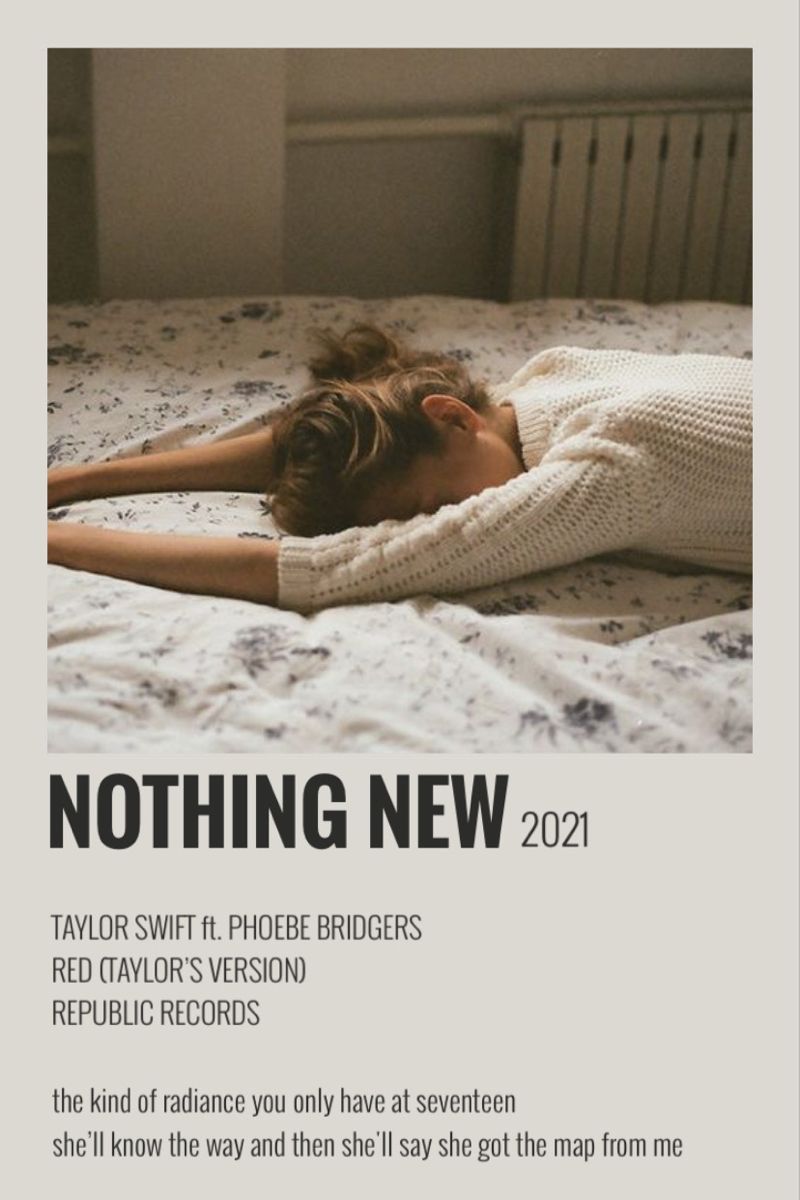
The Performer’s Blight: Second-Wave Feminism in “Nothing New,” Taylor Swift ft. Phoebe Bridgers

While Taylor Swift has been writing feminist inspired lyrics for her entire career, her latest album, Red (Taylor’s Version), features a new record with artist Phoebe Bridgers about the commodification and expiration of women in entertainment. In the opening verse of “Nothing New,” Swift sings “Criticize the way you fly when you’re soarin’ through the sky / Shoots you down and then they sigh, and say / ‘She looks like she’s been through it’.” This piece reminds me of Betty Friedan’s “Feminine Mystique” and classist rhetorics from early second-wave feminism. 

“Nothing New” describes the necessity for women in entertainment to be the hot, new thing. Once you have had your moment of success, entertainment firms and critics begin to tear you down and de-prioritize your work. This forces women to unjustly compete and find self-worth only in their social blade. Similarly, the “housewife’s blight” as discussed by Friedan forces women in the home to only find self worth in their work as home makers. Friedan asks “what kind of woman was she if she did not feel this mysterious fulfillment waxing the kitchen floor?” Similar to women in the entertainment industry, Friedan notes that toxic self-scrutiny is isolating and forces women to constantly compare themselves to the idealized housewife who is perfectly content and (re)productive in her role. 

While many can relate to Swift’s lyrics, her position as a hyper-famous celebrity makes her experience inherently non-universal. This is similar to Friedan’s “housewife” as “woman.” The difference between Friedan and Swift is that Friedan writes to depict the experience of women’s oppression and fails when generalizing “woman” as predominantly white, middle-class “housewife.” In contrast, Swift writes for herself. She does not attempt to project her experience onto others, but rather her fans happen to relate to her lyrics.

Feminist Mixtape: “Better Than Revenge” by Taylor Swift

Taylor Swift is a feminist! That is, until another woman gets between her and her boyfriend. While Taylor Swift, singing and song-writing icon, is commonly known for writing songs that blatantly call out misogynist and sexist stereotypes, Better Than Revenge employs a narrative that engages in slut-shaming and the reinforcement of sexist ideas. 

Better Than Revenge is Swift’s confrontation with a woman she blames for her messy breakup. In the song, Swift viciously attacks this woman’s character, dignity, and sense of self-respect, painting her as sex-obsessed and superficial. She accuses her of “stealing” her boyfriend from her and paints a narrative in which As a white, cis, heterosexual celebrity, Swift maintains a very strong sense of superiority. Although she speaks from an incredibly privileged perspective, she victimizes herself and continuously slut-shames the woman. She utilizes a sanctimonious tone, asserting that she is above the other woman, who she describes as malicious, disgraceful, and ugly for her actions. The tone and lyrics of Better Than Revenge make for an incredibly condescending and bitter outburst of blame and accusations against the other woman in the situation. Never during the song does Taylor attack her ex boyfriend, whose fault is not recognized. 

Swift’s lyrics slut-shame and degrade the woman she believes stole her boyfriend. The song begins with a recording of Swift saying, “now go sit in the corner and think about what you did.” Swift refers to the other woman as a little girl, and that she views her as childish and immature for her actions. Other lyrics like “she came along got him alone and let’s hear the applause, she took him faster than you could say ‘sabotage’” reinforces the idea that women’s desire for men is so crazed and uncontrollable that women devote all of their energy toward attaining men, even by malicious means. Swift shifts to shaming the woman, claiming that “she’s not a saint, she’s not what you think, she’s an actress.”  This insinuates that women should remain pure, as phallocentric mainstream ideas promote the desirable innocence of such purity. With her reference to being an “actress,” Swift includes the idea that many women feel pressure to act in ways that appeal to the male gaze, whether it be through sexualizing oneself or maintaining a “wholesome” image. Swift’s lowest blow comes next, as she claims that “she’s better known for the things that she does on the mattress.” By objectifying the woman, Swift reinforces the common idea that women are only good for sex. She also shames her for being very sexually active, reinforcing the stigma around sex. 

Overall, Better Than Revenge strengthens mainstream ideas about women needing men to feel fulfilled, women needing to maintain innocence to be desirable, and women disgracing themselves and their image by engaging in sexual behaviors. Swift, who is rarely called out for her degrading lyrics, released this petty anthem probably unaware of the stereotypes this song reinforces.