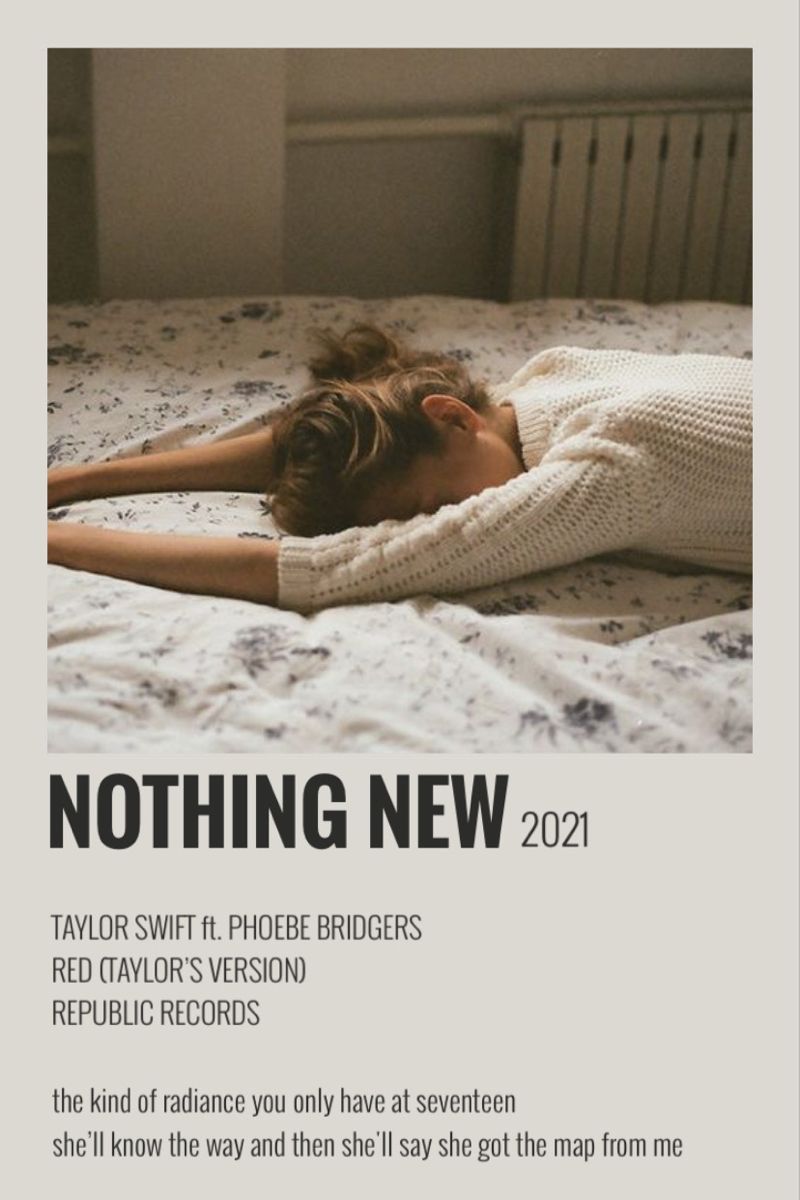
While Taylor Swift has been writing feminist inspired lyrics for her entire career, her latest album, Red (Taylor’s Version), features a new record with artist Phoebe Bridgers about the commodification and expiration of women in entertainment. In the opening verse of “Nothing New,” Swift sings “Criticize the way you fly when you’re soarin’ through the sky / Shoots you down and then they sigh, and say / ‘She looks like she’s been through it’.” This piece reminds me of Betty Friedan’s “Feminine Mystique” and classist rhetorics from early second-wave feminism.
“Nothing New” describes the necessity for women in entertainment to be the hot, new thing. Once you have had your moment of success, entertainment firms and critics begin to tear you down and de-prioritize your work. This forces women to unjustly compete and find self-worth only in their social blade. Similarly, the “housewife’s blight” as discussed by Friedan forces women in the home to only find self worth in their work as home makers. Friedan asks “what kind of woman was she if she did not feel this mysterious fulfillment waxing the kitchen floor?” Similar to women in the entertainment industry, Friedan notes that toxic self-scrutiny is isolating and forces women to constantly compare themselves to the idealized housewife who is perfectly content and (re)productive in her role.
While many can relate to Swift’s lyrics, her position as a hyper-famous celebrity makes her experience inherently non-universal. This is similar to Friedan’s “housewife” as “woman.” The difference between Friedan and Swift is that Friedan writes to depict the experience of women’s oppression and fails when generalizing “woman” as predominantly white, middle-class “housewife.” In contrast, Swift writes for herself. She does not attempt to project her experience onto others, but rather her fans happen to relate to her lyrics.
I think its so cool that Taylor Swift wrote a song about this experience. Female celebrities, including Taylor Swift, are so often treated terribly, with no regard for their privacy and personhood. It’s interesting that you point out Taylor Swift wrote this song just about her own experience. I wonder if this is an acknowledgment of her privilege, making her work less unaware of issues of class and race than Betty Friedan’s, or if it is not enough, and she should have better acknowledged that it is much harder for female celebrities of color than for her.
This is an interesting analysis! It is always interesting to think about celebrities and their experiences, because while of course Taylor Swift and other female artists experience lots of sexism in the industry and from society, can it be compared to the type of sexism that poor women and women of color experience? I still think it is important that she points out sexism where she sees it and is a person that others can relate to and I am glad that she wrote about how it is difficult to be a woman in the music industry as there are so many obstacles and criticisms that men will never have to face.
This is such an interesting commentary about personal experiences with sexism in music and literature being applied universally. I wonder if Taylor Swift reflected on her own privilege in having the financial resources, appearance, and fans to become famous and wildly wealthy in the first place. I can see why she might feel attacked from those who fear her, as woman in a position of incredible power and influence. However, like you mentioned it is important to remember that she still possess this power, in comparison to other talented artists who have been “shot down” from the beginning and continue to stay down, under the radar of popular culture.
Thank you for sharing this analysis! I’ve heard this song before, but I now listen to it in a different way after listening to your analysis. Specifically, I now pay more attention to the line “And will you still want me, when I’m nothing new?” I now interpret this main lyric as suggesting that once Taylor Swift is famous and her fame is not new, will people still be interested in her? As you mention, Taylor Swift suggests that people will no longer be interested when the fame fades. This is a sad reality, and the entertainment industry should consider ways to improve.
I absolutely love the comparisons you’ve made between Freidan’s work and Taylor’s song. Your last point is spot-on: Freidan was attempting to generalize her thoughts to all women, while Taylor Swift is merely singing about her own experiences. I feel like oftentimes celebrities get a lot of hate for singing about topics or personal experiences that aren’t relatable to their target audience. It’s almost like they have to be a spokesperson for the masses, and when they don’t function that way, they’re criticized.
I find this connection really interesting. The comparison of both Taylor and Friedan speaking from places of privilege shows how mainstream feminist voices have continued to generalize women and the oppressions they face. While Taylor speaks from her own experiences being undermined in the entertainment industry, I feel as though the media portrays her as a feminist icon who voices the struggles faced by all women, which is not the case. I also find it interesting how her experience falls back to the socially ingrained idea that women are only able to find success and fulfillment as domestic workers or “housewives,” and how this idea is still glorified as the real position for women when their ambitious careers fade or lose their promise.