Gay Tok: Hook-up Culture and Discrimination in the Gay Community

Tik Tok is home to a variety of trends from new dances to popular audios. There are many sides of Tik Tok, and you may be in multiple, depending on how diverse your ‘For You’ page is. However, I will be talking about a specific side of Tik Tok today, and this side of Tik Tok is referred to as Gay Tok (the side of Tik Tok created by and for the gay male community). There are innocent Tik Toks about gay couples on a date, but there are also videos that showcase the problematic side of the gay community. These short videos shine light on hook-up culture while other videos touch on the discrimination gay men of color face in the dating scene.

The first Tik Tok, created by @itslucasmorales, includes him sitting still in a room with the caption, “me remembering the time in high school where I thought I would find the love of my life on Grindr and ended up losing my virginity at 2am to some random guy in a tank top.” The audio in the background exclaims, “Don’t you feel silly, don’t you feel stupid, don’t you feel a little ashamed,” with an ominous sound playing in the background.

This short, twelve-second video shows the difficult dating scene gay teenagers face. The gay community’s dating pool is extremely small. Some people are closeted and not ready for a relationship, others are not queer, and some are already in relationships. The lack of a dating pool created a different pool within the gay community: hook-up culture. Younger gay people are thrown into hook-up culture through Grindr: a dating app intended for gay men. However, Grindr is used primarily to seek potential hook-ups instead of potential relationships. The way Grindr is used exposes teenagers to predators and potential grooming, which leads to gay teenagers engaging in sexual activities with older men. Early exposure to hook-up culture shifts gay teenager’s perception of relationships and their functioning. Instead of a relationship being seen as an emotional connection, it is perceived as a physical connection; gay teenagers will focus more on their bodies than their mental health.

The unhealthy, toxic atmosphere of hook-up culture perpetuates the idea that appearance, especially body shape, is a deciding factor in whether one deserves love or not. The fixation on bodies is deeper than expected. Each body type has their own category, such as twink (hairless, thin bodies) to otter (hairy, thin to athletic-build bodies) to bear (hairy athletic-build to larger bodies); there’s a category where any body type fits. This body categorization has been normalized to the point that there are quizzes, such as this one, to help identify your body type! Hook-up culture creates this body categorization and physical damage, but it also causes emotional damage. There are no emotional relationships. In hook-up culture, there are friends with benefits and sex with no strings attached. This goes back to the physical harm hook-up culture can cause with body fixation, but these issues also cause a mental toll on the person involved. The emotional aspect of relationships is not taken into consideration, making it difficult for gay teenagers to define a healthy relationship, especially if they are deeply involved in hook-up culture.

Hook-up culture is the root of most of the problems in the gay community. Hook-up culture leads to the creation of body categorization, physical over emotional relationships, and the use of preferences to justify discrimination in the gay community, which leads to my next Tik Tok.

The second Tik Tok involves a queer, black man talking about dating as a black person. This person discusses discrimination they have faced in the gay community from other black men. He starts his Tik Tok with the quote, “I’m getting to realize that I’m lowkey not in the mood to date black men anymore, and here’s why.” @Miamiboykhai explains the standards black men face in the gay community and the standards forced upon him. He mentions how black men have commented on his femininity, his skin tone, and his height in comparison to his position during sex, “What I’ve often heard towards myself was I was too feminine […] too dark while being feminine, and then I had people tell me I’m too tall for my position.”

Caption: @Miamiboykhai talks about the struggles he faces in the gay community when dating other black men

@Miamiboykhai discusses how the “outside world” already treats him differently, and now, he is ostracized from his own community. Many gay people feel out of place even within the gay community. They are treated differently due to their gender expression, body shape (as described in the first Tik Tok), and skin color. Grindr also plays a part into these standards. Many profiles have bios that exclude many people (no fats, no fems, no Asians), and the discrimination within the gay community creates an unsafe environment for people of color because of the intersectionality we face. Our cultures and religions are homophobic while the gay community is racist and discriminatory.

Another important argument this Tik Toker brings is, “[…] and I watch you guys pick and choose who you allow to be feminine, who you allow to date, you guys have many rules in the dating world as black people.” Femininity in the gay community is used to categorize gay people; it is associated with thinner body types, bottoms, and submissiveness. However, we need to move away from these stereotypes and realize femininity is a gender expression, and it does not dictate one’s position during sex, their likes and dislikes, or their behavior. Another thing that I should mention is that anyone can be feminine; it is not an exclusive trait reserved for people who are “allowed” to be feminine.          

So, what can we take from this? Tik Tok is a social media platform filled with a variety of genres and videos. The ones spoken about here display problems within the gay community in distinct ways. The first Tik Tok only used an audio and a caption, but it still made a strong point about the dating scene in the community, and it leads to discussing how the gay dating scene became what it is now. The second one was more of a rant, but it also showcased discrimination from someone’s personal experience. Tik Tok allows several people to discuss matters like this one, and it gives the younger generation some insight and information about several other issues in our world. In this case, we see how hook-up culture has perpetuated the idea that appearance, specifically body shape, dictates how desirable and valuable a person is and the assumptions that are made about a person through their gender expression.

Writing for Wear Your Voice | www.wearyourvoicemag.com

Audi’s Display of Sexism and Stereotyping

In 2017, Audi, a German car manufacturer known for its luxury vehicles, released an advertisement to its Chinese market that sparked much controversy around the world. In their attempt to promote used cars to potential customers living in China, the brand not only displayed apparent examples of sexism, but promoted racist stereotypes. This commercial starts off with an Asian heterosexual couple standing at the alter about to get married. Right before their marriage was officially declared, the groom’s mother interrupts the officiant and begins handling the bride roughly, attempting to inspect parts of her body. Only after the bride’s future mother-in-law examines some of her physical aspects, like her eyes, nose, ears, and teeth does she declare the bride fit to marry her son and gives her approval. The terrified bride is seemingly relieved after her future mother gives the couple her consent, until the mother’s focus turns to the bride’s breasts, bring her back to a panicked state. After this blatant objectification, the commercial’s narrator voices “An important decision must be made carefully” as a red Audi Sudan zooms down a highway (Greatdung 0:22-0:23).

YouTube, 17 July 2017

This sexist Audi advertisement centers around the objectification of a woman by not only debasing the bride’s value to just her physical attributes, particularly her facial features, but also by comparing her to something one can buy and own. By insinuating that marrying a living breathing person is an equivalent decision to buying a car, Audi turns the bride into an object that can be materialized and possessed. Not only is the bride objectified by her future mother-in-law, but with the attention shifting to her breasts, she also becomes sexualized. This overt objectification and sexualization of a woman not only advance the harmful ideology of women not being actual people and simply objects for the benefit of men, it can have dangerous consequences that go beyond these beliefs. The United Nations International Children’s Emergency Fund (UNICEF) makes this connection by declaring “The objectification and sexualization of girls in the media are linked to violence against women and girls worldwide” (UNICEF USA 2021). This treatment can also have a multitude of negative consequences on the targeted individual’s mental health that can last throughout a lifetime. With the massive platform stemming from the ability to air advertisements to millions of people, comes much responsibility to further notions of equality rather than ideologies that have the potential to cause an immense amount of harm. 

Not only is objectification based on gender a prominent issue in this ad, but race also plays a problematic role. The stereotype of the “tiger mom,” a term coined by Amy Chua which describes Chinese mothers as strict, controlling, and borderline abusive, is also deployed in this Audi advertisement. One aspect of this stereotype is the fixation Asian mothers have on the physical appearance of their daughters (Chua 2011). In this case, the need for the bride’s soon to be mother-in-law to examine her physical features, deciding whether they meet her standards prior to the couple’s marriage further perpetuates this stereotype. Most Asian mothers do not align with this parenting style and utilize a wide range of other strategies, contrary to popular belief. The bride also remains passive during this offensive interaction, exemplifying to this advertisement’s audience that this is the appropriate reaction in the face of maltreatment, which could be easily internalized by woman and child viewers. By displaying this inaccurate idea of what Chinese mothers usually place high value on, as well as the expectation of women staying passive, not only does Audi promote sexism, but also racist stereotypes.

Connecting these ideas, Audi exhibits how the intersection of both gender and race can work together, producing an even greater amount of discrimination for individuals like the bride in their commercial. On the basis of Kimberlé Williams Crenshaw’s concept of intersectionality, two social categorizations of the bride’s identity, being Asian and a woman, create a somewhat unique distinction of the discrimination she faces in this Audi advertisement. Unfortunately, this situation is not rare and many individuals who share these similarities in their identity experience this prejudice on a day-to-day basis. 

Shortly after this commercial aired, it received mass amount of criticism and backlash from the public. One commenter even voiced “The annoying thing about Audi’s used-car ad, besides its objectification of women, is that it thinks Chinese customers deserve only commercials like this” (Washington Post 2019). Others simply called the advisement sexist and disgusting. Many people initiated plans to boycott this company and convinced those around them to partake in this form of protest. Following this severe condemnation, Audi apologized for its ignorance related to this particular incident, assured the public an internal investigation would take place to avoid a mistake like this in the future, and removed this advertisement from television. Audi’s response to this backlash and quick withdraw of their commercial displays the power the public holds and how each individual’s voice matters when speaking out against discrimination. 

Unfortunately, this type of sexist and racist commercial is not the only one of its kind. These companies must continue to be held responsible for the harmful ideologies their advertisements promote and be hyper aware of the massive audience they have the ability to reach just through the commercials they release. These examples of sexism and racism through promoting stereotypes and targeting certain audiences unfairly in advertising must come to an end in order to create a more egalitarian world. These large-scale brands have the responsibility to advance impactful and beneficial messages to the massive audience they are capable of reaching, instead of carelessly feeding this harmful ideology to the masses. 

Works Cited: 

Chua, Amy. Battle Hymn of the Tiger Mother. Penguin Books, 2011. 

Greatdung. “Audi Used Car Commercial in China. Full of Sex Discrimination.” YouTube, YouTube, 17 July 2017, www.youtube.com/watch?v=WiBva8pEgTc. 

Smith, Jamiee, and Hannah Gould. “Not an Object: On Sexualization and Exploitation of Women and Girls.” UNICEF USA, 11 Jan. 2021, www.unicefusa.org/stories/not-object-sexualization-and-exploitation-women-and-girls/30366. 

Wang, Amy B. “An Audi Commercial in China Compared Women to Used Cars. It Didn’t Go Well.” The Washington Post, WP Company, 18 Apr. 2019, www.washingtonpost.com/news/worldviews/wp/2017/07/18/an-audi-commercial-in-china-compared-women-to-used-cars-it-didnt-go-well/. 

Harry Styles Likes Women’s Clothing and He Doesn’t Care Who Knows It (Not Even Candace Owens)

By Alice Berndt

Written for Jezebel

Vogue Online, 13 Nov 2020

On November 13, 2020, jaws dropped and 1D fans swooned when the cover image for Vogue’s December issue was released. The shot features former boy bander and current pop sensation Harry Styles dressed in a black and white lace gown and black cropped blazer, his hair swept to the side in an intentionally effortless flop. He is the first man to appear solo on the cover of Vogue in 127 years. As the cover reads, “Harry Styles makes his own rules.” [Vogue]

Framed against a sprawling green meadow and clear blue sky, the British singer squints into the sunny distance. He holds a blue balloon to his lips, mid-blow, showing off an array of chunky rings, including one in the shape of an “H” and another in an “S.” The photo is iconically Harry — sexy, androgynous, playful, and edgy. 

Since the beginning of One Direction’s seemingly eternal “hiatus” back in 2015, Styles has been making a name for himself as a solo pop rock artist. In addition to releasing hit singles like “Sign of the Times” and “Watermelon Sugar,” he has also become a fashion icon, breaking free from his 1D wardrobe of V-necks and skinny jeans and embracing more traditionally feminine styles like colorful blouses, bootcut pants, and dresses. For the most part, fans and the public have been accepting of his style transformation, which recalls music legends of the past including David Bowie and Prince. But for some, this Vogue cover took it a step too far. 

Screenshot: Twitter / @RealCandaceO

In a move that sparked contentious debate, conservative commentator Candace Owens retweeted Vogue’s post on Styles’ cover shoot and wrote:

“There is no society that can survive without strong men. The East knows this. In the west, the steady feminization of our men at the same time that Marxism is being taught to our children is not a coincidence. It is an outright attack. Bring back manly men.”

[Twitter]

Yowza. Owens received immediate backlash from liberals, feminists, and Styles’ fans alike who claimed she was being sexist and close-minded. She was criticized for her assumption that masculinity and strength (or lack thereof) are directly connected to wardrobe — a man cannot be “manly” if he wears a dress. 

This assumption stems from centuries of clothing acting as a marker of gender — men wear pants and women wear dresses and skirts. Period. But is Owens implying that the inverse is true as well — that women cannot be feminine if they wear pants? Certainly Owens herself has been spotted wearing pants on more than one occasion. Commentators wondered how an article of clothing could limit or “attack” masculinity and strength but not femininity or grace. 

Screenshot: Instagram / @harrystyles

In a reclamation of Owens’ derogatory words, Styles posted an image to Instagram from his cover shoot with Variety and captioned the post “Bring back manly men.” The caption combined with the cheeky photo — Styles in a powder blue pantsuit eating a banana — pokes fun at his haters, addressing the situation while also making light of it. 

Styles is certainly not the first celebrity to be criticized for their clothing choices, so why did this get so much attention? Perhaps because it’s far less common for a woman to publicly shame a man for his outfit than vice versa. We’re used to female celebrities being called out for “scandalous” or “overly sexy” clothing (Billie Eilish’s British Vogue cover, for example), but typically male celebrities wear what they want or what their stylists give them and that’s that. It also cannot be ignored that Styles has a massive fanbase that has grown alongside his career since the inception of One Direction in 2010 and is prepared to defend him regardless of the context.

In talking about gender and fans, we must engage in a conversation about privilege. A quote from Styles on the Vogue cover reads, “Anytime you’re putting barriers up in your life, you’re limiting yourself.” For Styles, a straight white male celebrity with a net worth of over $80 million, he has the comfort and freedom to express himself through his clothing without fear. [Vogue]

For many others, including female-identifying, LGBTQ+, and POC celebrities, what they wear is often the biggest target for ridicule, criticism, and objectification. These individuals must first break down the barriers placed in front of them by society before they can even consider those they may have built for themselves. 

With that simple act of reclamation via his Instagram post, Styles had, in the minds of many, “won” the argument. For many others — celebrities or not — the complexities of how they use clothing to express themselves is a never-ending fight, both internally and externally. [Vogue]

Vogue Online, 13 Nov 2020

Don’t get me wrong, I worship Harry Styles as much as the next Gen Zer and wouldn’t dare question his status as a cultural icon. As actress and director Olivia Wilde says of Styles, “It’s pretty powerful and kind of extraordinary to see someone in his position redefining what it can mean to be a man with confidence.” By breaking free from the societal binary of gendered clothing, Styles utilizes his privilege to pave the way for others. But his work is far from being done. [Vogue]

TikTok: Its Perpetuation of Gender-Based Stereotypes and Human Body Standards

Over the past few years, TikTok has become a mainstream social media platform. This application, available for most smartphones, uses an algorithm to curate content for users, effectively getting them addicted to scrolling on the app. There are many subcultures on TikTok… For example, people who like dogs might find that the algorithm has put them on ‘dog TikTok,’ because their ‘For You’ page is filled with videos of dogs. The same concept applies to gender and sexuality. There are many different points of view represented on the application, and once the algorithm figures out what yours is, it will show you a plethora of content to reinforce that exact idea. 

There is a large subculture (or really, a set of subcultures) on TikTok that perpetuates the gender binary system and all of the gender roles that come along with that. For example, this video is a representation of many of the different videos that are found on ‘straight TikTok’: 

When the individual speaking in the video says, “Men will choose a peaceful woman before a beautiful woman,” they are enforcing many of the expectations that are placed on female-identifying people in our society. Moreover, the speaker is implying that women must be ‘peaceful,’ therefore implying that often, women are not peaceful. This implication tells women that they need not express their emotions; rather, they should focus on being as passive as possible in an effort to be chosen by a man. 

Next, when the person speaking says, “Men seek for peace, and it don’t matter if you’re Black, blue, asian, Latina… they want to come home to a peaceful woman,” they are demonstrating a lack of awareness of the intersection between race and gender. This statement also reinforces the idea that men come home to women, therefore saying also that women should not be working professionals. 

On top of that, the speaker discusses the intellect of women and expectations in that area that men hold. They say, “He wants a woman that’s resourceful, a woman that can think on her feet. So when he can’t hold it down if he’s ill and he’s unable to pay the bills, she can be resourceful and have her intellect to make things happen.” The first implication I see in this statement is that the woman should just be intellectual as a safeguard… the woman will never actually have to use these skills unless it comes down to it. The assumption that men always pay the bills is harmful to all people, regardless of gender, because that is not the case for everybody. By the same token, the fact that the speaker is bringing this point up implies that women are, in general, less naturally intellectual than men. Drawing this unfounded connection between gender and intellectual capacity is harmful to society as a whole. 

Perhaps most disturbingly, our speaker talks about the ‘appropriate’ role of women in a sexual context. They say that men are “looking for a woman to supply their physical needs… A woman that looks good and proper and public but is a beast in bed” is the golden standard. First of all, in addition to ignoring the physical desires of the women at hand, this statement claims that the purpose of women is to fulfill mens’ sexual desires. This incredibly sexist ideology has the capacity to negatively influence the lives of many people. On top of this, the speaker is assuming a common definition of beauty… she is saying that women who have a certain physical appearance and demeanor are examples for what all other women should try to be when in pursuit of a relationship with a man. 

In conclusion, the ideology contained within this video is based on the idea that women are socially inferior to men, and that female sovereignty should not exist when it comes to romantic and sexual relationships. The central claim is that women should constantly be cultivating their personas to match what they think men are looking for in women, in hopes that they will ‘meet the cut’ for some man.

Similar to the last clip, this piece of satire brings awareness to many of the appearance-based expectations that our society holds for women, and the stark contrast between these expectations and those for men. The actor, mimicking a man, says: “Alright, so I want a girl with huge, but perky boobs, small waist, huge butt, flawless skin (but can’t wear makeup). And I like blondes, but I think she should also be brunette… because I get bored quickly, you know?” This statement encapsulates many of the body standards that our modern society has for women, and also touches on the normalized fact that men sleep around while women are expected to be loyal. 

In the caption of this video, the creator claims that this is how all men think. Although this is probably a sarcastic statement, it is representative of the way that many people think. Moreover, individuality is to be nonexistent: all men must act one way, and all women must act another way. Beyond pointing out, and perhaps reinforcing, the gender norms that are in place for men and women, this video illustrates the prevalence of the gender binary in our society. 

Content Warning: This video contains a real-life portrayal of surgical body mutilation. Use viewer discretion. 

In this shocking clip, we see a person that is identified as a man who has ‘overdeveloped’ breast tissue. His act of having the ‘excess’ tissue removed is labeled as life-changing. First of all, the video notes that this overdevelopment in the breast tissue of a man is an actual medical condition, which is known as ‘gynecomastia.’ Its causes are said to be “medications, drugs, testicular cancer, and hormonal imbalance.” 

Without looking into the history of this condition, it’s plausible to assume that this condition was developed in response to a bodily appearance that was not in line with society’s idea of what a man should look like. Moreover, this condition does not pose any medical risk to the patient; it is merely aesthetic. 

This video perpetuates a toxic standard of beauty, and is essentially telling men who have growth in their breast tissue that in order to be beautiful, they must undergo surgery. Explicitly, the caption says, “These [surgeries] literally change men’s lives.” In watching this video, men with growth in their breast tissue are inevitably going to receive the message that they are disgusting, and must go get surgery. 

In conclusion, the three videos I have analyzed here are examples of the many TikTok videos that enforce gender-based stereotypes and human body standards that are present in our society. This is not to say that TikTok is a problematic platform that should not exist; rather, this suggests that we as a society should critically examine the role that social media plays in perpetuating harmful gender-based stereotypes and expectations on a day-to-day basis.

Writing for Feministing | www.feministing.com

Beneath the Surface: a Look into Invisible Disability

Beneath the Surface: a Look into Invisible Disability

 The intersection of invisible disability and gender studies is still a forming field of study. Illustrated through the work of forerunners such as Maureen Fitzgerald, Kathryn Paterson and Karen Depauw. And more clearly developed through the more recent voices of Ellen Samuels, Aimee Valeras, Margaret Vickers, Kendyl Klein, Samantha Bassler and Denarii Monroe.  Mental illness within women, especially eating disorders, is a subset of invisible disabilities studies that demonstrated a strong link with gender studies and show how physically bound the subjects are. These authors analyze the difficulties of invisible disability, particularly disclosure, and how society oppresses people with hidden disabilities.

In the article “The Hidden Disability Dilemma for the Preservation” of self Maureen Fitzgerald and Kathryn Paterson address specific difficulties of women with invisible disabilities. Published in 1995 at the forefront of gender studies in intersection with disability, “The Hidden Disability Dilemma for the Preservation” of self-relates many of the challenges women with invisible disabilities face in contemporary times. Easiest to relate is the ever present question of disclosure and consequences with both informing people of invisible disability and hiding it. This ties directly to analysis, of identity which is grounded within the studies of women with invisible disability. By focusing in on two case studies where women from Hawaii and women from Australia were compared. These two groups of women with invisible disabilities, the women from Australia with hidden Multiple Sclerosis(MS) and the women from Hawaii with Temporomandibular Joint Syndrome(TMJ), are able to convey the ways in which invisible disability affects certain ways beyond a case by case basis. One problem the women from this study face, as others with an invisible disability do, is the issue of legitimizing disability. Because invisible disability is generally not apparent to others it can be difficult to get recognition for the really impacts a condition has on an individual’s life. In the case of one woman who was deaf but did not seem that way she began carrying a white pole, not because she needed it but rather because people would not accept that she was deaf. There is a possible weight in revealing a disability, a weight on identity-based on people’s reactions to disability. Many women from this study hide the level of pain they are in and the symptoms they have for various reasons. But this isolation of themselves comes at a cost while being interviewed, many of the women admitted that they were not as happy or as fit as they used to be. There is a negative correlation between invisible disability and self-worth. This study ends with a need for invisible disability to be taken seriously so that people with them don’t have to emphasize them as much for valid assistance.

Karen Depauw constructs the significance of space in the context of the society in  ““Space: The Final Frontier”: The Invisibility of Disability on the Landscape of Women’s Studies.” Through analyzing the breadth of subjects that gender studies encapsulate within intersectionality Karen Depauw noticed a lack of solid research in disability and how it connects to women, gender and identity. Published in 1996 Space: “The Final Frontier”: The Invisibility of Disability on the Landscape of Women’s Studies” is at the forefront of disability studies with Maureen Fitzgerald and Kathryn Paterson. By narrowing her view to the lens of space Karen Depauw is better able to articulate how disability dictates movement through space, also how disability can alter perceptions of space. Perception of space can be integral parts of identity and gender.  In working with space in relation to invisible disability she explains the ways in which spaces can differ based on interpretation. Her focus, particularly on mental disorders, illuminates how societies categorization of things and people can give stifling identities. Because of the individuality of invisibility disabilities, not to mention the different severities, it is limiting to categorize and clump disabled people. Furthermore to marginalize people because they do not fit into a normative format cramps them to the margins of society, into boxes that confine them. People with hidden disabilities are presented with two boxes, one in which they hide their differences and the other in which they may emphasise their differences in order to be believed and categorized as disabled.  Though there is more room for nuance than those two categories the exceptions are limited and never fully void of the decision that the individual with hidden disabilities makes about disclosure.  

The struggle of middle-aged women with chronic invisible disabilities who also work full time are argued by Margaret Vickers in “Unseen Chronic Illness and Work: Authentic Stories from “Women-Inbetween.”” Published in 2001 this article helps show many facets of being a woman and having an invisible disability. The eight women in this study explain some of the different difficulties. Like finding time for a doctor’s appointment, being assumed healthy at work, and trying to juggle a full-time career and caregiving. By adding in occupational difficulties Margaret Vickers shows another dimension of invisible disabilities effects. The added weight of gender is shown by the caregiver position that women are expected to fill, these mothers not only work full-time jobs but run households. Margaret Vickers explains how these roles stack up to burdens that leave these women not fully attending to themselves and struggling to show other people how much they are handling. Because hidden disabilities are not visible it adds to the dimensionality of whether people chose to believe in the legitimacy of these disabilities. Simple recognition of invisible disability would help in easing the weight of these women but in order to better understand their burdens society, gender roles, and other intersections must be scrutinized.

“My Body, my Closet: Invisible Disability and the Limits of Coming-out Discourse” by Ellen Samuels gives a more recent commentary on invisible disability. Published in 2003 this article focuses on disclosure of invisible disability. The approach of “My Body, my Closet: Invisible Disability and the Limits of Coming-out Discourse” is slightly unorthodox in its comparison of coming out in terms of sexuality and revealing an invisible disability. Through juxtaposing the two narratives “My Body, my Closet: Invisible Disability and the Limits of Coming-out Discourse” articulates the nuances of disclosure around invisible disability. Ellen Samuels explains how coming out keeps intact the binary that assumes heterosexuality and able-bodiedness are the norms and that it is necessary to reveal yourself as other if you are not strictly within those loosely defined boxes. One piece that is particularly addressed in revealing invisibility is the assumption with disabling that people are placed under but don’t necessarily want. In several people’s accounts disclosing an invisible disability are more about explaining it to others and less about accepting it yourself.  As addressed in “The Invisibility of Disability on the Landscape of Women’s Studies” is a pioneering article on disability studies with Maureen Fitzgerald and Kathryn Paterson the accusation of fraud around invisible disability is still an issue that keeps some people from disclosing at all. Ellen Samuels does an excellent job of explaining the weight and privilege that invisible disability holds: “Like racial, gender, and queer passing, the option of passing as nondisabled provides both a certain level of privilege and a profound sense of misrecognition and internal dissonance”(Samuels) Because invisible disabilities, in most circumstances, can be hidden there is consistent choice of disclosure. Unfortunately, both revealing and covering disability can have burdens. In elaborating on the issue of disclosure Ellen Samuels states a few times that people with invisible disabilities can “pass” as abled. However, even within just that word, she is still showing how disjointed they are from society and othered. People with hidden disabilities are in a weird in-between that fluctuates greatly by disclosure and can fluctuate with the severity of conditions on a day to day basis. Because hidden disabilities are a case by case dependent they have real tolls on people’s sense of identity and self-worth.

Specifically addressing mental disorders with the sector of invisible disability “Gender differences in mental health” address societal impacts on health. Through sharp analysis of statistics regarding men and women’s mental health, there are direct correlations to gender, particularly with anorexia and eating disorders. “Gender differences in mental health” show that not only is society ignoring mental illness they are often promoting it. The research, though published in 2007, holds many insights particularly in how gender relates to these illnesses. Mental disorder studies reflect how oppression can cause more people in a minority to develop them. Rooted in intersectionality, minorities are more vulnerable to mental instability and disorders. Another factor that affects mental disorders is the location, developing Arab countries women are more vulnerable and more likely to have mental instability. There is not one cause of mental illness or invisible disability and they can remain out of people’s perceptions. This can make invisible disability dangerous and endorse harmful societal norms. There needs to be recognition of invisible disability and wholesome approaches that don’t leave those with hidden disability awkwardly marginalized.

Identity is tightly associated with ability and disability. “”We don’t have a box”: Understanding hidden disability identity utilizing narrative research methodology” by Aimee Valera’s constructs the weight of hidden physical disability and explains the mental toll that it takes as well. By looking at the lives of six different people and their non-obvious physical disabilities, her study and analysis were written in 2010 provides insight into the complex layer of identity in relation to invisible disability. Core to Aimee Valeras’ argument like those of Maureen Fitzgerald, Kathryn Paterson, and Ellen Samuels is the pressure of disclosure. As framed in Aimee Valera’s study the six adults she picked chose to assimilate and push against the label disabled. Aimee Valera’s also takes the time to explain how intersectionality is essential to how people’s invisible disabilities affect their lives and identities. Researcher Aimee Valeras found about adolescent development of self-worth in conjunction with visible compared to invisible disability. One of the more recent and reliable studies showed that students with invisible disabilities had more emotional distress because of anxiety around possible exposure. To have an invisible disability takes people out of the obvious binary of able or disable: “The hidden disability experience, thus, falls in the misunderstood gap between the dominant disability paradigms, the medical model and the social model” (Valeras).

Much like the article “Gender differences in mental health,” “Why Don ‘t I Look Like Her? The Impact of Social Media on Female Body” reveals the specific impact society, especially social media, has on the mental conditions of college-aged women. Reviewing at this very specific study in 2013 of invisible disability in the form of mental illness it is easy to see how gender and white patriarchal society tie into the analysis of invisible disability. Kendyl Klein’s research show how unrealistic beauty standards have disproportionately affected young women. Additionally, her psychoanalysis provides insight into the direct ways in which social media harms women’s mental self-worth and mental stability. There are facts too that show the presence of eating disorders in college-aged women: “between 4% and 9% of college women have diagnosable eating disorders, but more frightening, 34% to 67% experience disordered eating at sub-threshold levels” (Klein). What Kendyl Klein articulates also is the endorsement of these unhealthy standards within America’s culture. The severity of eating disorders and mental illness have been dismissed by parts of society and the beauty industry. One particularly striking paragraphs of Kendyl Klein is the increased depression and suicide rates of those with eating disorders. This level of body dissatisfaction shows just how toxified societal views have become. In a personal account of Kendyl Klein, when she was struggling with body image, it is clear that her mental illness was spurred on by the media and society. Gender studies and invisible disability are tightly bound at the point of mental illness.  

Samantha Bassler constructs an argument that correlates music therapy with hidden disabilities in  “”But You Don’t Look Sick”: Dismodernism, Disability Studies and Music Therapy on Invisible Illness and the Unstable Body.” By first presenting invisibly and music therapy separately she is able to give a solid basis of both before connecting them. Similarly to many of the previous articles published before hers, published in 2014, Samantha Bassler explains the intricate issue of disclosure around hidden disability. Her article grapples with the impact that people’s disbelief around hidden disability has on people who struggle with them. What makes this article stand out is Samantha Bassler’s inclusion of music therapy as a potential avenue to help those with hidden disabilities. Samantha Bassler’s presentation of healing through music is that the music can not cure but rather helps the patient in dealing with their disability. Her final words on the matter of invisible disability tie it to feminism through looking at the normalization of society.

Tying feminism and a modern tone into the analysis of hidden disability Denarii Monroe explain the effects her own invisible disability has had on her life in her article “3 Ways My Learning Disability Affects My Life.” Written this year, Denarii Monroe explains the intricacies of living with an invisible disability.  One thing she addresses is the stigma people still have around disability and an avoidance to reveal her condition. Particularly focusing on the workplace she explains how revealing disability can cause discrimination, less pay or just not getting hired in the first place. Elaborating on occupational effects hidden disability can have she also explains the opposing argument that understanding can make a huge difference and communicating disability can relieve bad dynamics. Essentially reiterating that disclosure around invisible disability is really an individual decision and can help or hurt depending on the situation. Intersecting invisible disability to feminism Denarii Monroe argues that feminists are working for the equality of people and that people with invisible disabilities are among the marginalized. She creates an even stronger argument for intersectionality in her criticism of capitalism, patriarchy and the way in which conformity is institutionalized. The intersections minority people have are layers of oppression and greatly affects a person’s privilege. Truly intersectionality is at the core of starting to understand the complexities with individuals and even within invisible disability. Because there are many forms and accumulations of oppression that go unseen and acknowledged. Denarii Monroe explains the weight invisible disability can have on self-worth and confidence. Hiding disability and openly sharing it both come with their own burden. With sharing the information of invisible disability people sometimes doubt it’s legitimacy, categorizing the person as disabled or at least associating the condition with the person. To conceal the disability leaves the person open to the risk and vulnerability of exposure. Denarii Monroe concludes with the need to deconstruct societal boxes and embrace differences.

Intersectionality is core to understanding marginalization and different oppressions of society. Invisible disability and gender studies are better understood in the context of each other. The articles by Maureen Fitzgerald, Kathryn Paterson Karen Depauw, Ellen Samuels, Aimee Valeras, Margaret Vickers, Kendyl Klein, Samantha Bassler and Denarii Monroe provide a small window into an intersection of health and gender that is often overlooked. By focusing in on mental illness within the intersection of invisible disability and gender studies it is clear the influences society has.  

Sources:

Bassler, Samantha. (2014).  “”But You Don’t Look Sick”: Dismodernism, Disability Studies, and Music Therapy on Invisible Illness and the Unstable Body.” Voices: A World Form for Music Therapy.

Depauw, K. P. (1996). “”Space: The final frontier”: The invisibility of disability on the landscape of women’s studies.” Frontiers: A Journal of Women Studies, 17(3), 19- 23.

(2007) “Gender differences in mental health” Singapore Med Journal.

Image Fitzgerald, M.H., & Paterson, K.A. (1995). “The hidden disability dilemma for the preservation of self”. Journal of Occupational Science, 2, 13-21.

Klein, Kendyl M. (2013) “Why Don ‘t I Look Like Her? The Impact of Social Media on Female Body” Claremont McKenna College.

Megan Jones, “‘Gee, You Don’t Look Handicapped. .’: Why I Use a White Cane to Tell People That I’m Deaf,” Electric Edge, July-August 1997

Monroe, Denarii. (2016) “3 Ways My Learning Disability Affects My Life” Everyday Feminism.

Samuels, E.J (2003). “My body, my closet: Invisible disability and the limits of coming-out discourse.” GLQ: A Journal of Lesbian and Gay Studies, 9, 233- 255

Valeras, A. B. (2010). “”We don’t have a box”: Understanding hidden disability identity utilizing narrative research methodology.” Disability Studies Quarterly, 30(3), 1- 23.

Vickers, M. (2001). “Unseen chronic illness and work: authentic stories from “women in-between””. Gender in Management, 16(2), 62-74.

Finding Avenues for Reproductive Justice Education Post-Grad

GSS 101 has absolutely opened my eyes to many new frameworks for thinking and more comprehensive and fair language for communicating. Discovering the significance of intersectionality in all areas of gender and sexuality studies has been especially eye-opening and helpful for my knowledge and actions moving forward. My final literature review covered reproductive rights for minority women and how their experiences completely differ from white women, but that women of color groups have gone largely ignored and not given credit for their activism and progress in the fight for all-encompassing reproductive justice.

As GSS 101 has provided me with more comprehensive knowledge and more useful tools for speaking and acting on GSS topics, I realize that a lot of people go without the education they deserve, so I’m looking into areas where I can combine my interest in education and new interest in the fight for reproductive justice after graduation. Outside the class, I currently have a length pro-con list for two different cities I could possibly live in after graduation: Chicago and Charlotte. I’m going to add to the list by looking into a few different organizations in each city that I could get involved with.

At the top of my list in Chicago, the Chicago Foundation for Women targets the disparity in options for or access to health due to violence and poverty. The organization seeks out women in communities of need and on the margin, brings together women who have the power and ability to come up with solutions and raise money through grants and other avenues, and then implements these solutions through the combination of minds and funding. This sounds somewhat like consulting for marginalized women and their families, which might be appropriate extremely appropriate for me since I’ll be going into healthcare consulting.

Finding specific organizations in Charlotte proved a lot more difficult, but I think I would start by looking in the NC chapter of NOW (National Organization for Women) and working my into the community from there. NOW stands firm that reproductive rights are more than a matter of choice and supports providing more access to education and health options for all women, especially minority women who are disproportionately affected. While NOW’s efforts seem more implicated with law and policy change, I would use the network to find more ground-level opportunities to get involved with education for women.

I’m really excited to discover this new passion, something I had always inherently cared about but never took the time to better understand and share with others. I don’t think adding these to my pro-con list will affect my final living decision, but it does show me that I will try to make it a part of my life regardless of where I end up in the states.


From Theory to Praxis: Medical Care of LGBT Individuals

Over this semester, I have been exposed to a broad spectrum of concepts, issues, and questions through our readings and discussions. GSS has given me a new lens through which I see the world and a deeper understanding of the structures and institutions in place that govern our lives. As a senior, I will soon be entering the job market and am really looking forward to taking my newly acquired GSS knowledge to my future endeavors. I am looking for a job in the medical field, a field in which LGBT individuals are underserved and often reluctant to pursue care. In this context, lesbian, gay, bisexual, and transgender individuals are often grouped together in a way that implies homogeneity, which is not the case. These individuals are distinct in terms of race, socioeconomic status, age, and ethnicity in addition to their gender and sexual identities. What groups these people together is the underlying discrimination and stigma that they face in society as a result of living at the intersection of multiple different groups. The intersectionality of marginalized groups is a topic that came up frequently in our class discussion and has really opened my eyes as to how a person’s identity is not defined by just one element or trait, it is the combination of these interlinked traits that make up one’s identity.

There has been a long history of discrimination stemming from a lack of understanding of LGBT individuals in the medical field (i.e. the listing of homosexuality as a mental disorder in the DSM). However, as understanding has improved, the treatment of LGBT individuals in the medical setting has gotten somewhat better. There are certain diseases that disproportionately affect the LGBT community such as HIV and other STDs, and these disparities stem from structural and legal factors, social discrimination, access and availability of medical care, and the lack of culturally informed health care.

There are many things that those in the medical field can do to encourage an inclusive and welcoming medical environment. Below are some suggestions to be implemented in different medical environments, which I hope to bring with me to my future occupation:

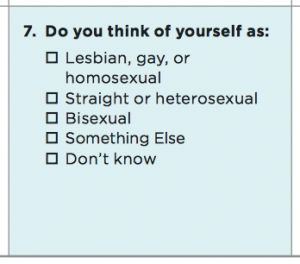
  1. Allow patients to privately self-input information about gender identity and sexual orientation (ensure that there are a wide range of options on the questionnaire).
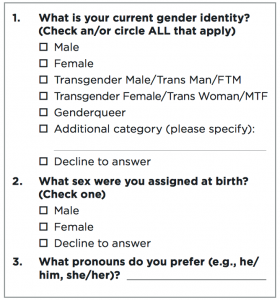
  2. Allow patients to specify the pronouns that they prefer.
  3. Be open and non-judgmental when collecting sexual histories of patients.
  4. Refrain from making assumptions about individuals based on appearance.
  5. Do not assume heterosexuality (i.e. Ask “Do you have a
    partner?” rather than “Do you have a boy/girlfriend?” when conducting sexual
    history).
  6. Make sure all staff are trained to interact respectfully
    with LGBT patients (i.e. ensuring use of their preferred pronouns).
  7. Make sure that the medical environment has a non-discrimination policy that includes discrimination based on gender identity and sexual orientation and publicly display this policy.
  8. The use of brochures and medical information that include images of LGBT people as well as medical information that specifically addresses concerns that
    these individuals face.

All of these suggestions are important, as a clinician may be one of the first people whom an individual discloses non-heterosexual behavior to, and for this to happen, individuals need to be in a space where they feel comfortable. The goals of medicine include providing quality and effective care, and through these suggestions and the scope of my GSS knowledge, I plan to do my best to create an inclusive and welcoming environment for all patients.

Works Cited

http://www.lgbthealtheducation.org/wp-content/uploads/Improving-the-Health-of-LGBT-People.pdf

http://www.aafp.org/dam/AAFP/documents/medical_education_residency/program_directors/Reprint289D_LGBT.pdf

Theory to Praxis: Intersectionality within RAC

This past semester, one thing that really interested me in GSS101 was the concept of intersectionality. It is important to recognize everyone’s co-existing identities, and I sometimes feel like certain organizations on campus have a hard time of doing that, if there is not representation of those different identities within the club. For example, I am a member of the Rape Awareness Club at Davidson, and we struggle to make sure that our events are queer inclusive. There are queer members in the club (myself included), but we find it difficult to include non-hetero sexual assault as one of our main concerns without assigning a queer person as a “spokesperson” for the entire community.

Next semester, I plan on finding ways to incorporate the queer community into our weekly meetings, no matter what we’re discussing. Perhaps we can try to designate a specific committee to talking about how RAC can involve the queer community in order to get us started. Another idea would be to invite those who would want to get involved from Q&A (another club on campus). Events such as the sex positivity fair and Take Back the Night should be advertised as queer inclusive.

RAC does a lot of good work on campus, and they spearhead a lot of the most notable events. So, it is extremely important for RAC to recognize the aspects they may be lacking. Intersectionality is not an easy concept to understand. Additionally, it takes a lot of effort to obtain and maintain an intersectional, inclusive environment. I plan on approaching the club as a whole, and hopefully discussing together what would work best in order to recognize non-hetero sexual assault as well.

Redefining Sovereignty

The Erotics of Sovereignty by Mark Rifkin interprets native american writers by illustrating the clear impacts of heteronormative white society on indigenous ways of life. The constraints of white society are best shown through the interpersonal lives of native americans. By closely working with excerpts of writings by: Qwo-Li Driskill, Deborah Miranda, Greg Sarris and Chrystos — Mark Rifkin reveals the extent of native america suppression and explains one form of liberation from conservatism through homosexual erotica. Mark Rifkin explores the intersection of sexuality and controlling power.  

The Erotics of Sovereignty illuminates how white patriarchal society has systematically denigrated and infiltrated indigenous society. This monograph particularly focuses on erotica and intimacy as a lens that reveals the extent of suppression within native tribes. The Erotics of Sovereignty expresses empowerment, specifically of queer native american women, through pushing away  homophobic western society. The physicality of this monograph is all about taking back the sovereignty over one’s own body.  Mark Rifkin deconstructs the writings of Qwo-Li Driskill, Deborah Miranda, Greg Sarris and Chrystos to articulate different specific ways white society has infiltrated native society and identity. In the first chapter “the Somatics of Haunting: Embodied Peoplehood in Qwo-Li Driskill’s Walking with Ghosts” Mark Rifkin addresses how the Cherokee have dispelled non heterosexual couples and African Americans, who were former slaves, within their communities. These exclusionary actions were pressured by the American government, they were pressured to keep a pure blood line for continued government recognition. Governmental pressure to prove native heritage is an overarching theme that ties into Native American self identity. Within the last chapter Chrystos writes about trying to maintain her identity even in an urban white society. She shows some of the real social damages American society and government have caused. Also revealing some of this suppression is Deborah Miranda who focuses on the displacement in place because even though her people are still on their land, emotionally they have become disconnected with each other and the earth. Mark Rifkin explores Deborah Miranda’s expelling of white normative constructs in his second chapter  “Landscapes of Desire: Melancholy, Memory, and Fantasy in Deborah Miranda’s The Zen of La Llorona,”.  Mark Rifkin interprets her words about nature and homoerotic sexs as her way to combat the heteronormative society constructed during colonialism. In Mark Rifkin’s chapter “Genealogies of Indianness: The Errancies of Peoplehood in Greg Sarris’s Watermelon Night” he investigates how white governmental suppression has shaped modern native society, particularly the Pomos. Focusing on the constraints and violence that were brought by white American pressures. Mark Rikin’s view of those encapsulates how the laws and formation of society have effected there tribals people’s identities, mental states, protection for those who are vulnerable and their tribes connection with the earth. However, he also shows that by breaking the societal sexual boundary some native americans are able to feel empowered.

Mark Rifkin has a PHD from the university of Pennsylvania and is a professor of Women’s and Gender Studies at University of Greensboro. He is well known for his books Manifesting America: The Imperial Construction of U.S. National Space, When Did Indians Become Straight?: Kinship, the History of Sexuality, and Native Sovereignty, The Erotics of Sovereignty: Queer Native Writing in the Era of Self-Determination and other essays in the area of Native american suppression. Through Mark Rifkin’s extensive work in the intersective fields of gender and sexuality and native american culture, he has established the background to delve into complicated issues of identity and sexuality in The Erotics of Sovereignty.

Mark  Rifkin’s uses the words of Qwo-Li Driskill, Deborah Miranda, Greg Sarris and Chrystos in their personal accounts to support his concept of native american suppression. Excerpts from Walking with Ghosts, The Zen of La Llorona, Watermelon Nights, and Chrystos’s Poetry provide a structure for Mark Rifkin to drape his arguments upon. Also pulling from legal and state documents he is able to provide historical background in an introduction that grounded the true atrocities committed against native people.

One Clear strength of Mark Rifkin’s work is how he found different elements of native society to consider the extent of native suppression. Through the text of four native american writers his is able to add additional dimension to each of their writing styles and perspectives. Through deconstructing small portions of text at a time he is able to articulate and bring finesse to each of his arguments with grace. Even the organizational method of his monograph is well founded. By giving historical background and a thorough introduction Mark Rifkin’s is able to present his argument well, before even diving into the details of his analysis. Even stronger still is his premise for the book that holds the intersection between the interpersonal realm of sexuality and the external power realm of society. By framing personal with societal Mark Rikins is able to imbue The Erotics of Sovereignty with just how deeply white heterosexuality society has been ingrained in current native american lives, all the way down to the erotic itself. By intertwining the two he is able to show how native american women reclaiming their sexuality is a form in which they reclaim their power.

The only weakness that Mark Rifkin’s work holds is that some pieces of his argument are speculative. The inclusion of speculation in The Erotics of Sovereignty is because this monograph is at the forefront of exploring native american society through the lens of Gender and Sexuality Studies. Mark Rifkin has framed this exploration by looking into queer writers personal experiences of suppression. Though immaculately framed and structured there is a strong basis in metaphor and interpretation that goes along with the inclusion of the interpersonal.

Mark Rifkin brings to light the true severity of american laws and societal pressures. By working with the text of four queer native american writers, he is able to examine independence of native culture and sexuality. One element addressed in the introduction is the loss of land and continual violation of promises by the government around rights, even just reconnection, if these indigenous people. Because native americans have such strong ties to the earth it would be interesting to examining how conservative western society effects health and healing practices, especially in relation to women’s health. Honing in on native americans disconnect from the earth, I would be fascinated to understand other ways, beyond sexuality, that native americans have been able to reconnect with the earth and find interpersonal empowerment. Nature is more than aesthetic value, it is what sustains, heals and provides context for an indigenous way of life.

Work Cited

Rifkin, Mark. The Erotics of Sovereignty: Queer Native Writing in the Era of Self-determination. Minneapolis: U of Minnesota, 2012. Print.

A Body Not Her Own: The Role of Policy in Limiting Women’s Reproductive Rights

On the morning after Thanksgiving in 2015, a gunman attacked a Colorado Springs Planned Parenthood, eventually killing a police officer and two civilians while injuring nine more before surrendering. In the following court hearings, the attacker, Robert Lewis Dear, Jr., expressed his anti-abortionist and anti-Planned Parenthood opinions, identifying himself as a “warrior for the babies” (Turkewitz and Healy, 1). This attack followed similar violent assaults on clinics or doctors’ offices where abortions are performed, adding to the aggressive climate brought by protestors who harass women and professionals outside of these facilities daily. The topic of abortions and, more generally, women’s reproductive rights has divided Americans, prompting some to execute what they believe is vigilante justice to protect the unborn, while allowing women to suffer physically and emotionally. Women’s reproductive rights, however, go beyond pro-life and pro-choice arguments. When lawmakers begin to judge who should be allowed to get pregnant and see pregnant women as merely a vessel that carries the valuable life of a fetus, as opposed to cherishing the already-existing life of the woman, women effectively lose any bodily integrity. These policies degrade all women, but also disproportionally affect minority, poor, and young women.

As a sociologist, author Jeanne Flavin takes an interesting choice by analyzing policies and other qualitative data, as opposed to gathering her own data. This choice, however, allows for a synthesis of many pieces of information, not yet put together in one place. Flavin, who worked in a prison as a young woman, admits her bias toward protecting women in the criminal justice system. She also hints that she does not intend to have children of her own. This creates a new perspective on the topic: from a woman who has personal experience with mothers in the criminal justice system and, while not planning to become a mother herself, wants to share the importance of supporting these women.

The monograph follows the same timeline of reproduction, focusing on the government’s involvement in women’s lives and bodies before, during, and after pregnancy. The first section “Begetting,” discusses sterilization laws, like those upheld under Skinner v. Oklahoma, that some states use to control “who” has the right to reproduce. Again, these unjust and invasive laws disproportionally affect women of color or of a lower socioeconomic class. The lawmakers justify this by saying these women are not in a position to raise a child to be a productive member of society. Instead of fixing the injustices in government and social institutions that unfairly keep people of color and lower income levels in these positions, the government at every level consistently chooses to punish these women and control their bodies.

This section also discusses the most prevalent reproductive rights issue: abortion. Often the argument of abortion focuses on a choice: whether to end an unwanted or unsafe pregnancy or carry to term and raise the child or give it up for adoption. The famous Roe v. Wade case established a woman’s right to choose, but since this decision, states have tightened their laws as far as they can to render this landmark case relatively ineffective. While this affects all women, Flavin notes that for most minority women, there still is no “choice.” Because of a lack of information, money, transportation, and, on a larger scale, education, women with an unwanted pregnancy cannot often obtain an abortion. This incredibly hypocritical statement by the government – that minority women should not be able to raise children, but if they do get pregnant, they shouldn’t be allowed to have an abortion – puts these women, and their future children, in a dangerous situation. In this section, Flavin flawlessly brings the discussion of abortion out of a pro-life/pro-choice argument, so readers realize the more damning effects these policies have on women without a choice, women who have been betrayed by their own government in many ways and now must give over control of their own bodies.

In the second section, “Bearing,” Flavin examines the discriminatory policies that turn pregnant women into second-class citizens. As soon as a woman becomes pregnant, her fetus becomes the one who must be protected, and she is simply a body, which the government can control in order to protect her future child. Again using policy to enhance her argument, Flavin notes how “fetus-centered laws” such as the Unborn Victims of Violence Act (UVVA), which claims a fetus as a second victim in domestic violence cases, leaves the pregnant women out of the realm of security. These kinds of laws do little to protect the woman, a victim in this violence, from the perpetrator, and instead only emphasize the harm done to the unborn child. Here, Flavin brings in an argument about drug uses, explaining how they have not made a choice to do drugs and instead institutional racism has driven them to this decision. Therefore, these women should not be further punished and deemed unfit to be a mother. While I follow this argument, as I note later, this segue may take away from Flavin’s strong argument.

In this section, Flavin also begins to note how the criminal justice system, not just government policy, devalues pregnant women. These women do not receive proper medical attention for diseases like HPV or even access to an abortion if impregnated by a guard. Flavin again notes the hypocrisy in the viewpoints of lawmakers who fear for the future lives of fetuses, but do not give the proper health care for imprisoned women, which will inevitably have public health consequences.

Lastly, Flavin delineates how, even after a child is born, policies subjugate the mother to high levels of scrutiny, continuing to impede on her rights to her body and her children. First, for women in the criminal justice system, the government strips them of any rights to motherhood. While Child Protective Services policies tend to deter child visitation to their incarcerated mothers, Flavin notes how important the relationship between a child and mother is to their future growth, and by taking that visitation away, children may be sucked back into a dangerous world. Going beyond just the benefits to the child, a mother who has the chance to build ties to her child will be more motivated in her own rehabilitation, better prepared to re-enter society. While not incarcerated, battered women also must battle for custody of their children if they speak of their abuse, as again, ineffective policies, like the flawed Violence Against Women Act, tend to protect the children over the mothers. While the children should certainly be safe, this fear of losing their children, silences many women who stay in abusive situations which continue to harm them and their children. Laws must defend the mother and the child and ensure they will not be separated.

          Our Bodies, Our Crimes fits most easily into feminist studies, as it highlights the impediment of women’s citizenship and their place in society. This monograph also fits into legal studies as Flavin uses myriad court cases and policies as examples in her argument. Notably, this book does not incorporate queer studies. While some queer populations cannot become pregnant, they can still be subjected to the same discriminatory treatment in sexual assault or parenting cases that infringe on their own rights to their bodies and their privacy.

The strength of this monograph lies in its organization. It clearly separates the information into pre-birth, during birth, and post-birth consequences of governmental interference into women’s bodies and lives. As the book proceeds, the reader realizes how extensively policies have been enacted to keep women under governmental control and to place the life of a fetus above that of a woman. The breath of research, legal and academic, Flavin performs roots her argument in evidence, giving more credibility to her case, that at times, can be controversial. She also redirects the conversation at certain points to make readers re-consider their perspectives on the age-old issue of reproductive rights. She does not focus on the pro-life/pro-choice debate as she points out that many women do not really have a choice even if the laws say they do. She also notes the implications of a discriminatory criminal justice system that gives up on its inmates, automatically assuming they cannot and should not be pregnant or mothers. These topics are largely overshadowed in the discussion of reproductive rights, which often focuses on the plight of upper-class white women, which while still relevant, as most social movements, leaves out many other affected women.

While Flavin fills Our Bodies, Our Crimes with an abundant amount of relevant citations from other legal and academic work, in order to make her argument more coherent, I would have left out her interlude into drug users. While after careful thought, I understand her point about the institutional racism that inevitably can cause women to take drugs but should not determine her ability to have a child and mother, this argument may not be easily accepted by other readers. For a more conservative reader, it is difficult to believe that drug users, whose habits may harm the child – a detail she dedicates only a few sentences to – should be able to raise their children away from government agency surveillance. While Flavin may not be targeting this more conservative group of readers, in order to spread her well-thought-out and developed argument to more people, she should tailor her argument a little more. This added point complicates the details of her argument even more, so leaving it out could make for an even more definitive conclusion.

In all, Our Bodies, Our Crimes, opens up the discussion about reproductive rights – moving away from just a debate between pro-life and pro-choice – and toward an inclusion of all intersectional backgrounds. While I would implore everyone to read this book, I believe at least white, liberal-minded people must pick it up. Flavin’s research shows that this group, while often well-intentioned, tends to mistake their rhetoric as improvement for all. Many liberals center themselves in the pro-choice debate, not recognizing how many other people lack the fundamental right of a choice. Institutional racism and classism often place women at a position where they do not have the means of information to make the same decisions upper-class, white women can, and their doubled struggles should be brought to the forefront. This book outlines the effects of infringing reproductive laws at every stage of a pregnancy – from conception to motherhood – with an eye, not just on the effects on upper-middle-class white women, but on those from a lower-socioeconomic or minority background. While these laws burden less-privileged women even more, laws that limit any woman will have a lasting negative impact on the lives and opportunities of all women.


Works Cited

Flavin, Jeanne. Our Bodies, Our Crimes. NYU Press : 2009.

Turkewitz, J. and Healy, J. “3 Are Dead in Colorado Springs Shootout at Planned Parenthood Center.” The New York Times, 27 Nov. 2015.


Beyond Marriage: Valuing All Families under the Law

“A woman married to a man for nine months is entitled to Social Security survivor’s benefits when he dies; a woman living for nineteen years with a man or woman to whom she is not married receives nothing.”[1] The debate over marriage equality for same-sex couples was one that took over the country’s social and political agenda in the early 2000’s. Nancy Polikoff’s Beyond (Straight and Gay) Marriage challenges this agenda by asking both straights and gays alike to consider a broader definition of what constitutes a family and how this structure should be protected under the law. Those protected by the institution of marriage have privileged status in regards to tax benefits, estate benefits, government benefits, employment benefits, medical benefits, and death benefits among others. Polikoff calls for a revamping of family law; one that takes into consideration the changing nature of family units while also deemphasizing the status of marriage in our society.

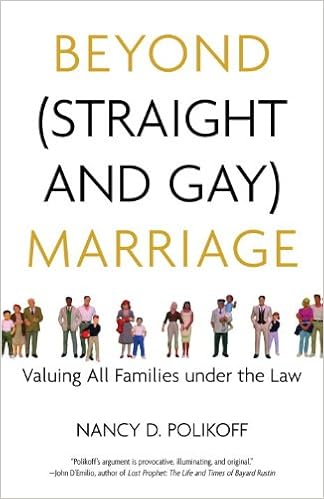
Nancy Polikoff is a professor of law at American University Washington College of Law. She teaches Family Law and a seminar on Children of LGBT Parents and has been writing about, litigating about, and speaking about cases involving LGBT families for the past thirty years. Her accomplishments include co-founding the Washington, DC Feminist Law Collective, supervising family law programs at the Women’s Legal Defense Fund, and co-authoring one of the first law review articles on the custody rights of lesbian mothers. Beyond (Straight and Gay) Marriage is Polikoff’s first book. She has a daughter in her twenties and lives with her partner in Washington, DC.

The first half of the Beyond Marriage gives the reader historical context as to how we got to the position we are in with marriage today. It begins with the advances made by the second-wave feminist movement in the context of marriage, and then describes how those advances have been attacked since the 1970s by the religious right. Betty Freidan, Gloria Steinem and others are cited in this section, along with groundbreaking legislature like Title IX. From there, she moves into the gay rights movement and the intersection of lesbianism and feminism. Eventually she delves into the marriage movement of the conservative right and the how the push for preserving marriage as an institution for heterosexual couples strengthened marriage’s societal status. She then brings the reader to the contemporary fight for marriage equality, the most thorough part of the first half of the monograph.

Generally, there are two dominant perspectives in the contemporary marriage debate. First, there are those who support the institution of marriage and believe that opening it up to non-heterosexual couples will undermine social structure. Second, there are those who support equal access to marriage for LGBT individuals since they deserve the same access to benefits as married heterosexual couples. Throughout the book, Polikoff makes reference to groups on both sides of the argument. Frequently mentioned supporters of the marriage movement include The Institute for American Values, the Alliance Defense Fund, and the Liberty Counsel. Those often mentioned on the side of marriage equality include Lambda Legal, the Human Rights Campaign, and the National Gay and Lesbian Task Force. All of these groups fight for legislation supporting their side of the argument or represent individuals in relevant court cases. Polikoff separates herself from these prominent groups by taking a third stance. She questions the legitimacy of marriage as the necessary qualification for receiving legal benefits and questions whether it is fair to exclude so many other family forms by limiting such benefits. This allows her to reframe the debate over marriage by making the point that the benefits associated with marriage are not inherent, they have been constructed over time and have increasingly drawn a line between families formed through marriage and families formed through other means. By fighting for the right to marriage for LGBT couples, dominant organizations like the Human Rights Campaign are reinforcing the place of marriage in our society as cultural institution that unfairly awards rights to the married and leaves those who are unmarried out to dry. She enforces the argument that marriage is outdated and the benefits that accompany it were developed decades ago when having sex outside of marriage was taboo, illegitimate children were considered outcasts, and marriage had gender roles legally entwined within it. Through the examination of historical movements, she determines that people have changed the way that they view and structure their lives and the current marriage equality movement does not reflect this change.

The second half of the book is dedicated to describing specific aspects of her proposed approach, called “valuing all families,” to make marriage matter less. The most important aspect of this approach is identifying the purpose of specific laws that currently grant marriage-specific legal consequences. By understanding the specific objectives of these laws, relationships can be identified that would further the law’s objective without creating a specific special status for married people. In regards to this approach, she addresses health care, medical leave, medical care, domestic partner benefits, the dissolution of relationships, death, and economic compensation. Polikoff argues that by taking this approach, our society can move more towards a legal system based on the nature of care and dependency in relationships, not just the relationship’s specific name. Her solutions are not only for same-sex couples, they are also for people non-conjugal relationships, like unmarried elderly people, caregivers and the people they help, or friends living together. For instance, through this approach she examines the current family and medical leave practices of businesses across the country, supported by anecdotes of those who were not allowed such leave to care for an ill family member. Many medical leave policies are limited to caring for a spouse or child with serious illness and are often unpaid. Polikoff proposes support of the “Healthy Families Act,” a bill that provides seven days of paid leave per year “to care for a child, a parent, a spouse, or any other individual related by blood or affinity whose close association with the employee is the equivalent of a family relationship.”[2] This kind of reform breaks down barriers and helps to redefine the law’s narrow definitions of family that do not accurately reflect today’s society.

Polikoff’s breadth of knowledge of her field is evident as she provides a comprehensive overview of legal history as it applies to social movements throughout the decades. This method is extremely effective in giving the reader context into the foundational aspects of marriage and establishing the true dividing line that it has become. By making interdisciplinary links through feminism, sexual liberation, class, and justice, her argument is multidimensional and looks at marriage through the views of different legal lenses. The inclusion of a significant amount of laws and court cases is appropriate since the nature of her “valuing all families” solution focuses on reforming these laws. In contrast to the formality of the included law, Polikoff includes many anecdotes and case studies throughout the monograph to explain how the law has failed certain families because of the marriage dividing line. These short stories help to break up the dense law material and make it easy to envision why her reform needs to be implemented in real world situations.

Although at first the idea of diminishing and eventually removing the significance of marriage in a society may seem radical to the general population, Polikoff’s presentation of her argument makes it seem truly possible and reasonable. She provides concrete solutions for reforming laws, many based at the state and local level, and also provides several examples of places where similar laws have been successfully enacted. Even with the abundance of case law, the Beyond Marriage is very much readable by those without Polikoff’s extensive background. This monograph is meant to reach a broad audience due to its increasing relevance, however, due to its connectedness with the marriage equality movement and gay rights, the audience becomes more limited.

Polikoff reinforces in Beyond Marriage that people should have the choice to marry based on their individual beliefs, whether they be cultural, spiritual, or religions in nature. It should not be a choice that people are forced into to obtain unique legal benefits that are specific only to marriage. The end goal of her efforts is a system in which marriage is not the rigid dividing line between who is in and who is out regarding family law, through her “valuing all families” approach. This monograph is a valuable resource for people in all family structures and can help our society move towards a legal system that helps improve the lives of all individuals and families.

Works Cited

Polikoff, Nancy D. Beyond Straight and Gay Marriage: Valuing All Families under the Law. Boston: Beacon Press, 2008.

[1] Nancy D. Polikoff, Beyond Straight and Gay Marriage: Valuing All Families under the Law (Boston: Beacon Press, 2008), Cover page.

[2] Nancy D. Polikoff, Beyond Straight and Gay Marriage: Valuing All Families under the Law (Boston: Beacon Press, 2008), 172.

High School Monograph: A Review of Pascoe’s Dude You’re a Fag


High school, while being a time in a adolescents life where the most growth, physically, emotionally, and psychologically, is looked on by many to be a stressful and miserable period full of bullying, angst, and feelings of inadequacy. Why do so many people hate high school? While it is a tendency of the 21st century to assert that we, as citizens of the United States, have made progress regarding how we accept people of different races, ideologies, and sexual identities, the normal high school environment proves otherwise. The four years adolescents spend in high school form the cornerstone in which they build their beliefs and how they come to interact with the world as adults. C.J. Pascoe’s academic monograph Dude You’re a Fag: Masculinity and Sexuality in High School is a case study of a high school in Northern California. In her work, Pascoe interviews numerous students and faculty and observes the daily workings of the institution for over a year. What she finds is an environment where adolescents ages 14 to 18 are bred to join the heteronormative, patriarchal society that we are all too familiar with.

Pascoe asserts that commonly held notions of gender, masculinity, and sexuality are solidified during the years in high school. During these formative years, Pascoe argues, important social events are central to the development of sexual and gender identity. Formal occasions such as prom, Friday night dances, and homecoming solidify heteronormativity by encouraging teenagers to pair up, girl and boy, and interact romantically in a social setting. Also examined by Pascoe is how the male students interact in ways that are misogynistic and homophobic. She uses the example of the “fag” epithet to show that teenage boys are forced to prove their masculinity and sexual orientation to their peers in order to gain their respect. If a boy is seen as effeminate or weak, they are more likely to be regarded as a “fag”, which is associated with not being “man” enough. One student that Pascoe interviewed said of being called this insult, “To call someone gay or a fag is like the lowest thing you can call someone. Because that’s like saying you’re nothing” (55). This student is pointing to a central idea in Pascoe’s book and a glaring problem of homophobia that is still present today. Being labeled as “gay” when you identity as a straight, cis-gender male delegitimizes the careful presentation of masculinity that many try to portray to the world. Pascoe also discusses how race plays a factor in determining masculinity. She found that black teenagers were automatically placed on a higher level of masculinity as their white counterparts, and because of this they were more likely to be seen as stronger, more aggressive and sexually domineering. The distinction between the types of masculinity led to more black boys being disciplined by the administration and their teachers. The intersectionality between race and masculinity is a vital part of Pascoe’s thesis and is also very relevant to today’s political and social climate, where the demonizing of black bodies is all too common. Pascoe’s monograph leads us to the starting point of the many issues we all face and grapple with in today’s world.

The author and researcher behind this monograph is C.J. Pascoe, a professor of Sociology at the University of Oregon. Pascoe graduated with a degree in sociology from Brandeis University and received her Ph.D. in sociology from the University of California, Berkeley. Her research focuses on the masculinity and femininity, youth, and sexuality studies. Her monograph Dude You’re a Fag won the American Educational Research Association’s 2007 Book of the Year Award. Pascoe’s knowledge expands beyond masculinity and into the realms of anorexia and its prevalence in society today and how social media and technology is changing how teenagers communicate and grow up. The expertise Pascoe brings to this subject is a deep understanding of adolescents and the developmental milestones they hit during high school. The knowledge gathered by the researcher from many years in academia and the practical world qualify her to write such a book.

Pascoe’s monograph is considered a case study of a singular high school that she uses to draw conclusions about educational institutions and their effect on students throughout the United States. Over an eighteen-month period, Pascoe interviewed numerous students, faculty, and administrators while also observing classes and conversations among students. Pascoe also attended common high school events where socializing takes places such as sports games, dances, and school sanctioned assemblies. Both by quoting directly and drawing conclusions based on conversations, Pascoe comes to find that at a working class, diverse high school gender norms and heteronormativity are deeply ingrained into the students. She observes school authorized events, such as the high school’s homecoming assembly before the dance, in which male students dress up and dance scandalously (in ways that would be considered unacceptable for girls to do) and attempt to win votes and be crowned the king. Other occurrences analyzed by Pascoe are the school plays, the only occasion where it is acceptable for boys to dance, wear makeup, and act flamboyantly in public, and the meeting of the Gay Straight Alliance club (GSA), a place where the margins of the school come together for support. What her observations found is not surprising. There are a very small number of students that participated in the GSA and sponsored activities, while many students either acted in or attended the school plays. The thin line between when it is acceptable to embody traditionally feminine characteristics and when it is considered taboo is shown through these events. Pascoe’s discovery of how deeply the notions of masculinity and femininity are pushed, even through our education system, asks if any progress has been made.

The paramount strength of Pascoe’s work is how she takes into account and analyzes the importance of intersectionality when looking at masculinity. By bringing race into conversation, Pascoe solidifies her argument even further. As noted earlier, the black students at River High were almost excluded from the “fag” discourse so commonly heard. Protected by what Pascoe calls “hip-hop culture” it is socially acceptable for the black students to pay attention and care to their appearance and dance in public without fear of being referred to as a fag. Pascoe pinpoints this phenomena as an underlying racist attitude that, because black men are seen as meaner, sexually aggressive, and domineering, they are hypermasculinized. Another succinct intersection is that of masculinity and queer identity in America’s high schools. One student at River High, Ricky, an openly gay student, is discussed about in length as an example of how queer students are treated in high school. Ricky describes his experience as violent and unpredictable at the hands of the male students attempting to assert their masculinity. If Pascoe were to leave out these very important intersections of masculinity, her book would not have had the weight and argument that it has.

The way Pascoe chooses to draw conclusions based on the observed actions of the students can be problematic at times. While Pascoe has and listens to numerous conversations with and among boys about their various sexual conquests with girls, she rarely receives female viewpoints. She instead analyzes the interactions of the students, which sometimes border on sexual harassment, and reports on them. In many of these scenarios, Pascoe reports that the girls are most often willingly submissive to the physical dominance of the males without giving a reason why from the girls’ perspectives. The lack of primary information the readers get calls into question Pascoe’s diligence in her research.

This particular monograph examines a subject that is relatable to anyone who graduated from an American high school. Though this may not have been the experience for everyone, River High is a portrait of the American, public, educational institution that casts its influence over the rest of society. Its explicit and easy to read format makes it accessible to readers that are not academics, while its well-researched and deep arguments make it attractive to those who are. I think that this book is analyzed deeply and has an argumentative and interesting take on an experience that is so common to so many people, even today.


Works Cited

“CJ Pascoe.” Department of Sociology. University of Oregon, 2016. Web. 24 Oct. 2016.

Pascoe, CJ. Dude You’re a Fag: Sexuality and Masculinity in High School. Berkeley: U of California, 2007. Print.

Pledged: Teagan Monaco

The Separation Solution: Single-Sex Education and the Politics of Gender Equality

9780520288966Separate but equal. These three infamous words, coined by Plessy v. Ferguson in 1896, heightened the ever-present racial divide between black and white individuals until struck down in 1954 by Brown V. Board of Education. Just sixty-two years later, after working to rid this axiom from our norm, we have three new words to examine: different but equal. This time, the focus shifts to the sex divide between men and women.  Juliet A. Williams, author of The Separation Solution: Single Sex Education and The New Politics of Gender Equality, assesses the ideas behind single-sex public schools and how these ideas are constructed, especially in terms of sexist and racist stereotypes and economic inequality.

Williams considers single-sex education in public schools and examines how advocates and critics frame their cases and analyze how “gender differences have been defined and positioned within these competing frames” (Williams 28).  She argues to focus on the different beliefs about gender that parlay discourse about racial and economic injustice in education so that a more “constructive trajectory” can be set for future dialogue.  With the integration of women into the previously male-dominated schoolrooms in the 19th century, sociological and biological arguments surfaced, such that this combination would place strain on female reproduction. However, the cost of keeping up with this as well as the dominance of one room houses eliminated the concept of separatism in education until it reemerged following Brown v. Board of Education. As much of society still posed racist sentiments, the thought of white girls and black boys being taught in the same room spurred single-sex education until this argument proved ineffective as Civil Rights activists brought notice to the changing sex discrimination laws. However, at the turn of the 1980’s, the “Black Male Crisis” emerged when advocates claimed black male students were often marginalized in coeducation because they were placed in environments run by female teachers, and often came from single-mother families so they had no male role model and viewed education as “feminine” as a result.  These arguments discriminated against women and so the discourse shifted in the mid-1990’s to single-sex schools for females as “an effective means to build girls’ self-esteem and encourage greater female participation in the traditionally male dominated fields” and break down the existing heteronormativity (Williams 30). The discussion continued to grow for single-sex schools as advocates claimed that boys’ and girls’ brains are “hard-wired” to learn differently and therefore require separate learning situations, but these dubious arguments championing biological determinism were later shut down along with the majority of single-sex public schools.

Juliet A. Williams received her Ph.D. from Cornell University in New York, and is additionally trained as a political theorist.  Currently, she serves as a professor of Gender Studies and as the Associate Dean of the Division of Social Sciences at the University of California in Los Angeles.  Williams’s research focuses on feminist theory, masculinity studies, gender and the law, gender and education, and cultural studies.  She has additionally written Liberalism and the Limits of Power and contributed to Public Affairs: Politics in the Age of Sex Scandals.

Williams notably frames her arguments through cross-disciplines: history, sociology, and biology. A series of court cases, specifically Plessy v. Ferguson, Garret v. Board of Education, United States v. Virginia, are used to set the historical context and establish precedents for building arguments for and against same-sex public schools. Moreover, relevant acts and laws, such the Title IX of the Civil Rights Act, the Equal Education Opportunity Act and the Women’s Educational Equity Act served to exhibit the political history and legal studies behind same-sex education and the decisions behind those in office.  By developing the terms gender, education, race, ethnicity and examining how men and women learn and react to learning styles differently exudes a sociological and biological argument respectively. Moreover, Williams did not not conduct any studies herself, but furthered the discussion based on court cases, research studies, and news and media studies in local areas. She specifically emphasizes the pre-existing arguments of Kimberlé Crenshaw, Rosemary Salome and Leonard Sax. Crenshaw, who coined the term intersectionality, continually examines how women of color can be marginalized by feminist and antiracist agendas especially in single-sex education. Salome builds an argument against the “conflation” of gender into racial discussions that halted the worthwhile single-sex public school initiatives and urges for dissenters of single-sex education to “move beyond ideology”, while failing to address the origins and effects of “conflation” and recognize many dissenters opposed the discussion from analysis based off past programs (Williams 100). Sax argues for same-sex public schools, with the basis of his argument being they will curb the reinforcement of traditional gender roles, believing these stereotypes will persist in coeducational environments because they will mimic society’s structure. This way, students can be successful with techniques geared toward their specific gender. Beyond Crenshaw, Salome and Sax, William’s referenced the work of numerous other scholars to build her argument.

Williams effectively examines the role of intersectionality in the discussion about single-sex education and builds upon Kimberlé Crenshaw’s research on the topic.  She quotes Crenshaw, who asserts that “the failure of feminism to interrogate race means that the resistance strategies of feminism will often replicate and reinforce the subordination of people of color, and the failure of antiracism to interrogate patriarchy means that antiracism will frequently reproduce the subordination of women” (Williams 77). Williams continually frames the discourse on single-sex public education in terms of interesectionality to thoroughly illustrate one of main controversies over over black single-sex institutions—black girls. This concept introduced how they are specifically marginalized more so than their peers by single-sex specifically black institutions.  More so, arguing through an intersectional lens underscores the complexity and ignorance of using a “single-axis” approach to advocate for women because in doing so, the shortcomings black students face are ignored. This incorporation of intersectionality additionally highlights the “strategic leveraging of difference to fracture potential coalitions” and expands this debate beyond the gender discussion (Williams 79). Williams examines not just the way intersectionality is used to characterize identities, but also how it is used to characterize the politics on the issue as well.

Although William’s evaluates the role of separate public schools for boys and girls, she does not thoroughly examine those who do not fit under this rigidly classified system.  Queer students are overlooked and only mentioned in a couple pages at the conclusion as way of afterthought.  The discussion needs to be expanded to fit the ever-changing definitions of gender and sexuality. It is a significant gap in the argument to overlook the specifics of whether a student who identifies as one gender but bears a different sex is forced to conform to the male-female binary, and how this argument can be used for future discussion on single-sex public education.

Ultimately, The Separation Solution reads extremely informative as it provides well-framed, fact based arguments for and against the formation of single-sex public schools. Government officials and school board officials as well as anyone in the field of education should read this book because it poses relevant information on what it means to separate gender in learning environments, and how other factors have to be considered in this separation. Moreover, Williams makes note how putting the spotlight on marginalized categories may seek to provide fair learning environments but in fact generates social divides that created disadvantages and advantages for specific groups in the first place. So we are finally left to consider whether gender-specific problems really garner gender-specific solutions.


Work Cited:

Williams, Juliet. The Separation Solution?: Single-sex Education and the New Politics of Gender Equality. N.p.: U of California, n.d. Print.

My Anaconda Don’t Want None…of the Intersectional Norms

The famous pop and rap musical artist Nicki Minaj debuted the music video for her chart-topping single Anaconda in the summer of 2014 and it became an immediately viral sensation. With over 617 million views on YouTube, the video homage to female physicality has been met with a wide range of opinions, some honoring it for promoting sexual liberation and some abhorring it for vulgarity and objectification. The intended audience of this video was certainly young, probably those born mostly in the 1990s and perhaps the 1980s. This intention is evidenced by the millennial-aimed product placement, use of contemporary slang, and the song’s content reflecting the relaxation of societal norms around sex over the past few decades. However, the nature of the Internet and the immediate infamous reputation of Anaconda presumably made the audience much wider than just twentysomethings. The obvious superficial task of this video is to entertain, but Minaj herself claimed on Twitter that it was “impacting culture.”[1] The Anaconda video does present undisguised sexually imagery that reflects aspects of culture and the sexual, racial, and gender norms that pervade it. A closer look at the media, however, presents a challenging contradiction as to whether Minaj subverts these norms, or plays into them and encourages their prevalence within a societal framework.

The Anaconda video presents the viewer with four minutes and forty-nine seconds of hypersexual and choreographed cinematography to accompany the song. However, in just a twenty-second clip from 0:40-1:00 we see many of the images that Minaj repeats and that offer insight into the norms she is representing. Minaj presents the following scene: several individuals, all wearing little clothing, dancing in the jungle. Minaj herself, lip-syncing to the slang and double entendre filled lyrics of her single and adorned in gold, is the clear focus of the scene. She is surrounded by several other people, all dressed in black, appearing in various poses illustrating their flexibility on the wooden structure on which they all stand. The scene features copious amounts of twerking, a dance move closely associated with black hip-hop culture. Some people have argued that, with this scene, Minaj is “calling out society’s view of black women as exotic and animalistic,” adding to the argument made in her tweet that she is impacting culture.[2] Minaj is certainly presenting this norm, and, though she attempts to interrupt it, her broad audience may not pick up on her effort to push against this norm; consequently, the video may reinforce the hypersexual, exotic stereotype of black women for those individuals who do not realize that Minaj is trying to ironically undercut those very norms. The broader audience to which I refer includes the over 600 million viewers of the YouTube video, as well as many others who have heard the song in another context. Minaj attempts to undercut these norms by seemingly playing directly into them. That is, she blatantly plays the role of a hyper-sexual, exotic (literally set in a jungle) black woman to prove that she controls her sexuality and can ironically inhabit this stereotype as a way to push back against it. This is recognizable to someone who has studied gender and sexuality in a formal setting, or is simply exposed to GSS theory. However, with no contextual understanding of the stereotype Minaj is undercutting, and no knowledge of her intentions to “impact culture,” I imagine many viewers saw the video as reinforcement of the stereotype.

Within the twenty-second clip previously mentioned, Minaj and the other individuals in the jungle scene play into the existing paradigm within American culture of fetishizing lesbian eroticism. While the contemporary United States still very much exist within a strict heteronormative matrix, there has existed for many years an obsession with eroticism between women. Even while sex between two men has been considered taboo and unacceptable, sex between women has been labeled as hot and sexy, with hours upon hours of so-called lesbian fetish pornography readily available, for free, on a host of internet porn websites. Minaj’s Anaconda reinforces the paradigm of lesbian eroticism being connected to a fetishized sense of desire—male desire, as the paradigm exists in the modern United States. Within the twenty-second jungle clip, the audience witnesses several images reinforcing this norm: another woman mounts Minaj and twerks as Minaj caresses the other woman’s thigh, and the clip features several other moments on intensely intimate touching between all of the women, again within the framework of exotic, animalistic sexuality.

Many have argued that, through Anaconda, Minaj has paid homage to female physicality and sexuality and, in turn, created some visual representation of sexual liberation. However, if we examine Anaconda more thoroughly, it may present an inaccurate representation of how power structures operate in society. If power is simply repressive, Minaj’s hypersexual ode to female bodies and sexualities would be seen as liberating and powerful as it pushes against the power that tells society not to talk about sex, particularly if you identify as a woman. However, the intersectional power dynamics explored in Minaj’s video are clearly more complicated than her simply pushing back against the power repressing her sexuality. Again, a wider audience not exposed to excepted thought and theory in gender and sexuality studies may not understand that she is attempting to make a statement about women—black women in particular—and the repressive stereotypes and norms under which they exist sexually and in general. Thus, the video may in fact reinforce those norms and stereotypes.

Minaj’s video as a whole presents a complex mixture of messages for the audience, especially an audience knowledgeable about Foucault’s understanding of how we internalize power. While Minaj may be attempting to subvert the norm of male sexuality and female submissiveness, her video for Anaconda nevertheless presents a host of images that reinforce certain intersectional stereotypes of race, gender, and sexuality, all the while operating within the male gaze. Though she displays acts of female homoeroticism, they are presented within the fetishized matrix of lesbian sexuality popular in the porn industry and mainstream media. Nicki Minaj’s video appears on the surface a strong step forward for female sexual liberation and I, personally, respect her attempt to impact culture and challenge norms by ironically embodying an exaggerated version of a commonly held stereotype. However, the Anaconda music video presents challenging contradictions as it plays into lesbian fetish norms, and may in turn simply reinforce the stereotype of the sexually liberated, exotic and erotic black woman.

[1] Nicki Minaj, Twitter post, 21 July, 2015, 3:23 P.M., https://twitter.com/NICKIMINAJ

[2] Mueller, Kate. “‘Aaconda’: Why You Should Watch Nicki’s Video Again.” The Huffington Post, November, 11, 2014. Web. September 16, 2016.


When Humor Reinforces Pre-Existing Social Structures Rather Than Satirizing Them

cooper-1

“9 Non-threatening Leadership Strategies for Women,” was a heavily shared graphic article during the summer of 2016. Sarah Cooper published the article on her satirical “office humor blog” known as The Cooper Review, which generates a variety of cartoons, listicles, and videos under the descriptor tagline, “Funny because it’s true.” However, as I dig into the complexities of the article’s simplistic assumptions, this tagline becomes less ironic and more revealing in how the media it promotes is actively harmful in reinforcing particular norms and binaries.

The graphic article begins with an introduction that suggests the audience (females in business work environments), the antagonist (males and “the patriarchy”), and the purpose (how to alter female leadership style in order to avoid negative perception from men): “In this fast-paced business world, female leaders need to make sure they’re not perceived as pushy, aggressive or competent. One way to do that is to alter your leadership style to account for the (sometimes) fragile male ego.” The full introduction, brimming with sarcasm and humor, sets the reader up for the satire to come: “Should men accept powerful women and not feel threatened by them? Yes. Is that asking too much? IS IT? Sorry I didn’t mean to get aggressive there.” The piece goes on to present nine graphics, each with its own caption and “strategy” for women in the workplace. This framework alludes to the “corporate manual” and variations of leadership strategy guides in the corporate world. These guides permeate the business world in the form of books, magazines, online publications, and are sometimes specified towards women, such as Levo League, an online platform dedicated to providing resources, advice, and connections to businesswomen.
cooper-2
Each of the graphics in the article is a colored square framed by the article’s name “9 Non-threatening Leadership Strategies for Women” on top and
The Cooper Review branding on the bottom. Between that framing, bold black letters spell out “#1” through “#9” and range from simple actions (e.g. “sharing your ideas” and “emailing a request”) to responding to external incidents (e.g. “someone steals your idea” and “hearing a sexist comment”). Each square is split by a black line, the left side title “THREATENING” highlighted black and enclosed in sarcastic quotes, while the right side title “NON-THREATENING” is not highlighted and is not enclosed in quotes, making it more approachable. Underneath each title is a simple gray scale drawing of a woman or a woman with a man and a text bubble above the woman’s head. The only differences between the left and right sides of each graphic are the characters’ facial expressions as linked to the text (“threatening” vs. “non-threatening”), showing that the “non-threatening” responses are supposedly more polite and happier for all those involved. The left to right transition, imitating the normal English reading pattern, also subconsciously implies which situation is the “right” way for women to act in order to be respected by men.

Despite the biting sarcastic humor of the graphics and their respective captions, the graphic article makes several assumptions that detract from its explicit attempt to undermine particular gender societal expectations. Most glaringly obvious throughout the nine graphics is the reinforcement of the gender binary and gender stereotypes as well as a complete lack of racial and body size diversity. Cooper’s article is fixated on women versus men and their respective perceptions in a corporate work environment. Every “woman” has long hair (either white or black), white skin, is thin, and wears some sort of blouse or suit jacket. Almost every graphic also includes the image of a “man,” also white with either white, gray, or black hair and a collared shirt and/or tie. In promoting such homogeneous images though, the graphic article reinforces a deeper problem of norms in the corporate world. The graphic images only present two categories of gender identity, one type of body size, one race, and most likely one social class, which perpetuates the same normature that the aforementioned “corporate guides” already promote. By showing one type of person, Cooper falls right into line with the large marketing structures that subconsciously promote homogeneous images and what is acceptable in the corporate world.

cooper-3

Cooper’s #whitefeminism mission leaves out several gender and racial identities, but she also goes further as to pinpoint and use male stereotypes. For example, “#6 When You Already Knew That,” depicts a “threatening” standpoint in which the female character tells the male character that she has already explained something to him. The “non-threatening” side presents the woman saying she would love to hear him explain it again. In the caption below, Cooper states “Men love explaining things.” While she might intend to present men as stereotypes in defiance of the generalized representations of women, such a statement doesn’t lead to a productive outcome for her assumed female audience. In breaking down expectations of women in the workplace, she builds up and reinforces stereotypes and expectations of men. In the last graphic, “#9 When You Disagree,” the only change between “threatening” and “non-threatening” is the fake mustache on the female character. She claims that wearing a mustache makes you “more man-like.” But what does “man-like” even mean? Having facial hair? “Growing a pair”? Although Cooper intends this comment as a joke, there’s also an unfortunate underlying assumption about what masculinity even means. But, her assumption that men receive more respect in a work environment due to their biology also reveals a subtler point about gender characteristics and perceptions. As we discussed in class, butch and femme characteristics receive different treatment outside the LGTBQ+ community, and perhaps more masculine qualities (i.e. butch) receive a greater degree of respect in the office environment. Studies have shown a counter-intuitive wage gap in which gay men receive a smaller salary than straight men while lesbian women receive a larger salary than straight women. Not only does the graphic article present the characters as cisgender, they also appear heterosexual, which brings us back to another corporate normature that Cooper sustains. One of our takeaways from the Wilchins piece discussed in class was that with sexual queerness comes a level of gender queerness and vice versa. Meanwhile, the characters in Cooper’s graphics seem to all fit the socially constructed gender and sexual norms that the typical corporate guide would also promote, whether intentionally or not.

cooper-4

Cooper sets out to critique and disrupt the man/woman dynamic in the corporate workplace and model that has been promoted by countless publications, advertisers, and media. She focuses on women’s oppression in the workplace and uses a male/female inversion to prove the lack of respect women receive. However, this graphic article fails to act as a didactic piece and comes across as only entertainment because she only inverts the heteronormative male/female relationship and reproduces other homogeneous racial, sexual, and class expectations in the corporate world. If she wanted it to be more than a piece of entertainment, highlighting the intersectionality of oppression in the workplace would ultimately teach and flip her audience’s expectations of who really does work in the business world.