From a Pantsuit to They/Them: How “One Day at a Time” Promotes Everyday Conversations on Gender and Sexuality

Main Characters of One Day at a Time. From left to right: Alex, Lydia, Penelope, Schneider, and Elena.

Are you looking for a new show to watch where you can get your fill of comedy and strong feminism? No?…Um, uh, okay then; you probably do not need to continue reading this then. Yes?…Well then One Day at a Time is definitely the show for you. Based off of the original show One Day at a Time that first aired in the 70s, the modern One Day at a Time (2017-2020) is available on Netflix and brings humor, feminism, sexuality, and family all together. The show follows a Cuban-American family in California, which includes the grandmother who immigrated from Cuba, Lydia, played by the stunning Rita Moreno, the daughter of the grandmother, Penelope, and then the daughter’s two children, Elena and Alex. It is so hard to pick one episode of this show that displays feminism and social justice best because every episode of the show introduces or addresses a large variety of modern issues elegantly. For this reason, I will highlight a few episodes from the show that display how modern and influential the show is. Honestly, explaining just one episode does not serve the show enough justice for how significant it is. 

The very first episode of this Netflix original show introduces some of the main characters that appear throughout the show’s duration, including the mom, Penelope, and her daughter, Elena. Elena is fifteen years old at the beginning of the show and the first episode focuses on her opposition to having a quinceañera. Elena is opposed to having a quinceañera because of its misogynistic roots and does not want to be put on display like a show horse (and personally, I cannot blame her for feeling that way). This is very upsetting news to her family as they fully embrace their Cuban roots because they are proud, as they should be. While Penelope and Lydia try to get Elena to embrace her Cuban roots with them, Lydia also tries to tell Penelope that she does not need the antidepressants she has been prescribed. Lydia is a little old fashioned and does not agree with the use of antidepressants. Going against her mother’s opinion, Penelope eventually does take the antidepressants for the betterment of her mental health. This is promising since being a single mother, and a non-white single mother especially, is not easy to say the least. Elena does eventually decide to have a quinceañera by the end of the episode to please her family, as long as some things are done to Elena’s liking, such as what the dress she will wear will look like. Lydia eventually makes her a pantsuit to wear to her quinceañera, and it is a truly touching moment later in season one. 

Elena in her school uniform at home.

Further into the first season, the show addresses sex, porn, and sexuality. When porn, a video of a threesom specifically for those who are curious, is found on Alex’s computer, the household breaks into chaos on what to do. Penelope approaches Alex about this, but he remains adamant that it was not him watching the porn. We later learn in the episode that it was actually Elena watching it on Alex’s computer. Penelope tries to give Elena the sex talk so she is prepared if things begin to go further with her boyfriend at the time, but in the process, Elena comes out to her mom as gay. Penelope is surprised, but supportive (phew, thank god). Side note: it is also mentioned in that same episode that Elena loves to read Autostraddle articles, so yay, we have made it to television everyone (and honestly I think she has got good taste in blogs)! Elena being honest to her mother and coming out shows bravery while Penelope approaching Elena shows motherly compassion, all while tying in humor in addition to expression of sexuality. 

In season two, Elena invites over a friend of video gamers who introduce themselves to the rest of the family with their preferred pronouns, confusing Penelope and Lydia as to why the teenagers are doing this. One friend of Elena’s, Syd, uses they/them pronouns. Elena’s friends introducing themselves with their pronouns casually normalizes this concept for the audience and provides a learning opportunity on gender for Elena’s family as well. As season two continues, Syd and Elena begin to grow closer to each other, eventually forming a relationship together. The two are very awkward with each other at first when they both learn that the other is gay, but it is a joyous and funny moment well written into the episode. Their relationship hits bumps like any relationship does, but it also displays Elena still figuring out her sexuality and who she is as an openly gay person now. Syd has had girlfriends before, but Elena has not and watching Elena learn to be authentically herself is an encouraging storyline. Syd being supportive of Elena discovering who she is is another lesson with sexuality seen in the show. One Day at a Time brings many modern issues into play and goes deeper than the surface level, taking many factors into account. It hits on many difficult subjects, but it is all portrayed tastefully with humor added in. 

Elena and Syd both learn that the other is gay in this awkward, but funny scene from season two.

These are only a few of the many topics that are crucial to today’s society that this show addresses, without giving too much away for those interested in watching the show now. This show is honest and displays how sometimes feminism is not what everyone understands, however, when one feels strong enough to educate others around them, like Elena, then these ideas continue positively. Elena is a really important part to introducing and addressing many social justice issues head on through being intelligent and well educated. One Day at a Time addresses queerness, sexuality, feminism, gender, heritage, race, class, and so much more. This show is amazing, funny, and progressive, and I highly recommend it be a show that you add to your Netflix list (at least for those who said yes at the beginning of this article anyways, and if you said no, why did you still read this far?). One Day at a Time tells us that educating others on today’s issues, including feminism and sexuality is often not a simple task. However, taking the time to explain ideas thoroughly is worth it in the end for both the ones who care deeply enough to teach others, and the ones that listen and are just beginning to learn.

Written for Autostraddle | www.autostraddle.com

Works Cited

Kellett, Gloria Calderon, and Mike Royce. One Day at a Time, Netflix, www.netflix.com. 

Lawler, Kelly. “Isabella Gomez as Elena Alvarez in ‘One Day at a Time’.” USA Today, 23 Jan. 2017, www.usatoday.com/story/life/tv/2017/01/23/one-day-at-a-time-coming-out-story-elena-netflix/96787436/. 

“ME GAY TOO – One Day At a Time Elena and Syd.” Youtube, Netflix, 2018, www.youtube.com/watch?v=GFRZXDXlHek. 

Poniewozik, James. “From Left, Marcel Ruiz, Rita Moreno, Justina Machado, Todd Grinnell and Isabella Gomez in ‘One Day at a Time,’ on Netflix.” The New York Times, 4 Jan. 2017, www.nytimes.com/2017/01/04/arts/television/review-the-2017-class-divide-in-a-new-one-day-at-a-time.html. 
Real Men Clean? A husband in the household goes viral on TikTok.

Written by Jack Muldoon for Jezebel www.jezebel.com

Maya and Hunter Leppard are the social media duo whose recent day in the life series has launched them to star status. The videos displaying a wife doing her day job and her husband cooking, cleaning and other daily chores have allowed the couple to rack up just short of 500,000 followers.

The quickly-paced video has racked up just shy of 20 million views and over a million likes. It is just one in a series of viral videos in the same bane. https://vm.tiktok.com/ZMRGHLM9W/

The tone of the video may seem mocking at first, with the meme favorite Home Depot soundtrack playing in the background and #girlboss description, this short clip could be written off as another misogynistic joke about a wife’s expectations. It appears however that the roles in the house are for real, and while they certainly want the series to be a laughing matter, the joke does not lie in the wife and husbands’ roles in the house. The short video has Hunter completing household tasks that are often still viewed in many parts of society as feminine. Making the bed, cooking breakfast, and feeding the dog are somehow the highlights of a video with over a million likes. While the humorous commentary does have a part to play, it is the fact a man is completing these tasks while supporting his working wife that draws most of the attention.

 These videos claim to fame is a man doing mundane tasks that millions of people complete every day, and this was seen as undeserved by some commenters. They argued that there was nothing extraordinary about this video and that the completion of these tasks by men should be as normal as working a construction job. The people, however salty they may be that their daily life hasn’t made them famous, are absolutely correct. These commenters are likely missing the point of the video though. The goal was not to get famous from displaying how different their life is from the “normal”, but to dispel the idea of a normal straight relationship that many still hold. While society has moved past the 1950’s era of housewives, the notion that a husband supporting his wife’s career by taking care of the house is an oddity still persists. While the number of stay-at-home husbands has hit their highest numbers ever at 2.2 million in 2016, they still only account for 16% of stay-at-home spouses. (https://athomedad.org/advocacy/statistics-on-stay-at-home-dads/). Seeing women take a role in the household that was traditionally reserved for men could be a small part in dispelling incredibly harmful notions about gender that still linger in society. Exposure to these videos and other media displaying women as the breadwinners will undoubtedly signal to young girls that the concept of marriage does not mean they need to put goals to the side and hit a pause button on their careers. These videos do participate in the idea that women are the ones typically supporting their husband’s career by addressing the relationship is not what society normally expects. While this does play into the myth in some ways, and a woman being the breadwinner in media without it being discounted as odd may be better representation, I would argue that this video is a benefit because it provides young people with an exampling differing that held in the mainstream.

Other commenters prove that these genderless still have strong gendered connotations in society. The couple recently mocked commentators who claim that this dynamic is unnatural and that Maya’s and all women’s job in a straight relationship is to support their significant other. These comments are proving the theory that every action we take is gendered, even when we believe that we have progressed as a society to the point that cleaning is not associated with women, there will always be people who assign these roles and judge those who do not conform to their standards. This video series utilizes a new medium, TikTok to help disprove a harmful trope. Young people seeing a financially strong wife and a husband complete housework and will hopefully help in dispelling the mythos of the traditional straight marriage, and as the video says, smash the patriarchy that upholds these standards.

The most recent video in the series put Maya’s point of view center stage with a retitled “Day in the life of a working wife”. https://vm.tiktok.com/ZMRGH6JwV/

The societal pressure still lays on women to be the ones taking care of the house, but these viral videos and their “like to smash the patriarchy” slogan could be helping. With the massive viewing they have, these videos may offer a fun and upbeat alternative to the societal norm. Young girls can see Maya hard at work, pursuing her goals while maintaining a healthy relationship like a true #girlboss. Seeing these strong examples at a young age and in a lively video could provide a new option that opposes the gender norms children are being conditioned to accept. 

“We Raise Our Cups” to Anaïs Mitchell’s Hadestown

Written by Zoe Smithwick, for Autostraddle.com

When I think about a musical geared towards social justice and societal change, my first thought would not be about a depression-era retelling of a Greek myth. BUT, if I tell you that this same musical is entirely women-directed, inspired by cultural and political tones in modern society, and focused on shedding light on the application of age-old themes to current topics of discussion, I bet you would change your mind. After watching Hadestown, I was blown away by the ability to not only tell the classic story of Orpheus and his journey to retrieve Eurydice from “Hadestown,” but also the ability to resonate with many of the songs and emotions portrayed in the show.

Hadestown Broadway Trailer

To start, there is the attention to feminism in every aspect of the show. Anaïs Mitchell, a singer/songwriter, came up with the vision for Hadestown and wrote the music, lyrics, and book associated with it. The musical started off as a story told through an album that Mitchell was writing, which, with help from director Rachel Chavkin, became an off-broadway and finally a broadway and touring musical. The musical made headlines with Mitchell as the first woman in years to have sole credit on a Broadway show. 

Looking back to high school, who dominated the theater-kid scene? Overly-dramatic girls who always outnumbered the less-enthusiastic guys. Yet looking at the professional scene, it seems as though a majority of the main roles on Broadway and the majority of directors/playwrights happen to be male-dominated. It’s interesting to see such a shift in a field that is primarily more “feminine” to where the majority (as per-usual) is cishet white men. This shift impacts women so heavily because in creating an atmosphere where women are not even able to succeed in their stereotypical niche, how would they be able to break out of the shell of modern gender roles? Mitchell’s work allows for younger girls and women to be empowered by her bold leadership in such a male-dominated field, not unlike the movement for women in STEM. Some other shows with similar experiences of women leading the way have been covered in this New York Times article by Michael Paulson and this Bustle article by Leah Marilla Thomas.

Additionally, Mitchell’s creative choices in music allowed for the show to highlight the female vocal range (specifically catering to Eurydice and Persephone’s songs), while she made the male range the separate ends of the range (Hermes in the middle, Orpheus at the top, and Hades at the bottom). In doing so, she allows the female characters to have a strength and versatility that is not provided to the male characters, which reflects in their individual portrayals; Eurydice and Persephone are both strong figures in their relationships and hold a lot of power over their male counterparts, whereas Orpheus’ high range mimics his innocence while Hades’ low range presents his power-driven personality. 

In the video trailer above, at the 0:32 mark, you can hear an example of Patrick Page as Hades singing in his gravelly, seemingly unnaturally low voice, marking his love for Persephone and somewhat “claiming” her as his territory. At 0:24, you can hear Persephone’s objections to the intolerable conditions that Hadestown creates for everyone there, adding to her constant efforts to ameliorate Hades’ world. On the contrary, you can hear Orpheus’ song of desire at 1:25, calling out to Eurydice and saying that he will do essentially anything in his power to bring her back to be with him, even traverse the treacherous conditions of the underworld. Meanwhile, Eurydice sings her version of his song at 0:50, singing of her experiences in Hadestown and of her love for Orpheus. In singing her song, Eurydice asserts that she chooses her path, so after stepping away from Orpheus and voluntarily joining Hades in Hadestown, she is ready to return to her husband.

Even in the setting of the show (depression-era, coal-mining, steampunk-esque), the woman’s place is considered. The silencing of women by men and society as a whole is reflected in Eurydice’s and Persephone’s main conflicts being with men and with their powerless position in the ways of the world. By recreating the myth in such a setting, Mitchell was able to communicate the timelessness of the issues faced by each character. Hades’ character was based heavily on a capitalist, upper-class leader who, while his morals were “broken” in a sense, was constantly trying to get back on a path to win back his wife. Orpheus, an artist stuck in his own head, dealing with the dilemma of how to win back his wife and conquering any obstacle in his path to love. Eurydice, a poor girl, trying to find a balance between surviving and listening to the Fates who govern her every decision. Persephone, a woman who has seen how bad the world can be, struggling to maintain an acceptable life for everyone. The intersection between doing what it takes to survive in desperate times and living a life full of wonder and love, as seen in Orpheus’ and Eurydice’s drastically different characters. We can see this in our world today, looking at how the power-hungry upper-class rules the world, how the climate is changing and those who have the power to change it aren’t doing so, and looking at poverty and finding the balance between a life of struggle and a carefree philosophy. 

Works Cited

Browne, David. “The Hell With Broadway: The Story of Anais Mitchell’s ‘Hadestown’.” Rolling Stone, Rolling Stone, 22 Oct. 2019, www.rollingstone.com/music/music-features/broadway-hadestown-best-musical-tony-anais-mitchell-842447/.

Brunner, Jeryl. “Hadestown Is A Broadway Musical Like No Other.” Forbes, Forbes Magazine, 29 July 2019, www.forbes.com/sites/jerylbrunner/2019/04/18/hadestown-is-a-broadway-musical-like-no-other/?sh=45e1beef4905.

Kallstrom, Megan. “Hadestown’s Tonys Triumph Was a Win for Women.” Slate Magazine, Slate, 11 June 2019, slate.com/culture/2019/06/hadestown-tony-awards-women-rachel-chavkin.html.

Sernaker, Emily, et al. “The Ms. Q&A: What Led Anaïs Mitchell to Hadestown.” Ms. Magazine, 15 Sept. 2020, msmagazine.com/2019/09/02/the-ms-qa-what-led-anais-mitchell-to-hadestown/.

Thomas, Leah Marilla. “Anaïs Mitchell’s ‘Hadestown’ Is Making Broadway History For Women – But She Wants It To Be Normal For The Next Generation.” Bustle, Bustle, 6 May 2019, www.bustle.com/p/anais-mitchells-hadestown-is-making-broadway-history-for-women-but-she-wants-it-to-be-normal-for-the-next-generation-17130069.», Dominique Rossi

The Problematic Past of Barbie™️ Advertisements

Written for Feministing magazine.

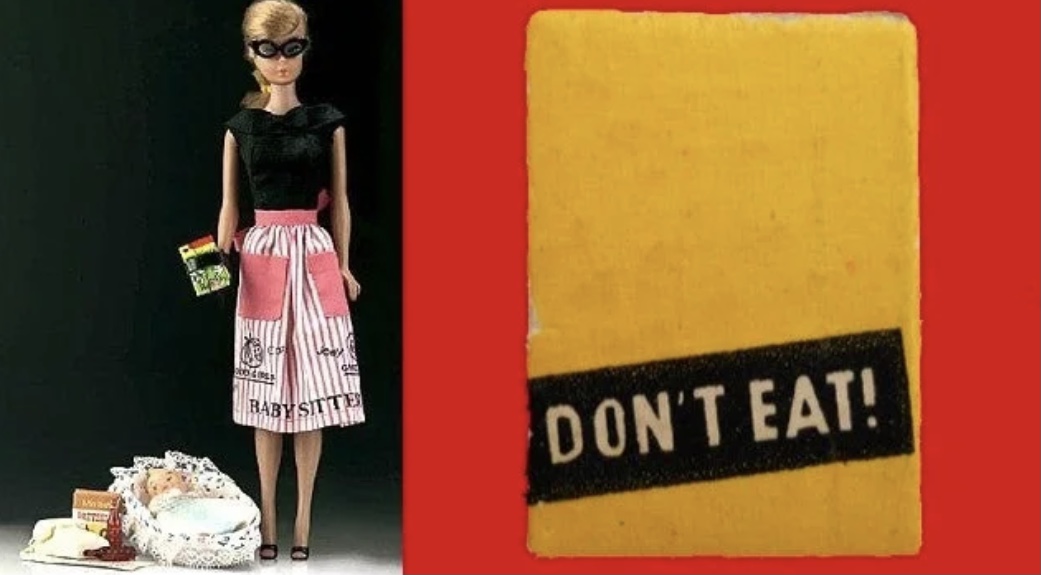
Mattel’s advertisement from the 1960s.

The Barbie industry serves as an integral part of many young people’s childhoods and continues to be an influential brand. Up until these last two decades, the trademark has kept selling an item that lacks real representation- one that is appearingly not meant for everyone. One of the most notable red flags with this brand is the unrealistic model of body anatomy that is set before young generations. While recent strides to become a trademark that is known as more inclusive and empowering have been ongoing, there is still an entire history of wrongful messages and branding to be seen in order to account for its controversial narrative. 

A prime example (and one of many) is none other than the “Babysitter Barbie” ad, which includes the words “DON’T EAT” and features Barbie holding a book entitled “How To Lose Weight.” Mattel, the company behind the entire franchise, promotes a harmful lesson to an incredibly impressionable audience. A young person who comes across this graphic becomes instilled with the need to already be regulating an area of their lives in order to be seen as valid from the golden standard Barbie places. This becomes a confusing take on what is supposed to be a franchise dedicated to lifting girls up. 

Not only does this ad present a norm that should not be reiterated to a young group eager to view Barbie as a role model, but it reinforces poor beliefs regarding body image. Any advertisement that emphasizes a problem before one might even be aware can change someone’s entire perception of what is “socially acceptable” for them to look like. In this case, Barbie’s message can unknowingly kickstart unhealthy eating habits and overall insecurity, and young people may not be aware of the root of where it all began until much later.

The positive impacts the Barbie industry has had on its audience is not to be discredited; however, regarding topics of feminism, it can be noted that Barbie’s history of branding has not always been helpful to that cause. Luckily, Mattel has made strides in inclusivity and Barbies is much more aware today. It is essential that brands are conscious of the content they present to audiences, especially when it can negatively impact the confidence of young girls and their bodies. The Barbie franchise missed the mark on this one.  

Latest on Desperate Housewives: depiction of women with assumptions and stereotypes

by Yuncong Hu

Written for Autostraddle

Last week, Desperate Housewives just released episode 9 of season 3, named “Beautiful Girls” after the character Gabrielle Solis’s plotline in this episode. Since 2004, when its first season started airing on ABC, the show has been positively received for its exploration on the inner dark sides and complicated personalities of the ordinary upper-class housewives, in contrast to the traditional plain, dour mother/wife figures on screen. Surprisingly in this episode, Gabrielle’s story isn’t technically boundary-breaking, and instead, it is borderline-misogynist.

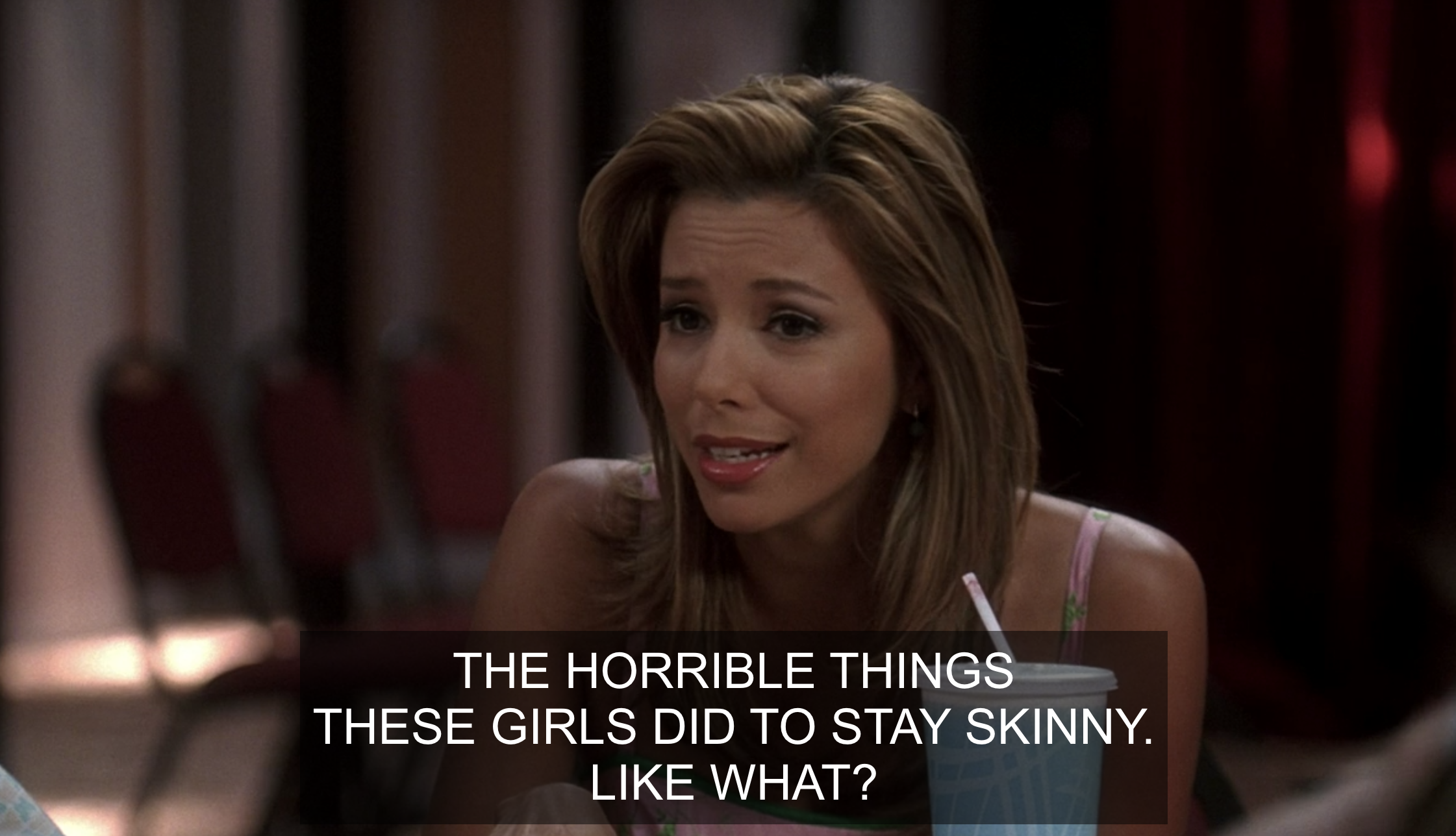
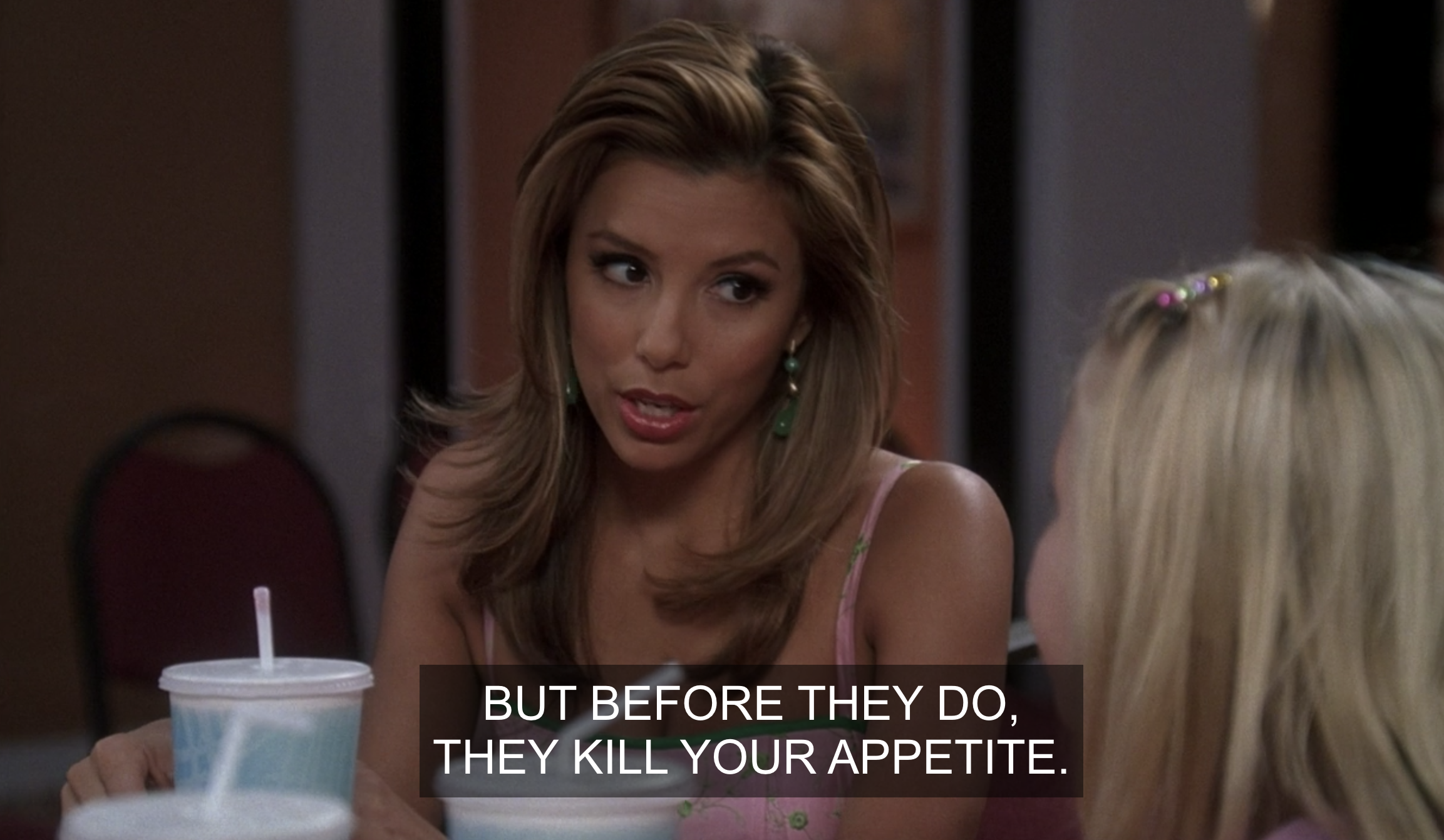
For those of you who haven’t watched Desperate Housewives, Gabrielle Solis is one of the four female protagonists, all of whom are close friends and neighbors living in a fictitious suburb are called Wisteria Lane. Gabrielle has a Mexican heritage, and the other three housewives are white. In S309, Gabrielle’s divorce is finalized. With the failed attempt to go back to her modeling career in last episode, Gabrielle accepts the fact that she is becoming an unemployed divorcée. In need of a distraction from her empty life, she accepts invitation from her gay personal shopper, Vern, to coach young pageant girls for his new beauty pageant consulting firm. While she reluctantly takes the offer, she later finds herself enjoying coaching the girls as her modeling expertise is incredibly idolized by these younger women. However, when she is reminiscing on her old modeling days, she accidentally tells the girls about some ill-advised weight-loss methods such as sticking fingers in throats and smoking. Later on, some girls are caught by their parents smoking and vomiting, and Gabrielle is fired. She then comes to the mothers of the girls, confesses to them that beauty pageant coaching is now the one single meaningful thing in the life of a woman without husband and family, and makes a subtle offer to give illegal diet pills to them. The parents give her a second chance.

It is noticeable that Gabrielle’s conversation with the girls in this particular scene demonstrate how fat stigmatization is socially institutionalized in popular culture. Specifically, Gabrielle starts with the warning “You would not believe all the horrible things model do to stay skinny” and “I never did it” before she introduced the kids into smoking and vomiting as weight-loss methods. The children, though aware of “smoking will kill you”, still ask “Do you have to be skinny to be a model?”, to which she answers, “When was the last time you saw a fat person on a magazine cover?” This is a highly representative example of anti-fat beliefs being passed on by someone elder and experienced to a younger generation, thereby creating an invisible social structure that is constantly renewing and strengthening itself. In her introduction to Fat Studies Readers, Marilyn Wann comments on this structure, “Every person who lives in a fat-hating culture inevitably absorbs anti-fat beliefs, assumptions and stereotypes, and also inevitably comes to occupy a position in relation to power arrangements that are based on weight,” The power relationship in this narrative is clearly the contrast between professional fashion models and some 9-to-12-year-old who wish they could be beauty pageant girls. As a result, Gabrielle herself, without realizing it, teaches the girls about the established beauty standard that discriminate against fat people. Her expertise, just like the enormous power of social norms behind beauty standards, is invisible and very restrictive, as the girls immediately accepts the norms and attempt to fit into them. Even worse, when she acknowledges that the methods she mentions is “horrible”, she is also explaining the conventional rules for fat people, that they need to suffer to lose weight, that being fat is even more dreadful than being unhealthy. These rules are internalized by the girls and soon, they start to punish themselves for being fat.

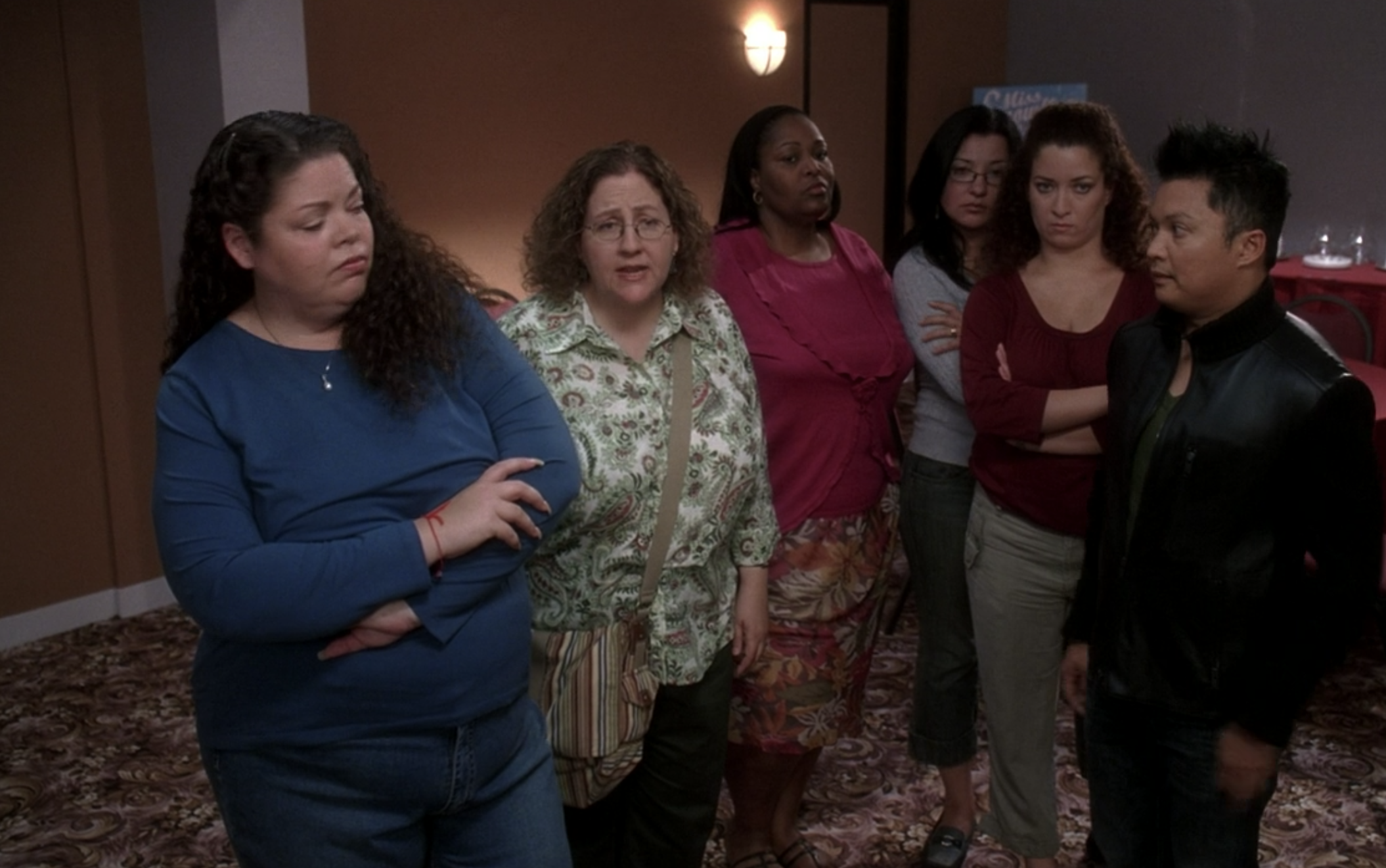
There is more to the fatphobia side of this episode. While it gives us an example of how fat-stigmatization transforms into social structures, it fails to offer any critical resolution towards it. This presentation of this story, which primarily focuses on weight and beauty standards, chooses to continue conforming to anti-fat beliefs and misrepresenting fat community. In the last scene, a sharp contrast is made between Gabrielle and the parents:

Eva Longoria, as Gabrielle, is intentionally put into better clothes, hair, accessories and make-up in this scene, while the other actors are clearly not. Gabrielle is wearing a full-length, Versace-styled ball gown while holding a clutch. Her hair is curly and silky, and she has full-makeup on. The other ladies are all wearing dowdy clothes, much less make-up and three of them can definitely be considered as fat. These women quickly changed their idea about firing Gabrielle after she mentions she has “highly effective non-FDA approved diet pills from Zurich”, and claim that “I guess the Christian thing is to forgive her” without admitting that they are attracted by the pills in reality. The plot and lines intuitively assume the beauty standards between two binaries – fat and thin, and coveys the implied message that thinner people do look better to its audience. Moreover, it falsely represents fat people by portraying them as automatically desiring losing weight at any cost. Therefore, it inevitably represents another effort to normalize weight-loss and anti-fat health promotion by making an assumption that fat people need to lose weight. In doing so, they neglect the group of audiences who belong to the self-accepting fat community.

In addition, the underlying assumption about Gabrielle’s social class is striking. She is a wealthy woman who can afford a personal shopper even after losing her steady income – her ex-husband. Her motivation for this job is not for survival, but only spiritual fulfilment. Just like Gabrielle, her other friends share the same social class and work motivation: they are married to lawyers, doctors, managers, etc. Essentially, the depiction of women’s struggle is mainly about upper-middle class, white women’s struggle (Gabrielle is the only POC protagonist in the show) A vast majority of women are already excluded in the production of this episode, as well as the whole series.

As the only non-white protagonist, the character of Gabrielle also indicates conformity to racial and gender stereotypes prevalent in America. She is undoubtedly, even in the script description, the most attractive housewife of all four, and a Latina ex-supermodel. There is a hyper-sexuality attached to her with her race, a form of over-sexualization of Latin women. The character has no choice but to be a gorgeous stereotype like a lot of other Latin women on screen, while diversity is allowed in white women. The same thing is applied to Gabrielle’s background. She is the only one who has a background story: she comes from a poor family, goes into modeling at a very young age, earns a new life through her new social circle, marries a rich husband and retires from fashion industry. Interestingly, Desperate Housewives does not introduce the backgrounds of other three white protagonists. They are assumed to be raised, educated and married normally as if they are in a standard white family, while Gabrielle needs an explanation of why she lives in a rich, white suburbs neighborhood. In other words, The abnormality in the life of a female, like Gabrielle, is highlighted and associated with her racialized background.            

Above all, the series Desperate Housewives does have many things to complement about: it gives a space for more female-centered narratives in the male-dominating media world, and it strives to tell stories from women’s points of view. Still, one must not neglect the problematic assumptions and stereotypes of women that it displays in only one episode. The production team need to inspect its work with more consciousness of preventing prejudices and assumption. And the audiences, while enjoying the marvelous episodes, should be aware of these problems.

Works Cited:

Wann, Marilyn. Foreword To Fat Studies Reader. NYU Press. 2009

Why can only white men drink beer?

A Budweiser beer advertisement from the 1950s

What do you first think of whenever you look at this ad? Budweiser is a very popular beer company, so it particularly stands out. When I first looked at it, I thought to myself “Hmm, this advertisement is probably from the 1900s”. Budweiser created this advertisement in the 1950s and the intended audience of it seems to be pretty clear: white men. The purpose can also be quite clear: sell Budweiser beer to white men. These are the things you can decipher when you just take a slight glance at this advertisement. 

As you dive deeper into the symbolic art that is presented in the advertisement, these things unearth more purpose and intention from the advertiser. Let us talk think about and analyze the actions of the two people in this ad. For instance, looking at the white man, he holds a hammer. As he is holding this hammer, it seems he is working hard on building something and we can assume this is either something for home or it is a part of his job. When looking at the white woman who we can assume is his wife, she is pouring him a glass of Budweiser beer. There is nothing hardworking about what she is doing, she is just simply acting upon her husband’s needs. This image sparks more controversial topics. In the 1950s, they would say “Well that is the role of a women, isn’t it?”. They would assume that the role of the women is to take care of her husband and fulfill all of his needs. Whenever we compare these two actions of the man and the woman, it really reflects those assumed and assigned gender roles that society claimed to be “right” in the 1900s. The typical woman staying at home, tending to her husband, the breadwinner. In contrast, the husband is the hardworking spouse in the relationship who has a job, does the “handyman” work at home, and acts upon all the “masculine” things society expects him to do. Just by looking at the actions of the two in the ad, it easily already brings those gender assumptions to the audience’s minds. However, when looking at the advertising techniques of Budweiser, you can question them on why they ignited these prominent gender roles in the ad. Well, since it was the 1950s, it was assumed that after a long day of hard work, men needed to decompress, so their wives could pour them some Budweiser beer at the end of the day. 

These points can also be proven by the facial expressions of the man and the woman in the advertisement. By the looks of the man’s face with his wrinkled forehead lines and his subtle yet irritated facial expression, he seems to be stressed out and tired from a long day of labor and responsibilities. Let’s remember, the 1950s were times when gender roles were prominent. Where the golden standard was the men working and laboring during the day while the women stayed at home with the children. So, because men are stressed out at the end of the day, this is why Budweiser aims at this audience of white men who have jobs. Budweiser tries to convince you that alcohol, specifically their beer, will help you decompress and relax at the end of the day. Now, looking at the intended audience of the advertisement, it sparks conversation on the assumptions of gender roles. For example, why is Budweiser assuming that only white men drink beer? Why can’t they advertise it to women or even non-white men? This question does have an obvious answer which has to do with the time that the advertisement was released, however, this only shows how prominent these gender stereotypes and standards as well as racial issues were during the 1950s. It shows how companies and businesses convinced society that men have specific roles and women have specific roles. It shows how there was so much assumption on what race was superior during the time and which were inferior. Moving on, let’s start looking at the women pouring the Budweiser beer for who we assume is her husband. She looks so content while pouring the beer. She looks as if she has no problems in this world. That may be true, or it may not be. Budweiser is trying to convince the audience that since it is the 1950s where women are at home while men are working during the day, the least they could do for their hardworking husbands is pour them a glass of Budweiser beer. Budweiser is trying to force these couples into these roles in order to advertise their product.  

Looking back at the advertising strategies that Budweiser tried to use, it may have been effective during the 1950s. However, that does not make it necessarily “right” to advertise in the first place. When people look at the advertisement in modern time, there are so many gender, racial, and class issues within the ad. However, we can learn to appreciate that advertisements such as this one was produced in history, because we can now analyze them and learn from them. That is the major takeaway we can obtain from media that occurred a long time ago, and that is what we need for social justice. 

Writing for Feministing / www.feministing.com

What is Mick Fleetwood’s Obsession with Balls?

Fleetwood Mac’s Rumors Album Cover

It’s been almost 50 years since the release of Fleetwood Mac’s Rumors (1977), but this album is still as popular as ever. From song versions sung by the Glee cast to a viral TikTok trend involving cranberry juice and “Dreams,” teenagers and adults alike fangirl over this influential record. They live for the drama, the ethereal energy, and the tack piano. But why, oh why, is there a pair of balls dangling between Mick Fleetwood’s legs, and who draped Stevie Nicks across Fleetwood like a damsel in distress? This blog post is an analysis of the album cover to Fleetwood Mac’s magnum opus and what it says about power dynamics between genders. 

If you’ve ever watched Superman, you know how much power superheroes exude solely from their stances. On the Rumors album cover, Mick Fleetwood stands tall and proud, one foot resting on a stool. His chest is proudly stretched, and his hand rests firmly on his hip. He’s set in place, grounded as he holds a crystal ball. On the other hand, Stevie Nicks is anything but steady. Her body is positioned closer to the floor, and her arm flexes behind her as if she’s turning (or possibly falling). She lacks balance, utilizing Fleetwood’s leg for support. At first glance, their stances are nothing to consider. However, this contrast of poses creates a clear power dynamic between Fleetwood and Nicks: Fleetwood is an object of power while Nicks floats along with little structure, reliant on Fleetwood’s body. These same power dynamics have dominated modern-day family and economic systems. During the 1950s, the cult of domesticity established the prevailing trend of male breadwinners. Even today, men are still seen as financial providers and political leaders of whom women are in desperate need. 

Along with posture, the juxtaposition of masculinity and femininity is apparent in Nicks’ attire. Nicks dons a black flowy shawl and is dressed as Rhiannon, the Welsh witch known from the song of the same name from Fleetwood Mac’s eponymous 1975 album. Throughout history, witches have been one of the most widespread images of female empowerment and resistance to patriarchal norms. Persecution of witches has existed as early as the creation of the Bible; the witch trials in The United States (most famously Salem, Massachusetts) and the United Kingdom merely dispersed witch hysteria throughout the world. Witch hunts often punished powerless women who were on the fringes of society: women of color, women that spoke against the man, outwardly sexual women, etc. Essentially, women – generally speaking, people – that didn’t conform to expectations set by society and the patriarchy were susceptible to being charged with witchcraft. Witchcraft’s connection to the feminine is also apparent in a witch’s connection to nature. While nature isn’t necessarily feminine, much of the discourse around women and motherhood connects to the Earth. Furthermore, women and the Earth alike have been subject to much exploitation, oppression, and destruction. Witches communicate with these forces of the environment, blurring the line between humans and nature. Now, what does this have to do with Stevie Nicks or Rumors? For much of the ‘80s, tabloids and haters alike speculated that Stevie Nicks was a witch. Rather than run from these harrowing accusations, Nicks embraced the identity – she embraced Rhiannon. Nicks even appeared on American Horror Story as the “White Witch.” She became this mystical, feminine icon in the male-dominated genre of rock, a “fuck you” to both the industry and patriarchy. This begs the question: if Nicks is a model of feminine power, what does the Rumors album cover say about the relationship between man and woman? Why is Fleetwood holding a crystal ball, Rhiannon’s median of art? Has he taken it, are they sharing it? Why is Fleetwood towering over Nicks, positioned as if he’s Captain Morgan overpowering the feminine? Is he part of the witch hunt? Expanding on the analysis of their gender dynamics from their posture, the cover art suggests an imperial conquest of wild and unruly women, i.e., witches. 

The last narrative piece that brings this analysis full circle is how Fleetwood himself is accessorized: with a pair of balls that hang below his pelvis. Why is it so crucial that Fleetwood reminds not just Nicks but the listeners (and therefore the world) of his genitals? The answer to this question is simple. He wants everyone to remember that he has balls. He wants his power as a man – as a person with a penis and testicles – to be known. We live in a world where power systems predominantly benefit those with one set of genitalia, so images related to testicles or phallic symbols can also be correlated to potency and strength. Today, we see phallic imagery in areas related to power, such as swords, rockets, skyscrapers, and cigars. These images create a subconscious association in our minds with hegemonic masculinity, a constant reminder of who and what is in charge. Similarly, Mick Fleetwood’s balls generate a reminder of his position in society and in relation to Rhiannon.  

Does this mean you should stop listening to the silky melodies of Fleetwood Mac? Absolutely not – I’ll always need my daily dose of Stevie! However, you should study and recognize the many messages the cover art delivers. Rumors has one of the most recognizable album designs of all time, so dissecting images that circulate pop culture is vital to understanding the social contexts in which we live. That being said, the next time you add “Songbird” to your Spotify queue, analyze the different stories hidden within the album cover and question any resemblances to your own relationship to gender and power.

Written by Anaya Patel with Autostraddle

Audi’s Display of Sexism and Stereotyping

In 2017, Audi, a German car manufacturer known for its luxury vehicles, released an advertisement to its Chinese market that sparked much controversy around the world. In their attempt to promote used cars to potential customers living in China, the brand not only displayed apparent examples of sexism, but promoted racist stereotypes. This commercial starts off with an Asian heterosexual couple standing at the alter about to get married. Right before their marriage was officially declared, the groom’s mother interrupts the officiant and begins handling the bride roughly, attempting to inspect parts of her body. Only after the bride’s future mother-in-law examines some of her physical aspects, like her eyes, nose, ears, and teeth does she declare the bride fit to marry her son and gives her approval. The terrified bride is seemingly relieved after her future mother gives the couple her consent, until the mother’s focus turns to the bride’s breasts, bring her back to a panicked state. After this blatant objectification, the commercial’s narrator voices “An important decision must be made carefully” as a red Audi Sudan zooms down a highway (Greatdung 0:22-0:23).

YouTube, 17 July 2017

This sexist Audi advertisement centers around the objectification of a woman by not only debasing the bride’s value to just her physical attributes, particularly her facial features, but also by comparing her to something one can buy and own. By insinuating that marrying a living breathing person is an equivalent decision to buying a car, Audi turns the bride into an object that can be materialized and possessed. Not only is the bride objectified by her future mother-in-law, but with the attention shifting to her breasts, she also becomes sexualized. This overt objectification and sexualization of a woman not only advance the harmful ideology of women not being actual people and simply objects for the benefit of men, it can have dangerous consequences that go beyond these beliefs. The United Nations International Children’s Emergency Fund (UNICEF) makes this connection by declaring “The objectification and sexualization of girls in the media are linked to violence against women and girls worldwide” (UNICEF USA 2021). This treatment can also have a multitude of negative consequences on the targeted individual’s mental health that can last throughout a lifetime. With the massive platform stemming from the ability to air advertisements to millions of people, comes much responsibility to further notions of equality rather than ideologies that have the potential to cause an immense amount of harm. 

Not only is objectification based on gender a prominent issue in this ad, but race also plays a problematic role. The stereotype of the “tiger mom,” a term coined by Amy Chua which describes Chinese mothers as strict, controlling, and borderline abusive, is also deployed in this Audi advertisement. One aspect of this stereotype is the fixation Asian mothers have on the physical appearance of their daughters (Chua 2011). In this case, the need for the bride’s soon to be mother-in-law to examine her physical features, deciding whether they meet her standards prior to the couple’s marriage further perpetuates this stereotype. Most Asian mothers do not align with this parenting style and utilize a wide range of other strategies, contrary to popular belief. The bride also remains passive during this offensive interaction, exemplifying to this advertisement’s audience that this is the appropriate reaction in the face of maltreatment, which could be easily internalized by woman and child viewers. By displaying this inaccurate idea of what Chinese mothers usually place high value on, as well as the expectation of women staying passive, not only does Audi promote sexism, but also racist stereotypes.

Connecting these ideas, Audi exhibits how the intersection of both gender and race can work together, producing an even greater amount of discrimination for individuals like the bride in their commercial. On the basis of Kimberlé Williams Crenshaw’s concept of intersectionality, two social categorizations of the bride’s identity, being Asian and a woman, create a somewhat unique distinction of the discrimination she faces in this Audi advertisement. Unfortunately, this situation is not rare and many individuals who share these similarities in their identity experience this prejudice on a day-to-day basis. 

Shortly after this commercial aired, it received mass amount of criticism and backlash from the public. One commenter even voiced “The annoying thing about Audi’s used-car ad, besides its objectification of women, is that it thinks Chinese customers deserve only commercials like this” (Washington Post 2019). Others simply called the advisement sexist and disgusting. Many people initiated plans to boycott this company and convinced those around them to partake in this form of protest. Following this severe condemnation, Audi apologized for its ignorance related to this particular incident, assured the public an internal investigation would take place to avoid a mistake like this in the future, and removed this advertisement from television. Audi’s response to this backlash and quick withdraw of their commercial displays the power the public holds and how each individual’s voice matters when speaking out against discrimination. 

Unfortunately, this type of sexist and racist commercial is not the only one of its kind. These companies must continue to be held responsible for the harmful ideologies their advertisements promote and be hyper aware of the massive audience they have the ability to reach just through the commercials they release. These examples of sexism and racism through promoting stereotypes and targeting certain audiences unfairly in advertising must come to an end in order to create a more egalitarian world. These large-scale brands have the responsibility to advance impactful and beneficial messages to the massive audience they are capable of reaching, instead of carelessly feeding this harmful ideology to the masses. 

Works Cited: 

Chua, Amy. Battle Hymn of the Tiger Mother. Penguin Books, 2011. 

Greatdung. “Audi Used Car Commercial in China. Full of Sex Discrimination.” YouTube, YouTube, 17 July 2017, www.youtube.com/watch?v=WiBva8pEgTc. 

Smith, Jamiee, and Hannah Gould. “Not an Object: On Sexualization and Exploitation of Women and Girls.” UNICEF USA, 11 Jan. 2021, www.unicefusa.org/stories/not-object-sexualization-and-exploitation-women-and-girls/30366. 

Wang, Amy B. “An Audi Commercial in China Compared Women to Used Cars. It Didn’t Go Well.” The Washington Post, WP Company, 18 Apr. 2019, www.washingtonpost.com/news/worldviews/wp/2017/07/18/an-audi-commercial-in-china-compared-women-to-used-cars-it-didnt-go-well/. 

TikTok: Its Perpetuation of Gender-Based Stereotypes and Human Body Standards

Over the past few years, TikTok has become a mainstream social media platform. This application, available for most smartphones, uses an algorithm to curate content for users, effectively getting them addicted to scrolling on the app. There are many subcultures on TikTok… For example, people who like dogs might find that the algorithm has put them on ‘dog TikTok,’ because their ‘For You’ page is filled with videos of dogs. The same concept applies to gender and sexuality. There are many different points of view represented on the application, and once the algorithm figures out what yours is, it will show you a plethora of content to reinforce that exact idea. 

There is a large subculture (or really, a set of subcultures) on TikTok that perpetuates the gender binary system and all of the gender roles that come along with that. For example, this video is a representation of many of the different videos that are found on ‘straight TikTok’: 

When the individual speaking in the video says, “Men will choose a peaceful woman before a beautiful woman,” they are enforcing many of the expectations that are placed on female-identifying people in our society. Moreover, the speaker is implying that women must be ‘peaceful,’ therefore implying that often, women are not peaceful. This implication tells women that they need not express their emotions; rather, they should focus on being as passive as possible in an effort to be chosen by a man. 

Next, when the person speaking says, “Men seek for peace, and it don’t matter if you’re Black, blue, asian, Latina… they want to come home to a peaceful woman,” they are demonstrating a lack of awareness of the intersection between race and gender. This statement also reinforces the idea that men come home to women, therefore saying also that women should not be working professionals. 

On top of that, the speaker discusses the intellect of women and expectations in that area that men hold. They say, “He wants a woman that’s resourceful, a woman that can think on her feet. So when he can’t hold it down if he’s ill and he’s unable to pay the bills, she can be resourceful and have her intellect to make things happen.” The first implication I see in this statement is that the woman should just be intellectual as a safeguard… the woman will never actually have to use these skills unless it comes down to it. The assumption that men always pay the bills is harmful to all people, regardless of gender, because that is not the case for everybody. By the same token, the fact that the speaker is bringing this point up implies that women are, in general, less naturally intellectual than men. Drawing this unfounded connection between gender and intellectual capacity is harmful to society as a whole. 

Perhaps most disturbingly, our speaker talks about the ‘appropriate’ role of women in a sexual context. They say that men are “looking for a woman to supply their physical needs… A woman that looks good and proper and public but is a beast in bed” is the golden standard. First of all, in addition to ignoring the physical desires of the women at hand, this statement claims that the purpose of women is to fulfill mens’ sexual desires. This incredibly sexist ideology has the capacity to negatively influence the lives of many people. On top of this, the speaker is assuming a common definition of beauty… she is saying that women who have a certain physical appearance and demeanor are examples for what all other women should try to be when in pursuit of a relationship with a man. 

In conclusion, the ideology contained within this video is based on the idea that women are socially inferior to men, and that female sovereignty should not exist when it comes to romantic and sexual relationships. The central claim is that women should constantly be cultivating their personas to match what they think men are looking for in women, in hopes that they will ‘meet the cut’ for some man.

Similar to the last clip, this piece of satire brings awareness to many of the appearance-based expectations that our society holds for women, and the stark contrast between these expectations and those for men. The actor, mimicking a man, says: “Alright, so I want a girl with huge, but perky boobs, small waist, huge butt, flawless skin (but can’t wear makeup). And I like blondes, but I think she should also be brunette… because I get bored quickly, you know?” This statement encapsulates many of the body standards that our modern society has for women, and also touches on the normalized fact that men sleep around while women are expected to be loyal. 

In the caption of this video, the creator claims that this is how all men think. Although this is probably a sarcastic statement, it is representative of the way that many people think. Moreover, individuality is to be nonexistent: all men must act one way, and all women must act another way. Beyond pointing out, and perhaps reinforcing, the gender norms that are in place for men and women, this video illustrates the prevalence of the gender binary in our society. 

Content Warning: This video contains a real-life portrayal of surgical body mutilation. Use viewer discretion. 

In this shocking clip, we see a person that is identified as a man who has ‘overdeveloped’ breast tissue. His act of having the ‘excess’ tissue removed is labeled as life-changing. First of all, the video notes that this overdevelopment in the breast tissue of a man is an actual medical condition, which is known as ‘gynecomastia.’ Its causes are said to be “medications, drugs, testicular cancer, and hormonal imbalance.” 

Without looking into the history of this condition, it’s plausible to assume that this condition was developed in response to a bodily appearance that was not in line with society’s idea of what a man should look like. Moreover, this condition does not pose any medical risk to the patient; it is merely aesthetic. 

This video perpetuates a toxic standard of beauty, and is essentially telling men who have growth in their breast tissue that in order to be beautiful, they must undergo surgery. Explicitly, the caption says, “These [surgeries] literally change men’s lives.” In watching this video, men with growth in their breast tissue are inevitably going to receive the message that they are disgusting, and must go get surgery. 

In conclusion, the three videos I have analyzed here are examples of the many TikTok videos that enforce gender-based stereotypes and human body standards that are present in our society. This is not to say that TikTok is a problematic platform that should not exist; rather, this suggests that we as a society should critically examine the role that social media plays in perpetuating harmful gender-based stereotypes and expectations on a day-to-day basis.

Writing for Feministing | www.feministing.com

Theory To Praxis: Abortion Access and Class Equity Issues

Through our time in GSS, I learned more about something I am already very passionate about, reproductive justice issues. If I learned anything in our short time delving into these issues in class, it is that they are highly intersectional, something which is often omitted from mainstream discussions of them. While not the only reproductive justice issue in any regard, the most commonly discussed topic of our time is abortion access.  In popular media, pro-choice and pro-life narratives are heavily centered around towing the line of viability. Furthermore, a sticky compromise, legally, was made by founding the right to abortion in a constitution right to privacy. This has allowed the focus on abortion to be shifted on morality instead of looking at the many nuanced reasons that women reach out for these procedures.

In my literature review I focused on what the major ways in which pro-choice arguments have been founded and identifying some common themes that are seen across the literature. These themes did include some legislative basis, particularly regarding rights to autonomy and how we discursively construct or limit personhood, particularly in regards to the oxymoronic concept of fetal personhood. One of the more interesting themes that I found was the topic of class equity as a means for opening up abortion access. A lot of these arguments center around women lacking access to provide adequately for any child. A number of narratives have noted that it is not just to have children if they are unable to be provided for and cherished. These arguments have also been used in a similar fashion regarding the cost of maintaining a healthy pregnancy. Depending on a woman’s health needs and the state she lives in, the total cost of pregnancy can be a very expensive process in comparison to the cost of an abortion.

Due to these issues being more current than some that are often discussed, I would like to use this information to propose a DRI / some other research project specifically into the intersections of class equity issues and abortion access. I would specifically like to focus on class equity and how this concept interacts with race regarding these issues, as many of the books commented on token populations, and I would personally like a more thoroughly representative depiction of the wide experiences of women seeking out these procedures. I believe that, as this issue is one with many extremist attitudes on both sides of the aisle, this research is essential and would provide different points and voices in the reproductive justice conversation.

From Theory to Praxis: Bringing My GSS Experience Abroad

The most powerful aspect of Gender and Sexuality Studies that I will take with me after this class is how to examine the world intersectionally, through a lens that always includes race, gender, class, and all other factors that vary the experiences of people. I have found myself unable to turn off my critical eye when interacting with people, consuming media, and taking my classes at Davidson. I know that the analytical skills I gained from this class will stay with me as I travel abroad to Stockholm, Sweden for the fall 2017 semester. Sweden has been known internationally for its liberal and open policies in regards to gender parity, sex education, social programs, and government in general. After taking this class, I have seen how many structural and systemic power structures there are that are designed in order to hold down people sexually, politically, and socially and I think it will be interesting to experience a culture that did not form the way the United States did. While abroad, I’m hoping to collect information and learn more about what makes Sweden so different than the United States in hopes of returning and being able to join dialogues about what we as citizens can do in order to make our country a more open and equal environment for all.

In my time aboard, I hope to not only take my classes but also to learn outside the classroom and bring back to the United States the culture lessons that Stockholm teaches me. In my research on Sweden, I have learned that Sweden is considered one of the most progressive countries when its come to women’s rights. Half of Sweden’s government ministers are women and almost half (44%) of their Parliament is female. For my theory to praxis, I would like to look at the differences in the societal and political systems in Sweden as compared to the United States in order to find out why there is such a difference in the power of women in both countries. Although the American and Swedish systems of government are very different, I hope to experience the feeling of tolerance that is so foreign to our country and bring back that experience to America.

I can connect my travel to Sweden with my literature review by examining the differences in the ideas of masculinity in both countries. The problems that plague America, such as rape, police brutality, and domestic violence, are seen in much lower levels in Sweden. I believe it is because, unlike America, there is no institutionalized idea of masculinity that is bred into boys from an early age. The power systems that are at work in the United States and are pushed by our capitalistic, patriarchal societal design place men and women on very different levels, allowing men to feel as though they have a right to women’s and other marginalized people’s bodies. By removing not submitting to this power system, Sweden has been able to stop many of the rampant problems of toxic masculinity still happening in America today.

Works Cited

Edsall, Thomas B. “Why Can’t America Be Sweden?” The New York Times. The New York Times, 29 May 2013. Web. 07 Dec. 2016.

“Sweden and Gender Equality.” Sweden.se. Swedish Institute, 21 Nov. 2016. Web. 07 Dec. 2016.

Beyond Marriage: Valuing All Families under the Law

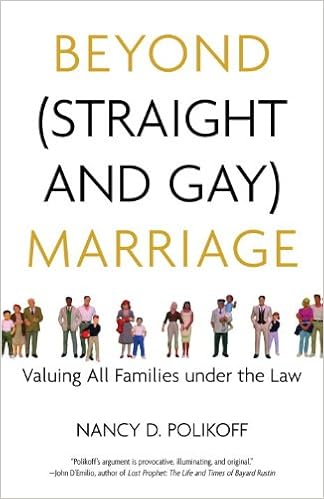
“A woman married to a man for nine months is entitled to Social Security survivor’s benefits when he dies; a woman living for nineteen years with a man or woman to whom she is not married receives nothing.”[1] The debate over marriage equality for same-sex couples was one that took over the country’s social and political agenda in the early 2000’s. Nancy Polikoff’s Beyond (Straight and Gay) Marriage challenges this agenda by asking both straights and gays alike to consider a broader definition of what constitutes a family and how this structure should be protected under the law. Those protected by the institution of marriage have privileged status in regards to tax benefits, estate benefits, government benefits, employment benefits, medical benefits, and death benefits among others. Polikoff calls for a revamping of family law; one that takes into consideration the changing nature of family units while also deemphasizing the status of marriage in our society.

Nancy Polikoff is a professor of law at American University Washington College of Law. She teaches Family Law and a seminar on Children of LGBT Parents and has been writing about, litigating about, and speaking about cases involving LGBT families for the past thirty years. Her accomplishments include co-founding the Washington, DC Feminist Law Collective, supervising family law programs at the Women’s Legal Defense Fund, and co-authoring one of the first law review articles on the custody rights of lesbian mothers. Beyond (Straight and Gay) Marriage is Polikoff’s first book. She has a daughter in her twenties and lives with her partner in Washington, DC.

The first half of the Beyond Marriage gives the reader historical context as to how we got to the position we are in with marriage today. It begins with the advances made by the second-wave feminist movement in the context of marriage, and then describes how those advances have been attacked since the 1970s by the religious right. Betty Freidan, Gloria Steinem and others are cited in this section, along with groundbreaking legislature like Title IX. From there, she moves into the gay rights movement and the intersection of lesbianism and feminism. Eventually she delves into the marriage movement of the conservative right and the how the push for preserving marriage as an institution for heterosexual couples strengthened marriage’s societal status. She then brings the reader to the contemporary fight for marriage equality, the most thorough part of the first half of the monograph.

Generally, there are two dominant perspectives in the contemporary marriage debate. First, there are those who support the institution of marriage and believe that opening it up to non-heterosexual couples will undermine social structure. Second, there are those who support equal access to marriage for LGBT individuals since they deserve the same access to benefits as married heterosexual couples. Throughout the book, Polikoff makes reference to groups on both sides of the argument. Frequently mentioned supporters of the marriage movement include The Institute for American Values, the Alliance Defense Fund, and the Liberty Counsel. Those often mentioned on the side of marriage equality include Lambda Legal, the Human Rights Campaign, and the National Gay and Lesbian Task Force. All of these groups fight for legislation supporting their side of the argument or represent individuals in relevant court cases. Polikoff separates herself from these prominent groups by taking a third stance. She questions the legitimacy of marriage as the necessary qualification for receiving legal benefits and questions whether it is fair to exclude so many other family forms by limiting such benefits. This allows her to reframe the debate over marriage by making the point that the benefits associated with marriage are not inherent, they have been constructed over time and have increasingly drawn a line between families formed through marriage and families formed through other means. By fighting for the right to marriage for LGBT couples, dominant organizations like the Human Rights Campaign are reinforcing the place of marriage in our society as cultural institution that unfairly awards rights to the married and leaves those who are unmarried out to dry. She enforces the argument that marriage is outdated and the benefits that accompany it were developed decades ago when having sex outside of marriage was taboo, illegitimate children were considered outcasts, and marriage had gender roles legally entwined within it. Through the examination of historical movements, she determines that people have changed the way that they view and structure their lives and the current marriage equality movement does not reflect this change.

The second half of the book is dedicated to describing specific aspects of her proposed approach, called “valuing all families,” to make marriage matter less. The most important aspect of this approach is identifying the purpose of specific laws that currently grant marriage-specific legal consequences. By understanding the specific objectives of these laws, relationships can be identified that would further the law’s objective without creating a specific special status for married people. In regards to this approach, she addresses health care, medical leave, medical care, domestic partner benefits, the dissolution of relationships, death, and economic compensation. Polikoff argues that by taking this approach, our society can move more towards a legal system based on the nature of care and dependency in relationships, not just the relationship’s specific name. Her solutions are not only for same-sex couples, they are also for people non-conjugal relationships, like unmarried elderly people, caregivers and the people they help, or friends living together. For instance, through this approach she examines the current family and medical leave practices of businesses across the country, supported by anecdotes of those who were not allowed such leave to care for an ill family member. Many medical leave policies are limited to caring for a spouse or child with serious illness and are often unpaid. Polikoff proposes support of the “Healthy Families Act,” a bill that provides seven days of paid leave per year “to care for a child, a parent, a spouse, or any other individual related by blood or affinity whose close association with the employee is the equivalent of a family relationship.”[2] This kind of reform breaks down barriers and helps to redefine the law’s narrow definitions of family that do not accurately reflect today’s society.

Polikoff’s breadth of knowledge of her field is evident as she provides a comprehensive overview of legal history as it applies to social movements throughout the decades. This method is extremely effective in giving the reader context into the foundational aspects of marriage and establishing the true dividing line that it has become. By making interdisciplinary links through feminism, sexual liberation, class, and justice, her argument is multidimensional and looks at marriage through the views of different legal lenses. The inclusion of a significant amount of laws and court cases is appropriate since the nature of her “valuing all families” solution focuses on reforming these laws. In contrast to the formality of the included law, Polikoff includes many anecdotes and case studies throughout the monograph to explain how the law has failed certain families because of the marriage dividing line. These short stories help to break up the dense law material and make it easy to envision why her reform needs to be implemented in real world situations.

Although at first the idea of diminishing and eventually removing the significance of marriage in a society may seem radical to the general population, Polikoff’s presentation of her argument makes it seem truly possible and reasonable. She provides concrete solutions for reforming laws, many based at the state and local level, and also provides several examples of places where similar laws have been successfully enacted. Even with the abundance of case law, the Beyond Marriage is very much readable by those without Polikoff’s extensive background. This monograph is meant to reach a broad audience due to its increasing relevance, however, due to its connectedness with the marriage equality movement and gay rights, the audience becomes more limited.

Polikoff reinforces in Beyond Marriage that people should have the choice to marry based on their individual beliefs, whether they be cultural, spiritual, or religions in nature. It should not be a choice that people are forced into to obtain unique legal benefits that are specific only to marriage. The end goal of her efforts is a system in which marriage is not the rigid dividing line between who is in and who is out regarding family law, through her “valuing all families” approach. This monograph is a valuable resource for people in all family structures and can help our society move towards a legal system that helps improve the lives of all individuals and families.

Works Cited

Polikoff, Nancy D. Beyond Straight and Gay Marriage: Valuing All Families under the Law. Boston: Beacon Press, 2008.

[1] Nancy D. Polikoff, Beyond Straight and Gay Marriage: Valuing All Families under the Law (Boston: Beacon Press, 2008), Cover page.

[2] Nancy D. Polikoff, Beyond Straight and Gay Marriage: Valuing All Families under the Law (Boston: Beacon Press, 2008), 172.

Women’s Progress and the Future of Marriage: Review of Generation Unbound

American social norms surrounding marriage and family structures have undeniably exploded since the 1950s golden age of Ozzie and Harriet-style unions. Over the past five or six decades, the United States has experienced a rapid decline in marriage and an enormous rise in births to unmarried mothers, especially among poorer, less educated Americans. Family sociologists agree that, in general, childbirth outside of marriage objectively increases poverty levels and inequality for children. In her 2014 work Generation Unbound: Drifting into Sex and Parenthood without Marriage,” Isabel Sawhill explores the causes and consequences of these striking changes in the United States’ marriage culture. She presents the reader with several explanations for the societal developments, including economic changes due to deindustrialization and globalization and a general liberalization of norms surrounding sex and marriage. However, unlike her colleagues in the field of family sociology, Sawhill identifies changes in women’s role in society as the overwhelmingly most powerful catalyst in the decline in marriage and increased childbirth to unwed mothers. In turn, Sawhill’s solution to the consequences presented by these developments is also ultimately a feminist one, as she argues that men must accept women’s changing roles and agree to function in a more androgynous union with a non-gendered divison of labor.

Throughout the expository introductory chapters of the book, Sawhill joins the existing dialogue of her contemporaries, including Charles Murray, Bradford Wilcox, and Robert Putnam, to establish a fact agreed upon by all family policy analysts and family sociologists: marriage is objectively the most successful union for stable parenthood, but marriage as an institution is rapidly declining in the lower socio-economic classes in the United States. What the U.S. has developed, in turn, is a cycle of poverty that fosters unstable family structures and unstable family structures that foster poverty. Sawhill’s main impetus to research the topic lies in the welfare of children. Her main argument is that marriage has seen such a rapid decline in recent decades because of the relative social progress women have made and the subsequent change in women’s opportunities and gendered expectations. Sawhill sees these developments as undeniably positive ones; however, progress for women has led to unintended consequences for children, as children have no autonomy over what type of family structure into which they are born, but must suffer any consequences assiociated with an unstable family. Sawhill’s argument develops into a suggested remedy for the future, in which she proposes that the government subsidize long acting reversible contraceptives (LARCs) to drive down the fertility of women drifting into motherhood with little active intention to do so.

Isabel Sawhill works at the Brookings Institution as a senior fellow in Economic Studies. She serves as the co-director of the Center on Children and Families, as well as the president of the board of the National Campaign to Prevent Teen and Unplanned Pregnancy. In recent years, she has focused especially on economically disadvantaged children in the United States, though throughout her life her research has examined various economic and social topics. She has extensively researched unplanned pregnancy, the economic consequences unplanned children face, and how the United States can best prevent unintended pregnancy.

Isabel Sawhill lays out her argument with extensive discussion and analysis of empirical, quantitative evidence representing the trends in marriage in twenty-first century America. Along with her contemporaries in the field of family sociology, Sawhill uses statistical evidence to determine that children fare best when they grow up in a household headed by their married parents. Despite marriages’ positive outcomes for children, though, Sawhill tells the reader that “marriage is on the wane,” going so far as to claim that marriage is an “endangered institution” (Sawhill 17-18). The bulk of her research is thus to explain why marriage rates have fallen so drastically; her findings bring her to the conclusion that “the changing status of women is the most important driver of changes in the family” (Sawhill 28). From the advent of the birth control pill, to increased numbers of women in college and the labor force, women have far more opportunities now than they did the so-called golden age of marriage, making them less inclined to marry, especially at a young age.

Sawhill also engages with her contemporary interlocutors by highlighting the growing class divide in family structures between the well-educated upper class and the less-educated lower classes. While women in the less educated, lower socio-economic classes have increasingly forgone marriage, while having children outside of marriage more and more often. However, women of higher socio-economic status are entering into so-called neotraditional marriages, which resemble 1950s-style unions, but are predicated on much greater egalitarianism between the husband and wife. Sawhill suggests several remedies to the negative consequences for children produced from what Sawhill considers unstable family structures. She argues that the U.S. government should subsidize long-acting reversible contraceptives (LARCs) to push down the fertility rates among the lower socio-economic classes in which fertility is high but marriage rates are low. She also supports increases in traditional government welfare programs to provide monetary and medical assistance to those in need.

The greatest strength of Isabel Sawhill’s work, I argue, is her introduction of a new explanation for the divergences in family structures in the United States during the past few decades. Her thesis, arguing that changes in women’s status in American society have been the greatest catalyst for breaking down the traditional family structure of the twentieth century, is an argument relatively untouched by Sawhill’s contemporaries. While family sociologists and policy makers have engaged in debate over the cause of changes in family structures, Sawhill presents a perspective unique from her colleagues by making her argument centered around the cultural shifts that occurred due to feminist movements. This argument strong and logical; the advent of accessible and relatively affordable contraception, the legalization on abortion through Roe v. Wade, no fault divorce, women’s increased presence in higher education institutions and improved status in the work force, etc. have all undeniably shifted marriage norms and structures (Sawhill26-30). She explains the bifurcation between upper and lower economic class families through the lens of gendered norms as well; well-educated, wealthy women are delaying marriage and childbearing while they gain education and profession status, but “at the other end of the economic spectrum, families are falling apart” (37). Sawhill explains this development as a result of lower-income men refusing to approach partnerships and marriage with an egalitarian view of gender.

Arguably Sawhill’s biggest weakness in her text is her explicit call to drive down the fertility rates of the less educated, lower income rungs of American society. Though she provides copious evidence that the instability present in many lower income families harms innocent children, her suggested remedies evoke the disturbing history of eugenics and birth control. Though Planned Parenthood provides undeniable benefits in 2016, and although Margret Sanger is often portrayed as a champion of women’s rights and social progress, we must remember the initial intentions of Planned Parenthood and birth control in general. While Sawhill herself may advocate purely on behalf of blameless children, her call for government-subsidized fertility control of less educated, poorer women threatens the agency of women on the sole basis of their economic status, as well as treading frighteningly close to outright eugenics. While children do unfairly suffer due to their parents decisions, we must always respect the agency and value of people regardless of their education attainment or economic status.

Overall, Isabel Sawhill provides an interesting and important commentary on the developments of marriage norms in the United States, with her predictions for the future and suggested remedies for the negative consequences associated with these changing social norms. The book exists in a field presumably off the radar of the average person, even among the more educated ranks. However, family structures and practices affect the future generation of thinkers, leaders, and influencers of our economy and society, and evidence shows us that the environment in which they are coming of age has a much greater affect on them than we may realize. Because Sawhill’s topic of analysis includes such a broad range of people—that is, all of American society—everyone could benefit from reading her text. I would openly recommend this text, but would explicitly suggest any reader to examine closely her remedies for the future and approach the work with a critical eye.

Sawhill, Isabel V. Generation Unbound: Drifting into Sex and Parenthood without Marriage. Washington, D.C.: Brookings Institution, 2014. Print.

Flirting with Danger

Every day, every single interaction, whether conscious or unconscious, shapes our identity and perception of the world. From the time we wake up in the morning until the time we go to bed at night, we are taking in information, processing it, and shifting our awareness of society based on the viewpoints we perceive. This impact of interactions and social cues has evolved over time into the hegemonic countercultures in different places around the globe. In her book Flirting with Danger, Lynn N. Phillips explores the ideology of power and choice within hetero-relationships formed by Western Culture through an in-depth analysis of the personal stories from young women.

Lynn N. Phillips coined the phrase “flirting with danger” in order to summarize women’s approach toward hetero-relations as established by previous interactions and media influence. In common situations of hetero-relations, the boundaries between “seduction and domination, pleasure and danger, responsibility and exploitation, agency and objectification, and consent and coercion” often become variable and murky (Phillips 3). However, women interpret this risky behavior as a “part of the ‘normal’ experience of their daily hetero-relational lives” (Phillips 3).  Through her research and analysis of women’s personal reflections of their relational experiences, Phillips successfully explores how women’s view of hetero-relations has evolved into the “need to flirt with danger” (Phillips 206).

Lynn N. Phillips draws on previous literature from feminist theorists in order to analyze her qualitative data. In doing so, she successfully creates a framework to guide our understanding of how society has shaped the subjectivity of power, choice, and desire within hetero-relations. In writing this book, Phillips aims to stimulate discourse regarding aspects of hetero-relations that are often excluded from feminist and social science literature. She specifically highlights the absence of conversation promoting “male accountability” and “female pleasure without penalties” (Phillips 77). While women do have the same sexual desires as men, “structural, ideological, and interpersonal barriers” created by Western Culture often prevent women from expressing these desires (Phillips 77).  Further, she hopes to gain a greater understanding of how women’s judgments, specifically regarding the meanings of male domination and sexualized power in their lives, have been shaped by personal experiences and outside influences. These subjectivities, formed from popular media and past hetero-relational experiences, are exemplified through four common themes of discourse: (1) “how to be a ‘good woman’,” (2) “what constitutes ‘normal’ male behavior,” (3) “what counts as ‘real victimization’,” and (4) “what should be expected from men and hetero-relationships” (Phillips 38, 52, 61, 69).  Through her comprehensive investigation of power and desire from personal narratives about hetero-sexual relations, Phillips successfully sets up a foundation for institutional change and further research surrounding “how issues of power and aggression might filter through same-sex relations” (Phillips 205).

Lynn M. Phillips consults with organizations on issues of sexuality, education, and victimization. As a Professor of Psychology and Gender Studies at Eugene Lang College of the New School University, she has experience in teaching and working with young adults. She has also written several other books on the topic of gender, sexuality, and relationships. For example, she was commissioned by the National Council for Research on Women to write The Girls Report: What We Know and Need to Know About Growing Up Female, and she is the author of Planned Parenthood’s Unequal Partners: Exploring Power and Consent in Adult-Teen Relationships. Her research in the field of gender and sexuality studies has sparked further inquiry surrounding the formation of the beliefs and messages guiding hetero-relations.

Phillips wrote Flirting with Danger in order to investigate her three central research questions: (1) How do “young women conceptualize the distinctions between good relationships and bad ones, between consent and coercion, and between agency and victimization?”, (2) How do “young women make sense of the violence and manipulation that all too often invade their hetero-relationships?”, (3)  What do young women “tolerate,…resist,…or perceive as ‘normal’ or ‘inevitable’ in their own and other women’s hetero-relational encounters?” (Phillips 5). In addition to using previous literature from feminist theorists such as bell hooks, Butler, Bartky, Collins, and more, Phillips conducted her own research study by interviewing young women from a small, progressive liberal arts college in the northeastern United States (Phillips 6). She placed letters in the campus mailboxes of all female students, inviting them to be interviewed about “power and intimacy in various relationships” (Phillips 6). She had in-depth conversations with the thirty young women who responded regarding their own personal experiences within hetero-relations as well as the hetero-relations of those around them.  Surprisingly, of the thirty young women that responded, twenty-seven of them “described at least one encounter that fit legal definitions of rape, battering, or harassment” but “only two women ever used such terms to describe a personal experience” (Phillips 7). Though Phillips does not discuss the official legal reporting of rape, battering, or harassment, this fact demonstrates the challenges of under-reporting. Many women are aware of what constitutes sexual assault and abuse, but refuse to consider themselves a victim when placed in the exact context. When in this situation of victimization, women have a “tendency to downplay the severity of their experience and blame themselves for their own abuse” (Phillips 157).  However, Phillips uses this fact alone as well as the contexts in which these young women’s hetero-relational subjectivities were constructed to understand young women’s personal perceptions, decisions, and attributions within hetero-relations. By placing these perspectives within cultural contexts, Phillips is able to identify common themes which contributed to their formation.

Through exploring prevailing themes within popular discourse relating to hetero-relations, Phillips creates a structure for the contexts, formulation, and application of “flirting with danger.” She specifically outlines four dominant themes of discourse with two conflicting discourses within each. For example, one dominant theme throughout her discussions was “how to be a ‘good woman’,” which broke down into “the pleasing woman discourse” and “the together woman discourse” (Phillips 38-39, 47).  The “pleasing woman” encompasses “the desire and ability to be pleasant, feminine, and subordinate to men,” stressing “morality, sexual ‘purity,’ and service to men and children” (Phillips 39). The “together woman” is “free, sexually sophisticated, and entitled to accept nothing less than full equality and satisfaction in her sexual encounters and romantic relationships” (Phillips 47). As exemplified though “how to be a ‘good woman’ discourse,” the two discourses within each dominant theme are viewed as mutually exclusive, thus creating the need to “flirt with danger” in order to obtain a “normal” hetero-relational experience (Phillips 38). As Phillips discusses, however, these two discourses should be seen as a spectrum rather than mutually exclusive, as hetero-relations will vary within each discourse based on the situation. Through exploring, establishing, and breaking down the social constructions of these dominant discourses, Phillips hopes to stimulate discussion surrounding the promotion of young women as sexual subjects who can find pleasure and safety within their hetero-relations with the final goal being a society without a “need to flirt with danger” (Phillips 206).

Within feminist literature, Phillips specifically draws from bell hooks’s Feminist Theory from Margin to Center in order to build off of previous theories regarding sexuality. In a passage referenced by Phillips, bell hooks describes “naming and criticizing the negative aspects of sexuality” as a “simple task for women” (Phillips 190). Further, bell hooks discusses difficulty of changing the norms of sexuality for women due to cultural constraints. Though Phillips agrees with the difficult task of creating new sexual ideals, especially in the present culture, she argues that naming is not such as simple a task as bell hooks portrays. Referencing the stories of the young women she interviewed, Phillips argues that women have difficulty making “straightforward claims about their own victimization” (Phillips 190). Women were able to speak against male sexual aggression in general, but unable to identify male sexual domination as victimizing within their own experiences. Similar to the views of bell hooks, Phillips contributes the inability to identify personal experiences as victimizing and the failure to establish new sexual paradigms to the cultural constraints of society today. By analyzing and critiquing the work of bell hooks in the context of her research, Phillips contributes to the conversation regarding feminist literature, enabling further research in this field.

One of the strengths of Phillips’s book is that it is relatable to a wider audience, concerning race, socio-economic status, and religion, as she draws on stories from all of the women in order to form her analysis. She uses specific examples of situations women found themselves in or brought upon themselves through poor decisions or risky behavior as evidence for all of her claims, further aiding her argument. This detailed investigation, however, is limited only to heterosexual relations; though some of these women identify as bisexual or questioning, she limits her research to only their hetero-relational experiences, excluding all other relations since she believes that “all women regardless of sexual orientation or sexual identity, are engaged in hetero-relations of some sort” (Phillips XI). Phillips did not take into account that these women’s same-sex relations could have made an impact on the formation of their ideas surrounding hetero-relations.  Therefore, in order to expand upon her study, Phillips suggests researchers should “explore how issues of power and aggression might filter through same-sex relationships as well,” building off of her framework and findings (Phillips 205).

Overall, in her book Flirting with Danger, Lynn M. Phillips successfully analyzes the hetero-relational experiences of thirty young women in order to create a structure for the formation of the beliefs behind their actions. Other feminist theorists as well as young women and men should read Phillips’s book in order to stimulate discourse and change the culture constructing these views and beliefs surrounding power, desire, and choice within hetero-relations.


Works Cited

Phillips, Lynn M. Flirting with Danger: Young Women’s Reflections on Sexuality and

Domination. New York: New York University Press, 2000. Print.

Moppa, Interrupted


The lives and experiences of trans* people are rapidly becoming more commonplace in conversations in mainstream media. I Am Cait, Orange is the New Black, and Katie Couric’s interview of Laverne Cox and Carmen Carrera on Good Morning America (however problematic) are evidence that television is becoming more representative of cultural diversity in terms of race, sexuality and, more recently, gender. Jill Soloway’s critically acclaimed Amazon original series, Transparent, has gained traction and interest beyond the trans* community for its raw, honest portrayal of the confusion experienced by a family accepting that its patriarch has come out as transgender. The Pfefferman family does not take the announcement in stride, but battles grief and denial with regards to the loss of its father figure in order to make way for another mother. The show broaches the question of whether a series so uniquely diverse in its field ought to assume an educator’s role for its viewers. The show-runners faced the dilemma of whether or not to accept the didactic responsibility of representing the underrepresented. Does a series about topics newly introduced to public conversation have the luxury of serving their audiences’ basic need for entertainment? As evidenced by the second episode of season two, Transparent says yes. The series serves to entertain its audience with education, but is not a visual textbook. Ultimately, Transparent is not didactic and maintains the right to ambiguity.

screen-shot-2016-09-17-at-9-03-11-pm

Discussions of identifying beyond the traditional gender binary necessitate the destruction of the perceived notion of “realness” or legitimacy associated with being a man or a woman. Thus, the International Bill of Gender Rights as adopted in 1995 asserted each individual’s right to define or change his or her own gender. According to Riki Wilchins in Queer Theory, Gender Theory: An Instant Primer, there is a “fascism of meaning” behind the association with certain physical or personality traits with femininity or masculinity; it is “an assault of meaning that forces people to live as gendered impossibilities” (38). Maura Pfefferman, known affectionately as “Moppa” (an amalgamation of “mom” and “poppa”) by her children, is depicted in the arc of each episode of Transparent as attempting to liberate herself from those “gendered impossibilities.” By the second season, she has succeeded, to a vast degree, by identifying as a woman to her family and to strangers. She proudly presents and lives as female.

screen-shot-2016-09-17-at-8-42-14-pmIn episode 202, “Flicky-Flicky Thump-Thump,” Maura is forced to confront the emotional implications her ability to fulfill her sense of self has on her interpersonal relationships while engaging in digital penetration with her friend and ex-wife, Shelly. The scene is set in the bathroom of Shelly’s retirement condo, where the two once again live together. Shelly relaxes in the bathtub while Maura scrutinizes her image in the mirror, wearing a black bathing suit with synthetic breasts. Their conversation derails from Maura’s body image to a reflection on their previous life as husband and wife. While Shelly is enthusiastic to reflect on their sexual experiences together, Maura resists. Her expression shifts from the frown of a perfectionist, searching for physical flaws to one marred by pain and resentment. Even as she engages Shelly, Maura is emotionally disengaged from the experience. She glowers down at Shelly, ignorant to this in her ecstasy. While Maura can dress, walk, dine, and sleep as a woman, Shelly displays one pleasure Maura cannot know. Shelly, as per usual, is oblivious to her ignorance of Maura’s emotional needs. Afterward, Maura shakes off her feelings by wrapping herself in a kimono, checking her hair and replying to Shelly’s offers of reciprocation with a curt, “I’m good.” The sumptuous nature of the kimono’s material, for Maura, must patch the divide between giving and receiving pleasure and emotional fulfillment.

screen-shot-2016-09-17-at-8-42-52-pm

Despite the groundbreaking nature of a sex scene between two older women, one of whom has a penis, the continuously muddied waters of the relationship between Maura and Shelly are the focus of the scene rather than the mechanics of their sex. In an article for The New York Times Magazine, Emily Bobrow describes the Pfeffermans as a “loving family in which everyone seems uncomfortable in their skin.” Her observation, while not subversive, is true. The Pfeffermans’ discomfort with their evolving family dynamic is at the heart of the series’ intrigue. Thus, in order to propel a dynamic and engaging plot, Maura’s discomfort, physical and emotional, cannot be shied away from. The silent tension at the conclusion of the pivotal scene in “Flicky-Flicky Thump-Thump” exists solely because the writers chose to reject conversation of Maura’s genitals. The richness and depth of the tension, both emotional and sexual, stems from the decades of imbalance in Maura and Shelly’s former marriage. Maura’s actions are indicative of her weariness of giving all of herself to Shelly’s demands without the emotional reciprocation or attention she deserves. The episode’s power lies in its illustration of Maura’s life as complicated because of the typical strain of interpersonal relationships, not because of her transition.

However, that the scene includes Maura’s hesitance to fully engage sexually with Shelly rather than allowing Shelly to reciprocate confronts some feminists’ argument to exclude trans-women. Trans-exclusionary radical feminists’ essentialist notion of womanhood excludes trans-women because of their genitals. While the voices of these feminists may not be the majority, their opinions are relevant in the modern conversation of trans* experiences’ place in a culture only beginning to accept that life exists beyond the gender binary. Michelle Goldberg encapsulates this in her article “What is a Woman?” for The New Yorker, when she addresses the seemingly anachronistic perspective of these women, “at a time when transgender rights are ascendant, radical feminists insist on regarding transgender women as men, who should not be allowed to use women’s facilities, such as public rest rooms, or to participate in events organized exclusively for women.” Thus, addressing what would have happened if Maura had decided to stay in the bathroom with Shelly becomes relevant. According to trans-exclusionary radical feminists, Maura is not a woman at all. However, her womanhood is the driving force for the inception of the series’ intrigue.

The writers ignore all of this. In the context of the greater conversation between the show-runners and the audience, the focus on the emotional side of Maura’s transition rather than the physical aspect is representative of their choice not to fully engage in questions of gender politics. The position is a strange one to take by those at the helm of a show with content that can be so easily politicized. The episode effectively introduces the audience to conversations of what Leila Rupp calls “different-status sex” in Toward a Global History of Same-Sex Sexuality in order to address the correlation between transgressions of gender norms and transgressions of the norms of sexuality. However, the show is simply that, it is entertainment. The intrigue of “Flicky-Flicky Thump-Thump” signifies Transparent’s acceptance of the right to function as entertainment as any other series with less subversive subject matter. Ultimately, Transparent exists to expand perception of trans* lives, not educate on trans* bodies.

screen-shot-2016-09-17-at-8-44-00-pm

Works Cited

Bobrow, Emily. “How Two Producers of ‘Transparent’ Made Their Own Trans Lives More Visible.” The New York Times. The New York Times, 13 Sept. 2016. Web. 14 Sept. 2016.

Goldberg, Michelle. “What Is a Woman?” The New Yorker. Condé Nast, 28 July 2014. Web. 14 Sept. 2016.

Rupp, Leila J. “Toward a Global History of Same-Sex Sexuality.” Journal of the History of Sexuality 10.2 (2001): 287-302. Web. 14 Sept. 2016.

Wilchins, Riki Anne. Queer Theory, Gender Theory: An Instant Primer. Los Angeles: Alyson, 2004. Print.