When Humor Reinforces Pre-Existing Social Structures Rather Than Satirizing Them

cooper-1

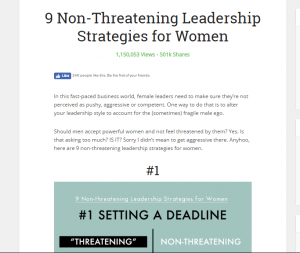
“9 Non-threatening Leadership Strategies for Women,” was a heavily shared graphic article during the summer of 2016. Sarah Cooper published the article on her satirical “office humor blog” known as The Cooper Review, which generates a variety of cartoons, listicles, and videos under the descriptor tagline, “Funny because it’s true.” However, as I dig into the complexities of the article’s simplistic assumptions, this tagline becomes less ironic and more revealing in how the media it promotes is actively harmful in reinforcing particular norms and binaries.

The graphic article begins with an introduction that suggests the audience (females in business work environments), the antagonist (males and “the patriarchy”), and the purpose (how to alter female leadership style in order to avoid negative perception from men): “In this fast-paced business world, female leaders need to make sure they’re not perceived as pushy, aggressive or competent. One way to do that is to alter your leadership style to account for the (sometimes) fragile male ego.” The full introduction, brimming with sarcasm and humor, sets the reader up for the satire to come: “Should men accept powerful women and not feel threatened by them? Yes. Is that asking too much? IS IT? Sorry I didn’t mean to get aggressive there.” The piece goes on to present nine graphics, each with its own caption and “strategy” for women in the workplace. This framework alludes to the “corporate manual” and variations of leadership strategy guides in the corporate world. These guides permeate the business world in the form of books, magazines, online publications, and are sometimes specified towards women, such as Levo League, an online platform dedicated to providing resources, advice, and connections to businesswomen.
cooper-2
Each of the graphics in the article is a colored square framed by the article’s name “9 Non-threatening Leadership Strategies for Women” on top and
The Cooper Review branding on the bottom. Between that framing, bold black letters spell out “#1” through “#9” and range from simple actions (e.g. “sharing your ideas” and “emailing a request”) to responding to external incidents (e.g. “someone steals your idea” and “hearing a sexist comment”). Each square is split by a black line, the left side title “THREATENING” highlighted black and enclosed in sarcastic quotes, while the right side title “NON-THREATENING” is not highlighted and is not enclosed in quotes, making it more approachable. Underneath each title is a simple gray scale drawing of a woman or a woman with a man and a text bubble above the woman’s head. The only differences between the left and right sides of each graphic are the characters’ facial expressions as linked to the text (“threatening” vs. “non-threatening”), showing that the “non-threatening” responses are supposedly more polite and happier for all those involved. The left to right transition, imitating the normal English reading pattern, also subconsciously implies which situation is the “right” way for women to act in order to be respected by men.

Despite the biting sarcastic humor of the graphics and their respective captions, the graphic article makes several assumptions that detract from its explicit attempt to undermine particular gender societal expectations. Most glaringly obvious throughout the nine graphics is the reinforcement of the gender binary and gender stereotypes as well as a complete lack of racial and body size diversity. Cooper’s article is fixated on women versus men and their respective perceptions in a corporate work environment. Every “woman” has long hair (either white or black), white skin, is thin, and wears some sort of blouse or suit jacket. Almost every graphic also includes the image of a “man,” also white with either white, gray, or black hair and a collared shirt and/or tie. In promoting such homogeneous images though, the graphic article reinforces a deeper problem of norms in the corporate world. The graphic images only present two categories of gender identity, one type of body size, one race, and most likely one social class, which perpetuates the same normature that the aforementioned “corporate guides” already promote. By showing one type of person, Cooper falls right into line with the large marketing structures that subconsciously promote homogeneous images and what is acceptable in the corporate world.

cooper-3

Cooper’s #whitefeminism mission leaves out several gender and racial identities, but she also goes further as to pinpoint and use male stereotypes. For example, “#6 When You Already Knew That,” depicts a “threatening” standpoint in which the female character tells the male character that she has already explained something to him. The “non-threatening” side presents the woman saying she would love to hear him explain it again. In the caption below, Cooper states “Men love explaining things.” While she might intend to present men as stereotypes in defiance of the generalized representations of women, such a statement doesn’t lead to a productive outcome for her assumed female audience. In breaking down expectations of women in the workplace, she builds up and reinforces stereotypes and expectations of men. In the last graphic, “#9 When You Disagree,” the only change between “threatening” and “non-threatening” is the fake mustache on the female character. She claims that wearing a mustache makes you “more man-like.” But what does “man-like” even mean? Having facial hair? “Growing a pair”? Although Cooper intends this comment as a joke, there’s also an unfortunate underlying assumption about what masculinity even means. But, her assumption that men receive more respect in a work environment due to their biology also reveals a subtler point about gender characteristics and perceptions. As we discussed in class, butch and femme characteristics receive different treatment outside the LGTBQ+ community, and perhaps more masculine qualities (i.e. butch) receive a greater degree of respect in the office environment. Studies have shown a counter-intuitive wage gap in which gay men receive a smaller salary than straight men while lesbian women receive a larger salary than straight women. Not only does the graphic article present the characters as cisgender, they also appear heterosexual, which brings us back to another corporate normature that Cooper sustains. One of our takeaways from the Wilchins piece discussed in class was that with sexual queerness comes a level of gender queerness and vice versa. Meanwhile, the characters in Cooper’s graphics seem to all fit the socially constructed gender and sexual norms that the typical corporate guide would also promote, whether intentionally or not.

cooper-4

Cooper sets out to critique and disrupt the man/woman dynamic in the corporate workplace and model that has been promoted by countless publications, advertisers, and media. She focuses on women’s oppression in the workplace and uses a male/female inversion to prove the lack of respect women receive. However, this graphic article fails to act as a didactic piece and comes across as only entertainment because she only inverts the heteronormative male/female relationship and reproduces other homogeneous racial, sexual, and class expectations in the corporate world. If she wanted it to be more than a piece of entertainment, highlighting the intersectionality of oppression in the workplace would ultimately teach and flip her audience’s expectations of who really does work in the business world.

An Analysis of Facebook Misogynists

Last year, in my high school class’s Facebook group there was a debate I’d like to discuss as it still infuriates me to this day. For context, I’m from a very small, affluent town in Connecticut. My town is known for being quite liberal, generally pretty progressive , and very well-educated. The public school that we all attended is ranked by U.S. News as being number 4 in the state and number 184 in the country. 99% of students who graduate from our high school go to college. For comparison, the national average of high school graduates who enroll in college is 65.9% according to The New York Times (2014). The percentage of Americans who actually attend and graduate from college is even lower. Every single person involved in these conversations is now attending a reputable college, including University of Indiana, Southern Methodist University, and University of Michigan. I don’t say this to brag, but rather to contextualize these comments and explain why I was so shocked by them. Given our shared background and education, this incident was unexpected. To further contextualize this, this occurred on social media with the knowledge that is was a form of mass communication. The people involved were aware of who would be seeing their posts. In order to analyze this, I will be examining some screenshots I have from the private group in which they were posted, and relating their contents to a variety gender and sexuality studies concepts, such as gaslighting, identity politics, and misogyny.

Despite having been graduated for nearly a year at the point when this incident occurred, someone decided resurrect our class Facebook group by creating a post in support of Donald Trump. When a fellow classmate, who happens to be female, spoke up about her dislike of the candidate, two male students felt the need to respond with the following comments: “95% of Hillary 12814413_964920363584441_1240800165149743160_nsupporters are women…BOOM roasted” and “You’re allowed to vote from the kitchen these days?” These comments led me to believe that these boys thought that female supporters of Hillary Clinton do not count and are invalidated in their belief simply because they are women.


As degrading as these comments were, what happened next was, to me and to many others, absolutely enraging. Another former classmate of ours posted a porn video that depicted a female porn actor advocating for a woman’s right to voice her opinion, only to be interrupted by a male porn actor shoving his penis in her mouth. Many people, including myself, were shocked that this boy would look up this video and post it in a group that was intended for school-related information. Despite this, many of my former classmates, both male and female, liked this post before group administrators (who were former student government members, so ex-classmates as well) removed the post. Prior to this however, more hatred and misogyny were spewed at the students who asked for it to be removed. Though it was a relatively small group of boys participating in this hatred, I was still shocked at the number of students participating and what they believed was okay to say, particularly coming from as liberal and well-educated of as place that we do. Ironically, this all occurred on International Women’s Day (March 8th), which, in my mind, solidified the point that we need this day to celebrate women seeing as we still face this misogyny, even from our classmates and supposed friends who are college educated.

I’ve included some of the comments below. These comments included such things as “#nomeansyes,” followed by “and yes means anal,” which reflected an incident we had during our Senior year, when the Women’s Empowerment Club created a rape awareness campaign, and put posters around the school with the statement “Rape is not a joke,” many of which were vandalized with the phrase “lol”. This displays the mindset of many of the students involved in this debate, where they truly don’t see women’s rights or rape (which certainly extends to more than just women) as an issue.
12814106_964919356917875_856941921631290399_n
12806194_964919360251208_3840839426840677950_n12794378_964920243584453_853440003447550235_n
12809523_964920300251114_7954592233995510200_n
12801117_964919713584506_2779395371015545430_n

10371895_964485050294639_14927973729924029_n

Their comments showed to me that these boys see gender as a clear dichotomy; there are only men and women. Not only that, they perceive these two genders in a clear hierarchy where women are the lesser of the two. Their statements not only diminished women but also served to reinforce this dichotomy and created a notion of having to “choose sides” between men and women, or even between feminist and misogynist. The fact that this one boy thought he was “roasting” Hillary and her supporters by calling them women furthers this notion as it’s clear he thought this was an insult of some sort. Furthermore, this displayed a weak and simplistic version of identity politics, where these boys tried to create a sense of comradery and alliance because of their gender. Their beliefs are being shaped by their gender identity and the convictions that come with that. I believe that many of these students, as white, cisgender men, who were raised in a very affluent town, have never been the subject of oppression or faced anyone telling them they are lesser. Most of them have never truly faced hardship, which I can say confidently as I have known the majority of them since they were in diapers. They are able to make these statements because of their position in society.

The student who posted the video defended his actions the next day with this post below. He felt he was justified because, supposedly, girls from our class had messaged him telling him that they agreed that the other girls in the group, who were defending their right to be seen12814811_964485743627903_3451060346602791121_n as equal, were being ridiculous. Because he had some support from females, it was okay. This again ties into the idea of identity politics where he is attempting to justify his beliefs on the basis of his gender and the support of the other gender. Additionally, it could be argued that he is gaslighting, where he is manipulating others into questioning their own beliefs. He refers to this whole situation as a “joke,” trying to diminish the impact of his words and mold the perception of his actions. He tries to defend his own character, implying that if he’s a kind person he couldn’t have done something offensive,insisting he’s “never said a mean thing” to any of his opposers. This likely won’t be shocking, but he was not a kind person in school. He considered himself a class clown of sorts, and was constantly making fun of others, but always under the guise of humor.

The outrage that followed these posts were undermined by the original posters complaining that feminists don’t have a sense of humor and that they couldn’t take a joke, which, from their perspective, is clearly these posts were. The people involved in both these posts and the anti-rape poster incident (which are groups that include many of the same members, unsurprisingly) excuse their words and actions with humor. Words have power. Actions have power. They are not excused because you think they are funny. There were many comments in this thread that told people to “take a joke” or “chill out” or “get a better sense of humor”. However, I believe that the comments they made are rude and insulting, and should certainly not be taken as a joke. This idea that women don’t have a sense of humor when they try to defend their rights as people is derogatory and degrading. This “joke culture” is harmful because it invalidates feminists’ claims as humorless without at12814530_964920476917763_3029247096580930692_ntempting to understand their arguments, valuing humor as the most important factor. It also attempts to minimize the impact of the offending statements and the culpability of those who make them because they “aren’t meant to be taken seriously,” which is problematic because not only are the perpetrators not seeing the other side of the argument, they often don’t even recognize that there is a problem. They don’t see that feminism and comedy can coexist, and that one does not negate the other.

The claim was made that “feminism definitely doesn’t have a sense of humor,” to which I must respond: I’m sorry that I don’t find rape funny. I’m sorry that you think I’m a “bitch” for arguing that all humans –  male, female, or otherwise – should be seen as equal. I’m sorry that I can’t “just chill my nips” and accept injustices. I’m sorry that completely undermining another human and treating them like subhuman for factors that are out of their control is not hilarious to me. If that means that I don’t have a sense of humor, then so be it. I’d rather be able to see the value of a human than be able to take a joke. I’d rather be a feminist than a comedian.

Sport Athletes Treated Differently Based on Gender

Continuing the post I wrote awhile ago about U.S. women’s soccer team not receiving the same amount of payment as the U.S. men’s national soccer team, I found this video a couple of days ago and found it relevant. In this video, male sport stars are asked a series of questions referring to their bodies, relationships, etc. that are framed in a way that would be so called “acceptable” to ask female athletes. What I found interesting in this video is the reactions of the men; their faces are utterly confused and disgusted by the questions and seem to reflect the sentiment “Why on earth would you ask such a pointless, objectifying question?” But at the end of the video, instead of expressing similar facial and vocal responses as the men, the women athlete interviewed simply laughs and “acts like a lady,” which was disheartening to watch.

https://www.youtube.com/watch?v=q_LDG8vM3_E

Performing Parts Symposium

Erica Miller

Grant Proposal Alternative

Performing Parts: Gender, Sexuality, and Media Symposium

Prior to the symposium, we were instructed to watch Edouard Lock’s Amelia. At first watch, I thought the performance was constructed to create a piece in which gender roles did not influence the piece. In other words, a piece that was completely “gender free.” Upon further discussion, the deeper meaning of the piece was revealed. Lock created this piece to not only question gender roles on the performing stage, but also display how gender equality does not necessarily equate with gender neutrality and equality does not necessarily equate with progressiveness.

Our discussion focused around two of the duets in the piece. In the first, both individuals, one male and one female, were wearing suits, slicked back hair, make-up, and female point shoes. One would assume the goal was to become gender neutral. However, these performers were very gendered wearing both male and female stereotypical outfits. Lock intended to show that this elimination of strict gender roles did not by necessity promote female empowerment or gender equality. Similarly, he wanted to show that by just because you have a gender equal performance it does not by necessity be gender neutral. Emily Martin argues, “Stereotypes imply not only that female biological processes are less worthy than their male counterparts but also that women are less worthy than men” (485-486). I believe Lock would agree with this statement, but would argue that when on the stage, it must be displayed and constructed differently. Females on the stage can embrace these stereotypes, such as wearing tutu’s and pointe shoes, while their male counterparts are in suits, and demonstrate their strengths, creating gender equality without succumbing to gender neutrality.

The second duet involved two individuals that were often indistinguishable, and instead of focusing on the bodies exclusively, the camera would focus on the silhouettes of the individuals. However, the movements of the individuals were very controlling, making one individual submit to the will of the other, as a puppet to a puppeteer. Again, Lock is pushing against the notion that equality on the stage automatically links with progressiveness. As the Beijing Declaration reads, “inequalities between women and men have persisted and major obstacles remain,” however forcing equality will not always be the most effective way to go (2). Instead, a more progressive movement would have been partners alternating lift sequences, challenging the notion that females must rely on their male counterparts to lift them.

Lock challenges his viewers to look at the different representations of gender on the stage and how these representations fit into the mold of equality that we have envisioned in our lives. Holla summed it up best with, “The fact that there are still such incendiary notions should tell us that American women have a way to go before they enter the promised land of equality” (9).


Works Cited

Amelia. Chor. Edouard Lock. Performance.

Holla, H. “Blame It on Feminism.” Editorial. Mother Jones Sept. 1991: 24. Print.

The Fourth World Conference on Women. Beijing Declaration and Platform for Action. 15 Sept. 1995. Web.

Martin, Emily. “The Egg and the Sperm: How Science Has Constructed a Romance Based on Stereotypical Male-Female Roles.” Journal of Women in Culture and Society 16.31 (1991): 485-501. Web.


GSS – Artist Statement – Seminar GSS -Seminar Proposal – Performance Lecture

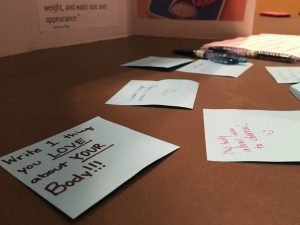
1972 Sex Positivity Fair: Body Image


IMG_6509
1972 Sex Positivity Fair: Body Image by Rachael, Maryanna, Malia, and Caroline B.

“If we start from a position of neutrality, and do not make an a priori assumption that higher  BMI  is  unhealthy,  we  are  left with  numerous  studies  showing  health  benefits based on quality nutrition, regular physical activity, social support, restful sleep, freedom  from  violence  and  stigma,  abstention  from  smoking  and  excessive  alcohol  and drug use, access to quality medical care, and so on” (Burgard, 47).

According to Jen Baker in her TED Talk Total Body Love, “4% of women will call themselves beautiful, and in my experience men are very similar.” By creating an exhibit for the 1972 Sex Positivity Fair, we seek to discover why only 4% of women would call themselves beautiful. As students of GSS 101, we have learned to identify the voices seeking to force, in both subtle and blatant ways, the image of the “ideal” body upon us. We have learned to reject these voices in the name of Total Body Love. We have identified three voices that are loud, though sometimes unrecognized in our culture: advertising and media, the health/wellness industry, and the medical world.

In a society overridden by advertisements and media, we are constantly bombarded with both conspicuous and inconspicuous symbolism in images dictating what “attractive” means. These images pervading online, in the news, and even in public spaces, are in almost all instances edited to depict what those believe to be a desirable body type for both men and women. For example, in Agnes Rocamora’s article about the fashion industry titled “Personal Fashion Blogs: Screens and Mirrors in Digital Self Portraits,” she states, “in a field, fashion, where those in charge of taking photographs have been predominantly men, and those photographed women, visuals show the latter behind the camera actively engaged in an act of self-representation contrast with doxic views of men as photographing subject and women as photographed object” (Rocamora, 420). Our culture teaches us that the woman’s body is valued only when serving a specific audience – whether that is the male gaze, commercial gain, or even representations of purity or innocence. The woman’s ideal body type has changed drastically over time, however. Today the ideal female body type depicted in the media is widely accepted as unrealistic and photoshopped, and many companies have moved towards a “body positive” approach to their advertising as in the case of Aerie’s #AerieReal campaign featuring models with untouched bodies. Conversely, advertisements featuring the male body are frequently also photoshopped to unrealistic proportions of musculature, which acts to shape society’s interpretation of masculinity. However, this issue has yet to take off as a widely accepted false representation of the male body, which can lead to low self-esteem and poor body image in the male population.

IMG_6511

The health and wellness industry contributes to an unrealistic body image by creating an unattainable picture of health. There are men and women whose bodies simply cannot be shaped and molded into the hard, athletic lines of a stereotypical gym-goer. The pressure to be toned and muscular has led to an increase in disorders like muscle dysmorphia: an obsessive preoccupation via a delusional or exaggerated belief that one’s body is too small, too skinny, insufficiently muscular, or insufficiently lean. Muscle Dysmorphia and other related disorders concerned with the strength of the body (together referred to as “The Adonis Complex”) are often overlooked. Because those affected by muscle dysmorphia are not seeking to drop significant amounts of weight, if at all, they are sometimes considered outside the realm of eating (or body) disorders. We are reminded of Marilyn Wann’s claim that “The weight divide is not just a fat/thin binary… People feel superiority or self-loathing based on each calorie or gram of food consumed or not consumed, in each belt notch, pound, or inch gained or lost, in each clothing size smaller or larger” (Wann xv). We learned that identifying voices seeking to shape body image in a way not immediately identifiable with the pressure to be thin or beautiful are especially insidious, and need to be addressed. IMG_6510Because they are encouraged to subscribe to patriarchal standards of “masculinity,” many men are imprisoned by society’s definition of “healthy.” Harrison Pope argues in his book Rise of the Adonis Complex, “Over the last three decades, the Adonis Complex has spread dramatically among boys and men, and more and more men are struggling to improve their appearance in one way or another.”  This obsession men experience with body image echoes Harrison Pope’s study, which reported “95% of college-aged men being dissatisfied with some part of their bodies.” Muscle dysmorphia and other disorders of the health/wellness world need to be more widely recognized in order to make effective and valuable changes.

Another voice seeking to define which bodies should be loved and which should be shamed comes out of the medical world. Fat studies scholars like Marilyn Wann and Deb Burgard argue that the unrealistic and scientifically false standards of “health” set up by health and wellness industries are perpetuated by members of the medical world through measures like BMI. BMI, or Body Mass Index, is one of a variety of “ideal” weight charts used by the federal government to mandate who is healthy and who is not. The problem with BMI is that it is too simple, and does not account for the full range of human diversity, especially in children. BMI works by juxtaposing height and weight to create a n
umber from 12-42. The oversimplification of the incredible varieties of the human body leads to the “medicalization of human diversity,” which “ inspires a misplaced search for a ‘cure’ for naturally occurring difference. Far from generating sympathy for fat people, medicalization of weight fuels anti-fat prejudice and discrimination in all areas of society” (Wann xiii).  Medical professionalsIMG_6508 who seek to determine patient’s achievement of “good health” based on flawed scales like BMI contribute to the chorus of voices that say, falsely, that our bodies are too fat, not muscular enough, too short; basically, that our bodies are
incorrect. We still need to seek advice from medical professionals; there are men and women who have completed years of training in order to help us live our best lives. Through this project, we discovered the importance of seeking medical professionals who understand and appreciate the diversity in human bodies and also encourage us to seek out a truly healthy lifestyle (in every sense of the word).


Works Cited

Rocamora, Agnès. “Personal fashion blogs: screens and mirrors in digital self-portraits.” Fashion Theory. Vol 15, No. 4, 2011.

Wann, Marilyn. Foreword to the Fat Studies Reader, by Marilyn Wann,  xxi-xxvii. New York: New York University Press, 2009.

“Why Postpartum Depression is a Feminist Issue”

http://www.huffingtonpost.com/maureen-shaw/why-postpartum-depression_b_5980276.html

Continuing the conversation we had in class yesterday, I found this article in the Huffington Post that serves as an affect perspective about postpartum depression and how our society fuels the continuation of this social pressure onto new mothers. As this article states, motherhood is already highly politicized and therefore the public is weighing in on their opinions of “what a mother should truly be.” Postpartum depression is increasingly becoming a talking point, along with conversations about rape and the wage gap, but the issue could be more talked about.

She’s Beautiful When She’s Angry

The documentary She’s Beautiful When She’s Angry was first shown to me in my Anthropology of Social Movements class last semester. This film traces the women’s liberation movement in the 1960s and 1970s, specifically focusing on activist groups like the National Organization for Women (NOW) and Black Sisters United. The collection of women interviewed for this film were part of these groups as well as leaders of lesbian activism sects and the writers of Our Bodies, Ourselves. When reading Betty Friedan’s except from The Feminine Mystique, this documentary automatically came to mind as women were arguing for equal rights not only inside the home as mothers, but also in economics and education. But I also found this documentary very interesting because of how it addressed the intersectionality of race and gender in this period of the women’s rights movement, such as Bell Hooks writes about in Black Women: Shaping Feminist Theory. Hooks states that Friedan “ignored the existence of all non-white women and poor white women” the same way that many African American and lesbian women saw “feminist radicalism [lose] ground to bourgeois feminism.” Lesbians at the time were also rebelling against compulsory heterosexuality and male identification as they felt they had a right to voice their opinion in the women’s liberation movement as shown in the documentary. She’s Beautiful When She’s Angry shows the dynamic intersectionality of race, class, and gender during the women’s right movement in the late 1960s and early 1970s.