Heroes So White: Lack of Diversity in the World of Superheroes

by Jo Papadopoulou

Written for Autostraddle

One of the first images that comes up when you google “superheroes.” Notice the number of non-male and non-white characters. (Screen Rant, 2019)

I once asked my 10-year-old sister who her favourite superhero was. “Flash!,” she answered excitedly. When I asked her why, she looked at me curiously and said “Cause he is fast, he is so fast sometimes it looks like he is flying, and he is so strong too!” Simple enough answer, right? Well, I then asked whether she knew of any female superheroes with the same abilities as Flash and she couldn’t come up with a reply. When asked about female superheroes, she only knew to list three: Wonder Woman, Supergirl, and Catwoman. None of them were her favourite though. An indicator that she probably didn’t choose her favourite based on gender but based on the abilities she could identify with best (she likes running, so Flash makes sense). However, what if she chose Flash because that was the only one she knew? There are other superheroes who are not cishet white males and have the same (and even more) abilities as Flash. She chose Flash because it was who she was most familiar with. It Is who TV series and ads and video games show her.

And that is not true only for my sister. Most kids, most people, only know the white, cishet male, super fit (and usually rich) superheroes. But they are not the only kind of superhero that exists. That is certainly not the only type of people who exist. So why are they the ones mainly shown? How can this very specific, very excluding group of superheroes represent the whole of them? The answer is, it can’t.

Diversity in Superheroes

For many years, the only superheroes shown on television are ones like Superman and Batman, white fit guys who fight crime and get all the beautiful girls. Companies have been trying to appeal to teenage white boys by promoting a heteronormative, fatphobic narrative. For decades, these companies have been creating false, dangerous role models for children and adults everywhere. And while most turn a blind eye to this, some people have always known how hurtful these role models are. All black, gay, fat, Latinx, trans (and many more identities not reprented) folx know. We have always noticed the lack of representation when it comes to superheroes. They never looked like us. We could never fully identify with them.

The “Original” Avengers of the Marvel Cinematic Universe, some of the most well-known superheroes by one of the most well-known entertainment companies. (Cinema Blend, 2019)

White Dudes (it’s always them)

White male superheroes are still dominating our screens and comic book pages (e.g. Iron Man, Spider-Man, Superman, Deadpool, etc.). When non-white characters are shown, they usually follow old, hurtful stereotypes (for example, Mantis of Guardians of the Galaxy appears as a submissive Asian woman and her main power is lulling people to sleep). When the companies try to create a more diverse environment around superheroes they usually go about it by adding characters of colour (e.g. Black Panther in the Marvel Cinematic Universe) and most (if not all) times these characters have huge success due to the fact that there’s so little diversity. So, the question that comes up is, are the companies really being more diverse and inclusive for the fans or for the money? (Sadly, usually capitalism wins over us).

Genre as Old as Time

This struggle with diversity has its roots mainly to the fact that the superhero genre was created some 40 or more years ago and has seldom changed since. Most, if not all, of the creators back then were rich white males making art for almost exclusively white male audiences. Because of nostalgia, a general fear of change, or pure laziness, the genre is still marked by the “white guy hero” trope that was the staple when it started.

Fighting the Status Quo

Another reason superheroes are still white guys is because a big part of what these heroes do is fight the status quo (e.g. bank robberies, coup d’états, etc.). And it is always shown from the perspective of the powerful, that is rich white men. For example, Bruce Wayne (aka Batman), who is a rich white cishet man, is at the center of Justice League sidelining the female characters and (few) characters of colour.

Fatphobia

Apart from being cishet guys and white, the majority of superheroes are slim and fit. In comic books, their abs and excessive muscles are always visible through their suits and in movies and TV shows actors go through long periods of dieting and strict work outs to achieve a “superhero-worthy” body. Whenever fat characters are included they are usually viewed as something to laugh at (e.g. Thor in Avengers: Endgame) or follow hurtful fatphobic stereotypes.

Chris Hemsworth as “Fat Thor”, as he was named by the fandom, in Avengers: Endgame. (“Avengers: Endgame”, Marvel 2019)

New Superheroes

To create a more diverse world, instead of dismantling the pre-existing wider superhero world, new ones are created without the stereotypes of the old ones. Companies like Marvel and DC, big entertainment companies, are starting to release novels with new, more inclusive, more diverse characters. Some examples are: América Chávez (the newest Miss America) is a Latina and a lesbian, Doreen Green (the newest Squirrel Girl) doesn’t have an incredibly slim body with abs and excessive muscles, and Miles Morales (the newest Spider-Man) is half African American and half Puerto Rican. But while it is great that all these diverse characters exist, they don’t appear in the companies’ big cinematic universes, they appear in comic book series not that accessible or well-known to the wider public. While the creation and existence of these characters is a huge step forward, it is still not enough. This diversity needs to be made more widespread and not stay limited to a few comic book characters. We, the fans, need to keep asking for more representation and we can only hope that the companies will listen.

We all deserve to be able to see ourselves as heroes.

Audi’s Display of Sexism and Stereotyping

In 2017, Audi, a German car manufacturer known for its luxury vehicles, released an advertisement to its Chinese market that sparked much controversy around the world. In their attempt to promote used cars to potential customers living in China, the brand not only displayed apparent examples of sexism, but promoted racist stereotypes. This commercial starts off with an Asian heterosexual couple standing at the alter about to get married. Right before their marriage was officially declared, the groom’s mother interrupts the officiant and begins handling the bride roughly, attempting to inspect parts of her body. Only after the bride’s future mother-in-law examines some of her physical aspects, like her eyes, nose, ears, and teeth does she declare the bride fit to marry her son and gives her approval. The terrified bride is seemingly relieved after her future mother gives the couple her consent, until the mother’s focus turns to the bride’s breasts, bring her back to a panicked state. After this blatant objectification, the commercial’s narrator voices “An important decision must be made carefully” as a red Audi Sudan zooms down a highway (Greatdung 0:22-0:23).

YouTube, 17 July 2017

This sexist Audi advertisement centers around the objectification of a woman by not only debasing the bride’s value to just her physical attributes, particularly her facial features, but also by comparing her to something one can buy and own. By insinuating that marrying a living breathing person is an equivalent decision to buying a car, Audi turns the bride into an object that can be materialized and possessed. Not only is the bride objectified by her future mother-in-law, but with the attention shifting to her breasts, she also becomes sexualized. This overt objectification and sexualization of a woman not only advance the harmful ideology of women not being actual people and simply objects for the benefit of men, it can have dangerous consequences that go beyond these beliefs. The United Nations International Children’s Emergency Fund (UNICEF) makes this connection by declaring “The objectification and sexualization of girls in the media are linked to violence against women and girls worldwide” (UNICEF USA 2021). This treatment can also have a multitude of negative consequences on the targeted individual’s mental health that can last throughout a lifetime. With the massive platform stemming from the ability to air advertisements to millions of people, comes much responsibility to further notions of equality rather than ideologies that have the potential to cause an immense amount of harm. 

Not only is objectification based on gender a prominent issue in this ad, but race also plays a problematic role. The stereotype of the “tiger mom,” a term coined by Amy Chua which describes Chinese mothers as strict, controlling, and borderline abusive, is also deployed in this Audi advertisement. One aspect of this stereotype is the fixation Asian mothers have on the physical appearance of their daughters (Chua 2011). In this case, the need for the bride’s soon to be mother-in-law to examine her physical features, deciding whether they meet her standards prior to the couple’s marriage further perpetuates this stereotype. Most Asian mothers do not align with this parenting style and utilize a wide range of other strategies, contrary to popular belief. The bride also remains passive during this offensive interaction, exemplifying to this advertisement’s audience that this is the appropriate reaction in the face of maltreatment, which could be easily internalized by woman and child viewers. By displaying this inaccurate idea of what Chinese mothers usually place high value on, as well as the expectation of women staying passive, not only does Audi promote sexism, but also racist stereotypes.

Connecting these ideas, Audi exhibits how the intersection of both gender and race can work together, producing an even greater amount of discrimination for individuals like the bride in their commercial. On the basis of Kimberlé Williams Crenshaw’s concept of intersectionality, two social categorizations of the bride’s identity, being Asian and a woman, create a somewhat unique distinction of the discrimination she faces in this Audi advertisement. Unfortunately, this situation is not rare and many individuals who share these similarities in their identity experience this prejudice on a day-to-day basis. 

Shortly after this commercial aired, it received mass amount of criticism and backlash from the public. One commenter even voiced “The annoying thing about Audi’s used-car ad, besides its objectification of women, is that it thinks Chinese customers deserve only commercials like this” (Washington Post 2019). Others simply called the advisement sexist and disgusting. Many people initiated plans to boycott this company and convinced those around them to partake in this form of protest. Following this severe condemnation, Audi apologized for its ignorance related to this particular incident, assured the public an internal investigation would take place to avoid a mistake like this in the future, and removed this advertisement from television. Audi’s response to this backlash and quick withdraw of their commercial displays the power the public holds and how each individual’s voice matters when speaking out against discrimination. 

Unfortunately, this type of sexist and racist commercial is not the only one of its kind. These companies must continue to be held responsible for the harmful ideologies their advertisements promote and be hyper aware of the massive audience they have the ability to reach just through the commercials they release. These examples of sexism and racism through promoting stereotypes and targeting certain audiences unfairly in advertising must come to an end in order to create a more egalitarian world. These large-scale brands have the responsibility to advance impactful and beneficial messages to the massive audience they are capable of reaching, instead of carelessly feeding this harmful ideology to the masses. 

Works Cited: 

Chua, Amy. Battle Hymn of the Tiger Mother. Penguin Books, 2011. 

Greatdung. “Audi Used Car Commercial in China. Full of Sex Discrimination.” YouTube, YouTube, 17 July 2017, www.youtube.com/watch?v=WiBva8pEgTc. 

Smith, Jamiee, and Hannah Gould. “Not an Object: On Sexualization and Exploitation of Women and Girls.” UNICEF USA, 11 Jan. 2021, www.unicefusa.org/stories/not-object-sexualization-and-exploitation-women-and-girls/30366. 

Wang, Amy B. “An Audi Commercial in China Compared Women to Used Cars. It Didn’t Go Well.” The Washington Post, WP Company, 18 Apr. 2019, www.washingtonpost.com/news/worldviews/wp/2017/07/18/an-audi-commercial-in-china-compared-women-to-used-cars-it-didnt-go-well/. 

Harry Styles Likes Women’s Clothing and He Doesn’t Care Who Knows It (Not Even Candace Owens)

By Alice Berndt

Written for Jezebel

Vogue Online, 13 Nov 2020

On November 13, 2020, jaws dropped and 1D fans swooned when the cover image for Vogue’s December issue was released. The shot features former boy bander and current pop sensation Harry Styles dressed in a black and white lace gown and black cropped blazer, his hair swept to the side in an intentionally effortless flop. He is the first man to appear solo on the cover of Vogue in 127 years. As the cover reads, “Harry Styles makes his own rules.” [Vogue]

Framed against a sprawling green meadow and clear blue sky, the British singer squints into the sunny distance. He holds a blue balloon to his lips, mid-blow, showing off an array of chunky rings, including one in the shape of an “H” and another in an “S.” The photo is iconically Harry — sexy, androgynous, playful, and edgy. 

Since the beginning of One Direction’s seemingly eternal “hiatus” back in 2015, Styles has been making a name for himself as a solo pop rock artist. In addition to releasing hit singles like “Sign of the Times” and “Watermelon Sugar,” he has also become a fashion icon, breaking free from his 1D wardrobe of V-necks and skinny jeans and embracing more traditionally feminine styles like colorful blouses, bootcut pants, and dresses. For the most part, fans and the public have been accepting of his style transformation, which recalls music legends of the past including David Bowie and Prince. But for some, this Vogue cover took it a step too far. 

Screenshot: Twitter / @RealCandaceO

In a move that sparked contentious debate, conservative commentator Candace Owens retweeted Vogue’s post on Styles’ cover shoot and wrote:

“There is no society that can survive without strong men. The East knows this. In the west, the steady feminization of our men at the same time that Marxism is being taught to our children is not a coincidence. It is an outright attack. Bring back manly men.”

[Twitter]

Yowza. Owens received immediate backlash from liberals, feminists, and Styles’ fans alike who claimed she was being sexist and close-minded. She was criticized for her assumption that masculinity and strength (or lack thereof) are directly connected to wardrobe — a man cannot be “manly” if he wears a dress. 

This assumption stems from centuries of clothing acting as a marker of gender — men wear pants and women wear dresses and skirts. Period. But is Owens implying that the inverse is true as well — that women cannot be feminine if they wear pants? Certainly Owens herself has been spotted wearing pants on more than one occasion. Commentators wondered how an article of clothing could limit or “attack” masculinity and strength but not femininity or grace. 

Screenshot: Instagram / @harrystyles

In a reclamation of Owens’ derogatory words, Styles posted an image to Instagram from his cover shoot with Variety and captioned the post “Bring back manly men.” The caption combined with the cheeky photo — Styles in a powder blue pantsuit eating a banana — pokes fun at his haters, addressing the situation while also making light of it. 

Styles is certainly not the first celebrity to be criticized for their clothing choices, so why did this get so much attention? Perhaps because it’s far less common for a woman to publicly shame a man for his outfit than vice versa. We’re used to female celebrities being called out for “scandalous” or “overly sexy” clothing (Billie Eilish’s British Vogue cover, for example), but typically male celebrities wear what they want or what their stylists give them and that’s that. It also cannot be ignored that Styles has a massive fanbase that has grown alongside his career since the inception of One Direction in 2010 and is prepared to defend him regardless of the context.

In talking about gender and fans, we must engage in a conversation about privilege. A quote from Styles on the Vogue cover reads, “Anytime you’re putting barriers up in your life, you’re limiting yourself.” For Styles, a straight white male celebrity with a net worth of over $80 million, he has the comfort and freedom to express himself through his clothing without fear. [Vogue]

For many others, including female-identifying, LGBTQ+, and POC celebrities, what they wear is often the biggest target for ridicule, criticism, and objectification. These individuals must first break down the barriers placed in front of them by society before they can even consider those they may have built for themselves. 

With that simple act of reclamation via his Instagram post, Styles had, in the minds of many, “won” the argument. For many others — celebrities or not — the complexities of how they use clothing to express themselves is a never-ending fight, both internally and externally. [Vogue]

Vogue Online, 13 Nov 2020

Don’t get me wrong, I worship Harry Styles as much as the next Gen Zer and wouldn’t dare question his status as a cultural icon. As actress and director Olivia Wilde says of Styles, “It’s pretty powerful and kind of extraordinary to see someone in his position redefining what it can mean to be a man with confidence.” By breaking free from the societal binary of gendered clothing, Styles utilizes his privilege to pave the way for others. But his work is far from being done. [Vogue]

TikTok: Its Perpetuation of Gender-Based Stereotypes and Human Body Standards

Over the past few years, TikTok has become a mainstream social media platform. This application, available for most smartphones, uses an algorithm to curate content for users, effectively getting them addicted to scrolling on the app. There are many subcultures on TikTok… For example, people who like dogs might find that the algorithm has put them on ‘dog TikTok,’ because their ‘For You’ page is filled with videos of dogs. The same concept applies to gender and sexuality. There are many different points of view represented on the application, and once the algorithm figures out what yours is, it will show you a plethora of content to reinforce that exact idea. 

There is a large subculture (or really, a set of subcultures) on TikTok that perpetuates the gender binary system and all of the gender roles that come along with that. For example, this video is a representation of many of the different videos that are found on ‘straight TikTok’: 

When the individual speaking in the video says, “Men will choose a peaceful woman before a beautiful woman,” they are enforcing many of the expectations that are placed on female-identifying people in our society. Moreover, the speaker is implying that women must be ‘peaceful,’ therefore implying that often, women are not peaceful. This implication tells women that they need not express their emotions; rather, they should focus on being as passive as possible in an effort to be chosen by a man. 

Next, when the person speaking says, “Men seek for peace, and it don’t matter if you’re Black, blue, asian, Latina… they want to come home to a peaceful woman,” they are demonstrating a lack of awareness of the intersection between race and gender. This statement also reinforces the idea that men come home to women, therefore saying also that women should not be working professionals. 

On top of that, the speaker discusses the intellect of women and expectations in that area that men hold. They say, “He wants a woman that’s resourceful, a woman that can think on her feet. So when he can’t hold it down if he’s ill and he’s unable to pay the bills, she can be resourceful and have her intellect to make things happen.” The first implication I see in this statement is that the woman should just be intellectual as a safeguard… the woman will never actually have to use these skills unless it comes down to it. The assumption that men always pay the bills is harmful to all people, regardless of gender, because that is not the case for everybody. By the same token, the fact that the speaker is bringing this point up implies that women are, in general, less naturally intellectual than men. Drawing this unfounded connection between gender and intellectual capacity is harmful to society as a whole. 

Perhaps most disturbingly, our speaker talks about the ‘appropriate’ role of women in a sexual context. They say that men are “looking for a woman to supply their physical needs… A woman that looks good and proper and public but is a beast in bed” is the golden standard. First of all, in addition to ignoring the physical desires of the women at hand, this statement claims that the purpose of women is to fulfill mens’ sexual desires. This incredibly sexist ideology has the capacity to negatively influence the lives of many people. On top of this, the speaker is assuming a common definition of beauty… she is saying that women who have a certain physical appearance and demeanor are examples for what all other women should try to be when in pursuit of a relationship with a man. 

In conclusion, the ideology contained within this video is based on the idea that women are socially inferior to men, and that female sovereignty should not exist when it comes to romantic and sexual relationships. The central claim is that women should constantly be cultivating their personas to match what they think men are looking for in women, in hopes that they will ‘meet the cut’ for some man.

Similar to the last clip, this piece of satire brings awareness to many of the appearance-based expectations that our society holds for women, and the stark contrast between these expectations and those for men. The actor, mimicking a man, says: “Alright, so I want a girl with huge, but perky boobs, small waist, huge butt, flawless skin (but can’t wear makeup). And I like blondes, but I think she should also be brunette… because I get bored quickly, you know?” This statement encapsulates many of the body standards that our modern society has for women, and also touches on the normalized fact that men sleep around while women are expected to be loyal. 

In the caption of this video, the creator claims that this is how all men think. Although this is probably a sarcastic statement, it is representative of the way that many people think. Moreover, individuality is to be nonexistent: all men must act one way, and all women must act another way. Beyond pointing out, and perhaps reinforcing, the gender norms that are in place for men and women, this video illustrates the prevalence of the gender binary in our society. 

Content Warning: This video contains a real-life portrayal of surgical body mutilation. Use viewer discretion. 

In this shocking clip, we see a person that is identified as a man who has ‘overdeveloped’ breast tissue. His act of having the ‘excess’ tissue removed is labeled as life-changing. First of all, the video notes that this overdevelopment in the breast tissue of a man is an actual medical condition, which is known as ‘gynecomastia.’ Its causes are said to be “medications, drugs, testicular cancer, and hormonal imbalance.” 

Without looking into the history of this condition, it’s plausible to assume that this condition was developed in response to a bodily appearance that was not in line with society’s idea of what a man should look like. Moreover, this condition does not pose any medical risk to the patient; it is merely aesthetic. 

This video perpetuates a toxic standard of beauty, and is essentially telling men who have growth in their breast tissue that in order to be beautiful, they must undergo surgery. Explicitly, the caption says, “These [surgeries] literally change men’s lives.” In watching this video, men with growth in their breast tissue are inevitably going to receive the message that they are disgusting, and must go get surgery. 

In conclusion, the three videos I have analyzed here are examples of the many TikTok videos that enforce gender-based stereotypes and human body standards that are present in our society. This is not to say that TikTok is a problematic platform that should not exist; rather, this suggests that we as a society should critically examine the role that social media plays in perpetuating harmful gender-based stereotypes and expectations on a day-to-day basis.

Writing for Feministing | www.feministing.com

From Theory to Praxis: Gender and Sexuality Studies as an Interdisciplinary Critique

In Gender and Sexuality Studies 101, I learned a lot about the ways in which the way in which monolithic ideas and cultural hegemonies inform the ways in which people think and behave. I realized through this course the ways in which these ideas seep into every facet of human life, even through most supposedly unbiased and objective academic disciplines. As someone who has always valued the tangible and facts, the application of gender and sexuality studies critiques of what we take for granted, as “common knowledge” has really been eye-opening.
I’m planning to major in history and biology, two disciplines that, despite their different methodologies and focuses, both tend to focus on the demonstrable and “provable”. However, something about both disciplines that I’ve learned to critique from GSS 101 is the ways in which these facts are interpreted and applied. Both disciplines require logical continuity and frown upon intellectual leaps without grounding in data. Still, scientists and historians are still human, and still Foucaultian subjects not only influenced but created by the world around them.
Our discussion of feminist science studies is a great example of the ways in which my views had been challenged. I knew, of course, that science has often been misinterpreted or employed as a rhetorical tactic to reinforce societal inequality; just look at a movement like eugenics. However, I wasn’t really aware of the ways in which, down to the very textbooks we use to teach biology, the way we frame and explain biological concepts reinforces the ideologies of gender difference and heteronormativity.
Similarly, I had always heard about the phrase “history is told by the winners” and knew on some level the ways in which history has been interpreted to soften the historical oppressions of non-dominant groups and bolster the dominant groups in society. However, GSS 101 opened my eyes further on these topics. The ways in which we interpret history to impose our own hegemonic ideas was surprising. For example, I found it interesting to learn the ways in which the idea of a “traditional marriage” is a construction of our modern society. It was also interesting to learn the ways people have thought about homosexuality and heterosexuality in the past, since such terms and identities didn’t even exist in many societies and therefore, aren’t an accurate representation of the ways in which people in the past saw their lives.
I would like to pursue a project that looks at the history of science through the lens of feminist science studies, and looks at the ways in which scientific fields, especially biology and medicine, have served to reinforce ideologies of gender difference, especially around the time that “heterosexuality” and “homosexuality” as terms came into being.
Through GSS 101, I’ve learned to look at the subjects I’m passionate about with a more critical eye. This course has taught me to challenge the hegemonic ideas that underlie much of human productions of knowledge. While I myself am a product of society, and can never truly free myself from its effects, I can still learn to be aware in which the ways my understandings are shaped by the society around me. Overall, I want to take what I’ve learned from this course to more fully investigate and interrogate the ways in which I understand the fields I’m passionate about.

Beneath the Surface: a Look into Invisible Disability

Beneath the Surface: a Look into Invisible Disability

 The intersection of invisible disability and gender studies is still a forming field of study. Illustrated through the work of forerunners such as Maureen Fitzgerald, Kathryn Paterson and Karen Depauw. And more clearly developed through the more recent voices of Ellen Samuels, Aimee Valeras, Margaret Vickers, Kendyl Klein, Samantha Bassler and Denarii Monroe.  Mental illness within women, especially eating disorders, is a subset of invisible disabilities studies that demonstrated a strong link with gender studies and show how physically bound the subjects are. These authors analyze the difficulties of invisible disability, particularly disclosure, and how society oppresses people with hidden disabilities.

In the article “The Hidden Disability Dilemma for the Preservation” of self Maureen Fitzgerald and Kathryn Paterson address specific difficulties of women with invisible disabilities. Published in 1995 at the forefront of gender studies in intersection with disability, “The Hidden Disability Dilemma for the Preservation” of self-relates many of the challenges women with invisible disabilities face in contemporary times. Easiest to relate is the ever present question of disclosure and consequences with both informing people of invisible disability and hiding it. This ties directly to analysis, of identity which is grounded within the studies of women with invisible disability. By focusing in on two case studies where women from Hawaii and women from Australia were compared. These two groups of women with invisible disabilities, the women from Australia with hidden Multiple Sclerosis(MS) and the women from Hawaii with Temporomandibular Joint Syndrome(TMJ), are able to convey the ways in which invisible disability affects certain ways beyond a case by case basis. One problem the women from this study face, as others with an invisible disability do, is the issue of legitimizing disability. Because invisible disability is generally not apparent to others it can be difficult to get recognition for the really impacts a condition has on an individual’s life. In the case of one woman who was deaf but did not seem that way she began carrying a white pole, not because she needed it but rather because people would not accept that she was deaf. There is a possible weight in revealing a disability, a weight on identity-based on people’s reactions to disability. Many women from this study hide the level of pain they are in and the symptoms they have for various reasons. But this isolation of themselves comes at a cost while being interviewed, many of the women admitted that they were not as happy or as fit as they used to be. There is a negative correlation between invisible disability and self-worth. This study ends with a need for invisible disability to be taken seriously so that people with them don’t have to emphasize them as much for valid assistance.

Karen Depauw constructs the significance of space in the context of the society in  ““Space: The Final Frontier”: The Invisibility of Disability on the Landscape of Women’s Studies.” Through analyzing the breadth of subjects that gender studies encapsulate within intersectionality Karen Depauw noticed a lack of solid research in disability and how it connects to women, gender and identity. Published in 1996 Space: “The Final Frontier”: The Invisibility of Disability on the Landscape of Women’s Studies” is at the forefront of disability studies with Maureen Fitzgerald and Kathryn Paterson. By narrowing her view to the lens of space Karen Depauw is better able to articulate how disability dictates movement through space, also how disability can alter perceptions of space. Perception of space can be integral parts of identity and gender.  In working with space in relation to invisible disability she explains the ways in which spaces can differ based on interpretation. Her focus, particularly on mental disorders, illuminates how societies categorization of things and people can give stifling identities. Because of the individuality of invisibility disabilities, not to mention the different severities, it is limiting to categorize and clump disabled people. Furthermore to marginalize people because they do not fit into a normative format cramps them to the margins of society, into boxes that confine them. People with hidden disabilities are presented with two boxes, one in which they hide their differences and the other in which they may emphasise their differences in order to be believed and categorized as disabled.  Though there is more room for nuance than those two categories the exceptions are limited and never fully void of the decision that the individual with hidden disabilities makes about disclosure.  

The struggle of middle-aged women with chronic invisible disabilities who also work full time are argued by Margaret Vickers in “Unseen Chronic Illness and Work: Authentic Stories from “Women-Inbetween.”” Published in 2001 this article helps show many facets of being a woman and having an invisible disability. The eight women in this study explain some of the different difficulties. Like finding time for a doctor’s appointment, being assumed healthy at work, and trying to juggle a full-time career and caregiving. By adding in occupational difficulties Margaret Vickers shows another dimension of invisible disabilities effects. The added weight of gender is shown by the caregiver position that women are expected to fill, these mothers not only work full-time jobs but run households. Margaret Vickers explains how these roles stack up to burdens that leave these women not fully attending to themselves and struggling to show other people how much they are handling. Because hidden disabilities are not visible it adds to the dimensionality of whether people chose to believe in the legitimacy of these disabilities. Simple recognition of invisible disability would help in easing the weight of these women but in order to better understand their burdens society, gender roles, and other intersections must be scrutinized.

“My Body, my Closet: Invisible Disability and the Limits of Coming-out Discourse” by Ellen Samuels gives a more recent commentary on invisible disability. Published in 2003 this article focuses on disclosure of invisible disability. The approach of “My Body, my Closet: Invisible Disability and the Limits of Coming-out Discourse” is slightly unorthodox in its comparison of coming out in terms of sexuality and revealing an invisible disability. Through juxtaposing the two narratives “My Body, my Closet: Invisible Disability and the Limits of Coming-out Discourse” articulates the nuances of disclosure around invisible disability. Ellen Samuels explains how coming out keeps intact the binary that assumes heterosexuality and able-bodiedness are the norms and that it is necessary to reveal yourself as other if you are not strictly within those loosely defined boxes. One piece that is particularly addressed in revealing invisibility is the assumption with disabling that people are placed under but don’t necessarily want. In several people’s accounts disclosing an invisible disability are more about explaining it to others and less about accepting it yourself.  As addressed in “The Invisibility of Disability on the Landscape of Women’s Studies” is a pioneering article on disability studies with Maureen Fitzgerald and Kathryn Paterson the accusation of fraud around invisible disability is still an issue that keeps some people from disclosing at all. Ellen Samuels does an excellent job of explaining the weight and privilege that invisible disability holds: “Like racial, gender, and queer passing, the option of passing as nondisabled provides both a certain level of privilege and a profound sense of misrecognition and internal dissonance”(Samuels) Because invisible disabilities, in most circumstances, can be hidden there is consistent choice of disclosure. Unfortunately, both revealing and covering disability can have burdens. In elaborating on the issue of disclosure Ellen Samuels states a few times that people with invisible disabilities can “pass” as abled. However, even within just that word, she is still showing how disjointed they are from society and othered. People with hidden disabilities are in a weird in-between that fluctuates greatly by disclosure and can fluctuate with the severity of conditions on a day to day basis. Because hidden disabilities are a case by case dependent they have real tolls on people’s sense of identity and self-worth.

Specifically addressing mental disorders with the sector of invisible disability “Gender differences in mental health” address societal impacts on health. Through sharp analysis of statistics regarding men and women’s mental health, there are direct correlations to gender, particularly with anorexia and eating disorders. “Gender differences in mental health” show that not only is society ignoring mental illness they are often promoting it. The research, though published in 2007, holds many insights particularly in how gender relates to these illnesses. Mental disorder studies reflect how oppression can cause more people in a minority to develop them. Rooted in intersectionality, minorities are more vulnerable to mental instability and disorders. Another factor that affects mental disorders is the location, developing Arab countries women are more vulnerable and more likely to have mental instability. There is not one cause of mental illness or invisible disability and they can remain out of people’s perceptions. This can make invisible disability dangerous and endorse harmful societal norms. There needs to be recognition of invisible disability and wholesome approaches that don’t leave those with hidden disability awkwardly marginalized.

Identity is tightly associated with ability and disability. “”We don’t have a box”: Understanding hidden disability identity utilizing narrative research methodology” by Aimee Valera’s constructs the weight of hidden physical disability and explains the mental toll that it takes as well. By looking at the lives of six different people and their non-obvious physical disabilities, her study and analysis were written in 2010 provides insight into the complex layer of identity in relation to invisible disability. Core to Aimee Valeras’ argument like those of Maureen Fitzgerald, Kathryn Paterson, and Ellen Samuels is the pressure of disclosure. As framed in Aimee Valera’s study the six adults she picked chose to assimilate and push against the label disabled. Aimee Valera’s also takes the time to explain how intersectionality is essential to how people’s invisible disabilities affect their lives and identities. Researcher Aimee Valeras found about adolescent development of self-worth in conjunction with visible compared to invisible disability. One of the more recent and reliable studies showed that students with invisible disabilities had more emotional distress because of anxiety around possible exposure. To have an invisible disability takes people out of the obvious binary of able or disable: “The hidden disability experience, thus, falls in the misunderstood gap between the dominant disability paradigms, the medical model and the social model” (Valeras).

Much like the article “Gender differences in mental health,” “Why Don ‘t I Look Like Her? The Impact of Social Media on Female Body” reveals the specific impact society, especially social media, has on the mental conditions of college-aged women. Reviewing at this very specific study in 2013 of invisible disability in the form of mental illness it is easy to see how gender and white patriarchal society tie into the analysis of invisible disability. Kendyl Klein’s research show how unrealistic beauty standards have disproportionately affected young women. Additionally, her psychoanalysis provides insight into the direct ways in which social media harms women’s mental self-worth and mental stability. There are facts too that show the presence of eating disorders in college-aged women: “between 4% and 9% of college women have diagnosable eating disorders, but more frightening, 34% to 67% experience disordered eating at sub-threshold levels” (Klein). What Kendyl Klein articulates also is the endorsement of these unhealthy standards within America’s culture. The severity of eating disorders and mental illness have been dismissed by parts of society and the beauty industry. One particularly striking paragraphs of Kendyl Klein is the increased depression and suicide rates of those with eating disorders. This level of body dissatisfaction shows just how toxified societal views have become. In a personal account of Kendyl Klein, when she was struggling with body image, it is clear that her mental illness was spurred on by the media and society. Gender studies and invisible disability are tightly bound at the point of mental illness.  

Samantha Bassler constructs an argument that correlates music therapy with hidden disabilities in  “”But You Don’t Look Sick”: Dismodernism, Disability Studies and Music Therapy on Invisible Illness and the Unstable Body.” By first presenting invisibly and music therapy separately she is able to give a solid basis of both before connecting them. Similarly to many of the previous articles published before hers, published in 2014, Samantha Bassler explains the intricate issue of disclosure around hidden disability. Her article grapples with the impact that people’s disbelief around hidden disability has on people who struggle with them. What makes this article stand out is Samantha Bassler’s inclusion of music therapy as a potential avenue to help those with hidden disabilities. Samantha Bassler’s presentation of healing through music is that the music can not cure but rather helps the patient in dealing with their disability. Her final words on the matter of invisible disability tie it to feminism through looking at the normalization of society.

Tying feminism and a modern tone into the analysis of hidden disability Denarii Monroe explain the effects her own invisible disability has had on her life in her article “3 Ways My Learning Disability Affects My Life.” Written this year, Denarii Monroe explains the intricacies of living with an invisible disability.  One thing she addresses is the stigma people still have around disability and an avoidance to reveal her condition. Particularly focusing on the workplace she explains how revealing disability can cause discrimination, less pay or just not getting hired in the first place. Elaborating on occupational effects hidden disability can have she also explains the opposing argument that understanding can make a huge difference and communicating disability can relieve bad dynamics. Essentially reiterating that disclosure around invisible disability is really an individual decision and can help or hurt depending on the situation. Intersecting invisible disability to feminism Denarii Monroe argues that feminists are working for the equality of people and that people with invisible disabilities are among the marginalized. She creates an even stronger argument for intersectionality in her criticism of capitalism, patriarchy and the way in which conformity is institutionalized. The intersections minority people have are layers of oppression and greatly affects a person’s privilege. Truly intersectionality is at the core of starting to understand the complexities with individuals and even within invisible disability. Because there are many forms and accumulations of oppression that go unseen and acknowledged. Denarii Monroe explains the weight invisible disability can have on self-worth and confidence. Hiding disability and openly sharing it both come with their own burden. With sharing the information of invisible disability people sometimes doubt it’s legitimacy, categorizing the person as disabled or at least associating the condition with the person. To conceal the disability leaves the person open to the risk and vulnerability of exposure. Denarii Monroe concludes with the need to deconstruct societal boxes and embrace differences.

Intersectionality is core to understanding marginalization and different oppressions of society. Invisible disability and gender studies are better understood in the context of each other. The articles by Maureen Fitzgerald, Kathryn Paterson Karen Depauw, Ellen Samuels, Aimee Valeras, Margaret Vickers, Kendyl Klein, Samantha Bassler and Denarii Monroe provide a small window into an intersection of health and gender that is often overlooked. By focusing in on mental illness within the intersection of invisible disability and gender studies it is clear the influences society has.  

Sources:

Bassler, Samantha. (2014).  “”But You Don’t Look Sick”: Dismodernism, Disability Studies, and Music Therapy on Invisible Illness and the Unstable Body.” Voices: A World Form for Music Therapy.

Depauw, K. P. (1996). “”Space: The final frontier”: The invisibility of disability on the landscape of women’s studies.” Frontiers: A Journal of Women Studies, 17(3), 19- 23.

(2007) “Gender differences in mental health” Singapore Med Journal.

Image Fitzgerald, M.H., & Paterson, K.A. (1995). “The hidden disability dilemma for the preservation of self”. Journal of Occupational Science, 2, 13-21.

Klein, Kendyl M. (2013) “Why Don ‘t I Look Like Her? The Impact of Social Media on Female Body” Claremont McKenna College.

Megan Jones, “‘Gee, You Don’t Look Handicapped. .’: Why I Use a White Cane to Tell People That I’m Deaf,” Electric Edge, July-August 1997

Monroe, Denarii. (2016) “3 Ways My Learning Disability Affects My Life” Everyday Feminism.

Samuels, E.J (2003). “My body, my closet: Invisible disability and the limits of coming-out discourse.” GLQ: A Journal of Lesbian and Gay Studies, 9, 233- 255

Valeras, A. B. (2010). “”We don’t have a box”: Understanding hidden disability identity utilizing narrative research methodology.” Disability Studies Quarterly, 30(3), 1- 23.

Vickers, M. (2001). “Unseen chronic illness and work: authentic stories from “women in-between””. Gender in Management, 16(2), 62-74.

From Theory to Praxis: Realizing My Own Privilege and Ignorances

Even before this class, I always felt like I was actively engaged in topics that have to do with gender and sexuality, that goes from reproductive rights to third world feminism to trans* people’s rights. However, this GSS has made me realize that I need to look even deeper into the issues that I thought I was familiar with. I also learned that I have so much more learning to do and that there are still a variety of issues that I am not familiar with and do not even know about.

More specifically, something that struck me that I learned about in class is when we learned about same-sex sexuality. When I thought out sexuality before, it was very much what I had learned growing up in a liberal American environment, that there was heterosexual and homosexual, and everything in between and that was it. However, in this class I realized that this definition was actually pretty narrow and that even defining anything that is “same-sex” as homosexual might be inaccurate. As we learned about same-sex practices from around the world, I came to realize just how narrow my worldview and thinking was. I leaned that despite the fact that I believed I was a relatively informed person, I still had a long ways to go and that I might not ever learn or understand as much as I want to given the privileges I have by living in the United States.

Also in this class, I became more aware of my own identity, especially because of the discussions we had regarding intersectionality. I’m a woman. I’m from the Middle East. I’m a refugee. I’m from a Muslim and Jewish background. However, I always knew these things about myself. What I really came to realize in this class is my position as an American. Despite parts of my identity that work against me in American society, I still have a certain privilege living in the U.S. and calling myself American. I’m able to vote. I’m able to criticize my government. I’m able to (mostly) dress the way I want to, and so many other countless privileges that I have. Before, I knew I had these privileges, however it did not hit me until we discussed black feminism and third world feminism. I realized I could make certain choices for myself that others cannot even make a choice about themselves. I’m glad that I came to realize my own privileges and that one can have both privileges and factors that work against them.

Lastly, I hope to take what I learned in GSS and apply it many events in my life in the coming future. Specifically, I hope to apply what I learned in GSS to my perspective trip to Jordan this summer. When I’m there, my goal is to learn and become more proficient at Arabic and to also learn more about Arab culture. At the same time, I want to keep in mind that despite my cultural background, that I am still an American that is visiting a place that is very different from where I grew up. I need to be prepared to realize that my concept of what gender, gender roles, sexuality, and more broadly, culture, are in Jordan might be completely different than what I imagined. I will apply what I learned in GSS by knowing that everything is not as it seems (from America). Because I’ll be in an environment that allows me to see that, I can have a more comprehensive view on certain issues like women’s rights in the Muslim world.

Finding Avenues for Reproductive Justice Education Post-Grad

GSS 101 has absolutely opened my eyes to many new frameworks for thinking and more comprehensive and fair language for communicating. Discovering the significance of intersectionality in all areas of gender and sexuality studies has been especially eye-opening and helpful for my knowledge and actions moving forward. My final literature review covered reproductive rights for minority women and how their experiences completely differ from white women, but that women of color groups have gone largely ignored and not given credit for their activism and progress in the fight for all-encompassing reproductive justice.

As GSS 101 has provided me with more comprehensive knowledge and more useful tools for speaking and acting on GSS topics, I realize that a lot of people go without the education they deserve, so I’m looking into areas where I can combine my interest in education and new interest in the fight for reproductive justice after graduation. Outside the class, I currently have a length pro-con list for two different cities I could possibly live in after graduation: Chicago and Charlotte. I’m going to add to the list by looking into a few different organizations in each city that I could get involved with.

At the top of my list in Chicago, the Chicago Foundation for Women targets the disparity in options for or access to health due to violence and poverty. The organization seeks out women in communities of need and on the margin, brings together women who have the power and ability to come up with solutions and raise money through grants and other avenues, and then implements these solutions through the combination of minds and funding. This sounds somewhat like consulting for marginalized women and their families, which might be appropriate extremely appropriate for me since I’ll be going into healthcare consulting.

Finding specific organizations in Charlotte proved a lot more difficult, but I think I would start by looking in the NC chapter of NOW (National Organization for Women) and working my into the community from there. NOW stands firm that reproductive rights are more than a matter of choice and supports providing more access to education and health options for all women, especially minority women who are disproportionately affected. While NOW’s efforts seem more implicated with law and policy change, I would use the network to find more ground-level opportunities to get involved with education for women.

I’m really excited to discover this new passion, something I had always inherently cared about but never took the time to better understand and share with others. I don’t think adding these to my pro-con list will affect my final living decision, but it does show me that I will try to make it a part of my life regardless of where I end up in the states.


Theory To Praxis: Abortion Access and Class Equity Issues

Through our time in GSS, I learned more about something I am already very passionate about, reproductive justice issues. If I learned anything in our short time delving into these issues in class, it is that they are highly intersectional, something which is often omitted from mainstream discussions of them. While not the only reproductive justice issue in any regard, the most commonly discussed topic of our time is abortion access.  In popular media, pro-choice and pro-life narratives are heavily centered around towing the line of viability. Furthermore, a sticky compromise, legally, was made by founding the right to abortion in a constitution right to privacy. This has allowed the focus on abortion to be shifted on morality instead of looking at the many nuanced reasons that women reach out for these procedures.

In my literature review I focused on what the major ways in which pro-choice arguments have been founded and identifying some common themes that are seen across the literature. These themes did include some legislative basis, particularly regarding rights to autonomy and how we discursively construct or limit personhood, particularly in regards to the oxymoronic concept of fetal personhood. One of the more interesting themes that I found was the topic of class equity as a means for opening up abortion access. A lot of these arguments center around women lacking access to provide adequately for any child. A number of narratives have noted that it is not just to have children if they are unable to be provided for and cherished. These arguments have also been used in a similar fashion regarding the cost of maintaining a healthy pregnancy. Depending on a woman’s health needs and the state she lives in, the total cost of pregnancy can be a very expensive process in comparison to the cost of an abortion.

Due to these issues being more current than some that are often discussed, I would like to use this information to propose a DRI / some other research project specifically into the intersections of class equity issues and abortion access. I would specifically like to focus on class equity and how this concept interacts with race regarding these issues, as many of the books commented on token populations, and I would personally like a more thoroughly representative depiction of the wide experiences of women seeking out these procedures. I believe that, as this issue is one with many extremist attitudes on both sides of the aisle, this research is essential and would provide different points and voices in the reproductive justice conversation.

From Theory to Praxis: Turning Apologies into Advancements

While I didn’t explicitly say this at any point during the semester, many of my peers already know that I have Tourette Syndrome (TS) and OCD. Tourette Syndrome is a neurobiological disorder characterized by motor and vocal tics, or involuntary movements and sounds. Thus, my journey from childhood into young adulthood was marked by instances of shame and pain, in which my peers voiced their disgust towards the “stupid” noises I made. I remember feeling defenseless against angry classmates who just wanted me to “shut up”, for they failed to understand the lack of control I had over my own body. Unable to bear the weight of the insults, I devised a plan to flip the script such that I was in a position of power. I decided to talk. In fifth grade, I gave my first TS talk, which involved a very informal discussion with my fifth grade classmates about TS, including the symptoms, the sensations, and the discomforts of the disorder. However, this one-time presentation very quickly evolved into a fulltime job. In highschool, I was certified as a Tourette Syndrome Ambassador for the Tourette Syndrome Association, and my job involved travelling to different elementary and middle schools in New Jersey to educate kids not only about TS, but also about stigmatization in general and the negative impacts it has on kids’ self-esteems. The overarching theme for the presentation was the importance of accepting people’s differences. While I came to college thinking I had taught thousands of kids an important lesson on “tolerance”, GSS 101 has changed my perspective, and, as a result, my future lesson plan.

Through our countless discussions regarding marginalization of mass amounts of people based on their race, sexual orientation, and physical capabilities, I’ve learned an important lesson on the apology narrative. As we discussed in class, pop culture has unfairly, and frankly, mistakenly characterized homosexuals as ashamed men and women who, deep down, desire a heterosexual orientation. In this way, popular coming out narratives frame gay people as apologetic for their sexual orientations, feeling they need to justify their sexual deviancy from the heterosexual norm. However, this framework is inherently flawed. It suggests that homosexual people are somehow lesser and subservient to their heterosexual counterparts with whom they are confessing a deep, dark, embarrassing secret, when in fact, variance from heterosexuality is common and no less acceptable than heterosexuality. This need to apologize for what makes us different stems from hegemonic monoliths that produce us as subjects—specifically heteronormative, white subjects. As a result, any deviancy from this model results in unwarranted discomfort and shame.

In the TS presentation I used to share in high school, the closing slide was a real tear-jerker, but now I realize it was also extremely stigmatizing in nature. On the last slide, I read an apology note to the students, pleading with them to understand that if I could, I wouldn’t make any noise in the back of the classroom, and that it bothers me just as much as it bothers them. Now that I’m armed with knowledge regarding subjectivity in our society, I feel incredibly embarrassed and ignorant for feeling the NEED to beg for forgiveness from a load of 10 year olds. In apologizing for my differences, I merely strengthened the shame discourses associated with disabilities as opposed to subverting them as I intended. I realize now that in order to truly deconstruct stigma surrounding various medicalized disabilities and differences, we need to look BEYOND medicine, which describes disabilities as pathologies, and present what we refer to as “disorders” as merely other versions of the “norm”. In the future, I plan to delete that slide from the presentation and, instead, work to deconstruct children’s perspectives of normalcy, which is where all stigma stems from.


From Theory to Praxis: Masculine Ideals in Male Athletics

One of the topics that really stood out for me from our GSS class was the discussion of body image. What especially resonated with me was when we talked about Adonis Complex and how people are concerned about their own bodies more than ever before. Since I talked about this topic in my literature review, I decided to focus on it more and apply it to my life. Being a male student-athlete, I am surrounded by an extremely heteronormative environment. It is easy to become ignorant and think that male athletics is only for heterosexual athletes because all the biggest stars are stereotypical masculine men. With the idealized image of masculinity comes the concept of muscle dysmorphia. It is a subset of the Adonis Complex that emphasizes a muscular male physique. As an athlete I feel this pressure of not only being in shape but also getting bigger even though it does not necessarily improve your performance on the court. From my personal experiences, this pressure comes from inside the team but also from outside observers.

Taking this class taught me so many new things and broadened my view of society. I think I can apply the ideas I have learned in this class to my own life and especially the athletic environment. I see gender and sexuality now as more of a spectrum rather than a binary. I am proposing a research project in which I survey several male athletic teams on campus to determine their attitudes towards masculine body image and appearance. I am interested if the perceptions of masculinity are similar across these different teams and if they differ from my personal experiences after taking this class.

Because of this class has changed my perceptions, I am excited to find out how my peers opinions will compare to those of society as a whole and my own views. This class has been a valuable experience for me and I am now much more aware of the structures and institutions that shape our society even though they may not be visible.

The Female Student-Athlete’s Body Image

One idea that we discussed in GSS101 and that I focused on in my book review was body image, and we particularly focused on this topic in week 4 when we discussed bodies, ads, and fat studies.  Although every week in this class definitely taught me something new and helped me realize my own ignorance in different topics, this week in particular was probably the most eye-opening for me.  I have always thought about how the media portrays unrealistic body images and ideals, and I have been aware of eating disorders, body dysmorphic disorders, and other problems that have to do with body image, but this week made me aware of so many more aspects that come into play when discussing body image.  For example, I had never before discussed or understood fat studies.  I had also never thought about many of the ideas Rosie Molinary discussed when she came to class and talked about her new book Beautiful You: A Daily Guide to Radical Self-Acceptance, such as her critique of deodorant and how companies make us believe that we need it.  Being exposed to these ideas and concepts questioning body norms made me contemplate every ad and body enhancement product I saw, including products that I would have never seen as being a body enhancement product (like deodorant) before taking this class.

Because I’m a student-athlete, I have seen intersections between these body image ideas and athletics, and having the knowledge I now have about body image has given me the ability to critique and have a different perspective on so many things that I would have never questioned before taking this class.  For example, almost everyone on my team seems to have some part of their body they are not okay with, or think there is something they can fix with enhancement products like deodorant, makeup, or hairstyling.  It also seems like we all think about what we eat way too much, wondering about the calories and fatty content that might add some unwanted curves, instead of thinking about how it might fuel our bodies for a grueling practice.  This discomfort with our bodies, of course, is not strictly limited to the girls or student-athletes, and many of these problems are consistent throughout the female population in America, and surely extends to more than females, for that matter.

However, in focusing on Davidson’s campus and the population in which I spend a lot of time because of my gender and being an athlete, I plan to address female student athletes’ body image at Davidson.  In order to do this and attempt to make a difference using the knowledge I have gained from GSS101, I will start out by sending an anonymous poll in order to ask questions and assess how female student-athletes at Davidson view themselves, and what body image issues are prevalent.  I can then use these answers to put together a presentation on body image for female student-athletes (similar to a previous presentation by a female Davidson swimmer called “Get Ovary It”) and discuss points such as those brought up in Beautiful You: A Daily Guide to Radical Self-Acceptance.  I can also use Socrative during the event in order to give everyone an opportunity to directly address and discuss problems.  I will likely start out doing this with my own team to provide a smaller environment so that everyone is comfortable talking about such intimate issues, and I can then attempt to expand these ideas and the presentation to help Davidson’s whole population of female student-athletes.

Theory to Praxis: Winter Break Project

Expanding on the work I studied for my literature review, I decided to focus on immigration issues and the intersection between immigration and queer studies. I am from Chicago, so I decided to look into organizations in the Chicago-land area that I can work for and with the immigrant population of my home city.
I am still waiting to hear back from one organization called the Frida Kahlo community Organization. This organization is located in downtown Chicago, in the Pilsen neighborhood. Pilsen has historically been a neighborhood of eastern European immigrants. Until the 1960s, the highest immigrant population was of Italian descent. However, since the 1960s, the neighborhood has seen an increase in the Mexican and Latino immigrants.
I am drawn to working with the Frida Community Organization because of the services they provide for women specifically. As we learned in our unit on reproduction and reproductive rights this semester, oftentimes prenatal care and other healthcare procedures is not made accessible to undocumented women or women of lower socio-economic status’. The Frida Kahlo Community Organization offers courses on the risk factors of cancer and the importance of early detection. It also offers cancer screenings for both breast cancer and cervical cancer. I am still waiting to hear back if I can volunteer, and what exactly my role would be if I can.
However, if this doesn’t work out I intend to work with the Illinois Coalition of Immigrant and Refugee Rights. There is a branch of this organization in my home town. This branch specifically focuses on providing resources for immigrant and refugee youth. They offer a wide variety of community resources and opportunities such as tutoring, spaces for transitional living, counseling programs, and Spanish speaking services for immigrants and their families. Because I can speak Spanish, I would love the chance to work with their Spanish speaking services.
This work intersects with what we have learned in GSS and what I wrote about in my literature review because we have learned in this class that socio-economic oppression, racial discrimination, and the human rights issues of immigration, are interlocking forms of oppression with members of the LGBTQ community. These organizations help empower immigrants and refugees with the tools they need to operate in the framework of American society. I am looking forward to building relationships with immigrant men and women and working alongside them this winter break, at either the Frida Kahlo Community Organization or the Illinois Coalition for Immigrant and Refugee Rights.

From Theory to Praxis: Medical Care of LGBT Individuals

Over this semester, I have been exposed to a broad spectrum of concepts, issues, and questions through our readings and discussions. GSS has given me a new lens through which I see the world and a deeper understanding of the structures and institutions in place that govern our lives. As a senior, I will soon be entering the job market and am really looking forward to taking my newly acquired GSS knowledge to my future endeavors. I am looking for a job in the medical field, a field in which LGBT individuals are underserved and often reluctant to pursue care. In this context, lesbian, gay, bisexual, and transgender individuals are often grouped together in a way that implies homogeneity, which is not the case. These individuals are distinct in terms of race, socioeconomic status, age, and ethnicity in addition to their gender and sexual identities. What groups these people together is the underlying discrimination and stigma that they face in society as a result of living at the intersection of multiple different groups. The intersectionality of marginalized groups is a topic that came up frequently in our class discussion and has really opened my eyes as to how a person’s identity is not defined by just one element or trait, it is the combination of these interlinked traits that make up one’s identity.

There has been a long history of discrimination stemming from a lack of understanding of LGBT individuals in the medical field (i.e. the listing of homosexuality as a mental disorder in the DSM). However, as understanding has improved, the treatment of LGBT individuals in the medical setting has gotten somewhat better. There are certain diseases that disproportionately affect the LGBT community such as HIV and other STDs, and these disparities stem from structural and legal factors, social discrimination, access and availability of medical care, and the lack of culturally informed health care.

There are many things that those in the medical field can do to encourage an inclusive and welcoming medical environment. Below are some suggestions to be implemented in different medical environments, which I hope to bring with me to my future occupation:

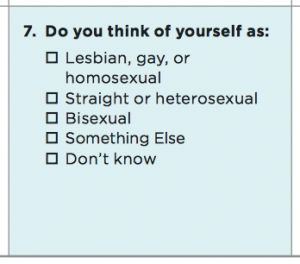
  1. Allow patients to privately self-input information about gender identity and sexual orientation (ensure that there are a wide range of options on the questionnaire).
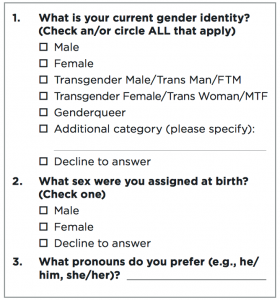
  2. Allow patients to specify the pronouns that they prefer.
  3. Be open and non-judgmental when collecting sexual histories of patients.
  4. Refrain from making assumptions about individuals based on appearance.
  5. Do not assume heterosexuality (i.e. Ask “Do you have a
    partner?” rather than “Do you have a boy/girlfriend?” when conducting sexual
    history).
  6. Make sure all staff are trained to interact respectfully
    with LGBT patients (i.e. ensuring use of their preferred pronouns).
  7. Make sure that the medical environment has a non-discrimination policy that includes discrimination based on gender identity and sexual orientation and publicly display this policy.
  8. The use of brochures and medical information that include images of LGBT people as well as medical information that specifically addresses concerns that
    these individuals face.

All of these suggestions are important, as a clinician may be one of the first people whom an individual discloses non-heterosexual behavior to, and for this to happen, individuals need to be in a space where they feel comfortable. The goals of medicine include providing quality and effective care, and through these suggestions and the scope of my GSS knowledge, I plan to do my best to create an inclusive and welcoming environment for all patients.

Works Cited

http://www.lgbthealtheducation.org/wp-content/uploads/Improving-the-Health-of-LGBT-People.pdf

http://www.aafp.org/dam/AAFP/documents/medical_education_residency/program_directors/Reprint289D_LGBT.pdf

From Theory to Praxis: Introduction of Mixed Gender Day Camp Groups at Summer Camp

During the past 12 summers I have attended YMCA Camp Minikani, first as a camper, then a counselor, and now as an administrator. With this new role in a leadership position, the responsibility of creating an environment for kids to learn and interact outside of normative constructions of the outside world is on my shoulders. Positive youth development in a camp setting is all about creating an environment of equality and respect for campers to pass on to people in their outside lives. Minikani actively works against destructive societal norms to promote originality and kindness towards others. As a leader of the organization, I aim to continue to work against constructions to promote individual and community wide respect. One way we can address this is through the reexamination of Minikani’s gender grouping.

For more than half of Minikani’s history, camp was extremely gender exclusive as only boys were allowed to come to camp. In 1967, the YMCA allowed for females to become campers, and soon after, counselors. Since then, however, there has been little change made regarding gender practices. The camp is currently set up with a day camp and an overnight camp, both of which separate groups into male and female groups. After taking this course, the necessity of demolishing the binary ideas of gender and sexuality became obvious. Anne Fausto-Sterling, along with other authors and theorists, has illuminated the history of assigning gender to bodies, the disconnection between ideas of binary genders and evidence of multiple genders, and the bias in the medical field with regards to sexing the body. These ideas make it clear gender is a construction, and limiting humanity to a binary viewpoint is limiting people’s ways of viewing themselves.

One of the YMCA’s core tenants includes the notion of diversity and inclusion. On their website, one can easily find this statement: “Together we work to ensure everyone—regardless of gender, income, faith, sexual orientation or cultural background—has the opportunity to live life to its fullest”. This is a goal that the YMCA at large, and Minikani in specific, have actively worked towards. Yet the continuation of binary gender divisions in camper groups has promoted an idea that is limiting to people’s constructions of themselves. Therefore, I am proposing a change starting in the day camp unit of Camp Minikani. We would, instead of organizing groups based on male or female and age, only organize groups based on age. This mixing of genders can help to teach cooperation and friendship with people who identify differently than you. More importantly, the lack of naming day camp groups in binary terms promotes inclusion and a non-limiting viewpoint on gender. Starting with the day camp groups in summer of 2017 can be a jumping off point and eventually lead to changes in the overnight camp unit to breakdown binary gender ideas as well. Even if no campers come to camp identifying outside of male or female, the breakdown of the binary system will lead to a respect and appreciation for mixed gender groups and a gender inclusive world.